




Abstract
To navigate the world, our minds must represent not only how things are now (perception) but also how they are about to be (prediction). However, perception and prediction blur together for objects in motion, a classic finding known as “representational momentum.” If you glance at a photo of a person diving into a lake, you will tend to remember them closer to the water than they really were. In seven experiments (with adult participants from the United States) we show that this phenomenon transcends motion: Our minds make predictions that distort our memories about changes that involve no motion whatsoever, including changes in brightness, color saturation, and proportion. Additionally, we use representational momentum to map the limits of automatic prediction, showing that there are no analogous effects for changes in hue. Our automatic predictions distort our memories in many domains—not just motion—and the presence or absence of these distortions expose the inner workings of perception, cognition, and memory.
Things change. Dawn brightens. Predators approach. Alliances fray. To navigate the world, our minds must represent not only how things are now but how they are about to be. Even just to perceive the world, our minds rely on prediction. It is easier to hit a baseball if you anticipate where it is about to be (Poulton, 1957), but it is also easier to see a baseball if you anticipate seeing one (Bar, 2004; De Lange et al., 2018; von Helmholtz, 1924).
A striking consequence of this constant prediction is representational momentum: Our memories of moving things tend to reflect not just what we saw but what we were anticipating (Freyd, 1983; Freyd & Finke, 1984; Hubbard, 2005, 2014). Watch a shape rotate and you will tend to remember it as having rotated a few extra degrees (Freyd & Finke, 1984). Watch it move left to right and you will tend to remember its final position too far to the right (Hubbard & Bharucha, 1988). This occurs even with still images of things in motion. Glance at a photo of a person jumping off a ledge and you will tend to remember seeing them closer to the ground (Freyd, 1983).
Is representational momentum a motion-specific phenomenon? Or do we make automatic predictions that distort our memories for other components of our experience, revealing something more general about the relationship between prediction, perception, and memory? One hypothesis holds that our minds represent and forecast the trajectory of any predictable, continuous change that we perceive, resulting in representational momentum in many domains, not just for motion through space (e.g., Freyd, 1993; Freyd et al., 1990). An opposing hypothesis holds that we experience representational momentum only for motion that we observe or infer (e.g., Brehaut & Tipper, 1996).
Two findings suggest that representational momentum may be more than just a quirk of motion perception. First, people experience representational momentum for changes in auditory pitch (Kelly & Freyd, 1987). Second, people have been shown to experience representational momentum for “state changes” (e.g., an ice cube melting into a puddle; Hafri et al., 2022). However, the state changes that are known to induce representational momentum still involve motion (e.g., a shrinking ice cube and expanding puddle), and rising and falling pitches sound like objects in motion (it has been argued; Brehaut & Tipper, 1996), leaving open the possibility that these are just more cases of representational momentum for observed or inferred motion. Additionally, and most notably, experiments have failed to find representational momentum for changes in brightness (Brehaut & Tipper, 1996; Favretto, 2002, as cited in Hubbard, 2015), further casting doubt on the generality of representational momentum beyond motion.
Here, we demonstrate unambiguously that representational momentum transcends motion: Our minds make predictions that distort our memories about changes that involve no motion whatsoever. In our first four experiments, we show that people do experience representational momentum for changes in the brightness of completely motionless stimuli, contrary to the established view (Brehaut & Tipper, 1996; Hubbard, 2015). Participants misremembered brightening stimuli as brighter than they really were and darkening stimuli as darker than they really were. In the fifth and sixth experiments, we show the same for two more dimensions of change entirely unrelated to motion: changes in color saturation and changes in proportions. Participants remembered saturating stimuli as more saturated, desaturating stimuli as less saturated, and things that were increasing in prevalence as being even more prevalent than they were. In our final experiment, we investigate the limits of automatic prediction. In particular, we hypothesize that the mind does not automatically represent the trajectory of changes in hue. Even though there is latent organization to hue representation, we suspect that our minds do not naturally compute or explicitly represent the trajectory of changes within this latent space and, therefore, do not make automatic predictions about changing hue. Consistent with this hypothesis, we found that our participants did not experience representational momentum for changing hue.
Research Transparency Statement
General disclosures
Study-specific disclosures
Experiment 1: Representational Momentum for Brightness
Do our minds make automatic predictions that distort our memories for anything other than motion (i.e., the positions of things that are moving through space)? Experiment 1 performed a basic test for representational momentum for changing brightness: We showed people a brightening or darkening animation and asked them to indicate how the animation ended, then checked if they overestimated how bright the brightening animations had become and overestimated how dark the darkening animations had become.
This approach differs from prior experiments that failed to find representational momentum for brightness (Brehaut & Tipper, 1996), which adapted the earliest methods used to study representational momentum for motion. Those experiments used impoverished stimuli (e.g., staccato three-frame animations), whereas our experiments used longer, smoother stimuli that provided a much stronger signal of the trajectory of change to serve as a basis for prediction.
Method
For each trial of Experiment 1, participants watched an animation of a gray square that gradually became either brighter or darker (see Fig. 1). At a random point during the animation, the square was abruptly hidden by a mask. Participants then tried to identify the last frame that they saw before the mask appeared by using a slider to move frame-by-frame through the animation (adapting a method used by Hafri et al., 2022).
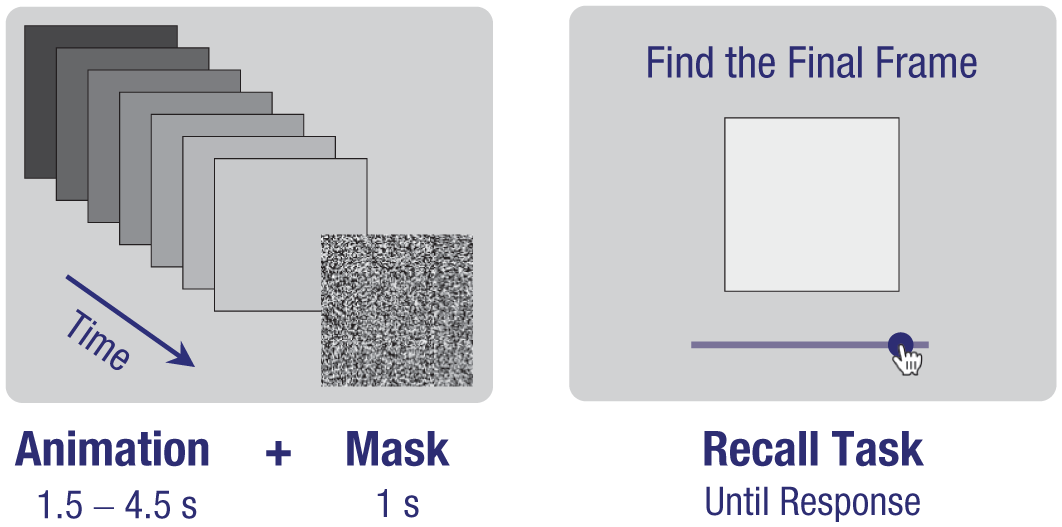
Procedure used in Experiment 1 and adapted for all other experiments. Participants watched an animation of a square that became either brighter or darker. A mask abruptly cut off the animation at a random point during each trial. After the mask, participants used a slider to move frame by frame through the full animation to try to select the last frame displayed before the mask.
If people experience representational momentum for changing brightness, participants’ responses would be biased toward later frames: They would recall the last frame of a brightening animation as brighter than what was actually shown and the last frame of a darkening animation as darker than what was actually shown.
Implementation details
The animation consisted of 180 frames equally spaced in CIELCh space between lightness values of 5 and 95, displayed at 30 frames per second (fps). Brightening animations always started at a lightness of 5 (almost black), and darkening animations always started at a lightness of 95 (almost white). Chroma and hue angle values were fixed at 0. The square was 240 by 240 pixels with a 1-pixel black border. The entire experiment was presented on a middle-gray background (RGB #777777; CIELCh lightness 50.03).
The final frame displayed before the mask varied randomly from frame number 23 to frame number 157, with all points within that range equally likely. Accordingly, the mask could appear anywhere from 0.77 to 5.23 s into the animation. The mask was one of seven different grayscale noise images selected at random for each trial. 1 This mask was displayed for 1 s before the slider appeared. The draggable button on the slider started at a random location for each trial, but no frame from the animation was displayed until the participant clicked or dragged the button to a new location. The far left of the slider corresponded to the first frame of the animation (i.e., the darkest square for a brightening animation and the brightest square for a darkening animation), and the far right of the slider corresponded to the 180th frame. Participants could move freely back and forth through the frames of the whole animation for as long as they wanted during each trial. When satisfied with their chosen frame, participants clicked a button to submit their response and proceed to the next trial.
Each participant completed four practice trials that were followed by 30 analyzed trials. Except for the first practice trial, participants received no feedback. For each participant, the direction of the animation (brightening vs. darkening) was the same for every trial. Participants were randomly assigned to the brightening or darkening condition. This was the only between-subjects manipulation. Demos of all experiments are available at https://subjectivitylab.org/rm.
Participants
In all seven experiments, the participants were adults in the United States recruited through the online platform Prolific. 2 Participants who completed any of the experiments were prevented from enrolling in any of the subsequent experiments.
Two hundred and twenty participants (126 male, 88 female, four nonbinary, two declined to specify; mean age = 39 years) completed Experiment 1. Our final analyses included 124 participants who saw a brightening stimulus and 91 who saw a darkening stimulus. The remaining five participants were excluded by our preregistered exclusion criteria (see Statistical Analyses section).
Statistical analyses
Our measure of interest was the error in each participant’s response for each trial: the difference between the frame number of the last frame that they remembered seeing and the frame number of the last frame that was actually presented. If the last frame they remembered seeing was before the final frame, this would be a negative error. By contrast, if the last frame they remembered seeing was an upcoming frame that never appeared during that trial, this was a positive error. If people experience representational momentum for changes in brightness, this would shift their errors in the positive direction. Adhering to our preregistered analysis plan, we excluded participants from our analyses if the absolute value of their error was more than 2.5 standard deviations larger than the mean of all participants’ mean absolute error.
We modeled participants’ errors with a simple Bayesian multilevel model using brms and Stan (Bürkner, 2017; Carpenter et al., 2017). We modeled participants’ errors as a linear function of the direction of the animation they saw (brightening or darkening) plus Gaussian noise while allowing random intercepts for each participant and using Gaussian distributions centered on 0 and bounded at −90 and 90 with a standard deviation of 15 as the priors for the intercept and the effect of direction. The standard deviation of the priors was selected on the basis of our pilot data and the size of other representational momentum effects observed in the literature (e.g., Hafri et al., 2022). These values were preregistered but also make very little difference because the influence of the priors was overwhelmed by the amount of data that we have.
We used effect coding for the direction variable so that the intercept coefficient could be interpreted as the overall error and calculated a 95% posterior highest density interval (95% HDI) for the intercept coefficient. Our preregistered prediction was positive overall error (i.e., a 95% HDI entirely above 0). We also computed 95% HDIs for the effect in each of the two direction conditions.
We do not calculate or report Bayes factors as part of any of our experiments. Using Bayes factors to compare null and alternative hypotheses gives disproportionate influence over the outcome of the analyses to the particular prior distributions that are chosen (Kruschke, 2014; Liu & Aitkin, 2008). Instead, we simply estimate and interpret the relevant parameters of the model, namely 95% HDIs for participants’ errors under different conditions. The meaning of these values is intuitive: Given our priors (i.e., that any effect is likely to be small and as likely to be negative as positive), there is a 95% probability that the magnitude of the effect falls within the 95% HDI. And, unlike with Bayes factors, the priors do not actually matter much. With the amount of data that we have in our experiments, any reasonable priors would yield nearly identical results.
For all experiments, additional details about the procedural and analytical methods are provided in the Supplemental Material. This research was approved by the Northeastern University Institutional Review Board.
Results
Participants exhibited representational momentum for changing brightness: When the animation was growing brighter, they tended to remember the final frame as brighter than it really was, but when it was growing darker, they tended to remember the final frame as darker (see Fig. 2). On average, the final frame of the animation that participants remembered seeing was a frame that had not yet appeared and would not have been displayed until 5.54 frames (approximately 183 ms) after the mask appeared (posterior 95% HDI for the model intercept = [4.09, 6.02]). Importantly, this effect held for both brightening and darkening stimuli—95% HDIs = [6.94, 9.47] and [0.55, 3.48], respectively—which confirms that it was not driven by a simple bias to remember everything as brighter (or everything as darker) than it really was. 3
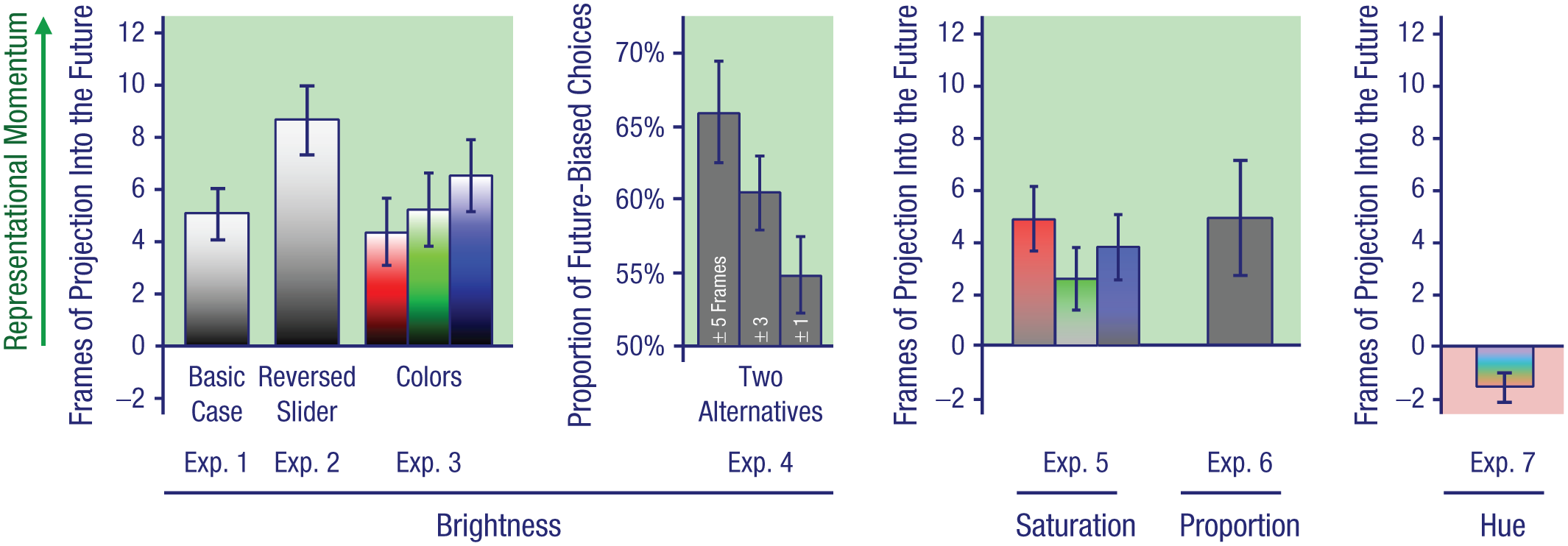
Results of all seven experiments. Participants consistently experienced representational momentum for changing brightness (Exps. 1–4). When tasked with choosing the final frame in an animation that was cut short (Exp. 1), participants tended to choose upcoming frames that had not yet been displayed (brighter squares for brightening squares and darker squares for darkening ones). This did not reflect a simple bias to respond to the right of the slider (Exp. 2) and held for different colors (Exp. 3) and when participants were given only two (equally incorrect) frames to choose between (Exp. 4). Participants also experienced representational momentum for changes in color saturation (Exp. 5) and for changes in proportion (Exp. 6), two additional varieties of change unrelated to motion. Participants did not experience representational momentum for changes in hue (Exp. 7), which serves as a powerful control for the other experiments, in addition to locating a limit of automatic prediction. Bar values are medians of the relevant posterior probability distributions. Error bars correspond to posterior 95% highest density intervals.
Experiments 2–4: Replications With Different Tasks and Stimuli
Experiments 2 through 4 verified that people consistently exhibited representational momentum for changes in brightness across variations in the stimuli and tasks used to elicit it.
In Experiment 1, participants chose the last frame they remembered seeing by using a slider that moved frame by frame through the animation as the slider was moved from left to right. Accordingly, what looked like representational momentum (i.e., a bias to choose a later frame) could have been merely a bias to respond toward the right of the slider. Experiment 2 directly replicated Experiment 1 while also ruling out this possibility by reversing the direction of the slider.
Experiment 3 replicated Experiment 1 using red, green, and blue stimuli rather than achromatic stimuli. Although brightness and hue are classically considered to be independent features of visual stimuli (e.g., Krantz, 1972), changes in one can impact the representation and perception of the other (e.g., Burns & Shepp, 1988). Accordingly, it is conceivable that the mind could make automatic predictions only about changes in the brightness of achromatic stimuli, or only for certain hues. Experiment 3 demonstrated that people experience representational momentum for changes in brightness along a variety of different trajectories through color space, and not just for achromatic stimuli.
Experiment 4 showed that people experience representational momentum for changes in brightness using a different measure, eschewing the slider-based response entirely for a two-alternative choice task.
Method
Experiment 2 exactly replicated Experiment 1 except that the response slider ran in reverse: The far left of the slider corresponded to the last frame of the animation (e.g., the darkest frame for a brightening animation), and the far right of the slider corresponded to the first frame of the animation. Our statistical analyses were identical to those used for Experiment 1.
Experiment 3 exactly replicated Experiment 1 except that the brightening or darkening square on each trial was red, green, or blue rather than gray (determined randomly on each trial, with all three options equally likely). Each animation consisted of 180 frames equally spaced in HSL space between lightness values of 0 and 1. All three stimuli had a fixed saturation value of 1. The red, green, and blue stimuli had fixed hue angles of 0, 120, and 240 degrees, respectively. The random noise mask for each trial was matched to the hue of the stimulus on that trial. Our methods for analyzing the data in Experiment 3 were identical to those for Experiments 1 and 2 except that we also included stimulus color as a predictor (using effect coding so that the intercept coefficient could still be interpreted as the overall error and including random slopes for the effect of color, as it was a within-subjects manipulation).
Experiment 4 replicated Experiment 1 except that (a) participants were only provided two options when asked to report the final frame that they remembered seeing and (b) there were 60 trials instead of 30. After the brightening or darkening animation was masked, participants were presented with two side-by-side squares (both also 240 × 240 pixels). Unbeknownst to the participants, one option was always slightly lighter than the final frame before the mask and the other was always slightly darker than the final frame before the mask. Participants were asked to choose the option that best matched their memory of the final frame before the mask. Participants responded using their keyboard, pressing the left or right arrow to indicate their choice. The two options were always an equal number of frames off from the final frame that was displayed, with the number of frames varying randomly between one, three, and five frames from trial to trial (each option equally likely). The position of the two options (brighter on the left vs. darker on the left) varied randomly from trial to trial (with each option equally likely).
In Experiment 4, our measure of interest was the probability that participants chose the upcoming, unseen frame from among the two alternatives. In other words, when a participant was asked to choose the best match for their memory of the final frame of a brightening square, what was the probability that they would choose the option that was too bright (rather than too dark)? And vice versa for a darkening frame. We used a simple Bayesian multilevel model for this probability, analogous to the models used in Experiments 1–3, adding the offset of the two options (one, three, or five frames from correct) as a predictor (for details, see the Supplemental Material). Adhering to our preregistered analysis plan, we excluded all trials with response times faster than 200 ms or slower than 6,000 ms. We also excluded all trials from participants who responded outside of this range on 10% or more of the trials.
One hundred and ten participants completed Experiment 2 (61 male, 47 female, two nonbinary; mean age = 36 years): two who were excluded by our preregistered exclusion criteria, 64 who saw a brightening stimulus, and 44 who saw a darkening stimulus. One hundred participants completed Experiment 3 (49 male, 50 female, one nonbinary; mean age = 38 years): two who were excluded, 44 who saw a brightening stimulus, and 54 who saw a darkening stimulus. One hundred and ten participants completed Experiment 4 (44 male, 63 female, three nonbinary; mean age = 38 years): 11 who were excluded, 58 who saw a brightening stimulus, and 41 who saw a darkening stimulus.
Results
Experiments 2 through 4 all found that participants exhibited representational momentum for changes in brightness.
Experiment 2 replicated the results of Experiment 1: Participants’ memories for the final frame of a brightening animation were projected an average of 11.0 frames into the future and their memories of a darkening animation were projected an average of 6.3 frames into the future (95% HDIs = [9.29, 12.72] and [4.22, 8.45], respectively). Thus, if anything, the momentum effect was stronger when left-to-right movement on the response slider moved backward through time instead of forward. The effects seen in Experiment 1 cannot simply be attributed to a bias to respond to the right of the slider.
Experiment 3 found representational momentum for chromatic stimuli in all cases that we tested (red: 95% HDI = [3.11, 5.65]; green: 95% HDI = [3.92, 6.69]; blue: 95% HDI = [5.10, 7.85]; brightening and darkening conditions collapsed). These results show that representational momentum for brightness is not specific to achromatic stimuli.
Experiment 4 also found the signature of representational momentum in the two-alternative choice task: Participants who saw the stimulus getting brighter chose the too-bright option 63.1% of the time, whereas those who saw it getting darker instead chose the too-dark option 56.1% of the time (95% HDIs = [59.8%, 65.9%] and [54.1%, 61.6%], respectively; [57.9%, 62.9%] overall). 4 This held regardless of whether the two options were five frames (95% HDI = [62.5%, 69.3%]), three frames (95% HDI = [57.9%, 62.9%]), or even just one frame (95% HDI = [52.2%, 57.4%]) removed from the true final frame.
Experiment 5: Representational Momentum for Saturation
Experiments 1 through 4 demonstrated that people experience representational momentum for increasing or decreasing brightness, a dimension of change that involves no motion whatsoever. Experiment 5 demonstrated that representational momentum extends to a second case of this kind: changes in color saturation. Like brightness, saturation is a rare example of a perceptual feature that can undergo continuous change without associated motion, providing the opportunity for a second, independent demonstration that representational momentum is not merely a quirk of motion perception but a more general phenomenon.
Method
Experiment 5 followed the procedure of Experiment 1 except that the stimuli were red, green, or blue squares that increased or decreased in color saturation rather than brightness, and the animations changed at 15 fps instead of 30 fps. The animations consisted of 90 frames equally spaced in CIELCh space between chroma values of 0 and 75. The red stimulus had a fixed lightness of 55 and hue angle of 30 degrees. The green stimulus had a fixed lightness of 75 and hue angle of 135 degrees. The blue stimulus had a fixed lightness of 45 and hue angle of 290 degrees. 5 These values (and the change to 15 fps from 30 fps) ensured that every frame of each animation used a distinct RGB value that could be displayed on a standard display (i.e., no two frames were the same, and the value of each RGB color channel was always between 0 and 255). Stimulus hue varied randomly from trial to trial, with each of the three hues equally likely.
One hundred participants completed Experiment 5 (45 male, 53 female, two nonbinary; mean age = 37 years): four participants who were excluded according to our preregistered exclusion criteria, 53 participants who saw saturating stimuli, and 43 participants who saw desaturating stimuli. Our statistical analyses were identical to those used for Experiment 1 except that we included stimulus color as a predictor.
Results
Participants experienced representational momentum for both increasing (95% HDI = [3.49, 6.18]) and decreasing (95% HDI = [1.01, 4.04]) saturation (95% HDI for the overall effect = [2.73, 4.72]). Participants also experienced representational momentum for all three stimulus colors (95% HDIs = [3.61, 6.07] for red, [1.38, 3.77] for green, [2.54, 5.04] for blue). Participants who watched the stimulus become more saturated remembered it being even more saturated than it really was in the final frame of the animation. Participants who watched it become less saturated exhibited the opposite effect.
Experiment 6: Representational Momentum for Proportion
Experiment 6 demonstrated that representational momentum extends to yet another variety of change that involves no motion whatsoever: change in the proportion of items in a set that are one type versus another. We showed participants an animation of a two-color array of pixels (e.g., each pixel was either yellow or blue) in which one color became steadily more common over time (e.g., approximately 10% of the yellow pixels became blue pixels each second). Participants experienced representational momentum for this change: When asked about the colors in the last frame of the animation, they overestimated the prevalence of the color that had been becoming more common.
Method
Experiment 6 followed the same procedure as Experiments 1 and 5 with a few modifications. Instead of seeing a single square that changed in brightness or saturation, participants saw a 40-by-40 grid of pixels in which 75% to 100% of the pixels were one hue (the “original hue”) and the remaining pixels were another hue (the “new hue”). Then, on each frame of the animation, five pixels would switch from the original hue to the new hue (with no change in brightness or saturation). The pixels that switched were selected at random, so there was no coherent motion within the image (e.g., the new hue did not spread left to right or outward from the middle of the frame).
The original hue was chosen at random for each participant and stayed the same from trial to trial. The new hue was always 180 degrees away from the original hue in CIELCh color space. Each pixel had a random brightness value between 60 and 70 that stayed fixed while the hue changed. Each pixel had a chroma of 34. Animations were presented at 30 fps and were 8 s in length. Animations were interrupted by a mask after 1.5 to 6.5 s. The mask was a square with a linear hue gradient that smoothly transitioned from the starting hue to the new hue at a fixed brightness of 65 and chroma of 34. The gradient in the mask was oriented at a random angle.
Two hundred participants completed Experiment 6 (102 male, 98 female; mean age = 37 years). Four participants were excluded according to our preregistered exclusion criteria. Another two participants were excluded because they enrolled using the same Prolific account ID number as one another.
Our statistical analyses were identical to those used for Experiment 1 with two exceptions. First, we increased the standard deviation of the prior distributions to 20 and the bounds of the prior distributions to [−120, 120] to reflect the greater length of the animation. Second, there was no “direction” parameter (e.g., “brightening” vs. “darkening”) because every trial was both a “decreasing” trial (with respect to the original hue) and an “increasing” trial (with respect to the new hue).
Results
Participants experienced representational momentum for the changing proportion: When asked to select the final frame that they remembered seeing in the animation, they selected a frame that was 4.77 frames further into the future on average (95% HDI = [2.60, 6.93]). In other words, they remembered seeing about 1.5% more of the hue that had been increasing in prevalence (and 1.5% less of the hue that had been decreasing in prevalence) than they really did. They did this consistently regardless of the hues involved: We split our data into 12 bins based on the starting hue angle, with each bin covering 30 degrees (e.g., 0–30 degrees, 30–60 degrees, etc.), and responses were future-biased in 11 of 12 bins.
Experiment 7: The Representation of Hue and the Limits of Automatic Prediction
Experiments 1 through 6 show that there are at least three cases in which people appear to experience representational momentum for a dimension of change that involves no motion whatsoever: changes in brightness (Experiments 1–4), changes in color saturation (Experiment 5), and changes in proportion (Experiment 6).
Experiment 7 tested whether people experience representational momentum for changes in hue. However, we hypothesize that the mind does not automatically represent the trajectory of changing hue, unlike changing brightness, saturation, and proportion. Brightness and saturation are magnitudes, and the trajectory of a monotonic change in either—or in a proportion, as in Experiment 6—is exceedingly obvious to an observer. By comparison, hue is not a magnitude and—even though there is latent organization to hue representation that is captured by color appearance models (e.g., orange is judged more similar to red than to blue; Fairchild, 2013)—our minds may not automatically compute and explicitly represent the trajectory of hue change through this latent space. As such, our (preregistered) hypothesis was that people would not have strong automatic predictions about changes in hue and therefore would not exhibit representational momentum for changing hue.
Experiment 7 also served as a powerful control. It used the exact same procedure as Experiments 1 and 5, except that the stimulus changed in hue rather than brightness or saturation. Accordingly, a negative result would verify that our approach does not merely yield future-biased responses in all cases. Instead, this would demonstrate that the momentum effects that we observe are induced by particular stimuli, rather than by some artifact of the experimental procedure.
Method
Experiment 7 exactly replicated Experiment 1 except that the stimuli changed hue instead of becoming brighter or darker. The animation consisted of 180 frames equally spaced in CIELCh space between hue angles of 10 and 330 (again displayed at 30 fps). Lightness was held constant at 70 and chroma was held constant at 36. The random noise mask on each trial featured the full range of hues. The direction of hue change (red to purple vs. purple to red) was randomly varied between participants (each direction equally likely).
Two hundred participants completed Experiment 7 (94 male, 102 female, four nonbinary; mean age = 38 years): seven participants who were excluded according to our preregistered exclusion criteria, 93 participants who saw red-to-purple animations, and 100 participants who saw purple-to-red animations.
Results
As we predicted, participants did not experience representational momentum for changing hue: On average, the last frame they reported seeing was 1.5 frames before the final frame displayed 95% HDIs = [−2.12, −0.99] overall, [−3.07, −1.43] for red-to-purple, [−1.62, −0.05] for purple-to-red). Our preregistered standard for “no effect” was a 95% HDI entirely within −2.5 and 2.5, as we find here.
Discussion
Representational momentum transcends motion. Our minds are continually trying to predict the trajectory of our experiences, and these predictions can distort our memories whether or not they are about literal, physical motion. Here, we provide clear demonstrations that people experience representational momentum for three different kinds of changes that involved no physical motion whatsoever: changes in brightness (Experiments 1–4), color saturation (Experiment 5), and proportion (Experiment 6). People misremember brightening stimuli as having brightened more than they really did and make analogous errors for darkening, saturating, and desaturating stimuli, as well as changes in relative proportion. Our findings also directly challenge the long-standing claim that changes in brightness do not produce representational momentum (using large, preregistered experiments with richer stimuli).
We show that representational momentum is more than merely a motion-specific phenomenon, but its true breadth remains unknown. Does it extend to changes in higher level visual features, other perceptual modalities, or beyond perception? A fundamental challenge in future research exploring these questions will be establishing that novel representational momentum effects are not merely disguised representational momentum for motion. As we noted previously, the state changes that have previously been shown to elicit representational momentum involve motion (e.g., a shrinking ice cube), and prior demonstrations of representational momentum for changing pitch have been challenged on the ground that this occurs only because changes in pitch sound like objects in motion (Brehaut & Tipper, 1996). Gradual changes that do not involve actual, apparent, or implied motion are surprisingly rare. However, as we have shown here, this challenge is not insurmountable. Much opportunity for exploration remains. Do people experience representational momentum for changes in intensity of odor? What about changes in higher level properties such as symmetry or numerosity? 6 Do people experience representational momentum for conceptual changes (Constantinescu et al., 2016)? Additionally, future work could investigate the domain generality of the mechanisms underlying different types of representational momentum. We hypothesize that the underlying computational mechanism is the same—the automatic prediction of continuous change through a representational space—but we do not speculate about, for example, the underlying neural mechanisms. Future work could also verify the generalizability of these effects to other populations. Our sample was limited to adults from the United States.
Past experiments have failed to find representational momentum for brightness (e.g., Brehaut & Tipper, 1996; Favretto, 2002). Why did ours succeed? One possibility is that past studies adapted the methods of the earliest experiments that demonstrated representational momentum for motion, which meant using relatively impoverished stimuli to cue the trajectory of change (e.g., three-frame animations). These were adequate to induce representational momentum for moving objects but may simply have been insufficient to induce momentum effects for changing brightness. Our experiments used longer, smoother stimuli that may have been more effective in eliciting momentum effects by providing a clearer signal of the trajectory of change to serve as a basis for prediction.
In our final experiment, we probe the limits of automatic prediction. We show that, under identical conditions, people experienced no discernible representational momentum for changes in hue (Experiment 7). Although these results alone cannot determine why this is the case, our hypothesis is that the mind does not automatically compute and explicitly represent the trajectory of hue change through latent color space in the way that it might naturally for brightness, saturation, and proportion within their respective representational spaces. There is a salient—but ultimately unsuitable—alternative explanation for the pattern of effects that we observed: Changes in brightness and saturation are changes in prothetic dimensions (i.e., the amount of something is changing; Stevens, 1957; Stevens & Galanter, 1957), whereas changes in hue are changes in a metathetic dimension (i.e., in a qualitative feature), so perhaps representational momentum occurs for changes in prothetic dimensions but not metathetic dimensions. However, this is almost certainly not the case. Orientation and pitch are paradigmatic metathetic dimensions, yet both exhibit representational momentum (Freyd & Finke, 1984; Kelly & Freyd, 1987). Instead, we hypothesize that the occurrence of representational momentum depends on whether the mind automatically and accurately predicts the trajectory of changes in a given dimension. For prothetic dimensions, these predictions are particularly easy; they are increases and decreases in a single magnitude. For metathetic dimensions, predictability may vary. For a rotating shape or changing pitch the trajectory of change is obvious (e.g., clockwise or counterclockwise, increasing or decreasing). By contrast, even though there is latent organization to hue representation, our minds may not automatically compute and explicitly represent the trajectory of hue change through this latent space. An interesting direction for future research would be to further test this hypothesis by providing people with extensive experience with continuous hue change. If, after this training, people begin to experience representational momentum for changing hue, this would be strong evidence that the absence of momentum for hue change in the rest of us directly follows from the fact that we cannot or do not automatically represent the trajectory of changing hue. (And this would be a particularly persuasive result given that we might otherwise expect expertise in an area to make us less likely to make memory errors in that area, rather than more.)
Our final experiment also serves as an important control. Because we found no representational momentum for changes in hue, we can rule out the possibility that our other findings are some artifact of our experimental procedure that produces momentum-looking effects for any changing stimuli: Our procedure reveals representational momentum in certain cases (e.g., changing brightness, saturation, or proportion) without seeing it everywhere. For example, this makes it unlikely that our results are driven by repulsive biases due to adaptation (e.g., Gibson, 1937; Pascucci & Plomp, 2021). One might think that participants actually experience a 68% brightness square as 70% brightness when it follows a 67% square because the visual system is exaggerating the difference between the two (and not that they are misremembering what they saw due to momentum). However, these kinds of repulsive biases are known to occur for changes in hue (Gibson, 1937). Thus, given that our procedure finds no momentum-looking effects for changes in hue, we think it is extremely unlikely that repulsive biases are driving the effects that we do see. 7
Although the results in our final experiment met our preregistered standard for no effect, participants did exhibit a trace amount of “negative momentum” for changing hue (about 1.5 frames worth) rather than showing no bias whatsoever. We cannot say why participants’ responses leaned slightly negative. One tempting explanation is that backward masking prevents people from seeing the final one to two frames of the stimulus that are on the screen before the onset of the mask (e.g., Raab, 1963). In this case, the final frame that participants would recall seeing would be one to two frames before the final frame that was presented. However, we exactly replicated Experiment 7 while omitting the poststimulus mask and obtained nearly identical results (see the Supplemental Material), casting doubt on this as a possible explanation. Understanding the cause of this slight negative momentum effect for changing hue will require future research.
Our minds automatically predict the trajectory of objects through physical space. More generally, however, we show here that they predict the trajectory of other varieties of change within their respective representational spaces. These predictions distort our memories, and the presence or absence of these distortions offer a window into the inner workings of perception, memory, and cognition. Finding representational momentum for a given variety of change (such as brightness, color saturation, or proportion) strongly suggests that the mind represents trajectory through the corresponding representational space and that it uses this representation of trajectory to engage in prediction. By contrast, the absence of representational momentum (as in the case of hue) suggests that the mind represents only the current and past position within the corresponding representational space and does not automatically compute and represent the trajectory of changes through that space.
Navigating the world requires that our minds represent how things are and how they are about to be. But, as is so often the case, systematic errors in these processes can reveal a great deal about how the mind works.
Supplemental Material
sj-pdf-1-pss-10.1177_09567976251395074 – Supplemental material for Representational Momentum Transcends Motion
Supplemental material, sj-pdf-1-pss-10.1177_09567976251395074 for Representational Momentum Transcends Motion by Dillon Plunkett and Jorge Morales in Psychological Science
Supplemental Material
sj-tex-2-pss-10.1177_09567976251395074 – Supplemental material for Representational Momentum Transcends Motion
Supplemental material, sj-tex-2-pss-10.1177_09567976251395074 for Representational Momentum Transcends Motion by Dillon Plunkett and Jorge Morales in Psychological Science
Footnotes
Transparency
Action Editor: Zhicheng Lin
Editor: Simine Vazire
Author Contributions

Notes
References
Supplementary Material
Please find the following supplemental material available below.
For Open Access articles published under a Creative Commons License, all supplemental material carries the same license as the article it is associated with.
For non-Open Access articles published, all supplemental material carries a non-exclusive license, and permission requests for re-use of supplemental material or any part of supplemental material shall be sent directly to the copyright owner as specified in the copyright notice associated with the article.
