




Abstract
People often protect public goods by sanctioning free riders. This occurs in simple situations in which protecting the public good does not conflict with other moral considerations. How do people navigate situations in which protecting the public good comes at the expense of helping someone? We theorized that people would prioritize the needs of the public or another individual on the basis of the individual’s group membership. To test this theory, we conducted a field experiment with male confederates approaching adult male travelers passing through check-in gates at Dutch train stations. The confederates requested to follow the travelers without checking in themselves. We observed whether travelers sanctioned the free rider by rejecting and disapproving of this request or helped by opening the gates. At three train stations, 801 travelers were approached by 10 different confederates. Group membership was varied by having five native-majority and five ethnic-minority confederates. Robust evidence was found for travelers being more likely to help native-majority free riders and to sanction ethnic-minority free riders.
Keywords
Public goods play a central role in human societies. Law enforcement, social security, national defense, libraries, public education, public environments, and public transport are all public goods that bring benefits to our everyday lives (Cowen, 1992; Kallhoff, 2014; Tullock, 1971). Yet public-good provision is challenged by the so-called “free-rider problem.” Because people can benefit from public goods without contributing to them, they may be tempted to free ride on the contributions of others (Olson, 1965; Zelmer, 2003). If too many people free ride, the public good is not provided and nobody benefits. A common theory is that public goods are maintained because people impose informal sanctions against free riders (also referred to as “norm enforcement”; Fehr & Gächter, 2000, 2002; Henrich et al., 2006). The informal sanctioning of free riders can minimize free riding by deterring would-be free riders.
People’s willingness to protect public goods by sanctioning free riders is usually tested in simple situations in which protecting the public good does not come at the expense of other norms (Balliet et al., 2022; Chaudhuri, 2011; Guala, 2012). In real life, however, the decision to protect public goods rarely happens in isolation from other, sometimes conflicting, norms or moral considerations. Choosing for the public good often means denying benefits of individuals in one’s immediate surroundings—a moral dilemma (Henrich, 2020; Li & Ng, 2022; McNutt, 1993; Trompenaars & Hampden-Turner, 2011; Waytz et al., 2013). For example, whistleblowing on another person’s illegal and harmful activity serves the public good but disadvantages that person, who may be a colleague or friend. How do people navigate these richer social situations in which protecting the public good comes at the expense of other moral considerations? In this study, we examined this question with a field experiment in which male participants were confronted with a moral dilemma between protecting a public good or helping an individual.
A large body of research on public goods suggests that people tend to use informal sanctions against free riders in the lab, even when it is costly and when they will not meet the free riders again (Chaudhuri, 2011). Yet scholars have questioned whether people’s willingness to impose informal sanctions in the lab translates to real-life contexts (Guala, 2012; Pedersen et al., 2013). Field experiments have thus been designed to study people’s informal sanctioning behaviors in everyday situations (Balafoutas et al., 2012, 2014; Przepiorka & Berger, 2016; Winter & Zhang, 2018). These field experiments typically focus on the informal sanctioning of norm violations in general rather than on the norm violation of free riding in particular. In these experiments, researchers let confederates violate a norm and then examine whether bystanders informally sanction the confederate by communicating verbal disapproval. The studies have shown that some people are indeed willing to impose informal sanctions in the field. For example, studies have shown that some people tell litterers to pick up their trash (Winter & Zhang, 2018) or to turn off loud music on trains (Przepiorka & Berger, 2016).
However, most people did not impose informal sanctions in these field studies, suggesting there are reasons to abstain from informal sanctioning. In particular, research suggests that people are less inclined to impose informal sanctions against others with whom they share a group affiliation (McAuliffe et al., 2016). According to the “black sheep effect,” in-group norm violators are more likely to be sanctioned than out-group norm violators to protect the positive image of the in-group (Marques et al., 1988; Mendoza et al., 2014). Yet, most research suggests that people display a form of in-group favoritism in which they are actually less likely to sanction in-group than out-group norm violators (Bernhard et al., 2006; Jordan et al., 2014; McAuliffe et al., 2016; Winter & Zhang, 2018).
People’s concern for their own group members is also observed in field studies on helping behaviors. Field experiments have shown that native-majority members are more willing to help other native-majority members than ethnic-minority members, for example, by lending out their phone (Zhang et al., 2019) or picking up dropped items (Choi et al., 2019, 2021, 2023). However, in these studies, helping one’s group member did not come at the expense of harming a public good. The public-good context thus introduces a moral dilemma in which people must choose between two opposing norms: to help an in-group member or to protect the public good. Are people willing to help members of their own group even when this means undermining public goods, such as helping others to free ride? If so, positive concerns for one’s group members may not merely prevent informal sanctioning as previously shown but also lead to harmful actions because efforts to help norm violators actually undermine public goods. To examine the extent to which people are willing to help others to free ride, we studied a real-life context in which research confederates asked bystanders to help them with free riding in public transport. Bystanders could informally sanction the confederates by verbally disapproving of the request and/or rejecting it. Or they could grant the request and thereby help them with free riding.
We theorized that whether participants responded to free riders with informal sanctioning or helping would depend on their group membership. More specifically, their higher level concerns for public goods would be suppressed by their immediate concern for their group members. This concern for one’s own group members can affect how people perceive the actions of in-group members and respond to them. Indeed, group membership is known to play a role in how people interpret the intentions underlying others’ behaviors, including others’ free riding (DeRidder & Tripathi, 1992). Intergroup attribution theory suggests that people are more likely to assume good intentions for in-group members’ free riding and bad intentions for out-group members’ free riding (Hewstone, 1990; Pettigrew, 2020). For example, when observing a fare evader in public transport, they may be more likely to think the fare evader cannot pay because they do not have the resources if the evader belongs to their in-group. When the fare evader belongs to an out-group instead, they may be more likely to think the fare evader can pay but wants to profit. These group concerns and attributions can shape how people react to the free rider. They may be more likely to regard free riding as permissible if they assume good intentions, and they may be more likely to disapprove of free riding if they assume bad intentions. Intergroup biases may thus drive reactions to free riders, with more leniency toward in-group free riders than out-group free riders (DeRidder & Tripathi, 1992). Altogether, we tested (a) whether participants would be more likely to help in-group free riders than out-group free riders and (b) whether participants would be more likely to informally sanction out-group free riders than in-group free riders.
Research Transparency Statement
General disclosures
Study disclosures
Method
We conducted a field experiment with confederates as alleged free riders in front of Dutch train stations. The norm that confederates allegedly violated was to pay for public transport. For many train stations in the Netherlands, people can enter the station only if they open one of several gates by swiping a chip card past a sensor at the gate. Checking-in in this way ensures that the use of public transport is registered and the associated costs are deducted from the chip card. We placed confederates near one of these gates and let them approach travelers who were about to check in and hence open the gate. The confederates said they wanted to catch a train and asked whether they could follow the traveler when the traveler opened the gate. This meant that the confederates would not check in themselves and hence leave the impression that they did not pay for the use of public transport (i.e., that they would free ride). If the traveler agreed to open the gate, we saw this as helping with the norm violation of free riding. Travelers who agreed to open the gate also engaged in norm-violating behavior themselves. Opening the gate for other people than yourself is not allowed and is considered assisted fare dodging. This can lead to a fine of €90, similar to the fine for free riding yourself. If the traveler rejected the request to open the gate without expressing verbal disapproval, we regarded this as indirect sanctioning. If the traveler rejected the request and expressed verbal disapproval, we regarded it as direct sanctioning. These operationalizations of indirect and direct sanctioning are in line with previous field studies (Balafoutas et al., 2014; Molho et al., 2020) and are sometimes also referred to as “weak” and “strong” norm enforcement, respectively.
We operationalized the group membership of the free rider in terms of visible ethnic background. In the Netherlands, there is a perception that free riding in public transport occurs more frequently among (young) persons with a Turkish and Moroccan background (Heyblom, 2020; Kruissink & Essers, 2004). Moreover, both Dutch and Turkish persons believe that persons with a native Dutch background would be more likely to sanction such free riders than persons with a Turkish background (DeRidder & Tripathi, 1992). Hence, regarding public transport use, there are perceived differences in both free riding and responses toward free riding between members of the native-majority group and the ethnic-minority group, suggesting this is a relevant group membership in this context. The perceptions of ethnic differences in free-riding frequencies of course need not reflect reality, but as long as people believe them, they may act on them (Quillian, 2006). We manipulated whether the confederate had a visibly native-majority (Dutch) background or a visibly ethnic-minority background (Turkish or Moroccan). Field experiments suggest that people can estimate other people’s ethnic background with relatively high accuracy (Winter & Zhang, 2018).
We hired 10 male actors between the ages of 19 and 27 as confederates, with five having a native-majority background and five having an ethnic-minority background. The field experiment took place at three train stations in the Netherlands: Amersfoort, Hilversum, and Woerden (with 25,000, 15,000, and 8,000 travelers per day, respectively; Nederlandse Spoorwegen, n.d.). These train stations were selected because (a) they are located in areas predominantly inhabited by citizens of the native-majority group; (b) they can be entered only by passing through the check-in gates; and (c) they are centrally located in the Netherlands, which helped us recruit enough confederates willing to participate. Sessions took place from 4 to 7 p.m. on weekdays from April to June 2022. Over a total of 14 sessions, confederates approached 801 male travelers with the request to follow them through the check-in gates (277 in Amersfoort, 243 in Hilversum, and 281 in Woerden). Confederates approached only persons who were clearly over 18 years old and male. Having only male participants and confederates ensured that group membership in terms of gender was fixed, allowing for clearer inferences of the effects of group membership in terms of ethnic background. The free-riding request was always made in a neutral tone as follows: “I want to catch a train; can I walk behind you when you check in?” Our preregistered plan was to collect between 400 and 600 observations, and the main results held when we analyzed the first 600 observations. Because confederates were able to collect more responses per session than anticipated, we ended up with 801 observations (for further analysis, see Section S0 in the Supplemental Material available online).
In a typical session, two confederates were present, one with a native-majority background and one with an ethnic-minority background. The confederates alternated in approaching persons. By having both confederates present within a session and alternating between confederates, we ensured that the treatment (the free rider’s group membership) was not confounded by session-specific characteristics (e.g., day of the week, time of the day, location). In four of the 14 sessions, only one confederate was present because one of the confederates canceled, but as we show, results were robust to excluding these four sessions. A confederate approached only persons traveling alone, so we included only one-to-one interactions. This way we prevented potential diffusion-of-responsibility complications in sanctioning that can occur when people are traveling in groups (Berger & Hevenstone, 2016; Przepiorka & Diekmann, 2018). At the beginning of a session, confederates approached the first traveler who met the selection criteria. After having noted the response of this traveler, they approached the next traveler that met the criteria, and so on until the end of the session. Confederates approached the next traveler not until the previous traveler and previous bystanders had left.
After a traveler responded to the confederate’s request, the confederate revealed that the request was part of a scientific study and informed the traveler that he did not actually need to follow the traveler through the check-in gates. Confederates subsequently filled in a form on a mobile phone in which they indicated whether the traveler allowed them through the check-in gates, how the traveler phrased their response, and their guess of the traveler’s age, national background, and understanding of the confederate’s request. A researcher was always present during the experimental sessions and monitored the confederates and how they recorded the participants’ reactions. In only 14 of 801 cases did the researcher disagree with how the confederate coded a participant’s reaction. In these cases, the researcher’s perception was followed. After the experiment, we found 12 cases in which research confederates mistakenly filled in the answer to a postexperimental question for which they should have filled in the verbal answer to the free-riding request. Results were unaffected by these 12 cases (see Table S8). In a few cases, travelers responded nonverbally to the request (e.g., by nodding yes or no). In those cases, we let the research confederates describe how the travelers responded. Confederates were blind to the study’s predictions so as not to influence their behavior. They were informed only that the study was about how participants respond to free riders in public transport. We obtained ethical approval from the Faculty Ethics Review Board of the Faculty of Social and Behavioural Sciences of Utrecht University, and we preregistered the study on OSF (see the Research Transparency Section).
To analyze whether participants were more likely to help in-group free riders than out-group free riders, we evaluated the behavioral responses of the travelers with two-sided chi-squared tests. That is, we examined whether participants were more likely to allow native-majority confederates through the gates than ethnic-minority confederates. To analyze whether participants were more likely to informally sanction out-group-free riders than in-group free riders, we used content analysis to evaluate how travelers verbally responded to the confederates. To not impose our own views on what constitutes disapproval, we recruited 57 independent coders to rate the verbal answers that the confederates obtained. These coders were informed that the travelers’ answers were obtained in a study about how travelers respond to free riding in public transport but did not know whether the travelers’ answers were directed to confederates with a native-majority or ethnic-minority background. The coders rated the answers in terms of verbal disapproval, helping intentions, and whether the norm to pay one’s fare was explicitly mentioned, and they classified the verbal answers into predefined categories. We use two-sided t tests to determine whether the ratings of verbal expressions toward native-majority confederates differed from those toward ethnic-minority confederates.
An advantage of asking participants directly for help with a norm violation instead of observing only their reaction to norm violations is that there is almost always a verbal response from the participant. This is what allows us to complement our behavioral analyses with content analyses of the verbal expressions of the participants. Moreover, these verbal expressions are made spontaneously; travelers have little time for deliberation. This makes it much more likely that these expressions are indicative of their true motives rather than post hoc justifications of their actions (Vaisey, 2009). We also used a postexperimental questionnaire to complement the information from the verbal expressions. After travelers answered the confederate’s request and before they passed the gates, they were asked whether they would be willing to take part in a short questionnaire about (a) the motivation underlying their response, (b) their personal view on the appropriateness of free riding in public transport, (c) their expectation on other people’s views on the appropriateness of free riding in public transport, and (d) generalized trust. Of all 801 travelers, 265 travelers agreed to participate in the postexperimental questionnaire, which amounted to a response rate of 33%. The answers to the postexperimental questionnaire are also presented.
Our field experiment combined the advantages of the experimental approach with the advantages of studying behavior in a natural environment (Baldassarri & Abascal, 2017). The experimental approach ensured that treatment assignment was random and allowed for causal inferences about the impact of the group membership of confederates. The field environment allowed us to observe realistic behaviors toward norm violations and free narratives explaining these behaviors without having to impose our own assumptions about the perceived costs, benefits, or motives underlying these behaviors (Ellemers et al., 2019). Focusing on the norm violation of free riding in public transport allowed us to study a norm violation that is relatively prevalent in everyday life, widespread in all countries, costs billions of dollars worldwide, and is widely considered inappropriate (Dai et al., 2018). The norm against free riding in public transport is considered a prime example of a civic norm across countries and has received considerable scientific attention (Herrmann et al., 2008; Knack & Keefer, 1997). Yet how citizens behave when they observe violations of this norm is largely unstudied. Another advantage of focusing on norm violations in public transport is the accessibility of the target population. A very large share of the population in the Netherlands uses public transport, with a wide variety in terms of age, education level, income level, and occupation. Because travelers were observed “in the wild” and were unaware of participating in an experimental study, we avoided both demand and selection effects. For more details on the method, see Section S0 in the Supplemental Material available online.
Results
Behaviors toward free riders
Of the 801 travelers, 400 were approached by native-majority free riders and 401 by ethnic-minority free riders. Native-majority free riders received help in 67% of the cases, whereas ethnic-minority free riders received help in 49% of the cases (difference of 18 percentage points), χ2(1, 801) = 26.22, p < .001. The effect size (Cohen’s h) was 0.36, which is typically regarded as a medium-sized effect in behavioral research (Cohen, 1988; Hemphill, 2003; Lovakov & Agadullina, 2021). The finding supports the hypothesis that participants would be more likely to help in-group free riders than out-group free riders. After controlling for estimates of the travelers’ demographic characteristics, their understanding of the request, and session effects, the magnitude of this difference remained (17 percentage points; b = −17.05, SE = 3.66, p < .001; Table S1). We also found a similar difference when we selected only sessions in which both a native-majority and an ethnic-minority confederate were present (15 percentage points), χ2(1, 640) = 14.00, p < .001, or incorporated location fixed effects (Table S4). Figure 1 shows the difference in helping native-majority and ethnic-minority free riders per location, travelers’ age, and session. We consistently observed differential treatment depending on confederate group membership; it was visible in all three locations, all age groups, and across all experimental sessions in which both a native-majority and ethnic-minority confederate were present.
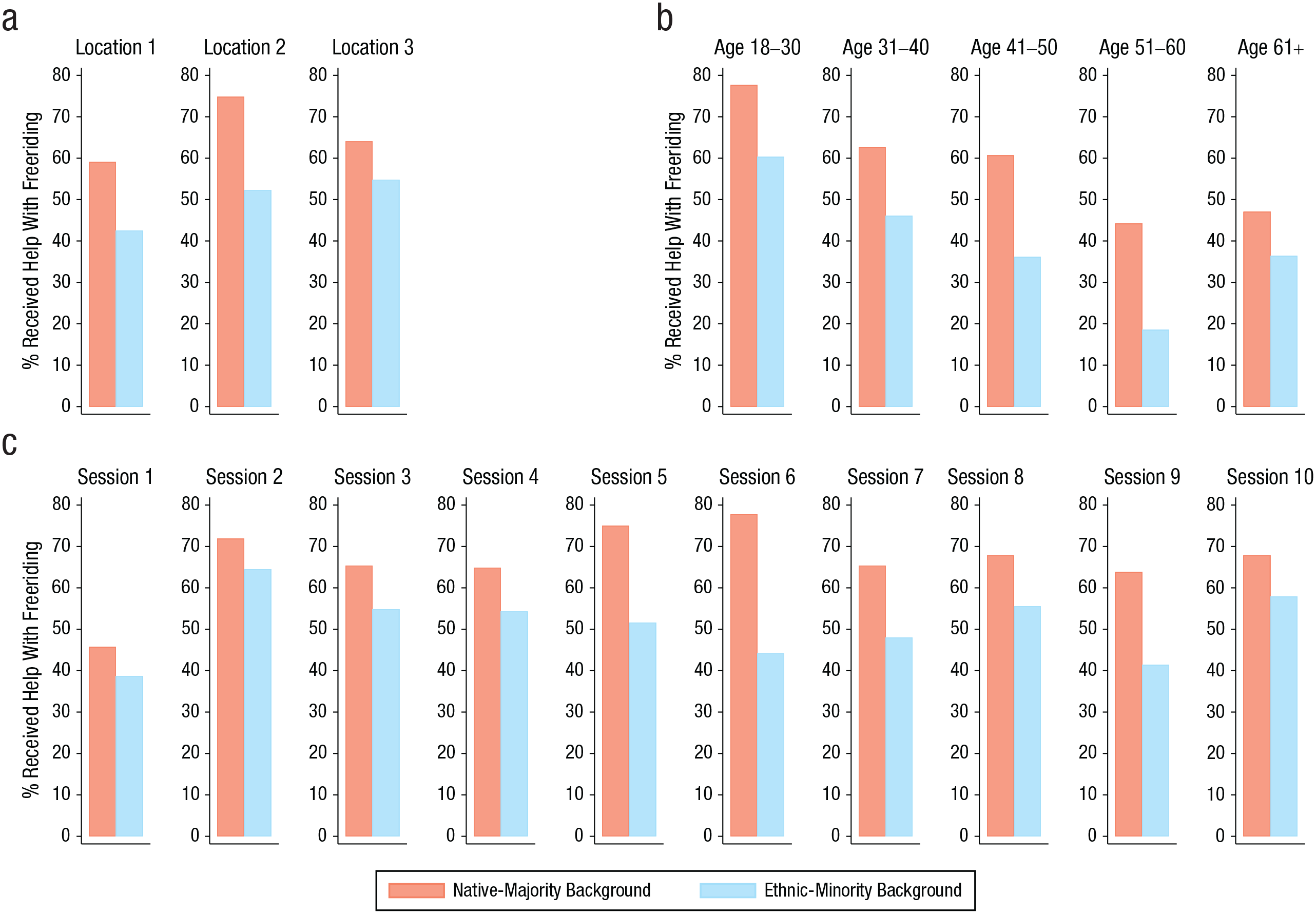
Behaviors toward native-majority and ethnic-minority free riders. Behaviors are plotted by (a) location, (b) travelers’ age, and (c) experimental session for all sessions in which both a native-majority and ethnic-minority confederate were present. Location 1 is Amersfoort, Location 2 is Woerden, and Location 3 is Hilversum. Confederates estimated the travelers’ age in categories of 18 to 30, 31 to 40, 41 to 50, 51 to 60, 61 to 70, and 71+. Because the 71+ age category had only five observations, we could not reliably estimate the rate of differential treatment for this category and merged it with the 61-to-70 age category, creating a 61+ age category.
We next tested whether this differential treatment was present among travelers with a native-majority Dutch background (603 travelers), travelers with a Turkish or Moroccan ethnic-minority background (68 travelers), and travelers with another ethnic background such as German or Polish (130 travelers; travelers’ ethnic backgrounds as estimated by the confederates; see Section S0). Travelers with a native-majority background helped native-majority free riders in 65% of the cases and ethnic-minority free riders in 45% of the cases (difference of 20 percentage points), χ2(1, 603) = 23.85, p < .001. Travelers with a Turkish or Moroccan ethnic-minority background helped native-majority free riders in 66% of the cases and ethnic-minority free riders in 72% of the cases (difference of 6.5 percentage points), χ2(1, 68) = 0.35, p = .56. Finally, travelers with another ethnic background (e.g., German or Polish) helped native-majority free riders in 75% of the cases and ethnic-minority free riders in 53% of the cases (difference of 22 percentage points), χ2(1, 130) = 6.73, p = .01. Hence, the bias against free riders with a Turkish or Moroccan background could be traced to native-majority travelers and travelers with another ethnic background but was not visible among travelers who themselves had a Turkish or Moroccan background. Whether the difference in the treatment effect between travelers with a Turkish or Moroccan and native-majority background was statistically significant depended on model specifications; it was significant in a location fixed effects regression but not when incorporating session dummies instead of location fixed effects (see Tables S5 and S6).
Altogether, native-majority citizens were more likely to help native-majority members to violate norms, whereas ethnic-minority free riders were more likely to face indirect sanctioning by having their free-riding requests rejected. We next turn to the content analyses of the travelers’ verbal expressions to examine whether ethnic-minority free riders also received more direct sanctioning in the form of verbal disapproval. The content analyses of travelers’ expressions also helped to reveal potential mechanisms that were stated to motivate their behaviors toward free riders.
Verbal reactions toward free riders
The 801 travelers gave a total of 513 unique verbal answers (i.e., although we have 801 answers, some answers such as a simple “yes” or “no” occurred multiple times). We recruited 57 independent coders to each rate 57 randomly selected verbal answers, resulting in a total of 3,249 ratings. This meant that each verbal answer was rated by six to seven coders. We mainly used Krippendorff’s α to assess intercoder reliability. This is a standard intercoder reliability measure with a rule of thumb that scores should be above .67 to be considered sufficiently reliable (Hayes & Krippendorff, 2007; Macanovic & Przepiorka, 2024). The main aspect that was rated was verbal (dis)approval. Coders answered the question “How disapproving or approving is the traveler’s answer according to you?” on a scale from 1 (very disapproving) to 5 (very approving). Krippendorff’s α for ratings of verbal disapproval was .74, suggesting decent intercoder reliability. We took the average across coders’ ratings to assign each verbal answer a score on verbal (dis)approval. To give an indication of what type of answers coders deemed (dis)approving, we display the answers with the lowest and highest ratings in Table 1.
Examples of Verbally Disapproving and Approving Verbal Answers
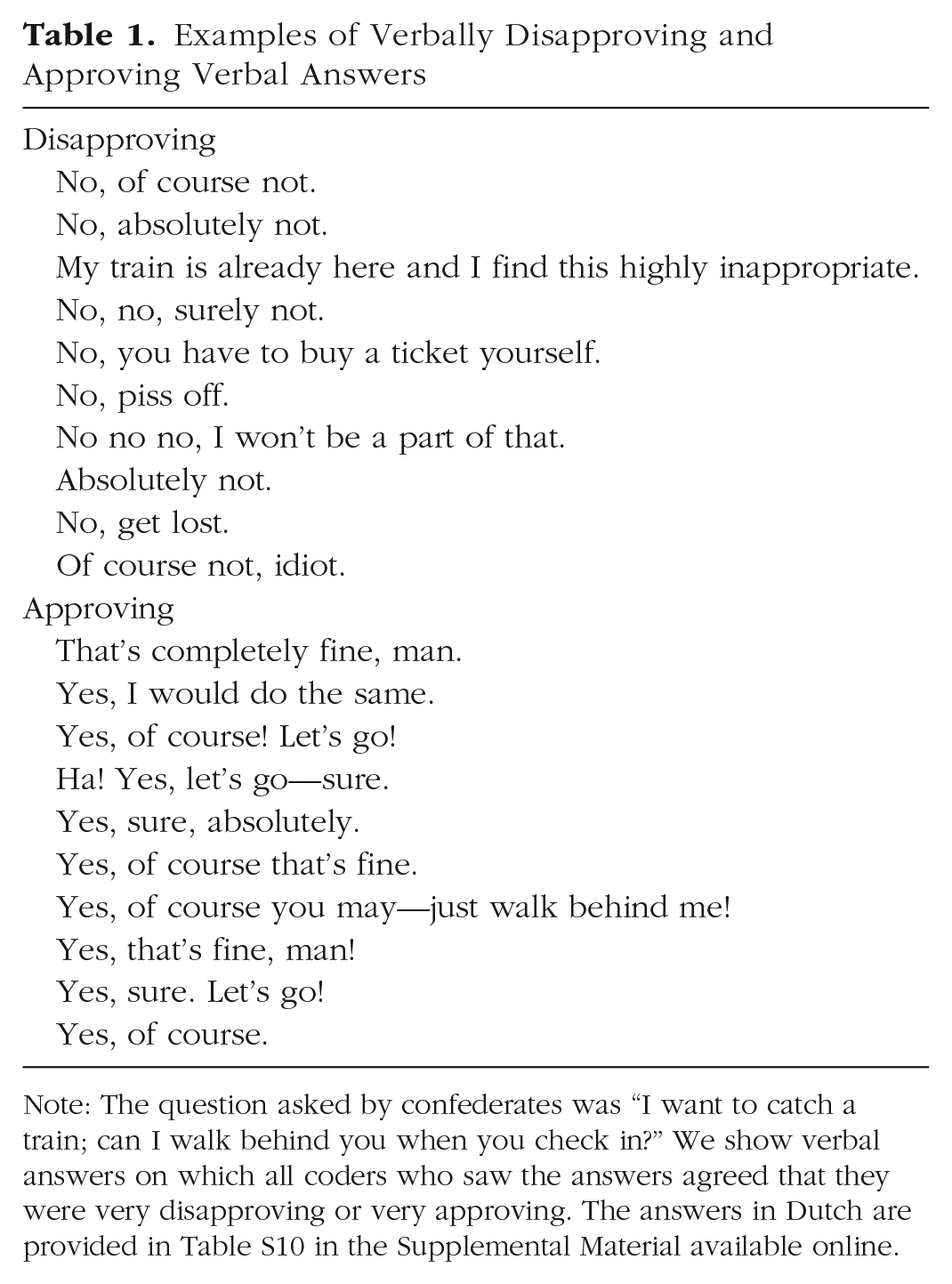
Note: The question asked by confederates was “I want to catch a train; can I walk behind you when you check in?” We show verbal answers on which all coders who saw the answers agreed that they were very disapproving or very approving. The answers in Dutch are provided in Table S10 in the Supplemental Material available online.
We found a clear link between helping free riders and verbal expressions of approval; helping free riders correlated with verbal expressions of approval (r = .79, p < .001). We found a small but significant difference in verbal expressions of (dis)approval depending on confederate group membership. The scores were 3.22 for native-majority free riders and 3.06 for ethnic-minority free riders, t(799) = 2.04, p = .04. This difference remained significant when we selected only travelers with a native-majority background (average approval score of 3.19 toward native-majority free riders vs. 2.98 toward ethnic-minority free riders), t(601) = 2.30, p = .02, or all travelers without a Turkish or Moroccan background (average approval score of 3.21 toward native-majority free riders vs. 3.02 toward ethnic-minority free riders), t(731) = 2.36, p = .02. This suggests that verbal answers directed toward ethnic-minority free riders were less approving across the board.
Figure 2 shows the distribution of ratings of verbal (dis)approval toward native-majority and ethnic-minority free riders. The modal verbal answer was neutral (26% and 27% of answers received by native-majority and ethnic-minority free riders, respectively), and the answers that were very disapproving were relatively rare (14% both for native-majority and ethnic-minority free riders). Answers that were moderately disapproving were more likely to be received by ethnic-minority free riders than native-majority free riders (21.0% vs. 15.7%), χ2(1, 801) = 10.67, p = .001. Native-majority free riders were more likely to receive very approving answers (23.3% vs. 17.6%), χ2(1, 801) = 9.35, p = .002. These findings support the hypothesis that participants would be more likely to informally sanction out-group free riders than in-group free riders. This result was driven by ethnic-minority confederates receiving more rejections, not harsher rejections. When we selected only travelers who rejected the free-riding request, ethnic-minority confederates did not receive more disapproval than native-majority confederates (see Section S7). This could also be seen when we ran separate regression analyses for indirect sanctioning (rejecting the free-riding request without expressing disapproval) and direct sanctioning (rejecting the free-riding request while expressing disapproval). These analyses show that ethnic-minority free riders received more indirect but not more direct sanctioning than native-majority free riders (see Table S7). Note also that differential treatment in terms of verbal expressions was weaker than differential treatment in actual behavior.
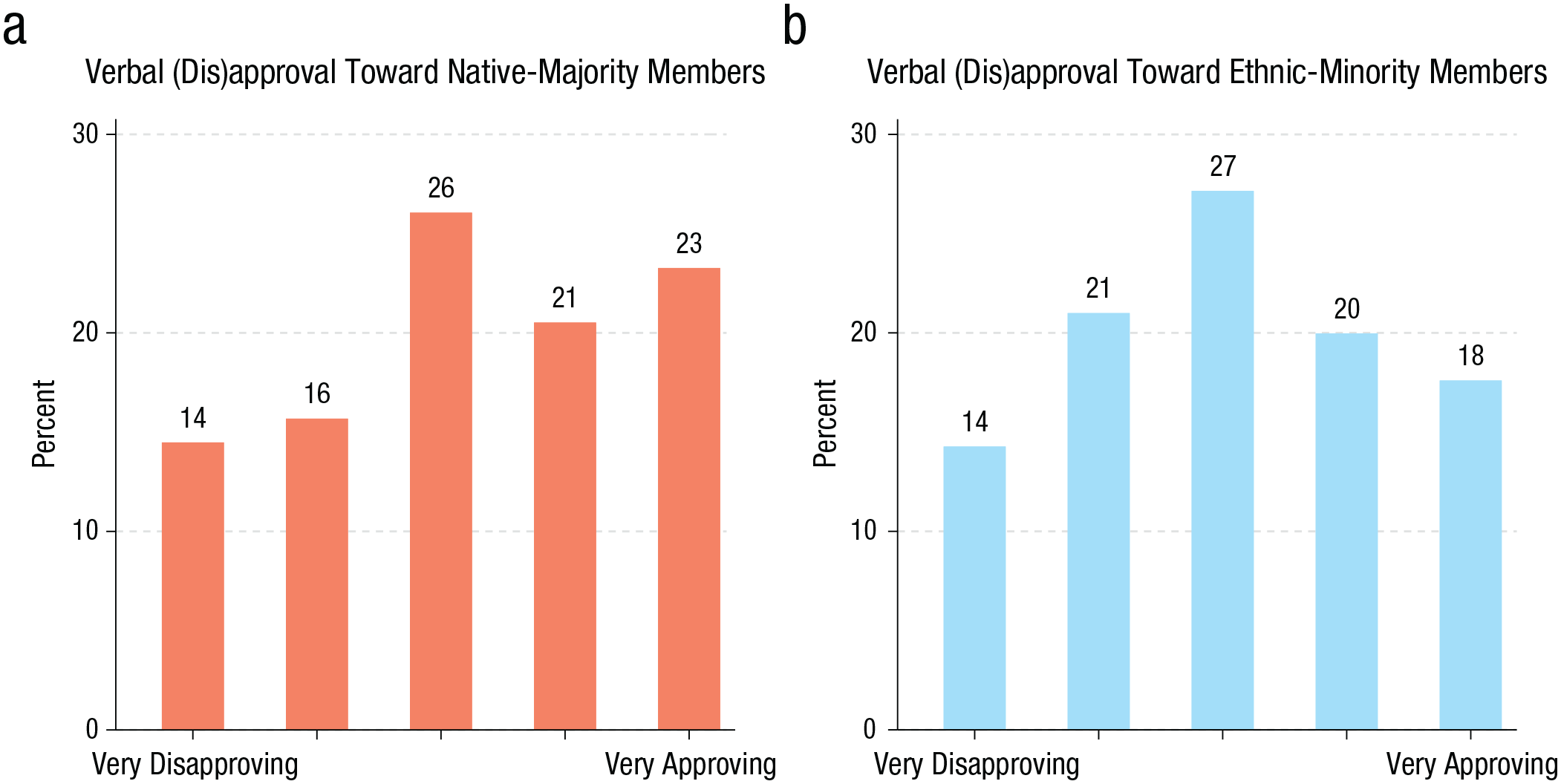
Verbal (dis)approval toward native-majority and ethnic-minority free riders. The graphs show the distribution of approval ratings for verbal answers toward (a) native-majority free riders and (b) ethnic-minority free riders, respectively.
The coders also rated to what extent travelers verbally expressed helping intentions and whether the norm to pay one’s fare was explicitly mentioned, and they also classified the verbal expressions into predefined categories. The results for these additional ratings are summarized here and given in full in Section S7. Verbal expressions toward native-majority confederates as opposed to ethnic-minority confederates were rated as more helpful (3.20 vs. 2.84 on a scale from 1 = very hesitant to 5 = very willing to help), t(799) = 3.64, p < .001. Whether the norm to pay one’s fare was explicitly mentioned in the verbal answer did not differ between native-majority and ethnic-minority confederates (6.9% vs 5.2%), χ2(1, 801) = 1.33, p = .25. The norm to pay one’s fare was rarely mentioned in both experimental conditions. This suggests that travelers being more inclined to reject free-riding requests from ethnic-minority confederates was unlikely to be driven by a motive to teach them the norm.
Finally, three categorical ratings are of particular relevance for the underlying theory of intergroup attribution bias. Recall that this theory suggests that people assume better intentions underlying norm violations of in-group members than out-group members. The three ratings relevant to this theory concern whether the travelers’ verbal expressions assume good intentions underlying the free-riding request, assume bad intentions underlying the free-riding request, or inquire about the intentions underlying the free-riding request. We indeed found that verbal responses more often contained expressions that assumed good intentions toward native-majority free riders than toward ethnic-minority free riders (7.0% vs. 4.9%; p = .02), but there was no difference in assumptions of negative intentions (7.4% vs. 7.3%; p = .87). Verbal responses that inquired about the intentions underlying the violator’s request were more likely toward native-majority than ethnic-minority free riders (3.3% vs. 0.6%; p < .001). In sum, ethnic-minority free riders were somewhat less likely to receive the benefit of the doubt, and travelers were also less likely to ask them about their intentions. However, these differences were small, and intercoder agreement was mixed on these ratings. Hence, we again found that differences in verbal expressions were more subtle than the actual behavioral differences. For more details, see Section S7.
Postexperimental questionnaire
As mentioned, 265 travelers agreed to participate in the postexperimental questionnaire (33% of all travelers). Travelers who helped the free rider were more likely to participate in the questionnaire than travelers who rejected the free rider (46% vs 16%), χ2(1, 801) = 77.30, p < .001. However, participation in the questionnaire did not depend on the free rider’s background; 35% of the travelers approached by native-majority confederates participated, and 31% of the travelers approached by ethnic-minority confederates participated, χ2(1, 801) = 1.00, p = .32. This suggests that the lower rates of received help by ethnic-minority confederates compared with native-majority confederates were not driven by a general tendency to avoid ethnic-minority members. If people would generally avoid ethnic-minority members, we should also have observed lower participation in questionnaires conducted by ethnic-minority confederates compared with native-majority confederates.
The first (open-ended) question that travelers answered was why they responded to the free rider with granting or rejecting the free-riding request. Most of the travelers who helped the free rider answered that they did so out of kindness (e.g., “I like to help people”) or because they do not care about other people free riding in public transport (e.g., “I don’t really care; it is not my problem”). Most of the travelers who rejected the request to free ride answered that they did so because free riding is against their principles and they believe everybody should pay their share (e.g., “It is not honest and people work hard for their money”). All original open-ended answers and automatic translations to English are available on OSF (see the Research Transparency Section).
Travelers next answered to what extent they find it socially appropriate or inappropriate to pass through the check-in gates without checking in on a scale ranging from 1 (very inappropriate) to 5 (very appropriate). They were also asked to what extent they think others find this to be socially appropriate or inappropriate. The average score for travelers’ own opinion was 2.24, and the average score for their expectation of others’ opinion was 2.16, t(264) = 1.08, p = .28. This suggests that travelers find, and expect others to find, free riders’ behavior to be moderately inappropriate on average. Note, however, that travelers who helped the free rider were overrepresented among those who participated in the questionnaire. When we selected travelers who rejected the free rider, we found free riding to be judged very to moderately inappropriate (M = 1.59, SD = 0.71). Among travelers who accepted the free-riding request, free riding is judged to be moderately inappropriate to neutral (M = 2.41, SD = 1.03). Altogether, these findings underline the presence of the norm against passing through the gates without checking in.
The correlation between travelers’ own opinions and their expectations of others’ opinions was .29 (r = .29, p < .001). In general, travelers expected others to find the free riding moderately inappropriate regardless of whether they themselves found the free riding to be inappropriate (see Fig. S10). Whether the travelers granted or rejected the free-riding request was associated with their own stated view of whether passing through the gates without checking in is inappropriate (r = .32, p < .001) but not with their expectation of others’ views (r = −.04, p = .50). Hence, travelers seemed to base their decision on how to behave toward free riders more so on their own opinion of what is right and wrong.
Discussion
A large body of research has focused on people’s informal sanctioning of free riding and other norm violations (Chaudhuri, 2011; Henrich et al., 2006; Jordan et al., 2016). We studied under which conditions male participants might opt for the opposite response, namely helping free riders and thereby becoming complicit in the free riding. Using a field experiment at multiple train stations, we found group membership to be an important factor in determining whether participants responded to free riders with informal sanctioning or helping. Native-majority travelers were more likely to help with the attempt if the free rider belonged to the native-majority in-group than if the free rider belonged to the ethnic-minority out-group. Conversely, native-majority travelers were more likely to use informal sanctioning toward ethnic-minority free riders by refusing the request to free ride and by expressing verbal disapproval of the request. The greater willingness of native-majority travelers to help native-majority free riders was visible across all studied locations, travelers of all age groups, and all experimental sessions in which both a native-majority and ethnic-minority confederate were present. Hence, we found robust evidence of double standards toward free riders.
Intergroup attribution theory suggests that people are more likely to assume good intentions for in-group members’ norm violations and ill intentions for out-group members’ norm violations (DeRidder & Tripathi, 1992; Hewstone, 1990; Pettigrew, 2020). The finding that native-majority travelers were more likely to help native-majority confederates to free ride than ethnic-minority confederates is in line with this theory. Even though we found that differential treatment was more difficult to detect in verbal expressions than in actual behavior, the content analyses did provide some evidence for intergroup attributions. The content analyses suggest that travelers were more likely to assume good intentions for native-majority free riders. Interestingly, we did not find that travelers were more likely to assume negative intentions for ethnic-minority members. Hence, the difference in assumed intentions seemed to occur mostly in the positive domain (offering in-group members the benefit of the doubt) instead of the negative domain (assuming bad motives of out-group members). This deviates somewhat from other theories of (intergroup biases in) sanctioning, such as deterrence theory. According to deterrence theory, people infer that out-group norm violations are driven by a disposition to treat one’s own group poorly and sanction these out-group violations to deter this poor treatment (Delton & Krasnow, 2017). Other theories posit that people sanction to signal their trustworthiness (Jordan et al., 2016) or to equalize or elevate their outcomes compared with the target (Raihani & Bshary, 2019). However, these theories typically have less to say on differences between sanctions toward in-group and out-group members insofar as both types of sanctions can signal trustworthiness and equalize or elevate outcomes (Jordan et al., 2016; Molho & Wu, 2021; Raihani & Bshary, 2019).
Our results challenge the view that people unequivocally respond to free riders with sanctioning and instead suggest that participants may also respond with the opposite response: helping with the free-riding act. Rather than protecting public goods through sanctioning, some people thus respond to free riders by behaviors that further undermine public goods. This behavior becomes visible when studying dilemmas in which protecting public goods comes at the expense of other moral considerations such as helping others. Which moral consideration is acted on depends on who these others are; native-majority members are more likely to help native-majority free riders and to (indirectly) sanction ethnic-minority free riders. The paradoxical effect is that extending help to native-majority individuals undermines public goods, whereas sanctioning ethnic-minority individuals protects these goods. Similar mechanisms of inappropriate in-group “helping” might explain the pervasiveness of behavior that undermines other public goods and erodes behavioral norms (e.g., ethical guidelines in the workplace; Ellemers & de Gilder, 2022). These double standards not only challenge public goods but are also detrimental to ethnic minorities. Research suggests that increased scrutiny of the norm conformity of ethnic minorities can cause them to experience stress and mental-health issues (Chaudry, 2021). It may even lead ethnic minorities to withdraw from public goods altogether (Settles et al., 2019), thereby losing out on the benefits that public goods provide. In this respect, public goods can cease to be public and instead become more exclusionary.
We limited our sample to male participants because female participants may have felt uncomfortable when our male research confederates requested to follow them through the gates because this requires the research confederates to stand very close behind them. This also has the advantage that group membership in terms of sex is fixed, allowing for cleaner inferences on ethnic group membership. However, some studies suggest that male participants show more in-group favoritism than female participants (Balliet et al., 2011; Vugt et al., 2007), although recent estimates suggest such sex differences are small and not consistently significant (Balliet et al., 2014; Spadaro et al., 2023). Future studies could examine whether the in-group favoritism toward free riders observed in our field experiment generalizes to other contexts, such as among female participants. One way to do so while reducing potential discomfort for female participants is to let female participants be approached by female research confederates. Studies varying the sex of the confederates and participants in addition to their ethnic background do require more power to test the effect of ethnic background while keeping the confederate’s and participant’s sex constant.
Although persistent discrimination in institutional settings such as the labor and housing market has long been documented (Auspurg et al., 2019; Pager & Shepherd, 2008; Zschirnt & Ruedin, 2016), field research showing everyday discrimination in more informal, unstructured encounters has only recently been gaining traction (Aidenberger & Doehne, 2021; Baldassarri, 2020; Choi et al., 2021, 2023; Koopmans & Veit, 2014; Zhang et al., 2019, 2022). There is already evidence that law enforcement targets free riding by out-group members more so than by in-group members as a result of ethnic profiling (Carter & Johnson, 2021; Mujcic & Frijters, 2020). As a high-profile example, it recently came to light that the Dutch government targeted citizens with an ethnic-minority background more so in controls for free riding than citizens with a native-majority background (tax evasion in particular; European Parliament, 2022). Ethnic profiling appears to be persistent even in the face of bias-training programs (Lai & Lisnek, 2023). Our findings highlight that members with a native-majority background are not only more likely to get away with free riding in institutional contexts but also in informal contexts. This is especially important because many social situations are governed by social norms rather than legal norms. Whereas legal norms are regulated by law enforcement, social norms are regulated by informal norm enforcement from ordinary citizens. We found that ordinary citizens discriminated by applying double standards in norm enforcement toward free riding. This type of discrimination gives native-majority members a double advantage: Their heightened capacity to free ride allows them to “cut corners” both in institutional and informal settings. This unfair advantage in free riding can increase intergroup inequality (e.g., in terms of paid taxes and fares) and undermine societal cooperation.
Supplemental Material
sj-pdf-1-pss-10.1177_09567976251346178 – Supplemental material for Protecting Public Goods or Helping Free Riders? A Real-Life Moral Dilemma in Interethnic and Intraethnic Encounters
Supplemental material, sj-pdf-1-pss-10.1177_09567976251346178 for Protecting Public Goods or Helping Free Riders? A Real-Life Moral Dilemma in Interethnic and Intraethnic Encounters by Kasper Otten, Vincent Buskens, Wojtek Przepiorka and Naomi Ellemers in Psychological Science
Footnotes
Acknowledgements
Wojtek Przepiorka is now at the Institute of Sociology, University of Bern. We are very grateful to Rumi Ünal, Kevin Christiaans, Ayad Murad, Rens Heilema, Alexander van Reeken, Bas Nillesen, Tarik Rahali, Oussama Dib, Silvan Zomerdijk, and Feyyaz Bademoglu for their participation in the experiment as confederates. We also thank Ana Macanovic for comments and suggestions on the content analysis.
Transparency
Action Editor: Roni Porat
Editor: Simine Vazire
Author Contributions

References
Supplementary Material
Please find the following supplemental material available below.
For Open Access articles published under a Creative Commons License, all supplemental material carries the same license as the article it is associated with.
For non-Open Access articles published, all supplemental material carries a non-exclusive license, and permission requests for re-use of supplemental material or any part of supplemental material shall be sent directly to the copyright owner as specified in the copyright notice associated with the article.
