




Abstract
How do people remember when something occurred? One obvious possibility is that, in the absence of explicit cues, people remember on the basis of memory strength. If a memory is fuzzy, it likely occurred longer ago than a memory that is vivid. Here, we demonstrate a robust illusion of time that stands in stark contrast with this prediction. In six experiments testing adults via an online research platform, we show that experiences that are repeated (and, consequently, better remembered) are counterintuitively remembered as having initially occurred further back in time. This illusion is robust (amounting to as much as a 25% distortion in perceived time), consistent (exhibited by the vast majority of participants tested), and applicable at the scale of ordinary day-to-day experience (occurring even when tested over one full week). We argue that this may be one of the key mechanisms underlying why people’s sense of time often deviates from reality.
Years are marked by landmarks like holidays, birthdays, and breaks, but days are made up of a redundant deluge of headlines and deadlines and never-ending to-dos. Against this backdrop, many days may blend together in our memories. How, then, do we remember not only what happened, but when?
Sometimes people remember when something happened on the basis of explicit knowledge about time (e.g., that the COVID lockdowns began in March 2020). Other times, people remember on the basis of a sense of time. This sense of time can be thought of as a clock, accumulating over experiences to determine how much time has passed (Block, 1974; Matthews & Meck, 2016; Ornstein, 1975; Wittmann, 2013). Or this sense of time can be thought of as a consequence of “jumping back in time” (Tulving, 2002), retrieving the temporal context from initial encoding (Howard & Kahana, 2002; Polyn et al., 2009). Even in the absence of explicit temporal context information, time can be inferred by the strength of a memory, with weaker memories perceived as more temporally distant (Hinrichs, 1970; Hintzman, 2005).
Although our minds seem equipped with multiple mechanisms to sense elapsed time (Friedman, 1993), people nevertheless have strong feelings about when something occurred. Get a few old friends together for a small party, and “That was only last week? It feels like that happened months ago!” is sure to be uttered at least once. Why is it that our sense of time so often diverges from reality?
We propose a specific factor that powerfully distorts temporal memory: the number of times that information is encoded. Specifically, we suggest that the more times a piece of information is encoded, the further away in time it is remembered as having initially occurred. This prediction is born out of subjective experience: If you read a headline on a Monday and then hear it repeated over and over again throughout the week, the initial event may seem further away than another headline seen at the same time that was not incessantly repeated. Importantly, this prediction stands in contrast to theories of how repetition influences temporal memory (see Hintzman, 2010; Zou & Kuhl, 2024). For example, some theories (such as the multiple-trace hypothesis) posit that each repetition yields an independent memory trace with a unique temporal context, or time tag (e.g., Hintzman, 1988); retrieving a repeated item (associated with multiple tags) can make the item seem more recent (Flexser & Bower, 1974). Other theories suggest that repeating information enhances the cumulative memory strength of that item, again predicting that repeated items would be remembered as more recent (Hintzman, 2005). Notably, although these theories have been developed within the paradigm of recency judgments, they presumably make similar predictions for primacy judgments: Insofar as these factors are related to remembered temporal distance, then enhancing the representation of a repeated item (by increasing the number of tags or its strength) should lead to the item being initially remembered more recently. What we found is more consistent with the intuition that repeated information seems further away in time: Across six experiments, people consistently perceived items encoded multiple times as having initially occurred substantially further away in time. These results demonstrate the existence of a powerful illusion of time that is likely to be common in everyday life. We call this illusion the temporal repetition effect.
Research Transparency Statement
General disclosures
Experiment 1 disclosures
Experiment S1 disclosures
Experiment 2 disclosures
Experiment 3 disclosures
Experiment 4 disclosures
Experiment 5 disclosures
Experiment 6 disclosures
Experiment 1
In the first experiment, we examined how repetition influences temporal memory: We had participants view sequences of images, some of which repeated, and asked them to subsequently recall when they had originally seen each image.
Method
Preregistration and data availability
All aspects of the procedure and design (for all experiments) were pre-registered prior to data collection. Those preregistrations, as well as raw data, can be found on our OSF page (https://osf.io/nx5t7/).
Participants
Participants in all experiments were recruited via the Prolific platform. All participants (in all experiments) were adults 18 years or older residing in the United States who were proficient speakers of English. Per our preregistered criteria, the final sample size was 50 participants, after exclusions and replacement. Participants were excluded if (a) they failed to complete the task (e.g., they did not complete all of the trials), (b) they failed to respond on at least 90% of encoding trials, (c) their temporal memory judgments were not correlated with the true temporal position of the items (as measured by Spearman rank correlation), (d) their false-alarm rate was above 50% or their hit rate was below 50%, or (e) they revealed a significant misunderstanding of the task. These criteria were the same for Experiments 1 through 4. In Experiment 1, 31 participants were excluded for failing at least one of these criteria. Note that none of these exclusions are related to the effect being measured; these exclusions reflect cases in which participants unambiguously failed to adequately complete the task.
All participants provided informed consent, and the study was approved by the University of Pennsylvania Institutional Review Board.
Task design and procedure
The experiment was administered online via a web-based interface using custom JavaScript code. The task consisted of an encoding phase followed by a memory phase. Participants were informed that they would be viewing a sequence of object images, followed by a memory test, though they were not informed of the nature of the memory test (i.e., they did not know that their temporal memory would be tested).
During the encoding phase, participants viewed a series of images of objects (Fig. 1, left). Object stimuli were adapted from Brady et al. (2008). On each trial, participants were tasked with judging whether the on-screen object was bigger or smaller than a shoebox (using the “q” and “p” keys to make their responses; Fig. 2a, top). Each object was presented on the screen for 1,500 ms with a 1,000-ms interstimulus interval. Participants viewed five blocks of 50 images, with a 10-s break between each block.
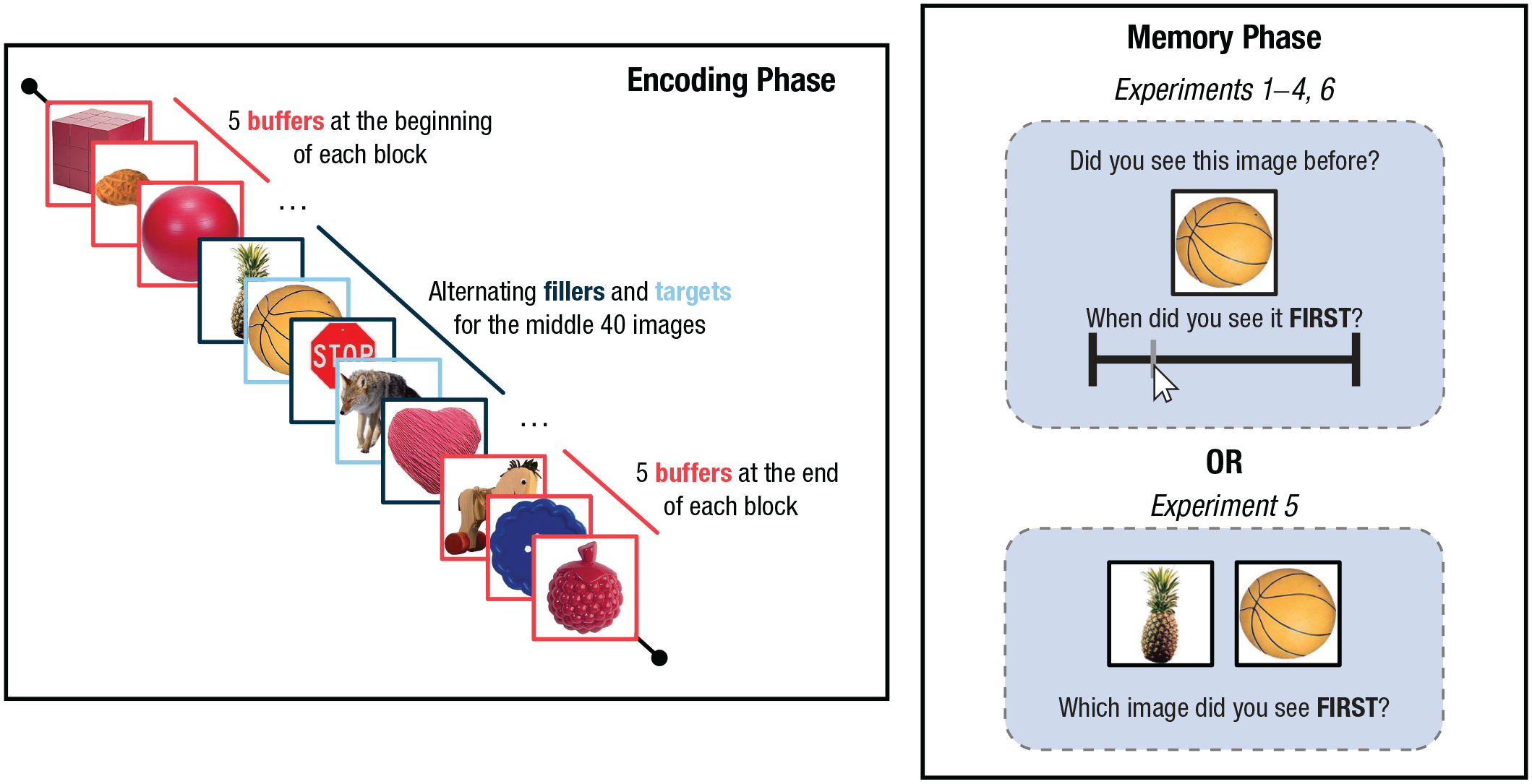
The experimental procedure. At left, participants viewed a sequence of object images in the encoding phase. Each block of images started and ended with five buffer images, which were not tested during the memory phase. After the buffers, the images alternated between fillers (which never repeated) and targets (which repeated across blocks; see Fig. S1 in the Supplemental Material for repetition structure). There were 50 total images per block. (In Experiment 6, blocks consisted of 100 total images with 22 buffer images on each end.) At right is shown the memory phase. In Experiments 1 through 4, participants were presented with an image, were asked whether they had seen the image in the encoding sequence, and were then asked when in the encoding stream they think they first saw that image. In Experiment 5 (bottom), participants were presented with two images and asked to indicate which image they saw first in the encoding sequence. Unbeknownst to participants, they were always presented with one target image, along with the filler that appeared immediately before its first presentation.
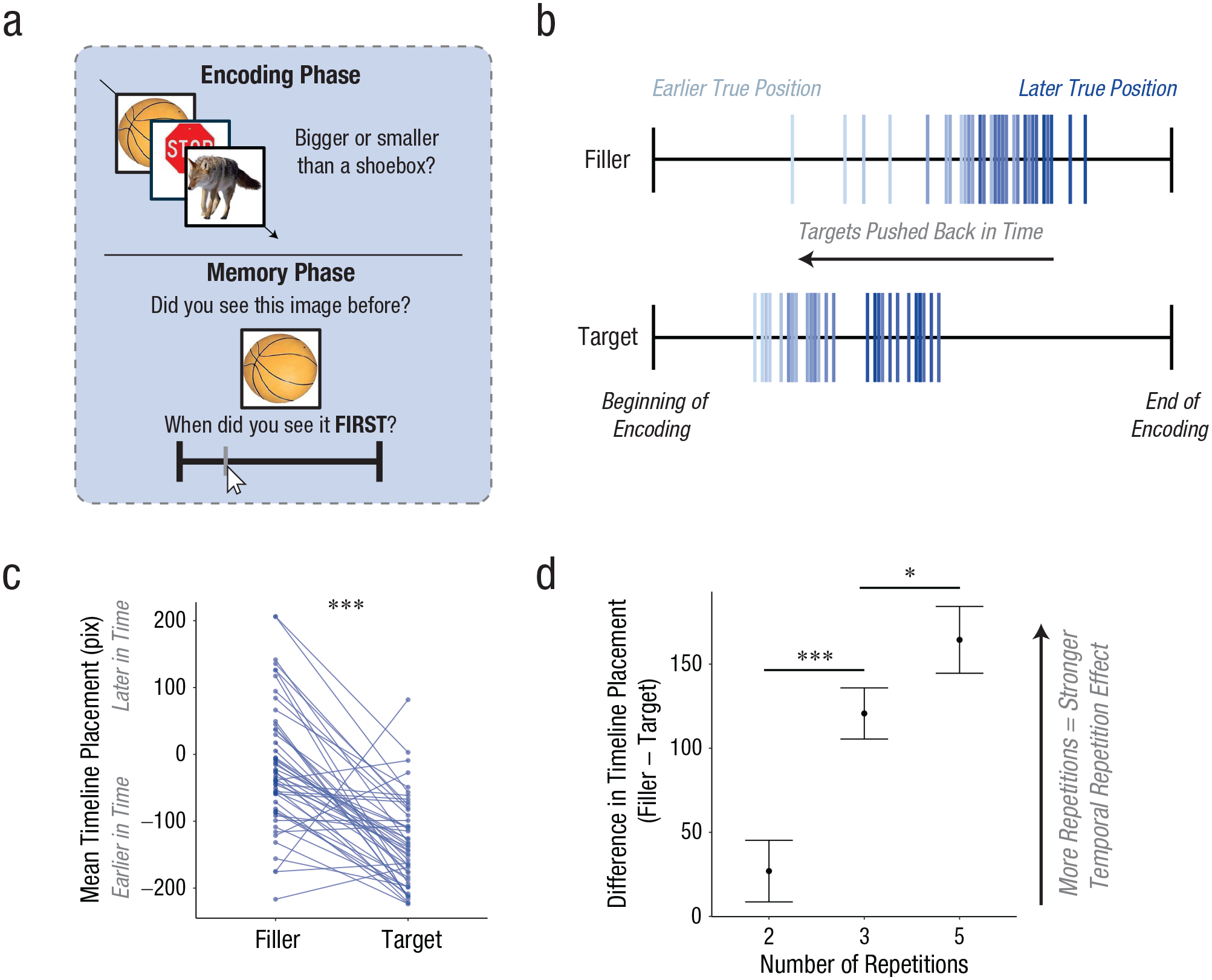
Experiment 1 design and data. During encoding (a; top), participants were presented with a stream of object images, and for each image they were asked to judge whether the object was bigger or smaller than a shoebox. After five blocks of encoding, participants completed the memory phase (a; bottom). For each participant, we computed the rank order of each image, sorting the true indices as a function of the relative placement of that image on the timeline. In (b), we plotted the median rank order timeline placement (across participants) of each image in the sequence as a function of the true index of the image (darker colors = later true temporal positions), separately for filler images (top) and targets (bottom). Average timeline placement for fillers and targets is shown in (c). Each dot or line represents a participant. In (d) we show the difference in timeline placement (fillers – targets) as a function of the number of times a target was repeated, controlling for recognition memory and initial presentation block; larger numbers indicate that targets were placed earlier in time. Circles indicate mean across participants; error bars represent ±1 SEM. *p < .01. ***p < .001.
Critically, the sequences were engineered to allow for subsequent comparison of memory for items that were repeated versus items that were not (thus requiring that the timing of repeated vs. not repeated stimuli were as closely matched as possible during encoding). To accomplish this goal, we designed the blocks to consist of target stimuli (i.e., ones that were repeated throughout the task) and filler stimuli (i.e., ones that were not repeated throughout the task). To avoid effects of primacy and recency, we ensured that the first and last five images of each block were always buffer images, which were not tested during the memory phase. The intervening 40 images alternated between fillers and targets (item 6 was a filler, item 7 was a target, item 8 was a filler, and so on). In this way, memory for every target can be compared against the filler item that came immediately before it in the sequence. Consequently, there was a carefully controlled comparison between two items that were initially experienced at neighboring points in time. This design intentionally favored the fillers insofar as they always appeared earlier than their accompanying targets.
There were 35 target stimuli in total, which were divided into seven sets of five images (see Fig. S1 in the Supplemental Material available online). Different sets were repeated different numbers of times and at different schedules. The schedules were as follows: Items from Set 1 appeared in Blocks 1/5; items from Sets 2 and 3 in Blocks 2/4; items from Set 4 in Blocks 1/3/5; items from Set 5 in Blocks 1/2/3; items from Set 6 in Blocks 3/4/5; and items from Set 7 in Blocks 1/2/3/4/5. This feature enabled us to assess the impact of multiple repetitions and also roughly dissociate the number of repetitions from starting position (e.g., by comparing Set 5, in which an item was first presented in Block 1, with Set 6, in which an item was first presented in Block 3).
Following the encoding phase, participants underwent the memory phase (Fig. 2a, bottom). On each trial, participants were presented with an object and asked (a) whether they had seen that item during the encoding phase (responses were made by clicking buttons labeled “yes” or “no”) and (b) when in the experiment participants first saw that object (Fig. 1, right). Participants made their temporal memory judgment on a timeline. The timeline was 780 pixels wide, and responses were coded as ranging from −390 to 390 along the x-axis. Participants could click and drag a response marker along the timeline. They pressed the space bar to submit their responses, at which point another trial would begin. The timeline was labeled (the beginning of the timeline corresponded to the beginning of the encoding phase and the end of the timeline to the end of the encoding phase). Participants made temporal memory judgments for all objects, even if they indicated that they had not seen the object during encoding. All 35 targets and their corresponding fillers were tested, intermixed with 15 foil objects that were never presented during encoding.
Results
During the encoding phase, in which participants were judging whether each object was larger or smaller than a shoebox, participants responded 98.3% of the time (SD = 1.93%), with a mean response time of 940 ms (SD = 95.5 ms), indicating that participants successfully paid attention throughout the encoding task.
To assess overall recognition memory during the memory phase, we computed A′ (a nonparametric measure of sensitivity that takes into account participants’ hit rate and false-alarm rate; Grier, 1971) for each participant. Each participant exhibited memory reliably above chance (A′ > 0.5), with an average A′ of 0.96 (SD = 0.031), indicating a high degree of recognition-memory fidelity. Further, analyzing recognition memory (hit rate) separately for fillers and targets revealed that targets were remembered more robustly than fillers, t(49) = 8.11, p < .001, d = 1.15. This enhancement in recognition memory for targets is consistent with the fact that targets were presented more times than fillers (and thus had more opportunities to be encoded into memory).
We next assessed overall temporal memory by computing the Spearman rank correlation between the true index of an object image and the placed position of that image on the timeline. All participants exhibited a correlation ρ > 0 (Mρ = .23; SD = .14), suggesting that participants had reliable memory for the temporal order in which they encountered the images (see Fig. S2a in the Supplemental Material). Surprisingly, when assessing the correlations separately for targets and fillers, we observed a reliably higher correlation for targets (M = .31, SD = .17) than fillers (M = .24, SD = .19), t(49) = 2.33, p = .024, d = 0.33, suggesting that repetition may have benefited temporal memory.
Our critical analysis assessed whether target images (which were repeated multiple times throughout the sequence) were remembered as having initially occurred further back in time than fillers that were matched in temporal position (always occurring one temporal position before a corresponding target). Indeed, we found a remarkably robust illusion of time: Items that were repeated multiple times throughout the sequence were remembered as much as 43% further back along the timeline compared with items that were not repeated, t(49) = 7.64, p < .001, d = 1.08 (Figs. 2b and 2c). This finding could not be explained by a difference in memory between the targets and the fillers: Analyzing only those items at test which participants indicated they had previously seen, we still observed the same temporal memory effect, t(49) = 7.57, p < .001, d = 1.07.
If repeating an item causes it to be remembered as having initially occurred further back in time, then we may expect the temporal repetition effect to scale with the number of repetitions. To assess this while controlling for the potential confounds of (a) differences in memory and (b) different image sets having different initial presentation times, we limited our analysis to correctly recognized items that initially appeared in Block 1 (Set 1, which had two repetitions, in Blocks 1 and 5; Set 4, which had three repetitions, in Blocks 1, 3, and 5; Set 5, which had three repetitions, in Blocks 1, 2, and 3; and Set 7, which had five repetitions, in Blocks 1–5). Indeed, the magnitude of the effect scaled with the number of repetitions, F(2, 96) = 33.99, p < .001. Images that were repeated three times in Sets 4 and 5 were reliably remembered as being first presented further back than images that were repeated two times in Set 1, t(49) = 6.12, p < .001, d = 0.87, and images that were repeated five times in Set 7 were remembered as further back than images that were repeated three times, t(48) = 2.34, p = .023, d = 0.33 (Fig. 2d). 1 Last, the effect was independently reliable across all seven image sets (six of which passed Bonferroni correction; see Fig. S3a in the Supplemental Material).
These data suggest a strong influence of repetition on remembered time. One possible explanation of these results, however, could be that participants are merely relying on a heuristic—perhaps if they remember seeing an image multiple times, they infer that its initial presentation must have been further back in time. To address the possibility, we conducted Experiment S1, in which we repeated Experiment 1 but added three survey questions at the end of the experiment. We first asked participants to describe (via free response) what strategies they used in the task. After they responded, we then asked them (a) to indicate, on a scale ranging from 0 to 100, on what proportion of trials they had used knowledge of the image repetitions to estimate temporal position, and (b) to indicate, regardless of their previous responses, how influential this strategy was on a scale ranging from 0 to 100. First, we confirmed that we robustly replicated the temporal repetition effect in this sample, t(49) = 7.94, p < .001, d = 1.12. We next turned to the survey responses. Subjectively assessing the free-response data, we identified only 5 participants who remarked on how they judged repeated items as having occurred earlier in time. (Note, though, that it was difficult to assess the possibility that participants who referred to this as a strategy might be merely reporting the phenomenological experience of the temporal repetition effect.) On average, participants reported that they used a heuristic strategy 39% of the time (SD = 30.1%); the overall influence rating was 45 (SD = 30.7). Thus, there was quite a spread of responses, making it difficult to conclude whether—on average—we should take this as evidence for the use of heuristic. Critically, however, neither the proportions (r = .048, p = .74) nor the influence ratings (r = −.020, p = .89) predicted participants’ temporal repetition effect (see Fig. S4 in the Supplemental Material). To account for individual differences in timeline usage across participants, which may influence the magnitude of an individual’s effect, we z-scored participants’ responses before computing the temporal repetition effect. Thus, we (cautiously) take this as evidence against a heuristic account; if participants’ use of an explicit strategy explained our observed effect, then we would expect some relationship between people’s reported use of this strategy and the magnitude of their effect. The full data for this experiment, including the survey responses, are available on our OSF page (https://osf.io/t4mqh).
Experiment 2
Might the temporal repetition effect observed in Experiment 1 be explained not by repetitions per se, but by the presence of event boundaries (Yates et al., 2023)? The first experiment was designed so that each repeated instance of an image occurred in a different block separated by a boundary (in the form of a salient pause), meaning that, in theory, boundaries might play a causal role in the temporal repetition effect (as event boundaries are known to influence remembered time; Ezzyat & Davachi, 2014). To address this possibility, we ran a similar experiment in which participants viewed an uninterrupted stream of images, allowing us to assess whether the temporal repetition effect depends on overt event boundaries versus mere repetition.
Method
Participants
Per our preregistered criteria, the final sample size was 20 participants, after excluding and replacing 7 participants. Given that the procedure was largely identical to that of Experiment 1 and that Experiment 1 had highly robust results (with 43 out of 50 participants showing the effect), we opted for a smaller sample size here.
Task design and procedure
The procedure was identical to that of Experiment 1, with the exception that there was no 10-s break between blocks. In other words, participants viewed a continuous stream of 250 images with no demarcation between blocks.
Results
During the encoding phase, participants responded 99.1% of the time (SD = .98%), with a mean response time of 936 ms (SD = 97.9 ms).
Performance in the memory phase also remained quite high. On average, participants exhibited an A′ of 0.97 (SD = 0.024). Further, replicating what we observed in Experiment 1, the hit rate was higher for targets than for fillers, t(19) = 5.45, p < .001, d = 1.22. Temporal memory performance (assessed via the Spearman correlation between participants’ timeline placements and the true temporal order) was also reliable (Mρ = .23; SD = .14; see Fig. S2b in the Supplemental Material) collapsing across trial types. Additionally, replicating what we observed in Experiment 1, temporal memory was reliably higher for targets (M = .36, SD = .18) than for fillers (M = .20, SD = .19), t(19) = 3.20, p = .0047, d = 0.72.
Critically, the temporal repetition effect persisted, t(19) = 5.64, p < .001, d = 1.26, such that targets were remembered as initially occurring further back in time than fillers (Fig. 3a, left and middle). This effect held when considering only trials in which participants successfully recognized the images, t(19) = 8.60, p < .001, d = 1.92. Here (possibly because of diminished power because of the smaller sample size), we did not find a main effect of repetition, F(2, 38) = 1.49, p = .24, though (mirroring the pattern observed in Experiment 1), images repeating three times were remembered as nonsignificantly further back than images repeated two times, t(19) = 0.85, p = .40, d = 0.19, and images that were repeated five times were remembered as nonsignificantly further back than images that were repeated three times, t(19) = 0.77, p = .45, d = 0.17 (Fig. 3a, right). Last, the effect was reliable at a Bonferroni-corrected threshold in five of the seven image sets (see Fig. S3b in the Supplemental Material). Therefore, the temporal repetition effect does not seem to depend on overt event boundaries.
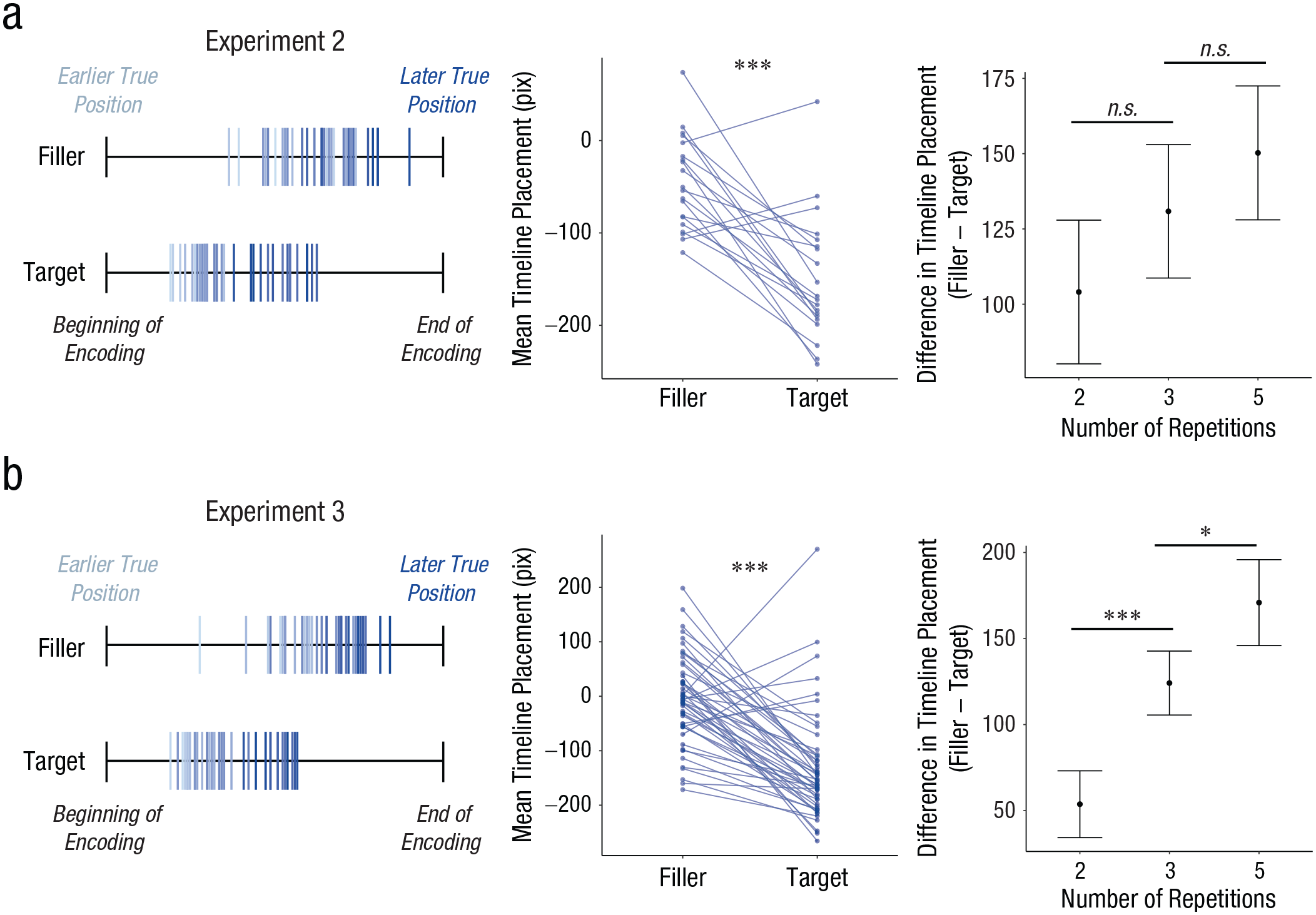
Data for Experiment 2 (a) and Experiment 3 (b). For both (a) and (b), at left is shown median rank-order timeline placement of each image in the sequence, as a function of the true index of the image (darker colors represent later true temporal positions), separately for filler images (top) and targets (bottom). In the middle is shown the average timeline placement for fillers and targets. Each dot or line represents a participant. At right is shown the difference in timeline placement (fillers – targets; larger numbers indicate that targets were placed earlier in time) as a function of the number of times a target was repeated (controlling for recognition memory and initial presentation block). Circles indicate mean across participants; error bars indicate ±1 SEM. *p < .05. ***p < .001.
Experiment 3
In a third experiment, we tested whether the effect would persist even if participants had explicit knowledge of what they were going to be asked about. If participants knew that only first appearances mattered, then perhaps participants would discount subsequent presentations, thus reducing the influence of repetition on memory and attenuating the temporal repetition effect.
Method
Participants
Per our preregistered criteria, the final sample size was 50 participants, after excluding and replacing 18 participants who failed to meet the inclusion criteria.
Task design and procedure
The procedure was identical to that of Experiment 1, except for one change to the task instructions. Specifically, before the beginning of the encoding phase, participants were informed of the nature of the memory task. They were told that they will be asked to recall when they first saw each image, and that they will do so by placing those items on a timeline.
Results
Again, performance during both the encoding phase (Mresponse rate = 98.3%, SD = 1.75%; Mresponse time = 970 ms, SD = 110 ms) and the memory phase (MA′ = 0.96, SD = 0.032; Mρ = .25, SD = .11; see Fig. S2c in the Supplemental Material) remained high. Additionally, we observed better memory for targets than for fillers, both measured by increased hit rate, t(49) = 7.70, p < .001, d = 1.09, and higher correlation between remembered and true temporal position (Mtarget = .33, SD = .17; Mfiller = .25, SD = .16), t(49) = 2.12, p = .039, d = 0.30.
Critically, not only did the temporal repetition effect persist despite participants knowing the question in advance, t(49) = 7.54, p < .001, d = 1.07, but it was also of a similar magnitude to what was observed in prior experiments (if not stronger; see Fig. 3b, left and middle). Further replicating prior experiments, this effect held when analyzing only trials for which participants correctly remembered seeing the images, t(49) = 7.60, p < .001, d = 1.07, and the effect scaled with the number of repetitions, F(2, 98) = 20.71, p < .001 (difference between two and three repetitions, t(49) = 3.90, p < .001, d = 0.55; difference between three and five repetitions, t(49) = 2.46, p = .018, d = 0.35; Fig. 3b, right) and was reliable across all image sets (ps < .001; see Fig. S3c in the Supplemental Material).
Experiment 4
In a fourth experiment, we repeated the same basic design except that during encoding, we asked participants whether they had seen each image before (Fig. 4a). This enabled us to track participants’ memories for the repetitions online and relate the temporal repetition effect more specifically to remembered repetitions.
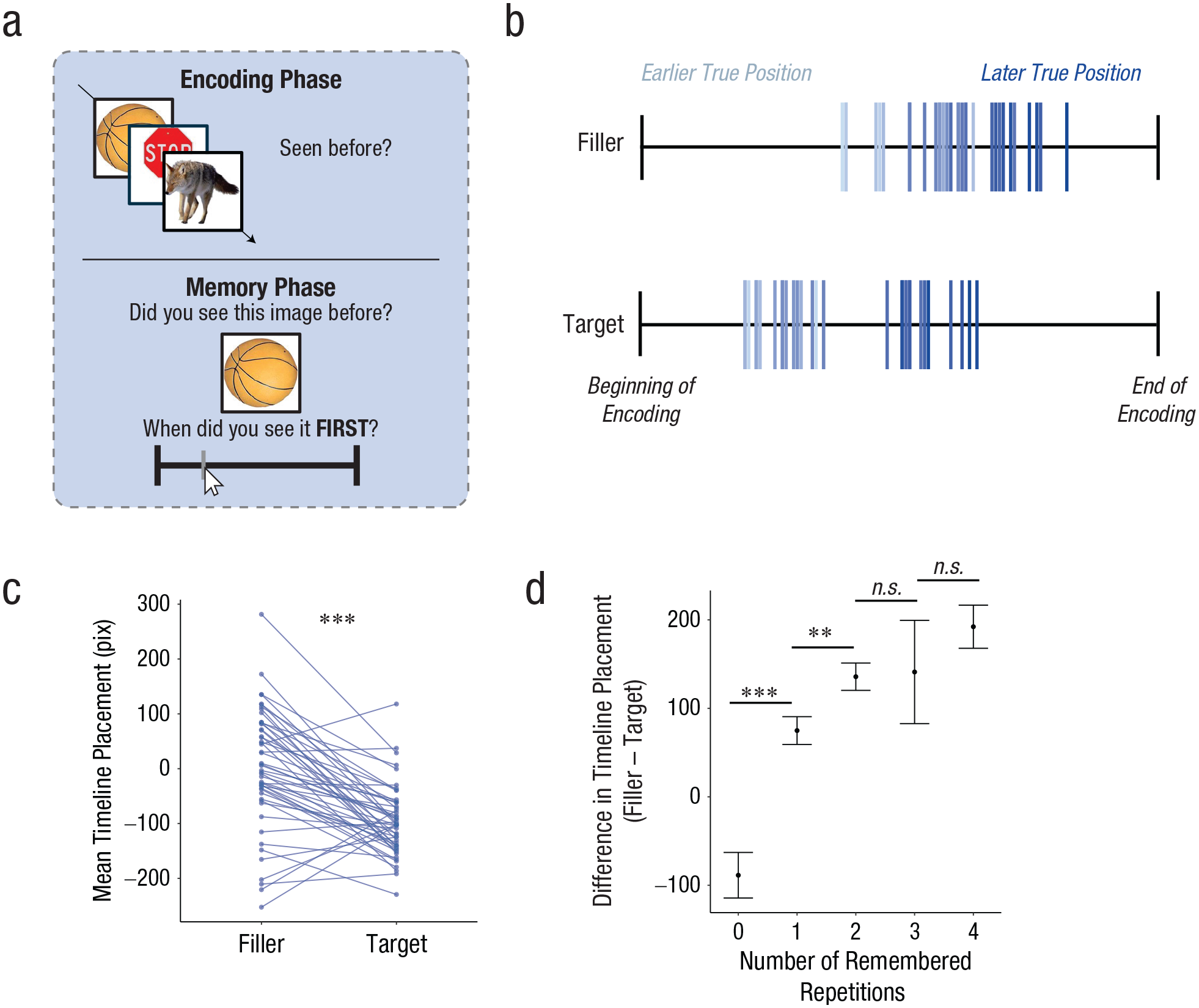
Experiment 4 design and data. During encoding (a; top), participants were presented with a stream of object images. In Experiment 4 only, participants performed a continuous-recognition task, in which they were asked during encoding whether or not they had seen the presented image before during the encoding phase. After five blocks of encoding, participants completed the memory phase (bottom). Median rank-order timeline placement of each image in the sequence is shown in (b), as a function of the true index of the image (darker colors indicate later true temporal positions), separately for filler images (top) and targets (bottom). Average timeline placement for fillers and targets is shown in (c). Each dot or line represents a participant. In (d) is shown the difference in timeline placement as a function of the number of times an image was successfully remembered during the encoding phase continuous-recognition task (fillers – targets); larger numbers indicate that targets were placed earlier in time. Circles indicate mean across participants; error bars represent ±1 SEM. **p < .01. ***p < .001.
Method
Participants
Consistent with our preregistered criteria, we used a final sample size of 50 participants, after excluding and replacing 20 participants.
Task design and procedure
The procedure was identical to that of Experiment 1, with the following changes. First, the task during the encoding phase differed. Specifically, participants in this experiment completed a continuous-recognition task, where for each object they indicated whether or not they had seen that object in the sequence thus far. Second, there was no 10-s break between blocks. The breaks were removed to avoid cuing participants to the structure of the repetitions.
Results
Participants responded on 98.3% of trials (SD = 1.87%) with a mean response time of 823 ms (SD = 95.7 ms). Additionally, participants performed well on the continuous-recognition task: On the first presentation of an image, participants correctly identified the objects as new 88.5% of the time (SD = 11.8%); on subsequent repetitions, participants correctly identified the objects as old 90.6% of the time (SD = 21.3%).
Performance during the memory phase remained high as well. On average, participants exhibited an A′ of 0.93 (SD = 0.051), with a higher hit rate for targets than fillers, t(49) = 8.86, p < .001, d = 1.25. Additionally, participants had an average temporal memory correlation of .27 (SD = .15; see Fig. S2d in the Supplemental Material), with better temporal memory for targets (M = .37, SD = .20) than fillers (M = .23, SD = .19), t(49) = 4.74, p < .001, d = 0.67.
Despite the change in task, the temporal repetition effect persisted, t(49) = 6.77, p < .001, d = 0.96 (Figs. 4b and 4c). This remained significant when limiting the analysis to trials that were correctly identified as old during the memory phase, t(49) = 9.89, p < .001, d = 1.40. Additionally, we replicated the effect of repetition, F(2, 92) = 22.2, p < .001 (difference between two and three repetitions, t(47) = 4.27, p < .001, d = 0.62; difference between three and five repetitions, t(48) = 2.77, p = .008, d = 0.40) and found that the effect was robust in six of the seven sets (ps < .01; see Fig. S3d in the Supplemental Material).
This design also enabled us to examine the effect as a function of the remembered repetitions. In other words, if the temporal repetition effect arises from remembering having seen the targets previously, then the temporal repetition effect should scale with the number of remembered repetitions. To address this question, while controlling for the fact that there may be an effect of repetition independent of memory, we ran a linear mixed-effects model (using the lme4 package; Bates et al., 2015) predicting the temporal repetition effect as a function of both the repetition structure (i.e., whether an image appeared in Blocks 1/5 vs. 2/4 vs. 1/2/3 vs. 1/3/5 vs. 3/4/5 vs. 1/2/3/4/5) and the number of repetitions in which an image was identified as old; random intercepts for each participant were included as a random effect. Comparing this full model to separate null models that removed either the true repetition or remembered repetition regressors, we found that the fit of the model was significantly improved by the inclusion of remembered repetitions, χ2(4) = 69.3, p < .001, but not by the inclusion of true repetition structure, χ2(5) = 4.28, p = .51, suggesting that the temporal repetition effect is in part dependent on recalling that the images have been previously presented (rather than mere repetition itself). Follow-up tests on the estimated marginal means (conducted with emmeans; Lenth, 2024) revealed significant pairwise differences in the temporal repetition effect for items that were remembered no times versus one time and one time versus two times (ps < .004), but not between items remembered two versus three or three versus four times (Fig. 4d).
Experiment 5
In a fifth experiment, we assessed the same basic effect using a different dependent variable (Fig. 5a, left). Instead of asking participants to respond on a timeline, we showed them a pair of items (each target and its accompanying filler) and asked which item was seen first.
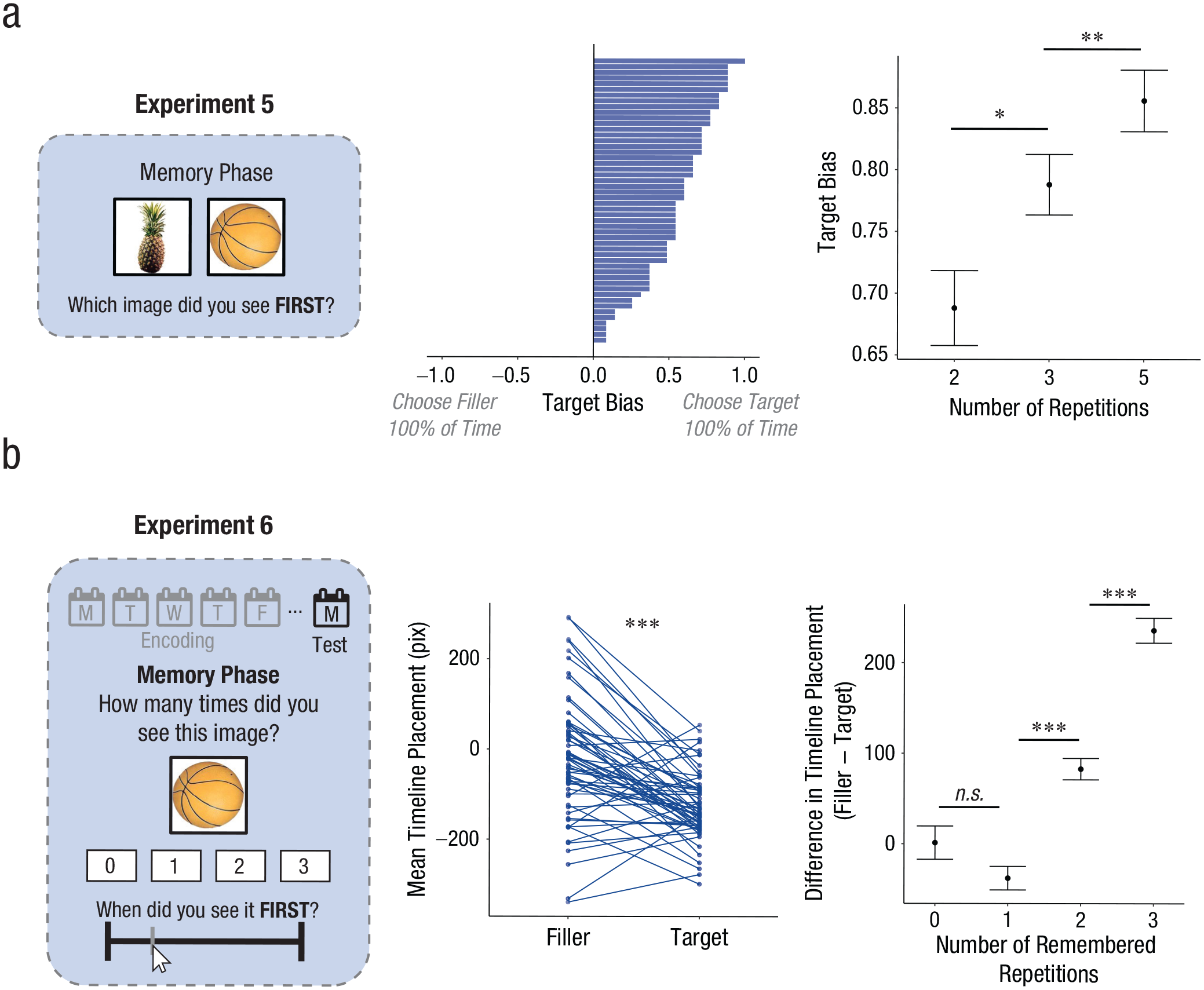
Experiments 5 and 6 design and data. In the Experiment 5 memory phase (a; left), participants were presented with two images (one filler and one target) and asked to indicate which image appeared first during the encoding phase. In the middle is shown the target bias score for each participant (1.0 = participants chose the target 100% of the time; −1.0 = participants chose the filler 100% of the time). Each bar represents one participant. At right is the target bias score as a function of the number of times a target was repeated. In Experiment 6 (b; left), participants encoded the image sequence across 5 days. On a sixth day, they underwent the memory phase after encoding. Average timeline placement for fillers and targets is seen in the middle of the figure. Each dot or line represents a participant. At right we show the difference in timeline placement as a function of the number of times a target was reported as having repeated. Circles represent mean across participants; error bars represent ±1 SEM. *p < .05. **p < .01. ***p < .001.
Method
Participants
Consistent with our preregistered criteria, we used a final sample of 50 participants, after exclusions and replacement. Participants were excluded only for (a) not completing the task or (b) failing to respond on at least 90% of encoding trials. Under these criteria, we excluded 14 participants.
Task design and procedure
The encoding phase was identical to that of Experiment 1; however, the task during the memory phase differed. Specifically, rather than probing temporal memory by having people indicate on a timeline when they had first seen an image, participants were presented pairs of images and asked which one they saw first. Each target image was paired with the filler that had appeared immediately before its first encoding presentation. In this way, the objectively correct answer would always be to choose the filler image rather than the target image. Participants completed 35 trials; because there were 35 unique target images, each of which was paired with its filler, there were no foils in this experiment. Additionally, unlike previous experiments, participants were not asked whether they had seen the images before.
Results
Performance on the encoding phase (which was identical to that of Experiment 1) remained high, with a mean response rate of 98.6% (SD = 1.34%) and a mean response time of 982 ms (SD = 124 ms). During the memory phase, participants were not asked to indicate whether or not an image was old. Thus, we do not report recognition-memory performance, nor can we assess temporal memory correlations (because participants did not make placements on the timeline).
We assessed the temporal repetition effect by computing the proportion of trials for which participants indicated that the target image occurred before its corresponding filler. We found that participants selected the target images 78% of the time, which was reliably greater than the chance level of 50%, t(49) = 16.13, p < .001, d = 2.28, despite the fact that, in reality, the target images were initially viewed later 100% of the time (Fig. 5a, middle). Although we could not limit our analysis here to correctly remembered trials, as there were no recognition-memory judgments, we again limited the analysis to items from Sets 1, 4, 5, and 7 to control for initial presentation block. The effect scaled with the number of repetitions F(2, 98) = 14.47, p < .001, with the effect stronger for three, relative to two, repetitions, t(49) = 2.79, p = .007, d = 0.40, as well as for five, relative to three, repetitions, t(49) = 2.65, p = .011, d = 0.38 (Fig. 5a, right). Last, the effect was robust across image sets (ps < .001; see Fig. S3e in the Supplemental Material).
Experiment 6
In a final experiment, we tested whether the temporal repetition effect occurs not only on the scale of minutes, but of days. We ran a week-long experiment in which participants viewed streams of images on five consecutive days. Three days later, we conducted the memory test. We used the timeline placement task common to Experiments 1 through 4 but additionally asked participants to recall how many times they had seen a given image.
Method
Participants
Consistent with our preregistered criteria, we recruited 100 participants on the first day of the experiment. The final retained sample size was 60—consisting of participants who successfully completed all 6 days and responded to at least 80% of encoding trials on each day. To maximize the window with which participants could successfully complete the consecutive sessions, we made the study available on Prolific from approximately 9:00 a.m. to 9:00 p.m. Eastern Standard Time each day, except on the final day of testing, when we allowed participants to complete the final memory test over a period of 2 days. (In practice, all but one participant nevertheless completed the task within 1 day.)
Task design and procedure
The task design was nearly identical to that of Experiment 1, with a few critical changes. First, in all prior experiments all five blocks were completed within a single session, but participants in this experiment completed the five blocks over five distinct consecutive days, Monday through Friday.
The structure of the sequence was similar to previous versions except that it was optimized to accommodate the longer, multiday task. First, each block was longer: Each block of images previously had contained 50 images, but here each block contained 100 images. Before, the first five and last five images were fillers, but here the first 22 and last 22 images were fillers. As a result, there were 28 targets per block rather than 20. In total, there were 49 target stimuli, divided into seven sets of seven images. Second, the way the sets were distributed across blocks was different from the other experiments. Images from Set 1 were repeated in Blocks 1/5; Set 2 in Blocks 1/2/3; Set 3 in Blocks 1/2/3; Set 4 in Blocks 1/2/4; Set 5 in Blocks 2/4/5; Set 6 in Blocks 3/4/5; and Set 7 in Blocks 3/4/5. That is (unlike Experiments 1–5), of the seven image sets, six were repeated three times and one was repeated twice.
The memory phase was completed on a sixth day. This session became available on the Monday following the five encoding sessions and was available through Tuesday (to ensure high retention). All 49 targets were tested, along with their corresponding 49 fillers and 22 foils. The memory phase was otherwise identical to that of Experiments 1 through 4 except that instead of asking participants whether or not they remembered seeing an image, we asked them to indicate how many times they had seen it, ranging from never to three times (Fig. 5b, left).
Results
On Day 1 of encoding, participants judged whether each object was smaller or larger than a shoebox. Performance was high, with a mean response rate of 97.2% (SD = 5.21%) and a mean response time of 1,009 ms (SD = 143 ms). On Days 2 through 5 of encoding, participants were instead tasked with indicating whether they had seen that object before, on a previous encoding day. The mean response rate remained high, at 97.9% (SD = 4.38%), and the mean response time was 1,011 ms (SD = 111 ms); the response rate did not differ across Days 2 through 5, F(3, 177) = 2.04, p = .11. Further, participants performed well on the continuous-recognition memory test across days: On the first presentation of an image, participants correctly identified the object as new 80.4% of the time (SD = 18.9%); on subsequent repetitions, participants correctly identified the objects as old 71.8% of the time (SD = 13.7%). Note that although this was lower than in Experiment 4, correctly identifying an object as old in this experiment required remembering the objects across days (rather than minutes).
Participants were invited back for the memory test on a sixth day, following a weekend (Days 1–5 were conducted on Monday–Friday and Day 6 on a Monday). Overall recognition-memory performance on Day 6 was considerably lower than in previous experiments (likely because of the multiday nature of the study), though still quite high (MA′ = 0.85, SD = 0.069); 59 of 60 participants exhibited an A′ greater than 0.5. We still observed reliably greater hit rate for targets, relative to fillers, t(59) = 12.20, p < .001, d = 1.57. Perhaps unsurprisingly, temporal memory also suffered considerably in this multiday design. Only 30 out of the 60 participants exhibited a rho greater than 0, and performance was not reliably above 0 at the group level, Mρ = .016, SD = .094, t(59) = 1.33, p = .19, d = 0.17 (see Fig. S2e in the Supplemental Material). Examining temporal memory separately for targets and fillers yielded the opposite pattern of results from our prior experiments. Specifically, performance on filler trials was reliably above 0, M = .041, SD = .13, t(59) = 2.53, p = .014, whereas performance on target trials was not, M = .005, SD = .16, t(59) = 0.27, p = .79; however, the difference between fillers and targets did not reach significance, t(59) = 1.40, p = .17. This numerically reverse effect likely arose from degradation in memory across days. That is, if participants remembered seeing an object on Day 5 and did not remember having seen the object previously, then they would place it to the far end of the experiment on the timeline, yielding worse temporal memory.
Critically, however, we robustly replicated the temporal repetition effect observed in our prior studies: Participants placed target objects’ first occurrence as further back in time than fillers, t(59) = 6.21, p < .001, d = 0.80 (Fig. 5b, middle). This effect held only when examining trials for which participants successfully identified the image at least one time, t(59) = 9.85, p < .001, d = 1.27. Further, we observed the same scaling with repetitions as in prior experiments (though we note that in this design, the majority of targets were repeated three times), with stronger effects for images repeated three, as opposed to two, times, t(59) = 6.77, p < .001, d = 0.87 (for this analysis, we included only correctly remembered items from Sets 1, 2, 3, and 4, which all had their first presentation in Block 1). Relatedly, the effect was significant in six of the seven image sets; the only nonsignificant effect occurred for the images that were presented only in Blocks 1 and 5 (see Fig. S3f in the Supplemental Material).
Because in this experiment we asked participants to recall how many times they remembered seeing an image, we can also analyze the temporal repetition effect as a function of remembered (in addition to true) repetitions. As in Experiment 4, we constructed a linear mixed-effects model predicting the temporal repetition effect as a function of both the number of remembered repetitions and the true repetition structure. We again found that the temporal repetition effect was predicted by the number of times a participant remembered seeing an image, because including this factor significantly improved model performance, χ2(3) = 252.9, p < .001. Here, including true repetition structure also improved model performance, χ2(4) = 12.02, p = .017. Follow-up tests on the estimated marginal means revealed that all pairwise comparisons of the temporal repetition effect across number of remembered repetitions were significant, except for the difference between items not remembered at all and items remembered one time, with the largest temporal repetition effect for images that participants remembered seeing three times (ps < .001; Fig. 5b, right).
Discussion
Across six experiments, we found robust evidence that participants’ temporal memories are systematically distorted: Repeated information was consistently remembered as having initially occurred earlier in time than information presented only once. This temporal repetition effect is notable not only for its existence, but its magnitude. In our shorter studies, the illusion amounted to as much as 24% of the full length of the experiment. The temporal repetition effect is also remarkably consistent across people. In our initial experiment, for instance, 43 out of 50 participants showed the basic temporal repetition effect. In our forced-choice experiment, 50 out of 50 participants showed the effect. In our week-long experiment, 47 out of 60 participants showed it.
The vast majority of work on time perception focuses on temporal perception of the present—how things like surprisal (Eagleman, 2008; Tse et al., 2004) or repetition (Matthews, 2011; Matthews & Gheorghiu, 2016) influence the perceived duration of a discrete moment. Yet our temporal perception of the past is an equally important, if not more important, part of people’s everyday lives; although we are rarely called upon to ask how long an experience lasted (especially on the scale of seconds), we are constantly called upon to remember when things occurred.
This work also speaks to the way that the structure of experience contributes to perceived time. Much prior work has examined how it is, for instance, that explicit event boundaries influence temporal memory and perceived time (DuBrow & Davachi, 2013, 2014, 2016; Goh et al., 2023; Yousif & Scholl, 2019; Yousif et al., 2024). In Experiment 2, however, we demonstrated that the temporal repetition effect does not seem to critically depend on explicit event boundaries; the effect instead seems to be due to the structure of the information itself (i.e., when and how information is repeated). An open question remains about how these factors interact.
Remembering when
Memory and perceived time are intertwined (Eichenbaum, 2013; Howard, 2018; Sherman et al., 2023), yet the current results are not easily accommodated by any existing theory of memory. In fact, although time is critical to the definition of episodic memory (Tulving, 2002), few theories make direct predictions about how memory should influence the temporal perception of our past — particularly in more naturalistic scenarios, when information is encountered multiple times. For example, some theories of the spacing effect (enhanced memory for repeated items that are spaced out over time, rather than repeated in a massed fashion) argue that memory benefits from spacing arise from the fact that encoding information across multiple, distinct temporal contexts creates additional retrieval cues to facilitate later memory (Benjamin & Tullis, 2010; Siegel & Kahana, 2014). However, it is unclear whether, or how, these theories make predictions about memory for the temporal contexts themselves (see Adams & Delaney, 2023). Even if people formed an integrated memory representation across encodings, they may confuse the later encodings of an item with the initial one, effectively pulling temporal memory toward the later encodings. Indeed, distinct temporal contexts, or time tags, have been invoked to describe findings that repetition can lead to items being remembered as more recent (Flexser & Bower, 1974).
As foreshadowed previously, canonical theories of temporal memory struggle to accommodate these results. Prior theoretical and empirical work has invoked the notion of relationships between memory strength (Hintzman, 2005) and remembered time, arguing that repeating an item enhances the memory representation of the initial experience, yielding greater cumulative strength. In turn, enhanced memory strength should cause an experience to be perceived as more recent. Yet we observed the opposite: Participants remembered repeated events as initially occurring earlier in time, even though those events had greater memory strength (insofar as participants were more likely to remember seeing targets than fillers).
One possible explanation is that each encoding of a repeated item leads to a recursive reminding, meaning that the representation of the initial presentation is embedded in the repetition of each subsequent encoding (Hintzman & Block, 1973; Hintzman, 2004, 2010; Jacoby & Wahlheim, 2013). This framework is thought to explain findings that repetition enhances temporal memory (Hintzman & Block, 1973) and is consistent with our finding that fine-grained temporal memory is better for targets than fillers. However, although the notion of recursive reminding may prove explanatorily useful, it does not straightforwardly predict the patterns observed here. Recursive reminding has been invoked to explain some temporal distortions (Hintzman, 2010), but this theory would require elaboration to accommodate the present results.
Another possible explanation for these results is that participants rely on a heuristic, or metamemory, to remember when things occurred: If they know that an image was seen multiple times, that may be a clear cue that it must have been seen early in the sequence. The data of Experiment S1 argue against a straightforward metamemory account: Although some participants reported using such a strategy, the extent to which they employed this strategy did not predict the magnitude of their temporal repetition effect. With that said, we do not fully reject the possibility that people may be relying on metamemory, or on cues other than encoded temporal information per se, to make their judgments. Indeed, some theories posit that time is never encoded into memory in the first place, but rather is reconstructed from mnemonic cues (e.g., De Brigard et al., 2020; Huttenlocher et al., 1988; see also Easton et al., 2024). In other words, metamemory may be the only route to temporal information. By this account, all effects of temporal memory may be conceptualized as effects of metamemory—including effects of memory strength, or even retrieved temporal context. This is an area that warrants additional empirical and philosophical consideration.
Notably, the effects we test and observe here are related to the first presentation of an item—that is, repeating information leads to that memory being remembered as initially occurring earlier in time. However, it is possible that repetition has distinct effects on memory across each instance. Indeed, in a small pilot study, we found the opposite effect when probing memory for the last presentation of an image: repeated information was remembered as having last occurred more recently than nonrepeated information (see Fig. S5 in the Supplemental Material). This opposing finding is perhaps consistent with existing empirical work and theoretical frameworks for how repetition influences recency judgments (e.g., Hintzman, 2010). Thus, future work is needed to understand how different mnemonic cues to time may produce unique distortions across different presentations of an item.
Limits on generalizability
These experiments were conducted on educated, Western, English-speaking adults, and consequently we do not make any claims about generalizability beyond that demographic. It remains an open question to what extent the temporal repetition effect studied here applies to all populations.
Conclusion
Our sense of time is tied to our sense of self and our goals, emotions, and motivation (Carstensen, 2006). The feeling that something happened “only yesterday” makes us feel attached to it—as if it is as much a part of us as the present moment. The feeling that an event occurred long ago enhances our sense of nostalgia (and heightens our awareness that time is always passing, whether we like it or not). Perhaps perceived temporal distance from an event also influences how we understand it. Perceiving the COVID lockdowns as occurring long ago may cause us to imagine it less concretely; maybe the distance from it prevents us from feeling the need to prepare for the next pandemic. In this way, when we remember something may sometimes be almost as important as what we remember about it. Through this lens, it may be surprising that our sense of time is subject to remarkable, predictable illusion.
Supplemental Material
sj-pdf-1-pss-10.1177_09567976251330290 – Supplemental material for An Illusion of Time Caused by Repeated Experience
Supplemental material, sj-pdf-1-pss-10.1177_09567976251330290 for An Illusion of Time Caused by Repeated Experience by Brynn E. Sherman and Sami R. Yousif in Psychological Science
Footnotes
Acknowledgements
For helpful feedback, we thank Tal Boger and Tristan Yates. This work was largely conducted in March 2024, as we awaited the arrival of our son, who was born later that same month. Nothing conveys the human inability to grasp the passage of time more powerfully than watching him grow up. Time marches on, but it does slow down sometimes—when we are laughing together, when he is snoring on our shoulders, each time he disarms us with his smile. For being a constant source of joy, we thank him, too.
Transparency
Action Editor: Tom Beckers
Editor: Simine Vazire
Author Contributions

Notes
References
Supplementary Material
Please find the following supplemental material available below.
For Open Access articles published under a Creative Commons License, all supplemental material carries the same license as the article it is associated with.
For non-Open Access articles published, all supplemental material carries a non-exclusive license, and permission requests for re-use of supplemental material or any part of supplemental material shall be sent directly to the copyright owner as specified in the copyright notice associated with the article.
