




Abstract
What does it take to become an adult in Africa? Life-span-development literature includes little exploration on this transition outside Western countries. A qualitative approach was used to identify locally relevant topics and variables in an understudied African context. Fifty 18- to 25-year-old Ovambo Namibians from rural and urban areas were interviewed. Results of reflexive thematic analysis suggest the significance of gender and birth order in defining adult roles and the completion of one’s education as a new rite of passage. Full adult personhood means providing for and engaging with a larger community as well as one’s children and extended family, reflecting the ongoing relevance of African communalism in today’s society. Youth in Namibia, and likely in sub-Saharan Africa more broadly, balance traditional and contemporary demands as they come of age in a postindependence, globalizing society. Our findings reflect the centrality of community and the intermingled nature of agentic and communal values in this process.
Introduction
What shapes adulthood around the world? Its meaning and responsibilities in each society shape how and when one is recognized as an adult. In traditional societies, gender-specific rite-of-passage practices have been important (Lo-oh, 2016; Obidoa et al., 2019), but societal changes worldwide are shaping new norms—for example, changes in labor markets are leading to more years of education (Wyn, 2014).
Emerging adulthood—defined as the time after adolescence before one takes on a fully adult role—has been defined in the West as a period of finding one’s identity and exploring romantic and vocational roles. It is characterized by instability, self-focus, feeling “in-between,” and optimism (Arnett, 2024; Arnett et al., 2014). Emerging adults consider financial independence, making independent decisions, and accepting responsibility for one’s self as key indicators of adulthood (Arnett, 2024). In China, a similar shift toward youthful exploration has been observed, but with less acceptance of romantic exploration and more emphasis on being able to support one’s parents as an indication of full adulthood (Zhong & Arnett, 2014). Students in the United States who are of immigrant origin also emphasize social and family responsibilities (Katsiaficas, 2017; Katsiaficas et al., 2015).
Recent studies of university and high-school students in South Africa, Ghana, Nigeria, and Cameroon also underscore caring for extended family in addition to financial and psychological independence, as well as gender-role differences (Lo-oh, 2016; Naudé & Esau, 2024; Obidoa et al., 2019). Generally, however, there is little in the literature on what it means to become an adult in Africa, although this is highly relevant in a region in which 70% of the population is under age 30 (United Nations, 2024).
The current study contributes an African perspective on what it means to become an adult, specifically for the Ovambo people in Namibia. We seek a more global understanding of emerging adulthood, and we want to consider what local expectations for adults reveal about personality, values, and African “cultural logic.”
Coming of age in Namibia
Namibia is home to more than a dozen ethnic groups, and about half of its population of 3 million are from the Ovambo people (World Population Review, 2024). Before colonization, entry into adulthood throughout Africa was typically marked by gender-specific rites of passage (Obidoa et al., 2019). The Ovambo Olufuko prepared girls around age 14 for womanhood, allowing them to become sexually active, have children, and marry (MuAshekele et al., 2018). Under the influence of Finnish Lutheran missionaries and German colonialism, marriage and preparation through confirmation were instead conducted through the church, with the exception of ceremonial practices (Eehungi) leading up to the wedding.
Starting in the 1950s, under the colonial oppression of South Africa, men aged 16 and above joined the contract-labor system (Likuwa & Shiweda, 2017). Initially, this was perceived as offering economic gains, and some local leaders advised parents not to allow daughters to marry men who had not done contract work, making this a new rite of passage. A long liberation struggle subsequently saw most young men and some women joining the armed forces, another new rite of passage.
Independence in 1990 brought new opportunities, and rural-to-urban migration increased dramatically as young people sought opportunities (Niikondo, 2010). Like their peers around the globe, Namibians now delay marriage and extend education (Arnett, 2016; Beckert et al., 2020; Obidoa et al., 2019; Naudé & Esau, 2024; The World Bank Gender Data Portal, 2019; Zhong & Arnett, 2014). Structural disadvantages, however, including extreme income inequality and unemployment, affected youth and overextended social resources, especially in informal settlements around cities and towns (Kamwanyah et al., 2021). As a result, some adolescents entered adult roles early to help their families, whereas others lacked opportunities to fully enter adult roles. Hence, we expect the transition into adulthood of young Namibians to vary and to differ from Western countries; this requires an Afrocentric framework to best explore them.
An African perspective on adulthood
Alongside incredible diversity in sub-Saharan Africa, a region of over 2,000 languages (Brown & Ogilvie, 2010), pan-African cultural values have emerged. For example, Ubuntu celebrates how individual identity is intertwined with community and elevates caring, sharing, respect, and compassion (Chigangaidze & Chinyenze, 2022; Sodi et al., 2021; Willmore et al., 2022). In contrast to the Western cultural logic of dignity, in which people are seen as having equal value from mere existence (Leung & Cohen, 2011), personhood in Africa means that although all humans have intrinsic value, recognition as a full adult requires mature, ethical, caring conduct (Adjei, 2019).
Using a social-constructionist and Afrocentric perspective, we explored how Ovambo emerging adults perceive the requirements of adulthood and their own status and transition. A social-constructionist approach aims to capture how perceptions and experiences unfold and how meaning is constructed through social processes (Braun & Clarke, 2022). Our research was thus informed by African social realities and philosophical perspectives (Adjei, 2019; Chigangaidze & Chinyenze, 2022; Sodi et al., 2021) and by emerging adulthood theory to compare findings to other world regions (Arnett, 2024). A qualitative approach was deemed necessary at this stage of knowledge generation in the African context to allow for holistic and contextualized insights (Braun & Clarke, 2022) that are Afrocentric rather than imported (Ratele, 2017) and to identify appropriate variables for future quantitative work.
Research Transparency Statement
General disclosures
Study disclosures
Method
Participants
We interviewed fifty Ovambo Namibians aged 18 to 25 (Mage = 21.08, SDage = 1.76, 50% female), the largest sample we believed tractable for reflexive thematic analysis, with the goal of capturing diverse socioeconomic, geographic, and lifestyle conditions. Interviewees were equally drawn from rural areas (Oshana and Ohangwena regions in northern Namibia) and urban areas. Urban areas included specifically the northern suburbs of Windhoek, where Black inhabitants were restricted during apartheid and where most still live, and nearby informal settlements, where homemade shelters have expanded since independence.
Although some participants were working part-time (e.g., in photography, in sales) or were seeking work, most were enrolled in tertiary schooling or vocational training (e.g., hospitality, medicine, human resources, education, engineering), as is typical at this age in Namibia. Compared with national statistics (Education Policy and Data Center, 2018), slightly more of our sample had completed secondary (high school) education. Although six had a child, none were married or living with a romantic partner. This is consistent with Namibian norms: The average age for having a first child is 21 years (World Population Review, 2024), and the average age at first marriage is 30 years (The World Bank Gender Data Portal, 2019), but cohabitation before marriage is not culturally normative. Most participants lived with relatives, which is typical for unmarried emerging adults in Namibia. Only 9 (50% female) were renting alone, with roommates, or in college housing. Most participants (92%) identified as Christian, the religion of 97% of Namibians (Pew Research Center, 2015); 1 participant identified as Muslim, and 3 were without a religious affiliation. A table with more details is available online (https://osf.io/sqc7t).
Procedure
Participants were recruited via social media and through referrals. Interviews were conducted by the first author using a semistructured approach and audio recorded with participant consent. The first two questions were from Zhong and Arnett’s (2014) mixed-method study of migrant workers in China. Two were added on the basis of research related to gender roles (Zhong & Arnett, 2014) and parental views (Nelson et al., 2007) in the transition to adulthood. Considering our goal to explore both personal experiences and normative perceptions regarding the transition to adulthood, two questions elicited the former (1, 4) and two the latter (2, 3):
Do you feel like you have reached adulthood? Why or why not?
What do you think are the most important markers/indicators 1 of adulthood?
Is becoming an adult different for women and men, or is it the same?
Do your parents 2 consider you to be an adult? (If yes) When did they first view you as an adult, and why? (If no) What would have to occur in order for them to think of you as an adult?
A subsequent series of questions about alcohol was intended from the outset for a separate project and not included in current analysis. Interviews were conducted mainly in English, with a translation into Oshikwanyama, a common dialect of Oshiwambo, available. All participants were Oshiwambo speakers of various dialects, but because English is the national language (and is used predominantly in primary education), most had a good command of it. For two interviewees who preferred to speak Oshiwambo, the interviewer provided in situ interpretation for the audio recording. Despite the interviewer and participants speaking different dialects, communication was clear. The full interview, including both topics, lasted on average 20 min. Interviews were transcribed using Sonix.ai and then reviewed and corrected by an Oshiwambo-speaking research assistant and the first author to ensure accuracy of interpretations.
Data analysis
The transcripts were analyzed using Braun and Clarke’s (2022) reflexive thematic analysis (RTA), intended for developing nuanced patterns of meaning. RTA involves six flexible phases: familiarization, coding, generation of themes, development and refining of themes, naming of themes, and writing (Braun & Clarke, 2022). RTA’s flexibility allowed for an inductively based analysis. We used a social-constructionist orientation that regards language as active in creating meaning from contextually situated realities (Braun & Clarke, 2022). Thus, the expressions of meaning that unfolded during interviews served as the unit of analysis. Trends and patterns of meaning units across accounts were considered to reflect collective understandings. We additionally used constructivist crafting (Finlay, 2021) to integrate semantic descriptions and interpretative, latent meanings from participants’ words. We did not view these as mutually exclusive, but given our constructionist stance were particularly interested in latent meanings and subtext—that is, how participants’ understanding, experiences, and interpretations were constructed by social norms, cultural contexts, and interpersonal dynamics.
All the authors read the transcripts multiple times for familiarization. Thereafter, the first author coded each transcript. Demographic characteristics were tracked during this process. Initial codes were discussed with the other authors, not to establish reliability but to reflexively explore ideas for meaning units. The first author continued with subsequent rounds of coding, with periods of detachment from the data for fresh critical engagement; she then organized codes into initial themes. These were explored with the other authors to identify conceptual boundaries and finalize central, organizing concepts.
Trustworthiness, rigor, reflexivity, and positionality
Critical reflection is essential to ensure the methodological integrity of a contextual qualitative study (Braun & Clarke, 2023; Finlay, 2021; Levitt et al., 2018). The first author’s experience as a young Ovambo woman aided her interpretation of cultural and linguistic nuances during interviews and in analysis. She worked closely with the last author, an American-European personality and cultural psychologist familiar with Ovambo and Namibian culture through prior research visits, and the second author, a South African developmental psychologist. The researchers remained actively and thoughtfully engaged, seeking depth and divergence in the development of meaning units through personal reflexivity to incorporate their diverse experiences, disciplinary reflexivity to synthesize Western and African notions of truth, and functional reflexivity to consider the utility and fidelity of research methods and actions—for example, considering how language proficiency could have played a role in interviews. Braun and Clarke’s (2023) guidelines for good practice in thematic analysis and the importance of becoming knowing researchers through active, flexible, prolonged engagement also informed our process.
Results
Using the RTA process, five themes were constructed to capture participants’ views on what it means to become an adult in Namibia and their own status in this transition, as shown in Figure 1 and described below. Participants’ quotes, included to support analytic claims, are identified by gender (F = female), age, and living context (U = urban area, R = rural area), with a final indicator (a, b, c) in case of overlapping demographics. Although we considered both gender and rural-urban lifestyle in our analysis, only the former are noted; differences in the latter were not evident, with similar views being shared by both groups.
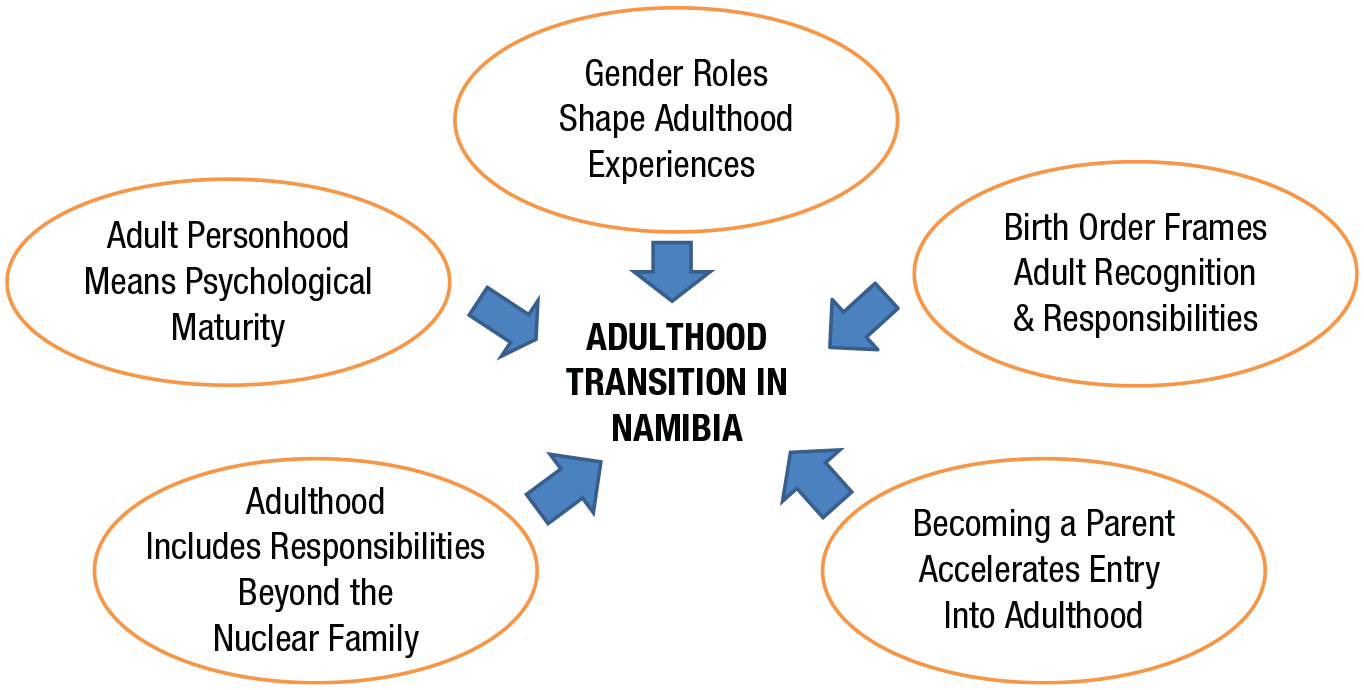
Key themes of the adulthood transition in Namibia.
Gender roles shape adulthood experiences
There was a general consensus among our participants that becoming an adult means different things for Ovambo men and women, and most believed that women become adults sooner in the sense of having responsibilities: Us ladies, we actually have more responsibilities than guys or men . . . they like to go out and things like that. And for us, we have to stay home, cook for them even, yeah (laughs) . . . like in my situation, since I’m now the oldest in the house I have to look for a job and start taking care of them . . . Now for the guys, OK, there are some of them that are responsible, but a lot of them are actually irresponsible. (F23R)
Although women have responsibilities typically centered around caregiving, they were also sometimes viewed as better protected and supported, socially and financially: “The society that we are in now, we would say that females are sometimes more relaxed. For male[s], you have to be hard working if you want to achieve, if you want to get what you want in life. But then for a female, it’s optional” (M19Ra).
Although men are seen as less mature in terms of caretaking, they are trusted with more freedom and independence to explore opportunities: So, men, they are trusted on their own . . . whereas females usually they’re harder to be let go by either their parents or their relatives [who] feel like we are in constant danger because of this world that we live in, where we are stereotyped that as women, we are weak and we cannot protect ourselves. So we are . . . kept closer to home than males are . . . (F19R)
This independence and this authority to make their own decisions is seen as related to an expectation that men will become providers and leaders in their families and communities: The way I see it, men have more freedom in the sense that regardless of where our futures are headed, we make our own choices and we stand our own ground . . . we become the leaders in the family and whatever choice we make, we are the ones to decide what should be done or not. (M20Ra)
On a related point, some participants perceived Namibian society to have more opportunities for men to hustle—that is, to pursue informal entrepreneurial activities, such as selling drinks and snacks or offering transport in the streets. All of these are common strategies for economic survival, especially among unemployed youth: There are different expectations because [parents] probably think he’s hustling until five o’clock in the morning and [if] you [were] coming home at five o’clock in the morning [parents would question] “where were you and what were you doing?” (F24U)
The successful transition into adulthood for men is also affected by scarce opportunities, however. One reason participants gave for men’s later entry into adulthood was the difficulty of fulfilling the role of provider: . . . woman by the age of 25, she can even get married, she can have a house because she at least has someone supporting her . . . at the age of 25, they don’t really consider him as an adult person because he can’t take care of the house and even the family, even though some of them, they have courage of doing that. (M25U)
These gender roles are socially and culturally established from childhood, with boys and girls prepared differently for adult roles and responsibilities: “It depends on the responsibilities of which you were imposed as a child . . . because wherever we grow up in our communities, women are regarded as primary caretakers” (M20U). Thus, the experiences of young Namibians continue to be shaped by traditional gender-based norms, with women perceived as maturing earlier in terms of caretaking responsibilities, but also as requiring more protection. By contrast, men are given freedom and independence earlier, but with the expectation that they will become financial providers sooner. Participants of both genders seemed to largely accept these roles, taking pride in their abilities to help their families and expressing concern mainly about scarce economic opportunities.
Birth order frames adult recognition and responsibilities
Although we did not ask about birth order, almost every participant mentioned it. Especially in large families, firstborn children are often given caregiving responsibilities for younger siblings and elderly relatives at an early age: “Especially that I am the firstborn, they really see me as a person who is older and that should take responsibility and care of my siblings” (F22Rb): If my aunt and my father are not available, so obviously they usually leave every responsibility in my hand . . . When I completed my Grade 12, they realized we don’t have anyone else to take care of the young ones. So [I] should be the one. (M24R)
Conversely, last-borns are afforded less responsibility and more freedom to enjoy their childhood, but also less recognition of their independence and maturity: I don’t know if you’re familiar, but there are last-borns, right? And I’m one of those. So it’s a tough position to be sometimes. I understand all the benefits that comes with it . . . it’s really a tough position to be sometimes because they still treat you like you are 17 or 15. (M22U) Being the last one of the family, you’re always young, even when you try to bring decisions of your own. They just feel like you’re still young, and I’m like, “but I’m grown!” But they never get to understand that. (F21Ua)
In summary, there were clear differences in how firstborns and later-borns transition into adulthood. Shaped by family needs, firstborn adolescents take on caregiving and provisional responsibilities, in some cases even becoming child heads of household (Ruiz-Casares et al., 2009). Children born last have a different role: Parents who may have been swamped with responsibilities earlier might enjoy parenting the baby of the family. Although this role has advantages, it delays being seen as an adult, which was a common wish for our participants at this age.
Becoming a parent accelerates entry into adulthood
Participants described having a child as an indicator of adulthood, but noted differences based on gender and how the role is embraced. Motherhood was seen as more likely to mean caretaking responsibilities and adult status: I think for a woman, it will be in most cases the moment they give birth, there is some sort of a bell ringing in them that this is now adulthood. They start setting aside their teenage life . . . they just become old enough to become responsible for their child. [Men] still remain into that ideology of “no, I’m still young” . . . (F19U)
In our sample, no participants, including the six with children, were married or living with romantic partners, and none lived alone with their child. Although women were typically more involved in caregiving, they had support from relatives, and some did not live with the child. Two fathers were involved parents, although also relying on female relatives. Because of this typical sharing of responsibilities between young parents and caregivers, parenthood is not always a clear-cut indicator of adulthood: So I don’t think the part of me being an adult has really come into effect yet, because of the support they still give me . . . I think even should I get a child now, I’m still not going to be considered by my parents as an adult, but rather just a responsible person or I’m growing into a responsible person. (F19U)
Despite their ongoing reliance on families, however, participants reported a shift in dynamics: So when I got pregnant, [my father] started telling me things about life. Like, for instance, at first, he used to give me stuff, like buy me things and everything. Now that I’m a mother, he’s telling me that “no, now it’s your baby’s turn.” (F23R)
In summary, having children was seen as an important but not conclusive marker of adult status, with much depending on the extent to which the role is embraced, and on whether the family elders endorsed the individual as responsible or not.
Adulthood includes responsibilities beyond the nuclear family
Participants told us that adults are expected to take responsibility for the well-being of extended family and members of the community. In addition to basic provision, this includes psychological and emotional caring, responsibilities that can require sacrifice, even the postponement of other developmental tasks: I stay with my grandmother because I grew up there, so I like supporting her and doing almost everything for her . . . Since my mother is not employed and my dad is currently working just as a cleaner . . . I take up most of the responsibilities into assisting him, also helping [extended family members]. (M20Rb) My aunt passed away in a car accident and I was in the city writing exams, but they told me like, I had to be there . . . It was during exams, but I had to be there. My presence was needed. So that means that I’m considered as an adult. (19bMb)
Such responsibilities extend beyond the family to larger in-groups: “It depends how the person behaves, the influence, how the person advises other people, and how to . . . let me say, like how to work with community” (M24U).
Completing secondary or tertiary education was seen as pivotal, even as a rite of passage, making it possible to take on these leadership and provisional tasks of adulthood and marking the end of parental/caregiver support and the beginning of financial independence.
One example reads, “I think maybe after school [my parents started to view me as an adult], because immediately after school, I started working, so I was working for a good year. So after that, I started getting a few responsibilities” (M22R).
A degree or qualification, however, brings expectations that can only be met when employment is obtained. Otherwise, young adults cannot provide for themselves, let alone others: I mean, you can just be there and you are thinking, “so where am I going to get my next money for cosmetics, who’s going to give money to braid my hair?” Yeah, it’s not nice, especially when you’re home and you’re not doing anything. It’s quite depressing.” (F20Rb)
In summary, taking responsibility for oneself, one’s family, and the larger community is key to being a real adult, and our participants expressed a highly positive sense of pride and achievement when they could fulfil such roles. Completing education is seen as important to achieving this potential, but prolonged unemployment after education is a risk in the Namibian economy. The increased financial and communal involvement expected from an educated individual adds uncomfortable social pressure when work is not available.
Adult personhood means psychological maturity
Participants described the psychological characteristics of adults as reflective, open to learning, resilient, having appropriate motivations, making careful decisions, and respecting the wisdom of elders. Adults are seen as attentive to the world around them: “You think about everything that happens around you . . . You don’t just look at it and let it go. But you think and ask yourself some questions like ‘why are these things happening?’” (M19Rc). They are seen as resilient in the face of adversity, with inner strength and independence: Now I’m actually going through a phase, right, because three months ago my mom passed on. So it’s like, it kind of pushed me into adulthood, because I literally used to depend mostly on her . . . So then I decided, “OK, let me just stay on my own, find my place and stay on my own and stuff like that” . . . So it’s quite a challenge and it’s something that I battle with every day. (F24R)
Adult maturity is displayed through how one makes decisions and the motivations behind those decisions: You have to make smart decisions in the sense that you can’t be easily enticed to choose the easiest option. Sometimes you have to choose the hard option, which will benefit you in the long run. And another factor would definitely be experience. Experience in the sense that you expose yourself to different aspects and situations, in the sense that they’ll help you grow and make wiser decisions in the long run. (M20Ra)
With increasing maturity also comes increasing humility and awareness of the growth that is still needed: “I just feel like I still have more to learn. And you get to feel this almost every year” (M20Rc). This includes respect for the judgment of one’s elders and knowing when to consult with them: “. . . and so you just have to also do more research about it and ask the elders, if they know about it” (M19Rc).
Discussion
We explored how Ovambo 18- to 25-year-olds conceptualize adulthood and experience their transition into it. Our results elucidate the mix of traditional and contemporary demands that shape emerging adulthood for young Africans. The key criteria for adulthood in Western contexts—taking responsibility for oneself, making independent decisions, and becoming financially independent—were also endorsed here, but with a much stronger focus on social and familial responsibilities. Participants indicated that being recognized as an adult is shaped by traditional gender roles, birth-order-associated responsibilities, ability to care for others, and psychological maturity (in terms of reflexivity, resilience, and independence), all coupled with humility and respect for the wisdom of elders. Despite some concerns about economic opportunities or concerns that one sex might have it easier than the other, our participants clearly embrace prosocial and communal expectations and are motivated to fulfil them. Individual agency and even self-focused pursuits, like studying, center others, with little expression of resentment for familial and community expectations. Here we compare our results to those of the emerging adulthood literature and discuss them through an Afrocentric lens in terms of the centrality of the family, rites of passage, and the role of community.
The importance of family in the identity of Ovambo young adults connects them to long tradition across Africa. The family establishes roles and expectations—for example, for older children to assist caregivers—which leads in turn to an earlier acknowledgment of their competence and independence. Depending on the degree to which they embrace this role (Adjei, 2019) and on the degree of their success, their efforts can enable younger siblings to delay responsibilities allowing them to experience a more Western-like emerging adulthood. The significance of birth order and family responsibilities in our results occurs in a context of high fertility (an average of 3.1 births per woman compared with 2.3 globally; Ritchie & Roser, 2024). It would be interesting to see whether these results generalize to other high-fertility contexts.
Traditional gender roles are also still salient to Ovambo emerging adults. Gender equality in the labor force is high, however (56% participation for women, 64% for men), at about the average for middle-income countries (The World Bank Gender Data Portal, 2023).
As in other contexts (e.g., Naudé & Piotrowski, 2023), becoming a parent is associated with the transition into adulthood. In Poland early parenthood was also seen as a barrier that disrupted employment, housing, and educational attainments (Pustulka, 2023). This might be less true in Namibia, where premarital parenthood is relatively common and where parenting is shared among extended family and beyond, in alignment with communalist values and the realities of limited housing. The impact of parenthood on adult status was thus mediated by the extent to which the role is embraced, depending on family needs and individual qualities.
Education may be a new rite of passage. Fewer Africans engage in traditional ceremonies today (Obidoa et al., 2019), despite some resurgence (MuAshekele et al., 2018). Instead, graduations resemble rite-of-passage ceremonies, as celebrations of new opportunities in the knowledge-based economy (Arnett, 2016, 2024). Especially for young women, pursuing an education can be a way to seek independence and postpone marriage and childbearing in a way acceptable to, and even celebrated by, elders.
In contexts outside that of middle-class college students in the United States and Europe, supporting one’s parents is often seen as an important part of being considered a full adult (Arnett, 2016; Zhong & Arnett, 2014; Katsiaficas, 2017). For our participants, this went beyond family, illustrating the continued significance of African communalism (e.g., Chigangaidze & Chinyenze, 2022). Although emerging adulthood has sometimes been seen as a self-focused time, there is an equally strong communalist other-focus for this population: Individual agency and goals are ultimately employed in the service of others. Some reports of ambivalence about this have emerged from African contexts—for example, the phrase “black tax” captures a sense of obligation (Arnett, 2024)—but our participants consistently expressed motivation and pride about being able to care for others. They also faced challenges bravely, embodying the Oshiwambo proverb kula u mone: that is, growing up means learning to accept and navigate the hardships of life.
In Namibia, as in much of Africa, households often include extended family and friends, and dense neighborhoods mean daily contact with neighbors. In a village or neighborhood, through churches and extended families, people are the social safety net for each other, providing social support, loans, convalescent care, and protection from crime (Obidoa et al., 2019). Being an adult requires taking leadership to promote the well-being of others, assisting them materially, and fulfilling moral obligations to guide and correct others when needed: Someone who silently witnesses another’s harmful behavior or attitude without intervening is not fully mature, in an African conception of personhood (Adjei, 2019). This important combination of agency and communion recalls descriptions of moral exemplars in North America (Frimer et al., 2011) and seems to capture an African ideal, or even cultural logic.
Limitations and future directions
The qualitative nature of this study means we cannot generalize systematically to a larger group or make formal comparisons, though we can identify priorities and variables of interest in an understudied region and put them into meaningful context. The single ethnic group on which we have focused is not representative of the great diversity in Namibia, let alone Africa. The Ovambo people are, however, the largest group in Namibia, and as a Bantu-language group they are linked to the largest linguistic and genetic group in Africa (Brown & Ogilvie, 2010), and they experience contextual factors common to the region. Using emic (culture-specific, insider-focused) and etic (universal, outsider-focused) approaches, future studies could explore adulthood in groups with diverse ecological, historical, and sociocultural backgrounds to better distinguish pan-African elements. Our sample was also limited to a cohort aged 18 to 25, and we included no one who was already married or serving in a community leadership role. Future studies could assess views of adulthood among those further into the arc of adult life. Future work could also address whether African values for agentic communalism, also termed self-promotive interdependence (Osei-Tutu et al., 2024), form a unique cultural logic that is meaningfully different from the dignity, face, and honor cultural logics (Leung & Cohen, 2011) that have been useful in understanding Western, East Asian, and Middle Eastern societies.
Conclusion
The meaning of the transition into adulthood for Ovambo people has changed multiple times over the past century. Today it involves balancing traditional values with modern demands. Being recognized as a full adult in sub-Saharan Africa may have less to do with age or childbearing and more to do with developing agency alongside communalism and taking responsibility for one’s family and community.
Footnotes
Acknowledgements
Data collection was supported by Elizabeth Shino of the University of Namibia, with translation by Rauna Ndinoshiho and transcription by Paulus Mwetulundila. Portions of findings were presented at the 2023 Society for the Study of Emerging Adulthood Conference and the 2024 European Conference on Personality.
Transparency
Action Editor: Amy Orben
Editor: Simine Vazire
Author Contributions
