




Abstract
We examined associations between sexist beliefs and tolerance of violence against women in India using a nationally representative probability sample of adults (n = 133,398). Research consistently indicates that hostile sexism fosters tolerance of violence against women. However, benevolent sexism is sometimes associated with higher tolerance and sometimes with lower tolerance of violence. We proposed that this inconsistency could be resolved by considering the source of violence: Is violence perpetrated by outsiders or intimate partners? Results of a multigroup structural equation model showed that endorsement of hostile sexism was related to greater tolerance of violence regardless of the source. In contrast, endorsement of benevolent sexism was associated with lower tolerance of violence from outsiders but was simultaneously associated with higher tolerance of spousal violence. These opposing processes indicate that although benevolent sexism promises women protection from violence, the very same ideology legitimizes spousal violence, thereby reinforcing men’s power within intimate relationships.
Violence against women in India periodically garners global attention and sparks local discontent following major cases of sexual assault (Roychowdhury, 2013). But Indian women also routinely face violence that is much less conspicuous: Nearly one in five report experiencing sexual harassment in public “often” or “very often,” and the estimated lifetime rate of domestic violence for women is 41% (Kalokhe et al., 2017; Desai & Malhotra, 2018). This public and private violence occurs in a societal context in which sexist beliefs are relatively prevalent (Sreemol, 2018). However, no studies have examined the link between sexism and tolerance of violence against women in India. We fill this gap by testing the relationship between two sexist ideologies (hostile sexism and benevolent sexism) and tolerance of violence from two sources (outsiders and intimate partners). Thus, we leverage a unique sample from an underrepresented population (n = 133,398) to address a long-standing question in gender relations: How do ambivalent attitudes toward women (both protective and punitive) simultaneously function to maintain gender inequality?
Ambivalent Sexism Theory
Ambivalent sexism theory proposes that sexist beliefs take two distinct forms—hostile sexism and benevolent sexism (Glick & Fiske, 1996). Hostile sexism comprises overtly negative beliefs, characterizing women as manipulative, power-hungry, and oversensitive. Benevolent sexism presents a highly idealized view of women as uniquely caring, moral, and deserving of men’s admiration and protection.
Hostile sexism and benevolent sexism are both theorized to legitimize gender inequality and harm women in distinct ways. The aggressive content of hostile sexism directly enforces norms of men’s power (Bareket & Fiske, 2023), fostering discrimination against powerful women (Masser & Abrams, 2004) and opposition to gender-based policies (Hideg & Ferris, 2013). In contrast, the patronizing content of benevolent sexism indirectly enforces men’s power through gender-role norms (Bareket & Fiske, 2023), undermining women’s career aspirations (Kuchynka et al., 2017) and willingness to challenge gender inequality (Becker & Wright, 2011; Hammond & Sibley, 2011).
Sexism and Violence
Of the many gender inequalities, violence against women is particularly complex because prejudice toward women combines antipathy and idealization. One possible consequence of this ambivalence is that hostile sexism fosters violence whereas benevolent sexism mitigates violence. However, the evidence does not bear out this straightforward pattern. In a meta-analysis of 152 studies, hostile sexism strongly predicted greater tolerance of violence, whereas benevolent sexism was a weak predictor of greater tolerance (Agadullina et al., 2022). Some findings show negative associations between benevolent sexism and tolerance of violence (Saunders et al., 2017), others show positive associations (Yamawaki et al., 2009), and many findings are null (Bareket & Fiske, 2023).
These inconsistent results occur alongside theoretical complexity. From one perspective, benevolent sexism should engender lower tolerance of violence because it prescribes that “women should be cherished and protected by men” (Glick & Fiske, 1996, p. 512). However, the tenets of ambivalent sexism theory are also consistent with the possibility that benevolent sexism fosters greater tolerance of violence. For instance, the idealization of women sets impossible standards for women’s behavior, putting them chronically at risk of being judged as behaving “badly” (Glick & Fiske, 2001). Accordingly, people who endorse benevolent sexism respond punitively to deviations from the “ideal woman,” such as legitimizing violence against women who are unfaithful (Abrams et al., 2003; Viki et al., 2004) or being more willing to dissolve romantic relationships when partners fall short of their standards (Hammond & Overall, 2014).
Thus, an enduring puzzle in sexism research is whether benevolent sexism is protective or punitive. Previous null findings have been interpreted as benevolent sexism promising more than it delivers—it expresses that women deserve protection but fails to promote protective behavior (Glick et al., 2002). We argue that this represents an incomplete picture of benevolent sexism arising from research that (a) overlooks its specific role in maintaining men’s access to relational intimacy (Hammond & Overall, 2017) and (b) overrelies on Western, educated, industrialized, rich, and developed (WEIRD) samples (Henrich et al., 2010). We propose a new model in which benevolent sexism is both protective and punitive depending on whether violence is committed by outsiders or by intimate partners.
Statement of Relevance
Violence against women is a major health and social-justice issue around the world. But it is an especially urgent problem in places with higher gender inequality, such as India, where it remains understudied. We assessed the sexist beliefs of a broad cross-section of Indian society to understand how such violence is tolerated and to resolve inconsistencies in past research. We found that the more overtly sexist beliefs people held, the more they tolerated violence perpetrated by outsiders and by intimate partners. In contrast, the more people held patriarchal beliefs that women should be protected by men, the less tolerant they were of outsider violence, but the more tolerant they were of spousal violence. This suggests that to solve the pervasive problem of violence against women, it is not just hostile gender stereotypes that must be challenged but also the seemingly protective yet patriarchal sexist beliefs that are prevalent across societies.
Sexism and Intimacy
Ambivalent sexism theory proposes that gender relations are different from other intergroup relations because the high-status group’s advantages exist alongside intimate interdependence with the low-status group. This interdependence is theorized to produce ambivalent, rather than purely hostile, sexist beliefs (Glick & Fiske, 2001). Benevolent sexism is theorized to facilitate intimacy, whereas hostile sexism maintains men’s power. Accordingly, research shows that hostile sexism increases men’s societal advantages over time (Brandt, 2011) but has relational costs, such as undermining heterosexual men’s fulfillment of romantic needs (Hammond & Overall, 2017). In contrast, benevolent sexism has relational benefits, such as increasing men’s relative appeal to women (Bohner et al., 2010) and improving relationship satisfaction (Hammond et al., 2020).
Although the relational nature of benevolent sexism is central to ambivalent sexism theory, research has often neglected the domain of relationships. However, a growing literature now suggests that benevolent sexism maintains conventional gender roles via interpersonal processes within romantic relationships (Bareket & Fiske, 2023; Hammond & Overall, 2017). Extending this idea, we propose that benevolent sexism should predict more tolerance of violence in the relationship domain.
Benevolent sexism frames relationships with men as a sanctuary for women (Sarlet et al., 2012), thus reinforcing women’s dependence on men (Hammond & Overall, 2015; Shnabel et al., 2016). It heightens women’s sensitivity to the threat of stranger violence (Phelan et al., 2010), predicts beliefs about men’s duty to protect their spouses (Saucier et al., 2016), and emphasizes men’s responsibility to reduce violence toward women (Brownhalls et al., 2021). These findings suggest that benevolent sexism signals safety from threats originating outside of traditional heterosexual relationships. However, this power dynamic allows the punitive effects of benevolent to manifest within such relationships. For example, benevolent sexism promotes women’s acceptance of their partner’s autocratic behavior (Moya et al., 2007) and predicts beliefs that normalize men’s power over their partners (Chen et al., 2009). Therefore, we argue benevolent sexism should foster protection from outsiders but be punitive toward intimate partners.
Sexism in Context
A methodological reason for the mixed protective/punitive effects of benevolent sexism is likely the overrepresentation of WEIRD samples. Specifically, a key feature of WEIRD contexts constrains both the protective and punitive potential of benevolent sexism: lower interdependence between men and women. First, women are less dependent on men for protection because there is less societal hostility. Research suggests that the appeal of benevolent sexism is particularly strong for women when perceived hostility is high (Fischer, 2006; Glick et al., 2000). This suggests that the link with protective norms (i.e., opposition to violence) would be weaker in the lower hostility contexts that typify prior research.
Second, people in WEIRD contexts can more easily dissolve unsatisfying relationships. Men who endorse benevolent sexism are more willing to end relationships because their partners violate their ideals (Hammond & Overall, 2014). But when social norms obstruct divorce, perhaps men justify punitive violence—aimed at aligning women’s behavior with sexist ideals—rather than seeking another partner. Indeed, when countries make divorce laws more permissive, domestic violence falls dramatically (Brassiolo, 2016).
Reconciling the seemingly contradictory nature of benevolent sexism requires moving beyond the WEIRD world. A large probability sample in India affords us a unique opportunity. The prevalence of hostility toward women in India is relatively high, and norms against dissolving unsatisfying relationships are strong (Desai & Malhotra, 2018; Sreemol, 2018). These social conditions—prevalent across many non-WEIRD countries—should allow the protective and punitive facets of benevolent sexism to emerge. On the basis of our argument that benevolent sexism connotes both antiviolence norms (protection) and violence norms (punishment) depending on the source of violence, we tested whether benevolent sexism would be (a) negatively associated with tolerance of outsider violence and (b) positively associated with tolerance of spousal violence. In addition to testing these two opposing associations, we also assessed hostile sexism, which we expected to be positively related to tolerance of both outsider and spousal violence, consistent with its overt enforcement of men’s power (Bareket & Fiske, 2023).
Open Practices Statement
All questionnaire materials, analysis code, and data used for the main analyses are available on the OSF at https://osf.io/vq6ud. The study was not preregistered.
Method
Sampling
Participants were drawn from the Centre for the Monitoring of the Indian Economy’s consumer pyramid sample, a representative national sample, as part of the Samaj Survey Project. In 2017, this sample consisted of 161,183 households (112,657 rural and 48,526 urban households). Households were selected by dividing the states and union territories of India into substate “homogeneous regions”—sets of neighboring districts with similar climatic conditions and urbanization levels—and then randomly sampling villages/blocks of towns and households within each region. Seven northeastern states were excluded because they lie in mountainous regions that are sparsely populated and difficult to access: Arunachal Pradesh, Nagaland, Manipur, Mizoram, Tripura, Meghalaya, and Sikkim. During August and September 2017, interviewers attempted to make face-to-face contact with each household. One member of the household was asked to volunteer to complete the verbally administered survey. In all, 134,531 people were successfully reached by interviewers.
Participants
Data for the current analysis were drawn from the 133,398 individuals (56,053 men and 77,345 women) who provided complete responses to all measures used in our model. Participants had a mean age of 44.26 years (SD = 13.41). Eighty-nine percent were literate, 95% were married, and 41% were in some form of employment (with a further 48%, 7%, and 3% classifying themselves as “homemakers,” retired, and students, respectively). Eighty-five percent of the sample were Hindu, 10% were Muslim, 3% were Sikh, and 1% were Christian; the remaining 1% belonged to other religious groups (e.g., Jain, Buddhist). Twenty-four percent of the sample were from upper castes, 11% were from intermediate castes, 39% were from Other Backward Classes (OBCs), and 26% were from Scheduled Castes/Scheduled Tribes (SCSTs). OBCs and SCSTs are official classifications used by the Indian government for the purposes of extending state assistance and antidiscrimination protections to historically disadvantaged caste groups (Jodhka, 2012). Thus, although the study was representative of key demographics such as religion and caste, women and people who were literate were overrepresented.
Measures
Survey characteristics
The large-scale nature of the survey necessitated the use of very brief measures for all variables in the model. For hostile sexism and benevolent sexism, we had only three-item scales available. These items were selected from pilot testing of sexism items on a subsample of 1,510 people (drawn from the same sampling frame as the main survey). We then took the three highest loading items each, for hostile sexism and benevolent sexism (see below). For tolerance of outsider violence and spousal violence, we had only single-item measures available. These items were validated in a separate study of 503 Indian people (see the measurement validation study below).
Validation analyses notwithstanding, short-form scales have lower reliability, and their inclusion in our analyses is an important caveat. Because of financial limitations, we faced the standard trade-off between measurement precision and large-scale representation of a population, particularly a population as diverse and physically dispersed as the Indian population (e.g., 60% of the population is rural). Accordingly, our approach prioritized measurement for 130,000 people with these short scales for the insight it provided into the gender attitudes of the world’s largest, yet understudied, democracy.
Items in the survey were first translated from English into nine Indian languages (Hindi/Urdu, Marathi, Punjabi, Bengali, Tamil, Telugu, Malayalam, Odiya, and Gujarati) and then independently back-translated to ensure accuracy. Surveys were administered in whichever language the participants were most comfortable with (including English). The nature of how language was implemented in the survey precluded formal tests of measurement invariance across linguistic groups (for a full discussion, see the Supplemental Material available online). N. K. Sengupta and R. S. Malhotra were involved in the initial data collection, in the role of advisors on survey content, but all final decisions regarding content and administration of the survey were made by the Centre for the Monitoring of the Indian Economy. Thus, no ethics approval was sought or received from an institutional review board. Nonetheless, the research followed established practices in survey research and is thus consistent with the ethical guidelines and legal requirements of the authors’ universities and complies with Indian law.
Ambivalent sexism
Attitudes toward women were assessed using six items from the Ambivalent Sexism Inventory (Glick & Fiske, 1996; scale from 1, strongly disagree, to 5, strongly agree). The three items measuring hostile sexism were “Women are too easily offended,” “Women seek to gain power by controlling men,” and “In a fair competition, if women lose to men, they usually complain about being discriminated against.” The three items measuring benevolent sexism were “Women, as compared to men, tend to have a more refined sense of culture and good taste,” “Women should be cherished and protected by men,” and “Women are naturally more caring and empathetic than men.” Although our analyses modeled variables as latent factors to adjust for measurement reliability, Cronbach’s alphas for averaged hostile sexism (α = .63) and benevolent sexism (α = .68) indicated acceptable internal reliability.
Tolerance of outsider violence
Participants indicated their agreement with the item “Women should accept eve-teasing as a normal part of life” (scale from 1, strongly disagree, to 5, strongly agree). “Eve-teasing” is a term widely used in South Asia to refer to harassment and assault perpetrated against women by strangers in public spaces (e.g., obscene remarks on the street or unwanted groping on public transport; Talboys et al., 2017).
Tolerance of spousal violence
Participants indicated their agreement with the item “A husband has the right to discipline his wife” (scale from 1, strongly disagree, to 5, strongly agree). This item did not refer to explicit acts of violence, but “discipline” connotes forms of physical and psychological abuse, including verbal aggression, humiliation, restriction of freedom, and economic abuse. All of these possible types of discipline constitute spousal violence as defined by the United Nations and under Indian law. Thus, the concept of a husband disciplining his wife constitutes spousal violence by local and international standards.
The inclusion of these two measures meant that we clearly distinguish violence perpetrated by intimate partners within the relational domain from violence perpetrated by outsiders in the public domain (see also “Measurement Validation Study” section below). However, the required brevity of the questionnaire meant we could not directly examine other forms of violence that have been linked to sexism (e.g., explicit sexual assault). For example, benevolent sexism is linked to higher justification of sexual assault when the perpetrator and victim are described as developing a romantic connection, with the victim inviting the perpetrator into her home (the “acquaintance-rape” condition) compared with the perpetrator being a complete stranger and following the victim in public (the “stranger-rape” condition; Abrams et al., 2003; Viki et al., 2004). The acquaintance-rape scenarios in prior research share characteristics with tolerance of spousal violence in our study (i.e., the implication that the perpetrator of violence is involved romantically with the victim and that violence occurs in a private setting). Thus, notwithstanding the specificity of the current measures, our model offers a framework for making predictions about other forms of violence by considering the extent to which they occur in a relational/private context versus outside of it.
Measurement validation study
To establish whether the single items for tolerance of violence captured the underlying constructs they were designed to assess, we conducted a separate measurement validation study using an adult convenience sample in India (n = 503). In this study, we included our single-item measures along with multi-item scales measuring tolerance of violence originating outside of intimate relationships (Illinois Sexual Harassment Myth Acceptance Scale; Lonsway et al., 2008) and tolerance of violence within intimate relationships (Domestic Violence Myths Scale; Peters, 2008). These scales were chosen because they come closest to the attitudinal nature of our own constructs (as opposed to scales that measure the direct commission or experience of violence) and because they have been validated and used extensively in prior research. The difference in content between the two scales also captures the key distinction in our study: violence originating from within versus outside of the romantic relationship dyad.
Full results of this study are presented in the Supplemental Material. Results showed that (a) outsider violence and spousal violence are distinct constructs, (b) our focal items loaded onto their respective latent constructs approximately as strongly as the typical item on the long-form scales, and (c) our focal items did not cross-load onto the undesignated latent construct (see Tables S2 and S3 in the Supplemental Material). Overall, these findings provide evidence that our items are acceptable indices of two constructs previously conceptualized to assess tolerance of violence that occurs outside of romantic relationships (i.e., sexual harassment) and tolerance of violence within romantic relationships (i.e., domestic violence).
Results
Analysis plan
We did not conduct an a priori power analysis. Because of the extremely large sample size, we determined that there was adequate power to detect the hypothesized effects, and we selected a more conservative critical alpha of p = .01. We conducted all analyses in MPlus Version 7.4 (Muthén & Muthén, 1998-2017).
We first tested the bivariate correlations between all variables observed variables. Next, we tested the fit of the measurement model (i.e., a confirmatory factor analysis modeling hostile sexism and benevolent sexism as latent variables). We then tested our hypotheses in a multigroup model that simultaneously modeled effects for women and for men that regressed tolerance of outsider violence and tolerance of spousal violence on both latent hostile sexism and latent benevolent sexism. Finally, we ran the same model with the inclusion of several demographic covariates (see Table S2 in the Supplemental Material).
Correlations
Descriptive statistics and correlations between all observed variables in the model are presented in the Supplemental Material (see Table S1). The bivariate correlations between items measuring sexism and violence indicated a pattern in which higher hostile and benevolent sexism were related to higher tolerance of both outsider violence and spousal violence. Tolerance of outsider violence and tolerance of spousal violence were also positively correlated with each other. To test the degree to which hostile sexism and latent benevolent sexism were uniquely related to tolerance of different forms of gender violence, we modeled these variables as latent constructs in a multigroup structural equation model.
Measurement model
First, we examined the local fit of the measurement model of the latent factors of hostile sexism and benevolent sexism, each constrained to an intercept of 0 and variance of 1, while freely estimating three parameters—specifically, where Mplus modification indices indicated that there may be residual item correlations (i.e., items that share variance not shared with the latent factor). The measurement model indicated strong and significant loadings for all of the items on their respective factors (βs = .514 to .681, SEs = .003 to .005, ps < .001) and a strong positive association between hostile sexism and benevolent sexism (β = .715, SE = .005, p < .001). Indicators of the comparative fit index (CFI = .946) and standardized root-mean-square residual (SRMR = .035) both indicated good fit for the measurement model, whereas the Tucker-Lewis Index (TLI = .838) and root-mean-square error of approximation (RMSEA = .108) were both lower than criteria for good fit (i.e., TLI > .90 and RMSEA < .08). We did not consider the chi-square test of model fit (χ2 = 7727.967, p < .001) because it is too sensitive to the very large sample size.
Altogether, we followed guidance to examine indicators holistically and in the context of their theoretical requirements (MacCallum & Austin, 2000; Marsh et al., 2004) and judged the overall fit for the measurement model as acceptable. Specifically, two indicators were good and two were lower than ideal, and our model specification was based in theory that hostile sexism and benevolent sexism are distinct, and positively related, ideologies (Glick & Fiske, 1996). Thus, we had no concerning evidence to indicate a lack of fit or problematic degree of error to reject our measurement model.
Multigroup structural equation model
We tested our hypotheses by simultaneously regressing tolerance of outsider violence and tolerance of spousal violence on latent hostile sexism and latent benevolent sexism. Parameters for men and women were estimated simultaneously in a multigroup model to facilitate comparison of the latent slopes. The model provided a good fit to the data, χ2(40) = 19451.104, p < .001, SRMR = .050, RMSEA = .085, 90% confidence interval (CI) = [.084, .086], CFI = .901.
Consistent with ambivalent sexism theory, latent hostile sexism was positively associated with latent benevolent sexism for both men, b = .441, SE = .005, p < .001, 99% CI = [.428, .455], and women, b = .375, SE = .005, p < .001, 99% CI = [.363, .386]. Accordingly, we included these latent variables simultaneously in the model to examine their unique patterns of covariance with tolerance of violence against women. Overall, the model for men explained 16.4% of the variance in tolerance of outsider violence and 35.9% of the variance in tolerance of spousal violence. The model for women explained 16.4% of the variance in tolerance of outsider violence and 30.9% of the variance in tolerance of spousal violence.
Endorsement of hostile sexism was related to greater tolerance of outsider violence (Fig. 1), bmen = .905, SE = .018, p < .001, 99% CI = [.859, .952]; bwomen = .788, SE = .012, p < .001, 99% CI = [.758, .818]. Comparisons of parameters between men and women in the multigroup model indicated that this association was stronger for men, parameter difference = .117, SE = .021, p < .001, 99% CI = [.064, .171]. Endorsement of hostile sexism was also related to greater tolerance of spousal violence, bmen = .184, SE = .013, p < .001, 99% CI = [.152, .217]; bwomen = .172, SE = .008, p < .001, 99% CI = [.150, .193]. There was no evidence that the effect was significantly different by gender, parameter difference = .013, SE = .015, p = .400, 99% CI = [−.026, .051]. Thus, as hypothesized, endorsement of hostile sexism was related to greater tolerance of violence against women regardless of whether the source of that violence was outsiders or women’s intimate partners.
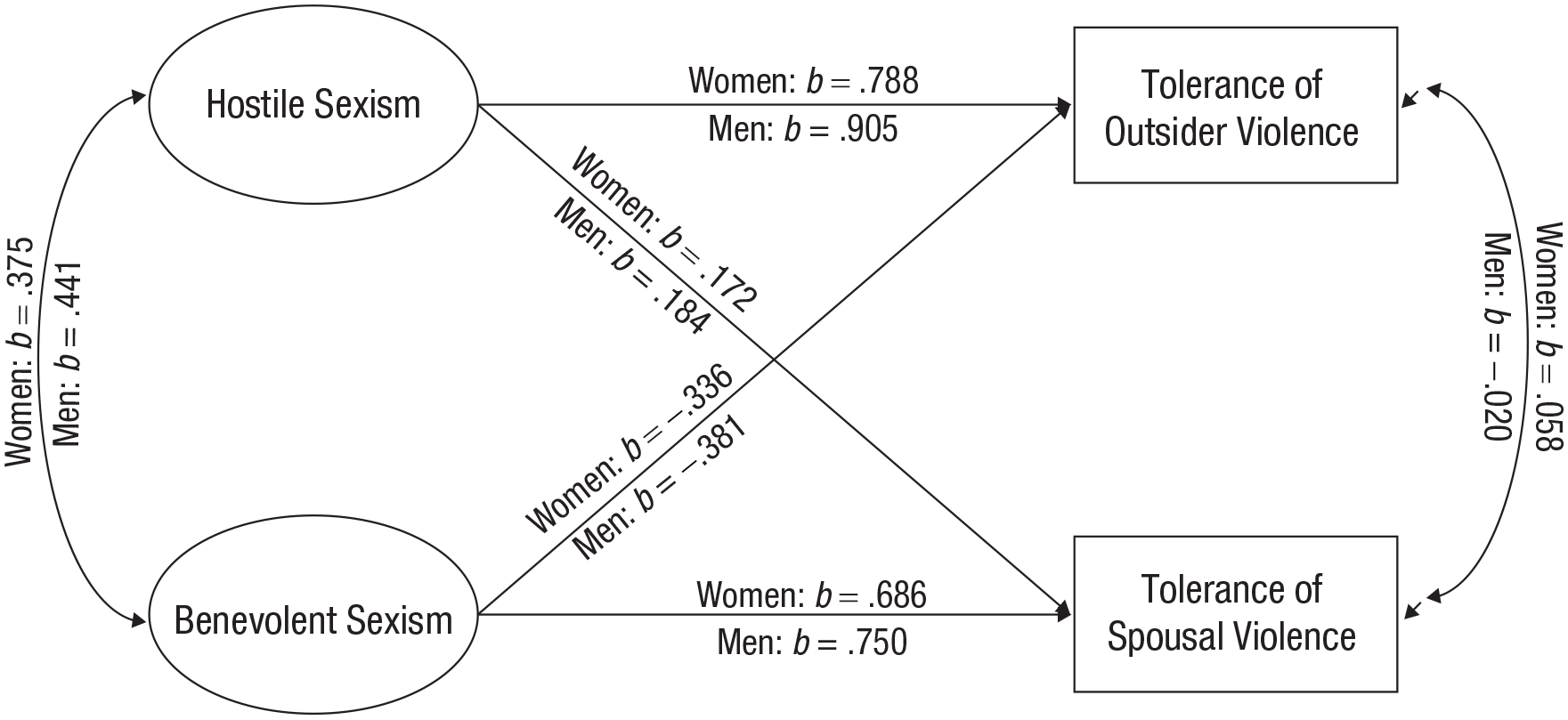
Multigroup structural equation model testing the simultaneous associations of latent hostile sexism and latent benevolent sexism with tolerance of outsider violence and tolerance of spousal violence. For visual simplicity, paths from the latent variables to the manifest indicators are not shown.
The pattern for benevolent sexism revealed the hypothesized opposing effects on tolerance of outsider violence versus spousal violence (Fig. 1). Endorsement of benevolent sexism was related to lower tolerance of outsider violence, bmen = −.381, SE = .016, p < .001, 99% CI = [−.422, −.340]; bwomen = −.336, SE = .009, p < .001, 99% CI = [−.360, −.312]. This effect did not significantly differ by gender according to our critical alpha, parameter difference = −.045, SE = .018, p = .014, 99% CI = [−.092, .002]. In contrast, endorsement of benevolent sexism was related to higher tolerance of spousal violence, bmen = .750, SE = .012, p < .001, 99% CI = [.719, .782]; bwomen = .686, SE = .008, p < .001, 99% CI = [.667, .706]. A comparison of the parameters indicated that the link between latent benevolent sexism and tolerance of spousal violence was slightly stronger for men than for women, parameter difference = .064, SE = .014, p < .001, 99% CI = [.028, .100].
Because hostile and benevolent sexism were both positively related to tolerance of spousal violence, we conducted an exploratory test of the differences in the relative strength of these relationships. The coefficient of benevolent sexism was significantly higher than the coefficient of hostile sexism for both men, parameter difference = .566, SE = .023, p < .001, 99% CI = [.506, .627], and women, parameter difference = .515, SE = .015, p < .001, 99% CI = [.477, .552]. Thus, endorsement of benevolent sexism was related to even more tolerance of spousal violence than endorsement of hostile sexism. Results remained consistent when testing the model with the inclusion of the following demographic covariates: age, literacy, employment status, marital status, caste, and religion (see the Supplemental Material).
Discussion
We conducted the first large-scale analysis of sexism and tolerance of gender violence in India. As expected, hostile sexism was related to greater tolerance of both outsider violence and spousal violence (see Agadullina et al., 2022), consistent with its function of directly enforcing men’s power (Bareket & Fiske, 2023). In contrast, the results for benevolent sexism diverged from, and provided an explanation for, null-to-weak effects in prior research. Benevolent sexism was simultaneously related to lower tolerance of outsider violence and higher tolerance of spousal violence. The opposing associations that differed on the basis of the source of violence illustrate the context-specific harm of benevolent sexism, consistent with its sensitivity to relational gender-role norms (Bareket & Fiske, 2023). Further, effects emerged for both men and women, aligning with theory that intergroup ideologies, including sexism, are effective at structuring society because their prescriptions are consensually shared by both high- and low-status groups (Sengupta et al., 2017; Suppes, 2020).
Our results provide new evidence for a central proposition of ambivalent sexism theory: Hostile and benevolent sexism have distinct consequences that perpetuate men’s societal power. Hostile sexism reinforces such power with overt aggression. By contrast, benevolent sexism simultaneously entices women with offers of safety while disempowering them with restrictive expectations. We demonstrated that this dual nature of benevolent sexism applies to violence. Any protection from public violence that women gain from benevolent sexism also means they are more vulnerable to violence committed by their “protectors.” Its protective appeal goes hand in hand with the disempowerment of women within relationships.
Although the disempowering effects of benevolent sexism are well documented, the implications for women’s power within relationships are underresearched (Hammond & Overall, 2017). Indeed, norms of men’s primacy in intimate relationships are weaker in WEIRD contexts, in which sexism research is typically conducted (Chen et al., 2009). Thus, prior research typically focused on indirect forms of disempowerment (e.g., benevolent sexism undermining women’s career aspirations; Kuchynka et al., 2017). By going beyond WEIRD contexts, our findings show that benevolent sexism is not always subtle in bolstering gender inequality. It can legitimize men’s power over women directly—at least within the traditional relationships that are prevalent in non-WEIRD societies such as India. Together with recent evidence that a nation’s gender inequality may moderate benevolent sexism’s effects on violence (Agadullina et al., 2022), these findings lay the groundwork for understanding how sexism functions in non-WEIRD contexts on the basis of the sociostructural conditions prevalent in these contexts (e.g., a combination of higher inequality and higher interdependence).
A key strength of this study was its high generalizability. Our large, representative sample indexed the gender-related attitudes of a broad cross-section of the Indian population—a diverse democratic society that accounts for one sixth of humanity. High statistical power also meant that our estimates of the hypothesized associations were very precise. Nonetheless, the data still come from a single country, and so more research will be needed to confirm whether the findings generalize to other non-WEIRD countries with different political structures (e.g., nondemocracies), religious traditions (e.g., Latin America), and histories of gender relations (e.g., postcommunist societies). Moreover, the findings are based on the specific questions posed to participants in the current survey, and our analysis cannot speak to forms of sexism (e.g., old-fashioned sexism) and violence (e.g., rape) that were not measured here.
Our cross-sectional survey precludes tests of the directionality of associations. The rationale that sexist attitudes precede violence norms follows prior theory and research stating that sexist prescriptions for women subsequently legitimize violence in response to women’s deviations from those prescriptions (Abrams et al., 2003; Agadullina et al., 2022). Nonetheless, ambivalent sexism theory also recognizes that societal conditions, including prevalence of violence, foster sexism (Fischer, 2006; Glick et al., 2000). Thus, sexist attitudes legitimize gender inequality, but in turn, people’s experiences of (dis)advantage foster beliefs that rationalize that inequality. The current findings likely represent a snapshot of a reciprocal process that can be tested in future longitudinal research and do not imply that fixing pervasive gender violence is as simple as changing people’s attitudes.
Conclusion
We drew on ambivalent sexism theory to examine how the pervasive violence faced by women in India is tolerated. Results showed that understanding this problem requires considering not only the hostile beliefs held by men but also the combination of aggressive and protective norms shared by both men and women. Prescriptions that women should be protected from outsiders can simultaneously legitimize men’s dominance within relationships, thus reinforcing the very inequalities that make women more vulnerable to violence.
Supplemental Material
sj-docx-1-pss-10.1177_09567976241254312 – Supplemental material for Ambivalent Sexism and Tolerance of Violence Against Women in India
Supplemental material, sj-docx-1-pss-10.1177_09567976241254312 for Ambivalent Sexism and Tolerance of Violence Against Women in India by Nikhil K. Sengupta, Matthew D. Hammond, Chris K. Deak and Ragini Saira Malhotra in Psychological Science
Footnotes
Acknowledgements
We are grateful to Rajiv B. Lall for conceiving and managing the Samaj Survey Project, which provided the data for the current study.
Transparency
Action Editor: Mark Brandt
Editor: Patricia J. Bauer
Author Contributions

References
Supplementary Material
Please find the following supplemental material available below.
For Open Access articles published under a Creative Commons License, all supplemental material carries the same license as the article it is associated with.
For non-Open Access articles published, all supplemental material carries a non-exclusive license, and permission requests for re-use of supplemental material or any part of supplemental material shall be sent directly to the copyright owner as specified in the copyright notice associated with the article.
