




Abstract
People perceive out-groups, minorities, and novel groups more negatively than in-groups, majorities, and familiar groups. Previous research has argued that such intergroup biases may be caused by the order in which people typically encounter social groups. Groups that are relatively novel to perceivers (e.g., out-groups, minorities) are primarily associated with distinct attributes that differentiate them from familiar groups. Because distinct attributes are typically negative, attitudes toward novel groups are negatively biased. Five experiments (N = 2,615 adults) confirmed the generalizability of the novel groups’ disadvantage to different aspects of attitude formation (i.e., evaluations, memory, stereotyping), to cases with more than two groups, and to cases in which groups were majority/minority or in-groups/out-groups. Our findings revealed a remarkably robust influence of learning order in the formation of group attitudes, and they imply that people often perceive novel groups more negatively than they actually are.
People often hold more negative attitudes toward out-groups, minorities, and novel groups than toward in-groups, majorities, and familiar groups (e.g., Hewstone et al., 2002). These intergroup biases can result from self-serving human motivations (e.g., Brewer, 1991; Tajfel & Turner, 1979), but they can also arise beyond motivated social perception as by-products of basic cognitive-learning processes. Sherman et al. (2009; see also Alves et al., 2018) introduced such a cognitive explanation and argued that the order in which people encounter different groups may cause biased attitudes. Across one’s lifetime, as well as during smaller time intervals, people typically encounter majority and in-group members before encountering minority and out-group members. Even when access to group members is not restricted, people choose to sample information about the in-group first (Bergh & Lindskog, 2019; Derreumaux et al., 2022, 2023).
Importantly, people’s attitudes toward novel attitude objects (e.g., groups) mostly reflect distinct attributes that are not shared with familiar attitude objects (Alves et al., 2020; Bruine de Bruin & Keren, 2003; Halberstadt et al., 2011). According to Kruschke’s (2003) attentional-learning theory, the cognitive system highlights distinct attributes of novel groups and cancels out shared attributes with groups encountered earlier (Kruschke, 2003). This asymmetrical learning effect is adaptive because it “reduces interference with previous knowledge and accelerates acquisition of new knowledge” (Kruschke, 2009, p. 169).
Crucially, as negative attributes (e.g., traits, behaviors) have a substantially lower probability of being present in a given person or group than positive attributes, negative attributes are strongly overrepresented among distinct (i.e., unshared) person or group attributes, whereas positive attributes are strongly overrepresented among shared person or group attributes (Alves et al., 2018; for a review, see Unkelbach et al., 2019). For example, let us assume the probability that a given person is trustworthy is .80 and the probability that a person is untrustworthy is .20, resulting in an objective trustworthy/untrustworthy odds ratio (OR) of 4. Among traits shared by two persons, this OR increases from 4 to 16. Conversely, among distinct traits, the odds ratio decreases from 4 to 1. If one sampled distinct attributes of persons or groups, the resulting attribute sample would be negatively biased. More detailed formalizations and simulations of this common-good phenomenon can be found elsewhere (Alves et al., 2017; see also Baldwin et al., 2024; Koch et al., 2024).
In sum, assuming (a) that out-groups and minorities are often more novel to perceivers than in-groups and majorities, (b) that people form attitudes toward novel attitude objects on the basis of their distinct attributes, and (c) that distinct attributes provide negatively biased attribute samples, we can expect people to form negatively biased attitudes toward novel groups and (by proxy) out-groups and minorities.
Despite its wide-ranging implications, the empirical evidence for the role of learning order in the formation of intergroup biases is still limited. Sherman et al. (2009) had participants learn the positive and negative attributes of members of a larger (i.e., majority) and a smaller (i.e., minority) group and confirmed that attitude formation first focuses on the majority before it switches to the minority. Instead of manipulating group size, Alves and colleagues (2018) directly manipulated the order in which participants learned about the positive and negative attributes of two fictional alien groups. Participants afterward preferred the first-encountered group over the more novel group when the groups’ distinct attributes were negative, leading to a novel group’s disadvantage. Conversely, when the groups’ distinct attributes were positive, participants preferred the novel group.
The Present Work
We provide further evidence for the causal role of learning order in the formation of intergroup biases and for the implied novel groups’ disadvantage. Experiment 1 confirmed that the novel groups’ disadvantage extends to cases in which participants encounter more than two groups and that it manifests itself in evaluations and biased memory for positive and negative group members. Experiment 2 found that participants’ recollections of the groups’ specific attributes are similarly biased by the order in which groups are encountered, and Experiment 3 extended this to the formation of stereotypes. Finally, Experiments 4a and 4b found that more recently encountered groups are primarily evaluated on the basis of their distinct attributes regardless of whether they are numerical majorities or minorities (or in-groups or out-groups).
Open Practices Statement
All experiments were preregistered. Preregistrations, materials, data, and analysis code are publicly available via the Open Science Framework (https://osf.io/5enqu). The Supplemental Material available online provides additional information and analyses. The present research follows the ethical guidelines of the American Psychological Association and the German Psychological Society and received approval from a local ethics board.
Statement of Relevance
The present research investigates why people often view groups they are not familiar with (or do not belong to) more negatively than their own groups, above and beyond self-serving motivations to dislike unfamiliar social groups. We suggest that this happens because people naturally focus on the differences between unfamiliar groups and their own groups, and those things are often negative. Our experiments found that when people encountered and formed impressions of new groups, their attitudes toward these groups (including memories and stereotypes) were mostly based on distinct and thus negative group attributes, which disadvantaged novel groups. These findings have important implications for understanding why people have more negative impressions of novel groups, like out-groups and minorities, and they highlight the need for greater awareness of the cognitive and motivational processes that underlie impressions of different social groups.
Experiment 1: Evaluation and Valence Memory
Experiment 1 featured an adapted version of the attitude-formation paradigm used by Alves et al. (2018). Participants sequentially encountered members of three different alien groups along with descriptions of their traits or behaviors. After the learning stage, we measured how likeable these groups were perceived to be and asked participants to recall how many group members had displayed positive traits or behaviors and how many had displayed negative traits or behaviors. All alien groups displayed the same number of positive and negative traits or behaviors, and we manipulated between participants whether the negative or positive attributes were distinct or shared among the groups. We predicted that in an ecology with distinct negative attributes, participants’ likeability ratings and their recalled frequencies for later-encountered groups would be negatively biased. We predicted the reverse pattern for participants in an ecology with distinct positive attributes.
Method
Participants
For Experiment 1, we aimed for a convenience sample of 600 participants to ensure sufficient statistical power (α > .90) to detect small-to-medium-sized interaction effects in the present design (Cohen, 1992; see Text S5 in the Supplemental Material). We recruited participants on Prolific Academic, which returned responses from 601 participants (age: M = 35.88 years, SD = 23.01; 188 males, 406 females, 4 other, 3 prefer not to say). All participants were located in the United Kingdom and participated for compensation of £0.40.
Procedure
Attribute-learning paradigm
We employed an experimental attribute-learning paradigm that was based on previous research by Alves et al. (2018). In this paradigm, participants encountered members of three alien groups, each consisting of six individual aliens. The three alien groups were depicted as one of three colored cartoons (developed by Gupta et al., 2004; see Fig. S1 in the Supplemental Material). The specific cartoon that represented each of the three groups was randomized. Participants encountered the aliens one by one in random order, and each alien was described with either a positive or a negative attribute. Three members of each group displayed a positive attribute, and three displayed a negative one. For each participant, the attributes were randomly selected from a list of attributes (see Table S1 in the Supplemental Material). Participants’ task was to follow the presentation of aliens and their attributes cautiously and to form an impression about the alien groups. After having encountered all six members of the first group (X group), participants encountered all six members of a second group (Y group), followed by all six members of a third group (Z group). We manipulated two different attribute ecologies between participants: In the negative-distinct ecology, the positive attributes were shared among all groups, and the negative attributes differed (i.e., were distinct) for each group. In the positive-distinct ecology, the negative attributes were shared among all groups, and the positive attributes were distinct for each group. We also manipulated attribute type—traits (e.g., “loving”) versus behaviors (e.g., “cheers others up”) between participants.
Dependent variables
After participants had undergone the attribute-learning paradigm, we measured participants’ evaluations of the groups by asking them to rate the likeability of each group on a 7-point scale (1 = very unlikeable, 7 = very likeable). Participants provided group likeability ratings in the same order they were encountered.
We measured valence memory for each group by asking participants to recall how many members of the respective group had shown a positive trait (or behavior) and how many members had shown a negative trait (or behavior). We presented the valence-memory measures for each group in the same order they were encountered. Participants could enter numbers in six free entry boxes on separate pages, two (positive valence, negative valence) for each group. The order of likeability and valence-memory measures was randomized.
Results
We here report only the statistical tests regarding our central predictions. All other analyses, results, and information on data exclusions can be found in the Supplemental Material (see Tables S2–S9 and S17; see also Text S2). Also, as we did not find any interactions of critical effects with attribute type, we combined both attribute-type conditions and treated them as one sample. Analyses and results of separate analyses of both attribute types can also be found in the Supplemental Material (see Table S2, Table S3, and Fig. S2).
Likeability ratings were analyzed with a mixed analysis of variance (ANOVA), including the factors ecology (positive-distinct vs. negative-distinct), attribute type (traits vs. behaviors), and serial position (first group vs. second group vs. third group). Serial position was coded with polynomial contrasts. As predicted, ecology significantly interacted with the linear contrast of serial position, B = −0.31, β = −0.25, t(1,489.83) = −4.77, p < .001. As shown in Figure 1a, perceived likeability in the negative-distinct ecology decreased with increasing serial position of the groups, whereas it increased in the positive-distinct ecology.
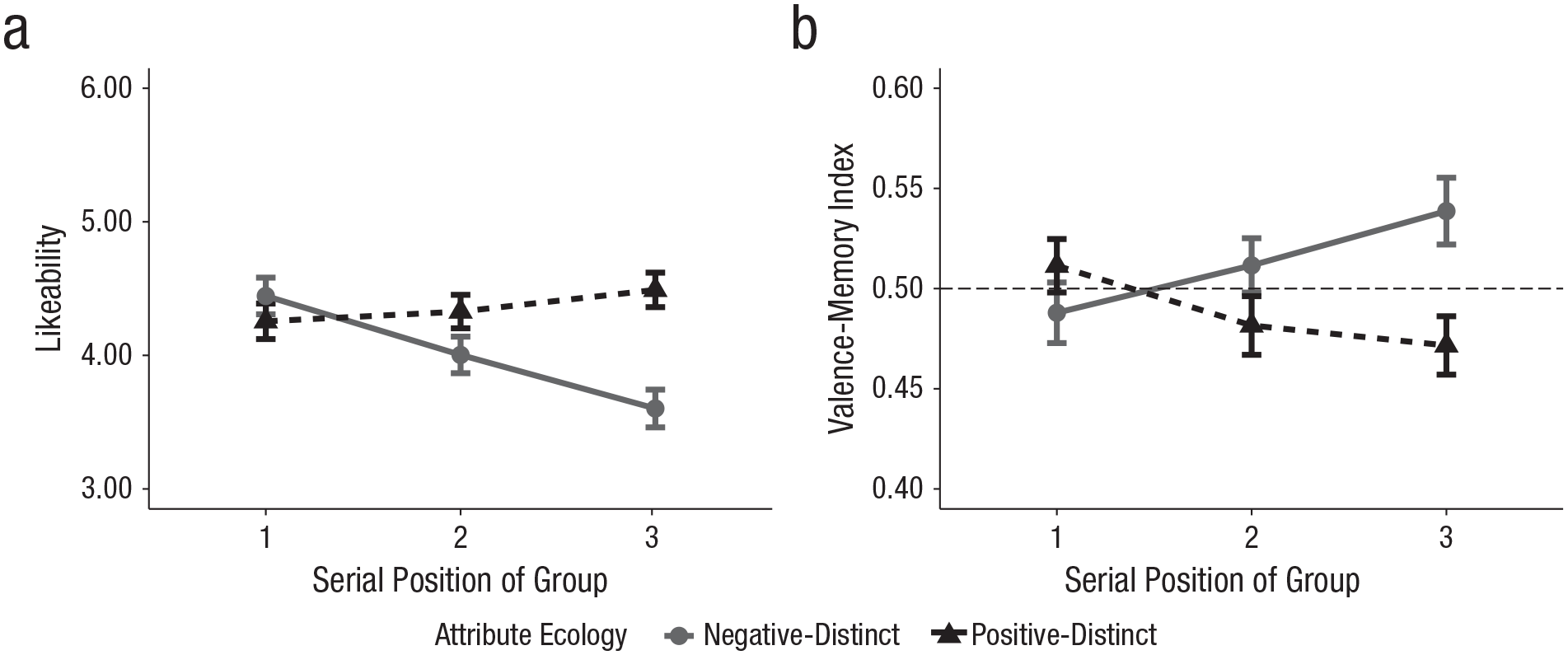
Likeability ratings and valence memory in Experiment 1. The valence-memory index expresses the relative frequency of recalled group members that displayed a negative attribute; an index higher (lower) than 0.5 indicates an overestimation of the frequency of negative (positive) compared to positive (negative) members for the respective group. Error bars represent 95% confidence intervals.
Participants’ valence memory for each group was analyzed similarly to the groups’ likeability. For each participant, we computed a valence-memory index separately for each group, expressing the relative frequency of recalled group members who displayed a negative trait (see Text S1 in the Supplemental Material). As predicted, ecology significantly interacted with the linear contrast of serial position, B = 0.03, β = 0.20, t(1,465.93) = 3.57, p < .001. As evident from Figure 1b, participants in the negative-distinct condition recalled an increasing relative frequency of negative group members with increasing serial positions of the groups. This pattern was again reversed for participants in the positive-distinct ecology.
Discussion
Experiment 1 confirmed the causal role of learning order in the formation of biased group attitudes for cases with more than two groups. When distinct group attributes were negative, more novel groups were evaluated more negatively. This novel groups’ disadvantage not only manifested in lower perceived likeability of later-encountered groups but was also visible in participants’ memory. This confirms that the novel groups’ disadvantage constitutes a genuine learning effect instead of a mere attribute-weighting effect, as suggested by attentional-learning theory (Kruschke, 2003; Sherman et al., 2009). Finally, Experiment 1 found the same effect pattern regardless of whether group members were described with traits or behaviors.
Experiment 2: Trait Memory
Going beyond the recalled frequencies of positive and negative group members, Experiment 2 tested whether participants’ recollection of specific group attributes is similarly affected by learning order. In addition to likeability ratings, Experiment 2 asked participants at the end of the experiment to recall the specific traits that the members of each group had displayed.
Method
Participants
To provide sufficient statistical power (α > .90) to detect small-to-medium-sized interaction effects in the present design (Cohen, 1992), we aimed for a convenience sample of 300 participants (see Text S5 in the Supplemental Material). We recruited participants through Prolific Academic, which returned responses from 303 participants who were all located in the United Kingdom and who participated for compensation of £0.40 (age: M = 34.79 years, SD = 11.40; 71 males, 229 females, 3 other, 0 prefer not to say).
Procedure
In Experiment 2, we used the same attribute-learning paradigm as Experiment 1. However, we omitted the behavior stimuli, because Experiment 1 found similar effects for both behaviors and traits as attribute stimuli.
After encountering all aliens, participants rated the likeability of each group, as in Experiment 1. We measured trait memory for each group by asking participants to recall which traits members of each group had displayed. We presented trait-memory measures for each alien group in the same order as before (“X” first, “Y” second, “Z” third). Participants could enter the traits in three free entry boxes on separate pages, one for each group. The order of likeability and trait-memory measures was randomized.
Results
We again report only the statistical tests regarding our central predictions. All other analyses, results, and information on data exclusions can be found in the Supplemental Material (see Tables S10, S11, and S18; see also Text S2 and S3). As illustrated in Figure 2a, Experiment 2 fully replicated the effects of likeability ratings found in Experiment 1. Results of the likeability analyses can also be found in the Supplemental Material (see Tables S10, S11, and S18).
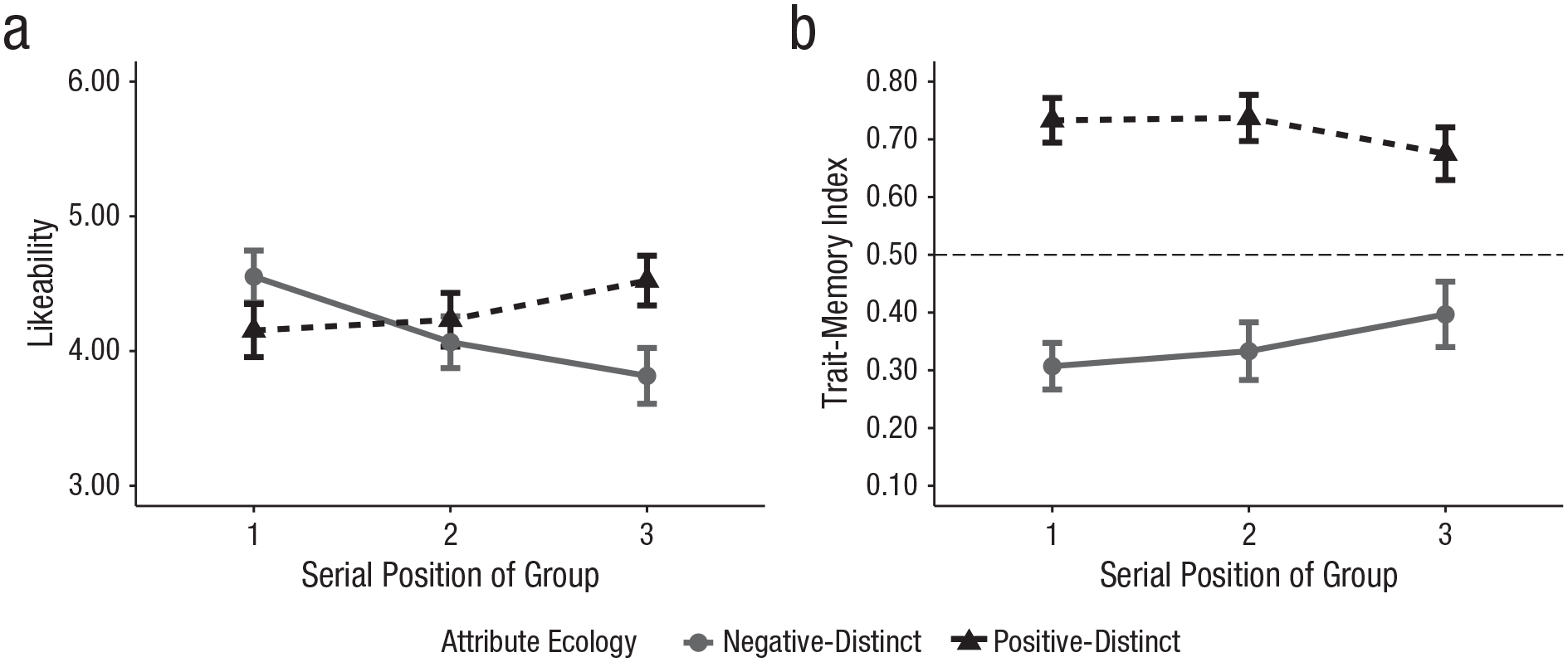
Likeability ratings and trait memory in Experiment 2. The trait-memory index expresses the relative frequency of correctly recalled negative traits; an index higher (lower) than 0.5 indicates that more negative (positive) than positive (negative) traits were recalled for the group in question. Error bars represent 95% confidence intervals.
Participants’ trait memory was analyzed in a manner similar to Experiment 1’s analysis of likeability ratings and valence memory. The trait-memory index expresses the relative frequency of correctly recalled negative traits for all three groups (see Text S1 in the Supplemental Material). As predicted, ecology significantly interacted with the linear contrast of serial position, B = 0.05, β = 0.16, t(561.37) = 3.25, p = .001. As shown in Figure 2b, the relative frequency of correctly recalled negative traits increased with increasing serial position of the groups in the negative-distinct ecology. This pattern was again reversed when distinct traits were positive.
Note that ecology had a large main effect, F(1, 278.39) = 369.50, p < .001, η p 2 = .57. In the negative-distinct ecology, participants correctly recalled fewer negative than positive traits (M = 0.35, SD = 0.30), and the reverse was true in the positive-distinct ecology (M = 0.72, SD = 0.25). Hence, participants’ trait memory was more accurate for shared than for distinct traits.
We then explored whether shared or distinct attributes drove the interaction between ecology and serial position. We calculated the mean number of recalled shared and distinct attributes for each serial position. As illustrated in Figure S3 in the Supplemental Materials, the effect of serial position on recalled attributes was different for distinct and shared attributes, F(2, 1510) = 14.11, p < .001, η p 2 = .02. Post hoc simple-effects analyses revealed that serial position did not affect the number of recalled distinct attributes, B = −0.02, t(1,510) = −0.39, p = .700, d = 0.01. However, with increasing serial position, the number of recalled shared attributes linearly decreased, B = −0.47, t(1,510) = −7.78, p < .001, d = 0.20.
Discussion
Experiment 2 confirmed that learning order casually influences the specific group traits that participants could remember, again resulting in a novel group’s disadvantage when negative traits were distinct. In the negative-distinct ecology, participants could recall more of the positive relative to the negative traits overall, but the proportion of correctly recalled negative traits increased for later-encountered groups. This pattern was again reversed in a positive-distinct ecology. More details on these results can be found in the Supplemental Material (see Text S6 and Fig. S3).
Experiment 3: Stereotyping
Going beyond biased memory, Experiment 3 tested whether participants would be more likely to stereotype novel groups on the basis of their distinct attributes than earlier-encountered groups. After encountering all groups and their traits, participants received a list of each group’s traits and were asked to pick one trait that best described each group.
Method
Participants
To provide sufficient statistical power (α > .90) to detect small-to-medium-sized effects in the present design (Cohen, 1992), we aimed for a convenience sample of 500 participants. We suspected that the effect size for stereotyping might be smaller than for evaluation and therefore sampled more participants than in the first two experiments. We recruited participants through Prolific Academic, which returned responses from 506 participants who were all located in the United Kingdom and who participated for compensation of £0.40 (age: M = 41.92 years, SD = 32.21; 166 males, 332 females, 8 other, 0 prefer not to say).
Procedure
In Experiment 3, we used the same attribute-learning paradigm as in the previous experiments, with a few exceptions. After participants encountered all aliens, we measured how participants stereotyped the groups. Stereotypes can be defined as “traits that come to mind quickly when we think about [the] groups” (Stangor, 2016). Thus, we asked participants to indicate one of each group’s traits that best described the group after participants had encountered all members of the three alien groups. Participants were presented with a list of all traits of each group and asked to select one trait that they thought best described the group. The order of traits within a list was randomized. We reasoned that the stereotype measure might be sensitive to presentation order at the judgment stage because participants might be reluctant to use the same attribute as a stereotype twice. Therefore, the order in which participants provided stereotypes for the different groups was also randomized.
Results
For each participant, we coded positive stereotypes with 0 and negative stereotypes with 1, depending on whether the participant selected a positive or a negative attribute of the respective alien group as the best description for this group (see also Text S1 in the Supplemental Material).
We fitted a mixed-effects logistic-regression model predicting the binary stereotype valence (0 = positive, 1 = negative) from three fixed effects: ecology, serial position, and their interaction. The serial position was coded with polynomial contrasts. The model included a random intercept for participants. As predicted, the model revealed a significant interaction between ecology and the linear contrast of serial position, OR = 1.81, 95% confidence interval (CI) = [1.49, 2.22], z = 5.83, p < .001. As illustrated in Figure 3, in the negative-distinct ecology, the likelihood that a negative trait was selected as a stereotype increased for groups encountered later. This pattern was again reversed in the positive-distinct condition. All other main and interaction effects are reported in the Supplemental Material (see Tables S12, S13, and S19).
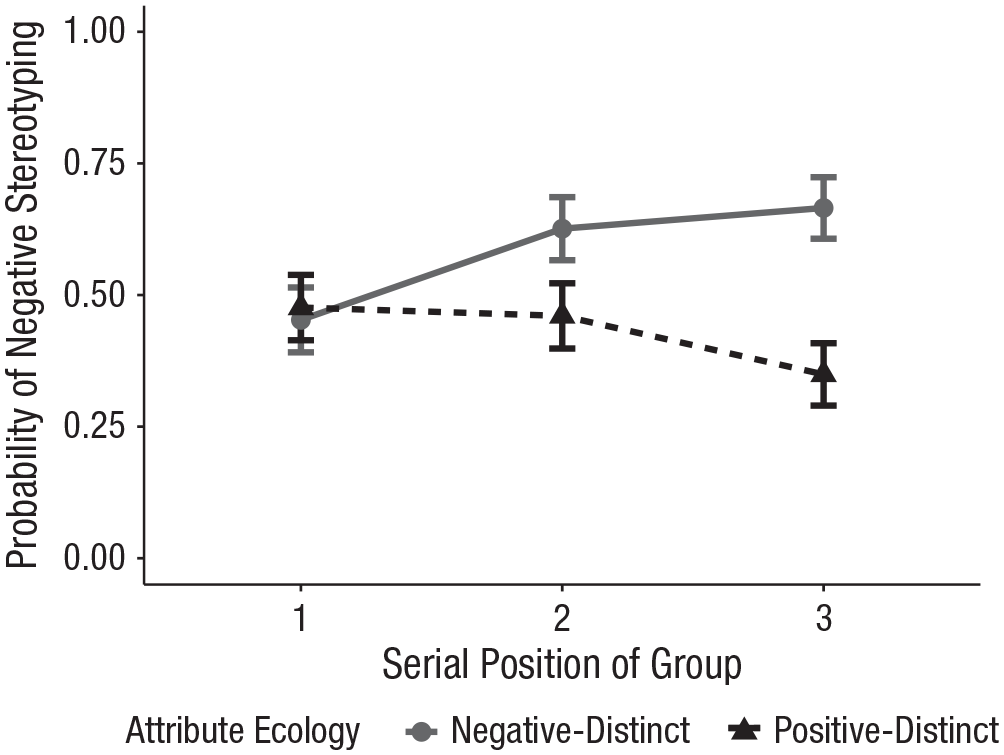
Probability of negative stereotyping in Experiment 3. Error bars represent 95% confidence intervals.
Because of a reviewer’s comment, we also explored the potential effects of serial group position at the stereotyping stage (instead of the serial group position at the learning stage). Serial group position during stereotyping showed no significant effects on stereotype selection (all ps > .100; for detailed results, see Tables S22 and S23 in the Supplemental Material).
Discussion
Experiment 3 confirmed that learning order causally influences stereotyping. Groups encountered later were more likely to be stereotyped on the basis of their distinct attributes than earlier-encountered groups. This was the case even though participants described the different groups only after they had encountered all groups, even though they were provided with all of the groups’ traits, and even though group descriptions were provided in randomized order. Crucially, the learning order, not the sterotyping order, determined whether groups were more likely to be stereotyped on the basis of distinct attributes.
Our findings so far suggest that out-groups and minorities may be perceived negatively because they are encountered later than in-groups and majorities. Yet minority or out-group status itself may also cause an association with distinct or negative attributes (e.g., Hamilton & Gifford, 1976). Experiments 4a and 4b, therefore, directly tested whether learning order, majority versus minority status (Experiment 4a), or in-group versus out-group status (Experiment 4b) determines the effect of distinct group attributes in attitude formation.
Experiments 4a and 4b: Majorities Versus Minorities and In-Groups Versus Out-Groups
In Experiments 4a and 4b, participants sequentially encountered members of two groups along with positive and negative traits before rating the groups’ likeability. Experiment 4a presented two alien groups, a majority and a minority; Experiment 4b presented two human in-groups or out-groups by manipulating the gender of the group members.
Method
For Experiments 4a and 4b, we each aimed for a convenience sample of 600 participants to ensure sufficient statistical power (α > .90) to detect small-to-medium-sized effects in the respective experiment designs (Cohen, 1992). We recruited participants through Prolific Academic, which returned 605 participants for Experiment 4a and 600 participants for Experiment 4b. All participants were located in the United Kingdom and participated for compensation of £0.40 (Experiment 4a) or £0.54 (Experiment 4b).
The design of Experiments 4a and 4b differed from the previous experiments in the following ways: Participants sequentially encountered two (instead of three) groups. Experiment 4a presented participants with a majority alien group consisting of 12 members and a minority alien group consisting of six members. Each group displayed three different positive and three different negative traits; these traits were displayed twice by members of the majority. Experiment 4b presented participants with a female and a male friend group, each consisting of six members. Three members of each group were described as having shown a positive behavior and three as having shown a negative behavior. Using participants’ gender, we determined whether the female or the male group constituted an in-group or an out-group; nonbinary participants were excluded from the analysis.
The order in which participants encountered the majority and minority groups in Experiment 4a and the in-groups and out-groups in Experiment 4b varied between participants, and so did the attribute ecology (positive-distinct vs. negative-distinct). Participants in Experiments 4a and 4b were asked to rate the likeability of each group at the end of the experiment. Experiment 4a also measured participants’ valence memory; the results of this measure are reported in the Supplemental Material (see Table S14), along with further procedural details regarding Experiments 4a and 4b (see Texts S1, S2, and S4).
Results
Experiment 4a
Likeability ratings were analyzed with a mixed ANOVA, including the factors ecology (positive-distinct vs. negative-distinct), group order (majority first/minority second vs. minority first/majority second), and serial position (first group vs. second group).
The predicted interaction between ecology and serial position was significant, F(1, 601) = 35.92, p < .001, η p 2 = .06. As illustrated in Figure 4, perceived likeability decreased from the first to the second group when negative traits were distinct, but perceived likeability increased from the first to the second group when positive traits were distinct. This effect did not interact with the order of the groups, F(1, 601) = 1.02, p = .313, η p 2 = .002. This indicates that the group encountered later was primarily evaluated on the basis of its distinct attributes, independent of majority or minority status. All other main and interaction effects are reported in the Supplemental Material (see Tables S14 and S20). In addition, similar results were found for the valence-memory measure and are also reported in the Supplemental Material (see Table S14).
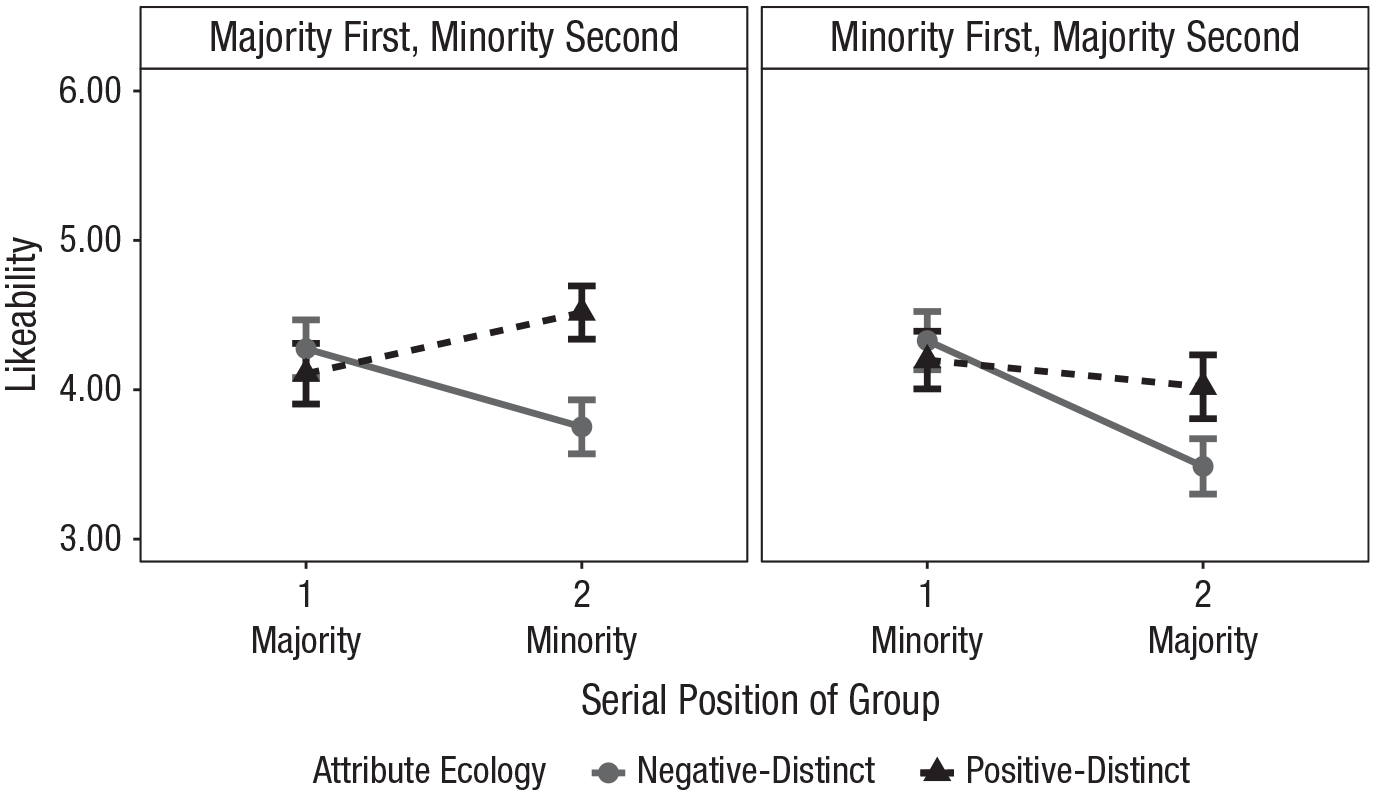
Likeability ratings in Experiment 4a. Error bars represent 95% confidence intervals.
Experiment 4b
As preregistered, we excluded from the analysis 52 participants who failed an attention check, which asked participants at the end of the experiment which of the two groups was the female and which was the male group. We also excluded 5 participants who identified as neither female or male.
Likeability ratings were analyzed with a mixed ANOVA that included the factors ecology (positive-distinct vs. negative-distinct), group order (in-group first/out-group second vs. out-group first/in-group second), and serial position (first group vs. second group).
Again, the predicted interaction between ecology and serial position was significant, F(1, 539) = 14.07, p < .001, η p 2 = .03. As illustrated in Figure 5, the second group was perceived to be less likeable than the first group in the negative-distinct ecology, and this was reversed in the positive-distinct ecology. This effect did not interact with the order of the groups, F(1, 539) = 2.33, p = .128, η p 2 = .004. This indicates that the group encountered later was primarily evaluated on the basis of its distinct attributes, independent of in-group/out-group status. All other main and interaction effects are reported in the Supplemental Material (see Tables S15 and Table S21).
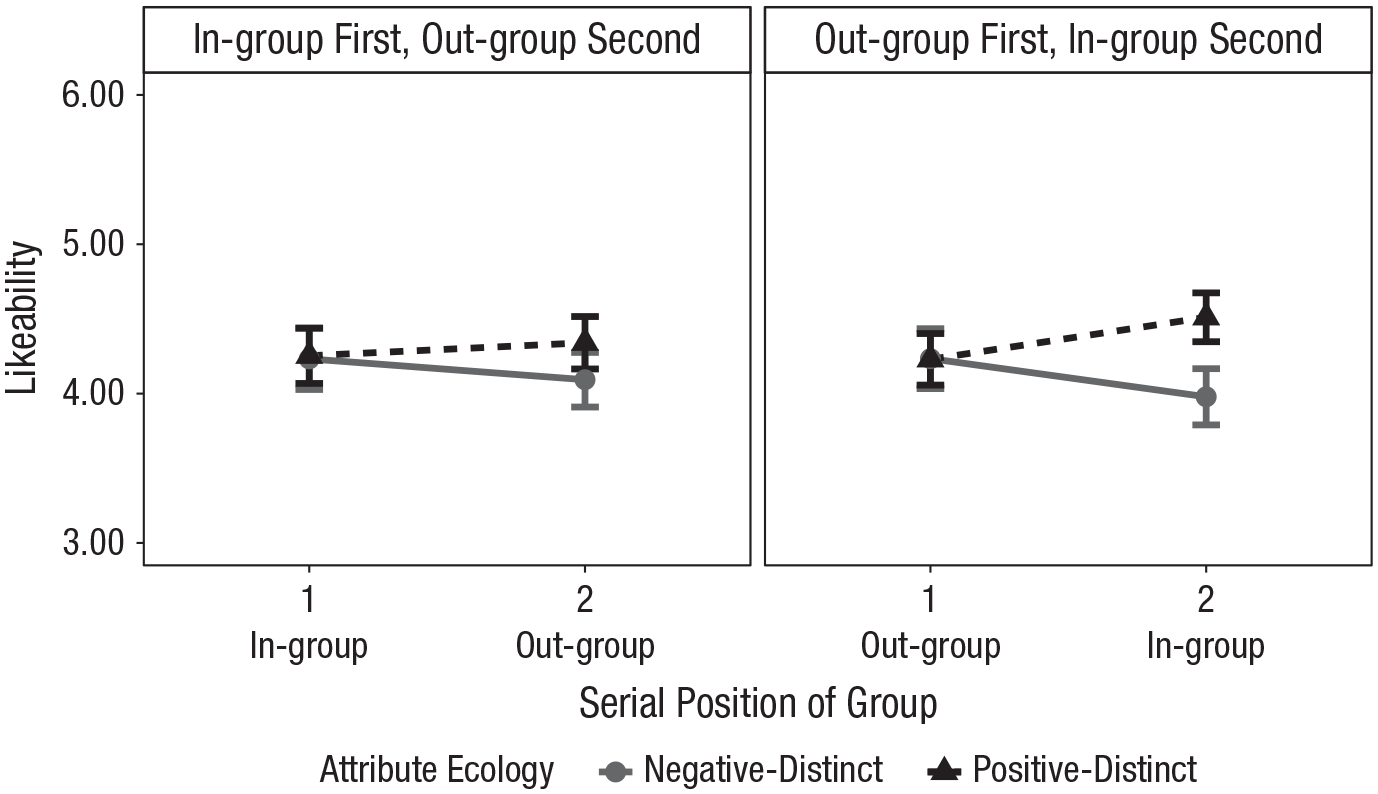
Likeability ratings in Experiment 4b. Error bars represent 95% confidence intervals.
Discussion
Experiments 4a and 4b confirmed that people evaluate groups that are encountered later primarily on the basis of the groups’ distinct attributes and that they do so independent of whether the groups are numerical majorities/minorities or in-groups/out-groups. Thus, group status per se does not determine the influence of distinct and shared attributes in sequential attitude formation, but learning order does.
General Discussion
The present work found converging evidence for the causal role of learning order in the formation of intergroup biases. People evaluate novel groups primarily on the basis of their distinct attributes, they overestimate the number of group members with distinct attributes, they recall less accurately attributes shared with already familiar groups, and they are more likely to stereotype novel groups on the basis of distinct attributes. These effects are not limited to two group cases but extend linearly to scenarios with three encountered groups. In addition, attitudes toward novel groups primarily reflect the groups’ distinct attributes regardless of whether the group is a majority or minority or an in-group or out-group.
Implications
Given that negative attributes are usually overrepresented among groups’ distinct attributes (e.g., Alves et al., 2017), groups that are relatively novel to perceivers will appear more negatively than they actually are. This disadvantage may apply to migrant groups like refugees but also to out-groups and minorities. People naturally encounter out-groups and minorities later in life than in-groups and majorities. Because people more often encounter in-group and majority members than out-group and minority members, people are also likely to first encounter members of the latter in any given context (Sherman et al., 2009). In addition, motivational forces may contribute to the formation of asymmetric learning orders. Recent research has found that people sample information about in-group members first, and more frequently, than information about out-group members (Bergh & Lindskog, 2019; Derreumaux et al., 2022, 2023).
Constraints on generality and open questions
It remains an open question whether the dominance of distinct relative to shared attributes is a universal phenomenon of attitude formation or whether there are cases in which shared attributes have a more dominant influence. Research on confirmation bias has shown that belief-consistent information can also enjoy advantages during learning (e.g., Klayman, 1995). When perceivers encounter members of the same group across different contexts, attributes shared among members from different contexts may actually enjoy a learning advantage, because they confirm the prior group impression. This would suggest that group impressions become more positive across time and contexts, an intriguing prediction that remains to be tested by future research.
Likewise, we do not know whether differentiation is moderated by different characteristics of the impression-formation task. Future research may, for example, investigate whether tasks that allow tracking values in a step-by-step fashion render even stronger differentiation effects (Hogarth & Einhorn, 1992).
Finally, some uncertainty remains regarding the extent to which the present findings from our laboratory paradigm can be applied to the real world. Outside the laboratory, impression formation is usually not condensed within a single learning session but distributed across time and space, and the relation between distinct and negative group attributes is probabilistic instead of deterministic.
Supplemental Material
sj-docx-1-pss-10.1177_09567976241239932 – Supplemental material for The Formation of Negative Attitudes Toward Novel Groups
Supplemental material, sj-docx-1-pss-10.1177_09567976241239932 for The Formation of Negative Attitudes Toward Novel Groups by Johanna Woitzel and Hans Alves in Psychological Science
Footnotes
Transparency
Action Editor: Mark Brandt
Editor: Patricia J. Bauer
Author Contributions

References
Supplementary Material
Please find the following supplemental material available below.
For Open Access articles published under a Creative Commons License, all supplemental material carries the same license as the article it is associated with.
For non-Open Access articles published, all supplemental material carries a non-exclusive license, and permission requests for re-use of supplemental material or any part of supplemental material shall be sent directly to the copyright owner as specified in the copyright notice associated with the article.
