




Abstract
In established relationships, are couples who are funny more satisfied with each other, or are satisfied couples more able to see the funny side of their partners? Much research has examined the evolutionary function of humor in relationship initiation, but not in relationship maintenance. Using a dyadic daily-diary study composed of college students from Singapore, results showed that relationship quality was positively associated with same-day humor production and perception. Importantly, and consistent with an interest-indicator perspective in which humor exchanges communicate relationship interest, relationship quality was also positively associated with next-day humor production and perception, and across both sexes. Results also indicated some support for a sexual-selection perspective in which humor exchanges predicted only same- and next-day satisfaction, but not commitment. Our findings suggest that humor can ultimately function as a strategy to monitor and maintain established relationships.
In established relationships, are couples who are funny more satisfied with each other, or are satisfied couples more able to see the funny side of their partners? Much research has found that humor promotes important relationship outcomes and is highly desired by potential mates (Buss, 1988). However, although evolutionarily minded scholars have employed frameworks like sexual-selection theory (Bressler et al., 2006) and the interest-indicator model (Li et al., 2009) to understand the roots and function of humor, such perspectives have not been applied to studying the day-to-day unfolding of humor in relationship maintenance.
Humor in Attraction and Mate Choice
Evolutionarily minded research on humor has primarily focused on its importance in mate choice and relationship initiation, with much evidence documenting the desirability of a humorous partner (e.g., Bressler et al., 2006). Accounts, however, differ on the role of humor in these contexts. One prominent perspective draws on sexual-selection theory (Darwin, 1871/1981), proposing that the capacity for humor may indicate the presence of other fitness-enhancing traits, like creativity and intelligence (Miller, 2000). Furthermore, humor’s role as a fitness indicator may be sex-differentiated. Given the greater obligatory reproductive costs borne by females, they have evolved to be choosier than males (Trivers, 1972). Thus, according to this male-display/female-choice model, females may prioritize a male’s capacity for humor production when evaluating his quality, whereas males may use humor displays to demonstrate their mate quality (Bressler et al., 2006; Li & Kenrick, 1999; Wilbur & Campbell, 2011). Here, humor is conceptualized as an antecedent of attraction.
In contrast, the interest-indicator model (Li et al., 2009) posits that humor evolved as a signal for communicating interest to potential and existing partners. From this perspective, when people are attracted to someone—and interested in initiating a relationship—they will display or appreciate humor attempts. Indeed, perceivers infer more romantic interest from targets who display higher (versus lower) levels of humor production and receptivity (Li et al., 2009; Tornquist & Chiappe, 2020) and perceive attractive or desirable targets as more humorous (e.g., Cowan & Little, 2013; Treger et al., 2013). Critically, unlike sexual-selection frameworks, the interest-indicator model conceptualizes humor as an outcome of attraction; furthermore, this model does not predict differences in tendencies to produce or appreciate humor outside of motivation to convey interest.
Role of Humor in Relationship Maintenance
Although evolutionary perspectives have proven useful for understanding humor in early relationship stages (i.e., mate selection), they have yet to be examined for maintaining established romantic relationships. Given the fitness implications of long-term relationships (Conroy-Beam et al., 2015), the lack of attention is surprising. Indeed, much research has demonstrated associations between humor and satisfaction and intimacy (e.g., De Koning & Weiss, 2002; Lauer et al., 1990; Ziv & Gadish, 1989), conflict reduction (Carstensen et al., 1995; Krokoff, 1991), and interpersonal emotion regulation (Horn et al., 2019). Yet research has rarely assessed the compatibility of extant evolutionary theories of humor with these findings and, more broadly, the utility of such theories in accounting for relationship-maintenance dynamics. Importantly, insofar as sexual-selection and interest-indicator perspectives extend to relationship maintenance, they should diverge in their predicted directionality of effects: Sexual-selection perspectives predict that humor leads to greater relationship quality, whereas the interest-indicator model predicts that relationship quality leads to more humor instead.
However, there may be some overlap between the two theories in the context of day-to-day relationship maintenance. For instance, some sexual-selection perspectives suggest that humor should be more strongly associated with relationship quality in the earliest relationship stages when people try to form accurate perceptions of potential partners’ qualities (Bressler et al., 2006). Other sexual-selection perspectives (e.g., Miller, 2000, 2007) suggest that humor should function as a continuing indicator of a partner’s quality throughout a relationship. This latter perspective suggests that relationship duration may not matter and is also aligned with the interest-indicator model. Proponents of that model argue that interest indication should occur at any stage of a relationship when gauging and expressing interest in a relationship is necessary (Li et al., 2009).
Statement of Relevance
Humor has typically been shown to promote attraction and is highly desired by potential mates, but the day-to-day unfolding of how humor affects relationship maintenance has rarely been examined. In this research, we tested whether relationship quality on a daily basis precedes humor or the other way around, using a sample of college students in Singapore. We found consistent evidence that individuals engaged in humorous interactions to the extent that they reported greater relationship quality on the previous day, but not the other way around. These findings enhance our understanding of the role of humor in relationship maintenance and highlight the importance of examining bidirectional processes between relationship quality and humor in interpersonal interactions.
Likewise, the theories may overlap somewhat in their emphasis on sex differences. Male-display/female-choice models of sexual selection propose that females place more importance on a partner’s humor production, and males place more importance on a partner’s humor appreciation (Bressler et al., 2006). However, other sexual-selection perspectives downplay sex differences in established relationships, in which both sexes are equally invested and thus equally choosy (i.e., a mutual mate-choice model of sexual selection; Miller, 2007; Stewart-Williams & Thomas, 2013). This latter view dovetails with the interest-indicator model, which does not predict inherent sex differences; insofar as relationship partners are equally motivated to signal their own (and evaluate their partner’s) romantic interest, both sexes are expected to display humor and appreciate a partner’s humor (Li et al., 2009).
Current Research
To fill the empirical gaps identified above—limited experimental methods, exclusive focus on early courtship, lack of evaluations of evolutionary perspectives, no tests of the directionality of effects—we utilized a dyadic daily-diary study to assess synchronous and lagged effects that constitute a valid test of the sexual-selection and interest-indicator models in established relationships. The lagged effects would be especially informative in establishing whether humor (production and perception) as a predictor comes before relationship quality (sexual selection) or relationship quality as a predictor comes before humor (production and perception as outcomes; interest indicator) over time in daily life. Furthermore, given that a sexual-selection perspective posits that mate preferences are especially relevant for adaptive reproductive purposes, we utilized a sample of college students in established relationships—a sample that would theoretically be well positioned to find any sex differences (e.g., Meltzer et al., 2014). In contrast to some sexual-selection perspectives (e.g., male-display/female-evaluation), an interest-indicator account does not expect sex differences in humor patterns for ongoing relationships and should not differ across relationship duration.
Open Practices
The data analytic code as well as materials for our study are publicly accessible at https://osf.io/cjh2x/?view_only=869815d796d84040976051d7e0184ecc. However, the data are not publicly accessible because of privacy concerns. The design and analysis plans were not preregistered.
Method
Participants and procedure
Participants were 108 couples (216 individuals) from a large Singapore university who were romantically involved in relationships (M = 18.27 months; SD = 19.25). Participants provided informed consent, and all procedures were approved by the Institutional Review Board at the institution where the research was conducted. Potential participants who were currently in romantic relationships (no minimum length) were recruited through flyers posted on campus, email announcements, listings via the school’s subject-pool system, and snowball sampling to take part in a dyadic, 7-day daily-diary study with a baseline survey. The baseline survey was conducted in a lab setting where couples completed several baseline questionnaires individually. They were then given instructions on how to complete the daily-diary portion of the study. We initially aimed to recruit at least 100 couples, following Kenny et al.’s (2006) recommendations, and also tried to recruit as many couples as possible across the academic year to account for potential attrition or missing data. Participants completed the daily diaries between 7:00 p.m. and 12:00 a.m. every evening for seven evenings. We received a total of 1,227 valid daily assessments during the daily diary for use in statistical analyses; on average, participants completed five valid assessments.
Diary measures
Daily humor perception
Participants completed a two-item measure of humor perception, with response options ranging from 1 (strongly disagree) to 7 (strongly agree), that tapped the extent to which people perceived that their partners were humorous (α = .95: “Today, my partner made me laugh”; “Today, I found my partner funny or humorous”).
Daily humor production
Participants completed a two-item measure of humor production, with response options ranging from 1 (strongly disagree) to 7 (strongly agree), that tapped the extent to which people engaged in humor with their partners (α = .94: “Today, I initiated humor toward my partner”; “Today, I made my partner laugh”).
Daily satisfaction
Participants completed a three-item measure of relationship satisfaction (Rusbult et al., 1998), with response options ranging from 0 (do not agree at all) to 8 (agree completely), that tapped the extent to which participants were satisfied in their relationship (α = .95: “Today, I felt satisfied with our relationship”; “Today, my relationship was close to ideal”; “Today, our relationship did a good job at fulfilling my needs for intimacy, companionship, etc.”).
Daily commitment
Participants completed a four-item measure of relationship commitment (Rusbult et al., 1998), with response options ranging from 0 (do not agree at all) to 8 (agree completely), that tapped the extent to which participants were committed to their relationship (α = .76: “Today, I am committed to maintaining my relationship with my partner”; “Today, I want our relationship to last for a very long time”; “Today, I would not feel very upset if our relationship were to end in the near future” [reverse scored]; “Today, I am oriented toward the long-term future of my relationship”).
Daily perceived partner commitment
Participants completed a four-item measure of perceived partner commitment (Rusbult et al., 1998), with response options ranging from 0 (do not agree at all) to 8 (agree completely), that tapped the extent to which participants perceived that their partners were committed to their relationship (α = .81: “Today, MY PARTNER is committed to maintaining my relationship with me”; “Today, MY PARTNER wants our relationship to last for a very long time”; “Today, MY PARTNER would not feel very upset if our relationship were to end in the near future” [reverse scored]; “Today, MY PARTNER is oriented toward the long-term future of our relationship”).
Results
We used SPSS MIXED to run multilevel models to account for the nested nature of our dyadic- diary data. Following recommendations for analyzing longitudinal dyadic data (Bolger & Laurenceau, 2013), daily observations and participants were modeled as crossed and nested within dyads. We included two redundant dummy codes to represent each couple member as two random intercepts nested within couples and slopes were fixed. We ran models looking at daily effects of relationship quality on same-day humor outcomes (and vice versa). Because of the large number of analyses involved in the current research, which might inflate Type I error, we adopted a stricter alpha level (i.e., .01) for significance testing.
As the key test for the validity of the sexual-selection and interest-indicator models, we ran models looking at same-day and lagged effects of humor on next-day relationship-quality outcomes (in accordance with the sexual-selection model), and models looking at the same-day and lagged effects of relationship quality on next-day humor outcomes (in accordance with the interest-indicator model). As another key test of both theoretical perspectives, we examined whether there were any gender interactions with relationship-quality variables (i.e., satisfaction, commitment, and perceived partner commitment), as the presence or absence of gender interactions is consistent with a sexual-selection perspective or interest-indicator perspective, respectively. Consequently, gender interactions with relationship-quality variables were added to our models. There was a main effect of gender for humor production but not for humor perception: Males reported producing more humor on a daily basis compared to females. Importantly for all our models, the interactions between gender and relationship quality were nonsignificant, which was consistent with an interest-indicator perspective. These gender interactions were subsequently removed for more parsimonious models. Finally, it is possible that relationship duration might be important from a sexual-selection perspective and that the link between humor and relationship quality might be stronger in the early stages of relationships. Relationship duration did not predict any of the humor or relationship-quality variables and did not have any moderating effects, which again is consistent with an interest-indicator perspective. We were primarily interested in within-person effects, but we provide between-person effects for interested readers.
Same-day effects of relationship quality predicting daily humor outcomes
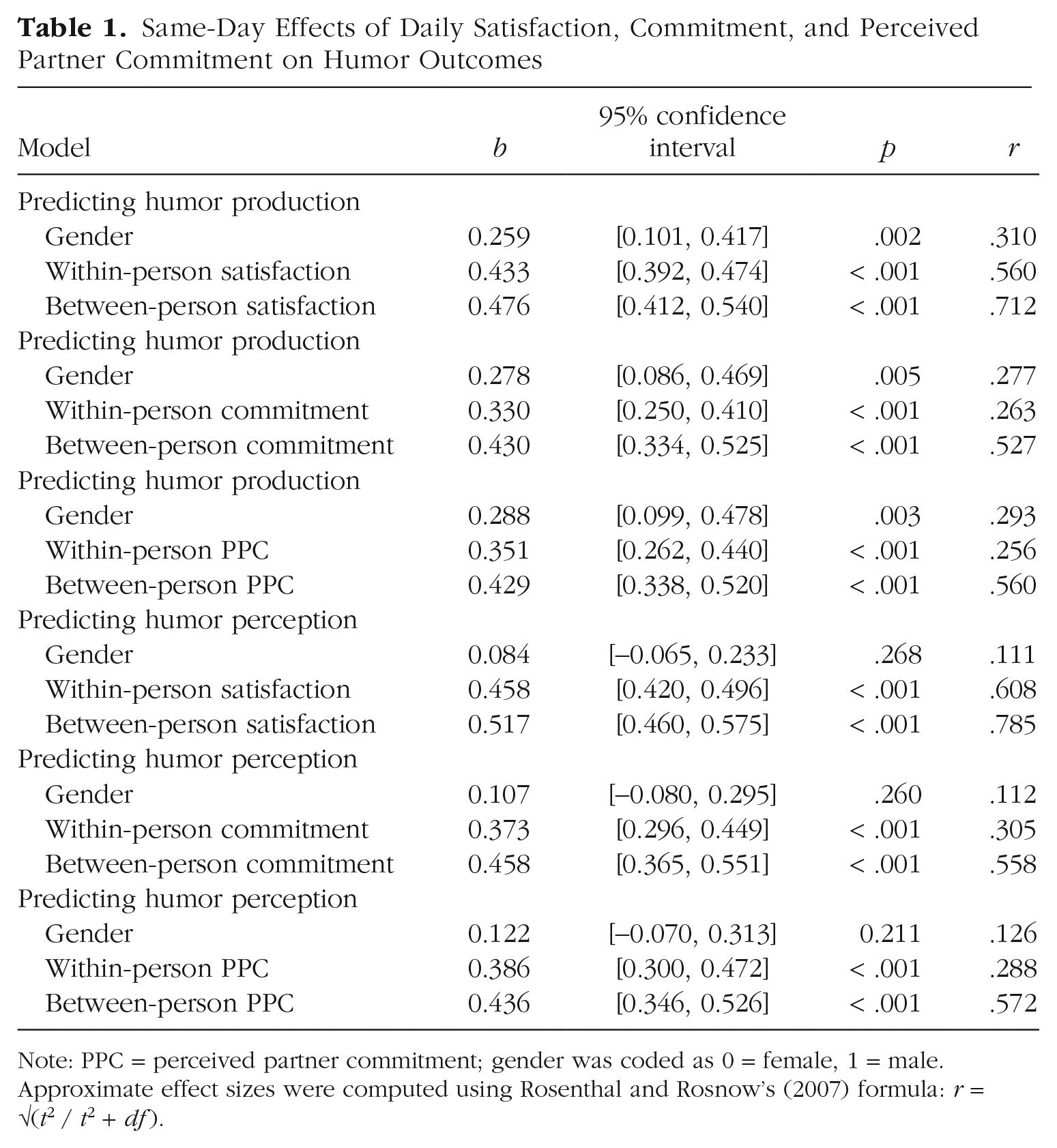
We first examined the predictive effects of satisfaction, commitment, and perceived partner commitment on same-day daily humor production and perception to test humor as an indicator of continued romantic interest. We computed separate models for each of our relationship-quality predictors. These relationship-quality predictors were within-person centered and reflected daily fluctuations in satisfaction, commitment, or perceived partner commitment relative to an individual’s own mean. We created separate between-person predictors by grand-mean centering the person-centered mean, providing a partition of between- and within-person variance (Wickham & Knee, 2013). Consistent with an interest-indicator perspective, both daily and between-person effects of satisfaction, commitment, and perceived partner commitment were significant and unique predictors of humor production and perception. That is, on days when an individual was particularly satisfied (or committed, or perceived that their partner was highly committed), they also reported greater humor production and perception (see Table 1).
Same-Day Effects of Daily Satisfaction, Commitment, and Perceived Partner Commitment on Humor Outcomes
Note: PPC = perceived partner commitment; gender was coded as 0 = female, 1 = male. Approximate effect sizes were computed using Rosenthal and Rosnow’s (2007) formula: r = √(t2 / t2 + df ).
Same-day effects of humor production and perception predicting daily relationship quality
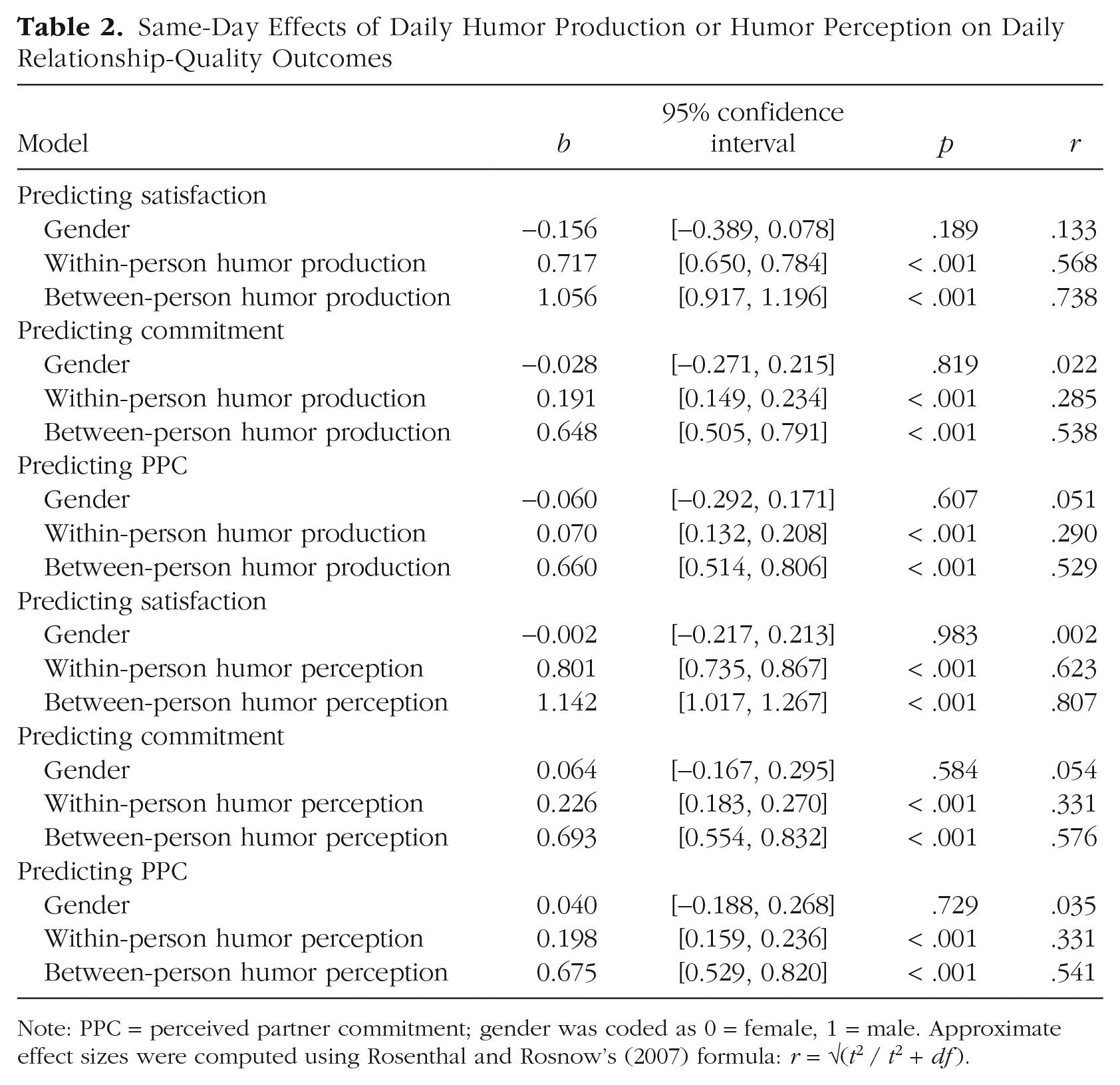
We next examined the predictive effects of daily humor production and perception on same-day satisfaction, commitment, and perceived partner commitment to test the idea that humor functions as sexual selection. We computed separate models for each of our humor predictors. Again, humor production and perception were within-person centered and reflected daily fluctuations in humor production and perception relative to an individual’s own mean. We created separate between-person predictors by grand-mean centering the person-centered mean, providing a partition of between- and within-person variance (Wickham & Knee, 2013). Consistent with the sexual-selection perspective, both daily and between-person effects of humor production and perception were significant and unique predictors of relationship quality. That is, on days when individuals produced and perceived more humor, they also reported greater relationship quality in terms of satisfaction, commitment, and perceived partner commitment (see Table 2).
Same-Day Effects of Daily Humor Production or Humor Perception on Daily Relationship-Quality Outcomes
Note: PPC = perceived partner commitment; gender was coded as 0 = female, 1 = male. Approximate effect sizes were computed using Rosenthal and Rosnow’s (2007) formula: r = √(t2 / t2 + df ).
Lagged effects of relationship quality predicting daily humor outcomes
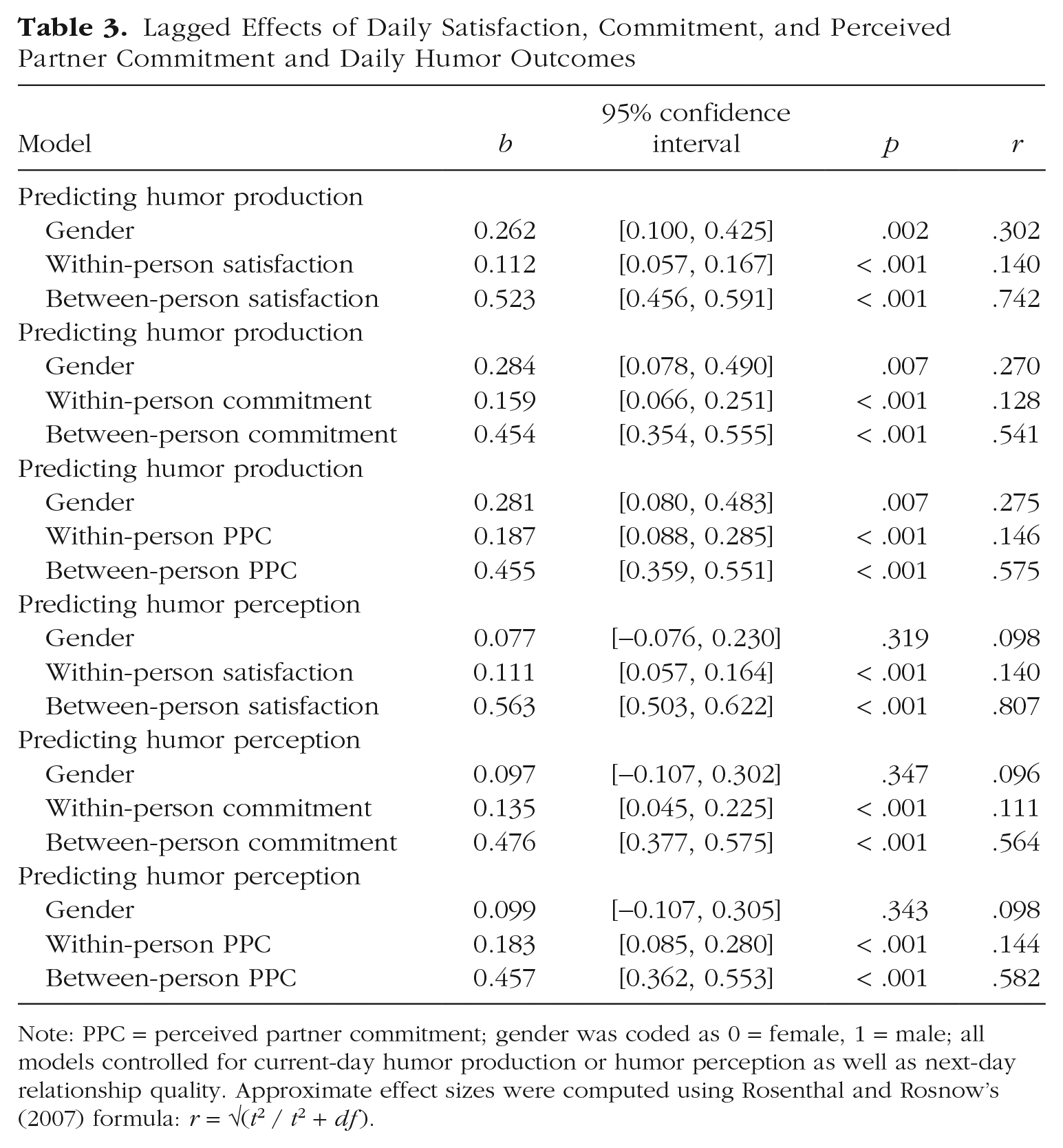
We next examined the predictive lagged effects of satisfaction on next-day humor outcomes of production and perception. We computed lagged models in which relationship quality (satisfaction, commitment, or perceived partner commitment) on day d was entered as a predictor of humor production or perception the next day (day d + 1). Humor production or perception measured on day d was included as a control variable to account for stability and thus model change from day d to day d + 1, whereas next-day relationship quality was also included to test that our lagged effects had predictive validity over current-day effects. Importantly and consistent with an interest-indicator perspective, both daily and between-person effects of satisfaction, commitment, and perceived partner commitment significantly predicted an increase in humor production and perception from one day to the next (see Table 3).
Lagged Effects of Daily Satisfaction, Commitment, and Perceived Partner Commitment and Daily Humor Outcomes
Note: PPC = perceived partner commitment; gender was coded as 0 = female, 1 = male; all models controlled for current-day humor production or humor perception as well as next-day relationship quality. Approximate effect sizes were computed using Rosenthal and Rosnow’s (2007) formula: r = √(t2 / t2 + df ).
Lagged effects of humor production and perception predicting daily relationship quality
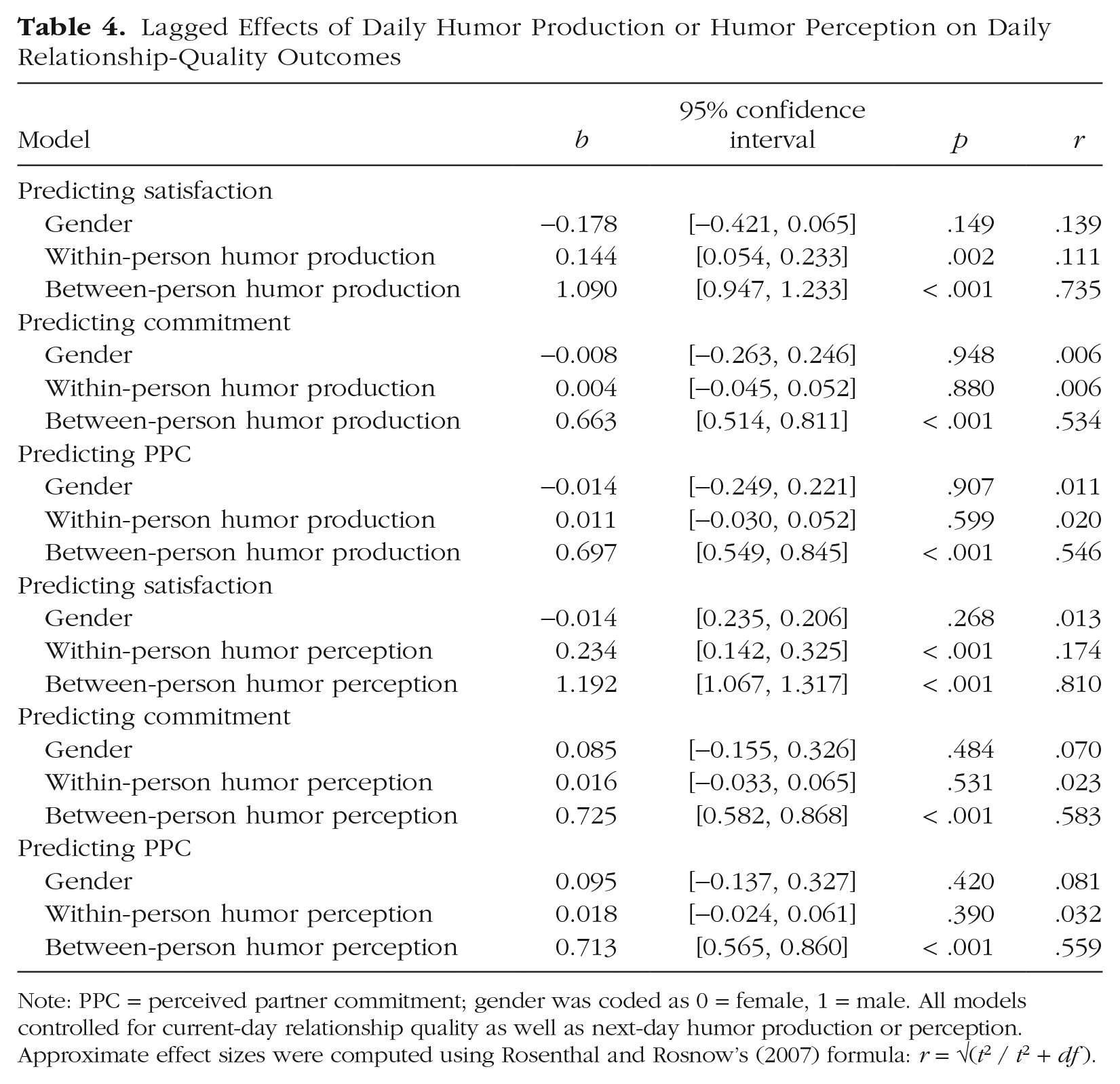
Finally, we computed reverse temporal models in which humor production or perception on one day (day d) predicted satisfaction the following day (day d + 1), while controlling for day d relationship quality (satisfaction, commitment, or perceived partner commitment) as well as next-day humor production or perception to test that our lagged effects had predictive validity over current-day effects. Consistent with a sexual-selection perspective, both daily and between-person effects of humor production or humor perception significantly predicted an increase in satisfaction from one day to the next. Interestingly, however, there were no significant effects of lagged daily effects of humor production or perception on commitment or on perceived partner commitment (see Table 4); we return to this issue of variation in effects in the general discussion.
Lagged Effects of Daily Humor Production or Humor Perception on Daily Relationship-Quality Outcomes
Note: PPC = perceived partner commitment; gender was coded as 0 = female, 1 = male. All models controlled for current-day relationship quality as well as next-day humor production or perception. Approximate effect sizes were computed using Rosenthal and Rosnow’s (2007) formula: r = √(t2 / t2 + df ).
Discussion
Various evolutionary models of humor have been previously proposed, yet extant research has largely tested these theories only within the context of relationship initiation. Even when the role of humor in relationship maintenance and daily life has been examined, direct tests of the sexual-selection and interest-indicator perspectives—two major evolution-guided models—have been rare. In addressing these gaps, the current research found greater support for the interest-indicator model (Li et al., 2009): relationship quality (in terms of satisfaction, commitment, and perceived partner commitment) was positively associated with same-day humor production and perception, but more importantly, positively predicted them on the next day. Furthermore, these findings were not sex-differentiated, nor did they differ by relationship length. Our findings provide direct evidence for theorizing (Li et al., 2009) on the interest-indicator model, that beyond indicating interest in early courtship, humor also functions as a tool for relationship maintenance by signalling continued interest during the relationship.
In contrast, we found less support for the male-display/female-choice perspective of sexual selection. Males reported higher levels of humor production daily compared to females, perhaps to continue showing their suitability as a romantic partner (Wilbur & Campbell, 2011). This finding is congruent with past studies showing evidence of sexual selection (e.g., Bressler & Balshine, 2006; Wilbur & Campbell, 2011) in which men were more likely than women to report producing humor to attract potential mates. However, inconsistent with some sexual-selection perspectives, we did not find sex differences, and we did not find that humor was more strongly predictive in the earlier stages of relationships. Although the sexual-selection model was not fully supported, our study replicated past research showing that humor precedes relational well-being (e.g., De Koning & Weiss, 2002). Specifically, humor production and perception influenced satisfaction (but neither commitment nor perceived partner commitment) the next day. It is possible that daily commitment and perceived partner commitment are constructs concerning relationship persistence and stability and, thus, waver less than constructs like satisfaction, which assess subjective experiences of rewards and costs (Rusbult et al., 1998). This was indeed the case in our data, where commitment (SD = 1.47) and perceived commitment (SD = 1.51) showed less variance than satisfaction (SD = 2.02). Beyond examining mediators such as positive interactions (Caird & Martin, 2014) and psychological intimacy (Horn et al., 2019), examining sexually selected fitness indicators such as warmth or intelligence could shed further light on a continued sexual-selection process in established relationships (Miller, 2000, 2007).
Limitations and future directions
Although diary methods offer advantages, such as time-lag analyses and external validity (Bolger & Laurenceau, 2013), they involve self-report—and not truly objective—measures of behavior. Coding video interactions of partners’ humor production and perception would constitute another measure for examining the validity of both theories. It could also allow for more fine-tuned analyses on humor dynamics or examinations of different forms of humor use, such as humor synchrony—an important predictor of interpersonal rapport (Vacharkulksemsuk & Fredrickson, 2012). Furthermore, examining humor processes longitudinally would shed light on the extent to which relationship quality affects humor and vice versa over a longer period of time. Finally, experimental designs would more strongly affirm the causal interpretations afforded here.
Our results were consistent with conceptualizations of humor as an indicator of continued compatibility or a lack of conflict. Interestingly, such accounts could lead to nuanced predictions that are not easily derived from the interest-indicator model (though they may ultimately be consistent with it). For example, although humor was implicitly characterized positively in our study, there are various other styles of humor (e.g., Campbell et al., 2008). For example, beyond affiliative or positive humor (e.g., humor used to connect, communicate, convey appreciation, make a partner laugh), there are aggressive or negative forms of humor used to attack or demean others (Martin et al., 2003) or oneself (self-deprecating humor; Stieger et al., 2011). Conflict and negative forms of humor are negatively associated with relationship quality (see Hall, 2017), and future tests can examine the extent to which they serve as indicators of poorer interest. Such examinations can contribute to a nuanced (i.e., domain-specific) account of humor’s role as an interest indicator in some situations, and a disinterest indicator in others.
Our sample was from Singapore—a departure from psychology samples composed of Western, educated, industrialized, rich, and democratic (WEIRD) participants (Henrich et al., 2010). Accordingly, our sample showcases how evolutionary models of humor can extend to non-WEIRD samples. Nonetheless, Singapore’s population is highly educated, industrialized, and rich, so future research could collect more culturally diverse samples to extend the generalizability of our results. Importantly however, research examining cultural differences in mating preferences showed largely the same patterns of effects between Singaporean and U.S. samples (e.g., Li et al., 2011; Thomas et al., 2020) in terms of sex differences, and humor was prioritized as a mate preference in Western versus Eastern cultures (Thomas et al., 2020). Moreover, East Asians are less likely to use direct forms of emotional expression (Butler et al., 2009) and are less likely to use direct expressions of positive emotion to communicate relationship closeness and warmth; they are more likely to employ instrumental means, such as practical advice (Chen et al., 2012). That we still found humor effects in Singapore indicates that these effects may also hold in Western samples. Finally, because our sample consisted of college students in dating relationships, we cannot ascertain whether our hypotheses hold in the context of long-term marriages and older adults. Given the theorized function of humor as an indicator of continued interest, we expect that the relevant processes may be unaffected by age or marriage.
Finally, although the sexual-selection and interest-indicator perspectives differ in important ways, they are not necessarily mutually exclusive (Li et al., 2009). That is, humorous exchange may have been shaped by evolutionary processes for both courtship (via sexual selection) and for communication of interest in potential and existing relationships. Moreover, sexually selected sex differences in humor production or reception may be found only in domains like initial courtship, where there has been more selective pressure for one sex (men) to initiate relationships. Going forward, humor research may benefit from examinations of these bidirectional processes across numerous social domains, such as work or parent–child relationships.
Conclusion
The current research sheds light on and adds to the literature addressing the evolutionary function of humor, especially in the context of established relationships. Our findings suggest that humor can be mutually transformative, that humor promotes relationship quality, and that relationship quality, more importantly, promotes the continued production and perception of humor in established romantic relationships.
Footnotes
Transparency
Action Editor: Martie Haselton
Editor: Patricia J. Bauer
Author Contribution(s)
