




Abstract
People’s ability to regulate emotions is crucial to healthy emotional functioning. One overlooked aspect in emotion-regulation research is that knowledge about the source of emotions can vary across situations and individuals, which could impact people’s ability to regulate emotion. Using ecological momentary assessments (N = 396; 7 days; 5,466 observations), we measured adults’ degree of knowledge about the source of their negative emotions. We used language processing to show that higher reported knowledge led to more concrete written descriptions of the source. We found that higher knowledge of the source predicted more emotion-regulation attempts; increased the use of emotion-regulation strategies that target the source (cognitive reappraisal, situation modification) versus strategies that do not (distraction, emotional eating); predicted greater perceived success in regulating emotions; and greater well-being. These patterns were evident both within and between persons. Our findings suggest that pinpointing the source of emotions might play an important role in emotion regulation.
Keywords
Imagine noticing that you are anxious. As you notice your feelings, you may try to identify what caused you to feel this way. In one scenario, you realize that you are anxious because of an approaching deadline at work. In another, you do not fully know why you are anxious, or you only vaguely identify that it must be work related. How does the degree of knowledge about the source of your emotions impact whether and how you try to change them? Research on emotion regulation largely assumes that people know the source of their emotions (Yih et al., 2019). However, people might not always know what made them feel the way they do, which could carry implications for emotion regulation. Here, we use ecological momentary assessments (EMA) to test whether greater knowledge about the cause of emotions in daily life predicts more attempts to regulate them, the use of emotion-regulation strategies that target the cause, and greater perceived emotion-regulation success.
Source Attribution of Emotions
Emotions are reactions to external or internal situations (Gross, 2015). Often people know what caused them to feel a certain way, but that is not always the case; sometimes people are aware of their feelings but unsuccessful in identifying what caused them (Clore et al., 2001). For instance, people can react emotionally without being consciously aware of what elicited their reaction (Lazarus, 1991; Sweeny et al., 2009). People can also be exposed to multiple emotionally-eliciting stimuli in quick succession, making it hard to match one’s feelings and the relevant situation. For instance, research on affect misattribution suggests that in ambiguous situations people may attribute their emotions to irrelevant sources (Payne et al., 2005).
Source attribution of emotions can vary not only across situations, but also across individuals. Boden and Berenbaum (2011) found that people differ in their typical clarity about the source of emotions and differentiated source clarity from identifying the type of the emotion experienced (e.g., anger vs. fear). Therefore, we expect both situational and individual differences in identifying the source of one’s own feelings.
Emotion Regulation
Emotion regulation involves changing emotions by using emotion-regulation strategies (Gross, 2015). Whereas some strategies target the emotional response itself, central emotion-regulation strategies target the source of the emotional response (Gross, 1998). For instance, situation modification involves changing the situation that caused the emotion (e.g., negotiating with one’s landlord to reduce anxiety over rent payments; Quoidbach et al., 2015), and cognitive reappraisal involves reinterpreting the situation (e.g., reinterpreting criticism as a growth opportunity to reduce anger; Uusberg et al., 2019). Other strategies do not necessitate knowledge of the source but commonly involve having such knowledge. For example, when people seek social support to regulate emotions, they typically share what made them feel the way they do (Zaki & Williams, 2013).
Because central emotion-regulation strategies target the source of the emotional response, when knowledge about the source is limited or lacking, these strategies can become unavailable, restricting the number of emotion-regulation strategies at one’s disposal. Like any other human behavior, the likelihood of initiating emotion regulation depends not only on how much regulation is desirable, but also on how much it is attainable (Tamir, 2021). When the set of emotion-regulation strategies is restricted, emotion regulation could become less attainable and therefore less likely to occur. For instance, when people know they feel anxious over a deadline at work, they can work harder to meet that deadline (i.e., situation modification), reappraise the importance of meeting this deadline for their career (i.e., cognitive reappraisal), or ask coworkers for help (i.e., social support). When the source of anxiety is vague, however, the attainability of emotion regulation decreases as such regulatory options become unavailable. Therefore, we predict that when source attribution of emotion is low, people would attempt emotion regulation to a lesser extent.
Statement of Relevance
For decades researchers have been trying to find ways to improve people’s ability to regulate negative emotions. Thus far, researchers have generally assumed that people know the causes of their negative feelings, and therefore highlighted emotion-regulation strategies that target these causes. In this project we tracked participants’ knowledge of the causes of their emotions, and their emotion regulation multiple times a day for one week, using their smartphones (ecological momentary assessments, or EMAs). We show that people do not always know the source of their negative emotions. We also show that the more people knew about the source of their negative emotions the more they tried to regulate them, the more they used emotion-regulation strategies that targeted the source, and the greater was their perceived success in decreasing these negative emotions. These findings suggest that knowledge about the source of emotions is a key factor in emotion regulation.
Source attribution of emotion, therefore, should also predict the type of the emotion-regulation strategies people use. Because situation modification, cognitive reappraisal, and social support typically target the source, we hypothesize they will be used to a greater extent the more people know the cause of their emotions. However, not all emotion-regulation strategies require knowledge about the source. For instance, expressive suppression involves merely concealing the outward expression of emotions (e.g., Butler et al., 2003), and body relaxation (e.g., deep breathing, muscle relaxation) involves changing the physiological aspects of emotion (Koole et al., 2011). Similarly, distraction involves changing one’s attentional focus without necessarily knowing what the emotion-eliciting situation was, whereas substance use, emotional eating, and self-injury elicit physical sensations that counter or distract from negative feelings without requiring any knowledge about their source (Cooper et al., 2016; Macht & Simons, 2011; McKenzie & Gross, 2014). We hypothesized that these strategies would be unrelated to source attribution of emotion.
Finally, because greater source attribution of emotion is expected to increase the attainability of emotion regulation, we hypothesize that the more people know about the cause of their feelings the more they will perceive their regulation as successful. Perceived emotion-regulation success refers to the degree to which emotion regulation is evaluated as successful in the aftermath of regulation, and it is hypothesized to predict subsequent self-efficacy in regulating emotions (Bigman et al., 2016; Gruber et al., 2012; Wylie et al., 2023).
Although the question of the relationship between source attribution and emotion regulation has not been thoroughly examined in the literature, one article provided an initial test of the association between trait-level emotional awareness and three emotion-regulation strategies (expressive suppression, cognitive reappraisal, and acceptance; Boden & Thompson, 2015). Greater trait-level source clarity was associated with less expressive suppression but was unrelated to reappraisal and acceptance. Although this study provided promising initial results, it had some limitations that were mainly driven by the fact that the goal of this study was exploratory and did not provide a clear theory on strategies that target or do not target the source. We directly address some of these gaps in the current article. First, the prior study (Boden & Thompson, 2015) focused only on three strategies, which makes it hard to draw any broader conclusions regarding source-dependent versus source-independent strategies. Second, the prior study (Boden & Thompson, 2015) focused on a single trait-level measure of source attribution that provided some evidence for individual differences but no evidence for within-individual variance. In the current investigation, we assessed within-individual changes in source attribution of emotion and emotion regulation “in the wild,” as they manifest in real-world contexts. Furthermore, we simultaneously targeted multiple emotion-regulation processes, including emotion-regulation attempts, 10 distinct emotion-regulation strategies, and perceived regulation success. This allows for a better understanding of the relationship between source attribution and emotion regulation.
The Current Project
The goal of this project was to examine how source attribution of emotion predicts emotion regulation of negative emotions. We focused on decreasing negative emotions, because this is the most common goal in emotion regulation (Kalokerinos, Tamir, & Kuppens, 2017), and because source attribution is likely to be more helpful for decreasing emotions than for increasing them. We had three preregistered hypotheses (preregistration: https://aspredicted.org/LVH_7KX). Our first hypothesis was that greater source attribution of negative emotions would predict more emotion-regulation attempts (Hypothesis 1). Our second hypothesis was that greater source attribution would predict greater use of strategies that target the source (i.e., situation modification, cognitive reappraisal, and social support; Hypothesis 2A), but would be unrelated to strategies that do not target the source (i.e., distraction, expressive suppression, body relaxation, substance use, emotional eating and self-injury; Hypothesis 2B). As for rumination (Nolen-Hoeksema et al., 2008), we did not have an a priori prediction, because people can ruminate about the causes of feelings (which requires source attribution) or on the consequences of feelings (which does not require source attribution). Our third hypothesis was that greater source attribution of negative emotions would predict greater perceived emotion-regulation success (Hypothesis 3).
To capture naturally occurring variance in source attribution of emotions in daily life, we used EMA methods. EMA involves collecting high-frequency data in participants’ natural environment. It minimizes recall bias and maximizes ecological validity (Shiffman et al., 2008). EMA also enabled the assessment of both within-person momentary changes in knowledge about the source and between-persons individual differences in such knowledge.
We collected both participants’ self-reports of their knowledge about the source and their written descriptions of the source. This enabled the validation of participants’ self-reports by analyzing the properties of the texts they provided. Finally, to ensure that results were not driven by related, yet distinct constructs, we controlled for emotional intelligence, self-concept clarity, and psychopathology. Because stable negative mood can result in experiencing negative emotions with little knowledge about their source, we also controlled for emotional inertia (Kuppens et al., 2010). We expected results to hold when we controlled for these constructs.
Method
Participants
To estimate the required sample size, we ran a power analysis using the simr package in R (Green & MacLeod, 2016). Relying on pilot data (see the Supplemental Material available online), we estimated the sample size required to detect a small effect size (R2 = .02; r = .141) in a multilevel model predicting emotion-regulation attempts by source attribution of emotion. Because of the pilot data, we expected participants to report on negative emotions on 10 surveys on average—given that the frequency of negative emotions was estimated at 30% of time points, and taking compliance rates into account. Therefore, we ran the power analysis using 10 time points per participant. Our analysis indicated that 400 participants would be sufficient to detect such an effect with 99.10% power, 95% CI = [98.30, 99.59] (see the Supplemental Material for additional details on the power analysis). We therefore recruited 401 participants through Prolific (Palan & Schitter, 2018). Participants were United States residents, aged 18+ years. Five participants were removed from the study before analyses. One participant failed two attention checks in the baseline survey, and four participants failed more than 10% of attention checks embedded in the EMA surveys (see the preregistration), resulting in a final sample of 396 participants. Participants were paid $3.50 for the baseline survey and an additional $0.25 for each completed survey in the EMA portion of the study. Participants also received an additional $1.00 bonus for any day they completed five surveys or more. The maximum amount participants could earn in the study was $21.00.
The average age was 37.73 years (SD = 12.02, range = 18–76). The gender identities within the sample were 205 women; 183 men; 4 genderqueer, nonbinary, or gender fluid; 1 transgender; 1 unsure; and 2 who preferred not to say. The racial identities were 75.3% White (n = 298), 8.6% Black/African American (n = 34), 5.6% Hispanic/Latino (n = 22), 7.1% Asian (n = 28), 0.25% Native American/American Indian (n = 1), 0.8% Middle Eastern or North African (n = 3), 2.3% Other (n = 9), and 0.25% (n = 1) who preferred not to say.
Procedure
The study consisted of a baseline survey followed by a 7-day EMA period. For the EMA, participants downloaded a smartphone-based survey app called Metricwire. Following recommendations by Courvoisier et al. (2012) and Eisele et al. (2022), we set up the survey app to send participants 6 surveys per day over a 1-week period. Five surveys per day were sent at random times at least 90 min apart between 9:00 a.m. and 6:30 p.m. and stayed open for 1 hr. The last survey each day was sent at a random time between 8:00 p.m. and 9:00 p.m. and remained open for 6 hr. All study procedures were approved by the Harvard University–Area Institutional Review Board (IRB No. 22-0128; “Source attribution of emotion and emotion regulation”). Electronic informed consent was obtained from all participants.
Measures
Baseline survey
The baseline survey was taken before participants started the EMA and included several questionnaires. We report the relevant measures for the current investigation (see the Supplemental Material for the full list of measures). The questionnaires were completed in random order, apart from demographic information that was collected at the end of the survey.
Emotional intelligence
We assessed emotional intelligence using the Self-Rated Emotional Intelligence Scale–Revised (SREIS; Brackett et al., 2006; α = .85).
Self-concept clarity
To assess self-concept clarity, we used the Self-Concept Clarity Scale (Campbell et al., 1996; α = .95).
Psychopathology
We used the DSM-5 Self-Rated Cross-Cutting Symptom Measure (Narrow et al., 2013) to assess the presence and severity of psychiatric symptoms (α = .92).
Well-being
We used the Satisfaction With Life Scale (SWL; Diener et al., 1985) to assess participants’ general well-being (α = .93).
Ecological momentary assessment
At the beginning of each survey, participants reported the extent to which they experienced negative and positive emotions within the past hour: “In the past hour, how much did you experience negative emotions?” (0 = not at all, 10 = extremely; see the Supplemental Material for convergent validity of these measures). If participants reported experiencing negative emotions within the past hour, they were asked to indicate how much they knew about the source of these emotions: “If you felt negative at all, do you know what made you feel this way?” (1 = no, 5 = I am confident about what made me feel this way), and describe it in writing (“Please shortly describe what made you feel negative”).
Next, participants reported on their regulation attempts: “In the past hour, how much did you try to decrease your negative emotions?” (0 = not at all, 10 = a lot), and the extent to which they used each of 10 emotion-regulation strategies (0 = not at all; 10 = a lot). Emotion-regulation strategy items were adapted from Kalokerinos, Résibois, et al. (2017), Gruber et al. (2013), and Nock et al. (2009). We focused both on strategies that are typically targeted in the emotion-regulation literature (e.g., cognitive reappraisal, expressive suppression) and on strategies that represent dysregulated behavior, because of their clinical significance (e.g., substance use, self-injury; Bresin, 2020). Participants were given the following instructions pertaining to emotion-regulation strategies: “We will now ask you about the ways you tried to decrease your negative emotions.” Participants then rated their use of situation modification (I took steps to change the situation I was in), cognitive reappraisal (I changed the way I was thinking about the situation), social support (I turned to someone close to me), rumination (I concentrated and dwelled on how I felt), body relaxation (I tried to take deep breaths and relax my body), expressive suppression (I tried not to show my emotions on the outside), distraction (I distracted myself), substance use (I drank alcohol or used drugs), emotional eating (I ate something to make myself feel better), and self-injury (I purposely hurt myself physically).
Finally, if participants indicated some level of attempts to decrease negative emotions (a nonzero response), they were asked to report on their perceived regulation success: “Overall, to what extent were you able to decrease your negative emotions?” (0 = not at all, 10 = a lot). When participants did not feel negative emotions, they still had to answer all the questions by choosing or typing the option, “I did not feel negative in the past hour.”
Emotional inertia was computed using reports of negative emotion in the EMA surveys (see the Supplemental Material for details on how emotional inertia was computed).
Analytic plan
Overview of analytic approach
For all analyses, we ran multilevel models (measurements nested within persons) using the lme4 package in R (Bates et al., 2015), with p values calculated using lmerTest (Kuznetsova et al., 2017). We included random intercepts and slopes, except when models did not converge (see below). Continuous level-1 predictors were person-mean centered so that higher scores indicated higher levels of that variable compared with the person’s own average and allowed for measurement of within-person effects. Continuous level-2 predictors were grand-mean centered so that higher scores indicated higher levels of that variable compared with the average in the sample and allowed for measurement of between-person effects. To estimate effect size, we followed Nakagawa and Schielzeth (2013) and calculated for each multilevel model both marginal R2 (R2M), which estimates the proportion of variance explained by the fixed effects, and conditional R2 (R2C), which estimates the proportion of variance explained by both fixed and random effects.
At the within-person level, source attribution of emotion and the intensity of negative emotion were correlated (see the Supplemental Material). Therefore, to ensure that any effects were not driven by the intensity of negative emotions rather than by their attribution to a source, in all analyses we controlled for the intensity of the experienced negative emotion. We also controlled for participants’ emotional intelligence, self-concept clarity, psychopathology, and emotional inertia. Results remained identical when we controlled for each of these constructs, apart for a between-person effect of using source attribution to predict distraction (see the Supplemental Material).
Analyses
To validate our measure of source attribution of emotion, we used language-processing methods to analyze participants’ written descriptions of the source. Because greater knowledge about the source of an emotion should result in a more concrete description of that source (Brainerd et al., 2012), we expected that participants’ ratings of their knowledge would be associated with the degree of concreteness of their written responses. To assess the concreteness of words in participants’ written responses, we relied on a preestablished concreteness dictionary that includes concreteness ratings for 37,058 English words (Brysbaert et al., 2014). Each word in the dictionary was rated by at least 25 native English-speaking participants, with different sets of participants rating different lists of 300 words. Raters’ average ratings were then validated against the MRC psycholinguistic database (Coltheart, 1981), which is an online dictionary that includes information about 26 linguistic properties of 150,837 words. The MRC database includes concreteness ratings for 4,292 words, showing a correlation of 0.91 with the dictionary developed by Brysbaert et al. (2014). Our data set contained 5,190 written responses, including 3,920 unique words. We removed low-information stop words (i.e., words that do not convey semantic meaning, like “is,” “and,” and “the”), resulting in 3,771 unique words. For the analysis, we used only words that had a concreteness rating, resulting in 1,858 unique words. To form a response-level concreteness score, we averaged across the concreteness ratings of all the unique words within each written response. Next, we used the concreteness scores per response to predict source-attribution ratings. Specifically, we ran a linear regression model with concreteness scores as the predictor and source-attribution ratings as the dependent variable. We also controlled for response length (calculated as the number of words, not counting stop words, in each response) and for the proportion of words within the response that had a concreteness rating in the dictionary (not including stop words).
To test whether source attribution of emotion predicted regulation attempts, we conducted a multilevel regression model, including only surveys in which participants reported experiencing some level of negative emotion within the past hour (nonzero responses; 45.1% of surveys; 5,466 surveys provided by 379 participants; 14.42 surveys per participant on average). Seventeen participants were not included in this analysis for not reporting any negative emotions. Reports of regulation attempts were entered as the dependent variable. We entered source attribution of emotion (person-centered) as a level-1 predictor to detect within-person effects and the person-mean-grand-centered value of source attribution of emotion as a level-2 predictor to detect between-person effects. To control for the intensity of the emotional experience, we entered the intensity of negative emotions in the past hour (person-centered) as an additional level-1 predictor. We also controlled for emotional intelligence, self-concept clarity, psychopathology, and emotional inertia by repeating the analysis with each of these constructs entered as an additional level-2 predictor (see the Supplemental Material).
To test whether source attribution of emotion predicted the emotion-regulation strategies people used, we repeated the previous analysis with each of the ten strategies as the dependent variable, including only surveys in which participants indicated some level of regulation attempts (nonzero responses; 84.4% of surveys in which negative emotions were reported, and 38% of all surveys; 4,613 surveys provided by 362 participants; 12.7 surveys per participant on average). Seventeen additional participants were not included in these analyses for not reporting any regulation attempts. This resulted in 10 separate models that differed only in their dependent variable (i.e., one of the 10 emotion-regulation strategies).
To test whether source attribution of emotion predicted perceived emotion-regulation success, we repeated the above analysis with reports of perceived success to decrease negative emotions as the dependent variable.
We conducted a post hoc analysis to test whether source attribution of emotion predicted the overall use of strategies that typically target the source (source-dependent strategies; situation modification, cognitive reappraisal, social support) versus strategies that do not typically target the source (source-independent strategies; body relaxation, expressive suppression, distraction, substance use, self-injury, and emotional eating), according to our a priori predictions. This enabled the direct comparison of the two types of strategies. We conducted a multilevel regression model, including only surveys in which participants indicated some level of regulation attempts. The degree of strategy use was entered as the dependent variable. We entered the interaction between the source dependency of the strategy (0 = source dependent, 1 = source independent) and the source attribution of emotion (person-centered) as a level-1 predictor to detect within-person effects. We also entered the interaction between the source dependency of the strategy (0 = source dependent, 1 = source independent) and the person-mean-grand-centered value of source attribution of emotion as a level-2 predictor to detect between-person effects. To control for the intensity of negative emotion, we entered the intensity of negative emotions in the past hour (person-centered) as an additional level-1 predictor. As before, we also conducted a series of analyses in which we controlled for emotional intelligence, self-concept clarity, psychopathology, and emotional inertia by entering each construct as an additional level-2 predictor (see the Supplemental Material).
Finally, we conducted exploratory analyses to test whether source attribution of emotion is associated with greater well-being. Specifically, we tested the association between source attribution of emotion and participants’ ratings of their life satisfaction and psychiatric symptoms. We ran multilevel regression models with source attribution of emotion as the dependent variable, and participants’ score on the Satisfaction with Life Scale (SWL; Diener et al., 1985) or the DSM-5 Self-Rated Cross-Cutting Symptom Measure (Narrow et al., 2013) as the independent variable. We controlled for the intensity of negative emotions in the past hour.
Results
The total number of completed surveys was 12,132. The average number of surveys completed per person was 35.05 out of 42 (SD = 7.86; 83.5% compliance; median compliance = 90.5%).
Validation of the source attribution of emotion measure
Supporting the validity of our measure for knowledge about the source of emotions, concreteness scores of the written descriptions of the source were significantly and positively associated with participants’ ratings of their knowledge about the source, b = 0.50, SE = 0.02, t(5149) = 29.48, p < .001, 95% CI = [0.46, 0.54], R2 = .18. These results suggest that higher reported knowledge about the source of emotion was associated with more concrete written descriptions of that source (see Fig. 1 for a word cloud displaying the most frequent 25 words used by participants to describe high vs. low knowledge about the source of their emotions).
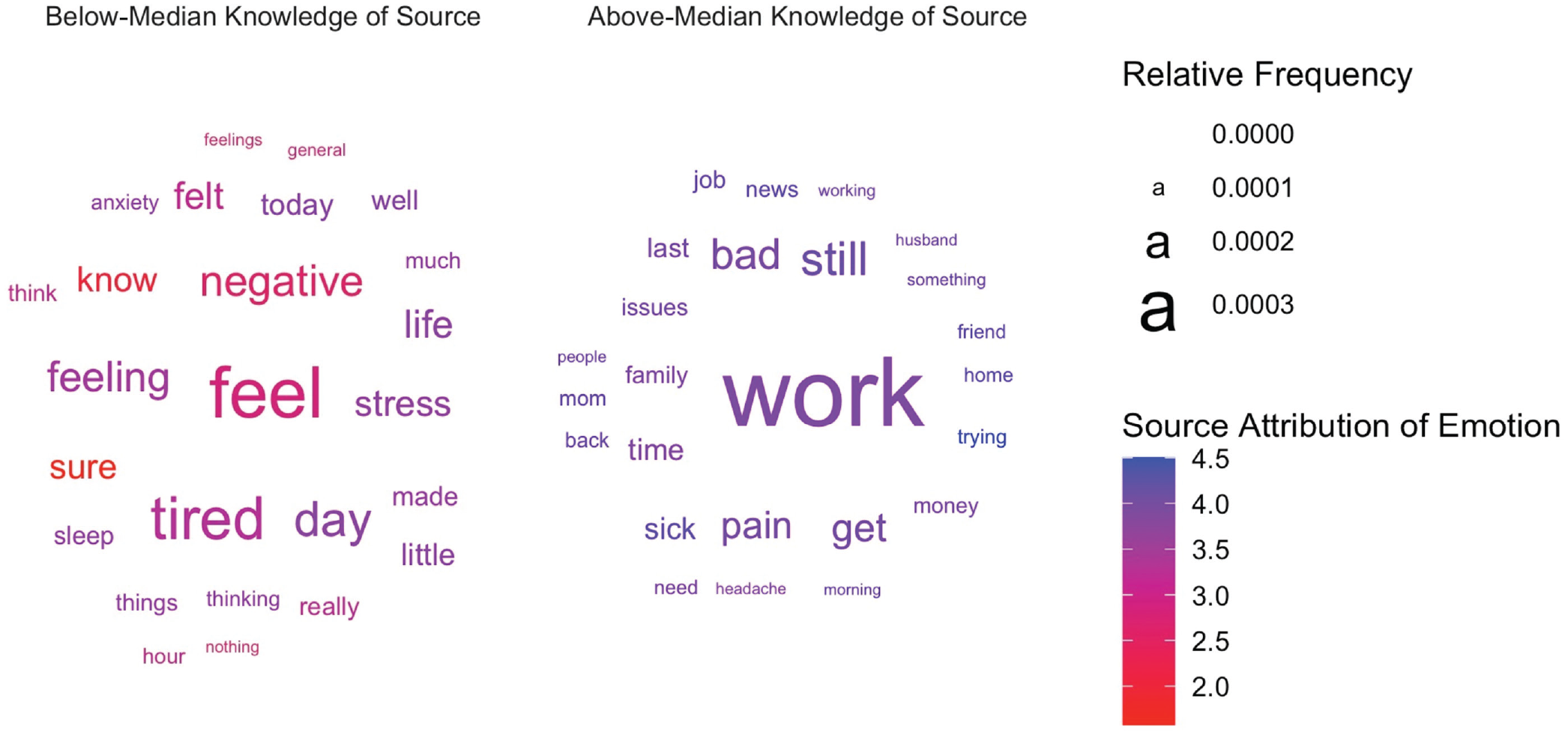
The most frequent 25 words participants used in their written responses describing low source attribution of emotion (below the median of source-attribution ratings), and high source attribution of emotion (above the median of source-attribution ratings). Words are displayed by frequency and by the mean source-attribution rating of the responses in which each word appeared. Words in shades of blue and purple were used in responses with higher source attribution of emotion, whereas words in shades of red or pink were used in responses with lower source attribution of emotion.
Emotion-regulation attempts
As predicted, we found a significant within-person effect for source attribution of emotions, b = 0.28, SE = 0.04, t(216.88) = 6.44, p < .001, 95% CI = [0.20, 0.37], R2M = .02, R2C = .45. Compared to their own average, when people knew more about the source of their emotion they attempted to regulate their emotions to a greater extent, even after controlling for the intensity of their negative feelings. We also found a significant between-person effect, b = 0.34, SE = 0.11, t(368.70) = 3.05, p = .002, 95% CI = [0.12, 0.57], R2M = .02, R2C = .45: People who were more knowledgeable about the sources of their emotions attempted to regulate their emotions to a greater extent. Effects persisted after controlling for emotional inertia, emotional intelligence, self-concept clarity, and psychiatric symptoms (see the Supplemental Material). Figure 2 illustrates fluctuations in source attribution of emotion across time taken from one participant and corresponding fluctuations in emotion-regulation attempts. It also illustrates the type of text participants provided when reporting high and low knowledge about the source of their emotions.
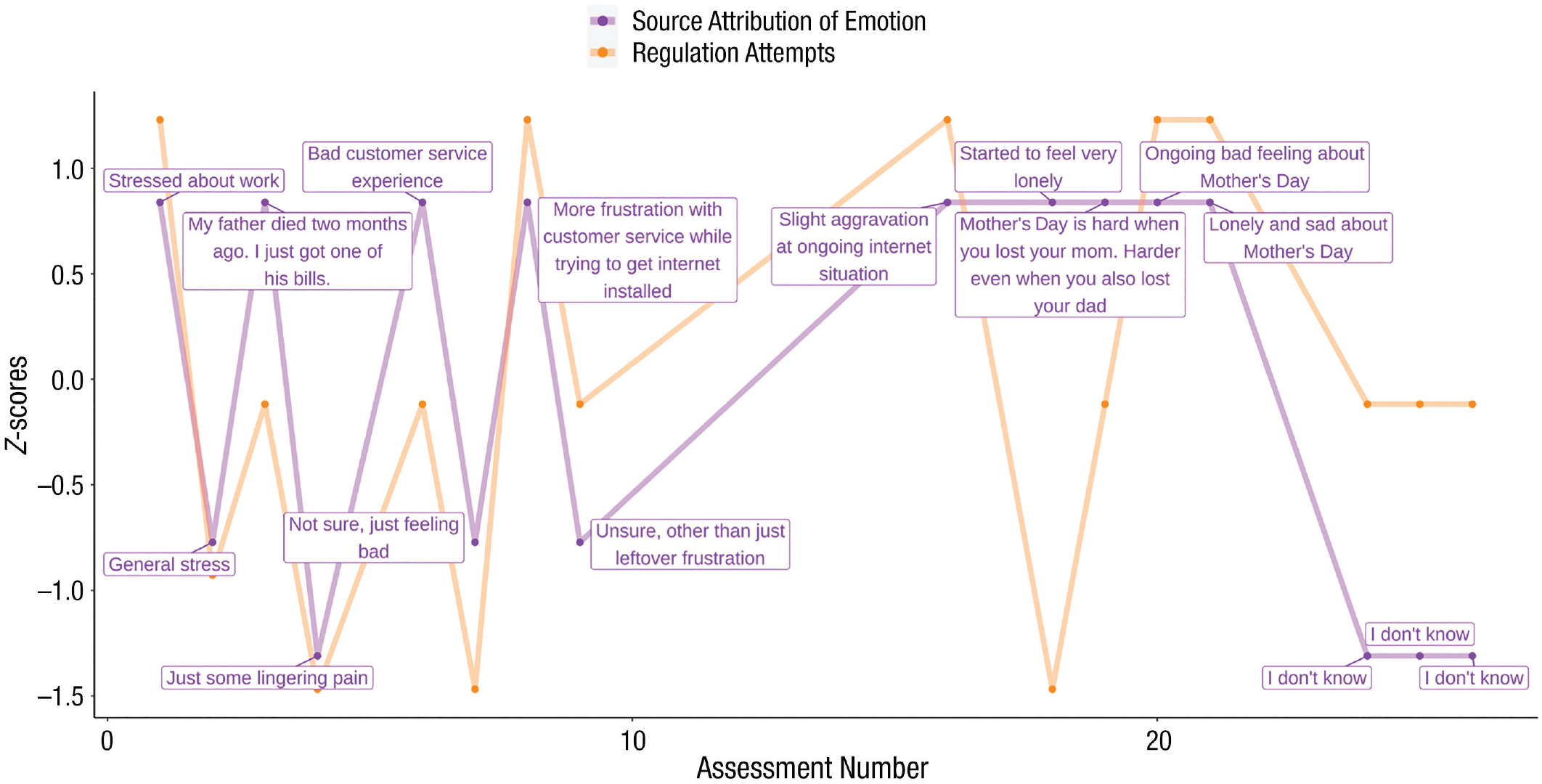
An illustration of fluctuations in source attribution of emotion across time taken from one participant (in purple) and corresponding fluctuations in emotion-regulation attempts (in orange). Texts describing the source of the emotional response were paraphrased to avoid identification. They illustrate the type of text participants provided when reporting high and low knowledge about the source of their emotions.
Emotion-regulation strategies
See Table 1 for a summary of the results. Figure 3 depicts the associations between source attribution of emotion and each emotion-regulation strategy at the within-person level. Consistent with our predictions, at the within-person level, greater source attribution of emotion predicted the use of more situation modification, more cognitive reappraisal, and more social support. Also, as expected, source attribution was not associated with expressive suppression, substance use, and self-injury. Unexpectedly, greater source attribution predicted reduced use of distraction and emotional eating, suggesting that the use of these strategies increases the less people know about the causes of their feelings. With regard to rumination, greater source attribution of emotion predicted the use of more rumination. Finally, contrary to expectations, greater source attribution predicted greater use of body relaxation.
Source Attribution of Emotion Predicting Individual Emotion-Regulation Strategies
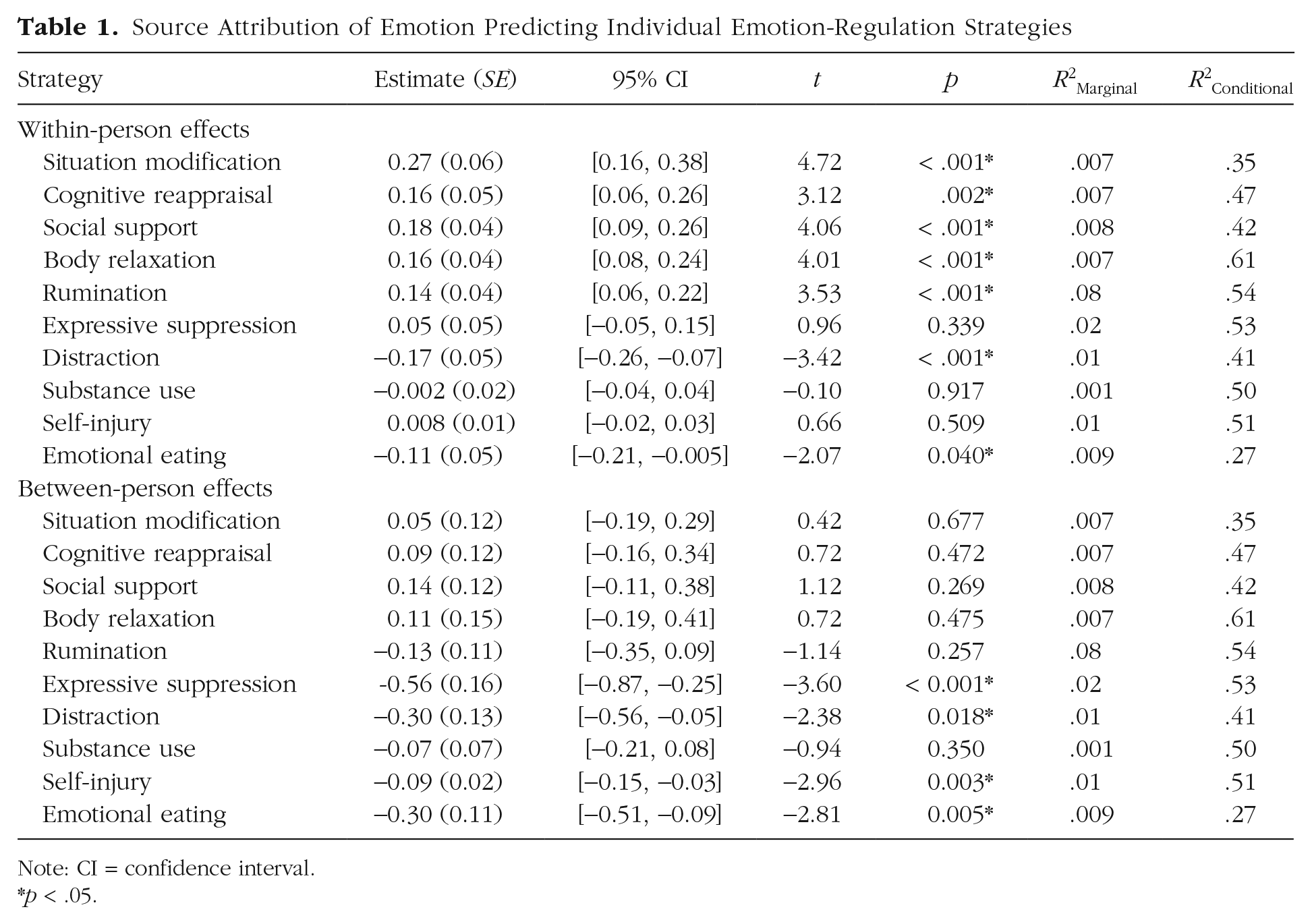
Note: CI = confidence interval.
*p < .05.
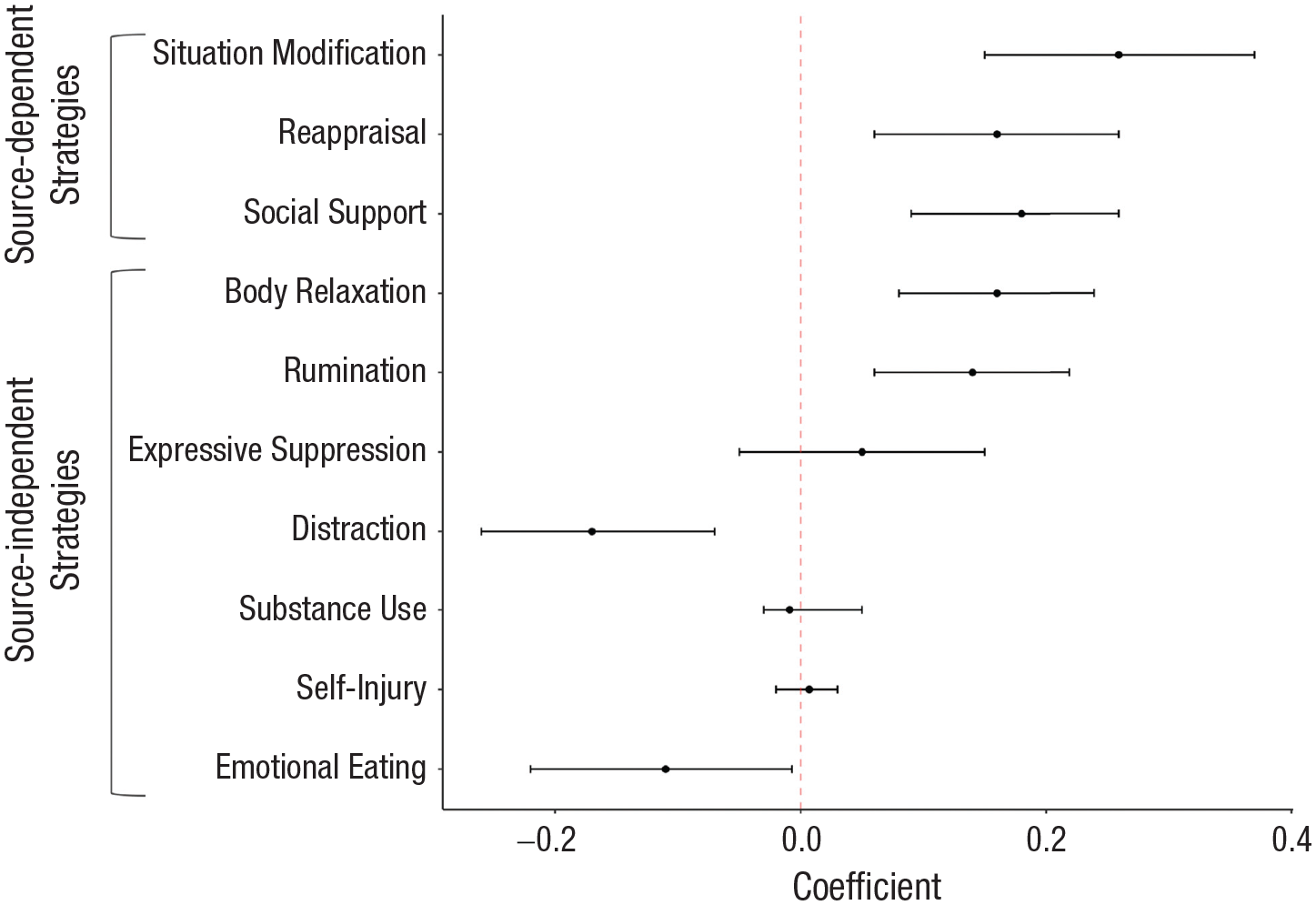
Within-person regression coefficients when predicting each individual emotion-regulation strategy by momentary source attribution of emotion. Error bars represent 95% confidence intervals. Confidence intervals above the zero line represent significant positive associations; confidence intervals below the zero line represent significant negative associations. Confidence intervals that cross the zero line represent nonsignificant associations.
At the between-person level, source attribution of emotion did not predict the use of situation modification, cognitive reappraisal, and social support. Neither did it predict the use of rumination, body relaxation, and substance use. However, greater source attribution predicted less expressive suppression, less distraction, less emotional eating, and less self-injury, indicating that people who were generally more knowledgeable about the sources of their emotions tended to use these strategies less in their daily lives (see Fig. S2 in the Supplemental Material for a depiction of associations between source attribution of emotion and each emotion-regulation strategy at the between-person level). Results remained unchanged when we controlled for emotional inertia, emotional intelligence, self-concept clarity, and psychiatric symptoms, except for the between-person effect on distraction (see the Supplemental Material). Because we assessed the simultaneous implementation of multiple strategies, we repeated the analysis for each emotion-regulation strategy when controlling for the use of all other strategies. Results remained unchanged (see Table S7 in the Supplemental Material). We also report in the Supplemental Material descriptives of the use of multiple strategies simultaneously (Polyregulation; Ford et al., 2019) and the results of a hierarchical cluster analysis to identify combinations of strategies used simultaneously and their relationship to source attribution of emotion.
Perceived emotion-regulation success
As expected, we found a significant within-person effect, b = 0.14, SE = 0.04, t(202.82) = 3.21, p = .002, 95% CI = [0.05, 0.22], R2M = .09, R2C = .49: Compared to their own average, when people had more knowledge about the source of their emotion, they rated themselves as being more successful in decreasing it. We also found a between-person effect—people who were more knowledgeable about the sources of emotions rated themselves as being more successful in decreasing their negative feelings, b = 0.53, SE = 0.11, t(334.98) = 4.93, p < .001, 95% CI = [0.32, 0.75], R2M = .09, R2C = .49. Effects persisted when controlling for emotional inertia, emotional intelligence, self-concept clarity, and psychiatric symptoms (see the Supplemental Material).
Comparing source-dependent versus source-independent strategies
The model converged only after we removed the slope for the interaction. We found a significant within-person interaction, b = −0.18, SE = 0.03, t(7383.86) = −6.24, p < .001, 95% CI = [−0.23, −0.12], R2M = .05, R2C = .56, so that when people knew more about the source of their emotion (compared with their own average) they were more likely to use source-dependent compared with source-independent strategies (see Fig. 4). Specifically, greater source attribution predicted greater use of source-dependent strategies, b = 0.22, SE = 0.04, t(181.7) = 6.12, p < .001, 95% CI = [0.15, 0.29], R2M = .01, R2C = .51, but was unrelated to the use of source-independent strategies, b = −0.01, SE = 0.02, t(131.3) = −0.47, p = .643, 95% CI = [−0.05, 0.03], R2M = .01, R2C = .58.
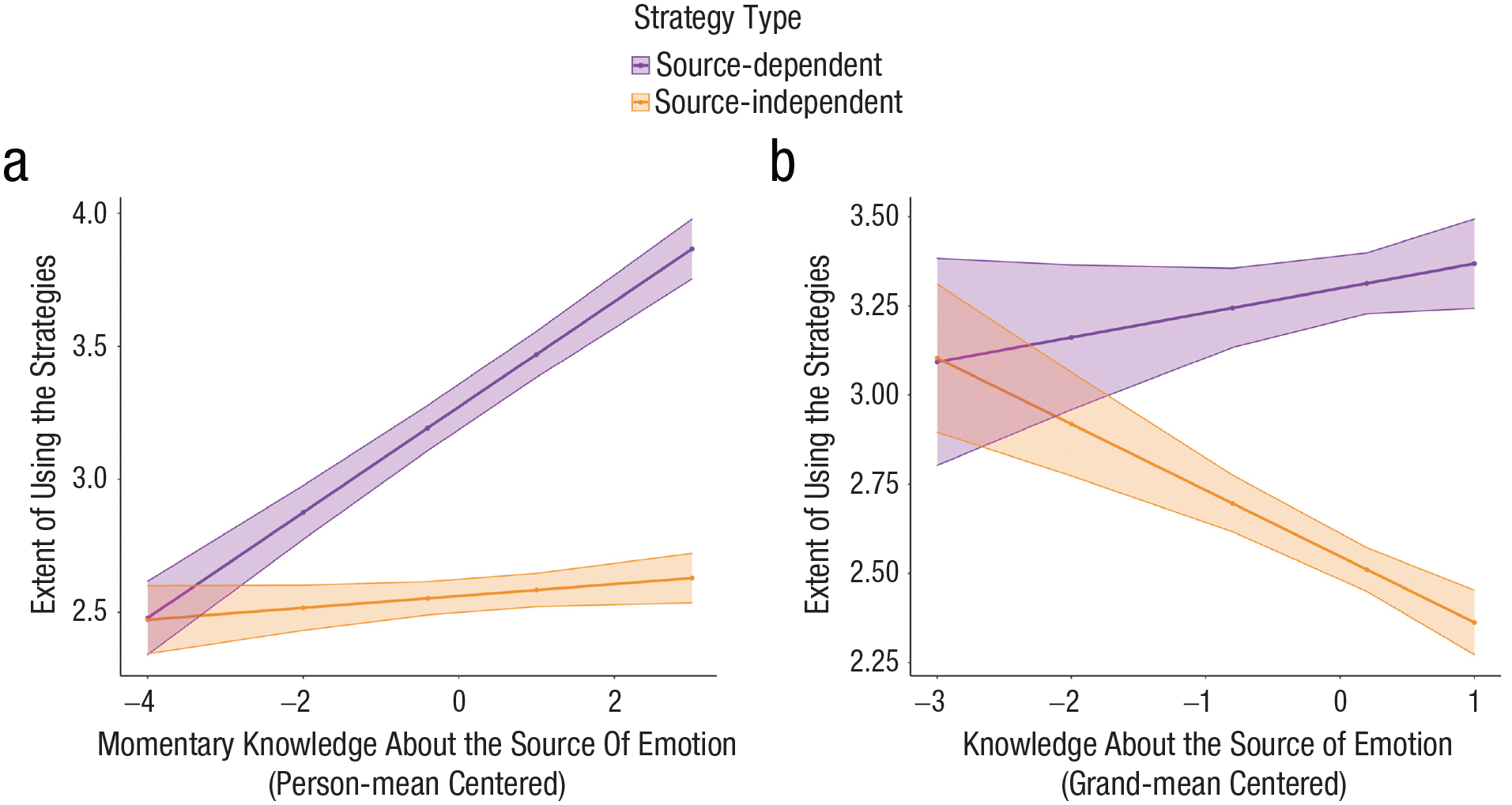
The extent of using source-dependent versus source-independent emotion-regulation strategies as a function of source attribution of emotion at the within-person level (a) and the between-person level (b). The more people knew about the source of their emotion, the more they used strategies that target the source versus strategies that do not target the source. Error bands represent ±1 SEM.
We also found a between-person interaction, b = −0.28, SE = 0.09, t(365.2) = −3.21, p = .001, 95% CI = [−0.45, −0.11], R2M = .05, R2C = .56: People who were more knowledgeable about the source of their emotions used more source-dependent compared with source-independent strategies (see Fig. 4). However, at the between-persons level, greater source attribution predicted reduced use of source-independent strategies, b = −0.19, SE = 0.07, t(369.9) = −2.90, p = .004, 95% CI = [−0.32, −0.06], R2M = .01, R2C = .58, but was unrelated to the use of source-dependent strategies, b = 0.12, SE = 0.09, t(355.7) = 1.24, p = .216, 95% CI = [−0.07, 0.30], R2M = .01, R2C = .51. These effects persisted after we controlled for emotional inertia, emotional intelligence, self-concept clarity, and psychiatric symptoms (see the Supplemental Material). Results suggest that momentary knowledge about the source of emotions predicts increased use of strategies that target the source of the emotion, whereas individual differences in source attribution of emotion predict reduced use of strategies that do not target the source.
Well-being
We found a significant effect for life satisfaction—higher life satisfaction was associated with greater source attribution of emotion, b = 0.07, SE = 0.03, t(363) = 2.67, p = .008, 95% CI = [0.02, 0.12], R2M = .09, R2C = .49. Higher source attribution of emotion was also associated with lower levels of psychiatric symptoms, b = −0.26, SE = 0.07, t(357.76) = −3.97, p < .001, 95% CI = [−0.39, −0.13], R2M = .10, R2C = 0.49.
General Discussion
Using an EMA study design, we assessed participants’ knowledge about the source of their everyday negative emotions. We first used language analysis to confirm that reports of knowledge about the source were predicted by the concreteness of written descriptions of the source. More importantly, we found that the more people knew the source of their emotions, the more they tried to regulate them. Source attribution of emotion also predicted the type of emotion-regulation strategies people used, with more knowledge about the source predicting increased use of strategies that target the source (e.g., cognitive reappraisal) versus strategies that do not (e.g., distraction). Finally, source attribution of negative emotions predicted greater perceived success in reducing them and greater well-being.
Overall, findings suggest that pinpointing the source of emotions might be central for their regulation. Whereas prior research has focused mainly on identifying effective emotion-regulation strategies, our findings suggest that using some of these strategies requires knowledge about the source of emotions. Therefore, to promote engagement and success in emotion regulation it might be important to assist people in identifying the causes of their feelings—for instance, by using diaries or digital applications.
Our study tested the links between source attribution of emotions and their regulation in daily life. However, results are correlational, and it remains unclear whether source attribution of emotion causally shapes emotion regulation. It is possible, for instance, that attempting emotion regulation or using strategies like cognitive reappraisal retroactively increases people’s knowledge about the source. Lab studies that manipulate source attribution are required.
Future studies are also required to understand why the relationship between source attribution and emotion-regulation strategies differed at the within versus the between-person levels. Source-dependent strategies typically require knowledge of the source, whereas source-independent strategies could be implemented regardless of such knowledge. This could explain the within-person effect, such that when people know more about the source (compared with their own average) they use more strategies that target the source but their use of source-independent strategies remains unchanged. At the between-person level, however, people who typically have high knowledge about the source (compared with others) can largely avoid source-independent strategies, whereas people with lower knowledge could be using both types of strategies. These findings are also consistent with Boden and Thompson’s (2015) findings on trait source clarity, which was associated with lower use of expressive suppression but unrelated to cognitive reappraisal. This suggests that cultivating general knowledge on sources of emotions might not increase the use of source-dependent strategies but might instead deter people from using source-independent strategies that are characterized by avoidance or disengagement.
Another limitation of our study is that we could not tease apart the role of accuracy versus certainty regarding the source of emotion. Is it most important to accurately identify the true source of an emotion, or is it more important to be certain about the source (whether accurate or not)? Future research could distinguish between these possibilities. Our design also cannot differentiate between low source attribution because of lack of knowledge about the source and low source attribution because there was no source to be identified. Whether emotions can arise without a source largely depends on definitions of emotion (Eldar et al., 2007; Lazarus, 1991). If emotions can arise without a source, it is important to distinguish between these two reasons for low source attribution. Future research should also address the unexpected positive relationship between source attribution and body relaxation, which should not require knowledge about the source.
Finally, another limitation is that we assessed negative emotions in general rather than discrete emotions. Discrete emotions should be assessed to test the potential relationship between source attribution of emotion and emotion differentiation (Kalokerinos et al., 2019). Future research could also test source attribution of positive emotions, the impact of source attribution on how much people want to change their emotions, and the role of source attribution for increasing emotions. Because momentary knowledge about the source is retrospective, such knowledge should be more relevant for decreasing emotions than increasing them. However, higher trait knowledge about the causes of one’s feelings could potentially be used for eliciting desired emotional states.
To conclude, this study is the first to explore the connection between source attribution of emotion and emotion regulation in daily life. Our findings suggest that identifying the causes of negative emotions could be essential for regulating them.
Supplemental Material
sj-docx-1-pss-10.1177_09567976231199440 – Supplemental material for Knowledge About the Source of Emotion Predicts Emotion-Regulation Attempts, Strategies, and Perceived Emotion-Regulation Success
Supplemental material, sj-docx-1-pss-10.1177_09567976231199440 for Knowledge About the Source of Emotion Predicts Emotion-Regulation Attempts, Strategies, and Perceived Emotion-Regulation Success by Yael Millgram, Matthew K. Nock, David D. Bailey and Amit Goldenberg in Psychological Science
Footnotes
Transparency
Action Editor: Rachael Jack
Editor: Patricia J. Bauer
Author Contribution(s)

References
Supplementary Material
Please find the following supplemental material available below.
For Open Access articles published under a Creative Commons License, all supplemental material carries the same license as the article it is associated with.
For non-Open Access articles published, all supplemental material carries a non-exclusive license, and permission requests for re-use of supplemental material or any part of supplemental material shall be sent directly to the copyright owner as specified in the copyright notice associated with the article.
