




Abstract
Are individuals adept at perceiving others’ emotions optimally adjusted? We extend past research by conducting a high-powered preregistered study that comprehensively tests five theoretical models of empathic accuracy (i.e., emotion-recognition ability) and self-views and intra- and interpersonal facets of adjustment in a sample of 1,126 undergraduate students from Canada and 2,205 informants. We obtained both self-reports and peer-reports of adjustment and controlled for cognitive abilities as a potential confounding variable. Empathic accuracy (but not self-views of that ability) was positively related to relationship satisfaction as rated by both participants and informants. Self-views about empathic accuracy (but not actual empathic accuracy) were positively related to life satisfaction as rated by both participants and informants. All associations held when we controlled for cognitive abilities.
Keywords
Is the ability to “read” other people related to psychological adjustment? This question is important for a theoretical understanding of the precursors of general functioning and because of its implications for training and feedback in education and in the workplace. From a theoretical standpoint, knowledge of how empathic accuracy relates to adjustment is necessary to fully understand the functions of this ability and the antecedents of optimal functioning. From a practical perspective, knowing whether empathic accuracy facilitates adjustment informs the content of training and feedback interventions, as findings that higher empathic accuracy relates to better adjustment would suggest another reason to formally train this ability.
Empathic accuracy for emotions—the ability to correctly identify the emotions that others feel 1 (Ickes et al., 1990; Levenson & Ruef, 1992)—could relate to higher adjustment by helping people coordinate their actions with others, respond to others’ unstated needs, and develop strong relationships (Gleason et al., 2009). Alternatively, reading others well could lead people to discover information that is challenging and negatively impacts adjustment, such as whether others truly like them (Elfenbein & Ambady, 2002; Simpson et al., 2003).
Empathic accuracy might also relate to adjustment in more complex ways that involve how good people think they are at reading others (He & Côté, 2019; Humberg et al., 2019). The literature on abilities and adjustment distinguishes between ability (as assessed by performance on objective tests) and self-views of those abilities (as assessed by impressions of one’s performance on tests or during social interactions; Salovey et al., 2002). Self-views are moderately correlated with abilities assessed with objective tests (He & Côté, 2019).
The literature features competing perspectives on the optimal combination of abilities and self-views for adjustment (He & Côté, 2019; Humberg et al., 2018, 2019). Models of positive (or beneficial) effects of self-enhancement state that adjustment is highest when self-views exceed abilities so that a larger gap between self-views and abilities contributes positively to adjustment (Colvin & Block, 1994; Dufner et al., 2019; Taylor & Brown, 1988). Models of negative (or detrimental) effects of self-enhancement posit that adjustment is lowest when self-views exceed abilities, so that a larger gap between self-views and abilities undermines adjustment—for instance, by causing conflicts with others (Anderson et al., 2008; Humberg et al., 2019; Polzer et al., 1997). Interactive models propose that empathic accuracy facilitates adjustment only if it is accompanied by favorable self-views that facilitate the implementation and increase confidence in using the ability (Dufner et al., 2019; Humberg et al., 2018). Individuals with unfavorable self-views may lack the confidence to employ their ability to read others.
There has been no shortage of research on this question. In most studies, however, adjustment was only measured with self-reports from focal participants. Self-reports conflate whether individuals with enhanced views of their abilities are actually better adjusted, or simply enhance their adjustment when reporting it. Measures of adjustment from other sources, such as peers, can help rule out this possibility. Moreover, several studies omitted measures of self-views of empathic accuracy, precluding tests of more complex models such as positive or negative effects of self-enhancement. In addition, no previous study controlled for cognitive ability, which correlates with empathic accuracy (Côté et al., 2010; Joseph & Newman, 2010) and predicted adjustment in some past studies (Humberg et al., 2018, 2019). Controlling for cognitive ability is necessary to examine whether any observed association between empathic accuracy and adjustment is confounded by it.
Perhaps because of these limitations, research to this point has been characterized by mixed findings. Some studies have found positive associations between empathic accuracy and adjustment (Bastian et al., 2005; Sánchez-Álvarez et al., 2016), other studies show no relationship (Di Fabio & Kenny, 2016; Zeidner & Olnick-Shemesh, 2010), and yet another study found tentative evidence that those with exaggerated views of their abilities are optimally adjusted (He & Côté, 2019).
The Present Study
To provide more definitive conclusions about how empathic accuracy relates to adjustment, we assessed empathic accuracy, cognitive ability, and self-views of these abilities in a large sample. We obtained self-reports and peer reports of both an intrapersonal indicator of adjustment (life satisfaction) and an interpersonal indicator of adjustment (relationship satisfaction). We leveraged recent developments in polynomial regression analysis (Edwards, 2001; Edwards & Parry, 1993; Humberg et al., 2019) and condition-based regression analysis (Humberg et al., 2018) to examine the evidence for the models of empathic accuracy and adjustment.
Statement of Relevance
The question of how empathic accuracy—or the capacity for reading others’ emotions—relates to positive life and relationship outcomes has been of interest to scholars for decades. This question is important because it informs us of the adaptive functions of this ability and also sheds light on what factors lead to optimal functioning. Moreover, knowing whether empathic accuracy predicts positive outcomes informs the content of feedback interventions, training, and counseling. Our comprehensive study examines the evidence for five competing models of how empathic accuracy relates to satisfaction with life and relationships. We conducted a large-scale study with participants and their informants. We found that “reading” others’ emotions is positively associated with satisfaction with relationships, but that merely thinking that one can read others (as contrasted with the ability itself) positively relates to life satisfaction.
We tested five models that have received theoretical and empirical support in past research (see Table 1). The positive-abilities-only model proposes that higher empathic accuracy is positively associated with adjustment, irrespective of self-views (Bastian et al., 2005; Furnham & Petrides, 2003; Martinez-Pons, 1997; Palmer et al., 2002). The positive-self-views-only model predicts that higher self-views about empathic accuracy are positively associated with adjustment, irrespective of actual empathic accuracy (Sánchez-Álvarez et al., 2016; Sened et al., 2017). The interaction model proposes that there is positive association between empathic accuracy and adjustment for people with high self-views and an attenuated positive or no relationship between empathic accuracy and adjustment for people with low self-views (Humberg et al., 2019). The positive self-enhancement model states that a larger positive gap between self-views and abilities is related to higher adjustment (Dufner et al., 2019; He & Côté, 2019; Humberg et al., 2019). Finally, the negative self-enhancement model posits the opposite: A larger positive gap between self-views and abilities is related to lower adjustment (Humberg et al., 2019). The models are mutually exclusive on theoretical grounds and make distinct predictions about the direction and significance of the coefficients for abilities and self-views in regression models.
Summary of Competing Models and Statistical Conditions to Be Met
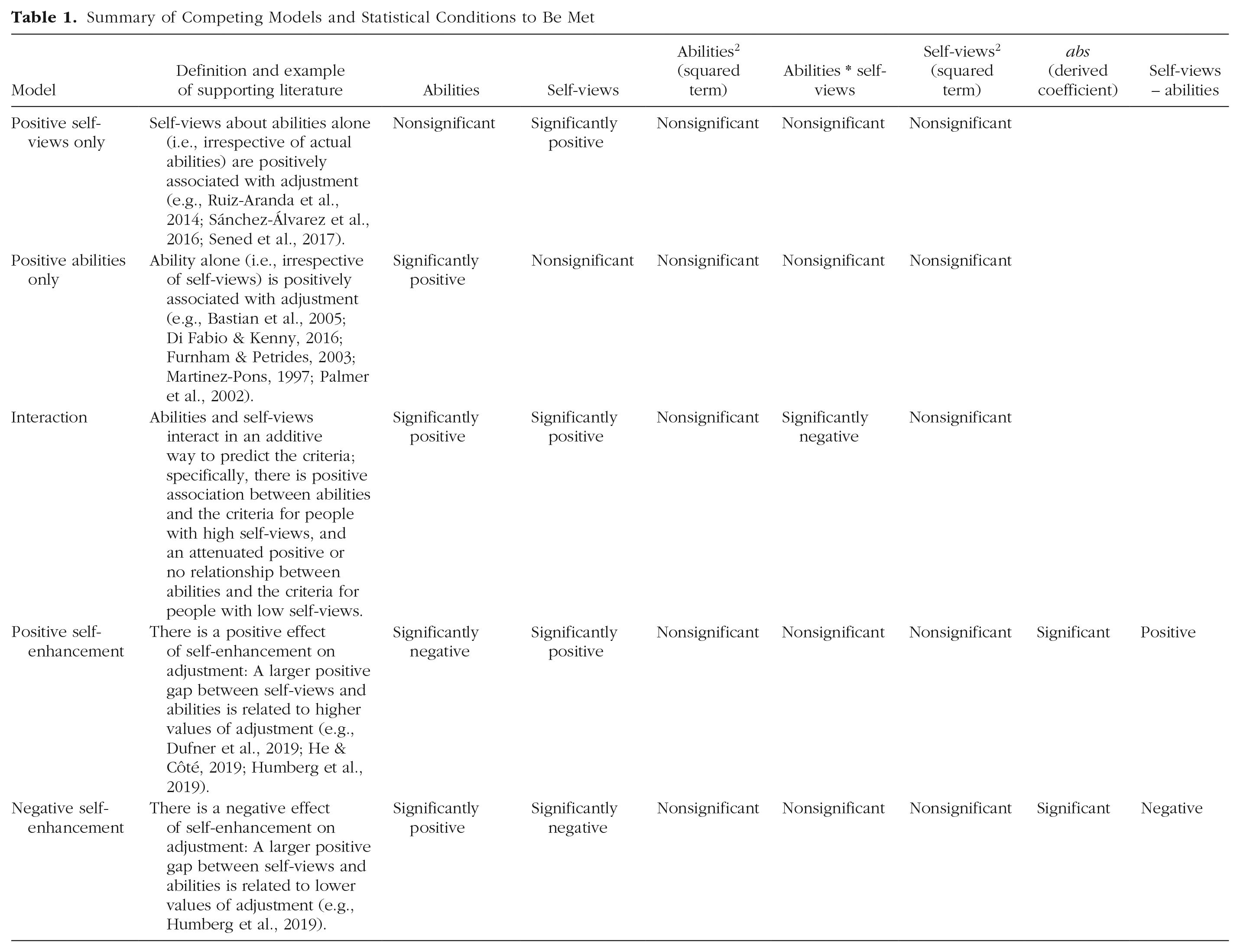
In addition to controlling for cognitive ability, we independently tested the models with cognitive ability (and self-views of cognitive ability) and compared the results with the results about empathic accuracy. Direct comparisons of how the two forms of abilities relate to adjustment illuminate whether empathic accuracy relates to adjustment in a distinct way.
The anonymized data, code for data analysis, preregistration, and surveys are available in Research Box (https://researchbox.org/801). There was no deviation from the preregistration.
Method
Participants
We recruited a sample of 1,126 undergraduate business students who completed the study in exchange for course credit. This study was approved by the Social Science, Humanities, and Education research ethics board at the University of Toronto (Protocol ID 31813). Participants provided informed consent and were debriefed.
Our target sample was 1,100 participants; however, a few more participants signed up in the system before we closed the study, and as per our preregistration, we analyzed all responses. An a priori power analysis using effect sizes from a previous investigation (He & Côté, 2019) and an alpha level of .05 revealed that a sample size of 1,099 would provide .80 power to test the hypotheses. The power analysis revealed a large sample-size requirement because of the small effect sizes detected in previous studies and the type of analyses that we conducted. Details of the power analysis, including calculations of effect sizes in past studies, appear in our online supplement.
Participants were on average 19.5 years old (SD = 1.28); 445 participants self-identified as a man or male (39.5%), 666 self-identified as a woman or female (59.2%), 1 self-identified as nonbinary (0.1%), and 14 did not disclose their gender (1.2%). For ethnicity, 592 participants were East Asian (52.6%), 214 were White (19%), 171 were Southeast Asian (15.2%), 96 reported a different ethnicity (8.5%), 65 were Middle Eastern (5.8%), 17 were Hispanic/Latino (1.5%), 13 were Black (1.2%), and 12 were West Indian (1%). 2
We instructed focal participants to list the first names and email addresses of 5 to 10 informants who could provide information about them and to indicate their relationship with each informant (friend, family member, classmate, etc.). We informed participants that informants would complete a short survey about them. Whether or not informants completed the surveys had no implications for focal participants. In total, 2,053 informant responses could be matched to a focal participant; 681 participants had at least one informant. For participants who had at least one informant, the average number of informants was M = 3.01, SD = 1.59, ranging from 1 to 9 informants. Informants were 1,184 (57.7%) female and 751 (36.6%) male; 6 (0.3%) self-identified as nonbinary, 3 self-identified as gender queer (0.1%), and 109 (5.3%) preferred not to say. On average, informants described having known the focal participant for 7.79 years (SD = 6.92; minimum = 1, maximum = 20+ years). In terms of relationship type, 1,495 (73%) informants reported being a friend, 93 (4.5%) reported being an acquaintance, 234 (11.4%) reported being a classmate, 31 (1.5%) reported being a co-worker, and 535 (26%) reported being a family member. 3
Procedure
The procedures were adapted from recent studies investigating similar questions (e.g., Humberg et al., 2018, 2019) and particularly a study on the relationship between self-insight into one’s emotional abilities and adjustment (He & Côté, 2019). Participants completed a 1-hr online survey. We determined on the basis of our previous studies that limiting the study to 1 hr could prevent fatigue effects that might reduce the quality of the data. Participants first completed a test of empathic accuracy and then estimated how well they performed on the test. They then completed a test of cognitive ability and estimated how well they performed on that test. Following the tests, participants completed the measures of adjustment, nominated informants, and reported demographics.
Nominated informants received an email message inviting them to complete a brief voluntary survey. After providing informed consent, informants completed measures of the adjustment of focal participants and measures of exploratory mechanisms. Informants indicated their gender and the number of years they had known focal participants before they were debriefed.
Measures
Empathic accuracy
We administered a 72-item test of empathic accuracy in which participants viewed pictures from the Montréal Set of Facial Displays of Emotion (Beaupré & Hess, 2005) showing men and women from three ethnic groups (White, Asian, and Black) posing facial displays of happiness, sadness, anger, surprise, shame, or disgust. Participants viewed each picture for 2 s and then chose the emotion that the person was expressing. The reliability was high (split-half reliability = .89 to .95) in past research (He & Côté, 2019). The convergent validity of this measure is supported by a high correlation (r = .80) with another measure of this ability, the Diagnostic Analysis of Nonverbal Accuracy (He & Côté, 2019). In our study, the split-half reliability was .72.
Self-views about empathic accuracy
Participants indicated how many questions they thought they had answered correctly on the test of empathic accuracy, from 0 to 72 (He & Côté, 2019; Sheldon et al., 2014). In past research, the correlation between this specific measure and a performance test of empathic accuracy was .25 (He & Côté, 2019), which was virtually the same as meta-analytic estimates of the correlation between self-views and performance tests of empathic accuracy (r = .26; Joseph & Newman, 2010). This item allowed us to meet the principle of commensurability for polynomial regression analysis, which specifies that abilities and self-views must be measured on corresponding scales (in this case, on a scale of 72 for both).
Cognitive abilities
We administered a short version of Raven’s Advanced Progressive Matrices (Denissen et al., 2011). Participants had 20 min to complete 15 problems. In past research, this version of the test was reliable (split-half reliability = .79; He & Côté, 2019) and predicted academic performance measured at a later time (Denissen et al., 2011). In our study, the split-half reliability was .64.
Self-views about cognitive abilities
Participants indicated how many questions they thought they had answered correctly on the cognitive-abilities test, from 0 to 15 (He & Côté, 2019), which again allowed us to meet the requirement of commensurability.
Adjustment
We measured two indices of adjustment—life satisfaction and relationship satisfaction—with self-reports and informant reports. Participants completed the Satisfaction with Life Scale (Diener et al., 1985), which is composed of five items (e.g., “In most ways my life is ideal”). Participants indicated their agreement with each item on a scale ranging from 1 (strongly disagree) to 7 (strongly agree). Participants also reported how satisfied they were with their relationships by indicating their agreement with four statements about their relationships in general (e.g., “I feel close to my relationship partners”; Impett et al., 2013; Le et al., 2020) on a scale ranging from 1 (very slightly or not at all) to 5 (a lot).
Informants completed the Satisfaction with Life Scale (Diener et al., 1985) about focal participants. We used a validated informant version of this measure (Zou et al., 2013). For instance, the sample item “In most ways my life is ideal” is phrased as “In most ways [focal participant]’s life is close to their ideal.” We averaged scores across all informants for each participant. The measure had good internal consistency (Cronbach’s α = .82). To calculate interinformant reliability, we aggregated the items for each informant and calculated intraclass correlation coefficient, or ICC(1, k). ICC(1, k) measures interrater reliability when each participant is rated by a different set of randomly selected raters, and reliability is calculated by an average of k raters’ measurements (Bliese, 2000; Shrout & Fleiss, 1979). The interinformant reliability was ICC(1, k) = .73, 95% confidence interval (CI) = [.70, .76]. Informant ratings of life satisfaction were correlated with focal participants’ reports of their satisfaction with life, r = .36, p < .001.
Informants reported their satisfaction specifically with their relationship with focal participants using the same four items (Impett et al., 2013; Le et al., 2020). For instance, the item “I feel close to my relationship partners” was phrased for informants as “I feel close to [focal participant].” The measure had adequate internal consistency (α = .62). The interinformant reliability was ICC(1, k) = .56, 95% CI = [.51, .61]. Informant ratings of relationship satisfaction were correlated with focal participants’ relationship satisfaction scores, r = .24, p < .001.
Analytical strategy for confirmatory tests of hypothesized models
We used polynomial regression analysis (Edwards & Parry, 1993; He & Côté, 2019; Humberg et al., 2019) and condition-based regression analysis (Humberg et al., 2018) to test the hypothesized models. These analytical approaches specify unique conditions to infer support for each model, whereas alternative approaches lead to ambiguous interpretations (for detailed explanations and mathematical demonstrations, see Edwards & Parry, 1993; Humberg et al., 2018, 2019). To infer support for each model, we examined whether the pattern of results across all coefficients in regression models matched the criteria that are listed in Table 1. The conditions to infer support for the models are mutually exclusive. The approaches rely on two regression equations with predictors centered around the midpoints of their respective scales. 4 The first equation is the linear model that specifies ability and self-views as predictors of adjustment. The second equation specifies a full polynomial model that additionally includes the polynomial terms (i.e., the two-way interaction between abilities and self-views, and the squared terms for abilities and self-views).
We inferred support for the positive-abilities-only model (a) if the polynomial model did not explain more variance than the linear model (which would reveal that the relationships are not more complex than predicted by this model) and (b) if, in the linear model, the coefficient for abilities was significantly positive but the coefficient for self-views was not (He & Côté, 2019; Humberg et al., 2018). We inferred support for the positive-self-views-only model (a) if the polynomial model did not explain more variance than the linear model and (b) if, in the linear model, the coefficient for self-views was significantly positive but the coefficient for abilities was not. We inferred support for the interaction model (a) if the polynomial model explained variance over and above the linear model, (b) if the coefficient for the interaction was significant, (c) if the coefficients for abilities and self-views were both positive, and (d) if the pattern of the interaction was consistent with prediction. Support for the interaction model implies that neither the positive-abilities-only model nor the positive-self-views-only model is supported, because these models specify only one linear effect. 5 We inferred support for positive (negative) self-enhancement (a) if the polynomial model did not explain more variance than the linear model and (b) if, in the linear model, the coefficient for self-views was significantly positive (negative) and the coefficient for abilities was significantly negative (positive; Humberg et al., 2018). The latter two conditions can be tested simultaneously through a test of the derived abs coefficient (Humberg et al., 2018).
Given that abilities and self-views tend to be correlated (Joseph & Newman, 2010), we verified that multicollinearity was not present (i.e., all variance inflation factor values < 2). Additional details of data preprocessing steps are available in the Supplemental Material available online.
Results
Table 2 shows descriptive statistics and correlations between the variables. Table 3 shows the results of tests of variance explained by the linear and polynomial terms and a test of additional variance explained by polynomial terms (i.e., the two-way interaction between abilities and self-views and the squared terms for both abilities and self-views). Table 4 shows the model coefficients from the polynomial and linear models. The polynomial terms failed to explain additional variance in each of the models. Thus, we did not find evidence for the interaction model in all instances. We examined the pattern of coefficients in the linear models to infer support for the remaining models. We report effect sizes for all coefficients of the polynomial and linear models, which can assist in evaluating the level of support for each model, in Table S3 in the Supplemental Material.
Means, Standard Deviations, and Correlations
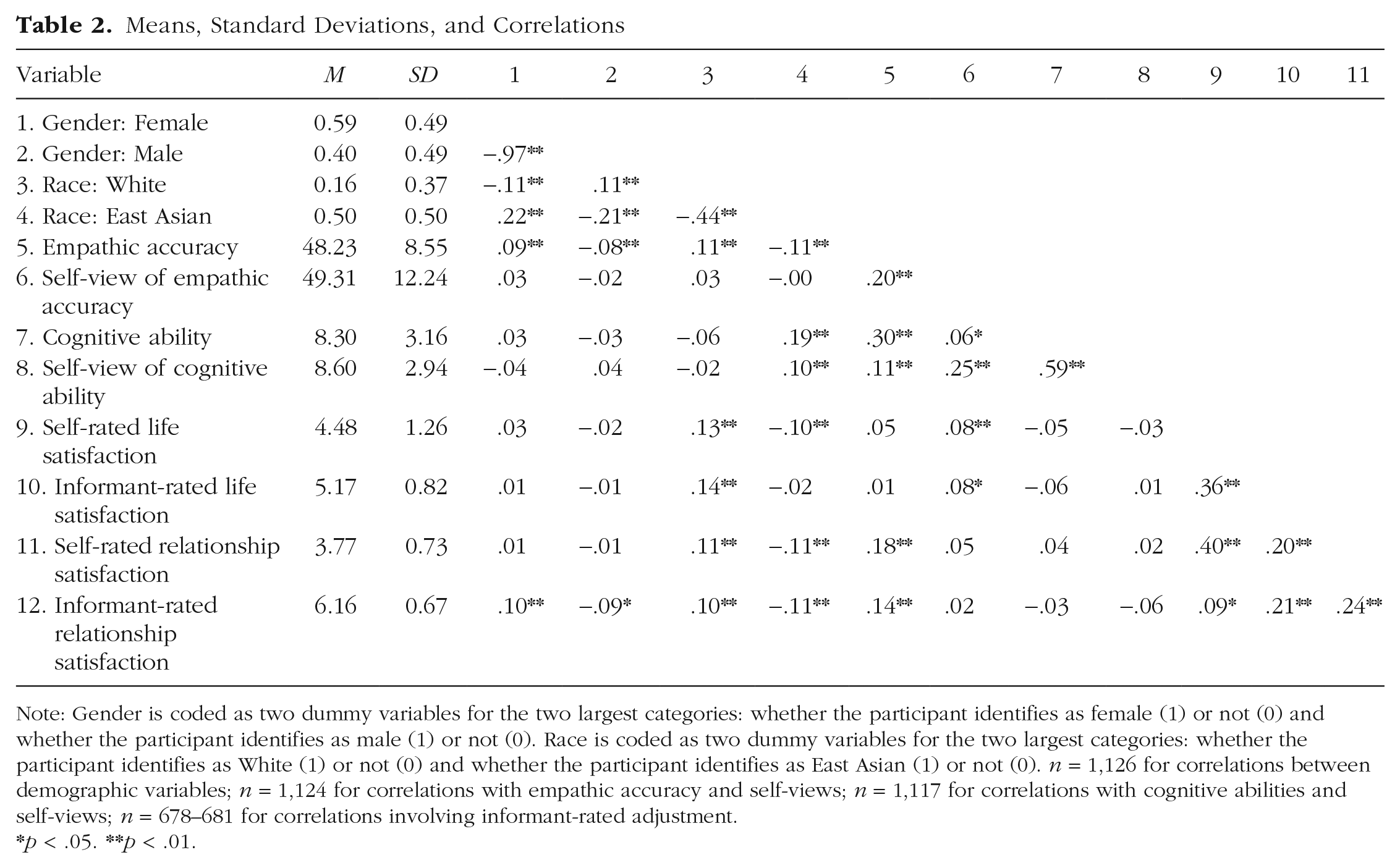
Note: Gender is coded as two dummy variables for the two largest categories: whether the participant identifies as female (1) or not (0) and whether the participant identifies as male (1) or not (0). Race is coded as two dummy variables for the two largest categories: whether the participant identifies as White (1) or not (0) and whether the participant identifies as East Asian (1) or not (0). n = 1,126 for correlations between demographic variables; n = 1,124 for correlations with empathic accuracy and self-views; n = 1,117 for correlations with cognitive abilities and self-views; n = 678–681 for correlations involving informant-rated adjustment.
p < .05. **p < .01.
Test of Explained Variance of Second-Order Terms Over and Above First-Order Terms in Full Polynomial Model
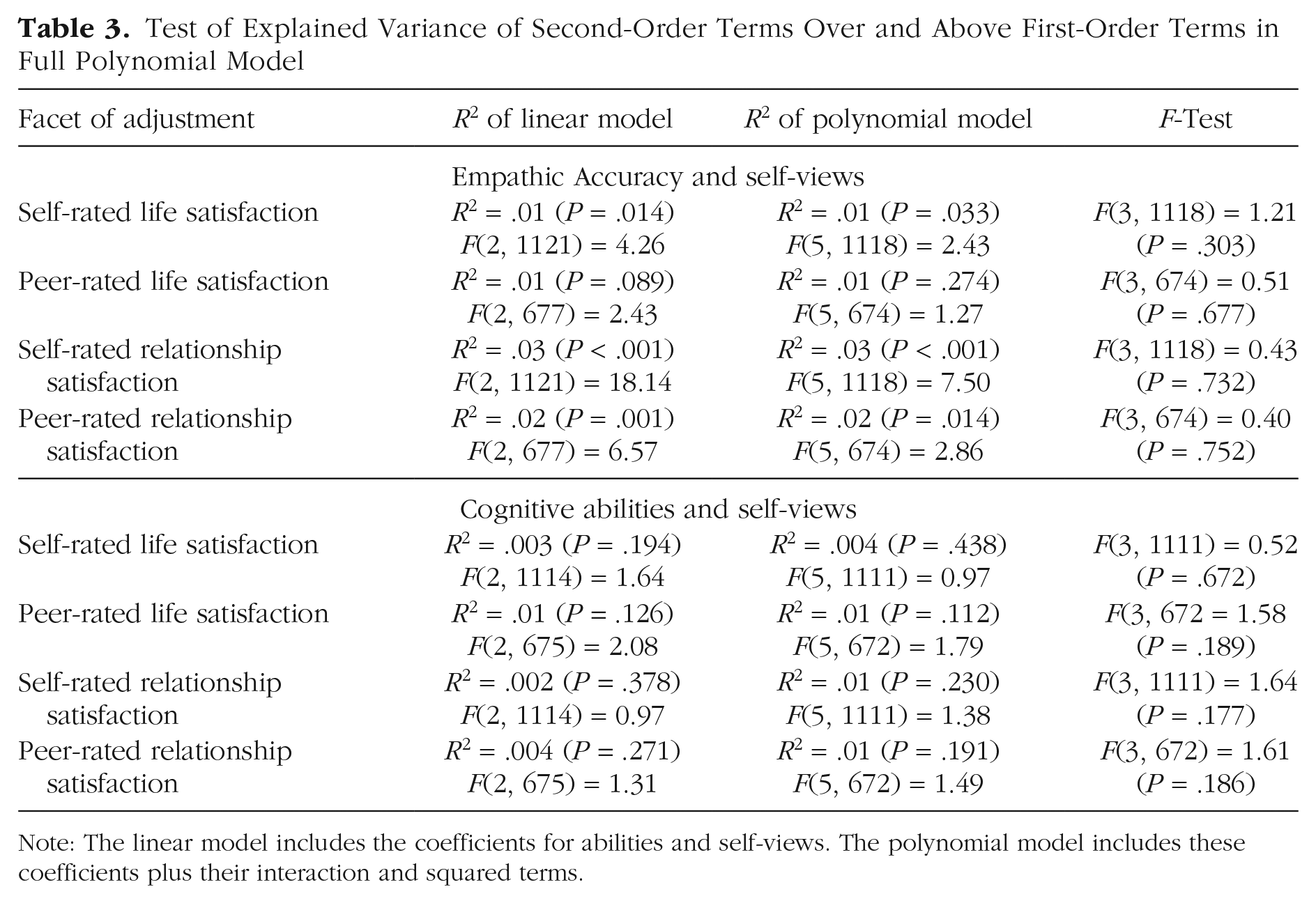
Note: The linear model includes the coefficients for abilities and self-views. The polynomial model includes these coefficients plus their interaction and squared terms.
Regression Results for Polynomial and Linear Models
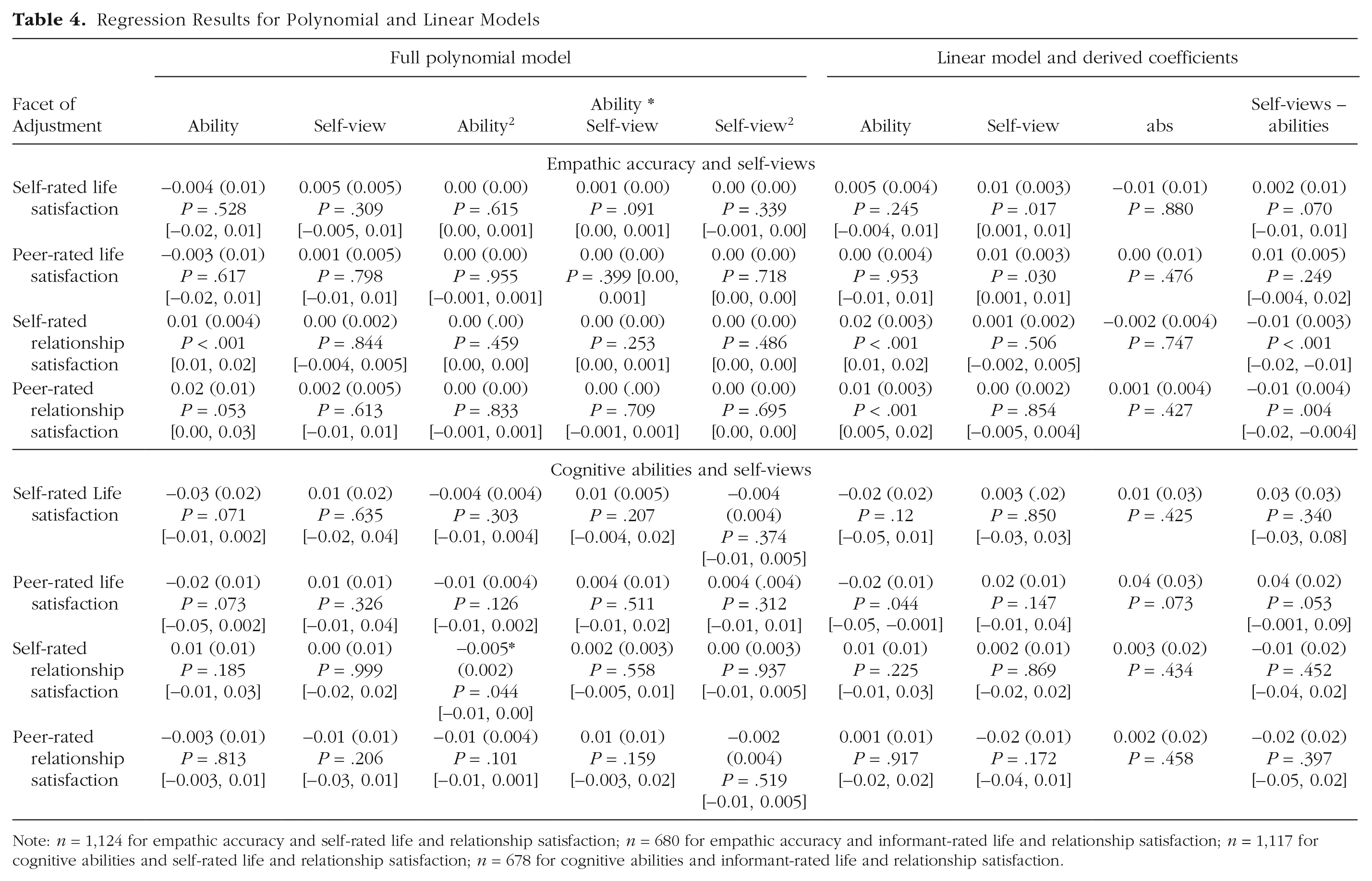
Note: n = 1,124 for empathic accuracy and self-rated life and relationship satisfaction; n = 680 for empathic accuracy and informant-rated life and relationship satisfaction; n = 1,117 for cognitive abilities and self-rated life and relationship satisfaction; n = 678 for cognitive abilities and informant-rated life and relationship satisfaction.
Empathic accuracy
Life satisfaction
The coefficient for self-views was significantly positive in the linear models predicting both self- and peer-rated life satisfaction. The more participants believed they could read others well (irrespective of whether they actually could), the more favorably they rated their lives, and the more they were seen by others as being satisfied with their lives. Empathic accuracy assessed by a performance test did not predict life satisfaction. Thus, the positive-self-views-only model was supported for life satisfaction. The positive-abilities-only and self-enhancement models were not supported.
Relationship satisfaction
The coefficient for empathic accuracy was significantly positive in the linear models predicting both self- and peer-rated relationship satisfaction. The more participants could actually read others well (irrespective of whether they thought they could), the more favorably they rated their relationships, and the more others rated their relationships with them favorably. Self-views of empathic accuracy did not predict relationship satisfaction. Thus, the positive-abilities-only model was supported for relationship satisfaction. The positive self-views only and self-enhancement models were not supported.
Cognitive abilities
None of the linear or polynomial models for cognitive abilities were significant, suggesting no association between cognitive abilities and adjustment. The only significant coefficient suggested a negative association between cognitive abilities and informant-rated life satisfaction. This association was not predicted and should be interpreted with caution until it is replicated in a confirmatory study with new data.
To directly compare how empathic accuracy and cognitive ability relate to adjustment, we formally tested for differences in the correlation coefficients with the cocor R package (Diedenhofen & Musch, 2015), which is useful for comparing effect sizes (Goldenberg et al., 2021; Karinen et al., 2019). Pearson and Filon’s z test (Pearson & Filon, 1898) revealed that empathic accuracy was more strongly correlated with both self-rated relationship satisfaction (z = 4.96, p < .001) and with peer-rated relationship satisfaction (z = 2.80, p < .01) than with cognitive ability. Further, self-views of empathic accuracy were more strongly correlated with self-rated life satisfaction (z = 2.95, p < .01), but not more strongly correlated with peer-rated life satisfaction (z = 1.52, p = .13), than self-views about cognitive ability. These results reveal that emotional and cognitive abilities are associated with adjustment in different ways.
Exploratory analyses
Empathic accuracy controlling for cognitive ability
We tested whether the results for empathic accuracy held when we controlled for cognitive ability. We added cognitive ability and self-views of cognitive ability as controls in the linear models. The results are reported in the Supplemental Material (Table S1). All associations held, suggesting that cognitive abilities did not confound associations between empathic accuracy and adjustment.
Moderation analyses
We explored whether the associations between empathic accuracy and adjustment varied by focal participant gender, focal participant race, informant gender, informant type (friends or family), or informant length of acquaintance. Results are reported in the Supplemental Material. Out of 36 tests of moderation, three (or 8%) were significant, which slightly exceeds what is expected by chance (i.e., 5%). The positive relationship between self-views of empathic accuracy and informant-rated life satisfaction was only significant for White focal participants. The positive relationship between empathic accuracy and informant-rated relationship satisfaction was only significant for non-White focal participants. Further, there was a positive relationship between empathic accuracy and life satisfaction as rated by male informants, but not female informants. The exploratory analyses did not reveal consistent patterns of moderation, and the results should be interpreted with caution.
Discussion
Are people who can read others accurately better adjusted than their counterparts? This study revealed several new insights.
The first new insight is that the answer depends on the facet of adjustment. Empathic accuracy relates differently to distinct facets of adjustment. Empathic accuracy assessed with a performance test was associated with higher relationship satisfaction assessed by both focal participants and informants, but it was not related to life satisfaction. Thus, how good people actually are at reading emotions relates to having better relationships, but not to assessing one’s life more favorably. Knowing how others feel seems to facilitate the development of strong interpersonal bonds. This link has received some empirical support in the past in smaller samples (Le et al., 2020; Sened et al., 2017; Zeidner & Kloda, 2013). Our study supports this link in a large sample and with informant ratings; it also extends past research (a) by showing that this relationship is not confounded by self-views or cognitive ability and (b) by comparing support against alternative models that propose that abilities combine with self-views to influence adjustment.
The pattern was different for self-views—how good people think they are at reading others. People who think they can read others well are more satisfied with their lives, but they do not have better relationships. Importantly, positive self-views are not simply associated with inflated responses on the life-satisfaction measure, because the pattern was the same when informants rated the life satisfaction of focal participants. The belief that one can successfully read others may cause certain behaviors that are noticed by one’s peers and that lead peers to infer that the participant is satisfied with life. These behaviors could include, for example, expressing confidence in knowing how to respond to others or lead others. These results match extant research documenting a positive association between self-views of emotional abilities and life satisfaction (Bastian et al., 2005; Di Fabio & Kenny, 2016; Furnham & Petrides, 2003; Martinez-Pons, 1997; Palmer et al., 2002). Our results advance these studies by revealing that this relationship exists irrespective of actual emotional and cognitive abilities and by ruling out more complex models positing combinations of self-views and abilities. Our results also suggest that the associations between self-views of emotional abilities and relationship satisfaction found in some studies (Malouff et al., 2014; Smith et al., 2008; Wollny et al., 2020) might be confounded by actual emotional abilities.
The second new insight is that relationships between empathic accuracy and adjustment are not confounded by cognitive ability and are fundamentally different from relationships between cognitive ability and adjustment. This finding is important because in past studies observed relationships between emotional intelligence and criteria often became nonsignificant when researchers controlled for cognitive ability (Harms & Credé, 2010). In our study, relationships between empathic accuracy and relationship satisfaction resisted control for cognitive ability. Relationships between self-views of empathic accuracy and life satisfaction also resisted control for self-views of cognitive ability. Thus, distinct forms of abilities relate to adjustment differently.
The third new insight is that we found no support for models positing combinations of abilities and self-views. Although a recent study found tentative evidence in exploratory analyses for the positive self-enhancement model (He & Côté, 2019), these results were not replicated in the current study, and thus our confidence in the value of self-enhancement should be reduced. Further, results shown in the Supplemental Material reveal that as in past studies (He & Côté, 2019; Humberg et al., 2019), self-insight was also not related to adjustment.
This study has several limitations that suggest directions for future research. Our study does not test causality because the measures were administered at one time. We cannot rule out the possibility that life or relationship satisfaction causally impacts empathic accuracy or self-views. Further, informants reported their impressions of focal participants’ satisfaction with their lives, and rated their own satisfaction with their relationship with focal participants. Although the referents in these measures differed, we observed similar results across self-ratings and informant ratings for each facet of adjustment. Moreover, self-ratings of life and relationship satisfaction exhibited different relationships with empathic accuracy, even though the referent (the self) was the same (Fig. 1). Thus, variation in the facet of adjustment seems to explain the pattern of results better than variation in the referent.
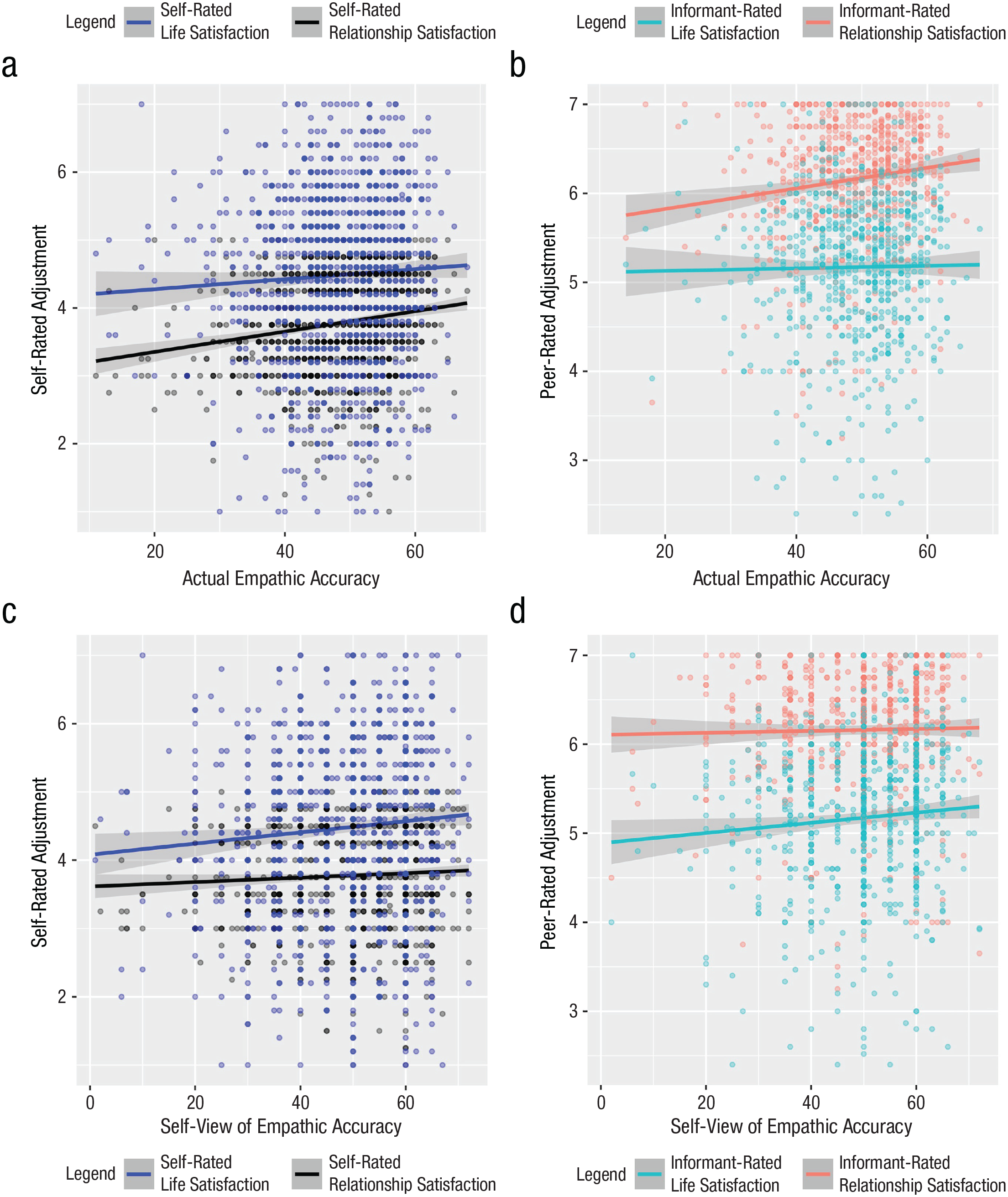
Empathic accuracy and self-views on peer- and self-rated life and relationship satisfaction. In (a) and (b), results are shown for actual empathic accuracy; in (c) and (d), results are shown for self-views of empathic accuracy. In (a) and (c), results are shown for self-rated adjustment measures (life and relationship satisfaction); in (b) and (d), results are shown for peer-rated adjustment measures (life and relationship satisfaction). Shaded areas represent 95% Confidence Intervals.
The mechanisms underlying associations between empathic accuracy and relationship satisfaction and between self-views and life satisfaction remain unknown. Exploratory analyses reported in the Supplemental Material revealed no support for three candidate mechanisms that we measured (i.e., perceived trust, responsiveness, and status). Future research should test other candidate mechanisms, such as the kinds of social behaviors that might transmit an effect of empathic accuracy on relationship quality. Exploratory analyses suggested possible moderation by participant and informant characteristics, but these patterns should be tested in a confirmatory manner in future research.
We relied on null-hypothesis significance testing to test the proposed models. The information theoretic approach is an alternative analytical strategy that reveals the likelihood (via maximum-likelihood estimation) that a given model best fits the data from a set of models (Förster et al., 2022; Humberg et al., 2019). This approach could be adopted in future tests of competing models of the effects of empathic accuracy and other emotional-ability domains.
Caution should be exercised, however, when generalizing these results. The participants were college students majoring in business who were relatively restricted in age and background, and the sample had a higher representation of East Asian participants compared with nationally representative samples recruited in other studies (He & Côté, 2019). We assessed adjustment as satisfaction with life (intrapersonal adjustment) and relationships (interpersonal adjustment). Future work could also examine career- or job-related adjustment in working adults, for instance. Because of time constraints, we limited our investigation to empathic accuracy. Future work could examine whether the same results hold with other emotional-ability domains. Empathic accuracy exhibits small to moderate correlations with other emotional abilities, such as the abilities to regulate emotions and to understand the causes of emotions (Côté et al., 2010; Joseph & Newman, 2010), and thus the results should not be generalized to other emotional-ability domains. It is also important to explore whether the pattern differs depending on which emotions people identify. This would require measuring self-views of the ability to identify each specific emotion separately.
The results tentatively suggest that individuals could potentially improve their satisfaction with their relationships with others by improving how well they identify others’ emotions. People might also become more satisfied with their relationships if they help others identify their own emotions—for example, by directly communicating how they feel. Further, organizations and schools could potentially improve their members’ satisfaction with their relationships by instituting empathic accuracy training.
In sum, actually reading others well is associated with satisfaction with relationships. But to feel happy about one’s life, the key might be simply thinking that one can read others.
Supplemental Material
sj-docx-1-pss-10.1177_09567976231185127 – Supplemental material for Are Empathic People Better Adjusted?: A Test of Competing Models of Empathic Accuracy and Intrapersonal and Interpersonal Facets of Adjustment Using Self- and Peer Reports
Supplemental material, sj-docx-1-pss-10.1177_09567976231185127 for Are Empathic People Better Adjusted?: A Test of Competing Models of Empathic Accuracy and Intrapersonal and Interpersonal Facets of Adjustment Using Self- and Peer Reports by Joyce C. He and Stéphane Côté in Psychological Science
Footnotes
Transparency
Action Editor: Karen Rodrigue
Editor: Patricia J. Bauer
Author Contributions

Notes
References
Supplementary Material
Please find the following supplemental material available below.
For Open Access articles published under a Creative Commons License, all supplemental material carries the same license as the article it is associated with.
For non-Open Access articles published, all supplemental material carries a non-exclusive license, and permission requests for re-use of supplemental material or any part of supplemental material shall be sent directly to the copyright owner as specified in the copyright notice associated with the article.
