




Abstract
How generous are people when making consequential financial decisions in the real world? We took advantage of a rare opportunity to examine generosity among a diverse sample of adults who received a gift of U.S. $10,000 from a pair of wealthy donors, with nearly no strings attached. Two-hundred participants were drawn from three low-income countries (Indonesia, Brazil, and Kenya) and four high-income countries (Australia, Canada, the United Kingdom, and the United States) as part of a preregistered study. On average, participants spent over $6,400 on purchases that benefited others, including nearly $1,700 on donations to charity, suggesting that humans exhibit remarkable generosity even when the stakes are high. To address whether generosity was driven by reputational concerns, we asked half the participants to share their spending decisions publicly on Twitter, whereas the other half were asked to keep their spending private. Generous spending was similar between the groups, in contrast to our preregistered hypothesis that enhancing reputational concerns would increase generosity.
Keywords
It is not from the benevolence of the butcher, the brewer, or the baker that we expect our dinner, but from their regard to their own interest.
Self-interest is a cornerstone of the modern capitalist economic system. Butchers, brewers, and bakers work to make a profit, not to be charitable. Adam Smith’s observation has been adopted into standard economic theory and long dominated academic and social discourse about the nature of human motivation (James & Rassekh, 2000). In recent decades, however, researchers in psychology and behavioral economics have called this aspect of the standard economic model into question, arguing that humans often act in ways that are against their self-interest (Thaler, 2016). Extensive evidence has documented human generosity across cultures (Henrich & Muthukrishna, 2021), in children (Hamlin, 2015), and in our nearest nonhuman ancestors (Prétôt & Brosnan, 2015). Even the field of economics has now widely rejected the traditional view of “Homo economicus” as highly rational and narrowly self-interested (Mullainathan & Thaler, 2015; Thaler, 2016). Despite this paradigm shift, the evidence quantifying generous financial behavior comes primarily from lab-based economic games. The extent to which humans exhibit financial generosity in consequential, real-world situations is essentially untested.
Perhaps the most notable evidence of generous financial behavior in the real world comes from the fact that people donate significant amounts of money to charity. In 2018, Americans donated $292 billion, roughly 1.4% of the gross domestic product (Giving USA Foundation, 2019). Although this amount is greater than what the most extreme interpretation of the standard economic model might predict (e.g., $0), it could be argued that it is trivial compared with what people keep (98.6%). Research has also suggested that people’s motivations for donating may be influenced by a variety of nonaltruistic factors, such as the pursuit of status and reputational concerns (Bekkers & Wiepking, 2011). Furthermore, up to 85% of donations are given as a direct result of solicitations (Bryant et al., 2003), suggesting that people may donate reactively to protect self-esteem but rarely do so proactively. Therefore, the amount donated to charity may be a distorted indicator of human generosity.
To circumvent these issues and to study the conditions that promote generosity, researchers have developed economic games to examine human generosity in the laboratory. For example, in the dictator game, participants are given a small sum of money as a payment or a gift and asked to allocate the funds between themselves and another participant. In a meta-analysis covering more than 100 studies and 20,000 decisions, Engel (2011) found that participants gave 28% of the money to other participants on average, casting doubt on the assumption of self-interest in standard economic theory.
These economic games have significantly informed our understanding of the nature of financial generosity, but do these findings extend beyond the lab? In a recent meta-analysis, behavior in such economic games was only weakly correlated with behavior in the real world, r = .14 (Galizzi & Navarro-Martinez, 2019). Several features of lab-based economic games limit their generalizability to real life (Levitt & List, 2007). For example, participants are forced to make artificial choices in response to the experimenter’s rules, and with some exceptions (e.g., Henrich et al., 2005), these studies have disproportionately relied on homogenous samples that represent only a small fraction of humanity (e.g., university undergraduates). Most importantly, the majority of studies using the dictator game involve stakes that are low, if not trivial (e.g., < $10). A meta-analysis of 31 studies (N = 3,233) found that participants are significantly less generous when the stakes are higher, d = −0.15, suggesting that the existing lab studies may overestimate the extent to which people are generous (Larney et al., 2019). Leibbrandt et al. (2015) conducted a high-stakes dictator game, giving 21 villagers in Bangladesh U.S. $120, an amount equivalent to 5 months’ salary. Participants gave away only 3.7% of this windfall, but the results should be interpreted with caution given the small sample size. To our knowledge, van den Assem et al. (2012) conducted the only study of economic games using stakes greater than several hundred dollars, examining cooperation between contestants on a British TV show who competed for a large prize (M = $20,000). Given that this study examined cooperation rather than generosity—and that contestants made decisions in front of a national television audience—our understanding of generosity in consequential real-world situations remains limited.
Statement of Relevance
To what extent are humans generous or selfish when making major financial decisions in the real world? Despite decades of research, this fundamental question about human behavior has remained unanswered. In a one-of-a-kind experiment, 200 adults from seven countries received a gift of $10,000 each from a pair of wealthy donors, with almost no strings attached. On average, the recipients spent over $6,400 on purchases that benefited others, including nearly $1,700 in donations to charity. Participants spent similar amounts on others regardless of whether they were instructed to keep their spending decisions private or to share their decision-making publicly on Twitter. By using a diverse sample, real-world decisions, and large stakes, this study provides the clearest evidence to date that humans are generous when making consequential financial decisions.
To overcome these issues, we took advantage of a rare opportunity to examine generosity among a diverse sample of participants from around the world. Participants received a potentially life-changing amount of money (U.S. $10,000) as a gift from an anonymous donor couple with nearly no limitations on how to spend it, mimicking real-life transfers of wealth such as inheritances. Participants were told they could spend the money however they wanted, such as pursuing a dream, spending it on family, or paying it forward to others, with the requirement that they spend all the money within 3 months (rather than storing it in savings or investments, which would effectively delay the spending decision). If human economic behavior is not driven by pure self-interest, individuals should spend a substantial amount of the money prosocially—perhaps as much as 28% if conclusions based on the dictator game are correct.
Of course, even seemingly generous decision-making may reflect concerns with status—concerns which may be amplified since the advent of social media (Brady et al., 2020). If prosocial spending is primarily motivated by such reputational concerns, then people should choose to spend more money generously when their decisions are made publicly rather than privately. In the present experiment, half the participants were randomly assigned to share their spending decisions publicly on Twitter, whereas the others were assigned to keep their decisions private, enabling us to test whether generous decision-making was driven largely by the desire to enhance one’s reputation.
Open Practices Statement
This article is part of a broader project investigating a variety of distinct research questions. This larger project was preregistered on OSF (https://osf.io/9rv8n/). The present article addresses Question 1 in the preregistration, and we report all conditions and measures that are relevant to this question here. To protect participants’ privacy, we have not made the data and associated analysis code available publicly, but we can share them confidentially with permission from the TED organization. The study materials and data request form are available on OSF (https://osf.io/h6q4a/).
Method
Participants
The study was conducted by the TED organization as the “Mystery Experiment.” Announcements on TED’s social media channels invited participants to apply via the TED website (see https://osf.io/h6q4a/). As part of the application, participants provided their demographic information and completed a brief baseline questionnaire assessing their personality and well-being. To obtain a globally diverse sample, we recruited participants from a wide range of socioeconomic backgrounds from both low-income countries— Brazil (n = 8), Indonesia (n = 50), and Kenya (n = 39)—and high-income countries—Australia (n = 12), Canada (n = 12), the United Kingdom (n = 25), and the United States (n = 54). These countries were included because they do not impose gift taxes, enabling participants to receive the full amount without tax penalties, and they provided a mix of three low and four high-income countries. Participants also had to be at least 21 years old and at least somewhat fluent in English. Because the public-versus-private manipulation required Twitter, participants also had to manage an active Twitter account with more than 100 followers (Mdn = 200–499). Participants were excluded if they were affiliated with the TED organization or if they reported that receiving $10,000 could create risks such as theft or violence. Participants in our final sample were relatively young (M = 34.2 years, SD = 12.1, range = 21–75), educated (85% had a bachelor’s degree or higher), and liberal-leaning (M = 34.6, SD = 18.6, on a scale from 0, left, to 100, right). Our sample size was determined on the basis of the resources available to fund the $10,000 gifts; a post hoc power analysis for a one-sample t-test with a sample size of 199 and an α of .05 revealed that we had 80% power to detect an effect of at least d = 0.2.
As part of the TED Mystery Experiment, an additional 100 participants were assigned to a third control group, but because this group did not receive any money, their data cannot be used to address the present research question. The Mystery Experiment was conducted by the TED organization in compliance with ethical guidelines and legal requirements in the United States, and the analyses reported in the present article were reviewed and approved by the institutional review board at the University of British Columbia.
Procedure
Applicants selected to participate received detailed study instructions via email (see https://osf.io/h6q4a/). To ensure participants believed that the project was legitimate, we sent them a video of the head of TED, Chris Anderson, announcing the $10,000 gift and explaining the key experimental instructions (see https://osf.io/h6q4a/). To minimize any motivation to lie about how they spent the money, we emphasized in the instructions that the money was theirs to spend however they wanted. We ensured that participants understood the study instructions by making them pass a quiz before providing consent.
Participants received the money via PayPal in a single payment and were randomly assigned to the public or private condition. In the public condition, participants were asked to share their participation with their friends and family and to post on Twitter using the hashtag #MysteryExperiment anytime they spent the money or were thinking of how to spend it. Four participants who had concerns about posting this information online were instructed to post about their purchases without using the hashtag or mentioning they received money for the study. Nine other participants had not tweeted about the study after 1 month and were sent a single reminder of the Twitter instructions. In the private condition, participants were asked not to share their participation publicly online, although they were permitted to tell their close friends and family.
Measures
As part of the Mystery Experiment, participants completed extensive surveys 1, 2, 3, and 6 months after the cash transfer (see https://osf.io/h6q4a/ for full measures). We asked all participants to complete all surveys privately online through a digital questionnaire in order to encourage honest responding. In the surveys 1, 2, and 3 months after the cash transfer, participants reported how they spent the money that month, in their preferred currency (which we converted to U.S. dollars). For each purchase, participants reported the cost and recipient (i.e., myself, family in the household, family out of the household, close friends, strangers or acquaintances, a local cause or organization, or a national cause or organization). They were asked to report purchases separately, so each purchase was for a specific purpose (see https://osf.io/h6q4a/). Purchases could have multiple recipients, and participants were encouraged to select all recipients who benefited from the purchase (e.g., taking a friend to dinner would benefit both the self and the friend). We calculated the total amount spent on each recipient category across the 3-month follow-up period. If participants made a purchase that benefited multiple types of recipients, we included the amount in each of the relevant categories shown in Table 1. To account for the fact that many participants did not report spending exactly $10,000, we also converted the amount spent per recipient category into a percentage of total reported spending. To increase the accuracy and completeness of the data, we asked participants to review their responses after each survey and to provide corrections whenever inconsistencies were identified.
Spending on Different Recipient Categories Across Conditions
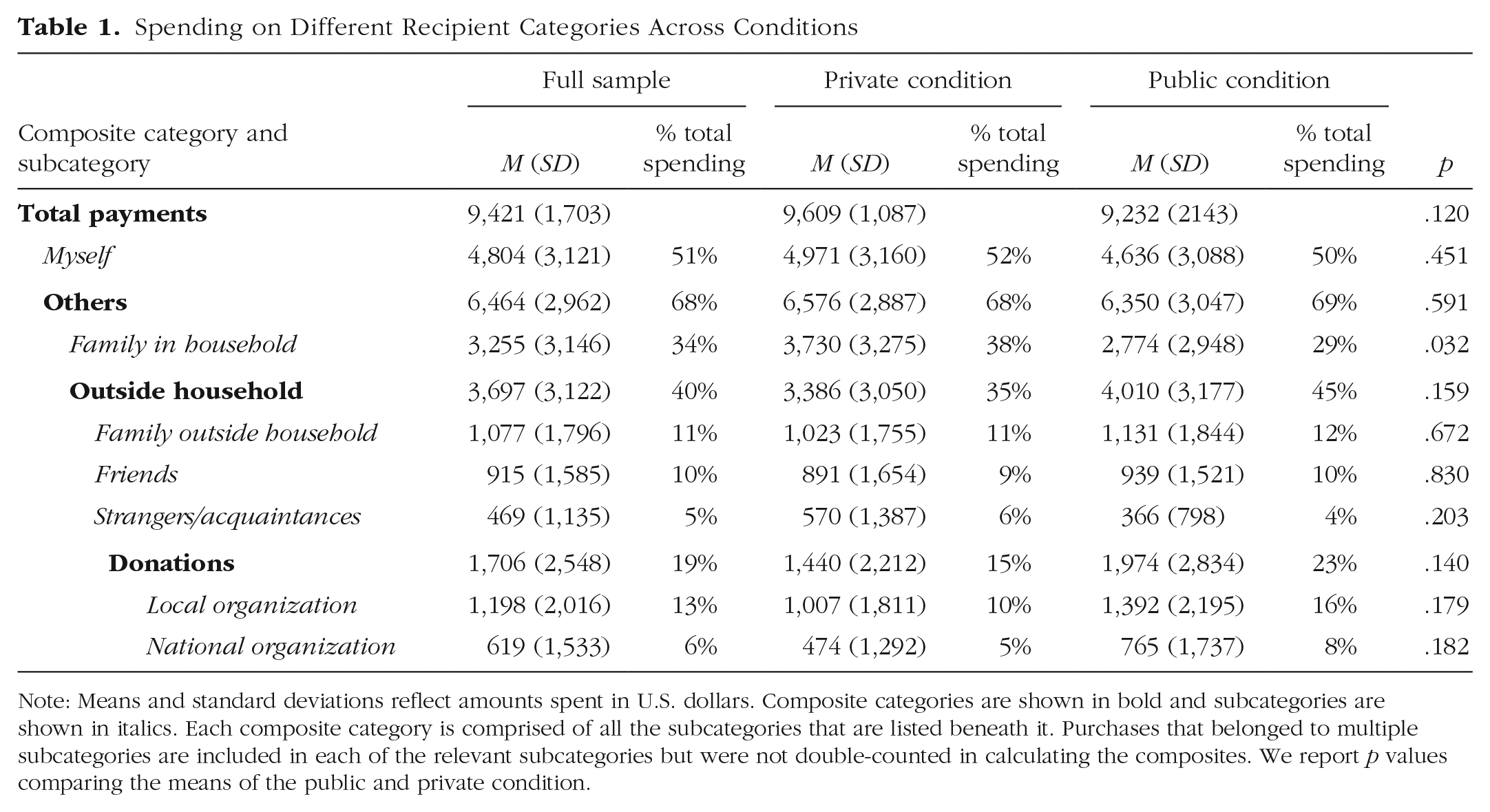
Note: Means and standard deviations reflect amounts spent in U.S. dollars. Composite categories are shown in bold and subcategories are shown in italics. Each composite category is comprised of all the subcategories that are listed beneath it. Purchases that belonged to multiple subcategories are included in each of the relevant subcategories but were not double-counted in calculating the composites. We report p values comparing the means of the public and private condition.
Prosocial spending
Following past research, we defined “prosocial spending” broadly as any spending that benefited others—even if it simultaneously benefited the self (see Aknin et al., 2022, for a review). We also examined narrower forms of prosocial spending, such as donations to charity, to provide a more conservative test of generous decision-making.
Manipulation check
On the 3-month survey, participants were asked, “When spending the money from Mystery Experiment over the last three months, to what extent did the following impact your spending decisions?” They reported on a scale from 0, not at all, to 5, very much, about the impact of “discussions with my family,” “discussions with my friends,” and “the requirement to share on social media” (this last question was presented only to participants in the public condition).
Missing data
Attrition was very low, and the survey reports accounted for nearly all of the money. One participant failed to complete any surveys, and therefore their data were treated as missing. From the remaining 199 participants, we received 95% of the expected surveys across the 3 months of the study. Some participants reported spending somewhat more or less than $10,000, perhaps because they lost track of their expenditures or missed a survey. Ninety percent of participants reported total spending within $1,000 of the full transfer amount, but one participant in the private condition and three in the public condition reported spending less than $1,000; to be consistent with our preregistration, we retained these participants in our analyses, but removing them had no substantive effect on our primary conclusions.
Results
Following our preregistered analysis plan, we first operationalized prosocial spending as including any purchases that benefited others. 1 Overall, participants spent $6,464 on prosocial purchases, significantly more than the strictest interpretation of the standard economic model would predict (e.g., $0), t(198) = 30.78, p < .001, 95% confidence interval (CI) = [$6,050, $6,878], d = 2.18. 2 Of these prosocial purchases, $3,697 was spent on people outside the household, confirming that participants did not simply spend the money generously on their immediate family members. Of the purchases outside the household, $2,067 was spent on strangers, acquaintances, and donations to organizations, demonstrating that generous spending extended beyond participants’ immediate social networks. Even using this relatively conservative definition of prosocial spending, 22% of total spending was generous. This amount is broadly consistent with the average of 28% reported in Engel’s (2011) meta-analysis of dictator games in the lab.
Of course, because participants could have spent the money on others in ways that also benefited themselves (e.g., taking an acquaintance out for lunch), it could be argued that some of these purchases were not generous. Looking just at donations to charity, however, we saw that participants contributed $1,706 to local and national organizations/causes (19% of their total spending). As another way of narrowing our definition of prosocial spending, we excluded any purchases that participants identified as also benefiting themselves (see Table S1 in the Supplemental Material available online) and then repeated our primary analyses. Using this stricter definition of prosocial spending, we found that participants spent $4,560 on others, including spending $2,979 outside the household and $1,496 on donations to charities. Regardless of how exactly we defined prosocial spending, then, participants spent a substantial amount of their windfall to benefit others.
That said, participants may have spent money on others in order to enhance their own reputations. If this were the case, then we should expect greater prosocial spending by participants who were required to publicly share news of their windfall and spending decisions, compared with participants who were instructed to keep this information private. Yet our preregistered analysis revealed that both groups spent similar amounts on others, t(196) = 0.54, p = .60, 95% CI = [$–603.2, $1,056.8], d = 0.08. Null-hypothesis significance testing can never prove the null, so we conducted a series of exploratory equivalence tests to determine what effect sizes would be improbable given the data (Lakens et al., 2018). The results from our equivalence tests suggested that we can reject effects greater than d = 0.32; in dollar terms, this means that we can reject between-group differences of more than $948. Thus, our manipulation of reputational concerns did not have a substantial impact on financial generosity. Exploratory analyses suggest that participants in the private condition spent more on people in their household, but no other significant difference emerged (Table 1).
It is possible we did not detect differences because our manipulation was unsuccessful. However, exploratory analyses showed that participants in the public condition tweeted about the “Mystery Experiment” approximately 14 times on average (M = 14.3, SD = 13.8) compared with 0 times in the private condition (M = 0, SD = 0), t(91) = 9.9, p < .001, 95% CI = [−17.18, −11.45], d = 1.4. As shown in Table 2, participants in the public condition reported being somewhat influenced by the requirement to share on Twitter. By sharing their experiences on Twitter, participants may have been unable to keep the news a secret from their real-life social networks. Indeed, participants in the public condition reported being more influenced by their family and friends than participants in the private condition. Together, these results suggest that participants in the public condition were more influenced by their social networks—both online and offline.
Self-Reported Influence of Friends and Family on Spending Decisions
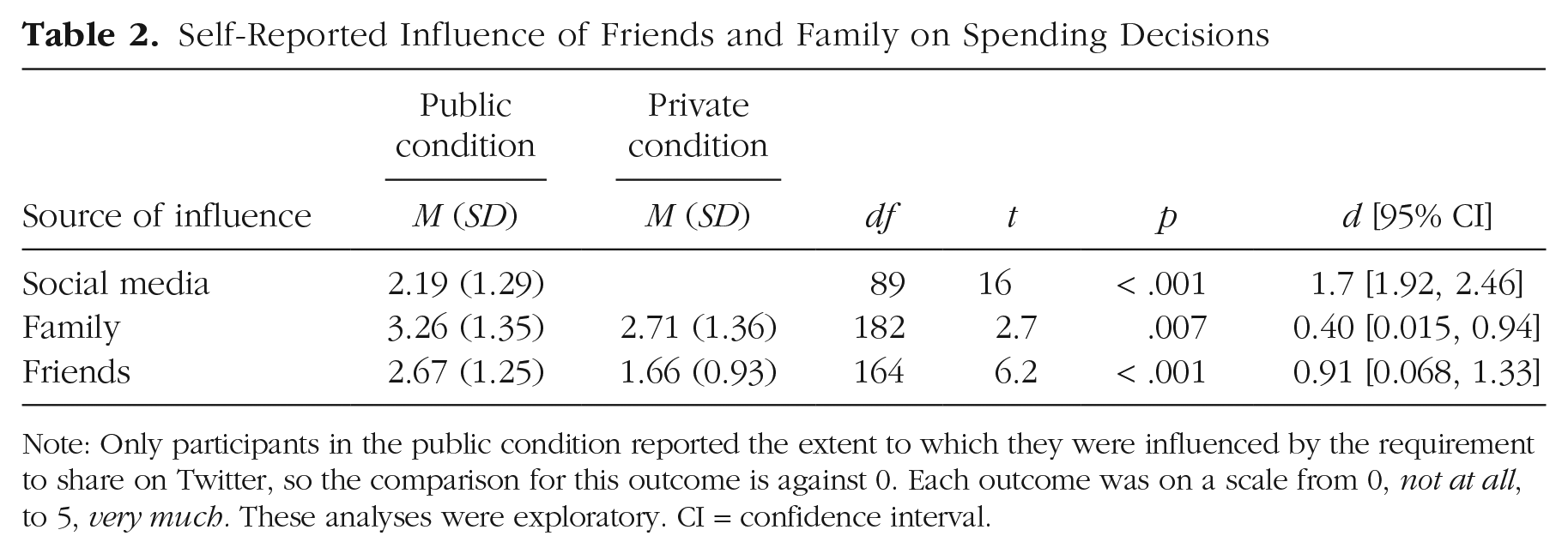
Note: Only participants in the public condition reported the extent to which they were influenced by the requirement to share on Twitter, so the comparison for this outcome is against 0. Each outcome was on a scale from 0, not at all, to 5, very much. These analyses were exploratory. CI = confidence interval.
In additional exploratory analyses, we examined the extent to which prosocial spending might vary across the global socioeconomic spectrum (see Table S2 in the Supplemental Material). It is possible that people from low-income countries might spend less of the money generously than people from high-income countries to the extent that they have greater material needs that could be addressed by the money. Yet participants from lower and high-income countries did not differ in overall prosocial spending, t(195) = −1.1, p = .3, 95% CI = [$−1,263.1, $384.2], d = −0.15, or in the amount spent beyond their immediate household, t(188) = −1.4, p = .20, 95% CI = [$–1,485.7, $239.4], d = −0.20. Results from exploratory equivalence tests revealed that we can reject effects on overall prosocial spending that are greater than d = 0.39 (or $1,218), suggesting that any potential effects are not large. However, participants from high-income countries spent more on charitable donations, t(173) = −2.4, p = .018, 95% CI = [$–1,537.7, $–148.3], d = −0.33.
Discussion
To what extent are humans generous or self-interested when making consequential financial decisions in the real world? Despite decades of research using economic games, a clear answer to this fundamental question about human behavior has remained elusive. We examined generous behavior in a one-of-a-kind experiment that provided participants from across the global socioeconomic spectrum with an unconditional gift of $10,000. Going beyond previous lab-based work, this preregistered study used a diverse sample, real-world decisions, large stakes, and a cash gift with essentially no strings attached, enabling us to demonstrate that humans are generous in natural and meaningful situations.
Across all our operationalizations of prosocial spending, people exhibited a level of generosity that was inconsistent with the standard economic model, falling closer to the average amount donated in dictator games (28%). Using a broad definition of prosocial spending that encompassed a wide range of purchases benefiting others (e.g., taking a friend to dinner), we found that participants spent 68% of the cash gift generously. Even using our narrowest definition of prosocial spending—donations to charity, which provided no benefit to the participant—we found that participants spent 16% of the money generously.
Of course, participants were aware that they were part of an experiment in which they would report their spending choices. This may have spurred them to spend money (or report spending it) in socially desirable ways (Krumpal, 2013). Indeed, one dictator game study quantified the effect of experimenter demands on financial generosity: People gave away 0.24 standard deviations more money when they were explicitly told that the experimenter expected them to share it (de Quidt et al., 2018). If we assume our participants experienced a similar level of experimental demand, we can reduce prosocial spending in the current study by 0.24 standard deviations. Even with this conservative adjustment, participants would still have spent more than half ($5,753) of their windfall on others. Importantly, however, most participants in the current study did not know that the “Mystery Experiment” had anything to do with generosity. When participants were asked what they thought the experiment was about, only 15% (n = 29) correctly guessed that the study was about generosity. When we excluded these participants, the amount spent on others was largely unchanged (M = $6,260), casting further doubt on the idea that participants were strongly influenced by experimenter demands.
To encourage honest responding, we asked all participants to account for their expenditures on private online surveys. Although participants could have been required to use a debit or credit card, enabling objective tracking, this would have limited the global diversity of the sample and the diversity of purchases that could be made. The self-report survey enabled participants to report cash transactions and to break down large payments into distinct purchases (e.g., multiple distinct items purchased from the same store could be reported separately). To our knowledge, this is the first study to document spending patterns of large cash transfer recipients using comprehensive purchase-level data.
If participants’ spending choices were driven largely by social desirability or reputational concerns, we would have expected to see greater generosity in the public (vs. private) condition, which was designed to maximize reputational concerns by requiring participants to share their spending decisions on Twitter. Although reputational concerns almost surely played a role for participants in the private condition, too, we would assume that publicly sharing experiences on Twitter should substantially elevate reputational concerns. Our finding that levels of generous spending were similar and high across both conditions is inconsistent with our preregistered hypothesis that heightened reputational concerns would drive generosity.
It is also possible that participants were inspired by the donor couple’s initial act of generosity. Research on mental accounting has demonstrated that people spend money in ways that match the source of the funds (Thaler, 1999), so participants may have spent this unexpected gift more generously than they might other sources of income. Although this limits the generalizability of the findings, it also demonstrates how a gift from a single household can spread diffusely through social networks to positively impact others (Fowler & Christakis, 2010). For example, one participant from Canada donated $1,200 to an organization that provides construction training to marginalized people so they can enter the workforce, and another participant in Indonesia gave $1,500 to the family of a friend who had passed away to help cover basic necessities, thereby passing on the benefits of the cash to others in their network.
Although all participants received $10,000, the increase in income they experienced varied dramatically. For participants in the high-income countries (who reported median household incomes of almost $100,000), the cash gift provided the equivalent of a 10% increase in income, whereas for participants in the low-income countries (who reported median household incomes under $8,000), the gift more than doubled their annual income, on average. The high- and low-income countries also differed on a number of dimensions, including language, geography, politics, and culture. Despite these differences, participants spent similar amounts of money on others, although people from high-income countries spent more on charitable donations.
These findings dovetail with past research showing that people around the world find spending money on others inherently rewarding (Aknin et al., 2022). Past research also suggests that people find giving to close others more rewarding than giving to distant others (Aknin et al., 2011). This may help to explain why people spent about 3 times as much on family inside (vs. outside) the household and twice as much on donations to local (vs. national) organizations.
It is important to note that participants were not selected to form a representative sample of their individual countries or the world. Participants were all active Twitter users who were at least somewhat fluent in English and were relatively young, educated, and liberal-leaning. Although our sample included participants from seven countries, most were from Indonesia, Kenya, the United States, and the United Kingdom. Still, this sample was far more diverse than typical lab-based experiments using convenience samples (e.g., undergraduates).
Although receiving a $10,000 windfall does not happen every day, as much as $36 trillion will be passed down to future generations as gifts in the form of inheritances over the coming decades in the United States alone (Steverman, 2019), and roughly 30% of American households will receive wealth transfers at some point (Wolff & Gittleman, 2011). Thus, this research not only informs our theoretical understanding of generosity but also carries the hopeful implication that this massive intergenerational transfer of wealth could be passed on for the common good. It would be fascinating to examine how subtle differences in framing gifts and inheritances might shape how generously they are spent. Taken together, our findings build on previous lab-based research and suggest that even in consequential real-world situations, humans are not narrowly self-interested but substantially generous. Furthermore, our research documents the potential of wealth transfers to generate large ripple effects in society and demonstrates how a single act of generosity can inspire countless more.
Supplemental Material
sj-docx-1-pss-10.1177_09567976231184887 – Supplemental material for Are People Generous When the Financial Stakes Are High?
Supplemental material, sj-docx-1-pss-10.1177_09567976231184887 for Are People Generous When the Financial Stakes Are High? by Ryan J. Dwyer, William J. Brady, Chris Anderson and Elizabeth W. Dunn in Psychological Science
Footnotes
Acknowledgements
We thank Malanna Wheat and Sheila Orfano for managing the Mystery Experiment and Robert Kuan, Erica Qiu, and Rachel Ma for research assistance.
Correction (September 2023):
This article has been updated with minor grammatical or style corrections since its original publication.
Correction (March 2025):
This article has been updated to correct a small data error where an excluded participant’s data was not excluded, but accidentally captured as 0. The article text and Table 1 have been corrected.
Transparency
Action Editor: Leah Somerville
Editor: Patricia J. Bauer
Author Contributions

Notes
References
Supplementary Material
Please find the following supplemental material available below.
For Open Access articles published under a Creative Commons License, all supplemental material carries the same license as the article it is associated with.
For non-Open Access articles published, all supplemental material carries a non-exclusive license, and permission requests for re-use of supplemental material or any part of supplemental material shall be sent directly to the copyright owner as specified in the copyright notice associated with the article.
