




Abstract
A well-established finding is that beliefs in contradictory conspiracy theories (e.g., Princess Diana was murdered vs. faked her own death) are positively correlated. This is commonly interpreted as evidence that people systematically believe blatant inconsistencies. Here, we propose that the field has insufficiently acknowledged a compelling alternative explanation: Disbelieving both conspiracy theories also yields a positive correlation. In four preregistered studies (total N = 7,641 adults), online participants evaluated 28 sets of contradictory conspiracy theories. Although the positive correlation was replicated in all cases, this was mostly due to participants who believed the official versions of these events (e.g., Princess Diana died in a car accident). Among participants who disbelieved these official stories, the correlation was inconsistent at best. A mini meta-analysis revealed a negative correlation among these participants, which was particularly due to the dead-or-alive cases. Apparently, researchers should reconsider the notion of systematic belief in contradictory conspiracy theories.
Keywords
Conspiracy theories are ubiquitous on social media and the Internet, questioning official explanations for impactful events. Conspiracy theories are defined as beliefs that a group of actors is colluding in secret to pursue goals widely seen as malevolent (Bale, 2007; van Prooijen & van Vugt, 2018). Empirical research on conspiracy theories has grown quickly in recent years (for overviews, see Douglas et al., 2019; van Prooijen, 2020, 2022; van Prooijen & Douglas, 2018). A basic finding in this research domain is that belief in one conspiracy theory positively predicts belief in another conspiracy theory (Abalakina-Paap et al., 1999; Goertzel, 1994; Swami et al., 2011). This finding has inspired the theoretical insight that people differ in their tendency to attribute events to conspiracies, which has been referred to as a conspiratorial mindset, a monological belief system, or conspiracy mentality (e.g., Imhoff & Bruder, 2014; Lewandowsky et al., 2013; Miller, 2020; Sutton & Douglas, 2014; Swami et al., 2011; Williams et al., 2022).
In an impactful contribution, Wood et al. (2012) found that even beliefs in mutually contradictory conspiracy theories are positively correlated. The belief that Princess Diana was murdered is positively correlated with the belief that she faked her own death; likewise, the belief that Osama bin Laden was already dead before the raid in Abbottabad is positively correlated with the belief that he is still alive. This finding has been well replicated for a broad range of conspiracy theories (Imhoff & Lamberty, 2020; Lukic et al., 2019; Miller, 2020) and is commonly interpreted as evidence for systematic belief in contradictory conspiracy theories: The more strongly people believe one conspiracy theory, the more likely it is that they also believe a mutually contradictory one.
Throughout the social sciences, this correlation is often presented as a testimony to the irrationality of conspiracy theorists: They apparently accept blatant inconsistencies by being likely to believe that a person is simultaneously dead and alive. For instance, authors have proposed that the Wood et al. (2012) findings indicate doublethink among conspiracy theorists (Irwin et al., 2015). Moreover, the correlation has inspired statements such as “the simultaneous belief in mutually exclusive theories—e.g., that Princess Diana was murdered but also faked her own death—has been identified as an aspect of conspiracist ideation” (Lewandowsky et al., 2020, p. 221) and “Wood et al. (2012) demonstrate that people are quite willing to believe contradictory [conspiracy theories]” (Miller, 2020, p. 320). Or as the original source concluded: “Believing that Osama Bin Laden is still alive is apparently no obstacle to believing he has been dead for years” (Wood et al., 2012, p. 772).
Here, we propose that researchers have insufficiently acknowledged a sobering and compelling alternative explanation: The positive correlation may be mostly due to the participants in the sample who are skeptical of both contradictory conspiracy theories. Imagine a hypothetical group of participants in the original Wood et al. (2012) study who believe the official story that Princess Diana died in a car accident and are skeptical of the conspiracy theories surrounding this event. When asked whether Princess Diana was murdered, they respond “strongly disagree” (1 on a 5-point scale). When asked whether Princess Diana faked her own death, they again respond “strongly disagree.” As a result, their responses show a perfectly positive correlation (r = 1.0). This does not reflect an irrational belief that Princess Diana is dead and alive at the same time. Instead, it simply reflects their belief that Princess Diana died in a car accident.
Although many citizens believe at least one conspiracy theory out of a longer list (e.g., Oliver & Wood, 2014), a majority of people usually do not believe in most specific conspiracy theories. Measures of beliefs in specific conspiracy theories typically yield skewed response distributions, with large portions of participants indicating strong disbelief in the conspiracy theory (Imhoff et al., 2022; Sutton & Douglas, 2022). Quite often, research finds relatively low mean ratings on measures of specific conspiracy beliefs (e.g., Hornsey et al., 2021; Imhoff & Lamberty, 2020; Jolley & Paterson, 2020; van Prooijen et al., 2021), although there are exceptions (e.g., van Prooijen et al., 2022, Study 2). If a positive correlation emerges among a majority of participants who are skeptical of conspiracy theories, it is very possible that their responses dominate the overall positive correlation. The correlation observed by Wood and colleagues (2012) may therefore not reflect systematic belief in contradictory conspiracy theories at all; it may alternatively reflect that disbelieving one conspiracy theory predicts disbelieving a contradictory one.
Statement of Relevance
Across scientific fields and in public debates, scholars often highlight conspiracy theorists’ simultaneous belief in blatant inconsistencies. This is based on a well-established finding that beliefs in contradictory conspiracy theories (e.g., Princess Diana was murdered vs. faked her own death) are positively correlated. Here, we provide evidence for a sobering and compelling alternative explanation: The positive correlation may be driven by participants who are skeptical of both conspiracy theories. We found that the correlation primarily emerged among people who believe the official version of events (e.g., Princess Diana died in a car accident). Among people who reject this official story, the correlation was unreliable and often negative. A meta-analysis yielded no evidence for a positive correlation among precisely those participants who rejected the official versions of these events. The correlation mostly reflects that people who disbelieve one conspiracy theory are likely to also disbelieve a contradictory one.
The Current Research
Although we do not dispute that belief in contradictory conspiracy theories may occur among individual participants (Petrović & Žeželj, 2022), here we tested the meaning of the positive correlation between such contradictory beliefs. Extending previous research (e.g., Wood et al., 2012), we asked participants in four preregistered studies whether they believed or disbelieved the official version of a range of events (e.g., Princess Diana died in a car accident). If believing one conspiracy theory predicts also believing a contradictory one, the positive correlation reasonably may be expected to emerge among participants who explicitly reject the official versions of events (Hypothesis 1). If, alternatively, the positive correlation is due to participants who are skeptical of both conspiracy theories, it should emerge among participants who believe the official versions of events but not among participants who disbelieve the official versions (Hypothesis 1alt). Moreover, because we suspected that the correlation is attributable mostly to people who are skeptical of conspiracy theories, we predicted that the correlation would be more strongly positive among people who believe, as opposed to disbelieve, the official versions of these events (Hypothesis 2).
Study 1
Method
Participants
The sample was recruited in the United Kingdom through Prolific (https://www.prolific.co/). We ran a priori power analyses to estimate the appropriate sample size for a bivariate correlation (Hypothesis 1 vs. 1alt) based on the correlation (r = .24) observed by Wood et al. (2012). Detecting a correlation of .24 with 80% power would require at least 133 participants who do not believe the official version of events. It was impossible to anticipate how many participants would and would not believe the official version of each event, however, and therefore we recruited a large sample of 800 participants. This sample size also provided 80% power for the Fisher’s r-to-z tests (Hypothesis 2) to detect an effect size below medium (q = .269) in the case of highly skewed distributions (e.g., at least 133 participants disbelieve and 667 believe the official version); for more even distributions (e.g., 400 believers and 400 disbelievers), this sample size provided 80% power to detect even smaller effect sizes (q = .199). Four participants were dropped because they indicated that they did not answer the survey honestly, resulting in a total of 796 participants (248 men, 543 women, five other; age: M = 38.87 years, SD = 13.12). The study lasted around 10 min, and participants were paid £1 (UK).
Procedure and measures
After providing informed consent, participants were (in a randomized order) presented with a short description of the official story for eight events or topics that have elicited many conspiracy theories: the COVID-19 pandemic, climate change, the 9/11 terrorist attacks, Maddie McCann’s disappearance, the pharmaceutical industry’s search for a cancer cure, Adolf Hitler’s suicide, the death of Princess Diana (see Wood et al., 2012), and Jeffrey Epstein’s suicide. For each topic, participants indicated in a binary format whether they believe that the official version of these events is true or false. Then they responded to two contradictory conspiracy theories regarding each event on a 5-point Likert scale.
Here is an example item as presented to participants (for full materials, see the Supplemental Material available online):
In 2007, British 3-year-old girl Madeleine Beth McCann (nicknamed Maddie), disappeared during a holiday with her family in Portugal. Until today, the police say it is not clear what happened to her. However, there are also groups of people who question whether the police really do not know. Do you think the official reading (i.e., It is still unclear to the police what happened to Maddie McCann) is true or false? (1 = True; 2 = False)
Participants then indicated their agreement with the following statements (1 = strongly disagree, 5 = strongly agree): “The police took a bribe to cover up the fact that Madeleine McCann was abducted by a sex trafficking gang,” and “The police took a bribe to cover up the fact that Madeleine McCann was killed by her parents.” At the end of the study, participants were debriefed and redirected to a URL to collect their payment. 1
Results
An overview of participant distributions (i.e., the number who believed and disbelieved the official story) per event, along with means, confidence intervals (CIs), and t tests, are provided in Table 1. The target sample of our power analysis (at least 133 participants who disbelieved the official version of events) was reached for seven out of eight topics. Although the level of belief in some of the conspiracy theories varied in both participant groups (e.g., conspiracy beliefs were very low for the theory that Princess Diana faked her own death), participants who disbelieved the official version of events agreed more with each of the presented conspiracy theories than participants who believed the official version of events (ps < .001). Moreover, participants who believed the official story scored below the scale midpoint (3.0) for all conspiracy theories; participants who disbelieved the official story scored above the scale midpoint for at least one conspiracy theory per topic.
Comparison of Descriptive Statistics for Beliefs in Contradictory Conspiracy Theories (Study 1)
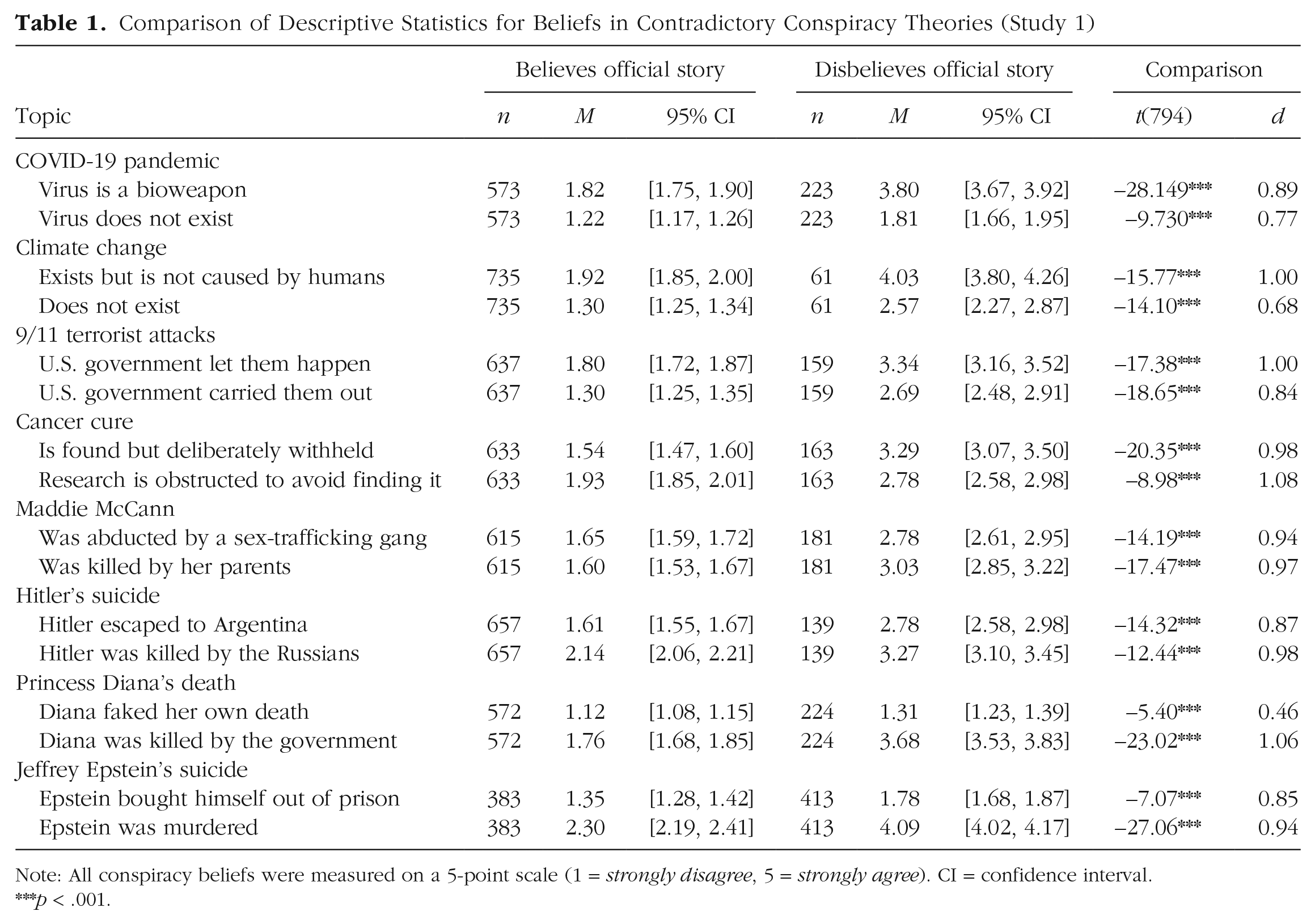
Note: All conspiracy beliefs were measured on a 5-point scale (1 = strongly disagree, 5 = strongly agree). CI = confidence interval.
p < .001.
Figure 1 provides an overview of all the correlations that we observed. The overall correlation between beliefs in contradictory conspiracy theories was significant for all eight topics (.21 < rs < .54, ps < .001), replicating the findings of Wood et al. (2012). Among participants who believed the official version of these events, the correlation was also significant for all of the topics (.27 < rs < .60, ps < .001).
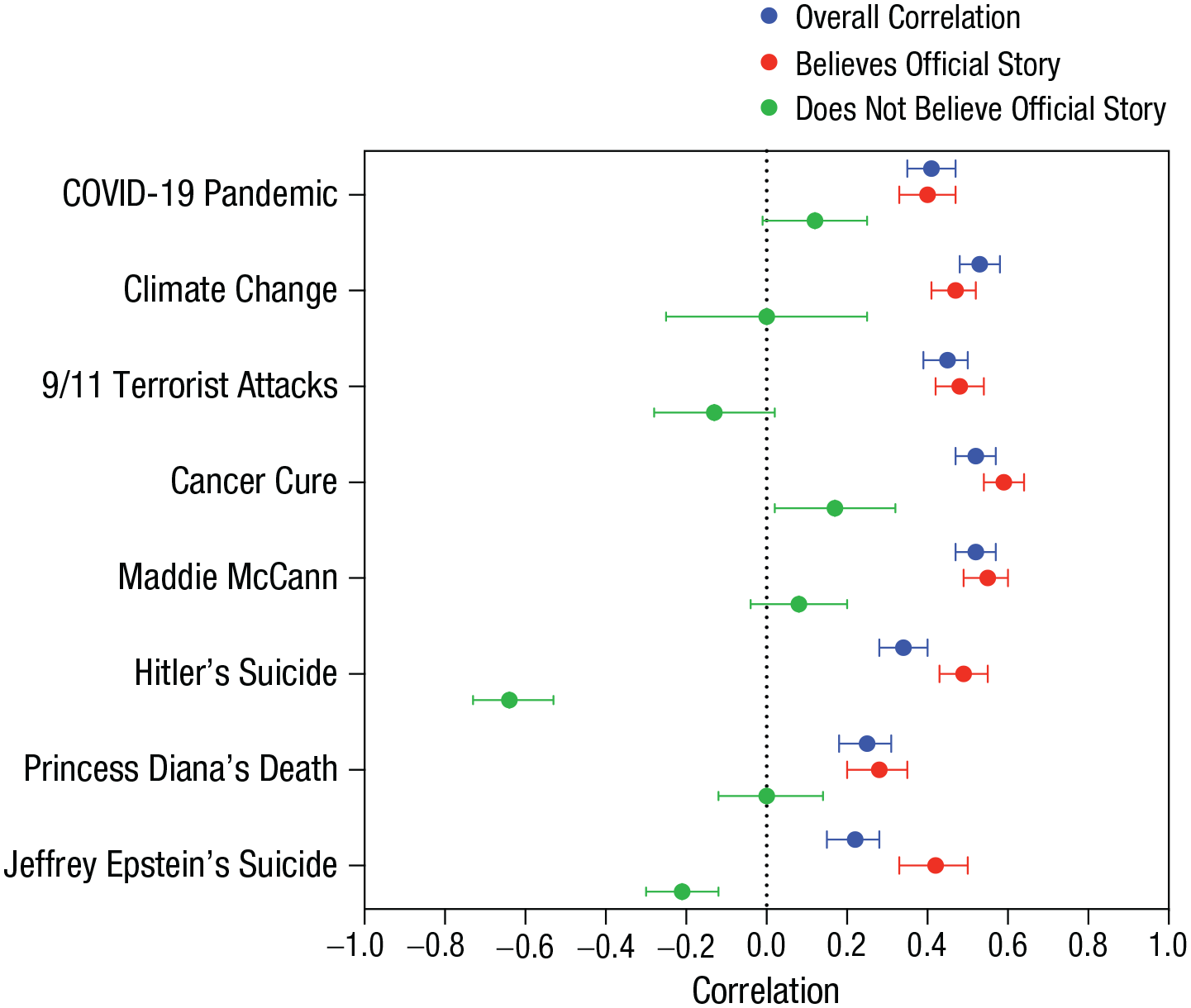
Correlations for beliefs in contradictory conspiracy theories in Study 1. Correlations for participants who believe and who disbelieve the official version of events are shown separately; overall correlations are also shown. Error bars indicate 95% confidence intervals.
Among participants who disbelieved the official version of events, however, the correlation was significant and positive for only one topic (cancer cure: r = .17, p = .027). For another topic (the COVID-19 pandemic) the correlation was marginal (r = .12, p = .068). For two topics (Hitler’s and Epstein’s suicides), the correlation was significant and negative (r = −.64 and r = −.21, respectively; ps < .001). For the remaining topics, the correlation was not significant (ps > .09). These findings support Hypothesis 1alt and contradict Hypothesis 1. Moreover, Fisher’s r-to-z tests (calculated in R’s cocor package) were highly significant for all eight topics (zs > 3.60, ps < .001), supporting Hypothesis 2: The correlation consistently was more strongly positive for participants who believed, as opposed to disbelieved, the official versions of these events.
Discussion
Although the overall correlation replicated for all topics, it was mostly due to participants who believed the official versions of these events. Among the participants who disbelieved the official stories, a (weak) positive correlation emerged for only one topic. Moreover, four of the topics were “dead-or-alive” cases and therefore arguably most clearly contradictory (see also Lukic et al., 2019); 2 none of these cases yielded a significantly positive correlation.
Study 2
In Study 2, we allowed participants to indicate that they were unsure of the official version of events. Of importance, a positive correlation between contradictory conspiracy theories among people who are unsure of what happened does not necessarily reflect inconsistencies in their belief system: Instead, it may reflect comparable levels of uncertainty about different explanations. The litmus test of systematic belief in contradictory conspiracy theories is a positive correlation among participants who disbelieve the official version of events.
Method
Participants
This study was conducted on a large prestratified panel in The Netherlands as part of a larger data-collection effort for multiple independent research projects. Data were collected by Kieskompas (“Election Compass”), a Dutch political research organization that complies with privacy standards of the European Union General Data Protection Regulation and is closely monitored by the Dutch privacy authority. Although the full sample contained 8,769 Dutch participants, for efficiency reasons (and to reduce questionnaire length), two separate questionnaires were sent to different subsets of the larger panel. A total of 5,261 participants responded to the questionnaire containing the measures for the present project (2,942 men, 2,319 women; age: M = 51.37 years, SD = 18.28), yielding high statistical power to investigate the current hypotheses.
Procedure and measures
Participants read a short description of the official story for four well-known societal events (COVID-19, climate change, the 9/11 terrorist attacks, and Hitler’s suicide; some of the events were slightly adjusted compared with Study 1) and indicated whether they believed or disbelieved the official versions of these events. Extending Study 1, we gave participants a third response option, allowing them to indicate that they are unsure whether the official story is true. For each event, participants again indicated their agreement with two contradictory conspiracy theories (1 = strongly disagree, 5 = strongly agree).
Results
Table 2 displays participant distributions, means, and CIs. For most conspiracy theories, belief was lowest for participants who believed the official version of the events, followed by participants who were unsure what happened; belief was highest for participants who disbelieved the official version of the events (the only exception was the belief that Hitler was killed by Russians, where belief was higher for those who were unsure than for those who disbelieved the official story).
Comparison of Descriptive Statistics for Beliefs in Contradictory Conspiracy Theories (Study 2)
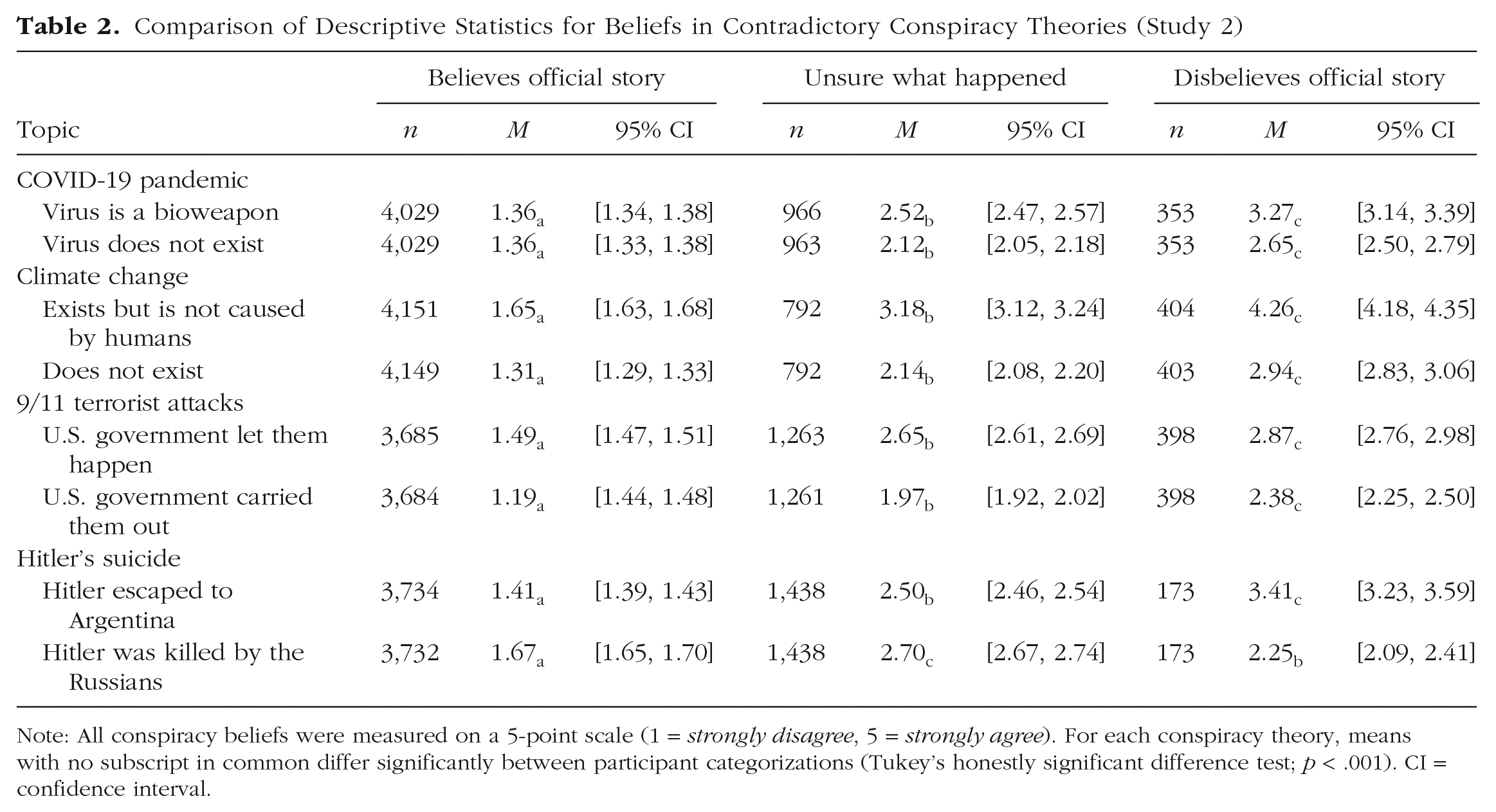
Note: All conspiracy beliefs were measured on a 5-point scale (1 = strongly disagree, 5 = strongly agree). For each conspiracy theory, means with no subscript in common differ significantly between participant categorizations (Tukey’s honestly significant difference test; p < .001). CI = confidence interval.
The correlations are displayed in Figure 2. Again, the overall correlation is strongly significant and positive for all four topics (.46 < rs < .67, ps < .001). Among participants who believed the official version of events, results again yielded only significant and positive correlations (.32 < rs < .53, ps < .001). Among participants who were unsure whether or not the official story is true, a positive correlation also emerged, although it appeared weaker than among people who believe the official story (.21 < rs < .37, ps < .001).
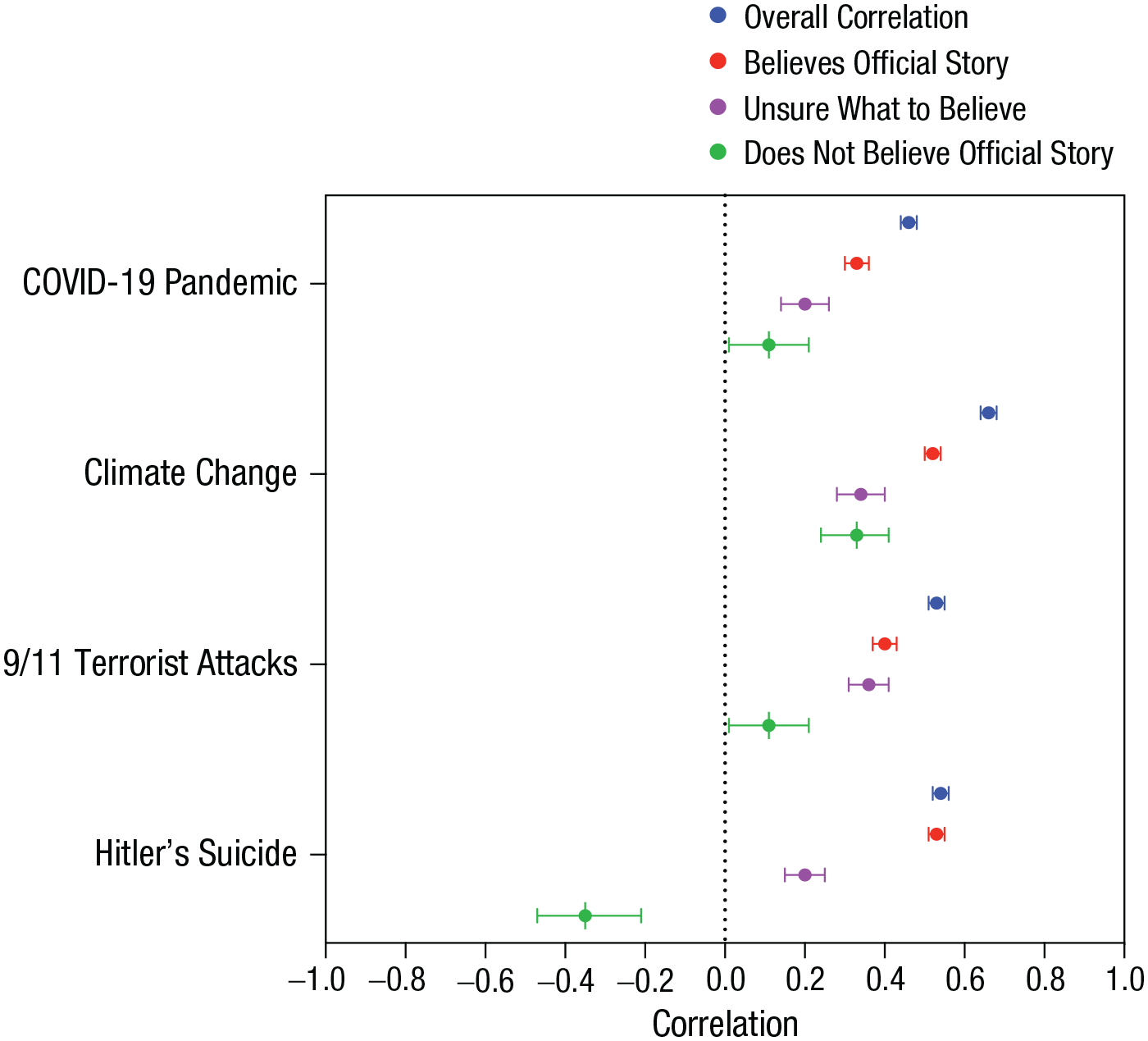
Correlations for beliefs in contradictory conspiracy theories in Study 2. Correlations for participants who believe the official version of events, who are unsure what to believe, and who disbelieve the official version of events are shown separately; overall correlations are also shown. Error bars indicate 95% confidence intervals.
Among people who disbelieved the official version of events, a positive correlation emerged for climate change (r = .33, p < .001). For COVID-19 and the 9/11 terrorist attacks, a positive correlation also emerged, albeit with a weak effect size (both rs = .11, ps < .001). The only dead-or-alive case that we included (Hitler’s suicide) yielded a negative correlation, however (r = −.35, p < .001). These results provide mixed support for Hypothesis 1 versus Hypothesis 1alt.
Fisher’s r-to-z tests confirmed that the correlation was more strongly positive for participants who believed, as opposed to disbelieved, the official story for all four topics, supporting Hypothesis 2 (zs > 4.08, ps < .001). The correlation for participants who were unsure what to believe was largely intermediate between believers and disbelievers: It was weaker than for people who believed the official story for three events (zs > 3.83, ps < .001), with the exception of the 9/11 terrorist attacks (z = 1.72, p = .086). Compared with participants who disbelieved the official story, the correlation was more strongly positive for the 9/11 terrorist attacks (z = 4.54, p < .001) and Hitler’s suicide (z = 6.98, p < .001) but not significantly different for COVID-19 (z = 1.45, p = .148) and climate change (z = 0.15, p = .883).
Discussion
Whereas Study 1 provided clear evidence against systematic belief in contradictory conspiracy theories, the evidence was more ambiguous in Study 2. A positive correlation emerged for three out of four topics among people who disbelieved the official story, but the correlation was weak for two of them. For the only dead-or-alive case, the correlation was negative.
Study 3
Studies 3 and 4 tested an additional hypothesis. Specifically, dead-or-alive cases are most clearly contradictory, and so it was striking that in Studies 1 and 2 a positive correlation for disbelievers of the official story did not emerge for any of these cases. It is possible that the more clearly contradictory conspiracy theories are, the less likely it is that people will simultaneously believe both of them. Hence, we included four (out of eight) dead-or-alive cases and preregistered the additional prediction that there would be no evidence for systematic contradictory conspiracy beliefs in these cases (Hypothesis 3).
Method
Participants
On the basis of the same power analysis as in Study 1, we solicited 805 U.S. participants through Prolific. Nine participants were dropped because they admitted that they had not provided honest responses, yielding 796 participants for the analyses (307 men, 481 women, eight other; age: M = 37.22 years, SD = 12.90). The study lasted approximately 8 min, and participants were paid $1.30 (U.S.) for participation.
Procedure and measures
The procedure was similar to that of Study 1: Participants read the official version of eight events and indicated for each of them whether they believed the official story was true or false. Then participants indicated their agreement with two contradictory conspiracy theories for each topic (1 = strongly disagree, 5 = strongly agree). The eight topics pertained to the COVID-19 pandemic, climate change, the 9/11 terrorist attacks, the pharmaceutical industry’s search for a cancer cure, Hitler’s suicide, Jeffrey Epstein’s suicide, the killing of Osama bin Laden (Wood et al., 2012), and the death of Elvis Presley. The last four topics represent dead-or-alive contradictory conspiracy theories (for full materials, see the Supplemental Material). At the end of the study, participants filled out some basic demographic questionnaires. They were then thanked, debriefed, and redirected to a URL for payment.
Results
Table 3 displays participant distributions, means, and CIs. Again, conspiracy beliefs were lower for participants who believed, as opposed to disbelieved, the official version of events. We note that for four of the topics (climate change, Hitler’s suicide, the killing of bin Laden, and the death of Elvis Presley), the number of participants who disbelieved the official story was below the required number according to our power analysis (n = 133); we will revisit this issue in the General Discussion.
Comparison of Descriptive Statistics for Beliefs in Contradictory Conspiracy Theories (Study 3)
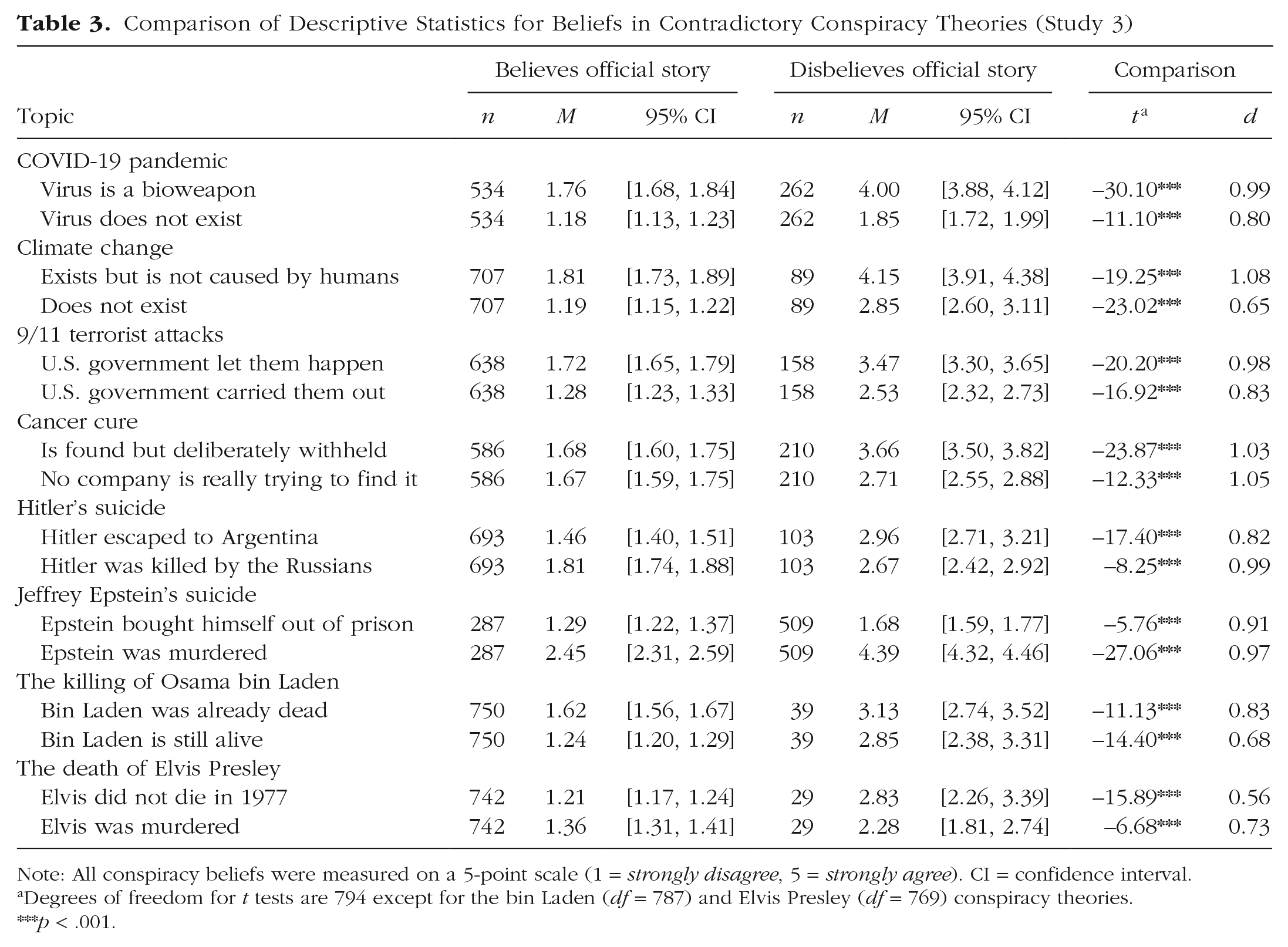
Note: All conspiracy beliefs were measured on a 5-point scale (1 = strongly disagree, 5 = strongly agree). CI = confidence interval.
Degrees of freedom for t tests are 794 except for the bin Laden (df = 787) and Elvis Presley (df = 769) conspiracy theories.
p < .001.
Figure 3 displays all the correlations. Again, the overall correlation between beliefs in contradictory conspiracy theories was significantly positive for all eight events (.10 < rs < .54, ps < .003). Likewise, for participants who believed the official stories, the correlation was also significantly positive for all events (.21 < rs < .49, ps < .001).
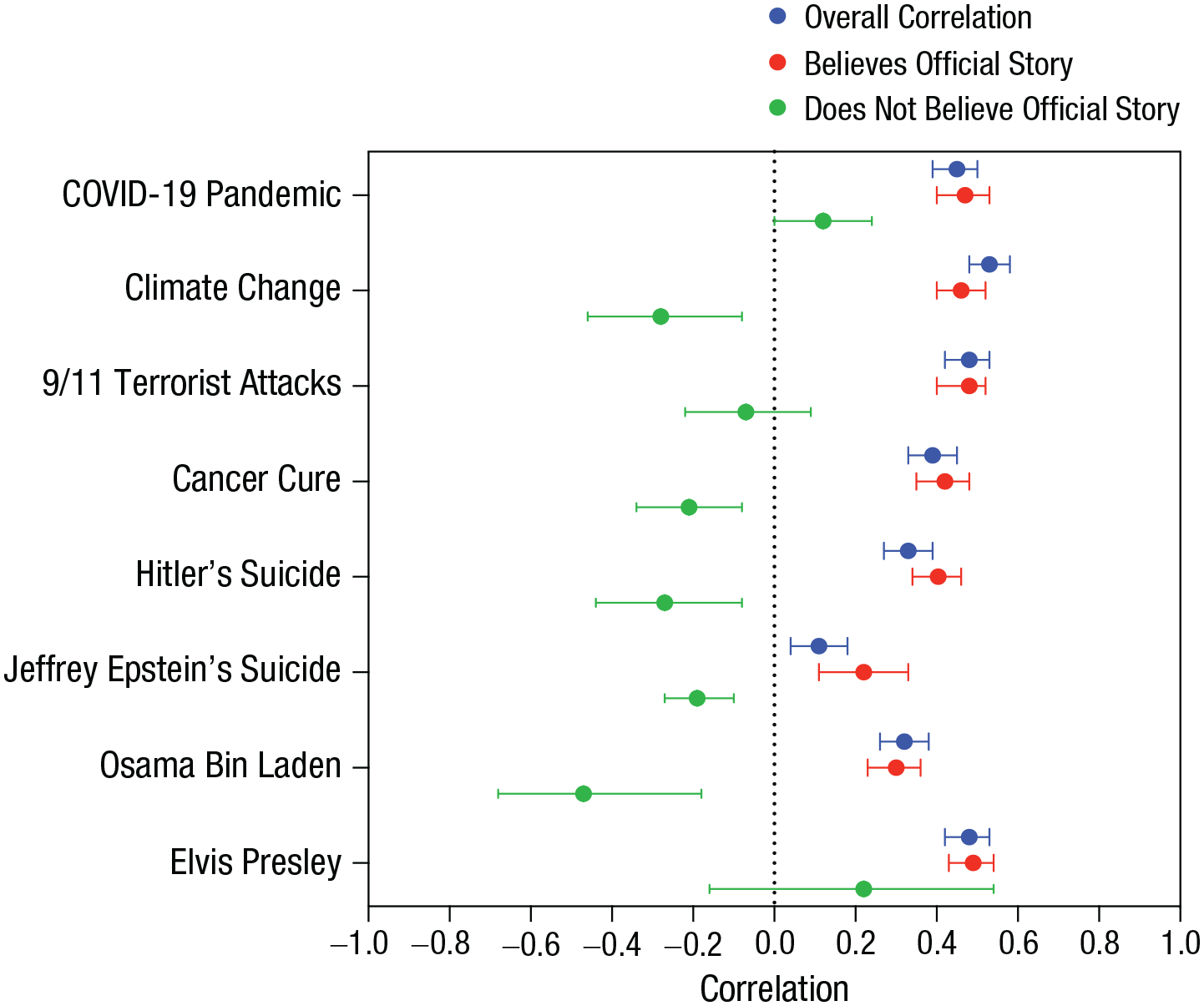
Correlations for beliefs in contradictory conspiracy theories in Study 3. Correlations for participants who believe and who disbelieve the official version of events are shown separately; overall correlations are also shown. Error bars indicate 95% confidence intervals.
For participants who disbelieved the official version of these events, the correlation was significantly positive only for the COVID-19 pandemic and with a weak effect size (r = .12, p = .044). The correlation was significantly negative for five topics (climate change, cancer cure, Hitler’s suicide, Epstein’s suicide, the death of Osama bin Laden; −.47 < rs < −.18, ps < .007) and not significant for the two remaining topics. These findings support Hypotheses 1alt and 3, and they contradict Hypothesis 1.
Fisher’s r-to-z tests were significant for seven of the topics (4.77 < zs < 8.21, ps < .001), with the exception of Elvis’s death (z = 1.52, p = .128). This supports Hypothesis 2, showing that the positive correlation between contradictory conspiracy theories was mostly driven by the participants who believed the official version of events.
Discussion
Study 3 did not support the assumption that increased belief in one conspiracy theory predicts increased belief in a contradictory one. In fact, the correlation among participants who disbelieved the official story was negative for five cases (three of them being a dead-or-alive case).
Study 4
Studies 1 to 3 have one potential methodological limitation: Participants first indicated their agreement with the official story, which could have carryover effects on subsequent conspiracy belief ratings. In Study 4, participants first responded to all conspiracy theory items before indicating their belief in the official stories.
Method
Participants
On the basis of the same power analysis as in Studies 1 and 3, we recruited 801 U.S. participants through Prolific. Thirteen participants were dropped for not providing honest responses, yielding 788 participants for the analyses (391 men, 383 women, 14 other; age: M = 40.04 years, SD = 14.11). The study lasted approximately 8 min, and participants were paid $1.40 (U.S.) for participation.
Procedure and measures
Participants again read the official story of eight events in a randomized order, but in contrast to the previous studies, after each of them, they directly indicated their agreement with two contradictory conspiracy theories (1 = strongly disagree, 5 = strongly agree). The eight topics pertained to the COVID-19 pandemic, climate change, the 9/11 terrorist attacks, the pharmaceutical industry’s search for a cancer cure, Hitler’s suicide, Jeffrey Epstein’s suicide, the killing of Osama bin Laden, and Princess Diana’s death. Then, in a second batch, all topics were repeated, and participants dichotomously indicated whether they believed that each official story is true or false (for full materials, see the Supplemental Material). Participants again provided some basic demographic information at the end, were debriefed, and were redirected to a URL for payment.
Results
Participant distributions, means, and CIs are in Table 4. Participants who believed, as opposed to disbelieved, the official version of events again scored lower on all the conspiracy theories. For two of the topics (climate change and the killing of bin Laden), the number of participants who disbelieved the official story was below the required number according to our power analysis.
Comparison of Descriptive Statistics for Beliefs in Contradictory Conspiracy Theories (Study 4)
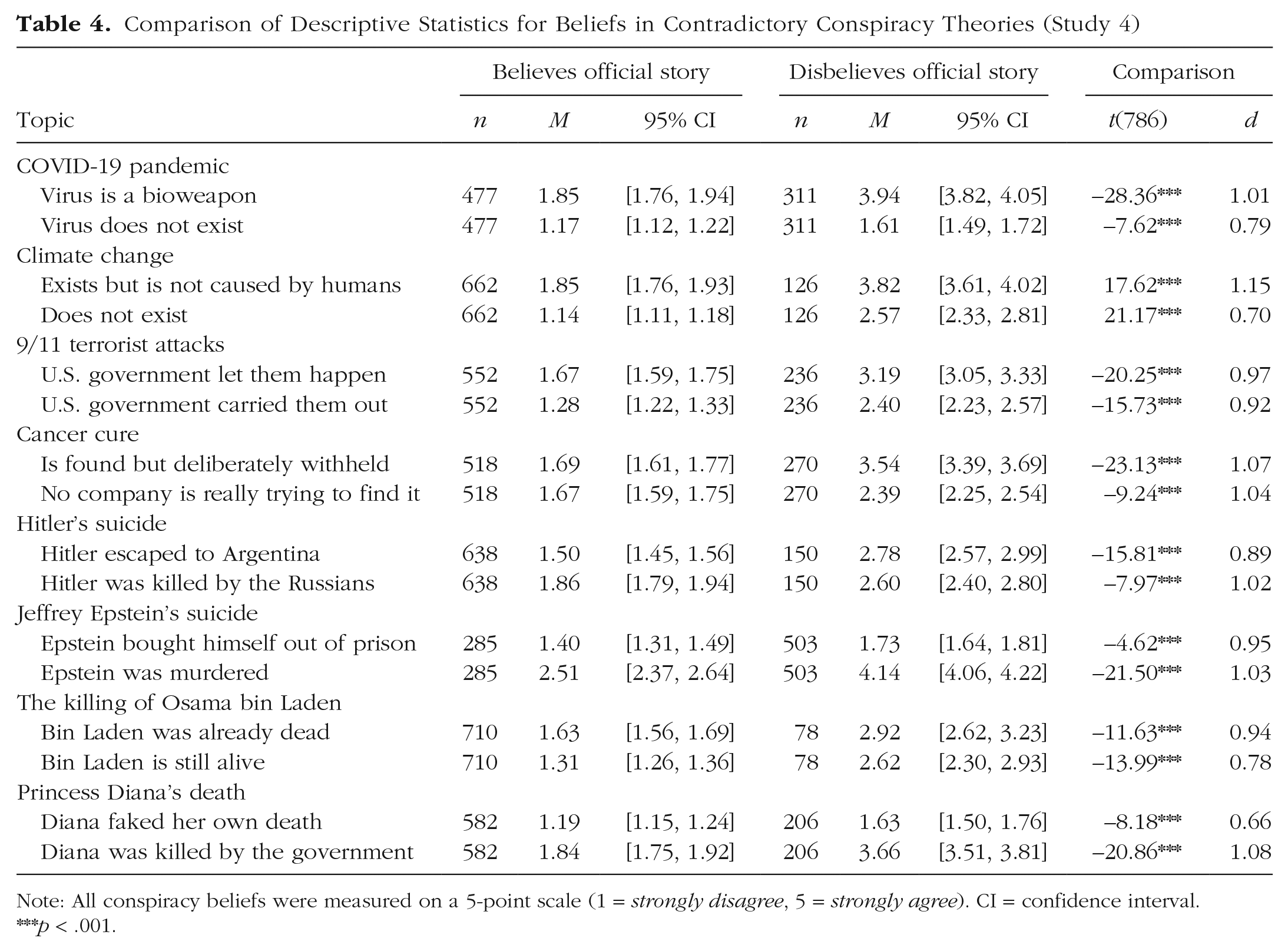
Note: All conspiracy beliefs were measured on a 5-point scale (1 = strongly disagree, 5 = strongly agree). CI = confidence interval.
p < .001.
The correlations are displayed in Figure 4. The overall correlation was weak but still significantly positive for the Epstein case (r = .08, p = .023); for the other seven cases, a significant positive correlation clearly emerged (.25 < rs < .42, ps < .001). Among people who believed that the official version of an event is true, we found a significant positive correlation for all eight cases (.26 < rs < .47, ps < .001). Among people who disbelieved the official version of an event, a positive correlation did not emerge for any of the cases. The correlation was nonsignificant for the COVID-19 pandemic (r = −.02, p = .705) and for the 9/11 terrorist attacks (r = −.08, p = .236). For the remaining six cases, the correlation was significantly negative (−.46 < rs < −.19, ps < .001). These findings again support Hypotheses 1alt and 3, and they contradict Hypothesis 1. We then conducted Fisher’s r-to-z tests. For all cases, these tests were significant (5.53 < zs < 9.22, ps < .001), supporting Hypothesis 2.
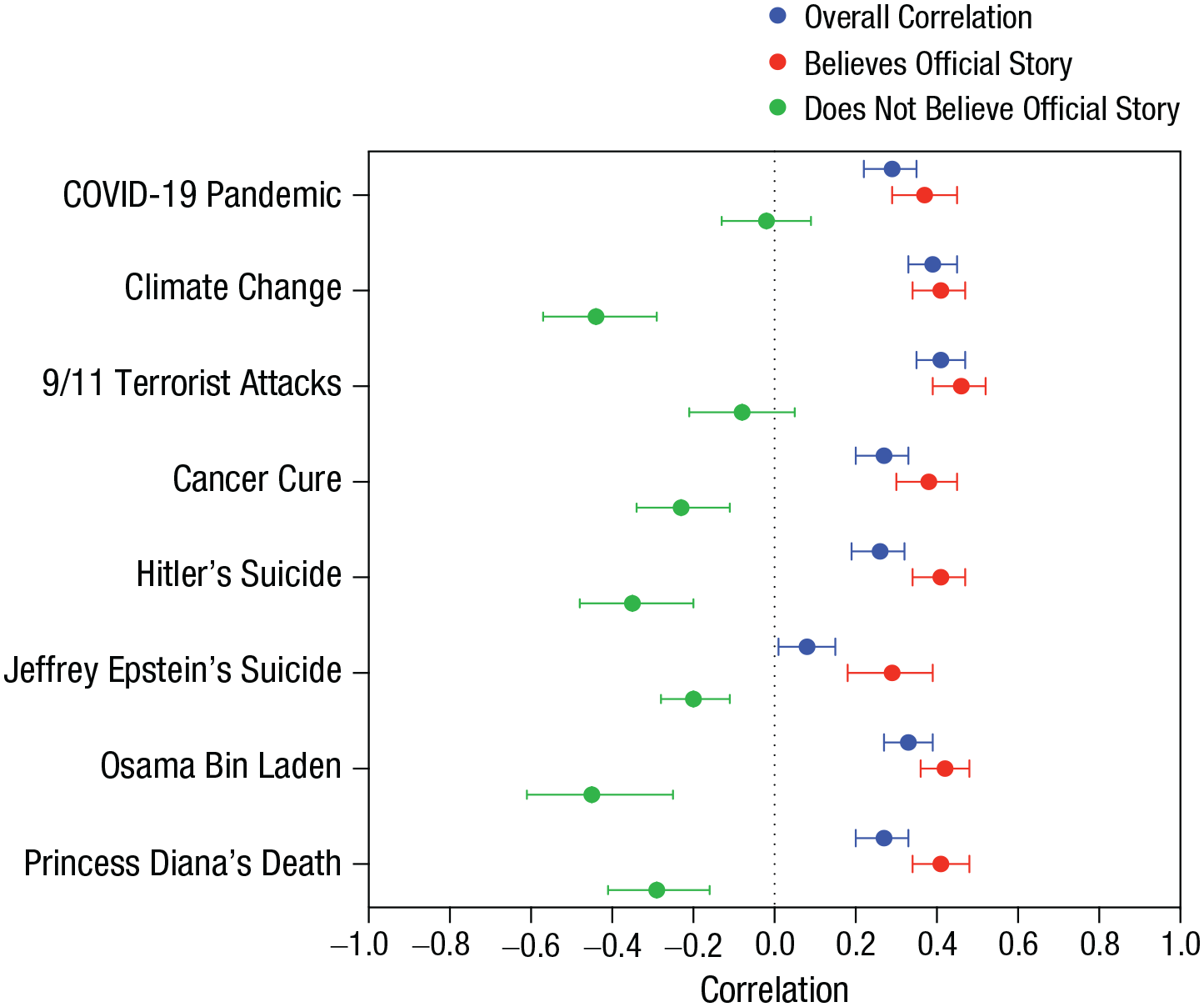
Correlations for beliefs in contradictory conspiracy theories in Study 4. Correlations for participants who believe and who disbelieve the official version of events are shown separately; overall correlations are also shown. Error bars indicate 95% confidence intervals.
Discussion
Study 4 revealed no evidence for the notion that believing a conspiracy theory predicts an increased likelihood of believing a contradictory one. This excludes the possibility that the findings of Study 1 to 3 were due to carryover effects.
Mini Meta-Analysis
As a final test, we conducted a mini meta-analysis of our four studies. The analysis was conducted in the R packages metaSEM and metafor. Correlations were nested within studies to account for their nonindependence (Cheung, 2019). The overall correlation between contradictory conspiracy beliefs was significantly positive, r = .40, p < .001, 95% CI = [.32, .49]. In addition, the correlation among participants who believed the official version of events was significantly positive, r = .43, p < .001, 95% CI = [.40, .46]. Among participants who disbelieved the official version of events, however, the correlation was significantly negative, r = −.13, p = .014, 95% CI = [−.23, −.02].
We then tested whether the latter correlation was different for dead-or-alive cases versus the other cases. Type of case indeed moderated the effect, estimate = −0.11, SE = 0.038, p = .004, 95% CI = [−0.182, −0.035]. For cases that did not refer to dead-or-alive contradictory conspiracy theories, the correlation was nonsignificant, r = .019, p = .789, 95% CI = [−.16, .12]. For dead-or-alive cases, however, the correlation was significantly negative, r = −.25, p = .001, 95% CI = [−.36, −.14]. These findings further undermine the common assumption that belief in one conspiracy theory predicts belief in a contradictory one.
General Discussion
The results of four preregistered studies in three countries, along with a meta-analysis, yielded the following conclusions. First, beliefs in contradictory conspiracy theories are positively correlated, replicating the basic finding of Wood and colleagues (2012). Second, this correlation is mostly attributable to the participants in the sample who believe the official version of events (Studies 1–4) and to a lesser extent those who feel unsure what happened (Study 2). Among participants who disbelieve the official version of events, the positive correlation emerges sporadically but inconsistently. In a meta-analysis, the correlation among these participants was negative, particularly for dead-or-alive cases. Altogether, the positive correlation between contradictory conspiracy beliefs mostly reflects that disbelieving one conspiracy theory predicts an increased likelihood of disbelieving a contradictory one.
Some of the correlations among participants who disbelieved the official version of these events were underpowered (e.g., the Osama bin Laden case; Studies 3 and 4); moreover, some of the conspiracy theories yielded very low levels of belief (e.g., the theory that Princess Diana faked her own death; Studies 1 and 4). Note that both of these issues speak against (and not in favor of) systematic belief in contradictory conspiracy theories. An underpowered correlation implies that only a small proportion of the sample disbelieved the official version of a particular case to begin with (Imhoff et al., 2022; Sutton & Douglas, 2022). Likewise, extremely low levels of belief on one of the items implies that few participants actually believe both contradictory conspiracy theories. And yet a positive overall correlation between contradictory conspiracy theories consistently emerged.
The current findings are limited to the populations and specific conspiracy theories investigated here, and future research may expand to different cultures and contradictory conspiracy theories. Moreover, our findings do not imply that people who believe contradictory conspiracy theories do not exist (see also Lukic et al., 2019; Miller, 2020; Petrović & Žeželj, 2022). Our data also contained participants who believed contradictory conspiracy theories, as well as other inconsistencies (i.e., believed the official version plus a conspiracy theory), although in low proportions (see Tables S1–S4 in the Supplemental Material). Instead, our findings suggest that researchers have overestimated the predictability and prevalence of such inconsistencies in a conspiratorial mindset.
This insight raises important new questions. For instance, to what extent is the correlation between conspiracy beliefs that are not mutually incompatible (often seen as reflecting a conspiratorial mindset) actually due to people who disbelieve both conspiracy theories? It is quite plausible that, among conspiracy theorists, the strength of this association is weaker than commonly assumed. More generally, the current studies underscore the methodological point that taking correlations at face value—without carefully examining underlying response distributions—can yield misguided conclusions.
This research domain hence should reconsider the notion of systematic belief in contradictory conspiracy theories. Certainly, many conspiracy theories are epistemically irrational in that they are based on weak evidence, pseudoscience, motivated reasoning, and unreliable sources. Moreover, most conspiracy theories do more harm than good for society (e.g., Douglas et al., 2019; Jolley & Douglas, 2014; Jolley et al., 2019; van der Linden, 2015; van Prooijen et al., 2022). That does not mean, however, that believing a person was murdered increases the likelihood of believing that same person faked their own death. It is time for the research field of conspiracy theories to accept the obvious: When people believe a person is dead, they are not more likely to believe that same person is still alive.
Supplemental Material
sj-docx-1-pss-10.1177_09567976231158570 – Supplemental material for Just Dead, Not Alive: Reconsidering Belief in Contradictory Conspiracy Theories
Supplemental material, sj-docx-1-pss-10.1177_09567976231158570 for Just Dead, Not Alive: Reconsidering Belief in Contradictory Conspiracy Theories by Jan-Willem van Prooijen, Iris Wahring, Laura Mausolf, Nicole Mulas and Shayda Shwan in Psychological Science
Footnotes
Transparency
Action Editor: Yoel Inbar
Editor: Patricia J. Bauer
Author Contributions

Notes
References
Supplementary Material
Please find the following supplemental material available below.
For Open Access articles published under a Creative Commons License, all supplemental material carries the same license as the article it is associated with.
For non-Open Access articles published, all supplemental material carries a non-exclusive license, and permission requests for re-use of supplemental material or any part of supplemental material shall be sent directly to the copyright owner as specified in the copyright notice associated with the article.
