




Abstract
Categorization has a deep impact on behavior, but whether category learning is served by a single system or multiple systems remains debated. Here, we designed two well-equated nonspeech auditory category learning challenges to draw on putative procedural (information-integration) versus declarative (rule-based) learning systems among adult Hebrew-speaking control participants and individuals with dyslexia, a language disorder that has been linked to a selective disruption in the procedural memory system and in which phonological deficits are ubiquitous. We observed impaired information-integration category learning and spared rule-based category learning in the dyslexia group compared with the neurotypical group. Quantitative model-based analyses revealed reduced use of, and slower shifting to, optimal procedural-based strategies in dyslexia with hypothesis-testing strategy use on par with control participants. The dissociation is consistent with multiple category learning systems and points to the possibility that procedural learning inefficiencies across categories defined by complex, multidimensional exemplars may result in difficulty in phonetic category acquisition in dyslexia.
Keywords
Categorization is essential for human behavior, including recognizing common objects, interpreting complex and variable speech signals, and giving meaning to high-level concepts. There is a long-standing debate on whether novel category learning is supported by a single system (e.g., Kruschke, 2020; Love & Tomlinson, 2010; Newell et al., 2011; Nosofsky, 1986) or multiple systems (e.g., Ashby et al., 1998, 2020; Chandrasekaran, Yi, & Maddox, 2014; Maddox & Chandrasekaran, 2014). According to one influential dual-systems model of category learning (Competition Between Verbal and Implicit Systems, or COVIS; Ashby et al., 1998), multiple category learning systems may differentially support learning categories that optimally draw on declarative, explicit processes versus procedural, implicit processes. In this study, we investigated auditory category learning in dyslexia, a language disorder that may involve selective disruption in the procedural memory system (Krishnan et al., 2016; Nicolson & Fawcett, 2011, 2019; Ullman et al., 2020; Ullman & Pullman, 2015), to assess the hypothesis that dyslexia should implicate impaired category learning via procedural strategies and spared category learning across hypothesis-testing strategies.
According to the COVIS model, category learning involves at least two systems that recruit distinct neural substrates with unique computational specialties. Categories that are discriminated easily by an explicit rule (rule-based categories) are proposed to be optimally learned by a hypothesis-testing system that depends heavily on working memory and executive attention (Ashby et al., 1998; Waldron & Ashby, 2001). In contrast, categories that cannot easily be discriminated by an explicit rule and involve integration across multiple stimulus dimensions (information-integration categories) are proposed to be optimally learned by an implicit striatal reinforcement learning system in which dopamine serves as the training signal (Ashby et al., 2011). Instead of accessing exemplar representations, individuals learn stimulus-response associations and, thus, the learning and memory involved are procedural (Ashby et al., 1998).
Critically, researchers can assess how individuals learn these categories by assessing learners’ decision strategies using decision-bound computational models (Ashby, 1992; Maddox & Ashby, 1993). An optimal strategy for learning rule-based categories encompasses testing rules that can be discovered optimally by a hypothesis-testing strategy, whereas the optimal strategy for learning information-integration categories involves integration from two or more stimulus dimensions at a predecisional stage and procedural learning across stimulus-response associations (procedural-based strategy).
There is substantial support for a dual-systems framework for visual categorization from behavioral, neurobiological, and patient studies (Ashby et al., 2011), and recent studies have made the case for its involvement in auditory categorization, as well (Chandrasekaran, Yi, & Maddox, 2014; Maddox & Chandrasekaran, 2014; Roark & Holt, 2018). However, there are substantial critiques of the dual-systems account that instead argue in favor of a single exemplar-based system that accounts for learning phenomena (e.g., Kruschke, 2020; Love & Tomlinson, 2010; Newell et al., 2011; Nosofsky, 1986).
In summary, there remain unanswered questions about the nature of category learning. In the current study, we leveraged a special population that, according to a dual-systems perspective, should have selective disruption of category learning that relies on procedural learning mechanisms—developmental dyslexia. Examination of category learning processes in adults with dyslexia can contribute to the debate of single versus multiple category learning systems and provide important insights into the learning difficulties encountered by individuals with dyslexia.
Developmental Dyslexia
Developmental dyslexia traditionally has been suggested to arise from a phonological impairment (Snowling, 2001). But domain-general accounts assert that dyslexia is a consequence of a selective dysfunction in procedural learning and memory (Nicolson & Fawcett, 2011, 2019; Ullman et al., 2020; Ullman & Pullman, 2015), which provides a mechanistic account for the diverse range of nonphonological linguistic and nonlinguistic symptoms observed in dyslexia (Beach et al., 2022; Gabay, 2021; Gabay et al., 2012, 2015; Hedenius et al., 2021; Howard et al., 2006; Lum et al., 2013; Massarwe et al., 2022; Pavlidou et al., 2009, 2010; Sperling et al., 2004; Stoodley et al., 2006; Vicari et al., 2003, 2005). Individuals with dyslexia demonstrate structural and functional differences in core structures of the procedural memory systems, including the cerebellum (Alvarez & Fiez, 2018) and basal ganglia (Brunswick et al., 1999; Hedenius & Persson, 2022; Kita et al., 2013; Wang et al., 2019), providing further evidence for a general procedural learning and memory deficit.
Statement of Relevance
Learning to carve perceptual input into coherent categories has a deep impact on human behavior. Yet debate remains about whether category learning is served by a single system or multiple systems. A multiple memory systems account proposes that distinct neural systems with unique computational specializations mediate declarative (“knowing that”) versus procedural (“knowing how”) memories. Here, we observed that adults with dyslexia are selectively impaired at learning sound categories that require integration across input dimensions and that are optimally acquired with procedural decision strategies; learning categories optimally acquired with conjunctive rules is spared. This dissociation is consistent with multiple category learning systems. Moreover, it suggests the possibility that phonetic category acquisition in dyslexia may arise from procedural learning inefficiencies across categories defined by complex, multidimensional exemplars.
Despite evidence of procedural learning and memory impairments in dyslexia, the nature of impairment is unclear (Bogaerts et al., 2021; West et al., 2021). Many tasks that are considered “procedural” (e.g., weather prediction task, serial reaction time task) involve a mixture of procedural and declarative task demands (Bochud-Fragnière et al., 2022; Packard & Goodman, 2013; Squire & Dede, 2015; Sun et al., 2005). Further, although prior studies of category learning among individuals with dyslexia have observed differences in overall accuracy, they have not examined the processes underlying these differences. This work has shown poorer categorization accuracy among dyslexia compared with control groups in learning complex, difficult-to-verbalize categories (e.g., information-integration categories) in the auditory and visual modalities (Gabay et al., 2015; Gabay & Holt, 2015; Sperling et al., 2004). In contrast, category learning (as assessed by accuracy) is spared in dyslexia when learning requires selective attention and explicit rules (e.g., rule-based categories; Sperling et al., 2004).
Yet differences in categorization accuracy across groups do not provide insight into why the groups differ; qualitatively different strategies can yield the same level of performance (Filoteo et al., 2017; Maddox et al., 2010; Roark & Holt, 2019). In the current study, dyslexia and neurotypical control groups learned both rule-based and information-integration auditory categories. We used decision-bound computational models to assess the multiple-systems hypothesis that procedural learning impairments in dyslexia arise from reduced use of, and slower shifting to, optimal procedural-based strategies during information-integration category learning.
Method
Participants
Twenty-nine neurotypical individuals (12 male, 17 female) and 27 individuals with dyslexia (13 male, 14 female) participated. A power analysis (calculated using the pwr package in the R programming environment; Version 3.6.1.; R Core Team, 2019; see Champely, 2020) indicated that a sample of 21 participants per group would be needed to obtain statistical power at a 0.80 level (α = .05) to detect a small-to-medium difference among conditions (d = 0.37 or f = 0.185). The effect size was estimated from the smallest between-groups difference from a recent study of auditory categorization (Roark et al., 2022).
All participants were native Hebrew speakers, were free of neurological or psychiatric disorders and attention deficits (American Psychiatric Association, 2013), had normal or corrected-to-normal vision and normal hearing, and came from families with middle to high socioeconomic status. The dyslexia group was recruited through Yael’s Learning Disabilities Center at Haifa University in Israel and had a formal diagnosis of dyslexia by a qualified psychologist, a score of at least 1 standard deviation below the average of the local norms in tests of phonological decoding (nonword-reading test; Shatil, 1995), and intelligence scores within the normal range (assessed by the Raven Matrices Test; Raven & Court, 1998). The presence of a diagnosed learning disability such as attention-deficit/hyperactivity disorder, specific language impairment, or any sensory or neurological disability excluded participation. The control group was at or above the inclusion criteria of the dyslexia group on the nonword-reading test and had intelligence scores within the normal range. Participants completed assessments of cognitive ability, verbal memory, rapid automated reading skills, and phonological awareness (see Table S1 in the Supplemental Material available online). The dyslexia group differed from the control group in reading and phonological skills but not in intelligence (see Table S2 in the Supplemental Material). The institutional review board at the University of Haifa approved the study, which was conducted in accordance with the Declaration of Helsinki, with written informed consent provided by all participants. Participants received compensation for their participation in the study (120 shekels, or approximately $30).
AX discrimination task
To confirm whether the dyslexia group had auditory processing difficulties that could affect learning, we had participants discriminate between pairs of stimuli drawn from the same stimulus space as the auditory categories. The exemplars were not experienced in training, were approximately equidistant in perceptual space, and were chosen intentionally to be highly discriminable to screen for perceptual processing challenges (Fig. 1a). Participants judged whether sounds were the same or different and heard each pairwise combination twice in a different order of presentation (275-ms interstimulus interval; 10 randomized repetitions; 1:1 same/different AX trials).
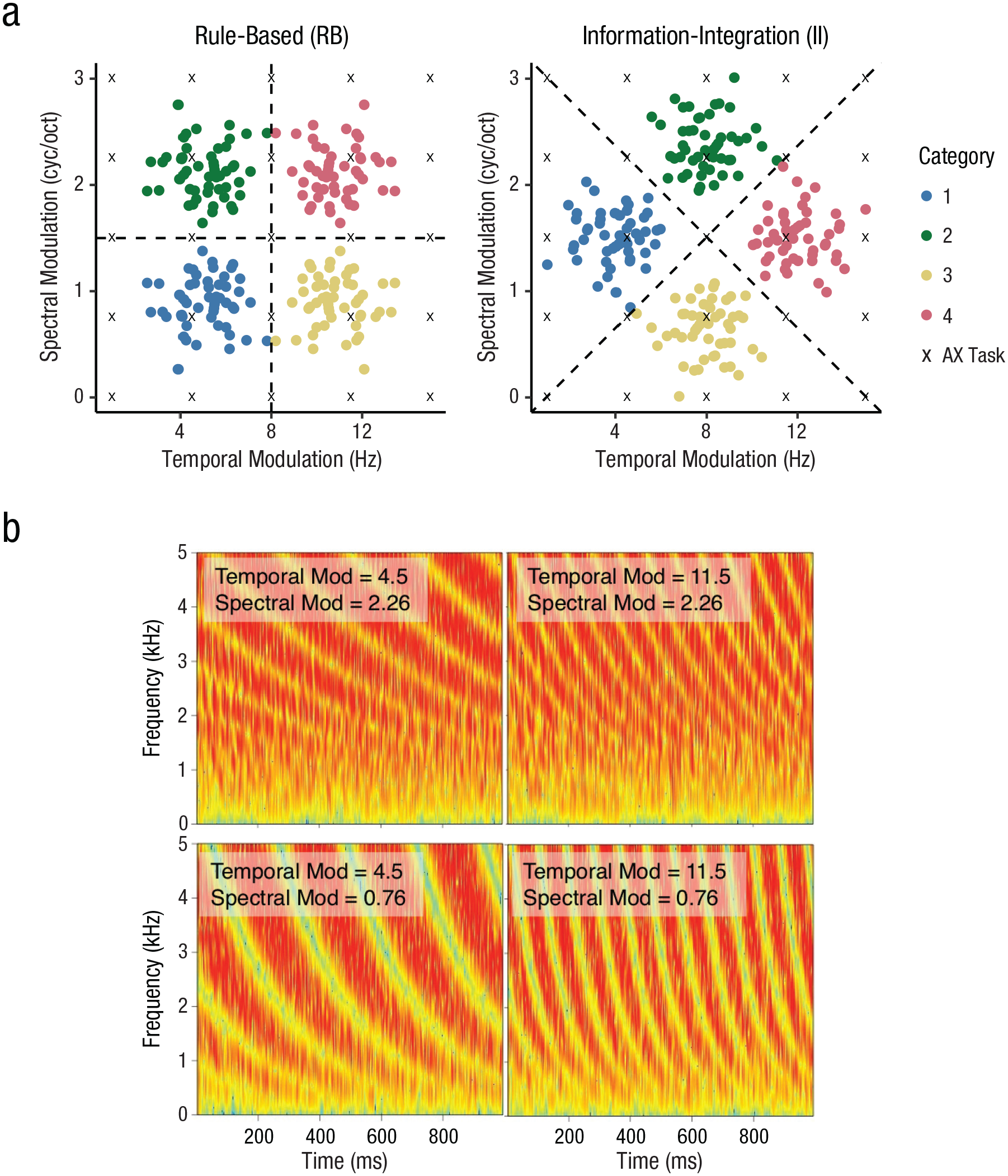
Category distributions and spectrograms. (a) Rule-based (left) and information-integration (right) auditory category structures. Dashed lines reflect optimal boundaries between categories, and different colors denote stimuli from different categories. (b) Spectrograms of four stimuli with varying temporal and spectral modulation values.
Rule-based and information-integration category learning tasks
The tasks were similar to those used in previous studies that examined rule-based and information-integration category learning in the auditory domain (Roark et al., 2022). Each participant completed both rule-based and information-integration tasks, and the order was counterbalanced across participants.
Stimulus distributions
Each participant learned two types of nonspeech auditory categories (information integration and rule based; Fig. 1a); each category type comprised four individual categories of sounds sampled from a bivariate normal distribution. The rule-based categories can be separated by decision boundaries (dashed lines in Fig. 1a) that involve selective attention to both acoustic dimensions, and the information-integration categories can be separated by diagonal boundaries across both dimensions that require integration across the dimensions.
Stimuli
Stimuli were complex nonspeech ripples varying in spectral and temporal modulation with a duration of 1 s (Fig. 1b). These dimensions reflect complex properties of sound perception (Schönwiesner & Zatorre, 2009; Visscher et al., 2007; Woolley et al., 2005) and have been studied in category learning contexts in prior research (Roark et al., 2021). Stimuli were generated using a custom script in MATLAB (The MathWorks, Natick, MA) and were amplitude matched at 70 dB.
Procedure
After completing an assessment session, participants completed two sessions separated by 1 week, in which they first completed the AX discrimination task and then completed both the information-integration and rule-based category learning tasks; the order was counterbalanced across participants. In each category learning task, participants completed eight 50-trial training blocks. Participants were not informed of the dimensions that defined the categories and were told to listen to the sounds and decide which of four possible categories the sound stimuli belong to. On each trial, participants heard the 1-s sound and were immediately prompted to identify the category (“Which category?”). Participants pressed one of four buttons (1, 2, 3, or 4) and received immediate feedback (“Correct” or “Incorrect”) for 1 s followed by a 1-s intertrial interval. Participants were given unlimited time to respond to ensure that they made a response on every trial. After training, participants completed a 100-trial generalization test in which they encountered novel stimuli and received no feedback.
Learning strategies
To assess participants’ learning strategies, we applied decision-bound computational models (Ashby, 1992; Ashby & Maddox, 1993). Four classes of decision-bound models were applied to category response data: hypothesis-testing models, a procedural-based model, and a guessing model, as in previous work (e.g., Roark et al., 2022; Maddox & Ashby, 2004).
Hypothesis-testing models
We fitted a series of hypothesis-testing models that use linear decision boundaries orthogonal to the dimensions. There were unidimensional models that use a single dimension (e.g., temporal or spectral modulation) and conjunctive models that use both dimensions (e.g., temporal and spectral modulation). The unidimensional models had four free parameters—three for the placement of the decision boundaries along the relevant dimension and one for perceptual and criterial noise. The conjunctive models had two free parameters—one for the placement of a decision boundary along each dimension and one for perceptual and criterial noise. A conjunctive strategy was the optimal strategy for the rule-based categories.
Procedural-based model
We fitted a procedural-based model that uses linear decision boundaries nonorthogonal to the dimensions to separate the categories. The implementation of the procedural-based model is the Striatal Pattern Classifier (Ashby & Waldron, 1999; Ashby et al., 2007) based on the neurobiology of the striatum. The model has four hypothetical “striatal” units that each represent a different category in the two-dimensional stimulus space. It has nine free parameters—two for each of the striatal units’ placement in space (x/y dimensions) for each of the four categories and one for perceptual and criterial noise. A procedural strategy, captured by the procedural-based model, is the optimal strategy for learning information-integration categories. It is unknown whether this model is “procedural” in all the senses that this common term is used in the literature, but information-integration learning is sensitive to feedback delay and response switching and is insensitive to dual task interference—common features of procedural learning in other domains (Ashby & Valentin, 2017; Chandrasekaran, Koslov, & Maddox, 2014; Chandrasekaran, Yi, & Maddox, 2014; Maddox & Chandrasekaran, 2014).
Guessing model
Finally, we fitted a separate model that assumes that participants guess the category identity on each trial. This model assumes that participants respond with different category identities with equal probability across a block of trials.
Model fitting and selection
These models were separately fitted to each block of each participant’s data using maximum likelihood procedures (Wickens, 1982). To identify the best-fitting model for each participant and each block, we used the Bayesian information criterion (BIC) as a measure of goodness of fit: BIC = rlnN – 2lnL, where r is the number of free parameters, N is the number of trials in a given block for a given subject, and L is the likelihood of the model given the data (Wickens, 1982).
Results
AX discrimination
The dyslexia (M = .87, SD = .05) and control (M = .88, SD = .04) groups did not significantly differ in their ability to discriminate sounds before category training, t(53) = 0.90, p = .37, d = 0.24. This ensures that any group performance differences are not a result of differences in perceptual abilities. 1
Category training
Figure 2 shows category learning performance as average accuracy. The dyslexia and control groups began the category learning task on equal footing. There were no significant group differences in Block 1 performance for rule-based tasks, t(54) = 0.907, p = .368, d = 0.24, or information-integration tasks, t(54) = 0.72, p = .47, d = 0.19. We examined accuracy of categorization decisions across groups (dyslexia, control), training blocks (Blocks 1–8), and tasks (rule based, information integration) using a mixed-model analysis of variance (ANOVA). In general, categorization accuracy improved across blocks, F(7, 378) = 51.32, p = .00000, η p ² = .48. But the dyslexia group was significantly less accurate than the control group, F(1, 54) = 8.44, p = .002, η p ² = .13. This is moderated by a group-by-block interaction, F(7, 378) = 3.75, p = .001, η p ² = .06, a task-by-block interaction, F(7, 378) = 2.32, p = .02, η p ² = .04, and crucially, a three-way interaction of Group × Block × Task, F(7, 378) = 2.18, p = .03, η p ² = .03.
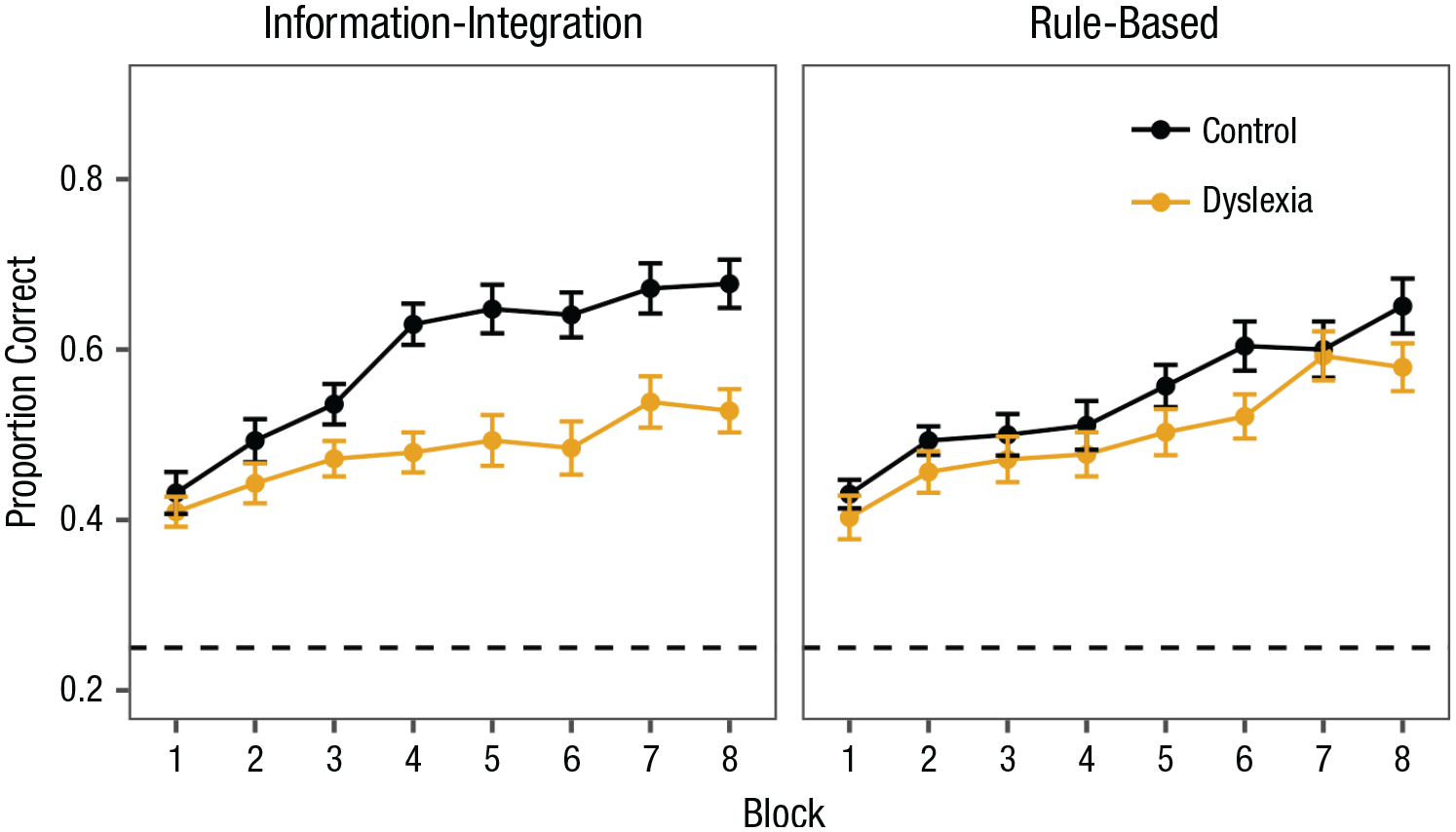
Performance across blocks. Error bars reflect standard error of the mean.
We conducted linear contrast tests separately in the information-integration and rule-based tasks to examine the three-way interaction. This enabled comparison of performance across training blocks for the two groups. In the information-integration task, there was a greater linear trend (of improving categorization accuracy) for the control, compared with the dyslexia, group, F(1, 54) = 11.47, p = .001, η p ² = .17. In contrast, there were no significant group differences in the linear trend across groups in the rule-based task, F(1, 54) = 0.46, p = .50052, η p ² = .008. In summary, category learning in the rule-based task proceeded similarly for the dyslexia and control groups. The groups diverged in learning information-integration categories; the dyslexia group learned less effectively than the control group. We next investigated computational modeling of individuals’ learning strategies to understand whether this pattern of performance is driven by a selective impairment in procedural-based strategies and spared hypothesis-testing strategies among individuals with dyslexia.
Computational analyses of learning strategies
To better understand the nature of poorer information-integration category learning in dyslexia, we examined learning strategies (Fig. 3a), how strategies shifted from suboptimal to task appropriate (Figs. 3b and 3c), and—for task-appropriate strategies—how efficiently a strategy was deployed (i.e., the level of accuracy reached using the strategy; Fig. 3d). These three measures move beyond between-groups accuracy differences to examine possible source(s) of the information-integration learning deficit in dyslexia.
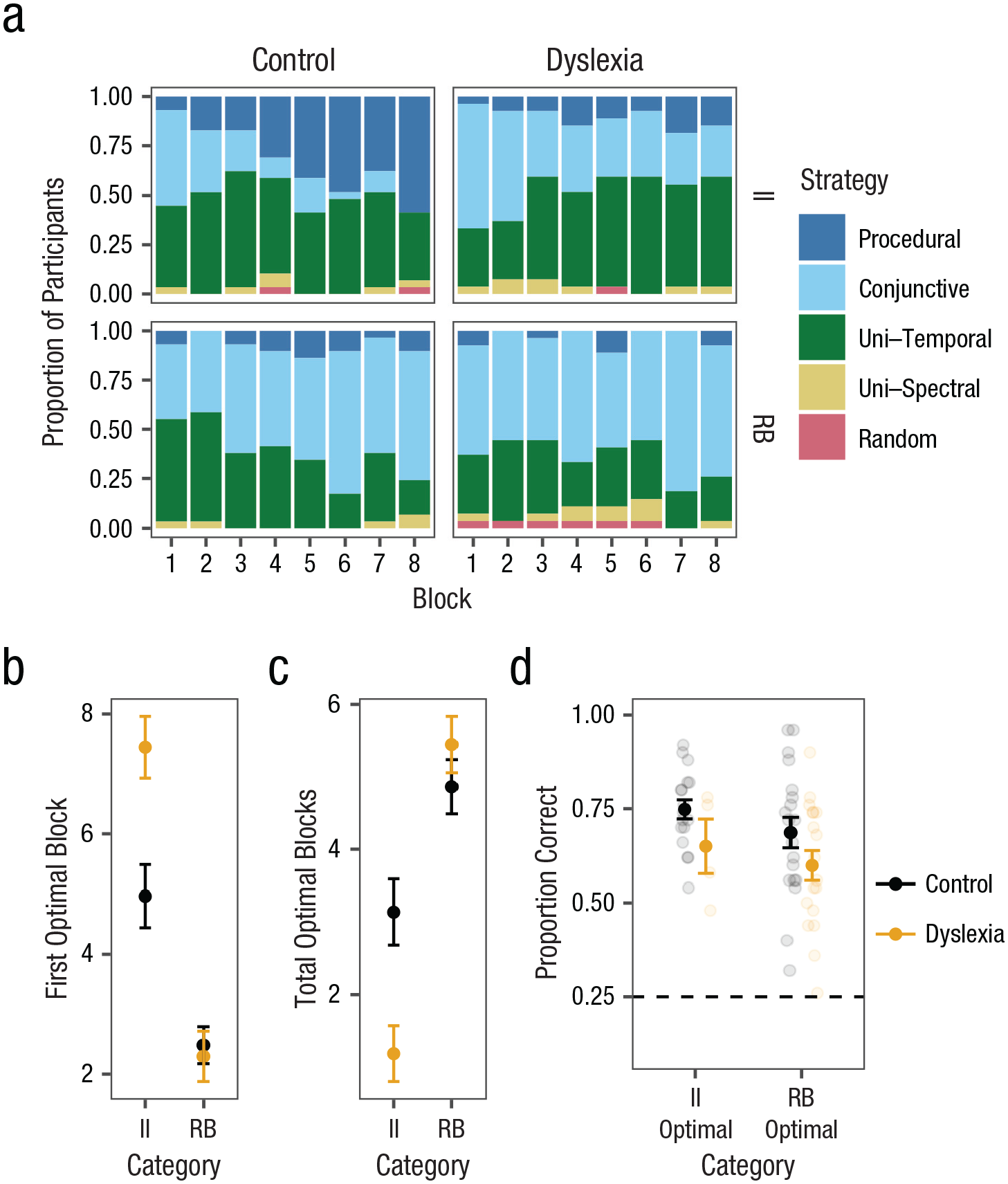
Learning strategies during training. (a) Learning strategies across blocks, tasks, and groups. (b) Mean first block to use optimal strategy across tasks and groups. (c) Mean total blocks using optimal strategy across tasks and groups. (d) Average final block accuracy across participants using optimal strategies (information integration, or II: procedural; rule based, or RB: conjunctive). Error bars reflect standard error of the mean.
Examining participants’ learning strategies across blocks, we found that the dyslexia group perseverated with task-inappropriate hypothesis-testing strategies during information-integration learning. Relative to the control group, the dyslexia group showed limited use of the task-appropriate procedural strategy even in the final block of training (15% dyslexia, 59% control). In contrast, both control and dyslexia participants were able to find and apply the optimal conjunctive strategy in the rule-based task (67% dyslexia, 66% control).
To understand how participants shifted from suboptimal to task-optimal strategies, we next compared the first block in which participants used the optimal strategy (Fig. 3b) and the total number of blocks in which participants used the optimal strategy (Fig. 3c) across groups and tasks.
First optimal block
There was a significant interaction between group and category in the first block in which participants used the task-optimal strategy, F(1, 54) = 10.8, p = .002, ηG2 = .075. The dyslexia group (M = 7.44 blocks) used the optimal procedural strategy later than the control group for the information-integration task (M = 4.96 blocks; p = .0014, 95% confidence interval, or CI = [1.00, 3.95]). In contrast, there were no significant differences between the dyslexia (M = 2.30 blocks) and control (M = 2.48 blocks) groups in number of blocks to first use the optimal conjunctive strategy for the rule-based task (p = .72; 95% CI = [−1.23, 0.86]).
Total optimal blocks
There was also a significant interaction of group and category in the total number of blocks in which they used the task-optimal strategy, F(1, 54) = 14.6, p < .001, ηG2 = .084. The dyslexia group (M = 1.19 blocks) used the optimal procedural strategy in fewer blocks than the control group (M = 3.14 blocks) in the information-integration task (p = .0018, 95% CI = [0.76, 3.15]). In contrast, there were no significant differences between the dyslexia (M = 5.44 blocks) and control (M = 4.86 blocks) groups in the total blocks in which they used the optimal conjunctive strategy in the rule-based task (p = .29, 95% CI = [−0.50, 1.66]). These results indicate that the dyslexia group has a selective deficit in the ability to use procedural-based strategies to achieve success in the information-integration task.
Efficiency of optimal strategies
Even though there were fewer participants with dyslexia using optimal procedural strategies in the information-integration task compared with controls, there were some participants in each group using the optimal procedural strategy. We next asked whether dyslexia participants who used the optimal strategies in the information-integration and rule-based tasks were less efficient at using those strategies than control participants using the same strategies (Fig. 3d). That is, do dyslexia participants have worse final block accuracy than control participants when they use the same task-appropriate strategy? Our results suggest that if individuals with dyslexia can find the task-appropriate strategies, they perform at similar levels to controls in both rule-based and information-integration tasks. In both the information-integration and rule-based tasks, we found no significant differences between dyslexia and control groups—information integration: t(3.78) = 1.28, p = .27, d = 0.78, 95% CI = [−12.0, 31.6]; rule based: t(35) = 1.54, p = .13, d = 0.51, 95% CI = [−2.78, 20.3]—when participants used the task-appropriate strategy. We note that there were many fewer dyslexia participants using optimal strategies in the information-integration task (information integration—dyslexia: N = 4, control: N = 17; rule based—dyslexia: N = 18, control: N = 19), leading to a relatively small sample size for this comparison. It is difficult to compare the efficiency of procedural strategies across groups because individuals with dyslexia do not often find the optimal strategy in the information-integration task. However, it appears that when they do, they perform on par with control learners. Thus, the selective deficit in dyslexia appears to be in accessing optimal strategies, particularly in the case of procedural-based strategies.
Generalization
Participants were able to generalize category knowledge to novel sound exemplars (Fig. 4a). The performance of the two groups during the test block was examined using a mixed-model ANOVA with group (dyslexia, control) and task (rule based, information integration) and mean accuracy as the dependent variable. Although the dyslexia group generalized significantly less accurately than the control group, F(1, 54) = 8.22, p = .00590, η p ² = .13, the group-by-task interaction was significant, F(1, 54) = 9.57, p = .003, η p ² = .15. The dyslexia group was less able to generalize category learning to novel exemplars in the information-integration task, t(54) = 4.24, p = .00009, d = 1.27. There was no significant group difference in rule-based generalization, t(54) = 1.01, p = .31, d = 0.31, reflecting the same pattern as training performance.
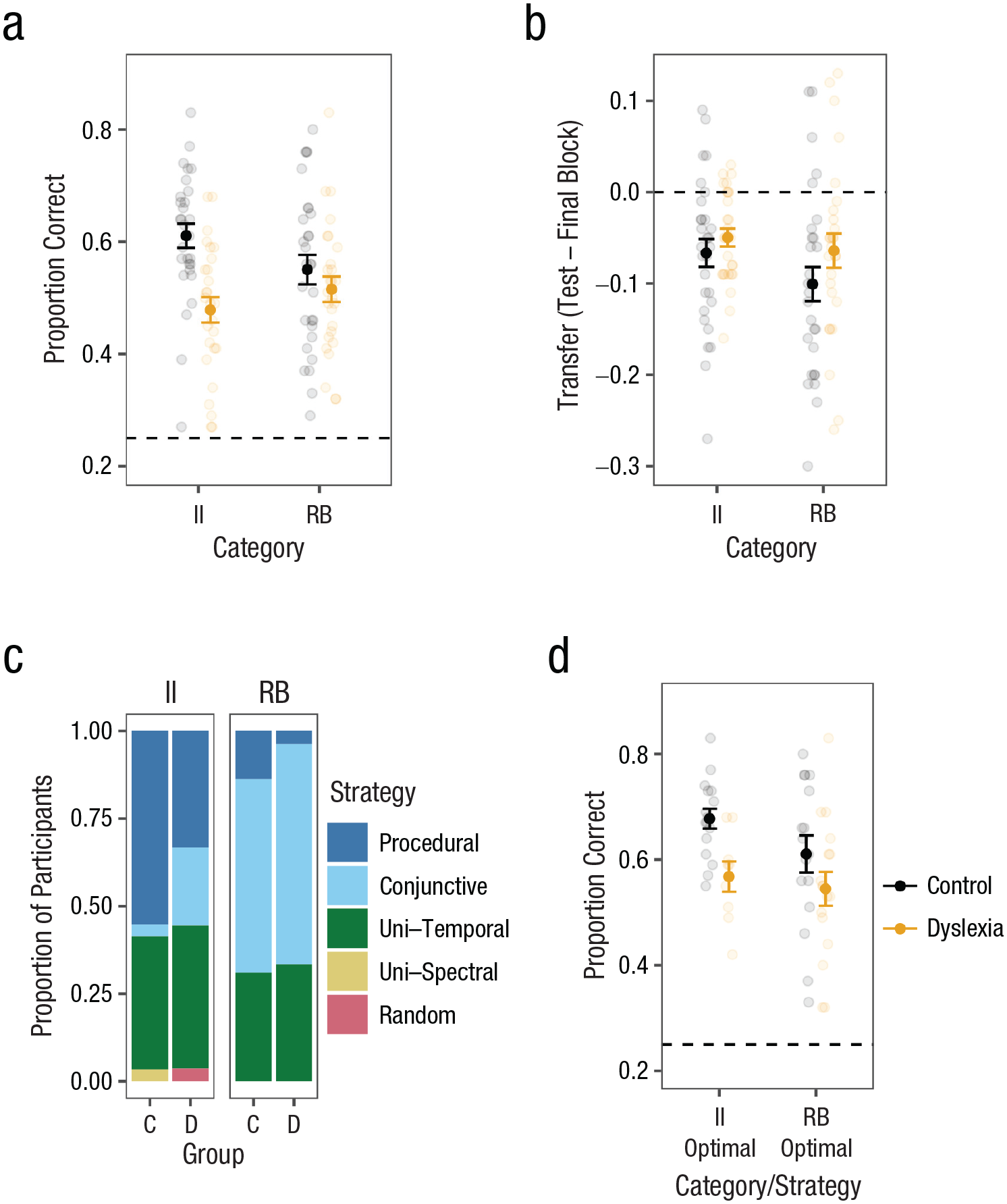
Generalization test performance and strategies. Error bars reflect standard error of the mean. Individual subject performance is shown in lighter points and group average in darker points. Dashed lines in (a) and (c) reflect chance performance (25%) and in (b) reflect no difference between test and final block performance. (a) Average generalization test accuracy relative to chance. (b) Average transfer of performance from the final block to generalization test. (c) Learning strategies across tasks and groups. (d) Average generalization test accuracy across participants using optimal strategies (information integration, or II: procedural; rule based, or RB: conjunctive).
However, in examining the transfer of performance from the final training block (with feedback) to the generalization block (novel exemplars with no feedback), we did not see any differences across groups (Fig. 4b). We examined transfer using a mixed-model ANOVA with group (dyslexia, control) and task (rule based, information integration) as factors. Transfer was not significantly different across the dyslexia and control groups, F(1, 54) = 2.70, p = .11, η p ² = .025, or rule-based and information-integration tasks, F(1, 54) = 2.30, p = .14, η p ² = .020, and there was no interaction between group and task, F(1, 54) = 0.38, p = .54, η p ² = .003.
We also examined decision strategies during generalization (Fig. 4c). The pattern was similar to training: The dyslexia group used fewer task-appropriate procedural strategies in the information-integration task compared with controls (33% dyslexia vs. 55% control), but the groups used the task-appropriate conjunctive strategy in the rule-based task at similar rates (63% dyslexia vs. 55% control). Among participants using the optimal strategy during generalization (Fig. 4d), control participants performed significantly better than dyslexia participants in the information-integration task, t(14.9) = 3.21, p = .0059, d = 1.36, 95% CI = [3.69, 18.3], but not the rule-based task, t(30.5) = 1.38, p = .18, d = 0.48, 95% CI = [−3.13, 16.3]. This departs from what we observed in training, where there were no significant differences. We note that this analysis has greater power than our analysis of efficiency in training because there were more dyslexia participants using the optimal strategy in the information-integration task during the test (information integration—dyslexia: N = 9, control: N = 17; rule based—dyslexia: N = 16, control: N = 16).
Discussion
In summary, the present study used dyslexia, a disorder that has been associated with a selective procedural learning impairment, as a test of whether category learning would differ from typical learners when optimal performance demands a procedural strategy. Individuals with dyslexia were impaired in learning and generalizing information-integration nonspeech categories defined by integration across input dimensions, whereas performance on rule-based categories defined by conjunctive rules was spared. Computational analyses revealed that individuals with dyslexia were slower, less efficient, and generally less able to use task-appropriate procedural strategies during information-integration learning. Participants with dyslexia needed approximately 100 trials more to discover the optimal procedural strategy and employed it over one third fewer blocks than control participants. In marked contrast, individuals with dyslexia used task-appropriate declarative strategies during rule-based learning. Like learners from the control group, individuals with dyslexia discovered the optimal, conjunctive strategy for rule-based category learning within the second block of training. This served learners well and led the groups to learn similarly. These findings support the existence of multiple category learning systems, add discriminant validity to the procedural learning deficit of language disorders such as dyslexia (Nicolson & Fawcett, 2011, 2019; Ullman et al., 2020; Ullman & Pullman, 2015), and illuminate cognitive processes that could contribute to the difficulties of individuals with dyslexia to acquire complex categories such as native and nonnative speech sounds.
The present computational modeling results reveal slower “switching” from suboptimal hypothesis-testing strategies to optimal procedural-based strategies in the context of learning information-integration categories among learners with dyslexia. The COVIS model (Ashby et al., 1998) postulates that responses are initially controlled by the declarative, hypothesis-testing system and switch to control by the procedural system if necessary. According to the model, switching between systems originates in the prefrontal cortex, but the switching is mediated within the basal ganglia (Ashby et al., 1998; Ashby & Valentin, 2017). Our results suggest that suboptimal switching in dyslexia may arise from poor mediation by prefrontal control processes. It is important to note, however, that patients with damage to the prefrontal cortex exhibit impairments in both rule-based and information-integration learning (Schnyer et al., 2009), rather than the selective impairment of information-integration learning observed here among learners with dyslexia.
Alternatively, basal ganglia dysfunction may contribute to suboptimal switching in dyslexia. Ashby et al. (1998) argued, on the basis of human and animal findings (Ashby et al., 2003; Jaspers et al., 1990; Roberts et al., 1994), that switching may be controlled by the tail of the caudate nucleus (Ashby & Ennis, 2006; Ashby et al., 2002). Further, they postulated that damage to the tail of the caudate would be most likely to produce selective deficits to information-integration learning. Indirectly supporting this possibility in dyslexia, Gabay and Holt (2015) found that incidental auditory category learning within a videogame task in which successful learning is related to activation of the tail of the caudate (Lim et al., 2019) is less successful among individuals with dyslexia compared with a control group. A combined approach with behavioral learning paradigms, computational modeling, and neuroimaging will be useful in future work to disentangle the source of strategy switching deficits in dyslexia.
In the current study, learning differences cannot be attributed to baseline perceptual differences. Discrimination across the stimulus space was highly accurate across groups because the stimulus spaces were intentionally constructed to limit differences in low-level sensory perception. The groups exhibited equivalent performance in the first block of each category learning task and performed equivalently in discriminating category exemplars. Further, task difficulty, reinforcement schedules, and amount of training were constant across the information-integration and rule-based learning challenges, and observed differences between information-integration and rule-based learning were established within the same learners. Our results support a dissociation when the structures of category input distributions demand different learning strategies, rather than a general deficit in category learning in dyslexia. Even more generally, the present dissociation of learning with procedural and declarative strategies aligns with models positing the existence of multiple distinct category learning systems (Ashby et al., 2011). In the future, it will be important to determine whether training programs designed to improve phonological skills of people with dyslexia may capitalize on encouraging strategy shifts or offering incremental training regimes (Tricomi et al., 2006). Furthermore, it will be informative to examine category learning in dyslexia using subjective measures of awareness to support the notion of dissociation between memory systems in dyslexia. Finally, it will be important to examine whether the observed findings generalize to samples of children with developmental dyslexia on the basis of the differential maturation of multiple memory systems across development (Finn et al., 2016).
Considered from the domain of dyslexia, the impaired learning and selective deficit in categorizing information-integration categories is consistent with previous demonstrations of a procedural learning deficit in dyslexia, as observed across motor, cognitive, and perceptual domains (Ballan et al., 2022; Gabay, 2021; Gabay et al., 2012, 2015; Hedenius et al., 2021; Howard et al., 2006; Lum et al., 2013; Massarwe et al., 2022; Pavlidou et al., 2009, 2010; Sperling et al., 2004; Stoodley et al., 2006; Vicari et al., 2003, 2005). The present findings also invite consideration of the relationship between phonological and nonphonological symptoms in dyslexia. Our results suggest that procedural learning deficits in dyslexia may be domain and modality general. Whereas previous work has demonstrated impaired information-integration category learning with visual categories (Sperling et al., 2004), we demonstrate an information-integration-specific learning impairment in the nonspeech, auditory domain. This suggests that dyslexia not only induces a phonological or speech processing deficit (Derawi et al., 2022; Serniclaes & Sprenger-Charolles, 2003), as has been previously argued (e.g., Snowling, 2001), but instead arises from a general, procedural learning deficit. Inasmuch as information-integration categories are like phonetic categories in requiring integration across multiple acoustic dimensions (e.g., Yi et al., 2016), phonological deficits in dyslexia may originate in general challenges in acquiring complex, multidimensional categories through procedural-based strategies.
In summary, computational modeling of categorization decisions among learners with dyslexia reveals reduced use of and slower shifting to optimal procedural-based strategies even as declarative-based strategy use is like that of controls. Poorer category learning in dyslexia specifically arises from group differences in the ability to discover and capitalize on procedural strategies, which has important implications for learning the complex multidimensional structure of speech categories.
Supplemental Material
sj-docx-1-pss-10.1177_09567976231151581 – Supplemental material for Impaired and Spared Auditory Category Learning in Developmental Dyslexia
Supplemental material, sj-docx-1-pss-10.1177_09567976231151581 for Impaired and Spared Auditory Category Learning in Developmental Dyslexia by Yafit Gabay, Casey L. Roark and Lori L. Holt in Psychological Science
Footnotes
Transparency
Action Editor: Angela Lukowski
Editor: Patricia J. Bauer
Author Contribution(s)

Notes
References
Supplementary Material
Please find the following supplemental material available below.
For Open Access articles published under a Creative Commons License, all supplemental material carries the same license as the article it is associated with.
For non-Open Access articles published, all supplemental material carries a non-exclusive license, and permission requests for re-use of supplemental material or any part of supplemental material shall be sent directly to the copyright owner as specified in the copyright notice associated with the article.
