




Abstract
When meeting other people for the first time, how should one behave in order to be liked? We investigated the effects of agentic and communal behaviors on two forms of being liked: popularity (being generally liked by others) and unique liking (being uniquely liked by specific interaction partners). In a round-robin study, 139 unacquainted German adults had dyadic conversations and provided liking ratings afterward. The conversations were recorded on video, and four agentic behaviors (leading, dominant, confident, boastful) and four communal behaviors (polite, benevolent, warm, friendly) were each rated by trained observers. Participants who generally showed agentic and communal behavior were also generally liked (popularity). When participants’ level of communal, but not agentic, behavior exceeded their personal standards during an interaction, they were particularly well-liked by the respective interaction partner (unique liking). The behavioral predictors of being liked thus differ, depending on whether one focuses on popularity or unique liking.
When meeting other people for the first time, how should one behave if one’s goal is to be liked? Even though this question is straightforward, it requires a nuanced answer. According to Kenny’s (1994) social relations model, the effects of interpersonal behavior on liking can be examined on two levels. On the level of the individual, one can examine whether persons’ general tendency to exhibit a certain behavior predicts the extent to which they are generally liked by others. This form of being liked is called popularity (Back & Kenny, 2010) and describes the target effect of the social relations model analysis with regard to being liked. On the level of the dyad, one can examine whether individuals who display more of a specific behavior than what is typical for them are particularly well-liked by their interaction partner in specific dyadic interactions. This form of being liked by others is called unique liking (Back & Kenny, 2010), and in the terminology of the social relations model, it represents the relationship effect with regard to being liked.
Both kinds of being liked are important for theoretical and practical reasons. Popularity safeguards social inclusion in the group, which was crucial for survival in our evolutionary past and is still highly important for mental health and well-being today (Baumeister & Leary, 1995). Above and beyond general popularity, the other form of being liked, unique liking, is highly consequential of mutually supportive dyadic relationships that are omnipresent in social life (e.g., friendships, partnerships, or romantic relationships) and that are adaptive in evolutionary terms (Hruschka, 2010). In such relationships, unique liking is typically reciprocated, meaning that the more person A likes person B, the more person B tends to like person A (Kenny, 2020), and this dyadic liking-based bond is crucial for keeping relationships together (e.g., Hays, 1984).
But what could the behaviors be that lead to popularity and unique liking in getting-acquainted conversations? When humans judge each other’s behavior, two orthogonal factors labeled agency and communion (Bakan, 1966; T. Leary, 1957; Wiggins, 1979) cover the bulk of the covariance between these judgments. Agency and communion thus do not describe specific social behaviors but rather represent the conceptual coordinates for the description of social behavior in general. Behavior that lies close to the agency dimension (also referred to as “status,” “power,” or “competence”) is characterized by high levels of dominance and confidence, and behavior that lies close to the communion dimension (also referred to as “affiliation,” “warmth,” or “love”) is characterized by high levels of warmth and friendliness (Wiggins, 1979).
What, then, are the consequences of behaviors that are typically judged as agentic and communal for being liked on the two levels of analysis? The case seems rather clear for communal behavior. Communal behavior is usually beneficial for all involved interaction partners, meaning that if a person behaves in a warm and friendly fashion, this typically brings about benefits for everyone (Abele & Wojciszke, 2007; Hogan, 1982). Accordingly, a general tendency to display communal behavior should positively predict popularity, which would be in line with findings of previous research (Küfner et al., 2013; Leckelt et al., 2015). At the level of the dyad, actors differ in the extent to which they show communal behavior toward particular interaction partners (Dufner et al., 2016), and research on friendship formation suggests that those interaction partners who receive much communal behavior from a specific actor should appreciate that and, as a consequence, uniquely like the actor (Lydon et al., 1997; Park & Flink, 1989).
For agentic behavior, predictions are less clear. Agentic behavior is usually self-beneficial (Abele & Wojciszke, 2007), meaning that if persons behave in a dominant and assertive fashion, such behavior typically brings about benefits for the actor themselves, such as high power or increased access to resources. For interaction partners, agentic behavior can bring about benefits or losses, depending on the context (Laustsen & Petersen, 2017). In getting-acquainted conversations, shy behavior, which is situated at the negative pole of the agency dimension, often evokes negative reactions, most likely because it creates an atmosphere of uneasiness (M. R. Leary, 1986). Accordingly, it is conceivable that people who behave more agentically are liked more.
However, the content domain of agency is also often characterized by a zero-sum principle, meaning that one person’s dominance comes at the cost of the interaction partner’s submission (Carson, 1969). From this perspective, agentic behavior entails potential disadvantages for the interaction partner, and therefore, it is also conceivable that people who show agentic behavior are liked less. Past research in group settings indicates that people who generally display agentic behavior are also generally liked by others (Küfner et al., 2013; Leckelt et al., 2015). Hence, agentic behavior might have a positive effect on popularity. On the level of the dyad, it is unclear which one of the two proposed processes dominates or whether they might even cancel each other out. Thus, a positive, a negative, and a null correlation between agency and unique liking all seem plausible.
Statement of Relevance
Being liked after getting-acquainted conversations can lead to a number of real-life benefits, such as getting the job after a job interview, an apartment after a viewing, or a long-term romantic partner after a date. In contrast, people who are disliked often consequently suffer from psychological problems such as low self-esteem or depression. Gaining a better understanding of the antecedents of liking is thus of high societal relevance. The current findings indicate that the behavioral dynamics that result in being liked differ depending on whether one focuses on people’s general behavioral styles or on instances in which they derivate from these general styles in specific dyadic interactions. This insight will lead to a better understanding of how individuals get popular and how friendships develop. As a practical contribution, the research provides recommendations on how to behave in getting-acquainted conversations in order to make a positive first impression.
In the present study, we implemented a round-robin design, in which previously unacquainted individuals met one another for the first time in the laboratory for brief dyadic conversations. Afterward, both members of each dyad rated each other in terms of liking. The design thus allowed us to investigate both popularity and unique liking. We hypothesized that communal behavior would be a positive predictor of both popularity and unique liking. For agentic behavior, we predicted a positive effect on popularity and analyzed the effect on unique liking in an exploratory fashion. We also considered that social judgments form spontaneously at first sight, without any direct interaction between the target person and the perceiver (Willis & Todorov, 2006). To ensure that liking judgments are indeed affected by the target person’s behavior, we also assessed liking prior to the conversations and controlled for these baseline assessments.
Open Practices Statement
We analyzed data from a larger study that was designed to address several research questions. Two articles based on that study have already been published, and these articles dealt with nonoverlapping research questions, namely implicit interpersonal attraction (Krause et al., 2014, Study 1) and social mimicry (Salazar Kämpf et al., 2018). We will solely describe the procedures and measures that are relevant to the current research question. The supplementary online materials (SOM; see https://osf.io/f2d3c/) provide a list of all study variables. The analyses were not preregistered and partly exploratory in nature, although hypotheses had been theoretically derived. Open data, materials, and analysis scripts have been made publicly available on OSF at https://osf.io/raqcp/.
Method
Participants
One hundred thirty-nine unacquainted students (70 men) from different fields of study participated in exchange for monetary compensation (20€). To test whether participants were indeed unacquainted, we asked them to indicate how well they had been acquainted with each group member before the study on a 6-point Likert scale (1 = not a bit, 6 = very well). The average level of acquaintance was close to the low end of the scale (M = 1.03, SD = 0.22; for a detailed description, see the SOM). Participants’ average age was 24.4 years (SD = 4.4), and they belonged to 26 same-sex groups, each consisting of four to six members. There were no case exclusions, we computed the analyses with all participants who signed up for the study.
Procedure
The ethics committee at the University of Münster, Germany, approved the study. Participants were recruited via newspaper announcements and a website. They were asked to sign up for a same-sex group (for separate analyses of the male and female groups, see Tables S3 and S4 in the SOM) that should consist only of people with whom they were unacquainted. After arriving at the laboratory, participants were photographed in a standardized position with a neutral facial expression to create pictures that were later used for the liking measures. Next, participants were asked to briefly introduce themselves to their group by telling their first name, family name, place of origin, field of study, semester, interests, and leisure activities. Afterward, participants were asked to provide baseline liking ratings of all other members on separate computer screens. (Note that by assessing the baseline ratings after the self-introductions, we could ensure that effects were indeed driven by participants’ behavior during the dyadic interactions.) For this purpose, they saw a photograph of one group member at a time on the screen and had to rate him or her. Then, each participant had a 5-min getting-acquainted conversation with each other group member about topics of their choice. Each conversation was videotaped. Similar designs have been used successfully in previous studies on impression formation at first acquaintance (e.g., Funder et al., 1995). This resulted in six, 10, or 15 getting-acquainted conversations per four-, five-, or six-member group, respectively. After the last conversation, participants were asked again to provide liking ratings of each group member. At the end of the session, participants were debriefed, thanked, and compensated.
Measures
Liking ratings
At baseline, participants answered two items that measured how much they liked each conversation partner on a 6-point Likert scale (“How likeable do you find this person?” “Would you like to get to know this person?”). After the getting-acquainted conversations, participants answered the same items plus an additional one: “Would you like to become friends with this person?” (According to our reasoning, this item would have been awkward to answer at baseline, when participants had not interacted at all.) Accordingly, the postconversation liking measure consisted of three items.
Interpersonal behavior ratings
After the study was complete, independent observers watched the video material and rated the degree to which each participant showed agentic or communal behaviors toward each other group member during the getting-acquainted conversations. (Observers saw videos showing both interaction partners but were told to focus on one of them.) There were eight behavioral indicators in total, four of them pertaining to agency and the other four to communion. Aiming to keep systematic observer bias to a minimum, we ensured that all behavior was not coded by the same observers. Instead, out of a pool of 21 observers in total (20 women), groups of four trained observers rated at least one behavioral dimension of interest (in addition to behavioral indicators that were irrelevant for the current research question).
For each dyad, person A’s interpersonal behavior toward person B and person B’s interpersonal behavior toward person A were rated in separate observations. Thus, we ensured a large time delay between the two observers’ ratings of a dyad. If an observer had rated the interpersonal behavior of person A toward person B, they rated a large number of participants before rating the behavior of person B toward person A. A video of the same getting-acquainted conversation was never presented twice in a row.
A rating manual provided behavioral anchors of the four agentic and the four communal behaviors so that raters would have a common understanding of what these behaviors meant. As agentic behaviors, the observers indicated how “leading,” “dominant,” “confident,” and “boastful” a participant’s behavior was. As communal behaviors, the observers indicated how “polite,” “benevolent,” “warm,” and “friendly” a participant was (a detailed description of the anchors of each of the eight behaviors can be found in the SOM). Ratings were made on a 6-point Likert scale ranging from 1 (not at all) to 6 (very much). Aiming to increase the reliability and validity of the behavioral assessments, we asked each observer to complete an observer training along with the other observers in the specific rating group. (See the SOM for a description of the observer training procedure.)
The observers viewed the participants in different random orders and made their ratings independently. After all four observers in a rating group finished their behavioral assessments, we averaged their ratings.
Power analysis
Previous studies have reported medium to moderate effects of observer-coded behavior on popularity. Küfner et al. (2013) and Leckelt et al.’s (2015; Study 1) studies, which had designs that were similar to the current one, detected agentic and communal behaviors as predictors of popularity with an average effect size r of .30. Given this effect size and the current study’s sample size (N = 139), the likelihood of finding a significant effect (p = .05, two-tailed test) was 95.2%. With a power of 80%, one would be able to detect a significant effect size r of .23.
We are not aware of any previous studies testing the effects of agentic and communal behaviors on unique liking. Yet, given our sample size of 309 dyads and thus 618 behavioral and liking assessments, it would be possible to detect a significant effect size r of .11 with a power of 80%.
Results
Social relations model analyses
We first ran latent social relations model analyses to determine the amount of variance in the liking ratings and in behavioral indicators explained by the perceiver/actor, target/partner, and relationship effects. 1 A precondition for testing our hypotheses regarding the behavior coding was that a significant portion of variance had to be located at the actor effect level and at the relationship level. Furthermore, for the liking ratings, a significant amount of variance had to be located at the target effect level and at the relationship level. As shown in Table 1, all these preconditions were met.
Latent Social Relations Analyses of the Group Members’ Liking Ratings and the Observer Ratings of Interpersonal Behaviors
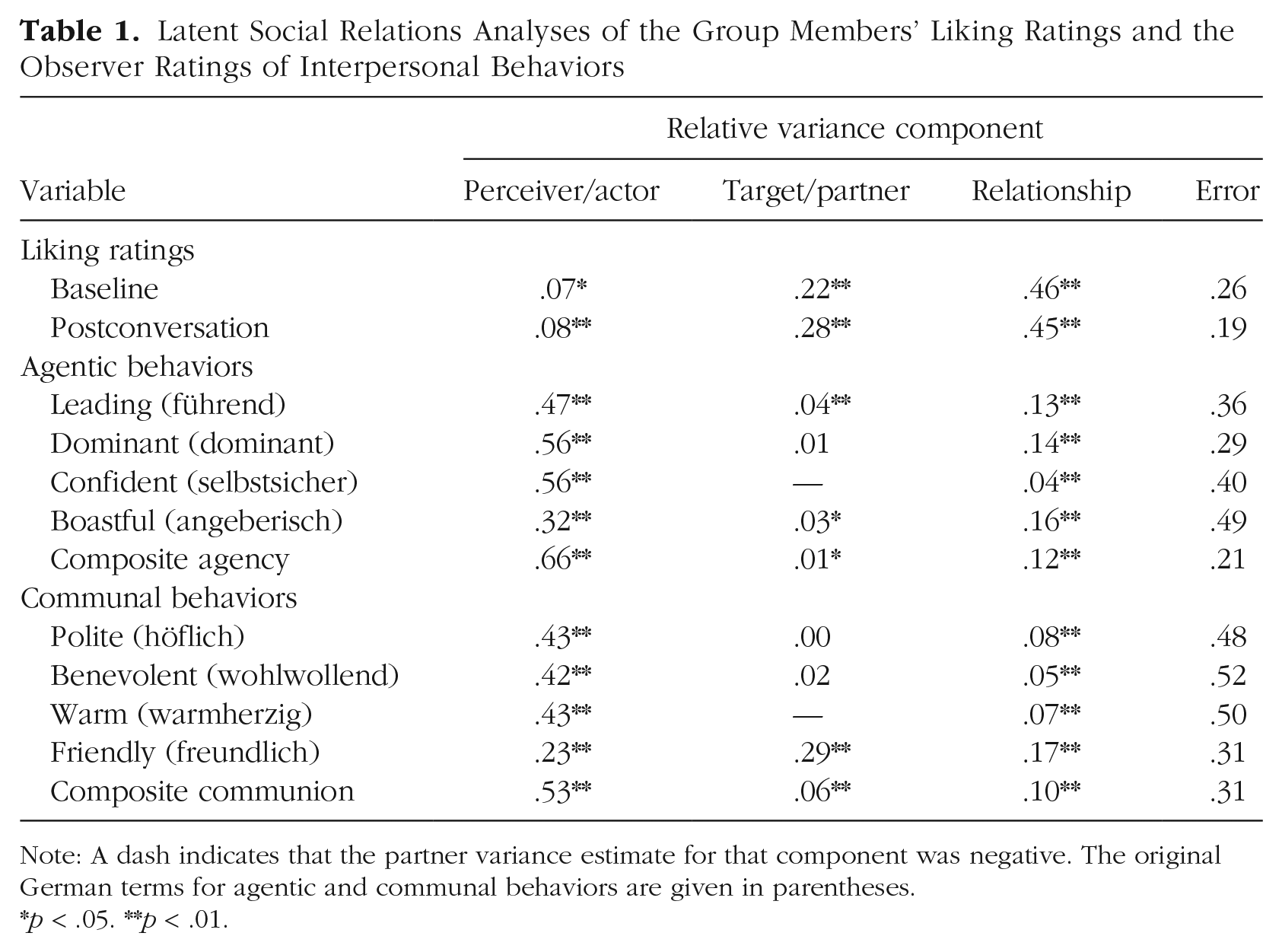
Note: A dash indicates that the partner variance estimate for that component was negative. The original German terms for agentic and communal behaviors are given in parentheses.
p < .05. **p < .01.
For the baseline and postconversation liking measures, we found small but significant amounts of perceiver variance, substantial amounts of significant target variance (i.e., individual differences in popularity), and large amounts of significant relationship variance (i.e., differences in unique liking). This pattern matches well with previous findings indicating that liking other people is essentially a relational phenomenon (e.g., Back, Schmukle, & Egloff, 2011; Kenny, 2020).
A different variance-partitioning pattern was obtained for the agentic and communal behaviors (see Table 1). Our results were in line with past research (e.g., Kenny et al., 2001): Actors behaved relatively consistently across interaction partners (large amounts of actor variance), and there were very few differences in interaction partners to evoke different reactions by others (almost no partner variance). The unexpected exception was friendly behavior: The amount of partner variance was higher than the amount of actor variance. As can be seen in the “Relationship” column of Table 1, each interpersonal behavior also had significant relationship variance.
Descriptive statistics, reliabilities, and observer agreement
In the SOM, Table S1 presents descriptive statistics, reliabilities, and intercorrelations for all study variables. The internal consistencies of group members’ baseline and postconversation liking ratings were above .80 and thus satisfactory. Although the means of the two liking ratings did not differ significantly, t(617) = 1.27, p = .20, d = 0.05, the baseline and postconversation liking measures were only moderately correlated (r = .48, p < .001).
The observer ratings demonstrated moderate to good interrater agreement for all eight interpersonal behaviors—the intraclass correlation coefficients(2, k) ranged from .66 to .84. We formed a composite score of agentic behavior (α = .85) and of communal behavior (α = .83). The correlations between the single agentic and communal behaviors were relatively low when we examined the raw behavior judgments (mean r = .18, see Table S1), on the level of the actor effects (mean r = .29), and on the level of the relationship effects (mean r = .10). An exploratory factor analysis based on the raw behavior judgments with subsequent oblique rotation clearly indicated two factors (see Table S2), which were weakly correlated (r = .22, p < .01).
To investigate how different interpersonal behaviors predicted the ratings of being liked after the getting-acquainted conversations, we read out via the TripleR R package (Schönbrodt et al., 2012) the actor and relationship effects of each observer rating for each interpersonal behavior and the partner and relationship effects of each item from the baseline and postconversation liking measures via the TripleR R package (Schönbrodt et al., 2012). Then, we used structural equation analyses to compute latent regressions with the lavaan package (Rosseel, 2012) in R (Version 4.0.5; R Core Team, 2021).
Social relations prediction models of the link between behavior and being liked
Popularity
In the regression model for popularity, being liked was the latent dependent variable, as represented by the target effects of the three manifest postconversation items. The observed interpersonal behavior served as a latent predictor, which was represented by the actor effects of the four manifest observer ratings. The target effects of the two manifest baseline items were used to measure latent preconversation popularity. We included this variable as a control variable to analyze the effect of interpersonal behavior on popularity while holding the initial level of popularity constant. We ran separate models for each specific agentic and communal behavior (e.g., dominant behavior) and the agentic and communal behavior composite scores. All 10 latent regression models fit the data well—comparative fit indexes (CFIs) ≥ .956, root-mean-square errors of approximation (RMSEAs) ≤ .103, standardized root-mean-square residuals (SRMRs) ≤ .064.
The first three columns of Table 2 show that the actor effects of all agentic and communal behaviors significantly predicted target effects of liking ratings. Accordingly, high levels of both behaviors can lead to popularity after getting-acquainted conversations. To examine whether these effects were incremental, we ran a model including both the agentic behavior composite (as measured via the four specific agentic behaviors) and the communal behavior composite (as measured via the four specific communal behaviors) as simultaneous predictors of the target effect of liking (again controlling for baseline liking). The communal behavior composite (β = 0.40, p < .001, 95% confidence interval [CI] = [0.26, 0.54]) was a stronger predictor than the agentic behavior composite (β = 0.18, p = .01, 95% CI = [0.04, 0.31]), although the effect of the latter still remained significant.
Results of the Social Relations Prediction Model: Effect of the Actor Effects and Relationship Effects of Interpersonal Behaviors on Popularity and Unique Liking After Getting-Acquainted Conversations
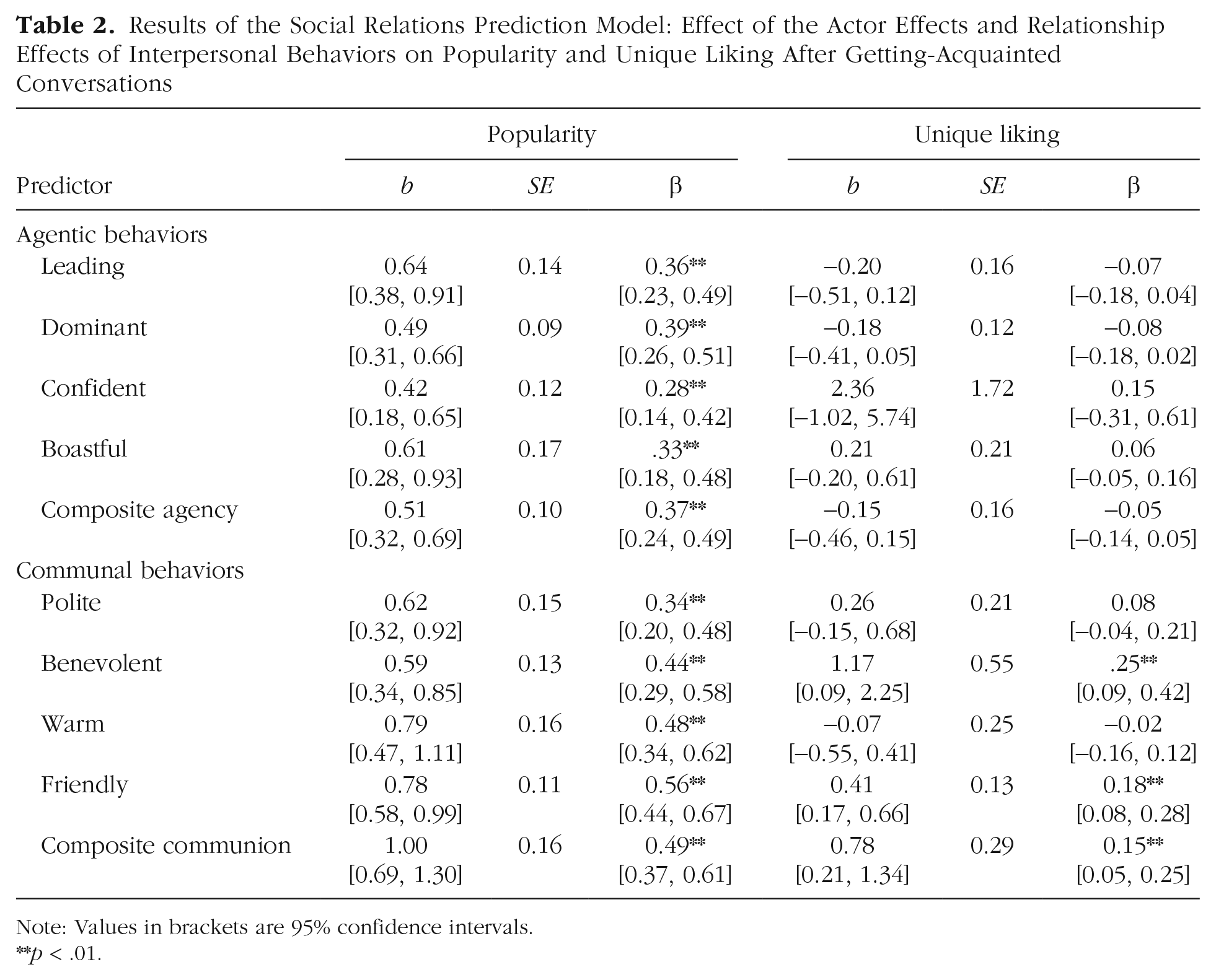
Note: Values in brackets are 95% confidence intervals.
p < .01.
Unique liking
In the regression model for unique liking, the latent dependent variable was represented by the interpersonal relationship effects (i.e., unique ratings of being liked) of the three manifest postconversation items. The latent predictor variable was represented by the intrapersonal relationship effects (i.e., unique behavior toward a conversation partner) of the four manifest observer ratings. The interpersonal relationship effects of the two manifest baseline items were additionally included to measure latent preconversation unique liking. To examine how the relationship effects of agentic and communal behaviors predicted subsequent unique ratings of being liked, we again computed separate latent regressions for each interpersonal behavior. All 10 latent regression models fit the data well—CFIs ≥ .960, RMSEAs ≤ .065, SRMRs ≤ .038.
The last three columns of Table 2 show that none of the relationship effects of agentic behaviors predicted the interpersonal relationship effects of liking ratings. By contrast, the relationship effects of two specific communal behaviors (i.e., benevolent and friendly behavior) and the composite score of communal behavior were significantly correlated with the interpersonal relationship effects of liking ratings. Hence, the results suggest that not agentic but high levels of communal behaviors led to unique liking after getting-acquainted conversations.
As in the analyses for popularity, we examined whether the effects of agentic and communal behaviors were incremental. To do so, we ran a latent regression model including the relationship effect of the agentic behavior composite (as measured via the relationship effects of the four specific agentic behaviors) and the relationship of the communal behavior composite (as measured via the relationship effects of the four communal behaviors) as two simultaneous predictors of the interpersonal relationship effect of liking (controlling for baseline liking). Whereas the relationship effects of communal behavior positively predicted unique liking (β = 0.20, p = .001, 95% CI = [0.09, 0.32]), the relationship effect of agentic behavior negatively predicted unique liking (β = −0.12, p = .02, 95% CI = [−0.23, −0.02]). The exploratory analysis thus indicated that when communal behavior is held constant, behaving in a uniquely agentic fashion toward specific others might even reduce one’s unique liking.
In the SOM, we report results for a number of robustness checks and supplemental analyses (see Tables S5 to S9). In all cases, effects remained robust.
Discussion
With regard to popularity, the current findings indicate that actors who generally behaved in a communal fashion toward others were generally popular, a finding that matches well with the claim that communion offers a way to safeguard one’s social inclusion (Hogan, 1982). Yet popularity was also incrementally predicted by agentic behavior, which means that even though agency is primarily discussed as a predictor of status or respect (Wojciszke et al., 2009), people who generally show agentic behavior might also be generally liked.
With regard to unique liking, the results indicate that uniquely behaving in a communal fashion toward a specific other evokes unique liking. This result supports the notion that communal behavior plays a central role in the development of friendships (Hruschka, 2010). By contrast, uniquely behaving in an agentic fashion toward a specific other does not appear to evoke unique liking by that other. Quite the contrary, when communal behavior was controlled for, showing higher than usual levels of agentic behavior toward a particular other was even linked to being uniquely disliked by that other. Note, however, that the latter result was based on an exploratory analysis and must therefore be regarded as preliminary evidence.
The current findings match well with the claim that agency and communion can differ greatly in terms of their social consequences (Abele & Wojciszke, 2007; Hogan, 1982). The results are the first, however, to show that effects can differ depending on whether they are studied at the level of the individual or at the level of the dyad. Thus, adopting a social relations model (Kenny, 2020) perspective on the social consequences of agency and communion seems fruitful (see also Dufner et al., 2016; Rau et al., 2019).
Which psychological processes might underlie the present effects? At the level of the individual, certain personality dispositions, such as extraversion or agreeableness (McCrae & Costa, 1989), are linked to the chronic display of agentic or communal behavior. Most likely, persons scoring high on these traits became popular. At the level of the dyad, it must have been the unique constellation of the attributes of the actor and partners that led the actors to derivate form their personal norms of behavior. For example, actors with a strong power motive might have spotted insecure interaction partners early during their interactions and then increased their agentic behavior in order to dominate the conversation. Potentially, the insecure interaction partners felt increasingly uncomfortable and then uniquely disliked these actors. This example is solely illustrative; what the (constellations of) specific attributes and processes are that lie behind the effects on the two levels needs to be studied in future work (see Back, 2021, for a discussion on the topic).
Future research should also consider that real-life interactions are characterized by ongoing reciprocal effects involving interpersonal behavior and social evaluations (see Back, Baumert, et al., 2011; Kurzius et al., 2022). It is, for example, conceivable that if person A shows communal behavior toward person B, person B will like person A more than he or she initially did and will then show communal behavior toward person A, which in turn leads person A to like person B, et cetera (Carson, 1969). In future studies on such effects, the researchers should ideally make separate video recordings of both interaction partners to safeguard independent behavior ratings. Future researchers should also consider other factors that vary in naturalistic interactions, such as situational circumstances or the relationship history of the interaction partners, and for the sake of precision, studies should ideally be based on a formalized framework (e.g., Kenny, 2004, or Leising & Schilling, 2021).
A limitation of the current research is its unknown generalizability. It is possible that the effects might be different in different social contexts. Generally, the more a specific behavior is preferred by the interaction partner in a given context, the more relevant it should be for liking (Back, 2021). Whereas the effect of communal behavior should be positive in most contexts, it seems likely that interaction partners approve of agentic behavior if it brings them closer to their own goals (Laustsen & Petersen, 2017) and disapprove of it if it undermines their own agency (Dufner et al., 2016).
Furthermore, our participants were young adults, and some research indicates that agency is a particularly relevant topic in young adulthood but less so in later life (e.g., Walker & Frimer, 2015). If so, the effect of agentic behavior could be weaker in older samples. Similarly, it is unclear what the effects would be in a different culture with a more collectivistic focus. Other ideas for future research include studying the consequences of nervousness or emotionally unstable behavior (e.g., Breil et al., 2022; Leising & Bleidorn, 2011) for being liked as well as the effects of social behavior on more agentic outcomes, such as being chosen as a leader (e.g., Härtel et al., 2021).
Conclusion
How should persons behave when they want to be popular? According to our results, they should generally show a mixture of high agentic and high communal behavior, as these behaviors are both positive and unique predictors of popularity. How should persons behave when they want to win a specific other as a friend? The degree to which a specific actor is liked by a specific partner in absolute terms is always a combination of individual- and dyadic-level effects (Kenny, 1994). For communal behavior, the effects on the two levels are both positive, so the recommendation is straightforward: Be as communal as you can! For agentic behavior, the effect is positive on the level of the individual but null, or even negative, on the level of the dyad. Hence, even though agentic behavior might generally make one popular, it might not be good advice to show a higher than usual level of agentic behavior when trying to win a new friend. We hope that these recommendations are useful for navigating through everyday interactions.
Footnotes
Acknowledgements
M. Dufner and S. Krause share first authorship of this article.
Transparency
Action Editor: Jamin Halberstadt
Editor: Patricia J. Bauer
Author Contributions
