




Abstract
Do test-anxious students perform worse in exam situations than their knowledge would otherwise allow? We analyzed data from 309 medical students who prepared for a high-stakes exam using a digital learning platform. Using log files from the learning platform, we assessed students’ level of knowledge throughout the exam-preparation phase and their average performance in mock exams that were completed shortly before the final exam. The results showed that test anxiety did not predict exam performance over and above students’ knowledge level as assessed in the mock exams or during the exam-preparation phase. Leveraging additional ambulatory assessment data from the exam-preparation phase, we found that high trait test anxiety predicted smaller gains in knowledge over the exam-preparation phase. Taken together, these findings are incompatible with the hypothesis that test anxiety interferes with the retrieval of previously learned knowledge during the exam.
To obtain a university degree, students must successfully pass a series of examinations. For many students, taking an exam creates a particularly stressful situation. They worry about whether they will be able to recall their knowledge; their hearts beat faster, they sweat, and they want to escape the exam room. These cognitive and affective-physiological symptoms are indicative of test anxiety (Cassady & Johnson, 2002; Pekrun, 2001). Test anxiety is defined as worries about possible negative consequences or failure in evaluative situations (Zeidner, 2007). Test-anxious students tend to react with anxiety in evaluative situations, which is why test anxiety is described as a situation-specific trait (Spielberger & Vagg, 1995). Approximately every third student reports some level of test anxiety (Quek et al., 2019). This finding suggests that test anxiety is widespread among students.
Meta-analyses consistently show that test anxiety is negatively linked to academic achievement. Test anxiety predicts lower academic achievement throughout primary, secondary, and postsecondary education (Hembree, 1988; Richardson et al., 2012), and across various disciplines, such as math and second-language learning (Caviola et al., 2021; Teimouri et al., 2019). Test-anxious students perform more poorly on a wide range of achievement tests, such as classroom examinations, scholastic aptitude tests, and intelligence tests (von der Embse et al., 2018). Average correlations between test anxiety and various achievement measures vary between −.20 and −.30, suggesting that test anxiety poses a serious threat to academic success.
Although its impact is clear, how exactly test anxiety relates to academic achievement remains vague. Arguably the most prominent explanation is the interference hypothesis, which suggests that test anxiety impairs efficient task processing and knowledge retrieval during an exam (Eysenck et al., 2007; Mandler & Sarason, 1952; Wine, 1971). During the exam, test-anxious students worry about knowledge deficits or the potential negative consequences of failure (Wine, 1971; Zeidner, 2007). These task-irrelevant thoughts produce attentional interference and occupy working memory capacities that would otherwise be available for task execution (Ashcraft & Kirk, 2001; Beilock & Carr, 2005; Beilock et al., 2004; Eysenck & Calvo, 1992; Ng & Lee, 2015) or knowledge retrieval from long-term memory (Rosen & Engle, 1997; Unsworth et al., 2013). Hence, test-anxious students’ task-irrelevant thoughts may interfere with efficient task processing and knowledge retrieval during an exam, which impairs academic achievement.
Prior research on the interference hypothesis provided inconclusive results. If test-anxious students choke under pressure (Beilock & Carr, 2001), they should perform more poorly than expected in evaluative situations given their knowledge or skills. In support of this hypothesis, it has repeatedly been shown that participants perform more poorly in a problem-solving task if the task instructions induced situational anxiety (Beilock & Carr, 2005; Beilock & DeCaro, 2007; Beilock et al., 2004). Studies that induce short-term (i.e., state) anxiety immediately before a task, however, may not examine the same mechanism that is at play in students with general (i.e., trait) test anxiety. Several studies that focused on trait test anxiety have revealed that highly test-anxious students performed poorly on nongraded quizzes or take-home examinations even in the absence of evaluative pressure (Cassady, 2004a; Covington & Omelich, 1987; Naveh-Benjamin et al., 1981). These results cast initial doubt on cognitive interference as the sole explanation for lower academic achievement among test-anxious students.
The goal of the present study was to test whether trait test anxiety predicts performance in a high-stakes exam when we controlled for students’ knowledge as assessed shortly before the exam. To this end, we analyzed data from 309 medical students preparing for their final state exam, which is the most important exam in their studies. Students’ knowledge was assessed shortly before the final exam using extensive log-file data from a digital learning platform. Most importantly, right before the exam, students took mock exams that were very similar to the final exam in terms of length and difficulty. The negative effects of cognitive interference should be particularly evident on important exams, in which failure can have lasting negative consequences for students. This study thus provides a unique opportunity to test the interference hypothesis with high ecological validity. According to the interference hypothesis, students with high trait test anxiety should perform worse in the evaluative situation (i.e., the exam) than in the nonevaluative situations right beforehand (i.e., the mock exams), and this performance decrement should be correlated with self-reported test anxiety. We also investigated whether the link between test anxiety and exam performance is smaller for test-anxious students with high working memory capacity, who may suffer less from interference effects. To rule out the possibility that students were already anxious during the mock exams, we used an additional knowledge measure assessed before the mock exams as a predictor of exam performance. Furthermore, we used ambulatory assessment data to gain insights into the development of students’ state anxiety and knowledge throughout the exam-preparation phase.
Statement of Relevance
It is a common but rarely tested assumption that test-anxious students perform worse in exam situations than their knowledge would otherwise allow. To examine this assumption with high ecological validity, we used extensive log-file data from a learning platform to assess medical students’ knowledge shortly before the exam. We found that when we controlled for students’ knowledge level, test anxiety did not predict exam performance. These results thus provide strong evidence against the hypothesis that test anxiety interferes with the retrieval of knowledge during the exam. Therefore, test-anxiety interventions should promote effective knowledge acquisition at an early stage during exam preparation rather than aiming to reduce test anxiety shortly before or during an exam.
Method
Participants
Participants were medical students preparing for their final exam, the second state exam, in October 2018 using a digital learning platform. Initially, 365 students from all over Germany registered for the study. Of those, 350 started the study (i.e., they participated in the study for more than 1 day). We excluded students who did not report how many points they received on the final exam (n = 17), as well as one outlier who reported zero points on the exam. Furthermore, 17 students did not participate in the mock exams or did not use the digital learning platform for exam preparation. Another six outliers answered an unrealistically high number of questions on the learning platform, indicating that they shared an account with another person. The final sample was composed of 309 students (71% female, mean age = 25.90 years, SD = 3.25 years). A post hoc power analysis revealed that a sample size of 309 was sufficient to detect a correlation (r = .24) between test anxiety and academic achievement with high statistical power (
We used existing data from a larger project that tested the effectiveness of a self-regulation intervention (see Breitwieser et al., 2021 1 ). Students in the intervention group received prompts to form an implementation intention throughout a 40-day intervention period, whereas students in the control group did not receive any prompts. Students in the intervention group were comparable with students in the control group regarding test anxiety, t(307) = 0.67, p = .505, performance during exam preparation, t(307) = 0.47, p = .642, performance in the mock exams, t(307) = 0.59, p = .559, and exam performance, t(307) = 1.17, p = .241. Therefore, we combined the two groups for data analysis. The study was approved by the ethics committee of the Leibniz Institute for Research and Information in Education (DIPF). All participants gave written informed consent prior to testing. Participants received up to $58 for participation.
Procedure and measures
Students used a digital learning platform (www.amboss.com) to prepare for a high-stakes exam. The main learning activity on the learning platform was answering old exam questions in a multiple-choice format. Students participated in a pretest (Time 1), a daily survey period over the course of 40 days, and a posttest (Time 2). We outline the variables that we used in the present study below. A detailed overview of the ambulatory assessment procedure and variables assessed in the prestudying and poststudying questionnaires can be found in Breitwieser et al. (2021).
Trait test anxiety
Trait test anxiety was assessed in the pretest using an adapted version of the Academic Emotions Questionnaire (Pekrun et al., 2011). Students rated their test anxiety on a 5-point Likert scale ranging from 1 (“strongly disagree”) to 5 (“strongly agree”). The scale was composed of five items (e.g., “I worry whether I have studied enough”; McDonald’s
State anxiety
State anxiety was assessed throughout a 40-day survey period, which covered parts of the exam-preparation phase. Students were asked to rate their current tension about the upcoming study day on a 5-point Likert scale (e.g., “I feel tense and nervous,” 1 = fully disagree, 5 = fully agree). Because the second state exam constitutes the final and most important exam for medical students, they usually do not take any other courses. That is, students rated their state anxiety regarding their main study activity, which was exam preparation. State anxiety was measured with one item, so we computed split-half reliability by correlating the responses on odd and even days for each participant. The split-half reliability of the item was high (r = .96) indicating a high reliability of the daily measure across time. Furthermore, there was a medium-sized positive correlation between the state and the trait anxiety measure (r = .45), indicating convergent validity.
Performance measures
Using log files from the learning platform, we assessed students’ objective performance on old exam questions over the course of 100 days until the final exam. The 100-day plan was suggested by the learning platform as an ideal time frame for exam preparation. Performance during the exam-preparation phase was operationalized as the percentage of correctly solved items aggregated over a 72-day learning phase. This time period covered the time window starting 100 days before the exam until 28 days before the exam. Mock-exam performance was operationalized as the percentage of correctly solved questions aggregated over five mock exams. The mock exams were completed throughout the last 28 days before the final exam. The mock exams were four previous state exams and were thus comparable to the final exam in terms of length and difficulty.
In the posttest, students self-reported their performance (i.e., percentage correct) in the written Second State Examination, which covers all the medical knowledge acquired during the 10-semester program of study. The Second State Examination is the final examination at the university and therefore very important and demanding for the students. It has 230 multiple-choice questions in total, and it is split into three parts that take place on 3 consecutive days. On each day, students are given 5 hr to answer the questions, which means that they have around 4 min for each question. The exam questions include case studies that provide, for instance, a patient’s medical history, blood values, and pictures of an electrocardiogram. Students have to incorporate these multiple sources of information to obtain the correct diagnosis or to derive an appropriate therapy (i.e., perform medical reasoning), which occupies working memory capacity.
Working memory capacity
Working memory capacity was assessed using a numerical-updating task (Riediger et al., 2014). After six practice trials, students completed 15 trials of the working memory task. In each trial, students were presented for 6,000 ms with four numbers in a grid. Then, five updating operations were presented for 900 ms each by successively replacing the numbers in the grid through an addition or subtraction operation. Students were asked to calculate the new number and, at the end of each trial, report the final updated numbers in the grid. Performance in the working memory task was operationalized as the sum of correctly updated numbers in the grid averaged across all 15 trials. Students performed the working memory task as part of the pretest.
We further assessed working memory capacity throughout the daily survey period using a short version of the numerical-updating task (six trials completed each day before studying).
Data analysis
We used R (Version 3.6.1; R Core Team, 2022) and MPlus (Muthén & Muthén, 1998–2017) for data analysis and set the significance levels at .05 throughout the analyses. The data analysis scripts are available via the Open Science Framework (https://osf.io/kg7wb/). The first set of analyses examined the role of test anxiety in final-exam performance. For this purpose, we first estimated a latent change score model to test whether test anxiety predicts a change in performance from the mock exams to the final exam. We additionally estimated linear regression models to find out whether the link between test anxiety and exam performance holds when controlling for knowledge in the mock exams and exam-preparation phase and when controlling for students’ working memory capacity. Using the latent change score analysis, we tested whether students show a performance drop from the mock exam to the final exam and whether this performance drop is explained by individual differences in test anxiety. Using the multiple regression analysis, we tested whether test anxiety can explain additional variance in exam performance beyond students’ knowledge. Both analyses thus addressed from slightly different perspectives the question of whether and how test anxiety relates to exam performance.
The second set of analyses was used to examine the role of anxiety in knowledge acquisition. First, we tested trait anxiety as a predictor of the increase in percentage of correctly solved questions throughout the 72-day exam-preparation phase. Using linear mixed models, we estimated individual slopes for the increase in percentage of correctly solved questions over time. We then used trait test anxiety to explain the variance in slopes (cross-level interaction). Second, we tested reciprocal links between state anxiety and percentage of correctly solved questions, using data from the 40-day survey period. We estimated a two-level dynamic structural equation model to account for autoregressive effects (McNeish & Hamaker, 2020). In other words, (a) we predicted the percentage of correctly solved questions on Day T by state anxiety on Day T, and (b) we predicted state anxiety on the subsequent study day (Day T + 1) by the number of correctly solved questions on Day T. In this analysis, we focused on effects at the intraindividual level: That is, we tested whether higher anxiety compared with the person’s average anxiety level predicted a lower percentage of correctly solved questions (and vice versa). We included random intercepts and random slopes in the analysis to account for interindividual differences in average anxiety levels, in the percentage of correctly solved questions, and in their relation.
Results
Test anxiety was negatively related to knowledge and exam performance
Test anxiety assessed at the beginning of the study was associated with lower performance during exam preparation, in the mock exams shortly before the exam, and in the final exam (see Table 1). Test anxiety was thus related to measures of academic achievement, a result that corresponds with findings from prior meta-analyses that revealed comparably strong correlations (Hembree, 1988; Richardson et al., 2012; von der Embse et al., 2018).
Descriptive Statistics and Correlations (N = 309)
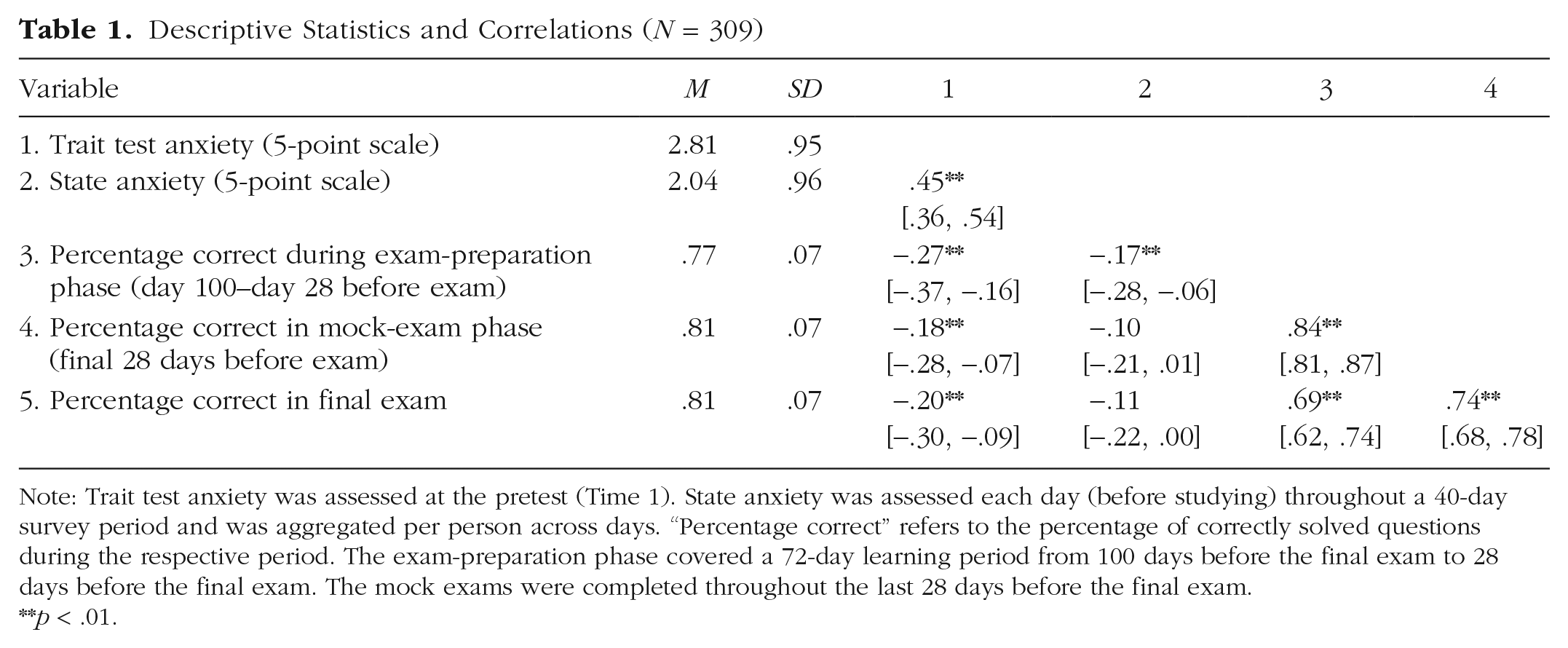
Note: Trait test anxiety was assessed at the pretest (Time 1). State anxiety was assessed each day (before studying) throughout a 40-day survey period and was aggregated per person across days. “Percentage correct” refers to the percentage of correctly solved questions during the respective period. The exam-preparation phase covered a 72-day learning period from 100 days before the final exam to 28 days before the final exam. The mock exams were completed throughout the last 28 days before the final exam.
**p < .01.
Test anxiety did not predict a performance drop from mock exams to final exam
Following the interference hypothesis, test anxiety should predict a decrease in performance from the nonevaluative mock exams to the final exam. We therefore tested whether test anxiety predicted a change in performance from the mock exams to the final exam using a latent change score model. As shown in Figure 1, average performance decreased slightly from the mock exams to the final exam (µ
d
= −.01, p = .044). The autoproportion parameter was negative (
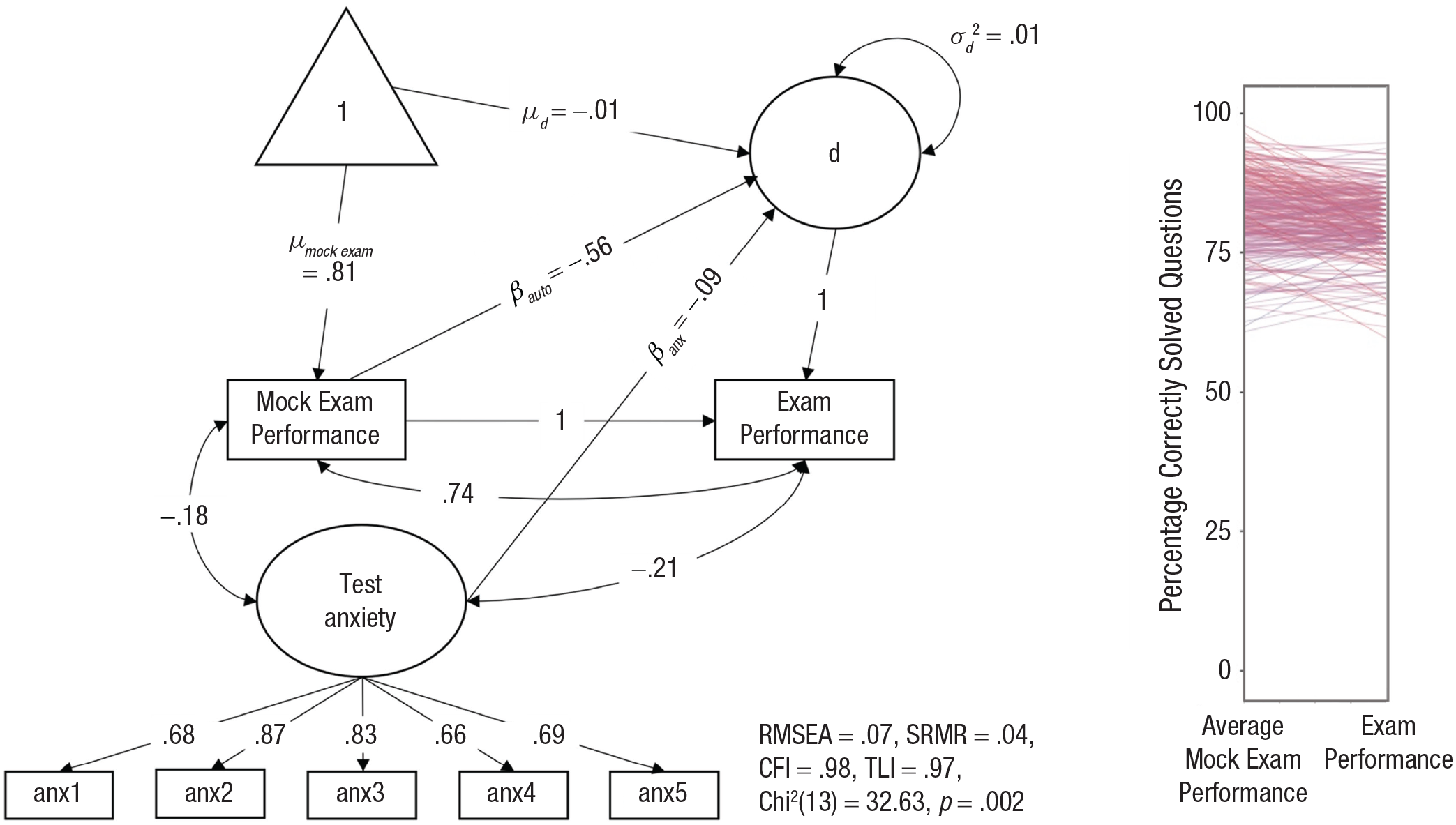
Latent change score model (left side) and development of percentage of correctly solved questions over the exam-preparation phase and from mock exams to final exam (right side). The figure on the left shows the results from the latent change score model; the figure on the right shows the individual development in percentage of correctly solved questions from the mock exams to the final exam. Each regression line represents the change in performance for an individual student (N = 309). RMSEA = root-mean-square error of approximation; CFI = comparative fit index; µ
mock exam
= average performance in mock exam; µ
d
= average change (d) in performance from mock exams to final exam; σ
d
2 = variance in change (d);
Test anxiety did not predict exam performance beyond mock-exam performance
Another way to examine the interference hypothesis is to test whether test anxiety predicts final-exam performance when we controlled for students’ knowledge levels assessed prior to the exam (i.e., in the mock exams). Using a hierarchical linear regression analysis, we found that test anxiety predicted lower exam performance when test anxiety was entered as a sole predictor (see Table 2, Model 1). This relation was no longer significant, however, when we controlled for performance in the mock exams (see Table 2, Model 2). Hence, test anxiety did not predict exam performance beyond students’ knowledge levels as assessed in the mock exam.
Predictors of Final-Exam Performance (N = 309)
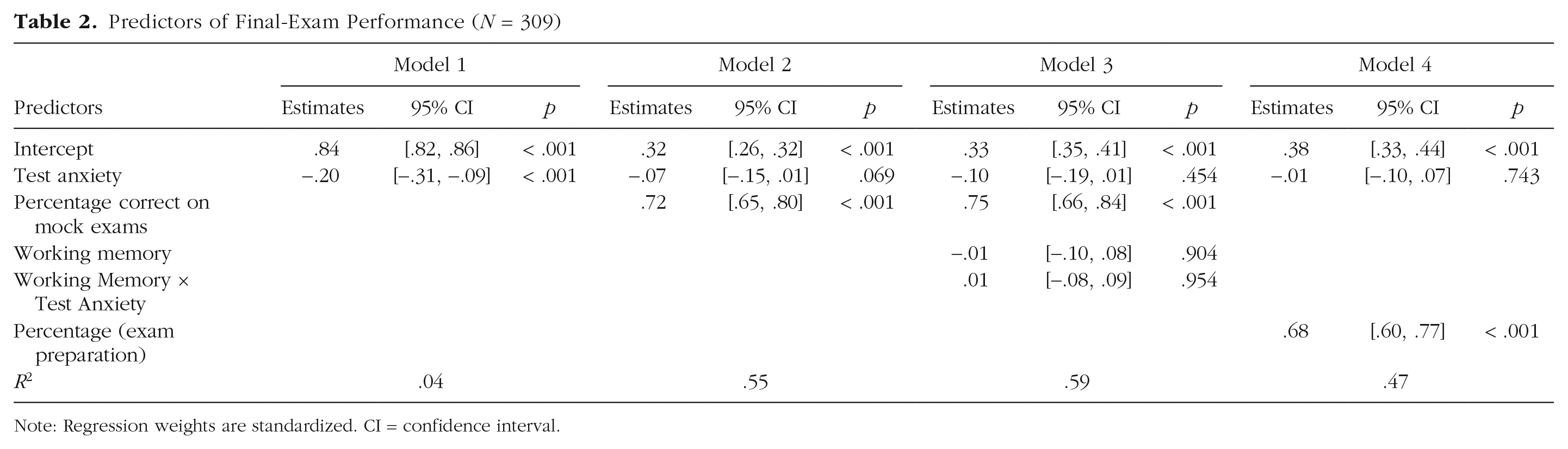
Note: Regression weights are standardized. CI = confidence interval.
Working memory capacity did not moderate the link between test anxiety and exam performance
Perhaps the link between test anxiety and exam performance exists only in students with low working memory capacity? A key assumption of the interference hypothesis is that irrational worries occupy working memory capacity that would otherwise be available for task execution (Ashcraft & Kirk, 2001; Eysenck & Calvo, 1992; Ng & Lee, 2015; Wine, 1971). In other words, highly test-anxious students with low working memory capacities should not be able to compensate for interference effects and would therefore perform particularly poorly on the final exam. We thus considered individual differences in working memory capacity (assessed in the pretest) as a moderator of the link between test anxiety and exam performance. The interaction term was not statistically significant (see Table 2, Model 3). We further tested working memory capacity averaged over the daily survey period as a moderator of the link between test anxiety and exam performance (i.e., equivalent analysis as reported in Table 2, Model 3). Working memory capacity did not moderate the link between test anxiety and exam performance, and this finding is consistent with the results when using the trait measure of working memory capacity as a moderator (see Table S1 in the Supplemental Material available online). Hence, we did not find evidence for the hypothesis that test-anxious students with low working memory capacity performed more poorly on the final exam than those with high working memory capacity.
Test anxiety did not predict exam performance beyond exam-preparation performance
Students completed the mock exams shortly before the real exam, and it was their last opportunity to test their final knowledge. Therefore, it could be argued that test anxiety did not predict exam performance beyond mock-exam performance because students were already anxious when completing the mock exams. Tentative support for this claim can be drawn from data gathered during the daily survey period, which covered 40 days during the exam-preparation phase (see Fig. 2a). Throughout the daily survey period, students reported their state anxiety, operationalized as self-reported tension assessed each day before studying. Results revealed that anxiety increased linearly over the daily survey period, β = 0.05, 95% confidence intervals (CIs) = [.04, .06], p < .001. These results suggest that anxiety likely increased further throughout the mock-exam phase.
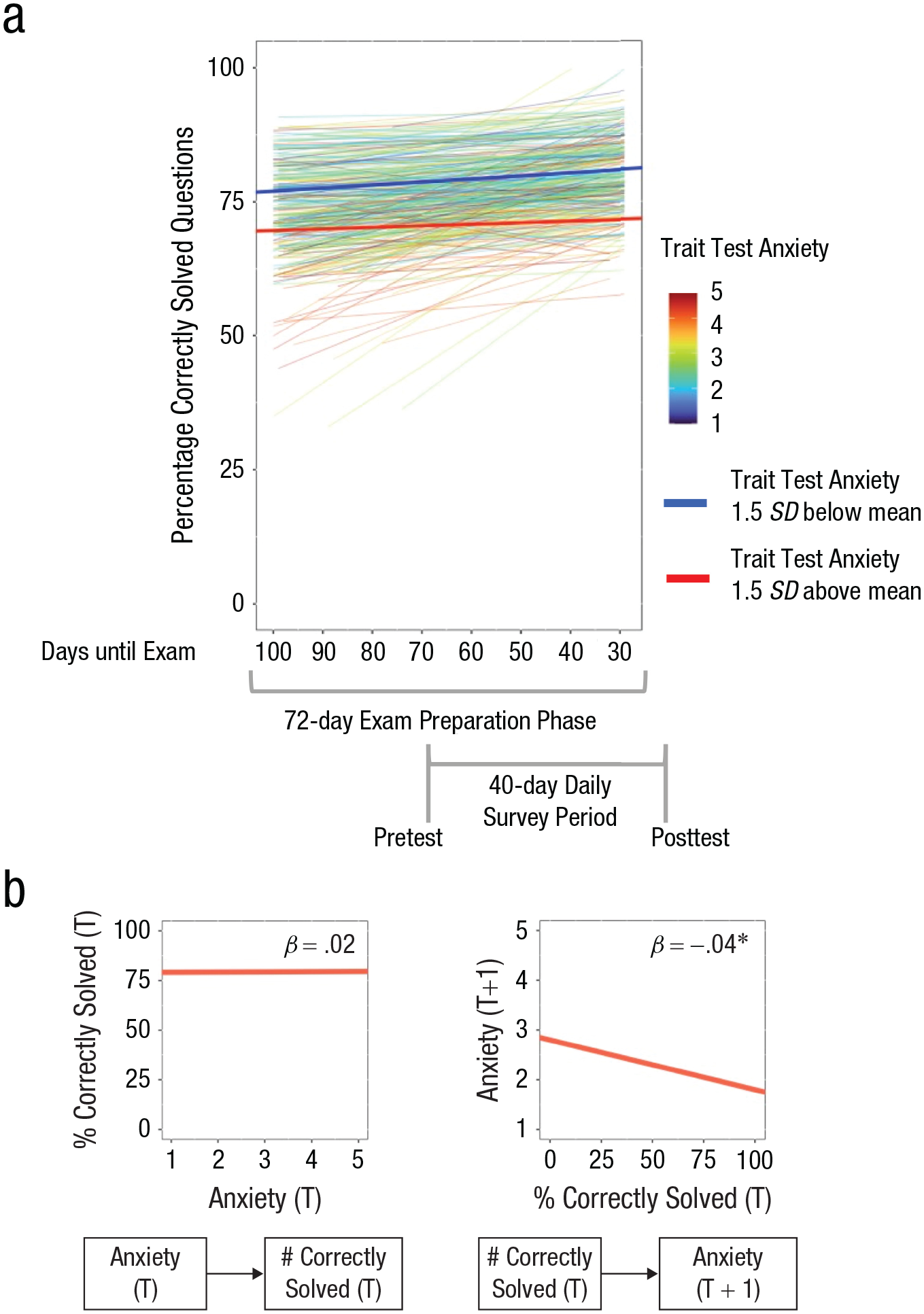
Development of knowledge over exam-preparation phase (N = 309) depending on trait test anxiety (a) and relation between daily state anxiety and knowledge (b). In (a) we show the development in percentage of correctly solved old exam questions over the 72-day exam-preparation phase conditioned on students’ trait test anxiety. The more reddish the regression line is, the higher the trait test anxiety. The more bluish the regression line is, the lower the trait test anxiety. The higher students’ trait test anxiety is, the lower the increase in students’ knowledge over time. In (b) we show reciprocal links between daily state anxiety and the number of correctly solved old exam questions. Higher anxiety before studying did not predict a lower number of correctly solved questions on day T, but a lower number of correctly solved questions did predict higher levels of anxiety on the following day (T + 1). Path weights are standardized (*p < .05).
To rule out the possibility that test anxiety contaminated mock-exam performance as a measure of students’ knowledge right before the final exam, we performed another analysis in which we leveraged log-file performance data from the exam-preparation phase (i.e., days 100–28 before the exam). The results revealed that the relation between test anxiety and exam performance was no longer significant when we controlled for performance during the exam-preparation phase (see Table 2, Model 4). Hence, test anxiety did not predict exam performance beyond students’ knowledge assessed in the exam-preparation phase, either. Moreover, we repeated the latent change score analysis using performance in the exam-preparation phase as a measure of students’ knowledge levels. We found that test anxiety did not predict a performance drop from the exam-preparation phase to the final exam (see Fig. S1 in the Supplemental Material). Taken together, these results indicate that the link between test anxiety and exam performance is due to lower knowledge levels in students with higher test anxiety.
The role of test anxiety in knowledge acquisition
What causes the lower knowledge levels in students with high test anxiety? We tested the hypothesis that trait test anxiety impaired knowledge acquisition throughout the 72-day exam-preparation phase. We found an overall increase in knowledge over time, β = 0.18, 95% CI = [.07, .19], p < .001, which was moderated by trait test anxiety, β = −0.25, 95% CI = [−.35, −.14], p < .001. In other words, the increase in knowledge over time was smaller for students with high trait test anxiety (see Fig. 2a). These results suggest that trait test anxiety may impair knowledge acquisition.
In a further step, we investigated whether anxiety and low performance may reinforce each other from one day to the next. For this purpose, we leveraged data from the 40-day survey period to garner insights into the interplay between state anxiety and the number of correctly solved old exam questions on a daily level. We found that higher state anxiety in the morning did not predict a lower number of correctly solved questions on that day, β = 0.02, 95% CI = [−.02, .05], p = .133, but a lower number of correctly solved questions predicted higher state anxiety the next morning, β = −0.04, 95% CI = [−.07, −.01], p = .015 (see Fig. 2b). Hence, higher anxiety did not predict lower knowledge levels, but lower knowledge levels predicted higher subsequent anxiety instead. These results suggest that the awareness of one’s own knowledge gaps may trigger anxiety.
Discussion
According to the interference hypothesis, test anxiety interferes with effective knowledge retrieval in evaluative situations, which impairs academic achievement. To test this hypothesis, we examined whether test anxiety predicts performance in a high-stakes exam when we controlled for students’ knowledge levels as assessed right before the exam. Our results are incompatible with the interference hypothesis. First, test anxiety did not predict a performance drop from nonevaluative mock exams to the final exam. Second, test anxiety did not predict exam performance when performance in mock exams was controlled for. Notably, although mock-exam performance was a strong predictor of final-exam performance, there was still a large amount of unexplained variance that could have been explained by test anxiety. Third, test anxiety did not predict exam performance when knowledge—as assessed during the nonevaluative exam-preparation phase—was controlled for. This pattern of results speaks against difficulties in knowledge retrieval during the exam as a sole explanation for test-anxious students’ lower exam performance.
Our results call for alternative explanations for lower academic achievement among test-anxious students. Anxiety-induced interference during the exam cannot explain the finding that test-anxious students already showed lower performance levels when preparing for the exam. Skill-deficit models assume that test-anxious students show deficits not only in retrieving information but also in organizing, encoding, and storing information (Naveh-Benjamin et al., 1981). Several studies have found that test-anxious students also report poor study skills, which may contribute to ineffective knowledge acquisition (Cassady, 2004b; Culler & Holahan, 1980; Kirkland & Hollandsworth, 1980; Naveh-Benjamin, 1991). In line with this assumption, we found that the increase in knowledge during exam preparation was smaller for highly test-anxious students. Lower knowledge levels, in turn, predicted higher subsequent anxiety. Another (nonmutually exclusive) explanation for these findings is that anxiety-induced interference effects do not only affect effective knowledge retrieval during an exam but impair efficient knowledge acquisition during exam preparation. This explanation would challenge the assumption that interference effects occur mainly during the final test situation. Our results thus raise the question of when anxiety-induced interference effects are setting in. Taken together, the results of the present study suggest that the reasons for the negative association between anxiety and test performance are complex and begin well before the final test situation.
Can the interference hypothesis be rescued? The interference hypothesis builds on the assumption that irrational worries consume working memory capacity that would otherwise be available for task execution (Eysenck & Calvo, 1992; Eysenck et al., 2007). It is important to note that test anxiety has been shown to impair performance, especially for test-anxious students with low (vs. high) working memory capacities (Owens et al., 2014) and in tasks with high (vs. low) working memory demands (Ashcraft & Kirk, 2001). In our study, we tested a selective sample of high-achieving medical students with above-average cognitive abilities. Although high levels of cognitive ability imply high working memory capacities (Ackerman et al., 2005), we found substantial variability in working memory performance in our sample as well. Nevertheless, the selective sample might explain why working memory capacity did not moderate the link between test anxiety and exam performance. Furthermore, it has been shown that practicing the test situation can counteract anxiety-induced performance decrements in tasks with high working memory demands (Beilock et al., 2004). In our study, students practiced the final test situation extensively by answering old exam questions that were of the same kind as the real exam questions. Hence, it is possible that interference effects emerge when students face test situations that are novel to them. However, what speaks against interpreting our results as limited because of a selective sample is that the uncontrolled correlations between test anxiety and exam performance were in the same range as those found in meta-analyses that included less selective samples (Hembree, 1988; Richardson et al., 2012; von der Embse et al., 2018). In sum, although it is still plausible that there are scenarios under which test anxiety interferes with performance, our results suggest that this interference is not as pervasive as previously believed. Future studies should test whether the present findings hold for less selective samples and other age groups.
Results from the present study have important implications for interventions designed to help highly test-anxious students. Test-anxious students’ knowledge deficits appeared before the actual exam situation and likely developed over time. We found that lower numbers of correctly answered questions on one study day predicted higher state anxiety the next day. Thus, test-anxious students became more aware of their knowledge deficits, which might have led to higher anxiety. Hence, test-anxious students need to acquire strategies that help them effectively acquire new knowledge and avoid repeated failure. For instance, meta-analyses showed that study-strategy training sessions can improve academic achievement among test-anxious students (Ergene, 2003; Huntley et al., 2019). On the other hand, interventions aiming to reduce test anxiety shortly before or during evaluative situations may not have the intended impact because they cannot offset knowledge deficits. This claim is underlined by recent failures to confirm the effectiveness on exam performance of short-term reappraisal interventions, such as expressive writing about worries to reduce anxiety (Camerer et al., 2018; Myers et al., 2021). To conclude, future research should focus on the development of interventions that facilitate effective knowledge acquisition during exam preparation, or even earlier, to improve the educational prospects of highly test-anxious students.
Supplemental Material
sj-docx-1-pss-10.1177_09567976221119391 – Supplemental material for Test Anxiety Does Not Predict Exam Performance When Knowledge Is Controlled For: Strong Evidence Against the Interference Hypothesis of Test Anxiety
Supplemental material, sj-docx-1-pss-10.1177_09567976221119391 for Test Anxiety Does Not Predict Exam Performance When Knowledge Is Controlled For: Strong Evidence Against the Interference Hypothesis of Test Anxiety by Maria Theobald, Jasmin Breitwieser and Garvin Brod in Psychological Science
Footnotes
Acknowledgements
We thank Andreas Neubauer and Florian Schmiedek for valuable discussions.
Transparency
Action Editor: Leah Somerville
Editor: Patricia J. Bauer
Author Contribution(s)

Notes
References
Supplementary Material
Please find the following supplemental material available below.
For Open Access articles published under a Creative Commons License, all supplemental material carries the same license as the article it is associated with.
For non-Open Access articles published, all supplemental material carries a non-exclusive license, and permission requests for re-use of supplemental material or any part of supplemental material shall be sent directly to the copyright owner as specified in the copyright notice associated with the article.
