




Abstract
Question-and-answer (Q&A) sessions following research talks provide key opportunities for the audience to engage in scientific discourse. Gender inequities persist in academia, where women are underrepresented as faculty and their contributions are less valued than men’s. In the present research, we tested how this gender difference translates to face-to-face Q&A-session participation and its psychological correlates. Across two studies examining participation in three conferences, men disproportionately participated in Q&A sessions in a live, recorded conference (N = 189 Q&A interactions), and women were less comfortable participating in Q&A sessions and more likely to fear backlash for their participation (N = 234 conference attendees). Additionally, women were more likely to hold back questions because of anxiety, whereas men were more likely to hold back questions to make space for others to participate. To the extent that men engage more than women in Q&A sessions, men may continue to have more influence over the direction of science.
Keywords
Participating in question-and-answer (Q&A) sessions is a ubiquitous aspect of the academic experience, providing opportunities for presenters to solicit feedback on their work from peers and experts in their field. Because time is limited and few people can ask questions, those who do ask questions are highly visible, communicating information about who receives recognition and authority and who belongs in the field (McCluney & Rabelo, 2019; Simpson & Lewis, 2005). To the extent that diverse voices are included in the feedback process, the quality of the work also improves (Woolley et al., 2010). In academia, women’s work continues to be underrepresented and undervalued (Knobloch-Westerwick et al., 2013; Vásárhelyi et al., 2021). The purpose of this research was to test for gender differences in question-asking behavior and, consequently, gender differences in attitudes toward participating in Q&A sessions.
When people are in power, they use that power to display dominant behaviors and disproportionately occupy space. Having power is associated with positive affect and disinhibited behavior, whereas being in low-power positions is associated with attention to threat and inhibited social behavior (Keltner et al., 2003). People in power are more likely to be first, to spend more time talking, and to deviate from social norms and expectations in group settings, which are behaviors that directly translate to Q&A sessions (J. K. Burgoon & Dunbar, 2006; Galinsky et al., 2003; Hall et al., 2005).
Historically, men have held more power than women, and power dynamics fall along gendered lines, particularly when it comes to using collective speaking space (Lips & Lips, 1991). Men are more likely to be perceived as dominant after speaking longer compared with women (Mast, 2002). Women are more likely to experience backlash for self-promotional acts because such acts violate gender norms (Rudman, 1998) and are more likely to avoid male-dominated domains because of the anticipated lack of power they would have in those spaces (Chen & Moons, 2015). Asking questions and taking collective space could be construed as self-promotional because it is a public display of knowledge. Women’s anxiety about participating may be warranted because they are more likely to experience backlash for speaking (Brescoll, 2011; Dupas et al., 2021).
Gendered power differentials also impact academic spaces in which women are underrepresented and paid less and in which their work is valued less (Gruber et al., 2021; Kaatz & Carnes, 2014; Knobloch-Westerwick et al., 2013; Llorens et al., 2021; Schroeder et al., 2013; Vásárhelyi et al., 2021). These gendered power differences can be seen behaviorally in departmental seminar and conference Q&A sessions, where, relative to women, men participate more (Carter et al., 2018; Hinsley et al., 2017; Käfer et al., 2018; Pritchard et al., 2014; Schmidt & Davenport, 2017; Telis et al., 2019). However, less is known about the cause of these gender disparities, where differences emerge within question-asking behavior, and the psychological mechanisms contributing to gender disparities in question-asking behavior. Past research has suggested that women are underrepresented among question askers for internal reasons, such as lacking self-confidence (Carter et al., 2018) or being less likely to choose to participate (Telis et al., 2019). The timing in which questions are asked might matter in that women are less likely to ask the first question but have more equitable representation later on in the question-asking period (Pritchard et al., 2014). Gender disparities in question asking are attenuated when women are first to ask a question, perhaps because it invites other women to speak (Carter et al., 2018). Though men are overrepresented among senior professors, in one study, younger and older men out-questioned women in their age cohort at the same rate (Hinsley et al., 2017). Although these studies provide some preliminary evidence of gender disparities in Q&A-session participation, more research is necessary to better understand the types of participation, both in terms of content and style, that exhibit gender differences and their psychological correlates.
In addition to the choice of whether to participate in Q&A sessions, there could be gender differences in how men and women communicate when at the microphone because of differences in how power impacts communication styles (J. K. Burgoon & Dunbar, 2006; Tannen, 1993). Men are more likely to increase their speaking time relative to their power (Brescoll, 2011; Mast, 2002), which could manifest in men taking longer speaking turns compared with women. Additionally, women are more likely to adapt their speaking style to men to be more indirect (Bowles & Flynn, 2010), which could have consequences for the use of questions versus comments. Lastly, men are more likely to interrupt others in conversation (Anderson & Leaper, 1998), displaying more dominance in their communication styles. A common running joke within academic spaces involves noting when question askers start their remarks with “This is more of a comment than a question,” indicating that how someone uses their time at the microphone is salient to the audience. It would be informative to know whether gender differences emerge not only in whether individuals speak but also in how they use their time. Power can be demonstrated in a multitude of ways, and knowing the scope of gender differences in Q&A-session behavior would inform the steps necessary to create more inclusive spaces.
Statement of Relevance
Question-and-answer (Q&A) is a popular component of presentations across academia, business, and government. After speakers communicate their content, audience members have an opportunity to ask questions, critique ideas, and shape direction. As time is limited and few people can ask questions, those who do ask questions are highly visible. The overrepresentation of some voices and the underrepresentation of other voices in public spaces communicate information about who belongs and whose ideas are valued in the field. To the extent that diverse voices are included in the feedback process, the quality of the work also improves (Woolley et al., 2010). The present research, grounded in academic conferences, examines the extent to which men occupy disproportionate conversational space and differences in how men and women occupy the Q&A space. Additionally, we test the psychological correlates in Q&A sessions and find that women are more likely than men to be anxious and fear backlash for participating. By understanding the psychological barriers impacting women’s participation in Q&A sessions, we set the stage to begin work toward structural changes that would create a more equitable space for scientific discourse.
The Present Studies
The present investigation built on previous research demonstrating that men participate more in conferences by testing how conference attendees differ in question-asking behavior (e.g., in the types of remarks and speaking time) by gender and why gender differences in participation emerge. A small, single-track, interdisciplinary conference was used for exploratory analyses and hypothesis generation (reported only on OSF: https://osf.io/9tuvb/). We then preregistered our key analyses and applied them to the conferences used in the following studies. In Study 1, we coded Q&A sessions from a filmed, single-track, interdisciplinary conference in the United States for markers of participation, whether the idea presented was a question or a comment, how many ideas were presented, and markers of power or dominance in how the attendee asked the question. Study 2 tested for gender differences in comfort participating in Q&A sessions through self-reports of conference attendees from a large multitrack conference. We also tested for mechanisms underlying why gender differences in participating in Q&A sessions emerge by qualitatively analyzing open responses for why conference attendees hold back questions. We then tested the robustness of the mechanistic effects by replicating the analyses in an existing self-report data set on seminar Q&A sessions. The methods of this research was approved by the University of Virginia Institutional Review Board. All preregistrations, materials, codebooks, data, and analysis code are available on OSF (preregistration: https://osf.io/akceu/; main project page: https://osf.io/uzmb9/).
Study 1
Method
Data source
Conference 1 was attended by 375 people (35% women, 63% men, and 2% other or unspecified; see Table 1 for disciplinary representation). There were 193 Q&A interactions across 32 research talks. The sample size was determined by the number of interactions that occurred at the conference. All Q&A interactions were initiated by waiting in line at one of two stationary microphones on either side of the room. 1 Questions asked by moderators were excluded from analyses (four interactions). Information about attendees was obtained from conference organizers. The Q&A interactions were documented from recordings of the conference posted online. Of the conference speakers, 45% were women and 55% were men.
Conference Attendees by Discipline (Study 1)
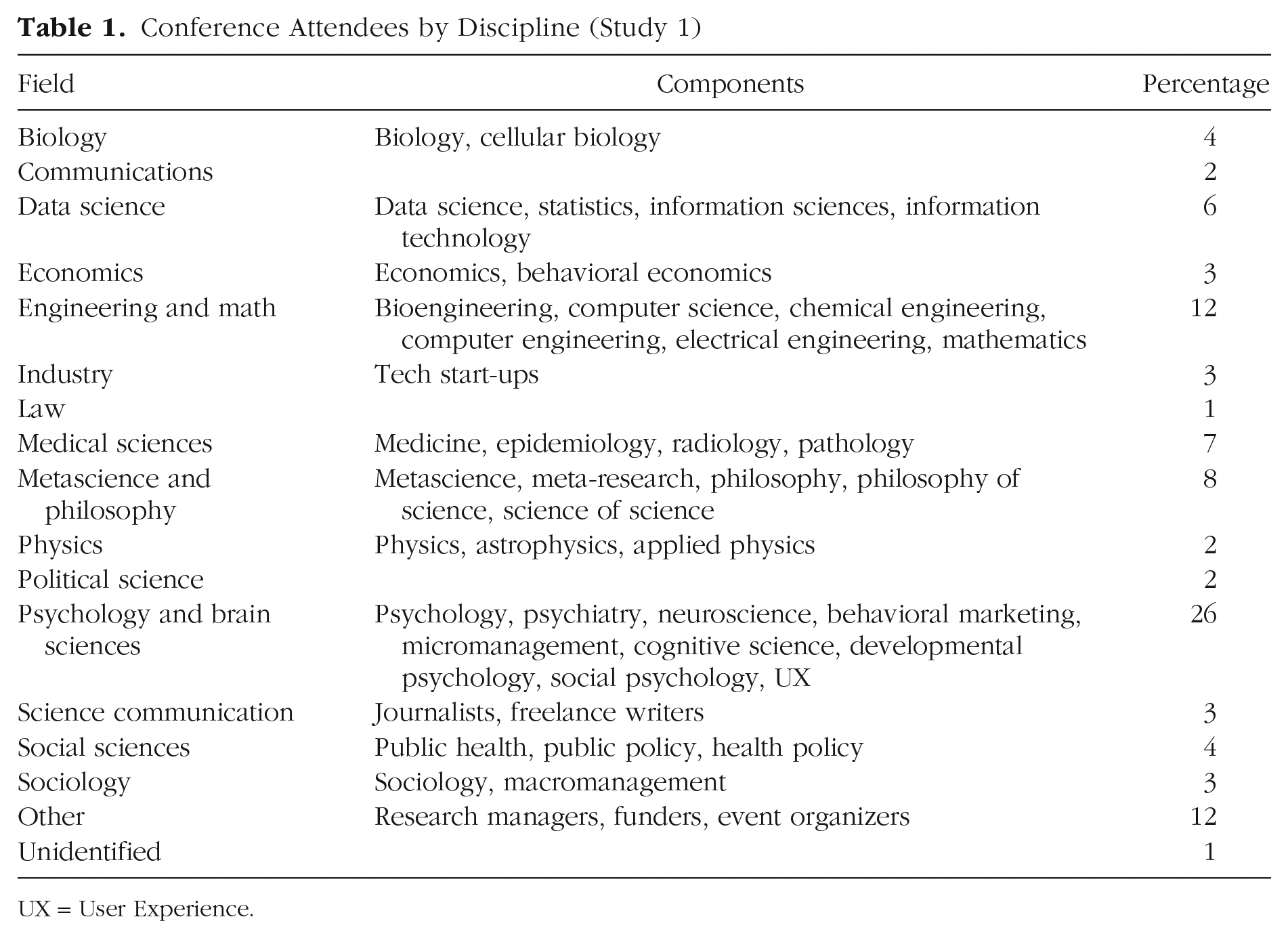
UX = User Experience.
Gender base rates of attendees
To calculate gender base rates of attendees, the researchers used a list of attendees from the conference organizers and coded self-identified gender from several sources: self-identified gender via survey response (38% of attendees), pronouns on personal websites (44% of attendees), pictures or names (17% of attendees), with 2% unidentified.
Question-asker gender
Gender presentation of question askers was coded by two independent raters on the basis of Q&A sessions’ recordings and by using vocal cues such as pitch (Cohen’s κ = 1.00). When question askers introduced themselves, their gender identity was cross-checked with the conference list (18% of question askers). The data were then anonymized.
Qualitative coding of conference sessions
Constructs to code were identified by the first two authors while attending a conference. The constructs focused on either indicators of participation or whether question askers were displaying relatively positive (complimenting the speaker) or negative (confronting the speaker) behaviors in Q&A interactions. Two independent raters blind to the hypotheses watched all Q&A sessions and indicated whether behaviors occurred in accordance with the codebook. Raters were trained on 10% of the data and then rated the rest of the data. They achieved sufficient interrater reliability across the constructs (weighted κ for ordinal data = 0.92; Cohen’s κ for categorical data = .69). More behaviors were coded than are reported in the main text. For a full list of recorded behaviors, see the codebook at https://osf.io/5nrfy.
Participation
Observations were defined as discrete interactions between one question asker and the speaker during a Q&A session. For each interaction, we recorded the total time (in seconds) that the attendee and the speaker spoke. Time for attendees was separated by their initial remarks and follow-ups. We also recorded time for personal introductions. Time recording between the two raters was considered discrepant if the differences were greater than 5 s and were resolved by a senior researcher. Time-recording differences of less than 5 s were averaged.
Remark content
We categorized remarks given at the microphone into one of four types of contributions: (a) questions, (b) comments, (c) comments with an afterthought of a question at the end (comment questions), and (d) questions that were subsequently answered in the remark (question comments; see Table 2 for examples). Types of remarks were tracked separately for initial remarks (N = 233) and follow-up remarks (N = 65). Remarks were coded on the idea level and not the sentence level—that is, an idea spanning multiple clauses was coded as a single remark. It was possible for attendees to contribute multiple remarks spanning multiple categories (e.g., “I have a comment and a question”).
Examples of Each Type of Remark, the Frequency of Each Type of Remark by Gender, and the Extent to Which the Proportion of Participation by Gender Differed From What Would Be Expected by the Gender Base Rates of the Conference Attendees (Study 1)
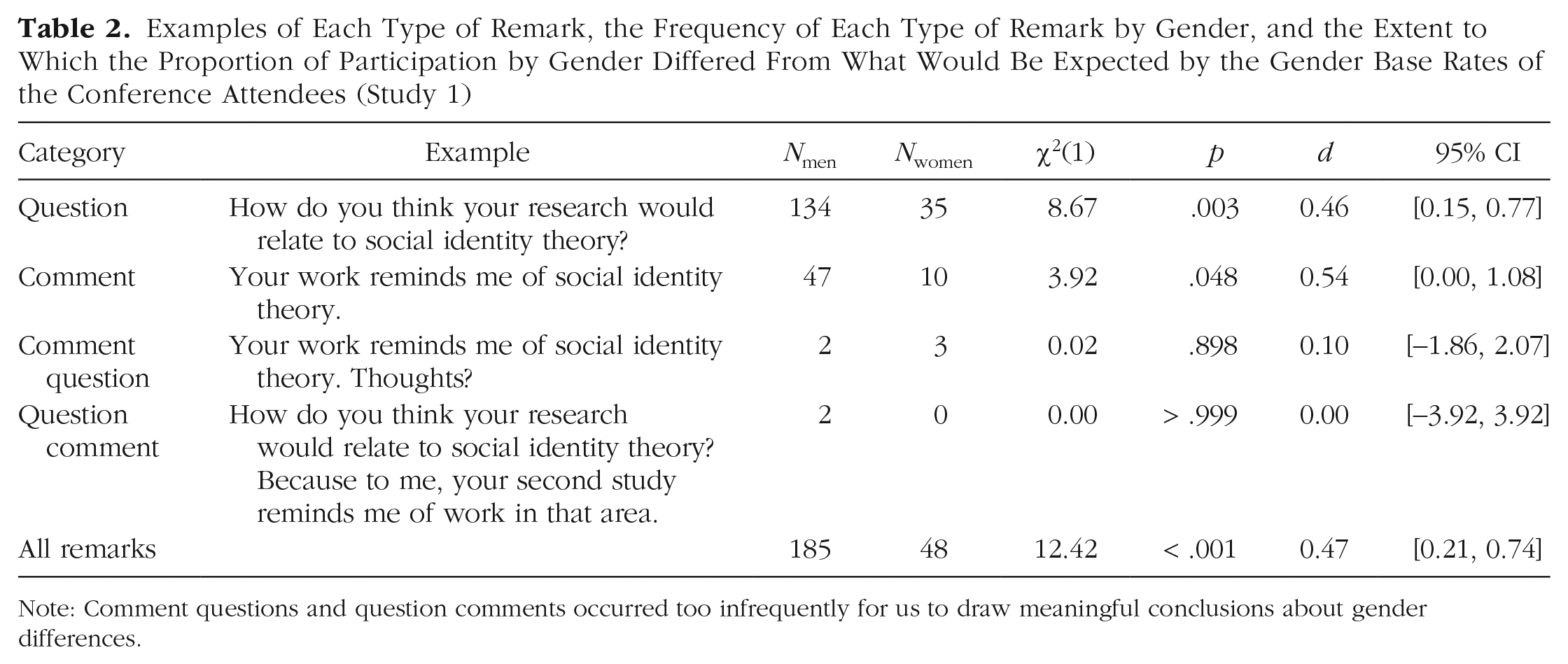
Note: Comment questions and question comments occurred too infrequently for us to draw meaningful conclusions about gender differences.
Dominance
Dominance was operationalized along two dimensions. First, we measured people’s earliness to ask questions (J. K. Burgoon & Dunbar, 2006). Earliness was measured as asking one of the first four questions during a Q&A session, meaning that the question asker was either first or second in line to ask a question per microphone. This cutoff was preregistered.
Next, we coded for whether the attendee challenged the speaker in their remark. Challenging the speaker was defined as any combination of (a) questioning the validity of a claim made by the speaker, (b) questioning the speaker’s knowledge or expertise, or (c) questioning the integrity or reliability of the presented research. Challenges did not include suggestions for improving research. Rather, this category focused on whether the question asker indicated or implied that the speaker was wrong about something.
Politeness
We categorized the following actions as polite: (a) thanking the speaker for the talk, (b) beginning their remarks with a positive comment about the talk (e.g., “That was an interesting talk”), or (c) thanking the speaker for their response. Question askers were coded as exhibiting politeness if they demonstrated any of these behaviors (0 = not polite; 1 = polite).
Results
Participation rates
To examine gender differences in participation, we compared rates of participation with the gender base rates of conference attendees. Because men made up 63% of conference attendees, we would expect approximately 63% of questions to be asked by men if there were no gender gap in participation rates. The extent to which men collectively ask more than 63% of questions would suggest disproportionate participation. We used the base rate as defined by the gender of all attendees because this was a single-track conference, meaning that all attendees experience the same set of sessions.
Did men disproportionately initiate Q&A interactions across the conference?
Compared with their representation among attendees (63%), men were more likely to approach the microphone and initiate Q&A interactions (78%), χ2(1, N = 189) = 8.41, p = .004, d = 0.43, 95% confidence interval (CI) = [0.14, 0.72] (see Fig. 1).
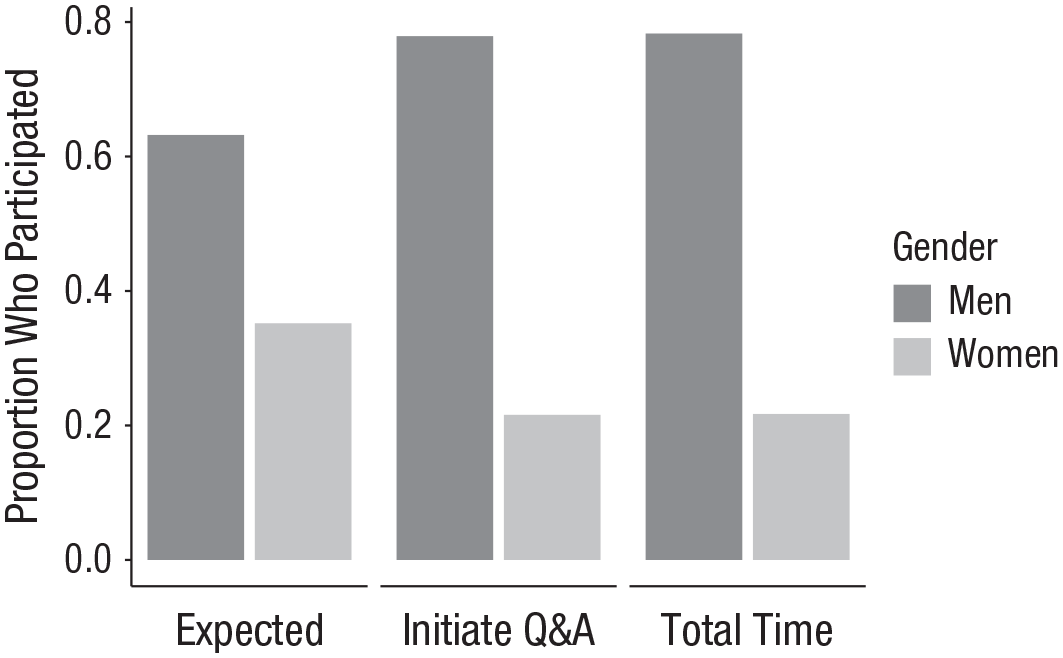
Proportion of men and women who participated in question-and-answer (Q&A) sessions (Study 1). Results are shown separately for the expected rate of participation given the base rates of attendees, the actual participation rate for initiating Q&A interactions, and the actual total time on the floor.
Were there gender differences in the length of time participants spent talking per Q&A interaction?
Per Q&A interaction, men (M = 66.87 s, SD = 44.51 s) and women (M = 66.93 s, SD = 42.89 s) did not differ in speaking time, b = 0.00, Z = 0.02, p = .984, 95% CI = [−0.20, 0.21].
Did men disproportionately take more of the total Q&A time across the conference?
Because of the disparity in volume of questions, men (9,897 s), compared with women (2,744 s), consumed a disproportionate amount of the total Q&A time, χ2(1, N = 12,641) = 605.64, p < .001, d = 0.45, 95% CI = [0.41, 0.48]. 2 Base rates determined by conference attendance would predict that men would consume almost twice as much of the Q&A sessions compared with women. In actuality, men consumed more than 3.5 times as much Q&A time.
Analysis of remark content
Were types of remarks used disproportionately across the conference by gender?
We analyzed the usage of types of remarks across the conference by gender using χ2 tests comparing the frequency with which men and women contributed remarks with the gender base rates of conference attendees. Men were more likely to ask questions and provide comments while at the microphone in their initial remarks (see Table 2).
Were there gender differences in the number of distinct points made per Q&A interaction?
We analyzed gender differences in the average number of remarks per question asker using t tests. However, no significant gender differences emerged in the number of initial remarks (women: M = 1.17, SD = 0.38; men: M = 1.25, SD = 0.53), t(88) = 1.07, p = .286, d = 0.19, 95% CI = [−0.16, 0.54]; follow-up remarks (women: M = 0.37, SD = 0.70; men: M = 0.34, SD = 0.64), t(60) = −0.23, p = .818, d = −0.04, 95% CI = [−0.39, 0.31]; or total remarks (women: M = 1.54, SD = 0.71; men: M = 1.59, SD = 0.86), t(76) = 0.39, p = .698, d = 0.07, 95% CI = [−0.28, 0.41].
Were there gender differences in saying only comments (and no other question type) during initial Q&A interactions per interaction?
No significant gender differences emerged in initial remarks that were not questions, including remarks that were only comments (women: M = 0.20, men: M = 0.14), b = 0.05, t(187) = 0.83, p = .405, 95% CI = [−0.07, 0.18].
Were there gender differences in the omission of questions (providing comments, comment questions, or question comments but no questions) during initial Q&A interactions?
There were no significant gender differences in failures to ask questions (women: M = 0.24; men: M = 0.17), b = 0.07, t(187) = 1.09, p = .276, 95% CI = [−0.06, 0.21].
Dominance
Were men disproportionately first to offer remarks in Q&A sessions across the conference?
Men (N = 99) were more likely than women (N = 21) to be among the first four audience members to offer remarks, χ2(1, N = 120) = 9.27, p = .002, d = 0.58, 95% CI = [0.20, 0.95].
Were there gender differences in how challenging or polite participants were to speakers?
There were no significant differences by gender in the likelihood of challenging speakers (12% of men, 15% of women), b = 0.02, t(187) = 0.42, p = .676, 95% CI = [−0.09, 0.14]. Nor were there gender differences in politeness of remarks (57% of men, 44% of women), b = −0.13, t(187) = −1.46, p = .145, 95% CI = [−0.30, 0.04].
Exploratory analysis of speaker-gender effects
We tested whether the speaker’s gender predicted attendees’ Q&A behaviors. Of the behaviors described above, only one exhibited significant speaker-gender effects and directional consistency across the exploratory sample (reported on OSF) and the confirmatory sample (reported in this study): Attendees were more likely to engage in polite behaviors when speakers were women (66%) than men (42%), b = 0.22, t(196) = 3.20, p = .002, 95% CI = [0.09, 0.36].
Discussion
Study 1 provided behavioral evidence that men are more likely to participate during Q&A sessions than women, relative to their attendance rates at the conference. This difference extends to both asking questions and providing comments. Although we observed a tendency for men to be among the first four participants in Q&A, a sign of dominance, we did not find that men were more challenging or less polite in their remarks relative to women. This study builds upon past research by testing with greater specificity gender differences in how Q&A session time is used.
Next, in Study 2, we examined how these behavioral differences relate to men’s and women’s psychological experiences during Q&A sessions. Specifically, we investigated self-reported barriers to speaking by asking conference attendees to rate their comfort in participating in asking questions, commenting, and approaching speakers after Q&A sessions as well as their tendencies to hold back questions and to fear backlash for participating. Questions were asked of both the focal conference and conferences generally to ensure observed effects were not due to an idiosyncrasy with the focal conference. Next, we measured attendees’ qualitative responses describing why they held back questions. We then tested the replicability of both the quantitative and qualitative findings using openly available data. Incorporating both quantitative and qualitative components provides insight from the perspective of conference attendees. At the focal conference in Study 2, women were the numerical majority, meaning that any effects found were not simply driven by the fact that men were the numerical majority, as in Study 1.
Study 2
Method
Participants
Recruitment emails were sent to a psychology society’s LISTSERV approximately 6 months after the annual conference in the United States. Conference 2 was for a subdiscipline of psychology in which women were the numerical majority of conference attendees (61%). It was a large multitrack conference spanning several days and served as the main conference for researchers within this subdiscipline. Participants could choose between many symposium sessions, poster sessions, and professional-development workshops scheduled throughout the conference.
Conference attendees were offered the chance to win $35 via a lottery for their participation. Of the 4,208 conference attendees, 284 attendees participated in the survey, and 234 attendees completed the focal items for this study. Sample size was determined by the maximum number of conference attendees we could recruit within 2 weeks. Participants were excluded from analyses if they did not fall within the gender binary or did not provide gender information. Survey participants were primarily women (69% women, 28% men, 1% nonbinary, 2% other or did not disclose gender) and predominantly White (59% White, 13% Asian, 9% Latinx, 8% multiracial, 3% Middle Eastern/North African, 2% Black, < 1% other, 5% did not disclose race/ethnicity). Additionally, survey participants were predominantly graduate students (51% graduate students, 3% undergraduates, 9% postdocs, 32% professors, 3% in industry, and 2% other). Analyses comparing the demographics of our sample with those of the conference attendees suggest that our sample was not significantly different from the full sample in regard to race, χ2(9, N = 232) = 15.03, p = .090, d = 0.53, 95% CI = [0.26, 0.79], or gender, χ2(5, N = 233) = 7.77, p = .170, d = 0.37, 95% CI = [0.11, 0.63], but included more early-career scientists and fewer full professors, χ2(3, N = 234) = 73.34, p < .001, d = 1.35, 95% CI = [1.04, 1.66].
Materials
The items used in this investigation were added to a survey for a separate investigation on broader conference participation (see https://osf.io/a84hg/ for preregistration and https://osf.io/7vj8q for materials).
Comfort in making remarks
Survey participants responded to three questions about how comfortable they felt engaging in Q&A sessions at Conference 2: (a) asking questions, (b) sharing comments or opinions, and (c) approaching speakers outside Q&A sessions. Responses were made using 7-point Likert scales (1 = very uncomfortable, 7 = very comfortable). We also asked the same three questions about participating in Q&A sessions at conferences generally. Because the items were highly correlated (specific: rs > .57, general: rs > .58), they were combined into a comfort index for ease of reporting (specific: α = .85, general: α = .85).
Fear of backlash
Participants indicated how afraid they were of receiving backlash for participating both at Conference 2 and conferences generally using 5-point Likert scales (1 = never, 5 = always). We did not define backlash because we assumed it is commonly understood to be fear of negative appraisals or retribution by others.
Propensity to hold back questions
Participants indicated how often they hold back questions on 5-point Likert scales (1 = never, 5 = always).
Qualitative coding
Participants and procedure
Of the survey participants, 198 participants (138 women, 60 men) responded to the following open-ended question: “If you hold back questions during Q&A sessions, why?” On average, participants wrote 19-word responses, which referred to, on average, approximately 1.1 of the 4 reasons in the codebook (described below).
Codebook
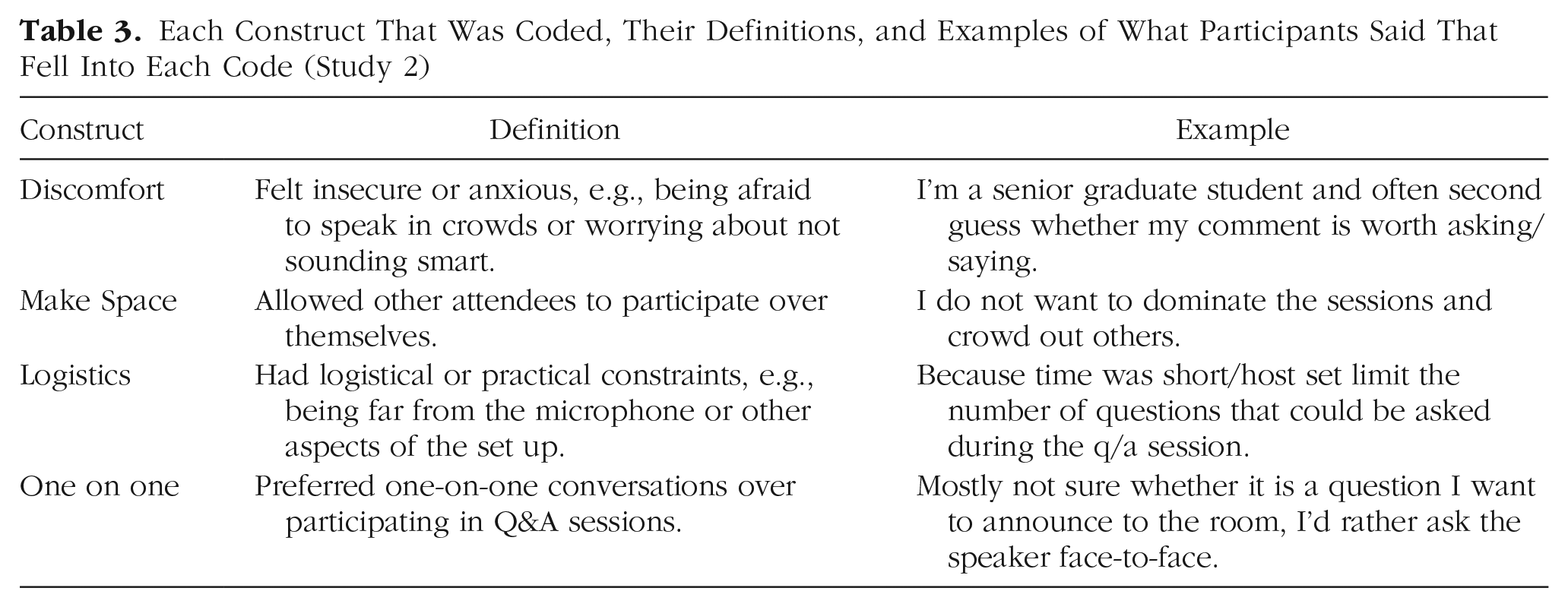
Coding themes were identified by two research assistants blind to hypotheses and participant gender by induction, using the exploratory conference (see OSF for a full description: https://osf.io/t5jph). The coding themes were then applied to the data from Conference 2. The four themes that arose most frequently included discomfort, 3 making space for others, logistics, and preferring one-on-one communication (see Table 3). 4 Two independent raters blind to hypotheses and participant gender coded the open responses according to the codebook. Each code was given either a 0 for absence or 1 for presence, and discrepancies were resolved by a senior research member. Independent raters achieved high interrater reliability for both data sets (main: Cohen’s κ = .77; replication: Cohen’s κ = .79). Additional exploratory measures were coded and included in the codebook on OSF (https://osf.io/e6sa2).
Each Construct That Was Coded, Their Definitions, and Examples of What Participants Said That Fell Into Each Code (Study 2)
Conceptual replication
Lastly, we attempted to replicate our quantitative and qualitative results by applying our codebook to a publicly available data set (Carter et al., 2018), which surveyed academics about their participation in departmental seminars. Specifically, participants were asked to rate the following factors related to discomfort that might prevent them from asking questions: (a) “worried that I had misunderstood the content,” (b) “couldn’t work up the nerve,” (c) “not sure whether the question was appropriate,” (d) “the speaker was too eminent/intimidating,” and (e) “worried that I was not clever enough to ask a good question.” 5 Responses to each of these items were made on a 5-point Likert scale (1 = not at all important, 5 = extremely important). They were also given the opportunity to write in factors that were not already listed. A relatively large sample provided Likert-type responses (N = 466; 277 women, 189 men), and a smaller subset provided additional factors (N = 104; 61 women, 42 men).
To replicate our quantitative analyses, we combined the five items to create a single discomfort composite (α = .84). We then coded the additional factors described in open-ended responses according to our codebook to replicate our analyses with the open-ended responses.
Results
Comfort in remarking
Were there gender differences in comfort participating?
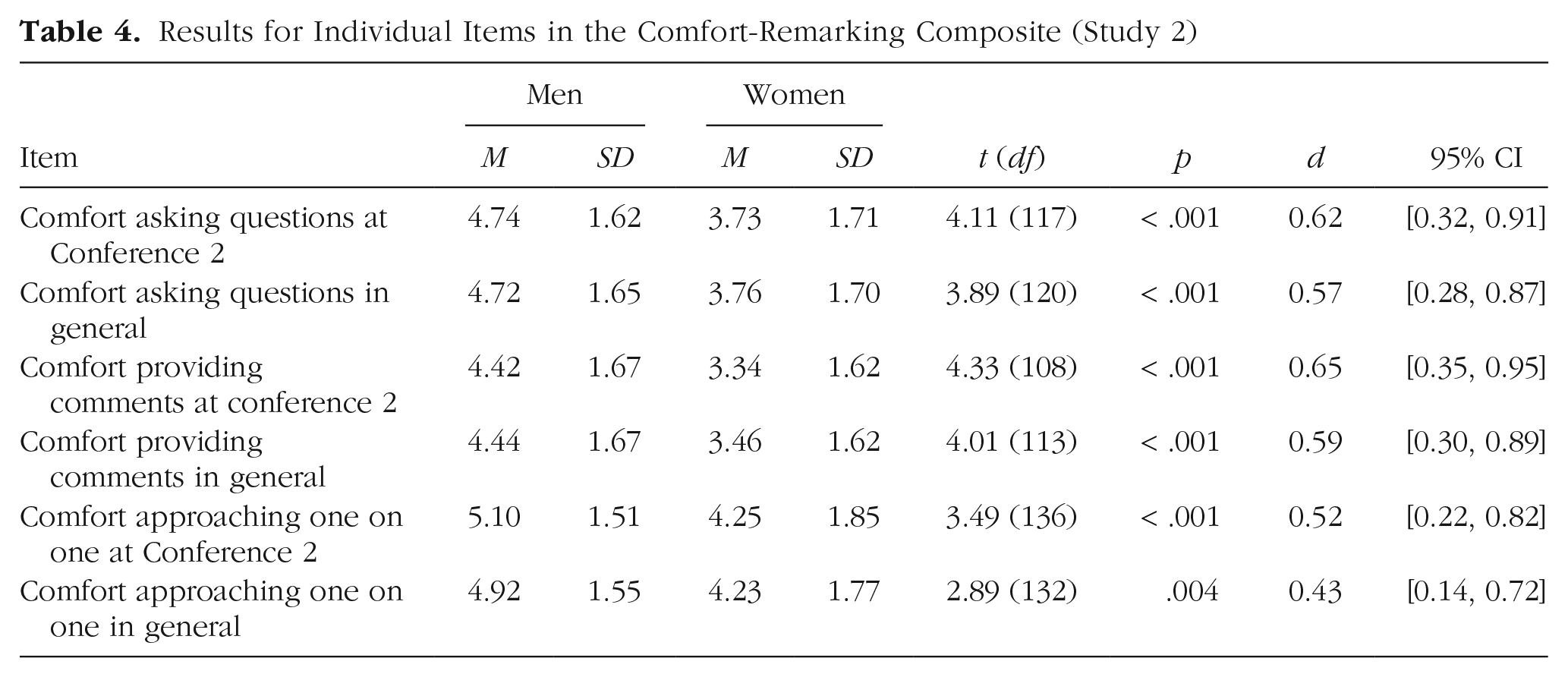
At the focal conference, women reported less comfort participating in Q&A sessions compared with men (women: M = 3.77, SD = 1.51; men: M = 4.76, SD = 1.38), t(124) = 4.73, p < .001, d = 0.70, 95% CI = [0.40, 1.00]. Women also reported less comfort participating in Q&A sessions than men in conferences generally (women: M = 3.82, SD = 1.49; men: M = 4.69, SD = 1.39), t(124) = 4.17, p < .001, d = 0.62, 95% CI = [0.32, 0.91] (see Table 4 and Fig. 2 for individual items).
Results for Individual Items in the Comfort-Remarking Composite (Study 2)
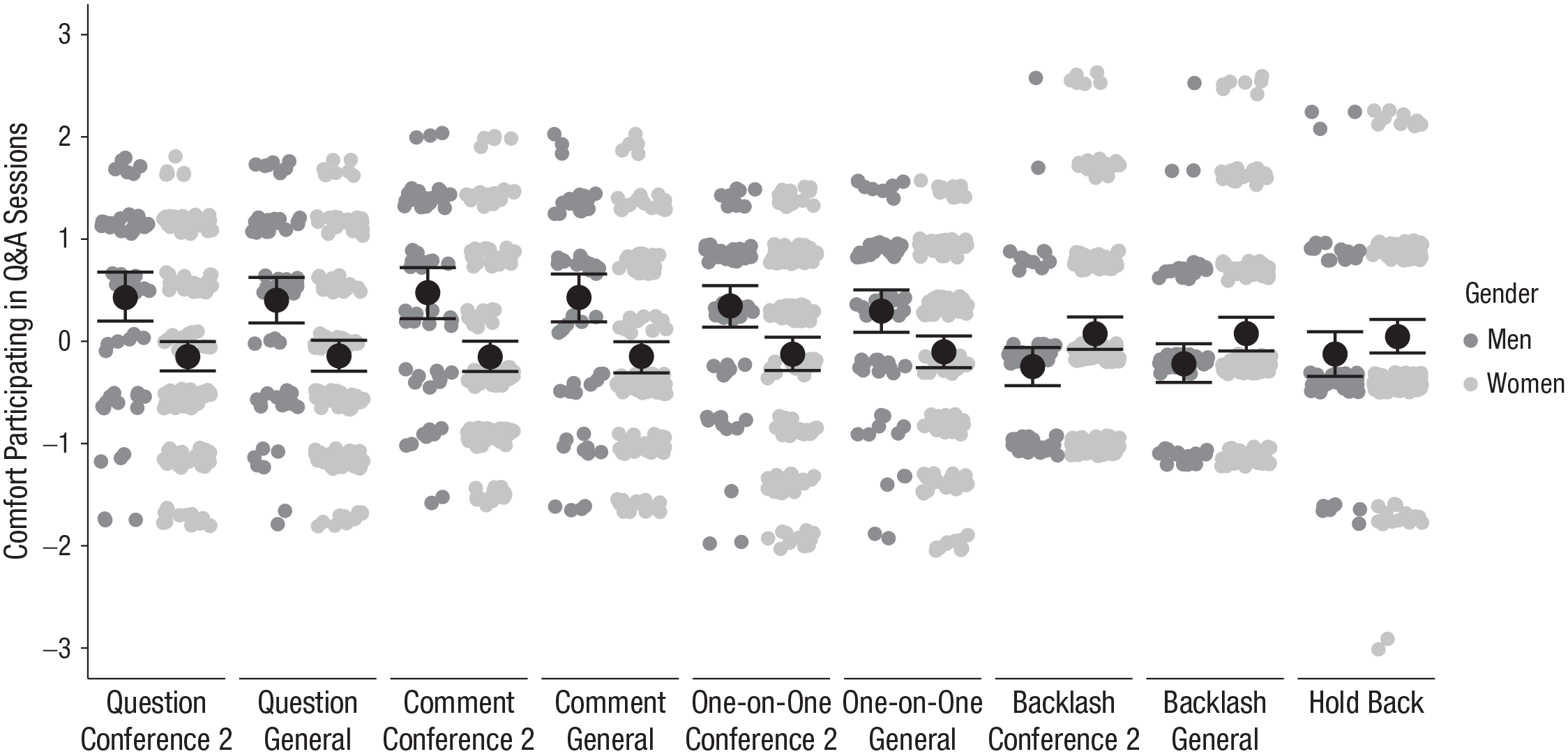
Self-reported comfort participating in question-and-answer (Q&A) sessions by gender (Study 2). Data were standardized because of differing scale lengths. Gray dots represent individual data, and black dots represent means. Error bars represent 95% confidence intervals.
Were there gender differences in fears of backlash?
Women were also more likely to fear backlash, both at the focal conference (women: M = 2.21, SD = 1.16; men: M = 1.86, SD = 0.86), t(153) = 2.50, p = .013, d = 0.37, 95% CI = [0.08, 0.67], and at conferences in general (women: M = 2.33, SD = 1.15; men: M = 2.00, SD = 0.90), t(150) = 2.25, p = .026, d = 0.33, 95% CI = [0.04, 0.62].
Were there gender differences in holding back questions?
Despite reporting less comfort and greater fears of backlash, women did not report holding back questions more than men (women: M = 3.35, SD = 0.81; men: M = 3.22, SD = 0.70), t(137) = 1.23, p = .219, d = 0.18, 95% CI = [−0.11, 0.47]. Given the stark gender differences in Q&A-session behavior observed in Study 1, it is surprising that women did not report holding back questions more than men. We turned next to analyzing whether gender differences emerge in self-reported reasons for why conference attendees hold back questions when they do.
Open-ended reasons for holding back questions
Using logistic regressions, we analyzed gender differences in the presence of spontaneous attributions of four reasons for holding back questions: anxiety, making space for others, logistics, and preferring one-on-one communication.
Were there gender differences in presence of discomfort?
Women were more likely than men to indicate that anxiety impacts their Q&A behavior (men: M = 0.50, women: M = 0.66, b = 0.65, Z = 2.06, p = .039, 95% CI = [0.03, 1.27]).
Were there gender differences in indicating trying to make space for other people?
Men, compared with women, were more likely to report holding back questions to make space for others to do so (men: M = 0.30, women: M = 0.12, b = −1.18, Z = −3.04, p = .002, 95% CI = [−1.95, −0.42]).
Were there gender differences in the experience of logistics as a barrier to participation?
Logistic barriers did not prove to be a greater barrier for men or women (men: M = 0.22, women: M = 0.17, b = −0.32, Z = −0.81, p = .416, 95% CI = [−1.07, 0.47]).
Were there gender differences in preferring to ask questions one on one?
In contrast to the Likert self-reports indicating that women were less comfortable than men approaching the speaker one on one, we did not find gender differences in spontaneous mentions of preferring to ask questions in one-on-one conversations after talks (men: M = 0.18, women: M = 0.13, b = −0.39, Z = −0.94, p = .346, 95% CI = [−1.20, 0.45]).
Conceptual replication
Were there gender differences in feeling comfortable with participating?
Using the discomfort composite, women reported that discomfort impacted why they held back questions more than men (women: M = 2.99, SD = 0.94; men: M = 2.52, SD = 0.94), t(402) = 5.35, p < .001, d = 0.48, 95% CI = [0.30, 0.66].
Were there gender differences in the open-ended reasons?
In the coding of open-ended responses, only the “make space for others” effect replicated. Men were more likely than women to say that they held back questions to make space for others to participate (men: M = 0.29, women: M = 0.11, b = −1.13, Z = −2.14, p = .033, 95% CI = [−2.21, −0.11]). No significant gender differences emerged in anxiety (men: M = 0.45, women: M = 0.38, b = −0.31, Z = −0.76, p = .445, 95% CI = [−1.11, 0.49]), logistics (men: M = 0.07, women: M = 0.18, b = 1.05, Z = 1.53, p = .125, 95% CI = [−0.19, 2.59]), or preferring one-on-one conversations (men: M = 0.00, women: M = 0.03, b = 17.18, Z = 0.01, p = .995). The absence of a difference on the discomfort measure could be due to these responses being meant to supplement factors already present in the question, which already included similar Likert-scale items.
General Discussion
Academic conferences are important forums for sharing new research. Q&A sessions are an key aspect of those forums, providing an opportunity for audience members to comment on presented findings. To the extent that men engage more than women, men continue to have more influence over the direction of science. Across two studies, we found that men as audience members consume a disproportionate amount of conversational space in Q&A sessions, and we found some evidence as to why this effect occurs. In Study 1, we replicated the effect that men are more likely to ask questions and found that they are more likely to be among the first few to do so. They did not, however, spend significantly more time talking or to provide more remarks when at the microphone compared with women. Men’s dominance in Q&A sessions seems to be driven by their greater willingness to jump into the discussion rather than in how they communicate while at the microphone.
In Study 2, women reported feeling less comfortable participating in all aspects of Q&A sessions, whether in conferences generally or in the specific conference they attended in which women were in the numeric majority. Women also reported being more likely to fear backlash because of their participation. This finding extends the work of Brescoll (2011) examining powerful women’s moderation of speaking time by showing gender differences even among junior scholars for whom, presumably, egalitarian beliefs are especially strong. Yet men and women did not significantly differ in the propensity to hold back questions, though they differed in the reasons why they held back questions. Women reported being more likely to hold back questions because they were anxious, whereas men reported being more likely to hold back questions to make space for other people to participate. This result suggests that if men were not regulating their behavior, they would dominate even more. Though some credit can be given to men for considering others, it also raises the question of how much bigger the gender gap in Q&A participation might have been in the past.
In addition to our key analyses, we found that both men and women were more likely to be polite to female speakers. This could be a case of benevolent sexism (Dardenne et al., 2007; Glick & Fiske, 1996; Hopkins-Doyle et al., 2019). Alternatively, people may be choosing to match their behavior to stereotypically feminine ways of communication to appease women’s apparent anxiety (Bowles & Flynn, 2010; M. Burgoon et al., 1983; Kray & Thompson, 2004). Future research is necessary to better understand why question askers are more polite to women speakers.
Possible sources of participation disparities
Our findings are consistent with previous results showing gender disparities in participating in academic spaces, such as classrooms (Aguillon et al., 2020; Lee & Mccabe, 2021) and conferences in other science, technology, engineering, and math (STEM) fields (Hinsley et al., 2017; Käfer et al., 2018; Pritchard et al., 2014; Telis et al., 2019). Our data provide some possible explanations for these disparities. For instance, our survey data suggest that women, compared with men, are less comfortable asking questions and providing comments in Q&A sessions. Furthermore, women fear backlash more than men for their contributions. Overall, these concerns could decrease women’s participation in Q&A sessions.
Interestingly, although men and women reported different reasons for holding questions back during Q&A sessions, they did not differ in their likelihood of holding back questions. It could be that men genuinely have more questions than women after watching a research talk. We have no data to suggest why that might be. It could also be that, relative to women, men come up with questions more quickly or set lower bars for what they deem to be worth asking. Alternately, because of feelings of stereotype threat, women have less cognitive bandwidth to generate questions in the moment (Schmader, 2010). The results from Study 1 are consistent with each of these explanations but do not allow us to distinguish between them.
Constraints on generality
A limitation of this work is that the behaviors from the live conference were from a conference predominantly attended by men. It could be that gender gaps in participation rates are exacerbated when women are in the numeric minority (Kanter, 1977). However, in Study 2 women were in the numeric majority but still reported feeling less comfortable participating in Q&A sessions compared to men. Additionally, past research has found that women were underrepresented as question askers in genetics and biogenetics regardless of whether women were in the numeric minority or numeric majority (Telis et al., 2019). It does not seem plausible that gender base rates of attendees at the conference can completely explain our observed effects. That said, because of the overrepresentation of men in higher professor ranks, there could be a conflation between status due to gender and status due to rank. Future research should compare participation rates between conferences that vary in gender representation at higher professorial ranks. Although the present research focused on gender, in the future, it will be important to study how gender intersects with race and other minority identities in shaping participation rates.
This work is also limited by the type of Q&A sessions examined. The conferences did not include moderated Q&A, which could impact participation rates depending on how fair conference attendees perceived the moderator to be with equitable calling behavior. Additionally, needing to walk to a microphone could pose a barrier, and women’s participation rates could increase if they needed only to raise their hands (Chapman et al., 2016; Leventhal et al., 1965). Finally, we did not include behavioral analyses of a large multitrack conference, where attendees may feel a greater cover of anonymity that increases the gender diversity of who participates in Q&A. Conversely, women may feel more anxiety in larger conferences because of the larger audiences. Further, session-by-session variation and attendance may impact participation rates.
It is also worth noting that the participation rate for Study 2’s survey was particularly low. The recruitment materials described the survey as being about experiences of the conference as a whole and how it impacted their work and their connections with other researchers. It seems likely that those most interested in conferences would be most likely to participate, but it is also possible that women who were more anxious selectively completed the survey. Our findings, however, converge with prior research on gender differences in participation in Q&A sessions in departmental seminars using similar methods (Carter et al., 2018), which reduces the concern that Study 2’s results reflect a selection bias.
Q&A sessions provide an opportunity for researchers at all levels to influence science by providing researchers with feedback. In this research, we found that, relative to women, men were more likely to participate in Q&A sessions but did not differ in how they participated while at the microphone. Understanding the impacts of disproportionate participation by men in these spaces and adjusting structures to encourage women’s participation could increase the diversity of voices in our dialogues about science.
Footnotes
Acknowledgements
The authors thank Sonya Mishra and Charlotte Townsend for feedback on earlier versions of this manuscript.
Transparency
Action Editor: Kate Ratliff
Editor: Patricia J. Bauer
Author Contributions
S. N. Jarvis and C. R. Ebersole developed the study concept and designed the study. Data were collected by S. N. Jarvis, C. R. Ebersole, C. Q. Nguyen, and M. Zhu. S. N. Jarvis analyzed and interpreted the data and drafted the manuscript. L. J. Kray and C. R. Ebersole provided critical revisions. All the authors approved the final version of the manuscript for submission.
