




Abstract
Astronomical events such as solar eclipses have played a transformative role in human social collectives as sources of collective wonder, inspiration, and reconciliation. Do celestial phenomena systematically shape individuals and their groups? Guided by scientific treatments of awe as an experience that helps individuals form into collectives, we used Twitter data (N = 2,891,611 users) to examine the social impact of a historic, awe-inspiring celestial event: the 2017 solar eclipse. Relative to individuals residing outside the eclipse’s path, individuals inside it exhibited more awe and expressed less self-focused and more prosocial, affiliative, humble, and collective language (Study 1). Further, individuals who exhibited elevated awe surrounding the eclipse used more prosocial, affiliative, humble, and collective language relative to their preeclipse levels and relative to users who exhibited less awe (Study 2). These findings indicate that astronomical events may play a vital collective function by arousing awe and social tendencies that orient individuals toward their collectives.
Humans have looked toward the sky for inspiration and guidance for millennia. Halley’s comet has dazzled generations of observers over centuries. The 1833 Leonids meteor shower, which featured tens of thousands of meteors, stunned observers and prompted them to gather others to bear witness (Muir, 2014). And in the year 585 B.C.E., a total solar eclipse—in which the moon completely obscured the sun—proved so wondrous that it ended a 6-year war (Herodotus, 430 B.C.E./1998). Over two and a half millennia later, some 215 million Americans witnessed a similar solar eclipse, the first in the United States with a path of totality stretching from coast to coast since 1918 (Miller, 2018). It was, as many people noted at the time, an extraordinary collective experience of awe (Fountain, 2017).
The social impact of astronomical events such as a solar eclipse have long been the subject of theoretical speculation. Historical accounts describe celestial events as playing an influential role in the artistic, intellectual, and political development of early societies—for example, they are purported to have inspired ancient native Hawaiian culture (Masse, 1995), new fields of scientific study (Littman & Suomela, 2014), and the works of Shakespeare (Wember, 2010). These accounts suggest that celestial events can profoundly impact their observers and broader society. In the present research, we examined the social effects of a large-scale historic astronomical event and the psychological pathways underlying them.
Effective action within collectives requires a reduction in self-interest, a motivation to affiliate with other people and attend to their needs, and an orientation to the larger entities to which one belongs (e.g., small groups, communities, and humanity; Keltner et al., 2014). Can witnessing an eclipse arouse such tendencies so vital to social life? To test this, we tracked millions of expressions surrounding the 2017 total solar eclipse to investigate consequent shifts in the processes that enable individuals to form into collaborative social groups. Further, we tested whether feelings of awe underlie these shifts.
The emerging science of awe sets the stage for the hypotheses we tested here. Awe is an emotion aroused by the sense that one is in the presence of something vaster than the self that defies current frames of reference for understanding the world. Experiences in nature tend to be among the most common elicitors of awe (Bai et al., 2017; Shiota et al., 2007), and firsthand accounts of eclipse observers frequently convey a powerful sense of awe (Russo, 2012). Consequently, awe is perhaps the prototypical emotion triggered by rare, wholly immersive, and visually arresting celestial events, such as a solar eclipse (Keltner & Haidt, 2003; Russo, 2012; Yaden et al., 2016).
Research on awe points toward the myriad ways in which witnessing celestial events can impact patterns of self-construal, social attention, and interpersonal tendencies. Awe triggers a reduction in self-focus (Bai et al., 2017; Piff et al., 2015)—attention to one’s individuated self and goals—and greater humility (Stellar et al., 2018).
Awe also increases collective focus: feelings of oneness, interconnectedness, and belonging with other individuals (Bai et al., 2017; Shiota et al., 2007; Van Cappellen & Saroglou, 2012). Further, awe can foster prosocial behavior—actions intended to help or assist other people (Piff et al., 2015). These findings, based largely on laboratory studies using controlled stimuli, converge on the idea that experiences of awe cause people to transcend self-interest in ways that benefit others. Extending this work, we examined whether real-world experiences of a large-scale celestial event—an event we hypothesized would be a powerful collective occasion for awe—enhanced sociality by triggering humility, collective focus, and prosocial and affiliative tendencies.
The Present Research
Across two studies, we examined 2,891,611 individuals’ responses to the 2017 solar eclipse using Twitter data—a powerful tool for assessing the social impacts of collectively experienced events (Doré et al., 2015; Garcia & Rimé, 2019; Jones & Silver, 2020). Twitter data offer several advantages over more traditionally collected survey data: (a) Tweets provide a direct window into individuals’ thoughts and feelings via the words they use (for a review, see Pennebaker et al., 2003; Tausczik & Pennebaker, 2010); (b) they are archival, enabling the capturing of ephemeral states at levels of granularity often inaccessible by traditional research methods across an extended time frame; (c) they are an ecologically valid observational data source that occurs in the real world; and (d) they can be either directly or indirectly connected to users’ locations.
Statement of Relevance
Awesome astronomical events, such as meteor showers or solar eclipses, have long been a source of human fascination. Here, we examine their impact on the individuals and groups that experience them. We analyzed millions of tweets surrounding a large-scale and historic celestial event—the 2017 total solar eclipse—to investigate its social effects. We found that the eclipse inspired awe among people in its path of totality and, in turn, increased humility, collective focus, affiliation, and prosociality—tendencies that enable people to form into collaborative social groups. These findings shed light on how celestial phenomena such as a solar eclipse can promote social cohesion and potentially provide an antidote to widening divisions and polarization in society.
We used text data extracted from tweets to examine shifts in several distinct processes that enable individuals to function more effectively in groups, and we investigated the role of awe underlying these shifts. (We also analyzed two more cognitive outcomes—certainty and present focus—that were less pertinent to the hypotheses here, and we report these results in the Supplemental Material available online.) We assessed individuals’ use of first-person singular and plural pronouns as well as their use of tentative, affiliative, and prosocial language in tweets surrounding the eclipse to index their levels of self- and collective-focus, humility, affiliative motivations, and prosociality, respectively, during the time of the eclipse. These social-cognitive tendencies are vital to social life: Collective focus indicates a more interdependent, socially cohesive sense of self (Bai et al., 2017; Seraj et al., 2021); humility reflects, in part, a recognition of the limitations of one’s own knowledge and an open-mindedness to others’ views (Stellar et al., 2018); affiliation involves a motivation to connect with other individuals (Leary et al., 2013); and prosociality—inclinations to share, care, and assist—deepens social bonds and collaborative social networks (de Waal, 2008; Keltner et al., 2014; Nowak, 2006; Piff et al., 2015).
In Study 1, we used a naturalistic quasiexperimental framework to examine whether Twitter users residing in areas with a view of the total eclipse exhibited greater awe and, in turn, higher prosociality, affiliation, humility, and collective focus, relative to users residing in areas without a view of the total eclipse. Further, we tested whether awe mediated these relationships. In Study 2, we investigated whether individuals who expressed elevated awe over time surrounding the eclipse showed corresponding increases in humility, collective focus, affiliation, and prosociality relative to their preeclipse levels and to individuals who expressed comparatively less awe.
Study 1
The 2017 eclipse’s path of totality was directly under the moon’s shadow and stretched across the continental United States from Oregon to South Carolina. Individuals in areas in the path of totality could see the sky turn completely dark as the moon entirely obscured the sun. Individuals not in the path could see the moon partially eclipse the sun but were not privy to the full eclipse’s more dramatic effects. In Study 1, we compared tweets posted on the day of the eclipse from Twitter users who were coded to be in the path of totality with tweets from users who were not. We reasoned that users in the eclipse’s path, who were more likely to experience the full eclipse, would express more awe and, in turn, be more likely to exhibit dampened self-focus and increased markers of humility, affiliation, prosociality, and collective focus. We also sought to account for whether group differences in sociality were driven by differences in general positive affect as opposed to awe.
Method
Twitter data
Tweets were obtained from a data set hosted on Documenting the Now’s (DocNow) Tweet Catalog, a data repository designed for archiving and providing open access to social media data sets from a collective of researchers and archivists (https://www.docnow.io). The data set contained 8,730,085 tweets posted from August 17, 2017, to August 23, 2017, that included any of the following keywords: “solareclipse2017,” “solareclipse,” “eclipse2017,” “eclipseday,” and “eclipse.” Because these data contained only tweets that referenced the eclipse, we were able to minimize the possibility that group differences in sociality would be attributable to group differences in awareness of the eclipse.
User location
To identify whether users were likely to reside in the eclipse’s path, we coded each user’s location and description fields for whether they included reference to any of the 1,215 locales within the path of totality (see the Supplemental Material for more information on this procedure and a figure depicting the distribution of users across the eclipse’s path). Users were coded for whether they did (1; n = 39,091 users) or did not (0; n = 2,844,784) list any eclipse-path locations. This coding scheme included a separate value for when users did not have any text in their location and description fields (2; n = 325,226).
Measures
Tweet data were preprocessed to remove emojis, hashtags, punctuation, and URLs prior to coding. A custom R script was used to compare the words in each tweet with lists of words available in separate dictionaries. To capture experiences of awe, we coded tweets for whether they contained words from a custom awe dictionary. The awe dictionary was constructed using a combination of theory-driven, top-down and data-driven, bottom-up approaches to enable the detection of awe-related words. The research team first agreed on a list of terms that have been commonly used to refer to awe in the psychological literature (e.g., “awe,” “sublime,” “transcendent”). Because the words used to describe awe in the academic literature might not reflect the words and phrases individuals use to convey a sense of awe on social media, this top-down approach was bolstered by a data-driven approach, in which the research team examined a random subset of tweets posted on the day of the eclipse and extracted words and expressions that suggested feeling awe (e.g., “amazing,” “mind-blowing,” “unreal”). Through these processes, we compiled a final list of 27 awe-related words and word stems (see the Supplemental Material for additional information).
Each tweet was also coded for whether it contained words from five separate Linguistic Inquiry and Word Count (LIWC; Pennebaker et al., 2015; Tausczik & Pennebaker, 2010) dictionaries that capture psychological processes linked to the markers of sociality we focused on here. To index prosociality, we used a dictionary of prosocial words reflecting an orientation to help other people (e.g., “care,” “volunteer”) devised by Frimer et al. (2014) and adapted it to also include expressions of gratitude and love—constructs central to prosociality (Algoe et al., 2020; Cavanaugh et al., 2015; Gonzaga et al., 2001; Vaish & Hepach, 2020) that frequently appear on Twitter (e.g., “Thanks for the follow,” “You are loved”). To assess affiliative tendencies, we used a dictionary of affiliation-related terms that reflect an orientation to social connection (e.g., “ally,” “friend,” “togetherness”; Pennebaker et al., 2015; Vaughn, 2018, 2019; see the Supplemental Material for ancillary analyses of the affiliation and prosociality dictionaries). To capture humility, we used a dictionary of tentative words—a set of linguistic qualifiers that allow for ambiguity in one’s views and openness to alternative viewpoints (e.g., “maybe,” “perhaps”; Pennebaker et al., 2015). To measure changes in self-focus and collective focus, we assessed use of first-person singular pronouns (hereafter referred to as “I” words; e.g., “I,” “me,” “mine”) and first-person plural pronouns (hereafter referred to as “we” words; e.g., “we,” “our,” “us”), respectively, which reflect a general orientation to refer to oneself in individuated or cohesive terms (Fitzsimons & Kay, 2004; Pennebaker & Chung, 2007; Tausczik & Pennebaker, 2010). These LIWC dictionaries are reliably associated with measures of the respective constructs they are intended to capture (see the Supplemental Material for information on the validity of these measures).
In order to identify whether a tweet contained words specific to each dictionary, we dichotomously coded each tweet for whether it included at least one word from a given dictionary. For example, if a tweet contained at least one awe word, it was coded as a 1; all other tweets were assigned a 0.
Analytic strategy
Because tweets in this data set were collected via a search of tweets with eclipse keywords, rather than by downloading all tweets posted in a given time frame by individual users, longitudinal analyses of users’ word use over time would be limited. Thus, we focused our analyses on tweets posted on the day of the eclipse (6,029,261 tweets).
Because our outcome variables were dichotomous, we conducted a series of logistic regressions to assess our research questions. In each model, we accounted for the clustering of tweets within users via cluster-robust standard errors. All reported effects are depicted as odds ratios (ORs), which represent intuitive measures of effect size. For example, the OR can be interpreted as the odds that a tweet from a user in the eclipse’s path will contain a particular construct (e.g., awe) relative to a tweet from a user not in the path.
Results
Is being in the path of the eclipse related to expressing awe?
To test whether witnessing the eclipse elicited awe, we examined whether being in the path of the total solar eclipse, relative to not being there, was associated with greater likelihood of using awe words. We also explored the effect of being in the eclipse’s path on expressing general positive emotion (assessed via the positive-emotion LIWC dictionary, excluding any words shared with the awe dictionary).
As expected, users in the eclipse’s path were more likely to use awe words compared with users not in the path (OR = 2.09, 95% confidence interval [CI] = [2.03, 2.14], p < .001), suggesting that the eclipse was an awe-inspiring event. 1 Furthermore, although users in the path were also more likely to use positive-emotion words than those not in the path (OR = 1.33, 95% CI = [1.31, 1.35], p < .001), the odds of their using awe words was 2.09 times larger than the odds of users not in the path using awe words, whereas the odds for expressing general positive emotion were 1.33 times larger than for users not in the path. The 95% CIs for awe and positive emotion did not overlap. These findings indicate that users in the eclipse’s path were more likely to express awe specifically than general positivity, relative to users not in the path.
Is being in the path of the eclipse related to sociality?
We next examined whether being in the eclipse’s path was linked to use of prosocial, affiliation, tentative, “we,” and “I” words. Whether a tweet contained at least one word from a particular dictionary (e.g., prosocial words) was regressed on a user’s location. Results are summarized in Figure 1. Relative to users not in the path, users in the path were more likely to express prosocial (OR = 1.28, 95% CI = [1.25, 1.31], p < .001) and affiliative (OR = 1.61, 95% CI = [1.59, 1.65], p < .001) language, and they exhibited an increased collective mindset by using more “we” words (OR = 1.58, 95% CI = [1.54, 1.61], p < .001) and reduced self-focus by using fewer “I” words (OR = 0.92, 95% CI = [0.90, 0.93], p < .001). Finally, users in the path were more likely to use tentative language, suggesting an increase in humility (OR = 1.08, 95% CI = [1.06, 1.10], p < .001).
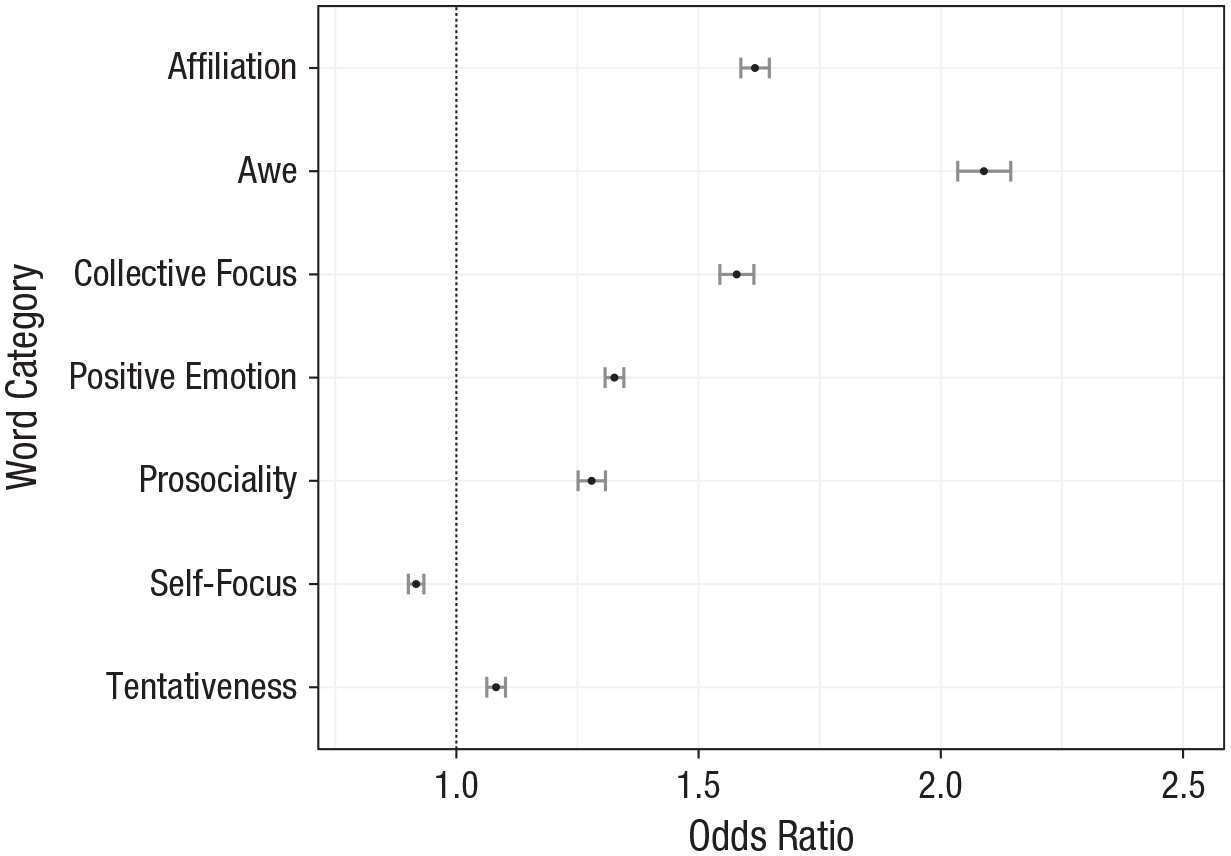
Odds-ratio estimates of the likelihood that users in the eclipse’s path (n = 39,091), compared with those who were not in the eclipse’s path (n = 2,844,784), would use words from each of seven categories (Study 1). Error bars represent 95% confidence intervals. The dashed vertical line (at 1.0) represents a null effect. Collective focus was measured with “we” words, and self-focus was measured with “I” words.
Does awe mediate the relationship between path location and sociality?
We next tested whether awe explained shifts in sociality by conducting a series of generalized structural equation models (using Stata Version 15; StataCorp, 2017). To establish the specific influence of awe on these outcomes beyond general positive affect, we constructed each model to control for expressions of general positive emotion. For each model, bias-corrected 95% CIs for the indirect effect were estimated via 5,000 bootstraps.
As expected, awe explained the relationship between being in the eclipse’s path, relative to not being in its path, on each of the five measures of sociality. Awe accounted for the relationship between being in the eclipse’s path, relative to not being in its path, and greater likelihood of using affiliation (OR = 1.25, 95% CI = [1.23, 1.26], p < .001), prosocial (OR = 1.11, 95% CI = [1.09, 1.12], p < .001), tentative (OR = 1.43, 95% CI = [1.40, 1.45], p < .001), and collectively focused (OR = 1.31, 95% CI = [1.28, 1.32], p < .001) language. Furthermore, users in the path were less likely to exhibit language reflecting self-focus via greater likelihood of expressing awe relative to those not in the path (OR = 0.85, 95% CI = [0.84, 0.86], p < .001). These results suggest that when the effects of general positive affect are accounted for, expressing awe in the wake of the eclipse partially explained why users in the path expressed dampened self-focus and greater prosociality, affiliation, collective focus, and humility in their tweets about the eclipse, relative to users not in the path of totality.
Study 2
In Study 2, we extended Study 1’s findings in two ways. First, although Study 1 found differences in expressions of awe and sociality in eclipse-related tweets from people inside and outside of the eclipse’s path, these differences may have emerged independently of the eclipse, constraining causal inferences. Thus, in Study 2, we examined individuals’ tweets before, during, and after the eclipse, enabling us to better test whether awe and sociality shifted because of the eclipse. Second, we further probed the role of awe in driving the observed shifts in sociality. Specifically, in Study 2, we clustered Twitter users on the basis of their use of awe words over time, to test whether individuals who experienced particularly high levels of awe from the eclipse exhibited correspondingly high shifts in sociality relative to both their preeclipse levels and people who experienced less awe. This allowed us to assess whether differing levels of awe as a function of the eclipse aroused differential levels of humility, affiliation, prosociality, self-focus, and collective focus.
Method
Twitter data collection
We obtained tweets from users likely to be residents of three of the largest metropolitan areas in the western, midwestern, and eastern portions of the eclipse’s path of totality (Kansas City, Missouri; Nashville, Tennessee; and Salem–Corvallis, Oregon), using methods outlined in prior work (Jones et al., 2016). This approach has notable advantages over other methods for collecting and identifying Twitter users on the basis of location, including those used in Study 1. In particular, this method does not rely on users’ self-disclosed, potentially misspelled, or erroneous profile location fields, and it is not dependent on the very small subset of tweets tagged with geocoordinates (Jones et al., 2016). Specifically, we identified Twitter accounts operated by local government and commercial organizations (e.g., city hall, radio stations) that were likely to be followed by residents in each area. Next, the most recent 5,000 followers of each account in each area were scraped using the rtweet package (Version 0.7.0; Kearney, 2017) for the R programming environment (Version 4.0.2; R Core Team, 2020). All followers were downloaded for accounts with fewer than 5,000 followers. Non-English-language accounts, private accounts, and verified accounts (i.e., those likely belonging to businesses, celebrities, and public figures) were filtered out. Approximately 6 weeks after the 2017 eclipse, a custom R script was used to download the most recent 800 tweets from each user. We obtained 1,543,357 tweets from 22,361 users (4,513 in Kansas City, 7,938 in Nashville, and 9,910 in Salem–Corvallis) who tweeted within a 12-week window surrounding the eclipse (42 days before and after; cf. Jones et al., 2016).
Measures
Emojis, hashtags, punctuation, and URLs were removed from Tweet data prior to coding. As in Study 1, each tweet was dichotomously coded for whether it included at least one word from the same dictionaries used in Study 1 as well as from a custom dictionary created to detect the use of eclipse-related words. The eclipse dictionary captured words and hashtags related to the 2017 solar eclipse (e.g., “solareclipse,” “totaleclipse”).
Analytic strategy
To focus our analyses on important time points in the context of the eclipse, we first identified meaningful points in time when users tweeted about the eclipse. Collapsing across areas, we calculated the proportion of daily eclipse-related word use over the 12-week window.
Next, change-point analyses were run in R via the changepoint package (Version 2.2.2; Killick et al., 2016) to determine the inflection points at which eclipse-related expressions shifted within the 12-week window surrounding the eclipse. The changepoint package uses the pruned-exact-linear-time algorithm (Killick & Eckley, 2014) to indicate whether the mean and variance of a variable in one block of time are significantly different from the mean and variance in the next block of time (see Jones & Silver, 2020, for an application of this technique). Using this algorithm, the package identified points in time when there were meaningful changes in daily proportions of eclipse-related word use around the moment of the eclipse (Fig. 2). We identified four time frames: 6 to 2 weeks before the eclipse (before eclipse), in which there were almost no eclipse-related tweets; the week before the eclipse (eclipse lead-up), when eclipse-related tweets started to increase relative to the prior time period; the 48-hour period including the day of and day after the eclipse (eclipse period), when tweets about the eclipse spiked; and the 6-week window after the eclipse period (after eclipse), during which eclipse-related chatter dropped off. This process enabled us not only to determine the duration of attention that the eclipse received on Twitter (in areas under its path) but also to center our primary analyses around time frames when the eclipse was discussed on Twitter.
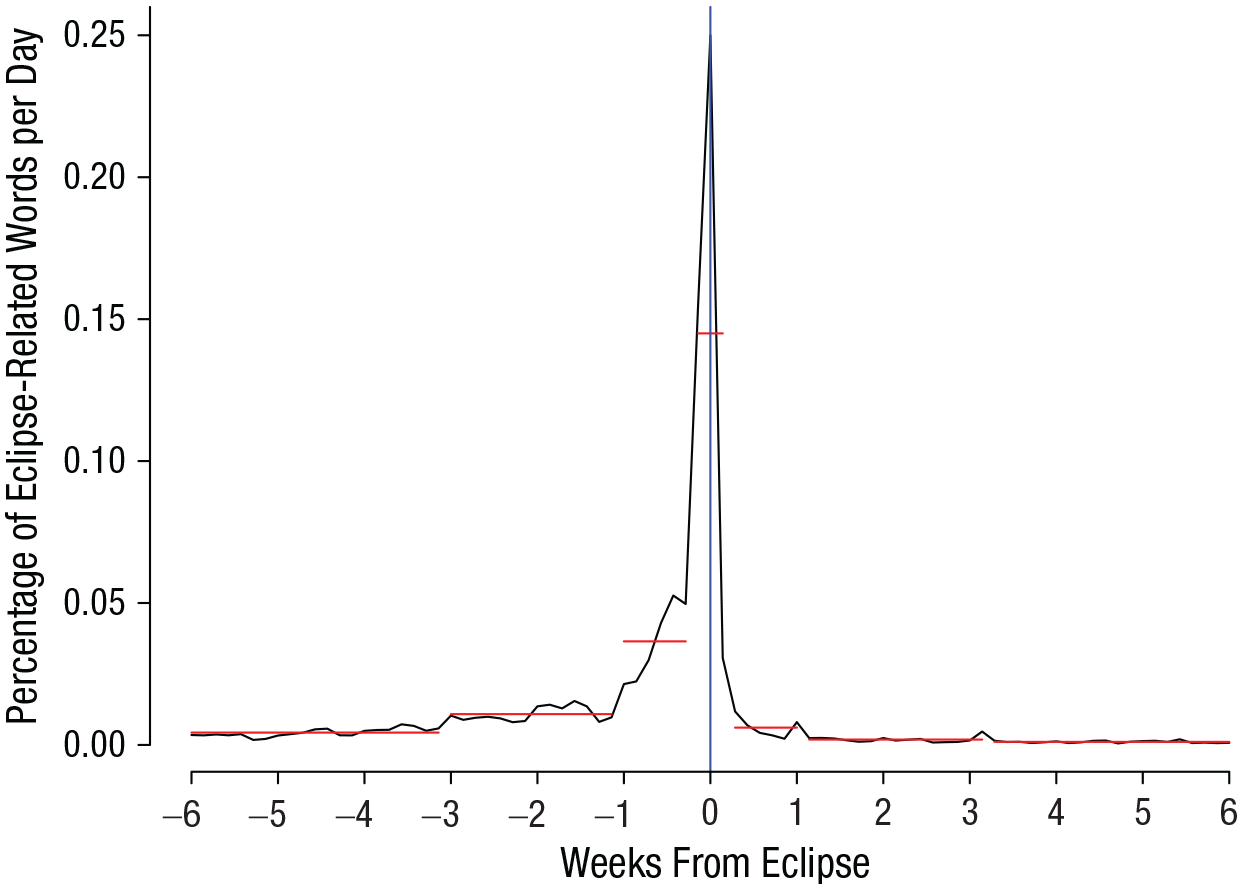
Results of change-point analyses showing the percentage of eclipse-related words used per day over time (Study 2). Red lines indicate periods of elevated or decreased eclipse word use. The vertical blue line indicates the time of the eclipse.
Clustering
To examine whether users differed in their use of awe words surrounding the eclipse, we employed k-means clustering—a data-driven clustering algorithm for identifying nonoverlapping groups in which group members have similar value patterns across a selection of variables. For our purposes, it was used to organize users into discrete clusters on the basis of their use of awe-related language over time. K-means clustering requires complete data; thus, in our analyses, we included only users who tweeted within all four of the time frames we identified via the change-point analysis (n = 7,736 users; n = 1,021,998 tweets).
The optimal number of clusters was determined via the NbClust package (Version 3.0.0; Charrad et al., 2014) for R, which uses 30 different cluster-estimation indices to generate an overall best number of clusters for a given data set. The program converged on three clusters, depicted in Figure 3. Users in the elevated-awe cluster (n = 251) expressed increased awe tweets on the day of the eclipse. Indeed, in the eclipse period, 74% of tweets in the elevated-awe cluster included an awe word, compared with 5% and 2% of tweets in the other clusters. Conversely, in the time periods before the eclipse, users in the reduced-awe cluster (n = 600) expressed more awe tweets (before: 12%; lead-up: 17%), relative to those in the other clusters, yet this group exhibited a decrease in awe tweets in the eclipse period (5%). Finally, users in the no-awe cluster (n = 6,885) exhibited relatively few awe tweets over time (M = 1.75%).
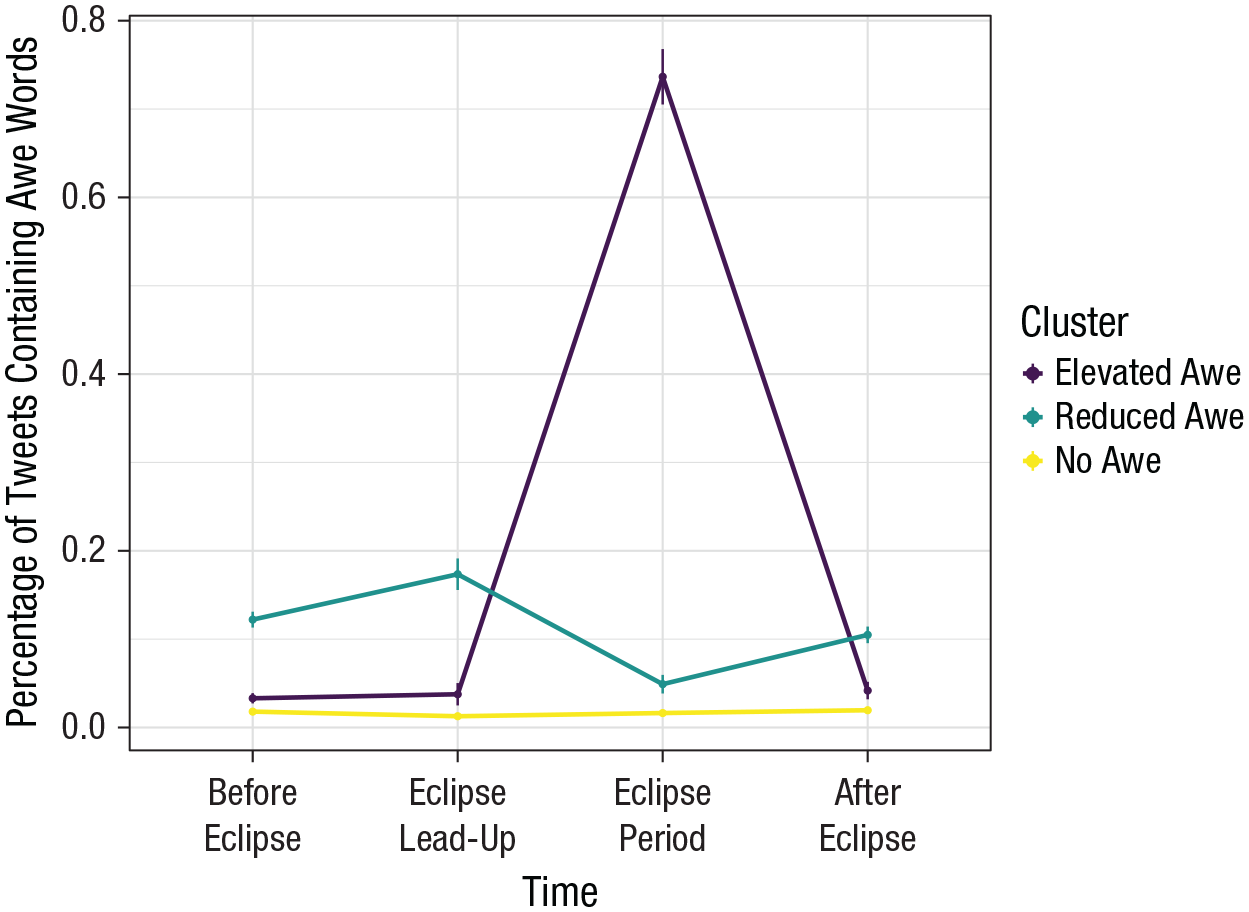
Percentage of tweets containing awe words in each user cluster over time (Study 2). Clusters of users (n = 7,736 users; n = 1,021,998 tweets) were defined on the basis of their use of awe-related words over time. Error bars represent 95% confidence intervals.
Dictionary use within and between clusters
Because tweets were nested within users, a series of logistic mixed-effects models were fitted for each outcome to assess whether the elevated-awe cluster exhibited significant shifts in awe-related outcomes in the eclipse period relative to (a) within-cluster preeclipse levels (i.e., eclipse lead-up levels) and (b) the other clusters during the eclipse period. Specifically, each model included a random effect of user and fixed effects for time frame and cluster. In each model, dichotomously coded dependent measures (i.e., affiliation, prosocial, tentative, self-focused, and collectively focused words) were respectively regressed on the interaction between time frame and cluster. As a check of whether users in the elevated-awe cluster exhibited greater awe and attention to the eclipse compared with those in the other clusters, we examined individuals’ use of awe- and eclipse-related words, respectively, over time.
All reported effects are depicted as ORs. Figure 4 depicts each cluster’s odds of using a particular word category at a given time point.
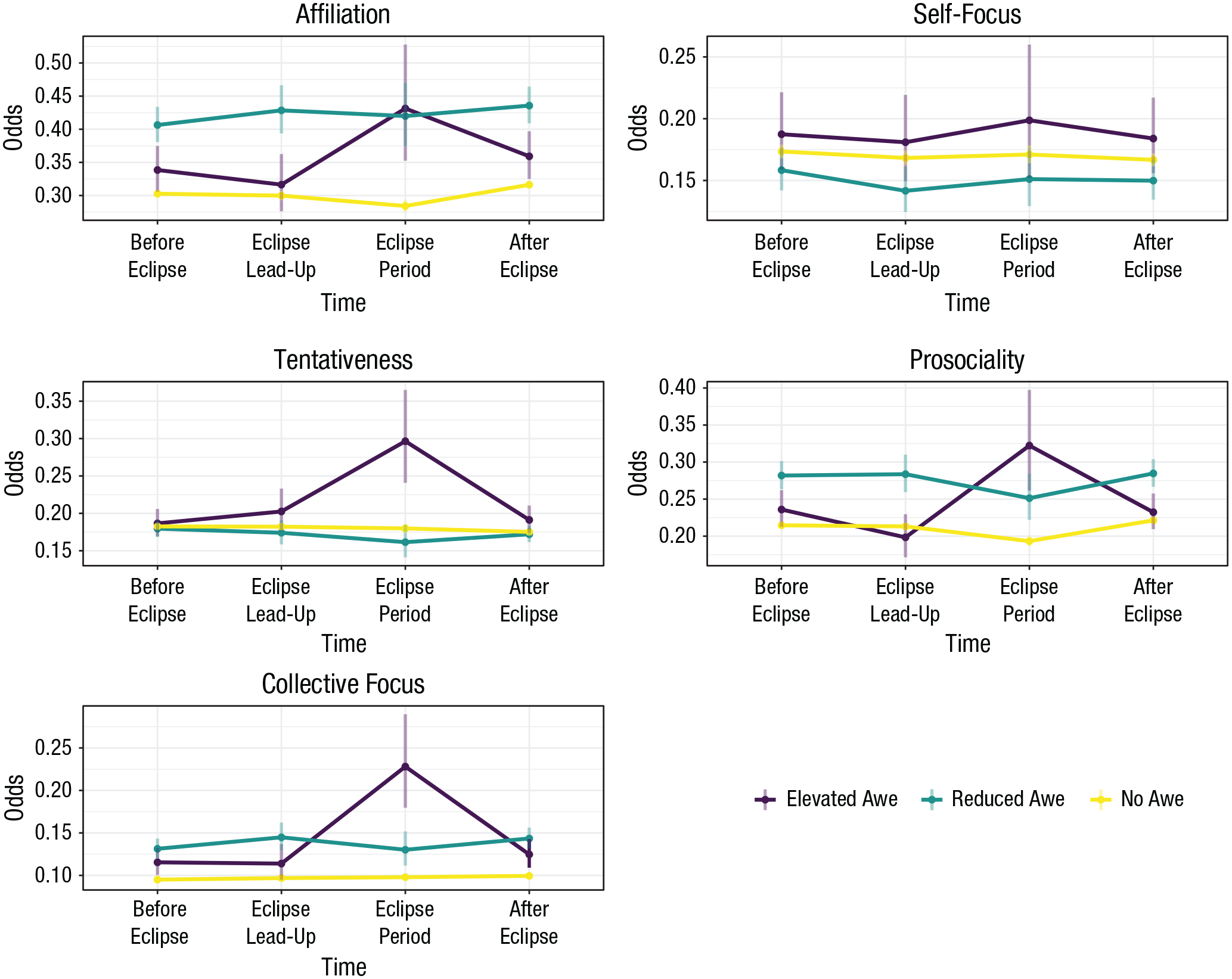
Odds of each user cluster posting tweets containing words from each of five word categories over time (Study 2). Error bars represent 95% confidence intervals. Collective focus was measured with “we” words, and self-focus was measured with “I” words.
Results
Users in the elevated-awe cluster were indeed more likely to express awe in the eclipse period, relative to their preeclipse levels (OR = 53.90, 95% CI = [40.30, 72.20], p < .001), to the reduced-awe cluster (OR = 23.30, 95% CI = [17.90, 30.30], p < .001), and to the no-awe cluster (OR = 83.30, 95% CI = [67.30, 103.00], p < .001). They were also more focused on the eclipse, as reflected by their greater use of eclipse-related words relative to their preeclipse levels (OR = 6.94, 95% CI = [5.21, 9.23], p < .001), to the reduced-awe cluster (OR = 3.57, 95% CI = [2.50, 5.09], p < .001), and to the no-awe cluster (OR = 4.94, 95% CI = [3.65, 6.67], p < .001).
Individuals in the elevated-awe cluster also exhibited more affiliative, humble, prosocial, and collectively focused language during the eclipse period relative to their preeclipse levels (affiliation: OR = 1.36, 95% CI = [1.10, 1.68], p < .001; tentativeness: OR = 1.46, 95% CI = [1.17, 1.84], p = .001; prosociality: OR = 1.62, 95% CI = [1.30, 2.03], p < .001; collective focus: OR = 2.00, 95% CI = [1.56, 2.58], p < .001). Neither of the other two awe clusters showed similar trends over time. The reduced-awe cluster showed no changes over time in any category (affiliation: OR = 0.98, 95% CI = [0.87, 1.10], p = .73; tentativeness: OR = 0.93, 95% CI = [0.80, 1.08], p = .33; prosociality: OR = 0.89, 95% CI = [0.78, 1.01], p = .07; collective focus: OR = 0.90, 95% CI = [0.77, 1.05], p = .18). The no-awe cluster exhibited only decreases in prosociality (OR = 0.91, 95% CI = [0.88, 0.94], p < .001) and affiliation (OR = 0.95, 95% CI = [0.92, 0.98], p < .001) from preeclipse levels to the eclipse period but no changes in collectively focused words (OR = 1.01, 95% CI = [0.97, 1.05], p = .63) or tentative words (OR = 0.99, 95% CI = [0.95, 1.02], p = .43).
In the eclipse period, the elevated-awe cluster exhibited more affiliative, humble, prosocial, and collectively focused language than the no-awe cluster (affiliation: OR = 1.52, 95% CI = [1.24, 1.86], p < .001; tentativeness: OR = 1.65, 95% CI = [1.34, 2.04], p < .001; prosociality: OR = 1.67, 95% CI = [1.35, 2.06], p < .001; collective focus: OR = 2.33, 95% CI = [1.83, 2.97], p < .001). The elevated-awe cluster also expressed more tentative words (OR = 1.84, 95% CI = [1.43, 2.35], p < .001), prosocial words (OR = 1.28, 95% CI = [1.01, 1.64], p = .04), and collectively focused words (OR = 1.75, 95% CI = [1.32, 2.33], p < .001) than the reduced-awe cluster in the eclipse period, but there were no differences between these groups’ expressions of affiliation words (OR = 1.03, 95% CI = [0.82, 1.29], p = .82).
Interestingly, users in the elevated-awe cluster did not exhibit significant shifts in self-focus in the eclipse period relative to their preeclipse levels (OR = 1.10, 95% CI = [0.86, 1.41], p = .46), to the reduced-awe cluster (OR = 1.31, 95% CI = [0.96, 1.79], p = .08), and to the no-awe cluster (OR = 1.16, 95% CI = [0.89, 1.52], p = .28), but they displayed a slight upward trend (see Fig. 4). Similarly, the reduced- and no-awe clusters did not show shifts in self-focus compared with preeclipse levels (reduced awe: OR = 1.07, 95% CI = [0.93, 1.23], p = .37; no awe: OR = 1.02, 95% CI = [0.98, 1.05], p = .35). In sum, individuals who exhibited greater awe in response to the eclipse used more collective, affiliative, prosocial, and humble language in their tweets during the eclipse period, relative to their preeclipse levels and to individuals who expressed less awe over time.
General Discussion
In two studies featuring ecologically valid observational Twitter data from over 2 million people, we found that the 2017 solar eclipse was associated with increases in awe and social processes that are core to collective life. Relative to individuals not in the eclipse’s path of totality, people in the path were more likely to express awe and, subsequently, less self-focus and greater prosociality, affiliation, collective focus, and humility in their tweets about the eclipse (Study 1). Moreover, among people in the path, individuals who expressed more awe over time were more likely to use affiliative, prosocial, humble, and collectively focused language relative to their preeclipse levels and to individuals who exhibited lower awe over time (Study 2). These findings indicate that awe-inspiring astronomical events such as a total solar eclipse can arouse tendencies—from greater attention to one’s groups to motivations to care for and affiliate with others—vital to collective life.
Interestingly, whereas Study 1 indicated that awe was associated with diminished self-focus, in Study 2 we found that greater awe corresponded with an upward, though nonsignificant, trend in self-focused language. This relative increase may be due to members of the elevated-awe cluster being more likely to share their personal reactions to the eclipse (e.g., “I experienced one of the coolest things I’ve ever seen”). Further, the fact that we observed an increase in “I” words alongside an increase in “we” words indicates that people can simultaneously experience increases in both self- and collective focus (Seraj et al., 2021), and awe may trigger forms of self-categorization that encompass both oneself and others (Perlin & Li, 2020).
Research on the social impact of celestial events should extend our findings in several ways. First, although analyses of social media data enable access to more statistically representative samples than traditional laboratory methods (Sterling et al., 2020), Twitter users can differ from the overall U.S. adult population (Wojcik & Hughes, 2019). Thus, future work should use other samples to assess the generalizability of our results.
Second, our data preclude the ability to determine with certainty whether users in our sample viewed the eclipse secondhand or in person, and if they did experience it, whether they were alone or with others. Many large social gatherings collectively experienced the eclipse (Fountain, 2017), and participation in these gatherings could have driven some of the shifts in sociality we observed via collective emotional responding (Goldenberg et al., 2020). Research using experience sampling could strengthen our results by linking individuals’ social-cognitive outcomes to their direct experiences with celestial events and their coexperience of them (or lack thereof) with others.
Third, although our custom awe dictionary captured tweets that directly conveyed awe, it likely missed posts that exhibited a less explicit sense of awe (e.g., “I felt small”). Consequently, it will be important to complement our results with assessments that more fully capture the variety of awe-related states.
Finally, although we employed quasiexperimental techniques (Study 1) and looked at within- and between-group shifts as a function of awe during the time of the eclipse (Study 2), we cannot draw direct causal inferences concerning the effects of the eclipse and awe on sociality. In this vein, it will be informative for future studies to use a combination of the methods used in Studies 1 and 2, comparing individuals who experienced the total eclipse with those who did not while also examining their within-person variation in awe and sociality over time. Complementary experimental work—for example, using virtual reality devices to immerse individuals in an awe-inspiring astronomical event (Chirico et al., 2018; Quesnel & Riecke, 2018; Stepanova et al., 2019)—would further bolster causal claims about the social impacts of those events.
Notwithstanding these limitations, our findings provide a direct glimpse into the psychological impact of the 2017 solar eclipse: It was associated with increases in awe and social tendencies that help bind people to others and their groups. These findings shed light on the social impacts of celestial phenomena and expand the emerging science of awe into large-scale collective contexts. Just as the moon aligned with the sun up in the heavens, people down on earth aligned with each other in awe of this spectacular celestial event.
Supplemental Material
sj-docx-1-pss-10.1177_09567976221085501 – Supplemental material for The Social Effects of an Awesome Solar Eclipse
Supplemental material, sj-docx-1-pss-10.1177_09567976221085501 for The Social Effects of an Awesome Solar Eclipse by Sean P. Goldy, Nickolas M. Jones and Paul K. Piff in Psychological Science
Footnotes
Acknowledgements
We thank Emma L. Grisham and members of the MESH lab and Silver Stress and Coping lab for their constructive feedback on this work. We also thank Rachel Reyes and Maria Garcia for their help with constructing the awe dictionary.
Transparency
Action Editor: Eddie Harmon-Jones
Editor: Patricia J. Bauer
Author Contributions
S. P. Goldy, N. M. Jones, and P. K. Piff designed the research. S. P. Goldy and N. M. Jones collected and analyzed the data. All the authors wrote the manuscript and approved the final version for submission.

Notes
References
Supplementary Material
Please find the following supplemental material available below.
For Open Access articles published under a Creative Commons License, all supplemental material carries the same license as the article it is associated with.
For non-Open Access articles published, all supplemental material carries a non-exclusive license, and permission requests for re-use of supplemental material or any part of supplemental material shall be sent directly to the copyright owner as specified in the copyright notice associated with the article.
