




Abstract
Body dissatisfaction is pervasive among young women in Western countries. Among the many forces that contribute to body dissatisfaction, the overrepresentation of thin bodies in visual media has received notable attention. In this study, we proposed that prevalence-induced concept change may be one of the cognitive mechanisms that explain how beauty standards shift. We conducted a preregistered online experiment with young women (N = 419) and found that when the prevalence of thin bodies in the environment increased, the concept of being overweight expanded to include bodies that would otherwise be judged as “normal.” Exploratory analyses revealed significant individual differences in sensitivity to this effect, in terms of women’s judgments about other bodies as well as their own. These results suggest that women’s judgments about other women’s bodies are biased by an overrepresentation of thinness and lend initial support to policies designed to increase size-inclusive representation in the media.
Between 13% and 32% of women in Western countries are dissatisfied with their bodies (Fallon et al., 2014). Women with these feelings have been shown to be at an increased risk for mental and physical health problems, such as depression, cancer, and, unsurprisingly, eating disorders (Fallon et al., 2014; Grabe et al., 2008). Among the many forces thought to contribute to body dissatisfaction, visual media has been suggested to play a major role in shifting women’s concepts about ideal bodies (Grabe et al., 2008). For instance, a meta-analysis of 25 experimental studies revealed that women’s body images were reliably more negative after they viewed images of thin women (Groesz et al., 2002). Theoretical work suggests that the negative effect that Western media have on body image relies heavily on the promotion of a thin ideal (Thompson & Stice, 2001; Tiggemann, 2002). That is, the media present an idealized female body image that becomes internalized, accepted, and endorsed by viewers through repeated exposure. Mechanistically, “repeated exposure to such images may lead women to internalize the thin ideal such that it becomes accepted by them as a reference point against which to judge themselves” (Tiggemann, 2002, p. 92).
The thin ideal refers to a standard among women portrayed in the media who represent an unrealistically slim and tall profile, usually 15% below an average woman’s weight (Hawkins et al., 2004). By the late 20th century, the ideal of female beauty had already become increasingly thinner (Sypeck et al., 2004), and by the 1990s, women in popular media often met the criteria for anorexia nervosa (Wiseman et al., 1992). 1 Since then, the situation has not improved. In an age of unprecedented media consumption, the thin ideal is reinforced through women’s and girls’ increased interaction with appearance-based social media platforms such as Instagram and Facebook (Mingoia et al., 2017). Perhaps counterintuitively, this ideal persists even amid the “obesity crisis” in the Western world (Blackburn & Walker, 2005).
This persistence raises the question of how such an ideal endures in Western society despite decades of research that has documented the negative impacts that arise from its spread through media (e.g., Calogero & Thompson, 2010; Evans, 2003; Fredrickson & Roberts, 1997; Stice & Shaw, 1994; Swami et al., 2010; Ward, 2003). In other words, the cognitive processes that underlie the proliferation and internalization of the thin ideal have yet to be fully clarified (López-Guimerà et al., 2010).
In the current study, we borrowed from cognitive psychology to explore one such possible mechanism: prevalence-induced concept change. Prevalence-induced concept change (or less formally, concept creep; Levari et al., 2018) predicts that as the numbers of exemplars of a given concept increase in the environment, the boundaries of that concept shrink to exclude exemplars that they would otherwise include. To assess prevalence-induced concept change, Levari and colleagues (2018) developed a task in which participants had to serially judge whether individually presented dots that varied on a color spectrum between blue and purple were in fact blue or purple. When the numbers of blue and purple dots in the environment were equal across the task (50% blue dots, 50% purple dots), people’s judgments were stable: If they judged a dot as blue in the first trials, they judged that same dot as blue in the last trials. However, if the number of purple dots in the environment increased over the task (50% purple dots in the first trials but gradually shifting to 96% purple dots in the last trials), dots that were first judged as purple were later categorized as blue. Put simply, when the prevalence of purple dots in the environment increased, the boundaries for what counted as “purple” shrunk. Thus, it could be said that the concept itself changed on the basis of the prevalence of exemplars in the environment—hence, prevalence-induced concept change. Critically, Levari et al. (2018) showed that this change occurred not only in perceptual (color) judgments but also in higher level social and ethical judgments.
Building on the reviewed literature, we proposed that the principle of prevalence-induced concept change may also apply in the case of body-image judgments. Thus, we predicted that as the prevalence of thin bodies increases in the environment, female participants will become more likely to judge women as overweight. This is because the concept of “thin” shrinks to exclude bodies that were previously (with equal prevalence) considered “normal.” Furthermore, we expected that young women might internalize this concept change and would become more likely to judge their own bodies as overweight. If this were the case, prevalence-induced concept change may represent a cognitive mechanism underlying the proliferation and internalization of a thin ideal in women, notably one that is driven merely by the frequency of events.
Statement of Relevance
Media imagery has shaped how women have judged their own and others’ bodies for decades. Through the promotion of a thin ideal, an overly slender standard for the female body is internalized by young women as the most suitable shape. Although past work has described this phenomenon, the cognitive processes by which this normalization of thinness occurs are less well understood. In this study, we asked women to repeatedly judge whether or not female bodies were overweight. When presenting thin bodies more often over time, we found that women’s conceptualization of thinness shifted, such that women were more likely to judge an average body as overweight when thin bodies were overrepresented. Our results provide novel insights into the cognitive mechanism underlying how visual media alter women’s perception of what constitutes a normal body and why we should instead strive to portray a truthful distribution of women’s bodies in our media.
To test whether prevalence-induced concept change could explain changes in body-image judgments directed at others as well as the self, we conducted a preregistered online experiment using a modified version of an established task to measure prevalence-induced concept change (the bodies task; see the Method section; Devine et al., 2021; Levari et al., 2018). Specifically, we preregistered three main hypotheses (https://osf.io/e28nd/). 2 Hypothesis 1 was that if the prevalence of thin bodies in the environment increases, women will be more likely to judge other women’s bodies as overweight than if this shift did not occur. Hypothesis 2 was that this shift in prevalence would not only affect women’s judgments of other individuals but also affect their self-concept, such that women will be more likely to judge their body as overweight after being exposed to more thin bodies. Hypothesis 3 was that in addition to affecting women’s self-concept (overweight or not overweight), an increase in the prevalence of thin bodies in the environment will affect women’s self-image, such that they will judge themselves as heavier after being exposed to this shift.
Method
Participants
An a priori power analysis revealed that we required 400 participants to detect effect sizes of minimal interest for all of our hypotheses (for details about the power analysis, see https://osf.io/fx4rh/). We collected data from 563 participants through Concordia University’s participant pool and the online participant recruitment platform Prolific (https://www.prolific.co/). Following our preregistered analysis plan (https://osf.io/e28nd), we excluded participants who were not between 18 and 28 years old, did not self-identify as female, used psychoactive substances, failed at least one catch question (for more details, see the Supplemental Material available online), and failed to provide a mean response time between 100 ms and 7,000 ms during the bodies task (described below). After we applied these criteria, data from 419 women were included in the final analysis (age: M = 22.60 years, SD = 2.93, range = 18–28). The prevalence manipulation described below was between subjects; 206 participants completed the stable-prevalence condition, and 213 participants completed the increasing-prevalence condition. All condition assignments were fully randomized (i.e., each participant had a 50% chance of being in the increasing- or stable-prevalence condition). All participants spoke English and had no cognitive, visual, or motor impairments that would impede their performance (e.g., mild cognitive impairment). All participants were given a 15-character random ID, and no participant was identifiable on the basis of this ID.
Materials
Bodies task
The main task that participants completed as part of the study was the bodies task. In this experiment, participants judged whether a computer-generated body image presented on the screen was overweight or not. Stimuli for this task were taken from a publicly available and validated image bank (see Moussally et al., 2017). Sixty images of computer-generated women’s bodies that ranged from emaciated to morbidly obese were used. The bodies had white skin and were wearing white underwear and a white tank top. The bodies were stopped at the neck, so no face was visible (for examples, see Fig. 1). Stimuli are available at https://osf.io/uwvs6/ and from the original authors (Moussally et al., 2017). JavaScript code for the whole experiment is publicly available at https://osf.io/3efgd/.
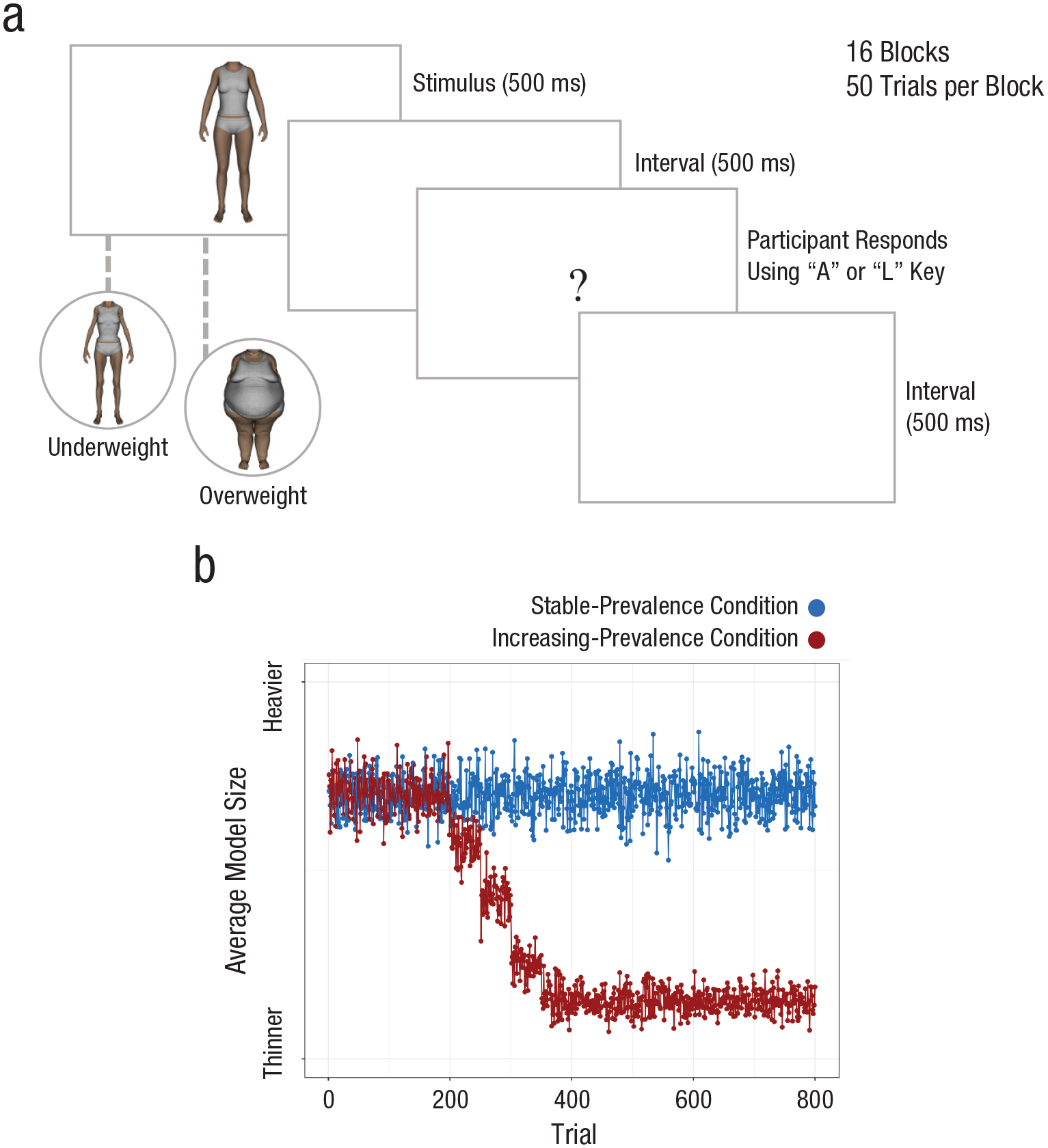
Design of the bodies task. An example trial sequence is shown in (a). On each trial, participants saw a single body stimulus and judged it as being either overweight or not overweight by pressing the “L” or “A” key, respectively, on the keyboard. The average model size across trials in the bodies task (b) is shown separately for each condition. In the increasing-prevalence condition, the number of thin bodies in the environment increased as the number of blocks increased in a predetermined fashion. In the stable-prevalence condition, the proportion of overweight and thin bodies in the environment did not change.
The task consisted of 800 total trials, divided into 16 blocks of 50 trials each (see Fig. 1a). Each trial proceeded as follows. First, a body (481 pixels × 891 pixels) appeared against a white background for 500 ms. After the body disappeared, there was a short delay (500 ms), during which only a white screen was shown. Then a question mark (60 pixels) appeared in the center of the screen and remained on screen until participants made a response: Participants judged whether the body was overweight or not overweight by pressing either the “L” or “A” key, respectively, on a keyboard. 3 After participants made a response, another short delay occurred (500 ms) before the next trial began. After participants completed a block of 50 trials, text appeared against a white background that read, “Block X. Press SPACE to continue,” where “X” was the block number. This text remained on screen until participants pressed continue, after which a 1,000-ms delay occurred before the first trial of the next block.
The key manipulation in this experiment involved controlling the prevalence of thin and overweight bodies in the environment. To accomplish this, we randomly assigned each participant to one of two conditions (between subjects): the stable-prevalence condition and increasing-prevalence condition. In the increasing-prevalence condition, the number of thin bodies in the environment increased as the number of blocks increased in a predetermined fashion. Specifically, the proportion of thin to overweight bodies had the following order across each block in the increasing-prevalence condition: .50, .50, .50, .50, .60, .72, .86, .94, .94, .94, .94, .94, .94, .94, .94, .94. In the stable-prevalence condition, the proportion of overweight and thin bodies in the environment did not change; it was always .50 (see Fig. 1b). Bodies were categorized as objectively thin or overweight by Moussally et al. (2017) according to World Health Organization (1995) guidelines. Body mass index (BMI) across all bodies ranged from 13.19 (severely underweight) to 120.29 (very severely obese). Before starting the main experiment, participants completed 10 practice trials, in which they judged five overweight bodies and five thin bodies. These practice trials were not analyzed.
In addition to measuring participants’ judgments of other bodies, we also assessed how changes in the prevalence of thin bodies affected participants’ judgments of their own bodies. To do so, we asked participants prior to completing the practice trials to choose a computer-generated model that they believed most resembled their own body type. This measure was based on similar assessment tools that capture participants’ body image using computerized models (Stewart et al., 2009). After choosing a body, participants were then asked to judge whether they would rate this body as overweight or not. This measure was included to assess whether participants’ self-concept (categorical: overweight or not overweight) could vary independently of their self-image (continuous: where they judge their body on a spectrum). Here, we drew on clinical work aimed at treating body-image disturbances, which has shown divergence between perceived body size in absolute terms and categorical body-image judgments—in other words, one may be entirely accurate in judging their own body size but differ in terms of the conceptual boundaries they set on body-image concepts (Gledhill et al., 2017; Irvine et al., 2020). More details on our specific hypotheses for these measures follow below. After completing the remainder of the bodies task (the practice trials and the 16 blocks), participants made the same continuous and categorical judgments again so we could determine whether the shift in prevalence affected participants’ judgments about their own body.
Questionnaires
In addition to completing the bodies task, participants filled out the following questionnaires. The data from these questionnaires were not directly related to our preregistered predictions but were collected for the purposes of exploratory analyses based on past work demonstrating links between media consumption and eating disorders (e.g., Harrison & Cantor, 1997; Spettigue & Henderson, 2004). Furthermore, we included three catch questions within these questionnaires. These questions were included for the purpose of exclusion and tested whether participants were paying attention during the experiment. Specifically, we asked participants (a) “If you’re paying attention please select ‘Moderately’ for this question”; (b) “If you’re paying attention to this question, please select ‘Rarely’”; and (c) “If you’re paying attention, please select ‘Not at All’ for this question.” For details about exclusion criteria for these questions, see the Supplemental Material.
Additionally, we asked participants to self-report their age, sex, education, height, weight, socioeconomic status, time spent consuming various types of media, and ethnicity, as well as respond to questions concerning physical and mental health. Some of these questions were also administered for the purpose of exclusion (see the Supplemental Material). Furthermore, we asked participants to complete the following questionnaires after they completed the bodies task: the Eating Disorder Examination Questionnaire-Short (Gideon et al., 2016), the Body Shape Questionnaire Short Form (Dowson & Henderson, 2001), and the Brief Symptom Inventory-18 (Franke et al., 2017). These questionnaires are described in full in the Supplemental Material.
The current study protocol was approved by the Concordia University Human Research Ethics Committee (Certification No. 30013101).
Analysis
Judgments of other bodies (Hypothesis 1)
To determine whether Hypothesis 1 was supported by the current data, we used a logistic multilevel model that had the following form:





Self-concept (Hypothesis 2)
To test whether participants’ self-concept (overweight or not overweight) was affected by increases in the prevalence of thin bodies, we conducted a logistic ordinal regression. 4 To avoid violations of the assumption of normality (each participant made two judgments: at the beginning and end of the task), we computed a dummy-coded difference score. Participants who judged their body as not overweight after the bodies task but who had previously stated it was overweight (i.e., a decrease in self-concept about overweightness) were coded as −1. Participants who did the opposite—judged their body as overweight after judging it as thin—were coded as 1. Participants who exhibited no change from before the bodies task to after were coded as 0. The goal was to predict these ordinal scores (−1, 0, 1) from participants’ condition (increasing prevalence or stable prevalence). To do so, we fitted the following model:

where
Self-image (Hypothesis 3)
To test whether participants’ self-perception varied according to whether the prevalence of thin bodies in the environment increased or not, we turned to simple linear regression. 5 Specifically, we computed difference scores in participants’ model choice (which model they chose to represent themselves at the beginning vs. the end of the task) and predicted these scores using the following model:

The significance of condition was tested for by a likelihood-ratio test.
To be sure that participants’ judgments about models meant to represent themselves (i.e., our predictions for Hypotheses 2 and 3) were reasonably accurate reflections of their true self-image, we verified that participants chose bodies that matched their BMI. BMI scores were computed from participants’ self-reported height and weight from the demographics questionnaire. For details about this analysis, see the Supplemental Material. In brief, we found good agreement between participants’ self-report BMI and the size of the models they chose to represent themselves.
Results
Judgments of other bodies (Hypothesis 1)
We found that the best-fitting model to explain participants’ judgments of other bodies in the bodies task was one that included all main effects and interactions of size, trial, and condition, χ2(5) = 231.24, p = 5.81 × 10−48. The full results from this model are summarized in Table S1 in the Supplemental Material. Most importantly, we found a three-way interaction between condition, trial, and size (β = 3.85, SE = 0.38, p = 1.09 × 10⁻²³). As seen in Figure 2a, this result shows that when the prevalence of thin bodies in the environment increased over the course of the task, participants judged more ambiguous bodies (average bodies) as overweight than when the prevalence remained fixed. We emphasize here that this effect is restricted to judgments of thin and average-size stimuli because the nature of our manipulation reduced the number of overweight stimuli seen by participants in the increasing-prevalence condition (as reflected by larger error bars for larger body sizes in Fig. 2a). Therefore, we found strong support for Hypothesis 1 in the current sample.
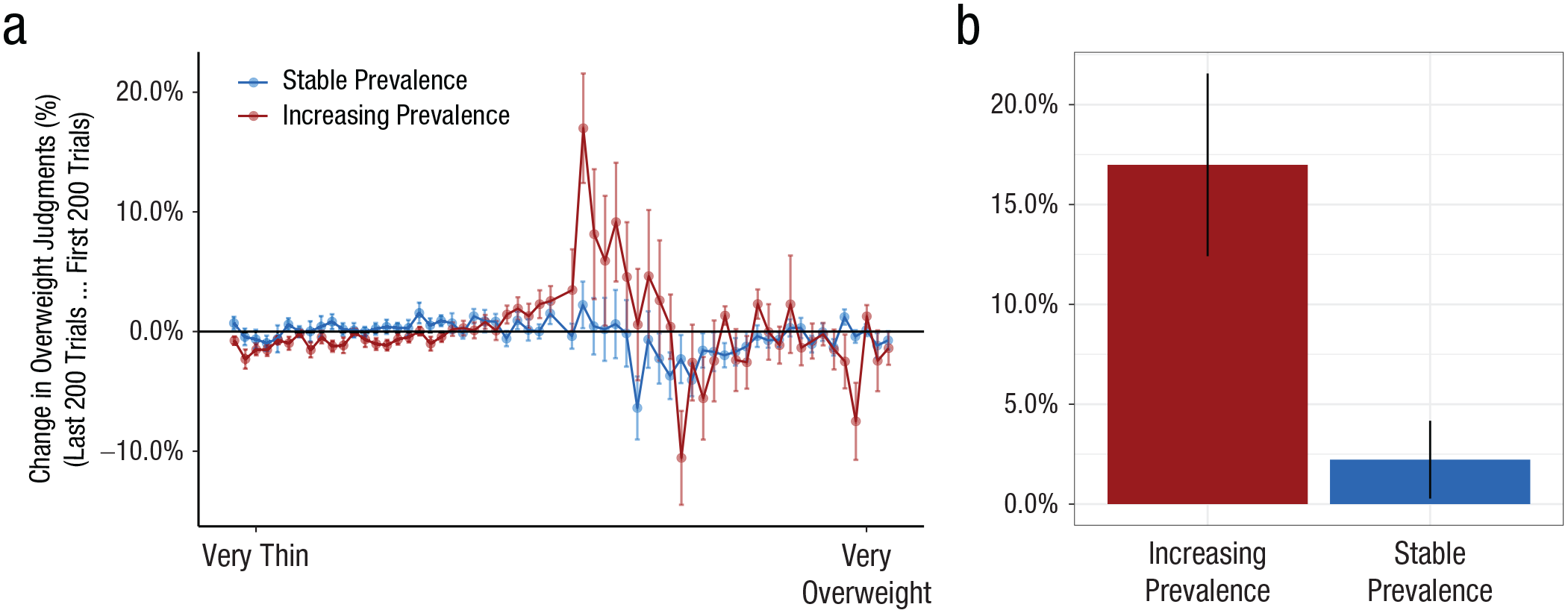
Judgments of models during the bodies task. The percentage of change in participants’ judgments about whether the models were overweight or not overweight from the beginning of the task (first 200 trials) to the end of the task (last 200 trials) is shown (a) as a function of the objective size of each model and prevalence condition. Positive numbers on the y-axis reflect an increase in overweight judgments, and negative numbers indicate a decrease. Points represent the percentage of overweight judgments made for that body. Error bars represent standard errors. The bar graph (b) shows the effect in (a) for a body with a normal body mass index (23.35), separately for each prevalence condition. Error bars represent standard errors.
To exemplify the consequences of prevalence-induced concept change in body judgments, consider a body with a BMI of 23.35 (well within the normal range of BMI for an adult woman). As shown in Figure 2b, at the beginning of the experiment, few participants in either condition (increasing prevalence or stable prevalence) judged this body to be overweight: 11% in the increasing-prevalence condition and 8% in the stable-prevalence condition. By the end of the experiment, however, a quarter (25%) of participants who saw the prevalence of thin bodies in the environment increase (those in the increasing-prevalence condition) judged this same body to be overweight. Conversely, in the stable-prevalence condition, there was virtually no change in participants’ judgments (9% overweight judgments).
Self-concept (Hypothesis 2)
We did not find a significant effect of condition on participants’ categorical judgments of the self (β = 0.06, SE = 0.35, p = .8636; see Fig. 3a). Therefore, the current data do not support Hypothesis 2.
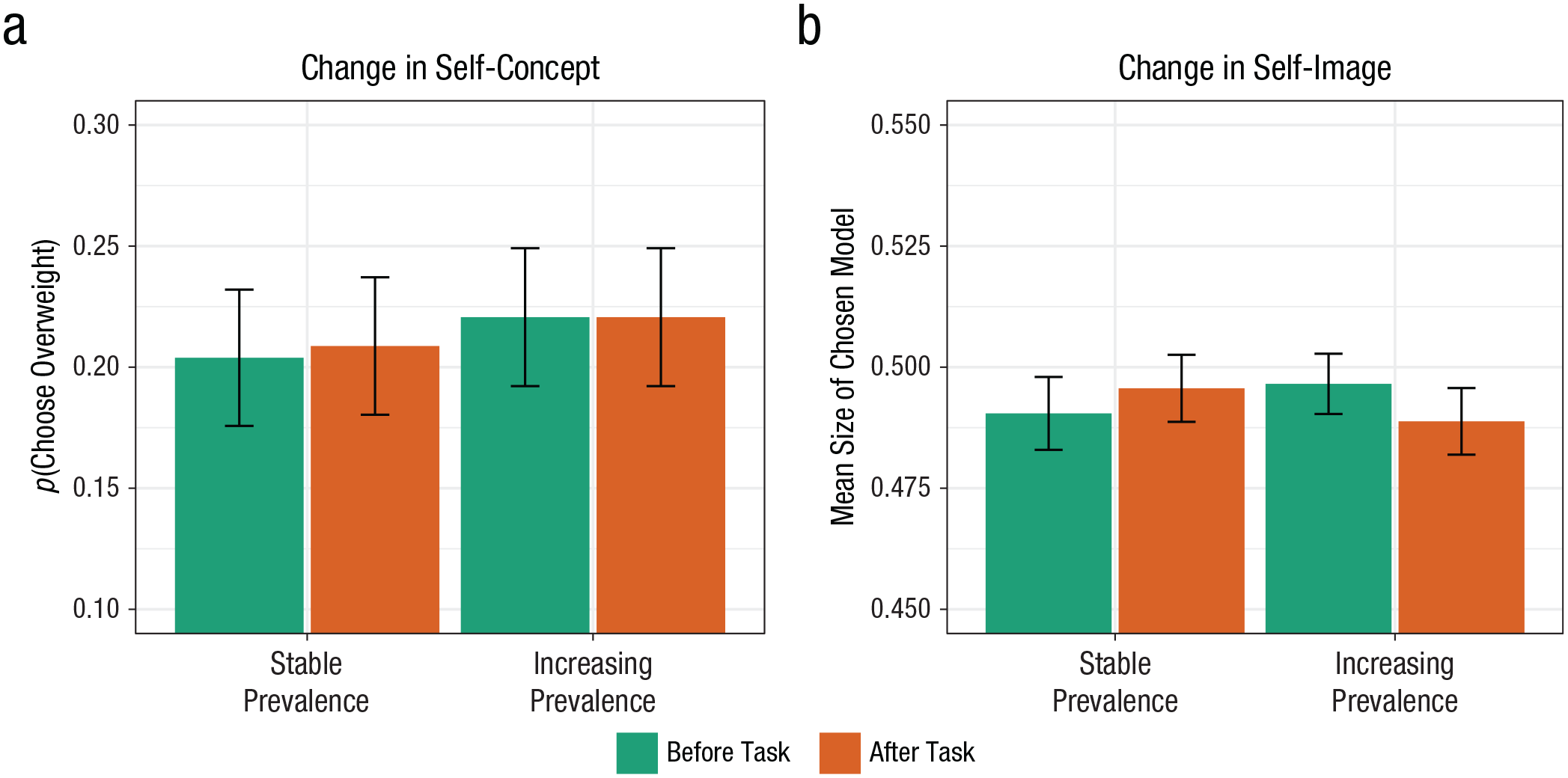
Categorical self-concept judgments and continuous self-image judgments before and after the bodies task. The proportion of overweight judgments that participants made for the model that they stated best represented their own (a) and the mean size of the chosen model (b) are shown for each prevalence condition both before and after participants completed the bodies task. The y-axis in (b) is scaled to be between 0 and 1. Error bars represent standard errors.
Self-image (Hypothesis 3)
We found a small but statistically significant effect of condition on participants’ self-image (β = −0.01, SE = 0.006, p = .0261). However, this effect was in the opposite direction from our initial prediction: When the prevalence of thin bodies increased, participants judged themselves as thinner than they did at the beginning of the task and compared with when the prevalence remained stable. As can be seen in Figure 3b, however, this effect was in part driven by a combination of baseline differences in body judgments and small effects in both conditions. We are therefore unable to reconcile these results with Hypothesis 3 and conclude that this hypothesis was not supported by the current data.
Exploratory analyses
In addition to our preregistered analyses, we conducted a series of exploratory analyses. In particular, we observed sizable variation in individual women’s sensitivity to concept change during the bodies task (conditional intraclass correlation coefficient = .35; see Table S2 in the Supplemental Material). To establish a relationship between sensitivity to concept change in judgments about others and judgments about the self, we examined whether these differences in concept change about other bodies might moderate women’s sensitivity to concept change about their own. To quantify individual sensitivity to prevalence-induced concept change during the bodies task, we computed empirical Bayes estimates (EBs): EBTrial,j = ljbˆTrial,j + (1 - lj)g00, where
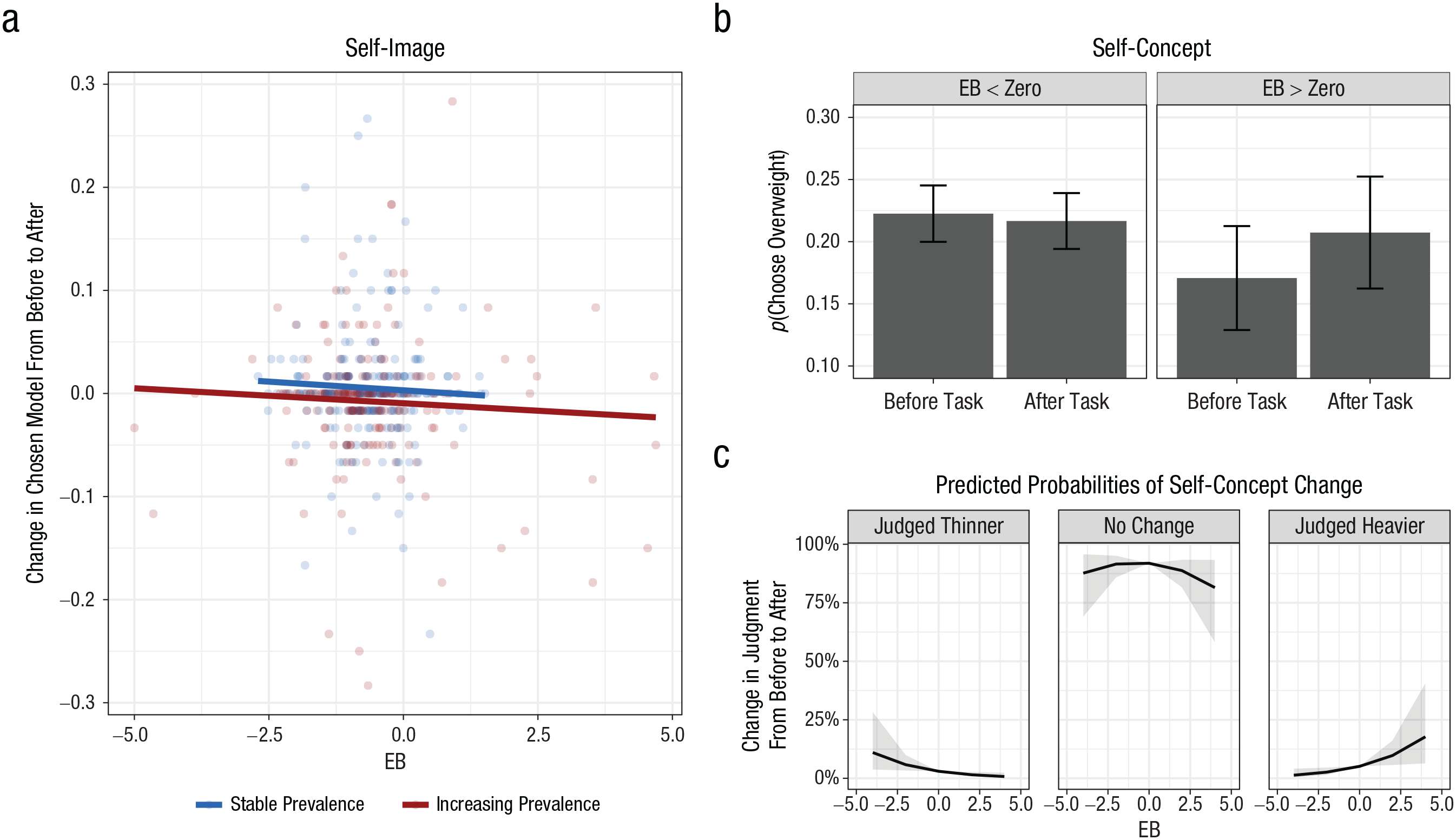
Relationship between sensitivity to concept change and (a) change in self-image and (b, c) change in self-concept across the experiment. The scatterplot (a) shows the relation between the change in the chosen model size from before to after the experiment as a function of empirical Bayes estimates (EBs) of sensitivity to concept change for judgments of other bodies (see the main text for more details). Larger values on the y-axis indicate a change toward heavier bodies. Solid lines indicate best-fitting regressions. The proportion of overweight judgments made on these chosen models both before and after the bodies task is shown in (b). Scores are dichotomized for EB less than 0 and EB greater than 0 for visualization purposes. Error bars represent standard errors. EBs for the probability of judging the chosen model as thinner, heavier, or the same at the end of the task compared with the beginning are shown in (c), as predicted by an ordinal logistic regression. Error bands represent 95% confidence intervals.
Overall, these results suggest that individual differences exist in women’s sensitivity to concept change in judgments about other bodies and that these differences predict how susceptible women’s self-concept is to changes in the prevalence of thin bodies. However, when predicting individual sensitivity to concept change (empirical Bayes estimates) from scores on the questionnaire data that we collected (see the Questionnaires section), we found no significant relationships (see Table S2). We discuss this lack of significant associations in the next section and suggest avenues for future research.
Discussion
Consistent with recent work (Devine et al., 2021; Levari et al., 2018), our results demonstrate that what women consider to be an “average” body shifts in accordance with the prevalence of thin bodies in the environment. Specifically, we found that when the prevalence of thin women in the environment increased, women became significantly more likely to judge other women as overweight, compared with when the prevalence remained the same, that is, 50/50.
On the basis of these results, we propose that prevalence-induced concept change may be a general cognitive mechanism to explain how women’s perception of “normal” bodies in Western society shifts over time: As the prevalence of thin bodies in the media has increased over time (Sypeck et al., 2004), the reference point for normality has shifted to be ever thinner. By “general,” we refer to the fact that prevalence-induced concept change has previously been shown to explain similar shifts in perceptual, social, and moral categories, making it a good candidate for a domain-general explanation of shifts in perception and judgments such as those seen in the current study (Levari et al., 2018). More precisely, the advantage of this framework in the context of women’s body judgments is that media-influenced biases in judgments can be explained in purely mechanistic terms as a comparative decision-making process, wherein people’s estimates of normality are updated by new information (see Wilson, 2018).
Concept change or perceptual adaptation?
The finding that judgments about bodies are context dependent is not unprecedented. In particular, an emergent body of work has focused on the role that lower level perceptual aftereffects play on body judgments (see Ambroziak et al., 2019; Brooks et al., 2016, 2018, 2019, 2020; Challinor et al., 2017; Mele et al., 2013; Mohr et al., 2016). On this view, prolonged exposure to thin bodies causes neural populations responsible for encoding body size to adapt to changing environments. This allows for more efficient coding of stimuli (cf. Clifford & Rhodes, 2005); however, it may also lead to a bias in subsequent body judgments (Brooks et al., 2020). This approach to understanding body-size and body-shape misjudgment has proven useful and influential, both clinically and experimentally (Challinor et al., 2017). Whereas visual adaptation remains an important candidate mechanism for stimulus-induced perceptual distortions in some contexts, our results and conceptual framework—prevalence-induced concept change—differ from it in three important ways.
Methodological differences
Visual adaptation is typically manipulated using a contingent- or cross-adaptation paradigm (Brooks et al., 2016; Challinor et al., 2017). Here, participants are passively exposed to images of bodies (usually the participant’s body) that are manipulated to appear larger or smaller. This exposure phase lasts for a prolonged period of time, during which participants simply observe the stimuli while their vision adapts to the image on the screen. After this adaptation period, participants judge whether a subsequent body is large or small (cf. Brooks et al., 2016, 2020; Mohr et al., 2016).
We deviated from this approach by removing this passive adaptation phase altogether. Instead, participants continuously made judgments, adjusting decision boundaries to changes in the prevalence in an online fashion. In other words, there was no explicit tuning of the perceptual system to a modified body image in the current task and thus no perceptual aftereffect. Rather than being told to refer to an explicit reference point when making judgments, participants had to converge on their own subjective threshold on which to make judgments, which itself is thought to be subject to shifts in accordance with the prevalence of thin bodies. In this sense, our paradigm was designed to capture how reference points are established (i.e., according to a latent decision boundary that reflects recently seen exemplars), rather than anchoring it explicitly to a well-known reference point for the participant.
In our view, our approach more closely mimicked real-world body-image judgment, which happens continuously rather than solely after a period of presumed nonjudgment adaptation.
Conceptual differences
As the name suggests, visual adaptation explains body-size and body-shape misjudgment by means of adaptation in visual perception. That is, misjudgment arises as a direct result of hypothesized overlap of receptive fields in higher order visual areas of the cortex (e.g., lateral occipital cortex, middle frontal gyrus, extrastriate body area, and fusiform body area; Brooks et al., 2020). In other words, the visual-aftereffects model proposes that thresholds for judging a body as thin or overweight remain intact but that the perception of the stimulus itself changes according to prolonged exposure to larger or smaller bodies. Prevalence-induced concept change, on the other hand, has been demonstrated to occur not only in visual judgments (colored dots; faces; and, here, bodies) but also in semantic judgments, such as moral ones (Levari et al., 2018; replicated by Devine et al., 2021) and the truthfulness of news stories (Levari, 2022), where perceptual aftereffects cannot be at play. In this regard, and in contradistinction to a purely visual account, we position our results within a broader framework that predicts that decision boundaries themselves shift in accordance with the prevalence of exemplars in the environment.
Mechanistic differences
If not perceptual aftereffects, what underlying mechanism could explain prevalence-induced concept change? Computational work on prevalence-induced concept change has emphasized the degree to which contextual effects in sequential judgments arise as a function of shifting decision boundaries (Levari, 2022; Wilson, 2018). Specifically, the increased prevalence of exemplars of one kind (here, thin bodies) updates a latent statistic: the concept of an “average” body, which in turn is reinforced by people’s bias toward repeated response, thus reifying this concept change (Wilson, 2018). Critically, this update process occurs over many trials; decision boundaries depend not only on trial-to-trial adaptation but also on longer time-scale changes in the prevalence of stimuli (here, thin bodies) in the environment. Notably, Levari (2022) found that such a model outperformed a perceptual-aftereffects model, in which decision boundaries were updated according to exposure to the previous stimulus only, suggesting that prevalence-induced concept change and perceptual adaptation differ in terms of mechanistic explanations of body-size and body-shape misjudgment.
Overall, then, prevalence-induced concept change can be thought of as a top-down stimulus-induced shift in decision boundaries rather than a bottom-up perceptual phenomenon. This is an important point because such a view of concept change carries certain implications about how to potentially reverse it—that is, how to limit body-size and body-shape misjudgment that arises from changes in the prevalence of thin bodies.
Implications and future directions
In the current task, we induced concept change by increasing the prevalence of thin bodies in the environment, mirroring the shift seen in North American media over past decades (Sypeck et al., 2004). In principle, however, concept change can also occur in the opposite direction. That is, by increasing the prevalence of overweight women and/or reducing the overrepresentation of thin women in the social environment (i.e., balancing the two), we would expect the (already expanded) concept of being “overweight” to shrink (Levari et al., 2018). Such a reversal effect has implications for representation in the media. Specifically, by increasing the number of normal women’s bodies in popular media, we would expect to counteract the overexpansion of the concept of being overweight brought about by the thin ideal. According to the proposed mechanism, then, an increased diversity of body sizes in people’s social environments would yield more accurate judgments of normal versus overweight bodies. Indeed, in the stable-prevalence condition of the current experiment, when the prevalence of thin and overweight bodies was balanced, participants were fairly accurate in their categorizations of stimuli. Anecdotally, we may be seeing just such a reversal occurring in North America: As the objective prevalence of overweight people has increased across the continent over the past four decades (Blackburn & Walker, 2005), there has been an increased acceptance and advocacy for promotion of fat-acceptance measures in the West (Cooper, 2016). Although extrapolatory, this is the exact type of normalization effect that we would expect from the perspective of prevalence-induced concept change. In the European Union, countries such as France and Italy, for instance, have explicitly attempted to harness such a normalizing force by passing legislation that bans overly thin fashion models from public appearances (Dearden, 2017; Poggioli, 2006). Our results lend support to similar policies and suggest that these efforts should have normalizing effects on concepts of normality about young women’s bodies. That being said, our results are the first to demonstrate prevalence-induced concept change in the domain of body judgments, and future research is needed to establish whether and how these results generalize to broader social contexts outside of the lab. Even so, the current conclusions speak to only one aspect of distortions in body perception—namely, the cognitive and decision-making aspect. Crucially, body image is multifaceted, and the policies to improve women’s perception of their own bodies must be multifaceted as well. 7
Notably, at the level of the individual, we found that women whose judgments were most biased by an increased prevalence of thin bodies were also more likely to turn this concept change inward—they were more likely to judge themselves as overweight after being exposed to an increase in thin bodies in the environment (see Fig. 4b). This exploratory result points to important individual differences in the degree to which these prevalence-induced biases in judgments affect women. It is worth noting, however, that these results are exploratory and in need of replication to extrapolate beyond the current sample. Furthermore, they are not without limitations. First, we were not able to explain these individual differences via person-level differences in the collected measures (i.e., various subclinical eating-disorder symptomatologies; see Table S2). Furthermore, we have no measure of test-retest reliability and therefore cannot judge whether these are stable traitlike individual differences or momentary fluctuations in mood or judgment style (i.e., state differences). Finally, empirical Bayes estimates—the measure of individual sensitivity to concept change used here—are an imperfect, inferred measure of individual sensitivity to concept change. Future work should be designed to build on the current experimental paradigm to extract a behavioral measure of concept change that more straightforwardly reflects sensitivity to concept change at the participant level.
Thus, our exploratory results should be understood as an avenue for future research to better understand whether and which individual traits moderate prevalence-induced biases in judgments at a mechanistic level: not only with regard to judgments about others but also how this shift affects judgments about the self. One promising direction for such research would be to explore these effects in an age-comparative manner, given the well-established literature demonstrating adolescents’ increased sensitivity to thin images (Harrison & Cantor, 1997; Stice et al., 2001). Indeed, work from our lab has found that prevalence-induced concept change is sensitive to age differences (albeit in the opposite direction: aging; Devine et al., 2021).
Another future direction might be to test these effects in a clinical sample, given that women with clinical eating disorders tend to devote more attentional resources to thin features in their environment (Pinhas et al., 2014) and display alterations in their learning of latent states (Bernardoni et al., 2018).
Conclusion
The overrepresentation of thin women in Western media creates a thin ideal, wherein thin bodies are considered “normal” and desirable. In the current study, we proposed that prevalence-induced concept change is a basic cognitive mechanism by which this normalization occurs: When the prevalence of thin bodies in the environment increases, the concept of being overweight expands to include bodies that would otherwise be thought of as normal. These findings have implications for cognitive theories that explain how women judge their own and others’ bodies, and they lend preliminary support to policies designed to increase representation of diverse body sizes in the media.
Supplemental Material
sj-docx-1-pss-10.1177_09567976221082941 – Supplemental material for Changes in the Prevalence of Thin Bodies Bias Young Women’s Judgments About Body Size
Supplemental material, sj-docx-1-pss-10.1177_09567976221082941 for Changes in the Prevalence of Thin Bodies Bias Young Women’s Judgments About Body Size by Sean Devine, Nathalie Germain, Stefan Ehrlich and Ben Eppinger in Psychological Science
Footnotes

References
Supplementary Material
Please find the following supplemental material available below.
For Open Access articles published under a Creative Commons License, all supplemental material carries the same license as the article it is associated with.
For non-Open Access articles published, all supplemental material carries a non-exclusive license, and permission requests for re-use of supplemental material or any part of supplemental material shall be sent directly to the copyright owner as specified in the copyright notice associated with the article.
