




Abstract
Mind-body practices such as yoga and meditation are often believed to instill a “quiet ego,” entailing less self-enhancement. In two experiments, however, Gebauer et al. (2018) demonstrated that mind-body practices may actually increase self-enhancement, particularly because such practices become self-central bases for self-esteem. We conducted preregistered replications of both of Gebauer et al.’s experiments. Experiment 1 was a field study of Canadian yoga students (N = 97), and Experiment 2 was a multiwave meditation intervention among Canadian university students (N = 300). Our results supported Gebauer et al.’s original conclusions that mind-body practices increase self-enhancement. Although the self-centrality effects were not clearly replicated in either experiment, we found evidence that measurement and sampling differences may explain this discrepancy. Moreover, an integrative data analysis of the original and the replication data strongly supported all of Gebauer et al.’s conclusions. In short, we provide new evidence against the ego-quieting perspective and in support of the self-centrality interpretation of mind-body practices.
Keywords
Mind-body practices (e.g., yoga, meditation) are common in Western culture and in psychological science (Van Dam et al., 2018). For example, clinical research supports yoga as a complementary treatment for serious mental health disorders (Pilkington et al., 2005). Similarly, meditation-related therapies frequently are examined for many conditions (e.g., depression, anxiety, chronic pain; Baer, 2003). These numerous benefits justify the need for a thorough examination of the underlying mechanisms through which mind-body practices produce benefits, advancing theory and the development of efficacious interventions.
Researchers often attribute the well-being benefits of mind-body practices to practitioners’ lowered levels of ego involvement (e.g., Salmon et al., 2009; Wayment et al., 2015). This purported mechanism is consistent with Buddhist and yoga philosophies, which characterize mind-body practices as antidotes for people’s inflated self-worth (Levine, 2009). According to Gebauer et al. (2018), mind-body practices are thought to reduce the self-centrality of people’s actions (e.g., Ryan & Rigby, 2015), subsequently decreasing self-enhancement bias (i.e., because self-centrality breeds self-enhancement; Gebauer et al., 2013; James, 1907).
However, as Gebauer et al. (2018) posited in their self-centrality principle, it remains unclear that engaging in mind-body practices should decrease the self-centrality of people’s actions, particularly actions most relevant to the practices themselves. Meditators, for example, may feel pride in their capacity to “sit with” negative thoughts and feelings, increasing rather than decreasing self-enhancement. In two experiments, one involving yoga (Experiment 1) and one using a loving-kindness meditation (Experiment 2), Gebauer et al. (2018) competitively tested the ego-quieting hypothesis against the self-centrality principle. Using a within-subjects design, Gebauer et al. asked participants to complete several self-related questionnaires, alternating the time so that questionnaires were completed either before they engaged in mind-body practice (control condition) or afterward (experimental condition). They found that (a) mind-body practices increase self-centrality of practice-relevant behaviors, (b) mind-body practices increase self-enhancement (e.g., perceptions of the self as better than average, communal narcissism, and self-esteem), and (c) increased self-centrality of yoga skills mediates the benefits of mind-body practices to well-being.
Gebauer et al.’s (2018) findings were surprising given the larger “quiet-ego” literature, and counterintuitive findings are particularly important to replicate. The original experiments also had some mixed results that a replication study might clarify. Specifically, yoga increased communal narcissism in Experiment 1, but meditation did not increase communal narcissism in Experiment 2, making it unclear whether these activities differed importantly or whether one finding was a false positive or false negative. Thus, the present replication attempts provided further data to help determine whether mind-body practices increase communal narcissism, which generally is viewed as a problematic personality feature (Barry et al., 2017). Additionally, in the original study, participants with more yoga experience trended toward having larger self-centrality effects (see Section S5 in Gebauer et al.’s, 2018, Supplemental Material), and we reasoned that our replications might shed light on this possible boundary condition.
Although debate exists about the definition of direct replication, that is what we label the present work (despite likely intersite variability, as we will examine later) because (a) we recreated all aspects of Gebauer et al.’s (2018) procedure germane to the original authors’ hypotheses, and (b) we consulted with J. E. Gebauer to ensure that our work was compatible with his research, including the use of crucial experimental materials, which he approved or provided (e.g., an English-translated version of Experiment 2’s audio recording, which was provided by J. E. Gebauer). Experiments 1 and 2 were both preregistered (see https://osf.io/v85sk and https://osf.io/pvgjx, respectively), and the materials and data for both experiments are publicly available (see https://osf.io/v3stn/ and https://osf.io/g69m4/, respectively).
Statement of Relevance
Mind-body practices (meditation, yoga) are popular, but their psychological effects are hotly debated. Some researchers view mind-body practices as “ego quieting,” meaning that they reduce people’s self-focus and desire to be better than others. Yet a recent study found that when Germans engaged in mind-body practices, succeeding at those practices became central to their sense of self. As they increasingly viewed themselves as skillful at mind-body practices, they tended to feel that they were better than other people overall (as shown by increases in self-esteem, narcissism, and beliefs that they were better than average). Given these remarkable findings, we attempted to replicate the German findings in two samples of Canadians. We replicated the finding that mind-body practices made people feel that they were more accomplished than others overall. When we combined the original and replication data sets, we also replicated the findings of self-centrality. Thus, our experiments provide new evidence that mind-body practices enhance rather than quiet the sense of self.
Experiment 1: Yoga
One well-studied mind-body practice is yoga, likely because of its psychological and physical health benefits (Baer, 2003; Grossman et al., 2004; Hyland et al., 2015). Yoga involves a sequence of postures, termed asanas, that incorporate focused attention and regulated breathing to bring one’s awareness to the present moment (Levine, 2009; Salmon et al., 2009).
Method
Participants
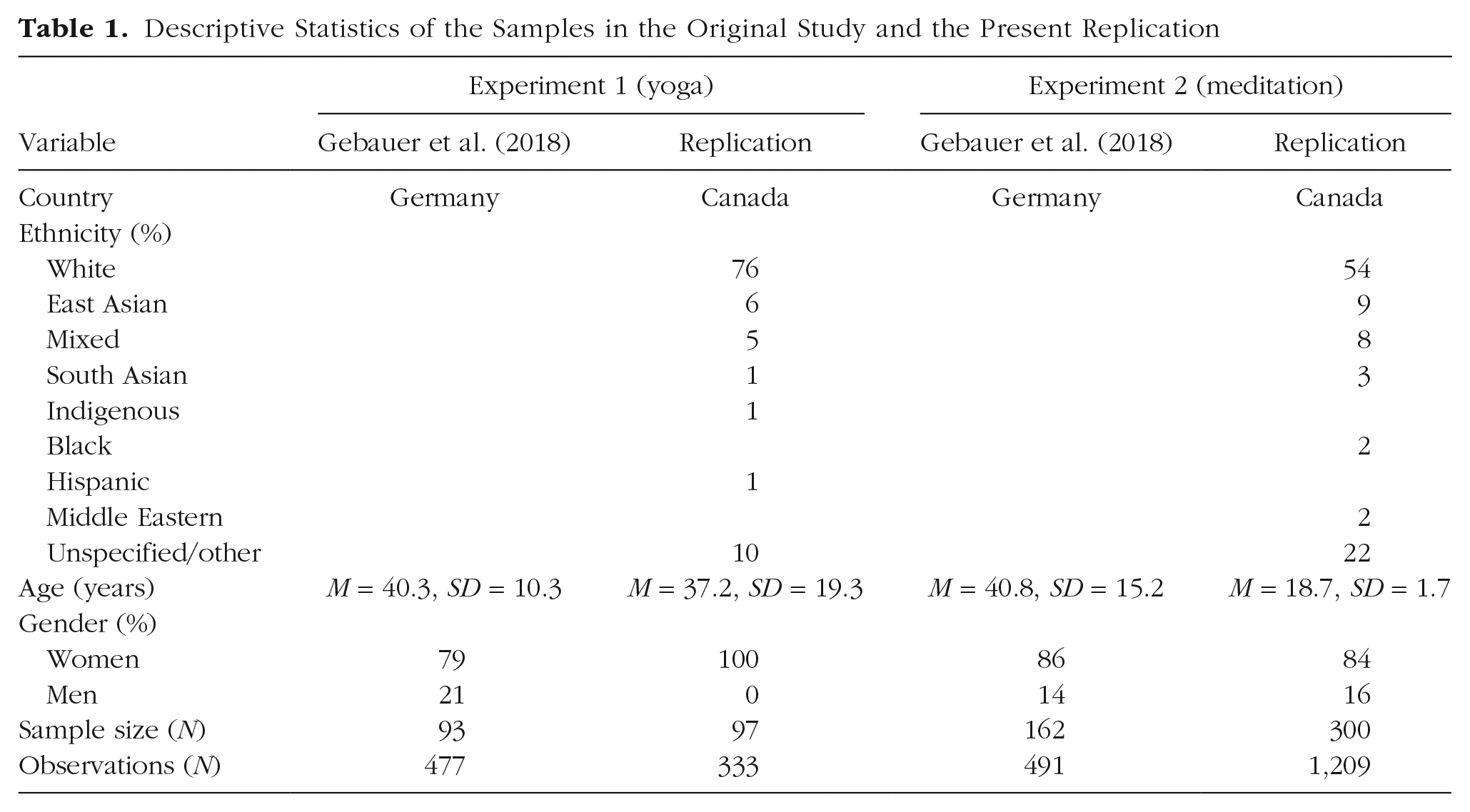
We conducted separate power analyses for Experiments 1 and 2 because their effect sizes were different, predicating power in each case on number of observations rather than sample size (because each participant provided a variable number of observations). Originally, we intended to collect 477 observations, seeking to match Gebauer et al. (2018), who had 477 observations across 93 participants. However, early in our second wave, the COVID-19 pandemic occurred, and local yoga studios suddenly closed. Because it was unclear when yoga studios would reopen, we decided to terminate data collection early. We originally collected data from 137 participants, but following our preregistration, we removed 40 participants who had only a single observation. Therefore, our final sample consisted of 97 participants who provided 333 observations. Descriptive statistics for the sample are shown in Table 1.
Descriptive Statistics of the Samples in the Original Study and the Present Replication
Procedure
We engaged in a variety of recruitment practices to collect a master email list that we then used to provide letters of information and consent. When consent was obtained, the master list was used to distribute surveys. Authors T. I. Vaughan-Johnston and A. Prosserman negotiated with the managers of local yoga studios in person or via telephone, requesting to display posters, have instructors tell their students about the study, or allow these authors to drop in and collect email addresses from students. Participants were sorted into two groups to counterbalance whether the control condition or experimental condition was completed first. Then on alternating weeks, participants were in either the control group or the experimental group. More specifically, following Gebauer et al.’s (2018) study, we used a within-subjects design; both groups received identical surveys, but the timing of survey completion varied. On the weeks when participants were in the control group, their surveys were sent 2 hr prior to their yoga session with explicit instructions to complete all materials before the yoga class, if possible. On the weeks when they were in the experimental group, surveys were dispatched to arrive approximately when their yoga class terminated to prevent people from completing materials early.
Each wave of the survey consisted of a consent form and questionnaires assessing self-centrality, better-than-average beliefs, self-esteem, communal narcissism, and several items included for additional research separate from the replication (for sample items, see the Materials section; verbatim materials are available in Section S1 in the Supplemental Material available online). Participants indicated whether they had completed the survey before yoga or after yoga or were not planning to attend yoga at all that day. Finally, participants provided demographic information (ethnicity, gender, and age) and answered two additional questions: (a) to what extent they felt motivated to practice yoga and (b) to what extent they had prior yoga experience. The experiment was approved by the Queen’s University General Research Ethics Board.
Materials
Materials mirrored those used by Gebauer et al. (2018) but employed 101-point rating scales for questionnaires. We made this change because Gebauer et al. themselves introduced this approach in their Experiment 2, and the same goal (reducing consistency effects) seemed equally relevant to Experiment 1. The original study’s first author approved this change (J. E. Gebauer, personal communication, June 17, 2019).
Self-centrality
Four items assessed the self-centrality of yoga to participants (Brown, 2012). A sample item was, “Focusing mindfully on the exercises across the whole yoga class is . . .” (0 = not at all central to me, 100 = central to me).
Better than average
Four items assessed the degree to which participants perceived themselves as better than the average yoga student in their yoga class. A sample item was, “In comparison to the average participant of my yoga class, my ability to focus mindfully on the exercises across the whole yoga class is . . .” (0 = well below average, 100 = central to me). To examine whether these effects extended beyond the yoga domain, we also added novel items about participants’ relative intelligence and appearance (one item each).
Communal narcissism
Following Gebauer et al. (2018), we used a four-item subset of communal-narcissism items from Gebauer et al. (2012). A sample item was, “I am the most caring person in my social surrounding” (0 = does not apply at all, 100 = applies completely). Communal narcissism is linked with an inflated perception of oneself as prosocial, making it a good self-enhancement measure (Nehrlich et al., 2019).
Self-esteem
Participants rated the applicability of this statement to themselves: “At the moment, I have high self-esteem” (0 = does not apply at all, 100 = applies completely).
Motivation and experience
We included two additional items: “To what extent do you feel motivated to practice yoga in your life in general?” (0 = not at all, 100 = extremely) and “To what extent have you had experience with yoga, NOT INCLUDING this research study?” (0 = none at all, 100 = a great deal).
Results
Preliminary considerations
Internal consistency
Internal consistency was weak for self-centrality (α = .53; compare Gebauer et al.’s α = .90) but acceptable to good for measures of better than average (α = .76) and communal narcissism (α = .83). Our novel better-than-average items correlated moderately, r(301) = .44, p < .001, and were averaged. In response to a reviewer’s request, we report analyses of individual items in Section S6 in the Supplemental Material.
Confirmatory factor analysis
Following our preregistration, we conducted confirmatory factor analyses to see whether our new better-than-average items were better represented on the same factor as the original better-than-average items or separately. A two-factor structure was superior (as shown in Section S3 in the Supplemental Material), so we treated these sets as distinct variables.
Determination of the self-enhancement g factor
Following Gebauer et al., we analyzed whether a latent g factor accounted for better-than-average, communal-narcissism, and self-esteem responses; indeed, these produced significant standardized loadings on a common factor (.79, .60, and .53, respectively). This g factor was analyzed as a dependent variable.
Primary analyses: multilevel models
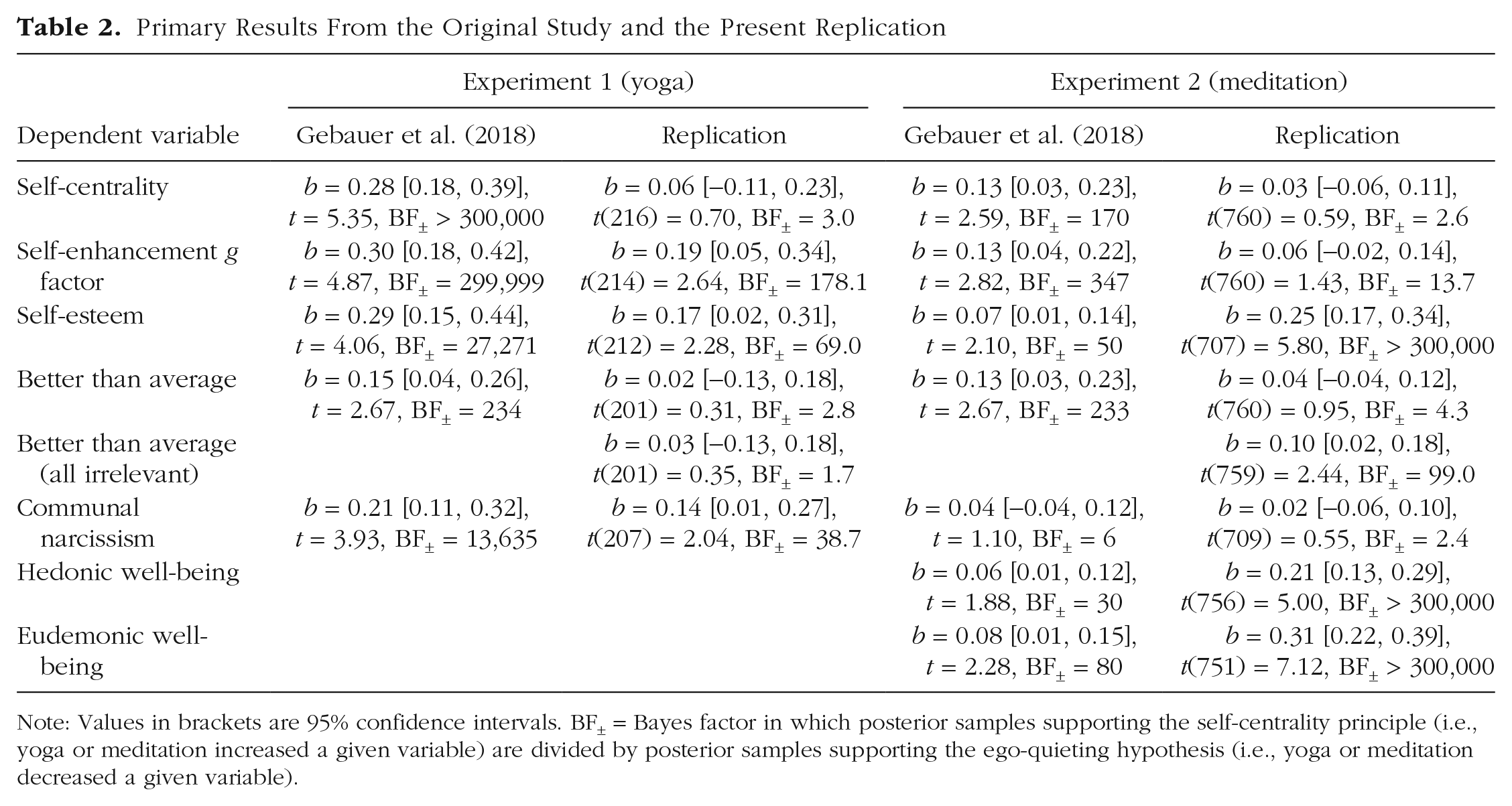
Because the data were nested (i.e., assessments nested within participants), we used multilevel modeling with random intercepts. Gebauer et al. publicly posted code for their Experiment 2, which we followed using the lme4 package (Version 1.1-20; Bates et al., 2015) and the BayesFactor package (Version 0.9.12-4.2; Morey & Rouder, 2015) in the R programming environment (Version 3.5.2; R Core Team, 2017). Following Gebauer et al.’s procedure, we dummy-coded the condition variable: The control (before-yoga) condition was 0 and the experimental (after-yoga) condition was 1. Thus, the unstandardized regression weights can be interpreted as mean differences between when participants completed the questionnaires before yoga compared with after yoga. Effects from both the original study and the replication are compared in Table 2 and Figure 1; moderation and mediation effects from both studies are shown in Tables 3 and 4, respectively. Note that BF± refers to a Bayes factor (BF) in which posterior samples supporting the self-centrality principle (i.e., yoga increased a given variable) are divided by posterior samples supporting the ego-quieting hypothesis (i.e., yoga decreased a given variable). Thus, these coefficients refer to the relative likelihood of the self-centrality principle versus the ego-quieting hypothesis rather than to the relative likelihood of the typical null hypothesis versus no effect, making our BFs interpretatively different from our frequentist analyses (for details on this encompassing BF method, see Hoijtink, 2012; Klugkist et al., 2005). The BF±s express varying degrees of relative support for one hypothesis over another; BF±s from 1 to 3 indicate trivial support, from 3 to 10 indicate substantial support, from 10 to 30 indicate strong support, from 30 to 100 indicate very strong support, and greater than 100 indicate extreme support (Jeffreys, 1961).
Primary Results From the Original Study and the Present Replication
Note: Values in brackets are 95% confidence intervals. BF± = Bayes factor in which posterior samples supporting the self-centrality principle (i.e., yoga or meditation increased a given variable) are divided by posterior samples supporting the ego-quieting hypothesis (i.e., yoga or meditation decreased a given variable).
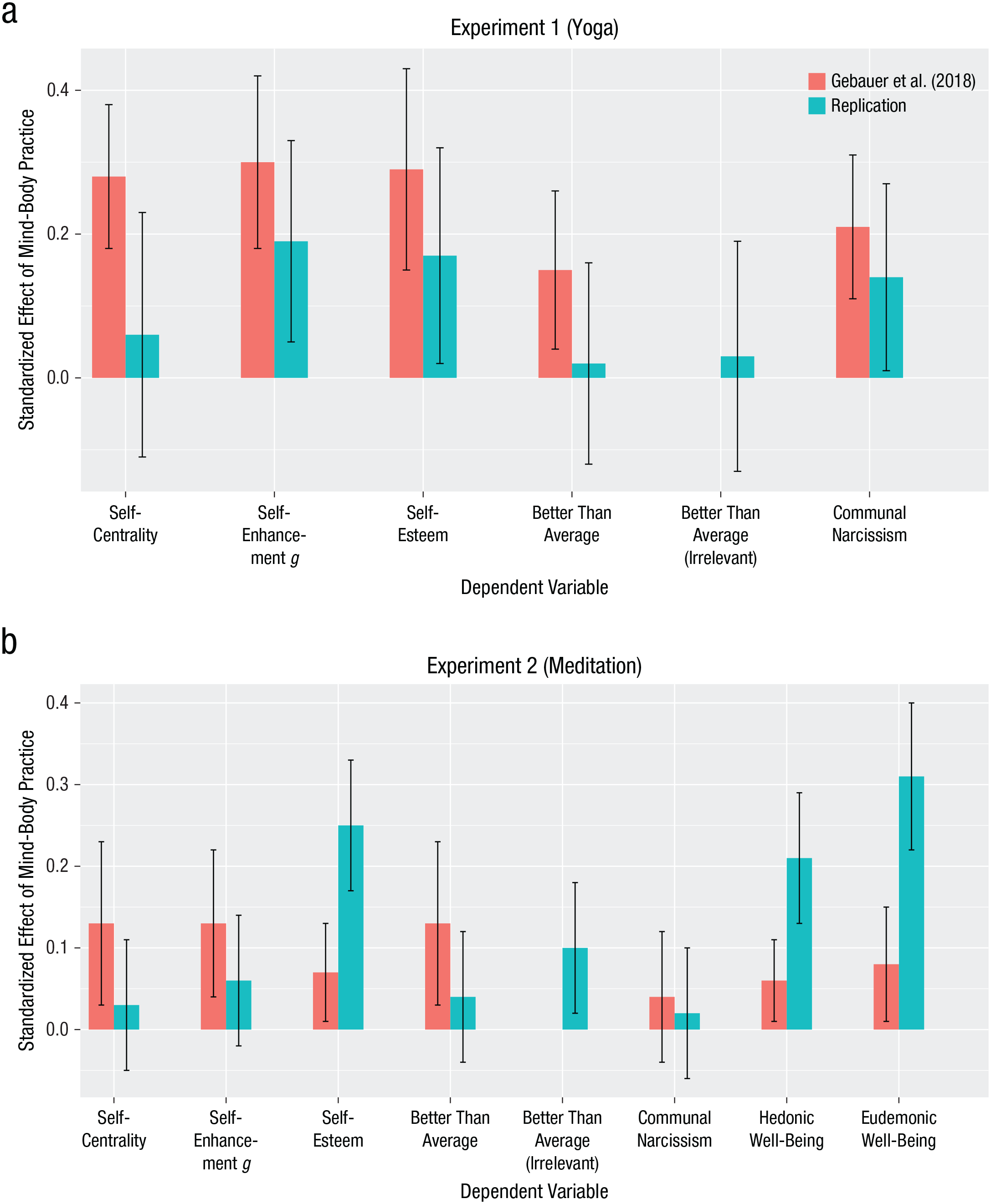
Standardized effect of mind-body practice condition on each dependent variable in the original study by Gebauer et al. (2018) and the present replication. Results are shown separately for (a) Experiment 1 and (b) Experiment 2. Error bars reflect 95% confidence intervals.
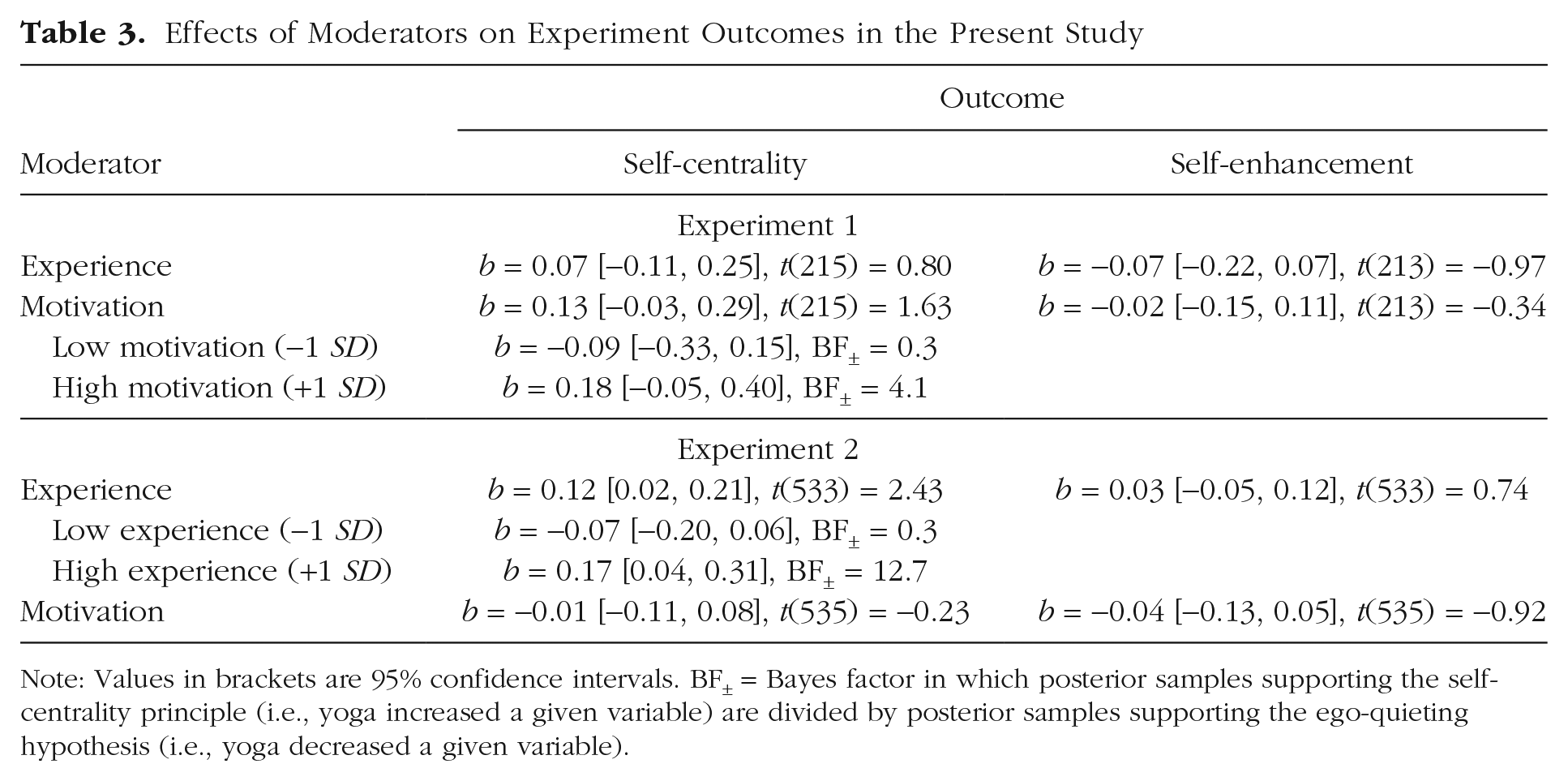
Effects of Moderators on Experiment Outcomes in the Present Study
Note: Values in brackets are 95% confidence intervals. BF± = Bayes factor in which posterior samples supporting the self-centrality principle (i.e., yoga increased a given variable) are divided by posterior samples supporting the ego-quieting hypothesis (i.e., yoga decreased a given variable).
Effects of Yoga (Experiment 1) and Meditation (Experiment 2) in the Original Study and the Present Replication
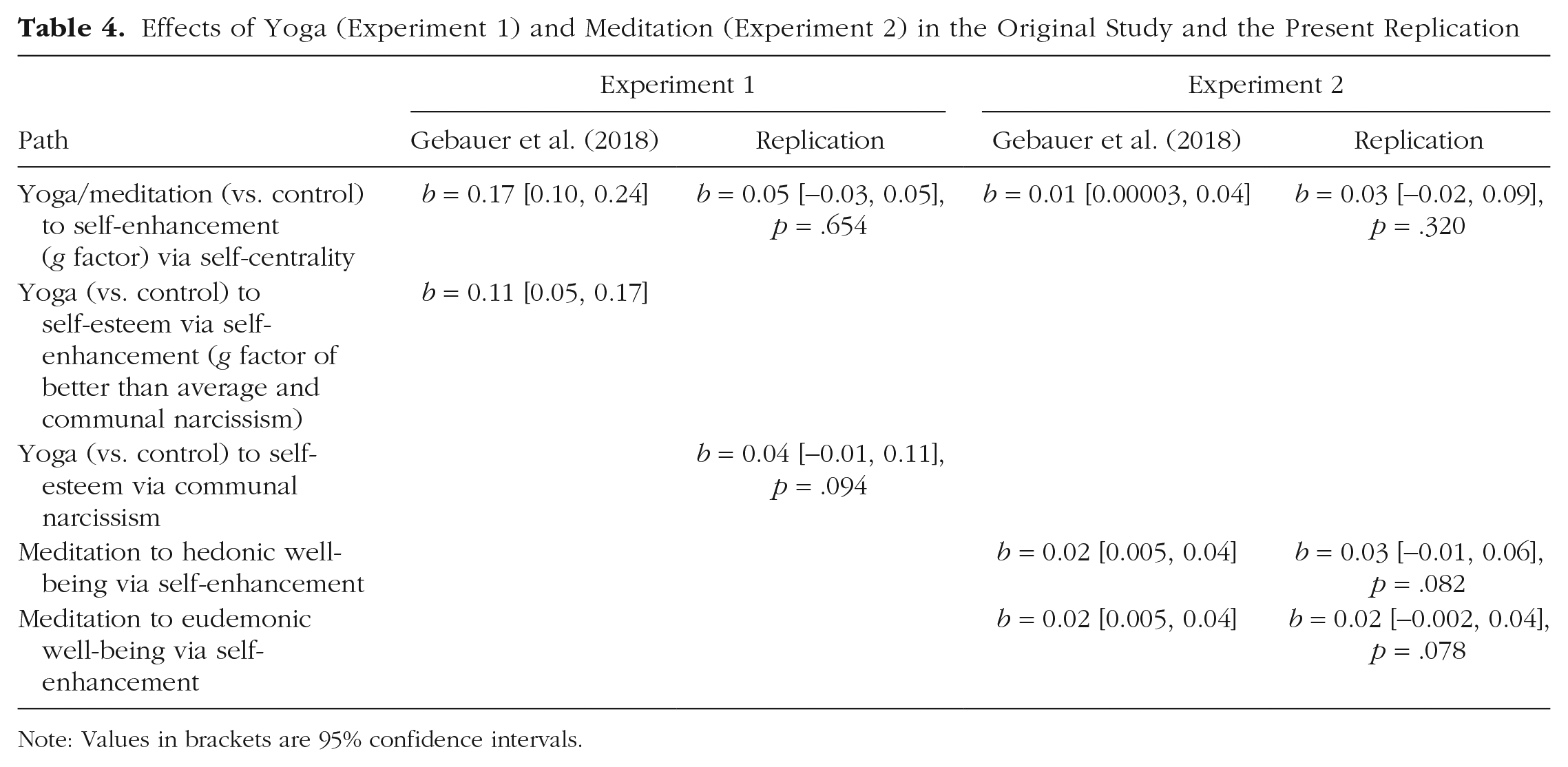
Note: Values in brackets are 95% confidence intervals.
Self-centrality effects
We first examined whether yoga increased participants’ self-centrality. Surprisingly, in our frequentist analysis, the effect was not significant, but the BF provided borderline evidence of somewhat greater support for the self-centrality principle relative to the ego-quieting hypothesis (albeit much more weakly than in the original study).
One explanation for this weaker effect could be sampling differences. Overall, our participants reported reasonable levels of motivation (M = 78.0, SD = 19.1) and past yoga experience (M = 69.1, SD = 23.0). Nonetheless, the standard deviations indicated substantial between-person variance in both dimensions. Because the authors of the original study surmised that differences in motivation and experience could drive different outcomes (J. E. Gebauer, personal communication, July 25, 2018), we tested whether the impact of yoga on self-centrality might vary on the basis of motivation and/or experience. To this end, we grand-mean-centered motivation and experience, each estimated from a given participant’s first assessment, and included these items as moderators in the model predicting self-centrality scores. Although the interaction was not significant for experience, we found some support for the predicted interaction of Motivation × Experimental Condition on self-centrality (see Table 3). Specifically, although our participants lower in motivation (1 SD below the grand mean) showed no significant self-centrality effect, our participants higher in motivation (1 SD above the grand mean) showed a positive self-centrality effect. Thus, practicing yoga made yoga skills self-central for participants who should show these effects most strongly (people higher in motivation) but was ineffective among participants who should show effects most weakly (people lower in motivation).
A second possibility is that the self-centrality measure performed inadequately in the present sample. The self-centrality measure showed weak internal consistency in our sample, so we decided to conduct an exploratory check of the individual self-centrality items as separate dependent variables. Although no significant effects of condition emerged, the first item (self-centrality of “executing correctly the asanas”) produced a BF± of 3.8, and the third item (self-centrality of “holding the asanas . . . as long as we were taught”) produced a BF± of 4.0. These items may be substantively different from the second (yielding BF± = 1.2) and fourth (BF± = 1.4) items, which pertained to mindful attitudes and integration of yoga into participants’ lives, respectively.
Self-enhancement and moderation by experience and/or motivation
We largely replicated Gebauer et al.’s original findings. Frequentist statistics supported yoga effects on overall self-enhancement, self-esteem, and communal narcissism. Bayesian statistics also indicated that these variables showed greater support for the self-centrality principle than the ego-quieting hypothesis. Bayesian (but not frequentist) analysis indicated a trivial increase in the better-than-average effect after yoga. Neither motivation nor experience moderated these effects.
Self-centrality as a process for the self-enhancement effect
Given that self-centrality did not significantly increase in the overall sample, one would not expect the mediation effect of yoga on self-enhancement through self-centrality to be statistically significant (because the ab mediation path was not significant). Indeed, a test of mediation was not significant.
Self-enhancement as a process for the well-being effect
Gebauer et al. found that the latent self-enhancement g factor composed of communal narcissism and better than average mediated the relationship between yoga and well-being (defined as self-esteem). We found that a confirmatory factor model of just communal narcissism and better than average did not converge, even though communal narcissism, better than average, and self-esteem did converge earlier (see the “Determination of the self-enhancement g factor” section above). Therefore, we ran separate mediation models in which communal narcissism and better than average were entered as individual mediators. Communal narcissism mediated the relationship between yoga and self-esteem; better than average did not (b = −0.008, 95% confidence interval = [−.05, .02], p = .626).
Discussion
In the frequentist analyses, we generally replicated Gebauer et al.’s findings regarding self-enhancement; significant effects emerged in the hypothesized direction for self-enhancement, self-esteem, and communal narcissism (but not self-centrality or better than average). In the Bayesian framework, we replicated Gebauer et al.’s findings on all variables, and only better than average fell into a borderline range (BF± = 2.8).
Concerning the nonsignificant overall self-centrality effects, one possibility is that this null effect is due to a statistical power issue. However, we found possible evidence of an interaction effect whereby self-centrality effects emerged among only relatively experienced participants (for a reexamination of all analyses with inexperienced participants removed, as recommended by a reviewer, see Section S4 in the Supplemental Material). Furthermore, separation of the self-centrality items revealed that our participants may have seen only the physical yoga behaviors as self-central, not the broader yoga philosophy or lifestyle integration. Therefore, we suspect that construct or external-validity differences are more plausible explanations for the discrepancy.
Experiment 2: Meditation
Method
Participants
Participants in Experiment 2 were Canadian young adults. Of 373 participants, we excluded 73 because they did not contribute in at least two waves of data collection, following our procedure in Experiment 1 and our preregistration. Unlike Gebauer et al. (2018), who recruited from meditation and yoga schools and from Facebook groups, we recruited our participants from an undergraduate psychology subject pool. Consequently, our participants likely had no special background with meditation, and they were younger than Gebauer et al.’s sample (see Table 1). The first two waves were completed in the lab to build experience with the meditation instructions and allow questions to be answered in person, whereas the third and fourth waves were completed online. Thus, this aspect of our procedure differed from the original study, in which all waves were completed online.
Procedure
As in Experiment 1, we used a within-subjects design in which participants alternated between the control (questionnaires before meditation) and the experimental (questionnaires after meditation) conditions each week. Consequently, most participants provided data for two control sessions and two experimental sessions. Participants completed all questionnaires in the lab on individual desktops or laptops arranged to maximize privacy, or when online, they found a quiet place to complete the questionnaires on their own device. During the meditation, participants sat in a common room while the meditation instructions played on a speaker, or when online, they listened to a digital file on their own device. Participants were to listen carefully and closely follow the meditation instructions. The experiment was approved by the Queen’s University General Research Ethics Board.
Materials
For the meditation recording, we used a loving-kindness meditation track (Condon et al., 2013) translated into English from the original study’s German. Questionnaires were identical to those used by Gebauer et al. (2018, Experiment 2). Participants selected responses on a 101-point scale presented as a slider.
Self-centrality
Ten items evaluated how much participants felt that meditation-relevant concepts were self-central. A sample item was, “How central is it for you to be free from envy?” (0 = not at all central to me, 100 = very central to me). To mask the hypothesis, we included six additional items pertaining to irrelevant domains (e.g., “How central is it for you to . . . be intelligent/have a charming personality/be attractive/have people enjoy my company/be persuasive/be funny?”).
Better than average
Ten items evaluated how much participants felt that they were superior to “the average participant of this study” on a variety of qualities. A sample item was, “I am a caring person” (0 = very much below average, 100 = very much above average). We included the same six irrelevant domains from the self-centrality questionnaire to determine whether people self-enhanced in domains beyond meditation-relevant ones.
Communal narcissism
Sixteen items probed participants’ inflated self-views in a communal domain (full items from Gebauer et al., 2012). A sample item was, “I will be able to solve world poverty” (0 = disagree strongly, 100 = agree strongly).
Self-esteem
Ten items probed the positivity of participants’ self-views (Rosenberg, 1965). A sample item was, “On the whole, I am satisfied with myself” (0 = disagree strongly, 100 = agree strongly).
Well-being
Hedonic (14 items; e.g., “I am happy”) and eudemonic (10 items; e.g., “In many ways, I feel disappointed about my achievements in life”; 0 = absolutely wrong, 100 = absolutely right) well-being items were drawn from past work on well-being (Diener et al., 1985; Ryff & Keyes, 1995).
Motivation and experience
We included two additional items: “To what extent do you feel motivated to engage in meditation practice in your life in general?” (0 = not at all, 100 = extremely) and “To what extent have you had experience with meditation, NOT INCLUDING this research study?” (0 = none at all, 100 = a great deal).
Results
Preliminary considerations
Internal consistency
Internal consistency was high for self-centrality (α = .94), better than average (α = .94), communal narcissism (α = .93), self-esteem (α = .91), eudemonic well-being (α = .77), and affective (α = .87) and cognitive (α = .88) types of hedonic well-being, which themselves correlated at an r of .55 and were, therefore, collapsed into a general hedonic-well-being index. The novel self-centrality items (α = .86), novel better-than-average (α = .89), and novel communal-narcissism (α = .84) items also were internally consistent.
Confirmatory factor analysis
Following our preregistration, we conducted confirmatory factor analyses to see whether our new better-than-average items were better represented on the same factor as the original better-than-average items or separately. A two-factor structure was superior, so we treated these sets of items as distinct variables (see Section S3).
Determination of the self-enhancement g factor
Following Gebauer et al. (2018), we analyzed whether a latent g factor accounted for better-than-average, communal-narcissism, and self-esteem responses; indeed, these produced significant standardized loadings on a common factor (.86, .75, and .40, respectively). This g factor was analyzed as a distinct dependent variable.
Primary analyses: multilevel models
Because the data were nested (i.e., assessments nested within participants), we employed multilevel modeling with the intercepts modeled randomly by participant.
Self-centrality and moderation by experience and/or motivation
As revealed in Table 2, once again, frequentist analysis did not support higher self-centrality in our experimental condition. However, Bayesian analyses slightly favored the self-centrality principle over the ego-quieting hypothesis.
Given the significant interaction effect in Experiment 1, we examined whether individual differences might again moderate our null self-centrality effect. Overall, Experiment 2’s participants were moderately motivated (M = 56.5, SD = 25.3) but inexperienced at meditation (M = 39.8, SD = 26.9). Gebauer et al. sampled relatively experienced meditators (M = 4.44 years), which might drive differences on self-centrality. Therefore, we conducted moderation analyses as in Experiment 1. Indeed, although the interaction with motivation was not significant, we found a significant interaction of Experience × Condition on self-centrality (see Table 3). Meditators with less prior experience showed no significant self-centrality effect, but meditators with more prior experience (i.e., those more similar to Gebauer et al.’s participants) did. This pattern provided support for the original authors’ proposed boundary condition.
Self-enhancement
Our frequentist and Bayesian analyses reached somewhat contrary conclusions regarding self-enhancement. Frequentist statistics supported effects of meditation only on self-esteem. However, the Bayesian competitive analysis supported extreme evidence for self-esteem as well as effects on the self-enhancement g factor, the better-than-average effect, and possibly communal narcissism. In other words, these variables provided greater support for the self-centrality over the ego-quieting hypothesis. Neither experience nor motivation moderated these effects.
Interestingly, we found even greater support for self-enhancement on the meditation-irrelevant better-than-average questions (statistically significant plus strong BF) than for the meditation-relevant questions. This result is somewhat surprising from a self-centrality perspective, and we will examine it further in the General Discussion section. Separate analyses of each specific trait for which meditation led to better-than-average effects are provided in Section S6.
Well-being
We found much stronger evidence for well-being effects than did the authors of the original study (i.e., standardized regression weights 3 to 4 times larger, and much larger BFs). Effects appeared to be extremely robust for both eudemonic and hedonic forms of well-being.
Self-centrality as a process for the self-enhancement effect
We next tested for an indirect path from meditation (vs. control) to augmented self-enhancement (g factor) via increased self-centrality (see Table 4). As expected from the nonsignificant ab path, mediation was not significant.
Self-enhancement as a process for the well-being effect
The next question was whether self-enhancement could partly explain meditation’s well-being benefits, as in the original experiments. Indeed, we found consistent mediation effects in the expected direction for both eudemonic and hedonic well-being. In this context, we interpreted effects of our p less than .10 as good support for the original, given that we were pursuing a confirmatory analysis (i.e., possibly justifying a one-tailed significance test). Thus, these data supported the self-centrality principle in that meditation’s well-being benefits were partially accounted for by the self-enhancement that this practice inculcates. 1
Integrative Data Analysis
We conducted an integrative data analysis that pooled the two original Gebauer et al. (2018) and two replication data sets together. Neither the original article nor this replication have associated file-drawer studies (as confirmed by J. E. Gebauer), meaning that these data are uncontaminated by publication bias. We briefly summarize the results here, but a full description of statistical procedure and results is provided in Section S5 in the Supplemental Material. Mind-body practices produced hypothesized effects on all dependent variables in the original experiments (ps < .01, BF±s > 5.3), including self-centrality. Additionally, all mediation effects in the original experiments emerged (ps < .05, > 3% variance explained). In short, despite the replication experiments producing some larger and smaller effects compared with the original study, a synthesis of all available data strongly supports the self-centrality interpretation of mind-body practices.
General Discussion
Mind-body practices, including yoga and meditation, are of growing interest both to the public and to psychologists, but their psychological mechanisms often remain understudied (see Van Dam et al., 2018). Gebauer et al.’s (2018) findings challenge a common assumption that mind-body practices inculcate a quiet ego that soothes self-enhancement needs, and they provide a novel explanation concerning self-centrality. In our two preregistered replications, we found strong evidence that the ego-quieting perspective is untenable (self-enhancement increased rather than decreased) and more tentative evidence supporting the self-centrality position (self-centrality increased on only some indices; indirect effects were marginal).
Still, several observations led us to ultimately affirm Gebauer et al.’s conclusions. First, our effects show a mixture of roughly equivalent, smaller, and larger effect sizes that might be expected from new samples. For example, pooling all effects and experiments, we found that seven of our replication effects (58.3%) showed standardized coefficients that fell within the original work’s confidence intervals, two (16.7%) that fell below the original’s lower bound, and three (25.0%) that fell above the original’s upper bound. Specifically, mind-body practices promoted self-enhancement rather than a quiet ego, and effects emerged most clearly for self-esteem (both experiments), communal narcissism (Experiment 1), general self-enhancement, well-being, and some better-than-average items (Experiment 2). Viewed this way, the smaller self-centrality effects could be a product of statistical fluctuation (Stanley & Spence, 2014). Second, an integrative data analysis of all original and replication data sets revealed that mind-body practices increased self-centrality and all self-enhancement variables, and it supported the self-centrality principle’s mechanism (mind-body practice increased self-enhancement via increased self-centrality).
The self-centrality effect is particularly key because it represents the self-centrality principle’s proposed mechanism for the enhancement effects of mind-body practices. Self-centrality effects in the replication studies were surprisingly weak. However, when effects do not replicate at a statistically significant level, researchers should consider possible differences in various dimensions of validity (Fabrigar et al., 2020). Psychologists often principally attribute replication failures to differences in statistical conclusion validity (i.e., declaring the original a Type I error or the replication a Type II error). Differences in external and/or construct validity may be critical in the present case. Crucially, self-centrality did increase in both replication experiments but only among relatively motivated yoga students (Experiment 1) and relatively experienced meditators (Experiment 2). These findings match prior research in which the benefits of mindfulness-related activities depend on practitioners’ motivation levels (van Hooff & Baas, 2013) and previous experience (Brewer et al., 2011). Thus, our self-centrality effects likely were weakened because our sampling drew in less motivated and experienced participants compared with Gebauer et al.’s more constrained sample (Section S4 presents results for Experiment 2 without the inexperienced participants). This finding highlights a possible boundary condition for the self-centrality route to self-enhancement.
Furthermore, the self-centrality measure in Experiment 1 showed poor internal consistency, and only the items relevant to yoga behavior (not to mindfulness and broader lifestyle integration) supported the self-centrality principle. An original study’s measure may not carry identical psychometric properties in a new population (Fabrigar & Wegener, 2016). For example, Canadian yoga studios may not consistently focus on integrating mindfulness into practitioners’ lifestyles, unlike German yoga studios. However, both cultures’ studios probably focus on body positions. Hence, a measure that treats all of these skills as unidimensional performs worse in Canada than in Germany.
Nonetheless, we found that mind-body practices increased self-enhancement even when they did not substantially increase self-centrality. Although the self-centrality principle is a good explanation for the appearance of mind-body benefits to outcomes such as self-esteem or (downstream) well-being, self-centrality may be only one route to these outcomes. Relatedly, in Experiment 2, we found better-than-average effects on attributes substantively irrelevant to mind-body practice (i.e., intelligence), which is puzzling from a purely self-centrality viewpoint. Perhaps mind-body practices contain elements that directly increase self-esteem. For instance, both practices might contain messages that bolster participants’ self-views. For example, Experiment 2’s meditation sessions focused on loving-kindness, explicitly inviting participants to direct love toward themselves (and others). Self-love directions might induce self-enhancement even on meditation-irrelevant traits, increasing self-esteem beyond the indirect impact of self-central skills. This idea could be examined in future research by comparing the magnitude of self-enhancement effects generated by meditations that do involve explicit self-love instructions (e.g., loving-kindness) with those that do not (e.g., mindfulness meditation). This may suggest a path from mind-body practice to self-enhancement independent of self-centrality.
In sum, the present work generally provides strong replication evidence for a novel, counterintuitive finding. Our overall conclusions strongly oppose the ego-quieting hypothesis and moderately support the self-centrality principle, particularly when all available data were analyzed together. Research paradigms that involve multistage interventions, field work, and other laborious procedures frequently may be passed over as replication candidates. In our opinion, the effort was justified, providing additional clarity about the psychological consequences of mind-body practices.
Supplemental Material
sj-docx-1-pss-10.1177_0956797621997366 – Supplemental material for Mind-Body Practices and Self-Enhancement: Direct Replications of Gebauer et al.’s (2018) Experiments 1 and 2
Supplemental material, sj-docx-1-pss-10.1177_0956797621997366 for Mind-Body Practices and Self-Enhancement: Direct Replications of Gebauer et al.’s (2018) Experiments 1 and 2 by Thomas I. Vaughan-Johnston, Jill A. Jacobson, Alex Prosserman and Emily Sanders in Psychological Science
Footnotes
Acknowledgements
The present work was facilitated by Jochen E. Gebauer, who provided crucial materials and proposed moderation analyses. This engaged spirit of response to replication science was greatly appreciated. Data collection was consistent with principles of the  Ethical Principles of Psychologists and Code of Conduct.
Transparency
Action Editor: Patricia J. Bauer
Editor: Patricia J. Bauer
Author Contributions
T. I. Vaughan-Johnston wrote the preregistrations for both experiments. T. I. Vaughan-Johnston and A. Prosserman planned and collected the data for Experiment 1, and T. I. Vaughan-Johnston and E. Sanders planned and collected the data for Experiment 2. J. A. Jacobson analyzed the data. T. I. Vaughan-Johnston wrote the manuscript. A. Prosserman contributed to the introduction. J. A. Jacobson, A. Prosserman, and E. Sanders edited the manuscript. All the authors approved the final manuscript for submission.
Notes
References
Supplementary Material
Please find the following supplemental material available below.
For Open Access articles published under a Creative Commons License, all supplemental material carries the same license as the article it is associated with.
For non-Open Access articles published, all supplemental material carries a non-exclusive license, and permission requests for re-use of supplemental material or any part of supplemental material shall be sent directly to the copyright owner as specified in the copyright notice associated with the article.
