




Abstract
The low-prevalence effect in visual search occurs when rare targets are missed at a disproportionately high rate. This effect has enormous significance for health and public safety and has proven resistant to intervention. In three experiments (Ns = 41, 40, and 44 adults), we documented a dramatic reduction of the effect using a simple cognitive strategy requiring no training. Instead of asking participants to search for the presence or absence of a target, as is typically done in visual search tasks, we asked participants to engage in “similarity search”—to identify the display element most similar to a target on every trial, regardless of whether a target was present. When participants received normal search instructions, we observed strong low-prevalence effects. When participants used similarity search, we failed to detect the low-prevalence effect under identical visual conditions across three experiments.
The low-prevalence effect (LPE) in visual search refers to the finding that observers miss rare targets at inordinately high rates (Wolfe et al., 2005). This behavior has deleterious consequences in circumstances in which important targets are rare, including radiological scanning (Evans et al., 2011, 2013) and airport security screening (Wolfe et al., 2013). Developing successful strategies to mitigate the LPE could translate directly into lives saved. In this research, we failed to detect the LPE after making a small change in the task instructions and providing participants with no training, effectively eliminating the LPE across three experiments.
The LPE is a fascinating problem for applied psychologists because it is well researched and has significant costs to the public yet remains resistant to intervention. Some attempts to reduce the LPE have been motivated by the finding that low target prevalence is correlated with early search termination on target-absent trials and that such searches involve motor or decisional biases toward the “absent” response (Rich et al., 2008). Surprisingly, deliberately slowing responses, working with a partner (Wolfe et al., 2007), slowly revealing parts of the search display (Kunar et al., 2010), and adjusting expectations of target presence (Ishibashi et al., 2012; Lau & Huang, 2010; Reed et al., 2011) have little or no effect on the LPE. Other interventions have shown mixed results or are not ideal for practical reasons. Correctible search (Fleck & Mitroff, 2007) can mitigate the LPE by allowing participants to reverse their last decision, but this intervention has shown mixed results (Van Wert et al., 2009). Inserting a block of high-prevalence searches with feedback or misleading participants with erroneous feedback can help searchers readjust their decision criteria, improving hit rate but concomitantly increasing costly false alarms (Schwark et al., 2012; Wolfe et al., 2007). There is currently no effective intervention for the LPE. The present study poses a novel solution.
Experiment 1
Given that the LPE is thought to be caused by modulation of the target-absent response threshold or the accumulation of information toward this threshold, we hypothesized that it should be possible to mitigate the effect by requiring a target-present response in every search episode. Rather than asking participants to report the presence or absence of a target, as is typically done in search tasks, we required participants to point out the most target-like stimulus on each display. This simple change in search instructions should maintain the expectation for a target on each trial. Rather than manipulating the physical search conditions, our intervention manipulated the rule and response defining a successful search.
Method
Participants
We aimed to analyze data from 40 participants. This sample size is greater than is common in other demonstrations of the LPE (e.g., Fleck & Mitroff, 2007; Wolfe et al., 2005, 2007) and is sufficient to detect an effect when a target is present on only 20% of trials, given .95 power and a .05 tolerance for Type I errors using a paired-samples t test. Estimates for effect size and standard deviation of the LPE were drawn from Figure 1 in the article by Wolfe et al. (2005)—targets present on 10% and 50% of trials on a display with 18 objects—because these were the conditions most similar to those in our study. Sample-size estimates were made with G*Power (Version 3.1; Faul et al., 2007).
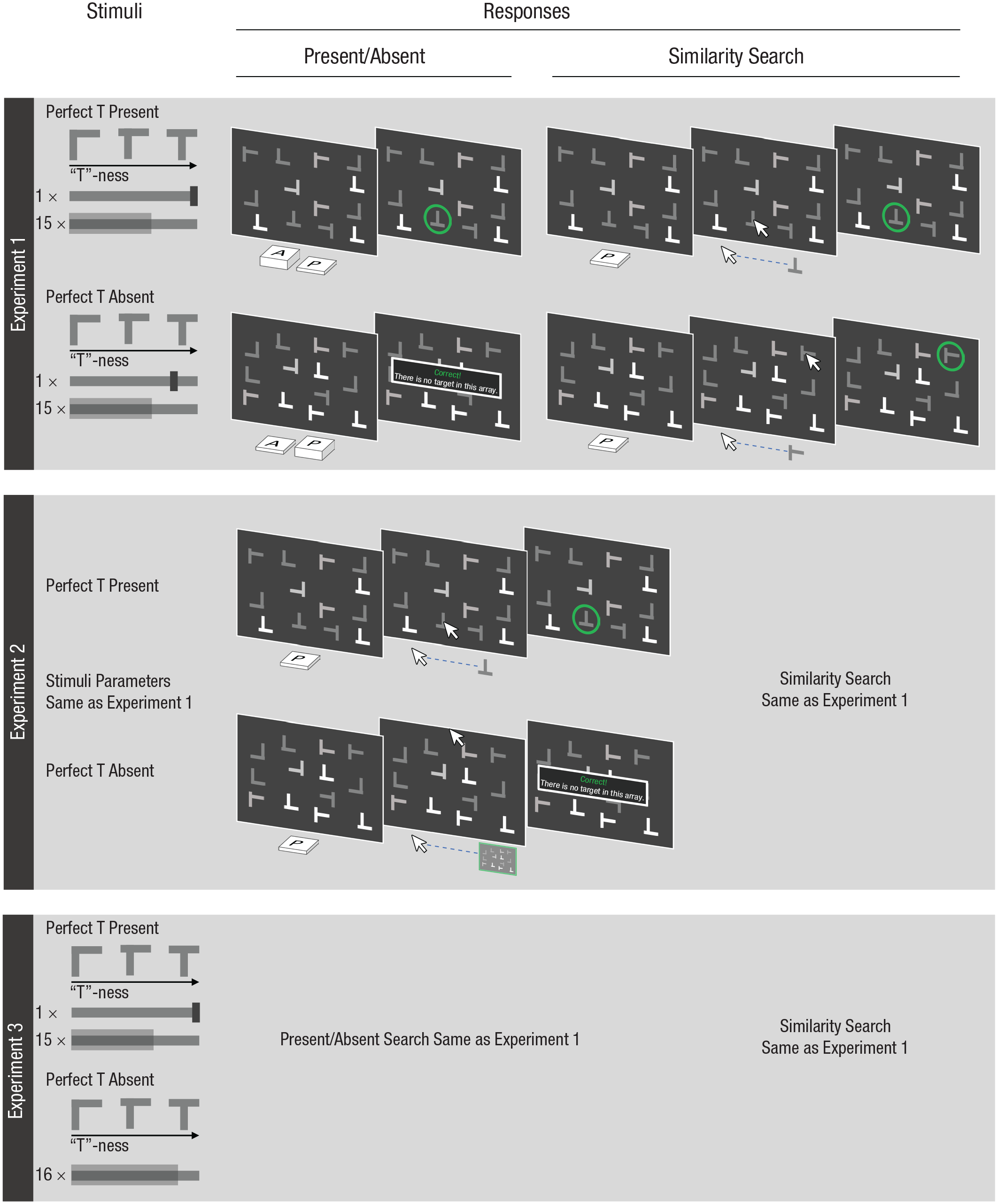
Illustration of the response and stimuli parameters for all experiments. For the target-present/target-absent condition in Experiment 1, a perfect T was the target, and anything else was a distractor. In the similarity-search condition, the target was the singular element closest to a perfect T (and on 10% or 50% of trials, depending on prevalence block, there was a perfect T). Critically, on trials with a perfect T, the search was physically identical between search conditions, allowing a comparison of missed target frequency. On trials without a perfect T, participants were to select the element most closely resembling a perfect T. Required responses are illustrated below the displays. On present/absent search, the participant simply pressed “P” or “A.” For similarity search, participants pressed “P,” revealing a cursor, and then moused over and clicked on the element they had chosen. Feedback was given after responses, either as a green or a red circle (correct or incorrect, respectively) around the target element or as a written message on target-absent trials in present/absent search. A pictographic description of the appearance and frequency of stimuli in different conditions appears in the left-hand column. A perfect T occurred when the stem bisected the branch of the T. In Experiment 2, the stimuli parameters and the similarity-search condition were identical, but the present/absent search was modified: If participants believed that the target was present, they were to press “P” and then mouse over and click the target, and if they believed that the target was absent, they were to press “P” and mouse over to the edge of the screen (the “present-click/absent-flick” condition). Experiment 3 was a replication of Experiment 1, except that trials without a perfect T contained 16 randomly determined near Ts, with the one closest to a T being the target. Consequently, participants could not rely on a stored target template for the near T. Image and display elements in the figure are not to scale.
Forty-four undergraduate students from the University of Toronto participated in exchange for course credit or $10. All students gave informed consent according to the guidelines of the university’s institutional review board. All participants had normal or corrected-to-normal vision. All participants were naive to the purpose of the experiment and its hypotheses. Four participants were rejected prior to analysis for producing incomplete data sets.
Apparatus and materials
Stimuli were presented on a Dell computer with 24-in. LED monitors using a 2,560 × 1,440 pixel resolution graphics mode and a 120-Hz refresh rate. The experiment was programmed using MATLAB (The MathWorks, Natick, MA) software with the Psychophysics Toolbox (Brainard, 1997). Viewing distance was held constant at 57 cm with a chin rest.
Statement of Relevance
The low-prevalence effect in visual search occurs when rare targets go unnoticed at disproportionately high rates. This phenomenon poses a serious harm in applied settings, including medical imaging and security screening, where signs of cancer or perilous threats go undetected because they are rare. The effect has also been historically resistant to intervention. In this study, we were able to mitigate the low-prevalence effect in a laboratory setting using a simple strategy that requires no training. Instead of asking participants to find a rare target, we asked them to find the item that most closely resembled the ideal target on every trial—regardless of whether that target was actually present. This simple alteration to the classic visual search instruction was sufficient to eliminate the low-prevalence effect. While this is a laboratory demonstration, this intervention could be migrated to the real world with ease.
Procedure
The search-condition manipulation (present/absent vs. similarity; see below) was a between-subjects factor. Participants were assigned to conditions in alternating order. The target-prevalence manipulation—low (10%) vs. high (50%)—was presented in separate blocks within subjects, and the order of the blocks was counterbalanced across subjects. There were 250 trials in the low-prevalence block and 50 trials in the high-prevalence block (i.e., there were 25 target-present trials in each prevalence condition). All participants completed 20 practice trials at the start of the experiment and again before the target prevalence switched to adjust to the target frequency. During practice trials, the words “Practice Trial” appeared centered at the top of the screen. Participants were informed of the target prevalence before each block. In the low-prevalence block, participants were encouraged by an interrupting display to take a break every 50 trials.
In both search conditions, every trial contained a search display with 16 elements that were pseudorandomly positioned on an invisible 8 × 8 grid to ensure that no array element occluded another. Element position was randomly selected without replacement from the 8 × 8 grid, and random positional jitter was applied to each by an amount no greater than half of the distance between the adjacent grid position. To an observer, the display appeared as a randomly assorted but uncluttered array on every trial.
All stimuli were presented on a dark gray background (RGB value: 40, 40, 40). Array elements differed in shade of gray (randomly generated on every trial for every element for some RGB value between 100 and 160) and orientation (random rotation of 0°, 90°, 180°, or 270°). Participants were informed that the shade of gray and orientation were irrelevant.
In both search conditions, every display contained 15 near-T distractors and a 16th element, which was either a perfect T or a near T that was nearer to perfect than the other 15 elements. Critical stimuli were perfect Ts when the stem perfectly bisected the branch of the T at its midpoint. Thus, near Ts occurred when the stem appeared offset from the perfect midpoint of the branch (as generated by random offset between the stem and branch of the T). The offset was applied independently for each distractor and was a minimum of one quarter of the length of the branch off-center and a maximum of the entire length (resulting in an L). On target-absent trials, instead of containing a perfect T, the array contained one element that had less offset jitter than the other 15 near Ts: The offset was equal to 1/11th of the length of the branch (see Fig. 1).
Participants were given feedback after every trial. There was a 500-ms intertrial interval. The only differences between search conditions were the instructions, response mode, and feedback, described below.
Target-present/target-absent search
Participants were instructed that they would be searching for a perfect T in an array of near Ts and were shown an example of a display with and without a target. Following traditional LPE visual search paradigms, we instructed participants to press “P” when the target was present and “A” when the target was absent.
On target-absent trials, a feedback message appeared at the center of the display saying “Correct! There was no target in this array” or “Error! There is no target in this array.” “Correct!” and “Error!” were presented in green (RGB value: 0, 180, 20) and red (RGB value: 180, 0, 0) font, respectively. On target-present trials, feedback occurred in the form of a green or red circle surrounding the target element after correct and incorrect responses, respectively.
Similarity search
Unlike in traditional LPE search tasks, participants in the similarity-search condition were instructed to find the item that most closely resembled a T on every trial. Participants were instructed to press the “P” key after they had found the “item that most closely resembles a T,” which revealed a mouse cursor. Participants then clicked on the item that they had chosen.
Click accuracy was determined by whether the response was made near the correct element (i.e., the perfect T or the nearest-to-perfect T) within a radius of 1.5 times its size. If participants correctly identified the most T-like item (a perfect T on target-present trials and a near T on target-absent trials), a green circle appeared around the element they clicked on. If they identified any other element in the display, a red circle appeared around the correct element.
Results
The critical analysis concerned whether perfect Ts were missed at different rates across prevalence conditions depending on the search-instruction conditions (i.e., the search-condition-by-prevalence interaction). Miss rates on trials in which a perfect T was present were analyzed with a 2 (search condition: present/absent or similarity; between subjects) × 2 (target prevalence: 10% or 50%; within subjects) mixed-factors analysis of variance. For target-present/target-absent search, a miss occurred when there was a perfect T in the display and participants indicated that the target was absent. For similarity search, a miss occurred when there was a perfect T in the display and participants indicated that another element was the most T-like. Critically, optimal performance in both conditions required that participants find the perfect T, so performance was comparable between search conditions on perfect-T-present trials.
There were main effects of search condition, F(1, 39) = 13.29, p < .001, η p 2 = .25, and target prevalence, F(1, 39) = 19.10, p < .001, η p 2 = .33. Critically, there was a significant interaction, F(1, 39) = 9.99, p = .003, η p 2 = .204, indicating that the LPE depended on search condition (see Fig. 2). To characterize this interaction, we ran post hoc paired-samples two-tailed t tests that compared miss rates between the high- and low-prevalence conditions at each level of search condition, applying Bonferroni corrections for multiple comparisons. These allowed us to evaluate the magnitude of the LPE in each search condition and, importantly, to evaluate whether we observed an LPE in the similarity-search condition. As expected, the results showed a robust LPE for target-present/target-absent search (20.50% difference), replicating established findings, t(23) = 6.02, p < .001, α = .025. The LPE effect was reduced to 3.3% in the similarity condition, which was not statistically significant, t(16) = 0.76, p = .46, α = .025. For performance data from trials without a perfect T and a note on response times, see the Supplemental Material available online.
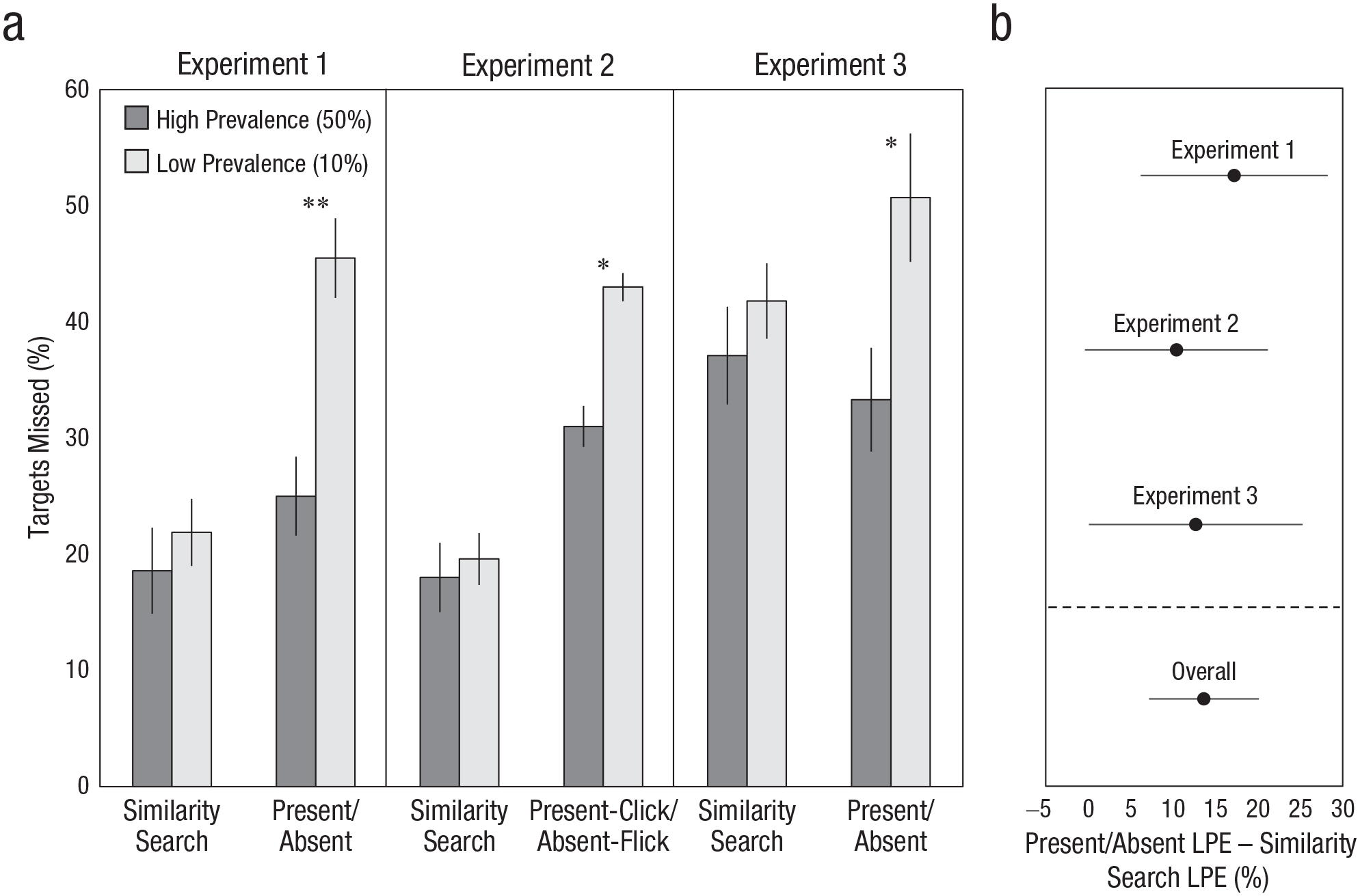
Results. The mean miss rate of perfect Ts (a) is shown as a function of search condition and target prevalence, separately for Experiments 1 to 3. Error bars represent ±1 SEM. Asterisks indicate significant differences between conditions (*p < .01, **p < .001). The effect of search condition (present/absent vs. similarity) on the low-prevalence effect (LPE) is shown in (b) for each experiment and for the meta-analysis (overall). Error bars represent 95% confidence intervals.
Experiment 2
In Experiment 2, we sought to reproduce the mitigated LPE with similarity search and to determine whether differences in response modes between search conditions—localized mouse responses versus a “P”/“A” key press—may have played a role.
Method
Participants
Forty-four additional undergraduate students from the University of Toronto who met the same criteria outlined in Experiment 1 participated in exchange for course credit or $10. Three participants were removed prior to analysis for producing incomplete data sets.
Procedure
The procedure was the same as in Experiment 1 with the following exception: In the target-present/target-absent condition, when a perfect T was present, participants were required to press the “P” key and then mouse over and click the target (exactly as in the similarity-search condition); if the target was absent, participants were required to press “P” and then move the mouse to the edge of the screen. We call this the “present-click/absent-flick” condition (see Fig. 1). No changes were made to the similarity-search condition. Critically, these search and response conditions were identical when a perfect T was present in the display.
Results
One participant was removed prior to analysis for responding randomly during target-present/target-absent search (48% accuracy in the high-prevalence condition). We conducted the same analyses as in Experiment 1. There were main effects of search condition, F(1, 38) = 30.15, p < .001, η p 2 = .44, and target prevalence, F(1, 38) = 6.53, p = .015, η p 2 = .15. The interaction between search condition and target prevalence was marginally significant, F(1, 38) = 3.82, p = .058, η p 2 = .09, indicating that the LPE depended on search condition, although this interpretation should be made with caution (see Fig. 2). The critical test was for the presence of LPEs in either condition. We performed post hoc paired-samples two-tailed t tests comparing miss rates between the high- and low-prevalence conditions at both levels of search condition, applying Bonferroni corrections for multiple comparisons. Results replicated Experiment 1, indicating that there was virtually no LPE in the similarity-search condition—1.6% difference in miss rates between the high-and low-prevalence conditions, which did not reach statistical significance, t(19) = 0.43, p = .67, α = .025. The present-click/absent-flick condition revealed an LPE (12.0% difference), t(19) = 3.10, p = .006, α = .025.
Experiment 3
In Experiments 1 and 2, when a perfect T was not present, there was a near T that was nearer to perfect than the rest of the distractors (its branch was offset at 1/11th of the length of the T branch). An astute reviewer noted that the presence of this element was a signal that participants might use differently between search conditions. Participants in the similarity-search condition could use a template for this nearest-to-perfect T to find their target, whereas participants in the target-present/target-absent condition might use the same template to correctly terminate a search. Essentially, participants could complete the task with two templates in mind (e.g., Irons et al., 2012; Roper & Vecera, 2012), one of which was always present, effectively making this a 100%-prevalence task. To address this, we repeated Experiment 1 under conditions in which participants could not store a template for the nearest-to-perfect T. On trials without a perfect T, all elements were fully randomly generated, and the one with the least offset was designated the nearest-to-perfect T (and hence, the target in similarity search; see Fig. 1). By introducing variability to the nearest-to-perfect-T stimuli, we made it impossible to complete the task by maintaining two target templates.
Method
Participants
Forty-four new participants were recruited online via Prolific in exchange for £5 (UK) per hour. The same inclusion criteria as in Experiments 1 and 2 were used. The experiment was coded in JavaScript and hosted on a custom server.
Procedure
The procedure was the same as in Experiment 1 with the following exceptions. First, whereas in Experiments 1 and 2, on trials without a perfect T, there were 15 randomly generated distractors and one distractor that was uniquely close to a T (1/11th offset), in Experiment 3, all 16 distractors were randomly generated and the one with the least offset was designated the nearest-to-perfect T (and therefore the target in the similarity-search condition). There was only ever one nearest-to-perfect T. Second, the experiment was moved online because of the COVID-19 pandemic. This also afforded us the opportunity to replicate our findings outside of the laboratory in a population of nonstudents.
Results
We conducted the same analyses as in Experiment 1. There was a main effect of target prevalence, F(1, 42) = 12.58, p < .001, η p 2 = .23. There was no effect of search condition, F(1, 42) = 0.21, p = .645. The interaction between search condition and target prevalence was significant, F(1, 42) = 4.13, p = .048, η p 2 = .09, replicating the effect that the LPE depended on search condition (see Fig. 2). We performed post hoc paired-samples two-tailed t tests comparing miss rates between the high- and low-prevalence conditions at both levels of search condition, applying Bonferroni corrections for multiple comparisons. Replicating Experiments 1 and 2, results showed that the similarity-search condition did not elicit a reliable difference between the high- and low-prevalence conditions (4.7% difference in miss rates), t(21) = 1.49, p = .152, α = .025. The target-present/target-absent condition revealed an LPE (17.4% difference), t(21) = 3.24, p = .004, α = .025. The increased error rates bear mentioning. Because of the COVID-19 pandemic, Experiment 3 was conducted online. Given our experience with many other online studies, and from what we have heard from colleagues, error rates are higher than in laboratories, and we are sure this is the case here. Notwithstanding, we stand by the result, given that the predicted pattern of the interaction was replicated despite higher overall error rates. Indeed, it would be difficult to account for why the change to distractor settings would allow the LPE to be preserved in present/absent search but not similarity search for any other reason. Importantly, even when baseline miss rates between present/absent and similarity search were incidentally similar (as in Experiment 3), only the present/absent search showed a robust LPE.
Meta-Analysis
In a meta-analysis of all three experiments, we found that similarity search reduced the LPE by 13.64 percentage points (95% confidence interval (CI) = [7.15%, 20.12%]; see “Overall” line in Fig. 1b). Overall, we estimated an LPE of 16.89% (95% CI = [11.96%, 21.83%]) in standard present/absent search. We estimated an LPE of 3.25% (95% CI = [–0.93%, 7.43%]) in similarity search, which was not statistically significant.
Discussion
The present study documented a remarkably simple solution to the LPE in visual search in a laboratory setting. Whereas past efforts have tried to reduce the LPE by changing physical search conditions or the context of the search, we changed the search task and response requirements. In addition to asking participants to make a typical present/absent search, which elicited the usual LPE, we asked another group of participants to search for the most target-like object on every trial. This simple strategic adjustment eliminated the LPE. 1 All three experiments provided evidence that similarity search reduces the LPE relative to present/absent search, and planned comparisons failed to find evidence for an LPE in similarity search every time and when data were pooled across experiments to increase statistical power.
The similarity-search task differs from the typical present/absent paradigm in some important ways. Of course, similarity search involves mouse localization responses, whereas the typical paradigm involves a binary key press. However, Experiment 2 ruled out the possibility that mouse localization responses eliminated the LPE. Experiment 3 replicated the effect under conditions in which the target on one trial could subsequently be a distractor, ruling out the possibility that a singular template for the near T could guide search.
We suspect that similarity search mitigated the LPE by maintaining a high search-termination threshold, reducing the accumulation of evidence toward the threshold, or both. Our suspicion can be understood in the context of Wolfe and Van Wert’s (2010) two-process model for the LPE. The first process is perceptual, and it concerns the accumulation of evidence for the presence or absence of a target (i.e., a signal detection problem; Macmillan & Creelman, 2004). In this model, it is possible that similarity search affects the position of a decision criterion with respect to the target-present signal. The second process is decisional. A quitting signal accumulates when perceptual comparisons fail to produce a target-present response; when the threshold is exceeded, the search is terminated (e.g., Moran et al., 2013). In this model, similarity search would diminish the accumulation of the quitting signal or shift the quitting threshold upward. Sequential target-absent decisions cannot shift the quitting threshold downward if there are no target-absent decisions. Recall that the task in similarity search is to decide not whether a target is absent but which element deserves a response.
This intervention has the potential to eliminate the LPE in high-stakes, real-world visual search scenarios. Similarity search could be easily and inexpensively applied to any search task in which the goal can be reframed as a graded rather than binary comparison: What element of this mammogram looks most like a precancerous lesion? What object in this baggage X-ray looks most like a weapon? However, there are potential limitations to our intervention that could diminish its real-world applicability. For example, security screening involves a search with heterogeneous target templates (e.g., knife, explosive substance, unsanctioned liquid) and heterogeneous distractors, whereas our laboratory study involved a search for a single target template (the perfect T) in a comparatively homogeneous set of distractors. The current findings do not speak to whether observers can judge similarity across more abstract templates (e.g., most dangerous) or whether similarity search would be effective at reducing the LPE under such conditions (e.g., Godwin et al., 2010). Also note that our participants were university undergraduates or Prolific recruits online—results discovered with these populations may not generalize to expert searchers such as security workers and radiologists. However, the ease with which our sample picked up the intervention gives us hope it could be deployed effectively in expert populations.
Considerations also arise in the application of similarity search to medical imaging. When medical experts scan for signs of cancer or injury, identifying similarity is not sufficient; they must then decide whether the stimulus poses a genuine threat (i.e., it may be cancer-like, but is it really cancer?). Likewise, similarity search must be shown to eliminate the LPE without a concomitant rise in false alarms. In practice, a two-tiered decision procedure could alleviate both concerns. After an initial judgment of similarity, observers would be asked in a second step to reexamine each suspicious element (e.g., the element designated most similar to a lesion or threat) to determine whether it poses a genuine threat. In the second step, however, there is no guarantee that the LPE will be absent or that the false-alarm rate will be acceptable. In addition, it is worth noting that our 1-hr experiment was brief compared with the prolonged vigilance demanded of security and medical experts (despite even lower target-prevalence rates of < 1%, compared with 10% in our study).
Other important empirical questions ought to be explored. It is unclear, for example, whether similarity search depends on having a singular pseudotarget; would it still work in cases in which observers view multiple most-similar items, as in a multiple-target search task? Understanding these and other potential issues in implementation, including the human resource costs, will be important for extrapolating this promising laboratory-based intervention to applied settings. Although work remains to be done, this study is the important first step of identifying a promising solution to a stubbornly persistent behavioral phenomenon that has wide-ranging impact beyond the laboratory.
Supplemental Material
sj-docx-1-pss-10.1177_09567976211048485 – Supplemental material for Eliminating the Low-Prevalence Effect in Visual Search With a Remarkably Simple Strategy
Supplemental material, sj-docx-1-pss-10.1177_09567976211048485 for Eliminating the Low-Prevalence Effect in Visual Search With a Remarkably Simple Strategy by J. Eric T. Taylor, Matthew D. Hilchey, Blaire J. Weidler and Jay Pratt in Psychological Science
Footnotes
Transparency
Action Editor: Krishnankutty Sathian
Editor: Patricia J. Bauer
Author Contributions
M. D. Hilchey and J. E. T. Taylor conceptualized the idea for the study. All the authors contributed to the design. J. E. T. Taylor coded the experiment. B. J. Weidler, M. D. Hilchey, and J. E. T. Taylor collected the data. M. D. Hilchey and J. E. T. Taylor analyzed the results. J. E. T. Taylor wrote the manuscript in collaboration with M. D. Hilchey, B. J. Weidler, and J. Pratt. All the authors approved the final manuscript for submission.

Notes
References
Supplementary Material
Please find the following supplemental material available below.
For Open Access articles published under a Creative Commons License, all supplemental material carries the same license as the article it is associated with.
For non-Open Access articles published, all supplemental material carries a non-exclusive license, and permission requests for re-use of supplemental material or any part of supplemental material shall be sent directly to the copyright owner as specified in the copyright notice associated with the article.
