




Abstract
Refugees suffer from a stigmatized identity portraying them as weak, unskilled victims. We developed a brief (~10-min) intervention that reframed refugees’ identity as being, by its very nature, a source of strength and skills. Reading and writing exercises, provided by a university, highlighted how refugees’ experiences helped them acquire skills such as perseverance and the ability to cope with adversity, which could help them succeed in a new country. In Experiment 1 (N = 93), the intervention boosted refugees’ (a) confidence in their ability to succeed at an imagined university and (b) challenge seeking: Participants were 70% more likely to take on an academic exercise labeled as difficult. In Experiment 2, the intervention, delivered to refugees entering an online university (N = 533), increased engagement in the online-learning environment by 23% over the subsequent year. There was also evidence of greater course completion. It is possible to reframe stigmatized individuals’ identity as inherently strong and resourceful, helping them put their strengths to use.
When I have to go to the Social Benefits Agency, I feel—“oh, look at yourself how low you are now, you used to be a normal person” . . . “What that guy will think of me when they hear that I am a refugee.” . . . I never had any kind of complexes in my life, but this has become a social complex. On the way to Europe a lot of things happened unexpectedly. So I had to learn to adapt to the situation, embrace changes and always roll with the punches. . . . This was an eye-opener and a beginning for a personal . . . revolution that [led] to liberation and personal growth.
With global numbers of forcibly displaced individuals at a record high (United Nations High Commissioner for Refugees, 2019), the question of how to adequately support refugees as they strive to succeed in their new homes constitutes a major challenge of our time. In response to the recent arrival of more than 1 million refugees in Europe—where the present research was conducted—the European Commission (2016) noted that “integration is key” (p. 4) for refugees in Europe, estimating the potential impact that successful integration measures could have at up to 1% of gross domestic product. Yet despite considerable investments, the effectiveness of resources offered to refugees still lags: Relative to other migrants, refugees underperform in language courses (Tissot et al., 2019) and take up to 20 years to reach employment rates similar to those of native-born individuals (Dumont et al., 2016). New insights are needed.
We suggest that narratives about refugees’ social identity—that is, the inherent qualities that refugees are thought to possess—pose a crucial, often overlooked barrier to the effectiveness of integration measures. Although widespread stigmatizing narratives framing refugees as inherently weak, deficient victims may limit refugees’ ability to make use of the measures, we hypothesize that it is possible to reframe refugees’ identity in an empowering way that will allow them to make better use of these opportunities.
The first quotation above illustrates how refugees suffer from a stigmatized identity. Partly as a consequence of the adversity they have experienced, refugees are often portrayed as weak, dependent victims who lack skills or potential. This stigmatizing narrative is perpetuated not only by people with antirefugee sentiments. Even well-intentioned actors such as aid organizations often focus on weakness and deficiencies, such as “trauma, victimization, limited (or interrupted) education, and preliteracy” (Shapiro & MacDonald, 2017, p. 80; see also Thomas et al., 2020). Narratives such as these offer, at best, an incomplete or false account of refugees’ identities, contributing to stigmatization. Past research shows that stigmatizing narratives may exacerbate disadvantage by triggering stereotype threat and doubts about one’s belonging and potential (Steele & Aronson, 1995; Walton & Cohen, 2007), which can limit people’s ability to make use of learning opportunities (Taylor & Walton, 2011). Here, we hypothesized that such narratives can undermine refugees’ confidence in their potential and their ability to pursue opportunities for upward advancement. Yet with the assumption that it is not the refugee identity per se but the narrative attached to it that causes this harm, we theorized that reframing refugees’ identity in an empowering way could help them succeed. Specifically, we theorized (a) that a convincing stigma-countering narrative can highlight how, by its very nature, refugees’ identity constitutes a source of strength and skills, which refugees have acquired and shown in overcoming diverse challenges, and (b) that this message can help refugees gain confidence and pursue their goals.
We thus represent the strength of refugees asnot despite or in addition to but because of their experiences—reversing stigmatizing narratives that frame these experiences as causes of weakness. In so doing, we build on classic attribution theory, which implies that acknowledging the strength needed to overcome the challenges that individuals face can reflect well on those individuals (Kelley & Michela, 1980). Moreover, we offer this narrative as coauthored by a relevant institution—a university offering refugees opportunities for advanced training—thus creating a positive common-ground understanding of refugees’ identity in an important context.
Statement of Relevance
The number of people forcibly displaced is at a record high. To help refugees succeed in their new homes, some countries have invested substantial resources in educational and training programs. Yet societal stigma may prevent refugees from taking full advantage of these opportunities, limiting their impact. We developed a brief, scalable, and cost-efficient intervention through which institutions can reframe refugees’ identity as an inherent source of strength and resourcefulness, countering default stigmatizing representations of weakness and deficiencies. This intervention enhanced refugees’ belief in their academic potential and willingness to take on academic challenges and, in a field trial, their engagement in a German university over a calendar year. Although stigmatizing narratives cause disadvantage, they are not inevitable. Highlighting how, by its very nature, refugees’ identity constitutes a source of strength and resilience can empower them to pursue existing opportunities and make progress in their lives.
The identity-reframing approach extends prior research. First, whereas prior interventions have been designed to remedy the detrimental consequences of stigmatized identities, such as threats to the self (Cohen et al., 2006) and doubts about belonging (Walton & Cohen, 2007), our intervention addresses the stigmatizing narrative about an identity as the source of these problems. Second, in focusing on how refugees’ past experiences and current identity already provide refugees with the skills and resources to succeed, we complement approaches that lead individuals to imagine a successful future (Oyserman et al., 2002). Third, our approach draws on research showing that stigmatized students’ performance can be enhanced when their identity and culture are referenced in positive ways (Brannon et al., 2015; Dee & Penner, 2017). Yet rather than focusing on positive aspects of an identity that is also stigmatized, we reframe the core stigmatizing part of individuals’ identity—their refugee identity and experience—itself in empowering terms.
Research examining the integration of recently arrived refugees in Europe is insufficient. Indeed, there are significant challenges in conducting research with refugees, including language barriers, low literacy rates (Scheible, 2018), and the difficulty of reaching widely dispersed and highly mobile minority populations. Here, using two rigorous, randomized experiments—one a longitudinal field study over 1 year—we tested how institutions’ representations of refugees’ identity affect refugees’ prospects for making progress through education. We recruited refugees using social media (Experiment 1), capitalizing on refugees’ relatively high social media use to receive migration-relevant information (Dekker et al., 2018), and by partnering with an online university that offered opportunities for advancement to refugees and tracked their learning engagement over time (Experiment 2). Given the challenges of conducting research with refugees, especially long-term experimental research, the present data provide a rare opportunity to learn about this population.
We developed the identity-reframing intervention via in-depth interviews with refugees in Germany (see the Supplemental Material available online). Ultimately, it comprised a 10-min online module in which participants read and reflected on earlier refugees’ stories, drawn from our interviews, that described how their experiences as refugees helped them acquire important skills, such as perseverance and the ability to cope with negative experiences, and how these skills helped them succeed academically in a new country. After reading the stories, participants were asked to reflect on how their own experiences illustrated the story themes, as exemplified in the second quotation presented at the beginning of the article (cf. Walton & Cohen, 2007).
The Present Research
We report two randomized experiments with mostly Middle Eastern refugees in Europe. Both studies compared the identity-reframing intervention with an active, potentially beneficial control condition focused on study skills. Experiment 1, using a scenario design, examined the immediate, interrelated effects arising from identity reframing on participants’ self-presentation, confidence in their academic potential, and behavioral challenge seeking as important predictors of learning and achievement (Jansen & Suhre, 2010; Yusuf, 2011). If initiated in a relevant context, would these short-term effects cascade to support sustained goal pursuit? Experiment 2, an intervention field experiment with refugees enrolling in an online university, tested whether the same intervention can cause sustained increases in academic engagement over 1 calendar year.
Experiment 1
Method
Participants
Given a target of 80% statistical power and an estimated medium effect size (d) of 0.50—similar to other laboratory identity manipulations (Bryan et al., 2014)—power analyses indicated that we would need to recruit at least 84 refugees. A total of 104 people participated. Eleven participants indicated that they were not refugees and thus were excluded. Most of the remaining 93 participants (88%) lived in Europe and reported having emigrated 4 years previously (M = 3.99 years,SD = 3.98). Reflecting the demographics of refugees who have recently arrived in Europe (United Nations High Commissioner for Refugees, 2019), participants were mostly male (79 male, 12 female, two other) and rather young (age: M = 27.98 years, SD = 8.16), and 85% came from Middle Eastern countries. We did not collect information on individuals’ educational background. However, the fact that they were able to take part in an experiment conducted in (simple) English suggests that most participants had some secondary education. Additional demographic details can be found in the Supplemental Material.
Procedure and measures
Participants were recruited online through relevant Facebook groups. We told users that we were looking for refugees to participate in a survey to learn more about their experiences in exchange for an Amazon voucher worth €4 or an equivalent donation to the United Nations Refugee Agency.
Participants were asked to imagine they would soon begin studying at a German online university called “Amberg University,” which provided free online courses for refugees. Each participant was then randomly assigned to the intervention (51 participants) or control group (42 participants) and completed the respective manipulation materials, followed by dependent measures.
Identity-reframing intervention
As in past social-psychological interventions (e.g., Walton & Cohen, 2007), the identity-reframing intervention used reading exercises that included vivid, illustrative quotations to convey the basic intervention message paired with writing exercises designed to help participants process the intervention message deeply and connect it to their own experiences.
The materials were presented as authored by the ostensible university and delivered as part of its onboarding program for new students. There were two parts. The first conveyed that individuals acquire important skills through their refugee experiences. The second focused on how refugees can use these skills to succeed in educational contexts. In the first part, participants read, In previous surveys, many Amberg students have said that their experiences as a refugee were often difficult. But many also said that they have learned a lot of useful things as a refugee. For example, some said that they have learned to be independent and not give up. Others said that their experiences as a refugee have made them stronger.
Participants were then asked to reflect on what they “learned through [their] experiences as a refugee.”
In the second part, participants read, “In previous surveys, many Amberg students also said that the things they have learned as a refugee have helped them to succeed at Amberg University.” They then read three ostensible quotations from Amberg University students that illustrated this theme. For example, [My experience as a refugee] was difficult, but I have learned to stand on my own feet. . . . This ability to do things on my own has also helped me a lot at Amberg University. For example, when I don’t understand something, I don’t just wait for somebody to help me. Instead, I go online and try to figure it out myself or I contact the Amberg discussion forum.
Participants were then asked to describe how they thought they could “use the things, which you have learned as a refugee, to succeed at Amberg University.” They were told that their responses could be shared with future Amberg students to help them succeed, placing them in the position of benefactors of others rather than the potentially stigmatizing role of beneficiaries. Common themes and illustrative responses to the intervention prompts can be found in Table 1.
Participants’ Responses to the Identity-Reframing Intervention in Experiment 1: Common Themes and Exemplary Quotations From Essays Written in Response to the Randomized Materials
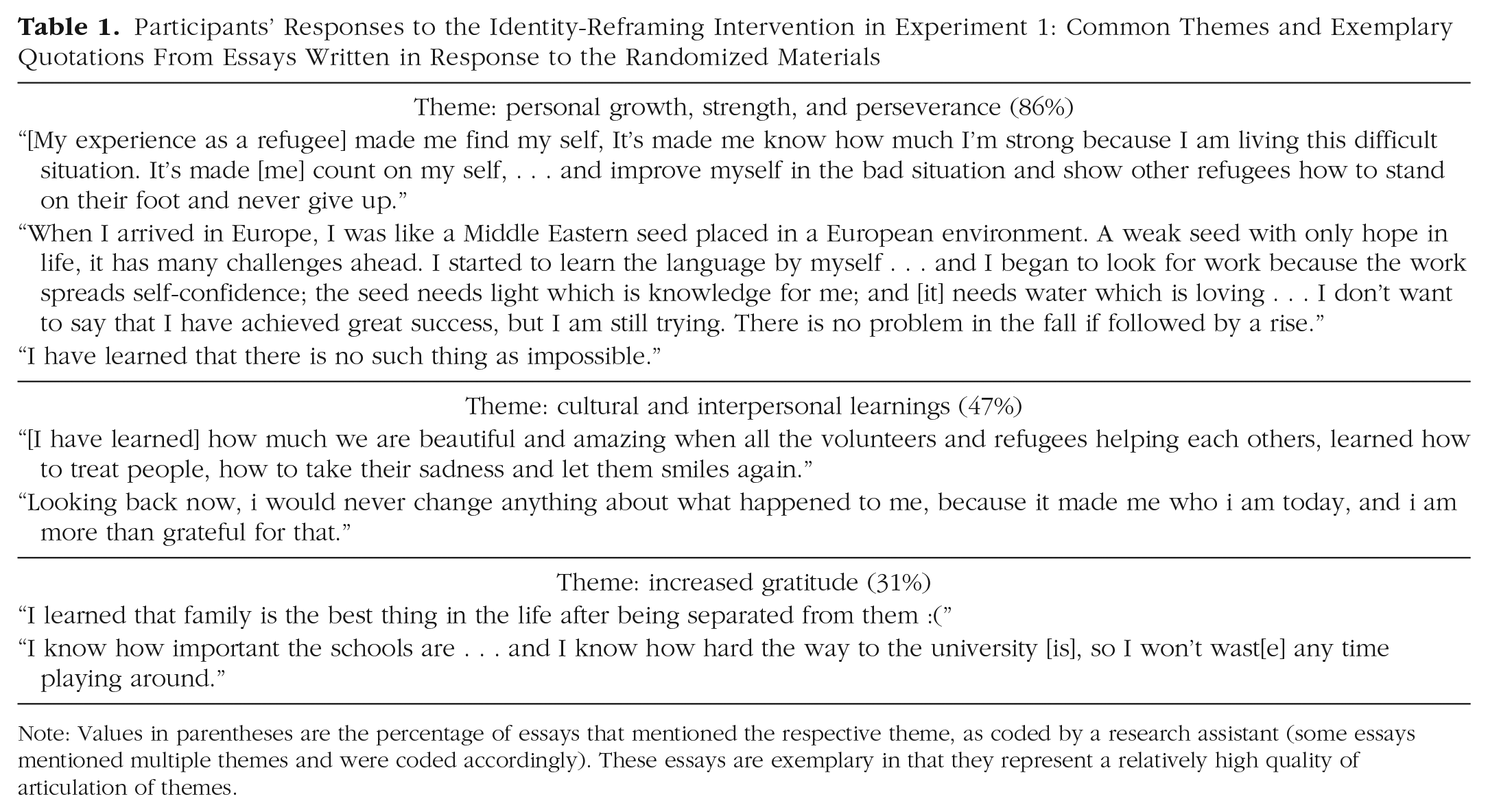
Note: Values in parentheses are the percentage of essays that mentioned the respective theme, as coded by a research assistant (some essays mentioned multiple themes and were coded accordingly). These essays are exemplary in that they represent a relatively high quality of articulation of themes.
Overall, the intervention took approximately 10 min to complete (Mdn = 10.91 min).
Study-skills control condition
The active control materials used a similar format, including quotations from prior students, and featured similar interactive writing exercises in which participants reflected on how previous experiences could help them succeed at university. However, they focused on study strategies (Kizilcec et al., 2017). Thus, although potentially helpful, they did not address refugees’ identity. For instance, participants read, When there’s a lot on your mind, it helps to make a list to organize yourself. I found writing down a bunch of personal due dates in my planner really helped, even though there were no deadlines in the course. That way I wouldn’t fall behind too much and stay on track with my studies.
Again, participants were asked about their own experience but to reflect on “which study tips could help you succeed at Amberg University.”
Empowerment in individuals’ self-presentation
We coded individuals’ open-ended responses to the questions about how their experience as a refugee (intervention condition) or study strategies (study-skills control) could help them succeed at university. Although these responses were to different prompts, they indicate how agentic and empowered refugees represented themselves to be in response to the manipulation, a particularly important question given the power of recursive stigma-related processes in interpersonal interaction (e.g., Word et al., 1974). Two coders unaware of the conditions participants were assigned to rated how motivated (1 = not at all motivated, 5 = very motivated; intraclass correlation coefficient [ICC] = .78) and agentic (1 = not at all agentic, 5 = very agentic; ICC = .73) each student seemed to be, how empowering their response was (1 = not at all empowering, 5 = very empowering; ICC = .93), and how likely they thought the student was to succeed at the university (1 = very unlikely, 5 = very likely; ICC = .77). Ratings were averaged across the two coders. ICCs represent two-way random effects with absolute agreement and two raters.
Self-perceived preparation and self-efficacy
Self-perceived preparation was assessed with two items (e.g., “I am well prepared to be academically successful as a student at Amberg University”; 1 = totally disagree, 6 = totally agree; α = .79; Stephens et al., 2014). Academic self-efficacy was assessed with four items (e.g., “I’m certain I can figure out how to do the most difficult classwork”; 1 = totally disagree, 6 = totally agree; α = .83; Stephens et al., 2014).
Academic challenge seeking
Academic challenge seeking, an important source of academic growth and a common measure in social-psychological interventions (Walton & Cohen, 2007; Yeager et al., 2016, 2019), was assessed by letting participants choose the difficulty of a logical-thinking exercise said to be used by the university in an introductory course. Participants were asked to imagine that the exercise they were about to do was assigned as part of their studies. They were asked to choose one of eight versions with varying degrees of difficulty, four of which were labeled as difficult (extremely, very, pretty, and rather) and four as easy (extremely, very, pretty, and rather).
Identification as a refugee
We assessed participants’ identification as refugees, after they completed the primary measures so as not to interfere with them, using two items drawing on previous research (Kessler & Mummendey, 2002; “I think of myself as a refugee” and “I see myself as a refugee”; 1 = totally disagree, 6 = totally agree; α = .83). Eight participants left the survey before completing this measure, reducing the degrees of freedom for analyses of it. Dropout did not differ significantly by condition (p = .65).
Results
Confirming the success of random assignment, results showed that there were no significant differences by condition on any assessed baseline measures (age, length of stay in Europe, and gender). The primary results of our analysis of variance (ANOVA) and logistic regression analyses are displayed in Table 2.
Primary Results of Experiment 1 (N = 93)
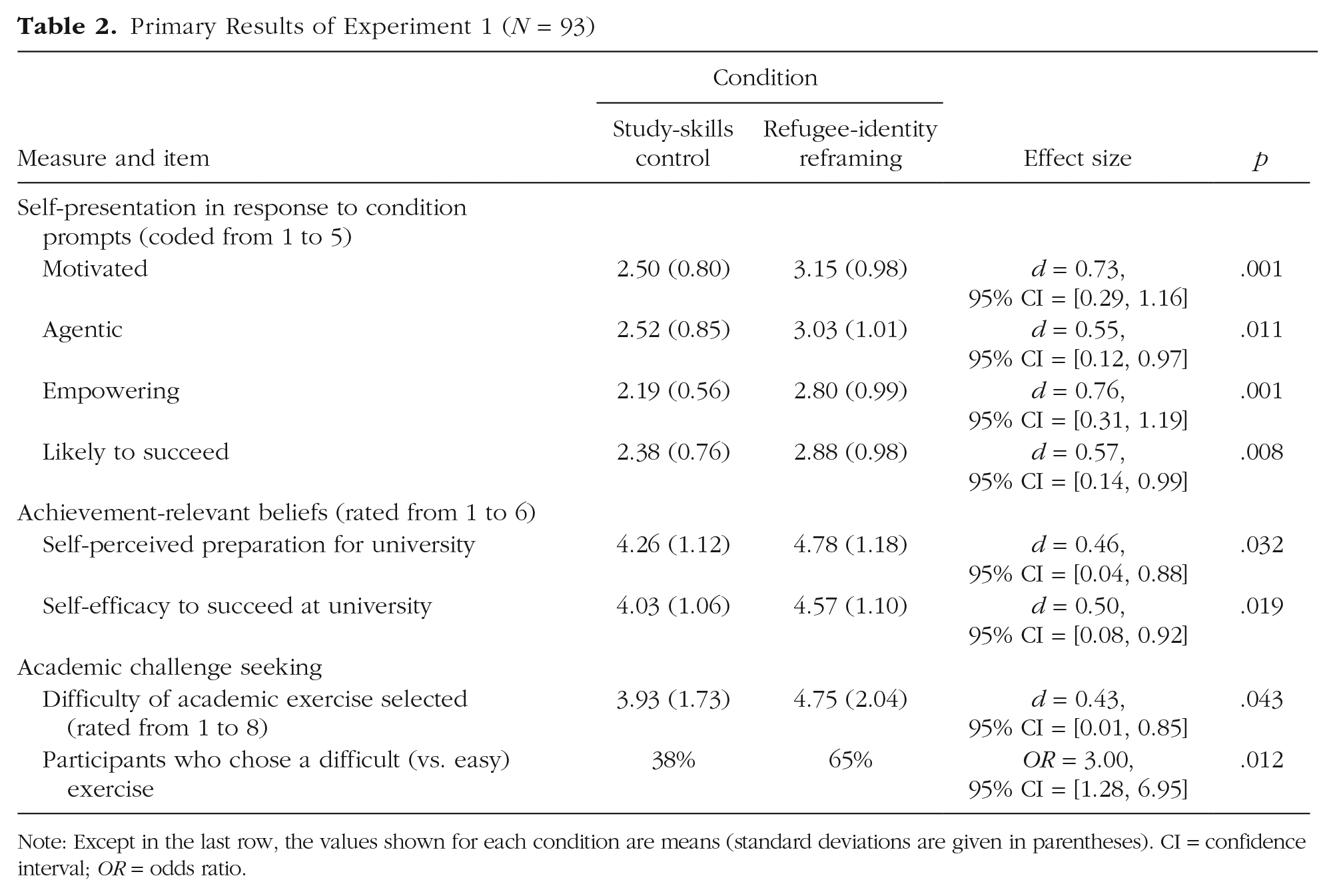
Note: Except in the last row, the values shown for each condition are means (standard deviations are given in parentheses). CI = confidence interval; OR = odds ratio.
Self-presentation
First, we analyzed refugees’ re-sponses to the questions about how their experiences as refugees (treatment) or their study skills (control) could help them succeed in the university. Responses were rated as more motivated, more agentic, more empowering, and indicating a higher likelihood of success at university in the intervention condition than in the study-skills control condition. Thus, the intervention helped refugees present themselves in more agentic and empowered ways. Table 1 provides common themes and quotations.
Achievement-related beliefs
Second, the intervention improved refugees’ self-perceived preparation for university and their general self-efficacy to succeed there.
Academic challenge seeking
Finally, benefits emerged in behavior; refugees chose more challenging logical-thinking exercises in the intervention than in the study-skills control condition. Examined in a binary form, refugees in the treatment group were 70% more likely to choose an exercise labeled “difficult” over one labeled “easy.”
Did the increase in refugees’ self-efficacy translate into a greater willingness to take on academic challenges? A mediational analysis was consistent with this interpretation; the boost in challenge seeking was explained by the treatment effect on academic self-efficacy—indirect effect (ab): b = −0.31, 95% confidence interval (CI) = [−0.62, −0.04], total effect (c): b = −0.51, 95% CI = [−1.28, 0.27]).
Self-identification as a refugee
Although the focus of Experiment 1 was on the effects of the identity-reframing intervention on achievement-related beliefs and challenge seeking, we also explored participants’ identification as refugees. We theorized that identity reframing could increase participants’ refugee identification if the stigma attached to refugees’ identity leads them to distance themselves from this identity (Pronin et al., 2004; Steele & Aronson, 1995) and the treatment remedies this. Consistent with this theorizing, results of exploratory analyses showed that identity reframing increased participants’ refugee identification (M = 4.52, SD = 1.36) relative to the study-skills control condition (M = 3.92, SD = 1.26), F(1, 83) = 4.37, p = .040, d = 0.46, 95% CI = [0.02, 0.90].
It is also possible that people who identify more as refugees would show greater intervention benefits because the framing of this identity may matter more to them (cf. Schmader, 2002). There was some evidence for this in further exploratory analyses: Among participants who identified more with their refugee identity, greater effects were found on refugees’ self-perceived academic preparation (p = .098), self-efficacy (p = .42), and challenge seeking (p = .02; see Fig. S1 in the Supplemental Material). Examined from a different angle, the identity-reframing intervention seemed to establish a positive relationship between refugee identification and outcomes: In the identity-reframing condition only, greater identification with the refugee identity predicted better outcomes on all three measures. Although suggestive, these results are complicated by the fact that the identification measure was assessed after the manipulation and showed treatment effects. We thus report detailed analyses in the Supplemental Material.
Taken together, the identity-reframing intervention increased refugees’ academic confidence, challenge seeking, and self-identification as refugees. These findings are in line with the assumption that individuals’ identification as refugees does not necessarily lead to adverse consequences, but effects may depend on the meaning with which the identity is ascribed.
Experiment 2
Could the immediate gains in self-presentation, confidence, and challenge seeking observed in Experiment 1 cascade into greater pursuit of learning opportunities over time? In Experiment 2, we delivered the intervention on a randomized basis in partnership with an online German university that provided refugees with free courses. Whereas continuous engagement in this online-learning context was important for refugees because it could provide them valuable skills, certificates, and the opportunity to transfer to mainstream German universities, online learning is also particularly challenging, as evidenced by course-completion rates that often fall below 10% (Kizilcec et al., 2013).
What effects would be meaningful in this context? Effect-size benchmarks from laboratory studies are inappropriate for use in field settings with long-term behavioral outcomes. Instead, effects should be benchmarked against alternative reforms for relevant outcomes (Kraft, 2020). For long-term educational outcomes, effect sizes (d) between 0.10 and 0.20 are considered medium (Kraft, 2020). Brief online psychological interventions show similar effects (0.10 ≤ d ≤ 0.25; Paunesku et al., 2015; Yeager et al., 2016, 2019).
Method
Participants and university context
With a target of 80% statistical power and an estimated effect size (d) between 0.15 and 0.25, power analyses indicated that we would need to recruit at least 398 participants (d = 0.25) for t tests. Because of the left skew and large amount of variance in our primary outcome (logins), which are typical in online-learning environments (Kizilcec et al., 2013) but violate assumptions of t tests, we used negative binomial regressions in our analyses. To obtain 80% statistical power to detect an estimated 20% increase in mean logins—consistent with effects found in prior research in online-learning environments (e.g., Davis et al., 2017)—would require 458 participants.
To recruit as many participants as possible, we implemented the intervention material in the onboarding process. Accordingly, all students who completed the regular onboarding procedures in the 8-month period in which our study was implemented by the university were included in our study. Overall, 533 refugee students were included.
Students had to provide documentation of their legal refugee status to enroll at the university. Because of privacy concerns, the university did not share participants’ demographic data with us. However, a survey conducted by the university shortly before our intervention found that most students came from Middle Eastern (61%) or African (23%) countries and lived in Germany (56%) or another European country (20%). Courses were provided by external partners and covered a broad range of topics at an undergraduate level in English. Because many refugees do not speak English, it can be assumed that participants were not fully representative of European refugee populations. However, given the recruitment procedure, they are representative of at least those individuals seeking out English-language university education from this provider. Additionally, school staff reported that on the basis of their experiences and internal English tests, many students struggled with English, and their skills in this area were often quite limited. More details about the student body are reported in the Supplemental Material.
Procedure and measures
During the onboarding program, each student was randomly assigned to either the identity-reframing condition or the study-skills control condition delivered through the online-learning platform. Materials were identical to those used in Experiment 1, except that the name of the university was adapted. Because of privacy concerns, the university did not share participants’ open-ended responses to the intervention and control material with us.
The primary outcome was students’ engagement on the platform over the calendar year after the intervention, which was assessed by login rates tracked by the university. The 1-year assessment period was selected because university staff reported that at this point, some students would begin to transfer to mainstream universities.
Because students completed course material through third-party providers, the university did not have access to students’ behavior in the learning environment beyond logins. However, we were able to obtain information about course completions. Students were regularly prompted by the learning platform to update the courses they had passed, so suggestions for further courses could be made. Because of unforeseen circumstances, we obtained course-completion information 7 months after the intervention, but not 1 year after the intervention, as originally planned. Technical problems at the university resulted in flawed course-completion data 1 year after the intervention, and the subsequent introduction of stricter privacy laws in Germany prevented the university from providing accurate data after the problem had been resolved.
Results
Because of the left skew in the distribution of our count data and the large amount of variance exceeding mean values, which make log-transformations (O’Hara & Kotze, 2010), ANOVAs, and Poisson regressions inappropriate, we used negative binomial regression analyses, an appropriate and conservative approach in this context (Goyer et al., 2019). As can be seen in Figure 1, over the year after the intervention, refugees engaged 23% more with the learning platform in the identity-reframing treatment (M = 44.99, SD = 79.74) than in the study-skills control condition (M = 36.55, SD = 58.77; b = 0.21, z = 2.03, p = .042, incidence-rate ratio [IRR] = 1.23, 95% CI = [1.01, 1.50]).
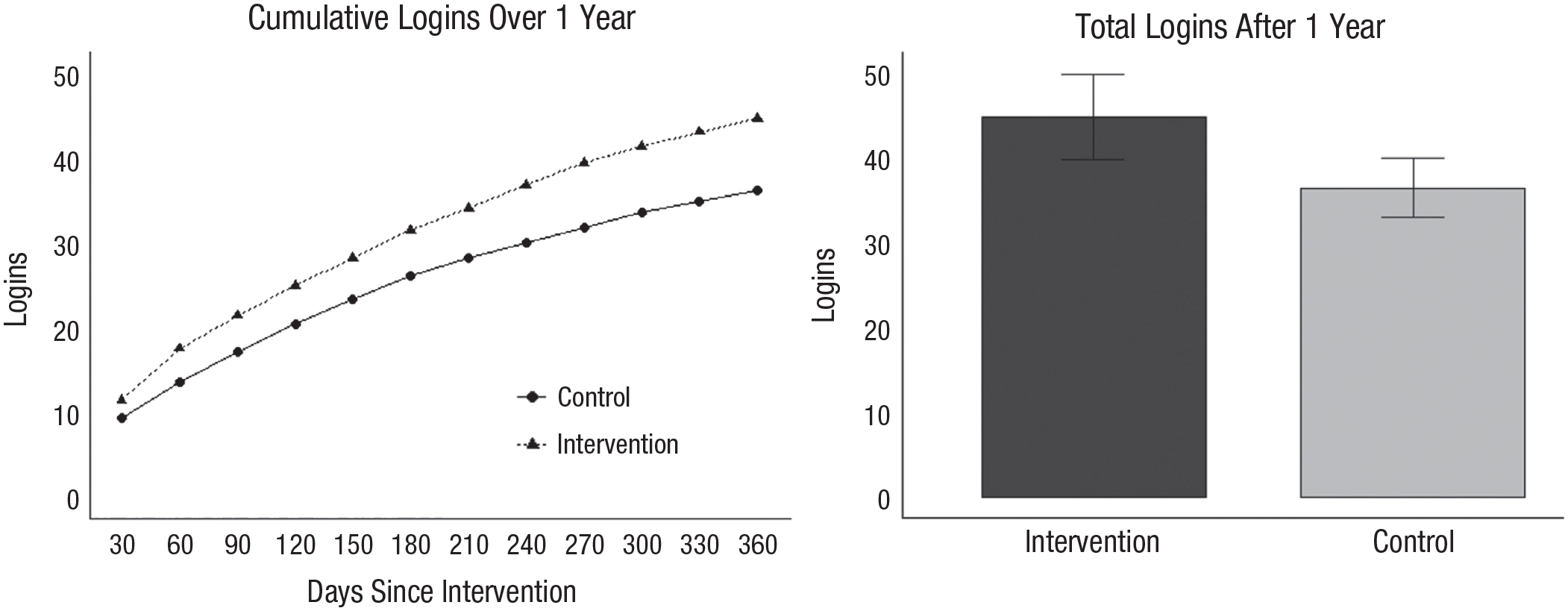
Results from Experiment 2: cumulative and total logins to the online-university learning platform over the first year after the identity-reframing intervention, separately for each condition (N = 533). Error bars represent ±1 SE.
Treatment effects on a month-by-month basis are reported in the Supplemental Material (see Table S3). Of note, the treatment effect emerged immediately after the intervention: There was a 27% increase in logins within the first week of coursework (p = .002) and a 22% increase within the first month (p = .018). With time, overall engagement declined, as is typical in online-learning environments (Kizilcec et al., 2013), whereas the variance increased: Standard deviations varied between 2.3 and 3.4 times the means (see Table S3). This reduced power to detect condition effects on a month-by-month basis. At the same time, logins were greater every month in the treatment condition than in the study-skills control condition (by 9% to 54%; .016 ≤ p ≤ .786). Critically, the statistical effect on cumulative logins was stable over the year-long assessment period. Thus, the choice of a year-long assessment period, relative to alternatives, did not materially affect the results.
Analyses of the course-completion data show that participants finished 39% more courses 7 months after the intervention in the intervention condition (M = 1.83, SD = 4.75) than in the study-skills control condition (M = 1.31, SD = 3.21), resulting in a marginally significant difference over this period (b = 0.33, z = 1.75, p = .080, IRR = 1.39, 95% CI = [0.96, 2.02]). Thus, although technical difficulties prevented us from obtaining course-completion data over the full 1-year assessment period, there was some evidence that the intervention increased refugees’ long-term academic achievement as well as their engagement. 1
General Discussion
In the present research, we represented refugees’ identity as inherently strong and resourceful, reflecting the challenges that they have learned to overcome and reversing stigmatizing narratives of refugees as weak, deficient victims. Endorsed by refugees’ university, this identity-reframing message helped refugees take advantage of the educational opportunities offered by the university and make progress toward their goals.
Our research suggests that widespread stigmatizing narratives about refugees’ identity constrain the effectiveness of educational programs and other resources serving refugees. Yet this stigmatizing narrative and its adverse consequences are not inevitable. With the identity-reframing intervention, refugees expressed more confidence in their ability to succeed academically, were more willing to take on challenges, and most importantly, engaged significantly more at university over a full year.
The one-time identity-reframing intervention can be delivered briefly online, can reach additional students at negligible cost, and is highly scalable. Although the intervention certainly does not fully mitigate the stigma, let alone the structural barriers, that refugees face, nor should it replace other reforms (Bauer & Hannover, 2020), results suggest that identity reframing can help refugees make progress.
An exciting avenue for future research lies in the processes through which the identity-reframing intervention causes lasting benefits. An intriguing finding in Study 1 was that the intervention seemed to help refugees present themselves in more positive and agentic ways. Given the power of self-fulfilling processes in stigma-relevant interactions (e.g., Word et al., 1974), it is exciting to consider whether improved interactions in the learning environment—where refugees are increasingly treated as the strong, agentic students they have come to see and present themselves to be—could reinforce the intervention message and create a virtuous cycle that contributes to lasting gains (cf. Goyer et al., 2019).
Like all social-psychological interventions, identity reframing is not a silver bullet. Its effectiveness depends on circumstances that permit better outcomes. Our intervention did not provide refugees with new resources but helped them take advantage of existing learning opportunities. If opportunities for advancement are unavailable, more adaptive mindsets will not be effective. Mindsets cannot substitute for other necessary preconditions of success (Walton & Wilson, 2018). Similarly, the intervention message may not be effective if perceived as illegitimate (Walton & Yeager, 2020)—if, for instance, instructors discredit the intervention message by conveying pity or low expectations.
It is exciting to consider whether the identity-reframing intervention could be recast for other relevant individuals to create educational environments that support strong and resourceful views of refugees. Could reframing refugees’ identity for peers or instructors, such as by sharing refugees’ strong and agentic self-presentations, improve their treatment, experiences, and outcomes?
Intervention effects may also vary with refugee populations. Not all refugees face the same stigma. Whereas the mostly male, Middle Eastern or Black samples we studied are typical of refugee populations in Europe, White or Asian refugees, for instance, may be “invisible” in Western people’s representation of refugees (Purdie-Vaughns & Eibach, 2008) and thus experience less stigmatization. If so, these refugees may need and benefit from identity reframing less. Conversely, female refugees may be even more prone to be perceived as weak victims (Johnson, 2011) and to benefit from identity reframing.
Finally, it is exciting to consider whether other stigmatized identities can be reframed, thus helping diverse groups overcome stigma-related barriers. People in many stigmatized groups, including racial-ethnic and religious minorities and those with low income or mental illnesses, regularly face and overcome significant barriers related to their identities. If institutions openly recognize and value the strength and resilience that people show in overcoming these obstacles (see Walton & Brady, 2020), could this promote more equitable outcomes broadly?
Supplemental Material
sj-docx-1-pss-10.1177_09567976211028978 – Supplemental material for Resourceful Actors, Not Weak Victims: Reframing Refugees’ Stigmatized Identity Enhances Long-Term Academic Engagement
Supplemental material, sj-docx-1-pss-10.1177_09567976211028978 for Resourceful Actors, Not Weak Victims: Reframing Refugees’ Stigmatized Identity Enhances Long-Term Academic Engagement by Christina A. Bauer, Raphael Boemelburg and Gregory M. Walton in Psychological Science
Footnotes
Transparency
Action Editor: Patricia J. Bauer
Editor: Patricia J. Bauer
Author Contributions
All the authors designed the research. C. A. Bauer conducted the research. C. A. Bauer and R. Boemelburg analyzed the data. C. A. Bauer and G. M. Walton wrote the manuscript. All the authors approved the final manuscript for submission.

Notes
References
Supplementary Material
Please find the following supplemental material available below.
For Open Access articles published under a Creative Commons License, all supplemental material carries the same license as the article it is associated with.
For non-Open Access articles published, all supplemental material carries a non-exclusive license, and permission requests for re-use of supplemental material or any part of supplemental material shall be sent directly to the copyright owner as specified in the copyright notice associated with the article.
