




Abstract
Negative thoughts about future events are a central aspect of anxiety disorders. It is important to gain a deeper understanding of how these imagined events are retained over time when considering the impact of negative future thoughts on anxiety. Prior research indicates that emotional intensity fades faster for negative than positive memories in healthy individuals. This so-called fading-affect bias could extend to recall of imagined future events. Furthermore, several studies have suggested that this bias may be reversed in individuals with high levels of anxiety. In the current study, we examined whether individuals with high anxiety (n = 23), relative to individuals with low anxiety (n = 30), showed faster decay for positive than negative future-event simulations. The results show that emotion facilitated cued recall for imagined future events in the low-anxiety group but not in the high-anxiety group. In addition, individuals with high anxiety showed decreased episodic specificity during recall across all emotional conditions.
Negative thoughts about the future form a central aspect of anxiety disorders. More specifically, patients with anxiety tend to imagine more negative future events and judge those events as more likely to occur, compared with nonanxious controls (e.g., Byrne & MacLeod, 1997; Kagan et al., 2004; MacLeod et al., 1997; Raune et al., 2005; Wu et al., 2015). In contrast, future simulations tend to be more positively biased in healthy individuals (Barsics et al., 2016; Sharot et al., 2007). Although much research has focused on the construction of future images, relatively little is known about whether and how they are retained.
Recent research has shown that future images can indeed be remembered over time (Jeunehomme & D’Argembeau, 2017) and can influence perception and memory beyond their initial construction. Notably, future thinking can influence the way novel events are remembered (Devitt & Schacter, 2018), can inhibit recall of topically similar memories (Ditta & Storm, 2016), and can increase false memories (Dewhurst et al., 2016). Furthermore, future thinking has been shown to benefit goal maintenance and to reduce impulsive decision making (Daniel et al., 2013; Dassen et al., 2016). The accurate retention of imagined future events may be pivotal in the behavioral maintenance and updating that are required to achieve the desired outcome of these future events over time (Ingvar, 1985; Szpunar et al., 2013). Therefore, it is important to gain understanding about how imagined future events are remembered, especially considering their impact in anxiety disorders.
It is well documented that episodic memory and episodic future thinking rely on similar neural mechanisms (e.g., Addis et al., 2007; Okuda et al., 2003). Patterns of remembering and forgetting found in episodic memory may therefore provide clues about the fate of imagined future events. For instance, an important determinant of memorability is the emotionality of the event: Emotional events tend to be remembered better than neutral events (LaBar & Cabeza, 2006; Talmi, 2013). Like memory content, the strength of the emotional affect that is associated with an episodic event (emotionality) is subject to change over time. A large body of literature indicates that negative affect fades faster over time than positive affect in healthy individuals, which has been termed the fading-affect bias (FAB; for a review, see Walker & Skowronski, 2009). Although the exact purpose of the FAB is unclear, it has been speculated that it serves in favor of a positive life narrative (Walker & Skowronski, 2009). This explanation fits with the positivity bias that is found in healthy individuals (Sharot et al., 2007). Given the aforementioned role of negative thoughts in individuals with anxiety, it has been suggested that the FAB may be decreased in anxiety disorders, leading to faster fading of positive affect than negative affect. This decrease has indeed been found in individuals with high trait anxiety for past episodic memories (Walker et al., 2014).
To the best of our knowledge, the FAB has not been directly studied in imagined future events. However, Szpunar et al. (2012) found that memory details of negative future events are forgotten at a faster rate than those of positive future events in healthy individuals. This pattern is identical to the FAB, which suggests that fading affect and forgetting may be connected. Szpunar et al. (2012) hypothesized that emotionality might serve as a binding factor to connect the episodic details that form the future event. If the emotionality fades over time, the connections between event details are broken, which leads to reduced recall. Because the FAB has not been studied in future simulations, it is still unclear whether faster fading of affect is indeed related to more forgetting in imagined future events. Furthermore, Jeunehomme and D’Argembeau (2017) were unable to replicate this enhanced recall for positive future events in healthy individuals, but their data were biased toward positive events, which may have obscured possible effects of emotional valence.
In the current study, we aimed to investigate whether the FAB occurs for remembered future-event simulations and whether it is reversed in individuals with anxiety. Additionally, we examined whether there is a parallel relationship between reductions in emotionality (fading affect) and recall accuracy of imagined future events. We compared individuals with low and high trait anxiety on their retention of core event details and subjective emotional intensity for positive, negative, and neutral future events. We used an adapted version of the experimental-recombination procedure to aid the construction of episodic future events (Szpunar et al., 2012), in conjunction with the Autobiographical Interview (AI) to enhance event elaboration (Addis et al., 2008; Levine et al., 2002). We expected the high-anxiety group to show stronger reductions in emotional intensity for positive than negative future simulations, and we expected the low-anxiety group to show stronger reductions for negative than positive future simulations. Because fading affect is suggested to be linked to reduced recall, we expected the high-anxiety group to have better memory for negative events and the low-anxiety group to have better memory for positive events.
Statement of Relevance
People regularly imagine detailed scenarios that could happen to them in the future. Accurate memory for these future events could benefit people’s ability to maintain and update future goals and to achieve them over time. Emotion is known to play an important role in enhancing memory and may therefore also affect memory for future events. However, individuals with anxiety tend to view the future in an overly negative way. Here, we investigated whether emotion improves memory for future events and whether individuals with anxiety have better memory specifically for negative future events. Our results show that individuals with low anxiety indeed have enhanced memory for emotional compared with neutral future events, whereas individuals with high anxiety show poorer memory regardless of emotional valence. If emotional future events are not remembered well, this could impact effective goal maintenance and leave individuals with anxiety less able to deal with their anticipated negative scenarios.
Method
Participants
Participants were 23 adults with high trait anxiety (23 female; age: M = 21.7 years, range = 18–26) and 30 adults with low trait anxiety (8 male, 22 female; age: M = 22 years, range = 19–26), none of whom self-reported current psychiatric impairment. They were selected on the basis of a prescreening of 250 university students using the trait subscale of the State-Trait Anxiety Inventory (Spielberger et al., 1970; Van der Ploeg, 1982). Cutoffs were set at a score of less than 35 for the low-trait-anxiety group (M = 28.8, SD = 3.1, range = 20–34) and greater than 46 for the high-trait-anxiety group (M = 52, SD = 5.2, range = 47–69). Although none of our participants reported being diagnosed with an anxiety or anxiety-related disorder or indicated that they received psychological treatment, the trait-anxiety scores of our high-anxiety group fell within the range of scores that is generally found in clinical populations (Balsamo et al., 2013; Fisher & Durham, 1999; Van der Ploeg, 1982).
A power analysis (conducted in G*Power, Version 3.1; Faul et al., 2009) was conducted to estimate the sample size. We chose to use a relatively conservative effect size for our power analysis (η p 2 = .05 compared with η p 2 = .15 reported by Szpunar et al., 2012) to correct for the reduction in trials. Using these parameters, we deemed that a sample size of 30 per group was necessary to detect a conservative effect of anxiety on emotional future thinking (power = .80, η p 2 = .05). However, because of difficulties in the recruitment of the high-trait-anxiety group, we ultimately decided to stop data collection at an earlier stage. This led to a power of .77.
All participants provided written informed consent. They were remunerated with course credit or money for their participation. The study was approved by the institutional review board at Utrecht University (FETC17-103). It consisted of three sessions.
Session 1: stimulus collection
In the first laboratory session, participants were asked to provide lists of 40 people, 40 places, and 40 objects that they knew from personal experience in the past 10 years. This method was adapted from the experimental-recombination procedure (Addis et al., 2008) and was previously used in this fashion by Szpunar et al. (2012). We used a listwise method for stimulus collection rather than extracting items from personal memories because this was more time efficient and proved to be equally effective in earlier studies (Szpunar et al., 2012; Szpunar & Schacter, 2013). For lists of people, participants were instructed to provide first and last names of people they knew personally. They were allowed to use social media outlets as a reference. For lists of places, participants were instructed to provide specific places (e.g., “the lake in Central Park” rather than “New York”) they had visited in the past 10 years. The objects needed to be portable and highly specific (e.g., “my blue Moleskine notebook” rather than “notebook”). For all lists, participants were instructed to choose items they knew well and could easily picture. The lists were examined for lack of quality (e.g., objects that were too similar or aspecific places), and the 30 best items from each list were selected. The items on all three lists were randomized separately and then combined to form 30 cue-word triads with a person, a place, and an object in each. This session took about 30 to 45 min to complete.
Session 2: future-event simulation
Lab Session 2 took place 1 week later. Participants were asked to imagine nine positive, nine negative, and nine neutral future events. They were instructed that each event should be plausible within the next 5 years of their lives. All events should be specific in time and place, meaning they had to transpire within the course of 1 day in one location. To elicit each future simulation, we showed participants a cue triad consisting of a randomly selected person, place, and object provided during stimulus collection. The cue words were shown in blue, red, or green, which indicated that the future simulation needed to evoke, respectively, a neutral, negative, or positive emotion.
There were three practice trials (one for each emotion) directly after the task instruction to familiarize participants with the task. Practice trials were identical to test trials, but the task paused after every practice trial so the instructor could provide feedback. For the 27 test trials, the task continued automatically. The experiment was split into three blocks of nine simulations separated by a 5-min break. Each block included three trials per emotional condition. Practice trials were not included in the analysis.
Each trial lasted 3 min, in which participants were asked to envision and verbally describe a future event that featured all three cue words (person, place, object), and strongly evoked the cued emotion. The cue triad remained on screen the entire time. Regarding the verbal description, participants were instructed to vividly describe anything they imagined about the event, including what they are doing, seeing, feeling, or thinking. If necessary, the experimenter used general probes from the AI (Addis et al., 2008; Levine et al., 2002) to elicit a more specific or detailed account. Probing ceased when participants started to repeat information. A countdown appeared on screen in the last 5 s to indicate the end of the description time. Descriptions were audio recorded using a desk microphone placed in front of the participant. Next, participants were asked to complete three visual analogue scales ranging from 0 to 100 on screen regarding the emotional valence (negative, positive), emotional intensity (not at all, very much), and vividness (not at all, very much) of the imagined event. This session took about 2 hr to complete.
Session 3: cued recall
One day after Session 2, participants returned to the lab for an unannounced memory test. In this recall task, for each trial, participants were presented with two of the three cue words from the original cue triads (person, place, and object). The cue words were presented in the original configuration to ensure that participants knew whether the person, place, or object was missing. The emotional-valence cue was no longer provided. Participants were given 3 min to verbally identify the missing cue word and to recollect the associated future event in as much detail as possible. Following the same procedure as in the previous session, we used probe questions to ensure that participants verbalized every detail they mentally reenvisioned about the event. A counter appeared on screen in the last 5 s to indicate the end of the description time. All event descriptions were audio recorded using a desk microphone. Finally, participants were asked to complete the same three visual analogue scales on screen. They were specifically instructed to answer each question as they felt about the imagined event now, rather than how they remembered feeling the day before.
The structure of the experiment was identical to that of the previous session, but trials were randomized within each block to minimize the effect of context on recall. Each type of cue word (person, place, and object) was omitted from the cue triad an equal number of times per block and per emotion condition. The same three practice trials as in the previous session were used to limit loss of data. Like Session 2, this session took about 2 hr to complete. All stimulus materials were presented using Presentation software (Version 20.0; NeuroBehavioral Systems, 2017).
Data preprocessing
First, to examine recall accuracy, we counted the number of correctly identified cue words in each condition for each participant. A recall score of 9 indicated that all cue words were recalled correctly. Only answers provided before onset of the event description were considered. Answers that captured part of the cue word were considered correct (e.g., “my green purse” instead of “my green purse with flower pattern”). Second, all recorded event descriptions, for both the simulation and recall phases, were scored on the basis of the level of episodic specificity with which they were described. Ratings were assigned a score of 0 to 6, using the rating scale for episodic richness outlined in the AI manual (Levine et al., 2002). On this scale, 0 reflects that no episodic information was described, whereas 6 means that the description evoked a sense of true experiencing (or pre-experiencing), was rich in detail, and contained at least two elaborations. Difference scores were calculated for each event (recall score – simulation score). A negative score reflects a loss in episodic detail (i.e., forgetting of details or impoverished description during recall), whereas a positive score reflects an increase in episodic detail (i.e., more event elaboration during recall). Finally, for the analysis of fading affect, difference scores were calculated for the subjective emotional-intensity ratings (cued recall – event simulation). A positive difference score reflects that there was an increase in emotional intensity from the simulation phase to the recall phase, whereas a negative difference score reflects a decrease in emotional intensity. Statistical analyses were performed using SPSS (Version 25).
Results
Subjective valence ratings
We ran a 2 (trait anxiety: low, high) × 3 (emotion: negative, positive, neutral) mixed analysis of variance (ANOVA) on subjective valence in the simulation phase to ensure that participants were following task instructions for the emotional-valence conditions. Higher valence scores reflect more positive valence. This analysis showed a main effect of emotion, F(1.235, 62.997) = 500.04, p < .001, η p 2 = .91, 95% confidence interval (CI) = [.869, .927], but not of trait anxiety, F(1, 51) = 0.089, p = .767, η p 2 = .002, 95% CI = [.00, .056], and no significant interaction, F(1.253, 62,997) = 3.079, p = .076, η p 2 = .057, 95% CI = [.00, .163]. This confirmed that both anxiety groups imagined future events that were of the appropriate valence within each emotionality condition (see Table 1).
Mean Subjective Ratings During Future-Event Simulation and Recall, Separated by Trait-Anxiety Group and Emotion Condition
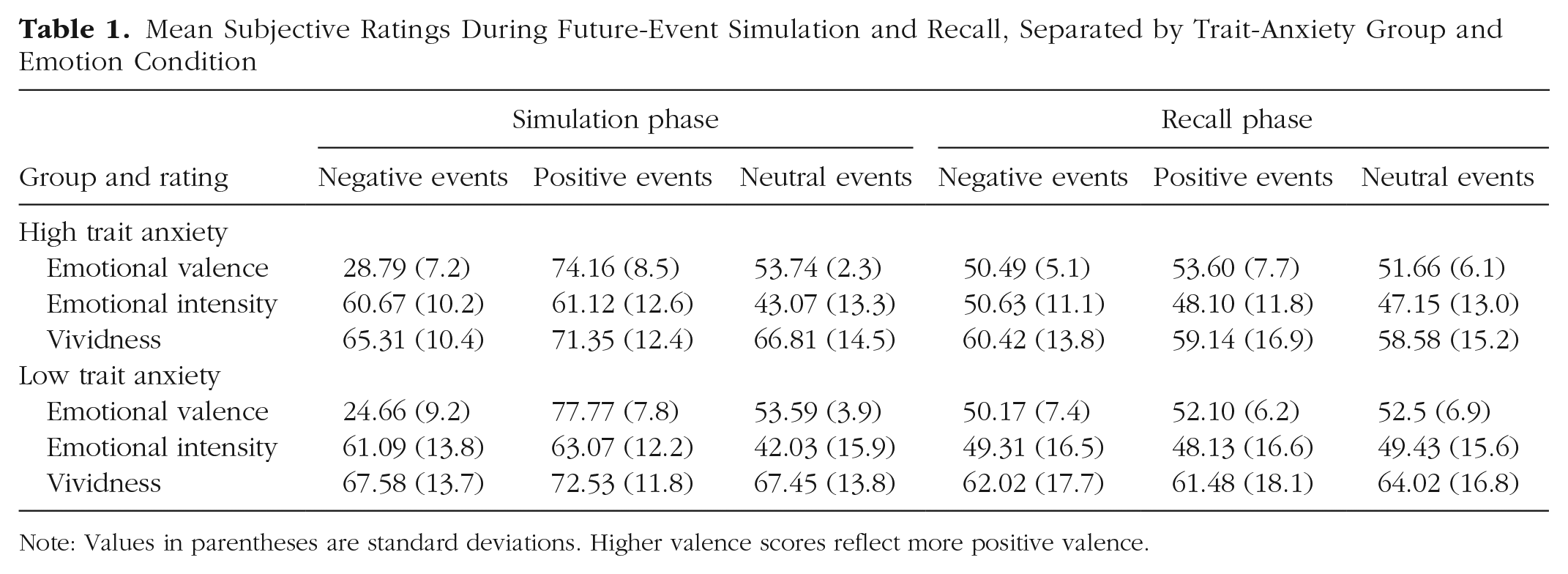
Note: Values in parentheses are standard deviations. Higher valence scores reflect more positive valence.
Recall accuracy
To investigate the influence of anxiety on recall of memory details for imagined emotional future events, we conducted a 2 (trait anxiety: low, high) × 3 (emotion: negative, positive, neutral) mixed ANOVA. A main effect was found for trait anxiety, F(1, 51) = 4.78, p = .033, η p 2 = .09, 95% CI = [.003, .219], but not for emotion, F(2, 102) = 1.33, p = .27, η p 2 = .025, 95% CI = [.00, .081], and a significant interaction between trait anxiety and emotionality was found, F(2, 102) = 3.83, p = .025, η p 2 = .07, 95% CI = [.004, .149]. 1 Post hoc independent-samples t tests revealed that, compared with the low-trait-anxiety group, the high-trait-anxiety group had lower recall accuracy for both positive future events, t(51) = −2.79, p = .007, d = 0.77, 95% CI = [0.206, 1.33], and negative future events, t(51) = −2.296, p = .026, d = 0.64, 95% CI = [0.076, 1.19], but not for neutral future events, t(51) = −0.624, p = .536, d = 0.17, 95% CI = [−0.372, 0.716] (see Fig. 1).
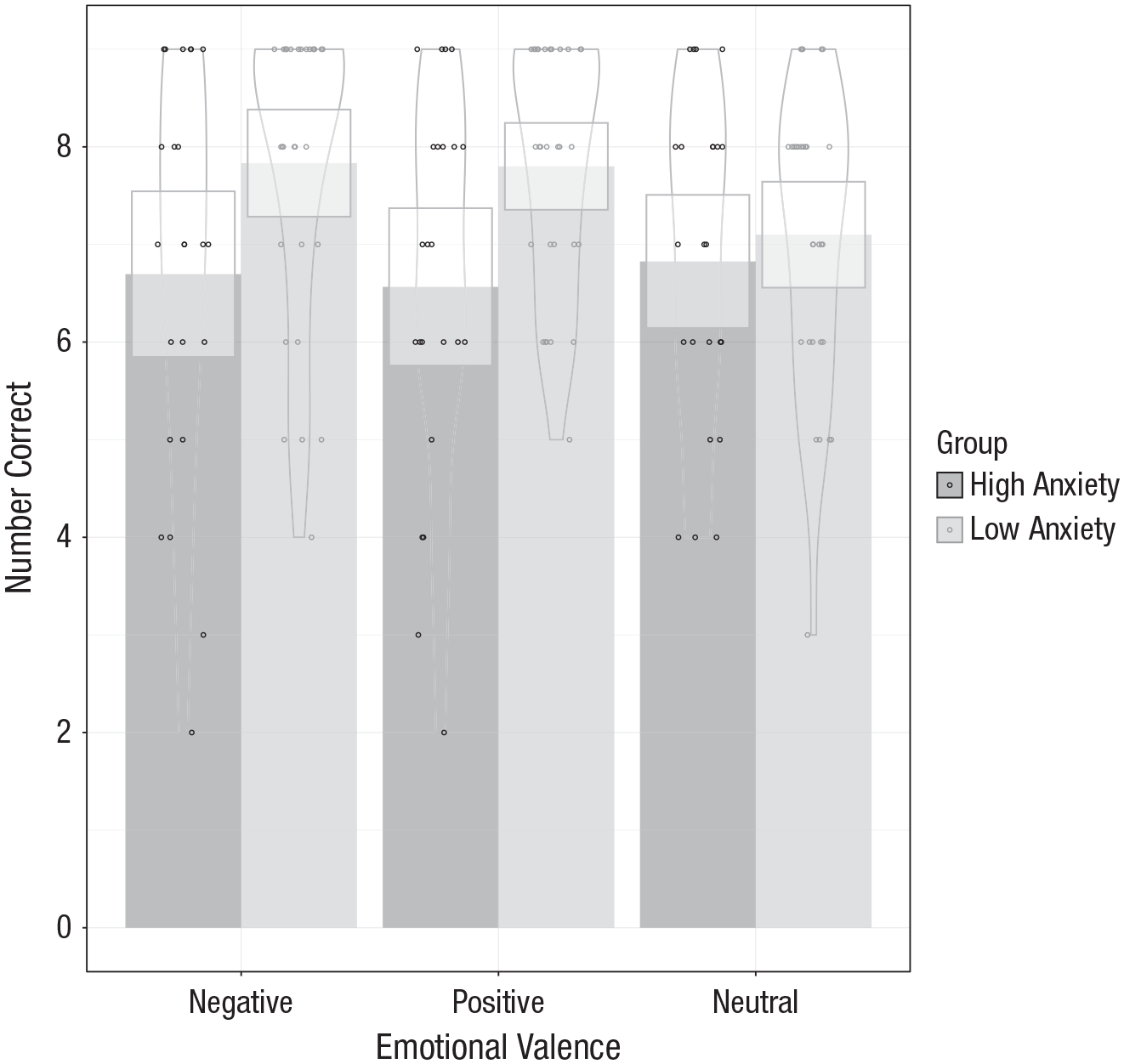
Number of correctly recalled cue words (maximum score = 9) per emotion-valence condition and trait-anxiety group. Shaded bars show means for each anxiety group. Clear boxes at the top of the shaded bars indicate 95% confidence intervals. Dots represent individual data points, and the width of the irregular outlines shows the density of the data.
Episodic specificity
First, we examined preexisting differences in the detail with which the future events were simulated. We ran a 2 (trait anxiety: low, high) × 3 (emotion: negative, positive, neutral) mixed ANOVA on the episodic-specificity scores for the simulation phase. We found a main effect of emotion, F(2, 102) = 5.345, p = .006, η p 2 = .095, 95% CI = [.016, .18], but not of trait anxiety, F(1, 51) = 0.300, p = .586, η p 2 = .006, 95% CI = [.00, .08], and no significant interaction, F(2, 102) = 0.648, p = .525, η p 2 = .013, 95% CI = [.00, .054]. This confirmed that both anxiety groups simulated future events with an equal level of episodic specificity (see Table 2).
Mean Episodic-Specificity (Autobiographical Interview) Scores for Future-Event Simulation and Recall, Separated by Trait-Anxiety Group and Emotion Condition
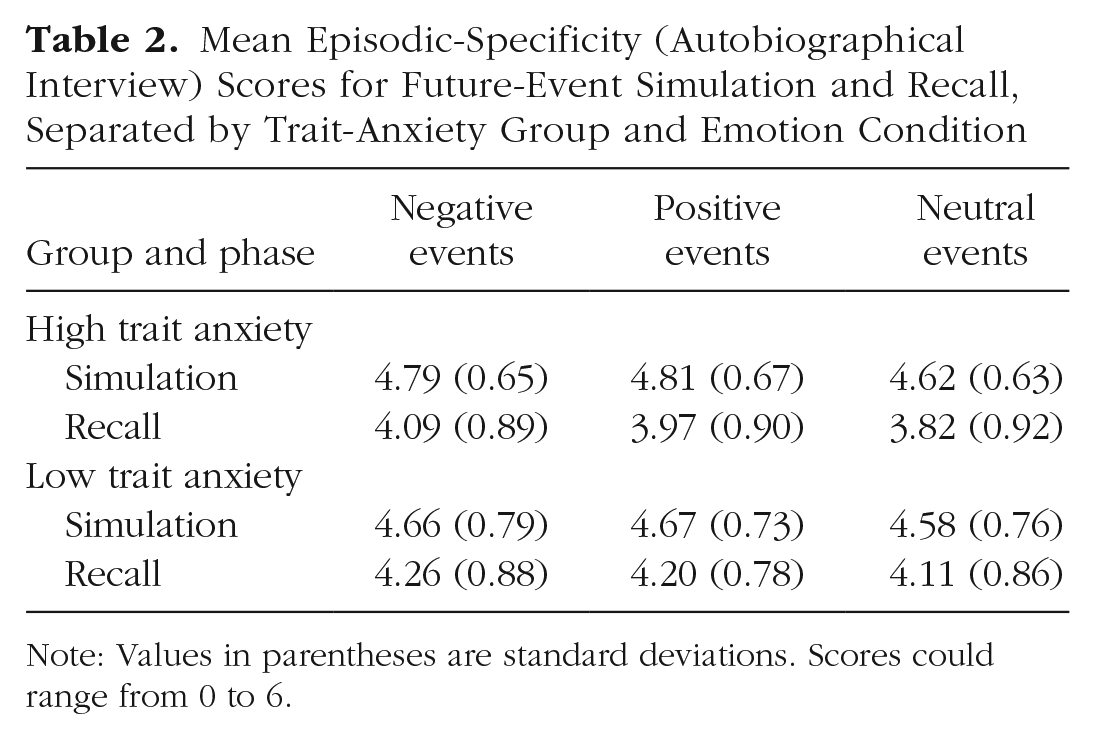
Note: Values in parentheses are standard deviations. Scores could range from 0 to 6.
Second, we conducted a 2 (trait anxiety: low, high) × 3 (emotion: negative, positive, neutral) mixed ANOVA to investigate the effect of anxiety and emotion on the change in episodic specificity between the simulation and recall phases (difference score: recall – simulation). We found a main effect of trait anxiety, F(1, 51) = 4.46, p = .04, η p 2 = .08, 95% CI = [.002, .21], but not of emotion, F(2, 102) = 1.50, p = .23, η p 2 = .029, 95% CI = [.00, .087], and no statistically significant interaction between trait anxiety and emotion, F(2, 102) = 0.192, p = .825, η p 2 = .004, 95% CI = [.00, .025]. Post hoc independent-samples t tests revealed that, compared with the low-trait-anxiety group, the high-trait-anxiety group showed a larger reduction in episodic specificity for positive events, t(30.338) = −2.09, p = .045, d = 0.60, 95% CI = [0.021, 1.13]. Similar but nonsignificant trends with medium effect sizes were observed for negative events, t(51) = −1.688, p = .097, d = 0.46, 95% CI = [−0.085, 1.01], and neutral events, t(33.725) = −1.727, p = .093, d = 0.49, 95% CI = [−0.074, 1.02] (see Fig. 2).
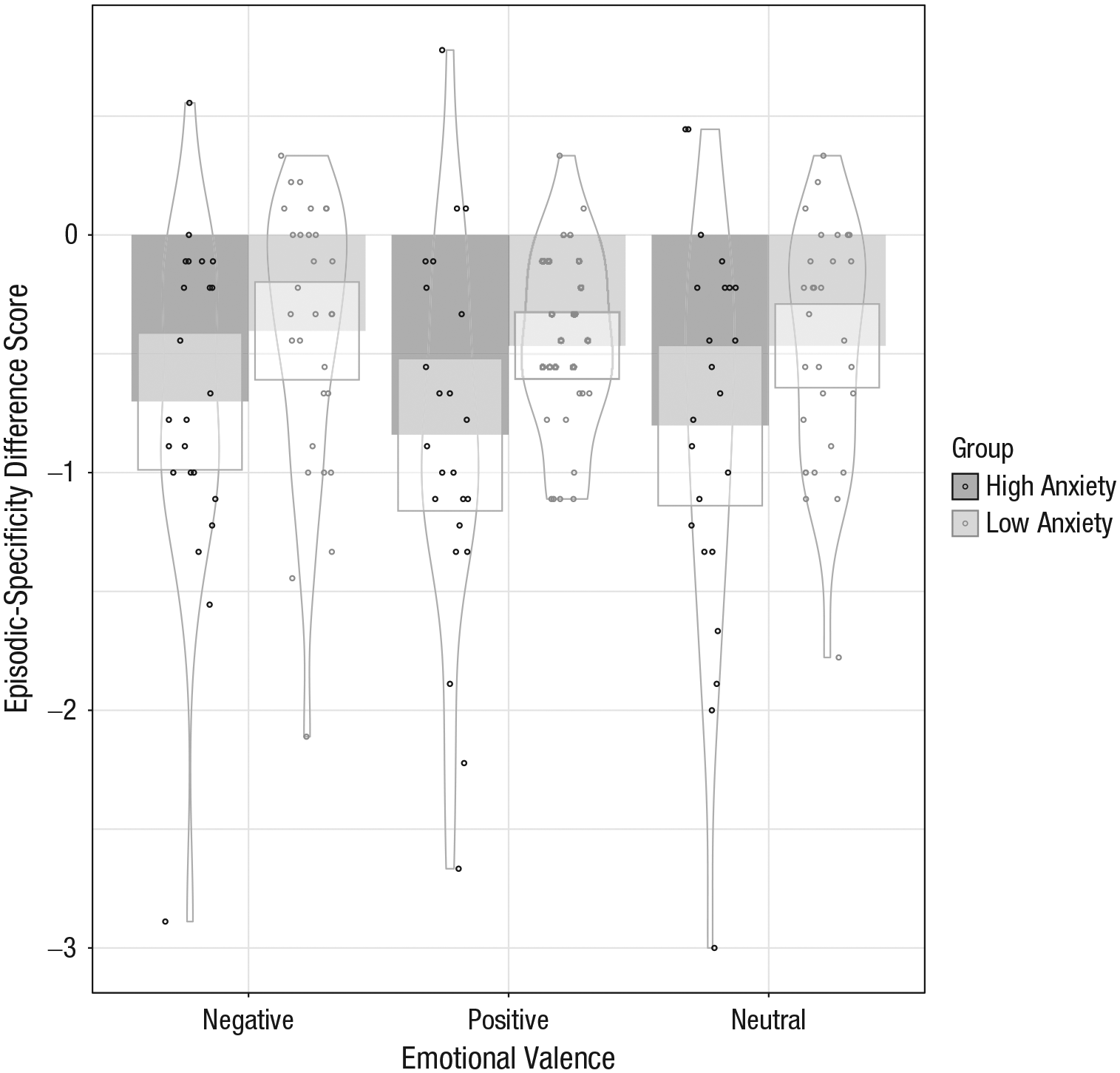
Mean episodic-specificity difference score (recall – simulation) per emotional-valence condition and trait-anxiety group. Negative scores reflect decreased episodic specificity during recall, whereas positive scores reflect increased specificity during recall. Shaded bars show means for each anxiety group. Clear boxes at the bottom of the shaded bars indicate 95% confidence intervals. Dots represent individual data points, and the width of the irregular outlines shows the density of the data.
Fading-affect measures
To assess the presence of a FAB, we subjected the difference scores (recall – simulation) of subjective emotional intensity to a 2 (trait anxiety: low, high) × 3 (emotion: negative, positive, neutral) mixed ANOVA. Scores below zero reflected fading of emotional intensity, whereas positive scores reflected increased emotional intensity. The results revealed a significant main effect of emotion, F(2, 102) = 60.02, p < .001, η p 2 = .54, 95% CI = [.42, .61], but not of trait anxiety, F(1, 51) = 0.002, p = .97, η p 2 = .00, 95% CI = [.00, .00], and no significant interaction between trait anxiety and emotion, F(2, 102) = 1.19, p = .31, η p 2 = .023, 95% CI = [.00, .076] (see Note 1).
Further examination of the main effect of emotion using repeated measures ANOVAs (time: simulation phase, recall phase) revealed a decrease over time of subjective emotional intensity for both negative (M = −11.03, SD = 13.44), F(1, 52) = 35.67, p < .001, η p 2 = .41, 95% CI = [.23, .53], and positive (M = −14.11, SD = 12.27), F(1, 52) = 70.04, p < .001, η p 2 = .574, 95% CI = [.41, .66], future events and an increase of emotional intensity for neutral events (M = 5.96, SD = 13.77), F(1, 52) = 9.91, p = .003, η p 2 = .16, 95% CI = [.035, .30]. The mean decrease in emotional intensity was higher for positive than negative events, but this did not reach statistical significance, F(1, 52) = 3.44, p = .069, η p 2 = .062, 95% CI = [.00, .18]. Together, these analyses do not show a difference in fading affect between the high- and low-trait-anxiety groups and do not show proof of a FAB in imagined future events.
Parallel fading
To investigate whether emotional intensity and recall deteriorate at a similar rate for simulated future events, we conducted three separate hierarchical regressions for each of the emotionality conditions. The dependent variable was the number of correct cue words, and predictors were group (trait anxiety: high = 0, low = 1), difference scores of emotional intensity (recall – simulation), and their interaction. The regression showed a significant relationship between group and recall for positive and negative future events but not for neutral future events (see Table 3), which was also indicated by the mixed ANOVA. Furthermore, for positive and neutral future events, we found a positive relationship between the difference score of emotional intensity and recall accuracy. This indicates that less emotional fading was associated with higher recall accuracy for positive (β = 0.259, p = .046) and neutral (β = 0.290, p = .038) future events but not for negative events (β = 0.152, p = .259). In all three analyses, the interaction term could be rejected. The remaining two predictors accounted for a modest amount of the variance for positive, F(2, 50) = 6.205, R2 = .199, p = .004, and negative, F(2, 50) = 3.302, R2 = .117, p = .045, future events. Finally, we tested whether emotional valence (negative, neutral, positive) interacted with the difference score of emotional intensity on cued recall across emotionality conditions using the neutral condition as a reference; the three-way interaction among group (low anxiety, high anxiety), emotional valence, and difference score was not significant (negative: β = 0.04, p = .314; positive: β = −0.01, p = .84). On the basis of these findings, we conclude that there was no parallel relationship between reductions in emotional intensity and recall accuracy of imagined future events.
Results From the Hierarchical Regression Analyses for Recall of Positive, Negative, and Neutral Events
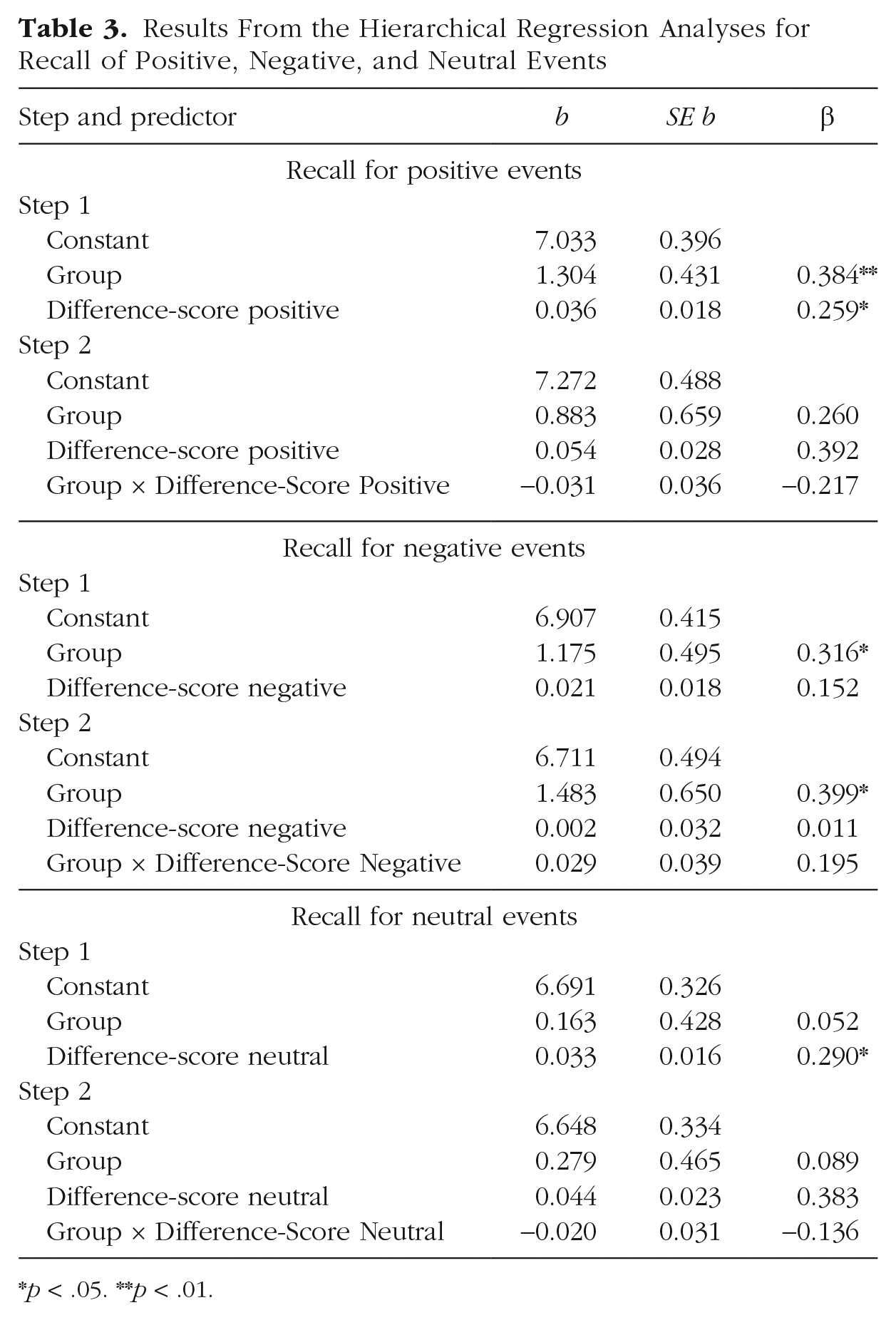
p < .05. **p < .01.
Discussion
Our aim in this study was to examine whether the FAB can be observed in memory for imagined future events and whether it is reversed in individuals with high levels of anxiety. Additionally, we sought to uncover whether there is a parallel relationship between reductions in emotionality and recall accuracy for imagined future events. Our results do not indicate a bias in fading affect for imagined future events in the low- or high-anxiety groups and did not replicate earlier reports of enhanced recall for positive future events (Szpunar et al., 2012). Instead, our results showed enhanced recall for both negative and positive future events, compared with neutral future events, in the low-anxiety group during cued recall. Interestingly, the high-anxiety group did not show this enhanced cued-recall accuracy for emotional future events. Furthermore, compared with the low-anxiety group, the high-anxiety group showed greater decay in episodic specificity across all emotion conditions. Although this effect was subtle, this does underline a potential negative relationship between anxiety and memory for imagined future events. Finally, reductions in emotional intensity were not significantly associated with reductions in recall accuracy.
The finding that emotion improves cued recall of imagined future events in individuals with low trait anxiety fits well with prior work on emotional-memory enhancement. This enhanced memory for emotional events is thought to be facilitated by the arousal-induced release of noradrenaline and cortisol, which aid memory encoding and consolidation (e.g., Diamond et al., 2007; Joëls et al., 2011). Even though this emotional-memory enhancement does not appear to affect episodic specificity of the recalled event, it does suggest that emotional future events are more readily available for recall. Interestingly, our results show that individuals with high anxiety may lack this emotional-memory enhancement. Indeed, earlier work using a perceptual-oddball task showed a similar effect in trait anxiety: Individuals with high trait anxiety did not benefit from the emotionality of the oddball, whereas controls with low anxiety did (Miu et al., 2005). The authors attributed this finding to a moderating effect of trait anxiety on the association between the release of noradrenaline in the amygdala and emotional-memory encoding. Although our data do not allow us to contribute to this mechanistic discussion, they do highlight that trait anxiety can interfere with the beneficial effect that emotion has on memory encoding. Together with the finding that individuals with anxiety showed reduced episodic specificity during recall, this lack in emotional facilitation may impede the adaptive value of future thinking in anxious populations.
As noted by Ingvar (1985), future thoughts are generally believed to promote goal-directed behavior (Bulley & Irish, 2018; Schacter et al., 2017). Our emotional reaction to a simulated future event is thought to be an important motivating factor in setting goals to achieve or to avoid these future events (Barsics et al., 2016). It is important to highlight that both negative and positive future thoughts hold adaptive benefits with regard to goal-directed behavior (Miloyan & Suddendorf, 2015). The heightened retention and mental availability of these emotional future simulations will ultimately benefit maintaining and updating of these goals. The finding that individuals with high anxiety do not show this emotional-memory enhancement and in general show faster memory decay for future events could possibly lead to reductions in effective goal-directed behavior (Ingvar, 1985).
Furthermore, our findings indicate that individuals with low trait anxiety benefit from the emotionality of the future event only with respect to the structural integrity of the memory. The subjective emotionality and valence that was connected to the future events during encoding dissipates quickly and reverts to a neutral state. Heightened retention of emotional future events in the absence of the reexperience of the emotion may indicate that emotional experience does not serve a purpose beyond encoding in future thinking. Thus, emotion can lead to stronger memory formation but does not depend on explicit maintenance of the emotion for its positive effect on recall. Moreover, the apparent absence of a positive or negative bias in future memory recall suggests that both valences may be equally important to retain after they have been simulated. Therefore, we posit that the remembered future is goal oriented rather than “rosy.”
Our results seem to contrast with past research that found a positive memory bias in healthy control subjects and pessimism for future events in individuals with anxiety. One reason for this may be that we fixed the number of future events for each emotional condition, instead of leaving the emotional valence up to the participant. Additionally, we instructed participants to provide cue words that did not have a strong emotional association. In contrast, earlier work on emotional-memory bias in anxiety disorders has mostly relied on valenced cue words (for a review, see Zlomuzica et al., 2014). These studies could therefore reflect a bias in attention and spontaneous future thinking rather than a bias that affects memory encoding as was assessed here.
The present study may be limited by its use of a general negative condition rather than a fear-specific one. Although the literature on anxiety disorders has often reported a negative memory bias, other work has exemplified that this memory bias is limited to anxiety-provoking events. However, our results are in line with recent work showing that high social anxiety is not associated with enhanced recall for imagined negative social situations (Romano et al., 2020). Combining this with our results, we postulate that anxiety may be related to the selective retrieval of anxiety-related memories but not to enhanced recall accuracy for such memories. Another limitation is that we examined a relatively small, nonclinical student sample, which may limit generalizability of the findings to a clinical population. Finally, although the AI analysis offers novel insights into episodic specificity of remembered future simulations for anxious populations, it is unclear whether this reduction in detail indeed leads to problems in adaptive functioning (Miloyan & McFarlane, 2019; Ward, 2016) and whether naturalistic future thinking follows a similar pattern of decay.
In conclusion, although prior research has shown that individuals with high anxiety have a stronger tendency to imagine negative future events in a naturalistic setting, the current results suggest that this bias does not translate to the type of emotional facilitation that survives consolidation. Ultimately, the combination of increased negative future thinking and faster (emotional) memory decay for future thoughts may still lead to an overrepresentation of, albeit poorly encoded, negative information in memory in high trait anxiety. Gaining a deeper understanding of the way these future events are represented in memory can inform treatments that target maladaptive fear.
Footnotes
Acknowledgements
We thank Donna Rose Addis, Karl Szpunar, and Brian Levine for supplying task materials and for their advice on methodological considerations. We thank Cecilia Wortelboer, Jetske Haitsma, and Gerben Feenstra for their assistance with data collection.
Transparency
Action Editor: Daniela Schiller
Editor: Patricia J. Bauer
Author Contributions
N. D. Montijn and I. M. Engelhard designed the study. N. D. Montijn performed the research, and N. D. Montijn and L. Gerritsen analyzed the data. N. D. Montijn wrote the first draft of the manuscript. All the authors approved the final manuscript for submission.