




Abstract
Haunted attractions are illustrative examples of recreational fear in which people voluntarily seek out frightening experiences in pursuit of enjoyment. We present findings from a field study at a haunted-house attraction where visitors between the ages of 12 and 57 years (N = 110) were equipped with heart rate monitors, video-recorded at peak scare points during the attraction, and asked to report on their experience. Our results show that enjoyment has an inverted-U-shaped relationship with fear across repeated self-reported measures. Moreover, results from physiological data demonstrate that the experience of being frightened is a linear function of large-scale heart rate fluctuations, whereas there is an inverted-U-shaped relationship between participant enjoyment and small-scale heart rate fluctuations. These results suggest that enjoyment is related to forms of arousal dynamics that are “just right.” These findings shed light on how fear and enjoyment can coexist in recreational horror.
Fear is often said to be an ancient emotion that evolved to allow organisms to swiftly mobilize large amounts of resources in times of need. As a universal, adaptive, and normally aversive emotion with significant relevance to psychological well-being, fear has been extensively researched (Öhman & Mineka, 2001). In humans, fear refers to the conscious unpleasant feeling that one has when in the presence of a threat to well-being, which is often but not always accompanied by behavioral and physiological defensive reactions (LeDoux, 2013; Mauss, Levenson, McCarter, Wilhelm, & Gross, 2005). Although fear as an emotional category almost exclusively refers to negatively valenced experiences, fear nonetheless denotes a variety of psychological states that vary significantly as a function of sensory input, context, and previous experience (Barrett, 2017). Although researchers have attempted to deal with this variation by creating ever-finer-grained typologies of fear (Barrett, 2017; Gross & Canteras, 2012), an integrated understanding of fear as an enjoyable activity—what we call recreational fear—is still lacking.
We define recreational fear broadly as a mixed emotional experience of fear and enjoyment. With this definition we seek to capture the broad spectrum of phenomena in which humans derive pleasure from playful engagement with fear-inducing situations. Such engagement ranges from mildly scary children’s activities, such as playfully being chased by a parent or caregiver, to full-blown horror media, such as horror films and haunted attractions, which remain prominent in popular culture (Clasen, Kjeldgaard-Christiansen, & Johnson, 2020).
Over the years, scholars have speculated on a variety of explanations for the recreational-fear phenomenon. For instance, it has been suspected that horror consumption may be an ambivalent confrontation with repressed desires (Schneider, 2004), a context for the social display of normative behavior (Zillmann & Weaver, 1996), a form of self-stimulation through artificially induced arousal (Menninghaus et al., 2017; Zuckerman, 1996), or a form of benign masochism (Rozin, Guillot, Fincher, Rozin, & Tsukayama, 2013). In addition, researchers have engaged with the related phenomenon of extreme sports in an attempt to understand such forms of thrill-seeking behavior (Brymer, Feletti, Monasterio, & Schweitzer, 2020). Moreover, a spate of media-effects studies on horror films have contributed significantly to our understanding of the allure of frightening films (for reviews, see Hoffner & Levine, 2005; Martin, 2019). Such studies often focus on the role of trait sensation seeking, suggesting that physiological arousal may play a key role in horror enjoyment. However, a direct relationship between arousal and enjoyment in recreational horror has not been established, perhaps because media-effects studies are typically lab-based and expose participants to relatively weak stimuli (short clips from frightening movies). With a few exceptions (Clasen, Andersen, & Schjoedt, 2019; Dezecache, Grèzes, & Dahl, 2017; Kerr, Siegle, & Orsini, 2019), little research has taken advantage of the high-intensity, immersive, and social phenomenon of haunted houses, perhaps because of the logistical challenges associated with such research.
A recent speculation among scholars of horror is the idea that recreational fear may be thought of as a form of play (Clasen, 2017; Grodal, 2009). The essential idea here is that recreational fear, such as horror entertainment, provides a context in which individuals can have low-cost, risk-free experience with fear and related negative emotions (Clasen et al., 2020; Morin, Acerbi, & Sobchuk, 2019). Horror-film viewers, for example, respond to the film with negative emotions such as fear, anxiety, dread, and disgust without being in actual danger. Like a child responding with suspenseful delight to being playfully chased by a caregiver, the horror-film viewer engages playfully with a form of threat simulation.
It is widely accepted within play research that play is a behavior that is internally motivated and enjoyable to the individual (e.g., Bateson & Martin, 2013; Burghardt, 2005). According to a variety of accounts, play and curiosity have also been characterized as behaviors in which the individual approaches situations in which the amount of uncertainty or surprise associated with them is “just right” for that person. It has been argued, for instance, that curiosity is aroused when individuals have their expectations violated to a just-right degree (Jirout & Klahr, 2012; Loewenstein, 1994). Similarly, the immersive and rewarding experience of “flow” characteristic of playful states tends to occur in tasks that are neither too easy nor too difficult for the individual to grasp (Bateson & Martin, 2013; Csikszentmihalyi, 1996). Such ideas are also echoed in recent work from cognitive science, which highlights the experiential attractiveness of just-right doses of uncertainty and surprise in play and playful forms of exploration (Andersen & Roepstorff, 2020; Clark, 2018; Kiverstein, Miller, & Rietveld, 2019). According to such accounts, phenomena associated with little to no uncertainty or surprise would render an experience boring and unmotivating, whereas too much uncertainty and surprise would render it chaotic, unmasterable, and displeasurable. Importantly, this applies to interoceptive as well as exteroceptive signals. For instance, individuals engaging in risky play have been found to seek heightened states of arousal, yet too much arousal in such forms of play will often result in a withdrawal from the activity (Sandseter, 2010).
Statement of Relevance
Our most typical interpretation of fear is that it is an aversive emotion that functions to keep us safe in dangerous environments. Yet humans seem to deliberately seek out frightening material: Horror movies are popular at the box office, horror novels are regularly featured on bestseller lists, and interactive horror experiences such as video games and haunted attractions are increasingly common. How is it that we derive pleasure from fear? Researchers have made significant advances in throwing light on the psychology of horror, but they have often used relatively impoverished stimuli in artificial lab settings. Instead, in this research, we took advantage of the high-intensity, naturalistic context of haunted attractions. We examined subjective ratings, behavioral responses, and physiological reactions (heart rate fluctuations). Our findings show how fear and enjoyment can coexist in frightening leisure activities that become enjoyable when they offer forms of arousal dynamics that are “just right.”
When applied to the context of recreational horror, such accounts would predict an inverted-U-shaped relationship between enjoyment and fear. Whether such an inverted-U-shaped relationship exists in these contexts is, however, unknown.
Our aim in the current study was to investigate the relationship between fear and enjoyment and their physiological and behavioral correlates in a recreational horror setting. Participants equipped with heart rate monitors were video-recorded at three preselected locations while they completed a haunted attraction. Our results show that enjoyment has an inverted-U-shaped relationship with fear across repeated self-reported measures. Furthermore, self-reported fear is a linear function of large-scale heart rate fluctuations, whereas self-reported enjoyment is characterized by an inverted-U-shaped relationship with small-scale heart rate fluctuations. These results suggest that enjoyment is related to just-right arousal dynamics embedded within a larger context of physiological responses associated with fear. These findings may explain how fear and enjoyment can coexist in recreational horror.
Method
Ethics and informed consent
The methodology in the present study was carried out in accordance with all relevant guidelines and regulations issued by the National Committee on Health Research Ethics, Copenhagen, Denmark. Informed consent was obtained from all participants prior to their participation. Consent and permission from a legal guardian was also obtained for participants under the age of 18.
Participants
Visitors (N = 110) signed up for the study (62 women; mean age = 30.45 years, age range = 12–57). The sample size was based on the number of participants who were willing to participate in the study, which was conducted in a single evening. Some participants had visited the attraction the prior year (n = 17), and a few participants had visited the attraction earlier the same year (n = 4).
Procedure
The haunted attraction used for the study is a Danish commercial attraction, Dystopia Haunted House. Here, visitors pay to go through 42 thematically connected rooms in groups of three to six individuals to experience an immersive, live-action theatrical horror production that involves a high degree of improvisation on the part of the actors and sometimes unpredictable and chaotic behavior on the part of the visitors.
Visitors were recruited for the study on arrival at the site and were compensated with 100 Danish krone (~US$15) for participation. Participants signed a consent form, were equipped with heart rate monitors (see the Heart Rate Monitors section), and completed a short structured questionnaire (see the Structured Questionnaires section). Participants then completed the haunted house in groups like regular visitors (group size: M = 4.00, SD = 0.83, range = 2–6). While the participants were inside the haunted house, they were video-recorded at three separate predetermined locations containing acute threatening events, or “jump scares” (see the Video Recordings section). When participants exited the haunted house, they were asked to complete a structured questionnaire (see the Structured Questionnaires section) and return their heart rate monitors.
Measures and equipment
Structured questionnaires
Participants were asked to complete two structured questionnaires. The first questionnaire, which they completed prior to entering the attraction, included basic demographic information, a question about participants’ expected fear intensity inside the attraction, and participants’ motivation for visiting the attraction. The translated versions of these latter two questions were, “How scared do you expect to become inside the haunted attraction?” (10-point Likert scale; 0 = not at all scared, 9 = more scared than ever before) and “Why did you visit the haunted attraction?” (A = mostly because I wanted to, B = mostly because my friends/colleagues/family/etc. wanted to).
The second questionnaire was administered immediately after participants exited the attraction. First, participants were asked about their general fear and enjoyment levels throughout the attraction in its entirety. These subjective measures allowed us to compare the overall subjective experience with participants’ overall heart rate distributions across the entire session. The translated versions of these two questions were, “How scared were you inside the haunted attraction?” (10-point Likert scale; 0 = not at all scared, 9 = more scared than ever before) and “Did you enjoy being inside the haunted attraction?” (10-point Likert scale; 0 = not at all!, 9 = very much!).
We also asked specific versions of these two questions for each of the three video-recorded locations. This allowed us to assess the relationship between (a) subjective experience of fear and enjoyment and (b) overt behavior (see the Video Recordings section). These questions included a brief description of each of the three locations and a probe to ascertain participants’ recollection of them. For each location, participants were then asked about their fear and enjoyment levels, for example, “How scared were you when the zombie jumped out from inside the table?” (10-point Likert scale; 0 = not at all scared, 9 = more scared than ever) and “Did you enjoy it when the zombie jumped out from inside the table?” (10-point Likert scale; 0 = not at all!, 9 = very much!).
Additionally, the second questionnaire contained seven questions. Three were about (a) play (“Did you feel that you engaged in a form of play inside the haunted attraction?”; 10-point Likert scale; 0 = not at all, 9 = very much), (b) whether participants had visited the particular attraction earlier that same year, and (c) whether participants had visited another attraction produced by the same company previously. The remaining four asked participants to (a and b) rank the three locations in terms of both fear and enjoyment, (c) list their horror-media consumption, and (d) indicate their satisfaction with the experience. A few of these items were included for exploratory purposes and were not included in the data analysis (but see the Data Availability section).
Heart rate monitors
We measured participants’ heart rate throughout the haunted attraction. Research assistants equipped participants with Bodyguard 2 (Firstbeat, Jyväskylä, Finland) heart rate monitors before they entered the attraction. The Firstbeat Bodyguard 2 is a small, lightweight, and unobtrusive device that can be quickly and easily fitted directly on the skin with two chest electrodes. This device was used to extract a beats per minute (BPM) signal at 1 Hz for each participant across the haunted attraction.
Emotion researchers have used heart rate to investigate the physiological correlates of a variety of self-reported emotions, including fear and enjoyment (e.g., Cacioppo, Berntson, Larsen, Poehlmann, & Ito, 2000; Critchley et al., 2005; Davis, 1992; Myrtek & Brügner, 1996). Overwhelmingly, an increase in BPM is the most common and reliable physiological indicator of self-reported fear, which has been studied using a variety of experimental paradigms (for a review, see Kreibig, Wilhelm, Roth, & Gross, 2007). Enjoyment specifically has been studied to a lesser degree; however, related emotional categories such as amusement, joy, and pleasure have been studied using BPM with mixed results (for a review, see Kreibig, 2010). Given its simplicity and reliability when measuring the physiological response associated with fear, BPM is a suitable physiological measurement for ecologically valid experimental designs that inherently contain more noise than carefully controlled laboratory experiments.
Spectral analysis is a common way to analyze fluctuations in heart rate by disentangling those that occur on short timescales (e.g., a few seconds) and large timescales (e.g., longer than 10 s; Task Force of the European Society of Cardiology & the North American Society of Pacing Electrophysiology, 1996; Sassi et al., 2015). The typical approach for separating heart rate fluctuations has been to use a set of normative frequency bands proposed by the Task Force of the European Society of Cardiology, which were based on a large sample of participants at a resting state. However, these bands may not be appropriate when participants are in an active state—such as being chased by a pig man with a chainsaw (see Fig. 1). Following the Task Force’s procedure, we identified appropriate frequency bands of heart rate for our scenario on the basis of the spectrum obtained by averaging across subjects (see the Preprocessing of Heart Rate Data section).
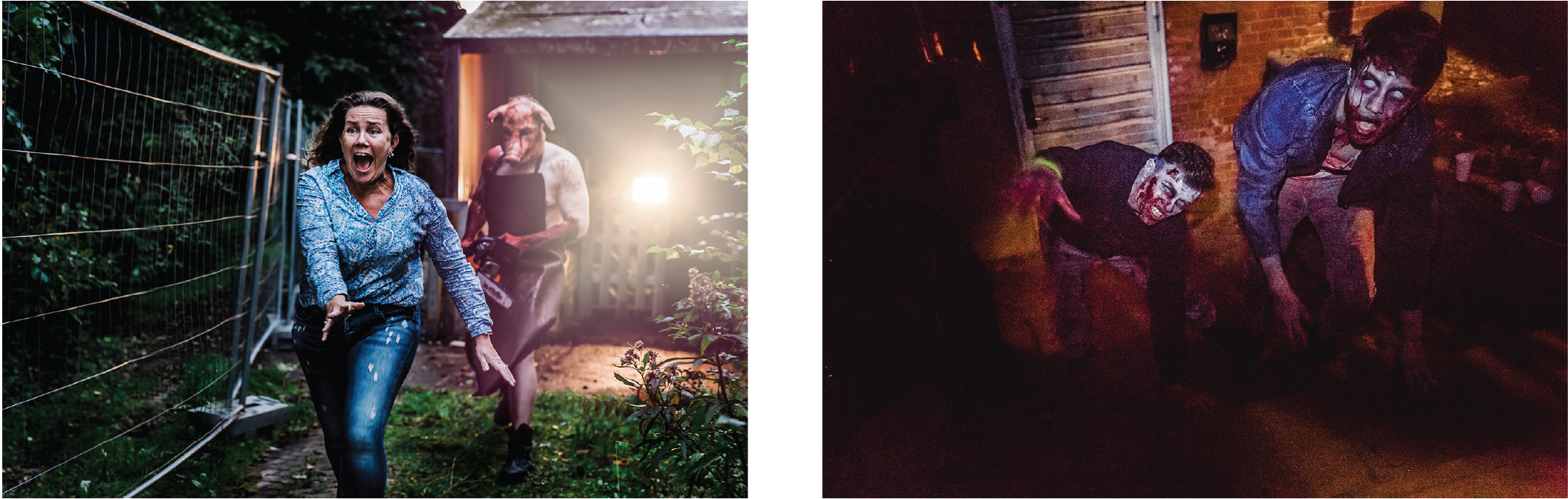
Photos from the haunted-house attraction: a woman running from “Mr. Piggy” at Jump-Scare Location 2 (left) and zombies at Jump-Scare Location 3 (right). Photos were taken by Tina Liv.
Video recordings
Participants’ behavior was video-recorded at three predetermined locations, each containing a jump scare. Video recordings were collected using six Indoor IP Dome 1080p cameras (ABUS, Wetter, Germany) with night-vision capabilities (full high-definition 1080p resolution; 1,920 × 1,080 pixels; 30 frames per second) and three infrared projectors, which provided sufficient lighting for night vision. There were two cameras at the first location, three cameras at the second, and one at the third.
In the first location, participants encountered a mad scientist who, after completing an unsettling monologue, kicked over a metal bucket, signaling to a hidden zombie to jump out from inside a table (see Fig. 2). In the second location, participants encountered the sudden loud noise of a combustion engine kicking into life, after which a large man with a bloody butcher’s apron and a pig mask emerged from hiding to chase participants with a roaring chainsaw (see Fig. 1). In the third location, just prior to the exit of the haunted attraction, participants turned a corner where several zombies suddenly jumped out from a staircase, snarling and aggressively lashing out at the participants (see Fig. 1).
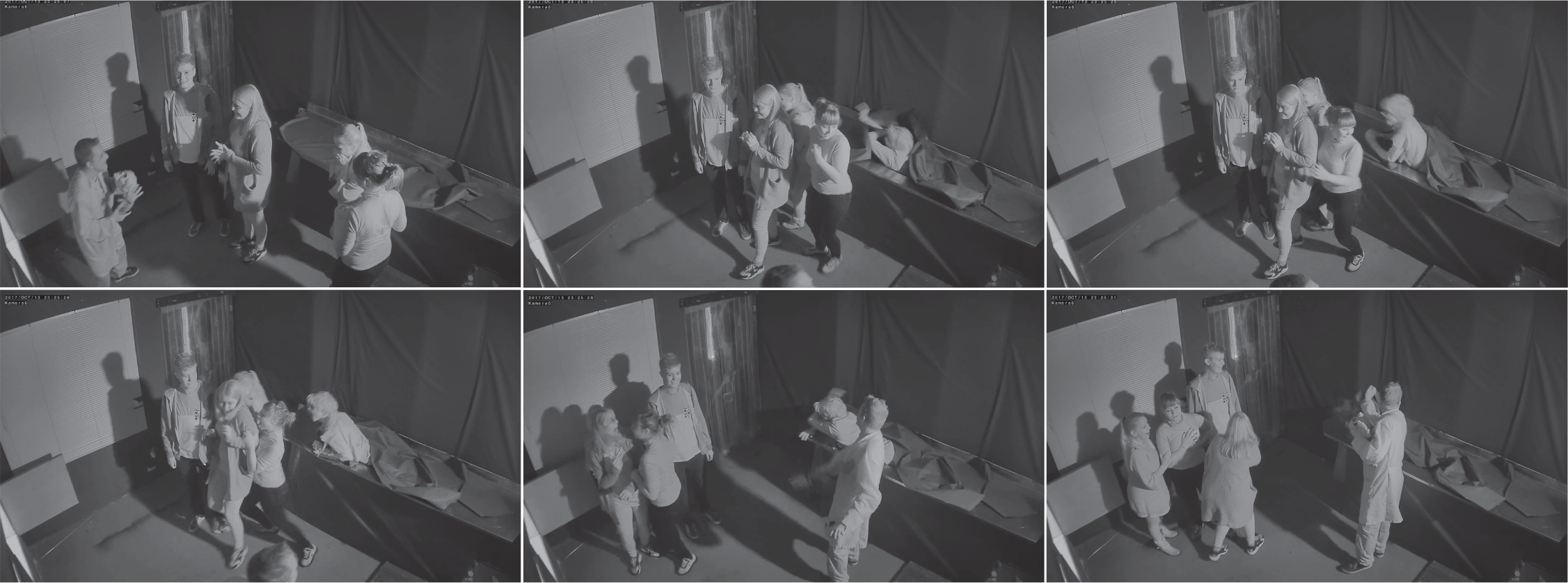
Freeze-frames from surveillance-camera footage at Jump-Scare Location 1, where haunted-house guests encountered a mad scientist, and a concealed zombie delivered a jump scare. The haunted-house guests shown in these images are research assistants from the study.
Data preprocessing
Exclusion of participants
Of the 110 participants who signed up for the study, 18 were excluded: 4 participants did not fill out the main questionnaire, 4 participants did not complete the haunted attraction, and 10 participants had missing or corrupted heart rate data. After these 18 participants were excluded, 92 participants remained for the analyses. For these 92, the mean artifact correction for heart rate was 11.3% (SD = 6.7%).
Preprocessing of heart rate data
Because participants were equipped with heart rate monitors before entering the actual attraction, and because participants often continued to wear the heart rate monitors while they filled out the questionnaire after exiting the attraction, the heart rate data were trimmed to ensure that they represented only the time spent inside the haunted attraction. The trimmed heart rate time series was set to start 20 s prior to the jump scare in the first location, and the end time was set to 20 s after the jump scare in the last location (M = 11 min 37 s, SD = 1 min 12 s).
To differentiate between the large-scale heart rate changes (low-frequency bands) that took place as the participants went through the attraction and the faster, small-scale changes (high-frequency bands) that took place during the individual horror encounters, we extracted large-scale heart rate changes by using a low-pass filter and the small-scale heart rate dynamics using a band-pass filter. We used forward and reverse Butterworth filters of Order 2, as implemented in Python’s SciPy toolbox (Virtanen et al., 2020). The cutoff frequencies were decided by visually inspecting the power spectrum averaged across participants, which showed clear drops at 0.1 Hz and 0.18 Hz, suggesting the coexistence of fluctuations of different natures (see Fig. S1 in the Supplemental Material available online). Therefore, the low-pass-filtered heart rate (0–0.1 Hz) kept all the changes that took place at the order of 10 s or slower, whereas the band-pass-filtered data (0.1–0.18 Hz) kept the changes that happened at the order of seconds (see Fig. 3). The high-frequency components (above 0.18 Hz) were discarded, as they would correspond to subsecond events that are not likely to reflect heart rate activity.
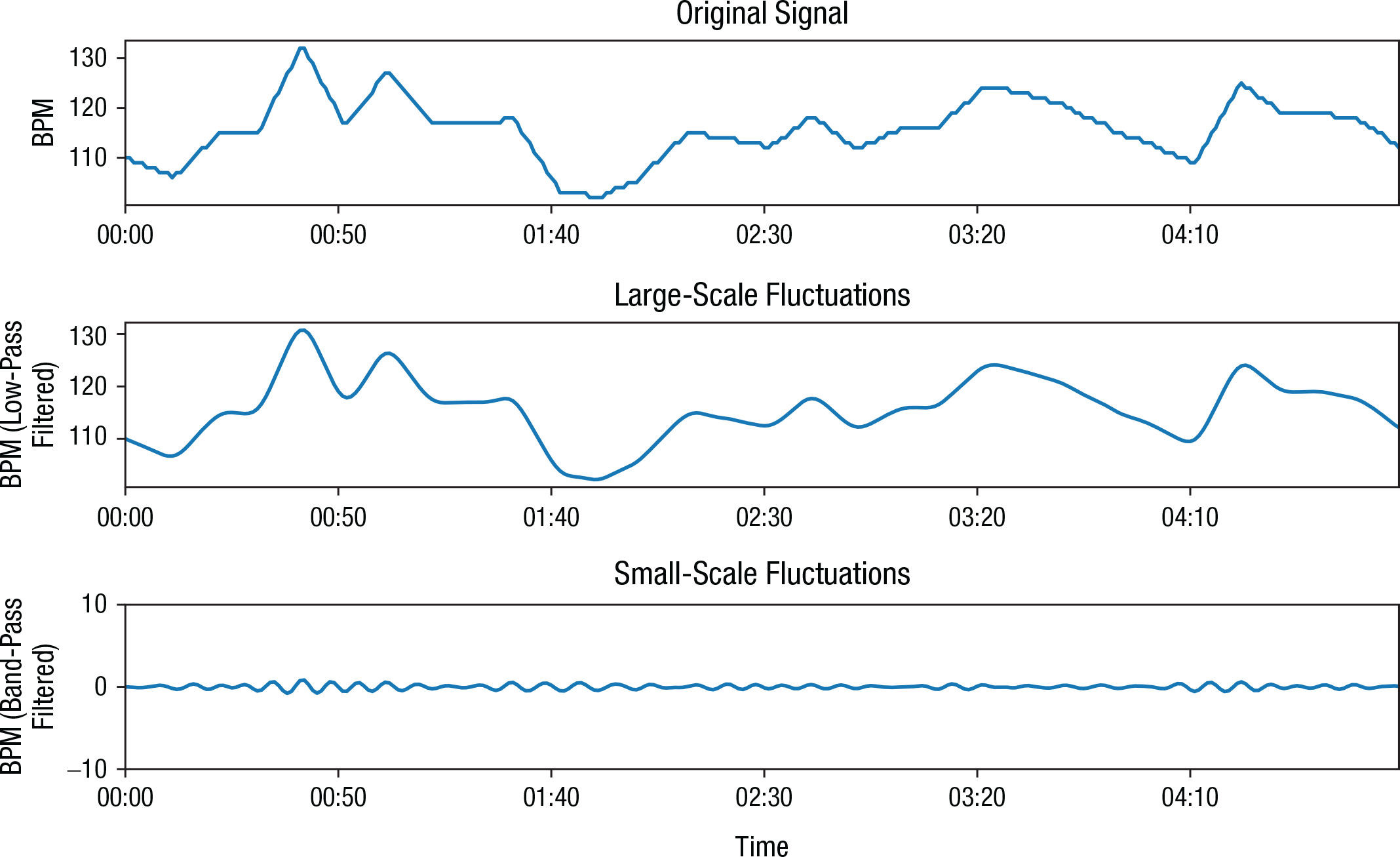
Heart rate data (beats per minute [BPM]). Large- and small-scale components were extracted from an original heart rate signal (top) via low-pass (middle) and band-pass (bottom) filtering, respectively.
Coding of overt behavior
Two independent coders, blind to the research questions of the study, coded the behavior of all participants at the three locations using the collected video footage. Coders were instructed to give overall assessments of participants’ fear, enjoyment, and surprise levels on the basis of participants’ facial expressions and body language. To assess participants’ fear levels, coders were instructed to look for facial expressions with open or stretched mouth or wide eyes, as well as a defensive body language (e.g., shielding oneself with hands or arms, jumping or moving away from the source of fear, hiding). To assess participants’ enjoyment levels, coders were instructed to look for facial expressions involving smiles or laughter, as well as a relaxed body language (e.g., arms down, relaxed shoulders). To assess participants’ surprise levels, coders were instructed to look for facial expressions with open mouth or wide eyes, as well as body language that indicated an immediate but transient response to the jump scare at each location. In all cases, if the participants’ faces were obscured, their behavior was not coded.
For each location, coders first identified the exact time of the jump scare for each participant group. Coders then isolated 5-s observation intervals before and after each jump scare. They then assessed how scared participants looked 0 s to 5 s prior to the jump scare and 0 s to 5 s after the jump scare (0 = no visible fear, 1 = mild fear, 2 = severe fear). They performed a similar assessment of how much participants seemed to enjoy themselves 0 s to 5 s prior to the jump scare and 0 s to 5 s after the jump scare (0 = no visible enjoyment, 1 = mild enjoyment, 2 = much enjoyment). Finally, coders assessed how surprised participants looked during the very brief interval of the actual jump scare (0 = not surprised, 1 = mildly surprised, 2 = very surprised). It took the coders a combined time of approximately 80 hr to 100 hr to annotate the data.
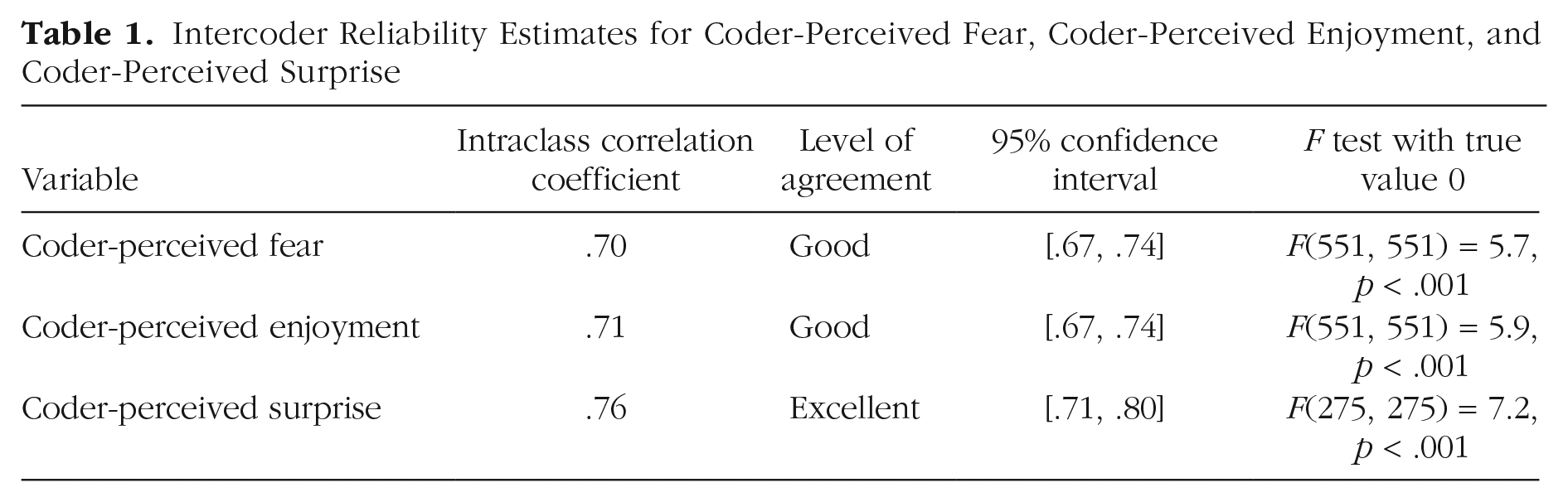
The intercoder reliability between the two independent coders was assessed using the intraclass correlation coefficient (ICC). ICC estimates and their 95% confidence intervals were calculated using the psych package (Version 1.9.12; Revelle, 2019) in R (Version 4.0.0; R Core Team, 2020) on the basis of single-measure, consistency-agreement, two-way mixed-effects models. Level of agreement was assessed using guidelines by Cicchetti (1994).
The ICC between the two independent coders was .70 for coder-perceived (CP) fear, which corresponds to a good strength of agreement; .71 for CP enjoyment, which also corresponds to a good strength of agreement; and .76 for CP surprise, which corresponds to an excellent strength of agreement (Cicchetti, 1994; see Table 1).
Intercoder Reliability Estimates for Coder-Perceived Fear, Coder-Perceived Enjoyment, and Coder-Perceived Surprise
Data analysis
Self-report measures
To test the relationship between reported overall enjoyment and fear level, we performed linear regressions with enjoyment as the outcome and fear as a predictor, with and without a quadratic term. In this model, we controlled for age, gender, and motivation.
To test the relationship between self-reported enjoyment and self-reported fear across the three prespecified video-recorded locations, we performed a linear mixed-effects regression with enjoyment as the outcome and fear as a predictor, with and without a quadratic term. In these models, we also controlled for age, gender, and motivation, and we entered participant and jump-scare location as random factors via random intercepts. The linear mixed-effects models were run using the lme4 package in R (Bates, Mächler, Bolker, & Walker, 2015). Selection between models with and without quadratic terms was then conducted using the Akaike information criterion (AIC). All models assessed between-level effects. All analyses were conducted using RStudio (Version 1.2.1335; RStudio Team, 2015).
Heart rate
To explore the relationship between heart rate and self-reported fear and enjoyment, we calculated the mean, standard deviation, and skewness of small- and large-scale heart rate fluctuations, which correspond to the first, second, and third moments of the signals. We then computed multivariate regression models using these quantities in linear and quadratic form, using self-reported fear and enjoyment as outcomes. In all models, we controlled for age, gender, and motivation. Selection between models with and without quadratic terms was then conducted using the AIC. All models assessed between-level effects. All analyses were conducted using RStudio (Version 1.2.1335; RStudio Team, 2015).
Overt behavior
To test the relationship between CP enjoyment and CP fear across the three prespecified video-recorded locations, we performed a linear mixed-effects regression with CP post-jump-scare enjoyment as the outcome and CP post-jump-scare fear as a predictor, with and without a quadratic term. Similarly, we calculated the change between CP pre- and post-jump-scare enjoyment (henceforth referred to as “CP enjoyment change”) as well as the CP change between pre- and post-jump-scare fear level (henceforth referred to as “CP fear change”). Using these measures of behavioral change, we performed a linear mixed-effects regression with CP enjoyment change as the outcome and CP fear change as a predictor, with and without a quadratic term.
To test the relationship between the CP surprise elicited by the jump scare and CP post-jump-scare enjoyment, we performed a linear mixed-effects regression with CP post-jump-scare enjoyment as the outcome and CP surprise as a predictor, with and without a quadratic term. Similarly, to assess the relationship between the CP surprise elicited by the jump scare and CP enjoyment change, we performed a linear mixed-effects regression with CP enjoyment change as the outcome and CP surprise as a predictor, with and without a quadratic term. Similar models were constructed with respect to participants’ fearful behavior as perceived by the coders. In all the above models, we controlled for age, gender, and motivation, and we entered participant and jump-scare location as random factors via random intercepts.
Finally, we assessed whether the coder-annotated behavioral data were in agreement with participants’ self-reported experience of the three specified locations. To conduct these tests, we performed linear mixed-effects regressions with (a) self-reported fear as the outcome and CP post-jump-scare fear as a predictor, (b) self-reported fear as the outcome and CP fear-change as a predictor, (c) self-reported enjoyment as the outcome and CP post-jump-scare enjoyment as a predictor, and (d) self-reported enjoyment as the outcome and CP enjoyment change as a predictor. In all these models, we entered participant and jump-scare location as random factors via random intercepts.
The linear mixed-effects models were run using the lme4 package in R (Bates et al., 2015). Selection between models with and without quadratic terms was then conducted using the AIC. All models assessed between-level effects. All analyses were conducted using RStudio (Version 1.2.1335; RStudio Team, 2015).
Data availability
The data generated and analyzed during the current study are available at OSF (https://osf.io/43hzk).
Results
Self-report measures
Self-report on overall experience
Overall, 56.5% of participants reported an internal motivation for visiting the haunted attraction (i.e., they visited the attraction because they wanted to), whereas 43.5% reported an external motivation for visiting the attraction (i.e., they visited the attraction because their friends, colleagues, or family wanted to). Overall, participants reported that they expected to be scared during the attraction (M = 6.79, SD = 1.88; Likert scale from 0–9). Finally, participants reported that the experience was a form of play (M = 6.74, SD = 2.11; Likert scale from 0–9).
Participants reported an overall high level of enjoyment (M = 6.95, SD = 2.57) and fear intensity (M = 5.71, SD = 2.6). Interestingly, results revealed no significant linear relationship between overall self-reported enjoyment and fear (β = 0.03, SE = 0.11, p = .759). 1 In contrast, internally motivated participants were more likely to report higher enjoyment than externally motivated individuals (β = 1.63, SE = 0.55, p = .004). In addition, women reported less enjoyment than men (β = −1.86, SE = 0.55, p = .001). Results revealed no significant relationship between age and enjoyment (β = −0.02, SE = 0.03, p = .576). The adjusted explained variance (adjusted R2) of this model was .13.
Self-report on experience for the three prespecified video-recorded locations
For the three prespecified video-recorded locations, participants reported similar levels of enjoyment (M = 5.79, SD = 2.87; Likert scale from 0–9) and fear (M = 5.09, SD = 2.80; Likert scale from 0–9). Participants reported remembering the prespecified locations in 93.8% of the cases. Results revealed a significant quadratic relationship between enjoyment and self-reported fear for the three prespecified video-recorded locations (β = −0.05, SE = 0.02, p = .014; Fig. 4). In addition, internally motivated participants were more likely to report higher enjoyment than externally motivated individuals (β = 1.27, SE = 0.53, p = .019), and women were less likely to report enjoyment compared with men (β = −1.44, SE = 0.53, p = .007). Results revealed no significant relationship between age and enjoyment (β = 0.03, SE = 0.03, p = .219). Some participants reported enjoyment- and fear-level scores despite reporting not being able to remember certain locations. Including these participants in the analysis did not change the results.
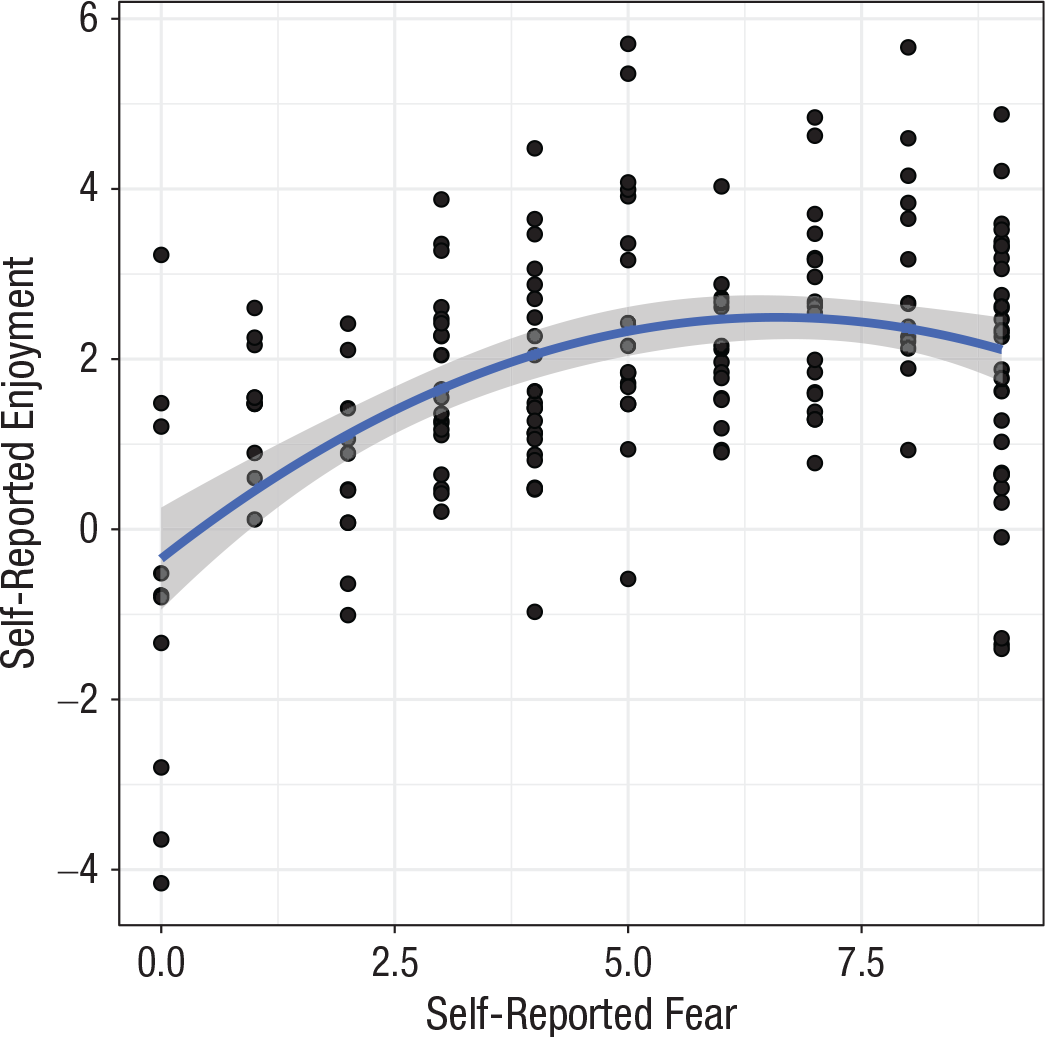
Scatterplot showing the relation between site-specific self-reported enjoyment and site-specific self-reported fear, after the effects of fixed and random factors are removed. The blue line shows the best-fitting regression, and the gray band is the 95% confidence interval.
Summary
Our results show an inverted-U-shaped relationship between self-reported fear and enjoyment, which suggests an optimal fear level for participants at which enjoyment is maximized. When we asked participants to summarize their fear and enjoyment across the entire haunted attraction, however, this relationship did not seem to be present. Perhaps this difference is caused by a lack of data points in participants’ general assessment or because it is more difficult for participants to report on a general experience rather than three specific ones. Results also show that internally motivated individuals and men reported higher enjoyment.
Heart rate
Fear
Results revealed a significant linear relationship between mean heart rate and self-reported fear (Model 1a: β = 0.035, SE = 0.01, p = .015). There were also significant relationships between large-scale heart rate fluctuations and self-reported fear. In particular, we found a significant linear relationship between large-scale heart rate standard deviation and self-reported fear (Model 2a: β = 0.20, SE = 0.06, p = .001; see Fig. 5) as well as a quadratic relationship between large-scale skewness and self-reported fear (Model 3a: β = −2.20, SE = 0.64, p < 0.001). In all these models, women were more likely to report higher fear intensity compared with men (Model 1a: β = 1.08, SE = 0.55, p = .054; Model 2a: β = 1.04, SE = 0.53, p = .051; Model 3a: β = 1.31, SE = 0.50, p = .011), whereas motivation (Model 1a: p = .158, Model 2a: p = .102, Model 3a: p = .090) and age (Model 1a: p = .680, Model 2a: p = .352, Model 3a: p = .117) showed no significant effects. Results revealed no significant relationships between small-scale heart rate standard deviation and self-reported fear (Model 4a: β = 7.42, SE = 6.34, p = .245), nor between small-scale heart rate skewness and self-reported fear (Model 5a: β = 8.21, SE = 8.86, p = .357).
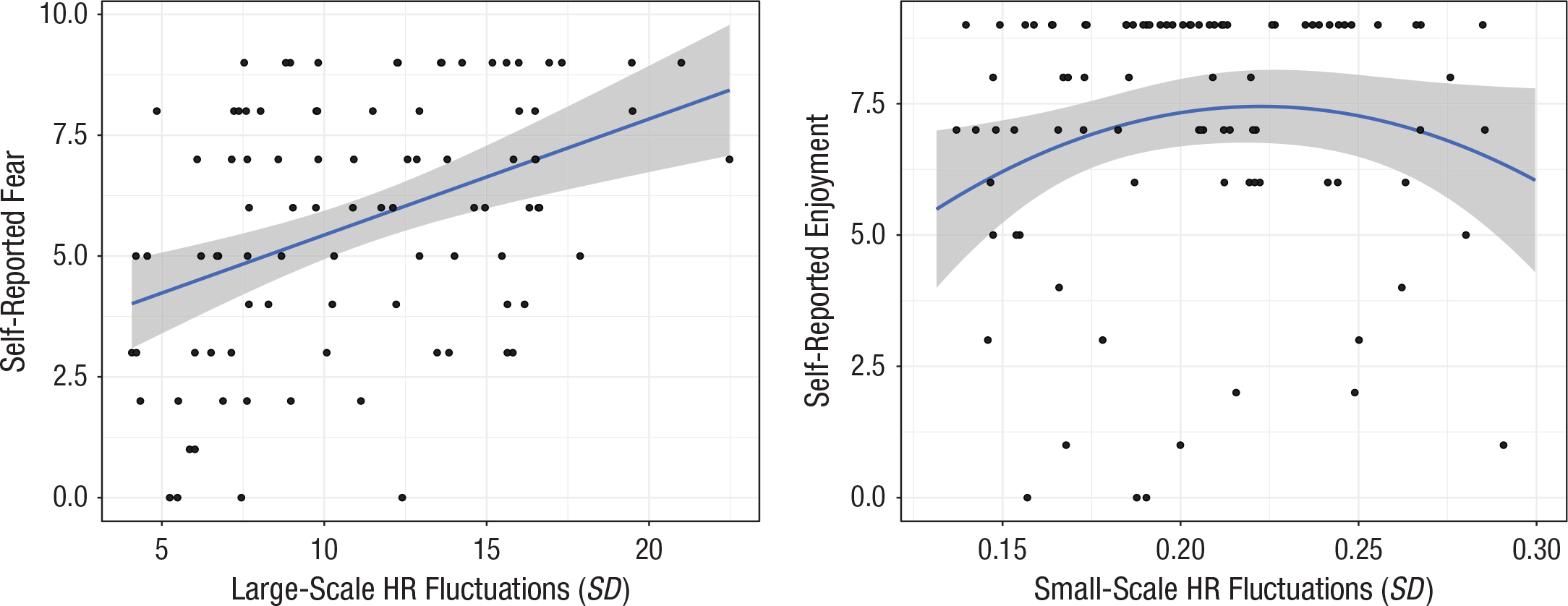
Scatterplots showing the relation between self-reported fear and large-scale heart rate (HR) fluctuations (left) and small-scale HR fluctuations (right). The blue lines show the best-fitting regressions, and the gray bands are 95% confidence intervals.
Enjoyment
Results revealed no significant relationship between mean heart rate and self-reported enjoyment (Model 1b: β = −0.005, SE = 0.02, p = .760). Similarly, there were no significant relationships between large-scale heart rate standard deviation and self-reported enjoyment (Model 2b: β = 0.03, SE = 0.06, p = .677) nor between large-scale heart rate skewness and self-reported enjoyment (Model 3b: β = 0.67, SE = 0.44, p = .131). In contrast, results revealed a significant quadratic relationship between small-scale heart rate standard deviation and self-reported enjoyment (Model 4b: β = −275.07, SE = 102.91, p = .009; Fig. 5) as well as a significant linear relationship between small-scale heart rate skewness and self-reported enjoyment (Model 5b: β = 18.91, SE = 8.43, p = .027). In both of these models, women were more likely to report lower enjoyment compared with men (Model 4b: β = −1.89, SE = 0.51, p < .001; Model 5b: β = −1.69, SE = 0.51, p = .001). Also, in both of these models, internally motivated individuals were more likely to report higher enjoyment compared with externally motivated individuals (Model 4b: β = 1.78, SE = 0.52, p < .001; Model 5b: β = 1.66, SE = 0.52, p = .002). Results revealed no significant relationships between age and self-reported enjoyment (Model 4b: p = .711, Model 5b: p = .363).
Summary
Mean and large-scale heart rate fluctuations were associated with fear, whereas small-scale fluctuations were related to enjoyment. Interestingly, although fear was linearly related to participants’ mean and large-scale heart rate fluctuations, enjoyment showed an inverted-U-shaped relationship to the small-scale heart rate fluctuations. In other words, when looking at the faster, small-scale changes that took place during moment-to-moment horror encounters, we found that the physiological data suggested that enjoyment was related to just-right forms of arousal dynamics. Importantly, these enjoyable fluctuations seem to be embedded within the large-scale heart rate fluctuations that are associated with fear.
Finally, women were more likely to report fear and less likely to report enjoyment compared with men. Internally motivated individuals reported more enjoyment but not more fear. Age had no effect on either fear or enjoyment.
Overt behavior
Overt enjoyment and fear
Out of 276 observations, 236 (85.5%) were possible to code for both CP enjoyment and CP fear. Results revealed no significant relationship between CP post-jump-scare enjoyment and CP post-jump-scare fear (Model 5c: β = −0.12, SE = 0.07, p = .095). Similarly, there was no significant relationship between CP enjoyment change and CP fear change (Model 6c: β = 0.01, SE = 0.09, p = .908). There were no significant relationships with CP post-jump-scare enjoyment and age (p = .083), gender (p = .523), or motivation (p = .271). Similarly, there were no significant relationships between CP enjoyment change and age (p = .668), gender (p = .820), or motivation (p = .278).
Overt surprise
Out of 276 observations, 217 (78.6%) were possible to code for CP surprise. Our results reveal a significant relationship between the CP surprise associated with the jump scares at the three locations and CP post-jump-scare fear (Model 1c: β = 0.52, SE = 0.05, p < .001) and CP fear change (Model 2c: β = 0.26, SE = 0.06, p < .001). Additionally, results revealed significant relationships between CP post-jump-scare fear and age (β = −0.01, SE = 0.004, p < .001) as well as gender (β = 0.29, SE = 0.08, p < .001); coders perceived younger individuals and women to exhibit higher levels of fear in their overt behavior. Results revealed no significant relationship between CP post-jump-scare fear and participants’ motivation (p = .558). There were no significant relationships between CP fear change with participant age (p = .119), gender (p = .347), or motivation (p = .841).
Similarly, our results revealed relationships between the CP surprise associated with the jump scares at the three prespecified locations and CP post-jump-scare enjoyment levels (Model 3c: β = 0.19, SE = 0.07, p = .008) as well as with CP enjoyment change (Model 4c: β = 0.15, SE = 0.08, p = .064; notice the nonsignificant statistical trend here). Results revealed an effect of age on CP post-jump-scare enjoyment: Coders perceived older individuals to exhibit a higher enjoyment in their overt behavior (β = 0.02, SE = 0.006, p = .009). There were no significant relationships between CP post-jump-scare enjoyment and participant gender (p = .142) or motivation (p = .843). Also, we found no significant relationships between CP enjoyment change with participants’ age (p = .362), gender (p = .768), or motivation (p = .195).
Overt behavior and subjective reporting
Our results show that there is a large overlap between participants’ self-reported fear at the three prespecified locations and coders’ annotations of participants’ fearful behavior. Thus there is a significant relationship between participants’ self-reported fear intensity and CP post-jump-scare fear levels (β = 1.21, SE = 0.23, p < .001). The same was true for participants’ self-reported fear intensity and the pre- to post-jump-scare change in CP fear levels (β = 0.60, SE = 0.26, p = .022).
In contrast, however, there was not a significant overlap between participants’ self-reported enjoyment at the three prespecified locations and coders’ annotations of participants’ joyful behavior. Thus there is no significant relationship between participants’ self-reported enjoyment and CP post-jump-scare enjoyment levels (β = 0.06, SE = 0.21, p = .776). The same was true for participants’ self-reported enjoyment and CP enjoyment change (β = 0.09, SE = 0.23, p = .685).
These results suggest that although it may be possible for onlookers to accurately perceive fearful states in participants, enjoyment is more difficult to accurately perceive in a recreational horror setting. It may also be that it is easier for participants to remember location-specific fear than location-specific enjoyment.
Summary
The behavioral data suggest that both fear and enjoyment are intrinsically connected to surprise. Yet overt fear and overt enjoyment as perceived by the coders did not seem to be significantly related. The lack of overlap between the behavioral coding of CP enjoyment and self-reported enjoyment, however, suggests that this may be due to enjoyment being difficult to accurately perceive and annotate in a recreational horror setting. Moreover, our coders may have erroneously identified so-called masking smiles (see the Discussion section) as expressions of enjoyment, which may explain why CP fear and CP enjoyment were not significantly related in these analyses. We remind the reader of the substantial intercoder reliability as well as the large overlap between CP fear and self-reported fear.
Accordingly, results did not show the same significant relationships between CP enjoyment and the controlling variables as in previous analyses. In other words, motivation and gender did not show significant relationships with CP enjoyment, whereas age did. Corroborating the idea that fearful behavior is easier to accurately perceive and annotate than joyful behavior in a recreational horror context, fear was rated as higher in women, as in previous analyses.
Additional information
Additional information from the statistical models with significant findings can be found in the Supplemental Material.
Discussion
Our aim in the current field study was to investigate the relationship between fear and enjoyment and their physiological and behavioral correlates in a recreational horror setting. As expected, our results showed that self-reported fear was positively and linearly associated with average heart rate and large-scale heart rate fluctuations across the haunted attraction. In other words, frightened participants were found to generally have a faster pulse and to exhibit larger deviations overall from the mean heart rate value. This observation corresponds with findings of previous fear research, which has consistently found a linear relationship between subjective fear and heart rate (for a review, see Öhman & Mineka, 2001). Such research, however, typically perceives fear as a negative emotion associated mostly with unpleasant sensations and avoidance behavior. The paradox of recreational fear is that it falls outside the scope of traditional fear accounts by seemingly allowing fear and enjoyment to coexist. Indeed, the participants from the current study expected to be frightened prior to entering the attraction, and although most reported high fear levels after exiting the attraction, they reported high levels of enjoyment as well.
The results of this study may help resolve the paradox of how fear and enjoyment coexist in a recreational horror setting. First, we found an inverted-U-shaped relationship between fear and enjoyment across location-specific self-reported measures. This finding suggests an optimal fear level—a sweet spot—for participants in which enjoyment is maximized. When participants were asked via a single measure to summarize their fear and enjoyment across the entire haunted attraction, however, this relationship did not seem to be present. We believe that this difference may be caused by a lack of data points in participants’ general assessment or because it is more difficult for participants to report on an overall experience rather than three specific ones.
Intriguingly, our findings reveal an inverted-U-shaped relationship between participant enjoyment and small-scale heart rate fluctuations, which suggests that enjoyment is related to just-right forms of arousal dynamics in a recreational horror setting. Interestingly, this relationship appears to be embedded within the context of large-scale heart rate fluctuations, which in turn are related to reported fear. In other words, while fear appears to be related to large and relatively long-term deviations from the expected physiological state of the human organism, enjoyment appears to be related to smaller just-right physiological deviations from whatever state the organism currently inhabits. These findings are interesting in the light of recent neurocognitive models of the human brain as a predictive organ, the primary function of which is to keep the organism within expected states (Friston, 2010; Hohwy, 2014). Such accounts have recently been applied to emotion research (Barrett, 2017), and perhaps the physiological separation between small- and large-scale physiological deviations may help explain why emotions of fear and enjoyment can coexist in recreational horror settings.
Our results are compatible with recent speculations among scholars of horror that recreational fear may be thought of as a form of play (Clasen, 2017). Like play, which is widely regarded to be an internally motivated and enjoyable activity for the individual, our participants generally reported a high degree of enjoyment, and enjoyment was significantly related to internal motivation to attend the haunted attraction. Furthermore, play and curiosity have by a variety of accounts been characterized as the individual approaching situations that have a just-right amount of uncertainty or surprise. Such accounts predict an inverted-U-shaped relationship between enjoyment and relevant interoceptive and exteroceptive activities. In support of such accounts, our results show an inverted-U-shaped relationship among enjoyment, fear, and small-scale heart rate fluctuations. Finally, participants generally reported that they considered their experience to be a form of play.
Our independent coders annotated what they perceived to be fear in participants in accordance with the participants’ self-reports. However, this was not the case with enjoyment. This finding corresponds with previous research demonstrating that enjoyment in other people is more difficult to correctly perceive and annotate compared with fear (Miles & Johnson, 2007). For instance, so-called masking smiles are sometimes used to conceal underlying emotions, such as misery, embarrassment, or indeed fear (Ekman, 1985). The finding is also in line with research suggesting that the experiential, behavioral, and physiological dimensions of emotion do not always correspond (Mauss et al., 2005). It is possible to feel enjoyment but not exhibit joyful behavior. Additionally, recent research has suggested that identifying emotions in other people may be a more complex and thus inaccurate process than has previously been assumed by emotion researchers (Barrett, Adolphs, Marsella, Martinez, & Pollak, 2019). For these reasons, our behavioral measure of enjoyment may be invalid.
Finally, our results demonstrate gender differences, with women reporting higher fear and lower enjoyment compared with men. Lower reported fear among men is not surprising in light of previous studies on horror (for a review, see Martin, 2019) and may be due to social desirability or past experience with frightening situations as part of stereotypical forms of play and entertainment. Men have been found to engage in more dangerous forms of behavior (Tamás et al., 2019), and thus they may have become more habituated to frightening phenomena relative to women. Also in line with previous research (Hoffner & Levine, 2005; Martin, 2019), which has consistently found that men report higher liking of frightening entertainment, we found that men reported more enjoyment than women in a recreational horror setting. This finding may reflect a preference among men for engaging in thrill-seeking behavior and frightening and violent leisure activities (Martin, 2019), although other research has suggested that gender differences are reduced and in some studies nonsignificant when neutral measures, such as need for affect, are administered (Bartsch, Appel, & Storch, 2010).
In terms of innovations, we took the idea seriously that instances of fear may differ strongly between laboratory and naturalistic settings (Mobbs et al., 2019). This has to do not only with immersiveness and experiential intensity but also with the vastly increased possibility spaces for the organism and the volatility of the naturalistic environment to which it is responding (Barrett in Mobbs et al., 2019). For the same reason, we believe that studies on fear in naturalistic contexts will benefit from employing subjective, behavioral, and physiological measures, because the particular configuration of these may vary as a function of the relationship between the organism and its environment. Similarly, our results illustrate the benefits of re-attuning normative frequency bands when conducting spectral analyses of physiological data in such contexts. Indeed, the more subtle physiological signal that correlates with enjoyment might have been overlooked in this study if the frequency bands were not re-attuned, leaving only the much stronger physiological signal that correlated with fear to be captured.
In terms of limitations, we faced several methodological challenges in this study, which in part were also revealed in the relatively large amount of excluded participants (18 out of 110). Participants in the haunted attraction frequently bumped into each other, made sudden movements, and sometimes perspired profusely when exiting the haunted attraction. Factors such as these sometimes impeded reliable HR signal detection, as evidenced by the relatively large number of participants excluded on the basis of missing or corrupted HR data. Similarly, the rather carnivalesque atmosphere in the waiting area, with dim lighting, guests and haunted-house workers milling about, and disturbing background sounds such as screams and roaring chainsaws, appears to have prompted some participants to forget to fill out the required questionnaires, and in a few cases, it was difficult for our research assistants to locate these participants and remind them of the oversight. Another limitation is the potential constraints on the generalizability of the findings. At this stage, it is unclear whether our findings generalize to other forms of recreational fear such as horror movies or books, extreme sports, or roller-coaster rides. Similarly, because no young children participated in our study, our results cannot shed light on recreational fear during development, such as when children are being playfully chased by a caregiver or engage in risky forms of play. Future studies may investigate whether our findings extend to such contexts. Another limitation of our study may be related to our behavioral measures. It is not clear that facial expression and body language are the most interesting response measures in this context. Future studies could consider using behavioral proxies for defensive reactions such as tracking the movement of participants in response to jump scares using accelerometers.
In conclusion, our findings of how fear and enjoyment coexist on subjective and physiological levels are intriguing. In future studies, researchers will need to replicate these findings and perhaps study their consequences. For now, understanding recreational horror as a form of play seems to be a fruitful approach to a longstanding paradox in the psychology of fear.
Supplemental Material
Andersen_FigS1 – Supplemental material for Playing With Fear: A Field Study in Recreational Horror
Supplemental material, Andersen_FigS1 for Playing With Fear: A Field Study in Recreational Horror by Marc Malmdorf Andersen, Uffe Schjoedt, Henry Price, Fernando Rosas, Coltan Scrivner and Mathias Clasen in Psychological Science
Supplemental Material
Andersen_Supplemental_Material – Supplemental material for Playing With Fear: A Field Study in Recreational Horror
Supplemental material, Andersen_Supplemental_Material for Playing With Fear: A Field Study in Recreational Horror by Marc Malmdorf Andersen, Uffe Schjoedt, Henry Price, Fernando Rosas, Coltan Scrivner and Mathias Clasen in Psychological Science
Footnotes
Acknowledgements
The authors thank Dystopia Haunted House, for making their haunted attraction available to the research team, and the research assistants, who provided invaluable help with data collection and coding: Kristine Schulz, Lena Molin, Theiss Bendixen, Eva Vium, Marie Cecilie Gammelby, Theis Oxholm, Nanna Røes Dahl, Signe Clausen, Maja Kruse, Agnete Mogensen, Lene Engelst Christensen, Ninna Vestergaard Lorenzen, Emma Thomsen, Marc Hye-Knudsen, Anna Sofie Bruun, Oliver Toft Sivebæk, Emilie Bagger, Cecilie Møller-Johansen, Sissel Jørgensen, and Mathilde Hernu.
Transparency
Action Editor: Paul Jose
Editor: Patricia J. Bauer
Author Contributions
M. M. Andersen developed the study concept and study design. U. Schjoedt provided critical revisions to the design. Data were collected by M. M. Andersen, C. Scrivner, U. Schjoedt, and M. Clasen. Data cleaning, data synchronization, and supervision of behavioral coding was conducted by M. M. Andersen. H. Price and F. E. Rosas preprocessed and analyzed the data, and M. M. Andersen, U. Schjoedt, and M. Clasen interpreted the results. M. M. Andersen, U. Schjoedt, and M. Clasen drafted the manuscript, and C. Scrivner and F. E. Rosas provided critical revisions. All authors approved the final version of the manuscript for submission.

Notes
References
Supplementary Material
Please find the following supplemental material available below.
For Open Access articles published under a Creative Commons License, all supplemental material carries the same license as the article it is associated with.
For non-Open Access articles published, all supplemental material carries a non-exclusive license, and permission requests for re-use of supplemental material or any part of supplemental material shall be sent directly to the copyright owner as specified in the copyright notice associated with the article.
