




Abstract
A major concern in today’s economic reality is the extent to which a sharing economy, in comparison with a traditional economy, promotes inequality. In the transformation from a traditional to a sharing economy, wage setting is replaced by contract pricing. The switch to contract trading implies that the party who carries out the labor evaluates the transaction from a buyer’s rather than a seller’s perspective. Drawing on psychological research on constructed and reference-dependent preferences, we predicted that the net valuation of work would decrease when the regimen involved contract trading. Three experiments (N = 1,105) eliciting work valuation under the two regimens confirmed our prediction, thus pointing to a novel factor that increases inequality.
Keywords
Over the past few years, peer-to-peer platforms such as Uber have changed the labor market; some 35% of the U.S. workforce is freelancing. How does this change affect the net value of labor? Is there a difference between the way freelancers value their labor compared with how regular employers and employees do? Consider, for example, a driver who switched from being employed by a cab company on a fixed salary basis to being an Uber driver. As one driver described it, the switch “requires you to adjust your expectations and the way you work” (Cetin, 2018). There are many obvious differences between the two forms of employment, including security, uncertainty, and working conditions but also flexibility and freedom. We asked whether, beyond these factors, the work itself (e.g., driving a fixed distance) is valued differently when performed by an employee (e.g., a regular cab driver) and a freelance contractor (e.g., an Uber driver).
The answer to this question is not trivial. To the extent that effort is the main determinant of value, if the labor remains the same, the transformation of the labor market should have little effect on the net value of work. The difference is ostensibly semantic: Employees are now contractors or contract workers, trading job contracts rather than labor for money.
In the current study, however, we predicted that the pure value of labor itself would change when contracts, rather than employment issues, were considered. We maintain that the content of the transaction, whether it is evaluated as an employment wage or as a job contract, affects the process of value determination such that the net value of labor in job-contract settings is lower than in employment-wage settings.
A great volume of psychological research (e.g., Lichtenstein & Slovic, 2006; Slovic, 1995) attests to the fact that preferences are constructed during the decision-making process and are, hence, largely determined by the specific process employed. This literature suggests that two psychological processes in particular may have differential effects on valuation of labor in the two regimens under study. The first process involves changes in reference points. Under this account, employment-wage and job-contract settings impose different reference points on individuals engaged in the market. Loss aversion relative to these reference points impacts the value assigned to the same labor. The second account involves an attentional process leading people to assign different weights to money and labor under different settings.
A reference model of evaluation posits that the situation prior to the transaction provides a salient reference for evaluating the transaction outcome. This holds true whether the transaction involves employment-wage or job-contract pricing. However, the nature of the transaction highlights different aspects of the reference state. Under employment-wage settings, the employee (e.g., taxi driver) would view giving up his or her free time and leisure as a loss. The employer (e.g., taxi company owner) would view this employee’s labor as a gain. In contrast, under job-contract settings, the selling of the contract is viewed as a loss by the employer, whereas the acquisition of the contract is viewed as a gain by the worker.
Seminal work on determinants of valuation shows that losses, relative to the prominent reference point, loom larger than gains (Kahneman & Tversky, 1979; Thaler, 1980). That is, value is a reference-dependent utility function that is steeper for losses than for gains (Kahneman & Tversky, 1979). Consequently, sellers often demand more to give up a good than buyers are willing to pay for the same good (Kahneman, Knetsch, & Thaler, 1991; Thaler, 1980). More recent research has explored other factors contributing to differences between buyers and sellers, including aversion to bad deals, differences in attention and information processing, and other psychological processes (Ashby, Dickert, & Glöckner, 2012; Kogut & Kogut, 2011; Morewedge & Giblin, 2015; Schurr & Ritov, 2013; Weaver & Frederick, 2012; Yechiam, Ashby, & Pachur, 2017).
The principle of asymmetry in value between buyers and sellers, applied to employment-wage and job-contract settings, yields similar predictions, although the roles of buyer and seller depend on the content of the transaction. Specifically, under employment-wage settings, loss aversion would amplify the compensation required by employees who are selling their labor. At the same time, under job-contract trading, loss aversion would amplify the compensation that sellers require for giving up the contract. All else being equal, high-contract selling prices imply reduced value of the labor itself under these conditions.
To illustrate, consider an employer and employee in a wage-employment setting and a contract seller and contract worker in a job-contract setting. Let W denote the pure value of labor. Assume that this value holds for everyone. Let G denote the market value of the produced good and λ denote the loss-aversion coefficient. Assume that λ is greater than 1 (otherwise, there is no loss aversion) and is the same under both settings. Note that loss aversion is experienced by sellers. Because employees and contract sellers are both sellers, their valuations should be multiplied by the loss-aversion coefficient λ (see Table 1). It follows readily that in the employment-wage setting, because the employer gains and the employee loses relative to their pretransaction reference states, the employer would bid W, and the employee would ask λ × W. These bids will be the employer’s and employee’s respective work values. In the job-contract setting, the bid is calculated by subtracting the price paid from the market value of the produced good (G). It follows that in this setting, a contract worker would bid G – W, whereas a contract seller would ask λ × (G – W). Using the above values, we can derive the net value of labor by subtracting the price of the bid from the market value G. This means that the net value of labor for contract workers would be G – (G – W) = W. The net value of labor for the contract sellers would be G – λ × (G – W).
Bid Value and Its Derived Work Value in Employment-Wage and Job-Contract Settings
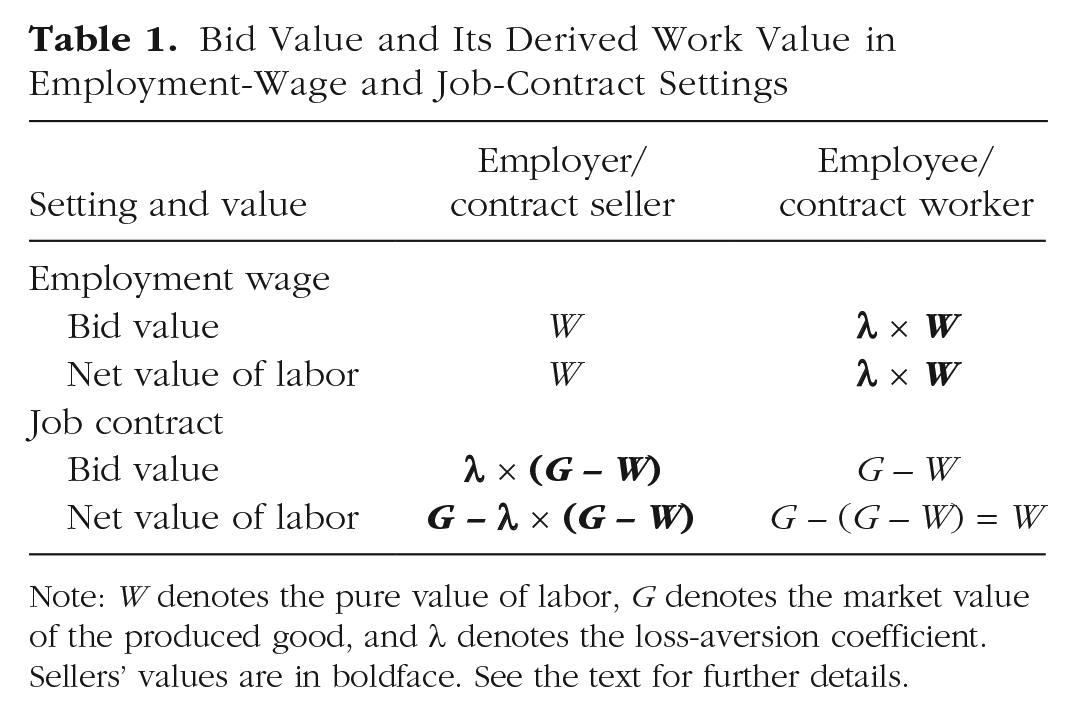
Note: W denotes the pure value of labor, G denotes the market value of the produced good, and λ denotes the loss-aversion coefficient. Sellers’ values are in boldface. See the text for further details.
From the above formulation, it follows readily that the net value of labor in a job-contract setting is lower than in an employment-wage setting. For contract workers, the net value of labor is W; for employees, it is λ × W. Because λ is greater than 1, it follows that W is less than λW. Likewise, the net value of labor for contract sellers is lower than that of employers: G – λ × (G – W) = G × (1 – λ) + λ × W < W. Specifically, because G is greater than W (otherwise, the good would not be produced) and (1 – λ) is less than 0, the following is the result: G × (1 – λ) < W × (1 – λ), implying that G × (1 – λ) + λ × W < W.
A second process affecting valuation of labor could be attentional. Under this account, workload draws most attention in employer–employee relationships. However, when work is being contracted, offers and demands are likely to be affected more by the remuneration for a completed work and to be less sensitive to the amount of work that is required. This differential sensitivity may occur independently of the weight assigned to each of the attributes (namely, remuneration and workload). However, the relative weight assigned to earning money and to performing a job may also vary in the two regimens. Fischer, Carmon, Ariely, and Zauberman (1999) maintain that evaluations are affected by implicit goals. Weber and Johnson (2006) suggest, in turn, that these goals determine the order and weight of the attributes considered. The goal of setting wages focuses attention on the essence of the task and the forgoing of free time and is thus likely to amplify the value of executing the work. The goal of bidding for or selling a job contract emphasizes monetary aspects of the transaction and is likely to highlight potential earnings while diminishing the value of the actual work required. The attentional process may enhance the transaction-framing effect predicted by the reference-dependent account.
In the present research, we used standard methods of value elicitation to determine valuation of labor. We compared buyers and sellers of work in the employment-wage setting with buyers and sellers of work contracts. Although we examined both buyers and sellers, our goal in the present research was not to explore the difference between buyers and sellers, that is, the endowment effect itself. Rather, we examined the premise that the value of labor is diminished under a job-contract compared with an employment-wage regimen, across buyers and sellers. For this purpose, we conducted three fully incentivized experiments comparing the value of identical work under the two regimens.
Finally, effort exerted in obtaining the labor may play a pivotal role as well. Indeed, as Adam Smith (1776/2007) famously noted with respect to the value of labor, “The real price of everything, what everything really costs to the man who wants to acquire it, is the toil and trouble of acquiring it” (p. 28). Thus, the value expressed in the market reflects, to some extent at least, the perceived subjective effort of filling out the questionnaire. Insofar as framing affects prices, this effect may stem from differential subjective perception of the effort required. To examine this possibility, we elicited estimates of effort in addition to price quotes (i.e., offers and demands).
Experiment 1
Method
Participants
To determine our sample size for Experiment 1, we conducted an a priori power analysis with G*Power (Version 3.0; Faul, Erdfelder, Lang, & Buchner, 2007). This analysis revealed that 27 participants per cell would be required to detect a medium-sized effect of 25% difference between conditions with 95% power and a .05 criterion of statistical significance. To be conservative, we set a target of at least 30 participants per cell. The final sample consisted of 284 students (147 men, 137 women; age: M = 24.68 years, SD = 2.686).
Design
Students participated in 16 experimental market sessions. Three factors were manipulated between market sessions: (a) the price paid in Israeli new shekels (NIS) per completed questionnaire (10 NIS vs. 20 NIS), (b) the workload (short questionnaire vs. long questionnaire), and (c) the transaction frame (hiring workers for wages vs. trading the right to fill out a questionnaire, which we will refer to hereafter as the employment-wage setting and job-contract setting, respectively). The two transaction frames were objectively equivalent. However, in one case, the employee’s wages were traded, and in the other case, the contract enabled the work to be performed. We maintain that merely trading contracts, rather than employment, diminishes the monetary value attached to the labor itself. In each session, half of the participants, randomly determined, were asked to fill out a questionnaire.
In the employment-wage-setting questionnaire, owners (participants who received the questionnaire) stated the highest amount they were willing to pay a nonowner (a participant who did not receive the questionnaire) to fill it out for them; nonowners stated the lowest amount for which they would be willing to undertake the job. Owners received payment from the experimenter for the completed questionnaire regardless of whether they filled it out themselves or paid someone else to fill it out for them. In the job-contract-setting questionnaire, owners stated the lowest amount for which they were willing to sell the questionnaire, and the nonowners stated the highest amount they were willing to pay to purchase it. Participants who completed the questionnaire received payment from the experimenter for the completed questionnaire. All transactions were made at the market price to incentivize participants to reveal their true preferences. This was explained to participants at the beginning of each session.
To establish the market price in the employment-wage condition, we computed the intersection of the owners’ supply curve (maximal prices that owners were willing to pay plotted from highest to lowest) and the nonowners’ demand curve (minimal prices plotted from lowest to highest). All owners with prices above the intersection paid the market price and were discharged from the task of filling out the questionnaire. All nonowners with prices below the intersection received the market price and filled out the questionnaire. In the job-contract condition, contract owners were asked to name the lowest price they were willing to sell the contract for, and nonowners were asked to name the highest price they were willing to pay to obtain the contract. As in the employment-wage condition, here too, we determined the market price by computing the intersection of the owners’ and nonowners’ curves. Notice, however, that in this condition questionnaire, owners were sellers and nonowners were buyers. The complete instructions appear on the Open Science Framework (OSF) at https://osf.io/d3wq9/?view_only=1658e9fa494a4aaca94a8415f6a32bc3.
In addition to stating their price, participants were asked to evaluate the effort required to perform the work. They rated feelings of distress, drag, waste of time, and exertion of effort associated with fulfilling the task. Rating scales ranged from 0 (not at all) to 10 (to a great extent).
Results
Our main interest in this study was the valuation of work, namely, the filling out of the questionnaire. In the employment-wage setting, the bid provided by both questionnaire-owning and questionnaire-nonowning participants reflected the value they assigned to performing the work. In the job-contract setting, this value had to be derived from the buying and selling prices of the uncompleted questionnaire that was being traded. The difference between the fixed price paid by the experimenter per completed questionnaire (announced at the beginning of each session) and the bid submitted for buying or selling the uncompleted questionnaire represented the value that participants assigned to the work of filling out the questionnaire. Labor valuations of 15 participants in the job-contract setting were negative; we Winsorized these valuations to 0. The main results show the same pattern when negative values are included.
Figure 1 presents the mean valuation of labor by questionnaire owners and nonowners in the two transaction frames and the two price-rate conditions, collapsed across workload. An analysis of variance (ANOVA) on the value of work by ownership status (questionnaire owners vs. questionnaire nonowners), price paid per completed questionnaire (10 NIS vs. 20 NIS), the amount of work required to complete the questionnaire (short questionnaire vs. long questionnaire), and the transaction frame (hiring workers in the employment-wage setting vs. contracting the right to fill out a questionnaire in the job-contract setting) yielded the following results. First, as predicted, there was a main effect of transaction frame: The value assigned to executing the work was lower in the job-contract setting than in the employment-wage setting (Ms = 5.578 and 7.345 for job-contract settings and employment-wage settings, respectively), F(1, 268) = 16.127, p < .001, η p 2 = .057. The effect of transaction frame did not significantly interact with ownership status, F(1, 268) = 0.67, p = .796, η p 2 = .000.
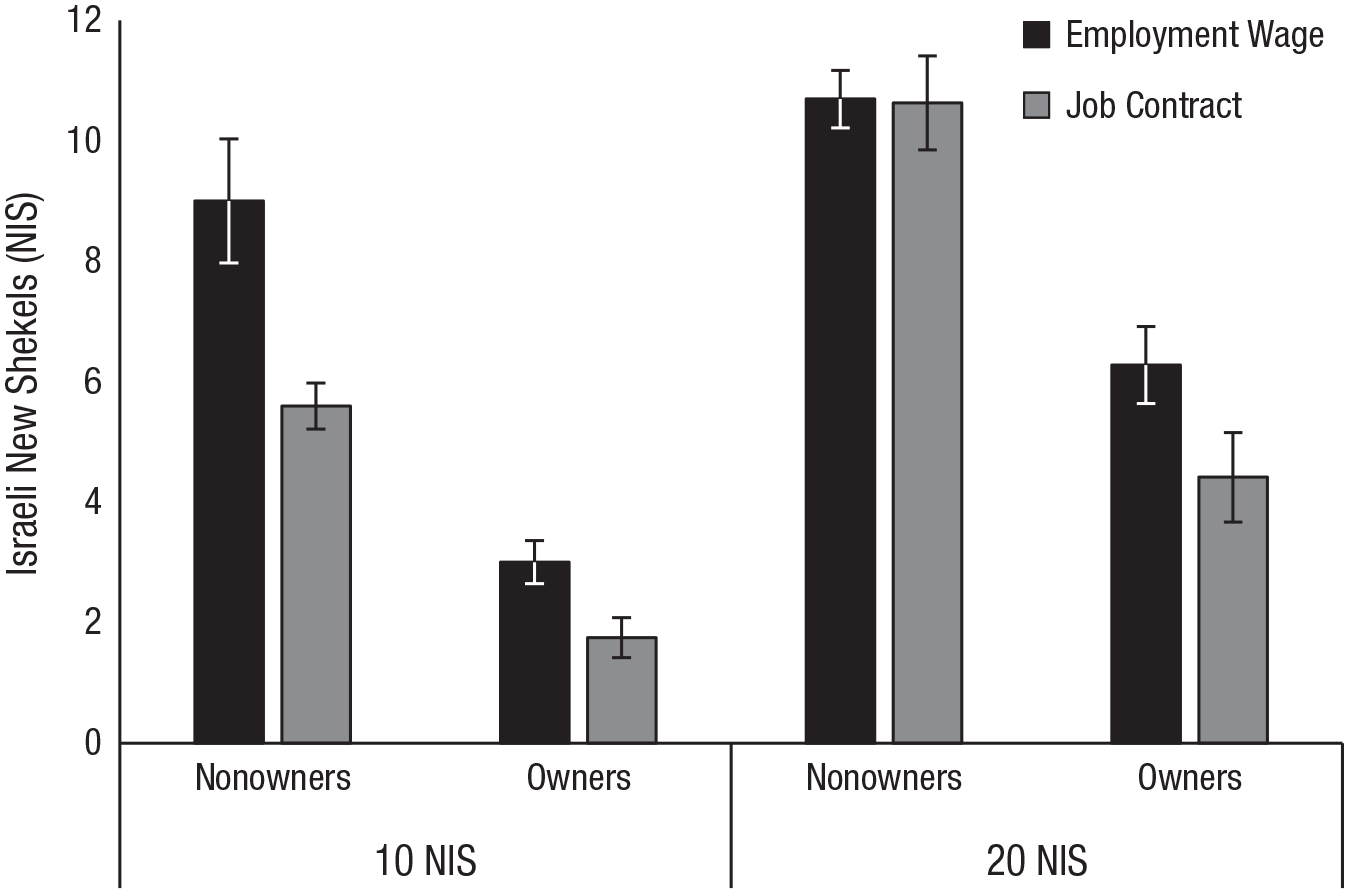
Results from Experiment 1: mean valuation of labor by participants who were given and not given a questionnaire (owners and nonowners, respectively) in each transaction frame and price-rate condition, collapsed across workload. In the employment-wage setting, means for nonowners represent the lowest amount they would be willing to accept for filling out the questionnaire, whereas means for owners represent the highest amount they would be willing to pay someone else to fill out the questionnaire. In the job-contract setting, means for nonowners represent the difference between the fixed price per completed questionnaire (i.e., 10 NIS or 20 NIS) and the highest amount they would be willing to pay to buy the questionnaire, whereas means for owners represent the difference between the fixed price per completed questionnaire and the lowest amount for which they would be willing to sell the questionnaire.
The main effect of price rate (the fixed monetary payoff per completed questionnaire) was significant: Participants valued the work of completing a questionnaire more highly when the payoff per completed questionnaire was 20 NIS than when it was 10 NIS (Ms = 8.041 and 4.743, respectively), F(1, 268) = 53.346, p < .001, η p 2 = .166. 1 The three-way interaction of price rate, transaction frame, and ownership status was also significant, F(1, 268) = 5.109, p = .025, η p 2 = .019. As illustrated in Figure 1, when the price rate was 20 NIS, the transaction frame affected owners more than nonowners, but this was not the case when the price rate was 10 NIS.
The main effect of workload was not significant, F(1, 268) = 1.027, p = .312, η p 2 = .004. It is possible that the amount of work was difficult to evaluate in a between-participants design, in which no standard of comparison is provided. Notwithstanding the lack of overall effect, workload significantly interacted with transaction frame, F(1, 268) = 12.748, p < .01, η p 2 = .045. For the low-workload condition, the effect of transaction frame was not significant, but for the high-workload condition, work was evaluated more highly in the employment-wage setting than in the job-contract setting (Ms = 7.897 and 3.391, respectively), F(1, 268) = 6.053, p = .015, η p 2 = .022. Workload did not significantly interact with any of the other factors.
To examine how the evaluation of effort required to perform the work was related to the factors we manipulated, we computed an average effort measure for every participant, combining the ratings for feelings of distress, drag, waste of time, and effort exertion (Cronbach’s α = .831). Across conditions, average effort significantly correlated with the value of work (r = .212, p < .001). However, the evaluation of effort was not significantly affected by any of the manipulated factors: An ANOVA with effort as the dependent measure and the four factors role, price rate, workload, and transaction frame as independent variables yielded no significant main effects or interactions (ps > .20 for all). Furthermore, including effort as a covariate in the analysis of work value did not change the significance level of any of the effects found in the analysis without the covariate described above.
Experiment 2
In Experiment 1, we found that framing labor as a job contract reduced its monetary value in job-market settings in comparison with employment-wage settings. In the present experiment, we sought to replicate our findings using a different sample and a different value-elicitation procedure. We used Becker, DeGroot, and Marschak’s (1964) value-elicitation procedure. We also sought to examine whether contract trading draws greater attention to monetary aspects than to labor aspects of a transaction, relative to the standard employment-wage setting. The framing of the transaction was similar to that used in Experiment 1. In the employment-wage condition, the content of the transaction was the price for filling out a given questionnaire. In the job-contract condition, the content of the transaction was the price for a one-time link that included the questionnaire and that was required to access and complete it.
Method
Participants
We recruited 421 Amazon Mechanical Turk (MTurk) workers (199 men, 191 women, 31 undisclosed; age: M = 37.52 years, SD = 12.23) through the TurkPrime platform. Only workers who had completed at least 1,000 surveys and had an approval rate above 90% completed the experiment. Because of the greater attrition among MTurk workers than among students, and for purposes of replication (Simonsohn, 2015), we roughly doubled the sample size in each cell compared with the sample size in Experiment 1. We excluded 2 participants who bid 1,000¢ or more (10-fold or more the maximal worth). The final sample consisted of 419 participants. The participants received 30¢ as a base payment and up to 100¢ as an additional bonus on the basis of their decisions.
Design
The experiment had a 2 (transaction frame: employment wage vs. job contract) × 2 (ownership status: nonowners vs. owners) between-participants design. The labor consisted of completing a 10-min questionnaire that paid 100¢. As in Experiment 1, we randomly assigned each participant to one of two transaction frames: employment-wage setting and job-contract setting.
Prices were elicited using Becker et al.’s (1964) procedure, a well-established method of eliciting the true value of goods in experimental settings. According to this procedure, buyers and sellers submit bids, which are compared with a randomly generated price. If the buyer’s bid is higher than the randomly generated price, the transaction is executed at the randomly generated price. Otherwise, the buyer receives nothing. Similarly, if the seller’s bid is lower than the randomly determined price, the transaction is executed. Otherwise, the seller receives nothing. Specifically, in the employment-wage setting, owners (i.e., labor buyers) stated the highest amount that they were willing to pay someone else to fill out a 10-min questionnaire, given that they were guaranteed payment for the completed questionnaire. Nonowners (i.e., labor sellers) stated the lowest amount that they were willing to accept to undertake the task. In the job-contract setting, owners (i.e., contract sellers) stated the lowest amount that they were willing to receive for selling a one-time link to a 10-min questionnaire that paid 100¢. Nonowners (i.e., contract buyers) stated the highest amount that they were willing to pay for a one-time link to a 10-min survey that paid 100¢.
Procedure
The complete instructions for the experiment appear on the OSF. The experiment included two stages. In the first, nonconsequential stage, participants learned about the bidding procedure and practiced their roles: Nonowners were asked to imagine that they could buy an iPad and stated the highest amount they were willing to pay for the iPad; owners were asked to imagine that they owned an iPad and stated the lowest amount they were willing to accept for the sale of the iPad. Next, participants answered a comprehension-check question regarding the drawing procedure. Specifically, participants were asked to explain what would happen if the drawn price were lower than their stated price. Participants who failed to answer this question correctly were given an additional explanation regarding the bidding procedure and were again asked to answer what would happen if the drawn price were higher than their stated price. Participants who failed the manipulation-check questions were paid the show-up fee but not allowed to continue the experiment. Following the practice stage, participants engaged in the second, consequential stage. In this stage, participants stated their prices for the survey.
We adapted query-theory methods (Hardisty, Johnson, & Weber, 2010; Johnson, Häubl, & Keinan, 2007) to our context; after stating their price, participants answered three questions that measured the extent to which labor and monetary considerations were on their mind when making their decisions. Specifically, they used a 7-point scale to rate (a) how much thought they gave to the money they would earn (1, little thought, to 7, much thought), (b) how much thought they gave to the work involved in filling out the questionnaire (1, little thought, to 7, much thought), and (c) what played a greater role in the decision—the money to be earned or the work of filling out the survey (1, money, to 4, same extent, to 7, work). Next, a random price between 0 and 100¢ was drawn, and the participants’ decision was executed.
Results
As in Experiment 1, the bid in the employment-wage condition reflected the value that owners and nonowners assigned to performing the work, whereas the bid in the job-contract condition was the difference between the fixed price paid for the completed questionnaire (i.e., price level of 100¢) and the bid submitted for buying or selling the survey link. Eight participants in the job-contract setting gave negative labor valuations; we Winsorized their valuations to 0, as in Experiment 1. The main results showed the same pattern when we included negative values.
We submitted participants’ net labor valuations to an ANOVA with transaction frame (employment wage vs. job contract) and ownership status (questionnaire owners vs. questionnaire nonowners) as predictors. As illustrated in Figure 2, the results replicated the pattern found in Experiment 1. The effect of transaction frame was significant, indicating that work was valued less highly in the job-contract setting than in the employment-wage setting (Ms = 47.80 and 65.63, respectively), F(1, 415) = 9.231, p = .003, η p 2 = .022. The interaction between transaction frame and ownership status was not significant, F(1, 415) = 1.041, p = .308, η p 2 = .003. As in Experiment 1, beyond the effects of transaction frame, participants who received the questionnaire assigned lower value to performing the work than participants who did not receive the questionnaire. The effect of ownership status was significant, indicating that participants who received the questionnaire (i.e., labor buyers in the employment-wage setting) or the questionnaire link (i.e., contract sellers in the job-contract setting) assigned lower value to performing the work than participants who did not receive the questionnaire (Ms = 38.73 and 74.15, respectively), F(1, 415) = 38.16, p < .001, η p 2 = .084. As acknowledged earlier, the endowment effect observed here may have been affected, to some extent, by differences in wealth between questionnaire owners and nonowners.
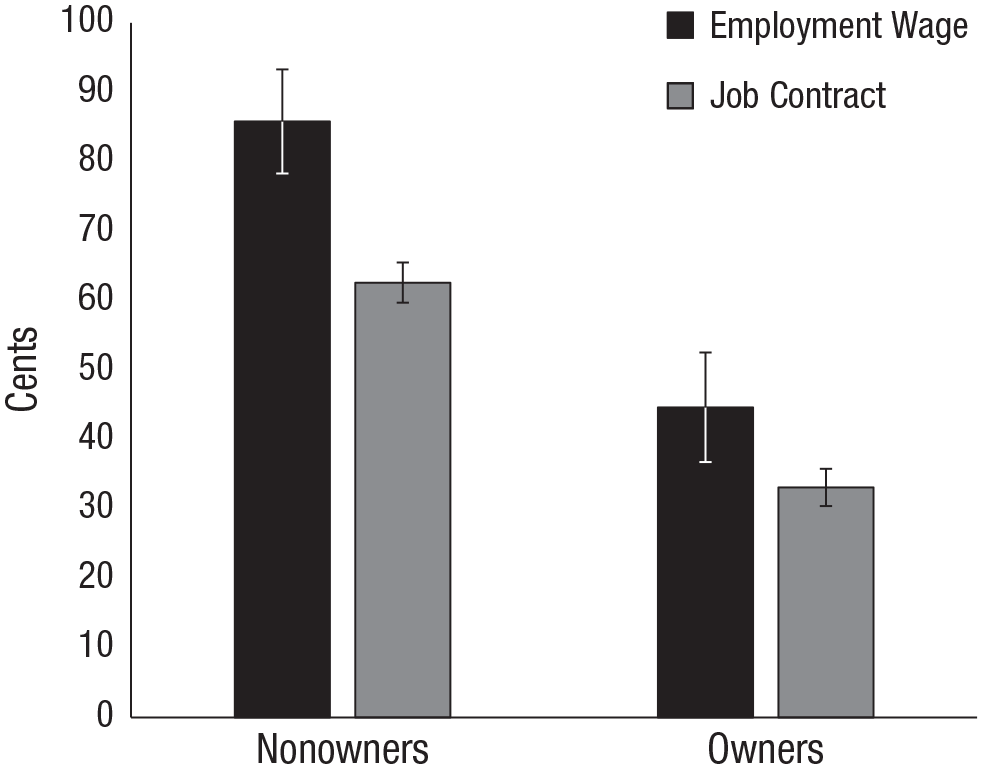
Results from Experiment 2: mean valuation of labor by participants who were given and not given a questionnaire (owners and nonowners, respectively) in each transaction frame. Under both transaction frames, means for nonowners represent the lowest amount they would be willing to accept for filling out the questionnaire, whereas means for owners represent the highest amount they would be willing to pay someone else to fill out the questionnaire. Error bars represent standard errors of the mean.
To examine the extent to which the transaction frame (employment wage vs. job contract) promotes focus on labor or money, we analyzed participants’ responses to the questions concerning the monetary and labor aspects of the task. The detailed analyses are reported on the OSF. An ANOVA on responses to the direct question, “What played a greater role in the decision—the money to be earned or the work of filling out the survey?” with transaction frame and ownership status as predictors did not yield any significant results—transaction frame: F(1, 400) = 2.087, p = .149, η p 2 = .005; ownership status: F(1, 400) = 0.914, p = .340, η p 2 = .002; and their interaction: F(1, 400) = 2.240, p = .135, η p 2 = .006. The two questions concerning how much thought participants gave to the money they would earn and how much thought they gave to the work involved in filling out the questionnaire did not reveal an effect of transaction frame either: A repeated measures ANOVA on the two ratings with transaction frame and ownership status as predictors did not yield any significant interaction with the repeated measure (i.e., thoughts about money and thoughts about labor; all between-participants effects and interaction: Fs < 1).
Experiments 3a and 3b
In the present experiment, we examined whether the effect of transaction frame uncovered in Experiments 1 and 2 would be replicated even when participants evaluated labor in both transaction frames. That is, we asked nonowners (in Experiment 3a) and owners (in Experiment 3b) to evaluate the same labor under job-contracting and under employment-wage settings. In addition to testing the robustness of the transaction-framing effect, this within-participants design controlled for possible wealth effects, as the pretransaction reference state did not change between the two frames. Additionally, we again sought to examine whether contract trading would draw greater attention to monetary aspects than to labor aspects of a transaction relative to the standard employment-wage setting. Although we did not find evidence for such a process in Experiment 2, we reasoned that a within-participants design might provide a more sensitive test.
Experiment 3a
Method
Participants
We recruited 218 MTurk workers (53 men, 53 women, 112 undisclosed; age: M = 37.91 years, SD = 12.15) through the TurkPrime platform, Only workers who had completed at least 1,000 surveys and had an approval rate above 90% completed the experiment. As in Experiment 2, we roughly doubled the sample size in each cell compared with the sample size in Experiment 1. We excluded 4 participants who bid more than 1,000¢ (more than 10-fold the maximal worth). The final sample consisted of 214 participants. The participants received 50¢ as a base payment and up to 100¢ as a bonus payment on the basis of their decisions.
Design
The design and procedure were identical to those for the tasks completed by nonowners in Experiment 2, with the exception that participants completed both the nonowners’ employment-wage task and the nonowners’ job-contract task, in counterbalanced order. After both tasks were completed, we randomly chose the results of one task to determine additional payment. Thus, Experiment 3a employed a 2 (transaction frame: employment wage vs. job contract) × 2 (valuation order: employment-wage first vs. job-contract first) mixed design. The complete instructions appear on the OSF.
Results
Eight participants in the job-contract setting gave negative labor valuations; we Winsorized their valuations to 0. The main results showed the same pattern when we included negative values. Figure 3 presents participants’ mean work valuations under the different transaction frames. To examine the effect of frame on labor valuation, we submitted participants’ net labor valuations to a repeated measures ANOVA with transaction frame (employment wage vs. job contract) as the within-participants repeated measure and valuation order (employment wage first vs. job contract first) as the between-participants factor. The results replicated the pattern found in Experiments 1 and 2. Work was valued significantly less highly in the job-contract setting than in the employment-wage setting (Ms = 58.90 and 73.64, respectively), F(1, 212) = 5.147, p = .024, η p 2 = .024. The effect of valuation order and the interaction between valuation order and transaction frame were not significant, F(1, 212) = 1.130, p = .289; and F(1, 212) = 0.524, p = .470, respectively.
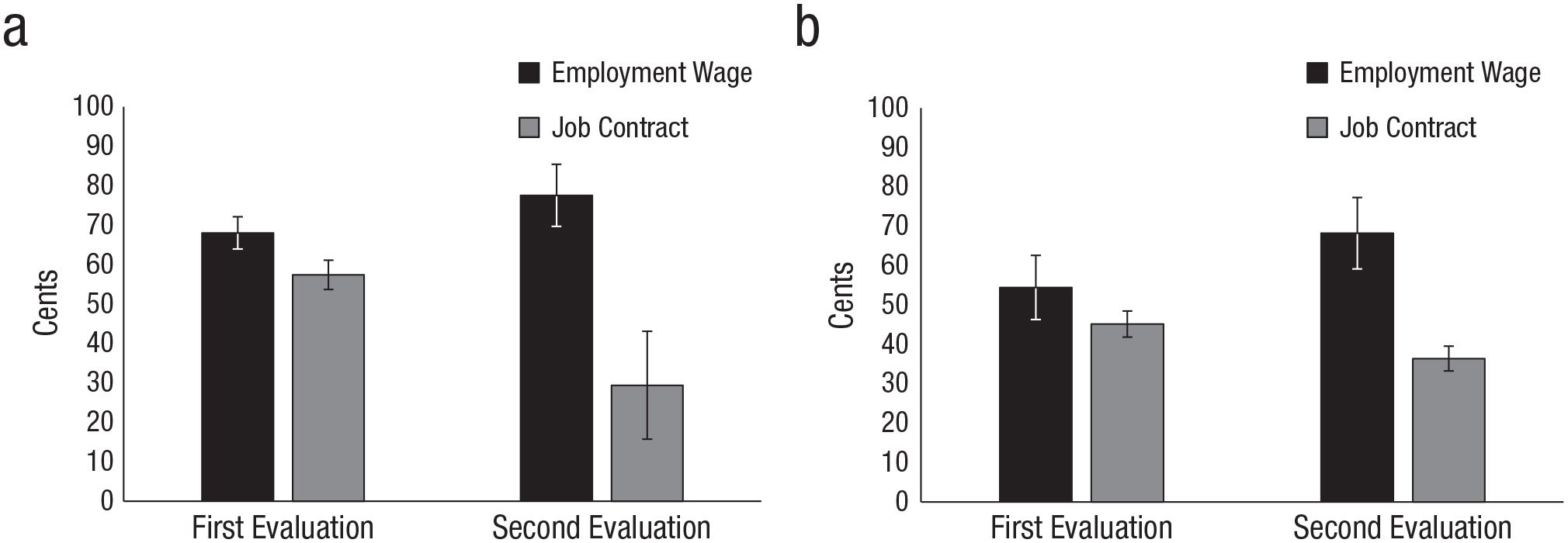
Results from (a) Experiment 3a (nonowners) and (b) Experiment 3b (owners): mean valuation of labor by participants in each transaction frame, separately for participants who completed the employment-wage condition first and who completed the job-contract condition first. Error bars represent standard errors of the mean.
To examine the extent to which the transaction frame (employment wage vs. job contract) promotes focus on labor or focus on money, we analyzed participants’ responses to the questions concerning the monetary and labor aspects of the task. Because analysis of these responses revealed a spillover effect of the first-task to second-task reactions (for details, see the OSF), we focus here solely on participants’ responses following the completion of the first task. Responses to the direct question, “What played a greater role in the decision—the money to be earned or the work of filling out the survey?” under the two transaction frames did not significantly differ, t(212) = 1.402, p = .162, Cohen’s d = 0.196. A repeated measures ANOVA on the two questions concerning thoughts about money and labor with transaction frame as the predictor did not yield any significant effect either— transaction frame: F(1, 212) = 0.004, p = .952, η p 2 = .000; question: F(1, 212) = 1.023, p = .313, η p 2 = .005; and their interaction: F(1, 212) = 1.259, p = .263, η p 2 = .004, respectively.
Experiment 3b
Method
Experiment 3b was identical to Experiment 3a except that participants were assigned the role of owners instead of nonowners. The experiment was completed by 182 MTurk workers recruited through TurkPrime (100 men, 77 women, 5 undisclosed; age: M = 36.98 years, SD = 13.22) who completed at least 1,000 surveys and had an approval rate above 90%. They received 50¢ as a base payment and up to 100¢ as a bonus payment on the basis of their decisions.
Results
Eleven participants in the job-contract setting gave negative labor valuations; we Winsorized their valuations to 0. The main results showed the same pattern when we included negative values. Figure 3b presents participants’ mean work valuations under the different transaction frames. To examine the effect of frame on labor valuation, we submitted participants’ net labor valuations to a repeated measures ANOVA with transaction frame (employment wage vs. job contract) as the within-participants repeated measure and valuation order (employment wage first vs. job contract first) as the between-participants factor. The results replicated the pattern found in Experiments 1, 2, and 3a. There was a significant effect of transaction frame, indicating that work was valued less highly in the job-contract setting than in the employment-wage setting (Ms = 41.16 and 61.33, respectively), F(1, 180) = 8.734, p = .004, η p 2 = .046. The effect of valuation order and the interaction between valuation order and transaction frame were not significant, F(1, 180) = 0.166, p = .684, η p 2 = .001; and F(1, 180) = 2.381, p = .125, η p 2 = .013, respectively.
As in Experiment 3a, analyses of the questions regarding thoughts about the monetary and labor aspects of the task after first-task completion did not yield any significant effects. Responses to the direct question, “What played a greater role in the decision—the money to be earned or the work of filling out the survey?” did not significantly differ under the two transaction frames, t(180) = 0.684, p = .495, Cohen’s d = 0.10. A repeated measures ANOVA on the two questions concerning thoughts about money and labor with transaction frame as the predictor did not yield any significant effect either—transaction frame: F(1, 180) = 0.902, p = .344, η p 2 = .005; question: F(1, 180) = 7.168, p = .008, η p 2 = .038; and their interaction: F(1, 180) = 0.734, p = .393, η p 2 = .004. Detailed analyses of the complete design are reported on the OSF.
Discussion
Across three experiments, we compared two transaction frames: employment-wage settings and job-contract settings. The comparison was made by collecting bids for the task of filling out a questionnaire. The obtained bids confirmed our prediction: The net value assigned to performing the task was lower in the job-contract setting than in the employment-wage setting. This effect did not stem from differences in judged effort, as the transaction frame did not affect estimated effort. This effect does not appear to stem from differences in wealth caused by ownership or lack of ownership of the questionnaire, given that the effect occurred even within participants, when ownership did not change.
Our results are compatible with the assumptions of the reference model of value. According to the model, there is an asymmetry in value between gains and losses. This asymmetry implies that relative to an initial reference state, losses loom larger than equivalent gains. For the value of labor, this asymmetry has the following implication: Owners of the resource to be traded, be they employees who sell their time and effort or questionnaire owners who sell their contractual rights to fill out the questionnaire, lose that resource in the transaction. On the other hand, nonowners, either employers buying labor (in the employment-wage setting) or workers buying contracts (in the job-contract setting), gain a resource relative to their preestablished reference state. Asymmetry between gains and losses yields the well-known difference in value between owners (sellers) and nonowners (buyers). Importantly, here, we demonstrated that this asymmetry results in a decrease in the net value of labor when one trades contracts instead of labor. Hence, the decrease in the value of labor when switching from employment-wage settings to job-contract settings stems, at least partly, from the different roles played by owners and nonowners in the two regimens and the different reference points that this imposes.
We also tested an attentional account predicting enhanced sensitivity to workload and diminished sensitivity to remuneration between the employment-wage setting and the job-contract setting. Indeed, the results of Experiment 1 supported this prediction: We found differential sensitivity to remuneration and workload under the two trading frames. Bids were more sensitive to price rate in the job-contract setting than in the employment-wage setting. However, differential sensitivities to remuneration and workload do not necessarily indicate that the relative importance of these two attributes changes as one switches from wage setting to contract trading. In Experiments 2 and 3, we measured the relative weight of these attributes more directly by asking participants to assess the extent to which thoughts of each attribute were prevalent in their minds as they were making their decisions. Responses to these questions did not yield a clear indication of a shift in relative prominence between money and labor considerations (for additional analyses, see the OSF).
Following Simons, Shoda, and Lindsay’s (2017) call for discussing constraints on generality, it is important to specify the scope to which our conclusions may apply. The gig economy comprises an array of different kinds of jobs and different economic structures, including in some cases a third party, who is typically a consumer who enjoys the fruits of the transaction. Our studies focused on transactions between two parties: employer–employee in regular employment-wage settings and contractors–contract workers buying and selling a contract in job-contract settings. The parties were drawn from the same population of highly experienced MTurk workers, and they had similar power in the context of the experiments. Under these conditions, we found that the same labor is valued less when the transaction is framed as a job contract than as an employment wage. Although we expect the pattern of results to be replicated in more complex situations, future research needs to explore such situations.
In conclusion, our main finding, the lower worth of work value under conditions of job contracting relative to regular employment, points to a novel factor that has far-reaching implications regarding the increase in inequality (Piketty, 2014; Weil, 2014). The diminished value of work implies the increased importance of endowment, thus widening the gap between people who are materially endowed and people who are not.
