




Abstract

Do hypothetical preferences predict real-life moral behavior? Bostyn, Sevenhant, and Roets (2018) conclude that there are notable discrepancies between the psychological processes underlying decisions in real-life and in hypothetical moral dilemmas, adding to recent critiques of the moral-dilemma empirical paradigm (Bauman, McGraw, Bartels, & Warren, 2014; Kahane, 2015; Kahane et al., 2018). One of their central findings is that hypothetical preferences for consequentialism were significantly correlated with consequentialist behavior when participants responded to a hypothetical dilemma (odds ratio, or OR = 2.14, z = 2.17, p = .030) but not when a separate sample of participants was presented with a real-life version of the same dilemma (OR = 1.35, z = 0.83, p = .406). Their study raises important questions about whether experiments based on hypothetical scenarios, such as trolley-style dilemmas, can be used to understand the processes underlying real-life moral behavior.
Our Commentary addresses a limitation of the analyses of Bostyn and colleagues: namely, they did not directly compare the effects of consequentialist-reasoning preferences on hypothetical and real-life moral behavior. In other words, their analyses tested whether consequentialist-reasoning preferences were associated with behavior within each sample, but they did not test whether these two effects were significantly different from each other. The strategy of focusing only on within-group analyses and interpreting significance dichotomously can lead to erroneous conclusions (such as Type II errors) and the misinterpretation of significant results (e.g., a main effect may be interpreted as an interaction effect; Gelman & Stern, 2006; Nieuwenhuis, Forstmann, & Wagenmakers, 2011). To address this limitation, we conducted new analyses that tested the interaction between consequentialist-reasoning preferences and dilemma type (real-life vs. hypothetical).
In our new analyses, we combined the data from the two samples collected by Bostyn and colleagues (i.e., the real-life dilemma and the hypothetical dilemma) and then reestimated the logistic regression model used to predict consequentialist behavior (i.e., the willingness to shock one mouse in order to save five). Importantly, our new model also included an indicator of dilemma type and dilemma-type-by-reasoning-preferences interaction terms.
The results are reported in Table 1. Replicating the authors’ analyses, our tests showed a significant main effect of dilemma type; participants were more likely to make a consequentialist decision in the real-life condition than in the hypothetical condition, p = .03. There was also a main effect of consequentialist preferences; participants with consequentialist preferences were more willing to make consequentialist choices, p = .03. Critically, there were no significant interactions between experimental condition and moral-reasoning preferences, ps > .32.
Effects of Dilemma Type (Real-Life vs. Hypothetical) and Moral-Reasoning Preferences on Behavior
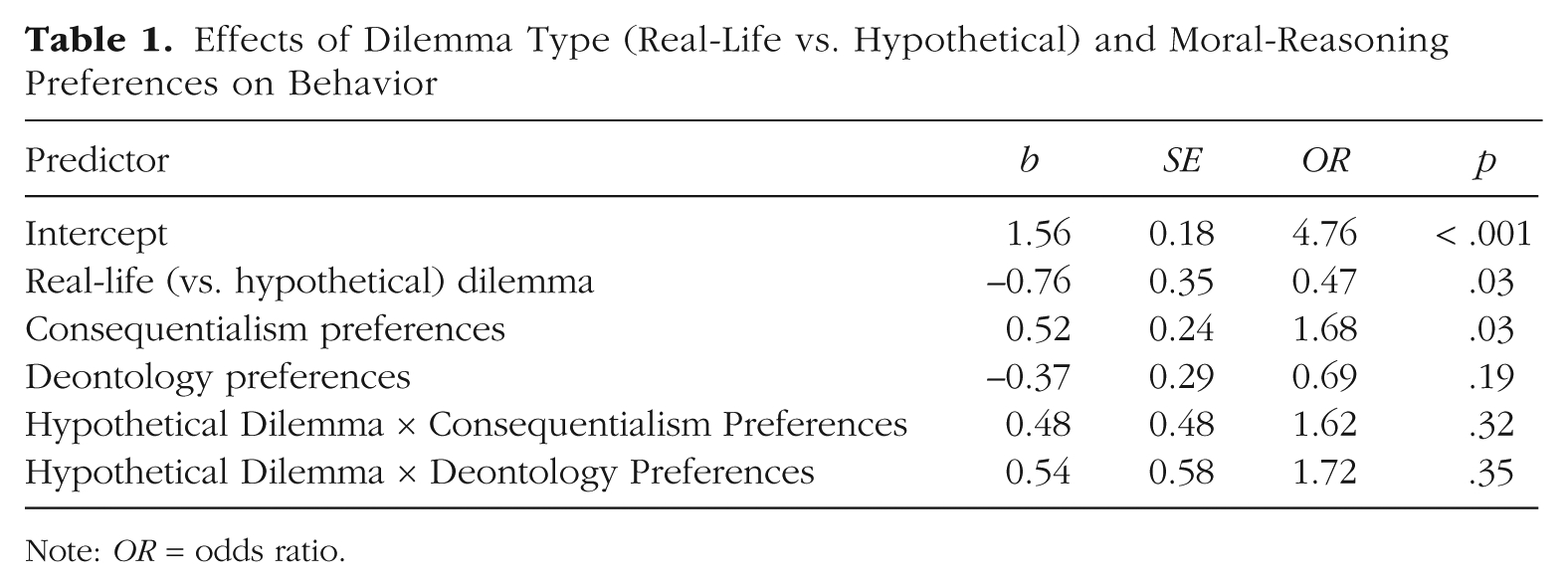
Note: OR = odds ratio.
To get a sense of the evidence for or against the presence of an interaction, we followed the approach of Bostyn and colleagues: We used Bayesian analyses to examine the nonsignificant interaction between dilemma type and consequentialist preferences. We estimated the Bayes factor using the Savage–Dickey density ratio (Wagenmakers, Lodewyckx, Kuriyal, & Grasman, 2010) in the brms package (Bürkner, 2016) in the R programming environment, using a weakly informative Student’s t distribution (ν = 3, µ = 0, s = 2.5) as a prior. This analysis yielded a Bayes factor of 3.47, moderate evidence for the hypothesis that there was no interaction between dilemma type and preferences for consequentialist reasoning.
There are at least two interpretations of these new results: One interpretation is that the original study lacked sufficient power to detect an interaction effect. Indeed, the study had 46% power to detect a medium-sized effect (OR = 2 or Cohen’s d = 0.30). This view suggests that there are insufficient data to confirm (or disconfirm) the presence of an interaction. Alternatively, we can take the Bayes factor at face value and draw a preliminary conclusion based on the evidence at hand: The present results provide moderate evidence for the hypothesis that moral-reasoning preferences have similar effects for real and hypothetical decisions, though further studies are needed to strengthen (or weaken) this conclusion. Both interpretations call for additional studies; however, the second gives us informed expectations going forward.
Our new analyses are consistent with a large body of interdisciplinary research suggesting that hypothetical preferences correspond, albeit imperfectly, with real-life behavior. For example, a meta-analysis of 82 studies by Balliet, Parks, and Joireman (2009) found that social value orientation, a hypothetical measure of altruistic preferences, reliably predicted behavior in both real-life and hypothetical social dilemmas. Similarly, studies on individual risk taking (Kühberger, Schulte-Mecklenbeck, & Perner, 2002) and intertemporal choice (Bickel et al., 2010) suggest that the processes underlying hypothetical and real-life financial decisions are similar. At the same time, this evidence does not mean that moral psychology should rely on hypothetical dilemmas as the stimuli of choice. The key question is whether such dilemmas are able to capture the relevant psychological processes underlying the moral situations that people actually face in real life (it is not clear that they do; Bauman et al., 2014).
In sum, there is insufficient evidence to support the conclusion that hypothetical preferences have different effects for real-life and hypothetical dilemmas. Despite this result, there are differences between behavior in real-life and hypothetical dilemmas. Indeed, several studies, including this one, point to the conclusion that mean levels of behavior differ in real and hypothetical dilemmas (Bostyn et al., 2018; FeldmanHall, Mobbs, et al., 2012); participants are more willing to be utilitarian when the consequences are real. Moreover, real and hypothetical decisions sometimes involve different neural regions and cognitive processes (FeldmanHall, Dalgleish, et al., 2012). 1 Surely, much can be learned when psychologists go beyond hypothetical self-reports to observe real-life behavior (Baumeister, Vohs, & Funder, 2007). However, we cannot clearly conclude whether moral-reasoning preferences have differing effects for real-life and hypothetical dilemmas.
Footnotes
Action Editor
D. Stephen Lindsay served as action editor for this article.
Declaration of Conflicting Interests
The author(s) declared that there were no conflicts of interest with respect to the authorship or the publication of this article.
Funding
The writing of this Commentary was supported with funding from the European Research Council under the European Union’s Horizon 2020 research and innovation program (Grant No. 759320).