




Abstract
Escalation of commitment to a failing course of action occurs in the presence of (a) sunk costs, (b) negative feedback that things are deviating from expectations, and (c) a decision between escalation and de-escalation. Most of the literature to date has focused on sunk costs, yet we offer a new perspective on the classic escalation-of-commitment phenomenon by focusing on the impact of negative feedback. On the basis of the inaction-effect bias, we theorized that negative feedback results in the tendency to take action, regardless of what that action may be. In four experiments, we demonstrated that people facing escalation-decision situations were indeed action oriented and that framing escalation as action and de-escalation as inaction resulted in a stronger tendency to escalate than framing de-escalation as action and escalation as inaction (mini-meta-analysis effect d = 0.37, 95% confidence interval = [0.21, 0.53]).
Keywords
Imagine that you have made a substantial initial investment in a project that seems to be failing, and you now face a decision to either proceed with your commitment or withdraw. Which will you choose? This seemingly simple, common decision-making scenario often results in a decision to escalate rather than to withdraw and highlights a curious phenomenon in decision-making processes (Brockner, 1992; Brockner et al., 1986; Kwong & Wong, 2014; Staw, 1976; Wong, Yik, & Kwong, 2006). Most scholars have examined this phenomenon by focusing on the fallacy of sunk costs and the reluctance to withdraw from a prior commitment. Their argument was that sunk costs are difficult to ignore, and therefore, situations involving them often result in decisions to persist with a failing course of action and to even escalate that commitment further to try to recover the initial investment (Arkes & Atyon, 1999; Arkes & Blumer, 1985).
A different, but highly relevant, type of bias that has not yet been explored in this context is the inaction effect (Zeelenberg, van de Bos, van Dijk, & Pieters, 2002), which refers to the phenomenon in which prior negative outcomes result in an expectation that action will be taken to avoid additional losses. The two types of bias focus on different aspects of the situation under study: The sunk-cost-fallacy perspective focuses on sunk costs, whereas the inaction-effect perspective focuses on negative feedback from prior outcomes. The oversight regarding the implications of the action orientation of the inaction-effect bias may be due, in part, to the ambiguity in escalation-of-commitment situations over whether the options to proceed or withdraw constitute action or inaction (Wong & Kwong, 2007). A better understanding of escalation decisions informed by both perspectives can help people devise simple strategies to improve decision making in such situations (as advocated by Milkman, Chugh, & Bazerman, 2009).
In the present investigation, we aimed to offer a new perspective on escalation-of-commitment situations and demonstrate the importance of action-inaction framing in the observed tendency to escalate commitment to a failing course of action. Building on the inaction-effect bias, we expected that (a) negative feedback in escalation situations would result in an action orientation and, therefore, that (b) framing escalation as action and de-escalation as inaction would result in higher escalation relative to framing de-escalation as action and escalation as inaction.
The Inaction Effect
The action effect (Kahneman & Tversky, 1982) is one of the best-known and frequently replicated findings in the regret literature (Gilovich & Medvec, 1995). Consider the following action-effect example from Zeelenberg et al. (2002, Experiment 1): Steenland and Straathof are both coach[es] of a soccer team. Steenland is the coach of Blue-Black, and Straathof is the coach of E.D.O. This Sunday Steenland decides to do something: He fields three new players. Straathof decides not to change his team. Both teams lose with [a score of] 3–0. Who feels more regret, coach Steenland or coach Straathof? (p. 317)
In response to this scenario, most participants (78%) rated the coach who had taken action to change the team lineup as experiencing greater regret over the negative outcome than his counterpart who had taken no action. Building on norm theory (Feldman & Albarracín, 2017; Kahneman & Miller, 1986), Zeelenberg et al. (2002) further extended the action effect by manipulating normality, that is, the normative behavior expected. They added two conditions informing participants of whether the two soccer teams had lost or won their previous matches; the results showed that in neutral situations (or when prior outcomes were positive), the normative behavior was not to act, whereas a prior loss created a normative expected behavior to act to avoid another negative outcome. The researchers thus concluded that there was an inaction effect, whereby presenting prior negative outcomes led participants to rate the coach who had not acted as more regretful than the coach who had acted (the percentage of participants rating higher regret for action dropped to 31%). The inaction effect has since received further support (e.g., Bar-Eli, Azar, Ritov, Keidar-Levin, & Schein, 2007; Inman & Zeelenberg, 2002) and been successfully replicated (e.g., Feldman, 2018).
Escalation of Commitment and Action-Inaction
Escalation-of-commitment situations involve sunk costs, negative feedback, and a decision between proceeding and withdrawing (for a review, see Brockner, 1992; Sleesman, Conlon, McNamara, & Miles, 2012). On the basis of findings on the inaction-effect bias, we expected that given negative feedback, people would prefer taking action over not taking action. If that proved to be the case, then such an action orientation would have important implications for the tendency to escalate, thereby revealing a previously unexplored perspective on a widely investigated bias.
However, escalation situations are often described in ambiguous terms with respect to whether they involve action or inaction. Does choosing to proceed constitute action or inaction? How about choosing to withdraw? What would happen if the decision maker does not make a decision between proceeding and withdrawing at all? To the best of our knowledge, the only reference to the action-inaction distinction in escalation situations was in a footnote in an article by Wong and Kwong (2007), who explored anticipated regret and concluded that “the action-inaction distinction . . . is not quite clear in escalation situations” (p. 546).
We predicted that as long as there was a clear decision between action and inaction following negative feedback, action framing would affect escalation decisions in such a way that the action option would be preferred over the inaction option. Therefore, escalation of commitment would be higher when escalation was framed as action and de-escalation as inaction, relative to the reverse. This perspective on escalation situations may offer a new interpretation of previous findings on why decision makers tend to escalate. For example, in the very first demonstration of escalation of commitment, Staw’s (1976) framing seemed to suggest that escalation requires the allocation of resources to a losing investment and that such allocation might have been perceived as taking action. Similarly, Arkes and Blumer’s (1985) radar-blank scenario also framed escalation as additional investment. Thus, Staw (1976), Arkes and Blumer (1985), and researchers following up on their studies (Moon, 2001a, 2001b; Wong & Kwong, 2007; Wong et al., 2006) may have framed escalation in a way that their participants interpreted as action. Action-inaction framing is especially relevant given findings that trait action orientation may affect the tendency to escalate in seemingly contradictory ways (higher escalation: Harmon-Jones & Harmon-Jones, 2002; McElroy & Dowd, 2007; lower escalation: van Putten, Zeelenberg, & van Dijk, 2010).
The Present Investigation
In four experiments, we manipulated action-inaction framing in escalation scenarios, following a pretest linking the inaction effect to escalation of commitment. Power analyses, measures, conditions, and exclusions are reported in the Supplemental Material available online. Data and code are available on the Open Science Framework (https://osf.io/c6wm5/).
Experiment 1
Preregistered pretest
The goal of Experiment 1 was to demonstrate the baseline effect that action-inaction framing affects escalation decisions. We conducted a successful pretest to establish a clear link between escalation-of-commitment scenarios and the inaction effect (Zeelenberg et al., 2002). As expected, we found that compared with positive feedback (mirroring a prior win in the inaction-effect scenarios) in escalation-of-commitment decisions, negative feedback (mirroring a prior loss in the inaction-effect scenarios) led to stronger perceived norms for action (d = 1.81), stronger perceived risk for inaction (d = 2.39), weaker perceived risk for action (d = 0.98), stronger perceived regret for inaction (d = 0.89), and finally, stronger tendency to take action (d = 2.18). Full details and results are provided in the Supplemental Material. We therefore hypothesized that decision makers facing classic escalation-of-commitment decisions with negative feedback will be action oriented and thus inclined to choose the option that best represents taking action.
Method
Participants and procedure
A total of 104 undergraduate students from a university in Hong Kong participated in exchange for partial course credit. Of the sample, 22 students (21%) failed comprehension questions and were therefore excluded (details below), leaving a sample of 82 students (48 females, 34 males; age: M = 19.28 years, SD = 0.85). We adapted the blank-radar escalation You are the vice president of a midsized high-tech firm. You have personally initiated a project to develop a radar-scrambling device that would make a plane undetectable by conventional radar. The project was estimated to cost 10 million dollars over a development period of 6 years. If successful, the project has the potential of bringing in a large profit for the company.
In the escalation-as-action condition, the text continued, “This project requires the allocation of an annual budget at the beginning of each year.” In the de-escalation-as-action condition, the text instead read, “The entire project budget has been approved and preallocated for the project out of your company’s multiyear budget.” In both conditions, the text immediately following was the same: It’s been 3 years since the project began, and 5 out of the estimated 10 million dollar budget have already been spent. You have just discovered that while your product is still in development, another firm has already launched and begun marketing a very similar product with a much better design: It takes up less space and is much easier to operate than your design. As you are currently the manager in charge, the project now requires your authorization to allocate money for the next year.
In the escalation-as-action condition, the text then continued as follows: The project budget decision depends only on you, and without it, the project will close down and will not be allowed to continue. The important decision you now face is to either: Take action to authorize next year’s budget. The budget will then be allocated and the project will proceed. Take no action to authorize the budget for the project. The budget will not be allocated and the project will terminate.
In the de-escalation-as-action condition, the text continued in a different manner: The project will naturally continue as planned unless you decide otherwise and take action. The important decision you now face is to either: Take action to initiate an order to stop all further work on the project. The long-term commitment will be violated and the project will terminate. Take no action, thereby allowing the project to proceed as planned.
Measures
Comprehension questions
The scenarios were followed by two comprehension checks: “What would happen if you decided to take action?” and “What would happen if you decided not to take any action?” (1 = project would definitely proceed, 5 = project would definitely terminate). As indicated above, incorrect answers led to an exclusion from the sample.
Escalation of commitment
Participants rated their willingness to continue with the project—“On a scale from 0 to 100, please indicate your willingness to proceed with the project (0 = absolutely not, 100 = absolutely yes)”—and were asked to briefly explain their decisions.
Results
The means and standard deviations for the two experimental conditions are detailed in Table 1, and t-test and effect-size statistics are summarized in Table 2. An independent-samples t test revealed that the action framing affected participants’ decisions to escalate their commitment, with significant differences observed between the two experimental conditions. Participants in the escalation-as-action condition escalated to a greater extent than those in the de-escalation-as-action condition (d = 0.62, 95% confidence interval, or CI = [0.18, 1.06]). Hence, framing escalation as action and de-escalation as inaction resulted in a significantly stronger escalation of commitment.
Experiments 1 to 4: Descriptive Statistics for the Escalation Decisions
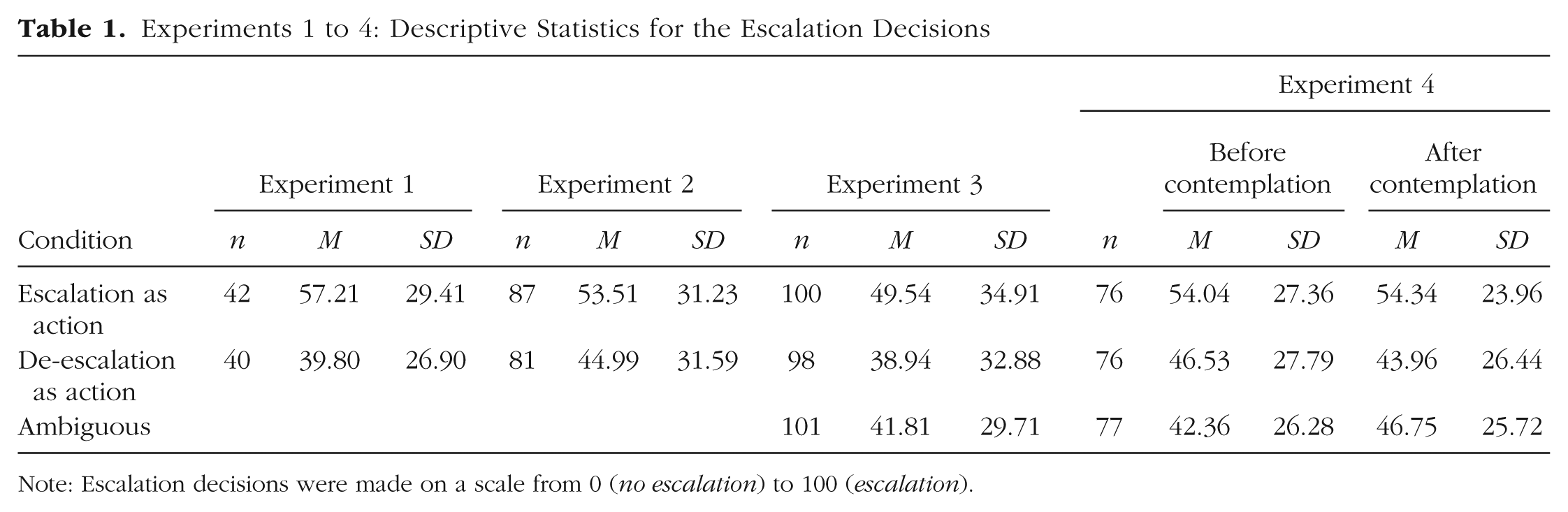
Note: Escalation decisions were made on a scale from 0 (no escalation) to 100 (escalation).
Experiments 1 to 4: t-Test Contrasts and Cohen’s d Effects for Escalation of Commitment Decisions
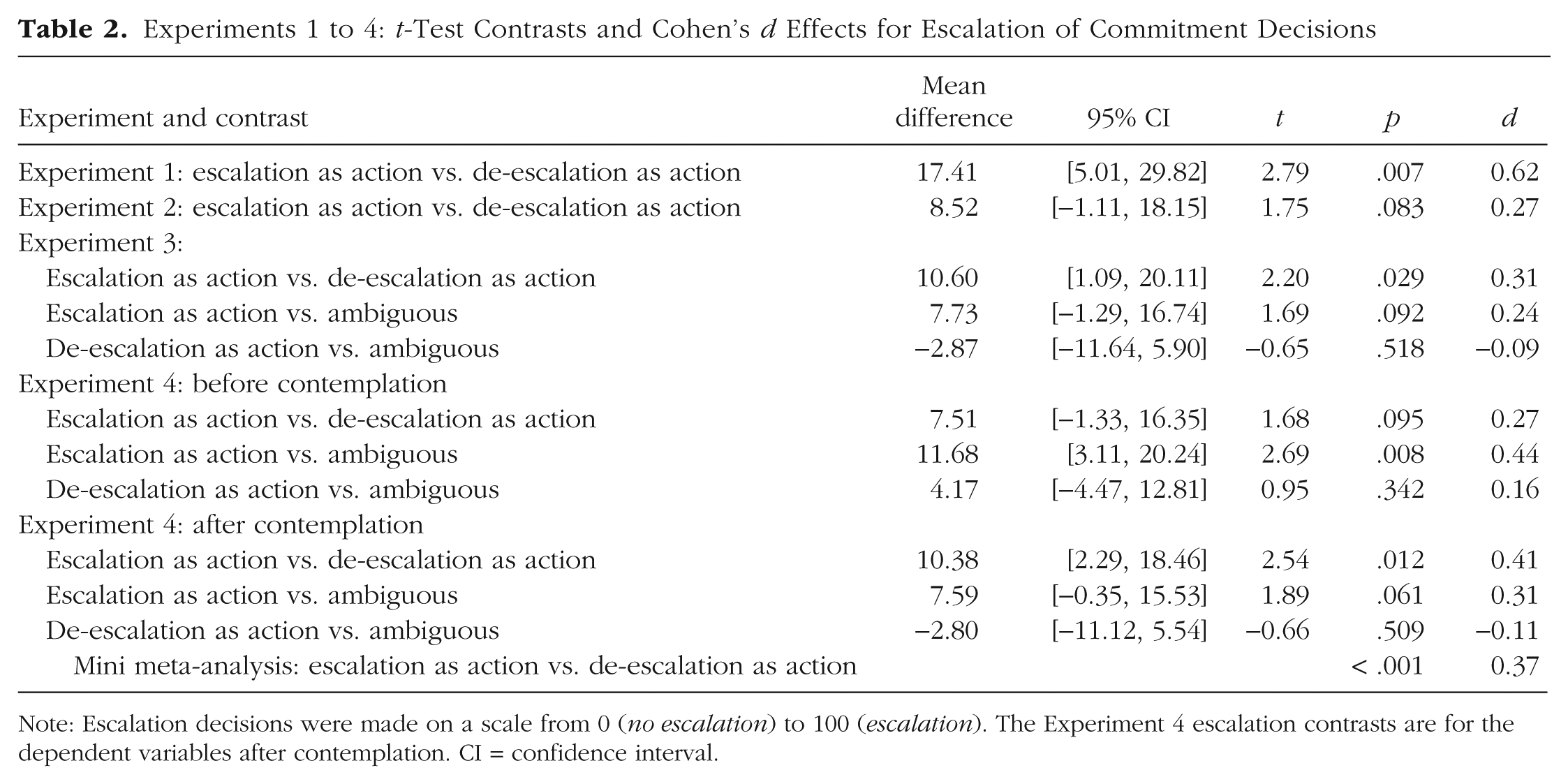
Note: Escalation decisions were made on a scale from 0 (no escalation) to 100 (escalation). The Experiment 4 escalation contrasts are for the dependent variables after contemplation. CI = confidence interval.
Experiment 2
Method
In Experiment 2, we extended Experiment 1 in several ways: testing samples with different demographics, addressing participant exclusion by forcing rather than checking comprehension, and measuring action preference to determine whether decision makers faced with negative feedback in escalation situations are indeed action oriented.
Participants and procedure
A total of 166 American Mechanical Turk (MTurk) participants were recruited online using TurkPrime.com (Litman, Robinson, & Abberbock, 2017; 76 females, 90 males; age: M = 34.59 years, SD = 10.00). Each participant was randomly assigned to one of two conditions manipulating whether escalation and de-escalation were framed as action or inaction, as follows: You are the vice president of a midsized high-tech firm. You have personally initiated a project to develop a radar-scrambling device that would make a plane undetectable by conventional radar. The project was estimated to cost 10 million dollars over a development period of 6 years. If successful, the project has the potential of bringing in a large profit for the company.
In the escalation-as-action condition, the text continued, “The budget is allocated in two phases, once at the beginning of the project, and then a second allocation of a budget to proceed to the next stage after 3 years.” In the de-escalation-as-action condition, the text instead read, “The entire project budget has been approved and preallocated for the project out of your company’s multiyear budget.” In both conditions, the text immediately following was the same: It’s been 3 years since the project began, and 5 out of the estimated 10 million dollar budget have already been spent. You have just discovered that while your product is still in development, another firm has already launched and begun marketing a very similar product with a much better design: It takes up less space and is much easier to operate than your design. As you are currently the manager in charge, the project now requires your authorization to allocate money for the rest of the project.
In the escalation-as-action condition, the text then continued as follows: The project budget decision depends only on you, and without it, the project will close down and will not be allowed to continue. The important decision you now face is to either: Take action and authorize the next budget. Given your actions, the budget will then be allocated and the project will proceed. Take no action to authorize the budget for the project. Given your inaction, the budget will not be allocated and the project will terminate.
In the de-escalation-as-action condition, the text continued in a different manner: The project will naturally continue as planned unless you decide otherwise and take action. The important decision you now face is to either: Take action and initiate an order to stop all further work on the project. Given your actions, the project will then terminate. Take no action. Given your inaction, the project will proceed as planned.
Measures
Comprehension questions
The scenario was followed by several questions that participants had to answer correctly to be able to proceed to the escalation dilemma. The questions were exactly the same as those used in the pretest, with one additional question: “Has the entire estimated budget for the project already been preallocated?” (yes/no).
Escalation of commitment
Participants rated their willingness to continue with the project—“On a scale of 0 to 100, please indicate your willingness to proceed with the project (0 = absolutely not, 100 = absolutely yes)”—and were asked to briefly explain their decisions.
Action orientation
Participants were presented with a question measuring action orientation: “In such decision situations, is it generally preferable to take action or not?” (0 = it is best to not take action, 5 = it is better to take action). Studies of omission bias (Ritov & Baron, 1990) have shown that action preference is a result of anticipated regret over action-inaction combined with risk aversion. Because escalation-of-commitment situations involve negative feedback, the option to escalate is likely perceived to be the riskier option (Whyte, 1986; Wong, 2005). Accordingly, we expected that the general tendency to take action would be even stronger when action framing was aligned with the less risky option of de-escalation.
Results
The means and standard deviations for the two experimental conditions are detailed in Table 1, and t-test and effect-size statistics are summarized in Table 2. Participants in the escalation-as-action condition rated a higher tendency to escalate than their counterparts in the de-escalation-as-action condition, although the effect was weaker than that in Experiment 1 (d = 0.27, 95% CI = [−0.03, 0.58]). Descriptive, t-test, and effect-size statistics for the action preference ratings are provided in Tables 3 and 4. In both the escalation-as-action and de-escalation-as-action conditions, participants were action oriented, with a stronger preference for action over inaction when de-escalation was framed as action (d = –0.36, 95% CI = [−0.66, −0.06]).
Experiments 2 to 4: Means, Standard Deviations, and One-Sample t-Tests for Perceived Action
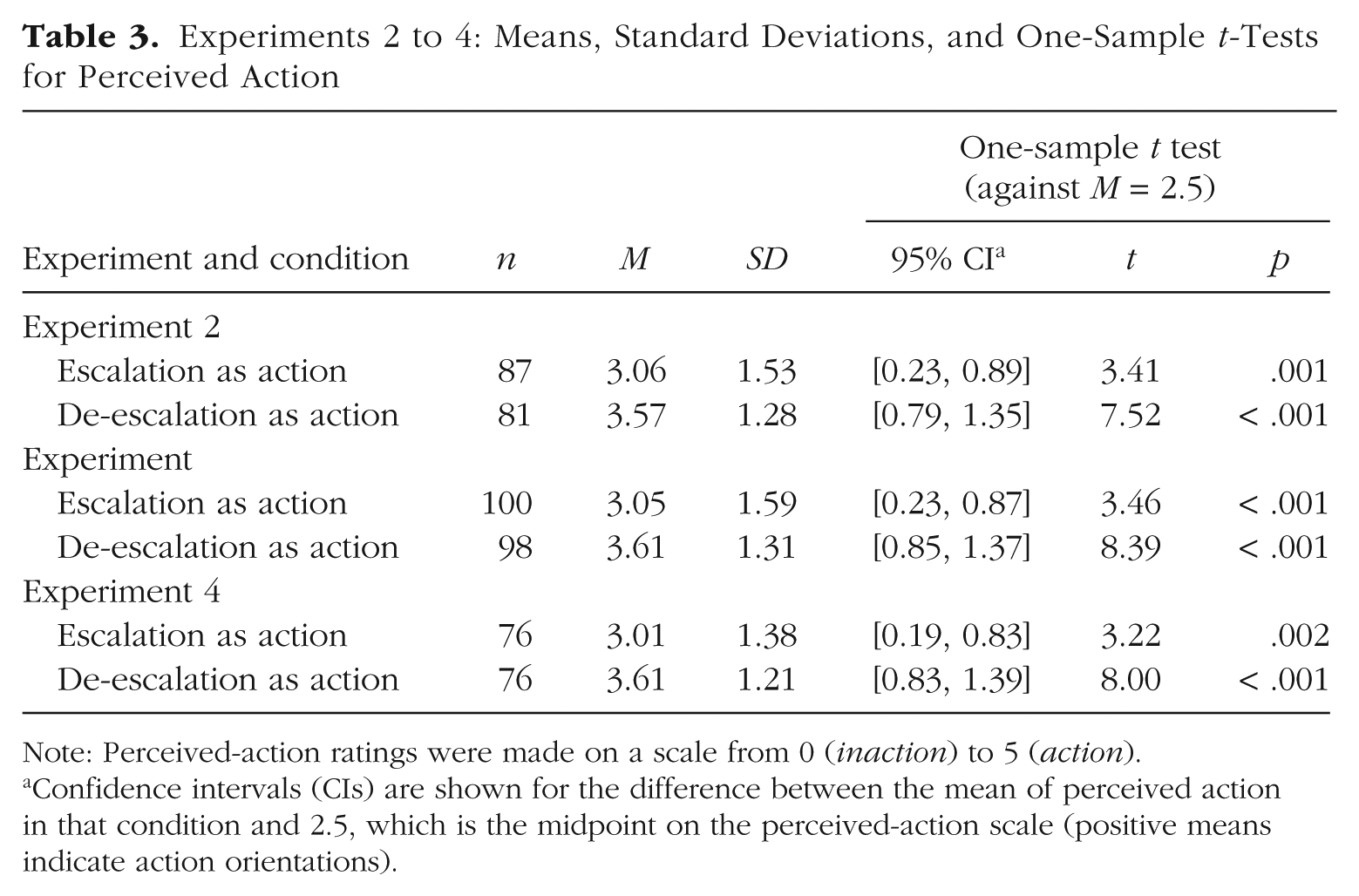
Note: Perceived-action ratings were made on a scale from 0 (inaction) to 5 (action).
Confidence intervals (CIs) are shown for the difference between the mean of perceived action in that condition and 2.5, which is the midpoint on the perceived-action scale (positive means indicate action orientations).
Experiments 2 to 4: t-Test Contrasts and Cohen’s d Effects for Perceived Action Ratings
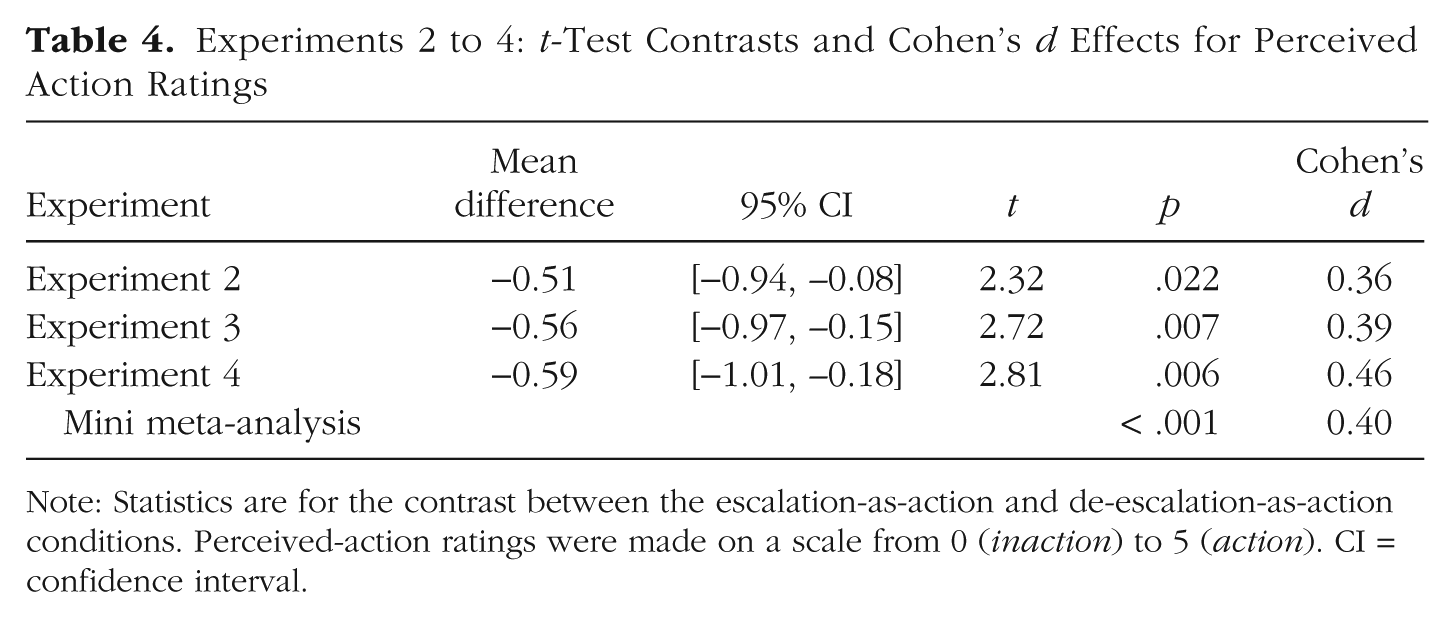
Note: Statistics are for the contrast between the escalation-as-action and de-escalation-as-action conditions. Perceived-action ratings were made on a scale from 0 (inaction) to 5 (action). CI = confidence interval.
Experiment 3
Method
In Experiment 3, we sought to replicate the previous findings and clarify in an ambiguous action-inaction scenario whether escalation and de-escalation would be perceived as action or inaction. A total of 299 American MTurk participants were recruited online using TurkPrime.com (171 females, 128 males; age: M = 36.89 years, SD = 12.36). Each participant was randomly assigned to one of three conditions manipulating the escalation framing: escalation as action, de-escalation as action, and ambiguous. The first two conditions resembled those used in Experiment 2. In the ambiguous condition, participants faced a decision between proceeding with the project or terminating it without any clear indication of action or inaction, as in the original Arkes and Blumer (1985) experiment.
In the ambiguous condition, participants were also asked to rate their perceptions of action and inaction: “What would have happened if you took no action at all?” (1 = project would proceed as planned, 2 = project would terminate), “Did proceeding with the project require your action or inaction?” and “Did terminating the project require your action or inaction?” (1 = required action, 2 = required inaction).
Results
The means and standard deviations for the three experimental conditions are detailed in Table 1, and t-test and effect-size statistics are summarized in Table 2. We began with a comparison between the escalation-as-action and de-escalation-as-action conditions, mirroring the designs of Experiments 1 and 2. The participants in the escalation-as-action condition displayed a stronger tendency to escalate than did participants in the de-escalation-as-action condition, with a similar effect size to that in Experiment 2 (d = 0.31, 95% CI = [0.03, 0.59]).
As in Experiment 2, we also measured participants’ action orientation (descriptive, t-test, and effect-size statistics are provided in Tables 3 and 4). Again, in both the escalation-as-action and de-escalation-as-action conditions, participants were action oriented, with a stronger tendency for action over inaction when de-escalation was framed as action (d = –0.39, 95% CI = [−0.66, −0.10]). We concluded that Experiment 3 successfully replicated the findings in Experiments 1 and 2.
We also compared the two conditions with the ambiguous control condition. The ambiguous condition was found to be closer to the de-escalation-as-action condition (d = 0.09) than the escalation-as-action condition (d = 0.24). When asked about their understanding of the ambiguous scenario, 79 of the 101 participants (78.2%) indicated that the project would proceed as planned if they took no action, and 94 participants (93.1%) indicated that terminating the project would require an action. Participants indicated confusion about whether proceeding required an action or not with a nearly random 50:51 split, indicative of random guessing. These results suggest that the participants generally understood the ambiguous scenario to mean that de-escalation requires action but were unsure about whether escalation entails action or inaction.
Experiment 4
Method
We extended Experiment 3 by adding contemplation of the possible decisions and outcomes to examine anticipated regret over possible failure and anticipated joy over potential success. A total of 229 Hong Kong undergraduate students participated in return for course credit (120 females, 109 males; age: M = 19.38 years, SD = 0.99). The experimental design was similar to that of Experiment 3, with random assignment to three conditions: escalation as action, de-escalation as action, and ambiguous.
After the same procedure as that in Experiment 3, the participants were asked four questions regarding the two choices (action and inaction) and two possible outcomes (positive and negative) and were asked to rate their anticipated feelings (2 × 2, for four ratings overall): Imagine that you finally decided to [take action (escalation as action)/not take action (de-escalation as action; ambiguous was left empty)] [and] proceed with the project. At the end, your decision turned out to be a big [mistake/success]. Because of your decision, both you and the company [suffered negative/enjoyed positive] outcomes. In that situation, on a scale of 0 (not at all likely) to 100 (extremely likely), how likely are you to feel [regret/joy] over your decision?
Following this choice-outcome contemplation, the participants were again asked to make a decision concerning the project’s fate: “Think again carefully. On a scale of 0 to 100, please indicate your willingness to proceed with the project (0 = absolutely not, 100 = absolutely yes).”
Results
The means and standard deviations for the three experimental conditions are detailed in Table 1. Table 2 reports the summary statistics of the t-test contrasts. The escalation decisions in the comparison between the escalation-as-action and de-escalation-as-action conditions before contemplation showed a similar effect to those found in Experiments 2 and 3. The participants in the escalation-as-action condition displayed a stronger tendency to escalate than did their counterparts in the de-escalation-as-action condition (d = 0.27), and the contrast became more pronounced with a stronger effect (d = 0.41, 95% CI = [0.09, 0.73]), following the contemplation of the possible decisions and their anticipated affective outcomes.
We conducted a series of four one-way analyses of variance on the contemplated outcomes and anticipated emotions. The only significant difference was in the level of anticipated joy following a positive outcome from proceeding with the project. The participants in the escalation-as-action condition recorded the highest anticipated joy rating for successful escalation (M = 90.72, SD = 14.47), whereas those in the de-escalation-as-action condition recorded the lowest (M = 80.09, SD = 24.21), t(150) = 122.51, p = .001, mean difference = 10.63, 95% CI = [4.24, 17.02], d = 0.54, with the participants in the ambiguous condition falling somewhere in between (M = 83.66, SD = 23.30), overall: F(2, 226) = 4.98, p = .008. These findings support the idea that an action orientation following negative feedback primarily results from trying to change a failing course of action in the expectation that the successful execution of that change will result in a higher level of perceived joy. We again replicated the findings of Experiments 2 and 3 with regard to an action orientation (as detailed in Tables 3 and 4), finding a stronger tendency toward action when de-escalation was framed as action (d = −0.46, 95% CI = [−0.78, −0.14]).
The findings for the ambiguous condition replicated the findings of Experiment 3. The ambiguous condition was closer to the de-escalation-as-action condition (ds = 0.16 and −0.11, ps = .342 and .509) than to the escalation-as-action condition (ds = 0.44 and 0.31, ps = .008 and .061). In the ambiguous condition, 50 of 77 participants (64.9%) perceived inaction to equate with proceeding, 59 (76.6%) perceived project termination to require action, and there was a nearly random 39:38 split concerning whether proceeding required action or inaction. Hence, when action-inaction was not specified, the participants again understood de-escalation as requiring action but were unsure about whether escalation required action or inaction.
General Results: Mini Meta-Analysis
To provide a summary of the evidence for our proposed hypotheses, we followed the emerging practice of performing a mini meta-analysis of all of our experiments to assess the overall effect size (Lakens & Etz, 2017). The effects for the contrasts between the escalation-as-action and de-escalation-as-action conditions on both the escalation decisions and action orientation in the four experiments are reported in Tables 2 and 4. We conducted mini meta-analyses of the escalation decisions and action orientation. The results of Cochran’s Q tests revealed no significant heterogeneity among the experiments—escalation: Q(3) = 1.85, p = .605; action orientation: Q(2) = 0.22, p = .895. Forest plots and the results of the two random-effects mini meta-analyses are presented in Figure 1. The overall escalation-decision effect size was 0.37 (95% CI = [0.21, 0.53], p < .001) and the overall action-orientation effect size was −0.40 (95% CI = [−0.57, −0.23], p < .001). Both results can be interpreted as consistent weak to moderate effects.
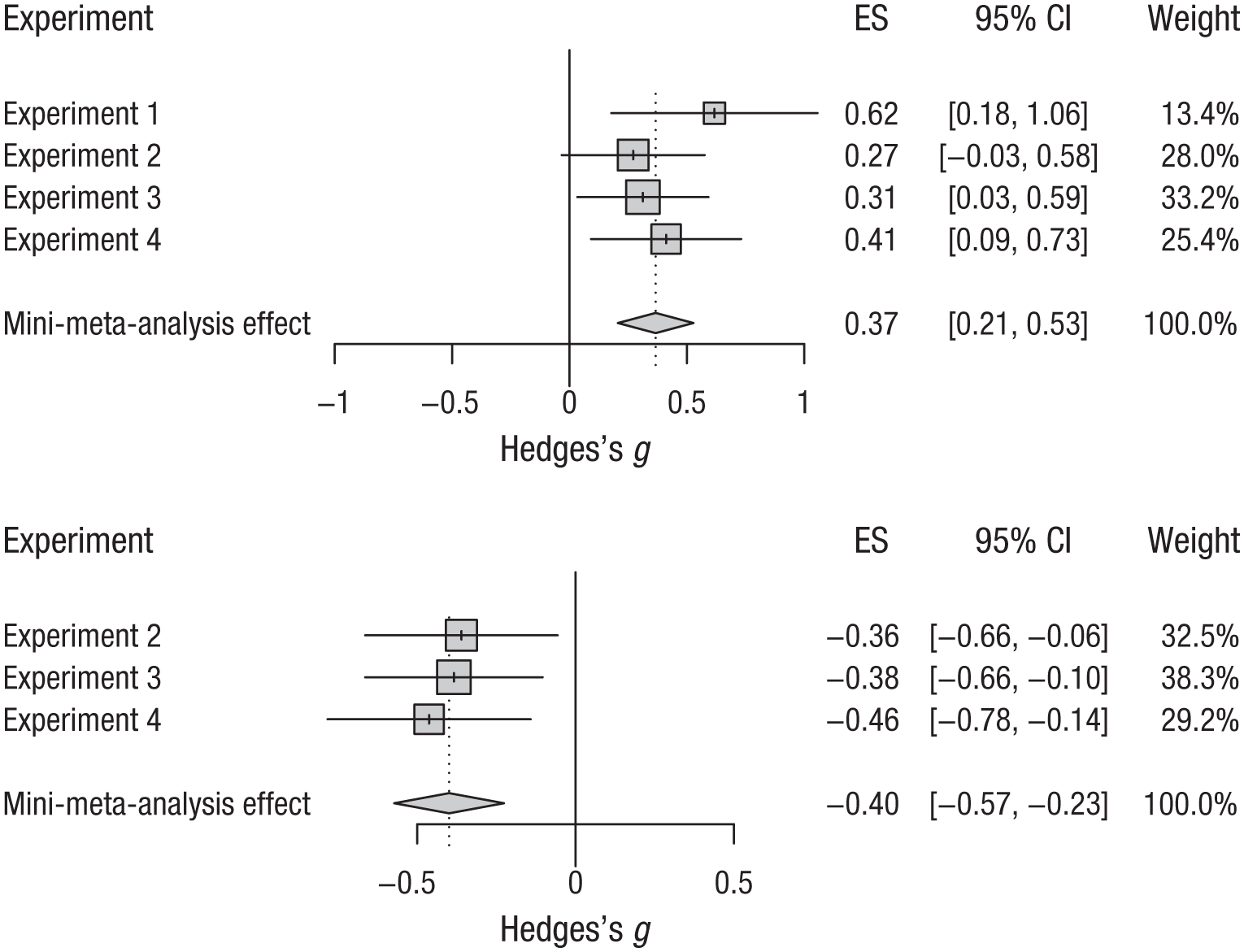
Forest plots of the mini meta-analyses of the four experiments. The first plot refers to the escalation decision, and the second plot to action orientation. Higher Hedges’s g values indicate higher values in the escalation-as-action condition compared with the de-escalation-as-action condition. A Hedges’s g of 0 indicates no difference between the conditions. CI = confidence interval. ES = effect size (Hedges’s g).
General Discussion
Action-inaction framing of options in escalation-decision situations affects the tendency to escalate. We demonstrated that when there is a choice between escalation and de-escalation, framing escalation as action and de-escalation as inaction leads to a higher degree of escalation than the reverse framing. We replicated this finding in three other experiments, with a mini-meta-analysis effect of 0.37, 95% CI = [0.21, 0.53], comparable with other suggested interventions for attenuating the sunk-cost bias (e.g., Hafenbrack, Kinias, & Barsade, 2014; Kwong & Wong, 2014) and typical for framing effects (Kühberger, 1998). A summary is provided in Table 5.
Summary of Experiments and Main Findings
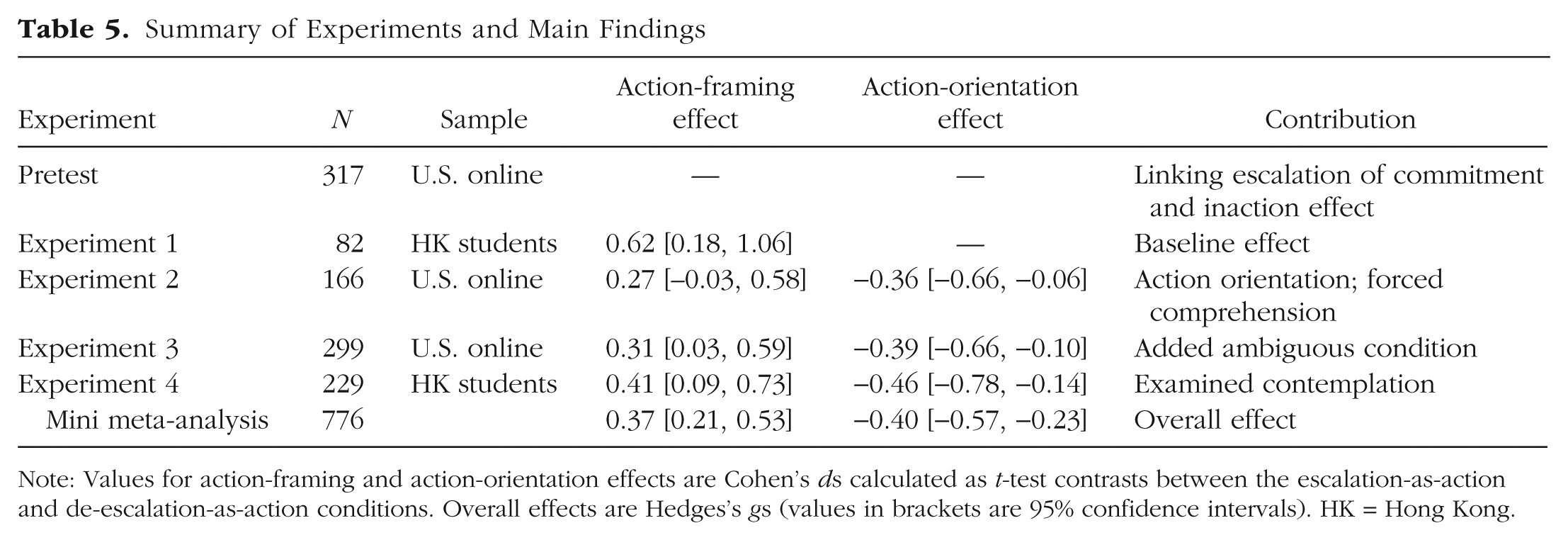
Note: Values for action-framing and action-orientation effects are Cohen’s ds calculated as t-test contrasts between the escalation-as-action and de-escalation-as-action conditions. Overall effects are Hedges’s gs (values in brackets are 95% confidence intervals). HK = Hong Kong.
Implications and future directions
Our findings offer important contributions for understanding escalation of commitment. On the basis of the inaction effect (Zeelenberg et al., 2002), we hypothesized and found that negative feedback resulted in greater inclination to act and choose the action option. In our pretest, we linked inaction-effect and escalation-of-commitment dilemmas by manipulating the feedback provided, with positive feedback resulting in lower action orientation, higher perceived risk for taking action, and higher anticipated regret for taking action if outcomes turn out negatively. Importantly, these findings indicate that escalation decisions lead to different default tendencies that run counter to other classic biases in which people generally favor the status quo (Samuelson & Zeckhauser, 1988), less risk, and omission over commission (Ritov & Baron, 1990), especially when facing risks of negative outcomes (Kahneman & Tversky, 1979). Further, we found support for the general tendency to take action in escalation-dilemma situations (Experiments 2–4), particularly when the less risky option of de-escalation was framed as action (mini-meta-analysis effect = –0.40, 95% CI = [−0.57, −0.23]).
We noted ambiguity in the literature regarding whether escalation and de-escalation involve action or inaction (Wong & Kwong, 2007), reflected by the debate regarding similarities and differences between escalation and inaction-inertia bias (Tykocinski & Ortmann, 2011). It is possible that some escalation effects reported to date stem in part from participants perceiving escalation as action. Furthermore, it is also possible that sunk costs affect perceptions of negative outcomes, with larger sunk costs strengthening the salience of negative outcomes and normative expectations for action. Therefore, researchers should aim to disentangle sunk costs from negative-feedback effects in future experiments and carefully articulate whether decision choices involve action or inaction. Practitioners and decision makers should take both factors into account and plan to differentiate action and inaction in key decision points to minimize tendencies to escalate.
Both the past and the future impact escalation decisions. Future anticipated joy mattered, in support of findings for the role of anticipated regret in escalation of commitment (Wong & Kwong, 2007), as did negative feedback, in support of findings regarding the impact of past experiences and outcomes (Tykocinski & Ortmann, 2011; Whyte, 1986). People vary in their attitudes and values regarding action-inaction (Ireland, Hepler, Li, & Albarracín, 2015; Zell et al., 2013), in their experienced regret over action-inaction (Gilovich, Wang, Regan, & Nishina, 2003), and in tendencies toward change versus status quo maintenance (Diefendorff, Hall, Lord, & Strean, 2000). These differences have been shown to impact escalation decisions, with seemingly conflicting findings. On the one hand, action-oriented people are more inclined to try to finish projects and less likely to quit an already started project (Harmon-Jones & Harmon-Jones, 2002; McElroy & Dowd, 2007), suggestive of higher escalation. On the other hand, they seem less susceptible to sunk costs and find it easier to let go of sunk costs when action requires it (van Putten et al., 2010), suggestive of lower escalation. Our results offer a way to integrate these two findings on the basis of the action-inaction framing of the escalation situation. We expect that stronger action orientation will lead to a higher likelihood of choosing an option framed as action (vs. inaction).
In summary, action and inaction should be considered in escalation situations in terms of context (past and feedback), decision (framing), future (anticipated affect), individual differences (action orientation), and culture (action values). We believe that interactions between two or more of these factors are promising directions for future research.
Limitations
We note several limitations. We used a single escalation scenario in all experiments, which was meant to address calls for emphasizing replication (Lindsay, 2015). However, this limits the generalizability of our findings to other escalation scenarios and to real-life decision situations. We therefore consider this as a first step in a promising new direction for understanding escalation decisions, yet we caution that more research is needed before any strong conclusions are drawn. We call for conceptual replications using other scenarios and further tests in real-life situations.
Our manipulation used explicit action-inaction framing, which may also affect action or inaction goals, direct attention to the action option, or make the action option seem more interesting or exciting. The pretest addressed these concerns by showing low action orientation under positive feedback when escalation was framed as inaction, and omission-bias findings (Ritov & Baron, 1990) suggest strong action aversion when facing similar decisions. Future research can more directly test how action framing affects goals, attention, and interest in escalation situations.
Lastly, we focused on testing negative feedback directly relevant to the escalation decision. It is possible that action orientation may also be affected by incidental feedback. Future research can further test the generalizability of our findings to assess the impact of indirect or unrelated negative feedback on action-orientation and escalation tendencies.
Conclusion
We outlined a new perspective on escalation-of-commitment bias, demonstrating that negative feedback in escalation-decision situations results in an action orientation and biased decision making in favor of the decision framed as action. We call on escalation researchers to resolve action-inaction ambiguities and take action orientation into account in escalation situations, and we alert practitioners and decision makers to be mindful of the impact of action-inaction biases in decision-making situations.
Footnotes
Action Editor
Timothy J. Pleskac served as action editor for this article.
Author Contributions
G. Feldman developed the study concept, designed and conducted the experiments, and analyzed the data. K. F. E. Wong provided guidance and critical feedback. G. Feldman drafted the final version of the manuscript, which was revised and approved by K. F. E. Wong.
Declaration of Conflicting Interests
The author(s) declared that there were no conflicts of interest with respect to the authorship or the publication of this article.
Open Practices
All data and materials have been made publicly available via the Open Science Framework and can be accessed at https://osf.io/c6wm5/ and https://osf.io/3uqx6/, respectively. The design and analysis plan for the pretest were preregistered at the Open Science Framework and can be accessed at https://osf.io/3uqx6/. The complete Open Practices Disclosure for this article can be found at http://journals.sagepub.com/doi/suppl/10.1177/0956797617739368. This article has received badges for Open Data, Open Materials, and Preregistration. More information about the Open Practices badges can be found at  .
.
References
Supplementary Material
Please find the following supplemental material available below.
For Open Access articles published under a Creative Commons License, all supplemental material carries the same license as the article it is associated with.
For non-Open Access articles published, all supplemental material carries a non-exclusive license, and permission requests for re-use of supplemental material or any part of supplemental material shall be sent directly to the copyright owner as specified in the copyright notice associated with the article.
