




Abstract
The present study investigated the role of early oral language and family risk for dyslexia in the two developmental pathways toward reading comprehension, through word reading and through oral language abilities. The sample contained 237 children (164 at family risk for dyslexia) from the Dutch Dyslexia Program. Longitudinal data were obtained on seven occasions when children were between 4 and 12 years old. The relationship between early oral language ability and reading comprehension at the age of 12 years was mediated by preliteracy skills and word-decoding ability for the first pathway and by later language abilities for the second pathway. Family risk influenced literacy development through its subsequent relations with preliteracy skills, word decoding, and reading comprehension. Although performance on language measures was often lower for the family-risk group than for the no-family-risk group, family risk did not have a specific relation with either early or later oral language abilities.
Early oral language abilities are believed to form the foundation of two pathways into literacy development that both lead to the acquisition of reading comprehension (Oakhill & Cain, 2012; Storch & Whitehurst, 2002; see also Hoover & Gough, 1990). In the first pathway, oral language abilities affect the development of preliteracy skills, such as phonological awareness and letter knowledge (Caravolas et al., 2012), which function as precursors for the acquisition of word-decoding skills. Word-decoding skills are, in turn, involved in reading comprehension. In the second pathway, continuous influence of oral language abilities fosters linguistic comprehension, which is also known to be essential for reading comprehension (Storch & Whitehurst, 2002). The first aim of this study was to examine the role of early language in developmental pathways toward reading comprehension. A second aim was to examine how family risk of dyslexia relates to these pathways into reading comprehension. In particular, we evaluated whether the relationship between family risk and reading comprehension is fully mediated by preliteracy and word-decoding skills or whether it is also mediated by the pathway that runs independently via language abilities toward the development of reading comprehension.
Evidence shows that having a family risk of dyslexia affects literacy development and is an important risk factor for the development of literacy difficulties (see Snowling & Melby-Lervåg, 2016, for an overview). Nevertheless, only a few longitudinal studies have focused on how early language skills may influence literacy development in children with and without a family risk of dyslexia. In a two-wave longitudinal study with British children, Duff, Reen, Plunkett, and Nation (2015) found that vocabulary knowledge between 16 and 24 months predicted vocabulary knowledge, phonological awareness, reading accuracy, and reading comprehension when the children were 5 to 9 years old. Family-risk status predicted reading accuracy and reading comprehension but not the language outcomes.
Torppa, Lyytinen, Erskine, Eklund, and Lyytinen (2010) provided a more detailed account of the pathway from early language toward preliteracy skills and word-reading ability in Finish children. Preliteracy skills concerned letter knowledge, phonological awareness, and rapid automatized naming (RAN). Their longitudinal path model shows that receptive and expressive language skills at 2.5 years mainly predict word-reading ability at the age of 9 years through preliteracy skills assessed at 3.5 years and 5.5 years. The effects of early language skills on word-reading ability through receptive and expressive language and morphological skills as assessed at 3.5 and 5.5 years were negligible. Because Torppa et al. (2010) combined the samples of children with and without a family risk of dyslexia, they could not trace the impact of risk status.
Finally, Hulme, Nash, Gooch, Lervåg, and Snowling (2015) examined both developmental pathways of word reading and oral language toward reading comprehension in a sample of British children who were followed from the age of 3.5 years through 8 years. They focused on the role of early speech and language factors in literacy development and included preliteracy skills and word-level literacy as mediating variables. Concerning the first path, their model showed that language skills at 3.5 years predicted the preliteracy skills phonological awareness, RAN, and grapheme-phoneme knowledge at 4.5 years, which in turn predicted word-level literacy at 5.5 years. An indirect effect of language skills on word-level literacy through preliteracy skills was also found. Early language at 3.5 years and word-level literacy around 5.5 years both had an independent effect on reading comprehension. This study shows that early language also has a direct effect on reading comprehension, besides the indirect effect through preliteracy skills and word-decoding ability. This suggests the existence of an independent pathway based on language abilities. In addition, the study showed that both pathways into literacy were similar in groups of children with and without a family risk of dyslexia.
Overall, these studies show a clear role for early language skills as a foundation for literacy development. However, there are still a number of outstanding issues. First, language skills partly reflect general intelligence (e.g., Gustafsson, 1984, 2002). Therefore, we included nonverbal intelligence to pinpoint the specific effect of language abilities on both pathways. Second, the results for the impact of having a family risk of dyslexia on the two pathways into literacy are not yet clear. Only Duff et al. (2015) explicitly modeled the relationship between family risk and literacy development by including it as a predictor in their model. However, their study consisted of only two waves. In the current study, we followed children from the first year of kindergarten through Grade 6, totaling seven waves. This allowed us to determine the extent to which risk status continues to have additional effects on later literacy development after its relationships with early language and preliteracy skills have been controlled. On the basis of behavior genetic studies, additional effects can be expected suggesting that new genes kick in during the early development of word reading (Byrne et al., 2009). These effects might also occur as long as reading development has not stabilized. Finally, previous studies have predominantly focused on reading accuracy. The present study was conducted with Dutch children. As Dutch has a relatively transparent orthography, fluency is deemed the more important indicator of reading ability (de Jong & van der Leij, 2003). Therefore, we examined the role of early language skills and risk status in both reading accuracy and fluency.
Method
Design
The current study was based on data from the Dutch Dyslexia Program, a prospective longitudinal study of children with and without a family risk of dyslexia (see van der Leij et al., 2013, for an overview). Data were collected throughout development, from age 2 months until the end of sixth grade. Data from assessments before the age of 4 years are not reported here. We report data from seven assessments. Time 1 and Time 2 occurred during the first year of kindergarten (at 4 and 4.5 years, respectively), Time 3 at the end of the second year of kindergarten (6 years), Time 4 at the beginning of Grade 2 (7.5 years), Time 5 at the end of Grade 2 (8 years), Time 6 at the end of Grade 3 (9 years), and Time 7 in Grade 6 (12 years). The current sample was obtained by recruiting as many families as possible with and without a family risk of dyslexia who were expecting a baby and who lived within the three major urban areas across The Netherlands where the study was conducted (i.e., Amsterdam, Nijmegen, and Groningen). The sample included twice as many at-risk families as control families, and its size did not differ from comparable studies with a similar design (e.g., Hulme et al., 2015).
Participants
The total sample consisted of 237 children, specifically 164 family-risk children and 73 control children. Children were considered to be at family risk when they had at least one parent and one first-degree relative with dyslexia. Family-risk status was further confirmed by assessing the word- and nonword-reading fluency and verbal-reasoning skills of the parents. A child was included in the family-risk group when the parent with dyslexia fulfilled one out of three criteria: (a) scores ≤ 20th percentile on both reading tests, (b) a score ≤ 10th percentile on one reading test and a score ≤ 40th percentile on the other reading test, or (c) a discrepancy of ≥ 60 percentiles between the verbal-reasoning score and one of the reading test scores, providing that both reading test scores were ≤ 40th percentile. 1 A child was included in the control group when both parents had reading test scores ≥ 40th percentile. Six control children without family risk of dyslexia turned out to be dyslexic and were excluded from the study. All parents signed written informed consent. Ethical approval for the study was provided by the faculty’s ethical committee.
Instruments
An overview of the measures administered at each time point and the corresponding grades the children were in is provided in Table 1.
Performance of the Family-Risk and No-Family-Risk Groups on IQ, Preliteracy, and Literacy Measures
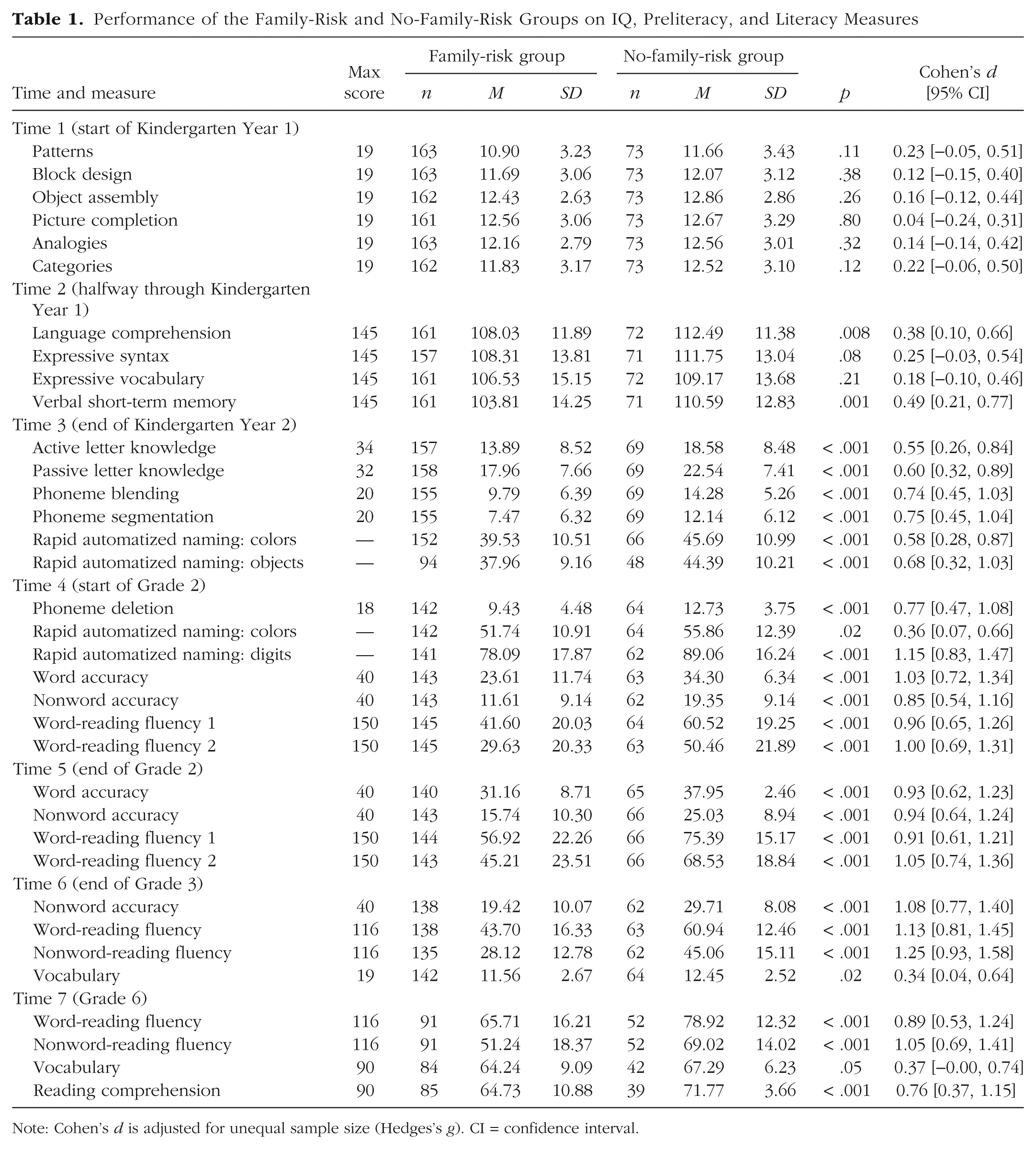
Note: Cohen’s d is adjusted for unequal sample size (Hedges’s g). CI = confidence interval.
IQ at Time 1 and Time 2
Nonverbal intelligence was assessed at Time 1 using six subtests of the Snijders-Oomen Nonverbal Intelligence Test battery (SON; Tellegen, Winkel, Wijnberg-Williams, & Laros, 1998). The patterns, object assembly, and block design subtests are all performance tasks that measure visuospatial processing, visual-motor coordination, and persistence. The reasoning tasks, tapping fluid reasoning about concrete and abstract categories, are the picture completion, analogies, and categories subtests. Raw scores per subtest were transformed into norm-based standard scores (M = 10, SD = 3) and used for the analyses. Test-retest reliabilities of the subtests vary between .48 (picture completion) and .64 (block design and categories; Evers et al., 2012).
At Time 2, verbal intelligence was measured using the language comprehension subtest of the Reynell test battery (van Eldik, Schlichting, lutje Spelberg, van der Meulen, & van der Meulen, 2001) and the expressive syntax, expressive vocabulary, and verbal short-term memory subtests of the Schlichting test battery (Schlichting, van Eldik, lutje Spelberg, van der Meulen, & van der Meulen, 2003). Norm-based standard scores (M = 100, SD = 15) for each subtest were used for the analyses. A more elaborate description of the verbal and nonverbal intelligence tests and the details of the individual subtests are provided by van Bergen, de Jong, Maassen, Krikhaar, et al. (2014). Reliabilities of the subtests were .90, .90, .86, and .79, respectively.
Preliteracy skills at Time 3 and Time 4
Letter knowledge at Time 3 was measured using a grapheme production task (Verhoeven, 1992) and a letter recognition task (van Otterloo, 2000). Children had to read a list of 34 Dutch graphemes as quickly and accurately as possible for the production task. For the recognition task, children heard a letter sound, and they had to choose the corresponding grapheme out of six alternatives. This task contained 32 items. The number of correctly produced or recognized graphemes for the separate tasks was used in the analyses.
Phonological awareness at Time 3 was measured using a phoneme blending task (Verhoeven, 1993a) and a phoneme segmentation task (Verhoeven, 1993b). For the blending task, children had to form a word out of several consecutive sounds (e.g., /aa/ /p/ → aap [monkey]). In the segmentation task, children had to divide a given word into its separate phonemes (e.g., uur [hour] → /uu/ /r/). Both tasks contained 20 one-syllable items of increasing syllable-structure difficulty. The task was terminated when a child had no correct answers in a set of items of equal difficulty. The number of correct items was used in the analyses.
At Time 3, RAN of colors (red, green, black, blue, yellow) and objects (tree, duck, chair, scissors, bicycle; van den Bos, 2003) was used to measure naming speed. For both subtests, children had to name items as quickly and accurately as possible. Each subtest contained a list of 50 items. The time to completion was used to compute the number of named items per minute, which was the score used in the analyses. At Time 4, the objects subtest was replaced with the digits subtest (2, 4, 5, 8, 9) to include both an alphanumeric and nonalphanumeric subtest in the analyses. Internal consistency of the subtests varied between .87 and .93 (Evers et al., 2012).
Phonological awareness at Time 4 was measured using a phoneme deletion task (de Jong & van der Leij, 2003). Children had to delete a target phoneme from a nonword, which resulted in another nonword. The test consisted of 18 items, covering nine monosyllabic and nine disyllabic nonwords, and was preceded by two practice items. Testing was terminated after six consecutive errors. Raw scores were the number of correct items.
Language skills at Time 6 and Time 7
At Time 6, vocabulary knowledge was assessed using the Dutch version (Kort et al., 2005) of the vocabulary subtest of the Wechsler Intelligence Scale for Children–Third Edition (Wechsler, 1991). The subtest contained 35 concepts, increasing in level of abstraction, and children had to describe the meaning of each one. Children received 2 points for correct answers and 1 point for incomplete answers. The subtest was terminated after four consecutive errors. Raw scores were transformed into age-referenced standard scores (M = 10, SD = 3), which were used for the analyses. The reliability is .80 for this age group (i.e., 9 years).
At Time 7, we tested vocabulary knowledge using version A of the DiaWoord, which is part of the online Diataal test battery (Hacquebord, Stellingwerf, Linthorst, & Andringa, 2005). Children had to provide the definition of 50 words that were presented in sentences with minimal context. The items varied in difficulty. The outcome is a competence score, based on the sum of all correct items and their difficulty weights, that reflects the vocabulary level of the children. The reliability is .82.
Word reading at Time 4 through Time 7
Word- and nonword-reading accuracy at Time 4 and Time 5 was measured using a word and a nonword task (de Jong & Wolters, 2002), both of which were designed for research purposes. Children were asked to read separate lists of words and nonwords consisting of 40 items each. Items on both lists increase in difficulty from one to four syllables. There was no time limit; the tasks were terminated when six errors in the last eight items occurred. The number of correctly read words or nonwords was the score used in the analyses. At Time 6, only the nonword-accuracy task was administered because of a lack of complexity in the word-accuracy task for children at this age.
Word-reading fluency at Time 4 and Time 5 was measured using two lists of the Three-Minute-Test (Drie-Minuten-Toets; Verhoeven, 1995). Both lists contain 150 monosyllabic words. The first list covers simple words with a simple structure (e.g., “maan” [moon]). The second list includes more difficult words with at least one consonant cluster (e.g., “schroef” [screw]). Raw scores were the number of correctly read words within 1 min per list, and these scores were used in the analyses.
At Time 6 and Time 7, reading fluency was measured using a word-reading task (Eén-Minuut-Test; Brus & Voeten, 1999) and a nonword-reading task (De Klepel; van den Bos, lutje Spelberg, Scheepstra, & de Vries, 1994). Both tasks consist of a list of 116 items increasing in difficulty from one to four syllables. Children had to quickly and accurately read as many words and nonwords as possible in 1 min or 2 min, respectively. Raw scores (i.e., the number of correctly read items) were used in the analyses. Internal consistency of both tasks is .90 and .92, respectively (Evers et al., 2012).
Reading comprehension at Time 7
We used Diatekst of the Diataal test battery (Hacquebord et al., 2005) to assess reading comprehension in Grade 6. Children had to read five texts, each consisting of about 200 words, and answer 10 to 13 questions per text. Questions target reading comprehension at the word and sentence level (micro), combining information from sentences and passages (meso), and distilling the main message of the text (macro). The outcome is a competence score, based on a weighing of the number of correct and incorrect responses, indicating the overall comprehension level. The reliability is .69.
Procedure
Children were tested individually by trained and supervised graduate and postgraduate students. Testing took place at home or at the university in a quiet room during 1-to-2-hr sessions for each occasion. Ample breaks were provided during the assessments. Tasks were administered in a fixed order.
Results
All children in the sample had complete parent data and complete data from at least one of the seven measurement occasions. Data points for univariate (0.4%, based on 3 SD above or below the mean) and multivariate (0.05%) outliers were also coded as missing. Independent-samples t tests demonstrated no statistically significant differences among the means between groups with and without missing data on the variables. It is therefore reasonable to assume that the data were missing independently of unobserved data and that absence did not depend on children’s literacy skills or family-risk status. Therefore, we handled these missing data using full-information maximum likelihood. Distributions for all variables were approximately normal, both within the total sample and within the separate control and family-risk groups.
Means on all IQ, cognitive, and literacy measures for the groups of children with and without family risk of dyslexia are provided in Table 1. There were no significant group differences on the early nonverbal IQ measures at Time 1, although children without a family risk generally had higher scores than children with a family risk. From kindergarten onward, the no-family-risk group clearly outperformed the family-risk group on the verbal IQ, preliteracy, and literacy measures. An exception was vocabulary knowledge at Time 7, where the difference just missed significance.
Table S1 in the Supplemental Material available online shows the correlations between the IQ, cognitive, and literacy measures in the full sample. Time 3 preliteracy skills correlated weakly with Time 1 nonverbal abilities and moderately with Time 2 verbal abilities. Correlations between Time 3 preliteracy skills and later word-reading variables were moderate to strong. Time 7 reading comprehension correlated moderately with word-reading variables, whereas correlations with vocabulary increased in strength from weak to strong over time. Family risk was weakly correlated with Time 2 verbal abilities and later vocabulary skills and moderately to strongly correlated with later reading skills.
Using Mplus 7.11 (L. K. Muthén & Muthén, 2012), we specified a full structural equation model to trace how early language abilities and family risk of dyslexia are related to literacy development. The data of both groups were combined to establish the full model. Subsequently, the heterogeneity within the sample was accounted for by including group membership (family risk vs. no family risk) as a predictor in the model (Kline, 2011; B. O. Muthén, 1989). We had two reasons for doing so. First, the relatively small sample size of the no-family-risk group compared with the family-risk group prevented us from fitting a multigroup model. Fitting such an unbalanced model may render ambiguous results (Kline, 2011). Second, a single-group model with family risk as a dichotomous variable fits better with our aim to examine when and how family risk may influence literacy development.
The model was built up by adding subsequent occasions. First, we specified two uncorrelated latent IQ factors to model the intelligence tests. All tests loaded on a general IQ factor, capturing the variance that all tests have in common. Additionally, the verbal tests were allowed to load on a specific verbal IQ factor, which reflects the unique variance that remains after the common variance of the tests has been accounted for (Hulme et al., 2015; Little, 2013). Next, adjacent measurement occasions were added sequentially. The specified direct effects between adjacent occasions were theory driven. All latent variable correlations within an occasion were included initially and removed one by one if statistically nonsignificant and if model fit would not deteriorate significantly. Following the model’s modification indices, additional across-time paths were added to the model, if necessary. Full longitudinal invariance did not hold for reading fluency, because this had been measured in a slightly different way at Time 6 and Time 7 compared with Time 4 and Time 5, using very similar instruments but with a different scale. However, partial longitudinal measurement invariance was established; factor loadings of identical constructs with identical indicators were fixed to be equal across time points, with residual correlations between the identical indicators across time points. Model fit of the unconstrained and constrained models did not differ significantly (ΔCFI < .02; Cheung & Rensvold, 2002). Despite the slight differences between the Times 4 and 5 measurement and the Times 6 and 7 measurement, the comparably high beta weights of the stability paths between Time 5 and Time 6 (different indicators) and Time 6 and Time 7 (same indicators) indicate that the reading fluency constructs were almost identical across time. For single-indicator factors, the error variance of the indicator was specified on the basis of the instrument’s reliability.
The full model showed a good fit to the data, χ2(554, N = 237) = 1,012.58, p < .001, root-mean-square error of approximation (RMSEA) = .059, 90% confidence interval (CI) = [.053, .065], comparative fit index (CFI) = .93, standardized root-mean-square residual (SRMR) = .10. The standardized path weights are displayed in Figure 1 (see Fig. S1 in the Supplemental Material for a full version of the model). An overview of the parameter estimates of the model is provided in Table S2 in the Supplemental Material.
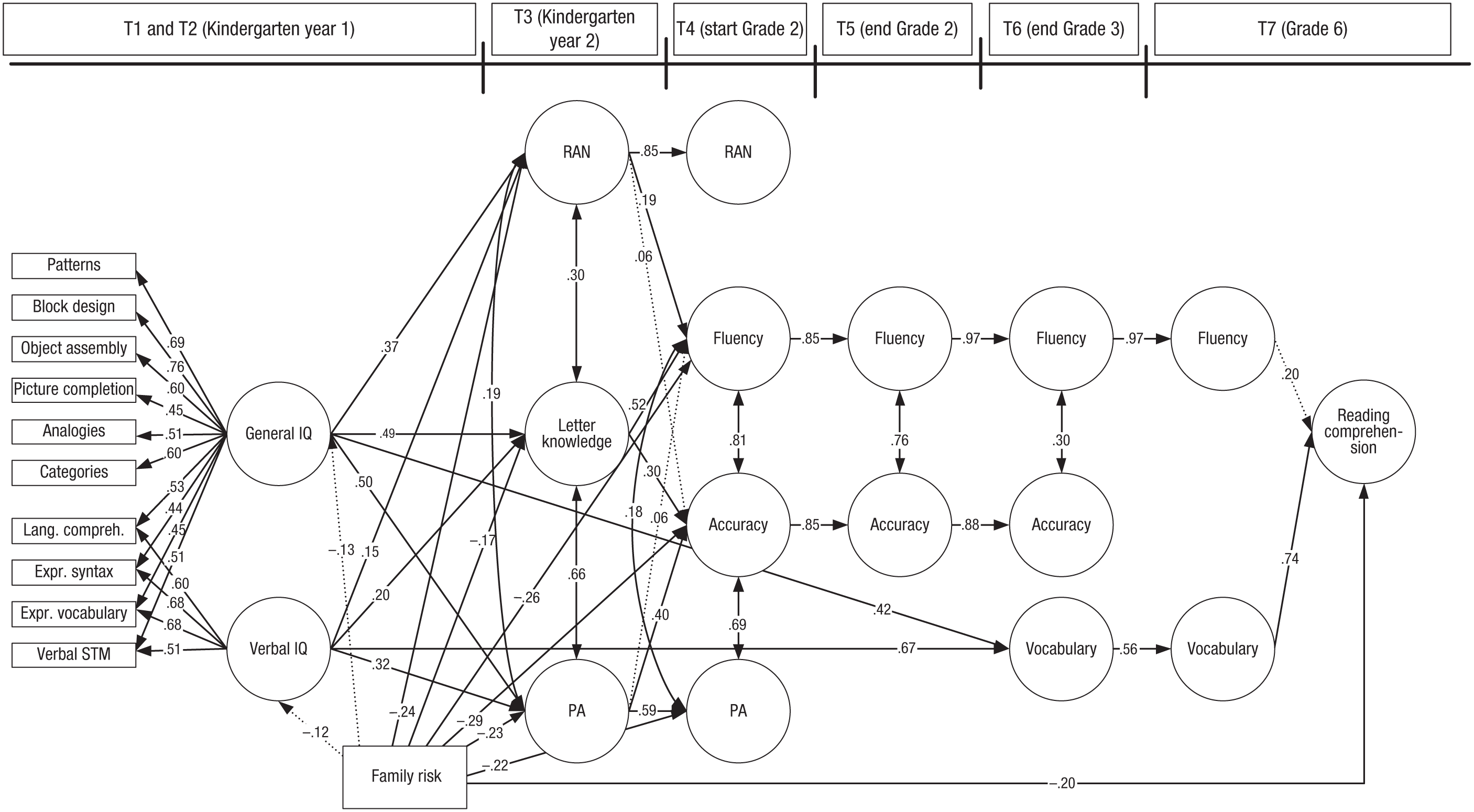
Structural equation model showing the longitudinal relations among Time 1 and Time 2 verbal and nonverbal IQ measures, Time 3 preliteracy skills, Time 4 and Time 5 reading accuracy and fluency skills, Time 6 reading accuracy and fluency skills and vocabulary, and Time 7 reading fluency, vocabulary, and reading comprehension, including family-risk status. Rectangles indicate observed variables, and circles represent latent variables. Values on single-headed arrows from latent to observed variables are standardized factor loadings. Values on single-headed arrows from one latent variable to another are standardized regression coefficients. Double-headed arrows indicate correlations (standardized covariances). Solid lines indicate significant effects (p < .05), and dashed lines indicate nonsignificant effects. Error terms are not displayed to aid visibility. RAN = rapid automatized naming; PA = phonological awareness; STM = short-term memory.
Two pathways toward reading comprehension are present in the model. The first pathway, through preliteracy skills and word-decoding ability, shows high stability from the moment reading accuracy and fluency were assessed (Time 4). The standardized regression coefficients between consecutive time points were large for reading accuracy from Time 4 through Time 6 as well as for reading fluency from Time 4 through Time 7. The correlation between both reading components decreased from .81 at Time 4 to .30 at Time 6. The regression of Time 7 reading comprehension on Time 7 reading fluency just missed significance (p = .087). Notably, though, Time 7 reading fluency did predict Time 7 reading comprehension when family risk was omitted from the model, β = 0.29, p < .01. As a second pathway, we found that early language abilities predicted Time 7 reading comprehension through vocabulary skills at Time 6 and Time 7.
Both pathways are influenced by early verbal and nonverbal abilities. For the first pathway, the general and verbal IQ factors independently predicted the three preliteracy factors at Time 3. This indicates that the specific verbal IQ factor may account for extra variance after general IQ was controlled for. The preliteracy skills at Time 3 mediated the effects of both IQ factors on the development of word-decoding ability. Letter knowledge and phonological awareness at Time 3 predicted Time 4 reading accuracy, whereas letter knowledge and RAN at Time 3 predicted Time 4 reading fluency. Additional effects of phonological awareness and RAN at Time 4 on reading accuracy and fluency were not established, however. For the second pathway, both general and verbal IQ at Time 2 predicted Time 6 vocabulary, which in turn predicted Time 7 vocabulary.
The indirect effects of general and verbal IQ on reading fluency and reading comprehension were estimated using the bias-corrected bootstrapping procedure in Mplus. The indirect pathways from general IQ and verbal IQ to Time 7 reading fluency through letter knowledge, RAN, and phonological awareness were both statistically significant—general IQ: β = 0.28, p < .001, 95% CI = [0.20, 0.37]; verbal IQ: β = 0.12, p < .01, 95% CI = [0.05, 0.20]. Yet the indirect paths from general and verbal IQ to reading comprehension via preliteracy skills and word-reading fluency were not. After excluding family-risk status from the model, these effects on reading comprehension did reach the significance threshold—general IQ: β = 0.10, p = .010, 95% CI = [0.03, 0.17]; verbal IQ: β = 0.05, p = .026, 95% CI = [0.01, 0.09]. Finally, in the second pathway through vocabulary, we found significant indirect effects of both general IQ, β = 0.17, p < .01, 95% CI = [0.06, 0.28], and verbal IQ, β = 0.29, p < .001, 95% CI = [0.15, 0.40] on reading comprehension. These results show that early general and verbal abilities are related to both developmental pathways, but they predict reading comprehension only through the second, oral language, pathway.
Concerning the role of family risk, we did not find statistically significant direct effects on general and verbal IQ. This might seem at odds with the results in Table 1, which show differences between the groups on the verbal IQ tests. Note, however, that the effects on these verbal subtests are determined by the joint effects of family risk on general and verbal IQ. Indeed, the sum of these coefficients differed significantly from zero (p = .037), indicating a lower score of the family-risk group on the verbal IQ subtests. Turning to the word-decoding pathway, we found that children with family risk of dyslexia had lower preliteracy skills at Time 3. Family risk also predicted Time 4 phonological awareness, reading accuracy, and fluency after we controlled for performance on Time 3 preliteracy skills. The indirect effect of family risk on Time 7 reading fluency through Time 3 preliteracy skills and reading fluency from Time 4 to Time 6 was significant, β = −0.32, p < .01, 95% CI = [−0.42, −0.23]. However, the indirect effect of family risk on reading comprehension at Time 7 through this pathway was not significant, which was mainly because of the small and nonsignificant effect of reading fluency on reading comprehension at Time 7. Family risk was not related to vocabulary in the second pathway but, unexpectedly, appeared to be directly related to reading comprehension at Time 7. Children with a family risk of dyslexia had lower reading-comprehension levels in sixth grade. Thus, family risk appears to have an impact on reading accuracy and fluency mainly through preliteracy skills and early word-decoding skills. It did not influence the second pathway.
Overall, the model accounted for 78% of the variance in word-reading accuracy at Time 6, 95% of the variance in word-reading fluency at Time 7, and 72% of the variance in reading comprehension at Time 7. This indicates that we could model a large amount of the variance in literacy development between the age of 4 and 12 years.
Discussion
The results of this study showed that both pathways toward reading comprehension, one through preliteracy skills and word-decoding ability and the other through language abilities, build on early oral language skills. For the first pathway, early language (here, verbal IQ) predicted phonological awareness, RAN, and letter knowledge. Independent of verbal IQ, general IQ also predicted all preliteracy skills. The preliteracy skills subsequently predicted word-decoding ability. In the second pathway, early language predicted later vocabulary, which, in turn, predicted reading comprehension. These findings agree with those of Duff et al. (2015), who found that early oral language was related to both word decoding and reading comprehension at some point during development. They also confirm that the relationship between early oral language and word decoding is mediated by preliteracy skills (Torppa et al., 2010). In addition, they show that an independent pathway from early language toward reading comprehension exists (Hulme et al., 2015) and that it may run via later language abilities.
Note that in our final model, word-reading fluency did not predict reading comprehension, nor was there a relationship between general or verbal IQ and reading comprehension that was mediated by the decoding pathway. However, in our model, the estimation of the relationship of word-reading fluency with reading comprehension was conditional on family risk. As a result, part of the correlation of reading fluency with reading comprehension was captured by their joint relationship with family risk. When family risk was left out of the model, we found a small but significant direct relation of word-reading fluency with reading comprehension as well as an indirect relation of both general and verbal IQ with reading comprehension through the decoding pathway. We take these findings to mean that the pathway through word decoding exists, although by the end of sixth grade the influence of word-reading fluency on reading comprehension has clearly decreased. The small effect at the end of sixth grade might be partly due to the transparency of the Dutch orthography (see Torppa et al., 2016, for a similar result in Finnish).
A specific feature of this study was that we modeled word-reading accuracy as well as word-reading fluency longitudinally. Whereas letter knowledge was a predictor of both accuracy and fluency, phonological awareness was more important for accuracy, and RAN was more important for fluency. These findings are similar to those of others (e.g., Kirby, Desrochers, Roth, & Lai, 2008). Both word-reading accuracy and fluency showed high stability from the start of Grade 2 onward. The relationship between word-reading accuracy and reading comprehension was fully accounted for by word-reading fluency. These findings support our interpretation that, in contrast to reading fluency, reading accuracy has a more limited role in literacy development toward reading comprehension in more transparent languages.
Although family risk was not related to general and verbal IQ and vocabulary, it did have an impact on preliteracy skills. However, the relationship between family risk and word-reading accuracy and fluency was not fully mediated by preliteracy skills. After the start of literacy acquisition, an additional contribution of family risk was found on the prediction of both accuracy and fluency. Apparently, there are effects of parental reading abilities on children’s word-reading skills that are not yet present in children’s preliteracy skills (van Bergen, de Jong, Maassen, & van der Leij, 2014). This matches the finding that new genes become active during the early development of word reading (Byrne et al., 2009). An additional influence on word decoding did not appear in later grades, suggesting that the processes underlying individual differences in word-reading ability are highly stable from the beginning of second grade.
Family risk had no impact on the language pathway. Although we did find differences on the language measures between the family-risk and no-family-risk groups, in our model, family risk did not influence language. These findings match those reported in the meta-analysis by Snowling and Melby-Lervåg (2016) in several ways. First, their meta-analysis showed that group differences on language are found between family-risk and no-family-risk groups, similar to the group differences in our study. From our model, it follows that the differences on language measures are due to the sum of minimal predictive effects of family risk on both general and verbal IQ. Second, according to Snowling and Melby-Lervåg, language effects are stronger at preschool age than at early primary school age. This relates to the absence of an effect of family risk on vocabulary in our study at Time 6 and Time 7. This finding also indicates that the parents of the family-risk children were apparently able to provide sufficiently rich language input, as we know that vocabulary is heavily influenced by the environment (e.g., Byrne et al., 2002; Hoff, 2006). Third, effect sizes were smaller for the family-risk group as a whole than for the children with a family risk within this group who later became dyslexic. This suggest that language might be primarily compromised in family-risk children who become dyslexic (e.g., Torppa et al., 2010; van Viersen et al., 2017). As these children are a minority of the family-risk group, it is very possible that much larger samples are needed to trace such a small effect of family risk on the language pathway.
Family risk was directly related to reading comprehension. Thus, children at family risk of dyslexia not only have lower word-decoding levels throughout primary education but also end up with lower reading-comprehension levels in Grade 6. This finding is in line with that of Duff et al. (2015), who found lower reading-comprehension levels in family-risk children between the age of 5 and 9 years. There are two possible explanations that do not exclude each other. Firstly, our reading measure might not cover all aspects of word-reading fluency. Oral reading speed of texts rather than words, on which family-risk children might also show impairments, could be more important for reading comprehension. Secondly, children who show somewhat lower word-decoding ability might read less and therefore have less exposure to texts (Mol & Bus, 2011).
Overall, the present study shows that there are two pathways toward reading comprehension. Early oral language ability lies at the basis of both pathways. Family risk for dyslexia influenced literacy development through its subsequent relations with preliteracy skills and word-decoding ability, as well as through a direct relationship with reading comprehension.
Footnotes
Acknowledgements
We are grateful to the parents and children who participated in the Dutch Dyslexia Program and to Britt Hakvoort and Ellie van Setten, who collected part of the Grade 3 and all of the Grade 6 data.
Action Editor
Charles Hulme served as action editor for this article.
Author Contributions
A. van der Leij was one of the designers of the Dutch Dyslexia Program. Data collection was supervised by B. Maassen (Groningen and Nijmegen) and A. van der Leij (Amsterdam). The study was designed by P. F. de Jong. S. van Viersen and M. Zee performed the data analyses and modeling under the supervision of P. F. de Jong. S. van Viersen drafted the manuscript, which was further written and revised by S. van Viersen, E. H. de Bree, and P. F. de Jong. All authors approved the final version of the manuscript for submission.

Declaration of Conflicting Interests
The author(s) declared that there were no conflicts of interest with respect to the authorship or the publication of this article.
Funding
A. van der Leij was coresponsible for funding over the years of the initial program, and for the additional funding together with B. Maassen. The Dutch Dyslexia Program was funded by grants (200-62-302/303/304 and 380-89-040) from the Dutch Organization for Scientific Research between 1998 and 2016.
Notes
References
Supplementary Material
Please find the following supplemental material available below.
For Open Access articles published under a Creative Commons License, all supplemental material carries the same license as the article it is associated with.
For non-Open Access articles published, all supplemental material carries a non-exclusive license, and permission requests for re-use of supplemental material or any part of supplemental material shall be sent directly to the copyright owner as specified in the copyright notice associated with the article.
