




Abstract
Background
Despite mounting evidence showing that kissing (tongue-kissing) may transmit gonorrhoea between men who have sex with men (MSM), little data exists on factors influencing the duration of kissing while they are above and/or lying underneath a partner for this population group.
Methods
Between May 2019 and March 2020, we invited MSM aged ≥18 years who attended the Melbourne Sexual Health Centre (MSHC) to participate in a survey about the duration of their kissing (minutes) and intimate position while kissing (i.e., kissing while above, or while lying underneath) their most recent partner. Univariable and multivariable negative binomial regressions were performed to examine the associations between the duration of kissing in different intimate positions, and demographic and behavioural characteristics (including age, region of birth, HIV status or PrEP use, and role in anal sex).
Results
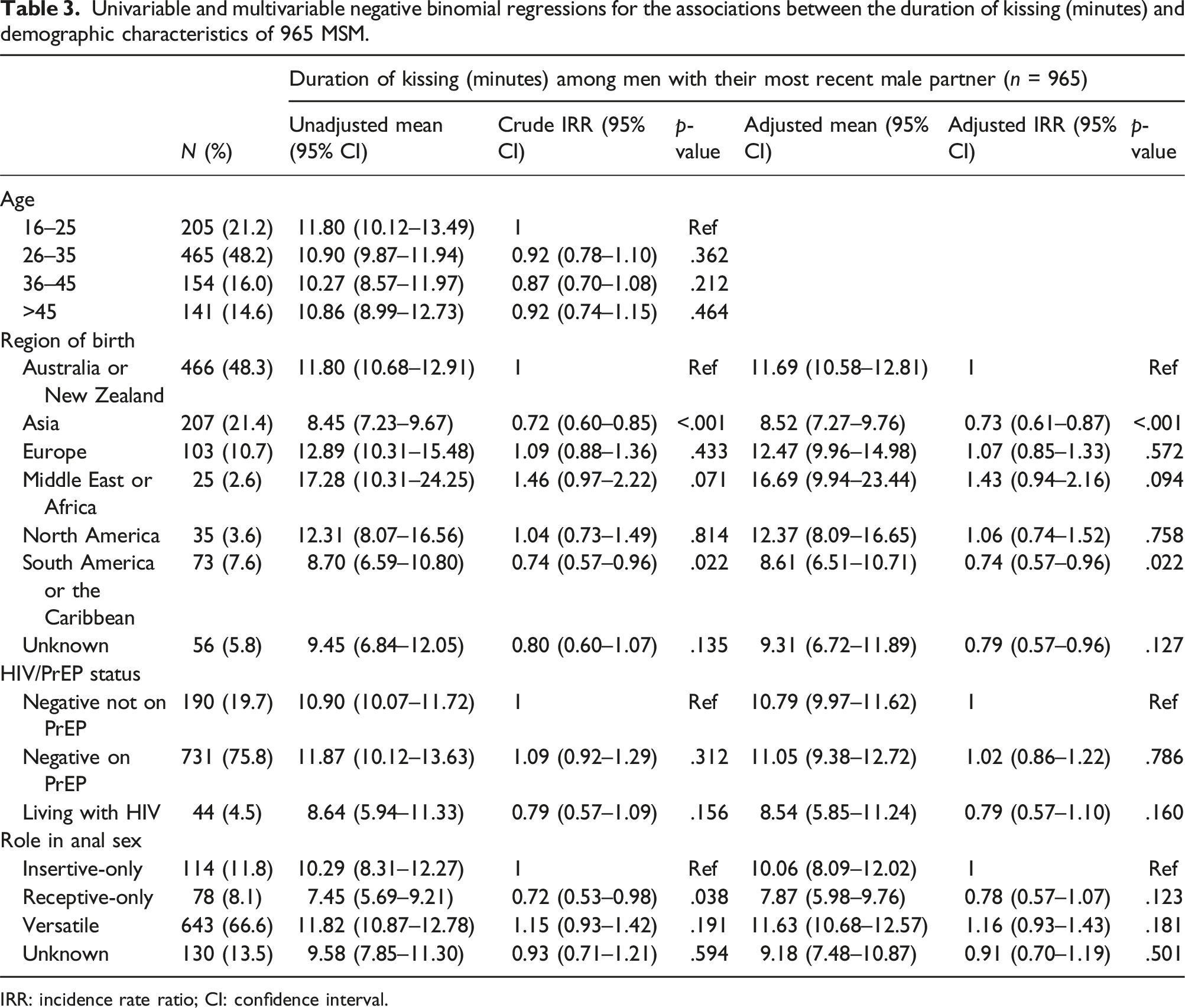
Of the 965 men with a recent male kissing partner, 89.0% (n = 859) also had sex with that partner. Of the 166 men with a recent female kissing partner, 71.7% (n = 119) also had sex with that partner. Our adjusted analyses showed that, on average, men born in Asia (mean 8.52 vs 11.69 min, p < .001) and South America or the Caribbean (mean 8.61 vs 11.69 min, p = .022) spent less time kissing compared to men born in Oceania, and the same was also observed for kissing while above or lying underneath. Men who had only receptive anal sex spent less time kissing while above than those who only had insertive anal sex (mean 3.04 vs 5.86 min, p < .001).
Conclusion
Our study is the first to examine factors that influence duration of kissing in different intimate positions. These factors could be associated with oropharyngeal gonorrhoea if saliva transmitted gonorrhoea and if gravity played a role.
Introduction
Since the 2010s, the incidence rates for gonorrhoea have been increasing among gay, bisexual and other men who have sex with men (MSM) in high-income countries, 1 including Australia. 2 In men, gonorrhoea, caused by the Gram-negative bacteria Neisseria gonorrhoeae can infect the urethra, anorectum, and oropharynx, and it was thought to be primarily spread through vaginal, anal, and oral sex. However, studies have reported that viable N. gonorrhoeae can be cultured from the saliva of individuals with oropharyngeal gonorrhoea.3,4 Several studies have also found that tongue-kissing was a risk factor for oropharyngeal gonorrhoea.5–9
Tongue-kissing (henceforth known as kissing) is common among MSM. For example, a US-based study of 24 787 MSM in 2010 reported that 75% of men kissed during their most recent sex episode with a male partner. 10 Furthermore, an Australian study found that 92% of 1524 MSM reported kissing during their most recent sex episode with a casual male partner. 11 A more recent US-based study of 210 MSM found that 83% of these men kissed during their most recent sexual encounter. 12
If kissing is a risk factor for oropharyngeal gonorrhoea, then it is conceivable for an individual who is lying underneath a partner while kissing would be more likely to acquire oropharyngeal gonorrhoea than an individual whose body is above a partner while kissing. Saliva flowing downwards due to gravity may result in greater exposure to N. gonorrhoeae for the individual underneath. 13 A recent study reported that heterosexual men spent more time kissing while above a female partner and the authors suggested that this difference may be due to the common sex position, where the female partner is lying on her back. This position could increase the risk of transmission for the partner lying underneath. 13
Among MSM, the terms ‘top’ and ‘bottom’ are commonly used to refer to insertive anal sex and receptive anal sex, respectively.14,15 Men’s role in anal sex (top or bottom) may influence the intimate positions they are in while kissing. While kissing practices can vary based on region of birth among heterosexual men, 16 this has not been examined in MSM. Therefore, we examined the kissing practices of MSM, including factors that can influence the duration of their kissing while they are above and/or lying underneath a partner.
Methods
Setting and population
Between May 2019 and March 2020, we conducted a cross-sectional study called the Kissing and Sexual Practices (KASP) study at the Melbourne Sexual Health Centre (MSHC), a public sexual health clinic located in Melbourne, Australia. The KASP survey collected data on kissing and other sexual practices from heterosexual men and women, sex workers, and men who have sex with men (MSM). This current manuscript reports data on the kissing and sexual practices of MSM, while data on heterosexual men and women 13 and sex workers 17 have been published elsewhere. We planned to administer this survey for 12 months, but the survey ceased in March 2020 due to the COVID-19 pandemic.
When clients arrived at the MSHC, they were asked to register and complete a routine questionnaire collecting demographic information and sexual history (number of partners, condom use) via computer-assisted self-interview (CASI) as part of their clinical care and management. Male clients who were over the age of 18 and who had sex with other men or both men and women in the past 12 months were invited to complete the additional KASP survey consisting of questions about their kissing and other sexual practices. Participation in the survey was voluntary, and none received payment for completing the survey. We provided a brief, plain language description of the study at the start of the survey, and clients provided their implied consent to participate by selecting ‘Yes’ or ‘No’ before commencing the survey. We excluded men who were <18 years old, and incomplete surveys. We considered surveys to be incomplete if participants did not provide responses through to the survey’s last question. This study was approved by the Alfred Hospital Ethics Committee, Melbourne, Australia (647/17).
Measurement and analysis
The KASP survey consisted of sections about kissing and other sexual practices. We defined kissing as tongue-kissing and sex as oral, anal and/or vaginal sex. First, we asked the participants whether they had kissed a man and/or woman in the past 3 months, and whether they had sex with the most recent person they kissed. We then asked how many minutes they spent overall kissing (i.e., “How many minutes did you kiss the most recent man/woman?”), and minutes spent kissing while their body was above (i.e., “While kissing this man/woman, approximately how long were you lying underneath with his/her mouth on top of yours?”) and/or lying underneath their most recent partner (i.e., “While kissing this man/woman, approximately how long was he/she lying underneath with your mouth on top of his/hers?”).
We extracted the participants’ demographic characteristics (age, country of birth), sexual history (regular and/or casual partners), and whether they had insertive and/or receptive sex with other men in the past 3 months from the routine questionnaire via CASI. Age was categorised into four groups (i.e., 16–25, 26–35, 36–45, >45 years). We categorised their country of birth into six regions based on continent: (1) Oceania; (2) Asia; (3) Europe; (4) Middle East or Africa; (5) North America; (6) South America or the Caribbean. 13 Men who had both insertive and receptive anal sex in the past 3 months were categorised as ‘versatile,’ men who only had insertive anal sex as ‘insertive-only,’ and men who only had receptive anal sex as ‘receptive-only.’ If men did not report insertive and receptive anal sex, this was categorised as ‘unknown.’ We only included their first completed survey if they completed the KASP survey multiple times during the study period. We considered duration of kissing of more than 60 min as outliers, and these were excluded.
We summarised continuous variables (e.g., age, duration of kissing) using mean and standard deviation (SD), and median and interquartile range (IQR). Categorical variables (e.g., region of birth) were summarised as frequencies and proportions. We performed a Wilcoxon rank-sum test to compare the median age between those who participated in our study and those who did not. We performed t-tests to compare differences in the mean duration of kissing between men who had sex and men who did not have sex with a recent male partner and/or female partner. A proportion of men spent time kissing while their body was above and while lying underneath their most recent male and/or female partner, which breaches the assumption of independence and therefore, we did not use the independent samples t test to compare mean duration of kissing relative to body position while kissing. We performed univariable and multivariable negative binomial regressions to examine the associations between duration of kissing and body position while kissing, role in anal sex and demographic characteristics, such as age and region of birth, which have been reported to be associated with kissing. 16 We used negative binomial regression to account for any over-dispersion of data. 18 We considered variables with a p < .20 in the univariable analysis to be potential confounding factors and these were included in the multivariable analysis. 19 All data analyses were conducted using Stata (version 17, College Station, Texas, USA).
Results
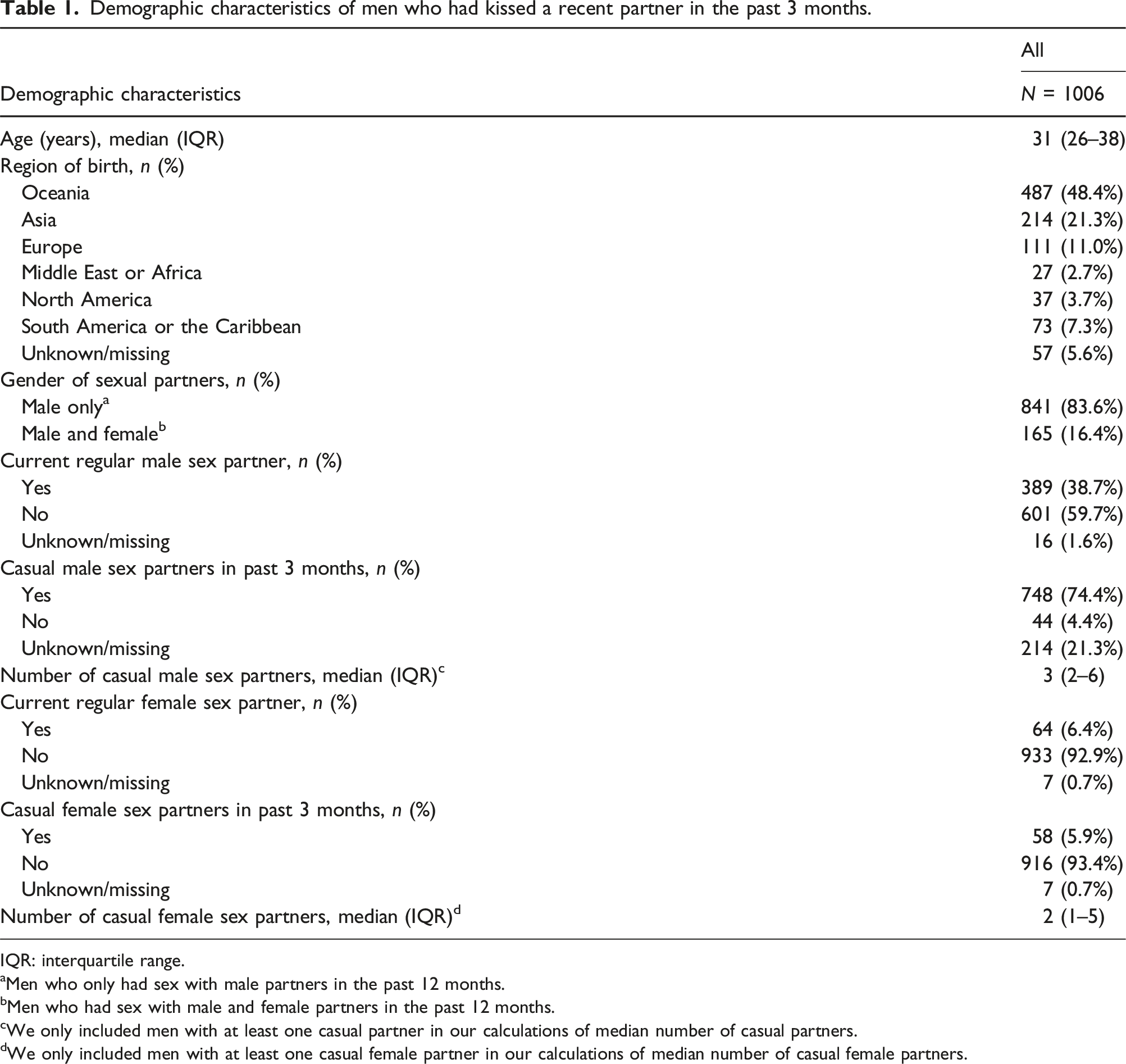
From May 2019 to March 2020, we invited 7184 MSM to participate in the KASP study, and of these, 1302 (18.1%) completed the survey. We excluded 39 male sex workers, and 231 surveys because they completed more than once by the men during the study period. An additional 26 surveys were excluded because the reported duration of kissing exceeded 60 min. The median age of men who participated in our study was similar those who did not (31 vs 30 years, p = .198). There were no differences in region of birth between those who participated in our study and those who did not. We included completed surveys from 1006 men in our final analysis.
Sample characteristics
Demographic characteristics of men who had kissed a recent partner in the past 3 months.
IQR: interquartile range.
aMen who only had sex with male partners in the past 12 months.
bMen who had sex with male and female partners in the past 12 months.
cWe only included men with at least one casual partner in our calculations of median number of casual partners.
dWe only included men with at least one casual female partner in our calculations of median number of casual female partners.
Duration of kissing and body position
Male kissing partners
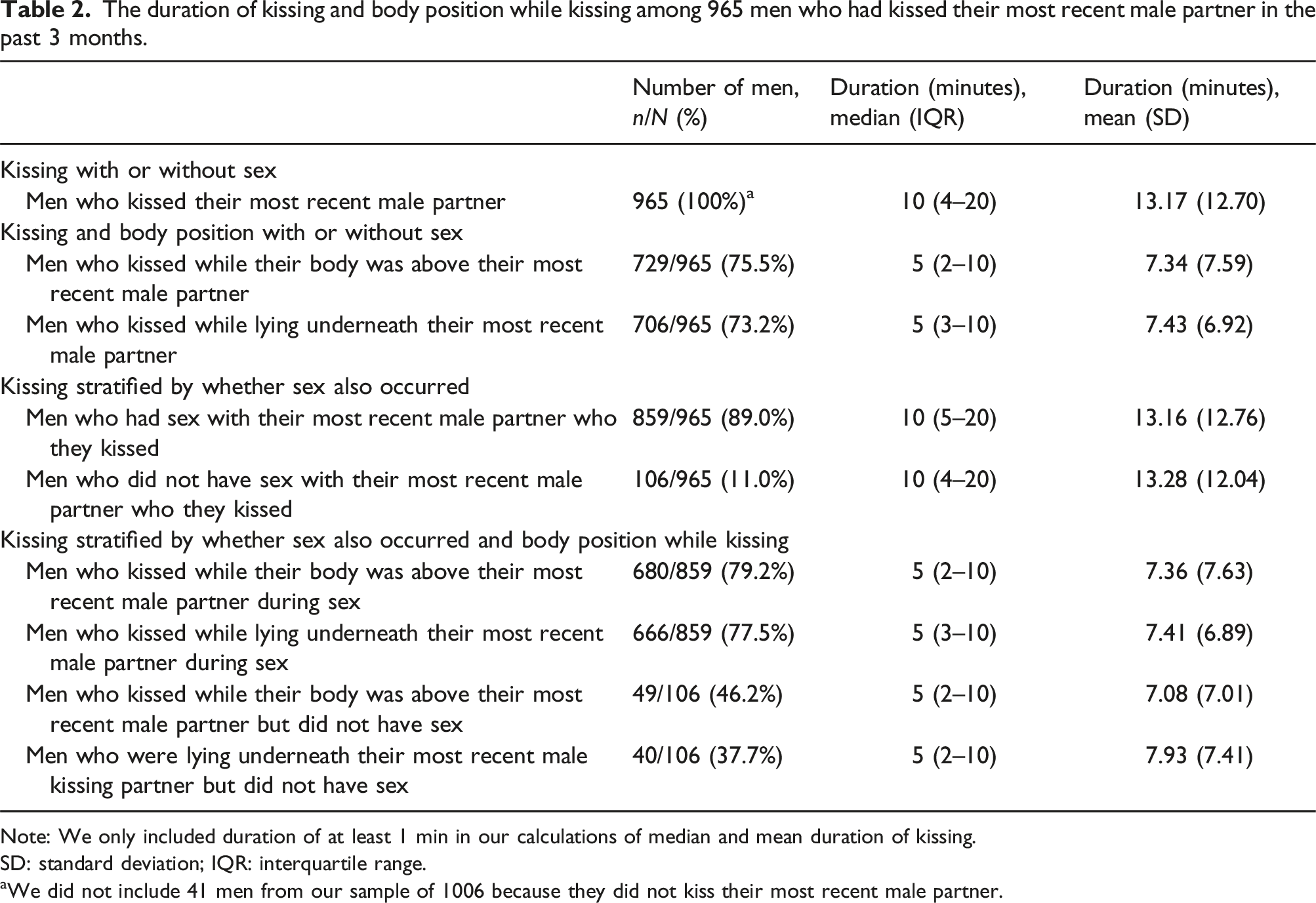
The duration of kissing and body position while kissing among 965 men who had kissed their most recent male partner in the past 3 months.
Note: We only included duration of at least 1 min in our calculations of median and mean duration of kissing.
SD: standard deviation; IQR: interquartile range.
aWe did not include 41 men from our sample of 1006 because they did not kiss their most recent male partner.
Men spent 7.34 min (SD = 7.59) kissing while above and 7.43 min (SD = 6.92) while lying underneath their most recent male partner. Among men who kissed and had sex, the mean duration of kissing while above their most recent male partner was 7.36 min (SD = 7.63) and 7.41 min (SD = 6.89) while lying underneath. Men who kissed but did not have sex spent 7.08 min (SD = 7.01) kissing while above and 7.93 min (SD = 7.41) while lying underneath their most recent male partner.
Female kissing partners
Of the 166 men with a recent female kissing partner, 71.7% (n = 119) also had sex with that partner (Supplemental Table S1). The duration of kissing was significantly longer among these 119 men compared to those who kissed but did not have sex (mean 15.32 vs 4.88 min, p = .005).
Men spent 10.12 min (SD = 12.04) kissing while above and 9.99 min (SD = 12.66) while lying underneath their most recent female partner. Of the men who kissed and had sex, the mean duration of kissing while above was 10.58 min (SD = 11.58) and 10.59 min (SD = 13.11) while lying underneath their most recent female partner. Men who kissed but did not have sex above spent 2.71 min (SD = 1.54) while above and 4.00 min (SD = 2.71) while lying underneath their most recent female partner.
Factors associated with duration of kissing in relation to body position while kissing
Region of birth
Univariable and multivariable negative binomial regressions for the associations between the duration of kissing (minutes) and demographic characteristics of 965 MSM.
IRR: incidence rate ratio; CI: confidence interval.
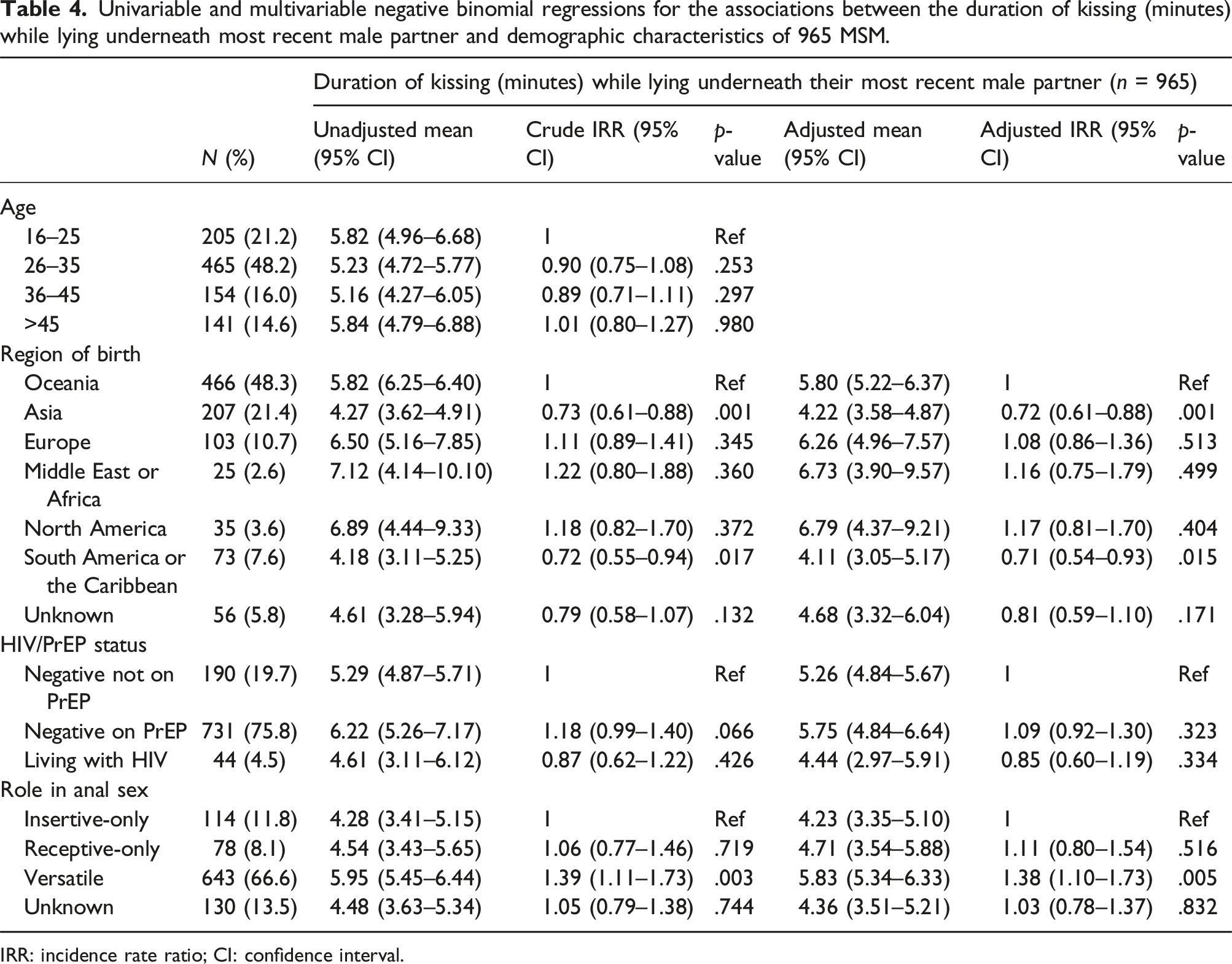
Univariable and multivariable negative binomial regressions for the associations between the duration of kissing (minutes) while lying underneath most recent male partner and demographic characteristics of 965 MSM.
IRR: incidence rate ratio; CI: confidence interval.
Univariable and multivariable negative binomial regressions for the associations between the duration of kissing (minutes) while their body is above their most recent male partner and demographic characteristics of 965 MSM.
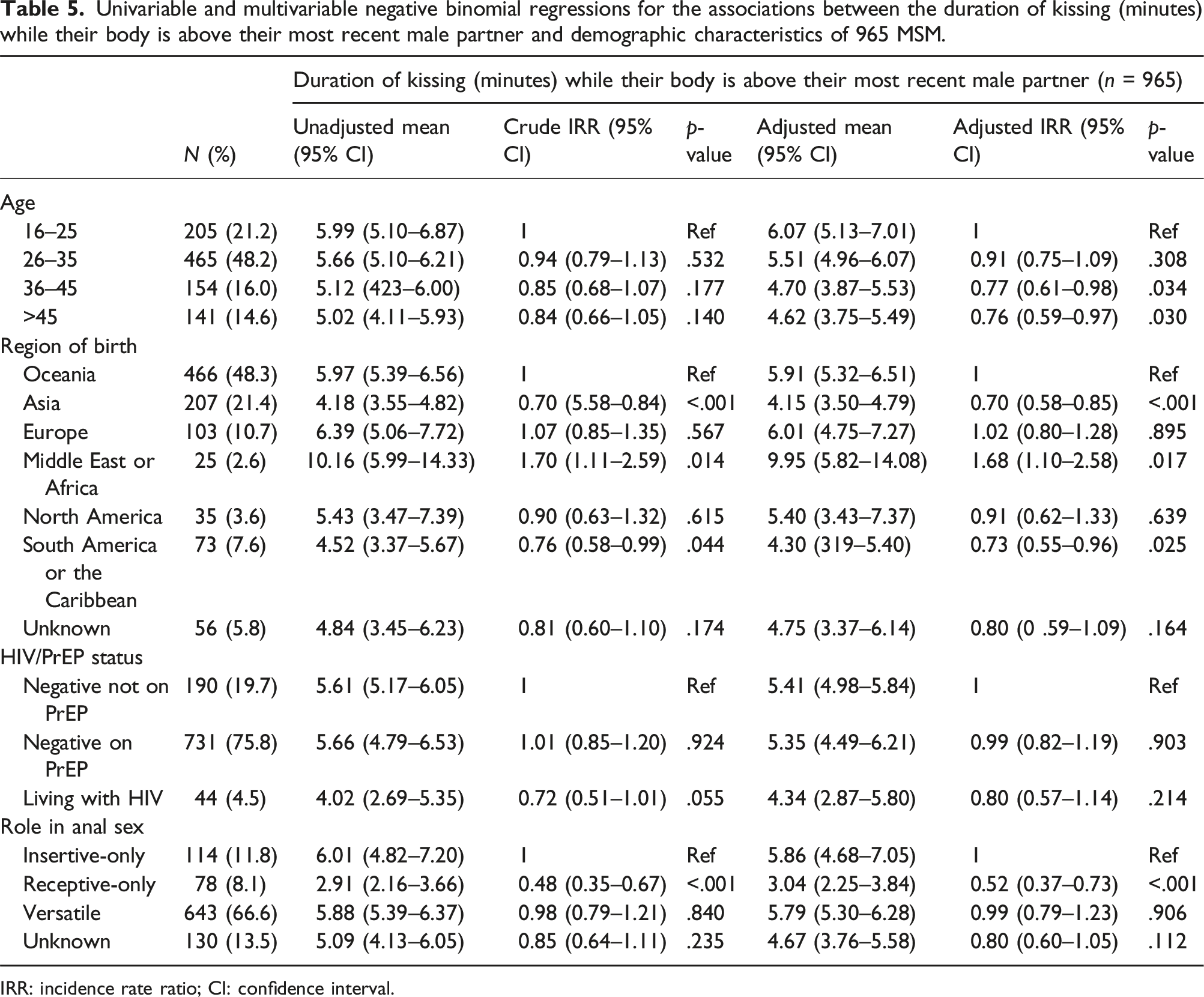
IRR: incidence rate ratio; CI: confidence interval.
Role in anal sex
The adjusted mean duration of kissing while lying underneath was significantly longer among versatile men (men who had receptive and insertive anal sex) than men who were insertive-only (5.83 vs 4.23 min; aIRR = 1.38; 95% CI: 1.10–1.73) (Table 4). The adjusted mean duration of kissing while above was significantly shorter among receptive-only men than insertive-only men (3.04 vs 5.86 min; aIRR = 0.52; 95% CI: 0.37–0.73) (Table 5).
Discussion
Our study examined kissing practices of MSM and is the first study to document the duration of kissing and report factors associated with the duration of kissing in different intimate positions—above and lying underneath. We found differences in the duration of kissing while above or while lying underneath based on their region of birth and role in anal sex, findings which have not been previously reported. These findings suggest that the kissing practices of MSM, including the duration of kissing, may be influenced by factors associated with their geographical origin, and the sexual positions they engage in as the receptive or insertive partner or both during anal sex. An insertive partner may spend more time kissing while above their partner as opposed to lying underneath, as in the missionary sex position. This distinction in body positioning could influence the duration of kissing in different intimate positions.
Our study found that region of birth was associated with the duration of kissing. We found that compared to men born in Oceania, those born in Asia, or South America or the Caribbean spent not only less time kissing in total, but also less time kissing while above or while lying underneath. These findings are consistent with those of Tran et al.’s study on kissing practices among 2866 heterosexual men and women, which found men born in Asia, and in South America or the Caribbean spent significantly less time kissing in total, and in different body positions. 13 The findings from our current study and Tran et al.’s study 13 suggest that the time individuals spend kissing can differ based on the region where they were born, regardless of the gender of their partners. Although geographical origin can be considered as a proxy indicator for ethnicity,20,21 other factors such as socialisation and cultural norms may have played a role in explaining these differences in duration of kissing between these groups. 22 We did not measure socialisation and cultural norms in our study, and therefore, these measures are warranted in future studies for a detailed understanding of kissing, as well as other sexual practices, through a sociocultural lens.
We provided novel data on how the duration of kissing while above or lying underneath is influenced by men’s role in anal sex. Men who were insertive-only spent more time kissing while above than receptive-only men. Similarly, men who insertive-only spent less time kissing while lying underneath than versatile men. These findings suggest that a man who is the receptive partner would be more prone to oropharyngeal gonorrhoea compared to his insertive partner, although no previous studies have assessed this link. This is important because hypothetically, the receptive partner’s mouth would experience prolonged exposure to N. gonorrhoeae if the insertive partner with oropharyngeal gonorrhoea spends more time kissing while above, and if the downflow of the saliva exchanged while kissing is facilitated by the pull of gravity. 13 However, this would only be the case if there were no other sexual exposures to the oropharynx besides kissing. When sex also occurs, other potential exposures to the oropharynx, such as performing fellatio and rimming, 23 can make it difficult to determine whether there was oropharynx-oropharynx transmission in relation to men’s intimate positions while kissing.
There were several limitations to our study. First, our study included MSM who attended an urban sexual health clinic, and therefore, findings from our sample may not be representative of the broader MSM population. Second, our study’s low participation rate could have biased our results if those who participated in the survey were systematically different from those who did not participate. Third, our study relied on men’s recall of the duration of their kissing and if they inaccurately recalled this, our results may be incorrect. However, even with a prospective study using time trackers, it would still be challenging to accurately capture the duration for such an intimate behaviour. Fourth, misclassification may have occurred in categorising men’s role in anal sex, as we did not ask men to self-identify as insertive-only, receptive-only, and versatile. It was possible that men who engaged in receptive anal sex only in the past 3 months may not self-identify as receptive-only. 15 This potential misclassification may have influenced our estimates for the duration of kissing based on men’s role in anal sex. Fifth, there are no validated measures for the duration of kissing, and therefore, we are not certain that our survey correctly asked about the duration of kissing. Finally, we did not link the duration of kissing with oropharyngeal gonorrhoea. We only collected men’s duration of kissing with their most recent male and/or female partners in the past 3 months but not the other partners they may have had during this 3-months exposure period. The duration of untreated oropharyngeal gonorrhoea has been reported to be more than 3 months,7,24 and therefore, we do not think that linking the duration of kissing to oropharyngeal gonorrhoea would be appropriate for the design of our study.
Conclusions
Our study found that kissing is common among MSM, and that kissing between MSM, and kissing female partners was common among men with female sex partners. While there is an accumulating body of evidence supporting kissing as a mode of transmitting gonorrhoea,5–7,9 beyond estimates from mathematical modelling, 25 exactly how commonly gonorrhoea is transmitted through kissing is still unknown. If the saliva of individuals with oropharyngeal gonorrhoea transmits gonorrhoea and gravity plays a role in facilitating the downward flow of saliva, then our study’s findings suggest that during anal sex, the receptive partner who spends more time lying underneath the insertive partner with oropharyngeal gonorrhoea may be more prone to transmission through kissing. However, further studies are required to confirm this link. Future studies aiming to model this dynamic in the transmission of gonorrhoea may want to consider using our study’s findings. We also found that the duration of kissing in different intimate positions varied depending on region of birth and role in anal sex and therefore, these nuances should be considered when tailoring preventive messages that are culturally and behaviourally relevant for MSM belonging or subscribing to these groups.
Supplemental Material
Supplemental Material - Duration of kissing in different intimate positions among men who have sex with men: A cross-sectional study
Supplemental Material for Duration of kissing in different intimate positions among men who have sex with men: A cross-sectional study by Julien Tran, Christopher K Fairley, Jason J Ong, Catriona S Bradshaw, Ei T Aung, Kate Maddaford, Marcus Y Chen, Jane S Hocking and Eric PF Chow in International Journal of STD & AIDS.
Footnotes
Author contributions
EPFC and CKF conceived and designed the study with input from JSH. JT performed data analysis and wrote the first draft of the manuscript. EPFC and CKF provided statistical advice. All authors were involved in data interpretation and revising the manuscript for important intellectual content and approved the final version.
Declaration of conflicting interests
The author(s) declared no potential conflicts of interest with respect to the research, authorship, and/or publication of this article.
Funding
The author(s) disclosed receipt of the following financial support for the research, authorship, and/or publication of this article: EPFC are JJO are each supported by an Australian National Health and Medical Research Council (NHMRC) Emerging Leadership Investigator Grant (GNT1172873 for EPFC and GNT1193955 for JJO). CKF and CSB are supported by an Australian NHMRC Leadership Investigator Grant (GNT1172900 for CKF and GNT1173361 for CSB). JSH is supported by an NHMRC Senior Research Fellowship (GNT1136117). JT is supported by Australian Government Research Training Program (RTP) Scholarship from Monash University.
Ethical statement

Supplemental Material
Supplemental material for this article is available online.
References
Supplementary Material
Please find the following supplemental material available below.
For Open Access articles published under a Creative Commons License, all supplemental material carries the same license as the article it is associated with.
For non-Open Access articles published, all supplemental material carries a non-exclusive license, and permission requests for re-use of supplemental material or any part of supplemental material shall be sent directly to the copyright owner as specified in the copyright notice associated with the article.
