



Abstract
Text messaging has been used to notify patients of results after sexually transmitted infection (STI) testing. This study aimed to characterise the population who refused notification of results by short message services (SMS) and to explore their reasons for refusing. From January to August 2018, 1180 patients coming for STI testing in a Parisian sexual health centre were offered SMS notification of their results, completed a self-administered questionnaire and were included in the study. Factors associated with refusal of SMS notification were explored using logistic regression models. Reasons for refusal were analysed following a qualitative content analysis methodology. In the study population, 7.3% [95% CI 5.8–8.8] of patients refused SMS notification. In the multivariate logistic regression model, male gender and older age were associated with refusal, as were non-French nationality, having forgone health care for economic reasons and being unemployed. Qualitative analysis showed that preferring face-to-face medical contact (32%) and anxiety about the test result (29%) were the main reasons given by patients for refusal. Socially disadvantaged patients may have more limited access to technology and be less at ease using it in a health context. Preference for face-to-face medical contact may reflect the need for human support in vulnerable populations.
Keywords
Strength and limitations of this study
To the best of our knowledge, this study is the first to explore not only the factors associated with refusal of SMS notification but also the reasons for refusal. This study provides valuable insight into the strategy needed to develop communication with patients as SMS notification of STI test results appears to be an interesting option for medical teams but is not suited to all patients. The main limitation of this study is selection bias as 878 persons refused to complete the questionnaire and were not included. Patients who did not complete the questionnaire were more likely to refuse SMS notification. Considering this selection bias, the impact of low socioeconomic status on refusal of SMS notification by participants is probably underestimated.
Key messages
Short message services notification refusal was not associated with sexual behaviour but with socioeconomic characteristics reflecting social vulnerability. Preferring face-to-face medical contact and anxiety about the STI test result were the two main reasons for refusing SMS notification. Preference for face-to-face medical contact may reflect the need for human support in vulnerable and anxious populations.
Introduction
In 2018, 37.9 million people worldwide were living with HIV and 1.7 million contracted the infection. In Western Europe, despite reduced AIDS mortality, the HIV infection rate has not significantly decreased and early diagnosis and treatment of sexually transmitted infections (STIs) remain public health priorities. 1 In France, around 6000 new HIV infections occur every year and 25,000 persons are living unaware of their HIV infection. 2 In addition, Chlamydia trachomatis and gonorrhoea infection rates have increased from 2012 to 2016, in particular among the 15–24 year age group. 3 French sexual health centres aim to prevent STI, and testing is free and anonymous. After their blood or genital samples have been taken, patients have to come back to the centre a few days later for their results. However, some patients do not return. According to the literature, the failure-to-return rate after STI screening ranges from 7% to 22%.4–7 Some studies suggest that the rate could be even higher among people tested positive for HIV infection.2–4
A large proportion of the population owns a mobile telephone and uses short message services (SMS) daily. The cost of SMS is low and text messaging has proved its usefulness in various health contexts 8 such as health promotion, smoking cessation and diabetes management. In sexual health, text messaging has been used with various objectives9–12: sexual health, appointment reminders, partner notification, anti-retroviral treatment reminders or result notification after STI testing. SMS result notification after STI testing has enabled earlier treatment and also saving in healthcare workers’ time. 13 It could also address the issue of the patient’s failure to return.
Acceptability and preference for SMS results notification in sexual health has been evaluated in a few studies.14–18 In some studies, notification by SMS was found to be acceptable,14,15 whereas other authors reported that talking face-to-face with doctors/nurses or mobile phone calls were preferred options.16,17,19 In order to improve the system, it is important to understand the profile and the motivations of patients who refuse notification of their results by SMS. However, only one study has examined the characteristics of patients who refuse SMS notification. 18 It suggested that refusal of SMS was associated with older age, less favourable social conditions and declining to answer sexual behaviour questions. Some other studies also observed an association with patients’ characteristics,14,15,18,20 but they were not specifically designed to explore this issue. Therefore, reasons for refusing notification of test results by text messaging are still unclear and more evidence is needed.
This study aimed to characterise the population that refused notification of STI test results by SMS and to explore their reasons for refusing.
Material and methods
Setting
The study was conducted between January and August 2018 in the Fernand Widal sexual health centre, which is one of the largest in Paris, France. This is a walk-in centre that offers screening for HIV, HBV, HCV, syphilis, chlamydia and gonorrhoea. During pre-test counselling, the physician evaluates the patient’s risk-taking behaviour and prescribes appropriate individualised screening tests. Since August 2016, SMS results notification is proposed to all French-speaking patients coming for STI testing who own a mobile phone. 18 In accordance with medical guidelines, if one of the screening tests performed is positive, results are not directly given in the text message. Patients are invited to return to the centre to obtain their results and receive appropriate guidance from a physician. Patients can come to collect a paper copy of their results whether or not they accept SMS notification. In the centre, a self-administered anonymous questionnaire available only in French is offered to all French-speaking patients coming for STI testing. While patients are waiting for their medical consultation, they are invited to complete the questionnaire using two computers freely available in the waiting room. Median time to complete the questionnaire is approximately 12 min.
Study population
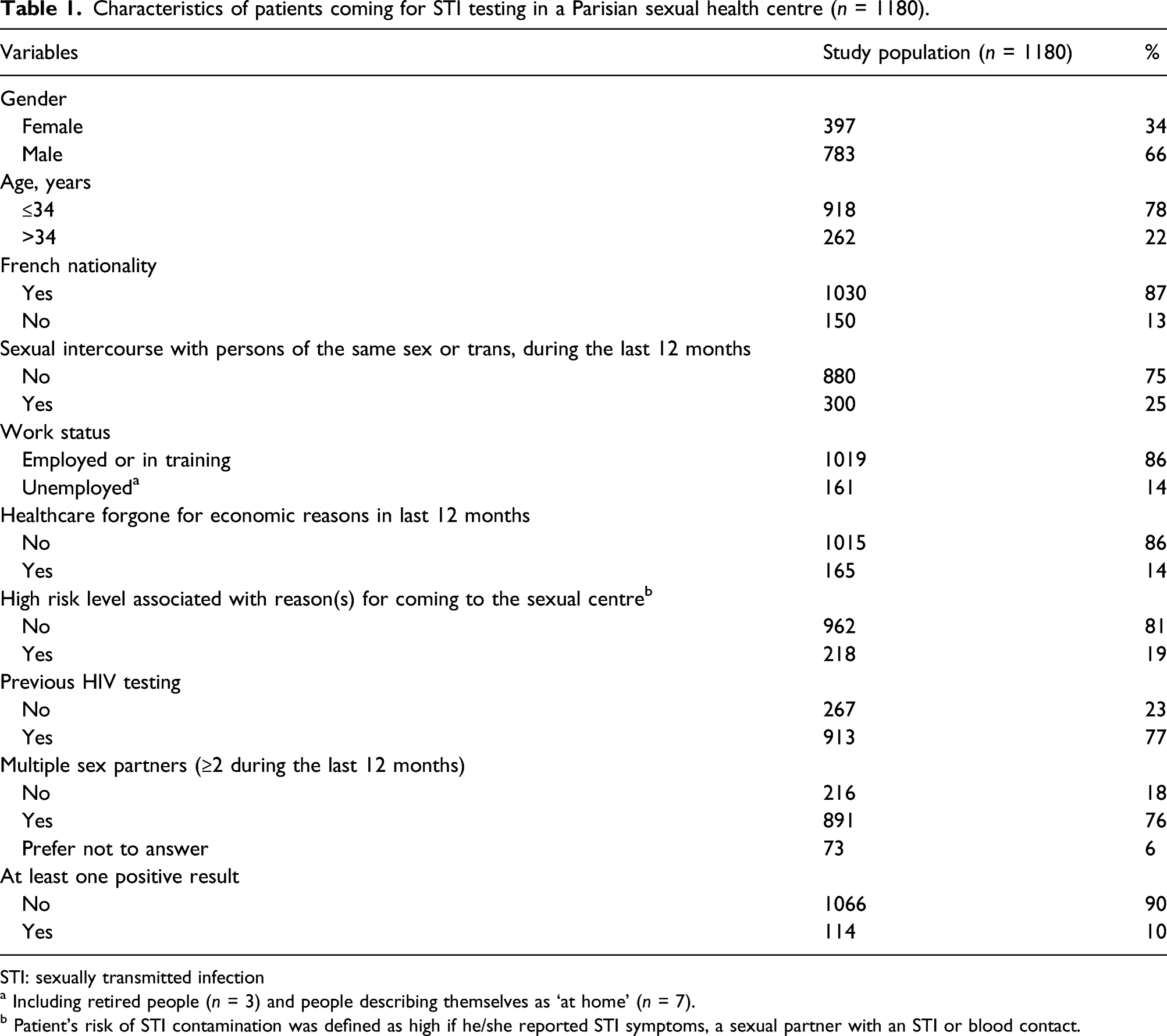
The study population included all patients coming for STI testing who were offered SMS results notification (whether they accepted or refused) and who completed the self-administered questionnaire. From January to August 2018, 2080 patients attended Fernand Widal sexual health centre for STI testing and were offered SMS results notification. The French self-administered questionnaire was not offered to 22 non–French-speaking patients and 878 patients declined to complete it. A total of 1180 patients completed the questionnaire and were included.
Data
The self-administered questionnaire included questions on sociodemographic characteristics, health, HIV knowledge, sexual behaviours and sexual partners. The patient was also asked whether he/she was willing to be notified of their results by text messaging. Respondents who declined were asked to enter their reasons for refusal in a free-form text box. Using open-ended questions has been shown to yield detailed responses and to avoid suggesting a range of responses to participants, unlike closed questions. 21
Having multiple sex partners was defined as at least two sexual partners during the last 12 months. Patients who stated they were consulting for STI symptoms, who had a sexual partner with an STI or who had blood contact were considered as having a high risk of STI.
Analysis
Factors associated with SMS notification refusal
Factors associated with SMS notification refusal were explored using univariate and multivariate logistic regression models. For multivariate analyses, variables were selected by a backward stepwise selection method with a 0.2 significance level for removal from the model. Statistical analyses were performed using STATA/IC 11 (Stata Corporation, College Station, TX, USA).
Reasons for refusing SMS notification
Free-text answers were analysed to explore reasons for refusing SMS results notification following a qualitative content analysis methodology. Each answer was coded independently by two researchers (JC and PP). In the event of disagreement, a third researcher was consulted (PT).
Ethical and legal requirements
The study was registered with the AP-HP (Paris Hospitals) Data Protection Office (Registration number 20181119172904) and received approval from an institutional review board (IRB 00006477).
Results
Characteristics of patients coming for STI testing in a Parisian sexual health centre (n = 1180).
STI: sexually transmitted infection
a Including retired people (n = 3) and people describing themselves as ‘at home’ (n = 7).
b Patient’s risk of STI contamination was defined as high if he/she reported STI symptoms, a sexual partner with an STI or blood contact.
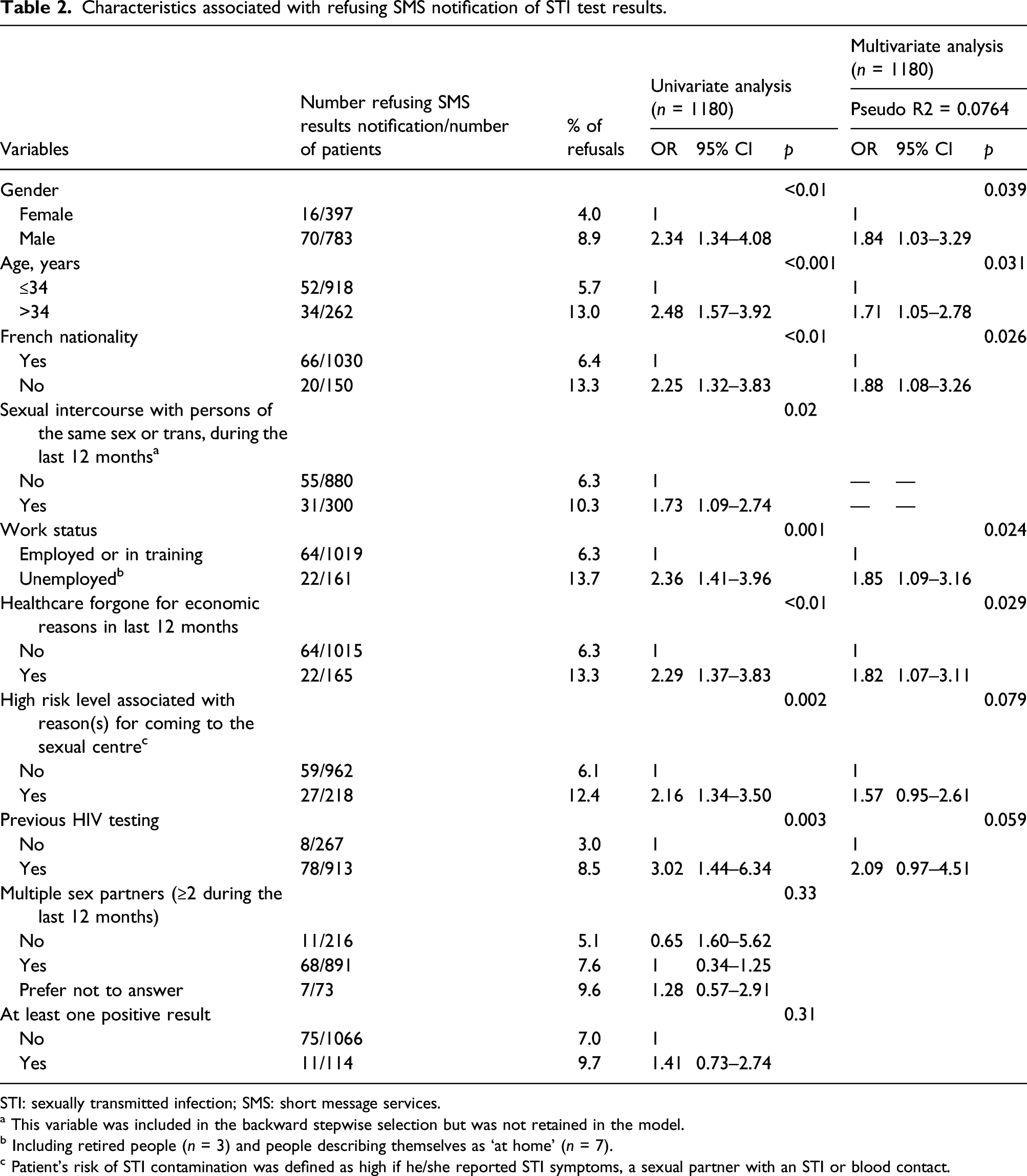
Characteristics associated with refusing SMS notification of STI test results.
STI: sexually transmitted infection; SMS: short message services.
a This variable was included in the backward stepwise selection but was not retained in the model.
b Including retired people (n = 3) and people describing themselves as ‘at home’ (n = 7).
c Patient’s risk of STI contamination was defined as high if he/she reported STI symptoms, a sexual partner with an STI or blood contact.
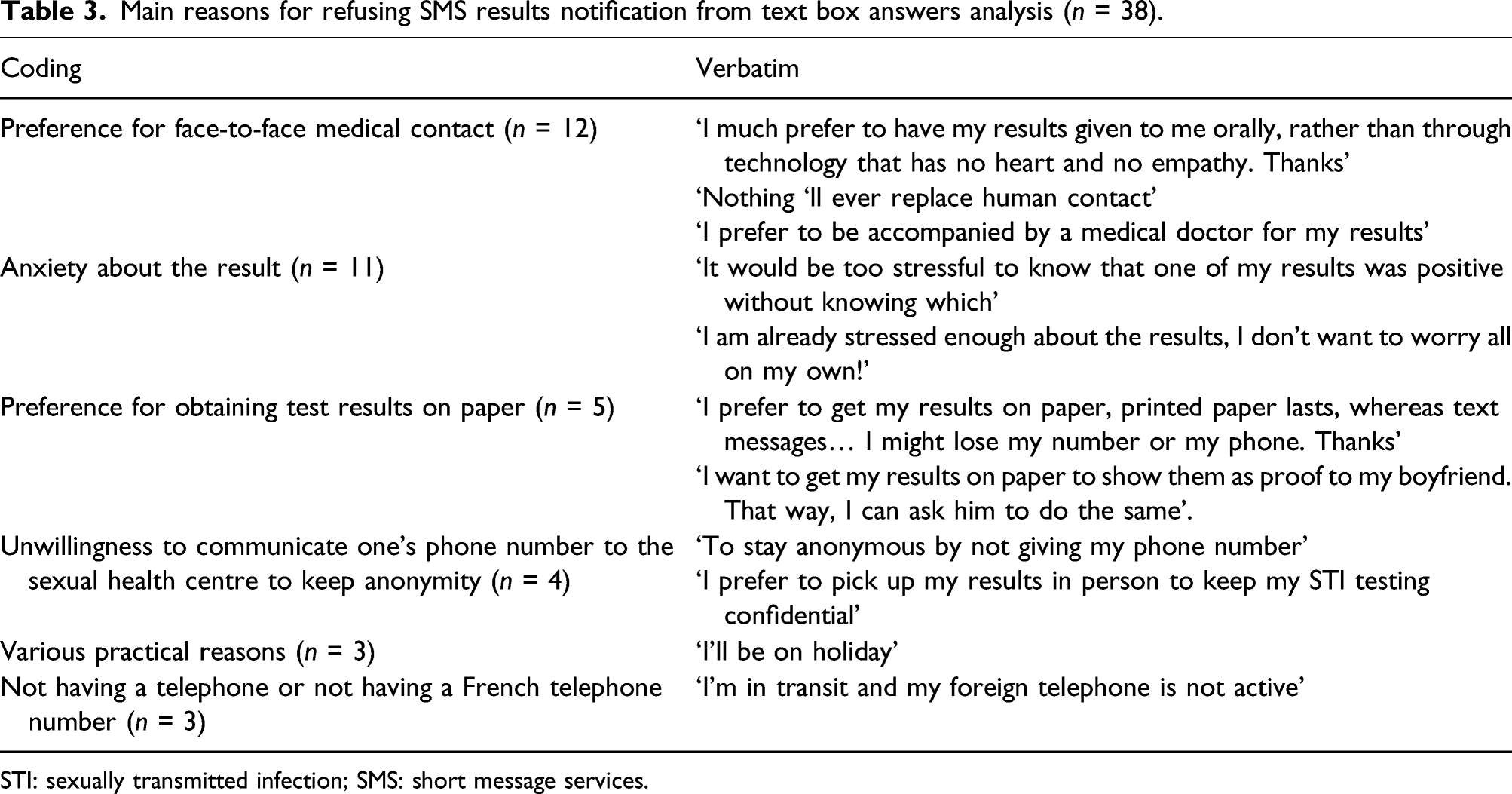
Main reasons for refusing SMS results notification from text box answers analysis (n = 38).
STI: sexually transmitted infection; SMS: short message services.
Discussion
Of the 1180 patients who came for STI testing and were included in our study, only 7.3% refused SMS notification of their results. Refusing notification of results by SMS was associated with sociodemographic characteristics reflecting social vulnerability, such as non-French nationality, having forgone health care for economic reasons or being unemployed. Conversely, sexual behaviour was not significantly associated with refusal. Regarding reasons for refusing, privacy concerns were only reported by a few patients, whereas preferring face-to-face medical contact was one of the main reasons given.
One of the principal strengths of this study is that it explores not only the factors associated with refusal of SMS notification but also the reasons for refusal, whereas the few previous studies only focused on the factors associated with refusal.14–18 The reasons for refusal of SMS notification were collected through a free-form box in a self-administered questionnaire, allowing detailed and sincere responses. 21 However, we cannot rule out selection bias as 878 persons refused to complete the questionnaire and were not included in the study. Patients were not asked about their reasons for refusal. Possibly, some may simply not have wished to spend time to complete the questionnaire, even though they had quite a long period in the waiting room as no appointments are given for medical consultations. Moreover, patients who did not complete the questionnaire differed from those who agreed to respond and who were included in the study (see Supplementary Electronic Material). Patients who did not complete the questionnaire were more likely to refuse SMS notification (37.6% vs 7.3%, p-value <0.001). This gap between participants and non-participants may be explained by less familiarity with use of technology in a health context and with a written form of language. 22 Illiteracy has been shown to have an impact on the use of SMS, and this would limit the use of SMS to convey health information.23,24 Health literacy is also associated with participation in research studies. 25 Considering this selection bias, the strong impact of low socioeconomic status on refusal of SMS notification by participants is probably underestimated. To enhance participation in future studies, particularly by people with limited literacy, patients should be helped by one-on-one counselling and support as suggested by Kripalani et al., for instance, verbal instructions and verbal completion of the questionnaire. 25 Moreover, translation of the self-administered questionnaire into other languages should be considered to allow participation by non–French-speaking patients.
In the total population who attended the sexual health centre for STI screening (n = 2058), the SMS notification refusal rate was 20.3%. This rate is low but is in agreement with the 20% to 48% refusal rates reported in previous studies on STI results notification.14,15,26 The important variation in the proportion of SMS refusal observed in the literature may be due to patients’ perception of its usefulness and to the explanations given. 26 In our centre, the receptionist explains how SMS notification works using an information leaflet and also gives the patient an explanatory card. Moreover, when results are negative, patients do not need to return to the centre, resulting in time-saving. The direct benefit perceived by the patients may thus also explain the low level of refusal in our setting.
In our study, male gender and age over 34 years were both associated with refusing SMS notification. These results are consistent with other studies.14,15,18–20,26 The age effect may reflect less ease with use of new information and communication technologies (ICT) among older people, according to the innovation diffusion theory. 27 As shown in a previous French study, 18 individual factors indicating low socioeconomic status (not having French nationality, being unemployed or having forgone health care for economic reasons) were associated with refusing SMS notification. Several mechanisms could explain this result. Firstly, socially disadvantaged patients may have more limited access to ICT. Use of mobile phones and text messages in the context of health care has been reported as associated with employment and higher education.28,29 Access to a cell phone is unreliable for socially disadvantaged patients and may be regularly disrupted as these patients are more likely to have a no-contract cell phone plan requiring the continuous purchase of minutes.30,31 Secondly, regardless of access to the technology, the association observed between social vulnerability factors and refusing SMS notification may be explained by differences in use of ICT according to social class, as examined in a Norwegian systematic review of innovative technologies and health inequalities. 32 Differences in use of these technologies could be related to health literacy disparities or to the digital divide and could be a consequence of socially differentiated strategies in using innovative technologies.23,24,33
Regarding the reason for refusing SMS, we hypothesised that the wish to avoid accidental breach of confidentiality to friends or partners was a reason for refusing SMS34,35 However, this reason was not explicitly mentioned in the free-form text box answers, although some patients stated that in order to keep anonymity, they were unwilling to give their phone number to the sexual health centre. In our study, preferring face-to-face medical contact was one of the main reasons reported by patients for refusing SMS notification. Direct healthcare provider contact allows patients to ask their questions and be reassured. The importance of human contact and of being able to put a question directly to a healthcare provider has also been reported in previous studies.16,19 The opportunity to ask a direct question may be important for patients with low socioeconomic status and limited access to external sources of information (written information or information obtained through a personal social network in particular). The resources an individual may expect from his or her social network depend on its composition. As social networks are characterised by homophily, that is, the tendency of individuals to associate and bond with similar others, patients with low socioeconomic status are less likely to find reliable sources of information about health in their social network than patients of higher status. Anxiety about the test result was the second most frequent reason reported by patients. This finding is in line with the association found in univariate analysis between the patient’s perception of his/her risk of STI infection and refusing SMS notification and with previous studies. 20 Several patients gave preferring to receive a paper copy of the results as their reason for refusing SMS, thus showing that a proportion of patients did not clearly and fully understand the SMS notification system. In fact, in our centre, patients accepting SMS notification also have the possibility of obtaining a paper copy of their results (in addition to the SMS). When implementing a new communication system, it is very important to consider the views of patients and in particular those who are socially less advantaged.
Conclusion
Preferring face-to-face medical contact was one of the main reasons that patients gave for refusing SMS notification, showing the need for human support. This finding provides valuable insight into the strategy needed to develop communication with patients as SMS notification of STI test results appears as an interesting option for medical teams but is not suited to all patients. To take into account the need of a number of patients for human support as well as the need to reduce the time spent by doctors on delivering negative STI results, new communication strategies such as delivering results by a nurse or a health mediator should be explored.
Supplemental Material
sj-pdf-1-std-10.1177_09564624211048555 – Supplemental Material for Notification of STI test results by text messaging: Why do patients refuse? Cross-sectional study in a Parisian sexual health centre
Supplemental Material, sj-pdf-1-std-10.1177_09564624211048555 for Notification of STI test results by text messaging: Why do patients refuse? Cross-sectional study in a Parisian sexual health centre by Jalal Charron, Pénélope Troude, Elise de La Rochebrochard, Christophe Segouin and Prescillia Piron in International Journal of STD & AIDS
Footnotes
Contributorship
J.C., P.P. and P.T. contributed to the design and implementation of the research, to the analysis of the results and to the writing of the manuscript. E.R. contributed to the analysis of the results and to the writing of the manuscript. C.S. supervised the findings of this work. All authors discussed the results and contributed to the final manuscript.
Declaration of conflicting interests
The author(s) declared no potential conflicts of interest with respect to the research, authorship, and/or publication of this article.
Funding
The author(s) received no financial support for the research, authorship, and/or publication of this article.

Supplemental material
Supplementary material for this article is available online.
References
Supplementary Material
Please find the following supplemental material available below.
For Open Access articles published under a Creative Commons License, all supplemental material carries the same license as the article it is associated with.
For non-Open Access articles published, all supplemental material carries a non-exclusive license, and permission requests for re-use of supplemental material or any part of supplemental material shall be sent directly to the copyright owner as specified in the copyright notice associated with the article.
