




Abstract
We critically examine a multi-year initiative led by Cities Alliance with municipalities and civil society groups in Somaliland, Kenya, Uganda, and Ethiopia to respond to refugees and migration. Adapting Goffman’s work, we posit that in ambiguous and resource-scarce political environments, network success rests on supporting two “frontstages” and a shared “backstage”. On stage one, authorities “visibilize” refugees to attract funding and national support while shaping national-level norms. On stage two they make refugees “invisible” within their own development strategies, integrating displaced populations into urban planning through data collection, service investments, and inclusive strategies. In an experimental and collaborative backstage, municipal actors share resources and workshop varied scripts for their respective audiences. The initiative has lessened host–refugee tensions, strengthened municipal voices in national and regional policy fora, fostered local accountability, and created financial and bureaucratic resources better able to outlast the vagaries of humanitarian or emergency aid.
Keywords
I. Introduction
Since 2015, there has been growing scholarly and policy interest in cities’ national and transnational influence on migration policy and practice. The Global Compacts on Refugees and Migration highlight the crucial role played by authorities across multiple levels of government in responding to displacement. More recently, the United Nation’s Call to Local Action for Migrants and Refugees recognizes that, “It is at the local level where we see pragmatic, principled and people-centred approaches that spearhead and exceed the commitments of global frameworks such as the Global Compact for Safe, Orderly and Regular Migration, the Global Compact on Refugees, as well the 2030 Agenda on Sustainable Development”.(1) Scholarly analysis on the local turn in migration governance focuses heavily on municipal authorities challenging the national-level domination on migration matters while also contributing to norm-generation in international and national spheres.(2) The possibility of bypassing national officials to develop migration and integration policy at supra- and sub-national levels has generated enthusiasm for, and interest in, Transnational Municipal Governance;(3) Multi-Level Governance;(4) Trans-City Networks;(5) and the International Organization for Migration’s “Whole of Government Approach”. In North America, debates focusing on welcoming and sanctuary cities examine variables promoting immigrant inclusion in local political and economic life.(6) Many scholars and activists advocate networks as a means of scaling and universalizing successful models.(7) Yet the empirical insights undergirding these initiatives draw largely from an EU and American corpus of work in a context that offers cities the possibility of a strategic alliance with a strong regional body, which has the resources and legal frameworks to work directly with local authorities.(8) Working in this context, scholars are blinded to the politics of municipal migration response elsewhere.
Through its focus on a municipal network in the Horn of Africa, this paper addresses a particularly significant gap in the literature on municipal responses to migration and displacement: secondary cities in the global South. A focus on these cities draws attention to the challenges of working in spaces where the practical political order often disempowers cities, despite calls for decentralization. Moreover, these types of sites – where, in fact, most of the world’s urban migrants and refugees reside – often face significant capacity and resource constraints and a deeply deprived citizenry. How can networks facilitate inclusion in contexts without strong regional norm-setting bodies like the European Union (EU), or robust federal systems of autonomy as in the United States? What mechanisms are available to local policy makers in these contexts to leverage resources for migration as well as meeting the developmental obligations to their local communities?
a. Towards a metaphor of engagement
We explore these questions drawing on research conducted in the Horn of Africa, specifically in Assosa and Jigjiga (Ethiopia), Borama and Gabiley (Somaliland), Koboko and Arua (Uganda) and Kakuma-Kalobeyei (Kenya) (see Figure 1). Our analysis of these cities’ efforts to address migration and displacement is undertaken through a form of critical, participant observation. Between 2019 and 2023, the Cities Alliance – with European Union support – attempted to respond to the needs of secondary cities in the Horn of Africa affected by the presence of refugees and involuntary migrants. Entitled the Regional Network and Dialogue Project: Comprehensive Refugee Response Framework (hereafter, ‘the initiative’), this effort was designed to explore ways of promoting social cohesion and lessening poverty while strengthening local institutions and municipal planning capacity. Over its lifespan, this initiative established a regional network and platform for dialogue among the seven cities listed above. It worked from the position that the network was not an end, but a means of norm-setting, generating and mobilizing knowledge, and strategically attracting resources in ways that could promote sustainable rural livelihoods and protection.
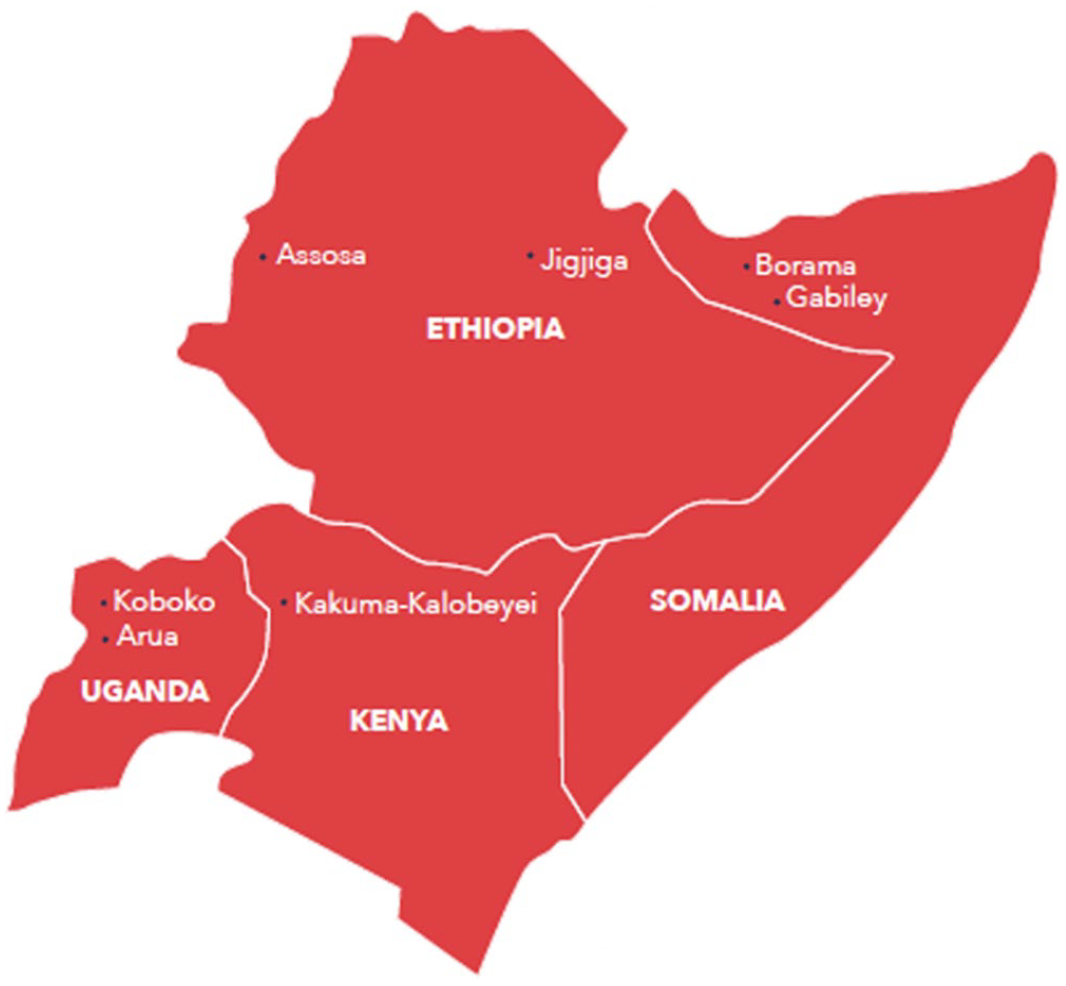
A map of participating cities in the Horn of Africa
The objective of this paper is not to evaluate the success or failure of this network. Instead, it seeks to leverage independent insights on how some local policy makers have navigated the complexities of migrant inclusion amid national and local contexts that view refugees as burdensome encroachers on limited resources. To do this, we employed a longitudinal qualitative study approach with elements of participatory action research and ethnographic observation. Our methodology was inherently iterative and collaborative, allowing us to work closely with local stakeholders to co-create knowledge and strategies that were both informed by global best practices and deeply rooted in local realities. We conducted a comprehensive review and synthesis of existing literature and case studies on urban networks globally, with a particular focus on those addressing displacement and migration challenges. This comparative analysis aimed to elucidate the structural and operational characteristics of successful networks, as well as to identify potential pitfalls and limitations. Concurrently, we engaged in an in-depth exploration of the unique sociopolitical, economic and cultural contexts within which the project’s stakeholders operated. This involved a nuanced examination of local governance structures, policy landscapes and stakeholder dynamics. Through this process, we aimed to support the development of tailored, context-specific approaches that would effectively leverage local strengths and address particular challenges.
We attended four network meetings – two virtually and two in person. The first was in Addis Ababa, Ethiopia (2–3 November 2021), the second in Kampala, Uganda (29–30 March 2022). The two in-person events were in Turkana, Kenya (31 January–3 February 2023) and Koboko, Uganda (6–8 June 2023). These engagements allowed for immersive observation and direct interaction with stakeholders. During and in between network meetings, we conducted formal, in-depth interviews with more than a dozen practitioners, including municipal officials, civil society representatives and refugee leaders. These interviews provided rich, contextual data on local perspectives and challenges.
Data were collected through multiple methods:
Field notes from participant observation during network meetings
Transcripts and notes from semi-structured interviews
Recordings and notes from group discussions and training sessions
Relevant documents and reports
We employed thematic analysis to identify key patterns and themes in the data. This process was ongoing throughout the research period, allowing for the emergence and refinement of analytical concepts. We also engaged in multiple reflective sessions where we offered provocations and recorded participants’ responses. Given our position as invited participants, we maintained a reflexive stance throughout the research process, critically examining our dual role as consultants and researchers. We ensured participant confidentiality and obtained informed consent for all interviews and data collection activities. We acknowledge the potential limitations of our embedded position and have addressed these through methodological triangulation, reflexive practice and transparent reporting of our research process. This research design allowed us to provide multiple inputs to the network, including empirical analysis of urban responses to displacement in other geographies, overview of the funding environment, methodological training and critical review of the network design. Our final report, incorporating feedback from participants, forms the basis of the following analysis.
To elicit further insights from the initiative, we view the East African network through the lens of Goffman’s frontstage–backstage dynamics.(9) Doing so reveals how these municipalities strategically navigated the politics of migrant inclusion and the role of the network in facilitating this approach. This conceptualization emerged inductively from our observations and analysis, offering a unique lens through which to understand the strategic approaches of secondary cities in addressing displacement challenges.
Our adaptation of Goffman posits two distinct frontstages. The first is a stage on which refugees are made visible to global actors, donors and governments. Municipalities use this device to gain attention, attract funding and promote norm-setting on the international stage. By making the presence and needs of displaced populations visible, municipalities can mobilize political support and resources from global actors, thereby encouraging buy-in from the sometimes hostile national-level actors within their own countries. The second stage presents a story of development and inclusion in which displaced people are rendered largely invisible to local communities and constituencies. The aim is to avoid the kinds of divisions that can stem from responses targeted at specific populations. By keeping refugee populations out of the public eye and focusing on strengthening municipalities’ more general capacities in data collection, budgeting, fundraising, planning, community participation and service delivery, local actors bolster their legitimacy among residents while still addressing the needs of displaced communities. These two performance platforms share a common backstage – a venue comprised of municipal offices and network-forged safe spaces – where local government actors can commune, strategize, and “change costumes” while drafting and practising the diverse scripts that enable them to navigate the politics and power relations of hosting displaced populations. This dual front–shared back strategy allows municipalities to balance multiple political agendas and navigate complex power relations in resource-scarce contexts (see Figure 2). While the network was not successful in all its objectives, its ability to foster an almost invisible and experimental backstage offers a model for similar initiatives elsewhere.
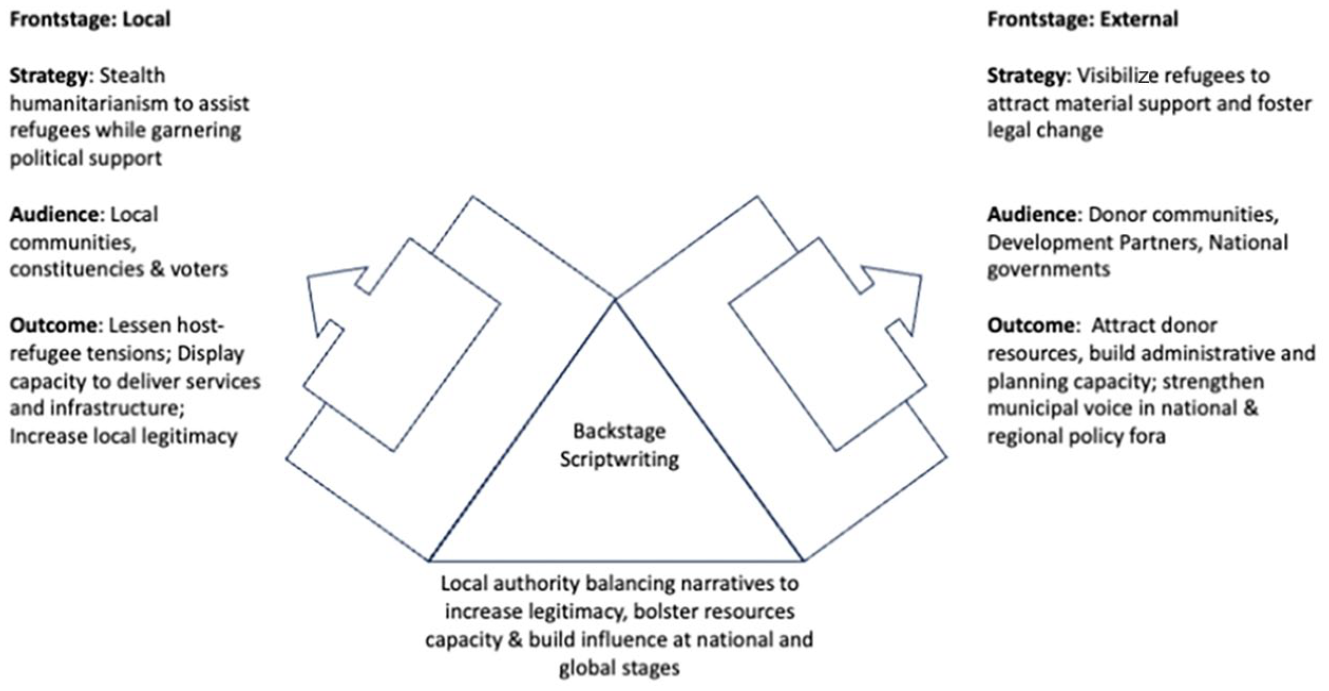
Frontstage(s)/backstage: Navigating visibility and invisibility in refugee politics in cities in the Horn of Africa
b. Migration governance and the intersection of (in)visibility and power
The strategic use of visibility and invisibility in population management is a long-standing tool in statecraft, particularly evident in the development of asylum and refugee policies.(10) Recent accounts of migrant agency and sociopolitical responses to human mobility offer insights into the complex interplay between visibility, invisibility, power and migration governance.(11) Critical migration studies highlight how legislation and policy mechanisms render certain migrant populations visible and vulnerable, making them deportable or marginal while culturally coercing them to integrate.(12) In these models, local authorities become either agents of resistance to the state or complicit through their role in labelling and in criminological or technocratic forms of surveillance and data gathering.(13)
Border studies examine the construction, enforcement and contestation of borders, elucidating how border regimes create hierarchies of inclusion and exclusion, often through processes of visibilizing and securitizing migrants.(14) Similarly, critical race theory highlights how the hyper-visibilization of black bodies attracts negative policing and security attention, perpetuating discrimination and stereotyping of racialized migrants.(15) Such processes of (in)visibilization not only reinforce existing social hierarchies, but also contribute to the marginalization and criminalization of migrant populations.
Activists and operational agencies counter migrants’ fears of visibilization with calls for higher levels of migrant and minority visibility, rights and representation. For international organizations and NGOs dependent on displacement-related funding, such an approach is often connected to mobilizing additional support.(16) For activists, it is often connected to forms of rights claiming, space-making and an ethics of inclusion.(17) Where organizations are not explicitly driven by self-interest (e.g. funding, political influence, personal advancement), such approaches often rely on an understanding of politics and mobility forged by the institutional and social structures associated with western democracies. In such models, the language of rights and incorporation is a relatively reliable pathway to recognition and influence. These models often make assumptions about the desirability of inclusion and the mechanisms through which people – citizen and alien – effectively secure access to space and other resources.(18)
Insights from secondary cities across the Horn of Africa highlight broader debates and power struggles surrounding migration policy within the state. This suggests the need to nuance many of the positions informing action on behalf of the displaced. Depending on context, visibilization can lead to empowerment or further vulnerabilization. It can help mobilize resources for those in need or lead them to become the targets of popular and political opprobrium. Navigating these tensions requires municipal actors to play simultaneously on two stages: to visibilize on one and blur lines between migrants and “locals” on the other. These strategies work to attract resources and credibility from global and regional actors while mitigating potential political backlash from national governments and “host” populations. Actively countering discourses from the capital, these peripheral cities challenge negative national depictions of migrants as a drain to economies, or the cause for growing unemployment and crime. But unlike migrant advocates who emphasize host country responsibilities to protect migrant rights or appeal to the benefits migrants offer host societies,(19) the municipal policy makers in this study understand when pro-migration and pro-migrant arguments are counterproductive. In response they work silently, making migrants invisible in ways that avoid political backlash and expand urban development. This translates to both external, highly visible strategies (e.g. raising money, advocating, reshaping global debates) but also invisible internal ones. Given the vagaries of migration and displacement, it often makes little sense for municipalities to concentrate energy on separating displaced populations from local ones. Rather, using the possibilities of displacement to build broader planning and administrative (and advocacy) capacity is more likely to create lasting effects that can respond simultaneously to displacement and local development.
This modified backstage/frontstage(s) performance(20) speaks to the ambiguous yet agential role of local authorities in the kind of hierarchical and under-resourced institutional environments in which most displaced people seek protection. This dual strategy of making forced migration both visible and invisible highlights the complexities and contradictions inherent in how states address and respond to forced displacement. Even in seemingly migrant-hostile governance contexts, there are openings for more inclusive policies and developmental actions that can benefit refugees and their hosts. By creating safe spaces for discussion, providing resources and insights and assisting authorities to hone their scripts and delivery, the network expanded the productive backstage. Largely invisible to the intended audiences, it nonetheless amplified the voices of local authorities and partners.
II. Empirical Background
The fundamental problem confronting most local authorities, especially those managing cities in developing countries, is the widening gap between the availability of financial resources and municipal spending needs.(21)
Located in the East and Horn of Africa, Assosa and Jigjiga (Ethiopia), Borama and Gabiley (Somaliland), Koboko and Arua (Uganda), and Kakuma-Kalobeyei (Kenya) are rarely featured in debates on urban governance. Positioned at the borderlands of their respective countries, they occupy a region facing multiple humanitarian, environmental, socioeconomic and political crises.(22) While there has been growing attention to the region’s capital cities,(23) these sites host a proportionally greater percentage of internationally and internally displaced people. In a region with over 18.8 million people displaced due to drought, conflict, and flooding in 2023,(24) they face the daily realities of governing mobility and displacement in spaces characterized by limited government capacity and widespread economic marginalization. They were selected for this network based on the challenges they face and their interest in joining other similar municipalities in addressing them.
Like cities elsewhere in the global South, this study’s municipalities struggle to accommodate rapidly expanding populations and the resulting demand for urban services. They are situated in a region with a rapidly urbanizing population: at country level cities in Uganda, Kenya, Ethiopia and Somalia have urbanization levels of over 4 per cent – much higher than the world average (1.7 per cent) and Africa’s average growth rate (3.45 per cent).(25) Municipal revenues are unable to keep pace with growing population needs. Transfers from central governments are often insufficient and sometimes politicized. Moreover, there are often legal restrictions on financing which limit local authorities’ ability to access additional budgetary allocations or receive international funding. With little access finance in capital markets, cities are left to fend for themselves, drawing income from existing revenue streams, rates or business taxes.(26) Indeed, this study’s cities draw most of their revenue from local taxes and licences. Gabiley, for example, raises 84 per cent of its revenue through livestock, milk and vegetable market taxes, and other farm and business taxes. Intergovernmental transfers account for only 6 per cent of the city’s revenue.(27) With the effects of climate change affecting 80 per cent of the population, especially those whose livelihoods are farming dependent, local resources are unsustainable and far from sufficient.
There are similar patterns in Borama, where revenue from local streams like livestock and land charges falls short. Overall, all the participating municipalities face pressing needs to boost revenue to tackle local development and manage the pressure that growing displacement and mobility place on their capacity. The Borama district secretary illustrated the point: “We have a budget of USD 4 million, it is not enough. We have 77 villages. If we need to provide water, electricity, and so on, it is not enough.”(28) Considering the resource and population pressures, as well as intergovernmental politics and processes, successfully tackling human mobility in secondary cities demands the ability to navigate multiple local, national and international agendas within a resource-constrained environment, carefully balancing both local and refugee development.
III. Findings: The Backstage Network
Where many efforts to support municipal government responses to displacement are premised on enabling refugees’ access to existing services and support, this initiative worked from the explicit position that beyond short-term humanitarian aid, assisting displaced populations means strengthening the cities where they live. While supporting collective responses, it also promoted an approach encouraging municipalities to situate their responses within particular economic and political ecosystems.(29) The project kept its focus pragmatically on how to substantively benefit people displaced by conflict, war, and climate while simultaneously securing urban futures for long-term residents, transient populations, and more recent arrivals. Towards these ends, the network facilitated extended conversation and engagements among refugees, migrants and host populations through collective discussions held in person, at sites throughout the region.(30) These took place in the workshops we attended and through multiple other formal and informal platforms. What emerged was a nuanced and sophisticated form of politics that recognized the necessity of reframing migration and displacement narratives to address different audiences in ways that could advance the municipal agendas. The following pages outline how municipalities managed a dual frontstage and backstage strategy and its resultant outcomes.
a. Promoting national norm-setting in uncertain and inhospitable national policy frameworks
Although Africa has regional economic communities and the African Union, these bodies typically lack the legal frameworks and resources to influence national or international policy. Local policy makers in the project faced the challenge of influencing national policies on development, migration and displacement in contexts where national government policies were unclear or increasingly securitized. Much of the multilevel governance literature speaks of local authorities actively implementing or resisting national policies or pushing the limits imposed by local mandates. Across this region, recent decentralizations and unclear or ill-aligned policy proposals often render the precise definition of these boundaries ambiguous, generating both uncertainty and opportunity. Operating in grey zones where policy and authority are poorly defined means authorities may walk a fine line between expanding autonomy and attracting political opprobrium.
This grey zone is evident where national priorities on encampment or integration policies may differ from those at a local level or be altogether absent and undefined. Tense relations between municipalities and national governments – due to political or personal differences – provide further challenges. The Mayor of Arua points to the complexities of working with national government: Our challenge has been that the central government of Uganda does not consider refugees who live in urban centres outside of Kampala. So even if we make noise that government should increase our resources, they do not hear us. We have umbrella associations of local government that bring mayors and town clerks together, where we can articulate these issues. . . We are also trying to engage our members of parliament. But our voice is not heard so much. Where there is rigidity like this, we cannot get milk out of a stone. In the process we suffocate.
Similarly, in Kenya, when the national government ordered the closure of refugee camps in 2015, 2016, and 2019, they were met with resistance.(31) Despite the orders to vacate, the camps remain open. By 2023, refugee numbers had increased by 22 per cent.(32) While international pressure may explain part of the reason for the government walking back on its orders, a significant pressure point has been local communities, which see some benefits from hosting refugees in their midst. The governor of Turkana exemplified the divergent interests and priorities between national and local governments regarding migration, when he recognized that the presence of refugees brought essential services, growth and job opportunities to an otherwise marginalized region. An International Labour Organization (ILO) representative highlights this tension, underscoring the critical role local authorities play in advocating for and benefiting from refugee populations: The governor of Turkana is a star when discussing role of local government in the management of refugees. He realized that Turkana is so marginalized, and that the only reason there were services, growth and jobs is because there are refugees. So, there’s a disconnect between the national and local approaches. The national level has a security-centric approach.(33)
The institutional elevation of Kakuma into a full municipality is largely attributable to increased lobbying efforts by the county for the recognition of refugee populations. According to the Urban Areas and Cities (Amendment) Act of 2017, an area with a population exceeding 250,000 can be designated as a municipality, the second-largest local government entity after a city. Without including the refugee count, Kakuma and Dadaab would not meet this threshold. The Refugees Act of 2021 facilitated the integration of refugees into local population registers, thus enabling these towns to attain municipal status. Municipal status confers significant powers to a board in the determination of the municipalities’ development agenda. This includes developing integrated plans, land use control and regulation, entering into contracts and partnerships, collecting rates, taxes and levies.
For the first time in Kakuma, we are having a new municipality that is, according to the Kenyan law, classified in terms of population. . . thanks to the count of refugees. So, for the first time we have been considered an urbanized population and granted municipal status. The same has also happened in Dadaab. Kakuma started the lobbying and Dadaab joined. That is something that we can pride ourselves as a county. (Director: Urban Areas Management, Turkana County)
The recognition of refugee populations has transformed Turkana County, giving local elites substantial influence in shaping national policies processes and illustrating the profound impact of strategic lobbying and in norm-setting. Yet they were only able to do this through a careful reading of ambiguities in the law and policy. Through deliberate strategy aimed at actors outside of the town, county authorities were able to work with network partners to craft scripts that ultimately used the refugee presence to attract status and resources.
b. Strategic visibility and invisibility: Navigating multi-scalar migration governance
When you work in a group, you do things well. One hand cannot clap, but two hands can clap and make a difference. (Mayor of Assosa, Ethiopia)
In a region characterized by de facto centralization and the strong influence of international agencies and donors, the network emphasized collaboration and consultation across multiple scales by building a multi-scalar, inclusive, and legitimate policy community. Most evidently this included the representation of non-governmental sectors: host communities, displaced persons, civil society, analysts, and technical experts. It also facilitated equitable conversations across the scales of government: from municipalities to regions/provinces to national ministries and East Africa’s Intergovernmental Authority on Development (IGAD). In multiple cases this brought local actors together in novel, equitable ways, facilitating conversations about a given municipality that would otherwise be unlikely. By bringing local actors together in novel ways, these engagements lent legitimacy and authority to municipalities as they exchanged with their counterparts elsewhere and with officials in other spheres/levels of government.
Among civil society and refugee representatives, the network offered access to political and policy actors in a way that would not have been possible otherwise. Built over a period of five years, these relationships strengthened over time, offering the possibility for a deep understanding of the issues facing different actors.
Because of this network, I am able to exchange and talk with the Minister [Lands, Physical Planning and Urban Areas Management, Turkana County]. When you are exposed to a senior person in government in this way, it is easier to pass your agenda to them, and they can even advise you on how to advocate when we are on the same platform. (Host Community Representative, Kakuma Settlement)
The in-person network meetings and informal (often virtual) platforms that it spawned offered what formal planning processes cannot: the possibility for refugees and policy makers to engage as equals, providing a unique platform for the genuine inclusion of voices that are often marginalized in formal political and administrative processes. This shared backstage, away from direct observation by local residents and national governments, fostered trusting bonds and information exchange that could further all parties’ interests. Outside of the formal scheduled network meetings, backstage negotiations happened informally and spontaneously. Network members would communicate with peers, ask questions, seek advice and offer suggestions and solutions to each other: Here the first thing is that in this network there are ministers, mayors, refugee leaders and we all sit at the same table, and we are treated the same. In other networks, refugees are used as an image, but here we stand up to speak and comment on specific issues, I’m involved in decision-making. (Youth and Refugee Representative, Kakuma Settlement)
Using the network’s visibility positioned members to shape domestic and regional policies in ways that have been pivotal in transforming local concerns into broader policy debates. The network offered a platform for participants to voice ideas and positions that might not have been expressed or acknowledged in national and global debates. Furthermore, the collection, analysis and mobilization of population and financial data also proved a powerful asset in highlighting needs while providing the empirical bases to demonstrate interventions’ effectiveness. The platform provided the opportunity for coalition-building, where aggregated local interests had a better chance to influence national policies: These can’t be local issues. We need to shape national and regional policies. But who are we as small towns or cities? We can’t be heard. Only through networks can we leverage our power to make lasting change. (Executive Secretary: West Nile Development Association [WENDA])
From regional voices to parliamentary caucuses, the network helped strengthen existing alliances, enabling them to leverage influence over national policies through parliamentary accountability and electoral processes: From a point of having regional voices, let these voices have links to parliamentary caucuses in the region. Here in the West Nile if we have a regional issue that needs the attention of the national government, we convene our regional caucus and put our facts clear to them. If they don’t do it, we tell them ‘Don’t come back to ask for votes’. (Executive Secretary: WENDA)
The multi-scalar approach, which integrated diverse stakeholders across civil society, governmental and non-governmental entities, bolstered participants’ confidence that they could exert meaningful influence on policymaking processes. As encapsulated by the Mayor of Assosa’s metaphor, “one hand cannot clap but two hands can clap and make a difference”, the collective nature of the platform fostered a sense of empowerment among its members. This dynamic reinforced their understanding that, together, they had the requisite knowledge to shape national policies. A representative from Uganda’s Office of the Prime Minister’s Department of Refugees acknowledged that the network had broadened his perspective on the distribution of urban refugees beyond Kampala and prompted the need to reconsider resource allocation and support to secondary cities to effectively address displacement. Moreover, the presence of a coalition of multiple stakeholders offered city governments the legitimacy to engage authoritatively in both national and global policy debates. While national authorities were invited to attend the meetings as observers, they were not afforded the opportunity to set the agenda and were typically absent from small group or informal interactions. Apart from the Cities Alliance, international organizations (e.g. International Rescue Committee and United Nations High Commissioner for Refugees) were similarly included as expert speakers but their roles were secondary and they were unable to frame discussions. By meeting formally and informally as a network, they could craft scripts that helped them engage more effectively with relevant national government entities.
c. Strategic visibility and pragmatic governance: leveraging refugee presence for municipal capacity-building
The strategic visibility of refugees at national and global levels has been crucial in enabling municipalities to leverage resources that significantly enhance their internal capacities in finance, planning, research and advocacy. This frontstaging of refugees in negotiations with external partners has not only facilitated resource mobilization but also allowed municipalities to demonstrate that through their participation in these displacement-related events, they were able to bring greater resources to their communities. They did this through programmes that acknowledged the refugee presence but largely avoided initiatives targeted explicitly at refugees or requiring displaced populations to step forward as anything other than broader members of their communities. Such a pragmatic approach, balancing visibility and advocacy, offers valuable insights for municipalities not only across the African continent but also globally, especially in contexts where resources are scarce and needs high: Refugees are an opportunity, as long as you look at them as an opportunity. But if you look at them as a burden, they really become a burden. I have looked at them as an opportunity, even when people were saying no. But today look at where we are in Koboko. Everybody now wants refugees; people are scrambling for refugees. (Mayor, Koboko municipality)
Municipal policymakers’ external frontstaging has been instrumental in making refugees visible in ways that enable them to effectively leverage financial and technical resources. By equipping municipalities with analytical tools to assess these needs accurately and identify potential avenues for policy change, the network has played a pivotal role in enhancing their capacity for strategic planning. Furthermore, the network has facilitated the mobilization of data and fostered productive collaboration between experts, service providers and municipalities. These collaborations have been essential in supporting administrative processes, thereby enhancing the operational effectiveness of municipalities, and increasing their prospects of attracting resources from both domestic and international sources. As the Director for Urban Areas Management in Turkana County reported, their participation in the Cities Alliance-supported network and related projects had enhanced their capacity to secure additional funding from diverse sources: With the Cities Alliance support, we developed a new local economic corridor along Kakuma-Kalobeyei, and a regeneration plan. Because we had a Local Integrated Development Plan and a regeneration strategy, we were able to access more funding from the Kenya Urban Support Program. So, what we got from Cities Alliance will continue to benefit us in the future. (Director, Urban Areas Management, Turkana County)
By actively involving mayors and elected officials, the network has garnered support for its projects, underscoring the political benefits of progressive responses to displacement. This mayoral leadership has been complemented by substantive engagement with bureaucratic procedures, facilitating the integration of policy responses into administrative systems. Measures such as defining key performance areas, conducting data reviews and formulating policies have been instrumental in safeguarding the network’s initiatives from sudden policy reversals. Instead, they help normalize responses to displacement, shielding effective responses from actors seeking to exploit exclusive political rhetoric.
The network’s efforts in enhancing strategic policy formation, advocacy, data mobilization and technical capacity have provided a solid foundation for further action by individual municipalities and the network. Already, municipalities have successfully secured funding from external sources and adjusted policy frameworks to support future initiatives. Nevertheless, the full potential of the network remains untapped.
d. Stealth inclusion: mainstreaming displacement in planning processes
In a region where many urban refugees and displaced people are not officially recognized (or are technically violating national policies), municipal authorities found it beneficial to embed concerns with displacement within broader consideration of mobility and inclusive planning. Indeed, the visibility of many migrant-centric networks in Europe and the Americas that draw explicit attention to migration and displacement can work against their potential effectiveness in spaces where host communities also face economic precarity. Moreover, across the Horn and East Africa, legal definitions are often poorly enforced and can correlate poorly with people’s experiences. Many internally displaced people are not bureaucratically recognized as such and there are often relatively few formally recognized international migrants or refugees. As noted, those that exist may not wish to be “seen” by national governments.(34)
Beyond the risks that overt recognition may pose to displaced people, there is little ethical or practical justification for considering one category of vulnerable migrant when there are others (both migrants and long-term residents) who face similar challenges. Services oriented towards one group at the exclusion of others – especially others who consider themselves citizens or locals – can also backfire politically.(35) The primary reason for this categorical focus is to attract the financial, human and institutional resources of organizations and agencies oriented towards migration and displacement as formally defined. Given this, the network worked by identifying the specific and relative needs of migrant populations but did not develop legal or humanitarian initiatives aimed specifically for them. Rather, they sought means to normalize migration and displacement by incorporating mobility into planning across all development sectors.
Through technocratic innovation and municipality-led advocacy, the network moved beyond political pronouncements to create the kind of elusive staging ground needed to navigate political ambiguity and resource scarcity. Through these strategies the cities were able to imagine and work towards a policy environment where they were better resourced and could avoid many of the political pitfalls of aiding outsiders in spaces characterized by economic hardship and deprivation. While speaking loudly of the need to aid refugees on the external stage, they co-authored a script to normalize migration and displacement within urban planning processes by making migrants largely invisible on the local stage. They did so by shifting their framing from one of crisis to one of more routine practicality, by investing in mechanisms for prediction and planning. This approach is likely to prove crucial in a region beset by conflict, environmental challenges and economic transformation, where the need to address migration and displacement intersects with most municipal planning priorities.
The local strategic action relied on a distinctive approach that responds to long-standing calls to merge urban-level humanitarian and developmental responses. By focusing on assisting all people occupying a place rather than targeting specific groups, it underscored the value of planning for migration and displacement for all residents. Moreover, it demonstrated that displacement to urban areas is often unavoidable and that a proactive response to new arrivals can attract skills, resources and opportunities for trade and investment. As evidenced by testimonies from local officials like Dr Sanya K F Koboko, Mayor of Koboko municipality, and Victor Lekaram, Director of Urban Areas Management in Turkana County, integrating refugees into local planning processes can yield unexpected benefits and opportunities for both refugees and host communities. This approach makes migrants and displaced persons invisible in the planning process, thereby avoiding political backlash while facilitating their integration into urban life.
The network opened my eyes to appreciate that local solutions are possible and there are a lot of potential benefits when you integrate a huge and vibrant refugee population. When you are providing services like garbage collection you realize you have a huge problem when you have to take care of a population that was not originally considered in the budget allocation. Kenya’s new Refugee Act and Marshall plan have changed how we plan at a local level. The fact that Kakuma for the first time is considered a municipality in terms of Kenyan law means that refugees are counted and allocated resources by government. (Director, Urban Areas Management, Turkana County)
This did not mean ignoring the particular challenges displaced populations might face or, indeed, the need to transform local and global norms around refugee and humanitarian assistance. Rather, this strategy was practised externally while simultaneously the internal planning process worked to accommodate the needs of displaced people without necessarily spotlighting their presence. The long-term effects of this remain uncertain. However, whatever success may ultimately be achieved stems from the network functioning to create the shared backstage for the municipal authorities’ dual performance spaces.
IV. Conclusions
Drawing on empirical evidence from the Horn of Africa, this paper contributes to critical debates on managing migration at the local level and what that might look like in contexts outside the wealthy West. While municipalities are often ill-equipped to respond adequately, they nevertheless offer novel approaches for cities in similar contexts. Engaging with the intricate dynamics of visibility, invisibility, power and migration governance, the network has enabled municipalities to play to multiple audiences simultaneously.
Many scholars in critical migration studies point to the negative aspects of states actively visibilizing and labelling refugees and migrants. The network’s approach suggests two points of departure. First, that state action to highlight the presence of displaced populations is not inherently a strategy of control (although it often is that). It may also be consciously intended to attract the resources and mechanisms required to assist specific categories of people. While these labels may have negative effects, that is not always the case. These risks can be further reduced by the careful mobilization of the terms and the framing of responses to displaced populations.
This draws attention to a second point, that local authorities are not only important actors in processes of labelling and visibilization, but also can speak to multiple audiences simultaneously using varied approaches. This frontstage(s)–backstage approach demands a more nuanced and agential understanding of the state. It requires analytically disaggregating political, humanitarian, development and civic actors in more subtle ways that recognize the multiple audiences for which labels are produced and mobilized.
This paper also speaks to a growing literature on municipal migration networks while revisiting slightly older questions on “stealth humanitarianism”, a principle which encourages actors to enhance local literacy and pursue “back routes to rights” by engaging with non-displacement actors and institutions.(36) As Heikkinen et al. argue, there is a great deal of enthusiasm about mayoral or municipal networks around migration and other issues, but little systematic evidence concerning the effects of network participation on municipalities or their diverse residents.(37) This paper is not intended to present this network as the model for all others to follow. Indeed, there were considerable frustrations with many of its technical ambitions and not all partners were unqualified in their commitment. Nonetheless, our analysis suggests that the high visibility and overt norm-setting strategies that characterize many of these Euro-American networks may ultimately do a disservice to both displaced and more sedentary populations unless they are complemented by less overt developmental and inclusive framing. At the local level, more technocratic- and “development”-oriented strategies are needed to effectively localize migration governance in ways that are institutionally and politically sustainable. In many ways, this echoes the principles of stealth humanitarianism(38) by following a close reading of context and seeking “back routes to rights”. However, this paper recognizes the powerful role that networks can play in strategically promoting visibility: to attract international support and to help illustrate the benefits of effective migration governance to neighbouring municipalities.
Footnotes
Acknowledgements
This paper was produced as part of the Comprehensive Refugee Response Framework (CRRF): Inclusive Urban Development and Mobility – Regional Network and Dialogue Action, which was implemented by Cities Alliance and financed by the EU through the European Emergency Trust Fund for Africa (EUTF for Africa). The views expressed are nevertheless those of the authors and do not reflect the corporate policies or viewpoint of the Cities Alliance Secretariat, its members or the United Nations Office for Project Services (UNOPS).
