



Abstract
Cities are emerging as the frontiers of low-carbon transition. The emergence of low-carbon cities in East Asian developmental states is often seen as serving nation-state-led transformative development and economic restructuring. But how are specific low-carbon infrastructures socially produced at the city level, especially in the context of social protests? What is the role of the local state? This paper addresses these questions through the case of Guangzhou’s waste-to-energy incineration, an infrastructure that was selected as a national low-carbon technology in China in 2014. The paper proposes a conceptual framework of “performative legitimation of infrastructure” and, drawing from the empirical work, identifies five performative governance tools – (re)conceptualization, reterritorialization, bureaucratization, culturalization and codification – which respond to evolving social demands, consolidate the legitimacy of incineration and regulate state–society relations in different contexts. The production of urban low-carbon infrastructure is presented as a material-discursive process that supports the legitimation of the local state.
I. Introduction
Cities are at the forefront of the low-carbon transition. In the US, city leadership as a complement to the nation-state is increasingly recognized as an emerging approach for advancing climate adaptation, energy transitions and broader ecological policy experimentation.(1) Similarly, low-carbon cities (and other eco-cities) have emerged in recent years in East Asian developmental countries such as China, Singapore and South Korea. Asian scholars have argued that the rise of such cities is related more to strategic national planning aimed at transformative development and economic growth than to state retreat.(2) Critical studies have also sought to expose social injustices such as urban gentrification, community displacement and ecological migration under this East Asian environmental authoritarianism.(3)
A growing number of scholars have argued for a re-scaling of Chinese environmental governance studies to specifically examine the role of the local state.(4) On the one hand, various political, financial and technological constraints often cause cities to prioritize development over ecological transformation. Local states may reinterpret top-down environmental policies according to their own development goals.(5) On the other hand, cities are also at the forefront of grassroots environmental activism. In authoritarian China, local governments, politically responsible for maintaining stability, have had to adapt to evolving social demands in order to reassert the legitimacy of official urban programmes.(6) In other words, urban environmental governance in China is not simply subordinated to national agendas, but must also reconcile the contradictions between local development agendas and grassroots social struggles.
A case in point is Guangzhou, China. Since being selected as a national low-carbon city in 2012, the Guangzhou government has identified waste-to-energy (WTE) as one of its key energy transition measures. Since 2021, seven WTE plants have been in operation and Guangzhou has officially announced the realization of zero waste to landfill. As early as 1993, well before it was declared a low-carbon city, the Guangzhou government started trying to develop waste incineration. In the three decades since then, several waves of anti-incineration protest have forced the government to adjust its governance mechanisms by reconceptualizing incineration, and through technological upgrades, spatial replanning and institution building. These measures were controversial in terms of their substantive effects but did respond to the protesters’ socio-technical imaginaries of environmental protection at different times. The WTE incineration that we see in Guangzhou today was actually assembled through a long process of contestation and negotiation between local state and social groups.
This paper uses the notion of “performative governance”, proposed by Ding,(7) as a conceptual tool for understanding the complexity of urban environmental governance in China. This mode of governance often occurs when local governments face strong public scrutiny but lack sufficient capacity to implement substantive ecological change (constrained for example by political capacity, development agendas, technological limitations, etc.).(8) Instead, they engage in performative practices based on specific rhetoric, gestures, language and discourses to give citizens the impression that this is good governance, in line with national ecological policies and public environmental imaginaries. Low-carbon or other green infrastructures are important technological means through which this performativity is deployed as a material-discursive process that mediates public perceptions, understandings and imaginaries of the environment.(9)
This paper focuses on the environmental activism and governance adjustments around waste incineration in Guangzhou between 1993 and 2023, specifically answering the following questions: What is the urban context within which waste incineration emerged in Guangzhou? Through what governance mechanisms does the city government accommodate the socio-ecological imaginaries from below and legitimize a state-dominated waste management system? The ensuing discussion is divided into several parts. The literature review covers research on the re-scaling of environmental governance and on performative governance in China. After introducing the methodology, the paper identifies three types of anti-incineration activism in Guangzhou and the corresponding adjustments of the incineration infrastructure governance model in terms of discourse, materiality and technology. The concluding remarks reiterate the theoretical implications of this paper and suggest potential directions for future research.
II. Literature Review
a. Re-scaling environmental governance in China
In recent years, the rise of urban policies focused on resilience, sustainability and decarbonization has prompted an essential question: What role does the local state play in this process? On the one hand, numerous studies identify cities as a locus for policy experimentation when the national government falters. Particularly evident in American studies, as the Trump administration withdrew from climate governance, “city leadership” emerged as an alternative solution to advance climate action, energy transition and decarbonization.(10) This urban climate and environmental action also aligns with urban entrepreneurialism, creating an ecosystem fit for entrepreneurs.(11) Critical studies have pointed out that these urban ecological governance measures may only aim to re-mobilize local-level growth coalitions in the name of ecology to serve capital accumulation, but essentially reproduce uneven development.(12)
Another group of arguments suggests that urban policies result from strategic planning by nation-states, notably in East Asian developmental states like China, Singapore and South Korea. Strong central authorities in these countries implement the creation of various types of eco-cities at the local level to drive transformative development and modernization on a larger scale.(13) In China, this trend intensified with the re-centralization of governance following Xi Jinping’s rise to power.(14) Thus, eco-urbanism in the East Asian context may not signal a state retreat but rather the rise of what Gilley calls “authoritarian environmentalism”(15) or what Beeson calls “environmental authoritarianism”.(16) This coercive environmentalism also contributes to spatial and social injustices such as gentrification, land grabbing, community displacement and ecological migration.(17)
However, an increasing number of scholars argue that state-led environmental governance in China needs to be re-scaled.(18) In addition to national environmental policies, local urban governments must consider two key factors.
One is the local development agenda. Chinese city governments rely heavily on fiscal revenues from leasing out state-owned land, and they often prioritize real estate development, urban sprawl and economic growth over environmental protection.(19) Cities may employ various means to reinterpret national environmental policies in order to realize local agendas.(20) Due to limited financial resources, city governments sometimes outsource the development of green infrastructure and related technologies to state-owned or private enterprises (e.g., in low-carbon cities, based on PPP [private–public partnership] models).(21) However, profit-seeking can divert these ecological projects from broader environmental governance goals.(22)
The second factor is the emergence of local protest. China’s rapid urbanization has contributed to economic growth but also to the rise of environmental activism and grassroots resistance.(23) These actors may express dissatisfaction with local development agendas and propose alternative environmental discourses.(24) City (and town) governments are often on the front lines of these protests, bearing the political responsibility of maintaining local social stability and controlling protests targeted at higher levels of government.(25) Various administrative means at the local level (e.g., policymaking) have been primary in quelling these protests, and are understood as a form of what Heurlin calls “responsive authoritarianism”.(26)
A further question, then, is: through what governance techniques does city government negotiate local development agendas and various grassroots environmental initiatives? How does this governance remain responsive to changing social demands and dynamic state–society relations?
b. Performative governance of urban infrastructures
Ding(27) introduces the concept of “performative governance” as a way of comprehending the environmental governance strategies employed by the Chinese local state. This mode of governance typically arises when local governments face challenges in implementing substantive environmental measures related to specific development agendas while simultaneously encountering intense public scrutiny.(28) Drawing inspiration from the concept of “performativity” in cultural sociology and gender studies,(29) Ding(30) contends that the local state, in order to reconcile the conflict between local development and environmental protests, utilizes performative practices (language, gestures and discourses) to convey to citizens the impression of “good governance”, in line with national and public ecological requirements.
Cities are crucial arenas for the enactment of performative governance. Numerous studies have explored the cultural construction of various types of eco-cities through a discursive analysis lens. For instance, Li and Lin employ the term “rhetorical decarbonization”(31) to scrutinize how local governments in China use specific low-carbon discursive practices to legitimize local development and garner support from higher levels of government and the public. These rhetorical discourses are pervasive in China’s eco-city development, and their adoption as a new aesthetic governmentality contributes to the construction of China’s world-class urban image.(32) Within these discursive practices centred on ecology, low carbon and resilience, the state reproduces itself. This can be understood as the “performativity of the state”.(33)
Two key points in the theoretical framework of performative governance deserve to be revisited. First, the notion of performativity provides an analytical tool to aid the understanding of how discourses are intertwined with techno-material practices. The process of performing the city is not only discursive, but also requires the material support of specific spatial forms, land transformations, eco-technologies and institutionalization.(34) Performative practice is actually a material-discursive process involving technologies, bodies, spaces, objects and events.(35)
Infrastructure studies highlight the material processes of performative governance. The visibility (conceptual and material) of infrastructure plays an important role in mediating urban environments and public perceptions.(36) This involves ongoing negotiations and conflicts, including the tension between the performative role of regulatory regimes and the way the public understands, perceives and envisions the resilience and energy transition.(37) Using energy infrastructure as a case study, Frey and Schädler(38) discuss three factors in how infrastructure visibility affects public perceptions: through the material presence of energy landscapes, the representation of energy technologies and the codification of energy production. In particular, the concept of codification highlights that energy infrastructure is becoming more visible and calculable to citizens, typically due to advances in digital technology; for example, through more sophisticated interfaces, power translated into numbers is becoming more readable, and allowing more users to monitor and contest energy performance.(39)
The second issue that the concept of performativity helps to clarify is the role of the “audience”, or what Ding calls “public scrutiny”.(40) China’s urbanization is in fact a process of negotiation between a continuously fragmented authoritarianism and rapidly changing social demands.(41) One feature of authoritarian China’s legitimacy construction is that local governments exhibit relatively strong resilience and autonomy in dealing with the unintended consequences of policymaking (e.g., social discontent) through policy adaptation.(42) Thus, urbanization is also a process of legitimation of the local state in the context of dynamic state–society relations.(43)
In the realm of Chinese environmental politics and state–society relations, waste incineration is a prominent topic. Over the past decade, for instance, numerous studies have delved into advocacy coalitions, local knowledge mobility, the role of media, rational resistance strategies and urban–rural resistance networks in China’s anti-incineration activism.(44) These studies depict local environmental governance in China as an outcome of conflict between grassroots society and the local state. This paper does not reiterate the details of this environmental activism; instead, it focuses on the mechanisms of policy adaptation in response to evolving protest groups and social demands over an extended period (1993–2023).
In short, based on Ding’s framework,(45) this paper argues for materializing and processing the performative governance of China’s local environmental state by incorporating the infrastructure perspective and the concept of “legitimation” in Chinese studies. It further proposes that what we term here the “performative legitimation of infrastructure” is a material-discursive process embedded in dynamic state–society relations. The following discussion uses Guangzhou incineration infrastructure as a case study to propose, inductively, a variety of specific governance techniques through which this performative legitimation is realized.
III. Methodology
This paper selects Guangzhou’s waste incineration as a specific empirical case to address the research questions. Situated at the forefront of China’s economic reforms in the 1990s, Guangzhou was among the first Chinese cities to undergo real estate-led growth. In Guangzhou, the development agenda has often superseded the environmental agenda.(46) Environmental challenges linked to urban development, such as waste overload, are particularly pronounced here.(47) Guangzhou is also recognized as having a relatively open political environment and free expression, with strong local public scrutiny and a pioneering role in contemporary environmental protests in China.(48) In other words, Guangzhou is precisely where Ding’s “performative governance”(49) could take place.
After being selected as China’s national low-carbon pilot city in 2012, Guangzhou shifted its focus to the development of WTE incineration. With its goal of achieving zero landfill by 2021, Guangzhou is considered one of China’s most successful cities in promoting WTE as a national low-carbon technology. It also typifies China’s anti-incineration protests, however. As mentioned in the literature reviewed above, before the government officially embraced WTE as a low-carbon technology, there had been nearly three decades of social controversy and several rounds of public protests around the development of incinerators in Guangzhou. The case of Guangzhou’s incineration politics is particularly instructive in allowing the examination of the social production of nation-state-led low-carbon strategies at the city level.
Data for this case study were collected from 1993 to 2023. Primary policy materials were comprehensively reviewed through qualitative content analysis. The analysis of Guangzhou’s municipal-level policies mostly draws on The People’s Government of Guangzhou Municipality Gazette (1990–2023) and The Work Report of the People’s Government of Guangzhou (1993–2023). For central government policies, relevant materials were sought in PKULAW, China’s largest policy database, using the keywords “waste”, “incineration”, “waste sorting” and “low carbon”. The policy process analysis was supplemented by secondary material from public speeches by officials and news reports selected primarily from newspapers affiliated with Guangdong province or Guangzhou municipal government, such as New Express, Nanfang Daily, Southern Metropolis Daily, Yangcheng Evening News, etc. These data are mainly used to analyse the development of Guangzhou’s waste management policy.
In addition, the author travelled to Guangzhou three times from 2021 to 2023 to conduct semi-structured interviews and experience guided tours of two incineration plants. The 26 interviewees included two incinerator employees, five members of social organizations, two grassroots community officials and 17 residents living nearby in Likeng, Panyu and Huadu. The fieldwork made it possible to understand the specific operational status of the incinerators, as well as the governance, interpretation and daily management of waste at the community level. The study also draws on a large body of established scholarship on the 2009–2013 anti-incineration protests in Guangzhou.
IV. Incineration as a progressive technology? Conceptualizing infrastructure
In the 1990s, the so-called “waste siege” was becoming a common problem in many rapidly developing Chinese cities such as Guangzhou.(50) At that time, Guangzhou produced more than 4,000 tons of municipal solid waste per day, an amount that had been increasing annually by 6 per cent. Several landfills operating in the 1990s, including Likeng and Datianshan, were expected to be full by the early twenty-first century.(51) Based on their projections, the municipal government realized that landfills were no longer a sustainable way to dispose of waste.
Guangzhou in the 1990s was undergoing market-oriented reforms, rapid urban sprawl and real estate development. Environmental risks and land occupation of landfills in the city were identified as urgent issues for the twenty-first century.(52) Incineration was recognized by the Guangzhou government as a novel solution to waste overload in the “Fifteen-Year Comprehensive Development Programme for Modernization” formulated in 1993. Subsequently, the “1993–1997 Environmental Protection Goals and Tasks” again emphasized the construction of a “modern international metropolis” and the development of environmental infrastructure, including incineration plants.(53) That same year, the Guangzhou Sanitation Bureau formally established a team to initiate construction of the first incinerator with a daily capacity of about 1,000 tons of waste.
Waste incineration was basically a new concept for the wider Chinese society. Prior to the Likeng project, a number of incinerators had been distributed in the Pearl River Delta, in which Guangzhou is located, but most of them were below the 300 tons per day treatment capacity.(54) Municipal waste disposal in China still depended mainly on landfills. Yet landfills, being both land-consuming and environmentally risky, were evidently incompatible with Guangzhou’s development goals of transforming into a modern global city at the time. In many parts of the global South, the primary objective of incineration has been, similarly, to address the development crisis stemming from urban population growth and excessive waste accumulation.(55) This differs from the focus in many developed countries, where the emphasis more often lies on the commodification of waste and the marketization of renewable energy.(56)
Regardless of the rationale for incineration, however, convincing the public to accept this new technology was a loaded issue. The existing landfill in Likeng had long caused resentment among residents of the nearby village of Yongxing, who had violently resisted its construction in 1989.(57) The selection of Likeng as the site for the new incinerator construction again in the early 2000s further intensified villagers’ discontent and resistance.(58)
In response, the government implemented a series of policy adjustments. In 2004, it closed the landfill in Likeng, which had then existed for 12 years, and invested 50 million RMB (equivalent to about US$7.04 million) to mulch and green it.(59) After two years, the landfill was transformed into a green landscape. The then deputy director of the Guangzhou Sanitation Bureau personally introduced the project to several official media outlets in Guangzhou, and it received widespread positive coverage.(60) The project was also part of Guangzhou’s 2006 “Plan to Create a National Model City for Environmental Protection”, which included the promotion of “high-tech”-based waste management strategies.(61)
As the old infrastructure was being phased out, the progressiveness of incineration as a new solution was emphasized in policy discourses. In 2000, the Guangzhou Sanitation Bureau announced that, in contrast to the management of small-scale incinerators in China in the 1990s, “world-class” companies would be invited to operate the Likeng incinerator.(62) This social imaginary of world-class infrastructure was further reinforced during a government-organized tour of the incinerator in the city of Macau. The guided tour did convince the villagers to some extent. Xu Guoqiang, one of the village leaders at the time, recalled, “That incineration plant was cleaner than the food factory we had in the 1980s, and you basically couldn’t smell the stench.” Even though the Macau incinerator was already considered a model, officials from the Sanitation Bureau further promised the villagers at the site that Guangzhou was going to surpass Macau: “The technology [of the incinerator] in Macau is from 1992. In Li Keng, the most advanced international technology of 2000s is to be used – German equipment, Japanese installation, French management.”(63)
Moreover, the plan was for the Likeng incineration plant to be a “garden plant” with a 48.36 per cent green space ratio. Xu Guoqiang recalled: “They [the government] promised at the time that there would be a green park of nearly 60,000 square metres, the size of eight soccer fields, just like the parks people use to exercise in the city, and that it would also clean up the exhaust gases. We’ve never seen such a big green park in our lives, and we think this project is quite lovely.”(64)
However, the facts behind the government’s evolving presentation of waste incineration are more complex. Technically, one of the main reasons for the introduction of foreign technology was the use of loans, initially from the Danish and later from the Spanish government for the Likeng project. Loan contracts from foreign governments require projects to prioritize cooperation with technology companies in their respective countries.(65) Foreign government loans with long maturities and low interest rates were in fact one of the common means used to promote economic and urban development in the early years of China’s reform and opening up.(66) In other words, the introduction of international technology is related to the financing mechanism in a particular political-economic context, not just because the foreign technology itself is more advanced. Contrary to the government’s discourse advocating foreign technology, Chinese technology firms actually played no less of a role in the Likeng project than foreign firms. In order for foreign technology to better match Chinese regulations and construction systems, foreign technology firms actually collaborated in consortiums with Chinese firms, as seen in the partnership between the Guangzhou Electric Power Design Institute and the Danish firm.(67) But these Chinese companies were not highlighted in the government’s publicity.
Moreover, the planned “green areas” were actually on land reserved for the second phase of the project, which would not begin for several years. Since the Guangzhou government at the time could only approve projects with an investment of less than RMB 200 million (equivalent to about US$28.16 million), the Likeng project was divided into three phases, each to cost less than RMB 200 million, allowing the project to circumvent the cumbersome procedures of central government approval and expedite its progress.(68) However, these construction lands reserved for subsequent phases due to specific fiscal regulations were shown as greening lands on the plan and became part of the evidence supporting the government’s “garden plant” narrative. It was not until 2009, when the second phase of the Likeng project began on the greening zones, that villagers realized the false promise of the plan.(69)
In the face of social discontent about incineration, the local state’s governance response was obviously performative. The specific governance techniques are presented here as the conceptualization of infrastructure. This involves the reconfiguration of the socio-technical imaginaries of local communities through the reinterpretation of infrastructural agendas, exemplified here by the Likeng incineration project, which was presented as utilizing world-class technology. This process of reinterpretation encompasses specific policy discourses and material practices, including guided tours and greening, which shape distinct infrastructural imaginaries while simultaneously obscuring the underlying political-economic processes such as central regulation, financing mechanisms and land planning.
V. Ecological and procedural legitimation of the incineration: reconceptualization, reterritorialization, bureaucratization
The first phase of the Likeng project began operation in 2005, with a daily waste disposal capacity of 1,040 tons.(70) However, this was obviously not sufficient to support the rapid urbanization of Guangzhou at that time. In particular, in 2000, Guangzhou introduced the “Conceptual Planning Outline of the Overall Urban Development Strategy of Guangzhou”, in which the concept of “southern expansion” of the city was proposed. The Panyu District in the south of Guangzhou experienced rapid development in the first decade of the twenty-first century. About 2,000 tons of waste were transported to the Huoshaogang landfill in Panyu for disposal every day.(71) At the time, this landfill was expected to be full by 2012.(72) Therefore, after the completion of the Likeng Phase I, the Likeng Phase II and Panyu incineration plants, which are both expected to have a waste treatment capacity of 2,000 tons, entered the planning stage under the leadership of the government.
Compared to Likeng Phase I, this round of incineration development involves a new agenda: waste-to-energy (WTE). In 2007, the central government promoted energy reform and issued the “Measures for Supervising Grid Enterprises in Acquiring Renewable Energy Power”, which sets up a market mechanism for the State Grid to acquire and utilize power from waste incineration.(73) Therefore, unlike Likeng Phase I, which was fully funded by the government, the new round of incineration developments has attracted corporate participation through the introduction of WTE technologies and the build-operate-transfer (BOT) model.
At the same time, in a different context from the 1990s, China promoted the financialization of urban land and an infrastructure development boom after 2008 in response to the global financial crisis by encouraging local states to set up financing platforms.(74) The Guangzhou government, in response, introduced its “Programme for Reform of the Investment and Financing System for Urban Development” and set up seven state-owned investment enterprises (SOEs) to finance and operate various types of urban infrastructure development.(75) Among them, the Guangri Group was assigned responsibility for waste infrastructure. With government approval, Likeng II, Panyu incineration and Guangzhou’s waste industry for the next 25 years were entirely outsourced to the Guangri Group.(76) Guangzhou Environmental Protection Investment Company (GEPIC), established by the Guangri Group, is specifically engaged in the financing and operation of these industries. Subsequently, Guangri entered into a technology transfer agreement with a Danish company, facilitating the domestic production of WTE technology.(77) Thus, in contrast to the emphasis on foreign technology in the 1990s, changes in financing mechanisms after 2008 contributed to the rise of state-owned enterprises and the localization of technology.
Unfortunately, social protests erupted again after the announcement of the Panyu incineration plan in early 2009. However, compared to the two earlier Likeng protests, there have been three distinct differences in this wave of protests.
First, the proposed site of the Panyu incinerator was close to the “South China Plateau”, an emerging real estate cluster in Guangzhou at the time. Consequently, those participating in this wave of protests were primarily from the middle class. Unlike the villagers, these middle-class citizens possessed stronger professional backgrounds, a higher level of education, and a greater willingness to take action.(78) They began contemplating the environmental aspects of waste disposal as “citizen experts” and endeavoured to propose alternatives, such as waste sorting, circular economy practices or alternative landfill solutions. Some of these proposals were formally submitted to higher levels of government through petitions.(79) A resident of Panyu recalls: “Just being “anti” does not solve the problem. The media said that if you don’t burn your own garbage on your own side, where else would you transport it to harm others? So we are also wondering what to do and what is in the environmental and public interest.”
Second, the Internet and online media were on the rise in China at the time. Online forums facilitated cross-regional exchanges and connections among protesters.(80) In early 2009, journalists and members of the public from Panyu visited Yongxing Village. They investigated the social impact of the incineration on the ground, and also helped the villagers to recognize the potential ecological risks of waste incineration. This urban–rural solidarity led to collective petitions and further street protests in the name of environmental protection.(81)
The third difference is that the protesters no longer readily believe in the government’s interpretation of advanced technology and have shifted their focus to concrete management mechanisms and procedural justice. This shift was related to two unexpected events: in January and November 2010, serious technical accidents occurred at the incinerators in Likeng Phase I and Macao respectively, which had been publicized as using state-of-the-art technology. Five employees were injured at Likeng.(82) Staff at the Macau incinerator also exposed serious management and pollution problems at the plant on the Internet. Ironically, the Guangzhou government had just taken a group of Panyu residents to visit Macau in April of that year.(83) One Panyu resident commented: “At that time, our understanding was that there were problems with regulation on the Macau side, that it was not as good as it was said to be, and that there was still pollution. It still came back to the question of regulation and whether there was public oversight.”
In May 2011, the Guangzhou media exposed an internal government document called “Document 39”, which revealed the inside story of how the government transferred the development rights of infrastructure to monopolistic state-owned enterprises through the reform of the municipal financing system.(84) The publication of this document sparked an immediate public outcry, particularly concerning the transparency and legitimacy of decision-making in public investment. An ENGO (environmental non-governmental organization) member in Guangzhou recalled: “The impact of this incident was quite big because infrastructure is a livelihood issue. It was given directly to state-owned enterprises without saying anything. Is this a black box operation? Document No. 39 is like a turning point, meaning that public opinion is not only about environmental protection – there is also the issue of political and business collusion, corruption, whether or not to hold public hearings, and so on.”
Compared to the villagers’ anti-incineration protests, the new round of protests focuses more on specific ecological issues, promotes a larger environmental campaign, and further asserts the public’s right to exercise scrutiny. Shifting social demands also necessitate a new approach to governance.
The government initially attempted to reinterpret the concept of infrastructure to accommodate changing social demands and imaginaries. In 2012, the Guangzhou government announced that all subsequent new “waste incineration plants” would be renamed “resource power plants”.(85) It is clear that the government aimed to diminish the stigma associated with incineration and instead to emphasize the nature of waste as a resource.(86) The chairman of GEPIC explained: “Public environmental knowledge is limited. People do not understand the treatment process of waste incineration power plants and the treatment results of reduction, resource utilization, and safe disposal. Many people wrongly believe that the waste incineration power plant is an environmentally polluting facility. So Guangzhou changed the name of waste incineration to alleviate public resentment and fear.”(87)
In the face of expanding environmental campaigns, the government compromised on the site selection of the Panyu incineration plant. In August 2011, the Panyu District government proposed three alternative sites considerably distant from the Southern China Plateau real estate area in the towns of Dagang, Dongchong and Lanhe.(88) In October that year, Guangzhou introduced the “Comprehensive Programme for the Overall Conceptual Plan of Guangzhou Nansha New Area” and allocated a large area formerly belonging to the Panyu District, including Dagang, Dongchong and Lanhe, to this new district. The Panyu incineration plant, originally intended to handle the waste of the Panyu District only, would now include Nansha District in its service area.(89) The final site for the incineration plant was selected in Dagang Town. Its proximity to the Nansha Expressway facilitated waste transportation and, more importantly, it was situated in an industrial area in Nansha New District where land acquisition had already been completed, reducing the likelihood of triggering new local protests (see Figure 1).(90)
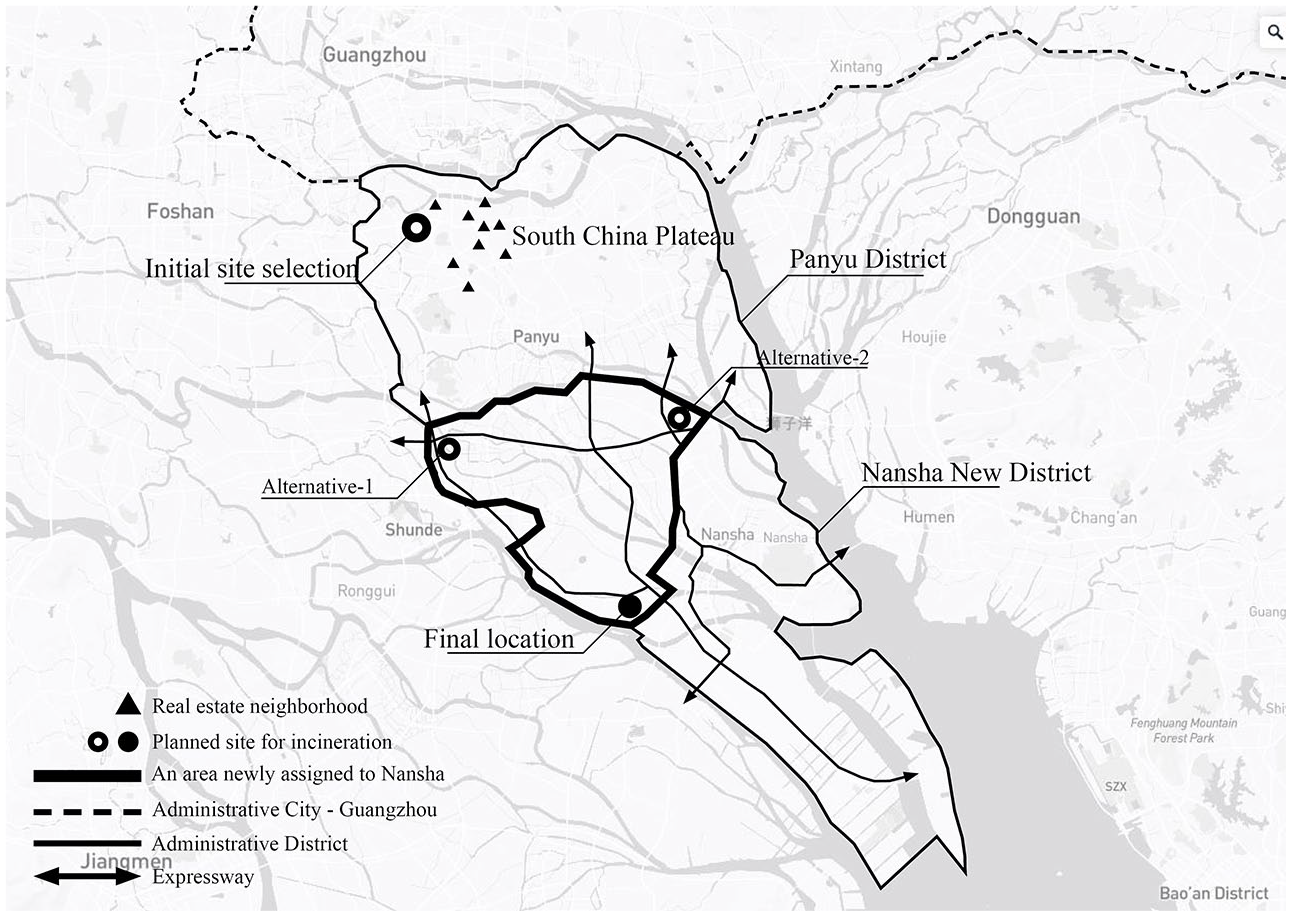
Reterritorialization of waste management areas
In addition to renaming the plants and changing the location, the government also created a public participation platform. The Guangzhou Solid Waste Public Advisory Committee was established in August 2012 with 30 members, including 19 representatives of the public and 11 technical experts.(91) The committee was to be renewed annually. Its responsibilities included overseeing waste disposal, organizing urban public forums and holding panel discussions on key technical topics about waste treatment.(92)
However, these governance innovations remained performative. First of all, under the banner of “resource power plants”, WTE is not truly marketized. Although market mechanisms such as WTE power acquisition and the BOT model have emerged, Guangzhou’s WTE incineration still relies on state subsidies and investment by monopolistic state-owned enterprises. An incineration plant employee raised financial issues in the interview: “This plant is not profitable. It is not even self-sustaining. The income from this little power generation cannot possibly cover such high costs. In fact, we are mainly doing waste treatment, and the government subsidizes us with waste disposal fees.”
An employee at another incineration plant was unwilling to discuss the issue of revenue in the interview, but repeatedly emphasized the fact that they were a state-owned enterprise: “I want to reiterate that we are a SOE, and we have to take social responsibility [. . .]. Actually, a big part of our side is technology investment and research. Is it possible for a private enterprise to get it right?”
In fact, the concept of “resource power plant” is largely designed to legitimize the involvement of the state-owned enterprises as a new financing platform and to shape the imaginary ecological value of incineration in the context of the new social discontent. This can be understood as a process of reconceptualization.
The subsequent relocation of the planned Panyu incineration plant represented a temporary transfer of environmental risk. It is noteworthy that this relocation was not solely driven by the capital logic of moving the plant to the urban periphery to allow for a sanitized, valorized city centre.(93) Instead, the Chinese local state undertook a larger scale replanning of waste management areas. Guangzhou’s Nansha District, designated as a New National Zone in 2012, is a centre of future development and clearly not peripheral. Yet the incineration plant was sited here both to avoid the politically sensitive area of Panyu and to prepare for future waste disposal in the new district. This governance mechanism is conceptualized here as state-led reterritorialization.
Of course, this move does not actually address the public’s concerns regarding potential pollution from the incineration plant and is essentially another type of performative governance. With the rapid real estate development in Nansha District, scepticism about incineration has since resurfaced in online forums, although it has not yet sparked further protests.(94)
The Solid Waste Public Advisory Committee’s substantive promotion of public participation in incineration construction has also been limited. Committee members are appointed by the government’s waste management office, making the Committee essentially a subordinate organization within the government bureaucracy. The Committee also lacks autonomy in terms of funding. It is not permitted to maintain a separate account or generate its own income, but relies on subsidies from higher levels of government.(95) Together, these two factors limit the Committee’s ability to independently set discussion topics and organize public events, significantly restricting its members’ capacity to influence decision-making.
This public participation mechanism in China functions as a shadow infrastructure, confining social conflict within a smaller site of accountability and a bureaucratized field of governance filled with official notices, hearings and policy documents, where the state holds a distinct advantage in interpretation and obfuscation.(96) True infrastructure problems are instead invisible to the wider public. Drawing on Chu’s argument,(97) I refer to the establishment of public advisory committees in Guangzhou’s waste incineration development as the bureaucratization of infrastructure.
VI. Sociocultural embeddedness of incineration: culturalization and codification
Street protests and collective petitions subsided after 2011. However, one type of grassroots action persisted from the previous wave of protests and sparked street protests again in 2013–2014: the waste sorting campaign.
In 2010, Guangzhou accelerated the pace of its waste incineration programme and began to plan for another five “resource power plants” – the third to seventh. This is known as the “great leap forward” in the development of waste incineration in Guangzhou.(98) One interviewee recalled: “It was still a shock to hear the news. Panyu is such a big deal. They’re doing seven at once? This shows the government’s attitude hasn’t changed, so it’s useless to do anything. [. . .] We have always proposed, opposed, petitioned and so on. This time we said let’s try to do it ourselves. That led to some of the actions that you have seen.”
Since then, several coalitions have emerged, each with the primary goal of waste sorting. Examples include the Zero Waste Coalition, Green Family and Eco-Guangdong.(99) These coalitions formulate their own rules and regulations for waste classification, encourage families to volunteer, and sustain their daily operational costs through the sale of recyclable waste. Their objective is to spontaneously implement an alternative waste management model, challenging the government’s reliance on incineration. These actions represent a form of anti-incineration protest based on everyday grassroots practices at the neighbourhood level, which Lin and Kao refer to as “Chinese eco-urbanism from below”. (100)
Waste sorting became an important social demand in the new wave of protests around 2013–2014 against the great leap forward of incineration, especially in Huadu and Baiyun Districts. A resident from Baiyun District expressed frustration, stating, “Waste sorting has been discussed for so many years; has the government actually implemented it? In the end, it’s still incineration.” Protesters also displayed banners with messages like, “Do a good job of sorting waste, and the incinerator doesn’t even need to be built.”
Once again, an adjustment of the governance mechanism was activated. The initial step was to address the public demand for waste sorting through a series of policies and regulations on waste sorting between 2010 and 2011. This included initiatives such as the “Guangzhou Waste Sorting Pilot” and the “Guangzhou Interim Provisions on Waste Sorting”.(101) In 2014, the government initiated the “Guangzhou Waste Sorting Walk of Ten Thousand People”, which saw the participation of 11,000 individuals. This event served as a momentum-building activity for the selection of the “National Demonstration City of Domestic Waste Sorting”.(102) Furthermore, from 2011 to 2015, the Guangzhou government undertook a large-scale deployment of waste sorting infrastructure. This encompassed the retrofitting of all existing garbage bins, the construction of waste sorting stations in communities and the mobilization of the public to adhere to scheduled garbage disposal intervals.
As the industry expanded, both the government and GEPIC recognized the need for a new governance model to counter the negative public perception of incineration on a larger scale. An innovative policy change emerged: the transformation of incineration plants into “ecological environment science popularization education bases”.(103)
By 2020, the third “resource power plant” gained national recognition as an AAA scenic spot.(104) Subsequently, the sixth and fifth incineration plants located in Zengcheng District and Huadu District were also designated as national AAA scenic spots in 2021 and 2022 respectively.(105) In 2022, the third incineration plant was further selected as one of the second batch on the Guangdong Province Industrial Tourism Excellence Route List.(106) Although guided tours had been initiated by the government before, the transformation of incineration plants into tourist areas has become a symbol of the cultural turn in Guangzhou’s waste management. These tourist areas are intended to serve as exhibition and education venues, introducing waste incineration technology and promoting waste sorting to the public.(107)
The next new mechanism was the digital governance of incineration plants. At the request of the central government, all incineration plants in Guangzhou joined the national monitoring network and published real-time data related to pollution on an online platform. These data include the daily average values of five pollutants (particulate matter, nitrogen oxides, sulphur dioxide, carbon monoxide and hydrogen chloride), furnace temperature profiles and related information.(108) Incineration plants in Guangzhou have also installed automatic monitoring equipment and display data on electronic screens at the entrance of the plants.
It can be seen that this round of governance adjustment is significantly different from others. The government embraced the bottom-up agenda of waste sorting and has attempted to make waste incineration more visible and transparent. However, this new round of governance remains performative.
One of the problems is that waste sorting is not supported by a sustainable local governance mechanism. Despite top-down policies, sorted waste was for a long time simply mixed again and shipped to incineration plants. This problem was exposed by the media in 2019. Guangzhou city management then stepped up its supervision and reform of waste sorting at the community level.(109) But the sudden onset of the COVID-19 pandemic in 2020 slowed the waste sorting reform. An employee of the incineration plant mentioned in the interview that “The current waste sorting does not have much impact on us. Guangzhou waste sorting wasn’t very strict before. Then the pandemic stopped it. [. . .] But the neighbourhood where I live is still very strict these days.”
Although the role of waste sorting is limited, it is increasingly culturally embedded in citizens’ everyday lives, evident in the ubiquitous waste sorting stations, the promotion of “waste sorting as a new fashion”,(110) and the rhythmic governmentality of regularly disposing of waste. Citizens are being moulded into self-governing performative subjects, while distancing themselves from the more radical debates on technological routes, such as the 2011–2013 waste sorting campaign.
Despite the philosophical difference between waste conversion represented by incineration and waste reduction represented by sorting and recycling,(111) in Guangzhou, the great leap forward of waste incineration and the widespread promotion of waste sorting have occurred almost simultaneously. A major reason is still that government-led waste sorting is essentially a performative response to the anti-incineration activism, paradoxically supporting the legitimation and further development of the incineration agenda.
Meanwhile, the transformation of incineration plants into tourist areas is also a performative practice. At the Fushan incineration plant, designated as a national AAA scenic spot, a large area with newly constructed basketball and tennis courts remains practically unused (Figure 2). During the interview, the staff admitted: “The main reason for building these courts is for the subsequent evaluation of the 4A level scenic spot. They require these facilities. [. . .] How they will be used afterwards is not yet known. Hardly anyone will actually come up here to play. People will have to make reservations and be checked.”
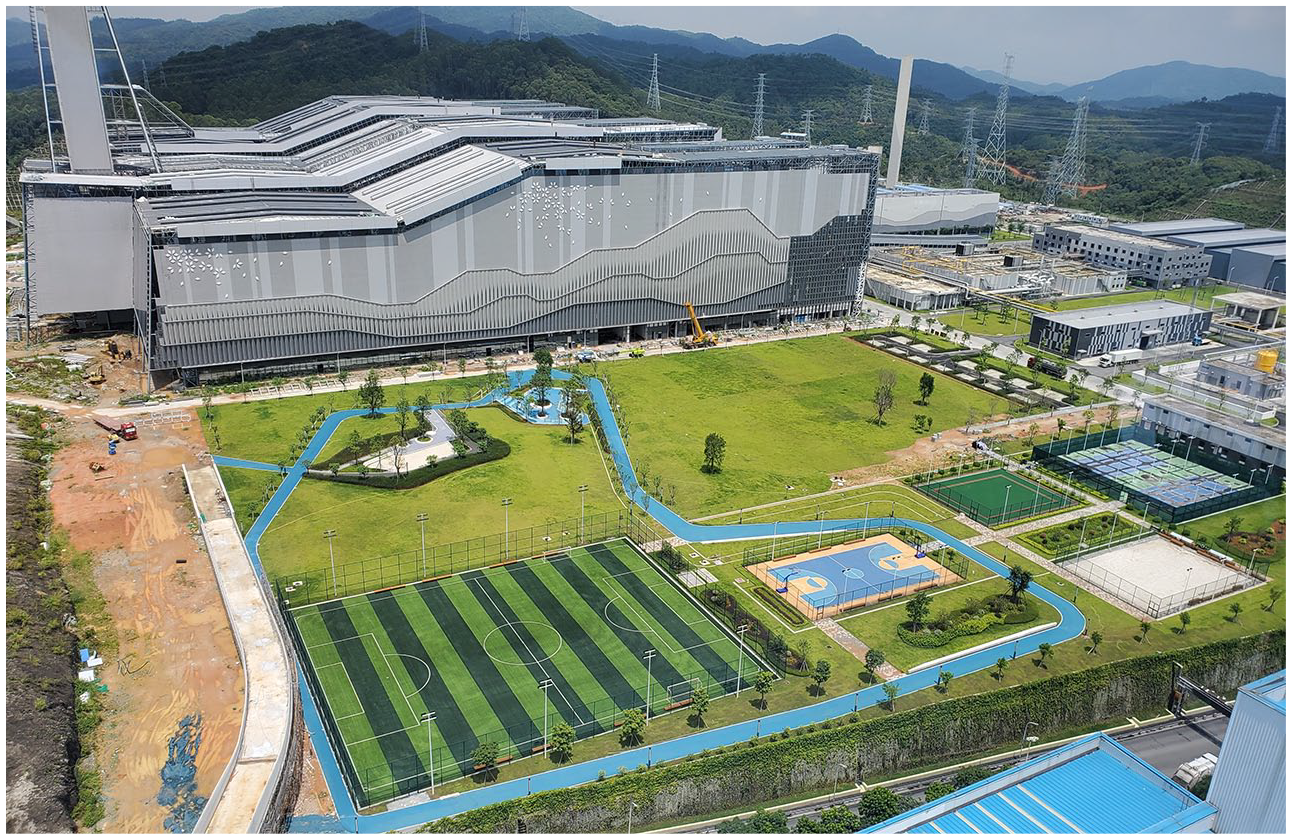
Incineration plant transformed into a AAA tourist area
Due to the peripheral location of most incineration plants, few individual tourists make the journey. Likeng, for example, exclusively accommodates group visits. According to Likeng’s reception staff, these group tours are primarily organized by government departments, primary and secondary schools or state-owned enterprises. One tourist also mentioned that they were participating in a company-organized party learning activity that day, not a commercial tour group.
Two new concepts are introduced here to explain the restructuring of governance mechanisms in this context: culturalization and codification. The former highlights the better integration of waste infrastructure with socio-cultural governance through sorting practices and urban tourism. The latter draws on Frey and Schädler’s discussion of codified energy,(112) arguing that state-led digital platforms are making the waste incineration process quantifiable for public scrutiny. Emerging under the great leap forward of incineration and the everyday activism of anti-incineration (e.g., waste sorting from below), these two new governance techniques are clearly different from the previous more localized response focusing on individual incinerators, but rather attempt to more proactively embed waste infrastructure and relevant waste management processes into the daily lives of citizens.
VII. Discussion and conclusion: performative legitimation of infrastructure as a material-discursive process
WTE is a key strategy for achieving a low-carbon urban transition. With what Rodenbiker referred to as the “ecological turn” of Chinese state governance,(113) the central government initiated a nationwide pilot programme for low-carbon cities in 2012 and included waste incineration in the first national list of key low-carbon technologies in 2014.(114) However, focusing on the development of waste incineration in Guangzhou over the past three decades (1993–2023), it is clear that incineration, labelled as a national low-carbon technology in recent years, is actually materially and discursively produced at the local level through a prolonged process of state–society conflict, and that its primary objective is not energy transition and low-carbon markets, but managing the overaccumulation of waste under rapid urbanization and legitimizing this management agenda in the face of social discontent. Renewable energy is indeed being generated, but only as a by-product of this waste management regime as it emerges.
In line with calls to rescale China’s environmental governance and focus on what some scholars are referring to as the “local environmental state”,(115) this paper draws on Ding’s “performative governance”(116) as a theoretical tool to examine how the city government uses certain language, discourses and gestures as performative practices to give citizens the impression that waste incineration represents “good governance”. Moreover, by bringing in the concept of “legitimation” in Chinese state–society relations studies,(117) this paper further introduces the framework of “performative legitimation”, which is useful for processing performative governance in order to analyse governance adaptation amid ongoing social protests. Drawing on the case of Guangzhou, the paper has discussed five specific performative governance mechanisms that contribute to the process of performative legitimation: (re)conceptualization, reterritorialization, bureaucratization, culturalization and codification (Figure 3).
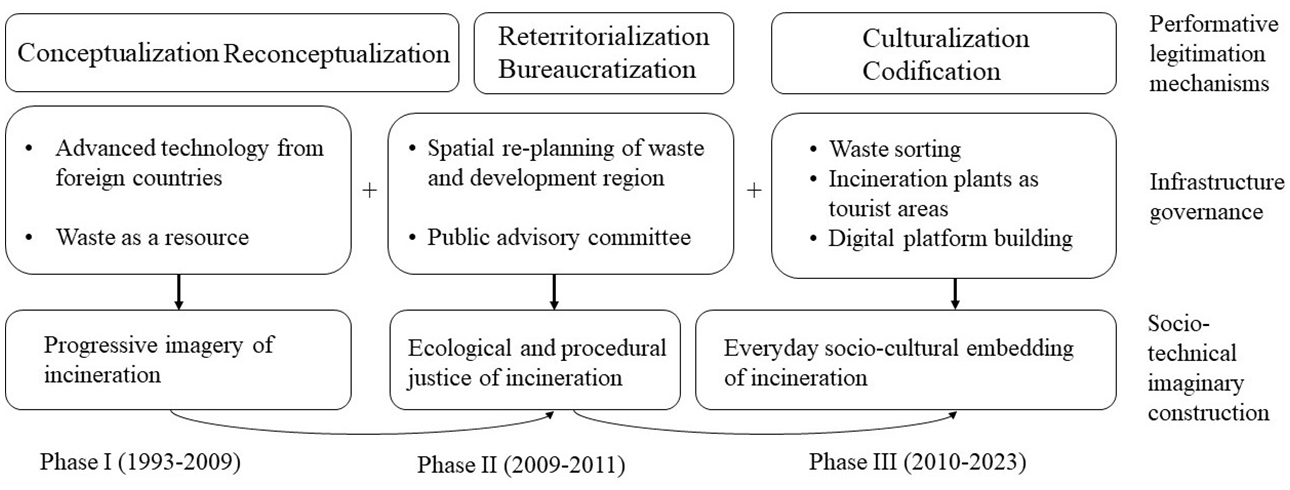
Performative legitimation of infrastructural governance
The evolution and layering of these governance mechanisms in Guangzhou reflects the responsive environmental authoritarianism of the Chinese local state in the face of public scrutiny. The logic of governance adaptation is mainly based on social demands that evolved under different phases. The context of Phase I was the technological transition of waste management from landfill to incineration. The main resistance was the bad impression that peri-urban villagers had of the old technology of landfilling. Phase II was a period of waste industrialization, accompanied by the deployment of incineration plants near the city centre and the involvement of monopolistic state-owned enterprises. The newly protesting middle class had a stronger consciousness of environmental and rights protection than the earlier protesters, and began to pay more attention to ecological risks and public participation issues under government–business collusion. The third phase was the period of the great leap forward of incineration. The new wave of anti-incineration represented at the same time by the sorting campaign was no longer confined to the incinerator itself but sought to fundamentally challenge the government’s technological path dependence on incineration with a form of everyday grassroots activism.
Corresponding to these phases of protest, evolving governance mechanisms have continued to legitimize the dominant waste management agenda (i.e., incineration) and construct regulated infrastructural social imaginaries. The (re)conceptualization emerged in the first to second phases, with the aim of introducing the new technology to two different protest groups, villagers and the emerging middle class, by emphasizing the progressive and the ecological nature of incineration respectively. Second, in the face of the more radical activism of the second phase, reterritorialization and bureaucratization served to redistribute the political space of infrastructure governance on a larger scale. The relocation of incinerators and the creation of participation platforms depoliticized infrastructure for politically sensitive communities while consolidating dominant management and development agendas (e.g., in the Nansha New Area). Finally, culturalization and codification contribute to the socio-cultural embedding of waste infrastructure to better respond to everyday activism such as waste sorting campaigns. Incineration plants transformed into scenic spots essentially serve to further promote the state-led waste management system in the form of an “education base”. The quantified incineration emissions on the online platform also provide a window for everyday public scrutiny.
However, these governance actions are largely performative, catering to citizens’ ecological and socio-technical imaginaries of WTE incineration, but at the same time obfuscating the real developmental logics and political-economic processes behind them, such as the financing mechanisms, the land-use planning, the bureaucratic systems and the mechanisms of waste sorting operations. This obfuscation makes waste incineration seem progressive, resource-saving, low-carbon and democratic, but it also obscures the common failure to fulfil performative infrastructural promises, including unrealized green spaces, the lack of marketable renewable energy production, potential pollution of the Nansha District, symbolic public participation, scenic spots without tourists and the mixed shipment of sorted waste, among other problems. But the hidden nature of these failures is often only temporary. The revelation of some of these inside stories may trigger a new round of social discontent, which is essentially an unintended consequence of performative governance.
Of course, critical analysis through the lens of performative governance actually implies an expectation of more substantive governance. Ding(118) emphasizes that not all governance remains at the performative stage. Substantive environmental governance is also possible with changes in technology and political capacity. First, the replacement of landfill with incineration does in fact provide a new source of electricity. With Guangzhou announcing “zero landfill” for municipal solid waste in 2021,(119) waste incineration could already provide 3.527 billion kWh of electricity in 2022, accounting for about 3.2 per cent of the city’s total annual electricity consumption.(120) Also promising are the ongoing reform of the waste sorting and recycling mechanism and the establishment of a nationwide digital platform for monitoring incineration after 2020. These measures have the potential to substantially contribute to incinerator energy efficiency, alternative waste governance experimentation and the transparency and democracy of the incineration process. These may be important topics for future research.
