




Abstract

I. Introduction
This special issue focuses on scaling up the participation of residents and their associations in planning processes. The need to consider this aspect of participation has long been recognized; indeed, the capacity to go to scale is increasingly seen as essential to successful development initiatives. What is equally well recognized is the failure of multiple efforts to respond adequately to this need for scaling. The papers in this collection explore many facets of the challenge of securing meaningful participation at scale. They clarify the fact that going beyond a local focus means not simply replication but engagement at higher levels of complexity, with a more challenging set of actors and potentially more contested power relations. As Beatrice De Carli and Alexandre Apsan Frediani emphasize in this volume, this means engaging with “the more conflictual, structural factors that underpin city making”. Together these papers help to explain why scaling has been so difficult and suggest ways in which it might be advanced.
If there is a simple message behind this collection, it is that understanding efforts related to scaling participation means recognizing the contradictions playing out in towns and cities across the global South. From one perspective, the momentum behind participation appears almost inevitable as citizens push for substantive inclusion in decision making. The legitimacy of their demands for inclusion results in numerous efforts to institutionalize a positive response. But the spaces opened through such institutionalization often appear to undermine rather than support substantive participation. Citizen groups struggle to make state-supported participation work for their members, but they can also disengage in frustration and disappointment.
This introduction begins by providing a typology of approaches to scaling, and an analysis of the problems that efforts to scale have encountered. We encounter examples of scaling “within”, as local organizations work to grow in strength, and scaling “out” to link with other neighbourhoods. Initiatives also scale “across” from one service or activity to another, and scale “through” as groups or communities use what they have learned from one activity to take on more complex needs. The most pervasive theme in this volume, however, is that of scaling “up” from efforts at the community level to those that work to ensure policy reforms and institutional support for local citizens’ efforts. As demonstrated by several papers in this volume, this is not necessarily a route to successful scaling.
Citizens press to be more involved in governance decisions that affect their lives. Collectives of various forms have clearly been successful in their efforts to be more involved in state decision making, and there has been an abundance of efforts to institutionalize participation building on these experiences. However, institutionalization emerges as problematic. One of the challenges encountered in these papers is what happens when these scaling-up efforts are driven from above with formalized citizen engagement. As demonstrated by experiences in Brazil and Mexico, described below, these efforts can be counterproductive, as top-down legislated opportunities fail to create adequate spaces for entrepreneurial citizenship and innovation. They can also be easily subverted, as real estate interests, residents of a higher social status, and state officials and politicians manipulate these spaces to exclude the marginalized and address the interests of the powerful.
Civil society does not passively accept this subversion of their efforts to advance participation. A staple of this journal has been the history of city-wide organizing by residents’ associations, grassroots federations and community groups.(1) While only a minority of the papers in this issue follow this bottom-up trajectory, the papers by Sally Cawood and by Philipp Horn certainly highlight the significance of these efforts, and I expand on this below.
This editorial frequently refers to citizens. The intent is not to restrict the discussion to those with a legal status. Rather, the term is used here to refer to those with a desire to participate fully in the societies in which they find themselves irrespective of formal citizenship status. The use of the term is also intended to recognize the people engaged in participatory processes beyond their identity as inhabitants of a particular space, or members of a particular group, be it defined by ethnicity, age or gender. Citizen is a term that implies a broader consciousness and membership in an expansive collective that challenges divisive and exclusionary boundaries, and that brings with it rights and entitlements, along with obligations.
The structure of this editorial is as follows. The following section (Section II) presents the typology of ways in which participation can be scaled, and it explains where the papers in this volume are located in terms of this typology. Section III then discusses these papers within a broader summary of recent debates in relation to participation, with particular attention to the key challenges involved in scaling participation. The fourth section concludes.
II. Modalities And Strategies For Scaling Participation(2)
The papers in this volume illustrate the multiplicity of directions in which participatory planning and development can be scaled (as summarized in Table 1). The papers discuss strategies and activities used to further these ends.
Types of scaling as exemplified in this volume
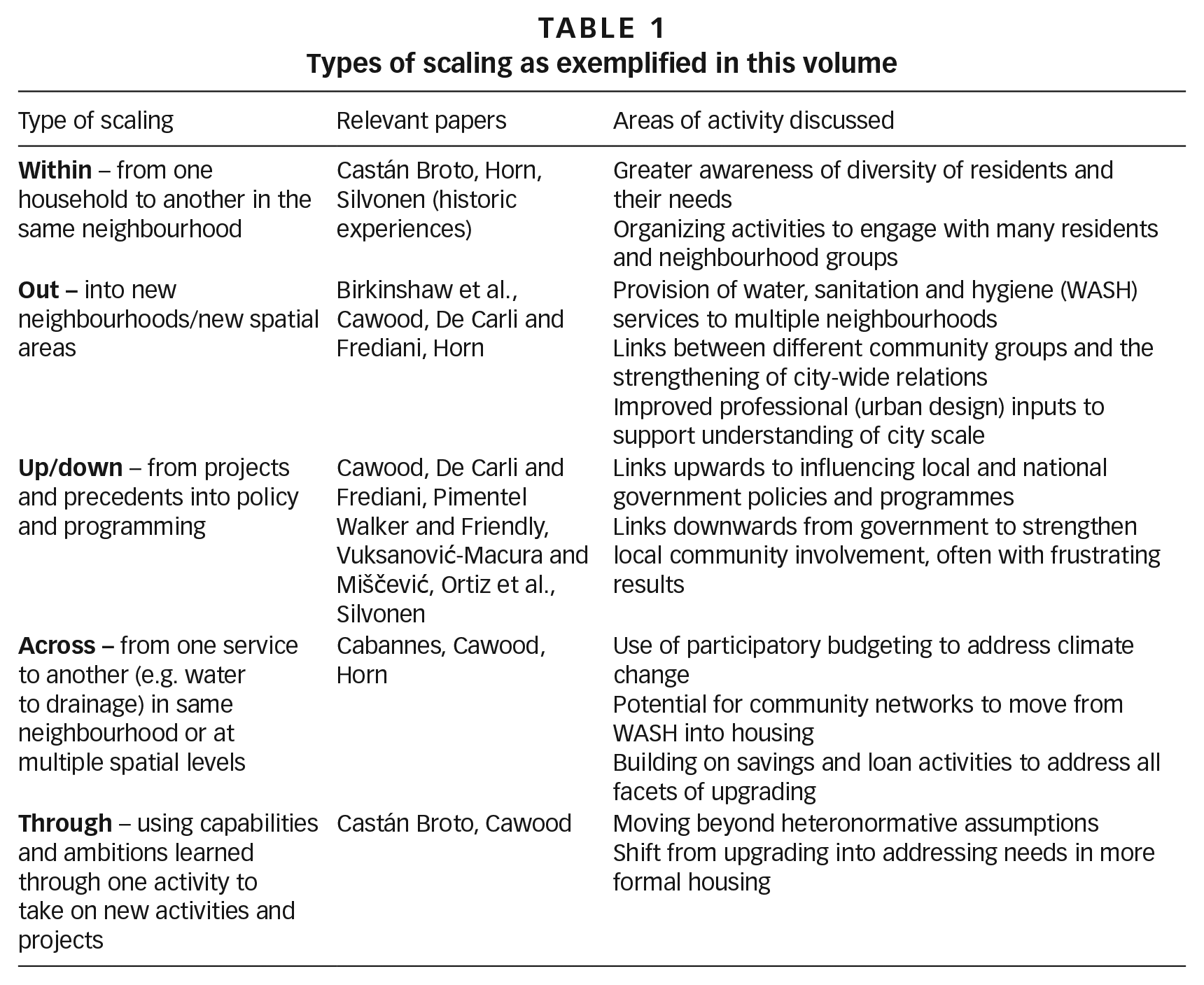
Participatory efforts that seek to build a critical mass of organized citizens focus on scaling both “within” and “out”. On the one hand, this means building stronger local organizations able to take on more complex local projects. On the other, it means linking to other neighbourhoods and strengthening the capability of residents’ organizations to collaborate and so contest anti-poor development plans and projects. Horn describes in detail the strategies used by the Muungano Alliance, which is scaling out from successful neighbourhood development elsewhere in Nairobi into this informal neighbourhood where residents have settled on privately held land. To ensure that as many residents as possible take part, both for democratic reasons and because of the opposition to upgrading, considerable efforts have been made to build close relations, and to ensure that local voices have input into the participatory plan.
Vanesa Castán Broto highlights another aspect to scaling within, when she articulates the need for neighbourhood participation to include those marginalized by heteronormative approaches. Her interest goes beyond the superficial inclusion of a marginalized group, however, as she explains that the queering of participation implies a deeper awareness of the diversity of needs within a community.
Scaling “up” implies connecting with or influencing more complex institutional structures. Many NGO project proposals explain the effectiveness of their approaches by suggesting that they will succeed in scaling “up” local community innovations, expanding local projects that support emancipation, and ensuring institutional support for citizen efforts. De Carli and Frediani explain how an awareness of city-wide processes by neighbourhood groups strengthens local participatory planning processes, challenging a narrow local focus and strengthening a politicized understanding of the problems that informal residents face. Earlier papers, for example the Environment and Urbanization special issue on citizen innovation in Asia, also showed the benefits to local communities of a city-wide understanding.(3)
Such efforts to scale “up” can also focus on catalysing policy and programming reforms. A positive experience on this front in Serbia is reported here by Zlata Vuksanović-Macura and Igor Mišcˇević, who discuss participatory approaches to engaging an excluded ethnic minority, the Roma community. The initiative was instigated by a national policy commitment, the Strategy for Social Inclusion of Roma in Serbia, which made a commitment to develop regularization and improvements for at least 50 per cent of Roma settlements (around 300 settlements) by 2025.
As in this case in Serbia, scaling “up” can actually involve scaling “down”. Many of the papers here discuss this reverse process, with formalized government programmes theoretically providing opportunities for participation. Brazil’s public policy councils, for instance, described by Ana Paula Pimentel Walker and Abigail Friendly, are supposed to provide space for marginalized groups to participate in formal processes; and Taru Silvonen describes formally supported practices of citizen participation in Mexican neighbourhoods. Both papers, however, focus on the challenges, describing the ineffectiveness of these formalization efforts and how difficult it has been to realize the benefits of scaling up.
Scaling “across” from one service or activity to another is well illustrated by Yves Cabannes, in his discussion of the expansion of participatory budgeting into climate change mitigation and adaptation. His study of 15 cities highlights the significance of citizen involvement in this regard, allowing citizen priorities to come to the fore, and projects to reflect local knowledge:
“These groups are certainly the change agent in the more climate change-sensitive PBs. In their multiple forms they are essential to identifying the projects best equipped to address the climate change effects felt by communities, and in most cases they define how and where they should be implemented. For instance, in the case of flooding, they indicate where to widen clogged water channels, thereby optimizing scarce resources.” [emphasis in original]
Horn also demonstrates this type of scaling in Nairobi through the development of an integrated plan for Mukuru’s upgrading with eight distinct service areas.
Scaling “through” takes place as communities use the skills and experience gained through one activity to take on projects that demand greater capabilities and address more complex needs. Cawood’s discussion of the city-wide networks in Dhaka describes the development options provided by NGOs and their motivation to support members to demand better choices. Success leads to more ambition, as goals previously seen as unattainable are considered possible. However, Cawood also describes the frustration of the city network leaders with these NGOs, and shows how adverse shifts in the funding context and increased demands by political parties for enhanced loyalties have raised new challenges for these networks and reduced the space available to them.
Just one paper in this collection refers to scaling “between” institutional bodies, rather than focusing on citizens. Patrick Brandful Cobbinah and Valentina Nyame, writing about the rapidly declining urban green space in Kumasi, Ghana, discuss the conflictual relationship between government planners and traditional authorities, and stress the importance of more collaborative decision making in the management of this critical resource.
III. Debates, Deliberations And Practices
Citizen participation in local planning and development processes has long been recognized as essential both for equitable democratic citizenship and for effective interventions that recognize and respond to everyday lived realities. This is true of very localized efforts to replan and redevelop neighbourhoods, as well as larger-scale initiatives. There have been multiple efforts across towns and cities of the global North and South, many of them successful in gaining some traction. But, as noted with regard to the current set of papers, too few initiatives have expanded or grown upwards and outwards to address the extent and the depth of the need at the city scale, be it through citizen-generated engagements(4) or through formally initiated arrangements.(5) Here I discuss what this volume’s papers add to the context of current debates and practices.
Existing approaches to inclusive planning, both top-down and bottom-up, have generally failed to address the needs of disadvantaged urban populations in the global South.(6) While these participatory approaches have had some success in terms of empowerment, efficacy and efficiency, they have not been the promised panacea. Horn et al.(7) argue that this is, at least in part, because inappropriate solutions have been applied in attempts to scale these processes to a level appropriate to the need. This lack of progress reflects a failure to fully embrace the potential of participation. Academics have long recognized that there is a gap between intent and reality,(8) and that an inadequate analysis of power relations means that some efforts are naïve.(9) Scholars have analysed projects and processes and sought to understand the mixed results. Hickey and Mohan(10) argued that efforts must recognize the importance of rights and entitlements if participation is to lead to social justice. However, in practice, the outcomes from these top-down efforts in terms of both enhanced democracy and stakeholder decision making have been disappointing, and there remains a gap between participatory rhetoric and actual citizen engagement.
Horn et al.(11) argue that decentralization and changes to representative governance have secured some improvements to citizen empowerment and more inclusive and redistributive planning in some urban settings, but their overall impact on participation has been limited. These reforms have expanded over recent decades. Contributions include constitutional reform in Kenya(12) and the 2008 Community Councils Act in Thailand, which gave legal status to residents’ bodies that include representatives from communities as well as all kinds of community groups.(13) At the sub-national level, and with a particular focus on urban-related initiatives, there are Sri Lanka’s Million Houses Programme;(14) the Sida-funded NGO-led informal settlement upgrading programmes, including PRODEL in Nicaragua and FUNDASAL in El Salvador;(15) and more recently the Community Organizations Development Institute in Thailand.(16) One of the best-known examples is participatory budgeting, which first emerged in Porto Alegre (Brazil), where social and community movements demanded greater control over city government spending decisions. It has since spread across Brazil(17) and beyond.(18)
This collection of papers provides further examples of such state-level participation mandates in Brazil (Pimentel Walker and Friendly), Cuba (Catalina Ortiz, Alejandro Vallejo, Jorge Peña, Emily Morris, Joiselen Cazanave Macías and Dayané Proenza González), Mexico (Silvonen) and Serbia (Vuksanović-Macura and Mišcˇević). However, such reforms alone appear unable to nurture a more inclusive politics, and, as articulated by Lines and Makau(19) for Kenya, enhanced modalities of representative democracy may make a limited contribution to citizen participation.
Participatory planning and development is particularly significant for the residents of informal settlements, who are generally among the lowest-income and most disadvantaged urban citizens. However, the nature of the material conditions and social relations in such neighbourhoods means that efforts to impose solutions from above are likely to be ineffective in securing the kinds of improvements that are sought after. They may even exacerbate the problems that residents face – leading, in the most adverse circumstances, to the exclusion from the process of those who cannot afford to take part. Participation is also recognized as significant for other marginalized groups (including low-income families in formal housing or those dominated by other elites), which can also be excluded by the powerful, either deliberately or incidentally, from involvement in state processes that create options and challenges.
Understanding the options for scaling participatory planning requires us to draw on the experiences that have challenged the limitations of current efforts. These have led to an academic reconsideration of the ways that both the state and residents engage in the production, arrangement and distribution of infrastructural networks and service provision.(20) Participation efforts driven from below have led to the emergence of “deeper forms of democracy”,(21) where urban alliances and federations mobilize their collective power to co-produce or co-construct infrastructural and dwelling solutions with greater degrees of autonomy.(22)
These social movements and other civil society groups may seek to incorporate similar components to those in state programmes – both for their substantive value and, perhaps, to increase the likelihood of state take-up.(23) The breadth of civil society ambition in advancing participative development is illustrated by the Asian Coalition for Housing Rights (ACHR) and its programme, the Asian Coalition for Community Action (ACCA), which has supported members to strengthen citizen planning and implementation in hundreds of cities and to scale up to a city-wide impact.(24) A further example is that of the Orangi Pilot Project (OPP) – one of the most successful civil society-led examples, with over a million households securing substantive improvements to sanitation. Their methodologies have been taken up by the government of Pakistan.(25)
This kind of participation has been recognized as entailing positive claim making by disadvantaged groups and their refusal to be marginalized. Participation enables informal settlement dwellers, for example, to avoid “oppositional” roles, which risk delegitimizing their needs and interests. While Holston’s(26) representation of insurgent citizenship has captured an academic imagination, this appears to be a simplified version of the range of strategies used by those pressing for greater participation – including contentious politics, collaborative endeavours and partly visible encroachment – to simultaneously address current needs and improve future prospects.(27) Understanding this complexity helps us place efforts towards greater participation within a broader set of demands for emancipation and democracy. And this requires a feminist understanding – an appreciation that contestation involves more strategies than oppositional politics, especially in a context in which women’s gendered position increases their vulnerability to violence, and to added marginalization from the use of violence.
As significant as securing political inclusion, participation in the context of spatial informality promotes more bottom-up and alternative ways of doing urban development. It offers a challenge to modernist visions of urbanization, urban design and city making. Iconic buildings and town squares, bridges and other urban spaces designed by globally acclaimed architects, exquisitely constructed of expensive materials, cannot be replicated throughout the city because of the cost. A different urban vision is embedded in citizen-led incremental approaches to development with a flexible orientation to diverse local preferences and efforts to improve affordability. Slum/Shack Dwellers International (SDI), one transnational network of organizations of the residents of informal settlements, has developed a portfolio of such methodologies to support incremental development. This is exemplified by Delgado et al.,(28) who illustrate how communities have organized over time to enable the participatory development of informal neighbourhoods in one small town in Namibia, expanding from the Freedom Square settlement to the city scale.
This “bottom-up” incremental development of informal settlements working to co-produce upgrading with local authorities has problematized the role of design and planning professionals.(29) New professional roles and practices have emerged through their active engagement – as equals – with organized communities, as described in the paper in this issue by De Carli and Frediani. This requires, however, that challenges such as the equitable co-production of knowledge are recognized.(30)
Specific and substantive challenges to scaling participation include the following:
Castán Broto’s contribution in this issue refines our understanding of inclusion and brings a further dimension to our understanding of basic needs. She articulates the need for participatory efforts to engage with sexuality and identity, arguing that those with non-normative identities are frequently left out. When they have been included, “participatory planning practices frame gender and sexuality as identity markers of vulnerable groups, rather than thinking of people interested in queer issues as having particular sensibilities and capacities that contribute to collective decision-making”. Castán Broto argues that the sensibilities and capabilities of queer groups, fine-tuned through their lived experience, are well placed to challenge exclusionary boundaries within participation on other fronts as well. Such engagement, she suggests, may return participation to its radical roots. Processes to queer participatory planning will enhance political participation, advance the wellbeing of vulnerable sectors of the population, expand the understanding of the diversity of needs, and potentially bring broader benefits to the wider field of participation. It is not simply a question of including marginalized groups as a matter of their rights. It is also a recognition that their inclusion holds the promise of improving the process by broadening the assumptions on which is it based.
Two further examples demonstrate the significance of efforts to expand understandings of who is entitled to be included and how – Vuksanović-Macura and Mišcˇević’s description of efforts to ensure that municipal planning engages with Roma communities when regularizing their neighbourhoods; and Cabannes’ account of the platform provided by participatory budgeting for citizens to address the climate emergency.
Debates about participation are typically framed in terms of the inclusion of disadvantaged groups. However, Cobbinah and Nyame highlight that even relatively advantaged groups can be excluded from some processes to the detriment of their own responsibilities and the public interest. The authors explain that poor land management in Kumasi has resulted in the decline in available green space in the city, with a loss of 80 per cent in the last 30 years. Underpinning this decline is a conflict between the traditional and statutory authorities responsible for these areas, resulting in the exclusion of traditional authorities from the process. The authors argue that these authorities need to work together for more effective land administration. The statutory authorities need to recognize the significance of traditional authorities and develop processes to enable their participation.
Further aspects of the inclusion challenges are raised by Matt Birkinshaw, Anna Grieser and Jeff Tan. This paper discusses the expansion of a community-managed water and sanitation programme from rural to urban areas in Gilgit-Baltistan, Pakistan. The research finds levels of participation to be significantly lower in the urban settings and identifies a couple of reasons directly related to the challenge of inclusion. First, urban neighbourhoods are more diverse and have more mobile populations. Urban heterogeneity, say the authors, “. . .is reflected in the number of languages spoken: an average of five in urban projects, one in rural projects”. Whether or not inclusion is an issue here, this research draws our attention to the need for a high degree of local engagement (scaling within). Second, because urban projects are more complicated, involving more complex technologies with larger-scale investments, they are more expensive, and the cost of services clearly influences the ability of the lowest-income households to participate.
City-wide organizing challenges isolation and builds solidarity, enabling efforts to secure justice to be better sustained, and ensuring that they are adequately informed. In some cases, that means building an understanding of what elites do to maintain power. In other cases, it means sharing ideas about new approaches to address longstanding grievances more effectively. A taken-for-granted component of these efforts is the significance of place-based organizing. Everyday connections between neighbours provide possibilities for persistent efforts to challenge disadvantage and marginalization.
Cawood’s discussion elaborates on the importance of city-wide networks for low-income informal households in Dhaka. Focusing on three city-wide urban poor networks (BBOSC, NDBUS and NBUS) in Dhaka, a city of 19 million, the discussion outlines the opportunities for scaling participation up (from projects and precedents into policy and programming), out (into new settlements and spatial areas), within (from one household to another in the same settlement), across (from one service to another, e.g. water and sanitation to housing), and through (applying capabilities learned from one activity to new projects). But Cawood’s account also gives full weight to the limits to this scaling up, pointing to overlapping trends in the relationship between the state and civil society that make it difficult to avoid the “deep structures of dependency, patronage and intermediation”.
De Carli and Frediani also recognize the significance of city-wide understandings of participatory processes, adding the route of design to strategies for achieving city-wide scale. They argue that bringing a design-based perspective to localized upgrading initiatives can be a powerful conceptual and practical tool to support horizontal, vertical and deep scaling. They share their own exploration of the ways in which professionals can support such a perspective, drawing on the Change by Design programme of Architecture Sans Frontières – UK (ASF-UK).
As illustrated both by Cawood and by De Carli and Frediani, a political perspective may be essential for communities to advance. De Carli and Frediani illustrate the role that a reflective professional cadre can play in this regard, adding value to grassroots efforts to redefine development options.
Silvonen summarizes the experiences of participation by residents in one low-income neighbourhood in Iztapalapa, Mexico City, drawing on their historical experiences as well as their present-day activities. She describes the efforts of the original residents who settled informally on the site and secured regularization and upgrading through an organic process of participation, and contrasts this with the experience of newcomers who have arrived more recently to occupy social housing and a private residential development. Silvonen expands our understanding of the challenges of institutionalizing participation, showing how the formal structures more recently established by the state have interfered with older local, collective processes. “As the neighbourhood became a more densely populated and fully developed urban area, then, its previous participatory practices were abandoned without the formal citizen participation channels filling the gap.” Inequalities between residents, ineffective local authority action and the growth of clientelist relations (as community leaders were selected for their partisan political affiliations) have prevented the emancipatory dimensions of participation from being sustained. Levels of participation are low now, and Silvonen suggests that residents believe that participation is onerous and brings few rewards.
However, Silvonen’s analysis also raises tricky questions about the potential of bottom-up participation to address some of the more complex continuing urban development challenges. Although site-specific housing and infrastructure needs have long since been addressed, residents still face considerable problems (such as poor water quality and rising levels of crime). But the problems that both original residents and newcomers now face have become more difficult for local groups to solve on their own through local action. Moreover, the modern vision of urban development realized by the authorities, with completed housing and access to a full suite of services, creates dependencies on the state that appear, at least in this location, to have become insurmountable obstacles to more engaged and active citizenship. Without an alternative vision, and the networks that enable power hierarchies to be challenged, residents remain frustrated and disaffected.
Birkinshaw et al. also highlight the challenges for participation in improved urban water supplies because, relative to improvements in rural areas, technologies are complex and expensive, depending on a more sophisticated management and, it is suggested, deterring community members from being involved.
While the state failure to scale participation and the gap between rhetoric and practice are related in part to competing ideologies and a lack of investment in participatory governance, they are also clearly related to a reluctance on the part of authorities to give up power. This reluctance sits alongside efforts to institutionalize empowerment and a participatory and democratic engagement in state processes; hence the contradictions referred to above. Pimentel Walker and Friendly highlight the paradox of state attitudes and actions in two Brazilian cities. Analysing experiences with participatory urban policy councils, they highlight the popularity of the idea of participation but also demonstrate how the practice can be co-opted even when it is supported by legislation. In Porto Alegre, for instance, the urban policy council established to take forward the master plan has been unable to deal equitably with informal settlements and inner-city neighbourhoods. These communities are denied regularization as elites make decisions behind “closed doors”. The authors conclude that legislative efforts to achieve equity are undermined by powerful interests, specifically those related to real estate, upper-middle-class residents and politicians. These experiences are reminiscent of earlier discussions about citizen non-engagement in city-wide planning processes, which remain in the hands of state elites with very limited accountability to low-income residents.(37) Pimentel Walker and Friendly do, however, explain that even when the space provided for community groups on these councils is unfairly co-opted, the process still allows for a greater awareness of urban policy issues on the part of these more marginalized stakeholders, who also then spread the word further.
Ortiz et al. analyse experiences from Havana, explaining the distinctive nature of the Cuban model of participation that has emerged within a long-established single-party political system dominated by the Cuban Communist Party (PCC). The catalyst for state-sponsored participation here is threefold: first, the goal is to strengthen social relations at the neighbourhood level and secure citizens’ active participation in their locality; second, it is seen as a prerequisite for local development, associated with devolved power and increased opportunities for involvement in decision making; and third, it is intended to strengthen a sense of “co-responsibility and social inclusion of the plurality of actors and vulnerable populations. . .[to enable the] . . .social project”. Like Silvonen, they recognize the significance of the historical trajectory of participatory efforts in Havana; their research reconstructs past experiences of participation through key informants who are also embedded in ongoing initiatives. The emerging lessons highlight both the ambiguity of state support for participation and the continuing pressure from below to reform state practices and politics, and to take advantage of whatever space is made available. When the state is weak there are opportunities to advance participation and secure a more egalitarian sharing of powers, which then close down as the state steps back from supporting these efforts.
These experiences from Brazil, Cuba and Mexico all demonstrate the ultimate diffidence of state support. Citizen pressure leads to support from political elites for reforms and the creation of institutionalized opportunities for participation, but these efforts appear unable to realize the intention for which they were instigated. Both a lack of state support and overly formal and inappropriate state processes emerge as problematic to both local participation and to efforts to scale participatory governance. Regardless of the objectives of state support for participation, these papers indicate that powerful local interests tend to control and benefit from the processes involved.
Cawood’s political economy perspective highlights a further aspect of the consequences of engaging state agencies. In Dhaka, changing donor priorities and the consequential shift of NGOs towards ensuring their own organizational longevity have meant that donors have less interest in supporting movements and reforming political processes. NGOs have thereby avoided confrontation with the state but have reduced local opportunities for “participation”. Cawood captures the limited options open to three city-wide grassroots networks in Dhaka, which seek to negotiate the needs and interests of their members. She argues that these networks are adversely embedded within relations influenced by the historical development of the city: “deep structures – entrenched patron–client relations mediated by caste, class, religion and kinship formed in an agrarian, pre-capitalist and pre-democratic Bangladesh (and South Asia more broadly) – continue to confine low-income groups within relationships of dependency” [emphasis in original]. The NGO sector is characterized by partisan party alignments and has increased the networks’ dependency on clientelist relations. Such patron–client relations have become more entrenched due to the strengthening of vertical links of authority. Movements struggle to navigate a conflictual and partisan politics.
In addition to challenges related to inclusion, expansion and formalization are those of finance. Cabannes’ analysis of participatory budgeting to address the climate emergency highlights this important constraint, pointing to the absolute lack of money available to local government in some contexts of the global South. Ortiz et al. also discuss how the lack of finance has prevented participation from expanding in Havana. However deep the political commitment and however well designed the institutionalization of participatory processes, without finance such institutionalization is unlikely to deliver results.
In the face of these constraints, however, it is all the more important to attend to building both citizen capabilities and relational capital.
Silvonen’s account of earlier resident histories also reveals the capabilities of local communities in Mexico City to create, improve and then secure regularization of their neighbourhoods. But local leaders were unable to maintain their community-led processes when the neighbourhood expanded. Newer residents had little expectation (and perhaps experience) of local citizen action, and a partisan politics strengthened clientelist exchanges that local leaders were unable to resist.
In terms of relational capital, the contributions in this issue highlight the multiple groups involved in furthering (and constraining) participation. Citizens build up their
In addition to broadening their social relations by networking with groups across the city, and benefitting from the knowledge that they receive from these connections, various associations, federations and groups participate in alliances with a range of professional agencies to advance their cause. Such alliances help by providing information and knowledge, and by offering connections to elites. They also help grassroots organizations to manage conflict effectively by working strategically with other stakeholders, recognizing that conflict is a means to challenge existing power configurations. The alliances help to minimize the costs of conflict (for example, through a loss of legitimacy to the agenda of low-income groups among elites), and help support a change of strategies away from contestation and towards collaboration through meaningful participation in state processes.
Such alliances can come under considerable pressure, however. Cawood discusses the trend towards NGOs establishing their own community organizations, and some community organizations registering as NGOs, and indicates how this has changed the dynamic of urban social movements and reduced meaningful participation in Dhaka. On the one hand, local residents’ associations are controlled by professional groups with a strong focus on an instrumental objective (service delivery) rather than a democratic rationale. On the other hand, the formalization of community groups (associated with NGO status) has limited local democratic practice. Cawood documents the embeddedness of some network leaders within relations of patronage, securing their personal self-interest, while also affirming their commitment to more value-based processes and supporting the needs and interests of their members. Positive engagements between social movements and professional agencies, along with “multi-sectoral coalitions among WASH organizations, housing NGOs (though few in number), human rights lawyers, community architects and other activists, involving participatory learning and action, could enhance coordination between NGOs and CBOs, and create opportunities to promote scaling across and up” [emphasis in original].
Horn also engages with the complexities of alliance building, explaining how the Muungano Alliance in Nairobi has worked with the county government to scale
“‘across’ to multiple policy areas and [promote] collaboration among different public, private and civil society organizations with relevant thematic expertise. This has been achieved through a multi-sectoral and consortia-based planning model, with seven thematic sector consortia and one responsible for coordinating community organization and communication among the different consortia.”
Vuksanović-Macura and Mišcˇević emphasize the significance of state–society links. Specifically, they conclude that the readiness of residents to participate is influenced by their relationship with local authorities.
“In settlements where the needs of the residents had been ignored by either past or current administrations, a high degree of dissatisfaction and concern hindered an active involvement in the process. . . On the other hand, if the development of the plan was a continuation of previous activities in which the municipality and residents participated, then the majority of the settlement inhabitants tended to be involved in the process.”
IV. Conclusions
Five conclusions emerge from these papers and broader considerations.
However, it is also clear that this is a dynamic process. The conclusions that follow here reflect the ways in which civil society agencies are engaging with the challenges they experience. Residents, their organizations and professional support agencies continue to advance efforts to be involved in policy, planning and programming. Arguably, multiple experiences with institutionalizing participation, and subsequent frustrations about the outcomes, have sharpened understandings about what is required. At the same time, attention to efforts that scale through, within, across and outwards provide the foundations for more effective participatory processes, and nurture development alternatives and social transformation.
Second, civil society uses
This city-wide scope also greatly expands the potential for collaboration with a wider group of agencies including NGOs, professional agencies, grassroots organizations active in different sectors and social media. De Carli and Frediani explain the significance of recognizing the city scale:
“we understand our adoption of a macro, city-level perspective as a conceptual and practical tool to support horizontal, vertical and deep scaling: one that allows for building a situated, bodily and spatial-material dimension into scaling processes. Through participatory design methods, the macro scale aims to deepen residents’ and partners’ understanding of city-wide dynamics and their own positions in relation to them, so that they can reach out and up to other places and stakeholders.” [emphasis in original]
In this way, they suggest that “. . .design methodologies can contribute to social mobilization, expanding the range of devices and rituals that grassroots groups and their support networks can put into practice to scale participation”. As importantly, these authors demonstrate a self-critical and reflective professional practice and a value-based orientation to their work.
Democracy creates useful opportunities for communities, and effective local organizations seek to use these opportunities. In this process, community members become planners and implementers. However,
In terms of contesting existing power configurations, Castán Broto calls on those involved in participatory planning to challenge normative approaches and acknowledge the significance of difference. She describes the alternative as “a process of cultural erasure: any strangeness or deviation from an externally imposed norm is covered up and ignored”, and she demands greater recognition of the fact that “queer is an intensely racialized and dispossessed category”. Engaging with this challenge of inclusion moves forward processes that address and overcome multiple forms of marginalization. Scaling, through this lens, has limited worth unless it deepens as it grows. By extension, to do this it has to undermine normative assumptions of all kinds, and so prevent their repressive consequences.
The importance of participation being consciously embedded in a political process is highlighted by Cabannes’ contribution on participation and climate change. Addressing climate change also requires an engaged citizenry. It has to be a political priority because of the magnitude of the problem and what has to be achieved, but also because citizens have insights into what needs to be done, and how it can most effectively be realized.
Citizens will continue to press for political inclusion and – as significantly – for active engagement in their own neighbourhoods. People’s motivation to be engaged resonates through these papers, even where there are frustrating limitations. The material benefits of that engagement are also evident in this volume. Political responses provide new opportunities and new challenges. In this context, exchanges and knowledge generation across cities and among communities, their organizations, and committed professionals and academics appear critical. New efforts have to build on past failures to realize the “right to the city” and consolidate these gains. Efforts to climb Arnstein’s ladder have been thwarted by unexpected snakes – to create an analogy with a childhood game – and what is clearer than ever before is the reality that democracy and participation are mutually constituted. Actors have to recognize the power and nature of structural constraints, but refuse to be daunted in their efforts. If history teaches us anything, it is that the unexpected is possible and new directions are forged by those with organizational tenacity, individual conviction and a collective imagination.
Footnotes
Funding
The discussion in this introduction benefited from interactions supported by the Leverhulme Trust who funded and international network “Achieving inclusive cities through scaling up participation planning in Africa” at the University of Manchester between 2018 and 2020, and from an international workshop co-funded through the network and the Hallsworth Conference Fund (University of Manchester).