




Abstract
The COVID-19 pandemic has had disproportionate economic consequences on the urban poor, particularly on young people living on the streets. As the pandemic moves from acute to chronic phases, novel methodologies can be used to rapidly co-produce outputs and share learning opportunities with those living in urban poverty. A “story map” focusing on the effects of the pandemic and lockdown was co-produced by UK researchers with street children and youth and practitioners in Harare, Zimbabwe in June 2020. Story maps are web applications combining participant-generated visual media into online templates, with multimedia content supported by narrative accounts. This story map reveals young street participants’ experiences of lockdown, including the effects on their livelihoods, sources of food and support networks. Its purpose is to tell the “story” of street lives, and to provide an advocacy tool and learning resource for policymakers, academics and practitioners working with young homeless people.
Keywords
I. Introduction
The effects of COVID-19 on communities have been uneven across the world, with disproportionate economic consequences for those living in poverty and dependent on informal and insecure sources of work. A median age of 18.7 in sub-Saharan Africa (SSA) compared to 41 in high-income countries,(1) as well as the lower number of tests being carried out,(2) may be contributing factors in fewer reported cases and deaths from COVID-19 per capita than in Europe, Asia and the Americas. Yet high levels of urban informality and homelessness mean urban SSA communities remain vulnerable to both direct and indirect effects of the pandemic. Due to the economic impact of lockdown, globally an additional 49 million people will have been pushed into extreme poverty by the end of 2020, 23 million of whom are living in SSA.(3) Populations resident in informal settlements and on the streets face especially challenging conditions, since many have neither access to the hygiene facilities needed to reduce risk of transmission, nor the safe spaces required to practise physical distancing and isolation.(4) Moreover, top-down public health approaches to the pandemic, where state policies seek to reduce risk through “de-densification” or containment of populations within informal settlements, are particularly damaging for the urban poor.(5) A better understanding of the daily challenges for those coping with informality and homelessness, including street youth, is essential to more informed responses.
For practitioners and policymakers, research conducted with people living in poverty is a means of learning and understanding their needs and everyday experiences, and is essential to planning effective public health responses.(6) Novel methods that facilitate the inclusion of unrepresented voices have long been recognized as an ideal to design equitable policies and to raise the efficacy of public health interventions.(7) In the context of a fast-moving crisis, as the pandemic and lockdowns continue to place additional strain on impoverished economies and exacerbate marginalization, this need has become more acute. While using participatory visual methodologies in urban environments with street children and youth is well established,(8) new spatial media are shifting the boundaries and reach of qualitative and multimedia outputs within co-produced research. Part of the “digital turn”,(9) these novel methodologies enable geographers to co-produce through engagement with digital technologies, working with participants to combine media that reflect their own “knowledges”(10) and to share the power of production more evenly.
This paper presents the experience of such a novel method in a collaboration between researchers in the UK and street workers and street youth in Harare, Zimbabwe to produce an online story map that shares the experiences of street youth during the pandemic. Story maps are web applications (in this case accessed via institutional licences to ArcGIS) that combine participant-generated multimedia into online predesigned templates. As a participatory methodology, these new technologies allow participants to determine the content. They decide on the locations and people to be included and the method of capturing data, whether through photographs, short videos or sound recordings. Entitled In the Shadow of a Pandemic: Harare’s Street Youth Experience COVID-19 (https://arcg.is/1q4WvH), the story map described here used this participatory approach to capture and share individual experiences at a particular time and place. Story maps can include interactive maps and satellite imagery; In the Shadow of a Pandemic opens with a map of Harare, but deliberately underutilizes this technology in order to protect participants’ locations. As an online resource, story maps can be shared internationally as advocacy tools for change. However, there are also limitations: because they require access to a computer or mobile phone and an internet connection, as well as knowledge of the language used (in this case English), participants with neither the skills nor tools to access them may be excluded. In this case, dissemination events involving participants in sharing the story map with local stakeholders such as NGOs, the police, local government and media were planned, but have yet to take place due to COVID-19 restrictions.
The story map came about as a legacy project of Growing up on the Streets, a longitudinal participatory research project funded by Backstage Trust and working with local NGOs and street children and youth in three cities – Harare, Accra (Ghana) and Bukavu (Democratic Republic of Congo) – between 2012 and 2016. This research project had adopted a capability approach(11) – that is, a framework emphasizing the role of various human capabilities in the potential to achieve wellbeing. With that approach in mind, the project had engaged and trained a network of street youth in ethnographic observation to provide deep insights on their lives on the street as they transitioned to adulthood in urban environments.(12) Through learning experiences delivered in regular training across the longitudinal project, and by daily use of their ethnographic skills, the young people were in turn able to deliver learning experiences to practitioners and stakeholders during knowledge exchange events held across the three cities from 2015 to 2018.(13) By bringing together the in-depth street knowledge of young people and the expertise of local NGOs that have worked with street children and youth for many years, ongoing collaborative relationships were developed that facilitated the making of the story map.
The section below explores this process, highlighting the challenges of creating a story map during a global pandemic and lockdown that, unusually, affected all contributors simultaneously, albeit in different ways. This account is placed alongside a timeline of the lockdown in Zimbabwe to set the story map creation in context. Following this, we explore what the story map reveals about the experiences of street children and youth, before examining issues for practitioners and researchers to consider in creating co-produced multimedia outputs. We indicate some learnings for practitioners globally from the story map as an advocacy tool. In a context where COVID-19 is forecast to reverse development gains, with extensive long-term impacts on the urban poor,(14) this paper contributes insights where rapid learning across research and practice is much needed.
II. Making a Story Map in Lockdown
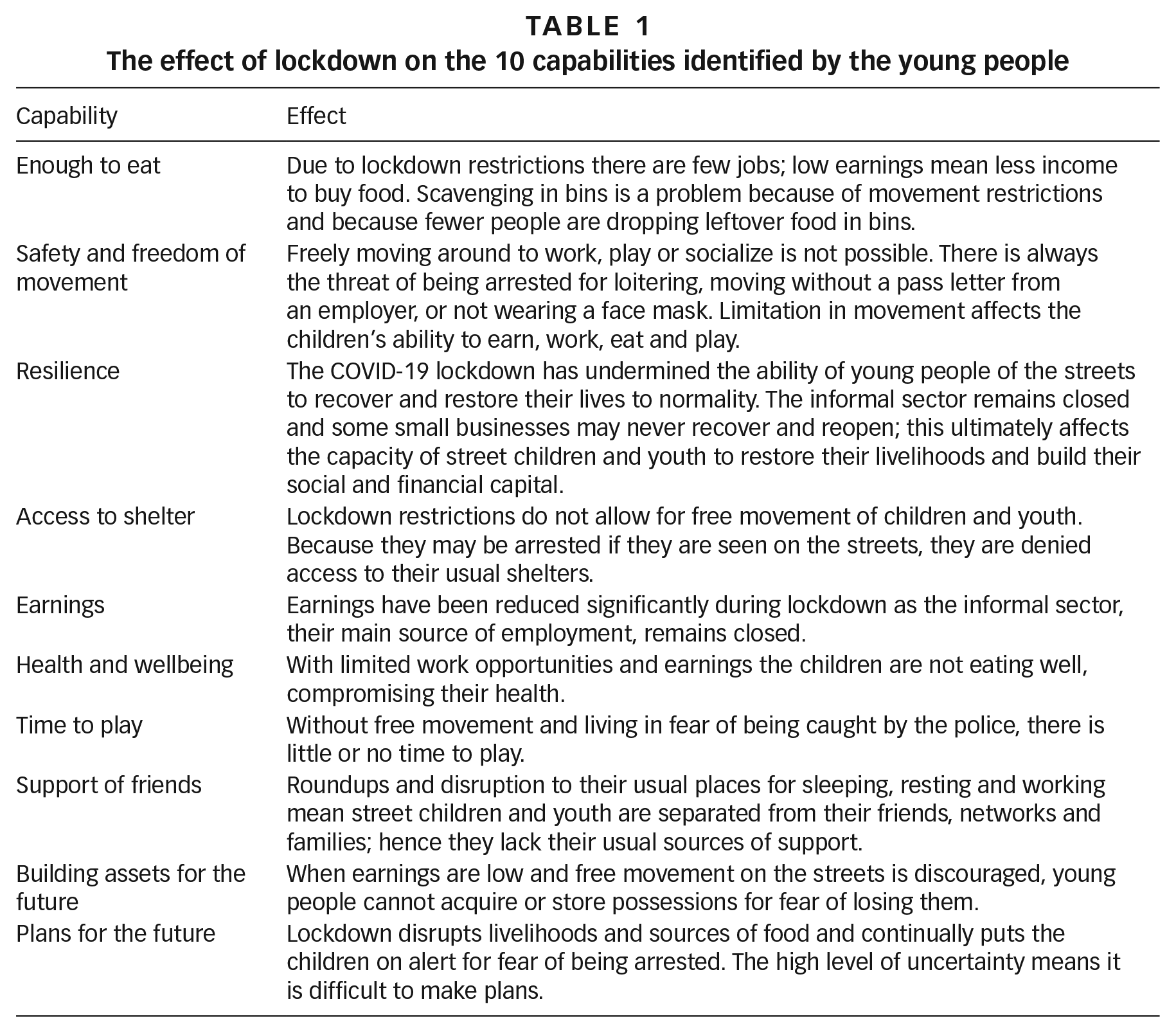
A story map activity involving street children and youth in Harare was originally planned for March 2020. Prior experience had shown story maps to be a compelling way of involving street youth participants in explaining and reflecting on their lives and experiences.(15) Funding was obtained as a legacy of the original longitudinal research project to produce a story map around the framework of the 10 capabilities, defined by participants at the start of Growing up on the Streets as fundamental to their achievement of wellbeing. These included aspects of health, mobility, play and meeting basic needs (Table 1). Shaibu Chitsiku, the former project manager for Growing up on the Streets in Harare and now the manager of the NGO Street Empowerment Trust (SET) (and one of the authors of this paper), was ready to project manage the story map in Harare. At the University of Dundee, Janine Hunter and Lorraine van Blerk (also authors) arranged the ethics application and developed the participant information sheets. By late March, due to the global spread of the COVID-19 pandemic and the lockdown in Harare, it became clear that the planned story map was no longer viable.
The effect of lockdown on the 10 capabilities identified by the young people
“I was on the streets yesterday. The town is closing down upon a directive from the government that all public gathering must be banned. Everything is shutting down. It will be futile for us to continue the story map under the circumstances. I have made the decision to postpone it until there is the usual activity in the CBD [Central Business District].” (Chitsiku, SET, personal communication, 26 March 2020)
Over the next seven weeks, there was mounting anecdotal evidence that the young people living on the streets were suffering as their income sources had disappeared and their mobility was severely restricted by lockdown measures. By curtailing freedom of movement, public health regulations introduced to halt the spread of COVID-19 also curtailed the ability of the young people to find shelter and safety and, due to the closure of public markets, to generate income from the informal urban economy. On 15 May, given the rapid decline in their ability to exercise their already precarious livelihoods and survival strategies, it was agreed that the story map be refocussed to reflect street children and youth’s experiences of COVID-19 lockdown. It was hoped that working with them to capture the context of their lives under lockdown would further enhance understandings of what life is like for street children and youth in Harare, in order to allow for practical responses. Our extensive research had already revealed the precarious nature of life on the streets; street children and youth are among the most impoverished in a country where 63 per cent of the population live below the poverty line, and 27 per cent of children suffer from stunted growth.(16) Box 1 shows the timeline of lockdown in Harare, including key dates relating to the story map.
Timeline of the COVID-19 lockdown in Zimbabwe
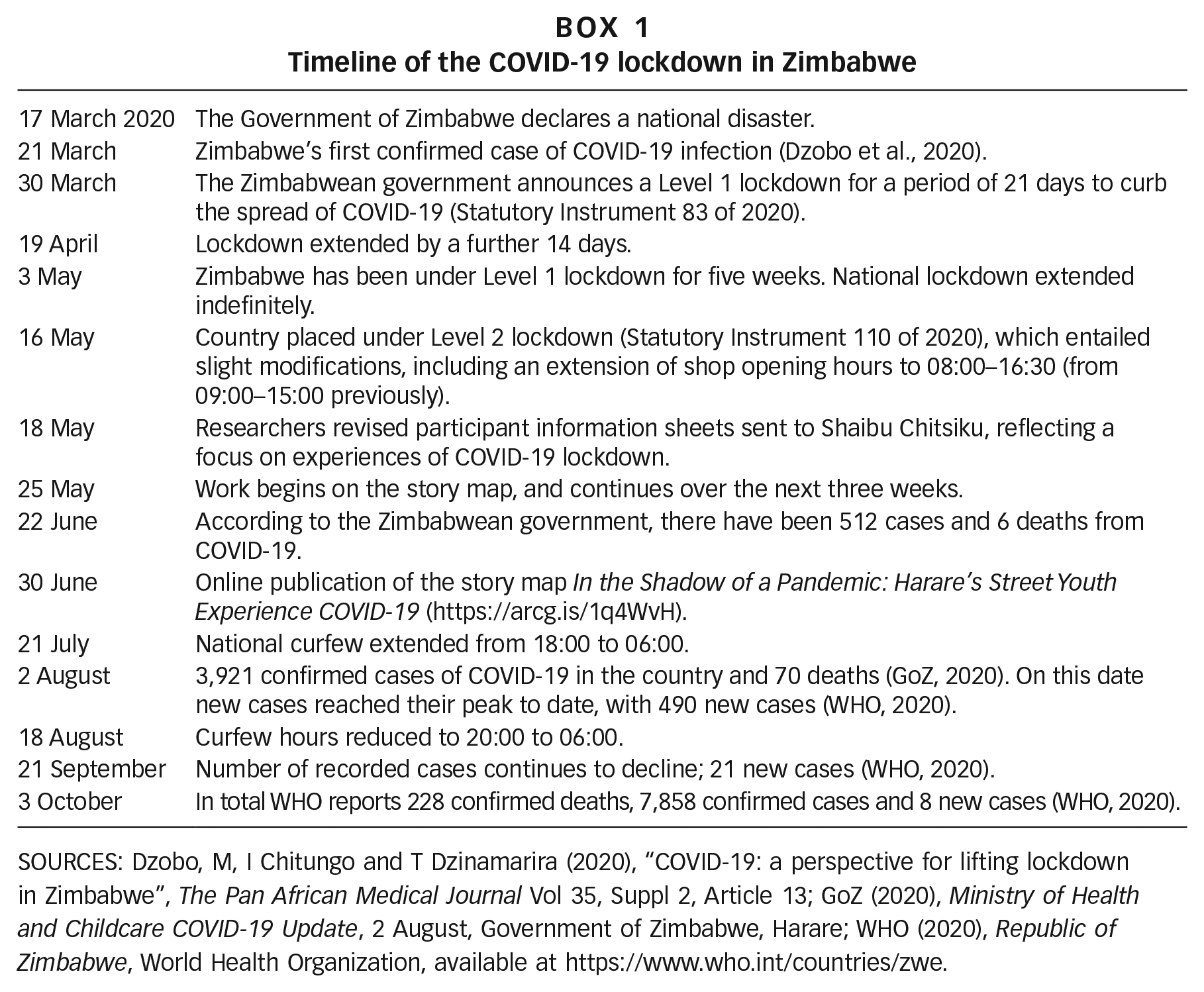
SOURCES: Dzobo, M, I Chitungo and T Dzinamarira (2020), “COVID-19: a perspective for lifting lockdown in Zimbabwe”, The Pan African Medical Journal Vol 35, Suppl 2, Article 13; GoZ (2020), Ministry of Health and Childcare COVID-19 Update, 2 August, Government of Zimbabwe, Harare; WHO (2020), Republic of Zimbabwe, World Health Organization, available at https://www.who.int/countries/zwe.
Our previous research in Harare had established relationships between SET and young researchers, two of whom are currently employed by SET as street workers. Participants were gathered from their street networks and from SET’s street work knowledge. Six key participants (Arnold, Mathew, Ndirege, Nixon, Ralph and Yeukai; all names are pseudonyms) were the filmmakers who recorded 18 other participants, nine of whom had been original participants in Growing up on the Streets. Some were too young to have been involved in the original research, so the story map was also an opportunity to include new voices, including those of young women on the streets. A revised version of the participant information sheet was prepared, which explained the story map production process alongside an ethical guide for participants, a participant code of conduct, and details of those involved in managing the project in Zimbabwe and the UK. The information was thorough, but designed to be relayed verbally during the initial workshop in several languages if necessary, with participants’ verbal agreement recorded. Previous experience has shown that explaining ethical issues and gaining informed consent verbally is essential in street contexts(17) because of varying literacy levels among participants, multiple languages spoken to different levels (in this case Shona, English and Ndebele, among others), and the association of paper forms with interactions with those in authority (e.g. the police). Ethical approval for the project and the verbal consent method had previously been obtained from the University of Dundee Social Science Research Committee. Those participants previously involved in Growing up on the Streets had partaken in various training sessions since the project began in Harare in 2012.
Involving participants in learning opportunities was a priority for the project – initially in ethnographic observation and later in acting as spokespeople at events with stakeholders and practitioners.(18) Now developed into a Knowledge Exchange Training Pack,(19) this training is freely available for educators and practitioners working with marginalized people globally to equip them “with the skills to recognise their knowledge and, by becoming effective spokespeople, exchange this information with those who hold positions of power over their lives”.(20)
From 25 May work began on the story map in Harare. Its purpose was to involve participants in capturing their narrative and multimedia accounts and to create with them an advocacy resource and learning tool for practitioners and policymakers in Zimbabwe and internationally. A workshop took place with participants using a PowerPoint presentation and the participant information sheet as checklists to ensure that participants understood the story map aims, as well as issues of ethics and personal safety, before gathering data. Movement around the city was restricted, so participants collected data where they could within their geographical area. Both Level 1 and 2 lockdowns (beginning on 30 March and 16 May respectively) restricted residents to their homes, except to purchase food or for health emergencies. Most shops were closed and security personnel were deployed across the country to ensure compliance. Movement within the country was banned; all public transportation services, except ZUPCO (Zimbabwe United Passenger Company), and flights in and out of Zimbabwe, were suspended. In Harare, police checkpoints on routes leading to Harare’s CBD turned back pedestrians and cars, except for employees in essential services (manufacturing, mining, public and health sectors). Wearing a face mask in public spaces became mandatory. Zimbabwe’s borders were closed to foreign nationals, and public gatherings of more than 50 people were prohibited.
Despite physical barriers and temporal curfews, and restricted access to the city centre in Harare, on 2 June the first multimedia data were shared from Harare. In total, 33 photographs were received, and more than 30 videos (uploaded to a shared channel on YouTube). These were then translated by SET in Harare from Shona and Ndebele and subtitled (using Pinnacle) in English. Participants’ contextual data that accompanied the photographs and videos were as important as the multimedia data. The notes taken from these narrative accounts provided the basis for the textual content of the story map and brought meaning to the visual material. Contextual data were edited and grouped by theme: six sections reflected aspects of street children and youth’s experiences. “Life under lockdown” describes the situation the young people were living in at the point of lockdown; “Keeping safe” shows how street youth negotiate keeping clean and protecting themselves against infection. Subsequent sections follow individual and collective experiences of life during Level 1 and 2 lockdowns for young men and women living on the street: these include “Mai Future’s story”, “Daily life in the shadow”, “Hunger in the shadow” and “Shelter in the shadow”.
Each section contains contextual data, at least one video, and photographs. Once an initial draft was ready, content was built using an online story map template (https://storymaps.arcgis.com ) that facilitates the addition of text in “content blocks”, displayed in “slideshow”, “swipe” or “sidecar” (used in this story map) format, alongside maps, photographs and videos.
On 26 June, the draft version of the story map was shared with the UK and Zimbabwe teams, and on 30 June 2020 the final version was published online. No further edits were made after this date, as this would automatically have changed the date on the “cover”; the content of the map is temporally as well as geographically sited.
III. Revealing the Experiences of Covid-19 for Street Children and Youth in Harare
While the timeline (Box 1) describes the public health response to the pandemic, including the legal framework employed by the Government of Zimbabwe to enact lockdown measures, as well as official infection and death rates, the effects on those experiencing lockdown remain hidden. In the days prior to the lockdown, the authorities conducted roundups of street children and youth; many children aged 10–16 were moved into children’s homes, leaving older youth and young children who live with parents on the streets. During the roundup process, street children and youth tried to run away because of their fear of the unknown, the lack of accurate information, or their previous experience of roundups. Roundups are associated with arrest and confinement in poorly organized care and protection centres, which, according to a UNOCHA situation assessment, “lack the bare minimum of basic services to maintain adequate personal hygiene and services to care for them”.(21) Detention in these centres also separates children and young people from their friends and networks. In the opening section of the story map, “Life under lockdown”, Ralph films a deserted street “base”: “This is the place where children used to stay. Some were taken by the police, others fled and hid in different places [. . .] The way children left this base was sad; everyone was running, no one wanted to be caught and each child just grabbed an item of importance to him or her and fled. Some had gone to buy food and came back to a deserted base, it was terrible.”
For street children and youth who do not have homes to be confined to, lockdown meant that they were unable to move around seeking income from the informal livelihood strategies they generally employ, such as gathering plastics (see the section of the story map entitled “Daily life in the shadow”). Those who remained after the roundups hid in alleyways, on scrubland, or in marketplaces. If on the move, they were careful to avoid the police or soldiers; they explained that if caught, in order to avoid arrest, they would probably have to pay a bribe. They generally sourced food from waste bins, but with fewer people moving around, there was less waste food, and moving between bins was difficult (see “Hunger in the shadow”).
Throughout the story map, the young people reveal their knowledge of the risks of infection and their fear of it. Madnax tells Ralph, who is interviewing him: “Hold on, cover your mouth with a mask so we can talk! We wash hands after working; no touching, no kissing or hugging.” Street youth are well aware of the necessity of reducing risks of infection, and seek to comply with local rules of governance and social norms, even when excluded from their benefits. In “Shelter in the shadow”, Denford describes how young men sharing his alleyway now sleep socially distanced, unable to huddle for warmth in the Zimbabwean winter: “We just sleep leaving space between us. A person puts his cardboard box on the ground and the next one follows suit. If he has a blanket he puts it, then covers it with plastic. We leave space between us and everyone knows his place.”
The principal means of protection from the virus, through handwashing, physical distancing and the use of face masks, are difficult for them to manage. In the “Keeping safe” section, young men share a “bath”: the luxury of a bucket of water provided by a nearby clinic. In order to access water, the clinic have drilled their own borehole as Zimbabwe is experiencing prolonged drought, making access to clean water an even greater challenge for street children and youth.
As in many cities, shelter locations for street youth are gendered. In “Keeping safe”, 10 young men, residents of the “secret” alleyway, gather in relative safety from the authorities in this liminal urban environment – a network of alleyways that cuts across Harare, in the back streets of houses, flats and shops. Alleyway residents store possessions there and plastics they have gathered for recycling. The alleyways are also the site for peer support and networking (see “Shelter in the shadow”). At the time of data collection, there were no girls or young women living in the secret alleyway, although some girls do sleep in these spaces alongside boys and young men. If they can afford to, which often means reliance on sexual relationships, girls and young women move to low-income settlements, which is where Mai Future was residing until her partner disappeared. Her story highlights how the pandemic and lockdown intersect with key aspects of survival including finding shelter and food and maintaining livelihoods. She, like other young people who appear in the films (Ranga talking about finding food, Mada describing the effect of a closed informal economy upon her income), recount their struggle to survive in a changed world.
The original Growing up on the Streets research was structured, as noted, around 10 capabilities (see Table 1) developed with the young people that articulate the key aspects most important to life on the streets. Considering the young people’s experiences under the pandemic within this thematic base provides further insight into the impact of lockdown on aspects of their lives (Table 1). These observations were made (by Chitsiku) while making the story map; they show that while the street children and youth’s lives were precarious before lockdown, its effects have been to compound their poverty and constrain their mobility and freedom to be on the street as well as their social interactions with peers, which are a critical source of support.(22)
For the young people who participated, the key sentiment expressed at the time was a sense of surprise and satisfaction in being able to use everyday technology to tell their story. In discussions with the project manager in Harare, they said that they had learned the power of the mobile phone. By using images and short videos, they could tell their story, put across their own ideas, and in so doing create an advocacy tool. Their feeling was that to look at a video or photograph without the description would give an impression of their situation, but by adding their narrative text they were able to tell the viewer what they want them to look for, as if they are narrating a story directly to them. For example, when Ralph talked about filming the abandoned alleyway, he felt his narration conveyed the emotional impact the events had upon him. His comment at the time was that now no one can doubt us because we have provided a story backed with evidence that shows the reality of street life.
IV. Story Maps as an Insight into Participants’ Pandemic Lives: Some Implications for Practitioners and Researchers
It is through individual stories that the effects of COVID-19 and associated lockdowns can come powerfully to our attention. As researchers, we may struggle to convey the realities of life for research participants or the breadth of their experiences through normal means of dissemination. Multimedia outputs such as story maps offer opportunities for researchers to reconsider their approach to working with and doing justice to participants. In this case, collaboration was remote, but where participants are in the same country, co-production could be developed further. Researchers can provide ethical insights, ethical approval and software; practitioners can act as gatekeepers and assist in dissemination; and participants can voice their lived experiences and contribute technical skills. The process of creation becomes an opportunity for learning for participants but also for researchers and practitioners.
Yet story maps, as a participatory methodology, are not a quick fix. The relative speed with which this project was delivered depended upon ongoing collaborative relationships and past learning experience from bespoke training.(23) The ethical issues and safety of participants when filming on the streets, especially where there is a significant police or army presence (as in this case), need careful consideration, local knowledge and a degree of trust. Trust is also important for participants when agreeing to go “on camera”; some potential participants declined to be filmed due to fears of identification by authorities, and this is an important consideration for practitioners and researchers using multimedia methods.
There are also challenges in sharing outputs with participants who may not own a mobile phone. While blending technology, relatively straightforward templates and on-the-ground expertise, the disparities of access remain. Few participants have yet seen the story map due to restrictions on local travel, but local dissemination events will take place in order to share findings with participants and local stakeholders.
That said, the act of creating the story map had immediate learnings for individual participants. The act of capturing the data enabled Mathew, for example, to use his expertise in his local street environment to engage with his peers and act as a researcher and investigator. Using a borrowed mobile phone, Mathew asks Mai Future (with whom he recorded several short films, only one of which is featured in the story map) about her life; Mai Future is in turn able to share her story of abandonment and survival through the filming interface. Having never previously met Mathew, the interaction of capturing multimedia data and recounting recent life experiences creates a familiarity, almost an intimacy, that provides us – the geographically–culturally–temporally remote viewers – a chink into Mai Future’s life.
The aim of the story map, like Growing up on the Streets, is to change the discourse around street children and youth at a national and international policy level. Their rights must be recognized and policy implementations affecting their lives must consider the voices of street children and youth themselves. By jointly creating an advocacy tool it is hoped that practitioners globally will learn from and adjust pandemic responses aimed at helping homeless young people.
V. Conclusions
Since making the story map, the rates of infections and deaths from COVID-19 in Zimbabwe have peaked and reduced.
“The situation on COVID-19 seems positive, according to the government there are fewer infections as compared to last month. The government has eased some of the lockdown restrictions, shops can now operate up to 6.30pm, and curfew hours have been reduced from 8pm to 6am. More and more people are going to work and we anticipate the situation may improve for young people on the street. Mai Future delivered a baby boy yesterday.” (Chitsiku, SET, personal communication, 17 September 2020)
In the Shadow of a Pandemic: Harare’s Street Youth Experience COVID-19 (https://arcg.is/1q4WvH ) provides a snapshot of street lives in a particular place and at a particular time. However, street youth face daily ongoing challenges that, while highlighted in the story map, remain relevant beyond the COVID-19 lockdown. These key issues of persistent poverty and limited livelihood opportunities require urgent action with longer-term strategies by local, national and international bodies. We have shown that for participants, making the story map, as a learning opportunity about the use of technology and their own in-depth knowledge of their street environments, is perhaps as important as the research output. For researchers and practitioners the output would be nothing without the young experts who navigate these stories on our behalf. The aim of Growing up on the Streets has always been to change the discourse around street children and youth: to have their rights recognized, both as children and as they grow into adulthood, and to be seen as citizens of their communities and cities. The story map contributes to this aim by countering dehumanized perceptions of street children and youth to provide a glimpse into their lives during this important chapter, as they endeavour to survive in circumstances that have rapidly become even more challenging. Its online format enables online dissemination to academic, practitioner and policy avenues; while providing a snapshot in time, the issues remain globally relevant and prevalent.
As the pandemic moves from acute to chronic phases, creating research outputs with participants that are effective in sharing their pandemic stories will continue to be important. While not a manual of “how to make” a story map, this article has raised some of the key issues that need careful consideration by practitioners and researchers in the application of this participatory method – around ethics, training, trust, accessibility, and some of the practical issues of story map building. We do not attempt to provide answers to all these issues, but hope to show that this type of participatory methodology goes some way to balance the weight of power among researchers, practitioners and participants and provide a unique insight into young urban lives.
Footnotes
Acknowledgements
We would like to acknowledge the work of the 24 story map participants (using their chosen pseudonyms): Arnold, Claude, Denford, Fatso, Fungai, Henzo, Jojo, Jonso, Jude, Mada, Madnax, Mai Future, Mathew, Mavhuto, Ndirege, Nixon, Ralph, Ranga, Tarwirei, Taurai, Tobias, Tonderai, Yeukai and Zviko. We thank Victor Maunzeni from SET, Harare, who translated and subtitled videos. We are grateful for the suggestions received from an anonymous reviewer and for editorial support in the preparation of this paper.
Funding
We thank Backstage Trust for providing funding for this project and our UK charity partner StreetInvest.
1.
2.
Kaneda, T and L S Ashford (2020), Sub-Saharan Africa’s Demographic and Health Characteristics Will Influence the Course of the COVID-19 Pandemic, Population Reference Bureau, Nairobi, available at  .
.
3.
UNCCSA (2020), How COVID-19 Is Changing the World: A Statistical Perspective, United Nations Committee for the Co-ordination of Statistical Activities, available at .
4.
Corburn, J, D Vlahov, B Mberu, L Riely, W T Caiaffa, S F Rashid, A Ko, S Patel, S Jukur, E Martínez-Herrera, S Jayasinghe, S Agarwal, B Nguendo-Yongsi, J Weru, S Ouma, K Edmundo, T Oni and H Ayad (2020), “Slum health: arresting COVID-19 and improving well-being in urban informal settlements”, Journal of Urban Health Vol 97, pages 348–357.
5.
Daily Maverick (2020), “De-densification of informal settlements as a crisis response is bad short-term thinking − 14 Civil Society groups”, 20 April, available at https://www.dailymaverick.co.za/article/2020-04-20-de-densification-of-informal-settlements-as-a-crisis-response-is-bad-short-term-thinking-14-civil-society-groups ; also Matamanda, A R (2020), “Battling the informal settlement challenge through sustainable city framework: experiences and lessons from Harare, Zimbabwe”, Development Southern Africa Vol 37, No 2, pages 217–231.
6.
Hunter, J, L van Blerk and W Shand (2020, in press), “The influence of peer relationships on young people’s sexual health in Sub-Saharan African street contexts”, Social Science & Medicine.
7.
Mizen, P and Y Ofosu-Kusi (2010), “Unofficial truths and everyday insights: understanding voice in visual research with the children of Accra’s urban poor”, Visual Studies Vol 25, No 3, pages 255–267; also Hampshire, K R, G Porter, S A Owusu, A Tanle and A Abane (2011), “Out of the reach of children? Young people’s health-seeking practices and agency in Africa’s newly-emerging therapeutic landscapes”, Social Science & Medicine Vol 73, No 5, pages 702–710.
8.
Harris, J C and S Little (2019), “Mapping hope: How do vulnerable youth locate hope in informal settlements?”, Urban Forum Vol 30, No 3, pages 289–306; also Young, L and H Barrett (2001a), “Adapting visual methods: action research with Kampala street children”, Area Vol 33, No 2, pages 141–152.
9.
Ash, J, R Kitchin and A Leszczynski (2018), “Digital turn, digital geographies?”, Progress in Human Geography Vol 42, No 1, pages 25–43.
10.
See reference 9, page 28.
11.
Nussbaum, M C (2000), Creating Capabilities: The Human Development Approach, Harvard University Press, Cambridge, USA; also Sen, A (1999), Development as Freedom, Oxford University Press, Oxford, UK.
12.
See reference 6; also Growing up on the Streets (2013), Briefing Paper 1: Research Principles, StreetInvest/University of Dundee, available at https://doi.org/10.20933/100001136; Growing up on the Streets (2014), Briefing Paper 2: Methodology, StreetInvest/University of Dundee, available at https://doi.org/10.20933/100001137; and van Blerk, L, W Shand and P Shanahan (2016), “Street children researchers: critical reflections on a participatory methodological process in the Growing up on the Streets research in Africa”, in R Evans, L Holt and T Skelton (editors), Springer Handbook of Children’s Geographies, Springer Press, New York, pages 159–178.
13.
van Blerk, L, W Shand and J Hunter (2020), “‘Street citizenship’: informal processes of engaging youth as citizens through research and knowledge exchange in three African cities”, Space and Polity.
14.
Ahmed, K (2020), “Progress in fight against child poverty could be wiped out by Covid, says report”, The Guardian, 22 October, available at .
15.
Growing up on the Streets (2017), Growing up on the Streets: A Story Map by Accra’s Street Youth, available at .
17.
Young, L and H Barrett (2001b), “Ethics and participation: reflections on research with street children”, Ethics, Place & Environment Vol 4, No 2, pages 130–134.
18.
See reference 13.
19.
Growing up on the Streets (2016), Growing up on the Streets: Knowledge Exchange Training Pack, available at .
20.
See reference 19, page 8.
21.
UNOCHA (2020), Zimbabwe Situation Report, 21 April, United Nations Office for the Coordination of Humanitarian Affairs, available at .
22.
See reference 6.
23.
See reference 19.