




Abstract
In recent years, Beijing has implemented urban renewal policies aimed at forcing out rural migrants to restrict the city’s population. One such policy restricts their access to public schools. We use the demolition of the Beijing Sun Palace Farmers’ Market to examine the long-term impacts of these policies on the educational status of migrant children in Beijing. Based on a survey and in-depth interviews with migrant vendors, we find that government-initiated urban remodelling campaigns have an enduring impact on their social mobility and the educational opportunities of their children. Despite severe limitations to their mobility and economic opportunities, many migrant vendors were still determined to stay in Beijing. Subsequently, their worsened living status significantly affected their children’s prospects. Migrant children caught in this urban dynamic either struggle in substandard informal migrant schools in Beijing or are left behind in their hometowns, with little hope of a good education or improved social status.
I. Introduction
In recent years, the Chinese government has imposed harsh urban renewal and population-control measures in big cities such as Beijing and Shanghai, to control the inflow of people and to force out lower-skilled migrants. In Beijing between 2014 and 2016, more than 200 markets were dismantled and relocated, and the space for rental stalls was reduced by 21,000 square metres.(1) According to the official urban planning policy, Beijing aims to become a world-class city cluster. And as the China Daily points out, “a decline in urban population growth means fewer traffic jams, less pressure on the housing and public service sectors, and a decrease in urban scale and resource use, which are necessary for sustainable development”.(2)
As the home of one of the largest migrant populations in China, Beijing’s mass demolition campaign and tightened population-control policies had an immediate and detrimental impact on the lives of the city’s migrant population, uprooting families and dismantling social networks.(3) Most significantly, these policies effectively foreclosed on the educational opportunities of migrant children, who constituted nearly a third of all school-aged children in the urban educational system in Beijing.(4) Although the central government explicitly requires local governments at all levels to provide equal educational opportunities for migrant children, it is still very hard for migrant students in Beijing to enter public schools, especially schools with higher-quality teaching.
Previous studies on the education of migrant children in urban China have focused either on the equality of educational opportunities for migrant children, or on the educational challenges and academic performance of these children in big cities.(5) With recent rapid population growth and urban development, researchers have taken notice of the impact of urban redevelopment and population-control policies on the educational status of migrant children. They have found, for example, that when population-control strategies were instituted, Beijing’s government used the threat of limited educational opportunities to discourage migration to the city, thus depriving migrant children living in and around Beijing of their right to high-quality education.(6)
While previous studies have acknowledged the impact of urban planning policies in China’s big cities on migrant children’s education, relatively little research has explored the apparent contradiction between denying migrant children equal educational rights and the government’s stated goal of championing education for all. On the one hand, the central government encourages equal education for the children of migrants. But on the other hand, it simultaneously seeks to exert tight control of the population in the nation’s largest cities. Few scholars have examined or explained these seemingly opposing goals within the Chinese government’s policy matrix, and how they prevent migrant children from realizing their right to public education.
To fill this research gap, we conducted an in-depth case study of the educational status of children of migrant vendors after the demolition of a local farmers’ market – Sun Palace Farmers’ Market in Beijing. Farmers’ markets are important gathering spaces for lower-skilled urban residents. They are unique public spaces that incorporate new migrants into big cities and build social and cultural connections between local urban residents and migrant families.(7) In the past decade, many farmers’ markets in mega-cities in China have been replaced by large, modern supermarkets, in part to upgrade sanitation and food-handling practices and to mitigate the public-health concerns about farmers’ markets.(8) Starting in 2006, in its effort to enhance the city’s global competitiveness, the Beijing municipal government sought to both control population growth and promote industrial optimization. As part of this campaign, farmers’ markets inside the second ring road were strictly prohibited and could only be converted into retail spaces.(9) In 2013, the central government ordered the Beijing municipal government to strengthen the capital’s core functions as a national “political centre, cultural centre, international exchange centre, and technological innovation centre”.(10) The municipal government responded by launching a “relieving non-capital function” campaign (shujie fei shoudu gongneng) that eliminated low-end job sectors and adjusted urban spatial patterns to expel low-skilled labourers from Beijing.(11) More farmers’ markets along with other low-end sites were demolished, forcing many rural migrant families to resettle to the outskirts of the city or to leave Beijing entirely, thus adding to the already significant educational constraints for their children.
To fully evaluate the impact of these disjunctures within the policy matrix on the educational status of children of migrant vendors, we investigated the responses of migrant families affected by Beijing’s urban renewal and population-control policies and traced their employment trajectories. We found that during the period under study, affected vendors sought new employment, either by taking jobs in new sectors or working in community food stations. Nonetheless, the demolitions had enduring disruptive effects on the vendors’ economic standing and life trajectories in Beijing. Most migrant vendors still chose to stay in Beijing rather than returning to their hometowns, primarily in the hope that they would be able to provide a better education for their children in the city. But although children of migrant vendors were told to expect equal educational rights, what they received in reality were diminished educational opportunities. Stricter admission policies at public schools, combined with population-control policies in Beijing, had left migrant families with little choice but to send their children to substandard migrant schools or leave them behind in their home regions. Thus, the lack of options severely reduced their opportunities for educational – and therefore social – advancement.
II. Educating Migrant Children In Beijing: The Policy Background
The educational problems for migrant children in urban areas have long been a major issue for the Chinese government. The government-initiated “household registration system” (hukou) divides the population into two broad sectors: rural and urban (technically, agricultural and non-agricultural). Conversion from rural to urban hukou status is tightly controlled. In cities, hukou has long been used by the local educational authorities to determine a student’s eligibility for public school enrolment; children with local hukou have been automatically eligible to attend, while those without a local hukou have been excluded from the urban public school system.(12) In response, a system of alternative informal migrant schools was established by the migrant population to ensure their children’s education.(13) Kwong(14) notes that by 2000, these schools served almost 80,000 migrant students.
In 2010, the State Council issued a directive to promote migrant children’s compulsory education. According to this directive, local governments were required to take primary responsibility for the education of migrant children by assuring public school access to migrant children, which would in effect provide better education in their destination provinces.(15) It would also provide better education than the informal migrant schools. A longitudinal study of 3,000 migrant children in public schools and the alternative migrant schools found that migrant children in public schools performed significantly better in mathematics and Chinese than those in schools for migrant children.(16) Another comparative study of the educational quality of migrant schools in Beijing, versus public schools in rural areas of Shaanxi Province, revealed that students who attended migrant schools initially performed better than their peers in rural public schools, but gradually fell behind due to the low-quality education in migrant schools.(17) Within the city, enrolment in local public schools is certainly the preferred option for migrant parents. With the implementation of the 2010 State Council directive, many migrant families that did not have the local hukou were able to send their children to study in public schools with an eligible local residence permit. By 2014, around 80 per cent of all migrant students in Chinese cities were enrolled in public schools.(18)
Although the Chinese government continues to promise equal educational opportunities for migrant children, in practice the lack of comprehensive local implementation, insufficient financial support, bewildering administrative barriers, and perceived discrimination against rural-to-urban migrants continue to put these opportunities out of reach for most migrant families.(19) In Beijing, for their children to be admitted to public schools, migrant families must provide the so-called five certificates, all of which must be audited by local administrative sectors: (1) proof of employment in Beijing, (2) proof of residence/apartment lease in Beijing, (3) documents proving compliance with the childbirth policy, (4) temporary Beijing residence cards for both parents, and (5) proof of there being no guardianship of the child in the original location. In 2014, only four outlying districts out of 16 districts in Beijing imposed these requirements; by 2015, that number had risen to 13.(20)
For many migrant families, obtaining all five certificates is difficult or impossible: self-employed migrants or migrants with temporary jobs are unable to present proof of employment; migrants living in makeshift accommodation are unable to provide proof of an apartment lease; parents with children born outside the childbirth policy are unable to obtain family planning documents; and many migrants have elder members of the family (i.e., grandparents) who could in theory serve as potential guardians in their home regions.(21) Even if families are able to collect all the required documents, some public schools also set up enrolment quotas rather than making extra vacant spots available to migrant children.(22) A substantial number of migrant children – especially the most economically and socially disadvantaged – are thus unable to enrol in public schools in Beijing.
Meanwhile, the central government has also sought to control population growth in large cities like Beijing and Shanghai, and has made it clear to local governments that they should make this a top policy priority. Given this mandate, the Beijing municipal government has deliberately erected barriers to educational opportunities for migrant children as a way to discourage the influx of rural–urban migrants.(23) This strategy has aligned with Beijing’s efforts to restrict the in-migration of low-skilled labourers, especially rural-to-urban migrant workers, who would impede the city’s urban renewal project. According to the official report of the Beijing government, controlling the population growth is part of the government strategy to ease the functions of the capital city: “We will guide the gradual relocation of clothing wholesale markets, small commodity markets and building and construction material markets. We will establish an interest-guiding mechanism for allocating high-quality public resources in the central city and dispersing population to new towns.”(24)
In this context, radical policy strategies have been implemented to speed up the urban upgrading. Education has become one of these strategies to slow the increase of migrants to Beijing. According to an empirical study in Beijing, the local education department had some concerns that if migrant children were able to receive a better education in Beijing, migrant families would be drawn to the city and increase the population pressure.(25) As an official from the educational bureau of Beijing stated: “The municipal government has made many efforts to control the growth of the migrant population. In fact, the administrative departments of education were pushed to the frontline to bar migrant children from the city.”(26)
As a direct result, many migrant families had to look for alternative options for their children’s education in Beijing. They were forced to keep their children in substandard schools or, in some cases, even to move them from public schools into inferior migrant schools with far fewer learning resources. In most cases, these migrant schools, set up by migrants themselves and located in the suburban areas, have low teaching quality and poor facilities. Because these substandard migrant schools frequently change location and are not formally registered with the local educational system, they are subject to closure by the local government, which can cite illegal construction, illegal operation and safety concerns.(27) Especially in the context of rapid urban upgrading and harsh population control in recent years, more and more migrant schools have been forced to close by the municipal government.(28)
III. Data And Methodology
The case investigated in this paper is that of families with a member who was formerly employed at the Sun Palace Farmers’ Market. This market was located between the third and fourth ring roads in the northeast of Chaoyang District, Beijing (Map 1), at the intersection of Sun Palace Middle Road and Sun Palace South Street. The market, which covered an area of about 45,000 square metres and was the place of work for more than a thousand vendors, was the largest farmers’ market between the third and fourth ring roads in northeastern Beijing. On 16 October 2013, the Sun Palace Farmers’ Market was demolished as part of Beijing’s population size regulation and non-capital function relief policy. Many similar markets have been forced to close in recent years, as the municipal government implemented its exclusive policy to remove large-scale farmers’ markets from the inner city. The demolition of the Sun Palace Farmers’ Market provides a model for examining the long-term effects of spatial governance and urban planning policies on migrant children’s education in Beijing.
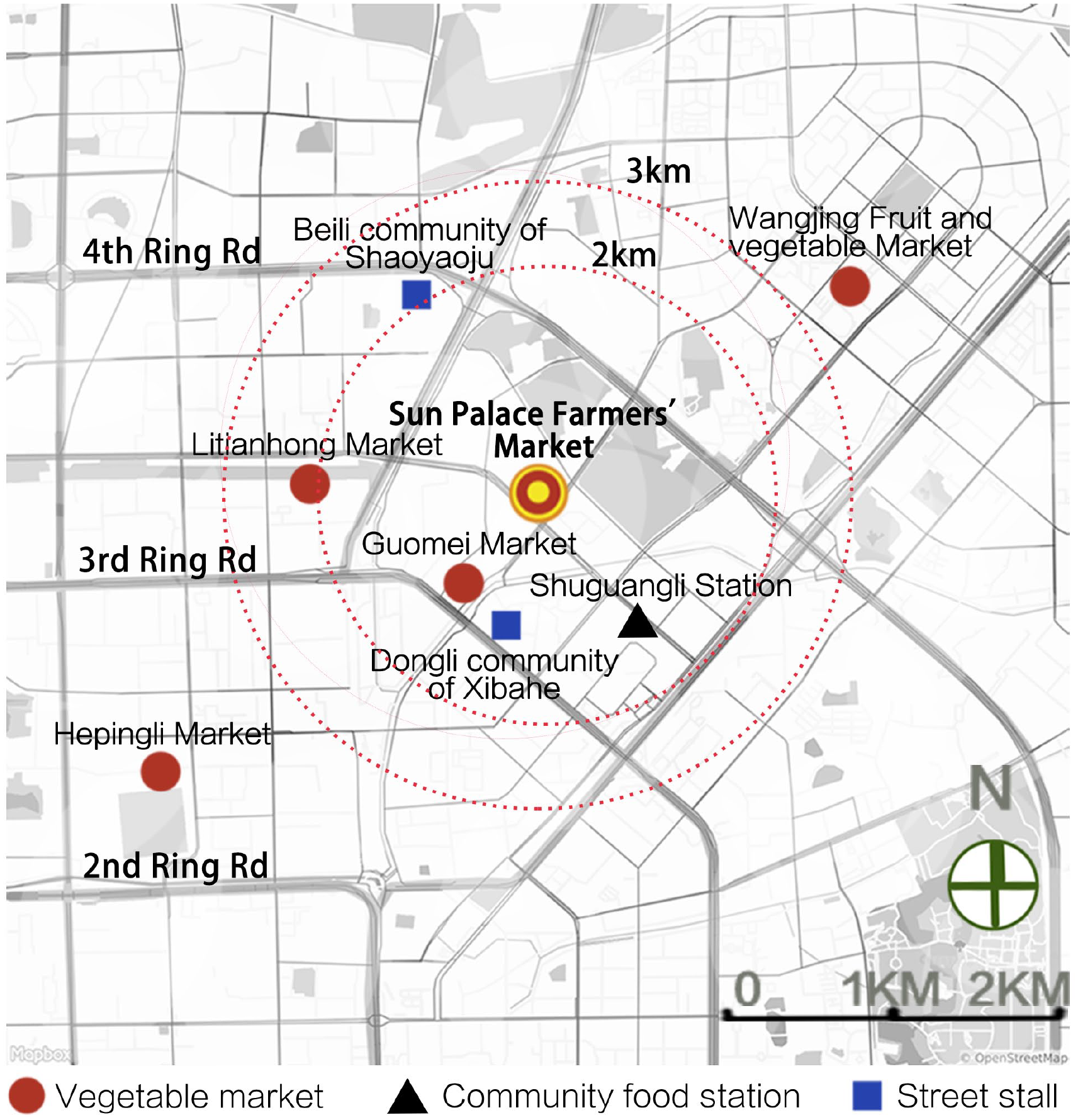
The former Sun Palace Farmers’ Market in Beijing (map constructed in July 2016)
In May and June 2016, our research team conducted a first-round survey of vendors who had worked in the Sun Palace market. In early July 2016, we conducted a second round of semi-structured in-depth field interviews with selected vendors to examine the impact of the demolition of the farmers’ market on their work and life situation. We approached a total of 53 vendors, identified using a snowball survey method. These vendors were engaged in various jobs at Sun Palace Farmers’ Market – some sold vegetables, meat, condiments and fruits, while others had small businesses such as repairing shoes and making clothes. We first contacted these vendors by telephone to confirm a meeting date and then went to their workplaces or homes to distribute a questionnaire. For those who had already left Beijing, we completed our survey via telephone. The questionnaire asked about migrant vendors’ current work status, degree of urban integration, reemployment experiences, and willingness to stay in Beijing in the future.
While the questionnaire was not specifically designed to focus on migrant children’s education, this was a theme that came up repeatedly in our interviews, making it possible and desirable to explore this unexpected but important aspect in the context of the migrant families’ changing circumstances. In particular, many vendors clearly indicated that one of the chief incentives for staying on in the urban area was to ensure a good education for their children. Some vendors also pointed out that their children should receive equal educational rights in the city according to the central policy, but were, in practice, denied admission to the public schools and left with no choice but to attend migrant schools instead, with all those schools’ attendant risks and disadvantages.
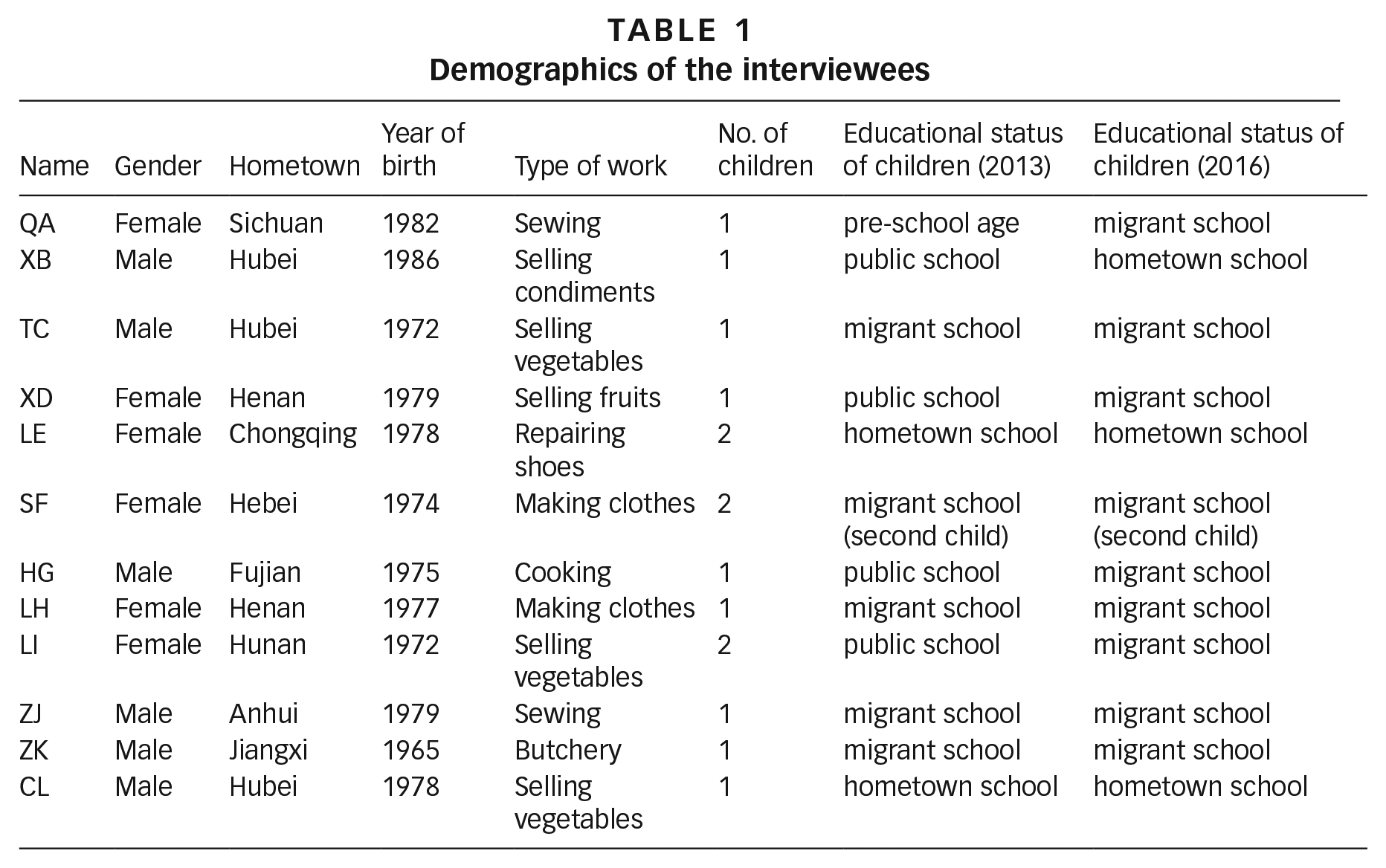
In response to this new development, we conducted a round of follow-up interviews with 12 vendors in late July 2016. Each interview lasted around one hour. Questions solicited information about the number of school-aged children in the household, the changes in children’s educational status before and after the demolition of the farmers’ market (the school attended before the demolition and the school attended three years later), children’s current location (whether studying in Beijing or in the hometown), the type of school they were currently attending (whether enrolled in public school, migrant children school or private school), tuition and extra endorsement fees (zanzhu fei – explained in Section VIa) if enrolled in a public school, and the quality of education if enrolled in a migrant school. We also asked about children’s academic performance, parents’ expectations and long-term plans for their children’s educational development, and the biggest challenge they faced in educating their children in Beijing. Along with these standard questions, follow-up questions were asked based on the interviewees’ responses. Basic demographic information of these 12 interviewees is listed in Table 1. All participants are identified by pseudonyms in this paper.
Demographics of the interviewees
IV. The Emergence Of New Types Of Food Markets
After the closure of the Sun Palace Farmers’ Market, a new food-purchasing network emerged in the Sun Palace residential area. This network was composed of three types of purveyors: small vegetable markets, community food stations and street stalls.(29) The small vegetable markets provide fresh fruits and vegetables only, rather than the one-stop services of a big market. Though these vegetable markets vary in operating conditions and popularity, all are under strict local government regulation and can be closed at any time to accommodate urban redevelopment or street beautification projects in the district.
The community food stations are approved by the local community neighbourhood committees. In the Shuguangli community, for example, an open-air food station at the entrance of the community had been operating for nearly two years. There were seven to eight fruit and vegetable vendors there, and because these food stations were officially organized by the community, they were not inspected by city management.
Street stalls are unsanctioned establishments set up by “guerrilla” vendors. Despite the ever-present risk of closure by urban authorities because of their non-legal status, street stalls are popular among migrant workers because of their inherent flexibility and the lack of booth fees. For example, in the Dongli community, more than 10 vendors conducted daily guerrilla selling, usually appearing in the early morning and after work hours pushing a small cart to sell fruits, vegetables and other products along the street at the main entrance of the community. When the city management carries out inspections, these vendors disperse. After the inspections, they return to their original spot and continue selling.
V. Migrant Vendors’ Life Trajectories
According to our survey, after the demolition of the Sun Palace Farmers’ Market, 48 of the 53 vendors surveyed remained in Beijing; only five had left the city. Among those who stayed in Beijing, 38 continued to be self-employed, eight had withdrawn from self-employment and switched jobs, and two were unemployed (Figure 1). In other words, three years after the demolition of the Sun Palace Farmers’ Market, more than 90 per cent of the selected vendors remained in Beijing, and those who stayed were still largely self-employed.
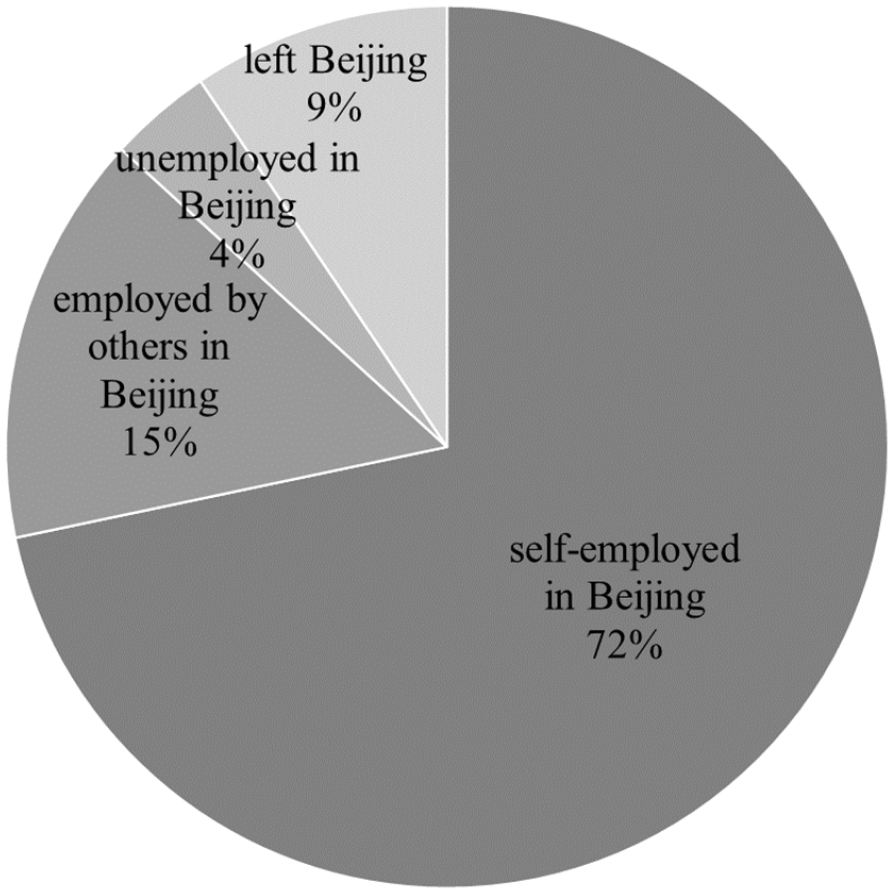
Migrant vendors’ employment status after the demolition of the Sun Palace Farmers’ Market
In terms of income, the overall monthly income for our surveyed vendors had decreased on average from RMB 6,080 (US$ 910) before the market’s demolition to RMB 4,635 (US$ 694) – a 24 per cent drop in income – while living expenses in Beijing had increased every year (Figure 2).
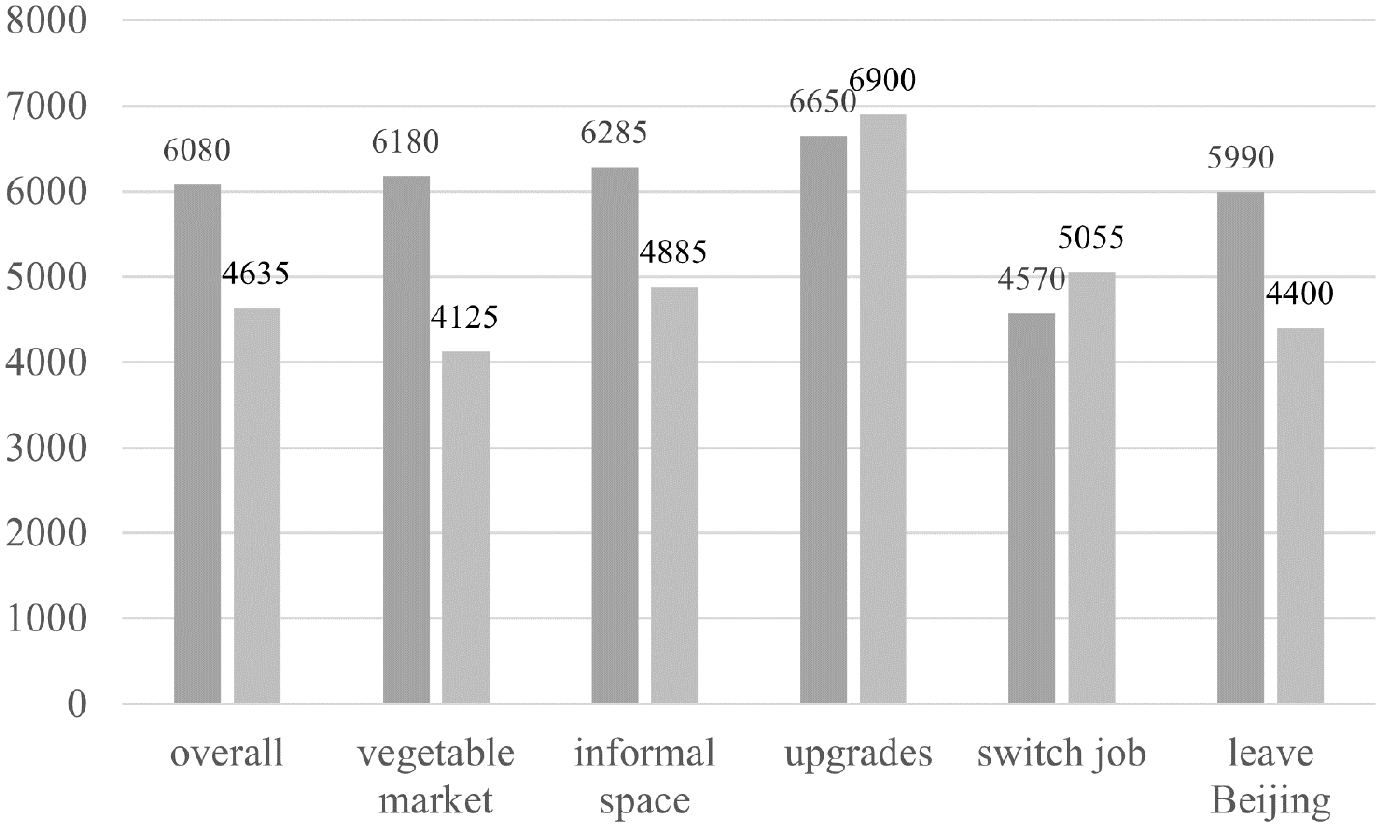
Comparison of average monthly income (in RMB) of vendors before and after the demolition of the Sun Palace Farmers’ Market
a. Self-employed in Beijing
Among those who were self-employed in Beijing, 22 (58 per cent) continued to be self-employed in small vegetable markets, another 13 (34 per cent) switched to street stalls or community food stations to sell food, and three (8 per cent) achieved self-employment upgrades by entering a more stable bricks-and-mortar operation.
Of the 22 vendors still working in the small vegetable market, most indicated that their income had decreased from an average of RMB 6,180 (US$ 925) three years ago to the current average of RMB 4,125 (US$ 618), about 33 per cent lower than the average monthly income level at the original farmers’ market (Figure 2). With the rising cost of living, selling vegetables alone barely provided a living wage. The 13 vendors who were self-employed in informal spaces such as roadside stalls and community food stations had greater operational risks because of the more unstable employment space. With a relatively stable source of customers in the neighborhood, the average monthly income for this group of vendors was RMB 4,885 (US$ 727) (Figure 2). Still, this group found it difficult to sustain their lives. The three self-employed vendors had a better life situation than their peers. After upgrading their businesses, for instance by renting a ground-floor apartment from which to operate, their monthly income increased to RMB 6,900 (US$ 1,033) (Figure 2). However, only very few people could realize this upgrade.
b. Switching jobs in Beijing
Eight of our surveyed vendors chose to switch to new jobs as retail sellers, construction workers, sanitation workers or casual labourers. This group, whose incomes and employability had been lowest, was most affected by the market dismantling. Income for this group before demolition averaged RMB 4,570 (US$ 684) per month. After switching to new jobs, the average monthly income increased to a high of RMB 5,055 (US$ 757) (Figure 2). Though their wages were still not high, these migrants chose to remain in Beijing, which offered “more opportunities” and allowed them to “earn more than at home.”
c. Unemployed in Beijing
Of the two unemployed vendors in Beijing, one young man had just finished short-term work and was looking for a new job. The other, a female merchant, had just returned from her hometown with her newborn second child to reunite with her husband; childcare would be her primary job for at least the next year or two. In the interview, she insisted that despite her family’s low quality of life and her husband’s needing to work extra hours, they would remain in Beijing.
d. Leaving Beijing
Five of our surveyed vendors left Beijing, returning to their hometowns to farm or start a small business to earn a living. Three returned to nearby Hebei Province. Since transportation from Hebei to Beijing is relatively convenient, all three were willing to return to Beijing if they could find flexible employment there.
VI. The Changing Educational Status Of Migrant Children
Migrant families in Beijing usually have three options for their children’s education: local public schools, local migrant schools and hometown schools. The changes in livelihood and income of migrant vendors after the demolition of the farmers’ market led to dramatic changes in the educational status of their children. Of the 12 people we interviewed, none reported having been able to send their children to a better school post-demolition. That is, they could not move their children from a hometown school to a city migrant school, or from a migrant school to a Beijing public school. Instead, the majority of the children of our interviewed families experienced diminished educational attainment, quitting public schools and moving to substandard migrant schools in Beijing or to schools in their home regions.
a. Quitting public schools
Of the 12 people who were interviewed, only four had sent their children to the local public schools before the demolition of the Sun Palace Farmers’ Market, and none was able to maintain public school attendance for their children after the demolition. Three of those families transferred their children to migrant schools and one chose to send their child back to the home region. Although at least another three of our interviewed families wished to send their children to public schools, policy restrictions and financial burdens prevented them from doing so.
Since 2014, as discussed in Section II, migrant vendors must present five certificates to enrol their children in public schools in Beijing. A temporary Beijing residence card might be relatively easy to obtain, but securing the other certificates is more difficult. Proof of employment in Beijing was especially elusive for vendors after the demolition of the Sun Palace Farmers’ Market, as many vendors became self-employed in small vegetable markets or changed jobs and became casual workers. As one interviewee pointed out: “It became more and more difficult to collect all the documents required by the local educational bureau. [Before the demolition], we only needed to present our ID card, Beijing residence card and family residence booklet to the [public] school. The document-checking procedure was relatively easy at that time. But now, the document-checking procedure has become more and more strict, and we have to present all the required documents, and not a single one can be omitted. This is the major reason that we had to quit public school and transfer our daughter to a community migrant school.” (interview with HG)
Another interviewee who wished to send his children to a nearby public school had experienced a similar situation: “My boy was just six years old, and we planned to send him to a nearby primary school. However, we were unable to obtain the required five documents. We were stuck in providing a proof of employment. After we moved from the [farmers’] market, we were no longer affiliated with any work units or companies and had to depend on our own. We just operated some petty business to make a living. How can we present an employment document?” (interview with QA)
Even for the few migrant families that had collected all five certificates, enrolment quotas for migrant children were limited, and waitlists for attendance were long. If migrant families were unable to provide all the documents and pass school screening procedures on time, enrolment was out of reach. As one interviewee who previously sent his child to a local public school shared: “From the very beginning, we were determined to let our son receive a better education in public school in Beijing. I usually worked 12 to 15 hours per day, hoping that my son will be able to find a good job and settle down in Beijing in the future. He must not live the same life as us. We believe that education can change his life. So we let him attend a local public school in our neighbourhood community when he was in grade one. In 2014, the whole situation changed. The market was dismantled, and I had to change my job. I tried every method to ask for help around our networks, and it took a really long time to collect all the required documents, especially an employment proof. But it was still too late. When we went to our public school, they told us that their quota this year [for migrant children] was full. There were only two classes specifically designated for migrant students and those who came first [with a full set of required documents] read [enrolled] first. We argued this with the school principal and pleaded with him to add one more quota for our child. The principal had a cold heart. He said no and we had to drop out from this school.” (interview with XB)
This migrant vendor had high expectations for his child and believed that education could effectively promote the social mobility of the entire family. His attempt to register his child in the public school was unsuccessful because the quota had been reached. When asked if he had tried other public schools, he told us that the situation was similar at other public schools in Beijing – required documents were a must, and public schools in Beijing simply did not care if they admitted fewer migrant children. When we asked about the current educational status of his child, this interviewee replied: “We finally decided to send him back to my hometown. Migrant schools in Beijing always face a risk of being shut down, and there was no guarantee that he could receive a quality education there. Certainly, schools in my hometown are not good. But at least he can attend a middle school in the county after finishing compulsory education in the village school. Students there can receive very strict discipline, though many of the teachers in this middle school are not that qualified, and turnover rates for teachers are very high.” (interview with XB)
In the end, this interviewee reemphasized his high expectations: “I hope [my son] can achieve a good score in the college entrance examination and attend a good college in the future. He would become the first college student in our family.”
Though some districts in Beijing have relaxed their rules to allow more migrant children into the public system, the high cost of attendance and the class discrimination faced by their children remain significant barriers to entry. One interviewee recalled her son’s learning experiences in a fine arts class when studying in a public school before the demolition: “Neither of us spent the money we earned. We spent all the money on our son who attended a public school not far away. He loved drawing and painting and in the fine art class, the teacher asked every student to buy papers and paint boxes for the class. We didn’t understand what fine arts was, but financially, we supported him without any hesitation. We bought a lot of painting tools. But in the class, he was still discriminated against because he came from the countryside, and other local students mocked him that a rural student was not qualified to learn fine arts. That was totally wrong.” (interview with XD)
When asked if her child was still studying fine arts, this interviewee replied with a shrug: “We could not afford the expensive endorsement fees [of the public school] after leaving the market. I used to sell fruits, and my husband was a security guard of a company. Since I was no longer working in the market, the endorsement fees were now far beyond our financial capacity. I had to send my son to a migrant school, but there was no fine arts class there. In fact, there were no art or music classes there. They only taught Chinese, math and English. I felt deeply for my son.” (interview with XD)
In theory, public schools are not allowed to charge any extra endorsement fees for students from other locations. However, in practice, many of them levy additional charges in name of “voluntary donations” or “sponsorship”. Such charges range from RMB 50,000 to 100,000 (US$ 7,485–14,970) per year and are impossibly high for the majority of migrant families. One migrant parent told us that, in addition to required tuition (usually several hundred RMB) and endorsement fees, public schools charge fees for after-school classes ranging from RMB 10,000 to 30,000 (US$ 1,497–4,491), depending on the class: “Money is actually the biggest concern for us. I have two children, and they used to enrol in the same public school in different grades. Because both my husband and I had to work for long hours, we sent our children to after-school classes so that they could be taken care of by the teacher. We certainly could have chosen not to attend after-school classes. That was a really heavy financial burden for us. We had to struggle a lot to support their education. Then, bang! Farmers’ market was removed. That was really a life shock to us. There was no compensation to claim, and our monthly income decreased a lot. What should we do now? That was really the last straw on our back. . .We quit. We bow to fate.” (interview with LI)
As a result of the high expenses of education, numerous strict admission procedures for public schools, and decreased family income after the demolition of the farmers’ market, migrant children had much lower enrolment rates and higher dropout rates in public schools in Beijing in our surveyed sample. For migrant vendors, educating their children in the local public schools was still the dream, but in reality, this dream was out of reach for all but a very few migrant families. Studying in substandard migrant schools became the second choice.
b. Staying in migrant schools
The second option for migrant families is to send their children to informal migrant schools. Compared to the public schools, migrant schools have much lower tuition fees and simpler admission requirements, and are usually located near migrant communities. However, they often have inferior facilities, less qualified teachers and inadequate teaching resources.(30)
Among the 12 migrant vendors we surveyed, five families had enrolled their children in nearby migrant schools before the demolition of the Sun Palace Farmers’ Market. After the demolition, another three families had withdrawn their children from the public schools, as discussed in the previous subsection. Moreover, one family (interviewee QA) enrolled their child in a migrant school after the child reached school age. A total of nine families had thus chosen to send their children to local migrant schools in Beijing. Migrant schools are not the best choice, but their much lower cost made them the most practical option after the demolition. As one interviewee said: “Our son was 14 years old, and we sent him to a migrant school pretty far away from our district. Though the school was very far, the tuition fees were very cheap. We only paid RMB 400 (US$ 60) per month. The transportation cost was roughly RMB 100 (US$ 15) per month so the total cost was around RMB 500 (US$ 75) per month. Because we can’t afford the expensive schools, we can only go to the cheap ones.” (interview with ZJ)
Another interviewee shared similar experiences: “Our first child was now working in Tianjin as a worker. He used to study in migrant school. So when my second child reached school age, I sent him to a nearby migrant school in Sun Palace residential area as well. He was then seven years old. The school was open just for migrant children. It had only two rooms without any desks or electronic equipment. The school had only four teachers, including the principal himself. But it seems like none of them had a teaching licence. During the class, students just sat there and listened to the teachers’ instructions.” (interview with SF)
Most migrant parents feel students cannot receive quality education in migrant schools. Several interviewees told us that their children had no desire to study at the migrant schools and therefore performed poorly. However, migrant schools indeed helped them solve the schooling problem and at least gave their children an academic foundation. As one interviewee admitted, “We actually didn’t have high expectations for our child. We know that he didn’t perform very well at school. But if he doesn’t go to school, he will be hanging around without doing anything everyday. We only hope he can find a technician’s job to repair cars after completing a nine-year compulsory education. We hope he can find a job soon.” (interview with TC)
Because some migrant schools are unregistered and have serious safety and security problems, they are major targets for government suspension or closure.(31) In 2000, there were about 300 migrant children’s schools in Beijing, with almost 80,000 migrant students attending.(32) In 2006, more than 30 migrant schools were closed overnight by the Beijing municipal government as a measure to control population growth, turning more than 10,000 migrant children into dropouts. In June and July 2011, 24 migrant schools were forced to close, and at least 14,000 students became dropouts in just two months.(33)
One interviewee had just such an experience. She had previously made clothes in the farmers’ market, and her child was reading grade four at a community migrant school very close to the market. The school was shut down at almost the same time that the farmers’ market was demolished. Without any hope of her child attending a local public school, this interviewee sent her to a remote migrant school in the Beijing countryside: “We were not able to send our daughter to the hometown as her grandparents were not in very healthy condition. So we decided to let her stay with us in Beijing. Then, schooling became a big problem for her. When we still worked in the farmers’ market, we put her in a nearby migrant school. Every day after school, she could walk to the market and study in the market. But the market was gone, and our school was closed. People said the property lease for this school was terminated by the district government. . .We had to find a new migrant school for her. She was not very happy and was reluctant to go to the new school. But you know, this is the best we can do for her.” (Interview with LH)
We can see that with the sharp decrease in monthly income following the closing of the farmers’ market, migrant schools became the best educational solution for those migrant vendors. With the recent waves of closures of unlicensed migrant schools in Beijing, migrant families had to scramble to find alternatives for their children’s education.
c. Returning to hometown schools
The third option for migrant families is to send their children back to their hometown, thus consigning them to the status of “left-behind children” or “stay-at-home children” in rural areas. Two of our interviewed families had already left their children in their hometown before the demolition. One family sent their child back to the hometown after withdrawing their child from the public school. Overall, the rate at which our sampled migrant vendors sent their children to hometown schools was not very high.
When left behind in the hometown, these children were cared for by members of their extended families, whether grandparents or other relatives, and were able to see their parents only once or twice a year at most. In many cases, guardians lacked financial resources and might spoil their grandchildren. As one interviewee complained: “We have two children, and both of them stayed at home, cared for by their grandmother. Every year, we sent RMB 5,000 (US$ 748) to the grandmother. Our county is a state-level poor county, and the overall school quality is very low. Our older brother always told me that he would like to come to the city to live with us. But we were unable to take care of him in the city. Nowadays, only older people stay in the village, and almost all the younger generations have gone to work in the city hundreds of kilometres away.” (interview with LE)
When asked how often she returned to her hometown to see her children, this interviewee replied, “Seldom. . .only once every two or three years” (interview with LE). Another interviewee echoed this: “We haven’t spoken much [with our son] for a long time. Every time we talked over telephone, my son asked me for the money, and then we started to quarrel, so I just gave up on talking if [there was] nothing important.” (interview with CL)
The parent–child relationship being one of the most influential and meaningful in one’s life, left-behind children are often severely disadvantaged. Most children would prefer to return to the city and live with their parents but can only stay in their rural home communities.(34) Being “left behind” can lead to a lack of companionship and low self-esteem. Research indicates that left-behind children are more likely to suffer from developmental problems or depression and to distrust others later in life.(35)
VII. Discussion And Conclusions
Through an in-depth examination of the demolition of the Beijing Sun Palace Farmers’ Market, we found that the practice of population control through the dismantling of farmers’ markets does not achieve the goal of dissolving urban migrant populations and enhancing urban vitality. Rather, market demolitions have direct, comprehensive and far-reaching negative impacts on the lives of migrant vendors and the educational pursuits of their children.
First, our survey found that after the Sun Palace Farmers’ Market was demolished, most of the migrant vendors did not leave Beijing; instead, they demonstrated a strong determination to stay on in the city. However, without institutional support for their welfare and wellbeing, they had to give up their years of experience in their profession and restart their careers from scratch, in most cases mainly relying on their own efforts alone. As a result, their incomes fell and their living conditions deteriorated, and they reported lower levels of life satisfaction than when they were stable workers in the farmers’ market.
Second, our follow-up interviews with 12 migrants further showed that the downward trend in the living status of the migrant vendors had a deleterious effect on their children’s education. By 2016, none of these children remained in the more highly regarded public schools. As migrant vendors struggled to remain in Beijing with significantly decreased salaries after the demolition, one of their chief incentives was to ensure a good education for their children. The directive issued by the State Council in 2010 to promote migrant children’s compulsory education appeared to support this objective. However, rather than realizing educational improvements in the urban area, these families were either forced to move their children from public schools into inferior migrant schools or to leave their children behind in their hometown. Migrant schools usually have low teaching standards and often face the very real possibility of government closure, but attending a hometown school and being separated from one’s parents could also impact children negatively. For those migrant children who were forced to struggle alone, the hope of a better education and upward mobility was little more than an elusive dream.
There remains the question of why these migrant children were prevented from realizing their right to public education in Beijing. One crucial reason is the failure of policy coordination within the policy matrix. Specifically, the education of migrant children is a policy issue of great importance to the central government. According to the 2010 State Council directive, migrant children by rights should be able to expect equal educational opportunities. But at the same time, the central government was also insisting on tight population control in the largest cities. This was spelled out explicitly in the national plan. Cities and districts were required to set and enforce a maximum quota for their migrant populations. When this was carried out by local government departments, there was a clear disconnect between education and urban planning imperatives. The local education department wanted to champion education for all, but the planning commission, asked by the state to tightly control the urban population, had to pursue urban planning policies that sought to control the inflows of people and force out lower-skilled populations. Because the local education department reported to the local government, it had to fall in line with the local government’s population-control plan, thus restricting the educational rights of migrant children. This resulted in a mismatch between central and local education policies, but a consistent urban planning policy. Our 12 cases clearly demonstrate that migrant children were victimized by this lack of policy coordination.
Our case study contributes to an understanding of China’s ongoing efforts to build global cities. In turning mega-cities such as Beijing and Shanghai into global cities, urban renewal and population management policies should not focus on “how to eliminate low-end industries and job sectors” and “how to effectively expel the population”. Instead, urban redevelopment should be incremental, and its potential long-term effects on all stakeholders, especially on the underprivileged, must be carefully evaluated. If some job sectors are radically dismantled without sufficient evaluation, it is likely to cause a series of detrimental impacts on many underprivileged families as well as their children. These effects might not appear immediately, but their influence may be profound and long-lasting. Therefore, urban planning policies should focus on retaining disadvantaged populations and integrating them into urban life.
