




Abstract
The city of Hawassa is growing fast, driven by construction of a flagship industrial park that is expected to attract up to 60,000 workers by 2021, mostly young women, arriving without families or dependents, and living off very low wages. Along with these young women, female-headed households; divorced, separated and widowed women; elderly women; and women with disabilities all face severe/acute shelter vulnerabilities. These groups are most likely to struggle to access both formal and informal shelter, related to their below-average income levels but also to other forms of bias and discrimination. This paper draws out key findings on gender and housing from a collaborative study investigating shelter provision in Hawassa, part of a wider research study on inclusive cities in East Africa led by the International Institute for Environment and Development (IIED). It aims to highlight specific constraints faced by women in accessing shelter, and around such issues as informality, safety and security, and infrastructure provision.
I. Introduction
This paper draws out key findings on gender and housing from a collaborative study investigating shelter provision in Hawassa, part of a wider research study on inclusive cities in East Africa. The methodology underpinning the Hawassa study recognizes that gender, poverty, displacement and ethnicity can act as major axes of discrimination that impede access to land, shelter and services in East African cities. The study objectives were to: investigate the systems through which people access shelter; establish how low-income and vulnerable groups (including women and girls, refugees and internally displaced people, and people with disabilities) are positioned within these systems; and identify targeted interventions that can allow low-income and vulnerable groups to improve their access to shelter.
Our Hawassa research included a desk review, as well as qualitative and quantitative fieldwork undertaken from April 2018 to May 2019, during which time major political reforms were unfolding in Ethiopia (with implications for the continued validity of some data). The team conducted a total of 146 interviews with residents and key informants, as well as 11 focus group discussions (FGDs) with different groups. Participants were identified with support from our local research team and/or from non-governmental organizations (NGOs) working with women and various hard-to-reach groups.
Findings from this research shed light on how gender affects shelter access in the city and point to recommendations for how to enhance inclusive responses by the Hawassa city administration, the federal government and development partners.
Section II provides background on Hawassa, the state of housing supply and demand, and government efforts on shelter provision for women and vulnerable groups. Section III provides a brief literature review of gender issues related to shelter in Hawassa. Section IV outlines the research methodology. Section V presents the findings from our research on specific constraints faced by women accessing shelter in Hawassa (particularly vulnerable women). These include specific issues around access to services and infrastructure; how gender norms and roles continue to constrain equal property rights for divorced, separated and widowed women; the role of informality and impact of regularization and resettlement on housing provision for low-income groups; and safety and security concerns associated with women living in peripheral locations. Lastly, Section VI summarizes conclusions and policy implications.
References have been inserted throughout the text to relevant sections of the original East Africa Research Fund (EARF) study this paper is based on,(1) where more information is available.
II. Background
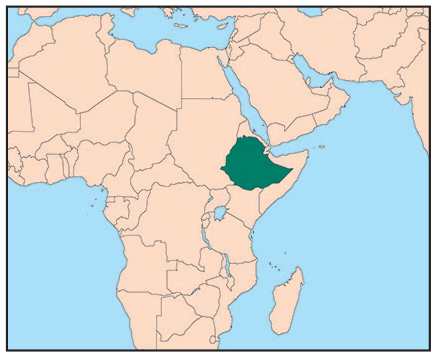
Founded in 1959 as one of a handful of planned cities in the country, Hawassa is a medium-sized city located 285 kilometres south of Ethiopia’s capital, Addis Ababa. Today it is a thriving and attractive city, home to one of the country’s biggest industrial developments, the Hawassa Industrial Park (HIP), and capital of the most diverse region in the country, the Southern Nations, Nationalities and Peoples’ Regional State (SNNPR).(2) At the time of writing, the city held the status of a “special zone” within the region(3) and is a self-governing city administration within the SNNPR. A referendum was held in November 2019 on the creation of a “Sidama Region” – a new regional state, of which Hawassa is expected to become the new capital.
Hawassa’s most significant economic development in recent times is the Hawassa Industrial Park – a key initiative within Ethiopia’s industrialization drive and the Growth and Transformation Plan II. Designed mainly to produce high-end apparel and textile products, HIP was officially opened in 2016. It is expected to generate about 60,000 jobs and increase Ethiopia’s export revenue by US$ 1 billion per year. It has attracted thousands of young women to the city, who account for approximately 90 per cent of the HIP workers [key informant interview (KII) with McKinsey & Company, 2018].
a. Housing supply and demand in Hawassa
The latest estimates suggest Hawassa’s urban population was around 335,508 in 2017.(4) The city’s annual population growth rate was estimated at 4 per cent.(5) However, both the total population and growth rate are likely to be much higher since the advent of the HIP, inaugurated in 2016. The overdue national census is key to providing more reliable data but was once again postponed from its scheduled April 2019 rollout.(6)
Hawassa is bounded by Lake Hawassa in the west and Oromia Region in the north, which constrains its physical expansion. The city is divided into eight sub-cities, which are further divided into 32 kebeles. These kebeles include both urban and rural neighbourhoods, and density varies according to three broad settlement types. Scott et al.(7) categorize these as follows:
Well-defined residential housing and industrial areas: low density with good, well-planned road access
Old kebeles within the city: medium to high density
Newly developing informal peri-urban areas: high density for those within the city boundary, while those encroaching on the city are currently more rural in nature
While it is difficult to obtain accurate or reliable information on the prevalence of housing types due to the lack of census data, our research team identified a number of housing types in Hawassa ranging from villas to traditional huts, shacks (prevalent in all parts of the city), row houses (the most prevalent housing type in both formal and informal settlements), and multi-storey tenements (less common except in some sub-cities).(8)
Informal settlements are proliferating around the outskirts of the city. Often referred to as “illegal settlements” in the Ethiopian context, these have existed in Hawassa since the 1980s, but are now increasing rapidly in size and number as the city’s population expands and in the absence of viable, planned alternatives. In particular, the policy of rural kebele annexation post-2005,(9) driven by political representation objectives as much as the objective of acquiring land for urban development purposes, has been a catalyst in the rapid growth of these peri-urban settlements.(10)
Demand for housing in Hawassa has grown at speed while housing supply is hardly increasing. Since 2015, the construction and thereafter staffing of the industrial park has had a significant impact on the demand for shelter in Hawassa. The city cleared a large area of land for the site itself, and has attracted tens of thousands of workers from the wider region to live and work in the city. Most HIP workers are young women, arriving without families or dependents, and living off very low wages (the average monthly salary of new arrivals is approximately 900 Ethiopian birr (ETB), or US$ 25, according to the park workers). Many of these workers are currently renting accommodation in informal settlements, given that other housing options are either insufficient for a number of reasons(11) or unaffordable.
Current efforts to develop the housing stock were described by one local official as “fetching seawater with a spoon”. UN-Habitat figures(12) suggest a housing deficit in Hawassa of approximately 32,400 units (based on population estimates and excluding informal housing). With supply failing to progress in step with demand,(13) challenges of overcrowding and affordability have become more acute.
b. Affordability of housing in Hawassa
Nationwide, housing affordability remains a big challenge, particularly for low-income groups, due to the lack of access to diversified and flexible housing finance in the country.(14) Low household incomes and high levels of unemployment (particularly for women) mean that housing rental or construction options are highly constrained for a large swathe of the urban population.
Hirboro et al.(15) conducted surveys on Hawassa’s condominium and rental housing, and found that most residents were “shelter poor”, meaning they could not meet basic non-housing needs after paying rent. Our research confirms this, in particular highlighting how people struggle to pay rents within the formal housing rental sector. Our survey concerning household expenditure (n=60) found out that almost half of respondents residing in the formal residential areas ranked rent as their biggest expenditure, compared to only one-sixth of informal settlement residents dwelling in rental housing.
The same survey found the average monthly rental expenditure to be ETB 1,353 (US$ 39) for respondents in the formal residential areas, whereas it is only ETB 384 (US$ 11) in informal sites. This constitutes approximately 37 per cent of the average wage income for formal settlement residents (ETB 3,690 or US$ 106) and 30 per cent for informal settlement residents (ETB 1,250 or US$ 36). Those living in single rooms make up 51.6 per cent of formal settlement residents and 65.5 per cent of informal settlement residents.
c. Government efforts to promote gender equality and social inclusion in housing
While there have been a number of initiatives in Ethiopia to promote gender equality in accessing shelter, as well as positive legal and regulatory frameworks, this has not translated into improved access for women to shelter at scale. This subsection outlines a number of these government initiatives to provide housing, as well as some key lessons learnt.
Since the nationalization of “extra houses”(16) after the 1975 revolution in Ethiopia, there have been two major strands to state shelter provision.
Government and kebele houses
The first comprises government and kebele houses, managed by a government housing agency and the woreda (district) administrations where they are located. These include those houses nationalized after the mid-1970s Ethiopian Revolution, as well as various types of low-cost housing built by the housing agency in the early 1980s and 1990s in different towns. Also included are “own assisted” houses – which were built partly using people’s own finances and partly with a long-term government loan under a cost-efficient construction system.
Female-headed households, which typically have below-average income levels,(17) are formally prioritized in allocations of kebele and other government housing for the very poorest (KII with a Tabor sub-city representative.) That this principle is so embedded in pro-poor housing approaches is to be lauded, and it sets a strong foundation for future policy. However, while female-headed households, people living with disabilities and those affected by HIV/AIDS are formally prioritized in the allocation of these units when they become available, there are allegations that they are often allocated instead to relatives of municipal officials, including through illegal and forced eviction of existing tenants (KII with the Office of the Ombudsman in Hawassa).
Condominium housing
The second strand of housing was initiated in 2005, when the government launched the Integrated Housing Development Programme (IHDP)(18) – arguably one of the most ambitious social housing programmes in Africa.(19) Drawing on finance awarded by the Commercial Bank of Ethiopia, regional governments constructed high-rise condominium blocks in 56 urban centres (including Hawassa). These were awarded to registered citizens through a lottery scheme.
As with kebele housing, where female-headed households are given priority, affirmative action in favour of women has been incorporated into the IHDP scheme. This scheme intends that at least 30 per cent of houses aimed at low-income to middle-income groups under the programme should go to female-headed households as a direct award prior to lottery competition for these units.(20) After that, women are also entitled to participate in the remaining 70 per cent of the housing lottery competition.
The affirmative action approach of the IHDP in favouring female-headed households and people with disabilities represents an important step for these historically marginalized groups. However, both the literature and our primary data confirmed that in practice the deposit required is so high that it precludes low-income households.
“For the bottom third of households, IHDP condominiums are only affordable if households select small units, take on high down payments and are able to support high-payment-to-income ratios. In fact, the 3-bedroom unit is unaffordable for even median households in Addis Ababa. Aside from high monthly payments, there are other reasons the current structure of the IHDP may not be a feasible housing solution. Notably, beneficiaries of the 10/90 loan may only purchase studios, even though lower-income households are not necessarily smaller.”(21)
Gebeyehu notes that in the case of Hawassa, the condominium housing project does not in fact address the need of the low-income groups because “the monthly income of more than half of the households [55 per cent in 2009 and 61 per cent in 2011] who were assumed to get condominiums in the two rounds lie between 500 ETB [US$ 34] and 1,500 ETB [US$ 100]”.(22) Furthermore, only 16 per cent and 20 per cent of those households that won the lottery for condominium housing in 2011 and 2009, respectively, were actually able to make the 20 per cent down payment.(23)
III. Literature Review – Gender and Access to Shelter in Hawassa
There are several studies on women’s access to and use of land across Ethiopia (particularly on the impact of the national land certification process), but the focus is typically on rural areas; the regional state of Tigray; or the capital city, Addis Ababa. Overall, there are very scarce reliable data on women’s access to and experiences of shelter in Hawassa, making this a priority area for our research. We have identified only three relevant sources to date,(24) discussing experiences with condominium housing, land certification, and street women and children respectively.
In line with findings from the global literature, data from Hawassa suggest that women with disabilities and divorced, separated and widowed women all face acute shelter vulnerabilities. In Nathan’s small-scale study of women and children sleeping rough across the city,(25) 81 per cent of the women begging and sleeping on the streets were found to be separated, widowed or never married, or had disabled husbands (16 per cent). Most of these women had small children; almost one-third were disabled. A 2015 World Bank poverty assessment similarly found that nationally, elderly, disabled and female-headed households in Ethiopia’s urban areas were much poorer than those in other social categories.(26) This aligns with global evidence that divorced, separated and widowed women are at particular risk of dispossession and constitute the most vulnerable subsection of urban women.(27) It is important to note that the economic vulnerability of women in these categories is understood to be a product of unequal access to assets, finance and property, as well as traditional gender roles vis-à-vis employment and caring responsibilities.(28)
A World Bank study found that female-headed households represent 33 per cent of Ethiopia’s total urban population, one of the highest in Africa, as compared to 17 per cent in rural areas.(29) Of this number, widow-led families represent a remarkable 15 per cent of Ethiopia’s urban population – many of them having migrated from rural areas to improve their livelihood prospects.(30) Multiple studies(31) highlight the trend of female-headed households migrating to urban areas due to social stigma and the lack of job opportunities in rural areas. Tiumelissan and Pankhurst(32) found a high prevalence in Hawassa’s low-income areas of households headed by women, many of whom were migrants from rural areas, particularly Oromia and Amhara. An older study from Addis Ababa(33) found that most of the women heading households in informal urban settlements in the study sample were widowed or divorced.
More recent data suggest that condominiums are less popular in Hawassa than in Addis Ababa, and that women working from home in Hawassa (mainly preparing and selling food and beverages) are concerned that living in condominium housing could entail limits on their business activities.(34) But girls were more positive than boys about condominiums, citing access to modern kitchens, private toilets, and a greater sense of security as particular benefits.(35) In both Hawassa and Addis, girls highlighted proper toilets as a key advantage of condominiums, likely because of menstruation and their desire for safety and privacy.(36)
While 90 per cent of Hawassa Industrial Park workers are women, recent research has found that housing is generally unaffordable for female HIP workers, who face difficulty in accessing decent housing and can be forced to live in rooms shared with up to four or five others.(37) There are also significant safety concerns as a lack of affordability, given their low wages, is forcing women to live in cheaper, more peripheral locations and to walk home at night, facing the threat of sexual harassment and assault.(38)
Ethiopia has positive legal frameworks around equal property rights for divorced, separated and widowed women.(39) Article 35, Sub-article 7 of the Constitution of the Federal Democratic Republic of Ethiopia(40) states: “Women have the right to acquire, administer, control, use and transfer property. In particular, they have equal rights with men with respect to use, transfer, administration and control of land. They shall also enjoy equal treatment in the inheritance of property.”
Several steps have been taken by the Ethiopian government in recent years to support female-headed households to access shelter. A revised Family Code(41) came into effect in July 2000, updating the 1960 Family Code. The law covers most areas of family relations, such as marriage, divorce, inheritance, paternity, adoption and child welfare. Legally, the revised Family Code stipulates that pre-owned or later purchased assets are co-owned by spouses after marriage.
Among the key changes pertaining to shelter in the revised law (compared to the previous 1960 Family Code) are that women are given the authority to administer common marital property; and more authority has been given to courts in settling disputes arising in cases of divorce and inheritance (and correspondingly less to traditional arbitrators). This allows greater agency for women.(42)
Several studies discuss the positive impact of Ethiopia’s joint land titling (with both the husband and wife named on the certificate) upon women’s rights and economic empowerment. In the early 1990s the government led by the Ethiopian People’s Revolutionary Democratic Front (EPRDF) formally proclaimed that land rights were to be granted to men and women, including the right to lease out land.(43) A national land certification programme was introduced in the late 1990s, although not in SNNPR until 2004.(44) It sought to address gender bias concerns in the land-tenure system by issuing a “non-alienable joint certificate to both spouses that confers equity and joint land ownership”.(45)
Whilst held up as a success story,(46) Ethiopia’s certification process has been implemented quite differently in each region. In SNNPR, regional land laws mandate the inclusion of both the husband and wife on land certificates. In Holden and Tefera’s study,(47) which sampled half from peri-urban and half from rural areas, around 80 per cent of all distributed certificates were found to include women’s names (wives or female heads), which is a considerable success.(48) In terms of perceptions, 75 per cent of households “believed that land certification contributed to increased tenure security of women” and that this would increase the probability that women would keep the land after divorce or death of their husbands.(49) Polygamy is widely practised within SNNPR and the legislation allows multiple wives to be listed on certificates, thereby increasing the sense of tenure security among polygamous wives, particularly later wives.(50) The legislation also strengthened inheritance rights, conferring equal inheritance rights to sons and daughters,(51) but evidence suggests that widows and divorcees still remain vulnerable to dispossession.(52)
Several studies(53) highlight interesting dynamics around how the certification process has played out in peri-urban areas or other areas affected by rapid urban expansion. As Deininger notes, “Households in areas where urban expansion is imminent are reported to be particularly eager to get certificates that could help them substantiate their claims for compensation once their land is subject to urban expansion. In fact, observers link the ability to use certificates to insist on compensation to the emergence of innovative in-kind compensation arrangements in a number of peri-urban areas.”(54)
Likewise, Bezu and Holden note a “sharp increase in land values from 2007 to 2012, particularly in Shashemene district, which is experiencing rapid urbanization”.(55) Early-stage fieldwork indicates that this phenomenon is likely also happening on the outskirts of Hawassa, although the gendered effects of this are not yet understood.
IV. Methodology
While the data collected for this study are primarily qualitative, we have drawn upon quantitative data from secondary sources where possible, and have also made use of a quantitative survey in order to understand household income, rental and utility costs, household characteristics, type of housing and sources of finance for construction.
This review used both qualitative (checklist based) and quantitative (questionnaire based) questions to gather data. This included 86 qualitative, semi-structured interviews; 11 focus group discussions; and 60 household surveys. Interviews and focus group discussions included people with disabilities, female heads of household living in various shelter types (informal settlements, low-cost government housing, condominiums, own housing), and select government and civil society representatives working with vulnerable women, children and people with disabilities in the city.
The 60 household surveys were quantitative (questionnaire based), and were conducted in one formal and one informal settlement (31 surveys in Philadelphia and 29 surveys in Dato respectively), in order to understand household income, rental and utility costs, household characteristics, type of housing and sources of finance for construction. The Philadelphia neighbourhood was selected as an example of a formal settlement and the Dato neighbourhood was selected as a contrasting case study site — a fast-growing informal settlement towards the outskirts of the city.
While our survey sample was not randomized, and hence has the limitation of not being formally representative,(56) we are confident that the findings provide an indicative and useful snapshot of affordability and perceptions in these two different settlement types.
Qualitative primary data were analysed using Excel, and by using a coding system that reflected the overall research programme’s objectives and core areas of focus. Where possible, during analysis, primary data were triangulated with secondary sources. However, the lack of reliable, up-to-date, published statistical data on shelter in Hawassa rendered this very challenging.
The principal challenge in the research was the fast-changing political landscape, with the result that data collected early in the project needed to be interpreted with caution. Political sensitivity, and the ongoing social unrest, was also a constraint in terms of what questions could be asked, given the imperative to do no harm.
Finally, a limitation of the study was that the scope did not extend to reliable and representative quantitative data that would permit a more detailed analysis of market segmentation. Our research thus paints a broad picture of how particular challenges affect certain population groups, but further research is required to quantify these inequalities to the level of accuracy required for setting budgetary targets or similar aims.
V. Findings
a. Vulnerability: female-headed households; divorced, separated and widowed women; elderly women; and women with disabilities
In line with the global literature, our study found clear evidence throughout our KIIs, focus group discussions and surveys that the key vulnerability factors affecting people’s access to decent shelter are poverty, gender, age, social status(57) and disability. These factors intersect in diverse ways and circumstances to produce higher or lower levels of shelter vulnerability. Building on our use of a gender and social inclusion lens to examine shelter issues in Hawassa, this section collates findings on barriers to accessing secure shelter for vulnerable groups.
b. Shelter vulnerability
Although there are very limited reliable secondary data on women’s access to and experiences of shelter in Hawassa, our interviews and focus group discussions nevertheless validate existing evidence from elsewhere in Ethiopia that female-headed households; unmarried, divorced, separated and widowed women; elderly women; and women with disabilities all face severe/acute shelter vulnerabilities and are among the most vulnerable urban residents in Hawassa. Female-headed households were found to be particularly affected by safety issues and challenges in accessing shelter (due to discriminatory perceptions or lack of access to finance) in informal settlement and low-income private rental areas, whereas this was less of a concern reported by those living in government-provided condominiums or low-cost government housing.
Residents interviewed for this study, both women and men, universally identified women in these categories as the most economically vulnerable in the city, and thus amongst the most constrained in accessing decent shelter in a context of high and rising rental and purchase prices. One man interviewed noted that “it is known that it is difficult [for a single woman and divorcee] to work and do things by herself [. . .] When a single woman is compared to those who live in pairs, her economic condition is very low.” Local women’s groups agreed, describing single (never married/divorced/widowed) women with children as significantly overrepresented among destitute city-dwellers.
“Women family heads. . .have a serious housing problem; particularly on women with low income. As you know, high budget is required in order to solve housing problem. We help them participate in different saving schemes so that even if it is difficult for them to construct their houses with such a saving, at least they would be able to pay their home rents and live better life. They are struggling in this regard. They have started to solve these problems and are living better life relatively now.” (KII with the chair of a women’s association in Hawassa)
Having children was described as an important vulnerability factor for single women by informants in our study – both in terms of the economic and time burden of caring for children, and because of discrimination by landlords. A broker reported that pregnant women are turned away by landlords. One female resident in a low-income district of Hawassa claimed that: “If you have a family and have two children, the house owners do not want to rent to you.
There were different accounts from interviews on whether single women without children face the same challenges or not. In a number of interviews, both with residents and with a broker, respondents reported that women in general face discrimination in accessing rental housing because of perceptions by landlords that they will use utilities more, invite their friends over and disturb their neighbours more than single men. This is likely because women generally spend more time around the home during the daytime than men, who more often work away from the home for long periods in the day. Women living in informal settlements on the outskirts of the city reported fewer challenges in obtaining rental housing than women attempting to rent in more centrally located areas because: “The area is remote, and there are not a lot of people who want to rent a house there, so there is not such a problem with landlords.” (FGD with female household heads in informal shelter, Monopol area)
In contrast, there was a strong perception among members of this same focus group of female household heads that “in the city centre no one would let a woman rent unless she is married, regardless of her income”.
Our interviews also suggest that condominium housing is prohibitively expensive for many,(58) but in particular for women, whereas more simply constructed housing would be more accessible for very poor women: “When I see a woman with seven children at her back […] how can such a woman join and compete for the house you have mentioned? Isn’t there anything cheaper than this? […] I am looking for small houses to be constructed in a small size which may not cost much just only where women can simply get into and sleep [. . .] Can a woman afford to complete the 20:80 ratio payments to the last?” (KII with the chair of a women’s association in Hawassa)
c. Access to services and infrastructure
Beyond affordability, our research found that access to both services and adequate infrastructure was a critical concern for Hawassa residents. Table 1 compares infrastructure provision in two settlements (one formal and one informal), where 60 residents were interviewed as part of our housing survey. The Philadelphia kebele is located within the Addis Ketema sub-city and is one of the oldest neighbourhoods within Hawassa. The Dato neighbourhood, a fast-growing informal settlement, was selected as a contrasting case-study site and a neighbourhood typically hosting a number of HIP workers. It is located within the Hawela Tulla sub-city at the periphery of the city and alongside Hawassa’s rural kebeles that are not within the plan boundary. It is one of the fastest-growing informal settlement sites hosting the city’s low-income population. Residents were asked about a range of issues including rental costs, services, shelter size and other shelter details.
Comparing infrastructure provision in in the Philadelphia and Dato settlements
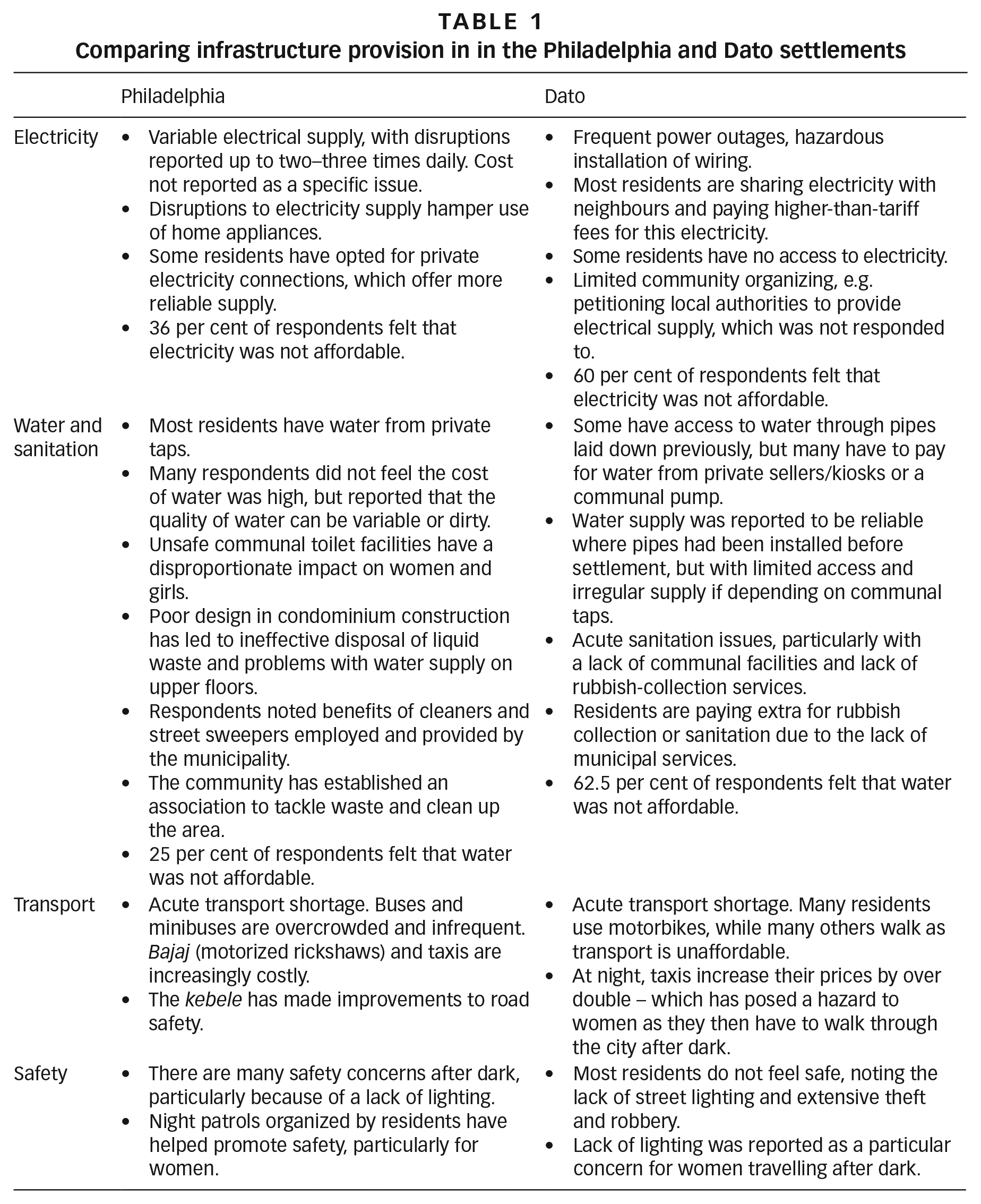
Illustrative of broader infrastructure-related issues found in our research, these case studies highlight the following issues:
Community organizing has been limited in both settlements and focused around specific issues, although in Philadelphia the community has established a community night patrol that has improved safety for women.
For condominium residents specifically, despite the generally better conditions there, both the peripheral location and poor infrastructure were critical concerns, especially regarding the provision of sanitation and toilets. Poor construction of the waste system appears to be compounded by a lack of clarity regarding ownership or management. One female respondent complained: “I think the construction was not studied by professionals. It was carried out by those who were organized under small and micro business enterprises [. . .] It is full of problems. The toilet [. . .] the septic tank does not have an owner. Who owns the septic tank and to whom to appeal is not known [. . .] The biggest and major problem is that the pipeline was not properly designed and implemented. The pipelines from the top leak to the lower floors. This creates problems among dwellers; it is a common cause of complaints [. . .] When the toilet is full, it flows in the house.” (female condominium resident, FGD)
Women in our study were particularly concerned with such infrastructure problems in condominiums since they spend more time in and around the home than their male counterparts. They are also more likely to run businesses from home, which require good water and sanitation – for example, making and selling coffee or injera (flatbreads), or preparing animal products for sale/consumption. Inadequate toilets are also a particular concern for women, particularly in informal settlements, due to menstruation and concerns over privacy/safety (FGD with female household heads, Monopol area).
d. Gender norms, divorce and inheritance
Ethiopia, as discussed above, has a positive legislative and policy framework around the property rights of divorced, separated and widowed women. However, in practice our interviews and focus group discussions(59) revealed multiple barriers that prevent women from realizing these legal rights: limited knowledge and awareness of the law; lack of access to legal advice and representation for divorce proceedings; lack of awareness and access to household assets as men traditionally manage these (even commonly “hiding” assets from their spouses to avoid sharing them with wives during or upon dissolution of a marriage); or cohabiting practices and un-formalized marriages (conducted in traditional or religious ceremonies but never registered with state authorities).
Many women interviewed discussed these barriers in depth. For example: “The asset division is not fair. They usually bring an elder in the process. The culture is a barrier [. . .] often [. . .] the woman does not even know anything about the asset [. . .] Usually they [elders and engineers consulted] skew the boundary towards the man because of bribes and then make the woman lose in the arrangement.” [KII with the Ethiopian Women Lawyers Association (EWLA)]
Nevertheless, there was a perception among some women that women are steadily claiming more of their legal rights regarding divorce and inheritance. Respondents in research by Hall(60) on female HIP workers also reported a greater sense of independence since moving to Hawassa for work.
e. Informality, regulation and resettlement
Informal housing constitutes an estimated 47 per cent of shelter in the city, according to UN-Habitat(61) approximations. Key informants in our research confirmed that private rental prices have been increasing rapidly, forcing residents – especially female-headed households – into the less-expensive peripheral areas of the city (KII with the chair of a women’s association in Hawassa, SNNPR Investment Commission).
Residents of informal settlements can also end up being evicted and resettled elsewhere. However, there is a risk that where housing deeds or leases are held by the husband, in practice, compensation will be paid out to male leaseholders only – which can impact women and household decision-making. The same group of female discussants observed that their husbands did not tell them how much they were given by the government as compensation.
Amongst the wider benefits to residents, our research suggested that regularization of informal settlements(62) may have particular benefits for enhancing women’s access to credit. This was widely agreed on during FGDs with women in these areas. One resident commented: “After we got a plan [for their home when regularized], we got something better. In the past, we couldn’t use our informal house as collateral. But now we can. So, if we want to invest, we can do that by getting loans from our house.” (FGD with female household heads in Monopol)
Another FGD participant noted the gender differences: “As for me, a house with a plan and deed and near to the road is better for women. So, water, electricity and other things are important to allow the women to do some sort of work near her house.” (FGD with female household heads in Monopol)
However, some of these women felt that if good roads had been built after regularization (this had not yet happened), they would be better able to run businesses from their homes or sell their goods further afield. Enhancements to the tenure security of women can have significant impacts on their prospects for economic empowerment, safety and wellbeing, due to their normative or actual association to the household compared to male counterparts. For example, the home is the site of child-rearing or income generation, as well as the foundation for women’s social networks.
f. Safety and security
Reinforcing findings in the literature review, safety and security emerged as key concerns for residents in different types of shelter across the city, cited in discussions ranging from transport issues to the location of housing.
Our key informant interviews, as well as our survey of residents of the Dato and Philadelphia settlements (Table 1), revealed that there are specific issues around the safety of women – particularly young female workers in the HIP – travelling out to informal settlements where limited transport options put them at considerable risk of sexual violence at the end of their commute. An NGO staff member working with survivors of violence described this: “Recently IP [industrial park] workers come here. Most are women. They get low salary. They live around Cheffe Datto, which are far, remote and inaccessible locations that do not have access to transport. When they go out in the morning or come back home in the evening, they are violated.” [KII with the Hawassa project coordinator of the Association for Women’s Sanctuary and Development (AWSAD)(63)]
Distressing reports were made during fieldwork by women residents and key experts, that rape of women and children is “very common” in informal settlement areas “because the houses are congested together”.(64) A representative from the SNNPR Bureau of Women, Children and Youth Affairs described how women living in these areas “are raped by landlords and the landlords’ sons”. Others described the rape of children in these areas as a common phenomenon because their parents work long hours in the city away from the settlements.
Although our research highlights that this phenomenon is known within the HIP(65) and beyond, there were no reports by any KIIs of actions being taken to tackle the violence. An anonymous key informant working in the HIP, in a phone interview in April 2019, suggested that the lack of clear roles for different levels of government authority was a serious impediment to integrated action.
VI. Conclusions
Findings from Hawassa on the intersection between economic vulnerability and gender roles and norms validates the literature and global recommendations, that, as noted by Baruah in 2007, “without livelihoods, incomes and access to basic services, access to land and property will not take women very far [. . .] pro-urban land policy must be located within a broader urban development framework” that includes gender-sensitive support to raising incomes, livelihood opportunities, education, housing and infrastructure (KII, AWSAD representative).(66)
Crucially, our research demonstrates how multiple intersecting forms of vulnerability – social, economic and spatial – act as barriers to women in accessing shelter in Hawassa. The peripheral location of condominium units, their unaffordability for poor (among whom women are disproportionately represented) and even middle-class urban dwellers, and corruption in kebele housing allocation all undermine the effective implementation of policies designed to support women.
Female-headed households; unmarried, divorced, separated and widowed women; elderly women; and women with disabilities all face severe/acute shelter vulnerabilities and are among the most vulnerable urban residents in Hawassa. These are the groups that are most likely to struggle to access both formal and informal shelter, because of their below-average income levels but also because of other forms of bias and discrimination. Despite a range of legal and policy stipulations that provide for affirmative action measures to prioritize women’s access to shelter, gender norms and roles continue to constrain equal property rights for divorced, separated and widowed women – who are also the most economically vulnerable.
In light of these findings,(67) the Hawassa city administration, the federal government and development partners should ensure that shelter solutions are genuinely and concretely inclusive, responding to the needs of vulnerable households and individuals, including migrant HIP workers, female-headed households, women and children facing risks of sexual violence in informal settlements, extremely poor households, resettled households and people with disabilities. It is important that inclusion goes beyond policy design to include implementation, which requires close monitoring and beneficiary feedback loops.
The city administration should actively support the formation of housing cooperatives to increase the supply of affordable housing. They should mobilize relevant bureaux and sub-city offices to explore multi-sector options for preventing violence against women and girls, including the provision of safe transport, improvements in water and sanitation facilities, and consideration of reliable daycare facilities for children whose parents work away from home – as well as data collection that allows for adequate assessment of the needs, and monitoring of responses where they are provided.
The Hawassa city government should provide more serviced land for housing at affordable lease prices. This might entail an additional mechanism that permits allocation of land to low-income households, outside of the competitive bidding system that is beyond the reach of these households.
To ease the acute demand for housing, the municipal government should also carefully consider regularization of eligible informal settlements according to the existing legal framework. To mitigate the risk of gentrification, this should ideally be done at scale, using alternative standards, with community involvement/ownership, and with consideration of collective landownership options. The authorities should ensure that any evictions of informal settlement residents are managed with maximum diligence and consultation. The municipality should also engage with residents of informal settlements to formulate responsive policies for the sustainable provision of shelter. If involuntary resettlement is unavoidable, best practices can be drawn from international standards such as the International Finance Corporation (IFC) performance standards on environmental and social sustainability, specifically Performance Standard 5 on Land Acquisition and Involuntary Resettlement, to safeguard vulnerable residents of informal settlements.
Recent reforms offer a major opportunity to involve communities and civil society organizations (CSOs) in organizing, mobilizing and advocating around issues of shelter affecting low-income groups, especially to address the acute challenges affecting women and others facing particular risks.
Companies operating in the HIP should provide proactive and holistic support for the welfare of their staff, including minimizing their exposure to violence on the journey to and from work. It is in these companies’ interest to improve shelter for workers, in order to boost worker retention and the park’s success.
Footnotes
Funding
The research was funded by the UK Department for International Development’s East Africa Research Fund (EARF) and contributed to EARF’s programme of research: Shaping East African Cities as Systems to Work Better for All. This material has been funded by UK aid from the UK government. However, the views expressed do not necessarily reflect the UK government’s official policies.
1.
Grant, E, G Desta, Y Admassie, F Hassan, S Stevens and M Ayenew (2019), In Search of Shelter: The Case of Hawassa, Ethiopia, International Institute for Environment and Development (IIED), London.
2.
This is the most ethnically diverse of Ethiopia’s regional states, with over 45 indigenous ethnic groups speaking distinct languages.
3.
4.
Based on projections: Central Statistical Agency (2013), Population Projection of Ethiopia for All Regions at Wereda Level from 2014–2017, Federal Democratic Republic of Ethiopia, available at  .
.
5.
See reference 4.
6.
The Economist (2019), “Why Ethiopia has postponed its census”, 29 March, available at .
7.
Scott, R E, I Ross and P M Hawkins (2016), Faecal Sludge Management: Diagnostics for Service Delivery in Urban Areas — Report of a FSM study in Hawassa, Ethiopia, World Bank, available at .
8.
See reference 1, Section 2.3 for more on the housing typology.
9.
“After the 2005 election landslide victory by the oppositions in urban Ethiopia, including Hawassa, the ruling party decided to overwhelm the urban centres, which are heterogeneously populated, with the original inhabitant ethnic community by bringing the nearby rural kebeles into the city’s jurisdiction.” [An official, in Kinfu, E, E Bombeck, H Nigussie and F Wegayehu (2019), “The genesis of peri-urban Ethiopia: the case of Hawassa City”, Journal of Land and Rural Studies Vol 7, No 1, pages 71–95, pages 78–79.]
11.
See reference 1, Section 4.5.
12.
13.
Constraints to housing development are discussed in more detail in Grant et al. (see reference 1). These include the scarcity of land and finance for those wishing to construct new housing (Sections 4.2 and 7.1) and the rigidity of the land lease system (Section 4.2).
14.
Kayiira, D (2017), Ethiopia: Landscape of Investment, country report, Centre for Affordable Housing Finance in Africa, available at .
15.
Hirboro, S G, M M Batu and S Aseffa S (2017), “Rental house price determinants and affordability in Hawassa City, Ethiopia”, Journal of Poverty, Investment and Development Vol 39, available at .
16.
In recognition of the public grievance concerning exorbitant living costs – including the high rental-housing prices, particularly in the capital, Addis Ababa – a new proclamation (47/1975 – FDRE) was issued in 1975. According to the proclamation, urban residents could keep one residential property and another business property (if they had a business), but were required to hand over any other properties (“extra houses”) to the government.
17.
The number of female-headed households under absolute poverty is higher than that of male-headed ones in urban Ethiopia. [MoFED (2002b) in Eskezia, B (2011), The Incidence of Urban Poverty in the Female-Headed Households in Addis Ababa, Ethiopia, available at .] Eskezia’s study also finds that the leading cause of households being headed by women in Ethiopia is divorce.
18.
For a more detailed overview of government policy and initiatives for housing in Ethiopia, see reference 1, Section 4.
19.
Gardner, T (2016), “Ethiopians adjust to life in Africa’s most ambitious social housing project”, Reuters, 25 October, available at .
20.
UN-Habitat (2011), Condominium Housing in Ethiopia: The Integrated Housing Development Programme, available at . See reference 1, Sections 4.2 and 4.3 for a more detailed overview of the Housing Development Strategy and IHDP scheme.
21.
World Bank (2015), Ethiopia — Urbanization Review: Urban Institutions for a Middle-Income Ethiopia, page 33, available at .
22.
Gebeyehu, B (2015), Background Report on Land Governance Assessment Framework Analysis for Public Provision of Land Information: Registry and Cadastre in Ethiopia, page 173.
23.
See reference 22.
24.
Tiumelissan, A and A Pankhurst (2013), Moving to Condominium Housing?: Views about the Prospect among Caregivers and Children in Addis Ababa and Hawassa, Ethiopia, Young Lives, Oxford; also Holden, S and T Tefera (2008), “From being property of men to becoming equal owners? Early impacts of land registration and certification on women in Southern Ethiopia”, UN-Habitat, Land Tenure and Property Administration Section; and Nathan, M (2012), Report to the City of Hawassa on Street Women and Children, Fulbright Specialist, Hawassa University Referral Hospital.
26.
See reference 21.
27.
Chant, S and C McIlwaine (2016), Cities, Slums and Gender in the Global South: Towards a Feminised Urban Future, Routledge; also Rakodi, C (2014), Expanding Women’s Access to Land and Housing in Urban Areas, World Bank, available at .
29.
Muzzini, E (2008), Urban Poverty in Ethiopia: A Multi-faceted and Spatial Perspective, World Bank Group Urban Papers, January, page 29.
30.
See reference 29.
31.
See reference 29; also Dokken, T (2015), “Allocation of land tenure rights in Tigray: How large is the gender bias?”, Land Economics Vol 91, No 1, pages 106–125; and Bezabih, M and S Holden (2010), “The role of land certification in reducing gender gaps in productivity in rural Ethiopia”, Environment for Development, Discussion Paper Series 10-23, available at .
33.
Zenebe, M (2002), “Analysis of household poverty from a gender perspective: a study based on two kebeles in Addis Ababa”, in M Ayenew (editor), Poverty and Poverty Policy in Ethiopia, Forum for Social Studies.
37.
Hall, T (2019), The Urban Lives of Migrant Women Factory Workers in Ethiopia, Africa at LSE, available at .
38.
Jego, S T (2019), Housing Condition of Industrial Parks Workers: The Case of Hawassa Industrial Park.
39.
For a more comprehensive overview of Ethiopia’s legislative framework pertaining to land and housing, see Sections 3.1, 3.2 and 3.3 of reference 1.
40.
FDRE (1995), The Constitution of the Federal Democratic Republic of Ethiopia, available at .
41.
FDRE (2000), Revised Family Code 2000, Proclamation No 213/2000, available at .
42.
Hallward-Driemeier, M and O Gajigo (2013) Strengthening Economic Rights and Women’s Occupational Choice, Policy Research Working Paper 6695, World Bank Development Research Group, Finance and Private Sector Development Team, available at .
43.
See reference 42.
46.
E.g. see reference 24, Holden and Tefera (2008); also see reference 27, .
53.
See reference 24, Holden and Tefera (2008); also see Deininger, K (2009), Moving towards Pro-Poor Systems of Land Administration: Challenges for Land and Asset Distribution in Africa, UC Berkeley, Center for Effective Global Action, available at https://escholarship.org/uc/item/3n63h9b0; and Bezu, S and S Holden (2014), “Demand for second-stage land certification in Ethiopia: evidence from household panel data”, Land Use Policy Vol 41, pages 193–205, available at .
56.
The study was not resourced to do a statistically significant or randomized sample. The area has not been mapped, so there were no records of existing households, and the last survey was conducted too long ago to be of use.
57.
In particular, stability of livelihood/employment, marital status and kinship ties.
58.
Gebeyehu notes that in the case of Hawassa, the condominium housing project does not in fact address the need of the low-income groups because “the monthly income of more than half of the households [55 per cent in 2009 and 61 per cent in 2011] who were assumed to get condominiums in the two rounds lie between 500 ETB [US$ 34] and 1,500 ETB [US$ 100]” (see reference 22, page 173). Furthermore, only 16 per cent and 20 per cent of those households that won the lottery for condominium housing in 2011 and 2009, respectively, were able to make the 20 per cent down payment. See Section 4 of reference 1 for an overview of condominium housing and affordability.
59.
KIIs with the Ethiopian Women Lawyer’s Association; SNNPR Bureau of Women, Children and Youth Affairs; and Hawassa Women’s Association. Some female-headed households also mentioned their lack of awareness or engagement in household asset management as a reason they were living in poor-quality shelter and could not access their rightful marital property/assets (FGDs with female household heads).
60.
See reference 37.
61.
See reference 12.
62.
Regularization does present a risk of increasing costs (associated with the land lease, services, etc.), and thus the potential gentrification of such areas, pushing low-income households into even more remote locations if they are unable to afford the costs. This can have a disproportionate impact on women and female-headed households, who tend to have lower incomes and can face discrimination from landlords if renting. See reference 1, Section 4.6 for more information.
63.
AWSAD is an Ethiopian NGO working on women’s rights, social and economic development.
64.
AWSAD representative.
65.
Notably, UN-Habitat’s 2019 study (see reference 12) flags this problem and calls for urgent action.
67.
A broader set of recommendations can be found in reference 1, Section 8.