




Abstract
Understanding the competing and conflicting interests in peri-urban land is crucial for informed decisions and well-managed urbanization. These interests in peri-urban land in Ethiopia are explored from a political economy perspective, using desk review and case study research. The findings show that the state, the private business sector and the local community are the three main sets of players with competing interests in peri-urban land, which has resulted in the rapid conversion of farmland into built-up urban property. The more land is expropriated by government agents, and the more land is developed by developers, the more revenues are collected by the government and the more profit is realized by developers and dealers, but with less opportunity and security for local communities in the peri-urban areas. Therefore, urban spatial expansion and development programmes in urban fringe areas require purposeful intervention of the government in a way that can accommodate the interests of all parties without conflict.
I. Introduction
The rapid expansion of urban centres has been transforming Earth into a planet of cities.(1) Presently, over 50 per cent of the world’s population lives in urban areas, and by 2050 the proportion of the urban population is expected to increase to 68 per cent or more.(2) The largest proportion of this demographic growth is expected to take place in low- and middle-income countries, where much of the spatial expansion is taking place at the peri-urban fringes. In many African countries, peri-urban space is in high demand for urban housing and other urban business activities.(3) Understanding and mapping the actors involved in peri-urban land development is crucial for informed policy decisions and well-managed urbanization.
Urbanization has been pushing urban boundaries into peri-urban areas, “shaped by the interaction among various actors with different values, goals, policies and priorities”.(4) In addition, the presence of various institutions, actors, cultures and values in peri-urban areas raises the risk of clashes and confusion.(5) “Urban and peri-urban areas often fall under separate administrative jurisdictions with different resources, capacities and political leanings.”(6) The difficulty of setting clear and permanent physical and administrative boundaries between proper urban and peri-urban areas, because of the dynamic nature of peri-urban areas, has been intensifying confusion.
Moreover, continuous urban spatial expansion and the dynamic nature of peri-urban areas make the system of land tenure regulation and management unstable and inefficient.(7) Most often, land governance and administration structures are thinly spread and administrative functions are not structured in line with the dynamic and transitional nature of the areas.(8) Unauthorized land use conversion and informal settlement also mushroom in these areas, as they offer cheap, albeit underserviced, land for people who cannot afford formal land and housing.(9) In general, peri-urban areas are usually zones of rapid change, often characterized by land conversion from agricultural to urban built-up uses, where different land interests may come into conflict.(10)
As in other developing countries, the demographic and spatial expansion of urban areas has been challenging the stability of land use and land tenure management systems in the transitional peri-urban areas of Ethiopia.(11) In these areas, there is severe competition between agricultural and non-agricultural uses due to the growing demand for urban land and housing. Nearly all new developments and changes on land occur in these peri-urban areas, and the land tenure system changes continuously.(12) Land transactions and development in these areas involve multiple competing interests and parties, which sometimes leads to conflicts over land.
Although the state has long monopolized power over peri-urban land in Ethiopia,(13) there are increasing numbers of formal and informal actors in this domain. However, scholars and policymakers have not paid enough attention to systematic and comprehensive analysis of these conflicting and competing interests; the roles and power relations among the actors involved in peri-urban development; and the implications for land governance.
a. Research methods
This study aims to examine the competing and conflicting interests from the political economy perspective of peri-urban land use conversion and development through a case study of Bahir Dar City and its peri-urban areas. The case study was selected to acquire the richest possible data. The issues examined are certainly not limited to Bahir Dar and its peri-urban areas but are also relevant in other cities in Ethiopia. Both primary and secondary data sources were employed. Primary data were drawn from key informant interviews and focus group discussions (FGDs). The key informant interviews were conducted with senior officials and experts working in the Urban Development, Housing and Construction Bureau (two interviewees) and Amhara Region Rural Land Administration and Use Bureau (two interviewees). Three focus group discussions, composed of five participants each, were also conducted. The FGD groups comprised a group of land experts from the Bahir Dar City Administration/municipality, land brokers group and a group of local residents. The purposive non-random sampling technique was employed to select the discussants. Related documents, such as legal and policy documents, previous research reports and journal articles, were reviewed in detail.
b. Research location
Bahir Dar is one of the largest cities in Ethiopia and the capital city of Amhara National Regional State. It is one of the fastest-growing cities in the country, in terms of both population and area. The population of Bahir Dar City, including peri-urban areas, is estimated at 450,000, but the population growth is expected to be more than fourfold by 2040.(14) The rate of spatial expansion of the city is also expected to be even faster than its demographic growth.(15) Like many other Ethiopian cities, Bahir Dar is rapidly expanding and is surrounded by agricultural hinterland – conditions that generate competing and conflicting interests in land for agricultural and non-agricultural urban economies, values and people. The current masterplan of Bahir Dar City encompasses four peri-urban villages located immediately after the municipal boundaries, namely Weramit, Addis Alem, Wereb Kol and Zenzelima (Map 1). These peri-urban villages, known as kebeles (the lowest administrative units in Ethiopia), face increasing pressure from urbanization. Weramit and Zenzelima were selected as case study areas from the four peri-urban kebeles. They are located in the western and eastern parts of the city, respectively.
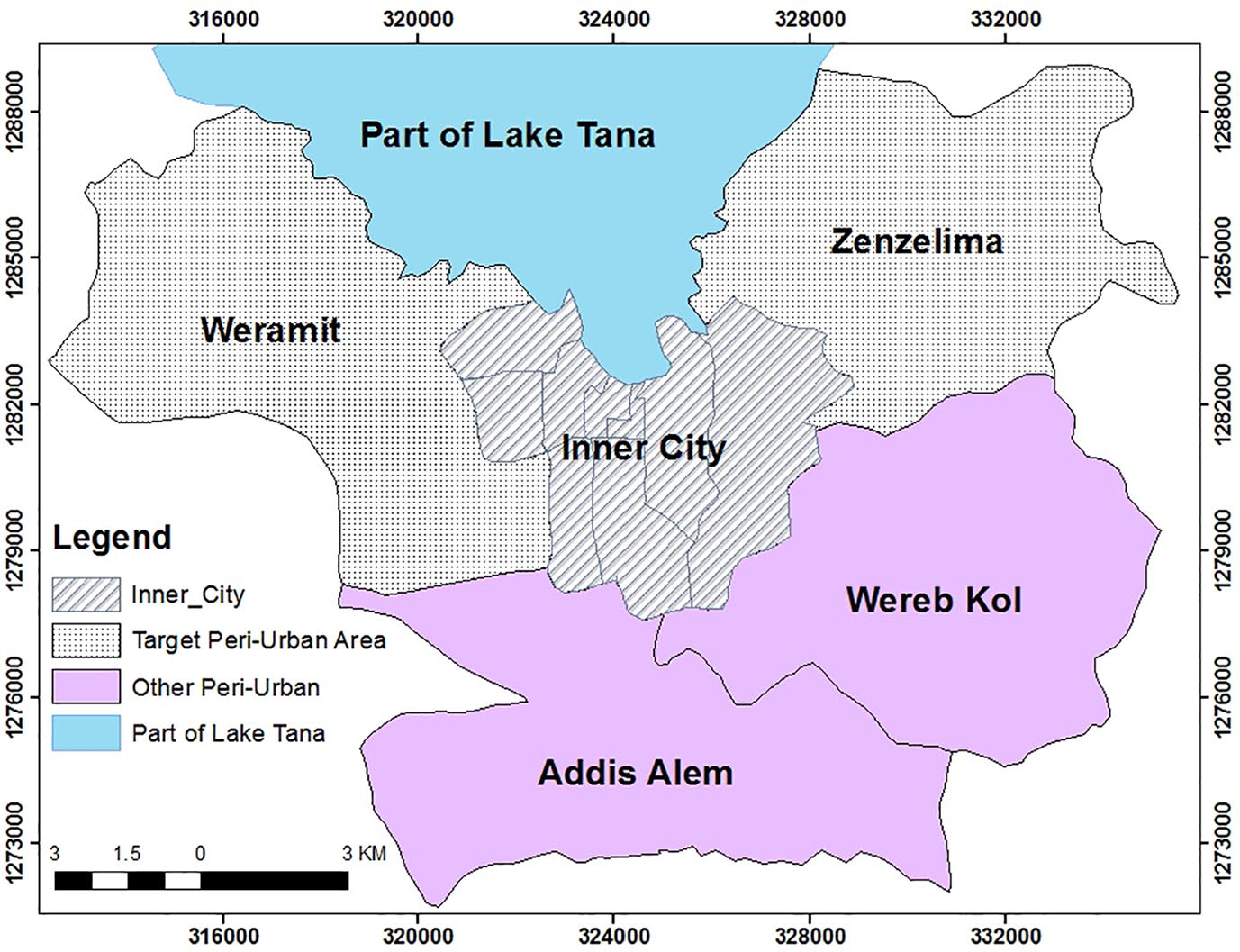
Location of Bahir Dar City and its peri-urban areas
II. Overview of the Land Tenure and Property System in Ethiopia
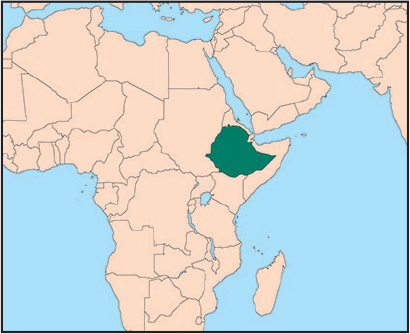
Ethiopia is one of Africa’s largest countries, with a total area of about 1.1 million square kilometres and an estimated total population of about 100 million. The current urban population accounts for only about 20 per cent, and the figure indicates that Ethiopia has one of the lowest proportions of urban dwellers in sub-Saharan Africa.(16) However, the proportion of the population living in urban areas is increasing rapidly. The Ethiopian Central Statistical Agency projects that the urban population will almost triple from 15.2 million in 2012 to 42.3 million in 2037, a growth rate of 3.8 per cent a year.(17) The World Bank’s estimation is that Ethiopia’s urbanization rate will be even higher, at about 5.4 per cent a year, and the tripling of the urban population will be reached even earlier – by 2034.(18) This rapid urban population growth has been accompanied by huge demand for peri-urban land.
Under Ethiopia’s constitution, which sets out the current land policy, all land belongs to the state and people of Ethiopia. Accordingly transfer through sale is prohibited.(19) The assignment of urban and rural land rights to the people is regulated and defined differently in policy and legislation. As a result the overall land tenure system is bifurcated into the rural land holding/usufruct system and an urban leasehold system.
Rural agricultural land through the holding/usufruct system can be provided by the government only for those who want to work in agriculture for their livelihood.(20) Federal and regional proclamations on land administration and use have details of rural land acquisition, transfer, redistribution and other aspects of rural holding rights.(21) As stated in the proclamations, every citizen aged 18 and over whose main residence is in a rural area and who wants to make a living from agriculture should be given free access to rural land and allowed to exercise usufruct/holding rights indefinitely.(22)
By contrast, the urban leasehold system has been implemented on land within the administrative boundaries of urban areas since the 1990s. All land in the urban jurisdictions is required to be governed by this system.(23) The leasehold system recognizes tenders (auctions) and allotments as the basic means of lease transfer from the government to citizens. As a matter of principle, land needed for private housing, commercial or other business purposes will be transferred by competitive tender. Governments may provide land by allotment to selected sectors considered vital to society, such as government organizations, religious institutions, public housing programmes, diplomatic missions, and land for people displaced by urban renewal.(24) The lease system, however, has been criticized for a number of reasons, including rent seeking, corruption, inefficiency and price hiking, which have made the system unable to satisfy the growing demand of both the urban poor and investors.(25)
Landholding rights in both urban and rural jurisdictions can be terminated when the land is needed for public purposes through expropriation (compulsory acquisition).(26) The legislation also provides for compensation of a “commensurate amount” to be paid to those who lose their landholding rights through expropriation. Expropriation measures by the government are largely implemented in urban fringe areas in response to the intensifying land and housing demands caused by rapid urbanization.
In general, the country’s land tenure and governance system is divided into urban and rural systems. However, overlaps exist on matters related to peri-urban land due to the dynamic nature of the area.(27) The multiplicity of actors interested in peri-urban land, as well as the lack of clarity over the land governance structure, has been contributing to conflicts of interest among various actors. Using a case study of Bahir Dar, this paper will explore conflicting peri-urban land interests often linked to the lack of clarity as well as overlapping legal and institutional arrangements.
III. The Political Economy of Peri-Urban Land Use Change
Peri-urban land is conceptualized as a third geographic space located between the urban and rural hinterlands.(28) It is characterized by ever-changing land uses, land values and landownership.(29) It is also a zone where peri-urban dwellers and other actors confront both urban and rural laws and institutions.(30) Peri-urban land in Ethiopia additionally includes rural agricultural land along municipal boundaries, which has been held by local farming communities. This is land under constant threat of expropriation by government agents, with a very high possibility of being converted into urban built-up property.(31) It is also where new unauthorized/informal settlements have been emerging, without basic utilities. The interaction of players through both the formal and informal channels largely defines the land tenure and use patterns in the processes of urbanization and urban land development in the area.
To analyse the actors and their interplay in the process of peri-urban land use conversion and development in Ethiopia, this study adopts a political economy perspective as an analytical framework. This analytical framework was originally used by scholars in the field of political ecology,(32) which theorizes land use conversion as a function of power relations among actors and enables an analysis of land use conversion across multiple scales.(33) This perspective also helps to reveal the complex social and environmental change resulting from interconnected and even conflicting economic, social and ecological processes operating at different scales.(34)
Recent studies use political ecology as a framework to understand the political economy of land use change in the transitional urban fringe areas of developing countries.(35) The framework allows researchers to examine how national governments formulate urban policy, and then consider how the provincial, municipal and village levels implement these policies.(36)
The political economy approach also simplifies place-based and non-place-based analyses of the complex process of urban land development in urban fringe areas. Existing literature refers to the state, the market and the community as the three sets of actors interested in land use conversion and development in peri-urban areas.(37) In the Ethiopian context, these actors are the state and its land agencies, the private business sector (both formal and informal), and the local indigenous community. The role of each actor is described in detail in the following sections to analyse their power relations and interactions and to identify their points of conflict when accessing and delivering land for urban development.
IV. The Role of the State and its Land Agencies
There are three levels of government in Ethiopia: federal, regional and local. Public institutions at all three levels have dual roles and objectives: as owners of land and as governors and managers of land. As owners, the federal and regional-level governments act as the sole suppliers of land for different urban development purposes through the lease contract system for specified periods.(38) It is also the responsibility of governments at federal and regional levels to enact laws and develop strategies that regulate the delivery of peri-urban land. Local governments, including the Bahir Dar City Administration, are mainly responsible for spatial planning, parcelling out the peri-urban land, and making it ready for lease. Some government agencies appear to pursue contradictory goals on this front. For instance, while the rural and urban land administration agencies have been established with the broader objective of administering land in their jurisdictions, sometimes there are contradictory interests and objectives for the transitional peri-urban areas.
Land acquisition and delivery from peri-urban areas involve four-step decisions by the government (Figure 1). First is incorporating the peri-urban agricultural land into the city’s masterplan. Second is expropriating the land from local landholders and putting the land in the land bank. Third is reallocating the expropriated land to different users through a lease contract, on the basis of annual ground rent for the period specified in the lease contract. The last step is a development phase where developers are expected to construct or develop on the land they have received. The land acquisition and delivery process indicates that immediately after a plot of land that used to be in the peri-urban territory “is planned for urban expansion, its inhabitants become the subject of “default” expropriation, with compensation only in cases where they have legal rights to the land, and at prices that are many times lower than farmers can fetch on the informal market”.(39) After compensation is paid to the victims, the state and its land agencies are required to assemble and subdivide land into parcels based on the masterplan of the area. Finally, re-parcelled and subdivided land will be ready for reallocation for different urban expansion and development programmes.
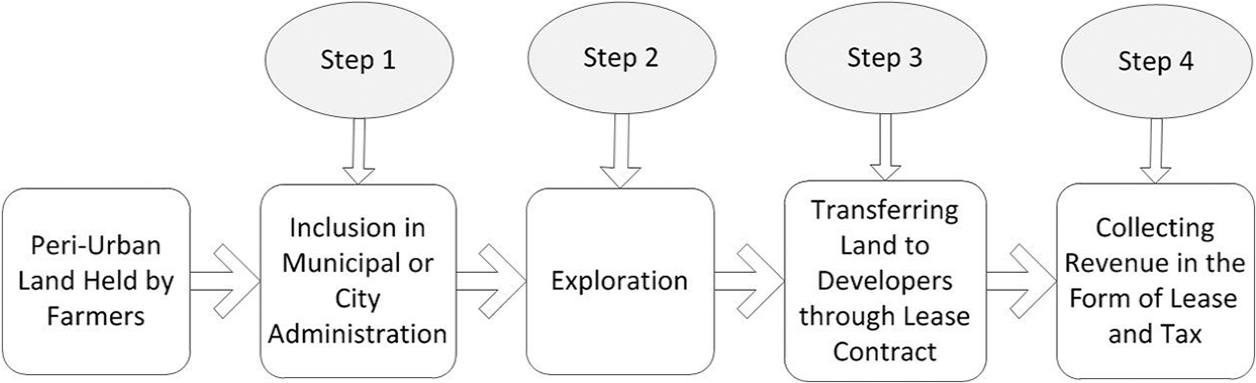
The role of the state and its agencies in urban land development process in Ethiopia
Expropriation largely implemented in the peri-urban areas of Bahir Dar and other urban centres is the sole formal means of trading between the bifurcated rural and urban landholding systems. Government agencies like the Bahir Dar City Administration stand to maximize their revenues by expropriating and leasing the peri-urban land adjacent to the municipal boundaries without due consideration of the local communities. The overall decision favours the interests of the urbanites over the local peri-urban farmers, and has led to land conflict in peri-urban areas. Comments made in the FGDs and interviews indicate that peri-urban landholders are mostly affected negatively because of the non-inclusive nature of the formal urban development programmes. They also indicated that urban land development programmes end up displacing the local peri-urban communities, causing physical, social, financial and psychological disruption.
The gaps in the official land acquisition and delivery system provides the incentive for many urban fringe residents to preempt such processes and subdivide and sell their land informally. The informal system has been serving as an alternative to satisfy the urban housing demand for low-income groups, and further encourages the expansion of informal settlements. In response to the expansion of informal settlements, measures taken by the state and its agencies to prevent informality range from stringent regulations and regularizations to outright demolition. Demolition measures are taken as key instruments to discourage future informality by declaring the action illegal. Despite the difficulty of establishing the exact number of demolished houses, the number is significant and growing every year.(40) Moreover, according to a city official interviewed: “If the City Administration does not stop unauthorized and illegal construction at the beginning, or if it regularizes the informally or illegally constructed houses, it will be a burden on the city administration itself and it will bring unnecessary cost in case of expropriation. In addition, regularizing the unauthorized construction and transaction would be a bad example for others to follow the practices of informality.”
This is why demolition is taken as the main response of the government against informal settlements. After demolition, the government puts all parcels in the land bank without paying any compensation or without giving any alternative land to the settlers. As a consequence of demolition, the fate of informal settlers is to become landless or even homeless.
V. Market or Business-Sector Actors
Peri-urban land around large Ethiopian cities like Bahir Dar is in the process of rapid conversion from agricultural land to urban built-up property, partly due to the intervention of private-sector actors. The key actors include private or state-owned companies that have received land for the establishment of light and heavy industries, real estate developers for residential or commercial use, and land brokers or dealers. These types of actors are described in the following subsections.
a. Private or state-owned industrial companies and real estate developers
The actors in this category demand land for commercial and industrial purposes, and in turn extend financial support to the government. They are interested mainly in utilizing land for profit. These actors are highly encouraged by both local and federal-level governments, including the Bahir Dar City Administration, to take land and establish factories. Because of the national development policy emphasis on shifting from agriculture to industry-led development,(41) large land tracts from peri-urban areas of Bahir Dar have been given to potential industrialists and developers. The role and behaviour of this group are compatible with the official channel of land transactions and development. The government is the sole supplier of land for this group of actors. It is encouraged to supply land for this group of actors with the expectation of benefits from the business sector such as creating job opportunities for youth and increasing public revenue.(42) It is from this group that the government collects more revenue in the forms of land taxes and rent. Thus, the sphere of interaction between this group of actors and the government is very wide.
The demand and pressure from this group on peri-urban land are growing every year because of the location advantage and development potential of Bahir Dar City. Moreover, Bahir Dar City and its nearby areas have been identified by the government as one of the development corridors in the western part of Ethiopia. There various national and international investors are encouraged to invest and establish large and medium-scale industries, such as textiles and clothing, food and beverage processing, chemicals, pulp and paper, packaging, and construction materials. According to one of the local residents interviewed: “a few years ago, there were almost no industrial establishments in Bahir Dar, particularly in the peri-urban areas. But now industries are booming and covering the prime agricultural land in this area because of the government’s strategy of promoting industrialization.”
The country’s urban development and expansion strategy favours the actors in this category. For instance, the urban land lease system provides them with better bundles of land rights than those held by local peri-urban landholders. The local peri-urban farmers are limited to using their land only for agricultural purposes, and they can transfer their land only through inheritances or gifts. However, a developer or leaseholder who received land from the government after expropriation of the same land enjoys broader rights to use, develop, sell and mortgage this land than the original peri-urban landholder did.
In general, the location advantage and development potential of Bahir Dar have been attracting national and international industrialists and real estate developers. As a result, the Bahir Dar City Administration in collaboration with the Regional State of Amhara is increasingly pressured to annex peri-urban land as a means of supplying land for these industrial companies and developers. Their interests, and the interests of government agencies including the Bahir Dar City Administration, have been pushing the physical boundary of Bahir Dar City into the surrounding peri-urban and rural agricultural areas.
b. Land brokers or dealers
Property dealers act as brokers or real estate agents and speculators. Some are originally from the local peri-urban areas and some are outsiders who moved recently from the inner-city area or from other urban centres who purchased a plot informally from the area. They are from both the supply and the demand sides of the land market. They are looking for profit and they tap into the monetary benefits related to the change of agricultural land into urban built-up developments. Thus, they are the most significant beneficiaries of peri-urban land development and land transactions.
Property dealers are well equipped with information about the loopholes in existing regulations. For instance in Ethiopia, selling land is prohibited by the law. But land transactions through illegal sales are common in the peri-urban areas through fake gift and donation methods. Inauthentic land transactions and agreements are largely facilitated by property dealers/brokers. They also tend to have strong connections with local residents, village representatives and local administration units. Thus, they are very close to the local community and they have detailed local information on land transaction-related issues such as the personal characteristics of landholders/owners who want to sell their land, parcel prices, locations and directions to the parcels, and legal status. Some of these property dealers are former or current landholders from the local community, and “they have an advantage over the outsiders due to the solidarity between the land-owning group in the villages, their knowledge of the local land issues, and their ease of movement in the social structures of their village”. (43) Therefore, property dealers have been playing a significant role in facilitating land transactions and converting farmland into urbanized property.
VI. Local Peri-Urban Communities or Residents
a. Local landholding farming communities
Local farming communities have lived in the area for a very long time and depend on agricultural activities. These communities have been granted a landholding right (usufruct right) by the state for an unlimited period as a means of obtaining a livelihood. For the majority of the local peri-urban communities, land was allocated by nationalization and redistribution programmes implemented first in 1975 during the Derg regime and then by the 1996 land redistribution programme of the current government.(44)
Although these smallholder farmers have a longstanding attachment to their land and a strong interest in keeping it for farming, the land is also in high demand by government and private-sector actors because of rapid urbanization. The usufruct right of the local landholders is expected to apply for an unlimited time, but can actually be cancelled by an expropriation decision anytime, especially if their land is close to the urban boundary. As a consequence of the government’s frequent expropriation measures, the sense of insecurity is high among local peri-urban communities. Discussants and interviewees expressed uncertainty around the duration of the holding and fear of losing the holding right, upon the inclusion of the land in the city territory and subsequent expropriation decisions made by the government. Evidence from previous studies also indicates that about 94 per cent of local landholders feel insecure about their land rights.(45) Most of them feel that the city administration would take their land at any time. According to a local resident interviewed: “Authorities come on surprise visits to measure the land and inform the local landholders that the land is needed for development project where the landholders cannot oppose their decisions. If the residents do oppose these decisions, they will be labelled ‘development saboteurs’, followed by threats or abuse by officials, including detention or exclusion from benefits.”
The rapid urban expansion into the peri-urban areas, accompanied by tenure insecurity, induced by government-led land acquisition, has been pushing the great majority of these local landholders in the peri-urban area to sell their parcels in the informal market. Three factors appear to be key in driving the local community to sell their land informally. The first is their need for immediate cash for different purposes (for marriage, education, building, etc.). The second driving factor is the expectation of expropriation, and the consequent lack of confidence about maintaining possession of the land, which induces a farmer to sell. Third is the occupational transformation in the area, which may speed up the decision to transfer/sell/rent part or all of the land. Moreover, farming activities have recently been declining, and significant numbers of residents have been shifting to non-farming petty business activities. Non-farming activities require more money, explaining why local peri-urban residents opt to sell their land outside the formal market as an alternative source of money to run their businesses.
b. Non-landholding residents and their role
The actors in this category are divided into two groups: landless young people from local communities and outside settlers. Overall, non-landholding residents are interested in acquiring land mainly for residential purposes. The local landless young people are sons and daughters of the peri-urban communities interested in land for farming and construction of houses. But the nature of the land tenure system and the inefficiency of the formal and legal land acquisition and delivery system makes it difficult to obtain land. The process of bidding for a land lease is highly competitive and unaffordable to this group of actors. The lease price is highly inflated and unaffordable for them. Thus, local landless young people prefer to buy plots of land informally/illegally at low prices from the local peri-urban communities, and then they erect unauthorized houses to reside in.
The second group of actors in this category consists of outside settlers who do not belong to the families of the local peri-urban communities. They are either migrants from other urban or rural areas of Ethiopia who are attracted by better employment opportunities and basic social services in Bahir Dar City or people who moved from the inner city recently looking for cheap accommodation. As the rent for a house in the inner city is not affordable to the majority of this group, they prefer to rent a house far away in the periphery; some also prefer to purchase a plot of land informally from the local peri-urban communities to build substandard residential houses. Therefore, some of these migrants live in rented houses, but most live in self-built unauthorized and substandard houses built on informally purchased parcels on former agricultural fields.
This group of actors has also been highly involved in the informal transactions and development of land. They commonly have three interconnected objectives and roles. First, they look for relatively cheap accommodation or parcels to live in or construct a house informally. Second, after constructing an unauthorized house on their purchased plot, they start to ask for public utilities and request the government to invest in public amenities in their village. Finally, they request official assurance and recognition of their settlement by government. This is happening in most of the informal settlement areas around Bahir Dar City, such as the Weramit informal settlement.
Their request can be accepted or rejected by the government, as explained in Section IV. If it is accepted, there are two options to formalize the holding right and provide public utilities. The first option is moving the settlers to a nearby place, providing alternative land with basic public facilities if there are plans to use the land for another purpose. The second option is registering and certifying the already occupied land, followed by readjusting the plan and providing basic utilities to the settlers. However, if the government decides to reject their request, demolition is unavoidable.
VII. The Nexus Among Actors and Dimensions of Conflict of Interest
This account of the key actors interested in peri-urban land, and their various roles and interests, reveals the existence of a multiplicity of actors and interests over the same peri-urban land (Figure 2). The fundamental dynamic is the conflict of interest, both revealed and hidden, among institutions, groups and individuals over control of land. Conflict of interest as reviewed from existing literature involves wide-ranging variations in interests that can lead to conflict.(46) Every actor, as described in detail in the previous sections, has its own interests and motives to access and control the same peri-urban land. For instance, local farming communities want to keep and use their land for agricultural purposes; they also want their sons and daughters to inherit their land. On the other hand, the state and its agencies want to expropriate and reallocate the same peri-urban land to the private sector with the intention of achieving better development benefits. Therefore, widely differing expectations about benefits from the same land and the prevalent sense of insecurity, as a consequence of governmental expropriation, have been triggering conflicts over land in the area.
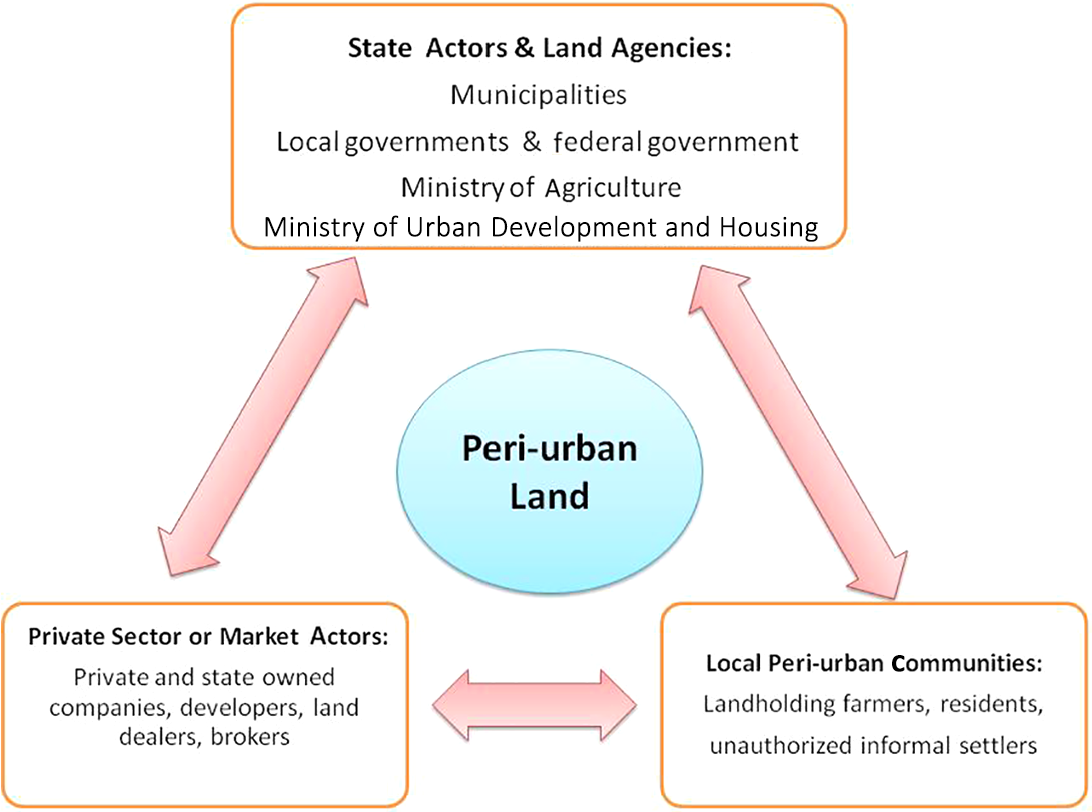
Actors interested in peri-urban land in Ethiopia
The multiple roles of the state and its agencies, and the full monopoly power to own and acquire peri-urban land, have been instigating conflicts of interest with peri-urban farming communities. This imbalanced power relation between the state and local community regarding access and control of peri-urban land leads local peri-urban communities to act outside the law. For instance, the prohibition on converting rural land rights into urban land rights disincentivizes landholders to keep their land; instead they prefer to transfer their land in the informal market. This has again motivated local landholders to become involved in unauthorized subdivision and sale of agricultural plots. Interviews with the experts and officials of the Bahir Dar City Administration show that almost all plots for the unauthorized construction of informal houses have been supplied by local peri-urban communities. Discussions with key informants also show that different sets of actors have been involved in the informal transactions and development of land in this area.
The overlapping and fragmented responsibilities and activities of government agencies have been contributing to the ambiguity in the land tenure management system in the peri-urban areas. As mentioned before, the fragmented and overlapping legislation related to the urban and rural land, and lack of coordination among public institutions on matters of peri-urban land, is another factor contributing to conflicts of interest over land. Because of this bifurcation of the land governance system, there is also a possibility for a power vacuum zone to be created in the transitional areas. This will happen when the urban authority adopts a revised masterplan that incorporates the urban periphery within the urban jurisdiction, but without expropriating and putting the land into its land bank; then the newly created zone falls within neither the urban nor the rural jurisdiction. This gap creates an opportunity for peri-urban communities to transform their agricultural land into residential plots informally, without any interference from government agencies, until the area is covered fully by the municipal administration.
VIII. Conclusions
This research had the primary objective of investigating and mapping out the principal actors competing for peri-urban land, and the effect of this competition on peri-urban land tenure relations in Ethiopia. Based on an analysis of the political economy of the relevant development decisions and activities, the state, formal and informal markets, and local community are explored as three groups of actors with different capacity and motivation to control peri-urban land in Ethiopia. The analysis of each group’s role and characteristics points to the interconnected motives around the control of land. The more land is expropriated and acquired by state agents, the more land is developed by developers, the more revenues are collected by the government, and the more profit is accrued by developers and dealers. But accompanying this is less opportunity and security among the local peri-urban communities and the poor in general. This study also indicates that both beneficiaries and victims may exist in any group, depending on the context and their interconnection in the network.
Moreover, there are sometimes “overlapping and complementary roles influenced by varying power relations and interests among actors”(47) interested in peri-urban land, such as state agencies and private developers. Among the actors identified, the full monopoly power is given to the state to own, manage and expropriate land, which has led to land tenure insecurity, conflict, and the mushrooming of informal settlements. Yet state-driven land-related legislation and institutional structures in Ethiopia do not consider the transitory characteristics of the peri-urban areas.
Therefore, this study recommends the establishment of strong and harmonized planning and land governance institutions. Planning institutions are expected to act as mediators when there are conflicting interests over peri-urban land; they should try to balance the competing interests of different groups. The institutional arrangements for land governance and development should be structured in a way that is sufficiently accommodating to all actors and institutions interested in peri-urban land. This study also points out that understanding the interests of various actors involved in peri-urban land is important not only for improving their interactions and peaceful coexistence, but also for setting up appropriate legal and institutional frameworks for urban land development and management.
Footnotes
Funding
The author received no financial support for the research, authorship, and/or publication of this article.
1.
Angel, S (2012), Planet of Cities, Puritan Press, Hollis.
2.
UN (2018), 2018 Revision of World Urbanization Prospects, New York; also  , The State of African Cities 2010: Governance, Inequality and Urban Land Markets, Nairobi.
4.
Fang, Y and A Pal (2016), “Drivers of urban sprawl in urbanizing China: a political ecology analysis”, Environment and Urbanization Vol 28, No 2, pages 599–616, page 600.
5.
Home, R (2004), “Outside de Soto’s bell jar: colonial/postcolonial land law and the exclusion of the peri-urban poor”, in R Home and H Lim (editors), Demystifying the Mystery of Capital: Land Tenure and Poverty in Africa and the Caribbean, Cavendish Publishing Limited, London; also Payne, G (1997), Urban Land Tenure and Property Rights in Developing Countries: A Review, Intermediate Technology Publications, London.
6.
Locke, A and G Henley (2016), Urbanisation, Land and Property Rights: The Need to Refocus Attention, Overseas Development Institute, page 4.
7.
Cotula, L and B Neve (2007), “The drivers of change”, in L Cotula (editor), Changes in Customary Land Tenure Systems in Africa, Russell Press; also Allen, A (2003), “Environmental planning and management of the peri-urban interface”, Environment and Urbanization Vol 15, No 1, pages 135–147.
8.
Wehrmann, B and D Antonio (2015), “Applying the Voluntary Guidelines on the Responsible Governance of Tenure (VGGT) in urban and peri-urban areas: an exploratory framework”, World Bank Conference on Land and Poverty, 23–27 March, Washington, DC.
9.
Adam, A G (2014a), “Informal settlements in the peri-urban areas of Bahir Dar, Ethiopia: an institutional analysis”, Habitat International Vol 43, pages 90–97.
10.
Wehrmann, B (2008), “The dynamics of peri-urban land markets in Sub-Saharan Africa: adherence to the virtue of common property vs. quest for individual gain”, ERDKUNDE Vol 62, No 1, pages 75–88; also Toulmin, C (2006), “Securing land and property rights in Africa: the role of local institutions”, revised version, Improving the Investment Climate Global: Competitiveness Report, 2005-06, World Economic Forum, Geneva.
11.
See reference 9.
12.
Adam, A G (2014b), “Land tenure in the changing peri-urban areas of Ethiopia: the case of Bahir Dar City”, International Journal of Urban and Regional Research Vol 38, No 6, pages 1970–1984.
13.
15.
Angel, S, D D Groot, R Martin, Y Fisseha, T Taffese and P Lamson-Hall (2013), The Ethiopia Urban Expansion Initiative: Interim Report 2, New York University Urbanization Project.
16.
18.
See reference 16.
19.
See reference 13.
20.
See reference 13.
21.
22.
See reference 21.
23.
24.
See reference 23.
25.
Ambaye, D W (2012), “Land rights in Ethiopia: ownership, equity, and liberty in land use rights”, conference on “Knowing to manage the territory, protect the environment, evaluate the cultural heritage”, Rome, 6–10 May.
26.
27.
See reference 13.
28.
Narain, V and S Nischal (2007), “The peri-urban interface in Shahpur Khurd and Karnera, India”, Environment and Urbanization Vol 19, No 2, pages 261–273.
29.
Mbibaa, B and M Huchzermeyer (2002), “Contentious development: peri-urban studies in sub-Saharan Africa”, Progress in Development Studies Vol 2, No 2, pages 113–131.
30.
Tacoli, C (2002), “Changing rural–urban interactions in sub-Saharan Africa and their impact on livelihoods: a summary”, Working Paper 7 in Rural–Urban Interactions and Livelihood Strategies Series, International Institute for Environment and Development, London; also Narain, V (2009), “Growing city, shrinking hinterland: land acquisition, transition and conflict in peri-urban Gurgaon, India”, Environment and Urbanization Vol 21, No 2, pages 501–512.
31.
See references 9 and 12.
32.
Bryant, L and S Bailey (1997), Third World Political Ecology, Routledge; also Blaikie, P (1996), “Post-modernism and global environmental change”, Global Environmental Change Vol 6, No 2, pages 81–85.
33.
See reference 4; also Tilt, B (2007), “The political ecology of pollution enforcement in China: a case from Sichuan’s rural industrial sector”, China Quarterly Vol 192, pages 915–932; and Robbins, P (2012), Political Ecology: A Critical Introduction, Wiley-Blackwell.
34.
Forsyth, T (2008), “Political ecology and the epistemology of social justice”, Geoforum Vol 39, No 2, pages 756–764.
35.
See reference 4.
36.
See reference 4.
37.
See reference 4; also Devas, N (2004), Urban Governance, Voice, and Poverty in the Developing World, Earthscan Publications, London and Sterling.
38.
See reference 23.
39.
Dadi, T T (2018), “The influence of land management on the prevalence of informal settlement and its implication for environmental management in Bahir Dar city, Ethiopia”, PhD thesis, University of South Africa, Pretoria.
40.
Ambaye, D W (2011), “Informal settlement in Ethiopia, the case of two kebeles in Bahir Dar City”, FIG Working Week 2011, Marrakech, 18–22 May.
42.
Rahmato, D (2011), Land to Investors: Large-Scale Land Transfers in Ethiopia, Forum for Social Studies, Addis Ababa.
43.
Fazal, S, N Banu and S Sultana (2005), “Expanding cities, contested land: role of actors in the context of peri-urban interface”, Current Urban Studies Vol 3, pages 187–198, page 196.
44.
Adal, Y (2002), Review of Landholding Systems and Policies in Ethiopia under the Different Regimes, Ethiopian Economic Association/Ethiopian Economic Policy Research Institute, Addis Ababa.
45.
Adam, A G (2015), “Peri-urban land tenure in Ethiopia”, PhD thesis, KTH Royal Institute of Technology, Stockholm.
47.
Nuhu, S (2018), “Peri-urban land governance in developing countries: understanding the role, interaction and power relation among actors in Tanzania”, Urban Forum Vol 30, No 1, pages 1–16, page 1.