




Abstract
This article arises from an interest in African urbanization and in the food, farming and nutritional transitions that some scholars present as integral to urban life. The paper investigates personal urban food environments, food sources and access strategies in two secondary Ugandan cities, Mbale and Mbarara, drawing on in-depth interviews and applying an intersectional lens. Food sources were similar across dimensions of difference but food access strategies varied. My findings indicate that socioeconomic circumstance (class) was the most salient influence shaping differences in daily food access strategies. Socioeconomic status, in turn, interacted with other identity aspects, an individual’s asset base and broader structural inequalities in influencing urban food environments. Rural land and rural connections, or multispatiality, were also important for food-secure urban lives. The work illuminates geometries of advantage and disadvantage within secondary cities, and highlights similarities and differences between food environments in these cities and Uganda’s capital, Kampala.
Keywords
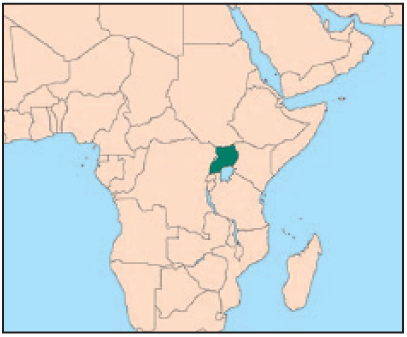
I. Introduction: Urban Transitions
This paper relates to the growing interest in African urbanization and claims concerning lifestyle, food system and nutritional transitions purported to occur with urban life.(1) Much of this research has been based on national-level datasets and studies in capital/primary cities.(2) However, the majority of the urban population in sub-Saharan Africa (SSA) resides in small-to-medium cities,(3) and these are experiencing the most rapid growth.(4) We lack knowledge of smaller city food systems.(5) As recent research notes, there is also a knowledge gap regarding urban food environments in lower-income countries, and “limited research investigating how people interact with food sources to acquire foods as part of daily life”.(6) This paper contributes to reducing these knowledge gaps.
Urban lifestyle and food system transitions have been conceived as moving away from physical work where food was predominantly grown, towards more sedentary service-based employment with food largely purchased, and a growing role for supermarkets as food sources.(7) Related nutritional transitions are considered to involve a shift from diets rich in complex carbohydrates and nutritionally dense foods, towards foods that are more processed, less nutrient-dense, and high in fat, salt and sugar. Epidemiological transitions in cities, meanwhile, are conceptualized as progressing from undernutrition and communicable diseases towards the higher presence of non-communicable diseases (NCDs), such as obesity, hypertension and diabetes.(8) Yet there have been few in-depth qualitative studies of how the food sources and access strategies of urban residents may vary by gender or class, or via intersections between identities and wider structures of economic and social life (though see the references in Riley and Dodson(9) for examples).
To shed light on these research gaps at the smaller city scale, I focus on two Ugandan secondary cities that are growing rapidly,(10) applying an intersectional analysis.(11) I explore whether, and in what ways, the food environment characteristics, food sources and access strategies are gendered, classed or otherwise differentiated among residents of Mbale and Mbarara. I apply the feminist geographic theory of intersectionality(12) to in-depth biographic interviews. My findings suggest, in the words of Cho and colleagues, “how intersecting axes of power and inequality operate”,(13) in specific Mbale/Mbarara residents’ lives, to affect their food environments, and allow comparison to Kampala, the country’s primary city.
By “secondary” city, I mean the second tier of urban settlement below the capital.(14) By “food environment”, I refer to Turner et al.’s recent definition(15): “The food environment is the interface that mediates people’s food acquisition and consumption within the wider food system. It encompasses external dimensions such as the availability, prices, vendor and product properties, and promotional information; and personal dimensions such as the accessibility, affordability, convenience and desirability of food sources and products.”
This incorporates the UN’s conceptualization of “from farm to flush”,(16) and includes non-market sources and strategies relevant in Mbale and Mbarara. When discussing household dietary diversity and household food insecurity I refer to the international tested and validated measures produced by the Food and Nutrition Technical Assistance (FANTA) project of the US Agency for International Development (USAID). Household dietary diversity refers to the number of different food groups consumed during a specific time period (for more information see Swindale and Bilinsky(17)). Household food insecurity is a measure of the access dimension of food security and is based on several Likert-scaled questions and a standard scoring mechanism (for more information see Coates et al.(18)). The Food and Agriculture Organization (FAO) classes a low-diversity diet as consisting of three food groups or fewer consumed within a 24-hour period; medium-diversity diets consist of four or five food groups consumed within 24 hours; and a high-diversity diet is six food groups or more.(19)
II. Context and Rationale
It is of value to study Ugandan cities’ food and farming circumstances, even though its urbanization and food system change processes are not highly advanced,(20) because the country is in a good position to be able to learn from other countries’ experiences. Improved understanding may allow Uganda to direct its now rapid urban transformation in positive directions.
In terms of the country’s urbanization level, this is estimated to be 20–40 per cent lower than in other African nations.(21) Urbanization here is late-onset but rapid,(22) particularly in the secondary cities such as Mbale and Mbarara, with their >3 per cent per annum growth, predicted to continue.(23) Secondary cities often play important regional and trading roles,(24) and this is true of Mbarara and Mbale despite their populations of only around 100,000 each.(25)
Research shows that Uganda’s cities are increasingly challenged by population growth,(26) a youth bulge,(27) absence of industry/formal employment(28) and urbanization of poverty,(29) which mix to create a potential crisis of unemployment, underemployment and food insecurity.(30) There is evidence that even the highly educated increasingly face unemployment compared to previous generations,(31) and that social capital plays an important mediating role in accessing employment.(32) Also, despite diets relatively low in diversity and dominant in maize and other staples,(33) Uganda is already experiencing an NCD burden.(34)
Similar to Hovorka’s description of Botswana, Ugandan society tends to privilege men and marginalize women: “men are constructed as independent, urban, productive leaders, commercial producers, and cattle-owners; women are constructed as dependent, rural, reproductive caretakers, subsistence producers, and non-cattle owners”.(35) Though cattle are slightly less prevalent and important than in Botswana, and progress on gender equality has been greater in Uganda,(36) understanding this still-dominant patriarchal, heterosexual, educated norm of the empowered,(37) is essential for intersectional analyses.
My Mbale/Mbarara cases are further relevant since both were recently designated regional growth cities for focused investment under Uganda’s new urban strategy.(38) This envisions green growth and development “built on agro-processing and upgrading the value-chain from agriculture”,(39) highlighting the value in investigating their food environments and agricultural relations.
III. A Lens of Intersectionality
The concept of intersectionality arose in the mid-1990s out of African-American feminists’ dissatisfaction with their legal rights and status.(40) Feminist geographic theorizing took the concept further, analysing “geometries of oppression”,(41) and how these intersect in space and time, to produce particular configurations of advantage (and disadvantage).(42) Geographers have argued that intersectionality is by its nature an inherently spatial concept as it seeks to reveal “how racial, gendered and classed power operates in place”.(43) I find intersectionality a helpful concept for analysing geometries of power: a “framework for understanding multiplicity as a way to interrogate ‘political and structural inequalities, not simply categories of identity’”.(44)
How does intersectionality relate to food? Ethnicity, class, gender, health, time and place all interact with food in myriad complex ways.(45) What people eat is influenced by where and when they live,(46) and by the economic circumstances and sociopolitical structures within which they are embedded. People can deliberately use food, and shape food systems, to express identity, heal yearning, remember a person or place, claim a position of power or enact a position of subordination.(47) Williams-Forson and Wilkerson note: “When we move from thinking of food as unraced, unclassed and unfettered by the binds of sexuality and physicality and therefore socially equal, to discussions of food as an inherent part of the social inequality of our lives, then the real complicated nature of our field begins to unfold”.(48) My analysis of people’s stories of daily life and daily diets in Mbale and Mbarara takes this intersectional approach. This allows me to interrogate some claims of the food and nutrition transitions thought to occur with urbanization, and to reveal some interactions of identity with wider structures of opportunity and oppression.
IV. Methodology
Data consist of 22 in-depth interviews with Mbale/Mbarara residents with differing circumstances, conducted in February–May 2017. Earlier spatial analysis of a random-systematic sampling household survey I coordinated in 2015 (of approx. 1,000 households/city) indicated inequalities in food security and diet diversity.(49) There were clusters of households generally doing well (by measures of food security, diet diversity, income and health), clusters doing less well, and anomaly clusters standing out as different in some way.(50) For the interviews this paper draws on, I purposively sampled from at least one each of these cluster types, striving for diversity of age, gender, socioeconomic status, food situation and farming activity. Sampling aimed more for diversity and thick description(51) than representativeness. However, some generalization to the city may be possible since most interviewees shared food environment characteristics with households in their cluster. In total, 17 interviewees were from the 2015 survey, and five were added purposively.(52)
Interviews (10 in Mbale, 12 in Mbarara) asked about daily routines, diets, food sources, health circumstances, and how respondents thought about urban life. Interviews lasted between 45 minutes and an hour. I conducted them in English with a local partner, Joe, who translated to Luganda when appropriate. Joe also led two interviews I was unable to conduct. I discussed with Joe anything context-specific or unclear in transcripts, but I conducted the final analysis alone, applying an intersectional lens to content analysis of interview transcripts.(53) Searching for advantage and disadvantage(54) in lived experiences, and how these relate to differentiated dimensions of identity and wider structures of opportunity or oppression,(55) led me to create an analytical overview of interviewees’ social locations. I then analysed the food environments and asset and labour circumstances of interviewees, to investigate my material against claims of nutrition and food system transitions and conceptualizations of urban life.(56) My findings show how socioeconomic circumstances or work status (essentially class(57)) was the most salient influence shaping differences in daily food experiences. As Christian and Namaganda conclude in their intersectional analysis of Ugandan domestic work, “the saliency of different categories can rise above others”.(58) The remaining text explores the results of this analytical process.
V. Findings
a. Intersection of work status with assets, rural places and rural people
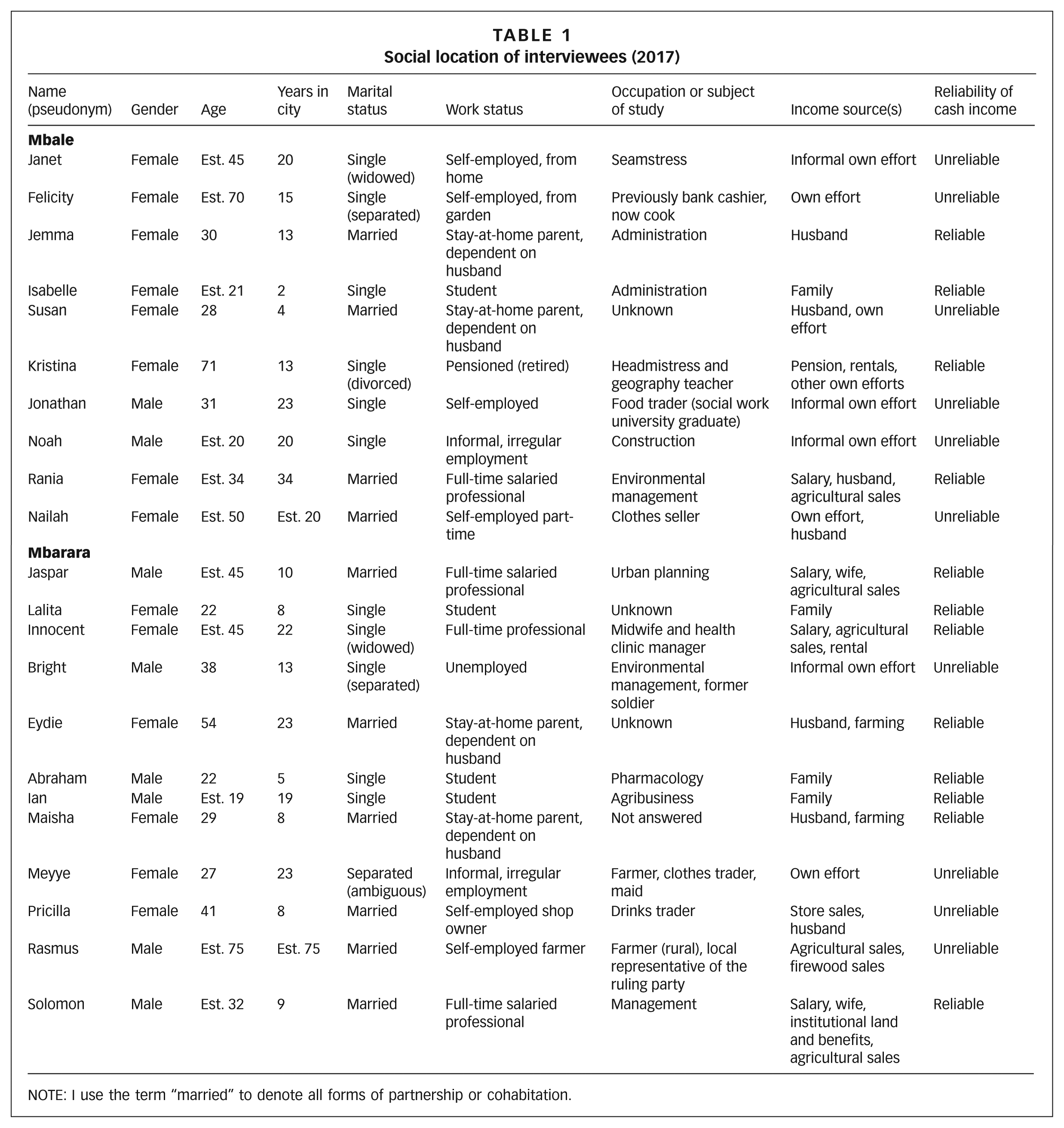
Table 1 depicts the social location analysis of interviewees, who ranged in age from 19–75. The majority had lived in the city for more than 10 years, some lifelong. Only three were recent migrants (<5 years in the city). Only Bright and Lalita were non-Ugandan but were still East African (from neighbouring Rwanda and South Sudan). National differences were referred to in food preferences but not in food sources. However, nationality could influence interviewee food access strategies via the intersection with migrant experience (reducing access to Ugandan land and support networks in the Rwandan’s case), via remittances received (in the South Sudanese case), or via possible shaping of their employment experience. Table 1 also lists interviewees’ income sources and reliability.
Social location of interviewees (2017)
NOTE: I use the term “married” to denote all forms of partnership or cohabitation.
An intersectional lens suggests gendered, classed and otherwise differentiated influences on Mbale/Mbarara urban food environments. Significant to food type preferences was tribe, which was often spontaneously mentioned in association with a particular food: “Like me, am a Muteso–I cannot do without kalo [millet dough]”, states Susan, Mbale. Tribe has geospatial, cultural, nostalgic and identity connotations, and food is one way of expressing this.(59) Jaspar spoke of long tribal traditions with cattle herding (his personal heritage and a clear source of pride and identity), and therefore also associations with milk production and consumption in Mbarara. This accords with Hovorka’s description of power and privilege associated with cattle ownership in Botswana.(60) Tribe can intersect with gender, place and attitudes in specific ways to influence food environments,(61) yet tribe did not influence sources of food or the access strategies deployed in my sample. I found that whether a person was married or not,(62) their work status (class) and the reliability of their main income (Table 1) were most relevant to localized power dynamics. These further interacted with livelihood assets to shape interviewees’ food environments. By assets, or asset base,(63) I include land, but also property, tools or equipment, and even the possibility to employ a maid, all of which can aid daily life, reduce drudgery or bring additional income. Essentially, socioeconomic status (SES), or class, played a critical role in influencing food access strategies.
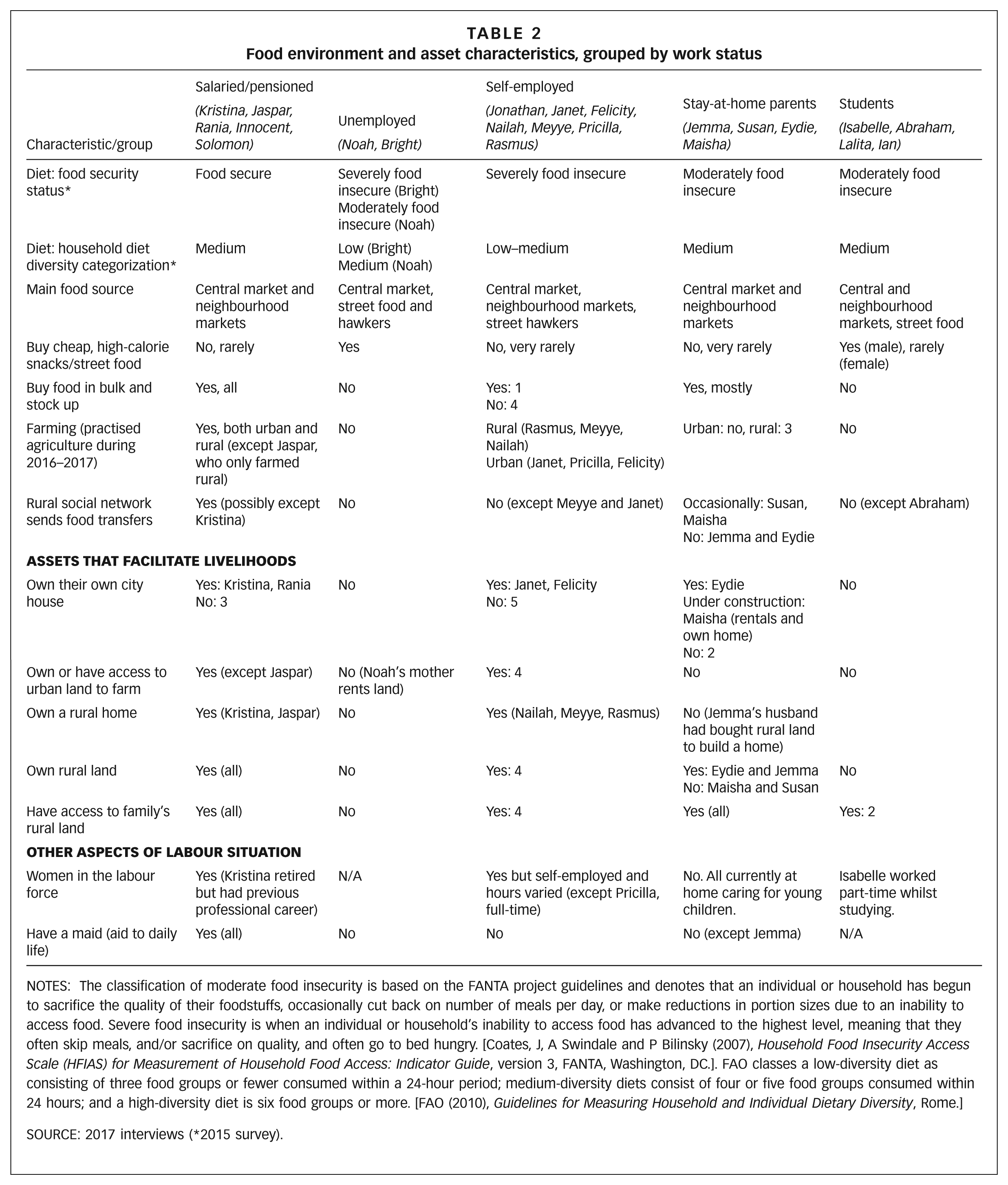
To illustrate further this key role of SES, Table 2 summarizes my analysis of personal food environments, sources, access strategies, and asset base, grouped by work status. By this I mean whether the interviewee was salaried (includes being pensioned), self-employed, unemployed, a stay-at-home parent or a student. Groups are not essentializing (64) or immutable categories,(65) and they can be expected to vary through the life course. However, in the contexts of Mbale and Mbarara it is rare that a man would be a stay-at-home parent. This task remains highly gendered, almost exclusively falling on women, most often in their 20s and early 30s. This is seen in Tables 1 and 2, and noted by others such as Wyrod for Uganda and Hovorka for Botswana.(66) Work status, and its interactions with other identity makers such as gender, age, race or marital status, better explained(67) interviewees’ daily food circumstances, emphasizing the importance of structural as well as identity inequalities.(68)
Some details in Table 2 are not surprising: for instance, that those with salaried employment felt more food secure. Yet other characteristics – such as similar levels of dietary diversity and similar food sources across classes – are perhaps more striking, and do not always fit with nutrition transition ideas.(69) In addition, the number of meals per day varied by work status; six of the self-employed, plus Bright and Jaspar, described a norm of one meal a day. It was only the stay-at-home mothers and Solomon who described having three or more meals a day. The rest generally had two as a routine, but once-a-day eating was not uncommon to them either. Breakfast often only consisted of water or tea/coffee.
Tables 1 and 2 also provide insight into other factors influencing urban food environments. My findings reveal greater food security for those with greater variety and reliability of income sources, a broader asset base, more access to land and active rural links (in the form of food transfers), and higher SES (salaried). The unemployed described unstable incomes, few assets, little land access, less rural support and great food insecurity. The self-employed reported slightly more land access or assets but were less able to deploy these productively due to variable incomes. They described heavy reliance upon their own labour, and were thus more vulnerable to fluctuations in health, demand for their services, or other economic or political conditions, and therefore more risk averse. They were severely food insecure. The stay-at-home women were mostly dependent upon their husbands, with moderate household food insecurity. Both Eydie and Maisha, however, farmed to contribute to food or sales income (Table 2). Eydie received regular cash transfers from her Kampala-based husband, similar to Rania. Jaspar worked in Mbarara during the week and travelled to his rural cattle farm at weekends. These mobilities point to links among SES, place and family networks (the interaction of class with physical, natural and social assets).
Food environment and asset characteristics, grouped by work status
NOTES: The classification of moderate food insecurity is based on the FANTA project guidelines and denotes that an individual or household has begun to sacrifice the quality of their foodstuffs, occasionally cut back on number of meals per day, or make reductions in portion sizes due to an inability to access food. Severe food insecurity is when an individual or household’s inability to access food has advanced to the highest level, meaning that they often skip meals, and/or sacrifice on quality, and often go to bed hungry. [Coates, J, A Swindale and P Bilinsky (2007), Household Food Insecurity Access Scale (HFIAS) for Measurement of Household Food Access: Indicator Guide, version 3, FANTA, Washington, DC.]. FAO classes a low-diversity diet as consisting of three food groups or fewer consumed within a 24-hour period; medium-diversity diets consist of four or five food groups consumed within 24 hours; and a high-diversity diet is six food groups or more. [FAO (2010), Guidelines for Measuring Household and Individual Dietary Diversity, Rome.]
SOURCE: 2017 interviews (*2015 survey).
Single/younger men struggled to provide, even for themselves,(70) and they more often resorted to cheap high-fat street foods than my female interviewees or men who lived with a partner. The female interviewees rarely ate out or consumed snack/street foods due to the expense and the lack of leftovers for the next-day’s meal, which home cooking often facilitated.(71) This lack of evidence of women’s diets and eating behaviours transitioning in the expected way is intriguing. Particularly so when I refer to the body mass index data from my 2015 survey, which found that 61 per cent of underweight adults were male, while 71 per cent of the overweight and 83 per cent of the obese were female.(72) These findings suggest caution regarding nutrition transition claims( 73 ) relating NCDs to an urban lifestyle consisting of increased wealth leading to greater eating out.(74)
Unemployment, underemployment and self-employment (linked as these are to SES/class) were more salient than other identity characteristics, such as gender, in shaping food insecurity and limiting diet diversity. Other research points to intersectional identity alignments, in interaction with broader structural influences such as colonialism or capitalism,(75) in shaping economic conditions.(76) My findings, for example, show younger married women (Jemma, Susan and Maisha) facing a period of being less employed, more house-bound and more dependent on their husbands for their food/livelihoods for the first few years after having children – with gender and age interacting with life course events and women’s reproductive role (Tables 1 and 2). Older head-of-household (single) women (Janet, Felicity) found ways to work from home to perform the dual tasks of family care and breadwinner(77) (Table 1). For these women, gender and age interacted with skills in sewing and cooking (human capital, to use Ashley and Carney’s terminology(78)), and with their physical capital assets (the home for Janet and the garden for Felicity).
Interviews also point to the isolation, vulnerability and challenges facing young single men (Bright, Noah and Jonathan) as they struggled to carve out a livelihood and build solid foundations for life. For them, gender and age also interacted with gendered perceptions of roles and abilities.(79) An intersectional lens reveals the slightly older, well-educated, professional women (Kristina and Rania, but also Innocent, and Solomon’s and Jaspar’s wives) relying upon maids’ labour to support their endeavours. Their gender, age and class interacted with education and labour market conditions to manage the still heavily gendered female responsibility for reproductive/caretaking activities, including maid support in food shopping and cooking (discussed by Kristina, Rania, Innocent and Jemma). While hiring a maid has the potential to support young women (the maid herself) to escape poverty or a lack of opportunity, the practice of bringing young girls from rural homes to work for relatives (e.g. Jemma), instead of acquiring education, can also perpetuate disadvantage.(80) Note that domestic work is so poorly paid and informal in Uganda that many lower middle-class households can afford support,(81) though that support also remains highly gendered and classed, and serves to maintain dominant gendered, classed and patriarchal norms in reproductive roles (including feeding the family). Not having any domestic help is an indicator of household poverty/insecurity (Table 2).
A major point is that, in this context of Ugandan secondary cities with large informal economies and a lack of formal employment opportunities (Section II), financial resources (SES) have the greatest power to shape food environments and food access strategies. If someone has sufficient financial assets (via reliable salaried employment), they can overcome limitations of gender, age, tribe or other aspects of identity, although these of course play a role in shaping SES in the first instance. The reliability of income is possibly just as salient as the amount since it allows for planning or saving. The unemployed, self-employed and stay-at-home respondents in my sample found planning and saving more difficult.
b. Similar food sources
Food sources and dietary diversity were similar across interviewees, regardless of gender, age, class, or interactions among them (Table 2). The main sources were the city centre markets, neighbourhood markets and local stores. Single mother Meyye highlights the role of local shops, known shopkeepers and relations of trust to enable credit in accessing food without cash: “We buy posho [usually maize or cassava flour which can be mixed with water to a mash, a common staple food] if we have gotten the money. Sometimes we do not eat lunch, we just take porridge when we come back. Then you start to…okay, from 3pm or 4pm start looking for what you will eat for supper. Because there are times when business is not good since nowadays, money is scarce, you find you have moved, like from here to Mbarara and you see it’s not a good day – you branch to the shop and you borrow what to eat and when you get you pay back.” (Meyye, Mbarara)
Research investigating three secondary cities of Zambia, Kenya and Zimbabwe notes similar credit-based food sources.(82) Borrowing food on credit in the absence of cash is of course also a strategy for accessing food, but the food source (and the credit) in my sample was the neighbourhood shop. This is one reason that large supermarkets have not made inroads into Mbale and Mbarara interviewees’ lives.(83) Interviewees also described suspicion of the quality and chemical content of supermarket food, noted their high prices, and complained of the inability to negotiate prices with a supermarket: “The good thing is one you have grown yourself and you get it from the garden and you eat it. But products in the supermarket come prepared with a lot of preservatives in them. And the money to buy them we do not have…Because I cannot go to the supermarket to buy meat for UGX 20,000 [approx. US$ 5] when I can get it at the local butcher for just UGX 8,000 [approx. US$ 2] or UGX 9,000 – that’s the problem. For them they have a set price, which cannot be reduced.” (Meyye, Mbarara)
The sporadic supermarket usage for interviewees (mainly for specific products such as soap, shampoo and bread) in these smaller cities contrasts with the theorized transitions in urban food environments noted in the introduction. The continued dominance of traditional markets and neighbourhood stores has been found in other studies.(84)
c. Differentiated food access strategies
Despite similar food sources, Table 2 suggests some differentiated strategies (85) to access food. The more food-secure/salaried residents bought in bulk and stocked food, and were able to respond to price variations by travelling to other markets or to rural areas, or by adjusting the time of the bulk purchase. They also had their own rural farms and/or urban gardens, and received food transfers from rural relatives. The least food secure (unemployed) were unable to engage in such food access strategies due to lower and more variable incomes, lower mobility and more limited access to land (Table 2). The self-employed and stay-at-home-parents had more diverse experiences but were also less involved in farming and less often in receipt of food transfers (Table 2). Bulk buying and stocking of major food products (particularly maize flour, beans, rice, sugar and tea) were reported by all the salaried and stay-at-home-parents but few of the others (Table 2), whilst food-insecure individuals spent more on small amounts. Similar findings are described by others.(86) Solomon’s description of his family’s stocking is illustrative: “Yes, I stock different things. Like nowadays they sell sugar at like 2.5 per kilograms [meaning UGX 2,500 or approx. US$ 0.67 for a kilogram of sugar]; rice 2.5; posho 2.5; so you buy and stock. And you don’t buy on a daily basis. What we buy on a daily basis is maybe like a bread, yes. Even like milk for the children: you also, you contract somewhere to supply you on a monthly basis…But like, when you have a fridge: you can buy and stock for one week, for the perishables, like tomatoes and such.” (Solomon, Mbarara)
Kristina spoke explicitly about watching the prices of basic staples and buying when prices were low, and she described moving through the city, and even to rural areas, to buy at lower prices: “…the advantage I have is that once I have bought sugar like 20 kilos, and the price changes, me I am safe a bit. And I am a bit mobile. So that usually I always I stock food.” (Kristina, Mbale)
This is a reminder of the relevance of place, mobility and individual agency to food access, bulk buying and storing – along with how these vary by class and status.(87)
Land and agriculture remain relevant for food-secure urban lives in Mbale and Mbarara. Table 2 shows that salaried individuals were all involved in farming in both urban and rural areas (except Jaspar, who only farmed in a rural area). Solomon’s interview revealed a different dimension to urban agriculture and the reason that the households within an anomaly cluster in Mbarara (see Section IV) experienced such differing food circumstances: the role of an institution.(88) Prison employees had free accommodation, no bills, and even (during 2015) seasonal food donations – an initiative that was eventually halted, but that nevertheless raises important possibilities.
“They would give some posho, and each person would get some maybe 20 kg of posho…in a quarter. Yeah. And then, eh, 40 kg of beans.” (Solomon, Mbarara)
Despite his low salary, prison employee Solomon lived on site with his family, worked a sedentary office job, ate four meals a day on average, and had a very diverse (89) garden on 200 square metres of prison land. My 2015 survey data showed that prison land, food and living subsidies made a difference to food security, diet diversity and overall wellbeing.
The salaried workers practised urban agriculture on their employer’s land (Solomon, an institutional intersection), on land they rented close to home (Kristina, a class intersection), or around their homes (Rania and Innocent, a gendered intersection as home gardening is often a female role in many SSA contexts (90)). Only Jaspar did not practise urban agriculture since he divided his time between the city and his rural dairy farm and plantation (a spatial intersection). All the salaried employees had rural land (sometimes hundreds of miles away) employing local labour, or relying on relatives. The main purpose of urban-grown produce was food supplementation, but they occasionally sold some produce. Their own rural farm produce, or farming they conducted on rural family land, also contributed to household consumption (Solomon, Innocent and Rania), but a greater portion was sold, compared to urban-grown produce. Whereas the more food secure and salaried reported diverse urban farming, the unemployed and self-employed were less able to manage farming activity (Table 2), due to lack of access to land (Bright), lack of income (Noah, Bright and Jonathan), fear of vulnerability to weather, pests or disease (Jonathan), or fear of theft on distant land (Pricilla). These reasons point to the lower asset base and greater vulnerability, and thus greater risk aversion, of the self-employed and unemployed, compared to the salaried (Tables 1 and 2).
An intersectional analysis of Solomon’s view of farming as a desirable and lucrative livelihood suggests how this view may be shaped by his positionality. Solomon held a more privileged position as a food- and livelihood-secure, married, highly educated man. His positioning conforms to the heterosexual, patriarchal, educated norm of those with power in the Ugandan context, as highlighted in Section II: “If you don’t have what you are doing in town [meaning no job] – any village is better! Because you have land. You grow. You can grow maybe maize, beans? Whatever, you grew, because you have ready market in town, you come and you’d sell it!…Because…there is money in farming…there is no question about it!” (Solomon, Mbarara)
From his position of intersecting privileges, Solomon regarded agriculture as a larger-scale business enterprise requiring knowledge, labour, tools, capital and marketing strategies to farm for good profit. This may resonate with Uganda’s new urban strategy to promote agri-business,(91) but there is an assumption of economies of scale and technologies that not many farmers in Mbale or Mbarara have. In contrast, Jonathan’s description of trading in agricultural products depicted farming as difficult and not lucrative at all: “the farmers, if they get from it at all it’s really what is little! What they get is small, but the fraction of what they put in is far better than what they get [meaning farmers work hard for little money].” (Jonathan, Mbale)
Both Jonathan’s and Solomon’s points emphasize how knowledge (of prices, markets, weather, etc.) and assets (educational, technological, social and financial) shape power and influence the view of agriculture, highlighting local parameters of power and of disadvantage.(92)
As noted earlier, the strategy of eating at restaurants or consuming street/snack food, theorized by nutrition transition scholars as a factor in the urban NCD burden (see Section I), was more common among my young, single (or living alone) male interviewees. They described consuming fried chicken or rolex (cheap, high-calorie fried chapatti, egg and vegetables), even when they had cooking facilities at home. Reasons included convenience, sociability, or not wanting or being able to cook. Male students also arranged prepaid accounts with a restaurant near to their university, where they ate their lunch. This finding reveals specific gendered sociospatial strategies (93) related to men, the student phase of life, the geographical arrangement of work/campus to home, and time or knowledge constraints for cooking, all interacting to influence personal food environments.
Finally, a relevant urban food source was food transfers from rural-based relatives (Table 2), mainly for those who farmed. Research from Southern African cities found similar exchanges.(94) Yet transfers are not a one-way process, as Meyye clarifies: “I have been farming at my in-laws’ place…If I go there I do some digging. So I leave some that they will send for me to eat. You get some time and you go to the village to, you do not just ask for the food that send me this, send me that, you give in some time and you also go there and farm.” (Meyye, Mbarara)
The points raised in this section about land and relations in rural areas, about farming and profitability, and about food prices, all help to explain why salaried residents in these smaller Ugandan cities engaged in agriculture (Table 2) more than those in less secure circumstances.
VI. Discussion
Regardless of gender or class, my interviewees had similar food environments in terms of the main food sources (central markets, local shops) and the types of food consumed (maize/beans, matooke/beans, posho). Yet there were differences by SES in food access strategies. Stocking, farming, food transfers, and spatial mobility were features of the salaried and food secure. These findings may be somewhat contrary to nutritional transition scholars’ ideas of dietary and food system change with urban life.(95) Socioeconomic status (tied to work status) was the most salient reason for differences. Financial capacity, within Mbale and Mbarara, can overcome limitations by gender, age, marital status, family background and asset base, and interactions among these. A person’s SES is also the result of interaction with wider structures of the labour market and of multiscalar relations with national or international policies.(96)
The finding of the potential of institutions to improve food security within cities, revealed by Solomon’s interview and the prison anomaly cluster, is significant for both food security and urban agriculture debates. It also highlights an important but understudied aspect of African cities: institutional land. The policy of an institution and the physical geography of its land can help overcome individual gendered, classed oppressions of identity or structural nature.(97) In previous research, I found a similar role in Ghana for institutional (hospital, prison, school but also church) land,(98) and the contribution this can make to urban food environments. Of note is that multiple actors can benefit from farming institutional land. It can be institutional staff who benefit (as with Solomon), but in Ghana I also found institutional land to be beneficial to school pupils, the institution itself (funding its services from its entrepreneurial agriculture), and nearby residents, (providing land management for the institution and food security for the community).(99) The role of institutional land in urban food environments is an area warranting further investigation.
My findings – of moderate to high food insecurity, with people commonly eating one meal a day, similar low–medium diet diversity across a range of identities, and class-based differences in food access strategies – are similar to findings from studies in the capital, Kampala.(100) Research by Pottier notes the carbohydrate-based, protein-poor diets of Kampala’s food insecure, a dominance of posho (maize), and a norm of eating one meal a day.(101) Sabiiti and Katongole note a prevalence of food insecurity within Kampala, linking this to urbanization without job creation. They note that “rapid population growth in Uganda’s urban areas, particularly Kampala city, has not been in tandem with economic growth and development and many city dwellers are still struggling below both the food poverty line and the absolute poverty line”.(102)
Yet despite the similarities, there were differences between Kampala and my cities in food sources. The capital possesses a greater diversity and competition among sources (types of shops, supermarkets, street foods, restaurants, fast foods, local markets, etc.) than Mbale or Mbarara. However, for the most food-insecure and lower-SES Kampala residents, the transition towards supermarkets and highly processed foods theorized as part of the nutrition and food system transitions, described in the introduction, were also not advanced.(103)
Wanyama and colleagues note that supermarkets were not highly frequented among their surveyed households in poor communities of Kampala and Nairobi, being mainly used for a few specific products, and largely by the highest-income group.(104) They also note that supermarket use was lower in Kampala than in Nairobi, concluding that “traditional food retail outlets continue to dominate among the urban poor”.(105) These outlets included local markets, wet markets (markets selling meat, fruits and vegetables), roadside vendors, street hawkers and small shops. The authors additionally noted the importance of local shops in providing small quantities and credit,(106) similar to my findings in Mbale and Mbarara.
Farming was relevant for urban Mbale/Mbarara residents, especially as a strategy of those with assets rather than for the less secure, similar to other SSA findings.(107) The farming of the salaried was strongly reliant upon rural spaces and people, as other research has noted,(108) except in the case of an institution making city land available. The salaried had the asset base, means and social relations to allow them to diversify their food and income sources and to spread their risk to shocks, price rises or other changes. Not only does intersectional analysis suggest that the more food secure had a larger asset base (109) in all dimensions than the food insecure, but – crucially – they also had assets in multiple spaces covering rural and urban people and places (Tables 1 and 2). My analysis of the identity and asset interactions of Mbale/Mbarara residents suggests that the more food secure had the greatest absolute, relative and relational sociospatial reach.(110) They were multilocal, as Satterthwaite, McGranahan and Tacoli termed the strategy of having “rural and urban components to their incomes and livelihoods”.(111) The unemployed and self-employed were not able to practise such multilocality.
My finding that “rural farming matters to urban food security”(112) aligns with Pottier’s in his survey of 118 households in two poorer Kampala districts. His conclusions regarding the role of regularity of income, and the importance of rural family farms and food transfers in ensuring urban food security, support my findings for the food secure in Mbale and Mbarara (Tables 1 and 2), though in Pottier’s study he describes these as strategies of the food insecure. Pottier also notes the link to assets, including land and social capital.(113) Indeed he concludes that rural land access “stood out as critical for achieving year-round, urban food security”(114) in Kampala. In addition he notes that the food insecure “tended to engage in poorly remunerated, informal sector activities”,(115) similar to my findings. As Cobbinah and colleagues note more generically for urban Africa, unemployment and the informality of urban economies are structures that force urban residents into vulnerable, often unsafe and unhealthy jobs that “limit their capacity to improve their lives”,(116) sometimes despite high education (117) (Jonathan is my example here). In other words, informality limits individual agency, as was the case for many of my food-insecure interviewees. This recognition of the interaction among identity, structures, assets and agency lies at the centre of a feminist geographic understanding of intersectional analysis, and is a contribution of this paper. As Parker notes, a feminist geographic approach “challenges theorizations of intersectionality and agency that underestimate the way that structures constrain the capacity of individuals to enact some realities”.(118)
Although I find a similar role of rural agriculture for urban residents in Mbale and Mbarara as studies from Kampala and other large African cities,(119) I note differences in the role and characteristics of urban agriculture (UA) between these smaller and larger cities. Studies from larger cities (Kampala, Kumasi, Nairobi, Accra, Dar es Salaam) see agriculture within and near the city representing “a significant contribution to the food basket”(120) and an important entrepreneurial livelihood.(121) There was no evidence of such highly organized entrepreneurial market gardening of high-value/perishable produce in Mbale or Mbarara. UA here was mostly backyard gardening with some small-scale poultry production or zero-grazing (confined, cut grass-eating) livestock, mainly for household consumption, with occasional sales.(122) This may be due to the greater proximity to rural land in these smaller cities, in comparison to Kampala and larger cities, and may also relate to market demands in larger cities. I found similar trends in a smaller Ghanaian city.(123) It is possible this will change as Mbale and Mbarara expand, but at this stage in their development I note this difference from Kampala’s UA. Urban gardening around the home was similar to Kampala’s; however, Pottier notes rapid urbanization and increasing land prices in Kampala prompting conversion of urban plots to raise income from rental accommodation instead.(124) This is a future risk for Mbale and Mbarara, particularly given the rapid growth rates.
VII. Conclusions
This paper analyses intersectional configurations in specific interviewees’ food environments at the understudied scale of Ugandan secondary cities, specifically Mbale and Mbarara. The work illuminates geometries of advantage and disadvantage.(125) The socioeconomic situation of interviewees, linked as it is to their work status, shaped personal food access strategies, with fewer differentiations by gender, tribe or other single identity-related aspect. Identity further interacted with an individual’s capital assets and wider sociopolitical and institutional structures to define food environments. As Williams-Forson and Wilkerson note, an intersectional approach reveals the “multidimensional and relational nature of social locations, places and forces (economic, cultural, political), lived experiences, and overlapping systems of discrimination and subordination”.(126) A contribution of this paper is the exploration of how identity, not in isolation but in interaction with assets, particularly with rural places and people, works to shape food environments, mediated by individual agency. It is exactly such interaction that researchers argue intersectional analysis should reveal.(127)
The limitations of thinking in discrete, disconnected categories of “urban” and “rural” for understanding livelihoods in sub-Saharan Africa are emphasized by my findings, and supported by others.(128) Those who were managing best in Mbale and Mbarara, even if not thriving, were those with both salaried employment and the ability to draw on rural assets and resources, regardless of gender, tribe or other identity marker. The more secure urban lives were those built on top of an active rural life. Individuals with weak or nonexistent links to rural land and people had, in interaction with insecure work status, more food-insecure and vulnerable lives. Yet for them, multispatial did not just refer to the rural, nor only to land. It also referred to social networks, family employment strategies, and ties to other urban areas, especially Uganda’s capital. Such hybridized livelihood strategies may be productive in tangible ways, but may bring other strains. The finding of the importance of rural–urban interaction for food-secure interviewees, involving the exchange of labour, cash and agricultural products with rural people, is another contribution of this work. This multispatiality may suggest the utility of using a food lens in urban planning, as recent studies suggest.(129) Further, the finding that institutions can combat food insecurity and help overcome identity-related disadvantages or structural constraints, via land access and/or livelihood subsidies, is a contribution to both the food security and urban agriculture debates in Africa.
My finding that in Uganda, rural land, rural agriculture and rural social networks remain important to urban food access strategies at the secondary city scale (and similar findings from other research at the primary city level(130)), is significant. This finding of the continued valuation of, and investment in, rural land by urban residents as a food and livelihood security strategy, in the uncertain socioeconomic context of Uganda,(131) does not fit neatly with the theorized transitions described in Section I. Land and farming are being used as safety nets, in a context of informality and lack of employment, especially by urban elites. This contrasts with nutrition transition theorizing that the role of land and agriculture diminishes with urban residence.(132) In my research, much of urban residents’ farming in rural areas revolved around the labour of others, not the labour of the city dwellers, emphasizing my finding of the need for financial capital in order to achieve/maintain such food access strategies. The continued role found for urban agriculture in own food production may also complicate conceptualizations of nutritional/food system transition. My finding of the continued role of traditional food markets also suggests caution regarding concerns of the supermarketization of urban African food systems. This paper points to a lack of advanced nutritional and food system transitions in the Ugandan city context, yet the presence of a non-communicable disease burden, found by my own and others’ research (133) (in both secondary and primary cities). These findings suggest that food system, nutritional and epidemiological transitions may be less linked than previously thought, or linked in more complex ways.
Footnotes
Acknowledgements
I am deeply grateful to Joe T Odori (not his real name) for his role in data collection, translation and transcription. It was a pleasure and an honour to work with him. I would additionally like to thank Aina Tollefsen, whose encouragement and guidance has been invaluable. Thanks to Magnus Jirström and Sabina Bergsten for comments on an early draft. Thank you also to Prof. Frank Mugagga, Department of Geography, GeoInformatics and Climatic Sciences, Makerere University, for logistical coordination and support. My gratitude to staff at the Municipal Councils of Mbale and Mbarara for their interest in this research. I thank three anonymous reviewers for helpful comments and for encouraging me to push my analysis further. Finally, to all the interviewees who so generously donated their time and shared their stories, thank you. Any errors or misinterpretations are mine alone.
Funding
This work was supported by the Swedish Research Council for Environment, Agricultural Sciences and Spatial Planning (Formas), grant number: 250-2014-1227, project “Urban agriculture, double disease burden and the ameliorative potential of household food production”. In addition, the field research was supported by a travel grant from the J.C. Kempe Memorial Fund managed by the Umeå Student Union, and by a scholarship from the Swedish Society of Anthropology and Geography (SSAG).
1.
4.
7.
25.
Uganda Bureau of Statistics (2016). For all urban areas apart from Kampala, the Ugandan government collects data only on the municipality level. The city-level estimate for Mbale given here also draws on Silver (2017). For discussion of Ugandan census data collection and urban categorizations see  .
.
28.
42.
46.
47.
49.
This survey had permission to use and adapt the African Food Security Urban Network’s (AFSUN’s) household survey instrument. AFSUN’s survey tool has been tested in a number of urban African settings and uses the internationally trialled and tested measurements of household food insecurity access scaled score (HFIASS), household dietary diversity score (HDDS), months of adequate household food provisioning (MAHFP), and a measure of infrastructure poverty, the lived poverty index (LPI). More detail on the methodology is available in .
50.
For example, an anomaly cluster of households in Mbarara clearly stood out in my spatial cluster analyses performed in a geographic information system (GIS) as having more food security, more diverse diets, fewer health complaints and more adults within a normal body mass index (BMI) range, compared to the city’s average. Yet these residents were more involved in farming than the average city household and they had only low to average levels of income. It was an area that stuck out in multiple ways as being different, which was why I went back there to follow up (resulting in the interview with Solomon [see reference 52]). What I found was that this was staff housing for a prison, and there were institutional arrangements in place that really made a difference.
52.
Noah was simply approached on the street in an area of Mbale that was food insecure, had low dietary diversity, and was highly transient; it had been difficult to track down 2015 survey respondents there. Solomon was a member of one of the households in the Mbarara anomaly cluster that I wished to investigate more deeply. Finally, I purposively asked three people whom I met through my feedback meetings at the local council offices whether I could interview them, after they showed a keen interest in my work. These people (Rania, Jaspar and Innocent) are all in my grouping of the food secure and salaried. (All names, except my own, are pseudonyms.)
57.
I use “socioeconomic status” (SES) or work status interchangeably with class.
62.
I use the term “married” to denote all forms of partnership or cohabitation.
66.
Wyrod (2008); .
70.
Wyrod (2008); .
74.
79.
Wyrod (2008); .
85.
86.
87.
88.
See reference 50.
89.
Groundnuts, beans, cassava, maize, sweet potatoes and matooke (a starchy cooking banana).
92.
95.
96.
97.
100.
103.
110.
119.
125.
129.
132.
133.
Kavishe (2015); Ministry of Health (2014); Schwartz et al. (2014); Mackay (2018); .