




Abstract

I. Introduction: Understanding and Addressing Climate Change in Cities
This special issue of Environment and Urbanization draws on the growing body of evidence about climate change impacts and responses in cities, and responds to calls for better documentation of this evidence to support the work of the Intergovernmental Panel on Climate Change (IPCC). Over the past decade, a growing body of evidence has demonstrated the ways in which cities will be at the forefront of climate change impacts and need to be at the forefront of responses. The first Environment and Urbanization special issue on Cities and Climate Change was published in 2007. Its editorial concluded: “It is within urban centres and urban governments that so much of the battle to prevent climate change from becoming a global catastrophe will be won or lost”.(1) As both the anticipated scale of impacts and the magnitude of the required response have become greater, the need for stronger understanding, concerted action and substantial financing has also grown.
The findings from research on climate change and cities conducted since the IPCC Fifth Assessment Report (published in 2013 and 2014) will be incorporated into the Sixth Assessment Report (due to be published in 2021). The IPCC reports are intended both to synthesize the current state of knowledge on the impacts of and responses to climate change, and to provide an appropriate scientific basis for decisions to be made by the United Nations Framework Convention on Climate Change (UNFCCC). As such, the IPCC’s reports are mandated to be “policy relevant but not policy prescriptive”, and this requires high-quality, empirically grounded and theoretically sound research.
While there is a significant and growing body of research on climate change and cities, this is still not sufficient to inform the scale of action required. As has often been stated, more than half of the world’s population now lives in urban areas – and this concentration of people, infrastructure and economic activity demands well-informed and significant action to reduce atmospheric greenhouse gas (GHG) concentrations and adapt to new and emerging climate risks.
II. Cities in The IPCC
Since the publication of its First Assessment Report in 1990, the IPCC has gradually increased its attention to human settlements and cities (Table 1). The coverage of cities has been strengthened by the expansion of author teams to include wider representation from policy and practice, recognizing that much evidence of the impacts of and responses to climate change in cities is generated by municipal authorities and non-governmental organizations. The information produced from these sources is carefully scrutinized to ensure that it is gathered and analysed in a suitably rigorous manner.
Cities in the IPCC
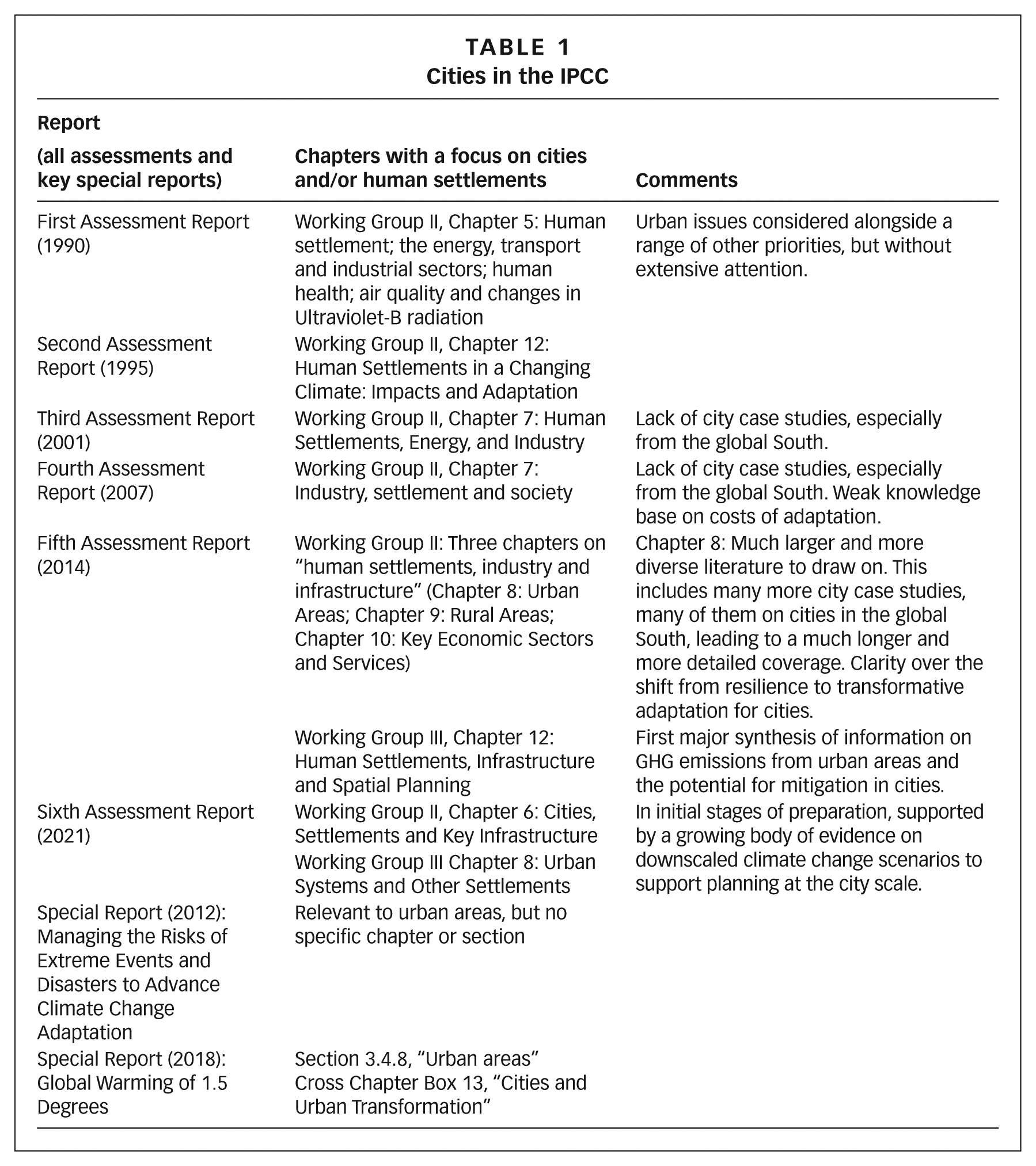
The most recent IPCC report – the Special Report on Global Warming of 1.5°C – highlights the significant and alarming consequences that climate change is expected to have on urban areas.(2) The report recognizes that current and projected trends in emissions reductions are unlikely to achieve the goal of limiting global temperature increases to 2°C, and that even if this were to be achieved the effects would be much greater than those caused by a 1.5°C rise. The findings of the report speak to three particular consequences for cities: climate change impacts; transitions to lower GHG emissions; and institutional frameworks to respond to these.
The first relates to the extent and nature of climate change impacts that cities will experience. Examples include:
At 1.5°C, twice as many megacities (including Lagos, Nigeria and Shanghai, China) could become heat-stressed, exposing more than 350 million people to potentially deadly heat by 2050 under midrange projections for population growth.
At 2°C, Karachi (Pakistan) and Kolkata (India) could expect annual climatic conditions equivalent to the deadly 2015 heat waves (without considering adaptation options).
Stabilizing at 1.5°C warming could decrease extreme temperature-related mortality compared with stabilization at 2°C for key European cities (assuming no adaptation and constant vulnerability).
The impacts of heat waves in cities at 1.5°C and 2°C are both substantially larger than under the present climate.
The report summarizes the situation,(3) with particular relevance for cities in low- and middle-income countries: “in the absence of adaptation, in most cases, warming of 2°C poses greater risks to urban areas than warming of 1.5°C, depending on the vulnerability of the location (coastal or non-coastal), infrastructure sectors (energy, water, transport), levels of poverty and the mix of formal and informal settlements.”
The second consequence is the need for cities – including those with currently low GHG emissions – to contribute to climate change mitigation. This will require “rapid and far-reaching transitions in energy, land, urban and infrastructure (including transport and buildings), and industrial systems”.(4) Pathways that can limit global warming to 1.5°C will require “changes in land and urban planning practices, as well as deeper emissions reductions in transport and buildings compared to pathways that limit global warming below 2°C”.(5)
Third, action to reduce the consequences of climate change, and to support the far-reaching transformations necessary to significantly reduce emissions, will require changes in urban governance and institutions. These will need to be supported by appropriate national policies (potentially including the National Urban Policies initiated under the New Urban Agenda), which provide appropriate legal and fiscal frameworks for action by subnational governments. But it will also require the meaningful engagement of non-state actors. The report identifies the need to go “beyond notions of formal government or political authority” and to integrate “other actors, networks, informal institutions and communities”.(6) This is particularly relevant for cities in low- and middle-income countries, where informality is a defining characteristic of both economies and urban centres.
III. Climate Change, Informality and Cities: Critical Issues
A range of critical issues have been identified for responding to climate change in cities. For example, Bai et al.(7) identify the need to address six key knowledge gaps: expand observations; understand climate interactions; study informal settlements; harness disruptive technologies; support transformation; and recognize the global sustainability context. The contribution of this special issue of Environment and Urbanization is intended to be particularly in the area of informality and climate change, recognizing the significant need for action in this area given the rapid growth of populations in low-income and informal settlements in cities. Population growth and urbanization are projected to add 2.5 billion people to the world’s urban population by 2050, with nearly 90 per cent of the increase concentrated in Asia and Africa.(8) Given the inadequate investment capacity for most cities in these regions, a substantial proportion of these people will be living in informal settlements. Here, we identify three particular implications of informality for adapting to climate change: understanding impacts; identifying actions; and financing responses.(9)
a. Understanding climate impacts in informal and low-income neighbourhoods
It is well established that many informal settlements are located on land that is highly exposed to climate-related hazards, including sea-level rise and coastal flooding, riverine flooding and landslides. These sites are chosen because they are convenient for accessing livelihood opportunities, and they are often at lower risk of eviction because of the nature of the land. However, more detailed local assessments of likely impacts on individuals, households and communities, including effects on health, wellbeing and livelihoods, are not available in most nations. There is too much reliance on national sample surveys that cannot provide data needed for each locality for planning and action. Table 2 provides an indication of what some of these impacts might be, but more empirical study is necessary to quantify these. As the papers in this issue show, different groups of people (including women and migrant workers) within informal and low-income neighbourhoods are affected in a range of ways, and more fine-grained detail on this distribution of climate impacts is necessary to inform policy responses.
Likely impacts from climate change on urban populations living in informal settlements and working in the informal economy
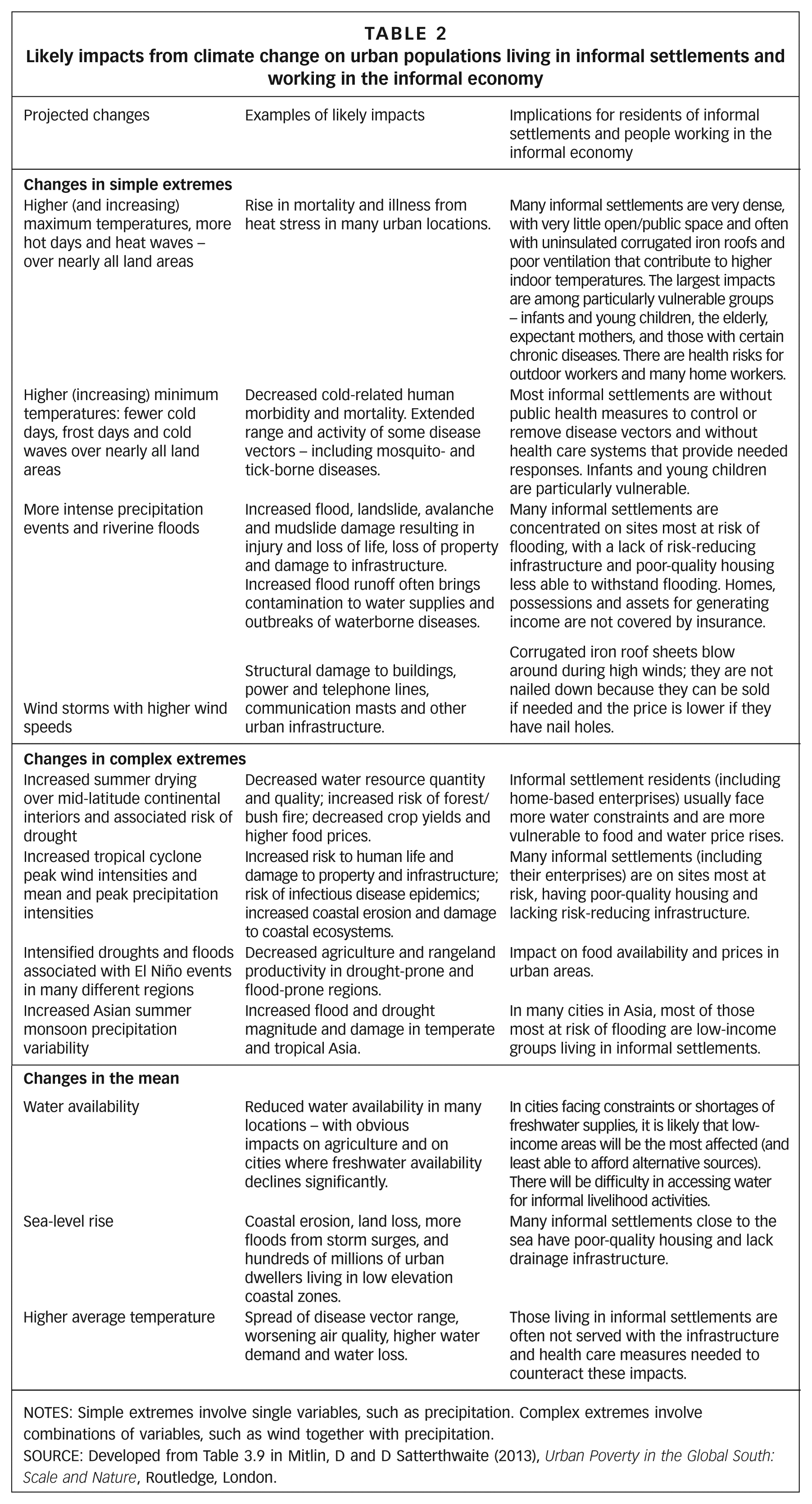
NOTES: Simple extremes involve single variables, such as precipitation. Complex extremes involve combinations of variables, such as wind together with precipitation.
SOURCE: Developed from Table 3.9 in Mitlin, D and D Satterthwaite (2013), Urban Poverty in the Global South: Scale and Nature, Routledge, London.
b. Identifying climate adaptation actions
By their very nature, informal settlements present particular challenges for climate change adaptation. Not least among these is the political marginalization of their residents, who are often (at best) ignored or (at worst) actively targeted for eviction by the formal authorities. This makes investing in infrastructure – whether at the household or neighbourhood level – problematic. While many case studies show the ways that households have coped with environmental risks (for example, building on raised plinths or stilts to reduce the risk of flooding, or improving ventilation to address heat stress), in themselves these do not address the systemic causes of increasing climate-related risk. In addition, the everyday and immediate needs for improved shelter, basic services, and infrastructure cannot be separated from the longer-term needs for climate change adaptation.
The most effective responses to climate change risk in low-income and informal settlements will therefore need to reconcile five key urban agendas: for economic success, poverty reduction and basic service provision, disaster risk reduction, climate change mitigation, and climate change adaptation. Although there are tensions among these, and often competition for resources, they are closely interrelated with some obvious commonalities. In particular, poverty reduction, disaster risk reduction and climate change adaptation share a focus on identifying and acting on local risks and their root causes.(10)
Despite this, many formal proposals for urban climate change adaptation fail to engage with poverty reduction. Supporting individuals and households to improve their own dwellings – whether through grants or incentives (such as increasing certainty that they will not be subject to forced evictions) – is an essential pillar of effective adaptation. Building on the responses that are already being taken, as displayed in the paper by Alexei Trundle, Bernhard Barth and Darryn McEvoy, is another. So is upgrading informal settlements: while most upgrading of informal settlements has not been done explicitly to build climate change resilience, there is considerable overlap among many aspects of upgrading, disaster risk reduction and climate change adaptation. Better housing quality, with good-quality urban infrastructure and services, is at the centre of reducing risks from extreme weather.
Unless these priorities are taken seriously, adaptation planning can contribute to greater inequalities in cities. Anguelovski et al.(11) describe “urban adaptation injustices” that arise from protecting and prioritizing elite groups at the expense of low-income urban residents, and that arise from negatively affecting or displacing poor communities. One way of addressing this can be through careful and deliberate expansion of participation in urban adaptation planning.(12)
c. Financing resilience in low-income and informal settlements
Ensuring that low-income neighbourhoods can cope with shocks and stresses associated with climate change will require investment in upgrading of existing infrastructure and additional risk-reducing infrastructure. This should include all-weather footpaths and roads, coastal protection, and the myriad small improvements to dwellings that will help them cope with higher temperatures and more extreme weather events. Climate finance could be used to deliver integrated packages of climate-compatible services and infrastructure, which could include some combination of improved water supply, sanitation, drainage, solid waste management and tenure.(13) As shown by the papers by Samuel Geldin; Jorgelina Hardoy, Ebru Gencer and Manuel Winograd; and David Samuel Williams, María Mañez Costa, Catherine Sutherland, Louis Celliers and Jürgen Scheffran, the governance arrangements to access and use this finance effectively also require strengthening.
Unfortunately, the various mechanisms for allocating finance to support climate change adaptation have not yet recognized the potential for community-driven and municipality-driven approaches to play a critical role in this process. While evidence shows that climate finance that reaches the local level can deliver effective, efficient and sustainable results,(14) only a small proportion of this money actually reaches the local level. Lessons from decentralized funds in urban areas(15) show that even relatively small amounts of adaptation finance could have a catalytic effect on the capacities of local organizations to respond to climate threats and address underlying drivers of vulnerability.(16) One critical role of research and practice in coming years will be to create increasingly detailed and convincing evidence-based arguments that shape future flows of climate finance.
IV. The Papers in this Issue
The papers in this special issue respond particularly to climate change impacts and adaptation in cities, and to the organizational and institutional changes that are necessary to address these. While some of these changes will also contribute to the reduction of GHG emissions, this is not the primary focus of the papers.(17) The papers consider the roles of various types of actors and institutions in building urban climate resilience; the relevance (or not) of global agendas in a local context; and approaches to untangling the differentiated and intersecting drivers of vulnerability in urban settings.
What is clear across all the papers is that urban climate adaptation requires action not just on one scale, but by many actors and stakeholders working within and across scales.
For example, Geldin considers the role of transnational municipal networks (TMNs) or city-to-city networks, which offer the opportunity for knowledge exchange and financial support for building urban adaptive capacity. However, TMNs tend to exclude smaller, secondary cities, even though many such cities face the most rapid population growth and may have the fewest resources. Geldin finds that this exclusion arises mainly from the lack of financial and political power in secondary cities, though the shortages of technical knowledge and language skills also act as barriers. The paper concludes that if TMNs are to increase adaptive capacity in the most vulnerable communities, as well as address resource constraints, there remains a need for more “rigorous evidence-based impact evaluations, revised selection criteria for vulnerable cities (a larger risk pool), and a new networked geography of collaborative incentives (cost savings from efficiency and shared resources)” (page 29).
Also looking at small to medium-sized cities, this time in Latin America, Hardoy and co-authors outline the challenges these cities face in developing participatory planning processes for inclusive and resilient urban development. Climate change adaptation requires long-term investments that rarely align with shorter-term political mandates, and while the case study cities have action plans or land use plans at different stages of development, these should also integrate a resilience lens. One approach is to identify the co-benefits for resilience that these various plans can provide. This of course also has financial implications, as cities have to balance short- and long-term spending priorities against each other. But the authors highlight that collaboration with adjoining larger administrative and planning units can provide opportunities for accessing further resources. Finally, the paper reminds us of the importance of integrating peri-urban and rural planning with the development of cities, as well as paying attention to natural resources such as rivers and lagoons, for these environments provide valuable ecosystem services that are vital to climate adaptation.
In the specific case of Pacific Small Island Developing States (SIDS), where a rapid urban transition is ongoing, Trundle and co-authors highlight the critical need to understand and integrate the “endogenous” modes of resilience that are traditional to Pacific urban livelihoods into institutionalized climate science. Without doing so, resilience initiatives that emerge from global agendas for sustainable urban development, and that favour city-scale interventions, risk undermining community-scale capacities for adaptation. Trundle et al.’s paper underscores the importance of preceding any urban climate adaptation strategies with a thorough understanding of cultural identity, land rights and associated access to ecosystem services, which are so critical to SIDS.
Turning to specific settlements, Juan Alberto Gran Castro and Silvia Lizette Ramos de Robles examine risk perception and vulnerability in the community of El Colli in Mexico. Speaking to local residents, the authors find that the risk perceptions of the community are strongly shaped by past experiences of flood damage, and thus community members rank this threat as the most important. However, an examination of municipal records does not record any flood emergencies in the area for the period covered by the household interviews – suggesting that the inhabitants of El Colli were excluded from official statistics. This may also explain why interviewees with a direct experience of floods showed more dissatisfaction with government institutions, as they have had to take their own measures to adapt to flood risk. Women in particular, who spend the most time at home, showed a more comprehensive knowledge of local events, but faced greater exposure to floods. However, they could be key actors in communication and education strategies to reduce vulnerability.
Daniela Schofield and Femke Gubbels, as well as Huraera Jabeen, highlight in their papers that it is necessary to go beyond seeing women as the most vulnerable and the poorest of the poor, and rather to untangle the interlinkages among gender, poverty and informality. This untangling needs to be locally and contextually specific; as Schofield and Gubbels note, gender differentiation in urban climate change adaptation is influenced by and compounded with gender differentiation in other areas of everyday urban life. Using the case of the Jangwani informal settlement in Dar es Salaam, Tanzania, Schofield and Gubbels demonstrate that the intersection of these various factors will determine how and what climate adaptation can take place at the level of individuals, within their personal geographic scale.
Meanwhile, in Khulna, Bangladesh, Jabeen finds that gender norms limit the extent to which women can make decisions about the layout and design of their homes, even though women will spend much more time at home than men, and thus suffer most from designs that are not adjusted for the local climate. However, women face fewer restrictions in using the parochial (neighbourhood) spaces for productive roles than in fully public spaces, giving them the opportunity to participate in decision-making around the design and layout of these spaces, including adapting them to local climatic conditions. Consequently, interventions designed to increase women’s livelihood opportunities should consider not only the financial aspects but also the physical aspects of the spaces in which they work, to fully address their resilience to climate change.
The paper by Eric Chu and Kavya Michael considers the climate injustices experienced by migrant workers in the Indian cities of Surat and Bengaluru, which arise due to (page 140): “(1) Broken political patronage and social networks as a result of the transition from rural to urban settings; (2) An erasure of voice and local citizenship rights in a relatively foreign sociopolitical setting; (3) The prevalence of conflict in communities with stark gender, class, caste, religious and ethnic divisions; and (4) Heightened exposure to environmental risks due to the inability to secure employment opportunities, advocate for access to public and financial services, and, at times, mobilize against displacement.”
Within this group, women bear a double burden of labour casualization and insecure household incomes, in addition to any caste- or gender-based discrimination, heightening the climate injustices they face. Consequently, to address climate vulnerabilities in an urban context means ensuring the recognition and participation of migrant groups (women and men) that would otherwise remain spatially disengaged and excluded, particularly as climate change initiatives continue to be led by local political and economic elites.
Williams and co-authors identify a role for local governments in this process of engagement, since they are at the interface between urban residents and environmental change and hold the potential to build inclusionary processes locally. The authors use the methodology of participatory systems mapping to develop a collective causal map. This identifies how socioeconomic capabilities (level of education, health and economic status), as well as sociotechnical responses (basic services and infrastructure), which are essential for building urban resilience, are shaped by governance processes at multiple scales. The process of developing the map reveals how essential governance is to shaping vulnerability, as it determines educational and healthcare standards, the delivery of public services, the provision of basic infrastructure, and livelihood opportunities, which all influence adaptive capacity and sensitivity. Hence, using the methodology in a participatory, multi-stakeholder process can raise not only local awareness but also that of urban planners and environmental managers about the “multifaceted and complex risk related to climate-induced natural hazards” (page 172).
V. Conclusions
The papers in this issue go some way in furthering our understanding of the multiplicity of actors across scales whose needs, capacities and vulnerabilities need to be fully taken into consideration when planning and implementing climate resilience measures, and ways that this can be done. The papers highlight the remaining governance challenges faced by cities, especially small and medium-sized cities, in developing the necessary technical, financial and human capacities to plan for and foster climate change resilience in an inclusive and sustainable way.
The growing international awareness of cities as priority sites for climate action, by the international scientific community, donors, governments, the private sector and grassroots organizations, should provide an entry point for concerted efforts to address urban risk and vulnerability. The precise nature of the challenge for these actors varies from place to place, depending on the extent of the adaptation deficit and the technical and financial resources that are at their disposal. What is not in doubt is the extent of the climate threat, or the implications of inaction on city economies, societies, and the lives and wellbeing of urban residents.
Footnotes
1.
Huq, S, S Kovats, H Reid and D Satterthwaite (2007), “Editorial: Reducing risks to cities from disasters and climate change”, Environment and Urbanization Vol 19, No 1, pages 3–15, page 14.

3.
See reference 2, page 180.
4.
See reference 2, page 17.
5.
See reference 2, page 17.
6.
See reference 2, page 352.
7.
Bai, X, R Dawson, D Ürge-Vorsatz, G Delgado, A Barau, S Dhakal, D Dodman, L Leonardsen, V Masson-Delmotte and D Roberts (2018), “Six research priorities for cities and climate change”, Nature Vol 555, No 7694, pages 23–25.
8.
United Nations, Department of Economic and Social Affairs, Population Division (2014), World Urbanization Prospects: The 2014 Revision, Highlights.
9.
This section draws on a background paper by the authors and colleagues [Satterthwaite, D, D Archer, S Colenbrander, D Dodman, J Hardoy and S Patel (2018), “Responding to climate change in cities and in their informal settlements and economies”, Paper prepared for the International Scientific Conference on Cities and Climate Change, Edmonton, March.]
10.
Bartlett, S and D Satterthwaite (editors) (2016), Cities on a Finite Planet: Towards Transformative Responses to Climate Change, Earthscan, London.
11.
Anguelovski, I, L Shi, E Chu, D Gallagher, K Goh, Z Lamb, K Reeve and H Teicher (2016), “Equity impacts of urban land use planning for climate adaptation: critical perspectives from the global North and South”, Journal of Planning Education and Research Vol 36, No 3, pages 333–348.
12.
Shi, L, E Chu, I Anguelovski, A Aylett, J Debats, K Goh, T Schenk, K Seto, D Dodman, D Roberts and J Roberts (2016), “Roadmap towards justice in urban climate adaptation research”, Nature Climate Change Vol 6, No 2, pages 131–137.
13.
Dodman, D, D Archer and M Mayr (2018), Addressing the Most Vulnerable First: Pro-poor Climate Action in Informal Settlements, UN-Habitat, Nairobi.
14.
Soanes, M, N Rai, P Steele, C Shakya and J MacGregor (2017), “Delivering real change: getting international climate finance to the local level”, Working paper, International Institute for Environment and Development, London.
15.
Mitlin, D, S Colenbrander and D Satterthwaite (2018), “Editorial: Finance for community-led, city and national development”, Environment and Urbanization Vol 30, No 1, pages 3–14.
16.
Colenbrander, S, D Dodman and D Mitlin (2017), “Using climate finance to advance climate justice: the politics and practice of channelling resources to the local level”, Climate Policy Vol 18, No 7, pages 902–915.
17.
Other journal special issues are being prepared in response to the IPCC Cities conference, which will focus on a range of relevant issues including mitigation. These include a 2019 special issue of the International Journal of Urban Sustainable Development on “Planning and Financing Climate Action in Cities”, as well as a forthcoming special issue of Urbanisation on “Climate Change and Cities”.