




Abstract
This paper analyses residential segregation over time in Indian cities. We examine the change in caste-based segregation longitudinally, while exploring how caste dynamics manifest differently across city size and region. The paper uses successive rounds of decennial census data, from 2001 and 2011. Contrary to expectations, we find residential segregation by caste/tribe persisting or worsening in 60 per cent of cities in our all-India sample, with differences by region and city size. For example, in the states of Karnataka, Haryana, Punjab and Tamil Nadu, a majority of cities experienced decreasing levels of residential segregation by caste/tribe, while in Maharashtra and Gujarat, 34 and 29 per cent of cities, respectively, experienced an increase. A greater proportion of small cities (population 20,000–49,999) than large cities (100,000–999,999) experienced an increase in residential segregation between 2001 and 2011. Across all city-size categories, the dominant trend has been no improvement in residential segregation by caste/tribe over time.
I. Introduction
“I have been searching for a house to rent in the Santinagar and Hemavati Nagar area of Hassan for the last 15 days. I liked a house that I saw, which was near my daughter’s school. When I called [the owner] I was asked to come the next day. I informed Manjegowda, Hassan Branch President of Karnataka Sahitya Parishat who gave a recommendation to the owner to rent me the house. Manjegowda was told that as he was recommending there is no issue and I was asked to arrive first thing in the morning. I had seen around 50 houses and I was excited and happy as I was convinced that Manjegowda’s recommendation would help me in securing the house….[The next morning] as Manjegowda was with me and the house belonged to a Gowda family I was confident I should get the house at least today. I said OK to everything after seeing the house. Coming out of the house I offered to pay the advance. “What is your caste, sir,” the owner asked directly in front of Manjegowda. For a second I looked at Manjegowda. He too was looking at me. I am not used to telling lies. I do social work and keep appearing on television and one day or the other truth will be out. I said, “SC (Scheduled Caste)[1]”. Owner’s face shrunk and he said, “Please don’t be offended but I don’t rent the house to SC.” “Why?” I asked. “My wife doesn’t like it,” was his answer. Nayakarahalli Manjegowda had become silent. I was speechless. I felt humiliated, angry and at the same time my patience had reached its limit. I have seen nearly 50 houses. I am ready to pay the asking rent and advance but I haven’t found a house where the owner doesn’t ask my caste.” – Nagaraj Hettur, 12 May 2016 (excerpt from a translation by Sridhar Gowda)(2)
Nagraj Hettur’s story of seeking a residence in Hassan, a city of approximately 130,000 residents in the south Indian state of Karnataka, illustrates how caste – independent of class and social networks – structures access to neighbourhoods in 21st-century urbanizing India.(3) Hettur has the financial resources to rent a home in Hassan, but landlords systematically refuse to rent to him because of his caste. While Hettur’s experience of discrimination is common among Dalits (i.e., Scheduled Castes or ex-untouchables) and Muslims in contemporary urban India,(4) there is limited understanding of how discrimination in the housing market has shaped patterns of residential segregation by caste over time.
This study takes a spatial and longitudinal approach to examine social inequality in urban India. With 410 million urban dwellers, India has the second-largest urban population in the world.(5) Over the next three decades, India’s urban population is expected to almost double, and urbanization will be the single most defining characteristic of India’s development trajectory, with profound implications for existing and emerging forms of social inequality and stratification.(6)
Against the backdrop of India’s progressing urbanization, this paper examines how patterns of residential segregation by caste/tribe are changing over time. It builds upon two streams of research in the Indian context. Previous research has found that caste and religion structure access to place and quality of residence in India’s largest cities.(7) This scholarship highlights that in India’s largest cities, residential segregation by caste/tribe is greater than residential segregation by socioeconomic status. Further, historically untouchable and tribal groups, which roughly correspond with the administrative categories of Scheduled Castes (SCs) and Scheduled Tribes (STs) respectively, are concentrated in urban wards with a low proportion of households with in-house drinking water and latrines.(8) At the same time, there has been an increase in the growth of smaller cities and in the level of rural–urban migration to smaller cities between 2001 and 2011.(9) As such, it is particularly important to understand whether caste dynamics constrain the ability of historically disadvantaged groups to access a place of residence in small and medium-sized cities, which often receive less attention in the media and social science research. This paper seeks to establish the extent to which smaller Indian cities, like Hassan, are residentially segregated by caste/tribe. This paper focuses on cities with a population of one million or less.
Our study also marks the first attempt to quantitatively examine the change in caste-based segregation over time, while providing a more nuanced understanding of how this durable system of social inequality manifests differentially across city-size categories in India. Consequently, we take a longitudinal perspective to examine whether urban residential segregation by caste is improving, remaining the same, or worsening over time. Overall, we expect processes of urbanization to gradually weaken the primacy of caste in shaping where people are able to live, leading to improvements in caste-driven residential segregation over time. We also build upon research that finds that spatial inequality varies by city size, with a higher incidence of income inequality by caste occurring in smaller Indian cities as compared to large cities.(10) We compare patterns of residential segregation by caste/tribe over time across three city-size categories. We expect the level of residential segregation by caste to be improving among a greater proportion of cities in the large city-size category, while a smaller proportion of cities in the smallest city-size category are likely to experience improvements in residential segregation over time. We expect that in smaller towns and cities, caste relations and processes of inclusion and exclusion are more similar to those in developed village settings, and that patterns of residence remain structured by caste relations. In larger cities, we expect that the greater intermixing of diverse linguistic, ethnic, religious and regional identities will reconfigure caste and class relations such that there are greater improvements in residential segregation by caste over time. In addition, because the structure and politics of caste vary across regions of India, we expect these region-specific histories to influence patterns of residential segregation by caste.
II. Background
a. Urbanization and caste in India
The caste system, rooted in the Hindu religion, is a longstanding and evolving form of social stratification and an instituationalized system of “domination and exclusion” that structures opportunities and outcomes in urban India – including where people are able to live, their education, employment, social networks, and marriage prospects.(11) As anthropologist Jeffrey Witsoe explains in his description of daily life in Patna, the capital of the state of Bihar, caste structures experiences across multiple spheres of life:(12) “The pervasive influence of caste networks explains why in getting a job or a loan, interacting with the police, dealing with mafia figures, interacting with or negotiating a bribe with a government official, or even renting a flat or commercial space in the capital, caste mattered. It is no coincidence that government offices, colleges, shopping complexes, and criminal networks in Bihar were often populated with people sharing similar caste background.”
Caste additionally interacts with gender, class, regional identities, religion, and migration histories to shape individual life opportunities and outcomes in the city. Ethnographic work on rural–urban migrants from the state of Jharkhand finds that the decision to move to the city often includes an expectation of liberation from rigid caste structures in villages.(13) However, caste hierarchies and identities experienced by migrants do not disappear within cities, but are rather reorganized and reproduced as new collective identities emerge along reformulated caste lines, which are unique to the urban context.(14)
While some extreme indignities related to caste may be less prevalent in cities,(15) caste-based discrimination continues, often taking on new forms.(16) For instance, an audit study in the market-driven and technologically advanced sectors of corporate India finds that caste and religion continue to play a key role in decisions to hire Muslims and SCs.(17)
A recent review of autobiographical narratives of Dalits summarizes the challenges faced by newly arrived migrants such as Sharankumar Limbale, who struggles to find a place of residence after being hired as a telephone operator in the secondary city of Latur, Maharashtra.(18) Reflecting on his experiences, Limbale writes, “This city was made of herds of castes. Even localities were identified by castes.”(19) Limbale is unable to secure a rental room unless he keeps his caste identity a secret, but that means living in fear of being exposed and facing violent consequences. Unable to transform his occupational mobility into social and geographic mobility, Limbale has no option but to live in a densely populated informal settlement with tenuous land rights and limited public services.
Similarly, Parmar’s recent study in Gujarat traces how SCs change their surnames (which signal caste affiliation) in desperation to access better housing, employment and educational opportunities.(20) The study describes the systematic discrimination faced by SCs and Muslims in accessing rental housing or purchasing homes in neighbourhoods and caste-based cooperative housing communities dominated by Patels (a common surname of the Patidar caste) and by Brahmins (considered, like Patidars, a privileged caste in Gujarat). Like Nagraj Hettur’s experience in urban Karnataka, the barriers SCs face in Gujarat vary from outright refusal (or builders/landlords lying about the availability of apartments for purchase/rent) to being quoted higher rental prices.
As well, a recent audit study by Sukhadeo Thorat and colleagues finds that screening by landlords is a significant mechanism that prevents Dalits and Muslims from accessing desirable housing regardless of their ability to pay.(21) We build upon these studies that seek to understand how caste transforms, and is transformed by, life in the city.
b. Regional variations in caste
Caste has largely operated as a localized system of stratification, but features of this system are consistent across location. As a graded system, each caste is divided into many subcastes that are hierarchically arranged.(22) Grades and subcastes among ex-untouchables, Brahmins or other castes may create distinctions in treatment and norms within subcastes. Most relevant for this paper, “untouchable” groups (formally considered to lie outside the caste system) were traditionally viewed as “polluting” by caste Hindus (both upper and lower castes) and unable to enter the homes of, eat with, marry or touch caste Hindus. As the opening story illustrates, notions of pollution and purity continue to shape patterns of opportunity and daily experiences of discrimination. In cities such as Hassan, caste Hindus regularly refuse to rent apartments to Dalits, which reinforces the “line of untouchability” that has historically shaped social life and norms throughout much of rural India, despite the practice being declared illegal since India’s independence.
At the same time, caste categories and relations are embedded within the histories and politics of ethno-linguistic regions, while also being influenced by national sociopolitical developments. In much of the Hindi Belt,(23) the caste system more closely resembles the varna model, with four castes (i.e., Brahmins, Kshatriyas, Vaishyas and Shudras) and outcastes (i.e., ex-untouchables).(24) Connecting varna categories with administrative categories of the Indian state, Brahmins, Kshatriyas and Vaishyas, or the twice-born castes, are considered upper castes or the “general category”; Shudras roughly map onto the category of Other Backward Classes (OBCs); and Dalits correspond with the constitutional category of Scheduled Castes. Brahmins have historically dominated politics in northern states such as Uttar Pradesh and Bihar, although since the 1990s there has been a shift in political power as Dalit and OBC politicians and regional political parties have gained a stronghold in several northern states.(25)
In contrast, throughout much of the south, including Karnataka and Tamil Nadu, the Kshatriyas and Vaishyas in the varna system are missing and the overall percentage of the upper castes is much smaller. In Karnataka, upper castes make up only 3.5 per cent of the state population (compared to nearly 20 per cent in Uttar Pradesh). A much earlier non-Brahmin movement in the south meant that as early as 1921, affirmative action benefits were created for non-Brahmins in certain regions. Dominant landowning castes consolidated considerable economic and political power in the period that followed, while Dalits continue to face considerable discrimination in the southern states.(26)
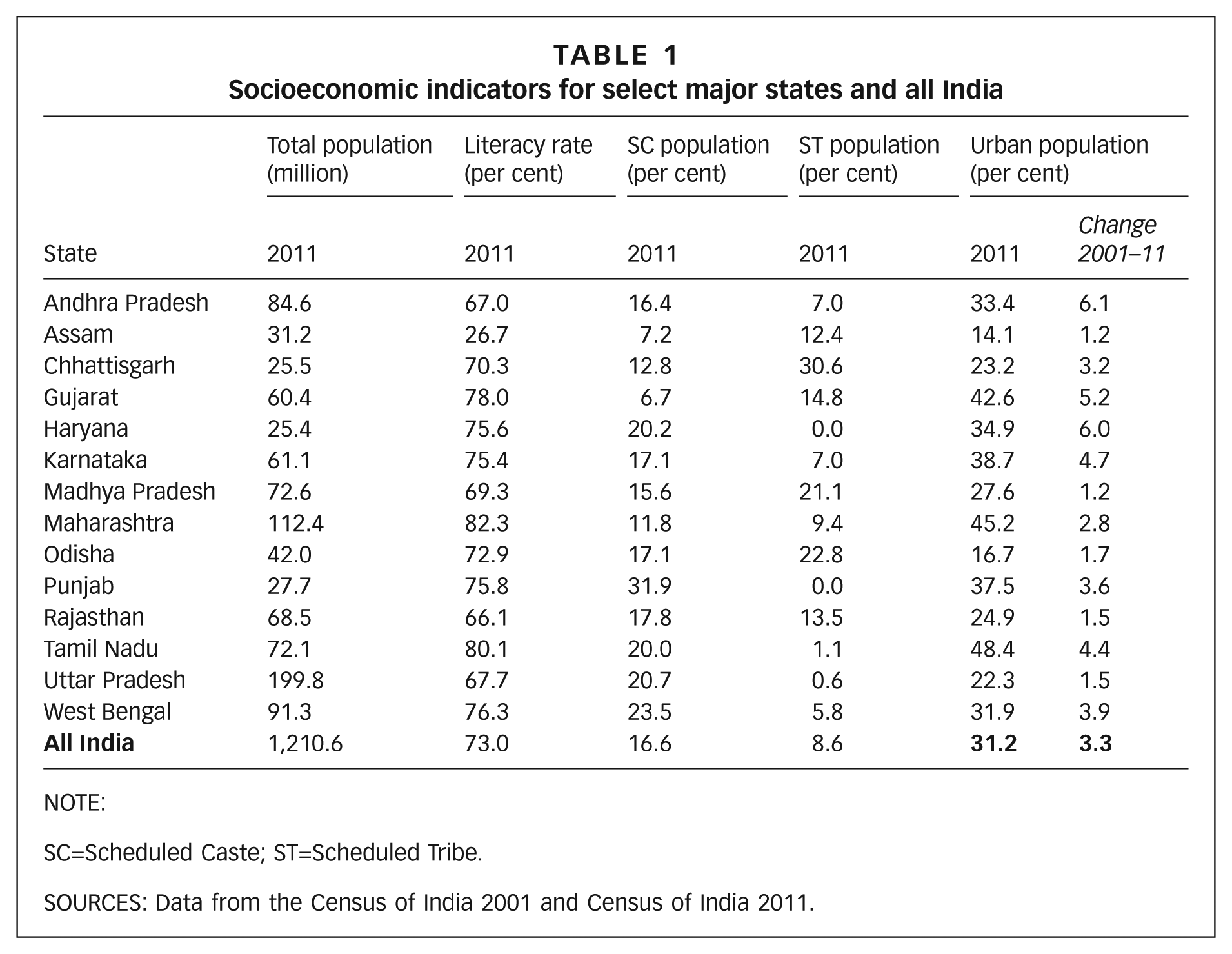
Adivasi is another broad category that includes hundreds of subgroups that have been excluded and socially isolated. Adivasis were afforded affirmative action in the 1950 Constitution under the administrative category of Scheduled Tribes (STs), similar to Scheduled Castes (SCs). Unlike SCs, Adivasis are outside the Hindu varna system and do not fall into the caste hierarchy. They are indigenous communities whose land and livelihoods are linked with forests but who have been discriminated against using narratives of “backwardness”. Education amongst tribal communities is the lowest among any social group, while child mortality rates are significantly higher than among other social groups.(27) STs are heavily concentrated in certain states: Chhattisgarh, Odisha and Madhya Pradesh (Table 1). SCs are more evenly distributed than STs, with the highest proportions in Punjab, West Bengal, Uttar Pradesh, Tamil Nadu and Haryana (Table 1). Our descriptive statistics in Table 1 are limited to the states included in our regional analysis.
Socioeconomic indicators for select major states and all India
NOTE:
SC=Scheduled Caste; ST=Scheduled Tribe.
SOURCES: Data from the Census of India 2001 and Census of India 2011.
III. Research Study
This study examines patterns of caste-based residential segregation in urban India. It uses established methods employed by a rich body of research on spatial segregation in US cities,(28) and more recently in the Indian context. Previous research has established that social stratification manifests in physical spaces within urban environments, particularly residential locations, and that spatial segregation within a city can be a source of disadvantage and structural inequality.(29)
We explore two sets of questions related to spatial inequality by caste in urban India: (1) How is residential segregation by caste/tribe changing over time? Are Indian cities becoming more or less segregated by caste/tribe?(2) Do changes in residential segregation by caste/tribe vary by city size and by region in India?
a. Data overview
We use ward-level caste/tribe data from the 2001 and 2011 censuses of India to calculate the level of residential segregation by caste/tribe in each city.(30) The Indian census collects caste data for SCs and STs, while others (i.e., OBCs and upper castes) are not enumerated and fall into a default “non-SC/ST” category.(31) In 2011, SCs accounted for 16.6 per cent, STs for 8.6 per cent, and non-SCs/STs for 74.8 per cent of India’s population (Table 1). These caste and tribe data allow us to examine if the “line of untouchability” – which physically and socially separates advantaged social groups from subcastes that have historically been considered untouchables – shapes patterns of residence in contemporary cities. This separation has historically dictated where individuals and groups reside. Given histories of discrimination and physical separation, we split the population into two groups: SC and ST versus all others (non-SC/ST). While the census does collect data on religion, disappointingly these data are not made available at the ward or sub-ward level, preventing us from examining how religion also structures access to urban neighbourhoods.(32)
We examine residential segregation by caste for three city-size categories, based on the Government of India’s classification of cities.(33) Our large city-size category consists of Class IC cities, with a population of 100,000 to 1 million people. Our medium city-size category consists of Class II cities, with a population of 50,000–99,999. Our small city-size category consists of Class III cities, with a population of 20,000–49,999. Only municipalities are included in this analysis; we do not include such urban areas as industrial towns or the cantonments because the choice to live in these spaces is restricted by the industrial body/cantonment authority.(34)
Since we are interested in changes over time, we examine cities for which census data are available for both 2001 and 2011. New municipalities that formed after the 2001 census but before the 2011 census cannot be included in the longitudinal analysis. Overall, we have longitudinal data available for 2,105 cities, which are further filtered to meet the methodological requirements of the analyses, as described in the next subsection.
b. Methods
Our measure for residential segregation by caste/tribe is the index of dissimilarity (D). We compute this value of unevenness based on an examination of the spatial distribution of SCs/STs and non-SCs/STs across urban wards in each city.(35) Dissimilarity values range between 0 and 1, with higher values associated with higher levels of residential segregation by caste. For example, a D value of .45 indicates that 45 per cent of SCs/STs (or non-SCs/STs) would have to move wards to create an even distribution across wards in the city. We include cities from all states and union territories (federally administered territories) in our all-India calculations, but limit our state-level analysis to 14 major states that have at least 10 cities with longitudinal data. Table 1 provides summary statistics at the all-India level and for the 14 states included in state-level analysis.
We first calculate how the level of residential segregation by caste varies over time for each city using 2001 and 2011 census data. The analysis in this section is affected by changes in ward boundaries and the addition of new wards in a city during the 10-year period. In some instances, the number of wards in a city changed because of a significant increase in the city’s population such that the official area of the city expanded and/or the city underwent a change in designation (i.e. from “town” to “municipality”).(36) The change in the number of wards signals a more complex reorganization of ward boundaries (i.e. not just splitting of wards so that they can be easily regrouped in the second period to recreate the original ward boundaries of the first period). We create an eligible pool of cities by identifying a subset of cities that had the same number of wards in 2001 and 2011. Within our city-size categories (described in IIIa), out of the 2,105 cities with longitudinal data available, our sample includes 1,244 cities where the number of wards has remained the same across the two censuses. This consists of 59 per cent of the available cities. Despite the reduction in sample size, the longitudinal analysis provides valuable insights into the trends over time in a significant number of Indian cities and offers a starting point for further in-depth investigations. We also compare the sample of cities included in our analysis (i.e., that had the same number of wards over time) with those excluded from our longitudinal analysis (i.e., where the number of wards changed over time) across several indicators and find no significant difference in the two groups.(37)
We calculate and compare the index of dissimilarity over time for 1,244 cities in the three city-size categories. In our analysis, we define “no difference” in the level of residential segregation by caste/tribe for a particular city when the difference in D value between 2001 and 2011 is less than or equal to +/-.03.(38) If the D value increased by more than .03 over time, then we define the change over time as an increase in residential segregation by caste/tribe. If the D value decreased by more than .03 over time, then we define the change over time as a decrease in residential segregation by caste/tribe. We present the proportions of cities that have a decrease in D, have no change in D, and have an increase in D over time for each of the three city-size categories. We also present the proportions of cities that have a decrease in D, no change in D, and an increase in D over time at the all-India level for the sample of 1,244 cities.
The regional findings presented in the next section show results for 14 states that have at least 10 cities in the longitudinal sample, which leads to a sample of 1,206 cities.(39) We use the same definitions as for the city-size analysis to categorize whether a particular city has decreasing, unchanging, or increasing levels of residential segregation by caste/tribe over time. We present regional findings in a similar way: the proportion of cities within a state that has a decrease in D, no change in D, and an increase in D over time. In order to examine trends in states missing from our longitudinal analysis, we additionally calculate and compare the mean D value for small cities at the state level, using a cross-sectional sample of available cities in 2001 and 2011.(40)
Using 2011 census data, we also present the mean D value for all small cities within a state to compare the levels of residential segregation by caste/tribe across regions and with the all-India level for the most recently available census data. We map these findings to visualize the geographic clusters of states in which the majority of cities have experienced improvements in their levels of residential segregation by caste/tribe over time, as well as where there has been little improvement in residential segregation by caste/tribe over time.
IV. Findings
a. A longitudinal look at residential segregation by caste/tribe across Indian cities
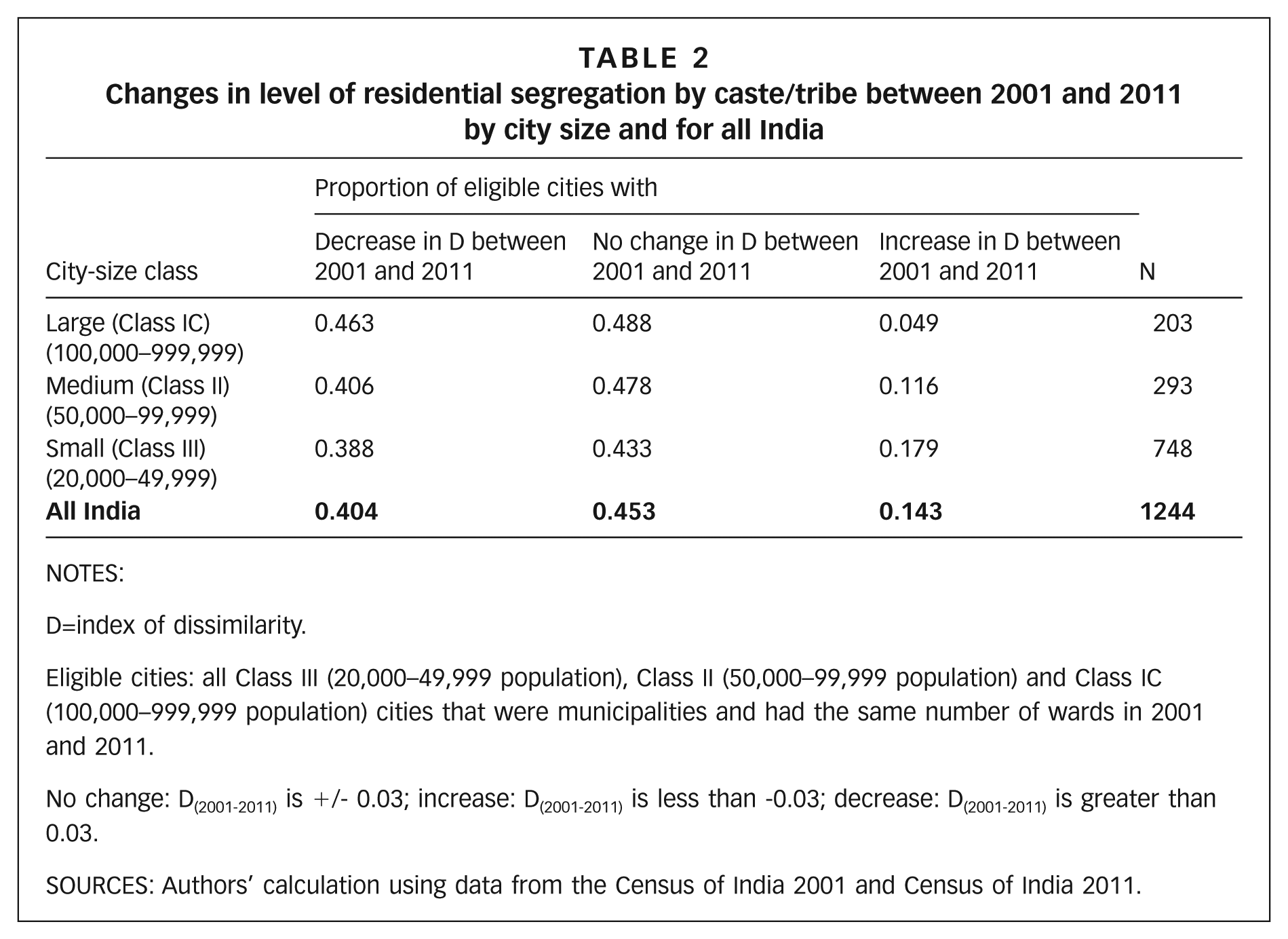
The longitudinal analysis of residential segregation challenges the expected trends in the first decade of the 21st century (Table 2). At the all-India level, there is a positive trend in only 40 per cent of eligible cities; these cities experienced a decline in caste/tribe-based residential segregation between 2001 and 2011. However, 45 per cent of cities nationally show negligible change over time, and approximately 14 per cent of cities show an increase in residential segregation over time. In other words, for a non-negligible proportion of cities in our analysis, residential segregation by caste increased in the first decade of the 21st century, and for almost 60 per cent of the eligible cities we do not observe the expected relationship of residential segregation by caste/tribe decreasing over time.
Changes in level of residential segregation by caste/tribe between 2001 and 2011 by city size and for all India
NOTES:
D=index of dissimilarity.
Eligible cities: all Class III (20,000–49,999 population), Class II (50,000–99,999 population) and Class IC (100,000–999,999 population) cities that were municipalities and had the same number of wards in 2001 and 2011.
No change: D(2001-2011) is +/- 0.03; increase: D(2001-2011) is less than -0.03; decrease: D(2001-2011) is greater than 0.03.
SOURCES: Authors’ calculation using data from the Census of India 2001 and Census of India 2011.
b. Differences in residential segregation by caste/tribe across city-size category
We begin by examining changing patterns of residential segregation by caste/tribe across our three city-size categories between 2001 and 2011 (Table 2). We observe two noteworthy differences and one similarity across city size. First, the large city-size category has the greatest proportion of cities where residential segregation is decreasing over time (46 per cent), compared to 41 per cent for medium cities and 39 per cent for small cities. In contrast, the small city-size category has the greatest proportion of cities where residential segregation by caste is increasing over time (18 per cent), compared to 12 per cent for medium cities and only 5 per cent for large cities. Finally, across all three city sizes, the largest proportion of cities experienced no change in their level of residential segregation between 2001 and 2011.
c. Regional differences in residential segregation by caste/tribe
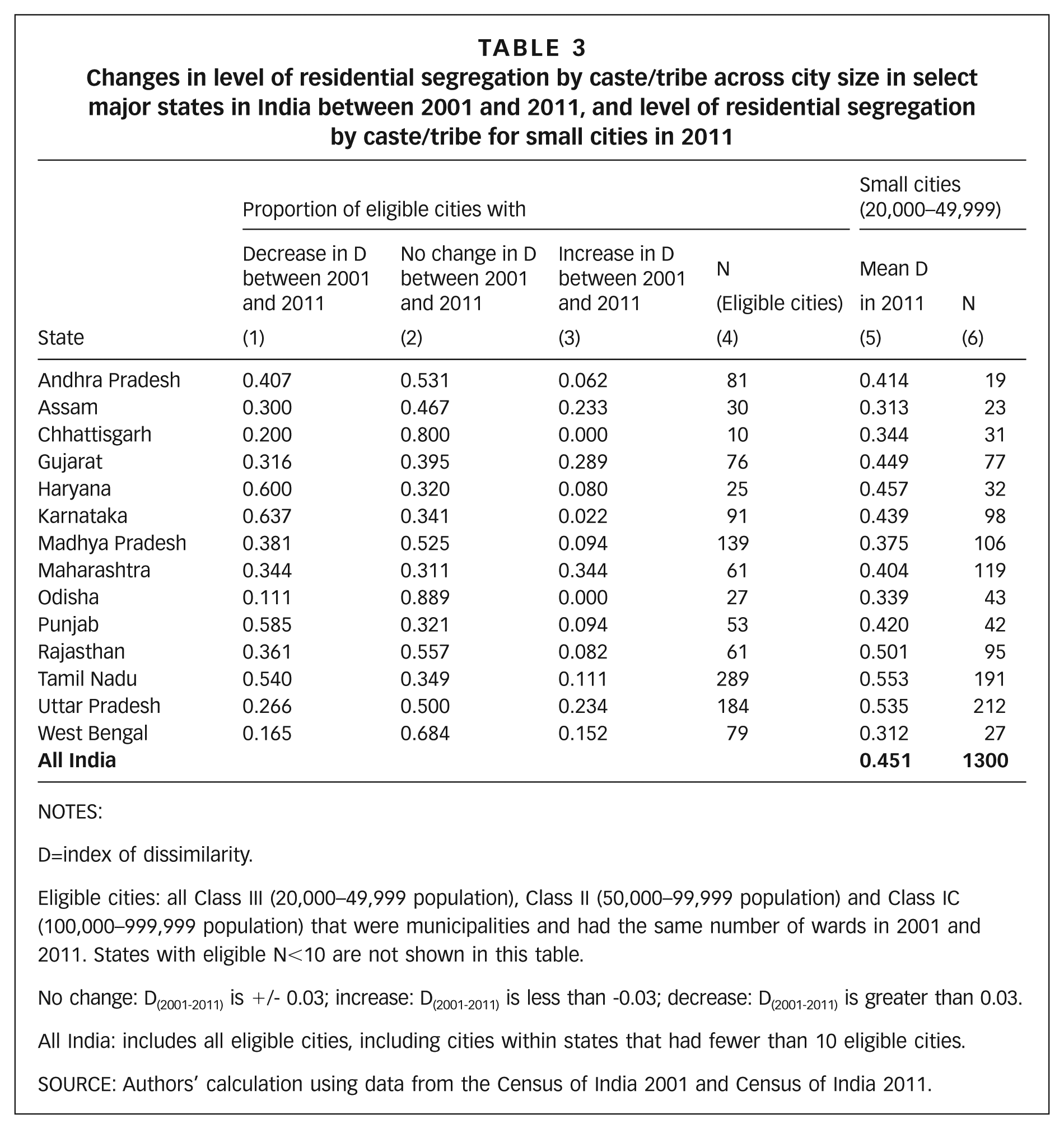
Our state-level longitudinal analysis shows important variations across 14 states with regard to the proportion of cities that experienced a decrease, an increase, or no change in the level of residential segregation by caste/tribe between 2001 and 2011 (Table 3, columns 1–4). We also find variation in the level of residential segregation by caste/tribe across states, based on the mean D for small cities in 2011 (Table 3, columns 5–6).
Changes in level of residential segregation by caste/tribe across city size in select major states in India between 2001 and 2011, and level of residential segregation by caste/tribe for small cities in 2011
NOTES:
D=index of dissimilarity.
Eligible cities: all Class III (20,000–49,999 population), Class II (50,000–99,999 population) and Class IC (100,000–999,999 population) that were municipalities and had the same number of wards in 2001 and 2011. States with eligible N<10 are not shown in this table.
No change: D(2001-2011) is +/- 0.03; increase: D(2001-2011) is less than -0.03; decrease: D(2001-2011) is greater than 0.03.
All India: includes all eligible cities, including cities within states that had fewer than 10 eligible cities.
SOURCE: Authors’ calculation using data from the Census of India 2001 and Census of India 2011.
We find three clusters of states in the longitudinal analysis. In four states (two northern states, Punjab and Haryana, and two southern states, Tamil Nadu and Karnataka), we find that residential segregation by caste/tribe decreased for a majority of the cities between 2001 and 2011 (Map 1). Despite these improvements, one of these states – Tamil Nadu – still had the highest level of residential segregation by caste/tribe in 2011 for small cities (mean D=.55). Even among these four states, between 32 and 35 per cent of cities experienced no change in the level of residential segregation over time, and 2.2 to 11 per cent saw an increase in residential segregation by caste/tribe over the inter-censual decade.
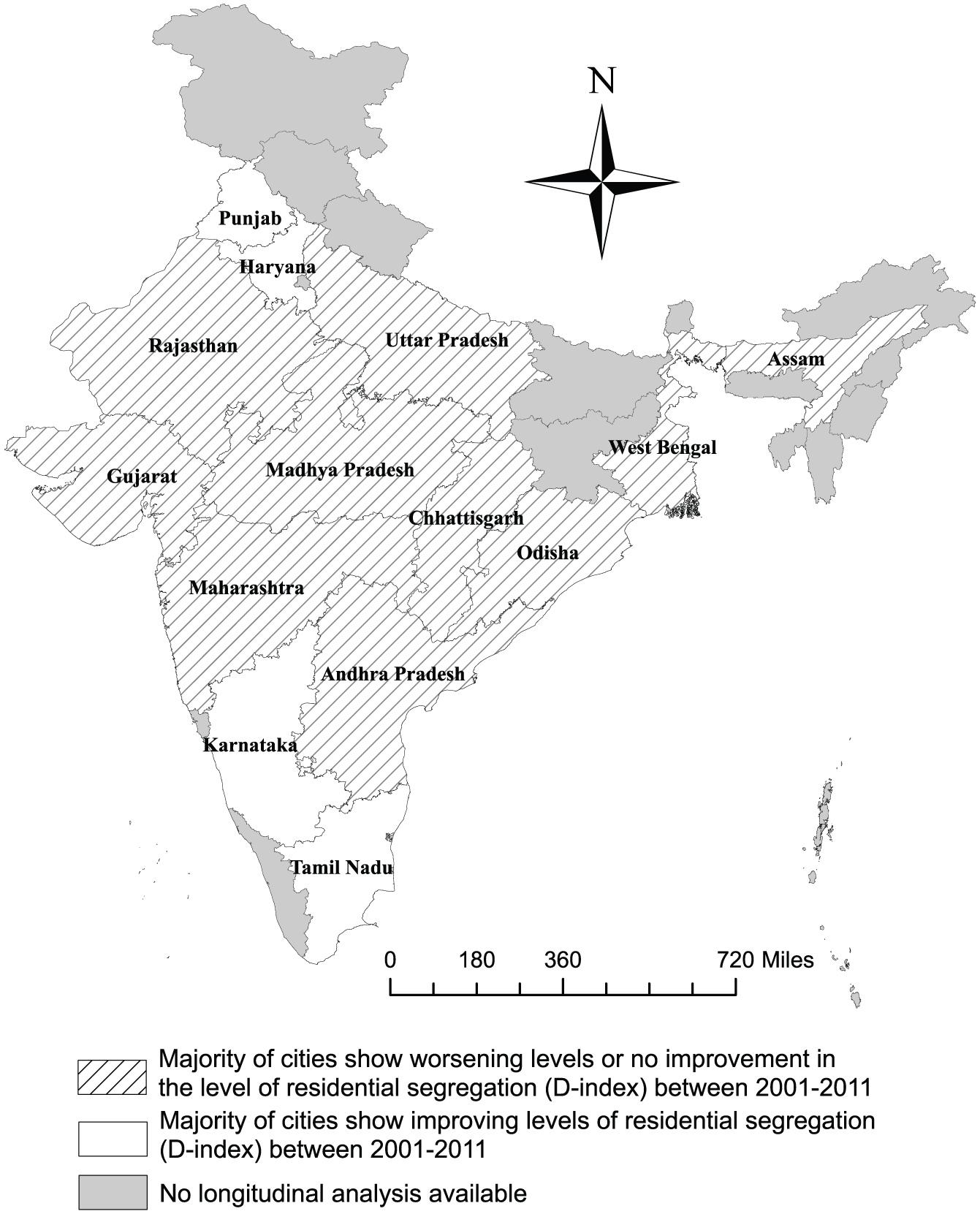
Changes in residential segregation by caste/tribe levels between 2001 and 2011
For a second group, of eight states, a majority of cities experienced no improvement in residential segregation by caste/tribe over the study period. In Andhra Pradesh, Chhattisgarh, Madhya Pradesh, Odisha, Rajasthan, Uttar Pradesh and West Bengal, there was negligible change over time in over 50 per cent of the cities, and in 47 per cent of the cities in Assam. Uttar Pradesh and Assam stand out as particularly problematic within this group because nearly a quarter of the cities in both states also experienced an increase in residential segregation over time.
Finally, Maharashtra and Gujarat have a substantial proportion of cities in which residential segregation by caste/tribe is worsening over the study period: 34 per cent in Maharashtra and 29 per cent in Gujarat. In both states, the percentage of cities that experienced a decrease in D is similar to the percentage of cities where there was no change in D over time. Gujarat is performing particularly abysmally when it comes to residential segregation by caste, with nearly 40 per cent of cities experiencing no improvement over time alongside the high proportion where D is increasing, and a relatively high level of residential segregation by caste among small cities in 2011 (mean D=.45).
To analyse the level of residential segregation by caste/tribe across regions in 2011, we examine the mean D-index for small cities in each state and compare these values to the all-India average for small cities (D=.45) (Table 3, columns 5–6). The southern state of Tamil Nadu and the contiguous states of Uttar Pradesh and Rajasthan in the north had the highest levels of residential segregation by caste/tribe in 2011 (with mean D values ranging from .50 to .55 for small cities). Karnataka, Gujarat and Haryana had mean D-indexes for small cities in 2011 that were not significantly different from the all-India value. The remaining south and central Indian states, as well as the northern state of Punjab and eastern state of Assam, fell below the all-India average in 2011 (with mean D values ranging from .31 to .42 for small cities). However, even among this group, we note that Andhra Pradesh, Assam, Chhattisgarh, Madhya Pradesh, Maharashtra, Odisha and West Bengal have a majority of cities experiencing no change or an increase in residential segregation by caste/tribe over time.
V. Discussion and Conclusions
Overall, the findings from these analyses underscore that caste-based residential segregation in contemporary India is not only a rural phenomenon or the marking of a bygone era, but very much a part of the existing urban fabric. Our results show three major trends:
1) Residential segregation based on caste/tribe continues to persist over time in Indian cities. In most Indian cities, we find that the level of residential segregation by caste/tribe is stagnating (45 per cent) or worsening (14 per cent); fewer than half of the cities in our analysis experienced improvements in residential segregation by caste/tribe over the period studied (40 per cent).
2) There are differences by city size in patterns of residential segregation by caste/tribe over time. The small-city category has the highest proportion of cities in which segregation by caste/tribe is worsening over time, while the large-city category has the highest proportion of cities where residential segregation by caste/tribe is decreasing over time, when comparing across the three city-size categories.
3) There are important regional differences in these trends, with regard to both the overall level of residential segregation by caste/tribe in 2011 and changes over time.
a. Situating the findings
Our initial hypothesis was that as a city grows, and individuals and groups acclimate to urban life and interact with more diverse groups of people regularly, residential segregation by caste/tribe would decrease over time. Contrary to our expectations, in nearly 60 per cent of cities included in our analysis, the level of residential segregation by caste/tribe has either remained stagnant or worsened over time. These findings signal that residential segregation by caste/tribe is a rather durable form of inequality, entrenched in contemporary Indian cities.
In line with our expectations, the overall findings suggest slower improvements in smaller cities, where caste relations, inter-caste mixing, and processes of inclusion and exclusion are more similar to those in developed village settings. In contrast, a greater proportion of large cities have experienced decreasing levels of residential segregation by caste/tribe over time, suggesting that higher levels of interaction among different social groups may serve to reconfigure caste relations and to lower levels of residential segregation by caste/tribe over time.
Our findings also highlight important regional differences in the patterns of residential segregation, and emphasize that sub-national comparisons are central to a proper understanding of caste/tribe-based spatial inequality in India. In the remainder of this section, we seek to contextualize the observed regional differences.
b. A closer look at regional variations
At first glance, the story from south India is one of improvement. In Tamil Nadu, Karnataka and Andhra Pradesh, the proportion of cities with a decreasing level of residential segregation by caste/tribe over time is higher than the all-India level.(41) Yet important differences by state underlie this positive finding. Tamil Nadu had the country’s highest levels of residential segregation by caste for small cities in 2011. These high levels of residential segregation by caste/tribe have persisted over time for many cities in Tamil Nadu (i.e., holding steady in 35 per cent of all cities and increasing in 11 per cent). While this trend over time is better than in many states, it is still disturbing, given that the mean level of residential segregation by caste in 2011 for small cities in Tamil Nadu is significantly higher than the all-India level. These findings come as a surprise given Tamil Nadu’s long history of anti-Brahmin and anti-caste politics. Historical political gains for Dalits have not translated into dismantling patterns of residential segregation in cities in Tamil Nadu. These findings are supported by other instances of caste oppression and discrimination, including village studies that show high degrees of residential segregation by caste in rural Tamil Nadu and increasing news reports of discrimination against Dalits in rural and urban areas, including within highly educated circles.(42) According to the National Commission for Scheduled Castes (NCSC), Tamil Nadu is among the top five states in the number of reported cases of atrocities towards Dalits.(43) Among these states, it has the lowest rates of conviction, at 12.5 per cent, as compared to 46.5 per cent in Bihar and 54 per cent in Uttar Pradesh.(44) Our findings underscore that caste-based segregation is alive in urban Tamil Nadu alongside the rural dynamics highlighted by other sources.
Karnataka and Andhra Pradesh have much lower levels of residential segregation by caste/tribe in 2011 (D>.10) than Tamil Nadu for small cities. Both states also have a much smaller proportion of cities where residential segregation by caste is increasing over time (2 per cent in Karnataka and 6 per cent in Andhra Pradesh), than is true for Tamil Nadu (11 per cent). In addition, 64 per cent of the cities in Karnataka have seen a decline in the level of residential segregation over the inter-censual period, which is a positive and noteworthy trend. However, in Andhra Pradesh most cities (almost 60 per cent) have not experienced improvements over time.
In the northeast, Assam and West Bengal have comparatively lower levels of residential segregation by caste/tribe in 2011, and their level of residential segregation for small cities is the lowest in the country (D=.31 for both).(45) West Bengal’s low level of residential segregation has held steady in a majority of cities (68 per cent), but also improved in 17 per cent of cities. In Assam, however, a substantial 30 per cent of cities have experienced a decrease in the level of residential segregation by caste/tribe. West Bengal and Kerala(46) are two Indian states with a long history of communist government rule. These states share a history of major land reforms, coupled with high levels of participation and democracy in local governments. Existing scholarship on the histories of land reform implementation in the two states suggests that these reforms particularly benefitted marginalized agrarian groups, such as sharecroppers and landless labourers, who also disproportionately formed the oppressed castes. Even though the land reform movements were more anti-feudal in tenor and defined in terms of class struggles (rather than anti-caste mobilization), combined with intentional anti-caste movements they had the effect of lessening the hold of untouchability and other forms of caste discrimination in rural areas.(47) Among the states included in our longitudinal analysis, Assam and West Bengal also have the largest Muslim populations (approximately 34 per cent and 27 per cent, respectively, in 2011). Examining the residential segregation of Muslims is an important area of inquiry but currently not possible as ward- or sub-ward-level census data on religion are not made available to researchers.
Positive results of a decline in residential segregation by caste/tribe in Assam and low levels of mean D in small cities in 2011 are not surprising, given that caste stratification in northeastern states of India differs considerably from that in other regions. Caste rigidities in terms of hereditary occupations, endogamy, and social stratification based on notions of purity, pollution and ritualism have not been as strong within the Assamese caste system as in many other non-northeastern Indian states. While a full analysis of the Assamese caste system is not possible here, the lack of rigidity can in part be attributed to the influence of the Vaisnavite movement, which opened up new avenues for acquiring social status and led to tribal groups transforming themselves into Hindu castes; thus the orthodox aspects of the Hindu caste system intersected with Vaisnavite ideology and tribal practices. However, it would be a mistake to suggest that caste/tribe-based residential segregation is a non-issue within Assam’s cities, with 23 per cent recording an inter-censual increase.(48)
The contiguous states in central India are generally static with regard to changes in levels of residential segregation by caste/tribe over the 10-year period. The majority of cities in Odisha, Chhattisgarh and Madhya Pradesh have no significant change in their level of residential segregation by caste/tribe over time. In addition, Odisha and Chhattisgarh have no cities where residential segregation by caste/tribe is increasing. In these three states the proportion of STs in the population is high (i.e., between 21 and 31 per cent of the state’s population) and they have levels of residential segregation by caste/tribe that are below the all-India average for small cities. Despite being among the poorest states in India, cities in these central Indian states are in a better place with regard to residential segregation by caste/tribe than the all-India average.
Maharashtra and Gujarat are adjacent states along the western coast of central India that have seen a rise in political parties espousing Hindu nationalist ideology since the late 1990s and early 2000s. Both states show a concerning trend of increasing residential segregation by caste in a sizeable proportion of cities. Caste/tribe-based residential segregation has increased in 34 per cent of cities in Maharashtra and 29 per cent in Gujarat, as compared to 14 per cent of cities at the all-India level. However, Maharashtra on average has a lower level of residential segregation by caste in small cities compared to the all-India level in 2011, while Gujarat is on par with the all-India level for small cities in 2011. While Gujarat has been hailed as a model state for economic development, news reports and studies on caste discrimination and atrocities in rural Gujarat are rife. However, less work has been done in the urban context to understand the nature and dimensions of caste/tribe inequality. Our findings empirically support the emerging scholarship that highlights caste-based discrimination across housing, education and employment fields and the spatial reordering of cities along religious and caste lines as part of “developmental progress” in urban Gujarat.(49)
Finally, moving on to the Hindi belt, including the states of Haryana, Punjab, Rajasthan and Uttar Pradesh, a mixed story emerges. The neighbouring states of Haryana and Punjab in north India show a positive trend of improvement over time. In both states, the proportion of cities with improving levels of residential segregation by caste/tribe over time is significantly greater than the all-India level. However, the level of residential segregation by caste/tribe for small cities is not significantly different from the all-India level. As a whole, the picture from Punjab and Haryana is slightly better than the all-India picture – and much better than that of the neighbouring states of Uttar Pradesh and Rajasthan.
In contrast, the contiguous north Indian states of Rajasthan and Uttar Pradesh are performing below the all-India level.(50) Rajasthan has a significantly higher level of residential segregation by caste/tribe for small cities (D=.50) compared to the all-India level, and the proportion of cities with a stagnant level of residential segregation by caste between 2001 and 2011 is 10 percentage points greater than the all-India proportion (Table 3). Uttar Pradesh has a sizeable proportion of cities where residential segregation by caste/tribe is increasing over time. This is particularly alarming given the high level of residential segregation by caste/tribe in Uttar Pradesh, which is second only to Tamil Nadu.
The trend of increasing levels of residential segregation by caste/tribe in Uttar Pradesh should be understood within the context of lower-caste sociopolitical movements. While Brahmins historically dominated politics, since the 1990s there has been a dramatic shift in political power to pro-Dalit and OBC political parties. For example, the pro-Dalit Bahujan Samaj Party (BSP) emerged as a competitor for state-level power in 1991 in Uttar Pradesh, winning 9.4 per cent of the vote that year. And in 2007, it secured a landslide victory, with 30.6 per cent of the total votes in the state.(51) However, while the politics of recognition has swept the state, without a radical shift in the distribution of economic and social opportunities, there seems to be a limited reconfiguration of entrenched caste relations with regard to patterns of residence.(52) These dynamics are reminiscent of the trends in Tamil Nadu, where the expansion of political democracy has not translated into the spatial incorporation of groups that have been historically discriminated. This suggests that equality in formal politics does not inherently lead to a reduction in spatially configured durable inequalities.
VI. Future Directions and Limitations
This paper describes patterns of residential segregation by caste/tribe over time, by city size and across regions. It does not delve deeper into mechanisms underlying these differences, but provides a strong basis for further investigation. For example, why does Tamil Nadu have the highest level of residential segregation by caste across both small and large city-size categories despite its comparatively high score on the Human Development Index (HDI), levels of urbanization, and GDP per capita, as well as a long history of anti-caste movements? Similarly, more investigation is required to understand why residential segregation by caste/tribe is worsening over time in states like Gujarat, where accelerated economic development and the drive towards industrialization over the last decade do not seem to be ameliorating such social inequalities.
Further analyses are needed to understand how the observed differences by region are affected by the higher proportions of STs in particular states. While research on discrimination and structural inequality faced by STs in urban areas is limited, demographic research consistently documents lower development outcomes within this group with respect to educational attainment, child mortality and maternal mortality.(53) A better understanding of the mechanisms that discriminate against Adivasis in urban areas is a critical area for future investigations.
From a methodological perspective, we have chosen not to directly compare mean D values across city-size categories because the median ward size increases with city size and the D-index is sensitive to these changes. Calculations in previous research comparing residential segregation in Indian metros in 2001 have shown that D decreases as the median ward size increases.(54) As such, comparisons of D should take into consideration differences in median ward size across city-size categories, although none of the papers we extensively reviewed offered any standardized adjustments or solutions for the ward size issue. The release of data at the enumeration block level (i.e., sub-ward level) for Census 2011 offers an exciting area of future research. To date, we have not had success accessing GIS ward boundaries of multiple cities included in this analysis in order to visually demonstrate the patterns of SC/ST settlements within city wards. This is a ripe area for future research that we intend to continue building upon.
Finally, discussions of social inequality and discrimination in contemporary India must extend to how religion shapes patterns of spatial inequality in cities.(55) Recent findings show that Muslims suffer greater poverty than Hindus in urban areas, with the gap in the poverty rates between the two communities persisting at 10 percentage points in 2011–2012.(56)
Unfortunately, the Government of India does not make data on religion available below the city level to social science researchers. Interestingly, the failure to systematically unpack the interactions between caste and religion is highlighted in another paper in this issue of Environment and Urbanization, titled “Residential segregation in Mithi and Karachi, Pakistan”.(57) The author highlights a similar inability to study caste-based discrimination among Pakistani Muslims, as Pakistan’s census does not allow Muslims to be categorized as Scheduled Castes (unlike Hindus and Christians). We believe that releasing census data that Indian taxpayers make a substantial investment in will improve our collective understanding of spatial inequality by religion, in addition to caste and class, and provide empirical evidence in support of policies to address structural inequality and religious discrimination.(58)
Footnotes
Disclaimer
The findings, interpretations and conclusions expressed here are only those of the authors, and do not represent the views of their organizations or any other organizations that have provided institutional or organizational support for the preparation of this paper.
The first author undertook the research and analyses during her doctoral degree prior to joining the World Bank, and the findings of the research have no association with the World Bank Group.