




Abstract
Economic decentralization in China has intensified the tension between higher-level and local governments in policy implementation. It is a core development right for local governments in urbanizing China to have construction land quotas determined in local plans. Negotiation around this quota can reveal the hidden rules and operating mechanisms of organizational structures in the urban development field. This paper undertakes a long-term tracing of a planning process in a case study area to reveal the conflicts and bargaining processes that occur when top-down enforcement of relevant policies deviates from or even contradicts local appeals and development goals. This study found that the local governments initially adopted a passive response in order to encourage the opportunity for informal bargaining to maximize their own benefits. The outcome was that higher-level government created incentives and offered flexibility in policy implementation to compensate local government. The role of the planning group in effective information delivery and technical support accelerated consensus reaching with compromise from both higher-level and local governments.
Keywords
I. Introduction
China’s rapid urbanization and large-scale urban growth stand out in the history of human civilization for their scale and speed. The urban population in China reached 57.35 per cent in 2016 compared to 21.13 per cent in 1982.(1) Urbanization is a major driving force contributing to China’s changing land use.(2) A large amount of arable land has been developed as construction land to accommodate an increasing urban population and facilitate economic development. Between 1982 and 2016, nearly 1,340 square kilometres of agricultural land were converted into urban construction land annually,(3) taking the form of numerous new urban districts, industrial parks and the accompanying urban infrastructure. However, encroaching too much on arable land threatens food security, environmental protection and general stability.(4) Since 2006, the central government has promoted an arable land protection policy, which guarantees that at least 120 million hectares (1,800 million mu) will be protected by 2020.(5) The national amount of arable land was only 135 million hectares (2,025 million mu) by 2015,(6) leaving little room for further loss of arable land if the target is to be achieved. Development with a reduction or zero growth of construction land is now promoted by the Ministry of Land and Resources and has been adopted by first-tier cities like Shanghai and Shenzhen.(7)
However, the reduction of the construction land quota(8) exerts huge and direct impacts on local development, since local land leasing is the main source of local revenue (Table 1). It is argued that this is a major driving force of large-scale urban expansion across China, especially in large cities.(9) The reform of China’s tax-sharing system in 1994 consolidated fiscal centralization and granted more economic autonomy to local governments.(10) Soon after China’s housing privatization reform, land-related revenue greatly increased through the leasing of land use rights to developers. Thus, it is understandable that local governments are always willing to encourage a housing boom and reluctant to apply central government policies to cool down the overheated housing market,(11) which may reduce land-related revenue.
Amounts and ratios of local finance and local land leasing revenue in China
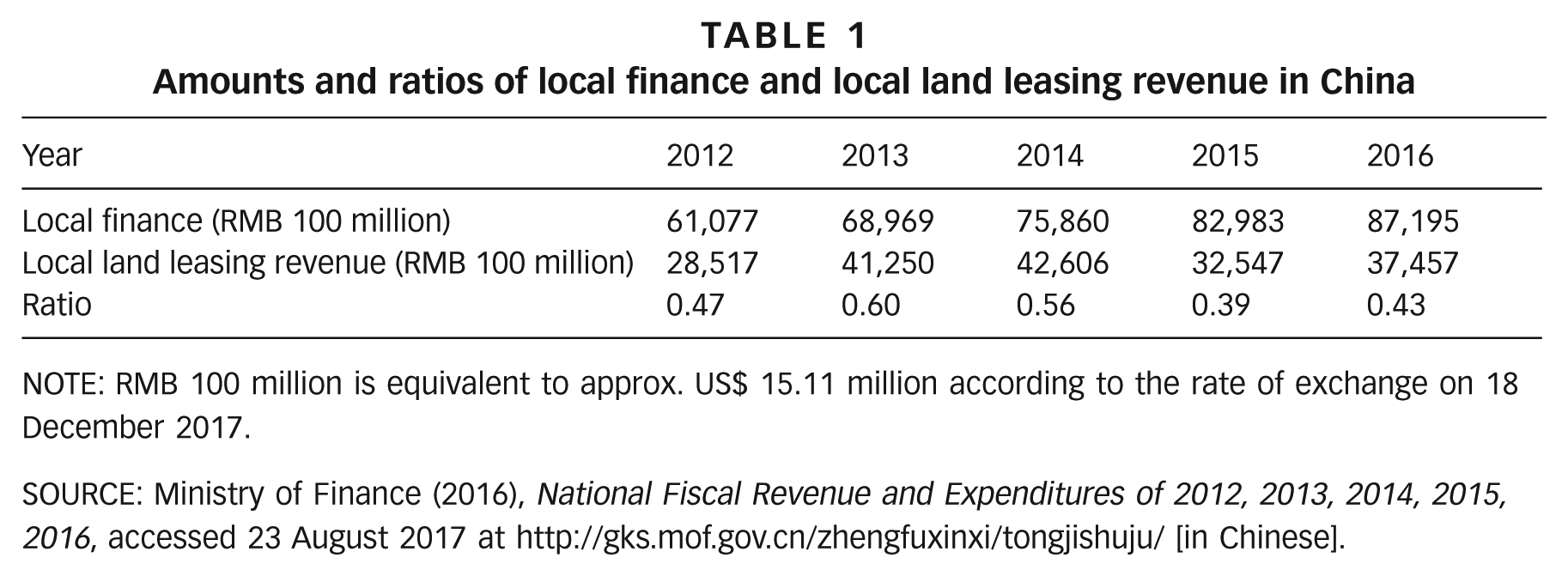
NOTE: RMB 100 million is equivalent to approx. US$ 15.11 million according to the rate of exchange on 18 December 2017.
SOURCE: Ministry of Finance (2016), National Fiscal Revenue and Expenditures of 2012, 2013, 2014, 2015, 2016, accessed 23 August 2017 at http://gks.mof.gov.cn/zhengfuxinxi/tongjishuju/ [in Chinese].
The construction land quota and distribution determined in the local land use master plan are needed for local governments to create legitimacy for urban growth and exert power. Without a land quota, all construction projects are considered illegal. The scale of local growth is thus controlled by the higher-level government, as the construction land quota is administratively allocated by the immediate higher-level government.(12) However, the quota of construction land is not necessarily allocated strictly according to economic and social demands or a justice principle. Instead many political and policy factors exert great weight in the decision.(13) Given the extreme importance of the construction land quota for a locality and the nature of land allocation as a political bargaining process, decision-making on land use planning is highly politicized, negotiated and competitive in China, and it reflects the hierarchical system in administration. The main characteristic is that statutory planning within local governments can only take effect when it is examined and approved by higher-level governments. Though the local People’s Congress should first discuss and approve the plan (a necessary procedure according to the Town and Country Planning Act 2008), higher-level government has more power in planning decision-making. The allocation of the construction land quota is the most important element and task of the land use master plan, and this allocation is harder when a city transforms from expansion mode to regeneration/non-growth mode. Implementing a reduced construction land quota in the highly negotiated and even conflicted arena of local land use planning in cities like Shanghai and Shenzhen is unlikely to be smooth. The philosophy of the newly completed Shanghai Comprehensive Plan 2040 (as well as its land use master plan) is “non-growth planning”,(14) rather than a plan for growth, considering past unsustainable encroachment onto agricultural land.
More conflicts and inconsistency tend to emerge in the process of reducing land quota allocations, since this is directly detrimental to local government’s potential revenue and legitimacy for development. However, bargaining for a construction land quota is by no means just a special case in Shanghai or in the current era. Since economic decentralization in 1990s, bargaining for construction land quotas has been a rational strategy for self-interested local governments to generate more local revenue. Although the form and intensity of bargaining may change with different development phases and constraints, the core objective of bargaining to increase local interests remains the same. During the growth era, while each locality aimed to increase its quota for more construction activities, within the context of a limited increase or even reduction in the land use quota, the forms and specific appeals of bargaining gradually changed. Currently, local governments need to consider how to avoid the reduction of the land use quota in their jurisdiction, and how to allocate their quota internally within different functions if they are to accept the reduction of the overall quota. This scenario is already a common phenomenon in relatively developed areas in China, while in less developed areas, growth remains the main trend.
Within this context, local governments intend to maximize their land quota for local development rights.(15) They develop their own tactics in enforcing policy and they bargain with higher-level governments in different ways. However, there has been little research on this issue, which may partly be explained by the relative separation of academics and practitioners in the field of Chinese planning. Most academics in planning and urban studies have little chance to directly observe and trace the local governments’ decisions, feedback and responses over time.
Our case study is based on close observation from July 2015 to August 2016 of the process of developing a land use master plan in the town(16) of Heqing in Shanghai, where one of the authors once acted as a planning practitioner. We noticed resistance and conflicts in the planning process, especially in the allocation of the construction land quota, and finally, over the course of the year under observation, all parties reached a consensus after lengthy bargaining and negotiation. The case study takes a participant observation approach to fully unpack the process, outcome and rationale of bargaining. Specifically, the opinions, attitudes and behaviours of government officers at different levels, as well as the reactions of the leading officer in the planning group on both formal and informal occasions, were closely observed and recorded. This is a pioneering approach in this context and needs to be further applied and tested in other regions.
This paper aims to answer the following three questions: (1) What measures does local government use to bargain with a higher-level government? (2) How does higher-level government react to the local government’s bargaining to ensure policy implementation? (3) What is the role of a planning consultation group in this bargaining process?
The remainder of the paper consists of three sections. Section II is a literature review on bureaucratic bargaining in Chinese governments and different forms of negotiation, based on which a conceptual framework is introduced. Section III first analyzes the background of the Heqing case and bargaining process, and then generates key research findings. Section IV presents the implications of this paper, while Section V concludes.
II. Literature Review and Conceptual Framework
a. Economic decentralization and local governments’ passive responses
China has been perceived as a top-down centralized state, with a top-down power of enforcement embedded in the traditional hierarchical administrative system, which facilitates China’s high-efficiency development. Policies originating from central government, under this system, are efficiently conveyed to local governments. Even though China has experienced major transformation from a planned economy to a market-oriented economy, the central government has retained its dominant role in policy-making.(17) Neoliberalism, as a pervasive ideology, has operated alongside authoritarian centralized control in China.(18) Government control, however, is compatible with the market condition requirement, and the government therefore acts as the market builder to facilitate market growth.(19)
The state started its tax-sharing system in 1994, as a symbol of fiscal recentralization.(20) After this, much higher proportions of locally collected revenues were delivered to the central government, which meant reduced tax revenues for local governments. The amount of local revenue to be delivered upward after the reform resulted in economic “competition” among local governments to guarantee indispensable local revenues.(21) The central government delegated power to the lower levels to promote local economic development, and numerous industrial parks were gradually set up by governments at different levels. In addition, the innovative institutional design of separating land use rights from ownership in the 1988 constitutional amendment,(22) and the later Land Management Law in 1998,(23) facilitated local governments’ local revenue growth through land conveyancing in the market, since land revenue fully belongs to local governments.(24) On a deeper level, local economic performance has been strongly tied to the promotion opportunities available to local officers, which has spurred incentives for them to foster economic development.(25) This institutional arrangement strengthened economic decentralization in the context of fiscal centralization.
Within bureaucratic organizations, the interests and incentives of higher- and lower-level governments or sectors are therefore not always compatible.(26) China’s centralized system emphasizes the authority and top-down consistency of policies, while the tension between economic decentralization and fiscal centralization forces local governments to pursue their own benefits, which are especially bound up with land development. Every policy received from higher-level governments necessarily goes through a “filtration” mechanism and the friction of bureaucracy.(27) Since friction between the governments and sectors needs to be mitigated and harmonized through negotiation,(28) bargaining plays an increasingly important role in policy implementation in the context of China’s marketization and decentralization.
Lieberthal and Lampton(29) put forward the “fragmented authoritarianism” model to describe bureaucratic decision-making in post-Mao China after the 1980s, and the emergence of bargaining and negotiation in bureaucratic decision-making processes.(30) Incentive mechanisms led by fiscal recentralization and a trend of economic decentralization intensified such fragmentation. Local governments participate actively in fostering economic development in their localities,(31) rather than merely acting as docile agents of higher-level governments.(32) Tirole(33) observed collusion behaviour within coalitions usually formed in the lower tiers of a vertical structure in economic organizations, as a result of asymmetric information. Zhou applied Tirole’s model to an understanding of government. When local governments are required to adopt policies that contradict their interests, they may use “various coping strategies to deal with policies, regulations, and inspections from the higher authorities, which is inconsistent with the original intentions behind the policies”.(34) Zhou et al.(35) further develop a “muddling through” model(36) in Chinese bureaucracy to illustrate these passive responses, and find that the main characteristics of these responses in China’s administrative bureaucracy include behaviours focusing on short-term goals, constant adjustment and improvised coping strategies.
b. Bureaucratic bargaining in Chinese governments and different negotiation forms
When policies are at odds with local interests, local governments usually have three choices: formal bargaining, informal bargaining and passive responses.(37)
Formal bargaining
Formal bargaining is the regular communication channel in China’s administrative hierarchy system,(38) and the central mechanism of formal bargaining is rationality and standardization.(39) Under formal bargaining, local governments can request instructions from their higher-level government in the form of official documents when receiving a task. The local government provides local information on challenges and efforts to higher authorities in order to improve its negotiating ability and to persuade the higher authorities to take a line of action. The higher-level government gives a formal reply. Once higher-level government responds to the request with an official letter, formal bargaining ceases. No room is left for further negotiation. Formal negotiation in bureaucratic bargaining is usually one-off,(40) which clearly disadvantages the local government as the higher-level government has the last word.
Informal bargaining
Informal bargaining involves multiple informal communications through channels beyond formal organization procedures,(41) and is similar to the alternating offers of two sides in the market.(42) In multiple rounds of this informal bargaining process, the local government’s information is updated constantly, causing an adjustment of the higher-level government’s evaluation. These alternating offers between bureaucratic government levels often occur in informal situations(43) that are bonded by social relations.(44) Informal interactions in these situations can accelerate the process towards consensus and avoid the strict rules and regulations of formal organization.(45) The local government has a strong incentive to invest in social relations, thereby increasing its ability to bargain with the high-level government.
Passive responses
In the market, both sides of the negotiation have the right to opt out. In Chinese governmental processes, however, a local government cannot refuse tasks assigned by its higher-level government.(46) Although a local government has no right to quit completely, the effectiveness of policy implementation can be weakened by passive responses, such as purposefully loose interpretations of what is expected within the implementation process. These flexible behaviours include reinterpretation of policy and private adjustment in the implementation process. The subordinate government undertakes a form of passive resistance and a negotiation strategy with the higher-level government, which can be called muddling through. The non-cooperative behaviours of the subordinate government can be alleviated by the higher-level government making concessions or agreeing to compensation. As muddling through involves great political risk because local officials’ future promotion may be affected, it is used cautiously by subordinate governments.
c. Conceptual framework
Figure 1 provides a graphic explanatory framework for these coping strategies, where the principal is the higher-level government and the agent is the local government. The first situation is that the agent enforces the policy without any negotiation process when there are no conflicts triggered by the policy. In China, although economic decentralization can cause conflicts, other major political and cultural decisions made by higher-level governments are usually strictly carried out by local governments. In other situations, the agent may have different strategies for coping with conflicts of interest. Bargaining, both formal and informal, is the predominant mode, although when that fails, the agent may just adopt some passive responses and even resist the policy in an implicit way. These three coping strategies are not mutually exclusive but usually intertwined. For example, the agent’s passive responses may create bargaining opportunities if the principal is eager to implement a policy in the agent’s jurisdiction, or the agent may adopt both formal bargaining and informal bargaining to increase wins.
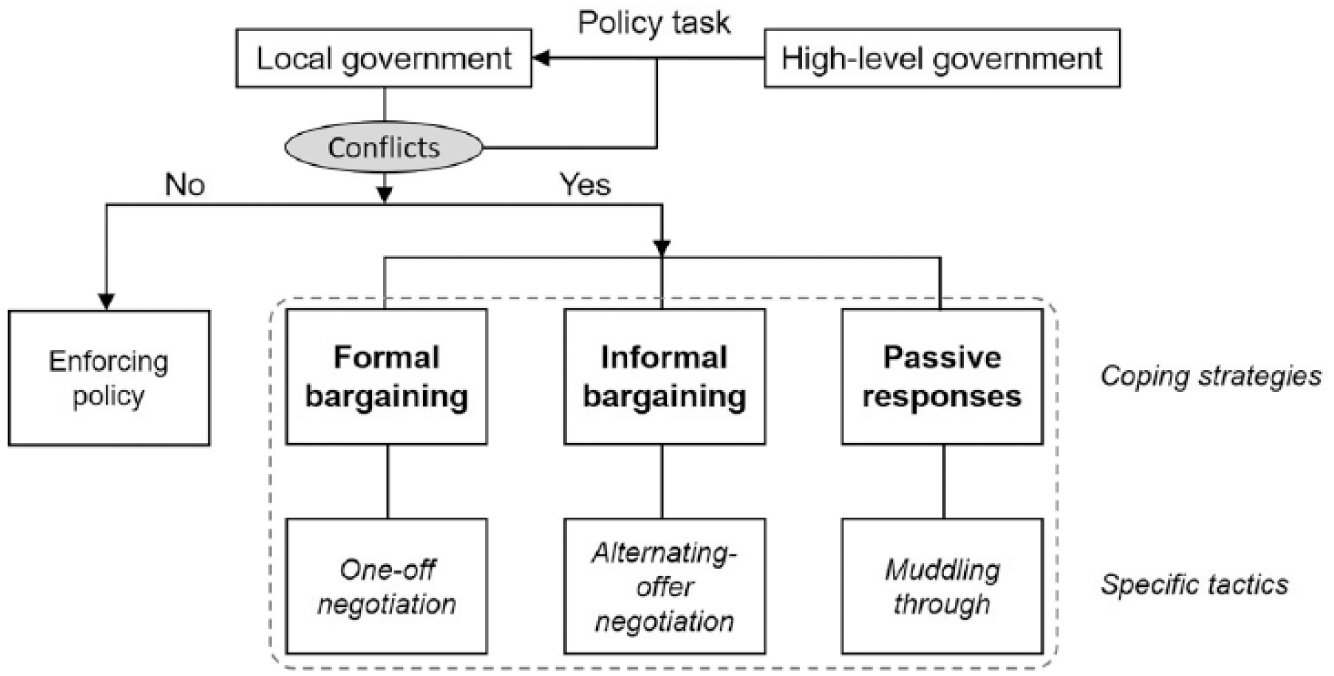
Different strategies local governments adopt in carrying out higher-level governments’ policies
In Chinese bureaucratic organization, there are two kinds of relationships within governments and sectors. Each level of government has agencies in charge of different affairs. For instance, the Shanghai Planning Authority is an agency of the Shanghai municipal government, while the Pudong Planning Authority is part of the Pudong district government. Governments can directly instruct different agencies (Figure 2). Another relationship is a vertical system within one specialized sector, in this case the planning sector. The Shanghai Planning Authority and Pudong Planning Authority are municipal and district-level planning administrations. For Heqing Town, the focus of this case study, the town government and its planning department are regarded as one entity, since the planning department in a town government is very small and many planning decisions are directly made by the town mayor. In this study, one principal–agent relationship exists between the Shanghai Planning Authority and Pudong Planning Authority, and another between the Pudong Planning Authority and Heqing Town government. How an agent reacts to a principal’s policy and how a principal ensures the agent implements that policy are the main focus of this study. Another major actor in this study is a planning consultancy, which delivers key information as well as providing technical support to both the principal and agent mentioned above.
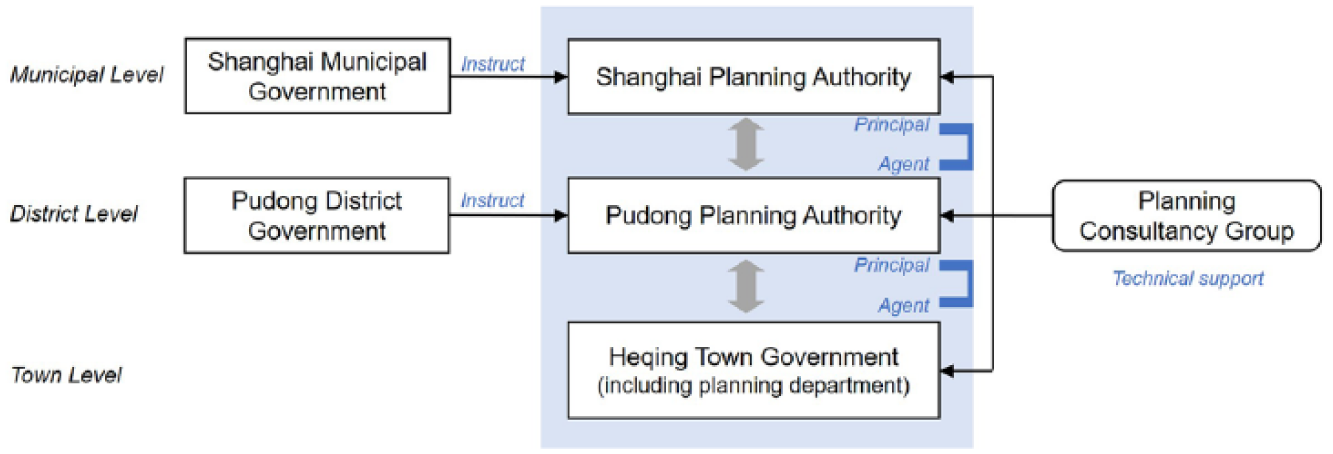
Principal–agent relationship in the case study
III. Case Analysis and Key Findings
a. Background information
Heqing Town is located on the eastern coast of Shanghai, adjacent to Pudong International Airport and far from the inner city (Figure 3). In 2010, the total population of Heqing was 135,000, but this began to decline. By 2014, the population had decreased to 126,800.(47) One of the most important reasons residents left was pollution. Heqing Town covers an area of 42.8 square kilometres, of which 26.2 per cent is industrial land composed of three industrial parks and scattered small industrial factories. This has brought a severe pollution problem to Heqing, and the newly constructed airport runways make things even worse. More than half the area of Heqing is affected by airport noise. The severe pollution issue in Heqing Town was communicated to Shanghai Party Secretary Han (the top official in Shanghai) during the Shanghai People’s Congress and Political Consultative Conference in early 2015. Han was very concerned and inspected Heqing twice. Afterwards he convened a meeting in Heqing and promised the public that polluting factories would be closed, buildings encroaching on arable land would be demolished, and most importantly, new statutory land use guidelines would be established, which would contribute to the development of Heqing’s land use master plan.
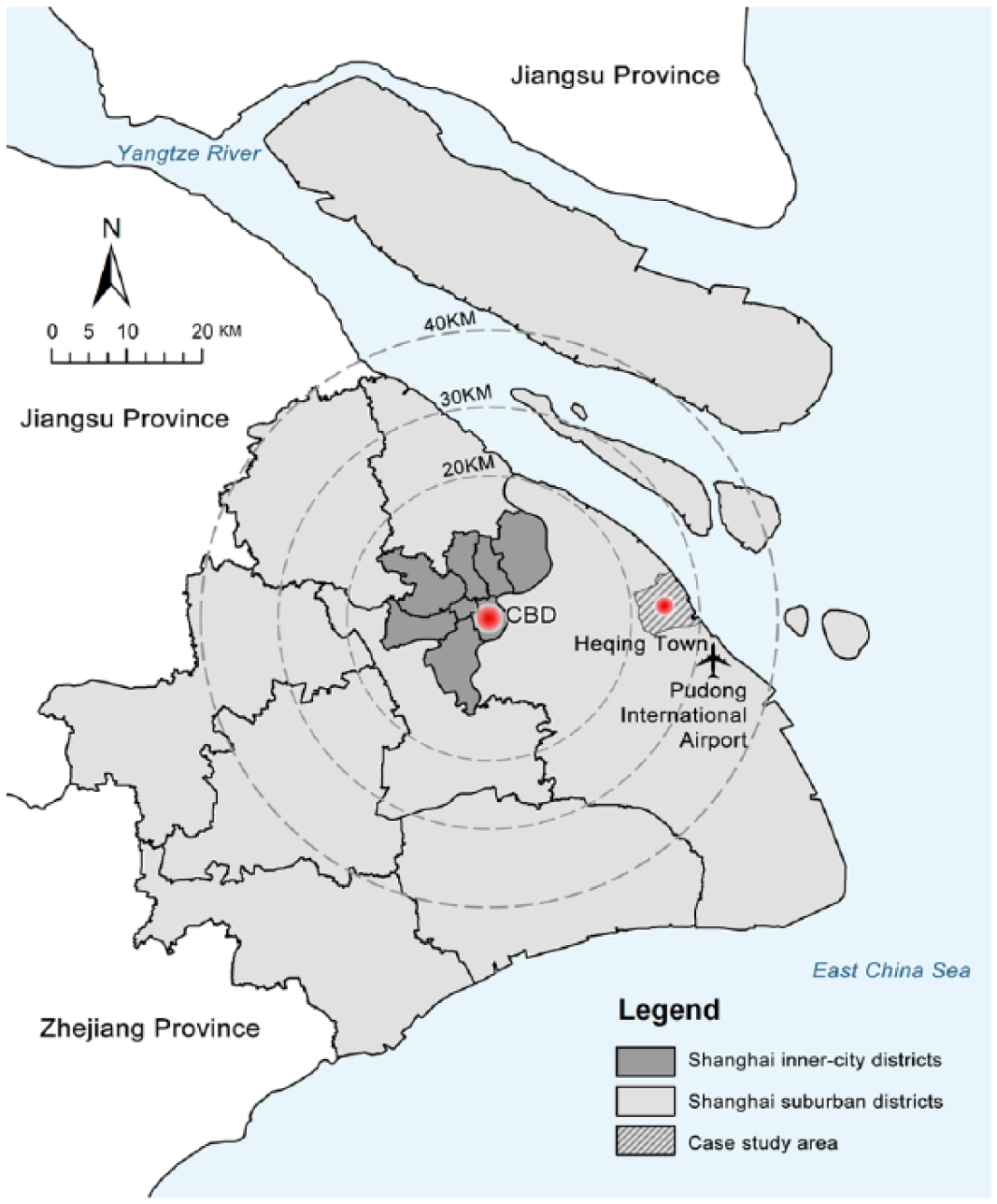
Location of Heqing Town in Shanghai
At that time (2015), Shanghai’s new comprehensive planning instrument – “Shanghai 2040” – was nearly complete, and its objectives and land quota requirements were to be integrated into Heqing’s local planning, given the planning system hierarchy. As mentioned earlier, Shanghai 2040 represents “non-growth planning” rather than a plan for growth, due to the existing urban sprawl and the stress it imposes on the environment.(48) This meant that the total construction land quota would be reduced and any illegally used land would need to be reclaimed. The overall reduction in the construction land quota in Shanghai would need to be allocated among the district (suburb) governments, which would then further allocate a reduction to each town. If the reduction were too severe, it would deeply affect local town governments’ development rights, since land-related revenue accounted for nearly half of local finance, as shown in Table 1.
Currently, there are two large-scale projects in Heqing, Bailonggang Sewage Treatment Works (BSTW) and Shanghai Links Executive Community (SLEC) (Figure 4). BSTW occupies an area of 260 hectares and SLEC takes up 289 hectares, together a large proportion of the overall built-up land in Heqing (2,811.7 hectares).(49) Due to these two large-scale projects, Heqing is considered to have encroached upon too much land and therefore needs to have its construction land quota reduced more than other towns. Heqing local administrators feel this is unfair since BSTW provides a metropolitan-level service, and SLEC is a special programme set up by the district government to accommodate foreign executives and their families in the district. Since these projects are not exclusively serving Heqing, the Heqing government suggests that they be excluded from the calculation of used construction land in Heqing. This response to top-down reduction of the construction land quota was the beginning of the planning conflicts here, and finally consensus was reached after multi-round bargaining and mutual compromise.
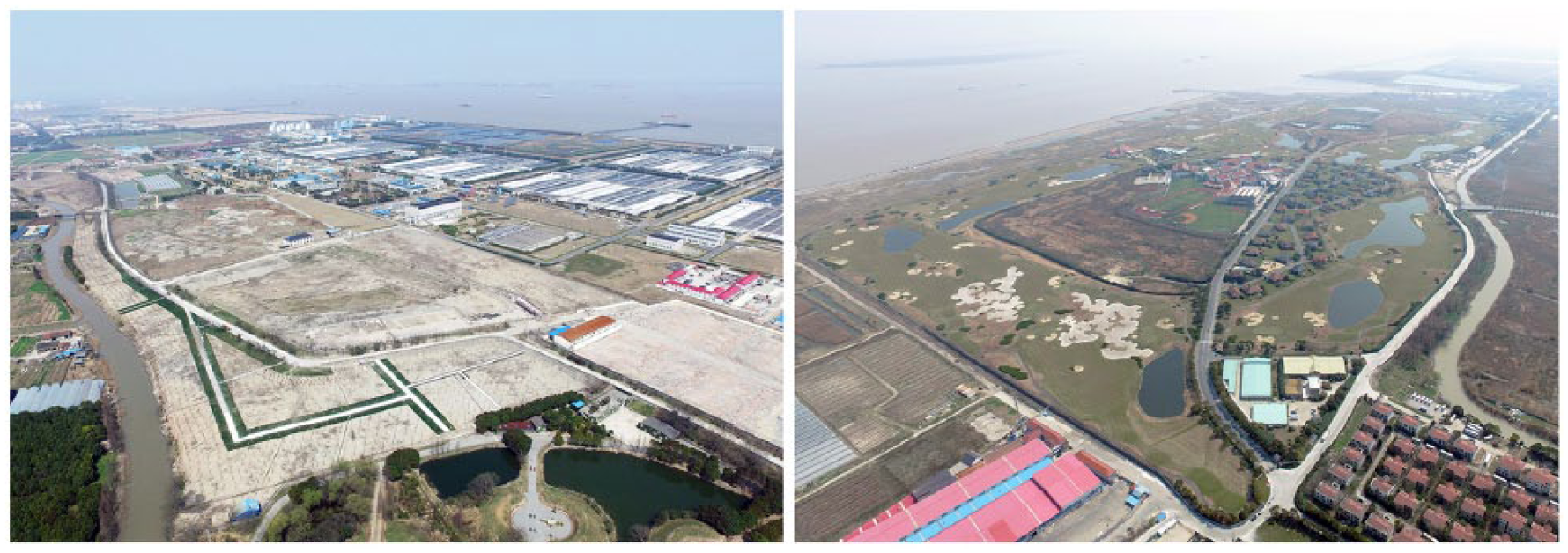
Locations of the Bailonggang Sewage Treatment Works (left) and Shanghai Links Executive Community (right)
b. Bargaining process analysis
Passive responses by the Heqing government to create further bargaining opportunities
Secretary Han has delivered explicit instructions that Heqing stop its expansion of low-end industrial land use, gradually reduce pollution, and reduce the construction land quota in its land use master plan. A planning group was selected by both the Shanghai Planning Authority and Pudong Planning Authority to help carry out this task and to compile the land use master plan. When the planning consultancy group first visited Heqing, the local government adopted a passive response. Local officials were not clear whether there was room for further negotiation, and they responded by intentionally mishandling their expected assistance to the planning group in collecting socioeconomic data and arranging on-site investigations. This kind of unhelpfulness is uncommon in China’s planning process.(50)
Local administrators viewed this planning and the policy of reducing construction land quotas as a top-down political process that overlooked their development rights. However, they had no way to express their discontent to high-level government other than acting reluctantly in the implementation of this policy. There was also an incentive for the local government to bargain with the district government/sector to gain additional compensation or to carry out the policy in a loose and self-interested way. They argued that Heqing had sacrificed significantly for the metropolitan region, especially with the daily operation of BSTW, which has resulted in air pollution for Heqing. Considering this, higher-level governments should support and compensate Heqing rather than reducing Heqing’s land quota. The strategy the Heqing government adopted in the face of potential conflict with higher-level government was to resist assisting the planning group’s investigation, and to ask the group to convey local appeals to higher-level governments. (Planning groups always have the chance to provide technical support to municipal and district planning authorities.)
In a later conference on the Heqing Town land use master plan, Town Mayor Xu also indicated that the town’s People’s Congress would not approve the planning outcome if the higher-level government did not increase the land quota for Heqing. According to the Shanghai Planning Ordinance, the approval of a town-level land use master plan should first be inspected and approved by the town’s People’s Congress. In addition, the Heqing government owned considerable local data, without which the work of planning consultancies could not be carried forward. Therefore, the planning consultancy group had to report the situation to both municipal and district planning authorities for advice on how to make the Heqing government cooperate with the planning.
Informal bargaining initiated: the failure of top-down executive commands and compensation provision
The planning group conveyed Heqing Town’s appeal to both the Shanghai Planning Authority and Pudong Planning Authority. The officer of Shanghai’s Planning Authority, who was in charge of the management of local towns’ land use master plans, regarded this issue as an internal problem for Pudong District. After this, the municipal planning authority instructed the district planning authority to equitably allocate the land quota among all the towns and minimize resistance from Heqing Town. The Pudong Planning Authority had no objection and promised to exert administrative pressure on Heqing Town. There were nearly no conflicts between municipal and district planning authorities, as the district planning authority knew that this was a prioritized project in Shanghai that should be carried forward without delay or fault. In addition, although the reduced construction land quota affected Heqing’s local revenue, Pudong’s overall development was hardly influenced, since Heqing was just a remote suburban town of little importance.
Although the Pudong Planning Authority promised to compel Heqing Town to accept the administrative order and cooperate with the planning group, the local government was quite negative in its attitude. The district planning authority suggested that the planning group explore how to maximize Heqing’s economic development within the constraints of the land quota from a technical perspective, which saw the start of informal bargaining. The district planning authority and planning group proposed a countryside park on the east coast of Heqing as compensation for its reduced land quota, and to help facilitate a transformation from an industrial town to tourist town. In a short time, the Pudong district government organized an international competition for designs for this proposed country park, and attracted the interest of design groups from the US, the Netherlands and Australia. This incentive reduced resistance from Heqing Town, which became more active in cooperating with the planning group.
Further bottom-up bargaining over the land quota transfer and acquiescence of the district planning authority
The Heqing government later realized that the reduction of the land quota had left no room for further bargaining, given the strong attitudes of both municipal and district-level planning authorities. Although they were pleased that a new country park would be planned in Heqing, they saw this as a long-term reward and additionally sought a land quota transfer from traditional industry to real estate development. Heqing government officers proactively contacted the planning consultancy for this appeal, pointing out that the overall land quota conformed to the demands of the higher-level governments. Of course, Heqing would benefit from such a transfer because the land revenue for local government was substantial(51) and kept by local governments, as compared to tax income from secondary industry, most of which went to the higher-level and central governments. In the final planning scheme, existing scattered factories within the location of the planned country park would mostly be demolished and the industrial park in the northwest of Heqing would also be downsized for the sake of real estate development. According to the final plan, with a general reduction of the construction land quota from 2,811.7 hectares to 2,197.7 hectares in 2040, industrial land would experience a sharp decline from 839.3 hectares to 333.3 hectares, while urban residential land would see an increase from 162.4 hectares to 368.2 hectares (Table 2).
The change of Heqing’s land area in different categories, 2014, 2020 and 2040
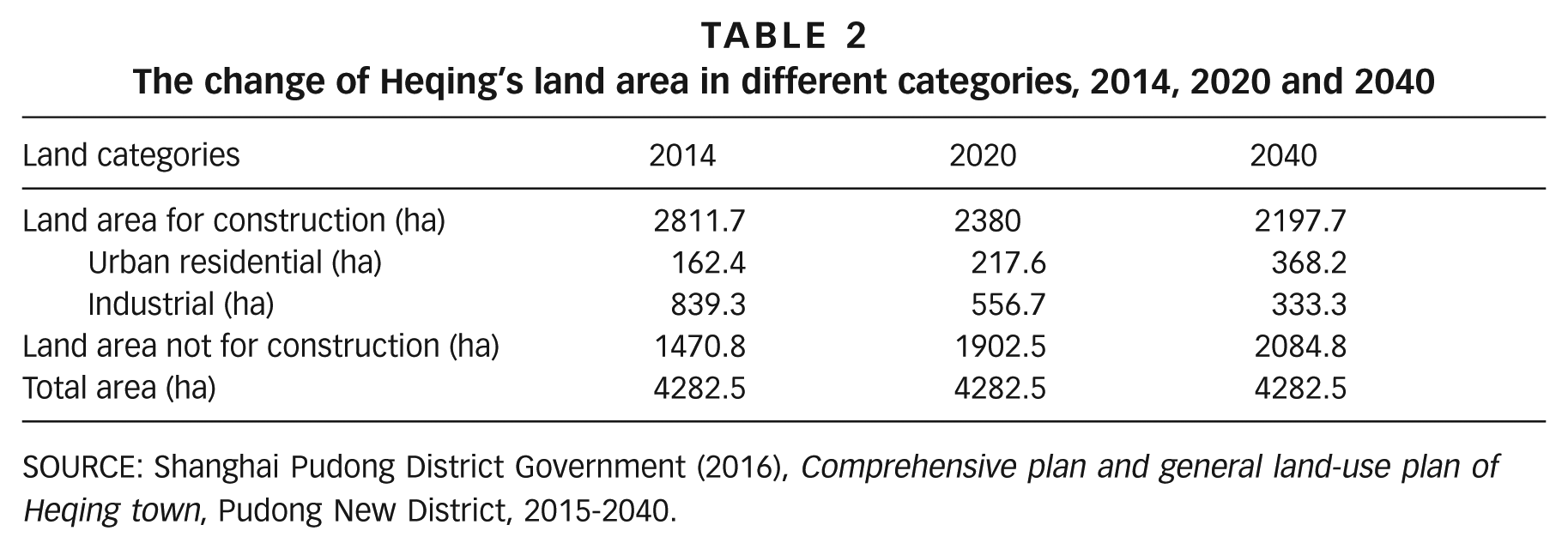
SOURCE: Shanghai Pudong District Government (2016), Comprehensive plan and general land-use plan of Heqing town, Pudong New District, 2015-2040.
In the negotiation process, the planning group developed a scheme that considered the appeals from the Heqing government and discussed it with the district planning authority. Both doubted that it was reasonable to increase the residential land quota in Heqing since the town was close to the airport and influenced by the associated noise. However, the district planning authority acquiesced to the arrangement and hoped the planning group would accelerate the planning with assistance from the Heqing government.
Local government’s further proposal of expanding the town centre area soon denied by the district planning authority
The Heqing government was not content to stop with the success of the last round of negotiation. Since East Gaoke Road had just been constructed and the town centre area was concentrated on the south of East Gaoke Road, local government further suggested that the town centre area be expanded to include the northern side of East Gaoke Road to maximize the use of this newly constructed arterial road. The planning group realized that further expanding the town centre area would support more residential development; however, this might go too far given that the main theme of Heqing’s plan was to shrink rather than grow. The planning group made it clear that the proposal could not be accepted. Soon the district planning authority also rejected the suggestion and confirmed there was no room left for any more bargaining. The draft plan should be finalized soon and submitted to the Shanghai municipal government and Secretary Han for review.
The final planning scheme was a fairly satisfactory outcome for both the Heqing government and higher-level governments. The town government was satisfied with the increased residential space and the planned countryside park. For the Pudong Planning Authority, the land quota for future development was finally reduced. For the Shanghai Planning Authority, the planning was completed on time and the plan for the future transition of Heqing complied with the municipal government’s instructions. After this stage, the planning scheme remained stable and only went through some minor revisions put forward in later reviews by both specialists and other government sectors.
In order to accelerate the planning approval process, the voices of the public, the direct stakeholders in this plan, were largely ignored. In the stage of devising the plan, members of the public had no forum for expressing their opinions to the planning group. In the later stage, although the draft plan was exhibited for 30 days in accordance with the Town and Country Planning Act 2008, the Pudong Planning Authority provided very limited access for the public to give suggestions and opinions. They could have a look at the draft plan exhibited on the ground floor of the town government building and on the website of the Pudong Planning Authority, but were limited to letters, emails or faxes to express their opinions. There was no public consultation event during the process and no phone number was provided for the public. This meant that many less educated people were excluded from the public participation.
IV. Key Findings
a. Passive responses of local government as a reaction to conflicts between governments of different levels
Under authoritarian centralized control, local governments must carry out the instructions of higher-level governments. However, passive responses to top-down policy in Heqing’s case stem from contradictions between the centralized system and economic decentralization in practice.(52) Since China’s reform and opening-up, deepening marketization and decentralization have enabled local governments to represent their own interests when implementing policies from higher-level governments. Despite assessment and incentive mechanisms from higher-level governments, local governments are in charge of local affairs, including economic development, people’s livelihoods and ecological protection, in some very concrete ways.
Heqing is a remote town in Shanghai without the benefits of city-level investments in mega projects. In that context, its construction land quota has always been a powerful tool to increase local revenue as well as promote economic development and social services within its administrative area. A reduction in this quota goes against Heqing’s interests and forces it to negotiate for its development rights with higher-level government. The presence of BSTW and SLEC, which both occupy large areas of land in Heqing, while serving the whole district and city, provided a good reason for Heqing to argue for a larger land quota at the first stage. Though the top-down policy requirements are explicit and powerful, the Heqing government has a strong rationale for objecting in an implicit way to maximize its own benefits. Such a phenomenon reflects the deep contradiction between top-down authoritative requirements and local self-governance. In addition, asymmetry of information and appeals between local and higher-level governments further strengthen the intention of resisting undesirable policies from higher-level governments. However, such resistance is always implicit. Heqing government officers dare not disagree with a higher-level government’s decision in public, especially in the presence of officers from higher-level governments, but only show their reluctance by not fully carrying out such a policy.
b. Constraints and strategies of negotiation under the joint administration mechanism
The negotiation process of the Heqing government and higher-level governments and the specific negotiation strategy of Heqing should be understood within the framework of the dual principal–agent relationships and the joint administration mechanism (liandai jizhi). Unlike the bargaining process of markets, bargaining processes within governments and sectors are constrained by this joint administration mechanism, which is an internal characteristic of Chinese bureaucracy. Under the supervision of the municipal government, town government and district government are joint and integrated in terms of their success and failure in carrying out a policy. The joint mechanism gives Heqing’s government the opportunity to bargain with district government, and helps both sides to reach consensus and complete the policy tasks as quickly as possible. As the municipal government is deeply concerned about the outcome, which generates political tasks for both district government and town government, the joint mechanism has been strengthened. District governments at the intermediate level are particularly constrained and shaped by this mechanism. On the one hand, a district government presses a town government to take measures and ensure the completion of tasks assigned by municipal government. On the other hand, it has to collaborate with town government to meet the requirements of municipal government.
Thus, under the existing joint mechanism, Heqing’s bargaining strategy – to maximize local development rights and revenue through multi-round bargaining in a limited time – has been rational and logical. Considering the uncertainty of formal bargaining, which usually consists of a one-off negotiation, the Heqing government avoided using such a strategy. Instead, multi-round informal negotiations and exploring the bottom line of the district government allowed the Heqing government to maximize its benefits. The passive resistance adopted by the Heqing government in the initial phase of planning, although it seems risky, aimed to create opportunities for informal negotiation in the next stage. The Pudong Planning Authority, as an intermediate-level sector, not only has the duty to implement the instructions of its higher-level government, but also needs to consider the situations and appeals of the Heqing government in the implementation process. It is the joint mechanism that presses both the Pudong Planning Authority and Heqing government to finish a plan on time; otherwise both sides would be blamed for neglecting their duty. This pressure stimulated the informal bargaining between the Pudong Planning Authority and Heqing government.
The outcome of informal bargaining was the creation of incentives for local government and the obtaining of flexibility in policy implementation. In the first round of informal bargaining, constructing a country park, as an incentive, accorded with the requirement of environmental protection and aimed to facilitate Heqing’s transition from a polluted industrial town to a coastal tourist town. This measure would be risk-free and politically shrewd, since it matched the theme of Shanghai’s future development as “a greener city” put forward in Shanghai 2040.(53) However, the more one gets, the more one wants. The Heqing government might have reaped greater benefits from additional informal bargaining, since a country park cannot bring direct benefits in the short term. The aim was to carry out the policy flexibly and meanwhile create direct benefits. Flexibility in policy implementation means the local government exploits loopholes within the policy with the understanding that it does not go against the general policy objectives. Since the total land reduction in Pudong had been confirmed and the allocation plan within the district had been published, the Pudong Planning Authority was unlikely to change Heqing’s land quota for fear of other towns’ further objections. After the Heqing government became aware of the impossibility of increasing its land quota, its proposed transfer of the internal land quota from industrial to residential use, though not technically correct (because of the town’s shrinking population and the proximity to the airport), might still have resulted in revenue for the local government as well as complying with the overall aim of land quota reduction.
Consensus could only be reached if the Heqing government received direct benefits. The Pudong Planning Authority, as an intermediate agency constrained by the joint administration mechanism, had to make concessions at this stage in order to implement top-down instructions as quickly as possible. However, the Heqing government further proposed to expand its town centre and negotiated this with the Pudong Planning Authority. The joint administration mechanism drove the Pudong Planning Authority to compromise once, but it would not make any more concessions, since the Heqing government’s proposal went against the central aim of top-down policy. The joint administration mechanism meant that the Planning Authority and Heqing government shared both the responsibility and the potential repercussions, and it accelerated the informal negotiation process between them.
c. The role of the planning group: coordinating between the local government and higher-level governments
Many planning strategies and/or disputes end not in consensus but rather in negotiation and compromise,(54) partly because of the different values of different stakeholders. With the emergence of conflicts in the planning decision-making process, a planner’s role in communication and coordination becomes more and more important. In Heqing’s case, the planning group took on the role of a platform for informal negotiation between the Pudong Planning Authority and Heqing government, to pass on information and provide technical support.
At the beginning of Heqing’s land use master planning, the planning group came to Heqing as a consulting group providing technical support. However, the planning group was not a direct government body and therefore local government dared to resist passively. Through detailed analysis of the local situation, the planning group passed on local information and demands to higher-level government, which contributed to stimulating an informal bargaining process. Apart from information delivery, the planning group could also provide specialized technical support, such as developing the plan for the country park, analyzing future trends for Heqing Town and assisting with creating the master plan. Facing the Heqing government’s demand for an adjustment in the master plan in terms of the internal land quota transfer and further expansion of the town centre, the planning group could provide higher-level government with multiple schemes and corresponding pros and cons for decision-making. It not only helped the local government to increase its benefits, but also smoothed over the conflicts and facilitated timely policy implementation.
A planning group thus becomes a new player in the traditional policy implementation process and relationship, and an important channel and platform for informal bargaining. Administrative friction in policy implementation can be alleviated by the planning group. In the Heqing case, final consensus, with a compromise from both sides, was finally reached through effective information communication and technical support.
V. Discussion and Conclusions
By the end of 2016, Heqing Town’s land use master plan had been approved by the Shanghai municipal government. It only took one year to investigate the local situation, compile the planning scheme and go through all the administrative processes, including expert review and government sector review, and finally get approved, which is quite fast when compared to the completion of the master plans of other towns or cities. The speed of the process was driven by both the top-down administrative pressure and final consensus through negotiation and mutual compromise. The analysis in this paper reveals that the local government’s strong self-interest motivated it to adopt diverse strategies to guarantee its development right (construction land quota). This paper draws the following three conclusions.
First, passive responses were this local government’s first strategy when asked to carry out a policy that was to its detriment. Even with instructions from higher-level governments, the local government did not cooperate fully with the planning group, but managed to drag out the process of planning, which created further opportunities for informal bargaining. The joint administration mechanism was an important factor in maximizing such opportunities, because the Pudong Planning Authority, as an intermediate government agency, would also have been blamed by municipal government if Heqing’s land use plan was not completed on time. Therefore, the Pudong Planning Authority had to provide some incentives or make concessions to Heqing to accelerate policy implementation.
Second, to enforce policy implementation, the Pudong Planning Authority also adopted different ways to cope with the bottom-up strategies of the Heqing government. It first instructed the Heqing government, in the name of the district government, to cooperate with the planning group. It then presented the country park project as an incentive when the administrative command had no effect. When the Heqing government proposed the internal transfer of the land quota, to compensate for its loss of development rights, the Pudong Planning Authority had to acquiesce in order to accelerate project implementation. However, when the Heqing government further argued for expanding its town centre, the Pudong Planning Authority made no more concessions, since it had already gone beyond the bottom line.
Third, the planning group acted as a platform for informal bargaining among the Heqing government, Pudong Planning Authority and Shanghai Planning Authority. It passed on information to all parties and generated technical solutions, which finally led to compromise and consensus on both sides. This example shows that planners can help mitigate and harmonize the friction of bureaucracy, and have an important coordinating role.
Though all parties in this case reached consensus in the end, the origin, process and outcome of bargaining still needs careful evaluation. The following factors should be kept in mind.
First, the contradiction between enforcing policies from higher-level governments and guaranteeing local development in the context of economic decentralization is important, and should be thoroughly considered when making policies. Policies from higher-level governments are sometimes overwhelming and need to be implemented quickly. This may carry the cost of demotivating local governments, especially if the policy goes against local interests. Higher-level governments should evaluate whether the policy’s objectives match the actual situation of lower jurisdictions. Fairer and more reasonable allocation of limited land resources must be a priority when determining the distribution of the construction land quota. More detailed investigation should first be conducted to facilitate better understanding of the local situation before the allocation plan is published. A more reasonable allocation plan and incentives arrangement will make the goals of higher-level governments and actions of local governments more consistent, which could smooth policy implementation.
Second, it is important to consider whether the public’s views have been included in the bargaining process. The construction land quota and its distribution affect the interests of the local government, but exert an even more direct impact on the public. Unfortunately, the public, in Heqing’s case, did not have good access to the land use planning process and therefore the opinions of relevant stakeholders were not reflected properly here.
Finally, flexibility in policy enforcement may have accelerated the implementation process and facilitated consensus, yet its legitimacy should be carefully examined, with attention especially to whether accommodation may generate some unintended negative impacts. In Heqing’s case, the internal transfer of the construction land quota needs further technical discussion – for example, whether it is in line with the population decline in Heqing, and whether it is suitable to increase the residential land quota adjacent to the airport noise area. In other words, bureaucratic bargaining and flexibility in policy enforcement may lead to policy deviation even if the main target has been guaranteed.
Having started from existing theoretical arguments concerning the behavioural patterns of the Chinese bureaucracy,(55) our work has tried to extend these theories into the urban planning field, which is a critical sector in urbanizing China, and to facilitate the understanding of the Chinese bureaucracy in planning decision-making. Our case study, which followed events over the course of a year, provides a powerful illustration of the bargaining process and rationale and provides a basis for future studies. This approach should be applied in other regions (both more developed and less developed areas) in the future, in order to generate comparisons and realize more generalizable conclusions.
Footnotes
Acknowledgements
We are grateful for the helpful comments provided on earlier drafts by Sian Thompson, Hao Chen and Shiqi Tao. We would also like to thank the anonymous reviewers for their insightful comments and suggestions. Jin Zhu acknowledges the support from Australian Government Research Training Program, and Weicheng Tang acknowledges the support from National Natural Science Foundation of China (project number 41771567). Any errors are the responsibility of the authors alone.
2.
Wu, Y, X Zhang and L Shen (2011), “The impact of urbanization policy on land use change: A scenario analysis”, Cities Vol 28, No 2, pages 147–159; also Li, B, C Chen and B Hu (2016), “Governing urbanization and the new urbanization plan in China”, Environment and Urbanization Vol 28, No 2, pages 515–534.
4.
See reference 2, Wu et al. (2011); also Kong, X (2014), “China must protect high-quality arable land”, Nature Vol 506, No 7486, page 7.
6.
Ministry of Land and Resources (2016), Main Results of National Land Change Survey, accessed 20 December 2017 at  .
.
7.
Guo, W, D Zhang and R Guo (2016), “Will the dependence of local finance on the land be affected by construction land reduction? Case study of Shanghai and Shenzhen”, China Land Vol 8, pages 4–7 [in Chinese]. First-tier cities are generally those with a high income, large population, and strict control by the Chinese central government.
8.
A land quota is a key element of China’s planned land-use system, as it sets the amount of arable land in a locality that is allowed to be converted into (non-agricultural) construction land. [Wang, H, R Tao and J Tong (2009), “Trading land development rights under a planned land use system: the “Zhejiang Model”“, China & World Economy Vol 17, No 1, pages 66–82.] The quota and spatial distribution of construction land are determined by a land use master plan.
9.
Lin, G C (2007), “Reproducing spaces of Chinese urbanisation: new city-based and land-centred urban transformation”, Urban Studies Vol 44, No 9, pages 1827–1855; also Ping, Y C (2011), “Explaining land use change in a Guangdong county: the supply side of the story”, The China Quarterly Vol 207, pages 626–648; and Fang, Y and A Pal (2016), “Drivers of urban sprawl in urbanizing China–a political ecology analysis”, Environment and Urbanization Vol 28, No 2, pages 599–616.
10.
Zhou, F and M Tan (2017), “Tax-sharing system”, in F Zhou and M Tan (editors), Relationship between the Central Government and Local Governments of Contemporary China, Springer Singapore, pages 37–55.
11.
Wang, Y P, L Shao, A Murie and J Cheng (2012), “The maturation of the neo-liberal housing market in urban China”, Housing Studies Vol 27, No 3, pages 343–359.
12.
See reference 8, . In this paper, higher-level governments refer to governments at a level higher than town government but lower than the central government in Shanghai. Specifically, there are three layers of government in Shanghai: the Shanghai municipal government, district governments and town governments. For Heqing Town, both the Pudong district government and Shanghai municipal government are its higher-level governments, and the district government is its immediate higher-level government. Usually, local government can only request instructions from its immediate higher-level government, the district government, and the district government may need to request further instruction from the Shanghai municipal government, if the district government cannot make the decision.
13.
Zhang, W, W Wang, X Li and F Ye (2014), “Economic development and farmland protection: An assessment of rewarded land conversion quotas trading in Zhejiang, China”, Land Use Policy Vol 38, pages 467–476.
14.
Zhuang, S (2016), “Striving for the excellent global city: innovations in the new round of Shanghai Master Plan”, Shanghai Urban Planning Review Vol 4, pages 1–8 [in Chinese].
15.
Cai, M (2011), “Local determinants of economic structure: evidence from land quota allocation in China”, accessed 24 October 2017 at .
16.
Towns are usually the lowest tier of Chinese local government. Town governments are in charge of administration of the town centre and surrounding rural areas. Most of the towns in Shanghai are in suburban areas.
17.
Ma, L J (2002), “Urban transformation in China, 1949–2000: a review and research agenda”, Environment and Planning A Vol 34, No 9, pages 1545–1569.
18.
Harvey, D (2007), A Brief History of Neoliberalism, Oxford University Press, Oxford; also Wu, F (2008), “China’s great transformation: Neoliberalization as establishing a market society”, Geoforum Vol 39, No 3, pages 1093–1096.
19.
20.
Fu, Q and N Lin (2013), “Local state marketism: an institutional analysis of China’s urban housing and land market”, Chinese Sociological Review Vol 46, No 1, pages 3–24.
21.
Zhang, J and F Wu (2006), “China’s changing economic governance: Administrative annexation and the reorganization of local governments in the Yangtze River Delta”, Regional Studies Vol 40, No 1, pages 3–21.
24.
See reference 20. In the Chinese context, “land conveyancing” means that the state leases out land use rights to the developers while reserving the land ownership for itself. The developers pay the one-off land leasing fee for the use right for a period of time – for example, 70 years for a residential function.
25.
Heberer, T and A Senz (2011), “Streamlining local behavior through communication, incentives and control: a case study of local environmental policies in China”, Journal of Current Chinese Affairs Vol 40, No 3, pages 77–112; also Zhou, X, H Lian, L Ortolano and Y Ye (2013), “A behavioral model of “muddling through” in the Chinese bureaucracy: The case of environmental protection”, The China Journal Vol 70, pages 120–147.
26.
Chen, J, H Bian and X Deng (2013), “Bureaucratic structure and policy implementation”, Social Studies Vol 6, pages 1–20 [in Chinese]; also Chien, S S (2010), “Economic freedom and political control in post-Mao China: A perspective of upward accountability and asymmetric decentralization”, Asian Journal of Political Science Vol 18, No 1, pages 69–89; and Ma, L J (2005), “Urban administrative restructuring, changing scale relations and local economic development in China”, Political Geography Vol 24, No 4, pages 477–497.
28.
Zhou, X (2010), “The institutional logic of collusion among local governments in China”, Modern China Vol 36, No 1, pages 47–78.
29.
Lieberthal, K and D M Lampton (editors) (1992), Bureaucracy, Politics, and Decision Making in Post-Mao China, University of California Press, Berkeley, pages 1–30.
30.
See reference 29.
31.
Walder, A G (1995), “Local governments as industrial firms: an organizational analysis of China’s transitional economy”, American Journal of Sociology Vol 101, No 2, pages 263–301.
32.
Walder, A G (1992), “Property rights and stratification in socialist redistributive economies”, American Sociological Review Vol 57, No 4, pages 524–539.
33.
Tirole, J (1986), “Hierarchies and bureaucracies: On the role of collusion in organizations”, Journal of Law, Economics, & Organization Vol 2, No 2, pages 181–214.
34.
See reference 28, page 51.
36.
Lindblom, C E (1959), “The science of “muddling through”“, Public Administration Review Vol 19, No 2, pages 79–88.
37.
Zhou, X and H Lian (2011), “Bureaucratic bargaining in the Chinese government: the case of environmental policy implementation”, Social Sciences in China Vol 5, pages 80–96 [in Chinese].
38.
See reference 28.
39.
March, J G (1994), Primer on Decision Making: How Decisions Happen, Simon and Schuster, New York.
40.
See reference 28.
41.
Kornai, J (1992), The Social System: The Political Economy of Communism, Princeton University Press, Princeton, NJ.
42.
Rubinstein, A (1982), “Perfect equilibrium in a bargaining model”, Econometrica Vol 50, No 1, pages 97–109.
43.
See reference 28.
44.
Burt, R S (2009), Structural Holes: The Social Structure of Competition, Harvard University Press, Cambridge, MA.
45.
Ai, Y (2011), “An organizational study of the inspecting-responding process within the Chinese governmental hierarchy: a case study of the end-of-year assessment of family planning in County A”, Chinese Journal of Sociology Vol 31, No 3, pages 68–87 [in Chinese].
46.
See reference 28.
48.
See reference 14.
49.
See reference 47.
50.
Usually, local governments actively cooperate with the planning group and give any possible assistance [Wu, F (2015), Planning for Growth: Urban and Regional Planning in China, Routledge.] This is because planning tools usually reflect local governments’ political intentions and bring great benefits and opportunities for local governments in the “growing era”.
51.
See reference 20.
52.
O’Brien, Kevin J and Li, L (1999), “Selective policy implementation in rural China”, Comparative Politics Vol 31, No 2, pages 167–186.
53.
See reference 14.
54.
Hillier, J (2003), “Agon’izing over consensus: Why Habermasian ideals cannot be ‘real’”, Planning Theory Vol 2, No 1, pages 37–59.