




Abstract
This paper examines the Arab revolutions of 2011 in Tunisia and Egypt, and their impact on street traders in Tunis and Cairo. Drawing on the literatures on urban conflict and resilience, the paper argues that the authoritarian regimes that the revolutions deposed left a vacuum in governance in which street traders found it hard to profit from the idealism and opportunism of an emerging new order. Despite being hindered by their lack of organization and voice, and disruption to their trade during the revolutions, street traders displayed resilience through small-scale adaptations to their trade and absorbed newcomers into the sector in the face of political conflict.
I. Introduction
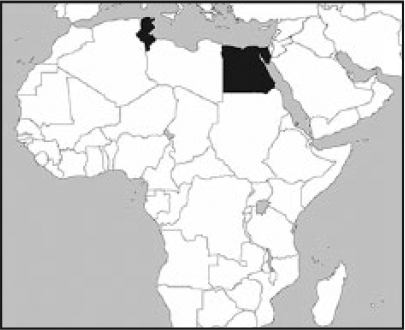
When 26-year-old Tunisian street trader Mohamed Bouazizi set himself alight in December 2010, in protest at humiliation and constant harassment from police and city officials, his death inspired revolution throughout the Arab world. The protests in Avenue Habib Bourguiba and Tahrir Square unseated despotic regimes as protestors challenged political repression and economic exclusion in a universal call for justice, fairness and the rule of law. The global headlines raised concern across the region about the explosive potential of street trade, but little has changed, and in cities of Africa, Asia and the Middle East, policy affecting street traders remains unreformed and punitive for the poor.
As unrest and revolution swept across capitals in the Arab world, street traders found working conditions increasingly precarious. In the early days of revolution, trading sites were over-run in the protests, although enterprising hawkers found a ready market in the demonstrating crowds. In the weeks and months that followed, economic collapse precipitated an influx of the newly unemployed or displaced into street trade and competition became intense, while as the new regimes solidified, tolerant policing gave way to increasingly restrictive street control. Although much is known about the operation of urban informal economies and the niche that street trading occupies, much less is understood about the effect of conflict on trading economies and the individuals concerned and the vulnerabilities and transformations that take place, which this paper explores.
The paper draws on British Academy-funded research in autumn 2012 and spring 2013, when memories of the Arab revolution were still raw. The impact of conflict on urban informal economies is not widely explored, and much needs to be understood about the challenges and responses of informal economy workers during political upheaval and economic shocks. Thus the paper draws on two literatures: discussions on urban conflicts as a backdrop to analysing the events of 2011 in the capital cities of Tunis and Cairo, and debates on social–economic resilience to help understand the responses of street traders. The fieldwork draws on local reports, expert interviews and extended semi-structured interviews with traders in both cities. At the stage of the research, both countries were moving uncertainly towards a democratic outcome, but their paths have since dramatically diverged. The paper argues that, although faced with huge obstacles, street traders were able to make tiny adjustments or more substantial changes to enable them to transcend the street disruptions.
II. Fragile Cities of the Arab Spring
a. Urban conflict as a setting for street trade
Informal employment is widespread in cities of the Arab world. A World Bank report in 2014(1) concludes that, with the exception of large oil producers, a typical country in the Middle East and North Africa (MENA) produces about one-third of its GDP and employs 65 per cent of its labour force informally, depending on its natural resources and size of the public sector. Urban figures are not given, and are notoriously difficult to compile. For example, a study by WIEGO (Women in Informal Employment: Globalizing and Organizing) of 11 cities in 10 countries in Africa, Asia and Latin America(2) piloted a three-stage approach analysing labour force statistics, supplemented by surveys of informal production units and household consumption. It found that total informal (non-agricultural) employment varied between 46.2 per cent and 83.1 per cent, and in all 11 cities more women were employed informally than men.(3)
In MENA cities, as elsewhere, street trade is an increasingly important component of urban informal economies, and a crucial livelihood strategy for the poor and very poor; it provides a key source of new jobs, and supports significant urban-to-rural and international remittances.(4) It is also one of the most visible and contested sectors of the informal economy, with public space as a place of work subject to frequent police crackdowns.(5) Yet, far from the common perception that street trade is a survivalist outlet for local produce or manufacturing, the informality is seen as a response to over-regulation.(6) The re-emergence of street trade is seen as an entirely rational reaction to today’s economic, cultural and social world,(7) with traders now inextricably linked to global systems of exchange.(8)
While much is known about the economy of street trade in different cities, its regulation and relations with the state, and the role of associations in claiming rights, relatively little is understood about its trajectories of change through conflict. This section therefore discusses the literature on urban conflict and fragile cities in order to analyse the Arab revolutions and their urban impacts.
The concept of “fragility” is usually applied to states, and although the term is contested, states are described as “fragile” when governments lack the will or capacity to provide for basic poverty reduction, development and human rights of their populations. The Organisation for Economic Co-operation and Development (OECD)(9) suggests five clusters of fragility indicators: violence; access to justice for all; accountable institutions; economic inclusion and stability; and resilience. Claire McLoughlin(10) suggests that fragile states are often characterized by ongoing violence, insecurity, legacies of conflict, weak governance, and inability to deliver equitable distribution of goods and services.
Recently, the concept of fragility has also been applied to cities, both as a reflection of state fragility, and as the potential loci for reconstruction and recovery. Jo Beall and colleagues(11) argue that violent conflict has become increasingly urban. Drawing on research in 10 cities, they identify three forms of conflict: sovereign conflict involving international actors; civil conflict between organized groups, one or more of which claims to represent the state; and civic conflict, a range of violent situations including gang warfare, terrorism, riots, rebellions and other violent protests, which is ultimately “a reactive expression of grievance by urban populations vis-à-vis the state or other urban actors”.(12) Muggah(13) describes the fragile city as a “discrete metropolitan unit” whose governance is failing “to deliver on the social contract”, but also sees fragile cities as sources of local resistance and agency.
Caroline Moser,(14) in her extensive studies of urban violence, argues that the intersection of unequal access to political and economic resources with poverty precipitates violence. With Cathy McIlwaine(15) she developed a fivefold typology of violence, conceived as an overlapping and interrelated continuum: political – motivated by a desire to gain or maintain political power; institutional – the exercise of institutional power over individuals or groups; economic – pursued for economic gain; economic/social associated with territorial claims, and social – intended to entrench social power. In practice urban dwellers often experience multiple forms of interconnected violence that become endemic and an everyday reality.
Urban protests, such as those witnessed in the capitals of the Arab world, are not new, and the Occupy movement that swept through Europe and the Americas in mid-2011 was partly inspired by the democracy claim of the Arab revolutions. David Harvey(16) suggests that these urban class-based struggles have their roots in anti-capitalist movements. Within weeks of the protests in Tahrir Square, a global protest movement had emerged.(17) Crucial to the Occupy movement were its messy diffusion of global activism, claim to urban space, and use of social media to rally support.(18)
Understandings of the economic impact of violence are still relatively under-developed, but in recovering from crisis, countries often go through periods of rapid economic recovery, although particular locales or sectors of the population may be left behind in the recovery.(19) Studies of Kosovo have shown how in contexts of violence, intrinsic inequalities and power relations constitute and reproduce informal economic practices.(20) The failure of governance, particularly the local state, also appears to be a key factor that heightens fragility.(21) A striking finding is the sheer range and diversity of activities observed in the face of violence and disruption. Research finds that violence can also result in “positive” outcomes, such as increased politicization or social cohesion,(22) although the role of the informal economy in conflict settings is not explored.
Thus critical factors in assessing the nature and drivers of urban violence and conflict, and its economic outcomes, appear to be the scale of exclusion and character of groups excluded, the role of power held by urban elites, the agency and reach of the state, failures of local governance, and the extent to which protests are organized by opposing factions or more spontaneous expressions of discontent. While the Arab revolutions occurred in a context of fragility characterized by social and economic marginalization and repressed human rights, they also reflected the democratic and anti-capitalist claims of the young witnessed in the Occupy movement.
b. Arab Spring or Arab revolution?
Despite similarities in the timing and initial events of the Arab revolutions in Tunisia and Egypt, the underlying structural factors and dynamics of the revolutions were very different.
Tunisia was an unlikely seat of ferment, with a good educational system, strong middle class, and strong labour movement. Yet free expression and political parties were tightly restricted in favour of representing the country as an attractive tourist destination, and the president’s family dominated many commercial sectors.(23) The uprisings in late 2010 spread from neglected rural areas to the capital, finding common cause with the repressed labour movement. While the spark that lit the protest was outrage at the death of Mohammed Bouazizi on 4 January 2011, underlying grievances over repression, corruption, economic hardship and lack of political freedoms were key. President Ben Ali’s televised visit to Bouazizi’s bedside did not save him, and he fled to exile on 14 January 2011 after nearly 25 years in power.(24)
Yet Tunisia’s political transition has been one of the most stable in the region. Although the protests revealed a divide amongst the opposition between union activists who led dissent in the 1980s and the radical youth, a process of conciliation emerged.(25) Around 100 new political parties were registered, and a coalition with the Islamist Ennahdha as the largest party won 63 per cent of the seats in the National Constituent Assembly in December 2011. Despite unrest throughout 2013, the new constitution was adopted in January 2014, effectively marking the end of the political crisis.
Outrage was also a driving factor in Egypt – at the murder of blogger and human rights activist Khaled Said in June 2010.(26) Widespread unemployment and poverty alienated millions of Egyptians, and military control of large sections of the economy remained powerful. Kickbacks and corruption in public service were endemic, while the national police were disliked for their “brutal crackdowns”.(27) Unlike Tunisia, in Egypt a young educated elite organized the uprisings, but the protestors’ tactical and digital sophistication was bolstered by the relatively free press.(28) In a copycat protest, anti-government demonstrations broke out on 25 January 2011, focused on the occupation of Tahrir Square. Elections in January 2012 brought the Freedom and Justice Party, affiliated to Egypt’s Muslim Brotherhood, to power. Their candidate President Morsi was elected in June 2012, but was eventually deposed in July 2013 by the army, which largely reinstated the authoritarian state.
In Egypt, the historically powerful military has dictated the course of events, and its extensive business interests provided a strong interest in maintaining the status quo.(29) Thus while the president was deposed, real power still lay with the “deep state” and old institutions.(30) Eva Bellin(31) argues that in the Middle East, four factors – state wealth from oil and gas industries; international support; patrimonially organized security services; and limited social mobilization – meant that authoritarianism was entrenched. This was supported by a coercive apparatus endowed with extraordinary capacity to repress, a repression acutely experienced by street traders in this study.
In both Tunisia and Egypt, the regimes maintained relative separation from the military and in both countries the army abandoned the president, but in Tunisia the military had no interest in assuming power, which paved the way for negotiations over civilian government.(32) Powerful labour unions have also played a role, including the Union Générale Tunisienne du Travail (UGTT) and Union Tunisienne de l’Industrie, du Commerce et de l’Artisanat (UTICA), although their support for informal economy workers was very limited. However, in Egypt this light-touch approach was reversed with the military takeover in July 2013.
Social media were critical in facilitating protests in Egypt. Several campaigners against police brutality set up a Facebook page, whose moderators became involved as mobilizers for the struggle. Social media also allowed protestors to escape political control. This page first published the call to protest on 25 January 2011. During the protests, as it became clear that the military was not going to intervene, protestors brought their children along and a carnival atmosphere prevailed.(33)
Unlike many sustained political reform movements, the Egyptian and Tunisian revolutions were very rapid – in Tunisia the president was unseated in one month and in Egypt in 18 days. The revolutions thus carried enormous social prestige but left little time for oppositions to build their own institutions, and “thus the incumbent regimes continued more or less intact”.(34) Bayat(35) argues that revolutions that aim to push political and social reforms through existing institutions have the advantage of ensuring orderly transition, but the possibility of genuine transformation will depend on “perpetual mobilization and vigilance of social organizations”.
It is not yet clear whether the events of 2011 were a spring from which a new democracy has emerged, as Tunisia promises, or a revolution that was reversed, as Egypt has found. The protests do not fit neatly into the categories of civic and civil conflicts identified by Beall et al.(36) In both countries, protests started peacefully, but conflict emerged in confrontations between protestors and the state, and petty crime thrived in the vacuum left by authoritative policing. In both Egypt and Tunisia, rebellion against authoritarianism, lack of political freedoms and economic exclusion were the core of the unrest, but the rapidity of events and eventual violent confrontation between security forces and protestors created a cycle of increasing violence. In Egypt in particular, the withdrawal of surveillance let loose an unexpected surge in petty crime and the widespread sexual harassment of women, which inevitably affected street trade.
III. Resilience and the Informal Economies of Tunis and Cairo
a. Community resilience and street trade
Policymakers often categorize street trade by its “flexibility” and “ease of entry”, but this simplification ignores the complex social networks and spatial claims that street traders must negotiate. In the aftermath of conflict, a crucial question is whether street trade and the informal economy provide a nimble means to reconstruct livelihoods and the adaptability to seize employment opportunities in the return to political and economic stability, or deepen insecurity for those affected. This section briefly examines the concept of resilience for both communities and individuals, as a basis for understanding informal economy responses to the political and social unrest of the Arab Spring.
The concept of resilience emerged in the 1960s and 1970s from studies in ecology, described as the capacity to persist within a domain in the face of change,(37) with resilience broadly defined as the capacity of a system to change and adapt and yet remain within critical thresholds. In a seminal paper, Holling(38) suggested that resilience, as a measure of a system’s integrity, was the ability to experience change and disturbance without catastrophic qualitative change in the basic functional organization.
By the late 1990s, it was argued that resilience was a useful way to think about sustainability, both in the conventional application to environmental processes and in relation to wider social and economic processes. This suggested that in the face of catastrophic and irreversible environmental problems, communities need a flexible and adaptive response system, with war and civil unrest as striking examples of qualitative shifts in which small disturbances become magnified to disrupt socioeconomic systems.(39)
More recently community resilience has been considered by Magis(40) as the “existence, development and engagement of community resources by community members to thrive in an environment characterized by change, uncertainty, unpredictability and surprise”. Berkes and Ross(41) argue for an integrated concept of community resilience that includes three components: adaptive capacity, self-organization and agency. However, they identify challenges in the concept, for example distinguishing between general resilience and specified resilience, e.g. to a disaster, such as an earthquake or flood. Recently, the concept has been widely applied in disasters and humanitarian aid literature, and the UK’s Department for International Development (DFID)(42) has suggested that “disaster resilience is the ability of countries, communities and households to manage change, by maintaining or transforming living standards in the face of shocks or stresses - such as earthquakes, drought or violent conflict - without compromising their long-term prospects”.
Critics of applying resilience to community development suggest that the concept of a return to equilibrium denies the possibility of moving away from an undesirable norm, arguing that the resilience paradigm has moved beyond its original concept, especially where returning to “normal” means returning to poverty, vulnerability and exclusion.(43) The resilience agenda thus disguises structural problems of power in socio-ecological systems, conflicts of interest and unequal distribution, to which the response is dismantling the capitalist market system.(44)
Thus, applying resilience thinking to the social–economic system of street trade implies the concept of a return to stable livelihoods after shocks or disasters, but with a recognition of evolution to a more secure equilibrium. This depends on knowledge systems, leadership and social networks that shape adaptation to the post-disaster reality, in parallel with responsive institutions that can embrace opportunities for change. Resilience thinking implies that for street traders, trading communities, individuals and street-level governance must all adapt on the ground.
b. Informal economies in Tunisia and Egypt
To what extent do the profound changes seen in both Tunis and Cairo live up to this expectation of adaptive capacity and resilience? Both Tunisia and Egypt have large informal economies, but macro-level information is patchy and the figures do not generally refer to street trade.
A background paper for the 2001 World Development Report found that in the 1990s the proportion of informal employment as a share of non-agricultural employment was 65 per cent in Egypt, and 39 per cent in Tunisia (weighted average of 1990 and 1995).(45) Tunisia’s government statistics department undertakes regular micro-enterprise studies. Egypt was included in the 2013 International Labour Organization (ILO) study.(46) This estimated that informal employment forms 51 per cent of the country’s non-agricultural employment, employs 8.2 million people, and includes 7.6 million men and 572,000 women (2009 data); it employs 56 per cent of all male non-agricultural workers and 23 per cent of women, as women tend to work in the service sector, which has lower levels of informality. Informal employment is estimated by the ILO to contribute 16.9 per cent of Egypt’s GDP (2008 figures). Unfortunately Tunisia was not included in this dataset.
A 2014 World Bank report analysed informality in the MENA region.(47) Using proxy figures, the report estimated that for Tunisia, informal employment increased from 50.5 per cent in 2005 to 53.5 per cent in 2009, with a pronounced increase amongst men and university graduates, partly due to a centralized and rigid wage-setting process. In Egypt, informal employment was thought to have increased from 49.0 per cent in 1998 to 58.3 per cent in 2006, partly due to contraction of public sector employment.
Several smaller studies of the informal economy have also been undertaken. In late 2012, amongst a fanfare of headlines, Hernando de Soto visited Tunisia and the family of Mohammed Bouazizi, and his consultancy undertook research in the country. The recommendations set out their policy guidelines for formalization.(48) Another study, undertaken through the Tunisian Inclusive Labour Initiative (TILI),(49) interviewed 1,203 workers across six regions, including own-account workers, employers and employees. Some 90 per cent of employers and own-account workers did not have a licence, and for them bureaucracy, corruption, and the cost of taxes were major obstacles to formalization. Unfortunately neither study looked at the impact of the Arab Spring.
According to key informants, in Tunisia the marché parallèle is well-developed, particularly cross-border trade with Libya and Algeria, which encompasses the informal economy but also includes contrebande et voleurs (smuggling and thieves). Smuggling goes both ways – cheap petrol is the main product coming into Tunisia, with subsidized wheat going out. The borders are porous – mafias threaten the authorities, smugglers are often armed so customs officers do not stop the trucks, and tractors bypass customs posts on a route through the dunes. Health insurance is also an issue as there is a huge problem of loss of medicines.
A well-respected researcher and key informant for our research suggested that Tunisia’s informal economy could be described as “illégal, mais toleré” (illegal but tolerated). He identified six main sectors of the informal economy: 1) micro-entreprises sur la rue (on-street trading); 2) commerce ambulant (hawking); 3) marchés hebdomadaires (weekly markets); 4) économie frontalière (border economies); 5) domestiques de la maison (home workers); and 6) service de reparation (repairs – a new category that has arisen since the revolution). Three of these categories represent different aspects of street trade, representing its centrality in Tunisia’s informal economy. He found that although now many traders are illiterate, in 15–20 years’ time there will be a new cadre of highly educated small-scale entrepreneurs.
In Egypt, there has been a long-standing interest in the economics of the informal sector. A large panel survey of micro-enterprises was commissioned in 2003 and 2004 and, according to a key informant, demonstrated that capital investment had increased and traders were becoming more educated, with more women working and businesses becoming more sophisticated. This led to Law No 141/2004, The Micro and Small Establishment Law, and various changes to social security legislation.
In Cairo, the independent Egyptian Centre for Economic Studies (ECES) conducted a small survey just before the revolution, of 90 employers and 180 employees in Manshiet Nasser, a poor district famous for its recycling community.(50) Men formed 94 per cent of employers and 85 per cent of employees. Although 25 per cent of the employers had a university degree, 23 per cent of the employees were illiterate. Employers were discouraged from joining the formal sector because of the complexity of government procedures, the length and cost of registration, the small size of enterprises, and the need to avoid tax. Most of the employers (84 per cent) were subject to government surveillance, with 80 per cent offering bribes to government inspectors. The Governorate of Giza had also commissioned a study to develop a street trading policy.
These studies do not relate to street trade or look at issues related to resilience. However, it is clear that the informal economy is significant and complex in both Egypt and Tunisia, and that street trade is likely to be both a crucial source of jobs and an important mechanism for facilitating informal sector trade more broadly.
IV. Experiencing the Revolution
Political turmoil was still fomenting in both Tunis and Cairo when the fieldwork took place, so this analysis provides a review of street traders’ experience at a particular moment in a context of rapid change. Nevertheless the findings are revealing.
a. Recovery in Tunis
In Tunis the traders’ survey for this research took place in early 2013 in three main locations: locations around the medina including Rue d’Espagne, Bab Aljazira and Cité Ibn Khaldoun; Marché Sidi Bahri, near the Ali Balhouene bus station; and the low-income suburban area of Cité Ettadhamen and Intilaka, with its large market around the metro station. In Ibn Khaldoun, most of the stalls were selling friperie (second-hand clothes). Interviewees included 103 traders, 88 men and 15 women, of whom seven were trading in Rue d’Espagne. Of the 103 interviewees, 61 were born outside Tunis, but only six had moved to Tunis in the last five years, and only two had moved to Tunis since the revolution, one from Gabès and a second from Sousse. Some 34 per cent of interviewees were aged 19–34 and 35 per cent aged 35–54. Many interviewees were well-educated: 41 per cent had secondary education, five had a diploma and one a university degree, while 13 per cent were illiterate. Some 83 per cent of interviewees were the main income earners in their households.
The impact of the revolution and traders’ resilience in the face of change were explored from various angles, including: whether traders saw more newcomers coming into street trade and how they were received; changes to trade, i.e. goods, suppliers or profits; changes in the role of the authorities; and changes to perceived insecurity and harassment.
Across all survey locations in Tunis, a large proportion (58 per cent) of interviewees had noticed a rapid increase of newcomers since the revolution, mainly young men, and those who did not were trading in places where sites were fixed. Some were hostile, reporting competition if newcomers were selling the same product, “noise and anarchy” in the souk, and a “lack of security in the chaos”. But others were more sympathetic, saying that “we are all poor”, and that traders treated each other with respect.
Many of the traders had made tiny adjustments to help them weather the disruptions to trade during the unrest. Some changed the goods they sold (18 per cent); some 43 per cent had changed suppliers to seek a competitive price or better-quality goods, or avoided locations affected by unrest. Others stopped work for a few days or changed working hours. One person was concerned about the tightening of trading conditions, citing the ruling family’s control over business.
Nevertheless most had suffered a drop in earnings. Only three had seen profit increase – one of whom, selling second-hand goods near Bab Aljazira, noted the increased freedom after the revolution as before he had no right to work or to move freely – while 17 per cent had seen no change. Some 74 per cent had seen income drop, attributed to the fall in citizens’ purchasing power and decline of security in the streets. Several people talked about a fire in the warehouses in Sousse during the revolution, and increased competition due to the increase in traders.
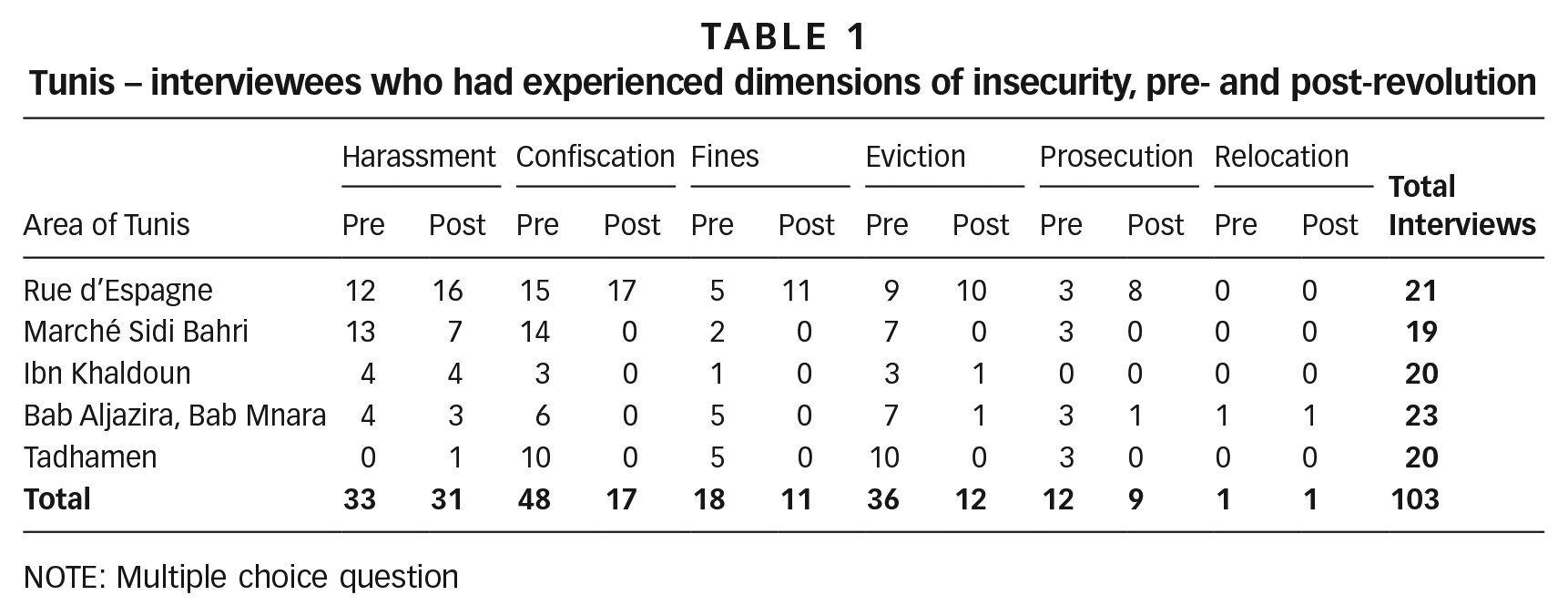
Relations with municipal authorities and police often defined how traders view their security. A number of dimensions of insecurity were explored, including harassment (usually by the authorities), confiscation of goods, fines, evictions, prosecutions and relocation (Table 1). Nearly half (48 per cent) of all interviewees had had goods confiscated before the revolution, which had fallen to 17 per cent in the two post-revolution years. Only in Rue d’Espagne had insecurity increased.
Tunis – interviewees who had experienced dimensions of insecurity, pre- and post-revolution
NOTE: Multiple choice question
Before the revolution a complex system of payments and protection was operating, with police and municipality officers extracting payments and bribes, but also providing some protection from evictions.
“The process was quite straightforward. We paid a small amount to established vendors to negotiate with the authorities without arresting us. They then made the negotiations with the authorities. The security forces protected us against conflicts and violence and traders could keep their place.” (Tunis, Rue d’Espagne, man selling nappies)
After the revolution, trading in Rue d’Espagne had become more difficult, particularly for women, with confiscations of goods and evictions dramatically increasing. Traders reported increased competition for space, resulting in fights, stone-throwing, and more unpredictable policing. One group of traders selling religious goods feared interference from abroad in an anti-Islamic crackdown.
“After the revolution there has been a decline in the role of the municipal police, but an increase of conflict with security forces, and in verbal and physical violence. The difficult economic and social situation and the political chaos has profoundly affected vendors. There are many problems: the absence of a legal framework guaranteeing rights; lack of stability in the work which is marginalized and vulnerable.” (Tunis, Rue d’Espagne, woman selling shoes)
Outside the city centre there was less oversight:
“After the revolution, I have not seen the municipality controllers…Informal trade appears a sort of a solution because the state cannot provide employment to the growing number of unemployed…there are hundreds of families affected by unemployment because many factories have closed, because of the lack of security and increasing labour strikes resulting from demands for increased wages.” (Tunis, Ettadhamen, man recharging phone batteries)
Almost universally, traders said there was no association representing their interests. One trader (selling plastic household goods near Bab Aljazira) had joined an association, but said that it was weak. As key informants reported, the main trade unions had been hostile to street traders, considering them “bandits” as up to 70 per cent of traders had no patente (licence). But after the revolution, UTICA had launched a dialogue with informal economy operators. Nevertheless, traders work in regional networks, with many originating from the interior – the North West (Beja, Le Kef, Jendouba, Siliana) and Mid-West (Kasserine, Sidi Bouzid, Kairouan). Various clans are particularly important, including the Arch/Awled Ayar from Makthar, and Jelma from Sidi Bouzid. This pattern of association suggests that social capital amongst traders in Tunis relies on traditional bonds and is not well-adapted to fluid urban settings.
b. Survival in Cairo
In Cairo interviews were undertaken during the early months of the Morsi administration, in areas where street trading was contested, including: the city centre around Tahrir Square; the metro terminal at Helwan; Ramses and the Abd El Moniem Riyad bus station – a site of several demonstrations; the low-income area of Embaba; and the area around the El Demerdesh metro station and hospital and Ain Shams University hostels. The 103 interviewees included 93 men and 10 women – the latter were selling foodstuff, mostly fresh food in Embaba, and one had been forced into vending by widowhood. About a quarter of the sample had moved from outside Cairo, but often some time ago, and only three had come to Cairo since the 2011 uprising. Our key informants had mentioned three groups of vendors: people selling on commission from shops; unemployed graduates, and those from the countryside often selling Chinese products, but in practice the spectrum was wider.
Most traders were young (53 per cent were aged 19–34), significantly younger than in Tunis. Education levels varied, but 27 per cent of interviewees had more than 14 years’ of education; of these four had university degrees and two had master’s degrees − in international law and commerce. Illiteracy was higher than in Tunis; 38 per cent of interviewees (mainly working in Helwan and Embaba) could neither read nor write and mostly originated from Upper Egypt. Some 80 per cent of respondents were the main income earners in their households.
The two main factors that led people to start trading were economic conditions and unemployment, but there are many obstacles to setting up in trade. Before the revolution, the main risk was that municipal enforcers (shurta) would confiscate their goods, but some people argued that at least the municipality was present and collected fees, organized space and prohibited uncontrolled vending.
As in Tunis, people in Cairo had made small adjustments to their trade since the revolution, by changing goods, suppliers, location or timing, although some people had long-term relationships with suppliers – for one person up to 35 years. Several people bought from the Albour wholesale market, where suppliers allow known traders to take goods on credit. One trader with a diploma had sold his shop in Shoubra during the revolution to cover this debt and was then selling tea and sandwiches around Tahrir Square. Some traders sold seasonal goods, e.g. dates, mango or cabbage. Some had come into the trade from construction, and one worked as a car mechanic during the slack trading time. A few changed suppliers, looking for a better price. As one person said, “Before the revolution there was a lot of selling, but after the revolution there have been a lot of robberies, the goods are now scarce and are sold on the black market”. (Cairo, Helwan, man selling cigarettes)
In Cairo, more interviewees reported an influx of newcomers than in Tunis. Some 68 per cent had seen an increase in the numbers of traders, although 23 per cent had seen no increase, usually because they were in established locations.
“I am one of them [a newcomer], I am gaining my subsistence by working hard, neither stealing nor begging.” [Cairo, Embaba, man selling school bags]
Newcomers often had to ask permission to trade from nearby shops or from the “controller” of the area. Other traders were wary but recognized people’s needs.
Amongst interviewees, 10 per cent of respondents said they had increased their profit since the revolution, as the municipality shurta no longer came round, competition had reduced as some traders had fled, and employees were returning earlier from work. 52 per cent had lost earnings, as prices had increased, competition from new vendors had intensified, customers had no money, or they had experienced theft or loss of a salaried job.
“After the revolution we cannot feed ourselves and families, until now people are still suffering.” (Cairo, Embaba, man selling school bags)
While the regional trading links found in Tunisia did not seem to be as widespread in Cairo, Helwan had seen dramatic changes as lack of policing allowed the metro station forecourt and a local park to be invaded. For many years, Helwan has attracted traders from Upper Egypt. The Baderi from Asyut came to Helwan over 40 years ago, and a few traders were from Fayum, Beni Suwaif or Suhaiq. By far the largest group was from a village in Asyut called Bahiq, in Wadi Gadid. The Bahiqis work under a “boss” or “leader”; they have strong kinship networks, and a tradition of carrying knives as weapons, although these are rarely used except during an argument. From Bedu and Arab stock, Bahiqi culture lays traditional claim over land rights in a large part of the Western Desert, and they see themselves as inheriting Pharaonic traditions. Although realizing they have no formal rights in Helwan, they claim authority over their trading land – called “laying on hands”. Migrants often become “bosses” because as someone becomes established he brings relatives to join him, or a group comes together as a gang. Bahiqis did not figure in the survey as they were reluctant to be interviewed individually.
Before the revolution, policing was heavy-handed, with a complex system of payments and protection in operation. Police and municipality officers usually extracted payments and bribes, but occasionally provided protection and warned of evictions.
“We suffered from everything you could imagine: the municipality would take our goods and you can’t get them back; then the municipality comes for evictions; if we don’t pay them they call us and tell us the wrong day and date when the evictions are happening.” (Cairo, near El Demerdesh Metro Station, man selling mirrors, shoe polish, plastic goods and razors)
The impact of the 2011 events on street traders varied. Some managed with limited disruption, e.g. by stopping work for three–four days, or working shorter hours, but others faced significant upheaval being out of work for two to six months, or losing salaried jobs. Only one said he went to Tahrir Square to demonstrate, and a few profited from the influx of protesters.
“Of course it’s affected us – with people’s treatment of us, there are lots of problems now, and without the government’s commitment there is a lack of security because of an absence of values and ethics. But I can’t deny that the trade has become better because we are now settled in one place because the municipality no longer comes around.” (Cairo, Helwan, man selling women’s clothes hung on a wall) “I worked as a computer teacher with EGP105 [approx. US$ 12 as of July 2011] per month and moved to a construction company with a salary EGP300 [approx. US$ 34] per month, until it was closed three months after the 2011 events.” (Cairo, Ghamra Metro Station, man selling children’s books and wall charts)
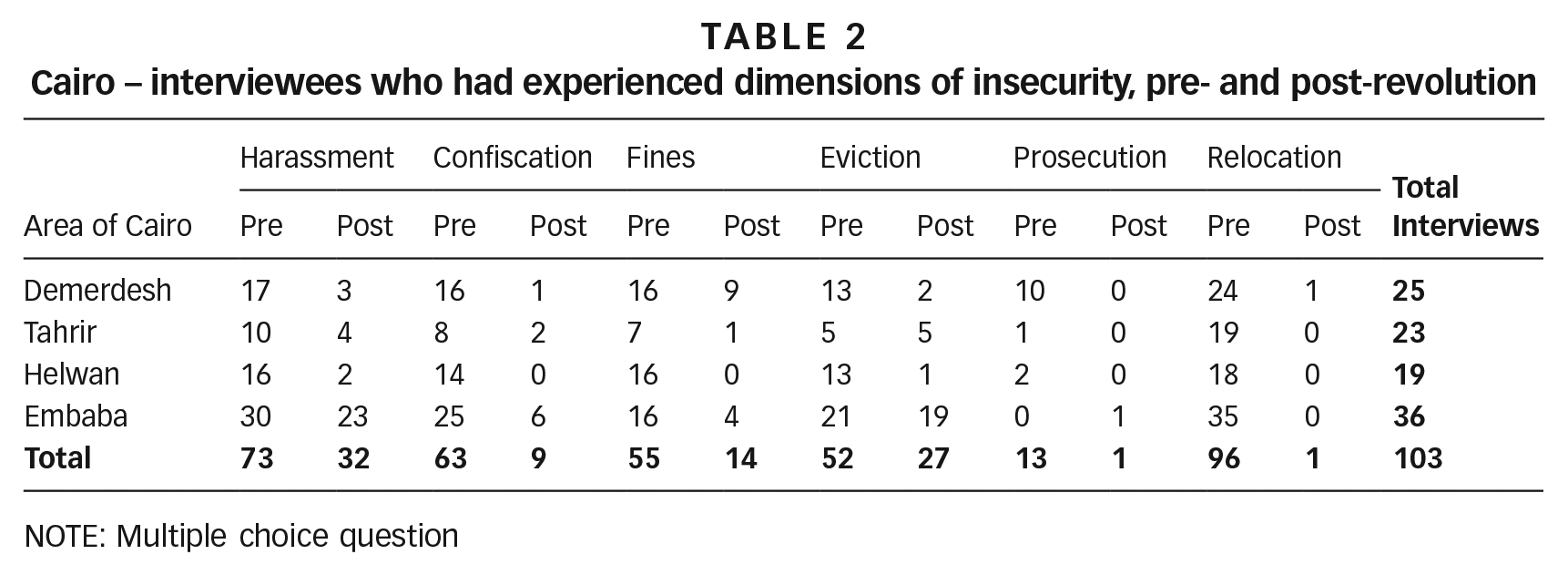
However, it was in Cairo that the effects of the revolution were most dramatic. Before the revolution, between half and two-thirds of interviewees reported being harassed, having goods confiscated, being evicted or being relocated, with the highest levels of insecurity in Helwan and Embaba (Table 2). Surprisingly, in the city centre around Tahrir Square slightly lower levels of insecurity were experienced. After the revolution, despite the riots, there were dramatic falls in the dimensions of insecurity across all sites, particularly in Demerdesh and Helwan, although insecurity in Embaba remained fairly high.
Cairo – interviewees who had experienced dimensions of insecurity, pre- and post-revolution
NOTE: Multiple choice question
The drop in harassment is particularly clear in Helwan, as shown in Table 2, and in this comment from a cigarette seller.
“Before 2011, every day they would come around sunset and the evening to take money from the vendors as a bribe to allow them to stay in their place. I was jailed for two months because of the curfew, I was accused of being a thug. On one of the revolution days the military police arrested me…and framed me on several charges: that I was carrying a weapon and an axe and lots of other things and I didn’t have any of these things. After the revolution they’ve stopped coming…They only care about the bribes they get out of us.” (Cairo, Helwan Metro Station, man selling cigarettes and lighters)
The Cairenians did not have a strong support network, and key informants confirm that there are few associations representing vendors. Amongst interviewees, only four people said they were members of associations. As one fish seller said, “There is no such thing – no one cares about us, or even seems to know about us”, and a vegetable seller: “No, there is none, there is a mosque that cares for us, they usually give us Ramadan bags and we are happy with so much”. Disputes were usually arbitrated by more senior traders or a recognized market leader. One person mentioned a traders’ syndicate on Shawarby Street, and said that it collected money but did nothing.
V. Uncertainties of Conflict
The Arab revolutions do not fit neatly into categorizations of violence. The rapid progression of events – the emergence of protests capitulating presidential downfall – was followed by a vacuum in which governance structures took a long time to emerge. Using the classification by Beall et al.,(51) the protests were neither an organized struggle of civil conflict, nor civic problems of gang warfare, but rather a spontaneous upwelling of economic and political grievances. Under Moser and McIlwaine’s(52) fivefold continuum of violence, protestors were not seeking political power, institutional control, economic gain, social dominance, or territorial claims but rather a move to a new, more democratic and globally aligned, politics. While in both countries a common factor was the claim for more democratic rights, in Tunis the revolution stemmed partly from rural deprivation, whereas in Cairo it was predominantly an urban movement. However, in both countries, long-standing authoritarianism was deep-seated, and the relaxation of social norms led to a rise in casual or “civic” crime and widespread sexual harassment.
The case studies covered a particular moment in the countries’ political transitions, but suggest that three core factors underpin community resilience during the revolutions for the traders of Tunis and Cairo. First is the flexibility of street traders to make small, incremental changes to their trading patterns, changing what and where they sell and the times at which they trade, or to make the larger-scale adjustment of moving into trade when other employment fails.
Second is the role of social networks. In Tunis, as revolution spread from the countryside to city, it seems likely that the regional and clan-based trading networks facilitated the spread of unrest, but also sustained trading links. Knowledge of their goods, the locality and the system of pay-offs enabled them to survive. However, the lack of a city-based support network and the ambivalent role of the labour unions towards traders meant that they had limited protection in the height of the protests.
In Cairo, the importance of regional trading links was also evident from the Bahiqis in Helwan and other Asyut clans, but this seems to have been a specific example not replicated in other areas of Cairo surveyed, and those from elsewhere in the city had less associational support. In many locations, trading spaces appeared to be under the remit of a “controller”, often a migrant from the interior who had been in Cairo for many years and claimed authority over space. Unlike in Tunisia, the revolution was initially led by young middle-class and computer-savvy activists, with whom traders had limited connections. In both countries, the lack of local trading associations is striking and exceptional, as many studies have documented the rich associational traditions of street traders in west and southern Africa, Latin America, India and Europe. Thus the knowledge systems from which innovation could stem – a crucial element of resilience – were limited.
Third is the role of the police and enforcement officials. In Tunisia the military stepped back from the revolution, while street-level control appeared to continue at a slightly lower level than before, except in the central area of Rue d’Espagne. In Cairo, however the relaxation of control was dramatic, but short-lived. Policing was relaxed for a short period after the revolution, resulting in a brief respite from predatory officials but a rapid rise in petty theft by “outlaws” and “thugs”, creating new threats for street vendors.
Surprisingly, in neither city did the traders interviewed play much part in the protests – only one trader in Cairo reported joining the demonstrations, and another stopped work to join his neighbourhood watch committee to stop looting. Needing a continued presence in public space, traders perhaps felt they could not risk being labelled as protestors.
The revolutions of the Arab Spring brought many challenges for street traders. While day-to-day evictions decreased, petty theft increased in the absence of strong municipality policing. Apart from those braving the crowds in Tahrir Square or Avenue Habib Bourguiba, many experienced perilous trading conditions after the revolutions, but found different methods to survive. Critical factors were the weak associational structure of street traders, and in Egypt the underlying power of state control. Nevertheless, traders’ knowledge of the local context and the complex trade networks gave them flexibility to create the conditions for resilience in the face of uncertainty.
In both countries, economists and academics had a very sound understanding of the informal economy, which had informed government policy, particularly in Tunisia, where the relaxing of a hostile attitude by UTICA holds the seeds of inclusion for street traders. However, the tradition of punitive policing and bribery is deeply embedded, and the endemic nature of the marché parallèle in both Tunis and Cairo creates fundamental problems of improved governance. Only radical local government reform and policy recognition of the economic role of street trading, coupled with strengthening of trader associations, are likely to counter this bias.
Footnotes
1.

2.
Niamey (Niger), Ouagadougou (Burkina Faso), Bamako (Mali), Dakar (Senegal), Abidjan (Côte d’Ivoire), Lomé (Togo), Cotonou (Benin), Antananarivo (Madagascar), Lima (Peru), Hanoi (Vietnam), Ho Chi Minh City (Vietnam).
3.
Herrera, J, M Kuépié, C J Nordman, X Oudin, X and F Roubaud (2012), “Informal Sector and Informal Employment: Overview of Data for 11 Cities in 10 Developing Countries”, WIEGO Working Paper (Statistics) No 9.
4.
Brown, A et al. (2010), “Street Traders and the Emerging Spaces for Urban Voice and Citizenship in African Cities”, Urban Studies Vol 47, No 3, pages 666–683.
5.
Brown, A (editor) (2006), Contested Space: Street Trading, Public Space and Livelihoods in Developing Cities, ITDG Publishing, Rugby.
6.
De Soto, H (1989), The Other Path, Harper and Row, New York.
7.
Cross, J and A Morales (editors) (2007), Street Entrepreneurs: People, place and politics in local and global perspectives, Routledge, Abingdon.
8.
Lyons, M and A Brown (2010), “Has mercantilism reduced urban poverty in SSA? Boom and bust in the markets of Lomé and Bamako”, World Development Vol 38, No 5, pages 771–782.
10.
McLoughlin, C (2012) Topic Guide on Fragile States, Governance and Social Development Resource Centre, University of Birmingham.
11.
Beall, J, T Goodfellow and D Rogers (2011), “Cities, conflict and state fragility”, Working Paper No 85, Crisis States Research Centre, Development Studies Institute, London School of Economics and Political Science.
12.
See reference 11, page 2.
13.
Muggah, R (2014), “Deconstructing the fragile city: exploring insecurity, violence and resilience”, Environment and Urbanization Vol 26, No 2, pages 345–358, page 345.
14.
Moser, C (2004), “Urban violence and insecurity: a roadmap”, Environment and Urbanization Vol 16, No 2, pages 3–16.
15.
Moser, C and C McIlwaine (2006), “Latin American urban violence as a development concern: towards a framework for violence reduction”, World Development Vol 34, No 1, pages 89–112, page 92.
16.
Harvey, D (2012), Rebel Cities: From the Right to the City to the Urban Revolution, Verso, London and New York, pages 116–118.
17.
Kerton, S (2012), “Tahrir, Here? The Influence of the Arab Uprisings on the Emergence of Occupy”, Social Movement Studies Vol 11, Nos 3–4, pages 302–308.
18.
Pickerill, J and J Krinsky (2012), “Why Does Occupy Matter?”, Social Movement Studies Vol 11, Nos 3–4, pages 279–287.
19.
Mallet, R and R Slater (2012), “Growth and livelihoods in fragile and conflict-affected situations”, Working Paper 9, Secure Livelihoods Research Consortium, Overseas Development Institute.
20.
Danielsson, A (2015), “Informality and Peacebuilding: Field Notes on the Intrinsic Reproductive Principles of Informal Economic Practices in Post-Conflict Kosovo”, International Peacekeeping Vol 23, No 1, pages 1–28.
21.
Jackson, P and Z Scott (2007), “Local Government in Post-Conflict Environments”, Paper prepared for “Workshop on Local Government in Post-Conflict Situations: Challenges for Improving Local Decision Making and Service Delivery Capacities”, Oslo, 28–29 November, United Nations Development Programme, Oslo Governance Centre, Democratic Governance Group; also Ahmed, S (2016), “Informal land controls, Karachi, Pakistan”, unpublished PhD thesis, Cardiff University.
22.
Bellows, J and E Miguel (2009), “War and collective action in Sierra Leone”, Journal of Public Economics Vol 93, Nos 11–12, pages 1144–1157.
23.
Anderson, L (2011), “Demystifying the Arab Spring: parsing the differences between Tunisia, Egypt and Libya”, Foreign Affairs Vol 90, No 3, pages 2–7.
24.
Bellin, E (2012), “Reconsidering the robustness of authoritarianism in the Middle East: lessons from the Arab spring”, Comparative Politics Vol 44, No 2, pages 127–149.
25.
See reference 23, page 5.
26.
See reference 24.
27.
See reference 23.
28.
See references 17 and 23.
29.
Allagui, I and J Kuebler (2011), “The Arab Spring and the Role of ICTs”, International Journal of Communications Vol 5, pages 1435–1442.
30.
Darwisheh, H (2014), “Trajectories and outcomes of the ‘Arab Spring’: comparing Tunisia, Egypt, Libya and Syria”, IDE Discussion Paper No 456, Institute of Developing Economies-Japan External Trade Organization.
31.
See reference 24.
32.
See reference 30.
33.
See references 29 and 30.
34.
Bayat, A (2013), “Revolution in bad times”, New Left Review Vol 80, pages 47–60, page 51.
35.
See reference 34, page 53.
36.
See reference 11.
37.
Folke, C (2006), “Resilience: the emergence of a perspective for social-ecological systems analyses”, Global Environmental Change Vol 16, No 3, pages 253–267.
38.
Holling, C S (1973), “Resilience and stability of ecological systems”, Annual Review of Ecological Ecology and Systematics Vol 4, pages 1–23.
39.
Levin, S A, S Barrett, S Aniyar, W Baumol, C Bliss, B Bolin, P Dasgupta, P Ehrlich, C Folke, I-M Gren, C S Holling, A Jansson, B-O Jansson, K-G Maler, D Martin, C Perrings and E Sheshinksi (1998), “Resilience in natural and socioeconomic systems”, Environment and Development Economics Vol 3, No 2, pages 221–262.
40.
Magis, K (2010), “Community resilience: an indicator of social sustainability”, Society & Natural Resources Vol 23, No 5, pages 401–416, page 401.
41.
Berkes, F and H Ross (2013), “Community resilience: toward an integrated approach”, Society & Natural Resources Vol 26, No 1, pages 5–20.
43.
Kelman, I, J Galliard and J Mercer (2015), “Climate change’s role in disaster risk reduction’s future: beyond vulnerability and resilience”, International Journal of Disaster Risk Science Vol 6, No 1, pages 21–27.
44.
Hornborg, A (2009), “Zero-sum world: challenges in conceptualizing environmental load displacement and ecologically unequal exchange in the world-system”, International Journal of Comparative Sociology Vol 50, Nos 3–4, pages 237–262.
45.
Charmes, J (2000), “Informal sector, poverty and gender: A review of empirical evidence”, Background paper for the World Development Report 2001, page 8.
46.
47.
For the statistics in this paragraph see reference 1, pages 87 and 110.
48.
De Soto, H (2012), L’économie informelle: comment y remédier? Une opportunité pour la Tunisie [The informal economy: how to remedy it? An opportunity for Tunisia], UTICA and Instituto Libertad y Democracia, Tunis.
49.
TILI was a partnership of the Tunisian Association for Management and Social Stability (TAMSS), Global Fairness Initiative (GFI), and Partners for Democratic Change, in collaboration with the Tunisian Ministry of Vocational Training and Employment. GFI, ISTIS and TAMSS (2013), Survey of informal workers in Tunisia, Study report.
50.
El-Fattah, M (2012), “A survey-based exploration of satisfaction and profitability in Egypt’s Informal Sector”, Working Paper No 169, Egyptian Centre for Economic Studies, Cairo.
51.
See reference 11.
52.
See reference 15.