




Abstract
This paper explores the impact of local government policies and urban plans on home-based workers. It presents recent national data on the size and composition of home-based work in developing countries as well as findings from two recent field studies of urban home-based workers in several Asian cities/countries. The research findings highlight that homes often double as workplaces, especially for women workers, and that slums are domains of significant economic activities. Reflecting these twin facts, as well as the demands of home-based workers, the paper makes the case that city governments and urban planners need to integrate home-based workers and their livelihood activities into local economic development plans. It also argues that city governments need to extend basic infrastructure to the homes-cum-workplaces of home-based workers, as well as transport services to the settlements where they live and work. The paper provides some promising examples of where and how this has been done, largely in response to effective advocacy by organizations of home-based workers.
Keywords
I. Introduction
Home-based workers produce goods or services for the market from within or around their own homes. In countries both rich and poor, they produce a wide range of low- and high-end goods and services for both domestic and global markets. Some of them are self-employed and some are sub-contracted. They stitch garments, shoes and footballs; weave textiles; roll incense sticks, cigarettes and cigars; thread flower garlands; prepare food items; assemble electronics, automobile parts and pharmaceutical products; and do laundry, hair-cutting, mechanical repair, clerical and professional work. Today, these workers represent a significant share of urban employment in some countries, particularly for women and especially in Asia.
This paper highlights that homes are workplaces, especially for women workers, and that slums(1) are domains of economic activities; and it makes the case that city governments and urban practitioners need to be aware of these twin facts in all their interventions. The paper draws heavily on two recent studies of urban home-based workers in Asia: a 2012 field study in three Asian cities (Ahmedabad, India; Bangkok, Thailand; and Lahore, Pakistan)(2) as part of a wider 10-city study(3) coordinated by the WIEGO network;(4) and a 2011–2012 field study in 18 cities in seven Asian countries (Bangladesh, Cambodia, India, Nepal, Pakistan, the Philippines and Thailand) undertaken by HomeNets South and South East Asia.(5)
II. Size and Composition
There have been improvements in the statistics on home-based workers in recent years, but challenges to counting and classifying them remain. Most notably, in many countries, labour force surveys do not include questions on “place of work”, a key indicator for identifying who is a home-based worker. Also, enumerators are often not trained to recognize and count home-based workers as workers, and home-based workers themselves often do not perceive or report themselves as workers, with the result that they are often listed as doing unpaid domestic work.
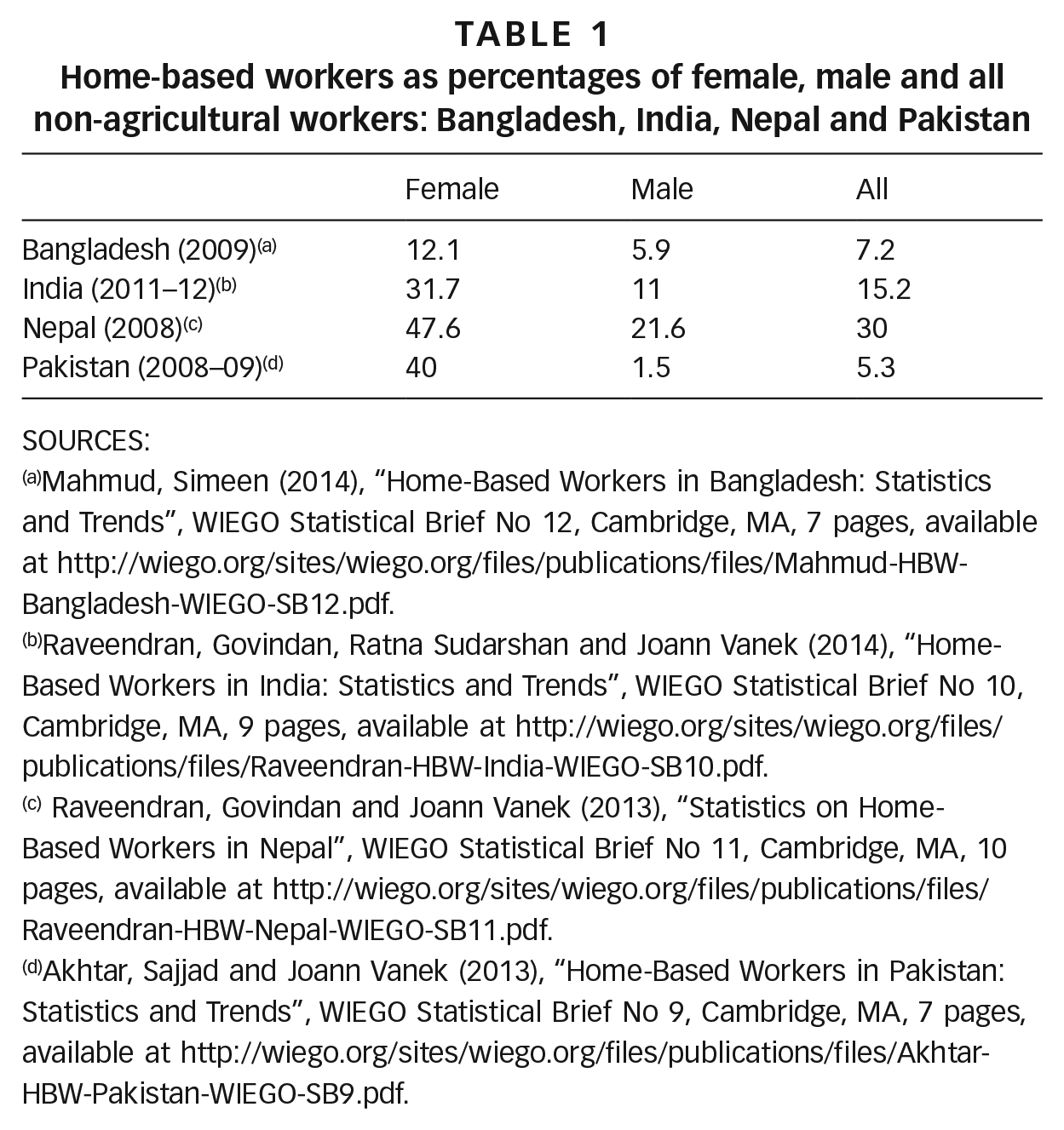
These limitations notwithstanding, available data, compiled by the WIEGO network, suggest that home-based work accounts for a significant share of urban employment in Asia (14 per cent in India) and a not insignificant share of urban employment in Africa (6 per cent in South Africa) and Latin America (3 per cent in Buenos Aires).(6) The available data also confirm that most home-based workers are informally employed (60 per cent in Buenos Aires, 75 per cent in South Africa), and that the vast majority of home-based workers almost everywhere are women (70 per cent in Brazil, 80 per cent in Ghana).(7) Finally, home-based work comprises a particularly high share of women’s work outside of agriculture, especially in Asian countries: see Table 1 for recent data from four South Asian countries.
Home-based workers as percentages of female, male and all non-agricultural workers: Bangladesh, India, Nepal and Pakistan
SOURCES:
Mahmud, Simeen (2014), “Home-Based Workers in Bangladesh: Statistics and Trends”, WIEGO Statistical Brief No 12, Cambridge, MA, 7 pages, available at http://wiego.org/sites/wiego.org/files/publications/files/Mahmud-HBW-Bangladesh-WIEGO-SB12.pdf.
Raveendran, Govindan, Ratna Sudarshan and Joann Vanek (2014), “Home-Based Workers in India: Statistics and Trends”, WIEGO Statistical Brief No 10, Cambridge, MA, 9 pages, available at http://wiego.org/sites/wiego.org/files/publications/files/Raveendran-HBW-India-WIEGO-SB10.pdf.
Raveendran, Govindan and Joann Vanek (2013), “Statistics on Home-Based Workers in Nepal”, WIEGO Statistical Brief No 11, Cambridge, MA, 10 pages, available at http://wiego.org/sites/wiego.org/files/publications/files/Raveendran-HBW-Nepal-WIEGO-SB11.pdf.
Akhtar, Sajjad and Joann Vanek (2013), “Home-Based Workers in Pakistan: Statistics and Trends”, WIEGO Statistical Brief No 9, Cambridge, MA, 7 pages, available at http://wiego.org/sites/wiego.org/files/publications/files/Akhtar-HBW-Pakistan-WIEGO-SB9.pdf.
There are two categories of home-based workers: self-employed and sub-contracted. The self-employed buy their own raw materials and supplies and sell their own finished goods, mainly to local customers and buyers. The sub-contracted workers (called homeworkers) produce goods for firms up the value chain, both national and global value chains. They typically do not know the backward or forward links of the chain they are engaged in beyond the firm or its contractor that directly outsources work to them; this is because they do not buy their own raw materials or sell their own finished goods. But like the self-employed, the sub-contracted have to cover many of the non-wage costs of production (workplace, equipment, utilities, transport) and absorb many of the risks of production (delayed or cancelled orders, unreliable supply of raw materials, delayed payments, rejected goods). It is important to distinguish between these two groups for organizing, advocacy and policy purposes.
III. Needs and Constraints
Like other informal workers, most home-based workers do not enjoy adequate economic opportunities, legal rights, social protection or representative voice – referred to by the ILO as the four pillars of decent work.(8) But home-based workers face additional challenges. Working from in or around their own homes, home-based workers, their activities, and their contribution to the economy remain largely invisible and undervalued. This is particularly true for women, who represent the majority of home-based workers. Their economic activities are often dismissed as an extension of their domestic work, rather than being recognized as production for the market that contributes to the economy.
Because they remain invisible and undervalued, home-based workers tend to be overlooked by policymakers when they design policies, regulations or services. The result is that most sub-contracted home-based workers are not covered under labour or employment law; most self-employed home-based workers are not covered by commercial law regulating contracts and transactions; and the homes-cum-workplaces of home-based workers often lack basic infrastructure services. Further, policymakers do not understand how wider economic trends impact home-based workers: how inflation increases the price of their inputs; how recession or imports reduce demand for their goods; how competition increases during economic downturns or when factory workers lose their jobs; and how mechanization displaces home-based production.(9)
Home-based workers tend to remain isolated from other workers in their sector (apart from those in their neighbourhood) and to have limited knowledge of markets and market prices (especially if they are sub-contracted) because they work from their own homes. As a result they are less likely than other groups of informal workers to be organized, although this is beginning to change (see Section V). Remaining isolated and unorganized limits their ability as individual workers to bargain in the market for more favourable prices and piece rates or to negotiate with government for basic infrastructure and transport services. It also means that they are often inserted into markets or value chains on unfair terms, including irregular purchase/work orders, irregular supply of raw materials, and delayed payments.
It is perhaps not surprising, therefore, that the average earnings of home-based workers are not only low but also erratic due to seasonal rhythms, value chain dynamics, and wider economic trends. The three-city study found that the average earnings of all home-based workers are quite low, with sub-contracted workers earning less on average than self-employed workers. While equal percentages of sub-contracted and self-employed workers were in the poorest earning quintile of their city, a far higher percentage of the self-employed were in the richest earning quintile.(10) In comparing net earnings, it is important to highlight that the sub-contracted homeworkers, like the self-employed, have to pay for many of the non-wage costs of production, notably the workplace, equipment, utilities and transport.
Despite their isolation, home-based workers have begun to recognize their contributions, to organize and to articulate demands. In the study of home-based work in three Asian cities, home-based workers characterized their contributions as follows:
“They contribute to the household budget but also, by working from home, to the care of children and the elderly, to the quality of family life, and to the social fabric of their communities. They provide goods and services at a low cost to low-income people and the general public. They also produce goods at low prices for domestic and global value chains. They do not commute every day and often go to markets on foot or by bicycle, thus, helping to reduce air pollution and traffic congestion. They create demand by buying supplies, raw materials, and equipment and paying for transport and other services (such as washing, ironing and packaging of garments they produce). They pay taxes on the raw materials, supplies, and equipment they purchase; and the firms up the chain who sell their finished goods often charge sales taxes.”(11)
IV. Urban Policies, City Practices and Home-Based Workers
Because their home is their workplace, home-based workers are more directly affected than other workers by government policies and practices regarding housing (notably, slum upgrading and/or slum eviction–relocation schemes), basic infrastructure services (notably, the availability and cost of electricity but also water and sanitation), and zoning regulations (notably, whether commercial activities are allowed in residential areas). Like other groups of workers, although not always on a daily basis, home-based workers are also affected by the accessibility and cost of public transport, especially if they are forced to relocate at great distances from their customers, markets or contractors.
a. Housing
Size and quality
For home-based workers, whose home is also their workplace, housing is an essential productive asset. A small house hampers productivity, as a home-based worker cannot take bulk work orders because she cannot store raw materials, and she cannot work continuously as there are competing needs for the same space of other household members and activities. Also, due to the poor quality of housing, equipment, raw materials and finished goods often get damaged. As a focus group of garment makers in Ahmedabad, India put it, “We take less work so that we have space to store the material in our house… In case we get work in large amounts and if the material gets damaged, we don’t get paid for that work, the trader even deducts cost of that material from our wage” (Ahmedabad Focus Group 1). In South and South East Asia, monsoon rains force many home-based workers to suspend or reduce production when their roofs leak or their homes flood and when the humidity rises. For example, many products – from incense sticks to screen-printed textiles to processed foods – cannot dry due to leaks and humidity. It is also more difficult to store and transport raw materials and finished goods during the rains.(12)
Further, occupational health and safety is a critical issue for home-based workers, including: ergonomic risks relating to poor posture from sitting on the floor or at low tables (incense stick and cigarette rollers), repetitive motion (incense stick and cigarette rollers), and long work hours with limited rest time; as well as exposure risks to toxic substances (incense stick rollers, shoe makers, metal workers).(13) These risks are compounded when the home-cum-workplace does not have shelter, water, sanitation, lighting or ventilation.(14) A comparative study of factory-based workers and outworkers in the Australian clothing industry found that the level of self-reported injury was over three times higher among outworkers than among factory-based workers undertaking similar tasks.(15)
The seven-country study reported occupational health and safety hazards as a major concern for the home-based workers. In Bangladesh, nearly all respondents reported respiratory and other chronic or acute health problems. In Thailand, many home-based workers, especially older workers, reported eye strain, sore eyes and blurred vision. Their workplaces have poor lighting and, particularly in the inner city areas, are often congested, hot and stuffy. Exposure to dust and other irritants, such as the pungent fumes of kerosene, results in allergies and respiratory diseases. Those engaged in food processing suffer from skin rashes caused by splashes of hot oil while cooking. In Kanpur, India, those working with leather in severely polluted work conditions have to deal with extremely pungent smells. In Nepal, home-based workers are forced to work in candlelight due to frequent power cuts: the dim light affects the eyes and the smoke from the candles irritates the nose and throat.(16) The focus groups in the three-city study identified four main types of outcomes from occupational health and safety hazards: body aches and pains; blisters, cuts and burns; eye irritation and strain; and respiratory problems. The main causes of these problems are the lack of proper seating/work tables, lack of adequate ventilation, and toxic substances used in production.(17)
Tenure
High rent and the lack of affordable housing is a major concern. The three-city survey found that 40 per cent of the home-based workers in Ahmedabad live in rented houses; and 9 per cent of the home-based workers in Lahore reported that rents are high. Members of a focus group in Lahore also commented on the behaviour of landlords: “We have to keep moving to new places and this wastes time and our work is affected as we don’t know where to get orders… We can’t find work easily in the new place. They seize half of our stuff to make up for the rent.” (Lahore Focus Group 10). A focus group of incense stick rollers in Ahmedabad reported: “Our landlord doesn’t permit us to do work at the house we have rented from him, arguing that it may damage his house” (Lahore Focus Group 10).
Location and relocation
Where they live is also of concern to many of the home-based workers: many live in congested, under-serviced or low-lying areas and/or in areas far from their customers, contractors and markets. In Bangkok, some were relocated to housing projects in areas on the periphery of the city that were submerged or cut off during the severe flooding in late 2011 and early 2012. Some of the home-based workers are concerned that their residential area will be flooded again. A group of waste plastic recyclers have heard rumours that the area where they live will, in the future, be used as a floodplain to control flooding elsewhere. Also, in both Ahmedabad and Lahore, some of the home-based workers live in low-lying areas prone to flooding, especially during the monsoon season.
Relocations result in loss of work, which in turn results in lower incomes, inability to pay electrical bills, the need to cut expenditures and withdraw children from school, and increased tension within families. In the three-city study, some of the focus groups spoke about the impact of relocation on their work and lives. In Ahmedabad, two focus groups ranked this as a priority issue. One group had been relocated from a slum colony on the banks of the Sabarmati River to make way for a river-front development project. The other focus group stated: “It is true that AMC [Ahmedabad Municipal Corporation] has given us solid [pucca] houses, but what is the use when there is no work to do?…The AMC has forcefully demolished our hutments, and has pushed us to the city’s periphery. Commuting is difficult, work has decreased as there are no work contractors near the rehabilitation site” (Ahmedabad Focus Group 5).(18) To cope, the women have sought alternative employment; have bought household necessities on credit; have taken loans from each other and from moneylenders; or have started using public, rather than private, health and education services, which are often of poor quality.(19)
In Bangkok, where many slum relocations took place in the 1980s and early 1990s, many of the focus groups discussed the struggle to get basic infrastructure services, road connections, public transport services, and social services where they now live. A group of home-based workers that prepares chili paste for a living described being relocated by the National Housing Authority (NHA) to an area prone to flooding with no public transport. As one of the group members commented: “At the beginning, we were living like beggars” (Bangkok Focus Group 10). Eventually, the NHA provided housing loans to the community and promised to build a new road and provide public transportation. In brief, it took a decade or so for those who were evicted and relocated to secure their housing, stabilize their livelihoods, and obtain basic infrastructure and transport services. Most reported that they have fewer employment opportunities and earn less than before they relocated, but they enjoy better housing and more open residential areas.(20)
b. Basic infrastructure services
One-third of the survey respondents in the three-city study reported lack of basic infrastructure services as a problem. Of particular concern, also raised by all focus groups in Lahore and several in Ahmedabad, is the irregular supply and high cost of electricity. Pakistan is suffering from an acute energy crisis that is directly felt at the base of the economy; all of the focus groups in Lahore ranked the irregular supply and/or high price of electricity as a major driving force in their work and lives. Three groups also prioritized the lack of water and sanitation; and one group prioritized the irregular supply and high cost of cooking fuel.
One focus group of garment makers in Lahore detailed the chain of impacts caused by load shedding (deliberate electricity shutdowns) as follows:
“When there is no electricity they (the contracting firm) cannot make dye and we receive the work late and then our own electricity fails and we have to work around the electricity supply, which is erratic.”
“Our houses are small and closed and we can’t work in the dark. We have to use needle and thread so we can’t see clearly…Light only comes for one hour. We can hardly do anything in that hour…We sit and wait for work. Or we try to finish our housework during load shedding. Or we use emergency lights which are expensive.”
“If we don’t deliver on time the contractors scold us and stop giving orders.” (Lahore Focus Group 4)
They summed up the situation in one sentence – “Work stops due to no electricity” (Lahore Focus Group 4) – which has multiple meanings: work orders are delayed, their own work is delayed, and future work orders are cancelled or not received.
In Ahmedabad, all six of the focus groups that ranked the irregular supply and/or high price of electricity as a major driving force were comprised of garment makers who used electrical sewing machines. These machines consume a lot of electricity, especially if the machine is an old model. When there are power outages, the workers cannot operate their electrical sewing machines. If the power does not come back quickly, the women have to work late into the night to make up for lost time and complete their work orders. But in Ahmedabad, in contrast to Lahore, the focus groups were more concerned with the rising cost of electricity than with power outages. This is because the price of electricity has gone up in recent years and power outages are not as widespread or prolonged as in Lahore. As one garment maker in Ahmedabad noted: “Earlier my electrical bill used to be 500 rupees every two months but now it is as high as 1000 rupees every two months for the same level of use” (Ahmedabad Focus Group 2). The workers also noted that if the electrical company finds more than one electrical sewing machine being used in a single house, it reclassifies the electrical connection as commercial, rather than residential, and charges a higher unit price.
When power outages are frequent or prolonged, or when they can no longer afford to pay their electrical bills, some garment makers shift back to manual sewing machines. One focus group in Ahmedabad discussed a number of problems associated with shifting to manual machines. Firstly, they cannot stitch as quickly on manual machines, compared to electrical machines, and the finishing of the garment is also not as good. Secondly, their legs begin to hurt from working the pedals on the manual sewing machines – forcing them to take breaks that undermine their productivity. As one garment maker said: “My legs pain and my feet swell. I am not able to do work for at least three-four days in a month and there is loss of income during those days” (Ahmedabad Focus Group 15). Other garment makers reported that they take painkillers and try to keep working. Manual sewing machines also make more noise and require more frequent maintenance than electrical machines.
It is important to highlight that slum-related health and environmental problems pose particular concerns for home-based workers, as they both live and work in those environments. The urban service-related hazards faced include problems of sewage, open or non-existent drains, poor waste management, the absence of water, and the presence of bad-smelling canals and ponds – all of which take a toll on the health and productivity of home-based workers. Additionally, as with other, mainly women, workers, the time they spend collecting water or disposing of garbage represents an opportunity cost, time spent away from their market activities.
c. Transport services
Home-based does not mean home-bound. Both sub-contracted and (more so) self-employed home-based workers have to leave their homes on a regular basis as part of their work. So the distance between the market/contractor/customer and the home-cum-workplace, as well as the availability and cost of public transport, directly impacts the time and money spent in commuting and transporting goods and, thus, the productivity and earnings of the workers. In all three cities, nearly one-fifth (18 per cent) of the survey respondents reported that they face problems transporting goods to and from markets: this is more the case for the self-employed (24 per cent) than the sub-contracted (15 per cent), as might be expected.
In Ahmedabad and Lahore, where there are strict norms of female modesty, seclusion and veiling among the Muslim communities, even Muslim home-based workers leave home for work-related reasons. In Ahmedabad, a focus group of Muslim sub-contracted garment makers all reported that they go to a local market every day or every other day to supply finished goods to and collect raw materials from their contractors. And they all reported going once a week to a specialized market to buy accessories like thread, sewing machine needles and oil.
The focus groups discussed the problems and costs associated with the lack, irregularity, inaccessibility and cost of public transport: not only the financial cost but also the opportunity cost of the worker’s time (or that of other household members). Inadequate public transport means that they cannot get work orders or raw materials on time (thereby having to wait for the next round of work orders/supplies), or miss deadlines for returning finished goods (thereby having their payments reduced or their goods rejected). As one woman in Bangkok reported: “I would like to go to the markets on the weekend, but there is no bus. Sometimes I have no choice but to take a taxi” (Bangkok Focus Group 9). It also means that the women and/or members of their family – whoever transports the goods – suffer exhaustion, headaches and body pain, especially when they have to walk long distances. As focus groups in Ahmedabad and Lahore reported: “From carrying the goods, we get tired and get body aches. We have to sit on the roadside for some time and take rest. Otherwise, sometimes, we get our children to collect the goods” (Ahmedabad Focus Group 3). “We carry our stuff and walk for hours and use Panadol [a brand-name analgesic] for headaches as we get tired” (Lahore Focus Group 6). Other problems ensue; a member of a focus group in Ahmedabad noted: “Because there is no public transport, we have to walk to the contractor’s place. While coming back, we have to carry the raw materials. During the monsoon season, we face a lot of problems” (Ahmedabad Focus Group 3).
Transport is of particular concern for those who get relocated to the periphery of cities to make way for urban renewal and infrastructure projects. In Ahmedabad, relocated home-based workers reported spending 100–125 rupees (more than an average day’s earnings) each time they go to the contractor to deliver finished goods and fetch raw materials. They also reported that the volume of their work orders has greatly decreased because their contractors do not contact them, even if work is available, as they cannot deliver on a timely basis. Also, the contractors are not willing to come to the relocation sites to distribute work.(21) Across the three cities, home-based workers reported spending an average of US$ 20 per month on transport, representing around 30 per cent of total work-related expenditures. More significantly, about one-quarter of the home-based workers who spend money on transport operate at a loss.
The seven-country study found that home-based workers across South and South East Asia faced similar problems in regard to housing, basic infrastructure services, and transport. In Nepal, home-based workers reported that they live in one-room houses because rents are so high. In the Philippines, home-based workers reported that rents had increased markedly in recent years. In Thailand, those living in rented houses reported that they have to pay flat rates imposed by their landlords for electricity and water.(22) In Phnom Penh, Cambodia, the home-based workers who rent homes worried that their low and erratic earnings would force them to default on their rental payments and face eviction. In Siem Reap, Cambodia, home-based workers were worried that the government might relocate them to a new location far away from their suppliers and buyers. And in Kanpur, India, home-based workers resisted being evicted from slum areas and relocated to government housing units because work was not available in the relocation areas.(23)
During three regional workshops convened by the WIEGO network in early 2014 – one each in Asia, Africa and Latin America – home-based workers and other sectors of informal workers articulated a platform of demands.(24) The common core demands by all sectors of informal workers included: the right to organization and representation; legal identity and standing; and economic and social rights, including social protection. The key sector-specific demands of home-based workers, differentiated by whether they were made by self-employed, sub-contracted or both types of home-based workers, were as follows:
the
the right to
the
V. Organizations of Home-Based Workers
Organizing home-based workers has unique challenges. This is because home-based workers are isolated, scattered and “atomized”. They do not know that other workers face the same terms and conditions, making it harder to generate solidarity.(25) This is also because sub-contracted workers need to organize to demand labour rights while the self-employed need to organize around market knowledge and access. Yet, despite these odds, home-based workers have been organizing.
a. Scale of organizing
Today, there are three regional networks of national and local organizations of home-based workers. HomeNet South East Asia (founded in 1996) has five national affiliates with a combined total of nearly 30,000 home-based workers as members; HomeNet South Asia (founded in 2000) has 58 local and national affiliates with a combined total of around 600,000 members; and HomeNet Eastern Europe (founded in 2013) has 13 local and national affiliates with around 48,000 members. The WIEGO network has mapped and begun working with 10 home-based worker organizations in Africa and 20 in Latin America.
b. Forms of organization
Neither informal workers nor their organizations fit easily into mainstream definitions of workers and worker organizations. The organizations of home-based workers, like organizations of other groups of informal workers, take various forms: trade unions, cooperatives, self-help groups, associations or hybrid forms. For those organizations that are registered, their legal form is often dictated by what is possible under the regulations of their respective countries and may, therefore, differ from their de facto structure, strategies and activities. Regardless of particular form and registration, what is important is how well each organization deals with the economic concerns of its members and whether the organization’s governance is representative and democratic.(26)
Especially in the case of home-based workers, some organizations are started by pro-labour non-governmental organizations (NGOs). Some such organizations have a hybrid structure, including NGOs and membership-based organizations (MBOs), and with representatives of both constituencies on their board. HomeNet South Asia recently shifted from a hybrid MBO-cum-NGO structure to a more representative democratic MBO-led structure, with a constitution that mandates the respective role and power of the MBO and NGO affiliates, giving MBO affiliates a greater voice in decision-making.(27)
The need for transnational linkages and global advocacy is driven in large part by the globalization of production and markets. Organizations recognize the need to engage with international agencies and the international development community, which deal with issues that affect their work and livelihoods. Given that businesses and governments are taking advantage of the rapid transmission of ideas and technologies, organizations of informal workers felt the need to do the same. In effect, globalization has provided both the impetus and the means for home-based workers’ organizations to link up transnationally and engage on the global stage.
c. Organizational strategies
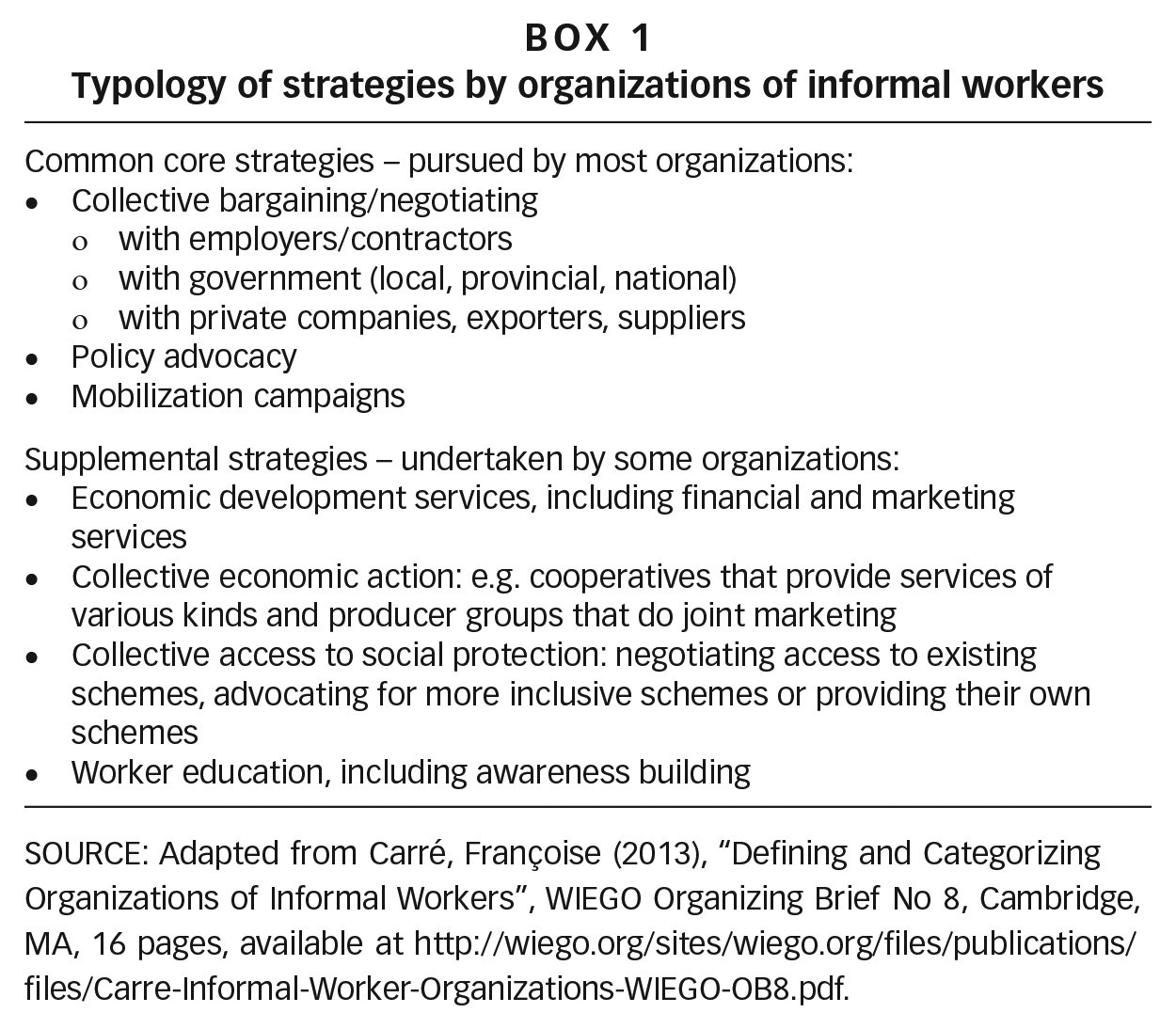
Organizations of informal workers, including home-based workers, typically pursue a wider set of strategies than trade unions of formal workers pursue.(28) See Box 1 for a typology of common core and supplemental strategies undertaken by organizations of informal workers.
Typology of strategies by organizations of informal workers
SOURCE: Adapted from Carré, Françoise (2013), “Defining and Categorizing Organizations of Informal Workers”, WIEGO Organizing Brief No 8, Cambridge, MA, 16 pages, available at http://wiego.org/sites/wiego.org/files/publications/files/Carre-Informal-Worker-Organizations-WIEGO-OB8.pdf.
Collective bargaining
Home-based workers have to bargain with local government for basic infrastructure services to make their homes-cum-workplaces more productive. Like other informal workers, they need to bargain for accessible and affordable public transport between their homes and the markets where they buy and sell goods, or between their homes and their contractors. Those who are self-employed have to bargain with suppliers and buyers for fair prices and terms of trade. Those who are sub-contracted have to bargain with lead firms and their intermediaries, the contractors, who outsource goods to them in order to obtain regular work orders, quality raw materials, fair piece rates, and timely payments.(29)
Promising examples
There are promising examples from cities around the world where home-based workers and their organizations have been able to demand better, more inclusive urban policies that integrate home-based workers and their livelihoods into urban planning and local economic policies. Organizations of home-based workers have also been successful in gaining victories for their members and other home-based workers in either the local or national policy arenas in some countries. These organizations have joined hands across nations to form regional networks to bring visibility to the home-based workers and to build a regional/global platform of demands.
Local
HomeNet Thailand (HNT) has been facilitating city dialogues to highlight and address the need for better public transportation for home-based workers and other informal workers in resettlement areas around Bangkok. These ongoing city dialogues, started in 2012, provide a platform for informal workers to articulate their realities and problems to city authorities. The city dialogues have resulted in tangible outcomes, including more regular bus services during rush hour, and a pedestrian bridge in one flood-prone district.(30)
In Ahmedabad in 2000, Mahila Housing Trust, the housing wing of SEWA, initiated a campaign with the Ahmedabad Electricity Company (AEC, a private company) to electrify all of the slum households of Ahmedabad. The campaign was so successful that the AEC has committed to expanding the coverage to slum areas in other cities of Gujarat.
HomeNet South Asia (HNSA) has used the study of multiple cities/countries in Asia, cited earlier,(31) to facilitate city-level policy dialogues between home-based worker organizations and city officials. In Faisalabad, HomeNet Pakistan negotiated a water filtration plant at a location with a concentration of home-based workers. The plant now serves 2,000 households. In Kathmandu, HomeNet South Asia partnered with SAATHI, a local NGO, to meet with municipal officials to discuss the water, sanitation and electricity needs of home-based workers. As a result, collaborative efforts are underway to install solar street lights and a 500-litre drinking water tank, and to devise a paid waste collection system. As a result of dialogues in Dhaka, Bangladesh between HomeNet South Asia and the Dhaka North City Corporation (DNCC), 20 million taka (US$ 251,014 as of January 2013) was allocated in the 2013–2014 corporation budget for garbage disposal in two slums.(32)
National
HomeNet Thailand has effectively campaigned with and for home-based workers and other informal workers on the national policy front, in alliance with other civil society organizations. The first such success was the universal health coverage scheme for informal workers and other groups not covered by formal health insurance. Thailand stands out for its decade-long inclusion of civil society organizations, including HomeNet Thailand, in an alliance for health reform, which contributed to the campaign for what became known, initially, as the 30 Baht Scheme.(33) (30 baht was equivalent to US$ 0.98 as of January 2001.) When the 30 Baht Scheme was replaced by the free Universal Coverage Scheme, the alliance of civil society networks, including HomeNet Thailand, was again involved in the design of the scheme, in the legislation, and thereafter in facilitating, monitoring and evaluating implementation.
The second success was the Homeworkers Protection Act, which entitles homeworkers in Thailand to a minimum wage, occupational health and safety protection, and other fundamental labour rights. To understand obstacles to implementing these protections, under a WIEGO project on law and informality, HomeNet Thailand examined instances where homeworkers had attempted to access their rights and to implement the tripartite implementation committee (comprised of government, private health providers and civil society) set up under the Act. The group also made a concerted effort to inform homeworker leaders and homeworkers about their rights under the Act through workshops with lawyers and government officials, posters, newsletters and other documents. In 2014, as a direct outcome of these struggles, three home-based workers supported by HomeNet Thailand were included in the tripartite implementation committee.
The SEWA Mahila Housing Trust (SEWA MHT) in India has campaigned for an enabling policy environment for housing and infrastructure for the poor at the national level in India, including procedures for better transparency and accountability regarding the housing subsidy to which the poor are entitled; and has worked to reform state-level rehabilitation policies and leverage urban town planning and tenure systems for the urban working poor in the informal economy. In the area of housing and infrastructure finance, SEWA MHT has advocated for enabling regulations and incentives to increase the access of the poor to formal housing finance. And it recently established a housing finance corporation, called SEWA Grih Rin Limited, for working poor women.
Regional and global
Organizations working with home-based workers from eight countries in South and South East Asia – Bangladesh, Cambodia, India, Nepal, Pakistan, Philippines, Sri Lanka and Thailand – along with city mayors and administrators from those countries, came together in a Regional Conference of City Authorities and Home-Based Workers in May 2014 in Pataya, Thailand to highlight how good civic amenities enhance the productivity, livelihoods and living standards of urban home-based workers. The conference participants developed and adopted the Asian Cities Declaration on Home-Based Workers, 2014.(34) In 2015, HomeNet South Asia and WIEGO organized the first-ever global conference of home-based workers in New Delhi, India. Over 100 home-based worker representatives and supporters from 24 countries participated in the conference and jointly formulated the Delhi Declaration, the first global declaration of home-based workers.
Key recommendations of both the 2014 Asian Cities Declaration and the 2015 Delhi Declaration include: recognize the home as a workplace and slums as sites of economic activity; integrate home-based workers and their livelihood activities into local economic development plans; extend tenure security through in-situ regularization and improvement in all existing settlements; extend basic infrastructure to all homes and settlements; and extend public transport services to all settlements.
VI. Conclusions
As the evidence presented in this paper has shown, three areas of urban policies, plans and practices have direct impacts on the livelihoods and productivity of home-based workers: informal settlements and housing policies, basic infrastructure and transport services, and zoning regulations.
Housing policies directly impact home-based workers, more than is the case for other groups of informal workers. To secure their livelihoods and make them more productive, home-based workers need good quality, low-cost housing in central locations, as well as affordable and reliable basic infrastructure services (water, sanitation and electricity) for their homes-cum-workplaces. Provision of work sheds or other workspaces for home-based workers should be included in the design of low-cost housing and settlements.
Similarly, settlement schemes need to factor in the livelihoods of home-based workers and other informal workers. Evictions and relocations of homes and other workplaces, especially to the periphery of cities at a distance from markets, contractors and customers, pose a direct threat to the livelihoods of home-based workers and other urban informal workers. The best approach to protecting and enhancing the livelihoods of home-based workers, and other informal workers, is in-situ upgrading of informal settlements and informal housing. This will require that city planners recognize informal settlements and houses as sites of production, and build them into plans for the allocation and zoning of urban land. If and when home-based workers and their families have to be relocated, efforts should be made to ensure that, from the outset, the relocation sites have adequate shelter, basic infrastructure, transport services, and access to markets, in addition to education and medical facilities.
Zoning policies need to reflect the significance and location of home-based work. Overly strict separation of land uses (such as single-use zones) can negatively impact the livelihoods of urban home-based workers. It is important to promote a balanced mix of uses that fruitfully interact with each other. In regard to home-based production, “it is important to distinguish not only land uses but also the scale of the uses – because, for example, a small tailor workshop may enrich a residential neighbourhood while a sewing factory may cause undue nuisance”.(35) Distinguishing both land uses and the scale of uses would allow policymakers to better address the needs of home-based workers. For home-based work, “it may be advisable to let neighbours decide whether or not such activities are desirable in the neighbourhood”.(36) Finally, transport systems and transport services need to be designed with the aim of connecting home-based workers and other informal workers to the markets where they buy and sell and the places where they work.
Clearly, urban policies, plans and practices affect home-based workers and other groups of urban informal workers. Most existing urban policies, plans and practices are not designed to support and protect the urban informal workforce and, therefore, often have negative impacts on the working poor. If they want to reduce poverty and inequality and to enhance overall growth and development in their cities, municipal governments need to recognize that most informal workers are working poor people trying to earn an honest living and contributing to the urban economy of their cities. They also need to recognize that most urban informal activities are situated in private houses or on public land: they need to recognize, more specifically, that most slum or squatter settlements and many informal houses – as well as public land or spaces – are sites of production and distribution.
In sum, municipal governments need to recognize the contribution of the informal workforce, including home-based workers, to their cities and to integrate informal activities into the plans, policies and practices of their cities. They should do so by inviting informal worker leaders to the policymaking table.