




Abstract
This paper explains the reasons behind the growing social tension and increased number of conflicts in China after a good performance in meeting the Millennium Development Goals. In this paper, we map out the issues with old urbanization (1978–2014) and the problems unsolved by past policy, and analyse whether the new policy changes introduced by the New Urbanization Plan (2014–2020) may help to deal with those problems. We argue that the tensions that evolve into conflicts are often a result of unaddressed social anxiety. Using money to purchase social stability can only be part of the solution. There need to be more serious attempts to improve governance, which involve: improving multi-level governance and inter-regional coordination, enhancing policy transparency and rule by law, adjusting the level of redistribution, and integrating rural and urban community governance structures.
I. Introduction
In early 2015, the United Nations Development Programme (UNDP) published a report suggesting that China had set a good example in achieving the Millennium Development Goals (MDGs). The achievement was examined in eight broad categories with a wide range of targets, including removing extreme poverty, stopping the spread of HIV/AIDS and delivering universal primary school education by 2015. The report’s authors expected that the “direction of China’s future development endeavours and the degree of its commitment to global public goods – especially climate change – will have significant impacts on the entire international community.”(1)
Despite these achievements, China is now facing some serious social tensions. The number of conflicts (or “mass incidents” [qúntĭxìng shìjiàn]), including petitions, sabotage, strikes, public demonstrations and riots, is an important indicator, demonstrating that the general public is not satisfied with the government or society at large.(2) Starting from 2009, there have been more than 100,000 conflicts each year, a dramatic increase from the 8,709 reported in 1993.(3) An analysis of 871 media-reported conflicts suggests that labour disputes, land acquisition and environmental pollution are the focus of the most frequent and largest-scale conflicts.(4)
A question is then raised: Why are there so many of these mass incidents, after China did so well in meeting the Millennium Development Goals? Because the three main areas of conflict just mentioned are all closely related to urbanization, we focus here on the policy responses to urbanization in order to explore this question. We show that these interventionist responses have fallen short in addressing the causes of tension provoked by the urbanization process, some of which can only be solved by changing the approach and structure of governance.
The urban proportion of China’s population grew from 17.9 per cent in 1978 to 54.8 per cent in 2014, an annual growth of 1.02 per cent. In 2014 alone, the number of permanent urban residents increased by 18 million.(5) The Chinese government estimates that by 2020, 60 per cent of China’s population, or 870 million people, will be living permanently in cities and 580 million in rural areas.(6)
In the following sections, we first review the problems that arose from past urbanization in China, and the difficulties associated with the past responses. We then go on to consider the 2014 New Urbanization Plan (NUP, 2014–2020), which attempts to deal with the pressure of economic slowdown caused by the global financial crisis that started in 2007, as well as to solve the problems of past urbanization. It is, to some extent, a more serious attempt to solve the problems than previous responses have been. However, it is primarily designed to boost the economy, and the state continues to take the interventionist approach that has proven problematic in the past. This generates new governance problems. We argue that to reduce the social tension caused by both old and new urbanizations, and to prevent it escalating into social conflict, there need to be more serious attempts to improve governance. These efforts might involve: improving coordination among the multiple levels of governance; enhancing policy transparency; introducing rule by law; adjusting the level of redistribution; and integrating rural and urban community governance structures.
II. “Old Urbanization” and Governance Issues
We label the urbanization before the New Urbanization Plan as “old urbanization”, distinguished not only chronologically, but also because it was not part of the central government’s national plan to push at that point for urbanization. The problems will be briefly presented here, in order to map out the issues relevant to the policy and governance responses examined in this paper.
a. Voluntary migration
The most important form of urbanization in post-reform China is voluntary migration, in which rural residents move of their own volition to cities to take up urban jobs. This is more or less a household-level decision undertaken in response to individual circumstances, and primarily driven by the employment opportunities, higher income and different lifestyles in cities. These largely voluntary migrants still have land in rural areas and are officially registered as part of the rural population. For the most part, family members who would not have work in the city remain in the rural area, as urban living costs are high. A small number of established migrants may bring their parents to cities if they have bought houses; if these parents work, they are also counted as migrant workers. Some couples bring their children, who are not counted as migrant workers as they are not working. The 2014 estimate of 269 million rural–urban migrants(7) does not include these non-working family members.
The household registration (hukou) system in China plays a big part in the issues faced by voluntary migrants. The system, introduced in the 1950s to control population mobility, was designed to differentiate rural and urban citizens according to place of origin. Until very recently, urban hukou granted urban citizens a range of economic and social rights (such as access to employment, social services and social protection) that were not available in the city to a rural hukou holder. Until the end of the 1990s, a rural person could only become an urban citizen if he or she were formally employed full time by an urban employer. In practice, the official quota made it very difficult for an urban employer to get permission to hire a rural person.
Despite these restrictions, rural to urban migrants started to work in cities in the 1980s. Despite the numerous documents and certificates required to come to cities, in practice, many workers were hired on the black market. These unsanctioned migrant workers might face detention and eviction at any time.(8) In early 2003, the detention and eviction practice was stopped, making it much easier for migrants to work in cities. However, they did not gain access to urban social services (e.g. urban education and healthcare) and social benefits (such as housing subsidies, unemployment benefits, disability benefits and various old age benefits). Despite the fact that more than 10 million extra migrant workers came to cities every year, only a small proportion was formally “urbanized” and eligible for the urban social protection system.(9)
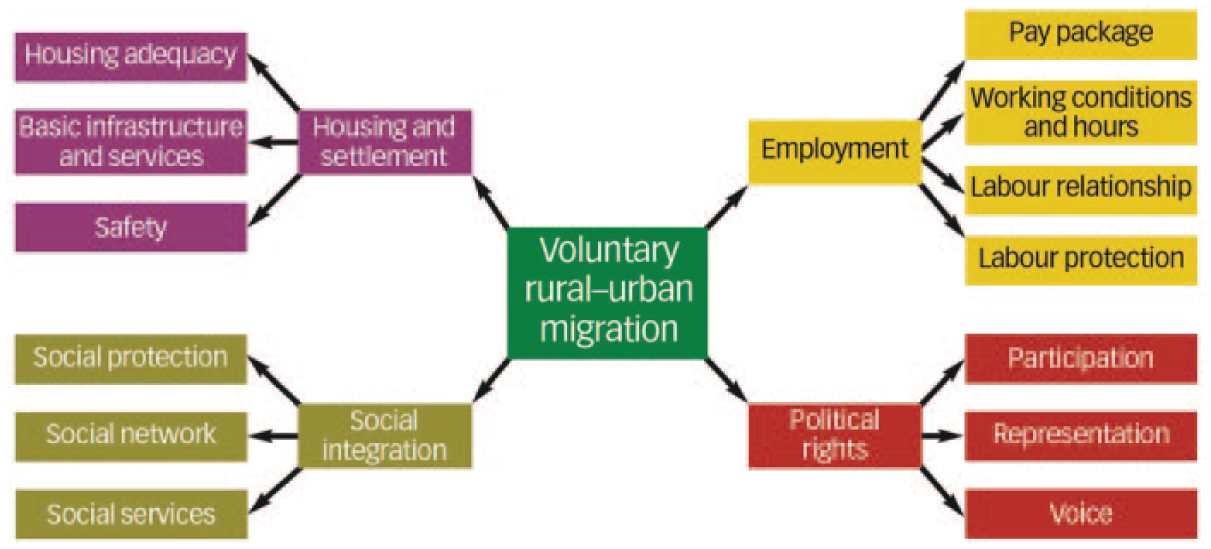
Voluntary migrants, as an un-urbanized “floating” population, have had to face various problems in cities (as shown in Figure 1).
Issues related to voluntary migration
Housing and settlement
Migrant workers come to cities to work in low-income, low-skilled and labour-intensive jobs. Some plan to return to their villages once they are too old to work in cities; others, with no intention of returning, need to save for their future. As a result, migrants tend to spend as little as possible on their housing, even if their incomes increase.(10) Most live in migrant enclaves in peri-urban areas, in dilapidated housing that is undesirable to urban citizens.(11) Houses tend to be overcrowded, poorly maintained and serviced, and often unsafe.(12) Employer-provided accommodations are of better quality, but are for singles only. These dormitories are also strictly managed by employers, who are often criticized for being too controlling.(13) Most migrant workers, particularly those doing manual work, are tenants, and security of tenure can be a serious problem in the informal sectors where they tend to live. When urban regeneration happens, while homeowners may receive compensation, tenants’ rights are rarely taken into account.(14)
Employment
Migrant workers have tended to receive lower pay, work for longer hours, and have less skilled jobs than their urban counterparts.(15) In the early 2000s, they faced severe competition in the job market, and were not protected against exploitative business practices.(16) In more recent years, as cities started to suffer from labour shortages, skilled and experienced migrant workers have gained stronger bargaining power.(17)
Social integration
Migrant workers also have to face discrimination in their daily lives.(18) It creates difficulties in their ability to network with other urban residents,(19) and has negative impacts on their subjective wellbeing.(20)
Political voice
Even when there are elections in urban neighbourhoods, which is not always the case (as explained below), migrants are not allowed to participate, as voting is open only to people with local hukou registration. Migrants can only vote back in their home villages. For many years, rural–urban migrant workers were also not represented in the urban trade unions.(21) Some migrant workers organized associations through which they were able to provide informal support to each other. However, their activities to organize and bargain for labour protection could easily be criminalized.(22)
b. Involuntary migration
Involuntary migration results from natural events or decisions made by people other than those in the household, whether by communities or the state. While internationally, involuntary migration generally results from political upheaval, natural disasters or human trafficking, in China, it results primarily from land acquisition, and environment or climate change. In both cases, these involuntary migrants have the status of full local citizens at their destination, with all the social protections that are available to urban citizens, if not more. Their status, in other words, is very different from that of voluntary migrants, who remain legally outsiders.
Migration resulting from land acquisition
About four million migrants lose their land every year in China. All land in rural areas is owned by rural collectives. Farmers contract to use land through the household responsibility contracts (first signed in the 1970s) under two forms of tenure: farmland (including agricultural land, forest and grassland) and homesteads (for building houses on no more than 200 square metres). These contracts can be reviewed and renewed at the end of the contract term. Collective land is retained to build public facilities and rent out for village-based businesses. Only homesteads and collective land can be used for construction. Farmland can only be used for farming. There are some local experiments with land swaps between farmland and homesteads, but the overall principle, that the total area of farmland not be reduced, remains the same.
Farmers can lose their land in several ways. In the past, mostly in the 1980s and 1990s, some eagerly gave up their farmland once they had the opportunity to settle down in cities, unwilling to keep paying taxes and fees to the local government. Their land was then recontracted to other villagers. These days, farmers do not have to pay a tax for farming, and can sublet their farmland to other farmers or farming companies for a fee. In some villages, farmers may decide to sublet farmland collectively to farming companies or more capable farmers who can operate at larger scale. Some of the original leaseholders then go to work in cities and others just retire. In contrast, land acquisition takes place when urban governments wish to acquire rural land to lease to urban businesses. The rural collectives, represented by rural “cadres” (party secretary, village head and village committee members), bargain with these urban governments for compensation. Once an agreement is reached, farmers receive compensation, and are moved to newly built resettlement housing in the urban area in question, becoming in effect formal urban residents. As farmers do not initiate this land acquisition process, we consider this to be involuntary migration.
Migration resulting from environmental degradation or climate change
For this kind of migration, farmers are either relocated to other rural areas where the natural conditions are suitable for agricultural production (as for instance in the case of the Ningxia Village Relocation [diaozhuang] Projects, where people were moved to less arid areas), or to urban or peri-urban areas (as in the case of the Three Gorges Dam Project).(23) Those moved to urban areas lose their means of living, and have to be resettled with the help of government funds. The number used to be relatively small, but it is growing fast. Migration and resettlement are organized by local governments at the source and the destination, and coordinated by higher authorities at the provincial or central level. A few examples include the migration caused by the Three Rivers Sources (sanjiangyuan) Project to protect water sources for the Project of Transferring Water from the South to the North (nanshuibeidiao), which affected 10,000 families, and the Da Xinganling and Xiao Xinganling Mountain Areas Projects in Northeast China to protect forests, which will affect 140,000 households.(24)
For eco-migrants, the financial compensation and resettlement process is different from that in the case of land acquisition. Eco-migrants’ livelihoods are threatened already, and relocation is meant to help them to escape the poverty trap. They receive a fixed subsidy to help them move, in the amount determined by the government. Eco-migrants are accepted at their destinations as local citizens. They may also have access to low-rent housing (lianzu fang), or may buy purpose-built subsidized private housing. They have less power than land acquisition migrants as there is little room for eco-migrants to bargain around their resettlement package.
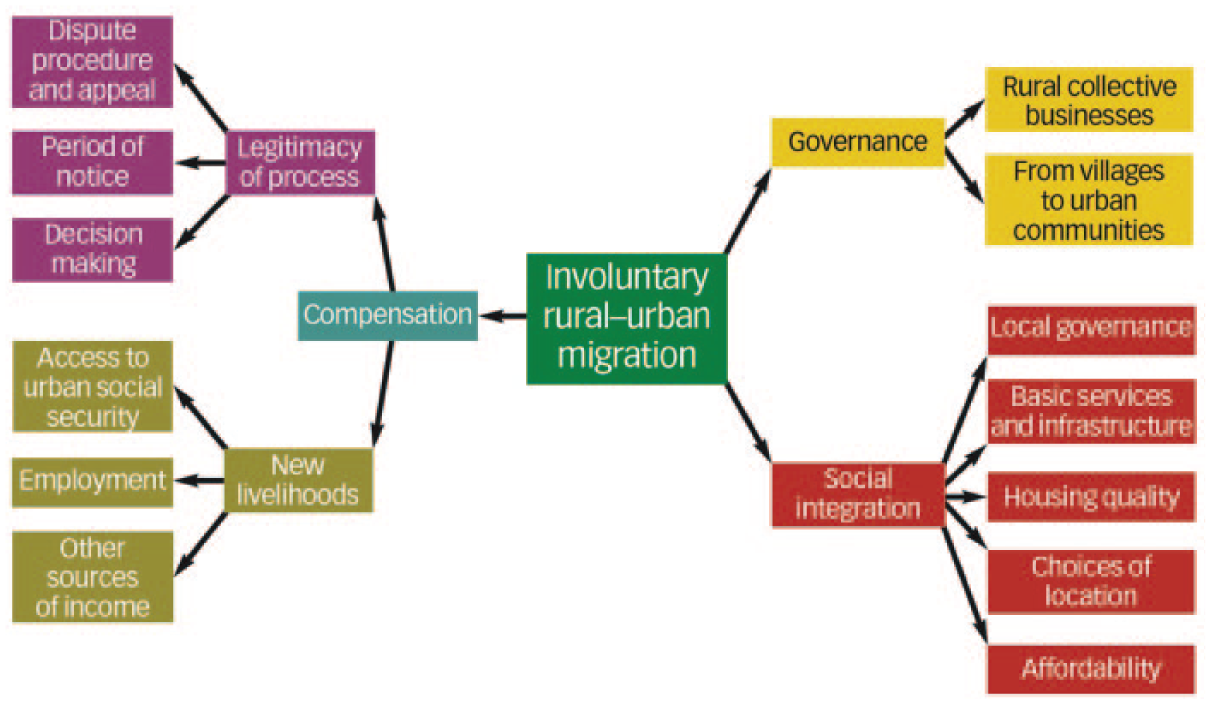
The issues faced by those affected by involuntary urbanization are illustrated in Figure 2.
Issues related to involuntary migration
Legitimacy of the process
Involuntary migration has attracted considerable media attention. There are sensationalized images, for example, of “nail households” – the small number of farmers or homeowners who refuse to give way to land grabbing or housing demolition. Sometimes the issue is the amount of compensation, but sometimes these farmers are unhappy with the way the process is handled.(25) Disputes may focus on whether they are consulted in decision making; how much advance notice is given prior to resettlement; and problems with the procedure of filing for appeal.(26) People’s perception of the process is also affected by how they are treated by the village cadres. Financial compensation and resettlement may be different in the cases of land acquisition and eco-migration. But in both cases, migrants have no alternative but to move. A key source of disputes is corrupt practices at various levels, which can prevent farmers from receiving their full compensation. A large part of the compensation may end up in the hands of a small number of village elites.(27) This often leads to protests locally, or ultimately to in-person complaints in Beijing.
Governance
In the resettlement period, a number of governance issues arise. For example, local elections started in villages in the 1980s, but elections in urban neighbourhoods only started several years ago. This meant that for a numbers of years, ex-farmers lost their right to vote. This problem was resolved when urban communities also started holding elections. However, technical difficulties remain around the fact that people can be registered in only one place. In many parts of the country, resettled ex-farmers still hold shares of rural collective businesses, which require them to maintain their rural hukou.(28) As a result, they can only participate in elections in the villages where their businesses are.
New livelihoods
About half of all involuntary migrants cannot find a job after being resettled in cities. In some regions, this rate can be as high as 60 per cent.(29) Some are unwilling to work, others cannot find employment. They might still prefer to do farming, or be too old or unskilled to find jobs in cities, or have family care responsibilities.(30) Because they are required to move, they are in a position to negotiate with the local government departments concerned for better compensation. This can include cash compensation and social welfare coverage when they become urbanized, and occasionally employment training and resettlement arrangements. If collectively owned businesses at their point of origin continue to exist, they can also negotiate around the new contract terms. However, the negotiations are not always satisfactory.
Social integration
As involuntary migrants move to cities, people from different villages may be assigned to the same urban neighbourhood. A recent field study in Fujian Province and Guiyang City of Guizhou Province in June–July 2015 by the authors of this paper reveals that resettled ex-farmers do not trust people from other villages as much as people from their own village. Unless community leaders are very active in their engagement with resettled residents, the resettlement neighbourhoods tend to be more poorly organized and maintained than other urban neighbourhoods. This is exacerbated when resettled ex-farmers rent out their houses to migrant workers from other parts of the country. Resettled ex-farmers do not consider migrant workers to be in the same social group as themselves – while they are homeowners and urban citizens, the migrant workers are tenants and outsiders. Long-term urban residents also distance themselves from the resettled ex-farmers – and eco-migrants face the same situation.(31)
III. Earlier Policy Responses and Governance Issues
On the whole, policies on migrant workers and “landless farmers” in China have improved in recent years, as migrants have been granted better access to urban social benefits and services, and as those unsettled by land acquisition have been offered better compensation packages.
From 2005, the government introduced a series of policies to include migrant workers in the national social insurance schemes. This included access to urban schools for migrants’ children, and campaigns to punish default on migrant workers’ salary payment. As with all such policies in China, central government articulates the principles, and provincial or local governments adapt these in local policies that fit their particular interests or circumstances. Thus, in some places, such as Chengdu City in Sichuan Province and in Chongqing, migrant workers from the same province could gain access to subsidized housing. Some 12 provinces (including Zhejiang, Sichuan, Shandong and Chongqing) have decoupled the linkage between hukou and social security, and allowed migrant workers from within the province to settle down in cities once they satisfy certain criteria – length of residency, stable employment, etc. However, these local regulations do not apply to inter-provincial migrant workers.
There have been new compensation regulations on land acquisition since 2009(32) that may provide income and social protection for the landless farmers. For example, a farmer may receive resettlement housing and/or a one-off payment. Farmers often make a living by letting out the resettlement houses they have been allotted. In some cases, part of the compensation fund is paid into social insurance schemes, allowing ex-farmers who reach retirement age to receive pensions. However, the actual treatment of relocated farmers varies greatly across the country. While in Hangzhou, wage-earning jobs were arranged for some landless farmers, in many other cities, landless farmers became unemployed.(33)
The policies regarding relocation and compensation address what has been referred to as the “performance” aspect of governance (as compared to the “representation” aspect, which includes transparency, accountability, social justice, human rights and democracy).(34) The policies aim to offer financial compensation, social protection and some social services to migrants, yet somehow, these local responses have not worked well. Migrants accept the money and social protections, but social conflicts continue to grow. Our contention here is that these conflicts centre on shortcomings in the representation aspect.
Many studies attribute the conflicts to resistance of vulnerable individuals to corruption and the powerful state. However, there is also a growing understanding in these studies of the complexity of the challenges that the governments at different levels are facing.
The most important challenge to local governments has been the slower economic growth. Before the global financial crisis, the Chinese government had started to reflect on the negative impact of the single-minded growth strategy.(35) Policies aiming to reduce inequality and environmental pollution and to enhance social integration were introduced even if they might mean small businesses would have to be shut down and local economies restructured.(36) The global financial crisis in 2007 changed the game. Economic growth slumped to 7 per cent, with exports falling even more. In 2008, many provinces reported a larger number of migrant workers returning to their home villages earlier than the Chinese New Year, the usual time for migrants to take a holiday in their villages, because their employers could not hire them until the end of the season. In Henan Province, around 3.77 million migrant workers returned to their home villages; in Chongqing, more than half of the 8 million migrant workers. It was estimated that about 60 per cent of the migrant workers’ return resulted directly from the global financial crisis.(37) In the countryside, social tensions became serious as some returning migrant workers wanted to take back the land they had rented to other farmers, who would then have to rearrange their livelihoods.(38) Moreover, returning young migrant workers did not know how to work on the farm and became “redundant” in villages.(39) The threat to rural social stability was serious enough to distract decision-makers from the larger economic slowdown.(40)
Second, local governments at the destinations did not always have the incentives to undertake the responsibilities, created by the policy changes after 2005, to offer equal social protection and services to migrant workers. Attitudes towards migration depended on local conditions.(41) In smaller cities and towns, migrant workers could be urbanized easily, and in cities where migrant workers were considered important resources for local economic development, policies were much more inclusive (such as Xiamen and Zhuhai) or even encouraging (such as Sichuan, Guizhou and Chongqing). But local governments were reluctant to offer access to public services in more developed cities, which intended to upgrade their economic structure. That is, they aimed to move away from low-skilled labour-intensive manufacturing industries towards more services or high-skilled employment, and to slow down population growth (such as Shanghai, Beijing and Shenzhen).(42)
Third, even in cases where cities were open to migration, there were institutional constraints to delivering a migration-friendly system. Local governments often criticized the central government for not producing “top-level design” (dingceng sheji). Without an overarching policy framework that would allow coordination across administrative and geographical boundaries, solutions to migration issues often ended up being localized firefighting tactics. For example, even in the more progressive provinces, where reforms to establish integrated rural–urban social protection systems were active, equal access to the system was only available to intra-provincial migrants. However, the 2010 census showed that around 54.5 per cent of migrant workers moved across provinces.(43) If migrants who contributed to social insurance schemes wanted to move to a different city, they would either lose their past contribution or have to withdraw the cash they had deposited. This created a serious disincentive for migrants to contribute to the social insurance system. There were some one-to-one agreements between different provinces to improve the transferability of social insurance contributions; however, they were not well implemented. Local governments, particularly those in poorer provinces, were not keen to cooperate.(44)
In the early 2000s, migrants were largely viewed as victims of government policy by the urban population. But increasingly, public attitudes towards the migrant population have changed. Some urban citizens have started to perceive migrant workers as the cause of deteriorating urban quality of life. For example, as governments from Beijing, Shanghai and Guangzhou decided to open up urban schools to migrant workers, some urban parents organized protests against migrant students studying in the same classes and competing with their children in the national exams for university entrance.(45)
On the whole, economic recession put a greater strain on the resources available to solve issues around urbanization. The lack of political will from local governments, and the increasingly negative public opinion about the migrant population, meant that migrants’ and farmers’ voices were poorly represented in the system. The urban governance system needed to be adjusted to the changes.
IV. The New Urbanization Plan (2014–2020)
The New Urbanization Plan (hereinafter “NUP”) was introduced in March 2014. Fearing that the 2007 global financial crisis would cause an economic slowdown, leading to serious unemployment, the Chinese government introduced strategies to sustain economic growth and push for structural transition. Urbanization was identified as one supporting strategy. The logic was that if rural migrant workers could settle down in cities permanently as urban citizens, they would spend more on housing, services and consumer goods, which would increase aggregate demand.(46) At the same time, the small scale of rural households’ agricultural production was criticized for being unproductive.(47) Urbanizing more farmers might facilitate the introduction of large-scale farming operated by farming companies or specialized large farming households, in order to achieve economies of scale in agricultural production.
The NUP aims for the following impacts:
a. Creating an overarching policy framework
The NUP is a response to the earlier-mentioned call for “top-level design” (dıˇngcéng shèjì) by local governments. It requires higher-level governments (provincial, national) to assume greater responsibilities in coordinating and pooling resources to cope with the pressure that city governments had to face individually in the past. Specific measures include:
Reforming the hukou system. This is designed to “transfer the rural migrants into urban residents in an orderly manner”.(48) Migrants are entitled to equal access to the basic public services provided to urban residents, and shall enjoy equal employment and entrepreneurship opportunities.
Setting up a unified land market for urban and rural areas. In the past, even with a household responsibility contract, farmers’ rights to different types of land were not very clear. This was particularly controversial with collectively owned land. The NUP makes land rights clear and legally binding. Once land titling is done, collectively owned land for construction in rural areas can be legally transferred or rented to businesses. Farmers may become shareholders of collective businesses. And the state cannot acquire farmers’ contracted land by negotiating only with village cadres (party secretary, head of the villagers’ committee). This was one of the most tension-ridden areas, as farmers frequently complained that they did not receive the compensation money.(49) Under the NUP, if the state needs land for development, existing users shall receive reasonable compensation calculated according to market value.
Integrating planning and design with provision of infrastructure and services for urban and rural areas. In the process of promoting urbanization, the NUP calls for special efforts to develop modern agriculture, enhance food security, improve rural infrastructure and develop a new countryside.
b. Creating city clusters
According to the NUP, the central government is responsible for promoting the development of inter-provincial city clusters across provinces. The focus is on three big city clusters: Beijing-Tianjin-Hebei, the Yangtze River Delta and the Pearl River Delta. This strategy does not rule out support for new city clusters in the central and western regions. Provincial governments are responsible for promoting the development of city clusters by, for example, making regional development plans, coordinating regional collaboration or even providing funding support. The strategy is expected to enhance economies of scale, improve transport links and integrate more peri-urban areas into the metropolitan economic circle.
c. Sustainable urban development
The NUP proposes six aspects for sustainable urban development:
Urban development shall achieve job creation when pursuing industrial development. Cities shall aim to absorb more of the labour force.
Large cities and satellite cities shall coordinate with each other. Some functions of large cities can be relocated to the satellite cities, while large cities should try to be more compact functionally.
The basic infrastructure and social services of cities shall be improved and upgraded.
Greater emphasis shall be put on building green cities (green energy, green buildings, green transportation, etc.), smart cities (broadband information network, urban management information system, smart grid, smart water networks, etc.), and cultural cities (cultural and natural heritage protection, cultural facilities, etc.).
Cities shall encourage self-governance and engage with different interest groups.
Urban construction shall rely on multiple sources of funding rather than government fiscal funds only.
The NUP directly addresses some of the earlier-mentioned problems. In terms of citizenship, the government sets specific targets for migration. By 2020, 100 million rural migrants shall receive urban household registration. Another 200 million without urban household registration shall enjoy equal access to public services. It is estimated that by 2020, China will have more than 580 million people living in rural areas and 870 million living in cities. With the overarching policy framework, the income and service gap between rural and urban areas shall be narrowed, and access to the social security system shall not be a barrier for moving between rural and urban areas.
There are some efforts to improve both productive and representative governance. We can observe innovations in the public service delivery system, such as public–private partnerships, the use of social organizations as service providers, and/or community co-production schemes, to involve alternative providers and public participation. In terms of representation, neighbourhood-level elections and resident councils have been introduced to develop greater levels of resident self-governance. In some provinces, such as Guangdong and Fujian, farmers have organized to carry out collective bargaining with the government and businesses to acquire better terms for land acquisition.(50) Their experience has been promoted at the national level to explore the possibility of institutionalizing some of the best practices. Although these changes are not included in the text of the NUP, as they were introduced before the NUP, they may help to reduce social tension. Therefore, they are championed by central government. Clearly, the experiments in representative governance and the structure of governance are still at an early stage, and it is not clear whether they will provide the anticipated outcomes.
V. New Problems Introduced by the NUP
The NUP is a cluster of policies that tries to deliver multiple goals. However, some of the goals are in conflict with each other, as discussed here:
a. The desire to boost growth is not compatible with the practice of labour mobility control
The NUP is primarily a top-down state prescription to boost the economy. Urbanization in its “natural” form contributes to spatial concentration of industries and services in the process of seeking lower production costs and increasing economic efficiency.(51) Therefore, to boost the economy as much as possible, one might expect the NUP to grant all migrants equal citizenship so that they can settle down, and consume and work like other urban residents. In reality, the NUP lays out quite specific population strategies for different types of cities:
Cities of 0.5–1 million people – granting permanent residency (hereinafter “PR”) with low restriction;
Cities with 1–3 million people – PR with relatively high restriction;(52)
Cities of 3–5 million people – PR with high restriction;
Cities of over 5 million people – PR with very high restriction, and caution about further population growth;
The largest cities, such as Beijing, Shanghai, Guangzhou – tightly controlled population inflow.
The strategies also come with a government-set quota: 100 out of nearly 300 million migrant workers will receive urban citizenship by 2020. But without clear market signals, the number is arbitrary: Why it is 100 million, but not 200 or 300 million? If these people can survive in cities without even claiming public resources, it means that they directly or indirectly serve the city’s demand for labour. The artificial labelling of people only sends signals that the government endorses the creation of second-class citizens. This practice will create new tensions but may not add to economic growth.
b. The migration quota can be manipulated for more aggressive land acquisition
Research in Zhejiang Province(53) reveals that farmers are not that interested in becoming urban citizens. There are similar findings from our field research in Chongqing in 2013, where city authorities were keen to urbanize farmers, but faced strong resistance. Setting a target for urbanization can potentially be used as an excuse to push more farmers off their land, even though the NUP stresses that the priority for urbanization shall be given to existing migrants.
c. City control excludes rather than includes the migrant population in larger cities
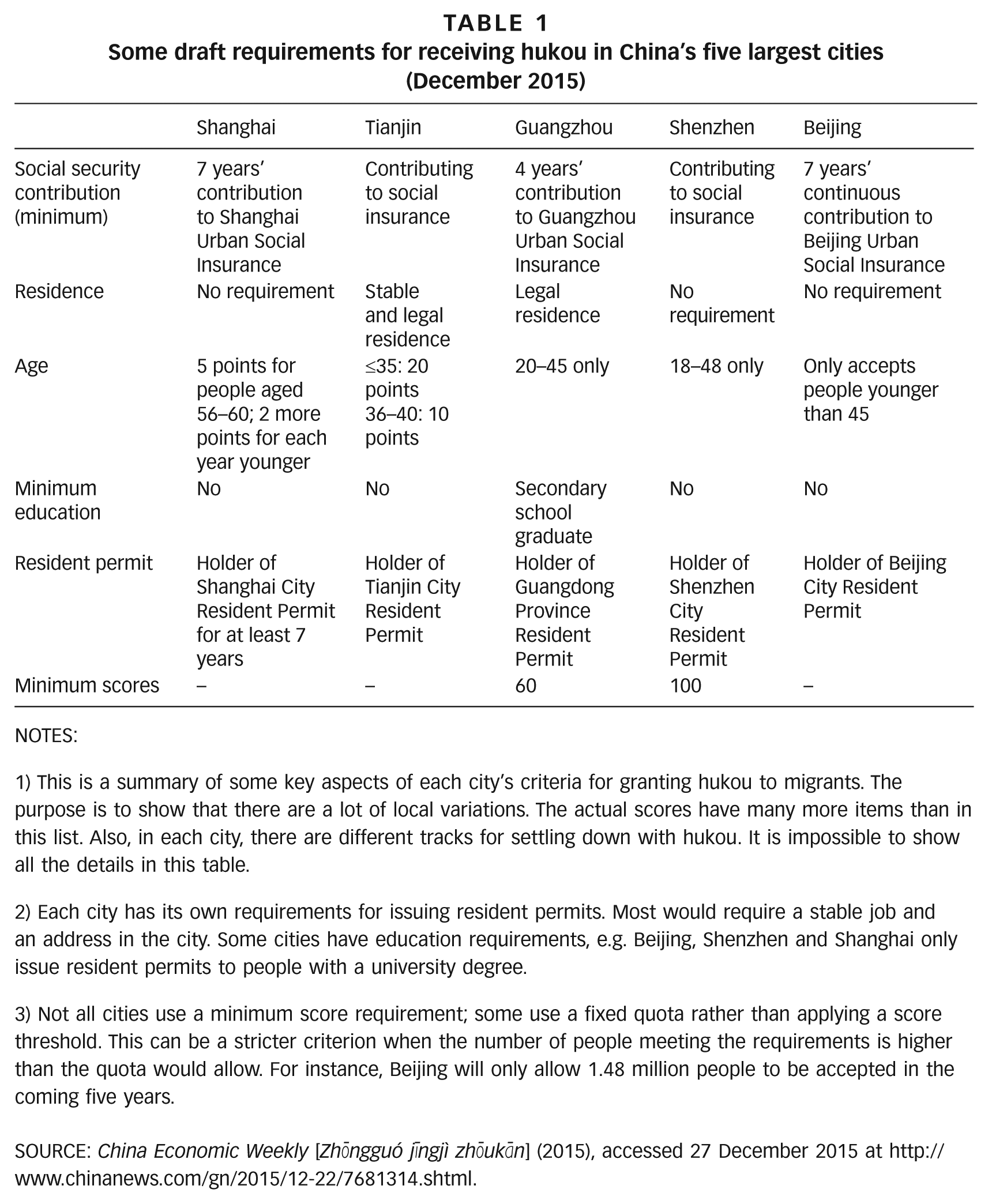
The NUP allows cities to come up with their own interpretation of the terms on which a person changes from having temporary to permanent residence. Cities have indeed responded differently. The largest cities will introduce a scoring system, which makes it even more difficult for migrants, in particular rural to urban migrant workers, to settle down permanently (Table 1). A number of medium-sized cities have also proposed policies that favour high-skilled workers at the expense of the low-skilled.
Some draft requirements for receiving hukou in China’s five largest cities (December 2015)
NOTES:
1) This is a summary of some key aspects of each city’s criteria for granting hukou to migrants. The purpose is to show that there are a lot of local variations. The actual scores have many more items than in this list. Also, in each city, there are different tracks for settling down with hukou. It is impossible to show all the details in this table.
2) Each city has its own requirements for issuing resident permits. Most would require a stable job and an address in the city. Some cities have education requirements, e.g. Beijing, Shenzhen and Shanghai only issue resident permits to people with a university degree.
3) Not all cities use a minimum score requirement; some use a fixed quota rather than applying a score threshold. This can be a stricter criterion when the number of people meeting the requirements is higher than the quota would allow. For instance, Beijing will only allow 1.48 million people to be accepted in the coming five years.
SOURCE: China Economic Weekly [Zhōngguó jīngjì zhōukān] (2015), accessed 27 December 2015 at http://www.chinanews.com/gn/2015/12-22/7681314.shtml.
The local authorities of large cities argue that they find it difficult to cope with massive influxes of migrants. However, good-quality and highly sought-after resources and public services such as universities, good hospitals and the best infrastructure are concentrated in these cities. They attract not only migrants, but also businesses. Unless the resource bias is addressed, and social services and infrastructure are more equitably available in the country, setting higher entry barriers may not deter migration. On the contrary, it may reinforce discrimination and continue to create social exclusion.
d. Local responsibilities and funding are not matched
The NUP demands that local governments take more responsibility regarding the migrant population. However, under the current public finance system, local government funding for migrant resettlement comes primarily from land leasing and tax revenues. When the local economy is not doing well, local governments’ revenues do not keep pace with the speed of increased spending (Figure 3). To avoid going further into debt, local governments have to collect more revenue, which is best done by acquiring and leasing out more land. This motivates them to push more farmers into cities, the faster and the cheaper the better, which exacerbates the tensions around forced urbanization.
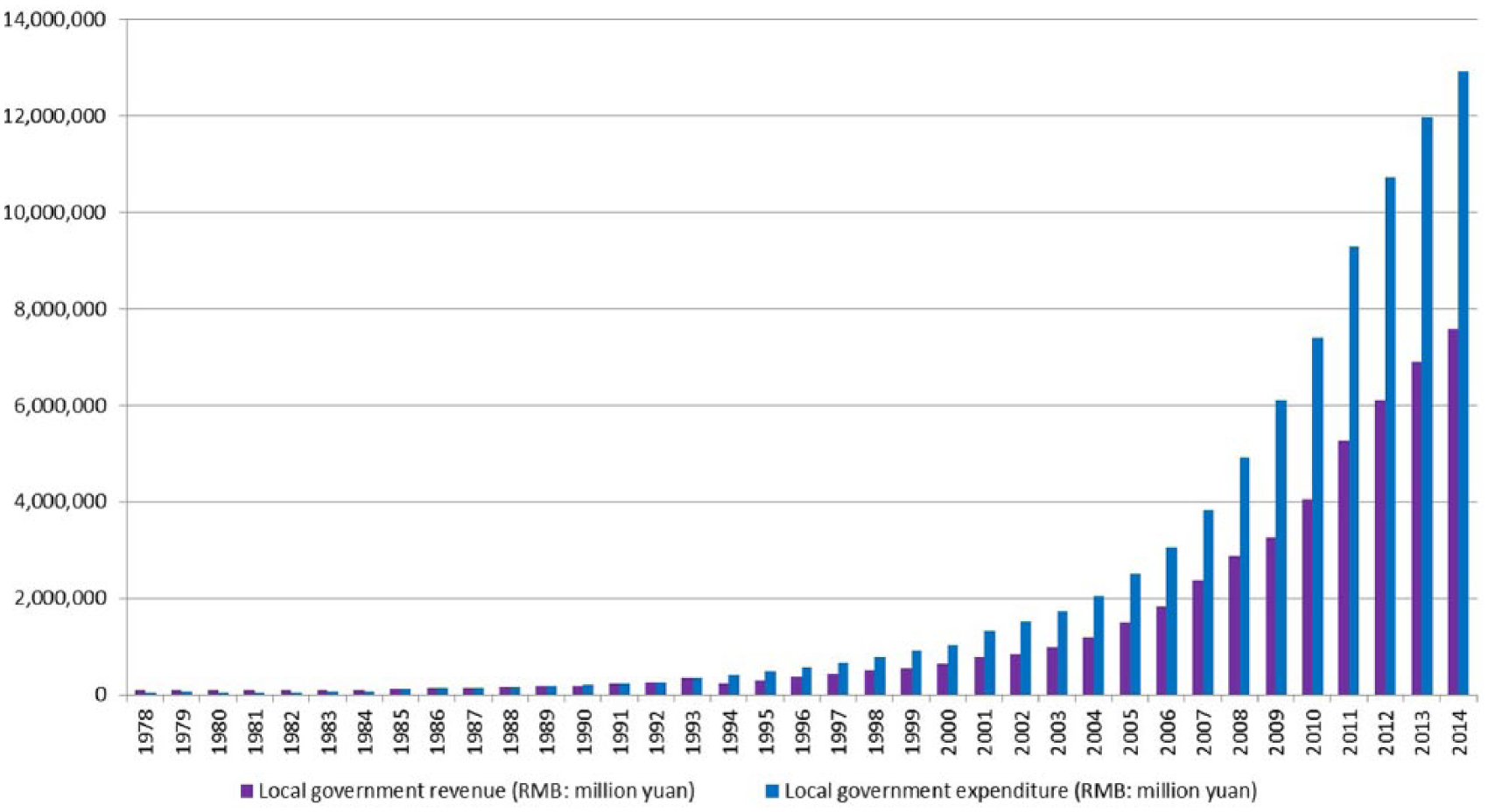
Local government revenue and local government expenditure (1 million yuan)
VI. Discussion and Conclusions
The history and the current status of urbanization in China show that the country faces serious social challenges as it tries to sustain economic growth. The ongoing economic slowdown makes it more difficult simply to inject more cash to win people’s support.(54) To avoid still greater risk of social unrest, local governments resort to generating more revenues by further boosting their local economies, and urbanization is identified as a solution. The New Urbanization Plan is designed to reduce both social and economic pressures. From the social side, it provides a set of supporting policies that offer better, if not yet full, coverage for the social rights of the migrant population.
However, so far, the number of conflicts has not diminished. People worry about the NUP’s stress on direct state control over numbers of migrants rather than on provision of a national-level framework for improvement.(55) The policy may be manipulated by local governments to push more people into cities rather than making the situation of existing migrants better. Since its introduction, there have been reports of more aggressive attempts by local governments to push for faster urbanization, and unfortunately the sluggish economy lowers rather than increases land revenues.(56)
Does this mean that it is not possible to relieve economic pressure and reduce social conflicts at the same time?
It is important to note that provision for social welfare does not usually generate conflict. Conflicts are caused by actions that take away people’s belongings (predatory land acquisition or loss of livelihoods because of environmental pollution), and by defaults on promises (unfulfilled salary payments, land compensation or industrial accident compensation, or loss of social insurance contribution).
It is equally important to note that migrants or farmers decide to file complaints because they find policies that support their position, but these policies are not enforced. This means that what leads to conflicts or protests is not always about the content of the policies, but about the implementation and the handling of the disputes that ignores either the legal request or the procedure for the complaints.
A frequent misunderstanding in the existing literature on urbanization in China is the tendency to portray the disputes as conflicts between vulnerable individuals and the mighty government or business interests, as if the people would prefer to stay put. The reality is much more complicated than this simple picture. The disputes are often about corruption at the local level, e.g. the promised compensation money being taken away by the village cadres.(57) Farmers may also want to bargain for better compensation after a deal is made between village cadres and the local government. Similarly, in labour disputes and environmental disputes, tensions with farmers, migrant workers and landless farmers are not always targeted fights against business interests, but rather attempts to call for negotiation. What has not been given sufficient attention in the NUP is the need to improve governance.
There are various existing practices, not specifically intended to deal with urbanization issues, that could well supplement current policies. One example is the village shareholding companies that allow farmers to collectively bargain with businesses. Another is the practice in a growing number of provinces of holding community elections of local cadres in cities, or establishing resident councils for self-governance in urban neighbourhoods.
The policies introduced by the NUP are not always consistent, and can conflict with each other. This could be because its primary goal is to boost economic growth. When economic growth takes a more people-centred approach, social rights are championed and realized. When this is not the case, people’s interests can become secondary to business interests. In this sense, the NUP is not transformative. A focus on more transformative governance changes might actually be less costly and more effective.
An insight based on field research is that the persistence of conflicts is related to people’s demand for respect and consent in the process of urbanization and dispute settlement.(58) This has to some extent grown out of the past three decades of economic liberalization, which has, paradoxically, been an empowering process for the migrant population. Economic liberalization demands freer labour mobility and the protection of private property rights.(59) A generally better awareness of these economic rights can result in tensions if the state continues: 1) to prevent people from moving to where employment opportunities are; 2) to demand that farmers/workers sacrifice their own interests for the benefit of the community, the government or the business sector; or 3) to make decisions without the consent of those affected. When the appeal to legal means or procedures is repeatedly ignored or even suppressed, i.e. when the state defaults on the policy promises it has made, tensions are very likely to evolve into conflicts. The past approach to releasing tension through paternalistic one-sided offers, which people were expected to accept unconditionally, is out of sync with the state’s own objectives of boosting the economy and maintaining social stability.
It is time to improve governance, and this could involve several kinds of changes:
Improving policy transparency and representation. There need to be clear procedures, good publicity about policies, and proper consultation throughout the urbanization process. This is particularly crucial in the case of involuntary migration. Relocation and dramatic changes to livelihoods would be a shock to any family. In cities, the urban middle class can be upset by much smaller disruptions in their lives. Yet decision-makers (both the state and businesses) consider it acceptable to push farmers into unfamiliar places to start a new life without sufficient time, resources or consultation to deal with the challenges. The protests have often been portrayed as resistance, but quite often, they are less an attempt to retain the status quo than an expression of anxiety about the uncertainty and the shock. These reactions should not be dismissed as just financial claims. Farmers need to be part of the negotiation. Even if the land is owned by village collectives, farmers are the sitting tenants; their opinions should be considered and they should be part of the bargaining process so that their concerns and anxieties can be represented at an earlier stage, rather than becoming the reason for endless conflicts afterwards.
Using rule by law to replace rule by administration. Disputes over land and housing relocation are frequently settled outside legal channels. The direct complaint system via the administrative channel was introduced in 1996. This allows individuals to deliver letters of complaint or meet with officials at higher levels of government directly when they are dissatisfied with decisions made locally. The central government uses this mechanism to gauge how well local governments have handled local disputes. When many complaints come directly to the centre, it is a sign of poor local governance. As a result, officials with poor records may be removed from their jobs. This practice causes serious problems. To keep their jobs, local officials make every effort to prevent people from going to Beijing to complain. Once complaints are lodged there, the central government lacks the capacity to carry out thorough investigations and enforce orders in every case. Many cases are referred back to local authorities for renegotiation and proper settlement locally. When there are continued disagreements, the people concerned might continue to complain. This system bypasses the legal system’s routine channels and undermines rule by law at all levels. Given that the NUP may encourage more migration, making the legal system function properly will be crucial.
Merging rural and urban community governance structure. For the urban and migrant populations to be fully integrated in the long run, people from different origins living in the same city should come under the same governing system. Currently, many of those who have been subject to involuntary migration live in cities, and continue to vote in their previous villages. Their votes can help to resolve issues related to their business interests back in the village, but they have no voice in the urban neighbourhoods where they live. If moving from villages to cities means that part of the long-established system of local democracy disappears, and there is no way for people to express their concerns, they are more likely to use street-level protest as an outlet for their anger. Recent reform of urban community democracy and local participation may be a positive step towards the merging of migrants into urban community governance systems.
Improve multi-level governance to fit the multi-level government. Large city clusters appeared in the past without much coordination between cities in terms of public administration, public infrastructure and social service delivery. Several city clusters, such as the Yangtze River Delta and the Middle Reach of the Yangtze River, have published new development plans that highlight the importance of coordination between higher- and lower-level governments and city-level governments. In terms of public administration, the key is the reorganization of the power structure and public finance capacity among different levels of government.
In conclusion, while the NUP is still a top-down state-led development agenda, given the social and economic situation, it is increasingly difficult for the government to impose direct control and use more financial compensation to maintain social stability. Trying to work with rather than against the people concerned through improved governance may be crucial for the sustainability of growth and social harmony.
Footnotes
Acknowledgements
We would like to thank Sheridan Bartlett for her editorial work and the two referees for comments on this paper, which helped us to improve the paper significantly.