




Abstract

This is the second Environment and Urbanization issue on sanitation this year. This issue, like the one published just six months ago, documents both the importance of sanitation for households’ well-being, dignity, and good health and the scale of sanitation need. The April editorial(1) also offered a comprehensive review of the lack of progress that has been made and argued that interventions that are sensitive to the specificities of local situations and acceptable to local people are going to be key to progress. And it highlighted some of the critical factors that need to be considered if sanitation improvements at scale are to be achieved.
This editorial is much briefer. It highlights key findings from the papers in this issue (some of which were introduced in the previous editorial). And it makes some suggestions in light of the UN Summit in September 2015 that agreed on the Sustainable Development Goals (SDGs), which pledge to “leave no one behind”. We are actually writing this prior to the ratification of the SDGs but, global democracy being what it is, there is every reason to believe the current draft proposal(2) will be agreed. Two goals are particularly relevant: Goal 6.2 with its general commitment to provide sanitation and Goal 11.1 with its commitment to upgrade informal settlements (slums(3)) with basic services (Box 1).
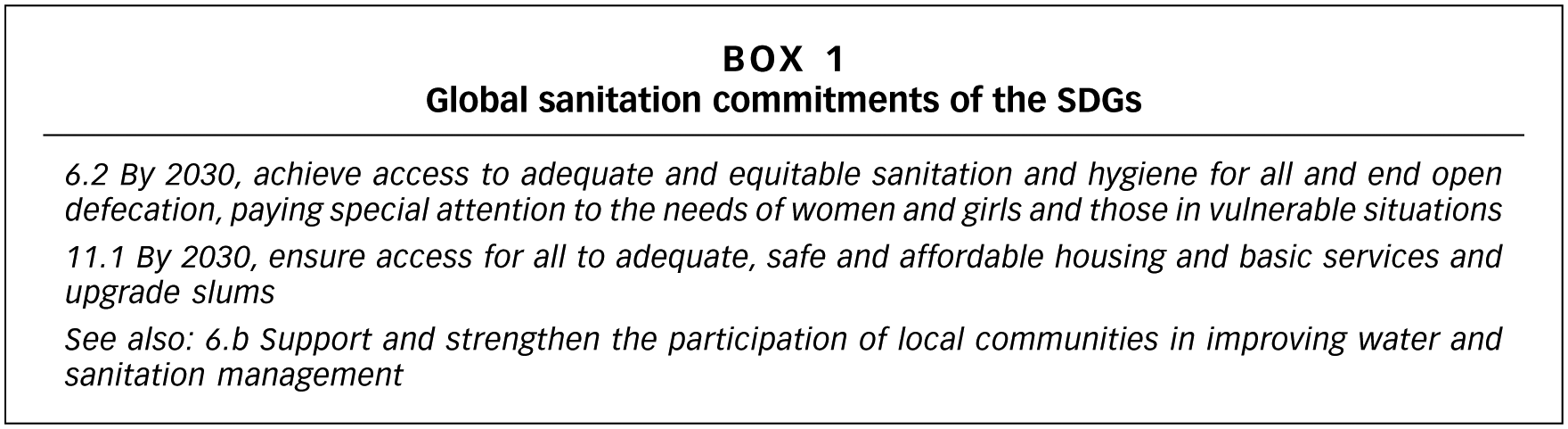
These commitments provide reason for hope – but we know that progress will depend on knowledge about what to do, political commitment to do it and our collective ambition to stay the course. What do these articles, those previously published in Environment and Urbanization and the more general literature add to our understanding on this front?
I. What do the Data Tell Us?
A first comment is that we should not believe figures that we hear about sanitation. The Joint Monitoring Programme, or JMP,(4) tells us that 82 per cent of the urban population have access to improved sanitation, and that another 11 per cent share sanitation that is otherwise improved.(5) The JMP reports that in sub-Saharan Africa, 40 per cent of the urban population use improved sanitation. The figure is 67 per cent in southern Asia, and 63 per cent in India.
Based on the papers in this issue, these figures still appear to be high. A key reason may be that these papers consider the problem of faecal waste management alongside the issue of toilet adequacy – and hence raise consistent concerns about the quality of “on-site”(6) sanitation and the risks to health of those living in dense residential settlements unserved by piped sewerage systems. They also elaborate other reasons that access to safe sanitation is severely lacking.
From China, Deljana Iossifova warns that aggregated figures across the nation do not help us to understand significant differences between regions on the coast and inland. Open defecation in urban areas doubled between 1990 and 2008 because the needs of the lowest-income and most disadvantaged groups such as migrants have not been addressed.
From East Africa, Mark O’Keefe, Christoph Lüthi, Innocent Kamara Tumwebaze and Robert Tobias note that 1 per cent of households in Kampala and 25 per cent of households in Nairobi are connected to sewers; the rest depend on on-site sanitation or open defecation.
From India, Kavita Wankhade reports that one-third of urban households are connected to a sewer, while others use septic tanks, pit latrines or other forms of on-site sanitation. Especially in smaller towns, where there is very little capacity to treat waste, less than 10 per cent of waste may be safely managed. Namita Gupta and Rajiv Gupta identify waste management as one of the most pressing planning issues facing India.
Also from India (Madhya Pradesh), Priyam Das reports on improvements to the situation in two towns, in a state where 20 per cent of urban households are connected to sewers; most in the state use septic tanks and 22 per cent report open defecation.
In Senegal (Dakar), Pippa Scott, Andrew Cotton and M Sohail examine faecal waste management strategies at the city scale in a city with a high water table in which 73 per cent of households have on-site sanitation.
From Zambia (Lusaka), Ruth Kennedy-Walker, Jaime M Amezaga and Charlotte A Paterson report that 10–20 per cent of households are connected to a sewer; other households are dependent on on-site sanitation.
The JMP has previously argued that many forms of on-site sanitation are safe and hence fall into the category of “improved”. But its latest report recognizes that providing sanitation at scale requires a consideration of faecal management – something that earlier reporting mechanisms have ignored. We argued in the April 2015 editorial that consideration of the safe separation of faecal waste also requires information about residential densities. This is still not considered by the JMP, and this requires urgent attention if the goal of universal access to sanitation is to be meaningful.
The discrepancy between the global figures and the information about specific locations may be due to a multitude of factors, and it may be that the global summary does not misrepresent the available data on the situation faced by urban residents in the global South. However, the data themselves are problematic and reflect a lack of accuracy on the part of those collecting data on living conditions, particularly the situation in informal settlements. And it may reflect that critical information is still not being recorded. This suggests that we need to look again at data collection, particularly in informal settlements.(7)
II. Standards Set by Whom?
Whatever the starting point is, the question of standards is never far away. The SDGs make significant commitments. Achieving them is going to require accurate reporting – and that requires some agreements on standards of adequacy. We highlighted in April that sewered systems cover a tiny proportion of urban dwellers in much of Africa and Asia. While the private and public costs of different systems have to be taken into consideration, we also argued that there is a need for flexible solutions – involving both on-site and off-site management of faecal waste, as well as community, shared and individual toilets. The paper by Maria Chiara Pastore shows that safe and effective water management in Dar es Salaam is likely to require an interplay of on-site and off-site components such as wells and pipes. Dealing successfully with sanitation needs will require a multitude of approaches.
But in their local context, we have to recognize that standards have been as much about defining exclusion as about supporting improvements.
In her moving account of changing values in Shanghai, Iossifova describes the difficulties faced by elderly people due to the social stigma associated with traditional latrines. Their lack of modern sanitation can mean that grandparents are no longer visited and sons do not have brides. She also describes how prejudice against migrants is rationalized with reference to their sanitary habits.
The JMP report itself, in its separate reporting of shared sanitation, demonstrates how standards change over time. The monitoring team is questioning its own definitions, which currently exclude shared sanitation from the category of improved sanitation. The papers included here and in the previous issue of Environment and Urbanization suggest a re-categorization, with some shared sanitation being included as improved. We suggested this in April’s editorial because it is acceptable to the users. The category of shared sanitation is now being considered by the JMP as potentially adequate.
However, the JMP seems to consider a restriction on the numbers sharing toilets, and this would still mean that all public or community blocks are defined as unimproved. As Sheela Patel and the SPARC team argued in the previous issue,(8) in Mumbai’s dense informal settlements, community-managed sanitation blocks are effective in addressing needs, and are all that is practical in the current context. Massive investment in sewers, for example, and housing upgrading might provide sanitation to residents of Mumbai’s Dharavi settlement, but would be associated with the displacement of the lowest-income households, the loss of their livelihoods and disruption to social networks.
Moving forward is going to require a much more nuanced approach. Global standards may be helpful to global monitoring but they may also be very misleading. Risks can be minimized if the SDG monitoring is itself participatory, setting global standards through a consultative process,(9) and recognizing that towns and cities have to decide what works for them, and how improvements can be achieved. The organization of residents of informal settlements that has taken place through the networks of Shack/Slum Dwellers International is an opportunity for global development institutions to rethink their approach to setting standards.(10)
III. Finance – From Where and For What?
Finance for investment in sanitation is key. In April we argued that there is an urgent need to rethink finance if local, national and international processes are to be able to support sanitation at the scale required. We recognized the contribution of domestic resources – and this was very much a part of the recent discussions at the Third International Conference on Financing for Development in Addis Ababa in July 2015.
But as important as the scale of finance is the nature of the sanitation investments to which they are directed. Investments need to be appropriate, affordable, locally owned and in many cases progressive, with a systematic capacity for further incremental improvement.
Finance is likely to be from multiple sources – grants, loans, internal cross-subsidies, and user charges.
If we are going to achieve universal coverage, the problem of the very limited capacity to pay of the lowest-income households has to be given centre stage. The papers in this collection once more provide evidence of multiple ways in which the lowest-income households are excluded. Such households are often made up of tenants and recent migrants – the groups identified by Dorothy Peprah, Kelly K Baker, Christine Moe, Katharine Robb, Nii Wellington, Habib Yakubu and Clair Null as the most likely to depend on public toilets in Accra, Ghana. Despite all previous research and the platitudes that accompany much of it, and despite the reality that dividing sanitation costs by household is the simplest of calculations, it remains evident that too many efforts to improve sanitation do not consider what contribution is affordable for the lowest-income households. Das reports that in one low-income settlement in Gwalior, households explained that 83 per cent of their income is taken up by food expenditure. In these circumstances, paying for sanitation is always going to be difficult. She concludes: “Where cost recovery is the key driver for community-managed sanitation projects, the goal of universal service provision becomes elusive.”
She also shows that higher-income households (in Indore) faced few of these difficulties and these households were able to make their required contributions. Sanitation providers may also be willing to support inclusion – as demonstrated by Colin McFarlane and Renu Desai’s account of women’s successful struggle to keep user charges in one Mumbai informal settlement at Rp. 1 rather than Rp. 2.
Wankhade discusses the relative costs of on-site and off-site services, suggesting that the former are cheaper overall but the latter are cheaper for households as part of the infrastructure costs are subsidized by the state. It is difficult to draw simple conclusions here. Many factors determine cost and system design is one of these, as the experiences of the Orangi Pilot Project have shown so clearly.(11) Another factor is the cost of capital and the time period over which these investments are to be repaid.
One reason why there has been inadequate emphasis on inclusive financing strategies is that, as discussed by Das and by O’Keefe and co-authors, toilets have been considered as private goods. In an urban context, where sewers fulfil at least some of the criteria for being a public good, that makes little sense. Moreover, the externalities associated with sanitation in dense residential areas – and for the city as a whole – are very significant. And, as explained in the last issue by Patel and SPARC,(12) sanitation cannot be privately consumed in dense urban settlements where dwellings are too small to include a toilet. But recognizing the inherently public nature of sanitation also makes sense as the health benefits of sanitation cannot be secured by one household acting alone; these benefits are only secured if a high proportion of the nearby households also secure access to sanitation.(13) (This is apparent from the discussion by Luiza C Campos, Philippa Ross, Zaheer A Nasir, Huw Taylor and Jonathan Parkinson of the social as well as environmental contributors to the health risks caused by inadequate sanitation.) And once faecal sludge management is associated with sanitation, as it has to be in an urban context where it cannot be assumed that on-site provision will enable the safe storage and processing of waste, then it is clear that sanitation is a public concern.
IV. Political Commitment is Key
There is increasing recognition of the importance of politics in determining the scale of basic services and social provisioning and the rules by which access is secured. As Das reminds us, decentralization in the global South was embraced in the 1990s and was meant to catalyse improvements in governance – with new forms of community participation and local ownership. However, whatever the original intention, in most nations, outcomes have been disappointing.
In the absence of state action to address sanitation needs, there has been a multitude of private, household and community provision. What is evident from the papers included here is that in most urban contexts, individual citizens can achieve little on their own; to achieve scale, they need to work in collaboration with their governments. At the same time, in the conditions that prevail in much of the global South, there is little that states can achieve if they do not collaborate with their own citizens.
Olumuyiwa Bayode Adegun considers both state-led and community-led approaches to drainage in informal settlements around Johannesburg, located in a country whose investment capacity is considerably greater than in much of the global South. He describes the divergent policies and practices of city and provincial governments, and the mixed response of residents – in part because some of them are unlikely to benefit from improvements. Contradictory legislation compounds the difficulties in moving forward in flood protection. Other authors also discuss the problems associated with poorly defined legal and regulatory frameworks – although as described by Kennedy-Walker and co-authors, it is the paucity of rules rather than the contradiction between them that is the problem in Lusaka. Transition may bring further difficulties; O’Keefe and co-authors discuss how the changes in Kenyan local government systems are blurring local government roles and responsibilities and creating further difficulties in addressing sanitation needs.
Das argues that even when communities are working in partnership with local government, they still face difficulties and can be overwhelmed. Enabling environments and champions within government are needed to make such partnership work. But the accounts in these papers offer no simple answers. While several of the authors emphasize that the major impediments are social and institutional rather than technological – and this is a familiar refrain in the broader literature – it does not mean that they are easy to address. McFarlane and Desai argue that simplicity cannot help here – and we need to start by recognizing that solutions need to be diverse and contingent on local circumstances and opportunities if they are to work effectively.
As suggested in the previous editorial, while there are no simple answers, there are tested processes that seem to offer a chance of success. Progress, again, seems to lie in supporting diverse solutions. Private providers frequently have an important contribution to make, especially for higher-income households. For the lowest-income households, there is a need for organized communities to work with local government and/or utilities in ways that build collaboration and that allow for learning and iterative development. Co-production is likely to be the way forward – with joint ownership, joint financing and joint management of different parts of the sanitation system. McFarlane and Desai argue that what is viewed as legitimate has a significant influence on progress. We hope that the adoption of the SDGs will succeed in legitimizing demands for support to improve sanitation across the income continuum.
V. Think Holistically and Beyond Sanitation
It is evident from the papers here and from contributions to other issues of Environment and Urbanization that there has been too little attention to faecal sludge management. Wankhade suggests that one reason may be the Millennium Development Goal on sanitation, and she points out the importance of making sure action on global goals addresses rather than exacerbates the lack of access to basic services in many towns and cities of the global South.
What is also evident from the papers by Scott and co-authors, O’Keefe and co-authors, and Wankhade is that tenure issues are central to sanitation options. This does not necessarily mean that formalization of tenure is the answer; indeed, given that a high proportion of households are tenants, this cannot be the case. We know that different contexts produce different responses and provide incentives for different kinds of behaviour.(14) However, what is clear is that household control over assets means that choices are greater and are more advantageous.
The environment also matters. It matters in part because it influences the challenges that solutions will have to face. The increased likelihood of extreme weather events related to climate change makes the need for settlement drainage even more acute, and means that designs for solutions such as pit latrines have to minimize the risk of contamination during periods of flooding.
But the environment can also help to contribute solutions, and Iossifova describes the historic practice in China of recycling human waste with collection carts up until the 1960s. While excreta collection stations remain up to the present day, there has been a gradual “decoupling” of human waste and plant and animal production. More recent experiences with eco-sanitation discussed in the papers by O’Keefe and co-authors and by Sayed Mohammad Nazim Uddin, Zifu Li, Ibrahim B Mahmood, Jean Lapegue, Jan Franklin Adamowski, Pier Francesco Donati, Elisabeth Maria Huba, Heinz-Peter Mang, Buyanbaatar Avirmed and Shikun Cheng show that we are seeking to recapture this more positive relationship with the environment in sanitation provision. However, while the Sanergy model O’Keefe and co-authors describe is appreciated by its customers for its cleanliness, and while it has been successful as a source of income for at least some of its operators, the authors are less confident about the profitability of the design overall. Moreover, the costs associated with the required capital investment and maintenance in the case of eco-sanitation and/or access to Sanergy’s pay-per-use model of sanitation provision limit the relevance for the lowest-income households.
VI. Scale Changes Things
In the previous editorial, we talked about the importance of the city scale. It is evident from this set of papers that this is not an original theme and there is much ongoing work related to scaling up neighbourhood improvements, and in “looking down” from the city to the local in efforts to increase the quantity of provision.
From the perspective of scale, insights emerge. As we argued last time, city-wide sanitation requires engagement with the dual issues of latrine design and faecal sludge management. Both Wankhade (with respect to India) and Scott and co-authors (with respect to Dakar) directly address this issue. Kennedy-Walker and co-authors add to the debate through an exploration of how Lusaka can develop locally appropriate and decentralized solutions for the treatment of faecal sludge generated in informal settlements. Scott and co-authors illustrate the ways in which a city-wide focus changes the nature of sanitation planning. Their discussion of frameworks that can support improvements in Dakar highlights that it is only with this shift in scale that is it possible to understand the challenges – i.e. who is left out, what becomes of the waste – and so begin to address them.
However, as McFarlane and Desai remind us, securing sanitation improvements is not simple – and nor is it easy. Das points out that national policy in India has been seeking city-wide interventions since 2008. Progress has been limited – at least in part because funds and capacities are lacking. Scale may change perspective but it does not immediately bring results.
The previous editorial asked many questions and unfortunately we cannot answer them here. What is evident is that global commitments can and have made a difference – especially if there is the understanding that progress in sanitation requires a sophisticated knowledge of the local context and projects owned by those who are intended to benefit. Contextual knowledge, with innovation and flexibility in crafting solutions and determination to secure progress, emerge as necessary conditions. And a key first step will be establishing the monitoring framework required to inform SDG implementation.
Footnotes
1.
Satterthwaite, David, Diana Mitlin and Sheridan Bartlett (2015), “Is it possible to reach low-income urban dwellers with good-quality sanitation?”, Environment and Urbanization Vol 27, No 1, pages 3–18.
2.
3.
The term “slum” usually has derogatory connotations and can suggest that a settlement needs replacement or can legitimate the eviction of its residents. However, it is a difficult term to avoid for at least three reasons. First, some networks of neighbourhood organizations choose to identify themselves with a positive use of the term, partly to neutralize these negative connotations; one of the most successful is the National Slum Dwellers Federation in India. Second, the only global estimates for housing deficiencies, collected by the United Nations, are for what they term “slums”. And third, in some nations, there are advantages for residents of informal settlements if their settlement is recognized officially as a “slum”; indeed, the residents may lobby to get their settlement classified as a “notified slum”. Where the term is used in this journal, it refers to settlements characterized by at least some of the following features: a lack of formal recognition on the part of local government of the settlement and its residents; the absence of secure tenure for residents; inadequacies in provision for infrastructure and services; overcrowded and sub-standard dwellings; and location on land less than suitable for occupation. For a discussion of more precise ways to classify the range of housing sub-markets through which those with limited incomes buy, rent or build accommodation, see Environment and Urbanization Vol 1, No 2 (1989), available at  .
.
4.
5.
See reference 4, page 14.
6.
This does not refer to the location of the toilet, but to solutions where the disposal of faecal matter is then managed on-site rather than through a piped sewerage system.
7.
8.
Patel, Sheela and the SPARC team (2015), “The 20-year sanitation partnership of Mumbai and the Indian Alliance”, Environment and Urbanization Vol 27, No 1, pages 55–72.
9.
10.
11.
Hasan, Arif (2008), “Financing the sanitation programme of the Orangi Pilot Project—Research and Training Institute in Pakistan”, Environment and Urbanization Vol 20, No 1, pages 109–119.
12.
See reference 8.
13.
Genser, Bernd, Agostino Strina, Lenaldo A dos Santos, Carlos A T Teles, Matildes S Prado, Sandy Cairncross and Mauricio L Barreto (2008), “Impact of a city-wide sanitation intervention in a large urban centre on social, environmental and behavioural determinants of childhood diarrhoea: analysis of two cohort studies”, International Journal of Epidemiology Vol 37, No 4, pages 831–840.
14.
Payne, Geoffrey, Alain Durand-Lasserve and Carole Rakodi (2009), “The limits of land titling and home ownership”, Environment and Urbanization Vol 21, No 2, pages 443–462.