




Abstract
This article juxtaposes two distinct violent dynamics in a highly securitized urban space: one covered by global media in every detail, yet of marginal importance to the vast majority of city dwellers; the other endemic, but absent from outsiders’ urban imaginary of life and death in Kabul. Although insurgent forces have utilized Afghanistan’s capital city as a stage for acts of spectacular violence ever since the 2001 international invasion, for most city dwellers, especially women and children, domestic abuse has constituted the main threat to physical well-being. In contrast, increases in mortality and morbidity due to insurgent attacks carried out in the city between 2002 and 2011 have been infinitesimal. An interpretive framework that draws from critical geographical scholarship by highlighting global discourses and local norms helps expose that the international community’s discursive construction of Kabul as the locus for post-2001 neoliberal state-building lies at the heart of persistent, yet largely invisible, victimization within the city. The analysis demonstrates how such scalar politics of security have turned Kabul into an urban stage that provides global visibility of spectacular violence against foreigners while eclipsing endemic causes of bodily harm among Afghans.
I. Introduction
“There are some who are in darkness And the others are in light And you see the ones in brightness Those in darkness drop from sight.”
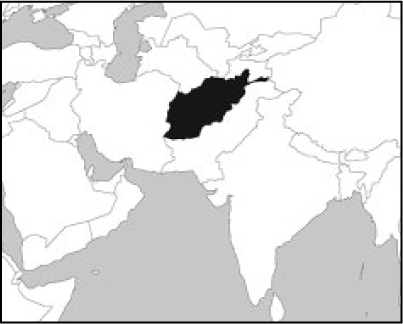
For more than 35 years, Afghanistan and its capital city, Kabul, have been the stage for a power play that leverages violence as a central component of visual communication and political mobilization. Especially since 2001, this strategy has resonated globally due to a heightened sense of vulnerability amid a “global war on terror”.(1) The key actors in this play are, on the one side, NATO forces backing the Afghan national army and, on the other, various factions of insurgent forces ranging from the Taliban to the Haqqani Network, Hezb-e-Islami, as well as local warlords rooted in tribal loyalties. The main victims, according to the popular rendition of the underlying plot, are those risking their lives for a better Afghanistan. Increasingly, these victims are foreigners who are paying the ultimate price in the service of the neoliberal imaginary of a unified country in which democracy and capitalism create a virtuous cycle of political stability and economic growth.(2) They are the “… country director for the International Monetary Fund [who] spent years navigating the shoals of scandal in Afghanistan’s financial sector” or “… a top political officer at the United Nations [who] dedicated himself over the past nine years to looking for a peaceful solution to the Afghan war.”(3) Afghans themselves, in contrast, are portrayed as spectators of the unfolding drama; their suffering either lies in the past, preceding the 2001 NATO invasion, or looms in the future awaiting Afghanistan once international troops have withdrawn from the country. Their agency, the narrative suggests, is either confined to mob violence in the country’s towns and cities or triggers drone attacks in response to the actions of seemingly anachronistic rural resistance fighters in a Fukuyama-esque post-historical era.(4)
The geographic epicentre of this power play, Kabul, is portrayed as a quintessentially violent city. A National Public Radio host summarized this perception in 2009 in the aftermath of a deadly attack on the luxury Serena Hotel, by pointing out that “… among the thousands of international workers, journalists and volunteers now living in Kabul, daily life is becoming even more challenging.”(5) A little more than four years later, in January 2014, a well-coordinated ambush by Taliban insurgents of a restaurant popular among expatriates and wealthy Afghans alike, left 13 foreigners and seven Afghans dead. The incident prompted global media stations to draw gloomy comparisons with Baghdad and Beirut, as it supposedly provided evidence that the pending drawdown of most international military forces would bring doom to the city’s residents.(6) The BBC’s chief international correspondent contributed a touching obituary in honour of the restaurant’s Lebanese owner, who “… made the best chocolate cake in Kabul” and valiantly defended his business with his AK-47 assault rifle.(7) In March 2014, the Taliban staged another attack, this time on the Kabul Serena Hotel, killing four foreigners and five Afghans.(8) As these attacks have been framed as foreshadowing a bleak future for the city, what is their significance for the millions of local dwellers who populate the Afghan capital today? More broadly, whom does the discursive construction of Kabul as a violent urban space serve and whose realities does it eclipse?
Drawing from critical international relations scholarship on “scaling” political analysis(9) as well as feminist geography(10) highlighting gendered dynamics in both social spheres and physical spaces, I argue in this article that the construction of Kabul as a violent city rests on a highly selective depiction of violence that obscures the real causes of victimization affecting the majority of the city’s dwellers. I seek to demonstrate that this reductionism is the result of what I call the “scalar politics of security”. Such politics determine the visibility and invisibility of different types of physical violence. They are rooted in the international political economy of military intervention and subsequent state-building efforts and are “disembedded”(11) from local realities. The term “scalar politics” denotes the discursive construction and reproduction of spatial units of analysis by those with material interests in highlighting some of them while ignoring others.(12) The analytic focus on material motivations for creating and reproducing such scales of security is anchored in Brenner’s dictum that “… each geographical scale under capitalism must be viewed as a complex, socially contested territorial scaffolding upon which multiple, overlapping forms of territorial organization converge, coalesce and interpenetrate.”(13) Even though the qualifier “under capitalism” may at first appear problematic in the context of an inquiry into the nature of urban violence in Kabul since 2001, both accumulation by dispossession(14) through evictions and land grabs, as well as more advanced capitalist modes of restructuring production, such as privatization and the exploitation of a resulting abundance of labour supply, are ubiquitous and indeed characteristic of Kabul’s post-2001 urban economy.(15)
Following Durán-Martínez(16) and extending earlier scholarship by Juris(17) and Rhodes,(18) I distinguish between “spectacular” and “endemic” types of violence. Interpersonal violence takes on different forms, both with respect to perpetrators as well as intended and actual victims. Underlying motivations differ just as much, and so do effects with respect to public perception. Frequency and visibility are not necessarily correlated; in fact, the high incidence of one type of interpersonal violence such as domestic abuse may go virtually unnoticed, whereas even a foiled terrorist attack usually draws significant attention by global news media “… constantly in search of sensational stories and images.”(19) In the case of post-invasion Kabul, “spectacular” violence denotes coordinated attacks by insurgent forces, including suicide missions, that are “extraordinary”(20) with regard to their degree of collective organization and impact. This notion of “spectacular” violence is thus similar to Goldstein’s, which conceptualizes vigilante lynchings of petty thieves as “… highly visible and dramatic vehicle[s] of communication”(21) utilized by marginalized city dwellers in Bolivia. In contrast, “endemic” violence refers to “everyday”(22) interpersonal acts of violence, such as those occurring in the context of spousal and family abuse, as well as violence resulting from neighbourhood conflicts and opportunity crimes.
Given the lack of any linear relationship between incidence, prevalence and perception, a scalar analysis of different types of urban violence allows us to pinpoint the role of discursive representations in the creation of a global imaginary of urban violence, which we can then contrast with individual realities and causes of (in)security or, in Hyndman’s words, the “… politics of security at the scale of the [civilian] body.”(23) Discourses both reflect and shape “… different ideas on what constitutes security”(24) and thus co-determine who needs to be secured and who is expendable.(25) Since the “… reshuffling and reorganization of spatial scales is an integral part of social strategies and struggles for control and empowerment”,(26) resulting security scales echo the distribution of power at a given time as much as political institutions do in the realm of governance.(27)
I begin by charting the incidence of “spectacular” violence that unfolded in Kabul during the decade since 2001. The sampled period encompasses a total of 78 insurgent attacks carried out in Kabul proper between November 2001 and November 2011, as well as three major riots. I then turn to the prevalence of “endemic” violence for which data were gathered through a meta-analysis of nine recent primary public health studies. I also include available crime statistics released by the Afghan national government; however, since the latter are not available for the city proper and rely on rudimentary documentation practices, they must be interpreted with extreme caution. Nonetheless, they allow for careful triangulation with the more detailed data gathered by primary research on public health conditions in the city. I contextualize the incidence and prevalence of both types of violence in light of statements made by representatives of the occupying forces during the period of observation, and offer an interpretation informed by critical social science scholarship that interrogates categories as social constructs rather than accepting them as structuring devices. I conclude with reflections on the locations of discursively constructed security and what these imply for policy-making.
II. Incidence of “Spectacular” Violence in Post-invasion Kabul
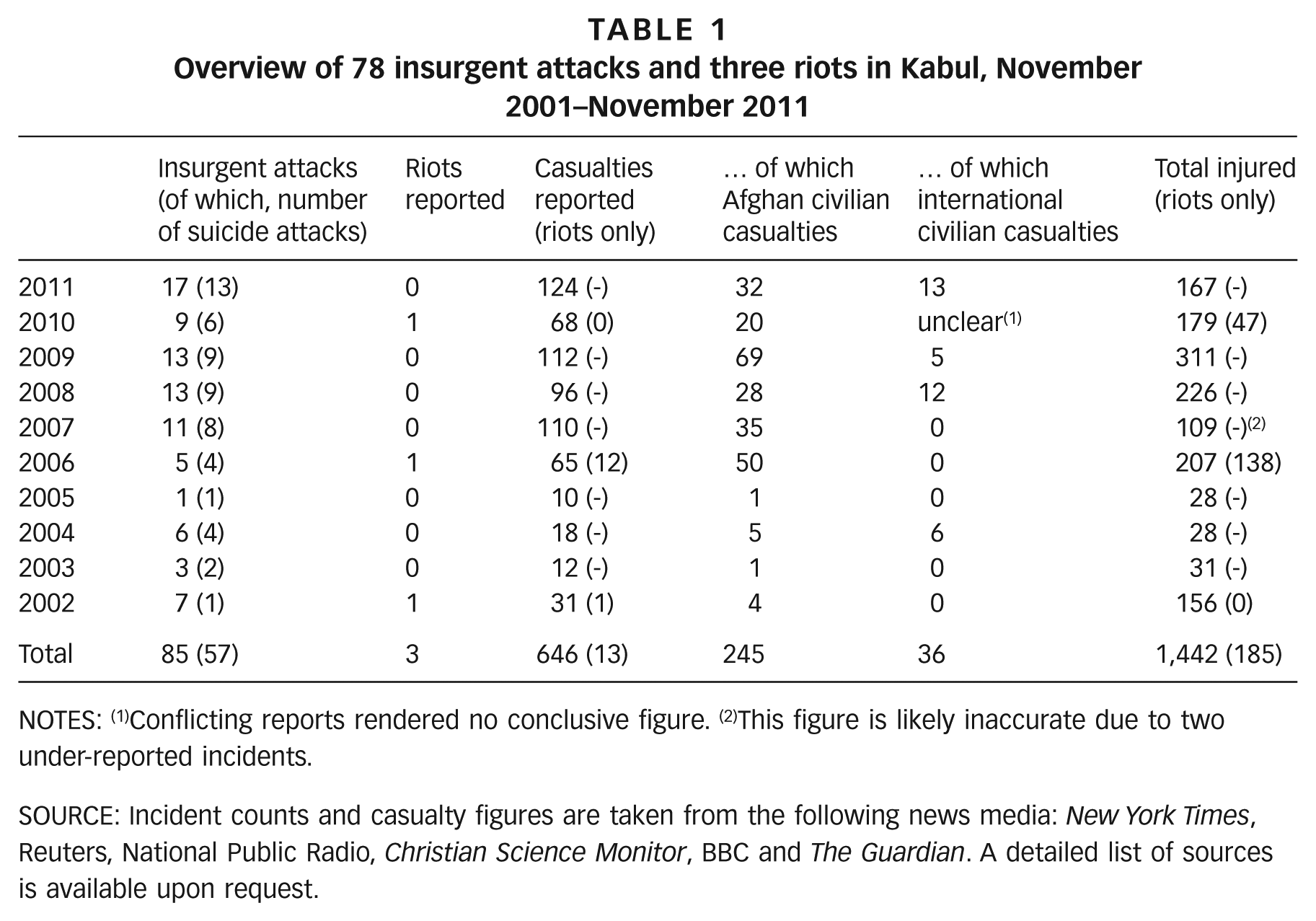
Keyword searches using the search terms “attack”, “riot” and “casualt*” in conjunction with “Kabul” were conducted in online repositories containing news articles published in The New York Times, Reuters, National Public Radio, Christian Science Monitor, BBC and The Guardian between November 2001 and November 2011. All relevant news articles were coded manually as follows: whether the incident was an insurgent attack or a riot; if carried out by insurgent forces, whether it was a suicide attack or not; the total number of casualties reported; the number of Afghan civilian casualties; and the number of international civilian casualties (if any). Table 1 provides an annual comparison of these variables. Figure 1 visualizes the timing, type and severity of each incident.
Overview of 78 insurgent attacks and three riots in Kabul, November 2001–November 2011
NOTES: (1)Conflicting reports rendered no conclusive figure. (2)This figure is likely inaccurate due to two under-reported incidents.
SOURCE: Incident counts and casualty figures are taken from the following news media: New York Times, Reuters, National Public Radio, Christian Science Monitor, BBC and The Guardian. A detailed list of sources is available upon request.
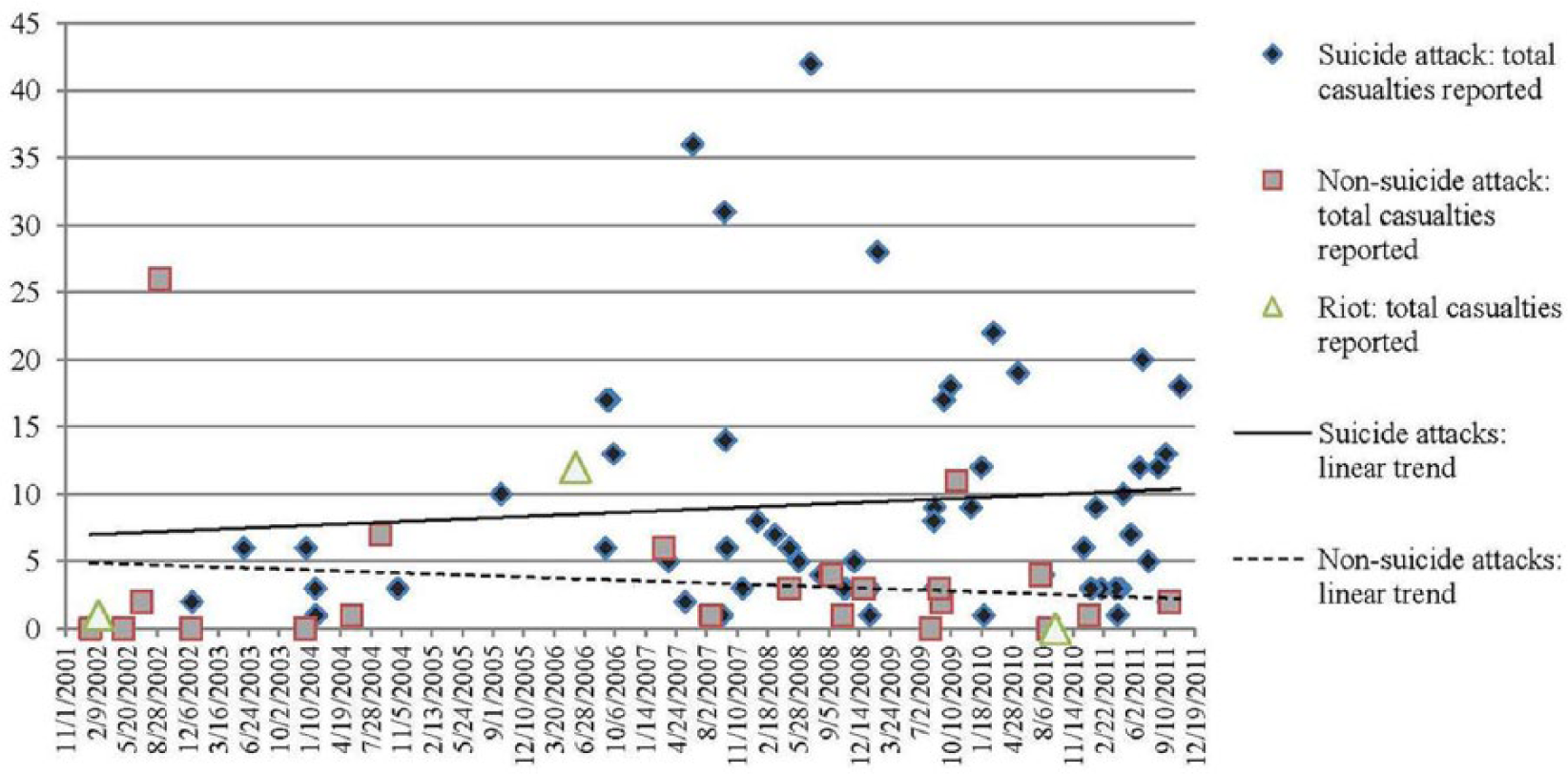
Timing, type and severity of 78 insurgent attacks and three riots in Kabul, November 2001–November 2011
Several observations can be made. Despite seasonal variability, the number of insurgent attacks carried out in Kabul between January 2002 (when the first such attack took place) and late 2011 forms a U-shaped curve, with 2005 constituting the turning point. With the exception of 2010, insurgent attacks in Kabul have since increased annually, and even in 2010, their incidence (nine) was higher than at any point between 2002 and 2004 (when they ranged between three and seven per year). This is consistent with similar findings by O’Loughlin et al. who, in their study of the spatial distribution of insurgent attacks in the Afghan-Pakistani frontier region, point to “… a high volume of violence in key urban centres (Kabul, Peshawar) that both lie close to the scene of greatest fighting but are also important administrative and iconic places.”(28) Both the number of suicide attacks and their share in total insurgent attacks increased steadily during the decade covered by the sample. Initially a rare occurrence, such attacks increased in the years from 2006 until 2011 to a total of 49. At the same time, only in 2002 did suicide attacks not account for at least two-thirds of all insurgent attacks carried out in the city. Meanwhile, only three riots in Kabul were reported during the period observed, in 2002, 2006 and 2010.
Casualty figures reflect this trend in insurgent attacks but fluctuate more widely; 2007, 2008, 2009 and 2011 were particularly lethal as a result of insurgent activity and also emblematic of a spread of insecurity “… geographically from the formerly insecure areas in the southeast to the west and north, including the capital Kabul.”(29) Civilian casualties – both Afghan and international – represented between one-third and more than two-thirds of all annual casualties since 2006, in contrast to 2002, 2003 and 2005 when only a small number of victims of insurgent attacks were non-combatants. Only in one year (2004) did the number of international civilian casualties surpass the number of Afghan civilians killed in Kabul. Riots led to a total of 13 casualties and 185 injured victims, none of them non-Afghan. In contrast, insurgent attacks resulted in 633 casualties and 1,257 injured victims, on average one casualty every six days and one wounded victim every three days during the decade under observation.
A conservative estimate of Kabul’s recent population ranges from roughly half a million under Taliban rule in early 2001 to more than three million inhabitants in 2011. In 2012–2013, the national government’s Central Statistics Organization (CSO) reported 3.31 million residents in Kabul proper.(30) However, since earlier annual statistics are unavailable, we can only calculate a lower and upper bound of insurgent attacks’ contribution to the city’s mortality rate (i.e., deaths per 1,000 individuals per year). Assuming that casualties were distributed evenly across the 10 years under observation, this contribution is 0.127 deaths per 1,000 individuals per year based on half a million inhabitants, and 0.021 deaths per 1,000 individuals per year if calculated based on three million inhabitants. Even if we base our estimates on an urban population size of 1.75 million in 2011 (i.e., the average during 2002–2011, which by all accounts is a conservative estimate) and calculate insurgent attacks’ contributions to mortality with that year’s annual casualty figure (n=124, the highest recorded during this period), the addition to general mortality in the city is merely 0.071. Likewise, insurgent attacks’ contribution to morbidity – when calculated based on the highest annual count of injured victims (n=311 in 2009) and an assumed population of 1.75 million dwellers – ranges around 0.178. Insurgent attacks’ contributions to both general mortality and morbidity in Kabul between 2002 and 2011 have thus been minute.
III. Prevalence of “Endemic” Violence in Post-invasion Kabul
In 2006, roughly five years after the invasion of Afghanistan in 2001, the United Nations Development Fund for Women (now the United Nations Entity for Gender Equality and the Empowerment of Women) raised alarm that “… domestic violence against Afghan women appears endemic …” and found that “… violence against women – whether sexual, physical or psychological – affects all branches of Afghan society.”(31) Although Kabul was “… a relatively ‘safe space’ [for Afghans] compared to most other places in Afghanistan”,(32) when the first Environment and Urbanization special issue on urban violence was published, “… certain forms of violence, such as domestic abuse”(33) were widespread. Already at that time, there was “… a general perception in Afghanistan that lawlessness is on the rise”(34) and, according to a local journalist, “… criminal activities, such as group sexual assaults on children, kidnappings and extortion by gangs of abductors have now become a more serious threat than that of the Taliban.”(35) Lamentably, Afghanistan’s Ministry of Interior only publishes nationally aggregated crime data. Formal as well as informal enquiries with various national and local government entities in Kabul were unsuccessful in obtaining location-specific records, and it is unclear whether these even exist. Furthermore, doubts about the veracity of published data prevail in light of the inaccessibility of many of the country’s provinces as well as persistent reluctance among victims to report crimes, especially when both victims and perpetrators belong to the same extended family or clan. Afghan tribal cultures are marked by long-standing traditions of settling even severe transgressions outside of formal court systems – which during most of the past century barely reached beyond urban centres. Crimes, therefore, often remain unaccounted for in government statistics. Nonetheless, we can discern different types of violent crimes reported nationally during 2004–2012, and then cautiously deduce some emerging trends.
As Table 2 and Figure 2 show, reported murders and violent injuries have moved in tandem. The Afghan calendar year 1386 (March 2007–March 2008) registered a spike in both types of crime, followed by a slight downward trend until March 2012–March 2013, when first the number of murders and then violent injuries increased dramatically. In contrast, the number of reported beatings has increased steadily since first being reported for the Afghan calendar year 1387 (March 2008–March 2009). Indeed, the figure for the year 1391 (March 2012–March 2013) is five times the figure for the year 1387. The incidence of reported beatings has thus quintupled in only five years of reporting.
Reported violent crimes, Afghanistan, March 2004–March 2013, Afghan calendar years 1383–1391
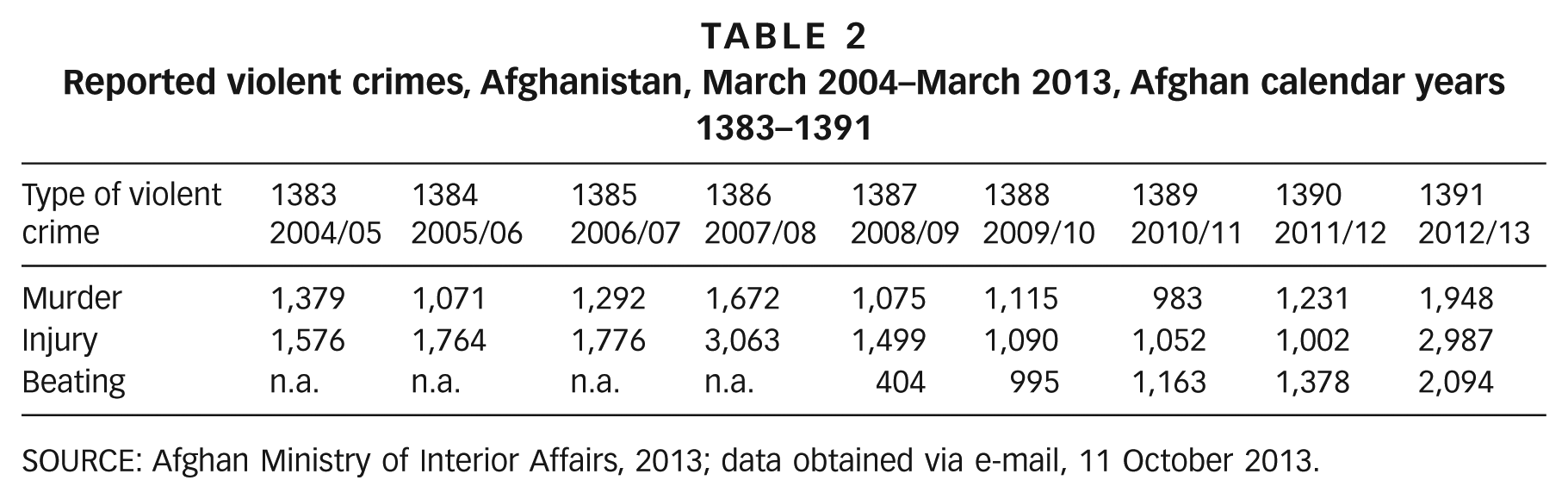
SOURCE: Afghan Ministry of Interior Affairs, 2013; data obtained via e-mail, 11 October 2013.
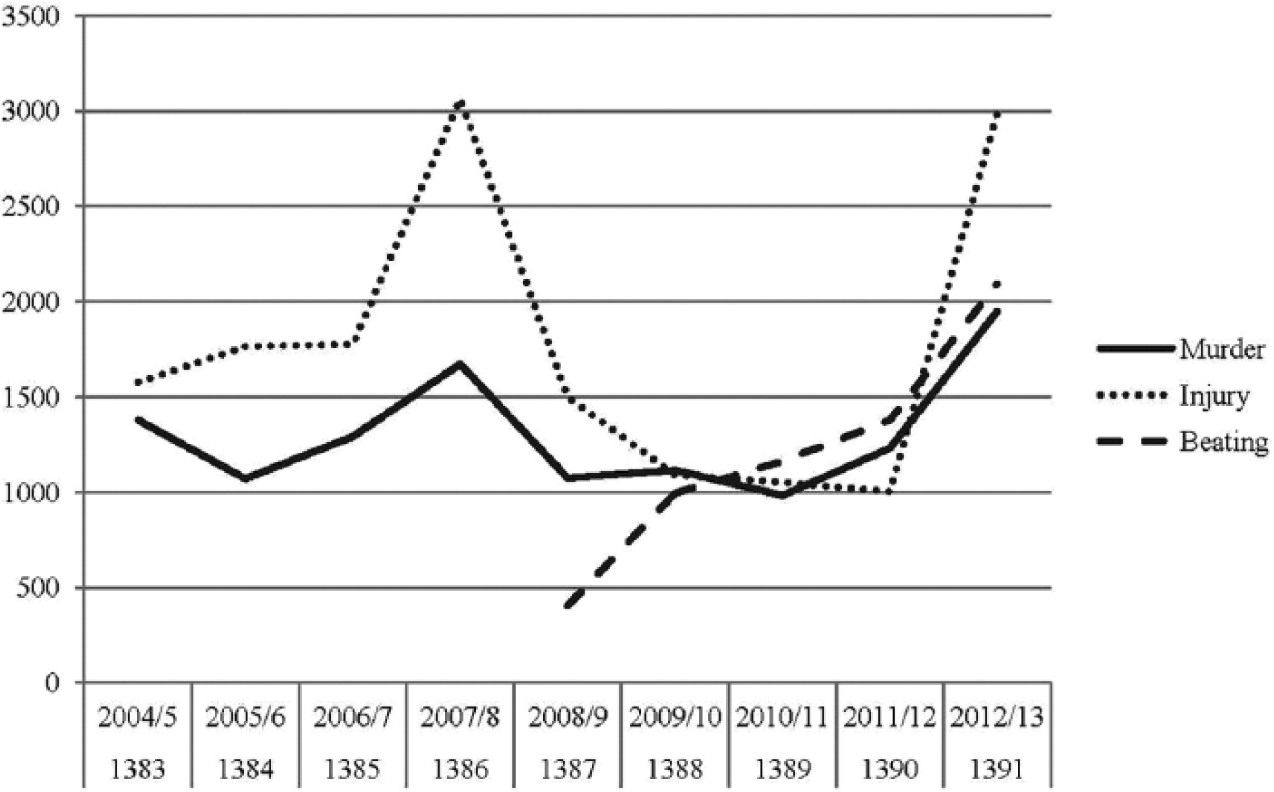
Trends in reported violent crimes, Afghanistan, March 2004–March 2013, Afghan calendar years 1383–1391
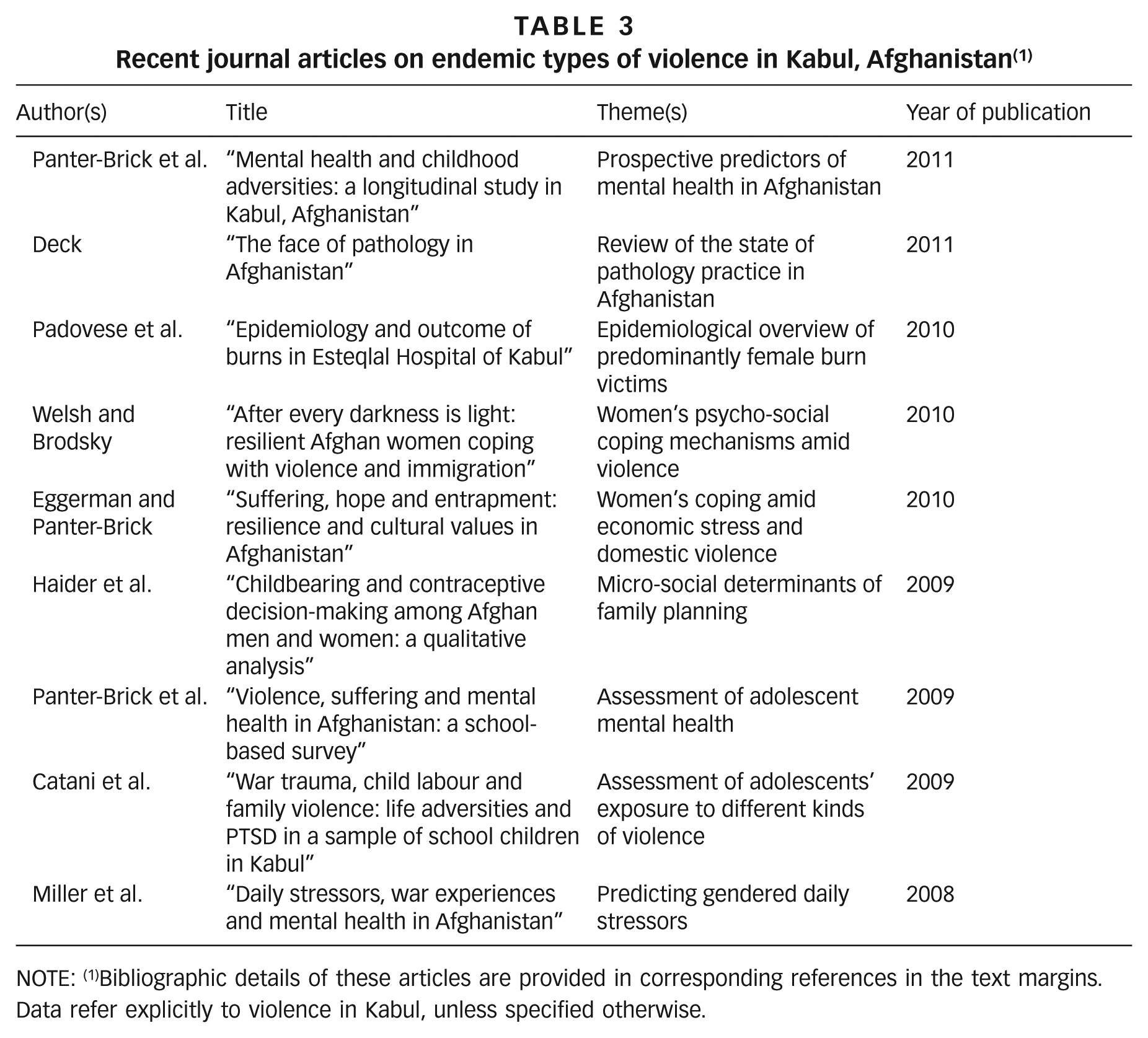
Since these statistics can only provide a highly speculative idea of the risks of victimization in Kabul, I seek to overcome this data-related challenge by reifying the types of endemic violence experienced by urban dwellers through a qualitative meta-analysis(36) of nine recent public health studies conducted in various neighbourhoods of the city proper. A detailed search in academic databases for articles reporting on different forms of interpersonal violence in Kabul and their effects rendered a total of 33 hits. Search terms included “violen*”, “beat*”, “trauma”, “threat”, “attack”, “tortur*”, “abus*”, “forc*” and “kill”. Five of these 33 hits pre-dated the 2001 invasion and were dropped from the meta-analysis, although insights from two of them – Faiz (1997)(37) and Palmer (1998)(38) – are included in the following section. Three articles could be retrieved neither electronically nor in hard copy and therefore had to be omitted. The remaining 25 articles were reviewed in depth and nine were classified as directly relevant. All of these nine articles explicitly discuss violence experienced by dwellers in Kabul. Table 3 provides an overview, ordered by date of publication.
Recent journal articles on endemic types of violence in Kabul, Afghanistan (1)
NOTE: (1)Bibliographic details of these articles are provided in corresponding references in the text margins. Data refer explicitly to violence in Kabul, unless specified otherwise.
Six of the nine articles discuss the effects of interpersonal violence on subjects’ mental health, and three of these six focus specifically on children. Research on violence presented in the other three articles was conducted in clinical contexts. One of them presents an overview of pathological practice; the second reports on violence-related topics observed in a clinic treating severe burns; the third discusses micro-social determinants of family planning but also comments on interpersonal violence in this context.
The most prominent theme emerging from these nine studies is the ubiquity of violence against children in the privacy of homes, perpetrated in the majority of cases by close family members. Catani et al. report:
“Lifetime exposure to violence experienced at home was high, with 77 per cent of children [71.3 per cent [of the] girls, 81.3 per cent of the boys] reporting at least one event type in the family violence spectrum. […] In addition, ongoing violence at home appeared to be common, with 35.2 per cent of the interviewed children [35.3 per cent of the girls, 35.1 per cent of the boys] having experienced or witnessed at least one aversive event in the last month. […] Eleven per cent of the children had suffered at least one injury [bruises, bleeding and broken bones] because of the violent treatment at home, and nine per cent of them had needed medical treatment on at least one occasion. […] 41.6 per cent of the children reported being beaten by the father, 59.9 per cent said they were beaten by the mother and in 37.8 per cent of the cases the child was also beaten by an older sibling. In addition, 31.5 per cent of the children had witnessed their mother being beaten by the father.”(39)
Catani et al. found the risk of boys being subjected to severe beatings outside of private homes and war-related violence to be between two and three times higher, respectively, than girls. The authors explain this by pointing to “… cultural characteristics of Afghan Muslim families where girls more than boys are mostly kept inside the house, thereby diminishing their risk of exposure to traumatic events such as war or community violence in the streets.”(40)
Another study of violence against children and youth in Kabul reports that “… young Afghans’ experience [of] violence […] is persistent and not confined to acts of war …”, and emphasizes “… the importance of understanding trauma in the context of everyday forms of suffering, violence and adversity.”(41) Its authors stress that “… beatings by close relatives or neighbours greatly outnumbered war-related events [involving landmines or combat] in reports of severe physical injury.”(42) Such experiences of domestic beatings were also found to be a consistent statistical predictor “… of changes in mental health trajectories, even in a context of ongoing exposure to war-related violence.”(43) Moreover, juvenile respondents covered in a subsequent study by the same authors “… clearly articulated linkages between abusive interpersonal relationships and the enormous pressure of socioeconomic stressors and political insecurity.”(44) Although not a dominant theme in the nine articles reviewed here, such causal links between micro-level violence and meso-level insecurity are also mentioned by Deck, who reports that one of his (male) respondents was experiencing severe mental stress as a result of receiving “… death threats for working with Westerners.”(45)
Among adults, women are much more likely to be victimized. Miller et al.,(46) Haider et al.(47) and Welsh and Brodsky(48) all highlight restrictive effects of resilient cultural norms whose violation triggers violent reactions. Even perceived “… failure to ‘serve’ their husband’s family”(49) might cause severe beatings, or worse. In such instances, “… women, who have few places to take shelter from [domestic] violence, resort to self-immolation in extreme cases.”(50) Miller et al. also report an “… increasingly common experience of sexual assault since the fall of the Taliban.”(51) In light of these findings, cautious hope in the wake of the 2001 invasion that Kabul could once again become “… a relatively ‘safe space’”(52) for vulnerable groups such as women and children of both sexes has not materialized. Yet this prevailing insecurity affecting local dwellers is not driving the depiction of the city as violent. In fact, continuing abuse of women and children has received virtually no international media attention, arguably because it contradicts the discursive frame employed by occupying forces. These frames merit further inquiry since they produce an exaggerated visibility of foreign casualties while eclipsing the primary drivers of mortality and morbidity in Kabul.
IV. The Scalar Politics of Security
In late 2010, the North Atlantic Treaty Organization’s (NATO) top civilian representative in Afghanistan, Mark Sedwill, went on a children’s television programme in the United Kingdom and shared his perception of violence in Kabul. According to an Associated Press news clipping:
“Sedwill said violence has been on the decline in the Afghan capital. […] ‘The children are probably safer here than they would be in London, New York or Glasgow or many other cities’ Sedwill said. ‘Most children can go about their lives in safety. It’s a very family-oriented society. So it is a little bit like a city of villages’.”(53)
Drawing criticism from human rights activists as well as from members of Glasgow City Council, Sedwill sought to clarify his remarks by arguing that he had merely wanted to illustrate that some regions of the country were more stable than others. And yet, Sedwill maintained that “… in cities like Kabul where security has improved, the total levels of violence, including criminal violence, are comparable to those which many western children would experience.”(54) Sedwill’s baseless narrative of Kabul as a safe space for children gives important insights into the discursive framing of security in the city. First, it has a reactive quality in that it implicitly addresses accusations of globally “… highly uneven geographies of humanitarian intervention and protection”(55) by claiming that those most vulnerable have, in fact, benefited directly from an international military invasion that was “… scripted as a rescue mission to liberate Afghans, especially women, from conditions of oppression.”(56) Moreover, perpetuating an imaginary of Kabul as a safe space also addresses foreign policy hawks’ interest in regime change, not only to expunge a hotbed of radical Islamism harbouring terrorists but also to install an Afghan government that is more predictable and controllable. A US counter-insurgency field manual from 2007 reflects this interest, stating that “… the host nation will not gain legitimacy if the populace believes that insurgents and criminals control the streets.”(57) As Moncada rightly points out: “… constructing localized orders in densely populated urban centres rather than sparsely populated and remote rural enclaves presents both states and local armed actors with a range of distinct challenges and opportunities.”(58) The imagined reduction in violence against ordinary dwellers in Kabul has thus been leveraged politically to illustrate non-military as well as military “successes”.
In addition, the narrative serves to reinforce the argument that Kabul was to be secured before it could be developed. This concealed inherent contradictions between highly ambitious plans and programmes seeking to transform Afghanistan into a formal market economy and functioning democracy on the one hand, and international toleration of rampant corruption, electoral fraud and a rapidly recovering illicit economy on the other.(59) Drivers of endemic violence have remained largely unchecked because they challenge the “mirage of peace”.(60) Pointing to insurgent forces as the main perpetrators of urban violence reduces violent dynamics in Kabul to a binary that pits rural traditionalists against city-dwelling progressive forces. Whereas incisions into the city’s economic structure were deliberately deep and transformational,(61) attempts to sensitize dwellers to the role of traditional values and customs in causing victimization were considered tangential to the international state-building agenda. This false dichotomy between peace-seeking, modernity-embracing Afghans and radicalized Taliban trivializes other salient forms of violence that are complicated, institutionalized, and thus intractable.
A potential challenge to this argument arose in the run-up to Afghanistan’s second presidential elections in 2009. Already regarded with suspicion by his erstwhile supporters in Washington DC and Langley VA, as well as facing mounting domestic scepticism, President Karzai decided to cajole Afghanistan’s Shi’ite minority by expressing political support for an initiative by a group of Shi’ite clerics. It entailed a revision of the marriage law for Shi’ite couples by prescribing a weekly minimum intercourse frequency, thus practically proposing the legalization of domestic rape. The revised law would also have sanctioned slavery by allowing Shi’ite men to prevent their wives from leaving their homes. However, as soon as Karzai’s intention to sign the bill into law had received considerable international news coverage, US President Obama as well as several European heads of state contacted the Afghan president, and NATO threatened to revisit previously agreed-upon procurement and training contracts. While it may appear that these reactions could signify actual high-level commitment to preserving basic human rights for Shi’ite women in Afghanistan, they fit just as neatly into the previously sketched interpretive frame of the international community as the liberator of Afghan women. After all, the US administration was content to embrace early praise suggesting that although “… America did not go to war in Afghanistan so that women there could once again feel the sun on their faces, […] the reclaimed freedom of Afghan women is a collateral benefit that Americans can celebrate.”(62) And yet, the meta-analysis demonstrates that this freedom is relative. Even in the country’s securitized capital city, women continue to suffer from domestic abuse inflicted in the micro spaces of the home that an international invasion cannot occupy, let alone secure.
My argument here is not that post-invasion levels of violence in Kabul have been any “worse” or “better” than during the preceding Taliban regime. We must not forget the harrowing tales of “… Afghan women […] regularly beaten for walking on the street without a male chaperone, […] not wearing a burqa”(63) or even failing to fully cover her ankles.(64) Female medical professionals were reported to having been “… forced to witness beatings of female colleagues by Taliban guards [or] a pregnant woman deliver[ing] her baby in a Kabul street while her husband was being beaten by [Taliban] guards for taking her to a hospital.”(65) In extreme cases, female offenders were publicly stoned.(66) However, while such crimes against women committed during the reign of the Taliban featured prominently in global media at the time, contemporary gendered violence receives virtually no international press coverage. The case of urban violence in Kabul exemplifies that discursively constructed notions, objects and measures of security produce “… inevitable winners and losers. The distribution of economic and political results in global politics depends heavily on the location at which global politics operates.”(67) Notably, this also holds true for local effects in the absence of global influences. Following the takeover of Kabul by the Taliban, Moller Okin quoted from a New York Times article in which “… the [male] medical director of a hospital in Kabul [had reportedly said] that the restrictions placed on women [by the Taliban] had been ‘a small price to pay for the peace’ that [their] victory had secured.”(68) With internationally induced regime change and the ensuing occupation, the locations where notions, objects and measures of local “security” are produced discursively are elevated to the global scale, which renders local perspectives largely invisible. For instance, recent reports suggest that for a large number of city dwellers, “security” relates primarily to a reduction of economic vulnerabilities and a growing demand to rein in the effects of growing economic inequality that result directly from the international occupation. “Of the less than 40 per cent [of US$ 70 billion disbursed for Afghan reconstruction] allocated to non-security expenditures …”, del Castillo points out that “… the large majority benefited a small elite in the urban areas or has been wasted trying to rebuild infrastructure and other projects in insecure areas.”(69) Even though “… many Afghans do fear violence after 2014” …”, according to Simcock, “… their focus is on something far more relatable: recession.”(70) Real estate prices, which peaked during the occupation as a result of sustained international demand for both large and lavish mansions and offices, have been in decline ever since 2014 was announced as the year of the international military drawdown. International emphasis on spectacular violence in Kabul has thus not only hampered potential inroads to diminishing the incidence of endemic forms of violence in the city; it has also reduced the visibility of local concerns reflecting a broader conceptualization of human security.
V. Conclusions
I hope to have demonstrated in this article that an investigation of different types of violence and the discourses that connect them to global–local power relations allows us to discover “… the scale at which security is conceived”(71) and thus to contribute to an emerging “… scale-based ontology of global politics.”(72) The scalar politics of security that have played out on the Kabuli stage since late 2001 have been disembedded from the local context to which they have subsequently been applied. Spectacular acts of violence carried out in Kabul have served as strategic means for furthering political agendas that transcend the urban scale by attempting to signal influence where influence is de facto limited.(73) At the same time, they have allowed international governments to demand greater control over urban governance and services (including security)(74) while neglecting drivers of mortality and morbidity in the city that challenge the ethical and political justifiability of forced regime change.
Looking ahead, “… disaggregat[ing] the broader notion of security to a finer scale at which smaller political constituencies and vulnerable groups become visible and their security a public matter of concern”(75) remains a promising ontological as well as methodological strategy. It reminds us that Marston’s plea for recognizing both households and the individual body as political scales has lost nothing of its urgency precisely because the latter easily drop from sight in global affairs.(76) Of course, we must not assume that locally constructed notions of security are necessarily more inclusive; the reign of the Taliban is a case in point. Nonetheless, instead of rendering victimization invisible in order to construct the mirage of a success story, the international community ought to concede acknowledge the stickiness of cultural norms both as shapers of local realities and constraints to policy effectiveness in the context of increasingly securitized development efforts in an ever-more urbanized global South.
Footnotes
Acknowledgements
The author gratefully acknowledges the many excellent comments on an earlier version of the manuscript received during the 2011 Watson Institute Conference on Violent Cities: Challenges of Democracy, Development and Governance in the Urban Global South, organized by Richard Snyder and Eduardo Moncada at Brown University. Thanks also go to Cathy McIlwaine and Caroline Moser for their editorial guidance and patience, as well as to two anonymous reviewers for encouraging and constructive feedback. Elizabeth Leonhardt, Patricia S Ward and Mariam Wafa provided outstanding research assistance. Jed B Byers expertly copy edited the manuscript for submission. The author assumes responsibility for any remaining errors.
1.
Steger, Manfred B (2008), The Rise of the Global Imaginary: Political Ideologies from the French Revolution to the Global War on Terror, Oxford University Press, Oxford, 336 pages; also Andreas, Peter and Kelly M Greenhill (editors) ( ), Sex, Drugs and Body Counts: The Politics of Numbers in Global Crime and Conflict, Cornell University Press, Ithaca, 287 pages.
2.
Rondinelli, Dennis A and John D Montgomery (2005), “Regime change and nation-building: can donors restore governance in post-conflict states?”, Public Administration and Development Vol 25, No 3, pages 15–23.
3.
Ahmed, Azam and Matthew Rosenberg (2014), “Deadly attack at Kabul restaurant hints at changing climate for foreigners”, The New York Times, 19 January, page A8, available at .
5.
National Public Radio (2009), “Afghans cope with violence in Kabul”, NPR, 31 October, available at .
6.
See reference 3.
7.
Doucet, Lyse (2014), “Lebanese owner who died defending Kabul restaurant”, BBC, 17 January, available at .
8.
Associated Press (2014), “Afghan official says nine people, including four foreigners, killed in attack on Kabul hotel”, 20 March, accessed 15 May 2014 at .
9.
Sjoberg, Laura (2008), “Scaling IR theory: geography’s contribution to where IR takes place”, International Studies Review Vol 10, No 3, pages 472–500.
10.
Hyndman, Jennifer (2008), “Conflict, citizenship and human security: geographies of protection”, in Deborah Cowen and Emily Gilbert (editors), War, Citizenship, Territory, Routledge, New York, pages 241–257; also Hyndman, Jennifer (2004), “Mind the gap: bridging feminist and political geography through geopolitics”, Political Geography Vol 23, No 3, March, pages 307–322.
11.
According to Stones (2012), “… disembedding refers to the way in which contemporary social practices can no longer be primarily defined by their grounding, or embeddedness, in the local context of a restricted place and time. Social practices are now, in large part, removed from the immediacies of context, with the relations they involve typically being stretched over large tracts of time and space. Local experiences and events are shaped by processes taking place on the other side of the world and vice versa. These are processes, moreover, that are primarily impersonal and abstract.” See Stones, Rob (2012), “Disembedding”, in George Ritzer (editor), The Wiley-Blackwell Encyclopaedia of Globalization, Wiley, Indianapolis IN (n.p.).
12.
See reference 9, page 480; also Montello, Daniel R (2001), “Scale in geography”, in Neil J Smelser and Paul B Baltes (editors), International Encyclopaedia of the Social and Behavioural Sciences, Pergamon Press, Oxford, pages 13501–13504.
13.
Brenner, Neil (1998), “Between fixity and motion: accumulation, territorial organization and the historical geography of spatial scales”, Environment and Planning D: Society and Space Vol 16, No 4, page 464; also Pierce, Joseph, Deborah G Martin and James T Murphy (2011), “Relational place-making: the networked politics of place”, Transactions of the Institute of British Geographers Vol 36, No 1, January, pages 54–70.
14.
Harvey, David (2004), “The ‘new’ imperialism: accumulation by dispossession”, Socialist Register Vol 40, pages 63–87.
15.
Esser, Daniel (2013), “The political economy of post-invasion Kabul, Afghanistan: urban restructuring beyond the North–South divide”, Urban Studies Vol 50, No 15, pages 3084–3098; also Verkoren, Willemijn and Bertine Kamphuis (2013), “State-building in a rentier state: how development policies fail to promote democracy in Afghanistan”, Development and Change Vol 44, No 3, pages 501–526; Calogero, Pietro (2011), “Kabul cosmopolitan: geopolitical empire from the planner’s viewpoint”, Planning Theory Vol 10, No 1, pages 66–78; and Esser, Daniel (2009), “Post-war political restructuring in Freetown and Kabul: theoretical limits and the test case for multiscalar governance”, Critical Planning Vol 16, Summer, pages 80–97.
16.
Durán-Martínez, Angelica (2011), “Violence in Juárez, Culiacán and Tijuana”, presentation at the Watson Institute’s Conference on Violent Cities: Challenges of Democracy, Development and Governance in the Urban Global South, 28 April, Brown University, Providence RI.
17.
Juris, Jeffrey S (2005), “Violence performed and imagined: militant action, the black bloc and the mass media in Genoa”, Critique of Anthropology Vol 25, No 4, pages 413–432.
18.
Rhodes, Joel (2001), The Voice of Violence: Performative Violence as Protest in the Vietnam Era, Praeger, Santa Barbara, 240 pages.
19.
See reference 17, page 415.
20.
Scheper-Hughes, Nancy (2008), “A talent for life: reflections on human vulnerability and resilience”, Ethnos Vol 73, No 1, pages 25–56; also Scheper-Hughes, Nancy (1993), Death without Weeping: The Violence of Everyday Life in Brazil, University of California Press, Berkeley, 614 pages.
21.
Goldstein, Daniel M (2004), The Spectacular City: Violence and Performance in Urban Bolivia, Duke University Press, Durham, page 208.
22.
See reference 21.
24.
Brown, Oli and Alec Crawford (2009), “Rising temperatures, rising tensions: climate change and the risk of violent conflict in the Middle East”, International Institute for Sustainable Development, Winnipeg, page 9, available at http://www.iisd.org/pdf/2009/rising_temps_middle_east.pdf ; also Khagram, Sanjeev, William C Clark and Dana Firas Raad (2003), “From the environment and human security to sustainable security and development”, Journal of Human Development Vol 4, No 2, pages 289–313.
26.
Swyngedouw, Eric (1997), “Neither global nor local”, in Kevin R Cox (editor), Spaces of Globalization: Reasserting the Power of the Local, The Guilford Press, New York, page 141.
27.
Moe, Terry M (2005), “Power and political institutions”, Perspectives on Politics Vol 3, No 2, pages 215–233.
28.
O’Loughlin, John, Frank D W Witmer and Andrew M Linke (2010), “The Afghanistan–Pakistan wars, 2008–2009: micro-geographies, conflict diffusion and clusters of violence”, Eurasian Geography and Economics Vol 51, No 4, page 466.
29.
Mullen, Rani D (2010), “Afghanistan in 2009: trying to pull back from the brink,” Asian Survey Vol 50, No 1, page 128.
30.
31.
UN News (2006), “Domestic violence in Afghanistan is ‘endemic’, perpetrators go unpunished – UN study”, UN News Centre, 14 August, available at amp;">http://www.un.org/apps/news/story.asp?NewsID=19512&.
32.
Esser, Daniel (2004), “The city as arena, hub and prey: patterns of violence in Kabul and Karachi”, Environment and Urbanization Vol 16, No 2, page 33.
33.
See reference 32, page 35.
34.
ICG (2008), “Policing in Afghanistan: still searching for a strategy”, International Crisis Group, Asia Briefing No 85, 18 December, page 5, available at .
35.
See reference 34, page 6.
36.
Greenland, Sander and Keith O’Rourke (2008), “Meta-analysis”, in Kenneth J Rothman, Timothy L Lash and Sander Greenland (editors), Modern Epidemiology, third edition, Lippincott, Williams and Wilkins, Philadelphia, pages 652–682.
37.
Faiz, Abbas (1997), “Health care under the Taliban”, The Lancet Vol 349, No 9060, pages 1247–1248.
38.
Palmer, Caitriona (1998), “The Taliban’s war on women”, The Lancet Vol 352, No 9129, page 734.
39.
Catani, Claudia, Elisabeth Schauer, Thomas Elbert, Inge Missmahl, Jean-Paul Bette and Frank Neuner (2009), “War trauma, child labour and family violence: life adversities and PTSD in a sample of school children in Kabul”, Journal of Traumatic Stress Vol 22, No 3, pages 166–167.
40.
See reference 39, pages 168–169.
41.
Panter-Brick, Catherine, Mark Eggerman, Viani Gonzalez and Sarah Safdar (2009), “Violence, suffering and mental health in Afghanistan: a school-based survey”, The Lancet Vol 374, No 9692, page 807.
42.
See reference 41, page 813.
43.
Panter-Brick, Catherine, Anna Goodman, Wietse Tol and Mark Eggerman (2011), “Mental health and childhood adversities: a longitudinal study in Kabul, Afghanistan”, Journal of the American Academy of Child and Adolescent Psychiatry Vol 50, No 4, April, page 361.
44.
See reference 43, page 360.
45.
Deck, John H N (2011), “The face of pathology in Afghanistan in 2006–2007”, Archives of Pathology and Laboratory Medicine Vol 135, No 2, page 181.
46.
Miller, Kenneth E, Patricia Omidian, Andrew Rasmussen, Aziz Yaqubi and Haqmal Daudzai (2008), “Daily stressors, war experiences and mental health in Afghanistan”, Transcultural Psychiatry Vol 45, No 4, pages 611–638.
47.
Haider, Sadia, Catherine Tood, Malalay Ahmadzai, Shakira Rahimi, Pashtoon Azfar, Jessica L Morris and Suellen Miller (2009), “Childbearing and contraceptive decision-making among Afghan men and women: a qualitative analysis”, Health Care for Women International Vol 30, No 10, pages 935–953.
48.
Welsh, Elena A and Anne E Brodsky (2010), “After every darkness is light: resilient Afghan women coping with violence and immigration”, Asian American Journal of Psychology Vol 1, No 3, pages 163–174.
49.
Eggerman, Mark and Catherine Panter-Brick (2010), “Suffering, hope and entrapment: resilience and cultural values in Afghanistan”, Social Science and Medicine Vol 71, No 1, page 80.
50.
Padovese, Valeska, Raffaele De Martino, M Ali Eshan, Vincenzo Racalbuto and M Arif Oryakhail (2010), “Epidemiology and outcome of burns in Esteqlal hospital of Kabul, Afghanistan”, Burns: Journal of the International Society for Burn Injuries Vol 36, No 7, pages 1101–1106; also see reference 49, page 80.
51.
See reference 46, page 627.
52.
See reference 32, page 33.
53.
Associated Press (2010), “Kabul not that dangerous for kids, NATO official says”, Associated Press, 22 November, available at .
54.
The Independent (2010), “Nato representative clarifies ‘safe Kabul’ comments”, 22 November, available at .
57.
Sewall, Sarah, John A Nagl, David H Petraeus and James F Amos (2007), The US Army/Marine Corps Counter-insurgency Field Manual, University of Chicago Press, Chicago, page 231.
58.
Moncada, Eduardo (2013), “The politics of urban violence: challenges for development in the global South”, Studies in Comparative International Development Vol 48, No 3, page 228.
60.
Johnson, Chris and Jolyon Leslie (2004), Afghanistan: The Mirage of Peace, Zed Books, London, 237 pages.
62.
The New York Times (2001), “Liberating the women of Afghanistan”, Editorial, 24 November, page 26, available at .
63.
See reference 38, page 734.
64.
Salahuddin, Sayed (1997), “Afghanistan: Taleban beat Afghan woman over bare ankles”, in Marie-Aimée Hélie-Lucas and Harsh Kapoor (editors), Women Living under Muslim Laws, Dossier 18, International Solidarity Network of Women Living Under Muslim Laws, Grabels, France, page 126.
65.
See reference 37, page 1248.
66.
Hernández-Truyol, Berta Esperanza (1997), “Sex, culture and rights: a re/conceptualization of violence for the twenty-first century”, Albany Law Review Vol 60, pages 607–634.
67.
See reference 9, page 481.
68.
Moller Okin, Susan (1998), “Feminism, women’s human rights and cultural differences”, Hypatia Vol 13, No 2, page 37.
69.
del Castillo, Graciana (2014), “Afghanistan’s misguided economy”, Boston Review of Books, 28 January, available at .
70.
Simcock, Julian (2013), “Kabul’s economy is worse than its security issues”, The Atlantic, 5 April, available at .
72.
See reference 9, page 473.
73.
Weinstein, Liza (2011), “Slum violence in Mumbai”, presentation at the Watson Institute’s Conference on Violent Cities: Challenges of Democracy, Development and Governance in the Urban Global South, 28 April, Brown University, Providence RI.
75.
See reference 10, Hyndman (2004), page 313; also see reference 10, , pages 241–242.
76.
Marston, Sallie A (2000), “The social construction of scale”, Progress in Human Geography Vol 24, No 2, pages 219–242.