




Abstract
This paper responds to Vanessa Watson’s article on the inappropriate urban development plans that are increasingly common in sub-Saharan Africa as governments seek to make their cities “world class”. It describes how the government of Angola has been able to use financing from Chinese credit facilities to build prestige projects that include support for the public-privately developed Kilamba city with 20,000 apartments. The apartments were initially too expensive for most of the population, and the state has had to draw further funds from its housing budget for a subsidized rent-to-purchase scheme to make the units affordable for middle-level civil servants. The author argues that an opportunity is being missed to use today’s income from high-priced natural resources and the current easy access to Chinese credit lines and technical expertise to address the very large backlogs in urban upgrading of basic service infrastructure and housing for the poor. The paper also reflects on a previous post-independence period when a number of African new cities were built, leaving some countries with decades of debt and stagnant development. Can errors from the past offer lessons for future African urban development?
I. Introduction
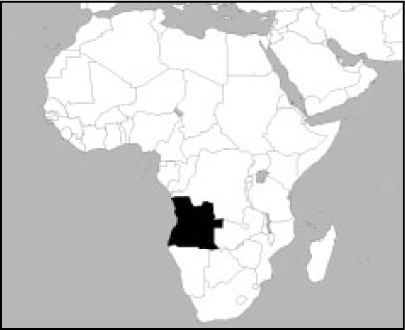
I am writing this in response to Vanessa Watson’s excellent recent article, “African urban fantasies: dreams or nightmares?”(1) I approach the topic with an on-the-ground perspective from Luanda, Angola, a city where one of the fantasies discussed by Professor Watson has developed beyond a dream to become a reality.
A little over a decade ago, Angola emerged from a protracted conflict dating back to the early 1960s. That conflict arrested economic development for 40 years but also caused a massive shift of population to the cities. This, in turn, led to a huge pent-up demand for housing and basic services in the overcrowded cities. The same period has also seen a significant rise in the value of Angola’s commodity exports, and newly available low-cost credit from China has created an opportunity to finance urban dream projects.
I agree with Professor Watson that investment by international property companies in large-scale, citywide projects is relatively recent. However, talk of African urban fantasies finds echoes in another era almost 50 years in the past. It was shortly after many African countries achieved independence that some of their leaders, finding themselves with easy access to low-cost financing, were enticed to invest in the construction of new cities. In the 1960s and early 1970s, the governments of Botswana, Malawi, Mauritania, Nigeria and Tanzania all initiated massive capital city relocation projects. Strong nationalist arguments were used to justify these very expensive initiatives. It was argued, for example, that shifting the urban locus of power from the coast to the interior would stimulate the economy of neglected central regions. But, most importantly, these new cities were built for symbolic reasons related to national pride and to make a decisive break from the colonial past. The new African urbanism of the 1960s reflected development theories prevalent at the time, particularly the use of so-called growth poles as a means of alleviating regional disparities.(2) Governments aspiring to build new capitals for political reasons readily adopted the theoretical arguments that justified the massive expenditures, and the equally massive borrowing from international lenders, that the projects required. These new urban centres were built primarily to accommodate state administrative functions and many had little or no economic impact on the underdeveloped regions where they were built.(3) While ostensibly demonstrating some of the most progressive theories of the day in urban design – theories that were promoted by financial intermediaries and by foreign engineering firms that stood to make large profits from the projects – the new cities often turned out to be expensive mistakes that diverted investment from potentially more sustainable economic and social projects. Moreover, these projects left some of the countries that initiated them with a burden of debt that inhibited national development for a generation or more.
Much of the financing for these post-independence new urban projects took the form of concessionary loans that had to be paid back with interest. The persistence of negative real interest rates in the 1960s and early 1970s made it economically attractive for low- and middle-income countries to borrow externally for both development and consumption rather than to save or attract investment. This was an era of relatively high commodity prices, which further encouraged a number of ambitious African governments to over-borrow at subsidized rates to invest in prestigious but often “useless urban projects”.(4) However, the oil crisis of 1979 resulted in a global tightening of monetary policy. For low- and middle-income countries, this meant that loans made previously on more generous terms were now transformed by being assigned floating and rising interest rates. Africa’s growth had picked up during the oil boom of the 1970s but slowed dramatically when oil and other commodity prices collapsed during the subsequent two decades.(5) The poverty levels of African debtor countries jumped and growth rates plummeted. By the late 1980s, mounting interest payments resulted in a reverse cash flow from low- to high-income countries.(6)
II. Development in angola since 2000
The post-2000 decade has been similar in some ways to the early 1970s. Africa has once more benefited from the surge in commodity prices and declining interest rates. For countries that are oil producers, the price of oil rose from less than US$ 20 a barrel in 1999 to more than US$ 100 in 2013. Prices for minerals, grain and other raw materials also soared with rising global demand, and Africa is likely to continue to profit from rising global demand for oil, natural gas, minerals, food and arable land.(7) The new urbanism that Professor Watson speaks about is an emerging phenomenon coinciding with this recent period of growth.
Angola’s economy has grown almost 10-fold since its civil war ended in 2002. Thanks chiefly to the demand for oil, the country’s growth rate peaked at more than 20 per cent in 2007 and has averaged a respectable seven per cent over the past decade. Poverty reduction, though, has been less impressive, with the government locked into its trickle-down development model. It has been access to Chinese credit, however, that has allowed Angola to become a pioneer of the new urbanism in Africa.
Angola leads the list of China’s principal African trading partners, followed by South Africa, Sudan, Nigeria and Egypt. China’s African engagement is largely state-to-state, involving the purchase of extractive resources and the provision of investment credits for infrastructure and construction. The Africa–China partnership was mapped out and endorsed by 48 African countries at the Beijing Summit of the Forum on China–Africa Cooperation (FOCAC) in November 2006. Chinese export credits and concessional loans are provided for the support of large infrastructure projects and can be accessed by African states and parastatal entities through China’s state-owned and private enterprises. China’s infrastructure investments in Africa are often associated with the construction of high-profile government buildings and national stadiums. The state-to-state nature of such loans and their lack of transparency have led to criticism in the western media.(8) Chinese construction companies had won African contracts valued at more than US$ 29 billion by the end of the first year following the signing of the FOCAC. Chinese investment in Africa grew at an annual rate of 20.5 per cent between 2009 and 2012, when it reached more than US$ 21 billion. By its own account, China’s Ministry of Commerce registered at least 2,000 Chinese firms working in Africa, with an additional 2,372 projects having official, government-sanctioned status.(9)
Drawing on its own experience of building mega-urban projects such as the new city of Shenzhen, China has become the epicentre of the neo-urbanization process that is being strongly promoted in Africa. David Harvey notes that: “China’s influence has become genuinely global, partly through the integration of financial markets that have used their flexibility to debt-finance urban development around the world. Mega-urbanization projects first emerged in the Middle East in places such as Dubai and Abu Dhabi, mopping up the surplus arising from oil wealth in the most conspicuous, socially unjust and environmentally wasteful ways possible. Immense fortunes have been generated for the financial intermediaries who matched easily accessed financing to surplus housing demand.”(10)
For a war-devastated country such as Angola, access to Chinese investment offers a unique opportunity to rebuild national infrastructure. Access to conventional western reconstruction aid was denied to Angola after repeated appeals to the international community.(11) In 2004, Angola turned to the Chinese and accepted the offer of a US$ four billion credit line that was rolled over several times and is currently worth more than US$ 15 billion.(12) Much of the Chinese financing has been used to rebuild the country’s damaged transport infrastructure, which is critical for the free movement of goods and people to the war-affected central and eastern provinces. However, substantial investments have been made in prestige projects as well, such as new, over-sized airports and sports stadiums. Long-delayed post-war elections, and the demographic shift of populations to the cities where 60 per cent of the electorate now lives, pressured the executive level of government to make commitments to the development of housing and basic services.
Rather than investing in in situ urban upgrading or in strategic urban infrastructure geared to slum(13) prevention and land readjustment, quick fix solutions were offered by Chinese and other international investors. There was no adequate preliminary assessment to determine the affordability of land and housing markets or to gauge urban management capacity before these projects, known colloquially as centralidades, were initiated. The rationalization for this approach reflects what Professor Watson would describe as the desire to build in Luanda a “world-class African metropolis” emulating Dubai, Singapore (or Shenzhen). Unlike the plans for many other new African urban centres, which, as Professor Watson notes, still remain on the drawing board, Angolan centralidades are being fast-tracked to construction phase from already existing Chinese prototypes, and sometimes from plans drawn up by South African engineering firms. A special reconstruction office was set up in Luanda under the military wing of the President’s Office to bypass the Ministry of Urbanism and Housing and the local municipal administrations. In the early phase of the programme, financing also bypassed the state budget. The mode of financing for the new urban centralidades has often been obscured through a mechanism referred to as a form of public–private partnership, where members of the Angolan government executive have become shareholders in their own right, with private foreign firms carrying out the construction.
III. Kilamba city
Professor Watson mentions the Chinese-built “ghost towns” in Angola, the most famous being in the Kilamba Kiaxi district of Luanda. This new centralidade, purported to have cost US$ 3.5 billion, was financed through the Industrial and Commercial Bank of China. The China International Fund (CIF), a private group of companies based in Hong Kong that has Angolan, Chinese and other investors, had a dominant role in building Kilamba city. The formal role on the public side of the partnership was the acquisition of land and, when necessary, the removal of existing occupants, which was justified on the legal principal that the state is the owner and manager of all Angolan land (Photo 1). In reality, private and informal land markets are prevalent across Angola, and urban and peri-urban land values are extremely high. The compulsory acquisition of land for new centralidades previously occupied by informal settlers results in the expropriation of assets and savings of the poor.(14)
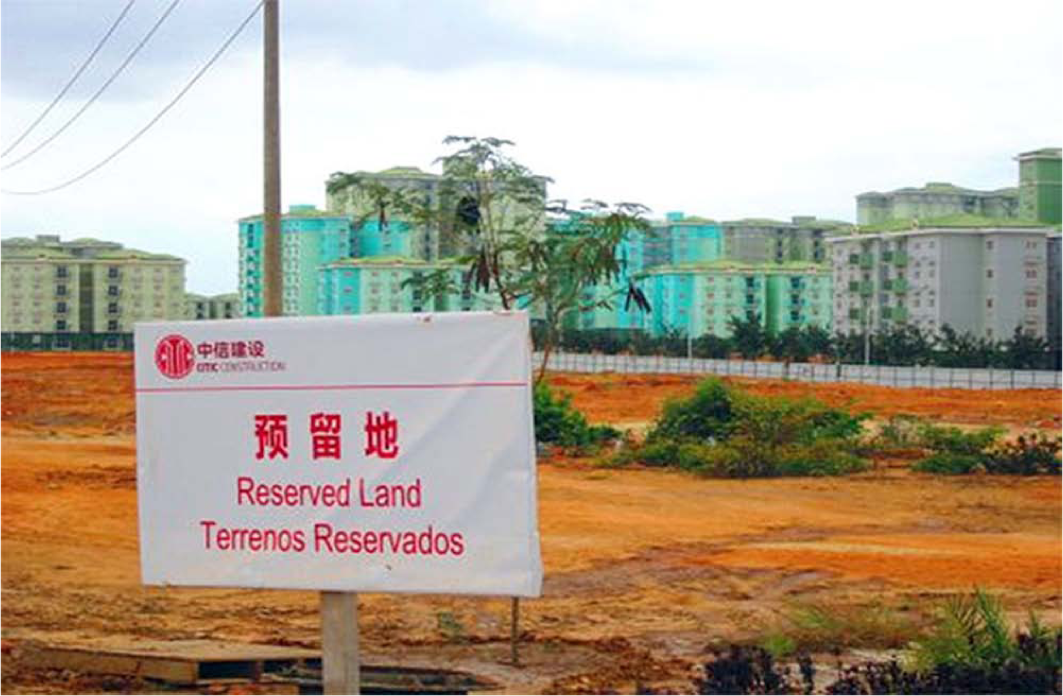
Land appropriated for Kilamba new city in Angola
The Kilamba city project, completed in 2012, includes 750 apartment buildings, schools and more than 100 retail units (Photo 2). The new city was built to accommodate 160,000 people in 20,000 flats, each with a floor area of between 110 and 150 square metres and costing from US$ 120,000 to US$ 200,000. Until early 2013, these apartments remained largely empty and so acquired the status of a ghost town in the international media.(15) Professor Watson mentions that most poor Angolans live on the equivalent of less than US$ 2 a day, but the original unit selling price of a Kilamba flat was unaffordable even for senior civil servants. The state was therefore obliged to step in to save the prestige project. A heavily subsidized rent-to-purchase scheme was introduced, offering three per cent on mortgages, and the cost of the cheapest units was cut from US$ 120,000 to US$ 84,200, which brought apartment ownership within the reach of middle-level civil servants.(16)
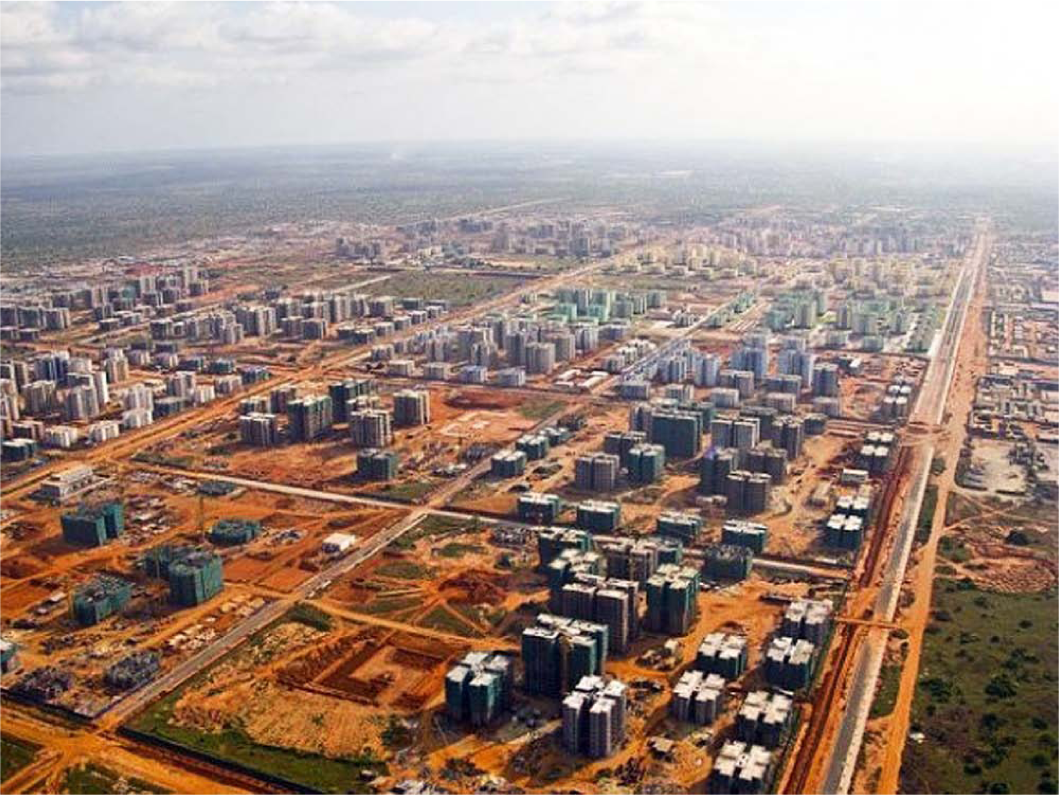
Kilamba new city in Angola
Professor Watson notes that the new urbanism theory of sustainability counts on “… a network of private interests, including property developers, designers, engineering and infrastructure companies, finance and IT firms working together to build ecological and smart cities.”(17) It is not a coincidence that the concept has gained currency today in African countries that have accumulated surplus income and are being enticed by the offerings of easy credit from international lenders. The Angolan case demonstrates that, while the financing for and implementation of Kilamba new city were conceived as a private initiative, the state’s role was principally the concession of land. Harvey notes that there is: “… potential for capital accumulation through such real estate projects because the land is acquired at almost no cost. In China (and Angola), since previous occupants of land lack private property rights, the state can simply remove them by fiat, offering a minor cash payment to help them on their way before turning the land over to developers at a large profit.”(18)
Despite the hidden subsidy in concessional land, the Angolan state was obliged to intervene to cover the massive shortfall in the form of additional subsidies to eventual tenant-buyers.
Today in Luanda, the urban fantasy phenomenon has resulted in an oversupply of high-end housing and a dramatic collapse in real estate values in that segment of the market. The state has been obliged to allocate the bulk of its housing budget to subsidies in order to make projects such as the Kilamba centralidade affordable to civil servants. The new, lower market prices are still too high for the poor; bursting the price bubble has not improved the situation of the majority of families living at the bottom of the housing pyramid. Professor Watson is correct in recognizing that state spending is likely to be skewed towards support for these new cities and away from meeting the basic services and housing needs of the much larger poor urban populations. Table 1 highlights the very high proportion of Luanda’s population with poor or no access to basic services.
Access to basic services in Luanda’s urban settlements (by typology)
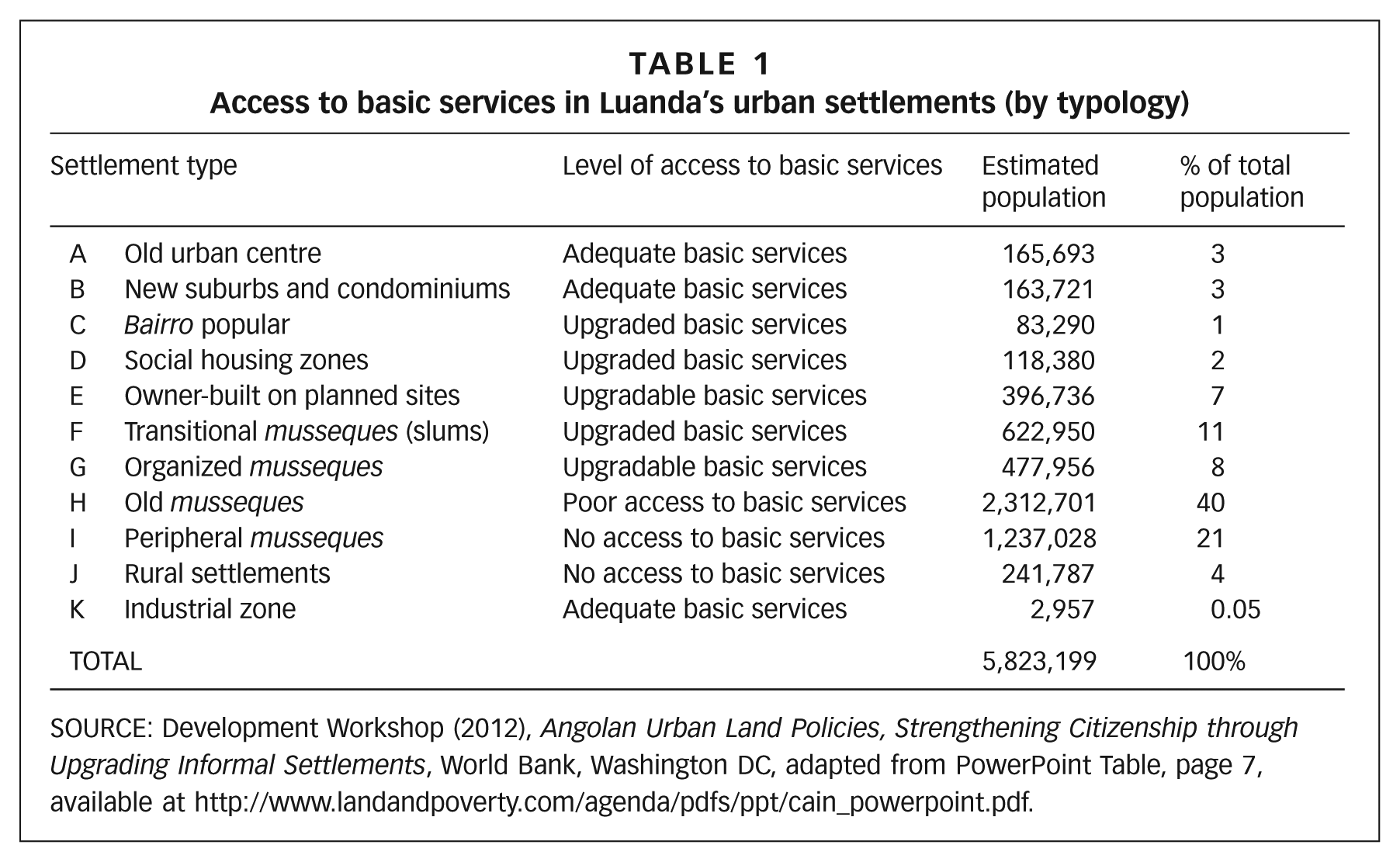
Source: Development Workshop (2012), Angolan Urban Land Policies, Strengthening Citizenship through Upgrading Informal Settlements, World Bank, Washington DC, adapted from PowerPoint Table, page 7, available at http://www.landandpoverty.com/agenda/pdfs/ppt/cain_powerpoint.pdf.
The early experience of Angola in putting the new urbanism into practice raises some fundamental questions about the viability of the new urban private sector-driven model. We must ask if the model is financially sustainable without substantial state guarantees of free land, subsidies and even bail-outs when all else fails.
Footnotes
1.
Watson, Vanessa (2014), “African urban fantasies: dreams or nightmares?” Environment and Urbanization Vol 26, No 1, pages 215–231.
2.
Friedmann, J (1973), Urbanization, Planning and National Development, Sage Publications, London, 351 pages.
3.
See, for instance, Potts, D (1985), “Capital relocation in Africa: the case of Lilongwe, Malawi”, The Geographical Journal Vol 151, No 2, July, pages 182–196.
5.
6.
Moyo, D (2009), Dead Aid. Why Aid is not Working and There is a Better Way for Africa, Penguin Books, pages 46–47.
7.
See reference 5.
8.
9.
Brautigam, D (2013), “China in Africa: the real story”, 28 September post, available at http://www.chinaafricarealstory.com/.
10.
Harvey, D (2008), “The right to the city”, New Left Review, September–October, page 30.
11.
In 2003, the IMF refused an Angolan request for post-war financing and the United States and European donors rejected the call for a Brussels-type round table reconstruction conference.
12.
Corkin, L (2013), “Uncovering African agency: Angola’s management of China’s credit lines”, Chatham House, London, 8 pages.
13.
The term “slum” usually has derogatory connotations and can suggest that a settlement needs replacement or can legitimate the eviction of its residents. However, it is a difficult term to avoid for at least three reasons. First, some networks of neighbourhood organizations choose to identify themselves with a positive use of the term, partly to neutralize these negative connotations; one of the most successful is the National Slum Dwellers Federation in India. Second, the only global estimates for housing deficiencies, collected by the United Nations, are for what they term “slums”. And third, in some nations, there are advantages for residents of informal settlements if their settlement is recognized officially as a “slum”; indeed, the residents may lobby to get their settlement classified as a “notified slum”. Where the term is used in this journal, it refers to settlements characterized by at least some of the following features: a lack of formal recognition on the part of local government of the settlement and its residents; the absence of secure tenure for residents; inadequacies in provision for infrastructure and services; overcrowded and sub-standard dwellings; and location on land less than suitable for occupation. For a discussion of more precise ways to classify the range of housing sub-markets through which those with limited incomes buy, rent or build accommodation, see Environment and Urbanization Vol 1, No 2 (1989), available at  .
.
14.
15.
16.
17.
See reference 1, page 216.
18.
See reference 10, page 30.