




Abstract
I. What Has to Be Resilient?
Despite all the complexities and complications raised by papers in this issue of the Journal and elsewhere regarding resilience and transformation, there are three obvious and simple points. First, the populations and economies of cities, towns and rural settlements have to become resilient to the direct and indirect impacts of climate change. Second, a large part of the world’s population lives in settlements that at present cannot develop resilience because they lack the institutions, technical competence and finance to do so. Third, the collective impact that consumption patterns – and the production systems required to meet (and encourage) these patterns – have on climate change at a global level has to be reduced dramatically, and this requires a transformation in consumer choices and in production systems (and thus, in cities too).
For climate change adaptation, we need to understand what or who needs to become more resilient. Within this, it is important to identify the characteristics of resilience that are required if settlements are to support economies and societies that enable residents to lead meaningful and satisfying lives even in the face of climate change impacts. These characteristics are mutually dependent and mutually reinforcing rather than existing in a clear hierarchy. Individuals and households need to be resilient – able to respond to present risks and reduce the consequences of future risks. For cities, this requires support from resilient systems, both built and natural – including networked infrastructure (piped water, drains, roads, electricity), services (including public transport, health care, emergency services) and protected and managed ecosystems that deliver a sustained supply of ecosystem services. This requires redundancy (so that failures in one system do not lead to cascading failures in others) and safe failure (so that the failure of a particular system does not in itself generate new risks). In turn, the arrangements of governance in urban areas need to be flexible, responsive and adequately resourced with both financial and technical capacities to ensure that these systems operate.(1) Finally – and frequently neglected – there is a political dimension to resilience – a resilient city is one in which city authorities are genuinely responsive to the priorities and needs of all residents. In most cities in Africa, Asia and Latin America, this includes residents of informal settlements, who require political representation and rights, including the possibility of settling on land that is not exposed to hazards and having networked infrastructure and services, as key components of their own resilience.
II. Cities and Change
Cities need to change to stay successful. No city can be prosperous if the enterprises it concentrates produce what is no longer in demand – whether this is goods or services or its cultural or religious heritage. Within an ever more integrated global market, this means that every prosperous city has to have and keep some comparative advantage over the competition – indeed, the need for cities to be “entrepreneurial” has been recognized for several decades.(2) At base, it is mostly cities where private capital chooses to concentrate that prosper. The paper by Sarah Orleans Reed, Richard Friend, Vu Canh Toan, Pakamas Thinphanga, Ratri Sutarto and Dilip Singh discusses this with regard to Da Nang in Vietnam. Here, there is pressure on the city government to focus on attracting or retaining private investment – resulting in a great range of risks from urban expansion onto land exposed to climate-related hazards. The paper on Surat in India is interesting in this regard in that the private sector in the city recognized the need for public investment to improve conditions after two crises – the plague epidemic that hit the city in 1994 and the massive flood that disrupted the city in 2006. Both had major indirect impacts on businesses, including serious disruptions to production.
Most nations have cities that have fallen far down the list of cities ranked by population size – and others that have shot up this list. There is some continuity in that most of the world’s largest cities have long been important ones, and India and China have long had a high proportion of the world’s largest cities. Yet there is constant change, both in those cities that prosper and those that do not. And there are some very successful cities that only have short histories – for instance, Shenzhen (with more than 10 million inhabitants) was a village in 1970, and Las Vegas (with two million inhabitants) was a small town in 1950.
The need to reduce global greenhouse gas concentrations is obvious – and this means reducing emissions from cities and from their inhabitants’ consumption. But cities also need to retain and attract successful enterprises. City governments are influenced by the priorities of enterprises and potential investors, which are usually at odds with climate change mitigation and often with adaptation. They are often at odds with public measures to raise funding or implement policies or regulations for mitigation. We are stuck with a fundamental disjuncture – the freedom of private capital to seek the highest monetary returns and the freedom of the prosperous to have high-consumption lifestyles, whatever their ecological consequences (including those related to climate change) and their social consequences. Cities might be celebrated for their capacity to change, but in reality each city has a huge inertia to change from the powerful vested interests it concentrates and its existing patterns of building, infrastructure and land use.(3)
III. Resilience and Transformation
The theme for this issue of Environment and Urbanization (our fiftieth issue) draws on Mark Pelling’s book on Adaptation to Climate Change: From Resilience to Transformation.(4) The focus on resilience and transformation was conceived as a theme that is of relevance to all urban settings, namely how the capacities to withstand or recover from all direct and indirect impacts of climate change (resilience) can be developed while also contributing to the so much-needed transformation to a low carbon (local and global) economy where everyone’s needs are met – and to achieve this quickly enough to avoid dangerous climate change. This has, as a central component, the delinking of successful cities, towns and rural settlements (and their inhabitants’ consumption patterns) from high greenhouse gas emissions. Of course, these are inter-connected, since reducing greenhouse gas emissions globally reduces the direct and indirect impacts of climate change.
Cities can be assessed with regard to each of the three basic issues outlined above: resilience, capacity to act and transformation. Robert Kiunsi’s paper on Dar es Salaam in this issue of the Journal shows a city with little resilience and very limited capacity to act on this. It is a city that is likely to have relatively low levels of greenhouse gas emissions per person, mainly because of the lack of industry and the low consumption levels of most of the population – although the city’s sprawl is helping to create an urban pattern that is difficult to serve with public transport and infrastructure. How does a city like Dar es Salaam begin to address climate change when it cannot even provide much of its population with piped water and provision for sanitation, drainage and all-weather roads?
Figure 1 highlights the astonishing differences in the annual expenditure per person by local governments. This ranges from US$ 2,000–13,000 for most high-income nations to less than US$ 20 for most low-income nations and less than US$ 5 for many.(5) Some of the variation relates to how local governments are defined – for instance, provincial or state governments are included as local government in some countries but not in others. But Figure 1 still highlights how the resources available to local governments in many nations are so far from what is needed to meet their responsibilities. If there were figures for capital available for investment per person – for instance, in risk-reducing infrastructure – they would be much lower than these figures, as most local government expenditure goes to pay staff and other recurrent costs.
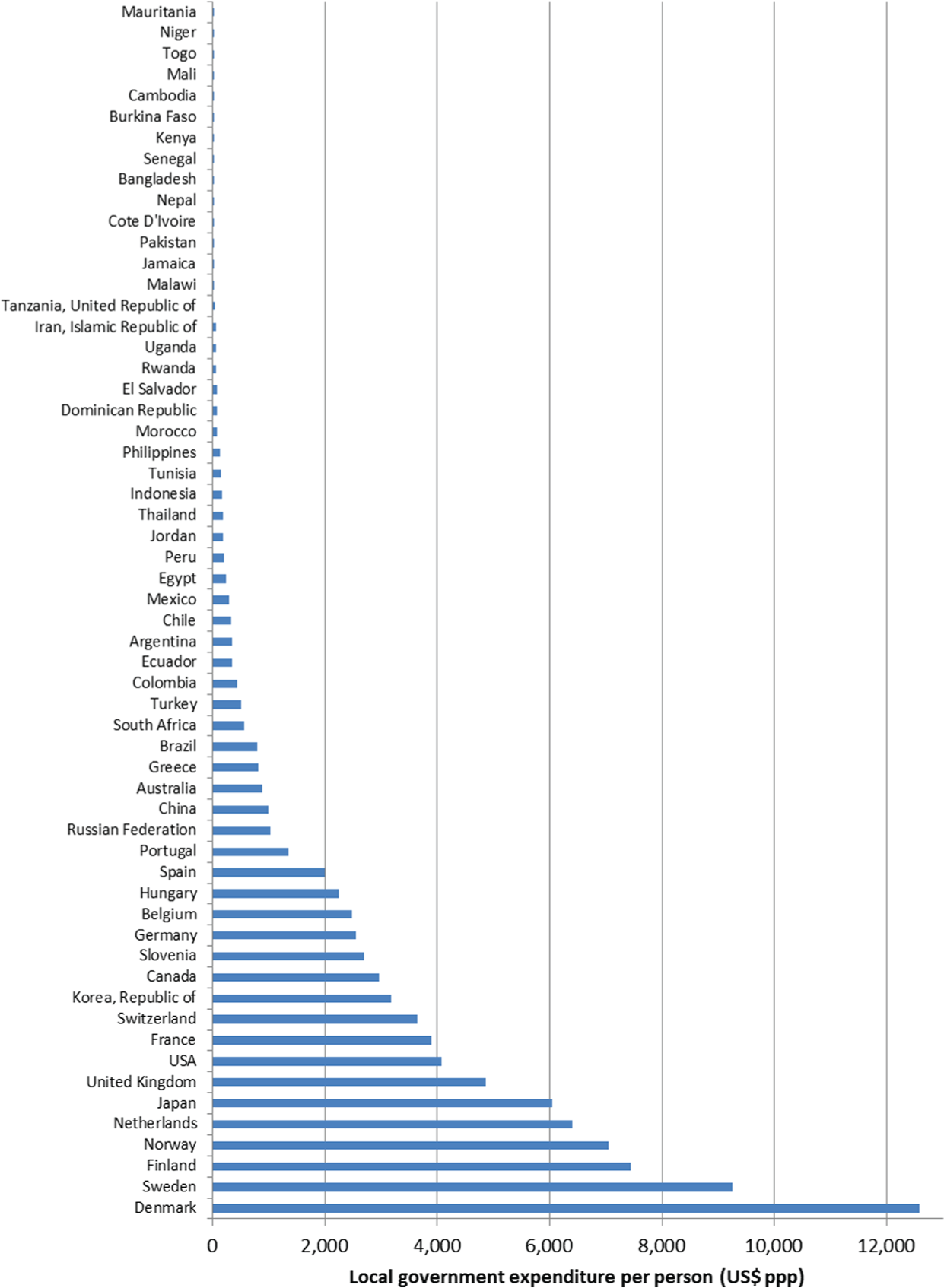
The range in local government expenditure per person per year
The paper on New York by William Solecki in a previous issue of the Journal(6) pointed to a city with resilience and capacity and where there is some discussion on transformation – although Hurricane Sandy showed the limitations in its resilience to such extreme weather. The paper by Debra Roberts and Sean O’Donoghue on Durban shows a city government that has long been an innovator in both adaptation and mitigation and clearly has far more capacity to act than local government in Dar es Salaam; but it also shows how there are other pressing priorities for city government that make the needed commitment to adaptation and mitigation difficult. The paper on Rosario describes the progress in making the city more resilient (especially for low-income groups) but also the significant challenges faced by the city’s administration, especially around funding, data and the challenge of responding to pressing and competing interests.
In cities in high-income nations, it is much simpler to set targets for mitigation than for adaptation – the success of mitigation initiatives can be assessed by a single metric (the reduction in greenhouse gas emissions) – and there are established frameworks for Monitoring, Reporting and Verification (MRV) (a key component of global climate negotiations). Conversely, in cities in low- and middle-income countries, it is easier to foresee progress on adaptation than on mitigation. Even the most progressive and climate change-aware city government will have difficulty refusing or discouraging new enterprises or high-consumption residents if this simply means they go elsewhere. It must also be recognized that most urban residents in Africa and Asia contribute little to climate change through their own emissions, although in urban centres where middle classes, and their consumption, expand this will change. Although some cities and local governments around the world have shown remarkable commitment to reducing their own emissions, these efforts need to be supported by global agreements on low carbon production and consumption – to which all national governments commit (and contribute to implementing).
Resilience also has importance with regard to cities facing disaster risks that are independent of climate change, as the papers on Surat and Bursa make clear. These emphasize the need for far more attention to disaster risk reduction and to working with low-income communities to identify how best such disaster risk reduction can be planned and implemented. Acting on disaster risk reduction can also help build local awareness as well as capacity to address climate change adaptation.
IV. Learning From Cities
Learning that is generated by and shared across all stakeholder groups is increasingly proposed as a key element of resilience – as discussed in the paper on shared learning with regard to 10 cities that are part of the Asian Cities Climate Change Resilience Network (ACCCRN). This learning sought to build an appreciation for complexity and uncertainty among stakeholders and provide a space for discussing vulnerability and resilience in each city’s particular context. This paper also describes the challenges faced by shared learning between different interest groups in politicized urban environments where the validity of addressing climate change is contested.
The paper on the experience of integrated assessment modelling in London and Durban shows the value (and importance) of such modelling; all cities need to consider options for mitigation and adaptation within contexts of demographic and economic change. But this paper also shows the difficulties both in getting the detail and resolution needed for action and in getting the needed understanding and attention within local governments. The paper ends with a valuable discussion of what is transferable to other cities and the importance of interaction between researchers and stakeholders.
Durban is a city from which we learn(7) – regarding the political changes that brought more attention to climate change issues and in the policies adopted; in the tools used to do this; in the identification of different options and their benefits and costs; in integrating the concern for climate change across the urban, peri-urban and rural areas within the city boundaries; in assessing the contributions of ecosystem services and measures needed to protect and enhance these; in looking for possibilities to enhance employment through developing a green economy; in showing how it is local innovators, not national policies or international initiatives, that are providing the knowledge of what needs to be done; in getting the attention of city government by bringing into climate change policy discussions the issues of job creation (within the green economy) and improved living conditions; in encouraging and recognizing local innovation (the interest in green roofs was started by one enthusiastic student); and in the honesty in being clear about what is not achieved. The experience in Durban has also produced some surprises, for instance on what approaches best build support for climate change adaptation within local governments, what measures work and from where lessons can be drawn.
This process in Durban can be contrasted with the experience in China described in the paper by Bingqin Li, where it is central government that has sought responses to climate change but with very little engagement with local governments or with citizens. The paper describes the range of new national policies and institutional changes on climate change and how provinces are encouraged to develop adaptation programmes. But the incentives for local governments are still much more focused on economic growth – and localized policy-making treats central mandates as guidelines to be manipulated for local interests. Policy-making at the local level does not engage citizens or businesses.
V. Of Terms and Terminology
With regard to climate change, the term resilience is a useful complement to the more frequently used concept of adaptation, in that it suggests a capacity not only to withstand shocks or stresses but also to recover (although what produces one may not produce the other) and an ability to withstand or recover from the unexpected. Another characteristic of resilience may be inserted between these – the capacity to cope. So for infrastructure networks this means the capacity to withstand external shocks and to have alternative paths of provision, while also being designed to recover quickly and cheaply.(8) Resilience might also include recovery in ways that increase capacity to withstand shocks or to have alternative paths for provision. Increasingly, resilience draws on ideas from the disaster risk reduction literature on “building back better”(9) – that is, not only supporting a return to the previous state but also actively working to improve it, while simultaneously reducing the outcomes from slow- and rapid-onset disasters and climate change. These are capacities that are very useful with regard to all disasters (or potential catalysts for disasters), so resilience is a popular word in discussions on disaster risk reduction. But a capacity to withstand shocks or stresses is an important characteristic within so many settings, such that the term resilience is also used in settings other than climate change and disasters. For instance, the use of the term in relation to economic change is particularly popular at the moment as city governments strive to cope with economic recession, often with a substantial proportion of their population having difficulty affording basic services and often with large cuts in funding from higher levels of government.
The theme of resilience has certainly proved popular. Even though we have allocated this and the next issue of Environment and Urbanization to the theme, we have had to stop accepting papers as we have received so many submissions. One of the disappointments with regard to some of the papers submitted is the lack of precision in using the most basic terms – resilience and vulnerability. There is also no agreement on the meaning given to transformation within discussions of responses to climate change – it is used both to mean substantial activities (posed as the opposite of incremental change) and to mean fundamental changes to social, political and economic systems.
Within discussions of development and climate change, resilience has come to be applied to a great range of contexts – for instance, to individuals, households and communities (and their assets and livelihoods); also to cities (or specific sectors within city economies) and national economies. Discussions of resilience in these contexts also include a range of threats and risks, perhaps especially for cities where there are complex inter-connections or inter-dependencies between a range of systems.
Although resilience is often considered to be the opposite of vulnerability, the latter is more often discussed in relation to particular groups of people within the population, whereas resilience is more often discussed in relation to urban centres (even though these discussions are usually around making the urban centre or its infrastructure better able to protect populations).
There is also an interest in the processes through which resilience is achieved – as measures for resilience have to respond to changes in impacts (for instance, rising sea levels, often increasing water constraints and often increases in intensity or frequency of extreme weather). Here, there is particular interest in how city, municipal or metropolitan governments have addressed this or are considering how to do so. In this case, resilience is seen more as a process than an outcome(10) – an activity that has to be continuously practised if it is to maintain value.
A focus on resilience for cities also encourages more attention to the dependence of residents and businesses on goods, services (including ecological services) and financial flows from outside their boundaries (and thus outside the jurisdiction of their governments) – for instance, water and other natural resources. For many cities, managing flood risk often means good management of upstream water flows and watersheds that are also outside their jurisdiction (see the paper on Surat). Then there is the complex mix of supply chains for natural resources and other goods from outside their boundaries (and often from foreign nations), on which urban citizens and businesses depend – and the dependence of many enterprises on sales of goods and services to external markets.(11) Indeed, some discussions of city resilience focus almost entirely on the resilience of the economy.
Then there is the resilience of many cities in high-income nations and some in middle-income nations to climate change impacts that has nothing to do with responses to climate change. As described in the paper on the political underpinnings of accumulated resilience, within these cities, resilience to extreme weather risks and some other potential disaster risks (for instance, fires) has been developed independent of climate change. But this gives them an institutional, financial and infrastructural base upon which to build resilience to the exacerbation of these risks that climate change brings or will bring. What this also brings to the fore is the politics of accumulating resilience, as this was driven by political pressures from those enterprises and residents who were at risk. In many cities in high-income nations, individuals’, households’ and neighbourhoods’ resilience to extreme weather and other shocks has been built by political processes where those who were vulnerable had voice and influence – this is what ensured provision for piped water supplies, sewers, drains, emergency services, health care and social security being extended to everyone in the city, regardless of their income. Contexts where these provisions are absent – as shown in the paper on Dar es Salaam – may be recognized as having accumulated risk. The paper on the city of Rosario shows how the measures to make the city much more resilient to external stresses and shocks were not implemented because of climate change, but they provide a valuable base into which climate change concerns can be (and are being) integrated. Here, there is some evidence that the institutions that produced Rosario’s “accumulated resilience” are developing the capacity to build on this and produce resilience to the direct and indirect impacts of climate change.
VI. The Limits of Resilience
A city government may build resilience to likely and possible climate change impacts while doing nothing to contribute to a low carbon economy or to meeting the needs of the population. Mark Pelling made the useful distinction between cities that move towards resilience and those that move beyond this, to transformation. Moving towards resilience is achieved with an active adaptation policy, identifying current and likely future risks, and with institutional structures to encourage and support needed action by all sectors and agencies. To go beyond resilience to transformation means having adaptation policies and investments integrated with development that really meets needs (including those of low-income groups), while also addressing mitigation and, where needed, over-large ecological footprints.(12) This obviously requires fundamental changes in the supporting political and cultural systems. We are far from understanding what can support these changes at local, national and global scales.
VII. Feedback
The importance of cities and urban systems for prosperous economies is now more widely recognized. The paper by Ivan Turok and Gordon McGranahan considers whether rapid urban population growth can help raise living standards in Africa and Asia, and suggests that this depends on how conducive the infrastructure and institutional settings are. Removing barriers to rural–urban mobility may enable economic growth, but the benefits will be much larger with supportive policies, markets and investments in infrastructure. The paper concludes by suggesting that governments should seek ways to enable forms of urbanization that contribute to growth, poverty reduction and environmental sustainability, rather than just encouraging – or discouraging – urbanization.
The paper by Diana Mitlin considers the engagement of urban grassroots organizations and federations with professionals as they scale up their work and convince local governments to work with them. The potentially negative consequences of such engagements have long been recognized. The paper discusses these relational tensions and considers the ways in which one alliance of urban poor federations and support NGOs has responded to the challenge to build alternatives within professionalized mainstream urban development practice.
Kate Parizeau’s paper considers the work of Buenos Aires’ cartoneros (informal recyclers) and the environmental and economic repercussions for the city. It also considers the impact of a formalization plan initiated in 2011 for cartoneros and their work. The author suggests that while this may benefit some workers (providing them with increased income, social acceptability and improved relationships with the municipality), there are also potential drawbacks (including possible difficulties with instituting a cooperative system with previously unorganized workers, and the labour exclusion of more socially marginalized cartoneros). Readers interested in this topic should also read the paper by Oscar Fergutz with Sonia Dias and Diana Mitlin on “Developing urban waste management in Brazil with waste picker organizations”.(13)
The paper by Rung-Jiun Chou describes the need to address watercourse sanitation in dense, water pollution-affected urban areas in Taiwan and the possible means to do so. In Taiwan, municipal wastewater is the largest source of pollution in rivers and canals, particularly in dense urban areas that lack adequate sewer systems. Owing to poor water quality, local residents prefer watercourses to be concealed even though water pollution is made worse, the ecological value is damaged and the amenity benefit reduced. Despite large investments in improving channel-side landscapes, poor water quality diminishes the success of watercourse rehabilitation. With a low completion rate for municipal sewer systems, the construction of channel-side sewage-intercepting facilities is effective in the short term. A combination of establishing short-term sewage-intercepting facilities and long-term municipal sewer systems is suggested to advance national environmental quality in Taiwan.
The paper by Afton Halloran and Jakob Magid adds to the many papers published in previous issues of the Journal on urban agriculture. Despite significant contributions to human health, livelihoods and food security, urban agriculture in Dar es Salaam has received little political support, and many urban farmers experience insecurity of land access and ownership and are unable to invest in improving their land, inputs and infrastructure. The paper focuses on the current incorporation of urban agriculture into the Dar es Salaam 2012–2032 Master Plan (still unapproved as of June 2013). The paper suggests that making best use of urban agriculture is largely dependent on political commitment from both local and central government – and needs policy and rules and regulations to support it, especially in land use planning. Nonetheless, urban agriculture will continue to persist, adapting and innovating under the pressures of urbanization.
The paper by Hyun Bang Shin and Bingqin Li suggests that the 2008 Beijing Summer Olympic Games produced an uneven, often exclusionary experience for a certain segment of the urban population. It looks into how the Games affected migrant tenants and Beijing citizens (landlords in particular) in “villages-in-the-city” (known as cheongzhongcun), drawing on their first-hand accounts of the citywide preparations for the Games and the pervasive demolition threats to their neighbourhoods.
Footnotes
Acknowledgements
We are very grateful to Debra Roberts for her comments and suggestions. Thanks also to Kate Lines and Emily Kelling for their help in preparing Book Notes.
1.
Tyler, Stephen and Marcus Moench (2012), “A framework for urban climate resilience”, Climate and Development Vol 4, No 4, pages 311–326.
2.
Harvey, David (1989), “From managerialism to entrepreneurialism: the transformation in urban governance in late capitalism”, Geografiska Annaler Series B, Human Geography Vol 71, No 1, pages 3–17.
3.
Handmer, John and Stephen Dovers (2007), The Handbook of Disaster and Emergency Policies and Institutions, Routledge, London, 192 pages.
4.
Pelling, Mark (2011), Adaptation to Climate Change; From Resilience to Transformation, Routledge, London, 203 pages.
5.
These are US dollars at purchasing power parity (ppp). The statistics are drawn from United Cities and Local Government (2010), Local Governments in the World; Basic Facts on 96 Selected Countries, UCLG, Barcelona, 100 pages.
6.
Solecki, William (2012), “Urban environmental challenges and climate change action in New York City”, Environment and Urbanization Vol 24, No 2, October, pages 557–573.
7.
Previous papers on Durban’s climate change policies in this Journal are in Vol 25, No 1 (April 2013), Vol 24, No 1 (April 2012), Vol 22, No 2 (October 2010) and Vol 20, No 2 (October 2008).
8.
Vugrin, Eric D and Mark A Turnquist (2012), “Design for resilience in infrastructure distribution networks”, Sandia Report No SAND2012-6050, Sandia National Laboratories, Albuquerque, 39 pages.
9.
Lyons, M and T Schilderman with Camillo Boano (editors) (2010), Building Back Better: Delivering People-centred Housing Reconstruction at Scale, Practical Action, 375 pages.
10.
Dodman, D, J Ayers and S Huq (2009), “Building resilience”, in Worldwatch Institute, Into a Warming World: State of the World 2009, Worldwatch Institute, New York, pages 75–77.
11.

12.
See reference 4.
13.
Fergutz, Oscar with Sonia Dias and Diana Mitlin (2011), “Developing urban waste management in Brazil with waste picker organizations”, Environment and Urbanization Vol 23, No 2, October, pages 597–608.