




Abstract
Grassroots organizations that have sought to scale up improvements to their urban neighbourhoods through engaging the state have found themselves drawn into relationships with professionals. The potentially negative consequences of such engagements have long been recognized. This paper explores the nature of relations between professionals and organizations of the urban poor, identifying and discussing associated relational tensions. It considers the ways in which one alliance of urban poor federations and support NGOs has responded to the challenge to build alternatives within professionalized mainstream urban development practice.
I. Introduction
Processes of pro-poor political and social change are rarely achieved through the struggles of low-income and otherwise disadvantaged groups acting alone. To legitimate and/or resource their struggles, these groups make alliances with a range of professionalized support agencies. Such social relations have been realized, developed and strategized for many years by excluded, disadvantaged and persecuted groups, including those who struggled for democracy in nineteenth-century Europe, the civil rights movement in America and the anti-privatization alliances in towns and cities across the world. On the one hand, it has already been acknowledged that such alliances appear necessary for a grassroots voice to be heard and recognized. On the other, the difference in social status self-evidently puts local groups and social movements at risk of being undermined and displaced.
This paper explores present-day manifestations of such alliances through examining the relations between organized communities living in informal settlements in towns and cities across the global South, and professionals who have chosen to help them. It explores how current alignments are taking place, the contradictions that are experienced and the resolutions that emerge. The discussion elaborates both underlying and manifest tensions in relationships that have a recognized functionality but that may undermine the agreed goal of community empowerment.(1) This paper has a deliberate focus on those professionals who subscribe to such goals.
The discussion draws on my work and experience with Shack/Slum Dwellers International (SDI), an international network of federations of the homeless and landless, and their support NGOs. These federations are made up of community groups or savings schemes that bring together the residents of informal settlements to identify their needs and interests and develop strategies to address these. SDI affiliates support people-centred development, with organized communities leading and implementing activities to secure a pro-poor urban transformation recognized and resourced by the state. Goals include greater tenure security and access to basic services for those living in informal settlements, improved housing, income generation and employment opportunities, and more effective welfare policies. I have been interacting with SDI affiliates and the network itself since 1989. I spent two years working as a professional within the South African support NGO in 1999 and 2000 and have regularly visited SDI affiliates before and after this period. In the last five years, most of my work has been with SDI affiliates in India, Kenya, Namibia, the Philippines, South Africa, Zambia and Zimbabwe. I have regularly been exposed to these issues through individual and group discussions with professionals and community leaders about their relationships (both jointly and separately); through observing interactions in affiliate meetings as well as affiliates’ interactions with other professional groups and the government; and through involvement in reflections related to the restructuring of such relationships, either directly or as a component of other changes in organizational practices.
The discussion begins in Section II with a summary of perspectives on professionalism, development assistance and urban development, which helps to identify and elaborate some of the relational contradictions. Section III then summarizes some of the experiences of SDI, looking at the tensions that are present in their work as they seek to use donor finance to build social movements able to catalyze pro-poor urban development. While this discussion focuses on SDI and its affiliates, it also includes references to other professional organizations that the affiliates and network collaborate with, including donor agencies, academic departments and local government staff. Section IV looks at the ways in which SDI affiliates seek to reconcile the tensions and move forward, and Section V concludes by arguing that activities that enable local communities to gain power, work together and hold professionals to account within a programme of agreed work point the way forward to enabling the benefits of professional knowledge to be secured with fewer of the negative impacts on the confidence, capability and contribution of low-income residents.
II. Professionalization: the Phenomenon
From the 1960s onwards, there has been an awareness that the professionalization of services has a set of specific impacts related to the creation of a group of experts with the social and sometimes legal status to define acceptable solutions. As articulated by Escobar,(2) the development of professionals is related to the nature of the modern state, associated problems and the expansion of the state into new areas of social provision. The growth of laws, rules and regulations in areas such as settlement planning, household construction and medicine has resulted in a “need” for planners, architects and a range of health officials to address problems that people previously solved for themselves.(3) Their solutions are viewed as superior to those used by non-professionals. The consequences of professionalism for citizen well-being were believed by Ivan Illich to be so harmful to empowerment that he named his volume on the subject Disabling Professions. Illich moves beyond a concern with specific professional practice to an argument against the institution itself: “Professionals tell you what you need and claim the power to prescribe. They not only recommend what is good, but actually ordain what is right. Neither income, long training, delicate tasks nor social standing is the mark of the professional. Rather, it is his authority to define a person as client, to determine that person’s need and to hand the person a prescription.”(4)
As emphasized in this text, the professional uses his or her public position as a knowledge expert to exert authority, establishing both “needs” and “solutions”.(5) Illich exemplifies his concerns with the education sector, arguing that people are disabled from finding their own solutions because they cease to believe in their own capacities.(6) Such concerns are repeated by Foucault, who explores relations between professionalization, knowledge and the power of the state when he discusses how governments have created not just subjects with problems that need to be solved but also experts with the power to define ideas such as truth and objectivity.(7) Foucault argues that while power does not necessarily flow from knowledge, knowledge as a technology can be used to further vertical social relations: “The
The challenge for those concerned with empowerment is to set out counter-processes in which alternative professional practices reverse such outcomes. However, despite these insights there has been relatively little reflection on the nature of empowerment and knowledge within the participatory approaches favoured by development, perhaps reflecting the difficulties of moving from discourse into practice.(9) It has been recognized that even when people’s knowledge is validated, their engagement with the knowledge process may not be empowering.(10) Cooke suggests that interventions from “external” participatory practitioners may result in the co-option of local communities and citizens into programmes designed for them by professionals.(11) Wilson is somewhat exceptional when he argues that partnerships between experts and citizens can contribute to broader processes of change.(12) In so doing, he recognizes the importance of professional inputs in, for example, more complex areas where expertise beyond immediate personal experience is required. Focusing on professionals working with local people in active local processes, he analyzes the accusation that professionals are technocratic and anti-political, and argues that in at least some cases this is not the case. Wilson is optimistic that difficulties can be transcended and that that once individuals engage in co-learning, acknowledge their differences and support the creation of trust and mutual confidence between experts and citizens, they can help to establish new transformatory ideas and practices.(13)
In achieving such a synergy, inequalities in the social status of professional intermediaries and community members need to be overcome. Freire engages directly with this contradiction and shares his ideas as to how radical knowledge that liberates rather than oppresses can emerge.(14) He agrees that hierarchies in knowledge in Latin America have ensured that peasants believe they “… know nothing and are incapable of learning anything … that in the end they became convinced of their own unfitness”,(15) and that processes of formal education have created professionals who believe in the superiority of their own knowledge. Nevertheless, he argues that professionals are important in contributing to new alternatives and in progressing society.(16) The challenge for him is not “if” but “how” supportive relations might be formed, and he suggests that teachers and students should jointly participate in recreating knowledge,(17) with an emphasis on the teacher being “… one who is himself taught in dialogue with the students, who in turn while being taught also teach.”(18)
The emphasis on the importance of dialogue between professionals and citizens replicates the ideas of Habermas, who develops a wider argument about the importance of public debate and the public sphere where, he believed, a rational debate could take place to develop an understanding about the collective action that would best address the interests of all. However, as Roberts and Crossley note,(19) Habermas may have been insufficiently critical of the ways in which unequal social relations are manifest in such public space and how class and gender excluded participation and stratified contributions.(20) They argue that agencies must recognize differences in social status and hence power between the participants within the knowledge process.
Within the development literature there is little exploration of ways to resolve such dilemmas. One exception is Laurie, Andolina and Radcliffe, who discuss how organizations of indigenous people in Ecuador perceive that the professionalization of knowledge is a necessary step to advance their interests, ensure that their knowledge is publicly recognized, and secure needed improvements, decentralization laws, land reform and indigenous rights.(21) To achieve this, indigenous movements have engaged with university staff to develop relations between academia and indigenous professionalization.(22) Laurie et al. compare two alternative modalities of professionalization,(23) one drawing indigenous people into the university and the other a hybrid space enabling alternative training forms. They argue that the hybrid space offers a more decentralized and flexible programme of study that seeks to nurture a “… semi-autonomous, indigenous-only university, working to different curricula and an alternative calendar [that] would become established outside of the state’s direct governing control.”(24) In addition to responding to the learning needs of the grassroots citizens, these interactions are used to educate other students and create a new understanding among emerging professionals.(25) In this context, highly organized movements have benefited from exposure to international networks for more than a decade, enabling them to explore and assess different options to advance their interests.
The nature of the problem is a much more common discussion within the development literature. In the urban context this includes a recognition of how professionalism adopts regulations and standards that become a means of social stratification and segregation.(26) King analyzes the colonial influence on urban development in India,(27) while Escobar’s more generalized critique of planning emphasizes how the processes of professionalization emerging within nineteenth century capitalism sought to address emerging social needs and institutionalize the modern economy within the city.(28) Myers exemplifies both historical and current-day relationships when he discusses these issues in the context of four colonial cities.(29) He elaborates on the ways in which formal planning rules segregated urban space with, following Independence, a switch in rationalities from race to class, as low-, medium- and high-density residential areas were defined.(30) He shows that local residents were not passive recipients but, rather, individuals with the agency to challenge outcomes and modify professional designs to increase their use value; however, a consequence of these multiple forms of exclusion is a sense among low-income residents that they were “outsiders” in the city.(31) His account emphasizes the extent to which professionalized urban development is a terrain of disadvantage for many low-income citizens. As communities seek to improve their lives and develop new options, they have to challenge regulatory and statutory constraints that are manifest through social inequalities. Whatever the general problems that citizens face from professional knowledge, these authors help us to understand the urban settlement as a place of struggle in which people’s experiential realities and their attempts to improve their situation challenge the ways in which top-down solutions have been conceived and may be imposed.
In summary, the literature warns us of the complexities of supporting pro-poor and inclusive social transformation and of the potential domination by professionals of such processes of social change. However, it does not suggest that the solution is to abandon the attempt. On the contrary, it recognizes that professionalism is a dominant part of the modern world and suggests that the solution is to find improved ways of engaging with such realities through alignments between citizens and supportive professionals.
III. SDI and the Challenge of Professionalism
For SDI affiliates, such contradictions are embedded within their working lives. As described below, the network aspires to support processes that are empowering at multiple levels. SDI is an international network of national federations whose membership is drawn primarily from informal urban settlements and whose purpose is to support community-led development, creating new solutions for the landless and homeless in towns and cities in the South. Federation membership is made up of local organizations (savings schemes) primarily formed by women, who come together in their neighbourhoods to save scarce funds, share their problems and begin to address their needs. Through federation activities at the city and national levels, SDI places considerable emphasis on supporting community organizational capacity. Federations are held together by community-to-community exchanges, which take place on a daily and weekly basis. Alongside these federations are nationally based support NGOs, organizations of up to 20 professionals and administrative staff who raise and manage funds, link to professionals within the state and other professional agencies, and support learning and documentation. SDI processes are based on the belief that the solutions to address poverty and inequality need to emerge from those who are experiencing the realities of such deprivation. However, although experience has shown the limitations of professionally led development solutions and their inability to go to scale, the model is not one that excludes professional support. Rather, professionals are seen as a critical component in building alternative models of urban development, challenging the kinds of exclusionary practices described above.
This model of dual organizations (federation and support NGO) emerged from SDI’s history, and has remained as the preferred form to support a substantive grassroots process able to negotiate with local and national politicians, while also managing donor finance and building relations with officials. When communities replicate savings activities and federate without access to support professionals, or when both participate in the same organizational space, then experiences in both Uganda and Namibia have shown that the consolidation and growth of community-led development does not take place. There appears to be a need for grassroots groups and networks to have their own autonomous space for mass organizations to develop. It was only following the division of organizational identities in Namibia in 1998 that the federation was able to mobilize 10 per cent of the country’s informal settlement dwellers, redefine local authority policies and secure state resources. However, the separation does not mean that relations are always unproblematic. Bolnick, one of the SDI staff members within their international secretariat, describes the origins of both this organizational duality and the difficulties of such relations. He explains that unlike professional agencies that reach out to organizations of the urban poor, “… from the outset, SDI has been driven by the rationalities and interests of organizations
Despite recognized functionalities, relations can also be problematic. Jockin Arputham elaborates on the processes through which the professionals dominate: “… the ego of professionals, it takes over. They think they can do it all … The professionals, they can take responsibility very easily. They do not realize that the people stop. They let the professionals take over. That is what happened in South Africa.(35) The leaders did not take responsibility. The people have to do it. They have to work out what to do and to do it.”(36)
Bolnick also reflects on the contradictions that affiliates have to manage.(37) In particular, he highlights the ways in which the organizational model used by SDI passes financial control to the NGO, and the consequential dependencies. He suggests that the model works best when the federations have a strong autonomous capacity and can link to the NGO professionals that they choose. While Arputham makes reference to South Africa − where the federation split and the NGO ended its work − this history is not typical within SDI, and other affiliates have continued their initial relations. In other cases, tensions have been identified, understood, avoided and/or sufficiently resolved to enable relations to continue. Bolnick’s discussion focuses on difficulties with international development finance, but we also need to examine the practice of SDI affiliates as they try to shift exclusionary and highly differentiated anti-poor development practices offered to those living in informal settlements into programmes that are inclusive and comprehensive. Affiliates seek to enable community solutions to emerge through processes that nurture their designs and plans. This requires developing alternative processes of knowledge and learning and integrating these solutions with more conventional approaches.(38) In the SDI template, the role of the professionals and federation/network leaders is to manage the boundaries of this process; it is to keep the formal world, which necessarily has to engage with this process if hybrid solutions are to emerge, at bay until the communities have crafted their own approach to scaling up. Then their role is to legitimate these approaches to professionals in state agencies and associated consultancies, helping to explain the value of community-designed alternatives and the importance of supporting this experimentation.
While the SDI federating process seeks to create the situations identified by Wilson,(39) i.e. those where communities can develop their own alternatives through collaboration with supportive professionals, in practice this is difficult to achieve. In addition to professionals within the aligned SDI NGO, federation leaders (and their support NGO staff) also work with professionals within government and from a range of other agencies that support (and sometimes contest) federation activities.
My exposure to SDI processes and experiences suggests that three challenges emerge to this model. They are briefly discussed here before the following section explores how these tensions are addressed (although it is too much to say that they are entirely resolved). A first problem is that professional training encourages SDI professionals to solve development problems rather than pass control over to the communities, i.e. they use the frameworks and theories that they have been trained in to provide solutions to problems that are faced by others. I myself have been asked by local communities to provide answers to questions that I cannot possibly know the answer to – and have sometimes found myself trying to answer. One common example of the modalities of interaction is the training and/or capacity-building workshop. Such workshops tend to favour a “vertical” relationship in which the skilled person (technician or professional) passes on knowledge to the local resident or other learner. Within this process, there may be insufficient consideration given to the community skills set and the ways in which local residents have constructed houses and consolidated settlements. But as importantly, there is little recognition that the skills and capacities of professionals have not delivered the development on the scale that is needed, with at least 900 million remaining in inadequate accommodation.(40) This lack of scale is not accidental, nor does it relate to an inadequate scale of finance; rather, it relates to inherent flaws in professional models that assume that formal processes can transform informal ones, with little acknowledgement of the challenges that this involves. Even within more participatory processes than workshops, professionals may be asked to provide answers. However, in providing solutions they reinforce the vertical relationships within the knowledge domain; and with the secondary status of community members thus reinforced, it becomes harder for them to have confidence in themselves and their design capabilities.
This role of professionals is even trickier when the activities involve direct engagement with state agencies, and it is here that SDI affiliates (both community members and NGO staff) have to deal with the intensity of professional involvement in urban development. As soon as local groups negotiate for improvements, they find themselves having to engage with state professionals in processes where professional values are given considerable legitimacy and professionals adjudicate on identified choices. Governments draw on professionals to provide standardized frameworks for urban development. Only rarely is adequate attention given to the reality that such frameworks favour some and exclude others. Affiliates frequently find that local government and associated development agencies encourage professional (rather than community) involvement. As SDI groups complete precedent developments that seek the state as an active partner, it is frequently assumed by the authorities that construction will comply with existing standards. Once it is clear that communities will construct their own homes and install their own services, there are concerns about the quality of their work. These questions are not in and of themselves problematic. Local residents, federation/network leaders and professionals are willing to explain their solutions and negotiate with multiple levels of the state. But SDI support professionals may find themselves pressured into being the intermediary between the community process and the officials. The more experienced will seek an alternative position that enables them to ignore the expectation that they will enforce professional standards and rules. Rather, they seek to help federations to negotiate more universalized exemption and/or facilitate a process in which the community acts outside of the rules, to demonstrate their dysfunctionality.
A third challenge that professionals have to overcome is their trained inclination to treat informal settlements and their residents as a “canvas” on which to develop alternatives to address community priority needs. The standardization processes adopted by the state are derived from such studies. The power of differentiated social relationships is evident when professionals accept their placement as knowledge intermediaries between donors and communities and between the state and communities almost without question, or more powerfully still, without a sense of accountability and responsibility. Communities are rendered as subjects rather than citizens. This engagement is more of a problem for the professional groups that SDI affiliates align with rather than for the professionals within the affiliates themselves. Many such agencies seek to work with SDI because they recognize the potential of organized communities and because they wish to be participatory, but located within institutions that favour a very different set of values, they struggle to change practices. For example, academics come with ideas for research, such as an investigation into communal toilet blocks, without recognizing that a critical first step is to spend time in a community and to expose themselves to community perspectives. Academics and consultants, even when working closely with the networks and their affiliates, take on contracts to collect information and analyze results without realizing that the processes would benefit from a restructuring of relationships, so that the communities themselves are drawn into the process as the core agency within the settlement and with the professionals playing a supportive role. Specialist tools may be designed to support community knowledge (for example in financial assessments), without considering the benefits of a direct design involvement. I am not suggesting that knowledge that is not at the community level is irrelevant − there is much that is useful. But if knowledge is to be used for political purposes, to challenge injustice, increase equity, address poverty and improve access to resources, then SDI’s experience is that disadvantaged communities need to be central to the production and use of such knowledge.
IV. Engaging Contradiction (Externally and Internally)
How then do SDI affiliates attempt to subvert professional perspectives on urban development into a process of radical rebuilding of the city? There have been both progressive and regressive outcomes as community leaders and professionals engage in realizing pro-poor inclusive urban development. Alongside relational issues are material processes of reconstruction. Some success has been achieved, with more than 200,000 households securing tenure and improved services and more than 55,000 houses having been built. Before continuing with an exploration of relations between SDI professionals and federations, the following discussion elaborates on some of the challenges regarding SDI solutions and those of professionals working in local and national government, and in some cases international agencies that have aligned with this process. The tensions between alternative professional approaches to urban development are elaborated here because I believe that it helps to understand the tensions within and between the SDI affiliates themselves and the ways in which these tensions are managed. At the same time, it should be recognized that the binary representation in Table 1 is a simplification of a more complex reality, with a continuum rather than two alternatives; moreover, it is not necessarily the case that local and national government officials are on one side and civil society professionals on the other. In reality, there is an overlap.
Competing principles for the development of informal settlements
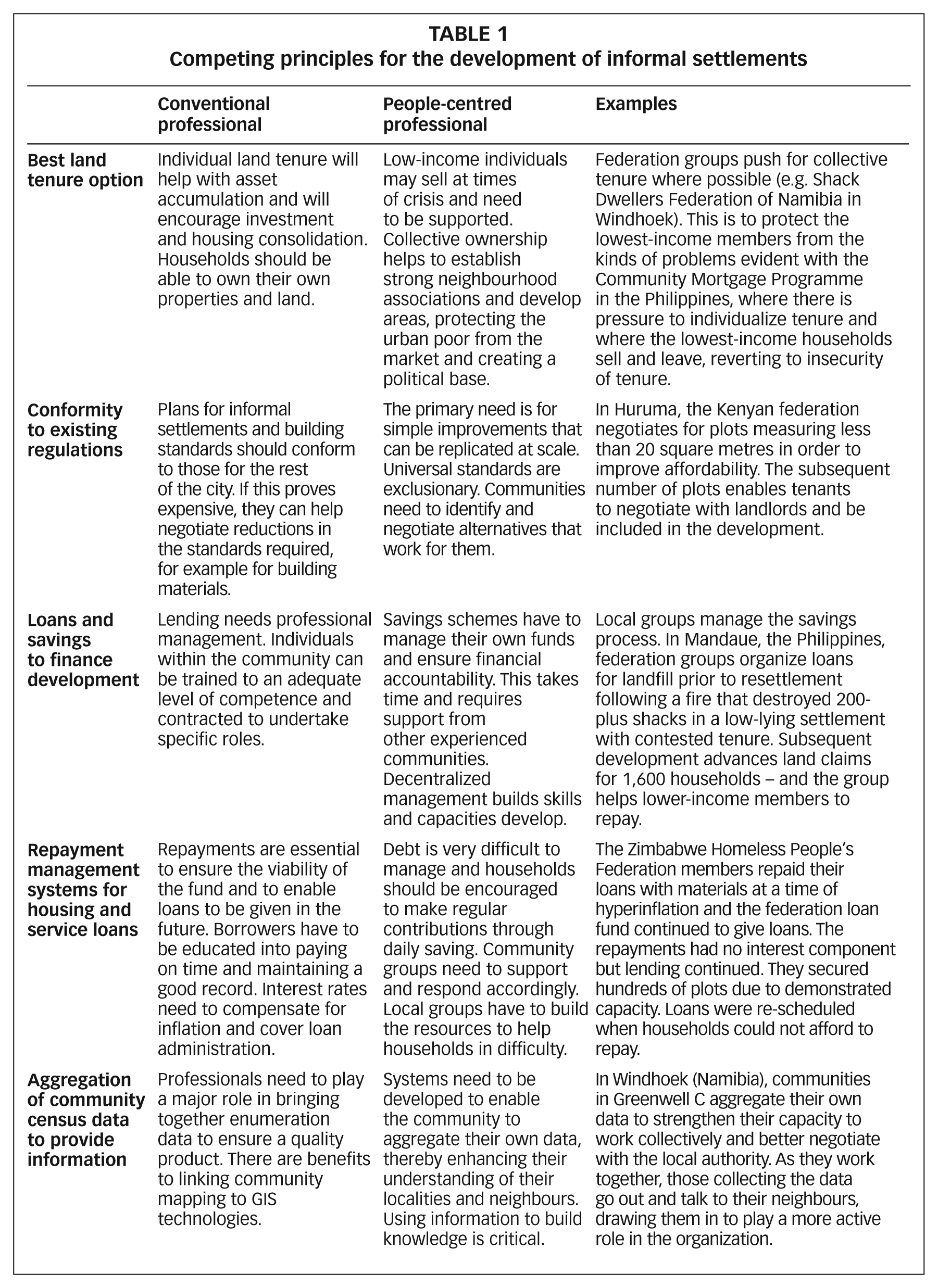
Table 1 illustrates some of the tensions that exist within professional solutions to urban problems − and specifically informal settlement upgrading − that I have observed as SDI precedents engage with local authority processes. The positions of the conventional professional may appear progressive, however experience shows that they may undermine the scale of individual and collective activities by the community, encouraging passivity and dependency. Table 1 seeks to illustrate that the problems lie with the professionalization processes and the position professionalization is given within urban development systems rather than with individuals, although they are the vector through which these practices are realized. However, the realities of life in informal settlements and the experiences of the federations result in a different kind of understanding about strategies to secure a pro-poor and inclusive city. The examples show how giving space to organized communities enables the emergence of alternative practices that expand our understanding of how the inclusive city might be achieved.
As SDI affiliates interface with local authorities and other development agencies, then the tensions between these different conceptualizations come to the fore. SDI affiliates recognize that activities need to be negotiated hybrids of alternative visions, such that community-led development can proceed in partnership with local authorities that will, in general, be oriented towards conventional approaches. The experience of SDI affiliates suggests that relations between professionals (both inside and outside of SDI) and organized communities are necessarily both conflictual and collaborative. Rather than one party being dominant, the challenge is to recognize ways in which the benefits of collaboration can be maximized while recognizing that differences in social status (and in some cases class position) means that more than good will is required. Like McKinnon, SDI professionals frequently recognize that rather than be overly concerned with their personal behaviour, it helps to recognize that they are necessarily part of a political process rather than on a personal journey.(41) It is acknowledged that core modalities of action are those that build collective organizations, negotiating capacities, an autonomous community resource base (through savings) and knowledge and information from the settlement level up. Equally relevant is the practice of community exchanges with joint teams that include community members and politicians. Such a practice strengthens direct links between community leaders and the state, and politicians understand the relational opportunity they are being offered to advance their engagement with mass organizations of the urban poor. Empowerment, in this context, is not gifted or passed on by professionals but emerges from everyday practices and the enhanced capabilities of organized groups to strategize and secure alternative relations through having their own power base strengthened − “Power is money and knowledge” in the words of the South African affiliate.
If the focus of the process is to change the capabilities for action of grassroots communities, then reflection within the grassroots becomes critical. An oft-repeated quote in the network is how Jockin (president of SDI and earlier president of the NSDF) explains to the NGOs that: “… if the federation leaders want to commit suicide, your job is not to stop them. It is to recommend how they might go about it.” His comment emphasizes the importance of the long term, and that the struggle for social justice and new substantive urban development alternatives at scale will not be reached by any preferred solution, no matter how important it is at the time. Building understanding and analytical capacity is what is critical, and professionals should support communities to understand their options and the potential consequences and engage with processes of experiential and collective learning, such that new and better strategies can be identified and realized.
In terms of the relational consequences for SDI affiliates themselves, I have observed five complementary strategies used to nurture an effective professionalism, and these are summarized in Table 2. These are strategies to manage the relationship between the organized communities and NGO staff such that the problems discussed above are avoided and the professionals do not dominate the process. None is singular and most are observable within any individual SDI affiliate. Each strategy is realized across a multitude of alternative experiences and diverse cultures, and all are practices within the broader contestation between professional ideas and urban development practice summarized in Table 1.
Strategies used by SDI affiliates to improve the quality of professional interface with community processes
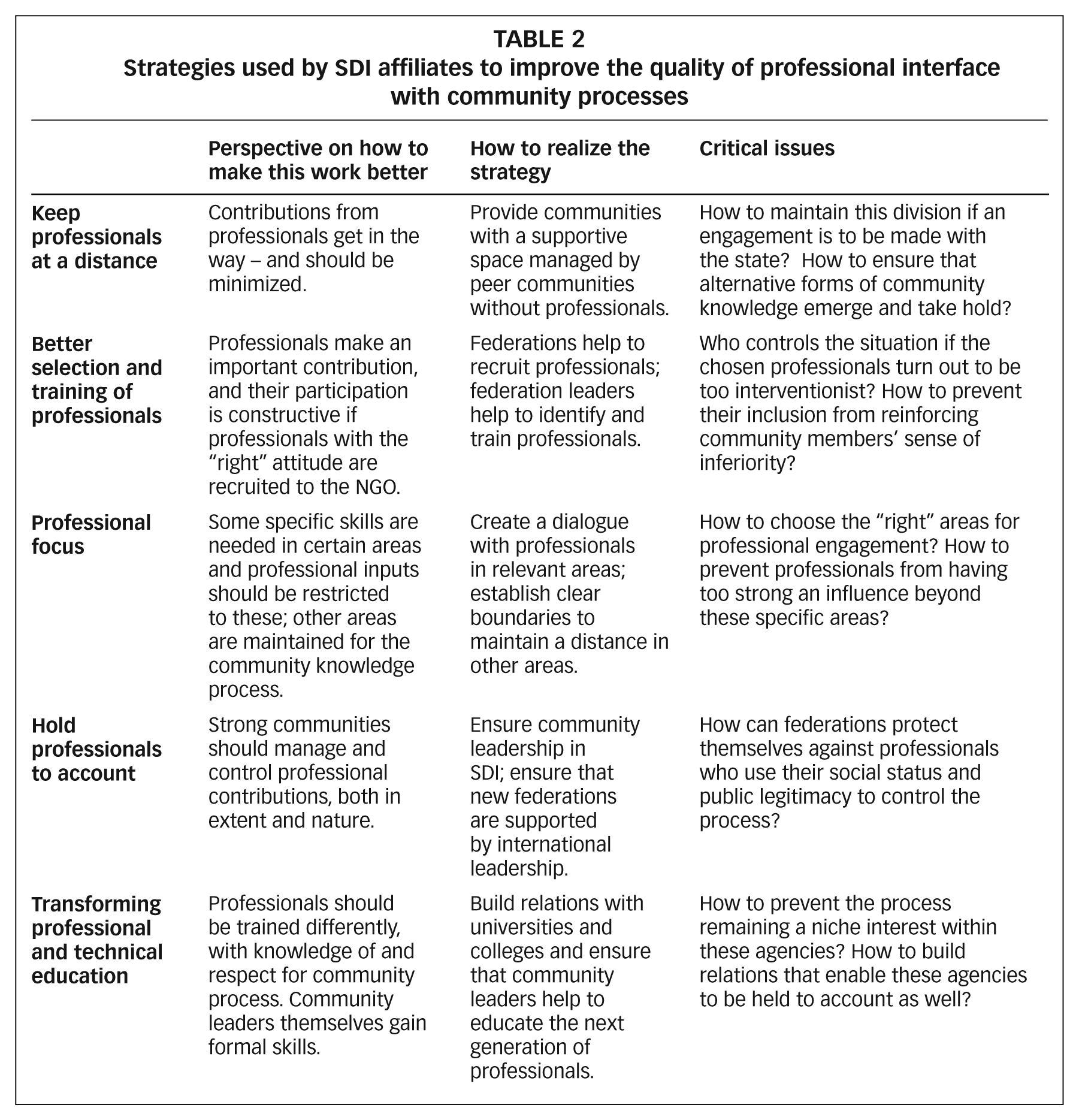
The “distance strategy” responds to the historical experience of many community leaders, which is that professionals have dominated local social groups and determined their solutions, strategies and tactics. Just as the NSDF walked away from NGO relations during its own history, federations temporarily withdraw from their alliance partners. This strategy remains a defensive option that federations use at times, creating closed space discussions prior to a re-engagement with their support NGOs. The other four strategies − better selection and training, professional focus, accountability and transforming professionals − are concerned with direct engagement. The “selection and training” strategy places emphasis on identifying and educating a new generation of professionals who learn their trade through working alongside organized communities. Rose Molokoane, vice president of SDI, acknowledges the importance of the federations investing in retraining professionals and replacing the values of conventional professionals. As one young Zimbabwean professional working with SDI said: “I am not a planner. I was taught planning but that is a different thing … Now I help the people. These women, they are the planners.”(42) The “professional focus” strategy recognizes that professional skills are needed in some areas, such as construction or planning, and in these areas joint work is required. This position keeps professionals out of other areas of activity that are left to the management of federation leaders (such as savings, local lending, perhaps regional funds); in so doing, this position seeks to encourage community activism and responsibility and confine the space for professional activity and hence the risks of professional domination.
The fourth strategy is one that holds the professionals to account through a community-led governance process. This treats the professionals as an executive, there to enact the wishes of democratic representatives of the community. This is not to say that professionals cannot offer a view of the problem and potential solutions, but their contribution is embedded within a broader set of principles that recognize the right for collective representative organizations to determine their own strategies. Within SDI, it took just over 10 years before the community processes were strong enough within the network to establish an international council of federation representatives to elect the SDI board. In India, this is very much the position of the community and professional components, with active contestation between them as ideas are refined and decisions made. This fourth strategy may be emerging in some of the other stronger affiliates, with a greater willingness to hold professionals to account based on the experiential realization of the capabilities identified above. In Zimbabwe, the federation leaders were concerned recently about some of the comments made by a newly recruited staff member. They recorded her comments and asked her to attend a meeting with the director of the support NGO. They explained their role to her, played back the comments and asked her to apologize and change her practice. The successful realization of this strategy reflects the adoption of material practices for urban development that shift power towards community groups, as summarized above.
The fifth strategy requires the building of relationships with academic institutions and the promotion of alternative perspectives, and appears to replicate some of the experiences of Ecuadorian indigenous movements described earlier. SDI affiliates have developed these over some time and now have relations with academic institutions in Kenya, Namibia, South Africa, Zimbabwe, the United States and the United Kingdom that support the direct engagement of students with community activists. For many years, professionals who co-produce knowledge with community organizations have been a niche within academic departments. The challenge now is to scale up these efforts so that they are no longer peripheral but are recognized as central to urban development.
The first three strategies are defensive, reflecting a desire to make progress within the status quo, which can be difficult and where the federation process requires a level of protection. The final two are more constructive, indicating a substantive change in the balance of power within relationships such that organized communities can advance their own interests. Toomey makes reference to roles that development practitioners dictate and those they suggest, but does not talk about situations in which the practitioners are accountable to the communities they seek to serve.(43)
V. Conclusions
“The concept of slum dwellers federations is rooted in the realization by very poor and marginalized men and women living on the margins of our cities of the need to rally together and to operate as collectives in order to rid themselves of the dependency and exclusion that binds them to perpetual poverty. SDI is therefore a global manifestation of a new realization that by seeking to run away from themselves and give their problems to professionals and politicians, the urban poor are condemning themselves to continued marginalization regardless of the number of houses that get built for them or the number of plots that are given to them.”(44)
If SDI represents the alignment of the urban poor with professionals in order to overcome dependency and prevent exclusion, then how does this alliance change the nature of professionalism, ensuring that it supports rather than undermines social transformation?
The relationship between the urban poor and their professional support groups has an acknowledged tension that goes to the heart of discussions about effective strategies for social movement organizations, pro-poor social change and social stratification. Section II discussed the critical association between professionals and formalization as the “agent” and “product”, which structure and maintain each other to impose practices that have substantive outcomes on social relations and spatial designs (whether intended or not). The formal world, with regulations, standards, planning approvals and compliance, is maintained through professionals. The modern state requires the professionalization of its functions − individuals who have an accredited status (provided by education and training institutes) to manage and impose rules. This is bureaucracy, the explicit, repeated application of norms and standards derived from some form of agreed programme of design.(45) The state achieves legitimacy through its involvement in the application of these processes. It should be recognized that this is a self-referential process, i.e. professionals produce formality, which in turn defines the systems and activities, which then produce professionalization and professionalism, which then replicates formality. This enactment itself supports social stratification with educated professionals gaining a high social status. There is nothing neutral about such processes, and professionals benefit from the stratification of income, class and knowledge.
As illustrated in Section IV, the processes of synthesizing community and professional knowledge are imperfect and all the more so because of the role of professionalism in defining and maintaining the very inequities that the SDI process is seeking to challenge. Individuals that work for SDI consciously seek to change their professional practice, but they may face external pressures to be conventional professionals. While Bolnick refers to professionals who dominate through the control of finance, this is at least a conscious explicit element that federations are aware of and, to some extent, engage with through participation in joint planning processes between federations and support NGOs.(46) The more subtle challenge is that even as local federations are successful in securing land and the potential for shelter development, they engage with authorities and other agencies on a terrain that is unfavourable because the conception of urban development is professionally defined and realized. A significant part of SDI’s work is to find new alternatives that bridge the formal urban development paradigm, including its working design modalities, technical approaches and regulatory framework, with the informal world of the urban poor. Existing approaches to poverty reduction have imposed various aspects of formality on the poor and have failed to address the problems associated with having low incomes, structural inequalities and low levels of social mobility. Faced with this reality, new hybrids are needed if the present conditions are to be overcome.(47) To address the needs of their members, SDI affiliates have been responsible for the development of more than 200,000 plots of land in ways that both conform to state regulations and facilitate the scaling up of interventions. The challenge is to ensure that this material engagement in the reconstruction of low-income neighbourhoods and the specific modalities of social action is undertaken in ways that build and reinforce the power of organized communities. In practice, this is done by providing opportunities to increase collective capacities through the involvement of organized communities at all stages of the process; building local financial resources (through savings practice); increasing knowledge both through information collection and collective strategizing; and building new relations with local authorities and other politicians through joint participation in exchange programmes. As SDI affiliates begin to articulate new modalities of urban development that offer more inclusive and effective cities, so they support new forms of knowledge production, new spaces of innovation and a chance for the urban poor to contest the basis for at least some forms of professional practice.
Despite some success in this regard, SDI affiliates continue to work the contradictions. If there remains a perspective that the ideas for change have to come from below, and only if they come from below will they be owned by the subaltern, developed by them, won and lost by them, and only then will the pressures for implementation be appropriately applied at the multiple levels across spatial and state levels as is required, then federation relations with professionals must remain ambivalent, paradoxical and contested. On the one hand there remains a recognition that the “better” professionals are in terms of their sensitivities and links to the grassroots process, the more corrosive they may be. Despite the argument that the engagement of sympathetic professionals is required because a bridge must be built between the formal and informal systems, because their consolidated knowledge of practice is important in contributing to community solutions, and because social relations are such that professionals legitimize community solutions, there has to remain the awareness that engagement comes at a price. With the understanding that individual perspective is conditioned by material reality, including their structured engagement and systemic relations, such partnerships with formal systems place interactions between the urban poor and the state onto a professional terrain, and that professional terrain is imbued with a differential social status that disadvantages those with low incomes.
On the other hand, just as an engagement with finance − the “glue” within markets and a critical mechanism through which capitalism allocates and redistributes benefits − provides a way for the urban poor to organize themselves and build relations of trust between one another, so an engagement with the professional terrain of urban development provides a way for the urban poor to challenge professional knowledge, and in so doing undermine the social stratification associated with such processes. The power of organized communities is built through their management capabilities, financial assets, networks of relationships and information bases. And, at least in part, the role of professionals is to support situations in which the communities gain power through their material engagement with the substance of urban development. In practice, this includes advice on the accumulation and self-management of investment finance, participation in processes of mapping and planning in which low-income households define the improvements they prefer, and a willingness to support direct relations between the urban poor and their politicians and officials, to complement the professional-to-professional relations established by NGOs. The longevity of SDI processes has enabled federation members to gain more formal control over decision-making at both affiliate and network level. And there is some evidence to suggest that over time, and taken with the other measures including support from peer federations, it may be sufficient to ensure that movements are able to hold their professional allies to account.
Footnotes
1.
“Empowerment” is defined in the concise Oxford English Dictionary as “to give authority or power to”.
2.
Escobar, A (1992), “Planning”, in W Sachs (editor), The Development Dictionary: A Guide to Knowledge as Power, Zed Books, London, pages 132−145.
3.
Illich, I with K Zola, J McKnight, J Caplan and H Shaiken (1977), Disabling Professions, Marion Boyars Publishers, London, 128 pages.
4.
Illich, I (1997), “Disabling professions”, in I Illich with K Zola, J McKnight, J Caplan and H Shaiken, Disabling Professions, Marion Boyars Publishers, London, page 17.
5.
Wilson, G (2006), “Beyond the technocrat? The professional expert in development practice”, Development and Change Vol 37, No 3, pages 502 and 503.
6.
See reference 4, page 28.
7.
Dreyfus, H L and P Rabinow (1982), Michel Foucault: Beyond Structuralism and Hermeneutics, Harvester Wheatsheaf, Hemel Hempstead, pages 202, 203 and 205.
8.
See reference 7, page 185.
9.
Cooke, B and U Kothari (editors) (2001), Participation: The New Tyranny?, Zed Books, London, 224 pages.
10.
Kothari, U (2005), “Authority and expertise: the professionalization of international development and the ordering of dissent”, Antipode Vol 37, No 3, page 439.
11.
Cooke, B (2004), “Rules of thumb for participatory change agents”, in S Hickey and G Mohan (editors), Participation: From Tyranny to Transformation?, Zed Books, London, page 53.
12.
See reference 5.
13.
See reference 5, page 517.
14.
Freire, P (2000), Pedagogy of the Oppressed, Continuum, New York, 183 pages.
15.
See reference 14, page 45.
16.
See reference 14, pages 137 and 139.
17.
See reference 14, page 51.
18.
See reference 14, page 61.
19.
Roberts, J M and N Crossley (2004), “Introduction”, in N Crossley and J M Roberts (editors), After Habermas: New Perspectives on the Public Sphere, Blackwell Publishing, page 4.
20.
See reference 19, page 11.
21.
Laurie, N, R Andolina and S Radcliffe (2005), “Ethnodevelopment: social movements, creating experts and professionalizing indigenous knowledge in Ecuador”, Antipode Vol 37, No 3, pages 486 and 491.
22.
See reference 21, page 482.
23.
See reference 21, page 487.
24.
See reference 21, page 489.
25.
See reference 21, page 481.
26.
Burgess, R (1978), “Petty commodity housing or dweller control? A critique of John Turner’s views on housing policy”, World Development Vol 6, No 9/10, pages 1105−1133; also Yahya, S, E Agevi, L Lowe, A Mugova, O Musandu-Nyamayaro and T Schilderman (2001), Double Standards, Single Purpose: Reforming Housing Regulations to Reduce Poverty, ITDG Publishing, London, page 29.
27.
King, Anthony D (1976), Colonial Urban Development, Routledge, London and New York, pages 18 and 24.
28.
See reference 2.
29.
Myers, G A (2003), Verandahs of Power: Colonialism and Space in Urban Africa, Syracuse University Press, 199 pages.
30.
See reference 29, page 141.
31.
See reference 29, pages 79 and 126.
32.
Bolnick, J (2008), “Development as reform and counter-reform: paths travelled by Shack/Slum Dwellers International”, in A J Bebbington, S Hickey and D Mitlin (editors), Can NGOs Make a Difference? The Challenge of Development Alternatives, Zed Books, London, page 324.
33.
D’Cruz, C and D Mitlin (2007), “Shack/Slum Dwellers International: one experience of the contribution of membership organizations to pro-poor urban development”, in R Kanbur, M Chen, R Jhabvala and C Richards (editors), Membership-based Organizations of the Poor, Routledge, pages 221−239.
34.
See reference 33, pages 232−233.
35.
Jockin is referring to the problems faced by the South African Homeless People’s Federation in 2001−2005, which eventually resulted in the closure of the support NGO and the split of the federation into two.
36.
Jockin Arputham, July 2006.
37.
See reference 32, pages 325−326.
38.
McFarlane, C (2006), “Knowledge, learning and development: a post-rationalist approach”, Progress in Development Studies Vol 6, No 4, pages 287−305. McFarlane argues that knowledge is important to the way that development interventions are perceived, and uses SDI to illustrate alternatives to the conventional practices of knowledge and learning (page 289). As he recognizes and as is discussed here, despite this challenge and the interest in creating an alternative knowledge, SDI also has to manage the knowledge boundary between alternative and conventional forms (page 302).
39.
See reference 5.
40.

41.
McKinnon, Katherine (2007), “Post-development, professionalism and the politics of participation”, Annals of the Association of American Geographers Vol 97, No 4, page 779.
42.
Siku Nkhoma, Director of CCODE, speaking at the World Urban Forum, Vancouver, June 2006.
43.
Toomey, A H (2009), “Empowerment and disempowerment in community development practice: eight roles practitioners play”, Community Development Vol 46, No 2, pages 181−195.
44.
See reference 32, pages 331−332.
45.
Scott, J (1998), Seeing Like a State: How Certain Schemes to Improve the Human Condition Have Failed, Yale University Press, 464 pages.
46.
See reference 32.
47.
Myers, G (2011), African Cities: Alternative Visions of Urban Theory and Practice, Zed Books, London, 256 pages.