




Abstract
As urbanization changes the face of poverty in Bangladesh, endemic insecurities within the urban environment force low-income households to deploy new strategies of labour mobilization that challenge traditional patriarchal ideologies, and in the process, gender dynamics. The research reveals the complex balance male household heads face in meeting economic and social priorities. While the majority of households depend on female labour mobilization as a short-term means of survival, this comes at the cost of displacing longer-term goals of household advancement, given that status, prestige and social networks are dependent on the ability to uphold patriarchal norms that forbid women from working. While most men hold on to patriarchal beliefs – viewing the mobilization of female labour as a “necessary evil” that dampens household honour and prestige and threatens masculinity – women are aware of the importance of their work and the centrality of their contributions to income. These opposing perspectives generate tensions within the household, leaving women to face a complex balance between managing the household, their jobs and the marital relationship. A wife’s labour is often viewed as a threat to male dominance and authority and can lead to various negative behaviours by the household head, including reducing working hours and income contributions or taking a second wife. A paradox is visible, in which men are aware of these negative tendencies but do not associate them with their own marital problems, instead blaming wives for their “disobedience”. This may be one reason for the persistence of patriarchal social norms that frown upon sending married women to work while, at the same time, it has become widely acceptable to send young, unmarried daughters, who do not offer the same challenge to authority, to work in Bangladesh’s thriving export-oriented garments sector.
I. Introduction
While urbanization offers greater access to employment opportunities, lower fertility rates and increased independence for women, a gendered perspective of urban poverty highlights the significance of non-income poverty – such as time poverty arising from multiple responsibilities and emotional distress – and highlights fundamental issues of equality and social justice given women’s unequal position in the labour market, their limited ability to secure assets and independence from male relatives and their exposure to domestic violence.(1) Given their deep rooting in socially entrenched gender roles and social norms, gender disparities persist in “sticky” domains of health disadvantages in morbidity, mortality and malnutrition among women and girls, and in economic realms of income differentials, gaps in asset ownership, segregation in economic activities and male−female responsibilities in household management and care work.(2)
The analysis here draws on research in four Dhaka bustees from September 2008 to July 2009.(3) Focusing primarily on the role of employment in household mobility, the research consisted of 22 male and female focus group discussions, community surveys covering around 100 households in each community and 77 in-depth interviews, to compare employment experiences across “coping” and “improving” households.(4) With its central focus on the influence of employment on household mobility, interviews were conducted with the household head, who in all but one case were men. Their perspective on female employment is critical given their role in the trajectories of women’s empowerment,(5) but this means there is less data to draw upon for analyzing female perceptions of household labour mobilization strategies. Focus groups and background interviews, however, give sufficient depth of information to contrast, contextualize and in some cases, contradict, male perceptions.
The landscape of female employment changed markedly throughout the 1980s and 1990s, with the rise of Bangladesh’s export-oriented ready-made garments industry generating a tremendous expansion in opportunities for female employment in urban areas – in 2003, an estimated 3,600 garment factories employed 1.8 million workers, 80 to 90 per cent of whom were female.(6) We must analyze influences on female labour mobilization within the broader household environment, and in this context, Section II explores the endemic insecurity faced by low-income urban households in Dhaka. Section III then looks at the increasing use of female labour mobilization as a coping strategy, and the tensions this creates for household heads trying to balance economic and social needs, before Section IV investigates the repercussions on women’s lives and relationships in the household.
II. Living With Endemic Insecurity: Income Deficits, Loan Seeking And Labour Mobilization Strategies
Low-income urban households in Bangladesh secure their livelihoods in a context of scarce resources and hostile conditions, facing opportunities and obstacles to household improvement that are shaped by social, economic and political institutions and processes.(7) The most immediate challenge they face is the search for income security. The high costs of living, combined with low and irregular incomes, mean that households can rarely survive on one income.
Across the four research sites, 420 households were asked about their household’s position compared to five years ago, using a subjective measure of well-being.(8) The majority of households – 43 per cent – reported that their households were worse off than five years ago, and a further one in three indicated that their household was in the same position. That opportunities for household mobility are limited to 23 per cent of households is indicative of the persistent economic vulnerabilities that act as a central constraint on urban livelihoods and opportunities for mobility. Low-income urban households in Dhaka are neither earning enough, nor regularly enough, to balance their incomes and expenditures amidst the high costs of urban living, particularly given the price increases that had occurred in the year leading up to the research.
A dependence on cash incomes means that money – and therefore employment – is at the heart of strategies for household survival and improvement.(9) Labour market experiences for low-income workers are characterized by both structural and agency-related obstacles, with low levels of skills, qualifications and experience weaved into broader structural constraints of oversaturated markets, low wage rates, irregular work and the mediation of the labour market by social relationships.(10) This leaves the majority of households having to secure their livelihoods through informal, insecure, low-paid and irregular work in the three main employment categories, namely unskilled labour, small business and formal sector/skilled work. Reliance on a sole income under these terms of employment leaves little opportunity for household mobility.(11) Urban livelihoods in Bangladesh can be distinguished by these occupational categories in terms of stability, security and prospects for mobility (Figure 1).(12) Although unskilled labour is the dominant employer of the urban poor, it offers little potential for household mobility and the greatest likelihood of household deterioration. Formal sector jobs that are viewed most prestigiously are those that increase a household’s potential for mobility.
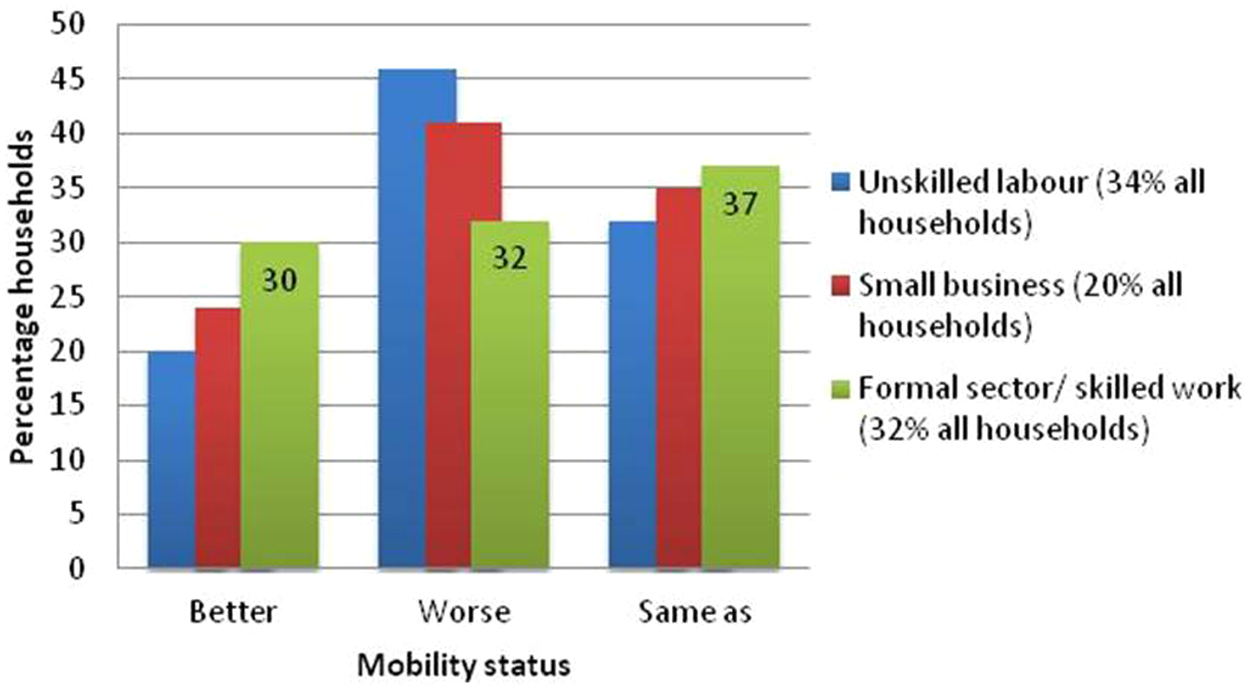
Self-reported mobility status by employment category*
The monetization of the urban economy, therefore, poses a significant threat to low-income households, who must devise multiple strategies of labour mobilization and manage complex financial portfolios to meet striking income deficits. Nearly three-quarters of all households have at least one loan or debt in their financial portfolio, illustrating the pressing need for alternative means of bridging the gap between household incomes and expenditures.(13) Coping with budget deficits is a situation commonly referred to as tanatani, highlighting the financial tug-of-war between income and expenditure, constantly pulling in opposite directions. One in five households has a large monthly income deficit of between 2,000 and 5,000 taka,(14) and a further 25 per cent have a deficit of between 500 and 2,000 taka (Figure 2). Small budget surpluses and deficits easily fluctuate in either direction if a household has additional expenditures (such as health costs) or has earned a higher income (e.g. through more regular work) in any given month. Health expenditures place a further burden on budgets, with three-quarters of households reporting monthly health expenditures averaging 863 taka. Only one in three households has a monthly income surplus sufficient to manage these costs without going (further) into deficit, highlighting how poorly equipped bustee households are to cope with additional income pressures.
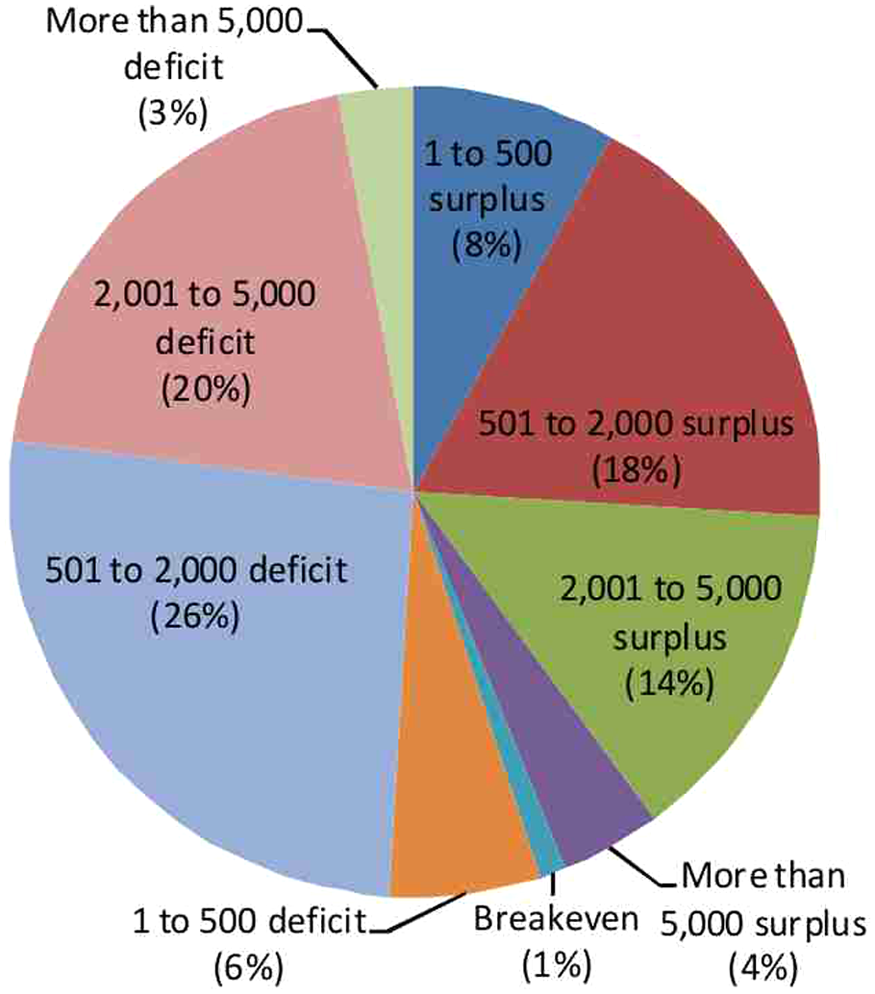
Size of household budget surplus/deficit (in Bangladesh taka)*
Labour mobilization strategies serve dual purposes: to smooth consumption and promote household security, and to build a platform for household mobility. In this context of severe financial instability, however, they serve primarily the former goal of smoothing consumption when income shortfalls need to be bridged. This means that for the majority of households, meeting immediate economic needs dominates in decision-making on labour mobilization strategies, taking precedence over patriarchal norms that forbid women’s employment. However, increases in female employment do not mean that patriarchal ideologies have become diluted, and their persistence results in significant divergence between male and female perceptions of female employment. As the following sections discuss, broad agreement on the need to mobilize female labour for household security is accompanied by two concerns. For men, this is the trade-off between economic needs and social status, while for women, concerns focus on the negative behaviours this promotes in some husbands. Women face a complex balance between maintaining their household, employment and marital relationships, and men remain unwilling to accept additional challenges to their authority.
III. Balancing Financial Needs And Social Status: Male Perceptions Of Female Employment
As we have seen, male household heads control decision-making regarding female labour mobilization, balancing competing economic and social priorities. While the daily pressures of income scarcity amidst the high costs of urban living means that additional sources of income are a necessity, the mobilization of female labour comes at a heavy cost, being a threat both to the self-image of the household head as the main provider and to their household’s status and honour.(15) This means that having to prioritize economic needs leads to the long-term sacrifice of the social networks most conducive to long-term prospects for household mobility. In the following two sub-sections we explore the perceptions and decision-making processes of two different groups of household heads: those who mobilize female employment out of economic necessity and another (much smaller) group who choose not to given the sacrifice this entails in terms of status and prestige.
a. Female employment: from a necessary evil to a strategy for advancement
Endemic insecurity has led to an environment in which patriarchal ideologies are forced to take a back seat. This is a view expressed by men and women in different ways. As one woman explained: “The mind set has changed about whether a woman can work. Now there is no man that does not want his wife to work!” Male focus groups estimated that only 5−10 per cent of women are housewives, but were far from viewing this as an indisputable good. Traditional patriarchal beliefs and gender norms remain, with household heads viewing female employment largely as a necessary evil crucial for survival in the city. As one focus group respondent argued: “It is not a matter of good or bad that a woman works. If my household needs it, my wife will work”, highlighting that only when female employment is necessary to survival will it be condoned. Another male focus group respondent explained the situation as: “For poverty, our habits are going bad”, highlighting that female employment symbolizes not so much a choice for households but rather, a lack of choice.
With a sole income earner rarely able to promote household stability, let alone mobility,(16) just under 60 per cent of households send female members to work, who make a significant contribution to household income (Figure 3).
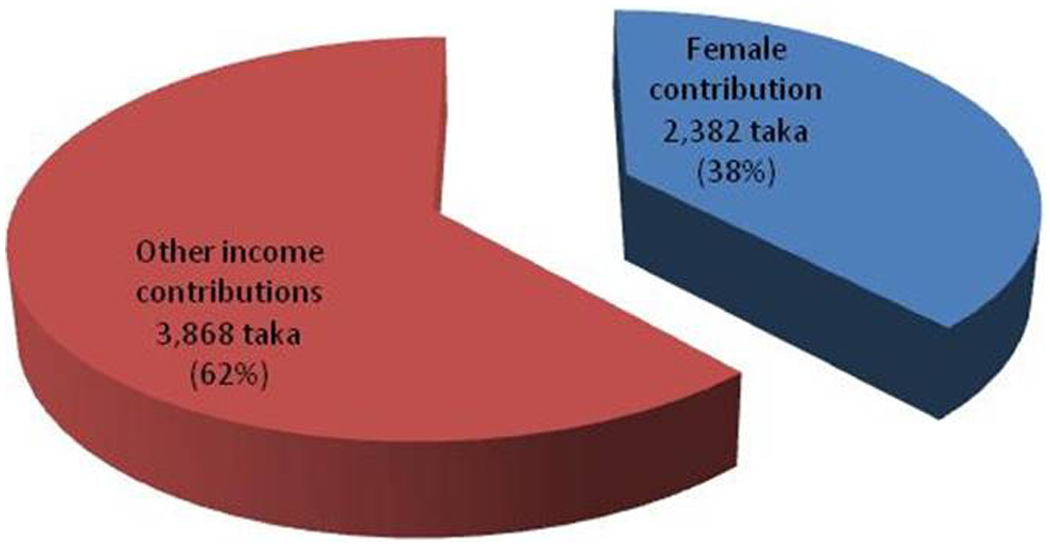
Female contribution to household income: male-headed tenant households*
The deployment of female labour as a response to insecurity is evident when one breaks down rates of female employment across various categories, including the household head’s employment category, household income and vulnerability to income shocks. For households headed by unskilled labourers facing low wages and irregular work, female labour rates increase to around 65 per cent of households. If a household head is unemployed, the figure rises to nearly 70 per cent. Insecurity also distinguishes between rates of female employment across communities. Households in one community had recently moved there after being evicted from their previous homes, and problems of gambling and drug addiction further increased financial pressures on many households; rates of female employment there were high, at 64 per cent of households.
This relationship is also evident when looking at female employment by household income, with relatively wealthier households much less likely to send women to work. Only around 40 per cent of households earning more than 10,000 taka a month mobilized female employment, compared to 50 and 70 per cent of households earning below 5,000 taka and between 5,000 and 10,000 taka, respectively.(17) This likely indicates that the poorest households are in this position because they cannot mobilize further income through female employment. Of the households in lower-income brackets who did not mobilize their wife’s labour, many interviews made clear that this was due to their inability to do so rather than unwillingness. Frequent disruptions to female labour due to lifecycle changes such as pregnancy, child care or daughters being sent for marriage act as further constraints on the ability of households to use female labour mobilization as a strategy for advancement.(18)
These constraints help to identify why female labour mobilization is so rarely able to facilitate household improvements.(19) Indeed, nearly half of the households that mobilize income from wives report that their household is worse off than five years ago, and a further 30 per cent as it being “the same”. That only one in four household heads who reported household improvements has mobilized their wife’s labour suggests that it is not female income contributions that have played the primary role in their household’s strategy for getting ahead. Instead, as discussed below, we see that it is a household’s social networks that play the strongest role in advancing household interests over time. For households that prioritize protecting and extending social networks, this entails a different rationale to labour mobilization strategies. In the political economy of bustees in Dhaka, honour and prestige are more important assets than short-term financial gain. This means, however, that the majority of low-income urban households in Dhaka who are forced to prioritize the short-term economic returns of female labour for their survival are, in the process, excluding themselves from the potential for longer-term economic returns and mobility.
b. Female employment strategies as a barrier to long-term mobility prospects
In urban Bangladesh, the extent of a household’s social connections has important implications for its opportunities for mobility.(20) Social networks for most households are limited to reciprocal networks that may assist in survival and coping with emergencies, but cannot enhance prospects for mobility. Relatives, neighbours, employers or moneylenders offer some forms of assistance to help smooth consumption, but given their similarly insecure livelihoods or their exploitative terms, offer few pathways to future improvements. A much smaller proportion of households have the right kinds of social networks necessary for advancing a household’s interests and economic status, in the form of social networks that link a household to bustee leadership figures and institutions. These connections provide access to the information, jobs, resources and other benefits that have the greatest long-term potential for expanding opportunities for household mobility. It is within this context that research in Dhaka and Chittagong has revealed that men link poverty not only to a lack of jobs but also to poor networking and a loss of social prestige.(21)
We see, therefore, that once a household has passed the first level goal of income stability, strategic decision-making shifts from household survival to strategies that aim to build a platform for mobility.(22) Conforming to patriarchal ideologies is one important dimension to securing the respect necessary for accessing and protecting the social networks through which households can access information, resources and opportunities. As one household head explained: “It is not a question of her financial assistance, it is a question of honour. People will ask me why my wife is working, so I will not allow this.” The non-economic costs of female employment in terms of lost status and respect mean that for some, upholding patriarchal ideologies takes priority over potential lost income in rationalizing labour mobilization strategies. This decision, however, can only be made by those who already meet their survival needs through other forms of income. For households lacking alternative sources of income – such as room rental or multiple male workers in the household – this strategy acts as an additional constraint on household security.
The importance of maintaining prestige through labour mobilization is evident in several spheres. First, female employment is less prevalent in households headed by small businessmen or formal sector workers, who hold more “prestigious” jobs. Only around half of small businessmen or formal sector workers mobilize female labour compared to around 65 per cent of households headed by unskilled labourers (Figure 4). This differentiation becomes even sharper when looking at the breakdown of female employment within the household. While around 55 per cent of unskilled labourers mobilize their wives’ labour, the figure drops to around 35 and 25 per cent of households headed by small businessmen and formal sector workers, respectively. In-depth interviews with household heads across these three employment categories also reveal that patriarchal ideologies are more common among small businessmen and formal sector workers when making decisions regarding household labour mobilization strategies.(23)
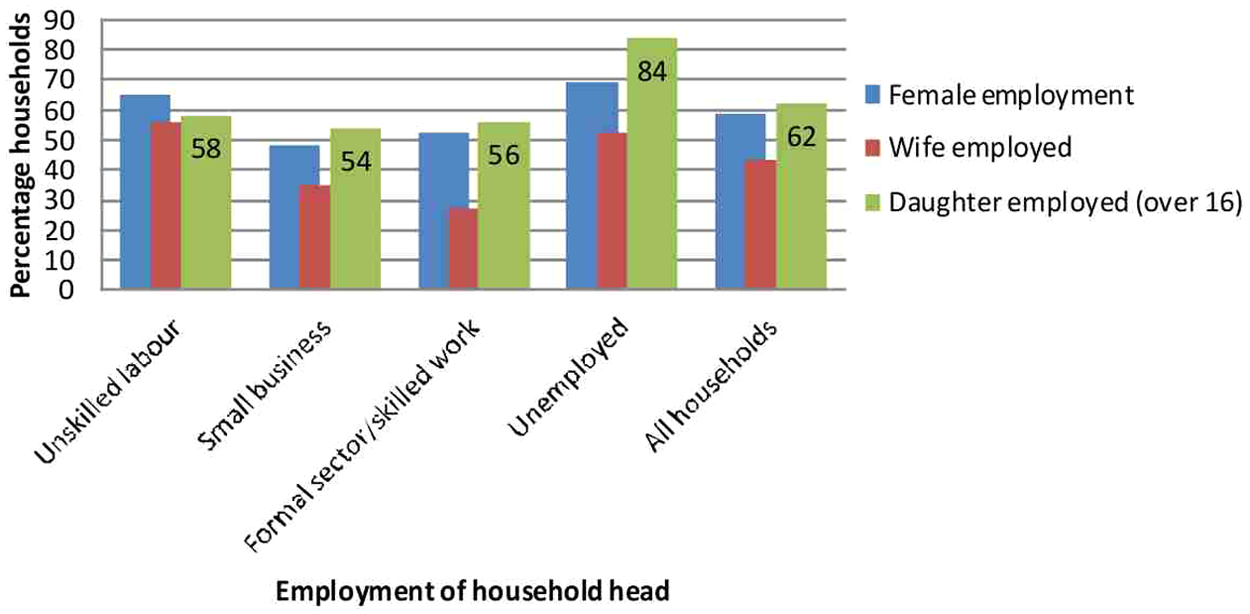
Breakdown of female employment rates by employment status of household head
This relationship is also evident in other indicators of prestige. Landlords are one group within the bustee who benefit from belonging to social networks that offer the potential for long-term mobility. Not only do they benefit from additional rental income, they are also likely to be connected to the bustee’s leadership structures, through which their household can access information, resources and the best forms and terms of employment.(24) By this logic, this should also mean that they prioritize prestige over the short-term financial returns of their wives’ labour. Sixty per cent of tenant households mobilize their wives’ labour, compared to 54 per cent of households that own their own house. If we exclude the community where homeowners did not own additional rental rooms, rates of female employment for tenants remain at 60 per cent, but drop to 42 per cent of households for landlords, highlighting the substitution effect this productive asset offers. Where landlords mobilize female employment, their contributions to household income are similar in kind to tenant households (2,520 taka per month compared to 2,382 taka per month), but this constitutes a much smaller proportion of total household income (29 per cent) given this additional income, which at 6,222 taka per month is 60 per cent higher than the other income sources displayed by tenants.(25)
Another indicator that a household is connected to bustee leadership structures is membership of various organizations. Organizations within a bustee setting are political institutions, and membership highlights a household’s allegiance or affiliation to ruling informal systems of governance, which is often rewarded by the distribution of resources and opportunities within these circles.(26) Households where at least one person is a member of an organization are less likely to mobilize female labour. Half of households displaying membership employed female labour, compared to 59 per cent of all other households. In the community where membership of bustee committees was highest, all but one of the households with membership were also landlords, reinforcing their higher social status. Interestingly, household membership of NGO programmes has a similar effect, with 53 and 60 per cent of households that are and are not members of an NGO mobilizing female labour, respectively. This is surprising in the context of NGO programmes in these areas. With the majority targeting women with microfinance for their social and economic empowerment, it could be assumed that this would have had the opposite effect of increasing female participation in the labour market.
If we break down female employment within the household, we see another interesting distinction, namely that the upholding of patriarchal ideologies appears to be more strongly adhered to regarding the employment of a household head’s wife. In contrast, there are few differences with regard to the labour mobilization of daughters, regardless of the different prestige and social status accorded to different employment categories (Figure 4). This confirms that garments work is now recognized as an acceptable option for young, unmarried women, in contrast to earlier assumptions that work for this group would be frowned upon given its risks to family honour and future marriage options.(27) The reasons for this become clearer when we look at how female employment impacts upon relationships in the household. That a wife’s employment can lead to negative male behaviours and marital tensions that challenge the household head’s dominance and authority means that the mobilization of a daughter’s labour is preferable to that of a wife’s.
IV. Balancing Employment And Household Responsibilities: Experiences Of Working Women
Focus groups reveal that women have two overarching, but incompatible, priorities when it comes to work, as the following two sub-sections discuss. Recognizing the centrality of their incomes to household security, the first is their commitment to maximizing their income contributions, prioritizing comparatively high-paid jobs in the garments industry regardless of the difficult working conditions. Their second priority is to minimize marital tensions arising from their employment. Reconciling these two priorities is difficult, however, due both to problems balancing work and household responsibilities and to the negative behaviours of their husbands that their employment can trigger.
a. Maximizing contributions to household income
“When I work, I cannot worry about the tensions or my husband’s attitude”, explained one woman: “I must work for my household.” This highlights the consensus displayed across female focus groups regarding their centrality to household security. As one female respondent explained: “There are only two households doing a little better here. [In the other households], the women cannot work outside, so they cannot do any better”, highlighting the belief expressed by many groups that there is no opportunity for household mobility without women’s income contributions. Regardless of a household head’s dominance in decisions about the deployment of female labour, women must use their own initiative in searching for work, primarily through their working neighbours who refer them to jobs.(28)
Around half of women are employed in the garments industry (Figure 5). That the relatively high monthly salaries in the garments sector are accompanied by multiple disadvantages highlights the priority women place on the household’s economic needs. The disadvantages include long hours and compulsory overtime, late payment, the need to travel long distances, job insecurity, dangerous working conditions, sexual harassment at and on the way to work, and difficulties reconciling their work and domestic responsibilities.(29) One woman described working in the garments sector as: “A second jail…we have to work from morning to night and cannot get any relief because they are pressuring us all the time.” Fixed shifts, long working hours and compulsory overtime often requires women to rise as early as 4am to cook household meals for the day and meet other responsibilities prior to work, and to return as late as midnight. Returning late from work and being unable to prepare food on time are a regular source of quarrels and tensions between husbands and working women, who receive little assistance from their husbands in face of additional burdens. When asked whether their husbands helped out, one group of women laughed, saying: “No! Men will not help us out. They just take their baths and want food all the time, otherwise they will beat their wives.”
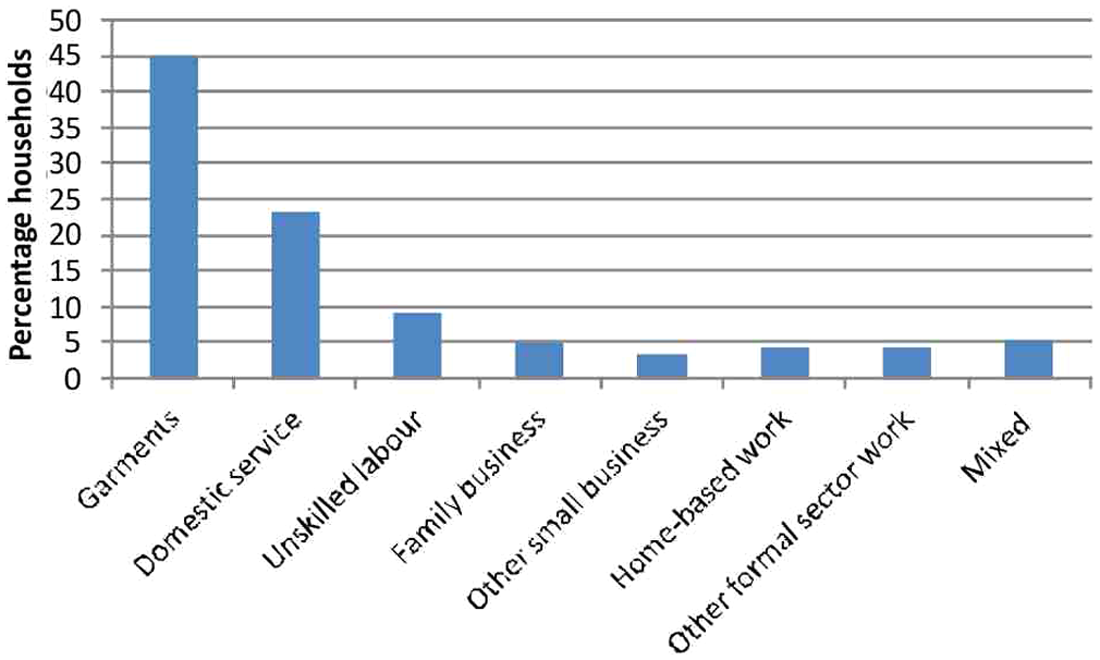
Female employment by sector (percentage households)
Focus groups distinguish between women doing outside work in the garments sector, in domestic service or as unskilled labour and those doing small amounts of home-based work such as tailoring or embroidery, which although offering more compatible work options and better working conditions also generate lower salaries (Table 1). “It is much better to work sitting in your home” explained one focus group of women, “…both for prestige and for your family. Women with children must take care of them and make sure they go to school.” However, in only five per cent of households with female employment were women doing home-based work, indicating that the income derived from this option is insufficient to allow it to play its necessary role in household security.(30) Other constraints preventing women from engaging in home-based enterprises include a lack of capital, limited space, a lack of skills and high levels of tenancy, with landlords ready to complain at excessive noise or electricity usage.
Overview of main employment opportunities for women
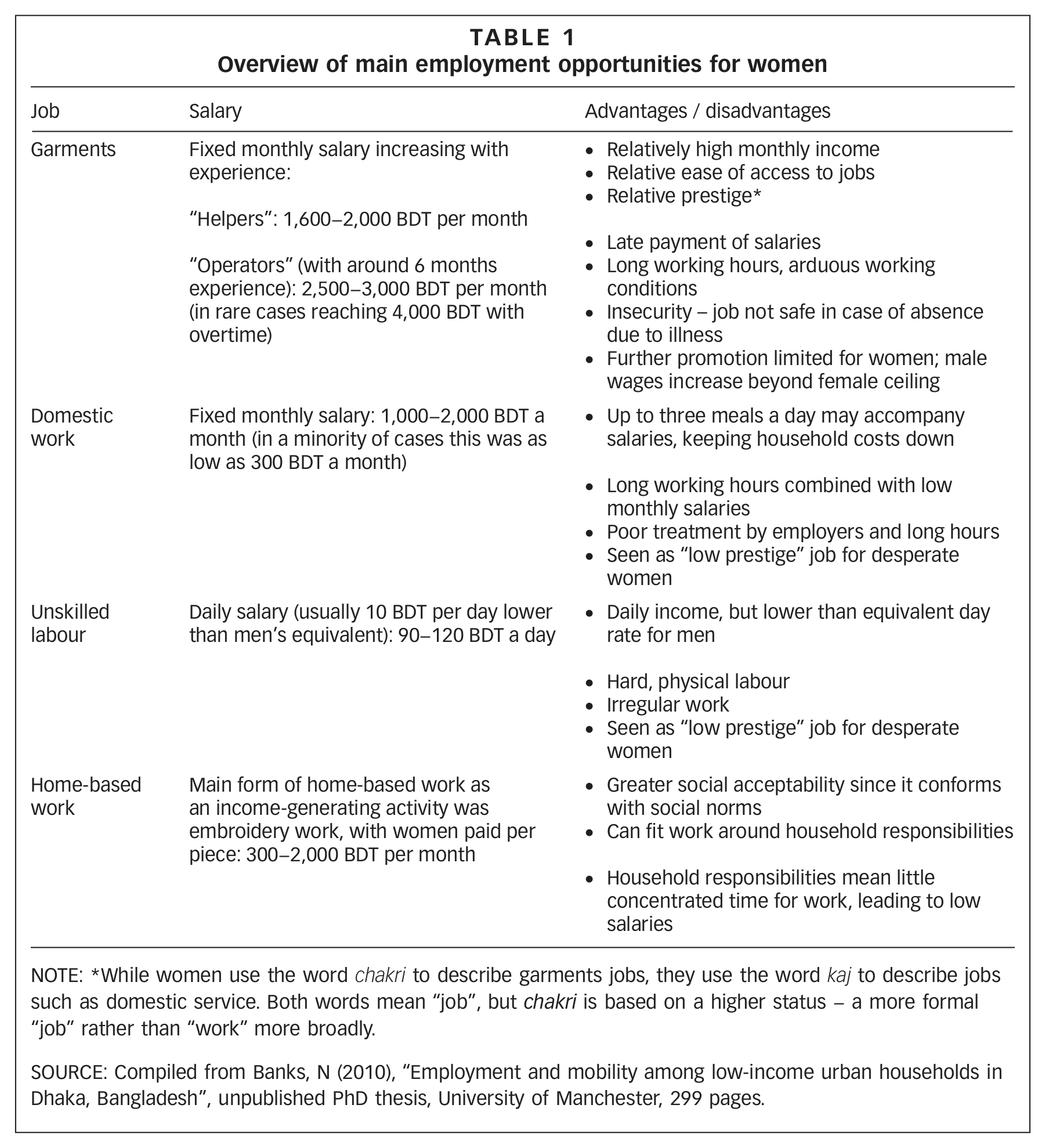
NOTE: *While women use the word chakri to describe garments jobs, they use the word kaj to describe jobs such as domestic service. Both words mean “job”, but chakri is based on a higher status − a more formal “job” rather than “work” more broadly.
SOURCE: Compiled from Banks, N (2010), “Employment and mobility among low-income urban households in Dhaka, Bangladesh”, unpublished PhD thesis, University of Manchester, 299 pages.
The garments industry of Bangladesh brings a new dimension to female employment, offering high and regular monthly wages to large numbers of women.(31) While this may increase women’s contributions to household income, in few instances do these terms of employment lead to greater financial autonomy regarding personal financial needs. As Table 1 reveals, most jobs for women provide a fixed monthly or daily income, which allows husbands to know how much their wives are earning and what to expect on payday, when women pass their income onto their husbands. This is in stark contrast to male workers, who receive daily incomes from which they can keep significant portions for pocket korotch (or personal spending money). As one focus group respondent explained: “My husband can work 15 days a month [as a bus conductor] and gets paid 400 taka daily. This is a good salary, but how is this salary good for the household if he gives me 100 taka and spends the rest?” In comparison, women rarely keep aside any income for personal expenditures, leaving them reliant upon their husband’s decisions or having to devise strategies such as borrowing from female neighbours or keeping aside small amounts of money from household funds to meet their needs. As one focus group respondent illustrated: “If we are ill, we hope our husband will recognize this and give us money for medicines, but still we are not free to buy it ourselves.”
b. Balancing marital stability and negative behaviours
The second challenge women face is maintaining marital stability within the household, where the deployment of female employment is often accompanied by tensions, quarrels and negative behaviours that range from laziness and the threat of violence to physical violence, abandonment or to husbands taking second wives. Other research in urban Bangladesh has highlighted that how a household head perceives female employment – as a necessary evil or a strategy for getting ahead – influences how they react to female income contributions and cope with changes to the balance of power or authority,(32) and this is also evident in findings here. With the majority of household heads viewing female labour as a matter of economic necessity, female employment is seen as a direct challenge to the role of the household head as the economic provider, especially where it leads to women’s increased participation in decision-making or to challenges to their authority. Women go to substantial lengths to avoid confrontation,(33) but when their husbands do not behave in line with household interests – for example, working fewer hours or contributing less income – they may vocally challenge their husbands because these behaviours reduce the impact that their additional labour has on the household.
As one woman argued: “When a man sees that his wife has got a job, he gets lazy – he will become a jamider!”, referring to a landowner who benefits financially from other people’s hard work. Male focus groups also universally acknowledged this tendency. For example, one male respondent argued that: “Some men are bad. They like their wives to work and use this as an excuse to work less hard”; and another that: “If men become too dependent on their wives, they become lazy and gossip at tea stalls rather than work.” Interestingly, however, while male focus groups were equally likely to discuss these bad behaviours, only one recognized that women’s attempts to change these bad behaviours were anything other than “disobedience”. Instead of viewing women’s reactions as a rational response to these behaviours, men instead saw them as an additional challenge to masculinity, which cannot be condoned. As one focus group explained: “There are two main reasons we won’t allow our wives to work. Firstly, some men use their wives’ work as an excuse not to work hard… Secondly, when wives work, they become intolerable towards their husband, becoming disobedient, argumentative and trying to negotiate.”
There is a contradiction here. Men recognize the bad practices their wives are reacting to but are unwilling to condone their view because it directly challenges their power and authority. This suggests that once a household head has accepted the trade-off in prestige associated with female employment, it is not the actual step of sending a wife to work that is the major concern but, rather, the additional challenge this brings to their authority and dominance. This also helps to explain why the mobilization of daughters of working age is more preferable and more commonly deployed, because daughters do not provide the same challenge to the power and authority of the household head. As highlighted in one male focus group: “It is the men who should be dominant, but if they are dependent on women, they are not anymore.” Only one male focus group recognized explicitly that it was male behaviours, rather than female disobedience, that led to these quarrels: “Women are contributing a lot to the household, but men use this as an excuse to misbehave with their wives by making quarrels or not working hard themselves.”
Preserving household solidarity and cooperation is more important for the long-term interests of women, rather than short-term goals of meeting personal needs that create tensions, because of multiple repercussions. First, repeatedly questioning male authority often leads to violence. As noted in one male focus group: “Men are simply beating their wives to solve this problem [of confrontation].” Women in Bangladesh experience some of the highest rates of domestic violence in the world, with a survey across several cities revealing that three-quarters of women have been physically abused by their husbands at least once, and 45 per cent reporting frequent violence.(34) In addition, the urban environment is also characterized by marital instability, with the abandonment of wives or the taking of additional wives being common practice.(35) In three of the four bustees,(36) between eight and 22 per cent of households were female-headed households, who face particular vulnerabilities. Lacking male income earners and other forms of protection amidst societal norms that disadvantage women, many female-headed households find themselves facing “…a precipitous decline in social status and material conditions should they find themselves deprived of male protection”, often joining the ranks of the extreme poor.(37)
It is important to note that while male resistance or hostility to female employment can curtail the transformative potential of women’s work, male support can also enhance it.(38) Where household heads see female employment as a strategy to assist with mobility rather than for survival, this played an important role in positive outcomes, since it was reflected in positive behaviours and work motivations. For the joint labour of husband and wife to contribute to household mobility, both parties must work to the best of their ability and contribute sufficient income. Such attitudes characterized “improving” household heads, who displayed positive attitudes to “teamwork” and viewed their household as a “unit” in which improvements are dependent on the labour of both spouses. As one improving household head described: “Two years ago my wife started working and this has improved our situation… As a household head, I must think of what’s best for my household. I think of our household as a vehicle with two wheels, me and my wife. Without both wheels, this vehicle cannot go.”
V. Conclusions
Based on broader research into employment among the urban poor, this research did not attempt to measure the extent of female “empowerment” as a result of employment. Instead, it focused on changing male and female perceptions of female employment in a context of endemic urban insecurity, and its practical implications on women’s lives. As such, the research affirms previous research in Bangladesh that finds that the relationship between paid work and women’s empowerment is one of “contradictions and contestations”, and rarely represents a linear pathway.(39) Women recognize the centrality of their work contributions to the household, prioritizing jobs in the garments sector, which offer the highest wages, regardless of the associated difficulties in working conditions and in balancing work and domestic responsibilities. Maintaining this precarious balance is made even more difficult by the addition of a third factor to juggle, that of keeping marital relationships stable while simultaneously trying to negotiate those behaviours of their husbands that are detrimental to the household.
The research reveals that female employment is not so much a choice but, rather, a lack of choice in the context of the high costs of urban living and the insecurity of urban livelihoods. In a political economy where access to information, resources and opportunities is dependent on a household’s social networks, household heads also struggle to balance an incompatible trade-off, namely the need to balance the household’s immediate economic needs with its long-term strategic interests. For the majority, economic necessity takes priority, regardless of the long-term sacrifice that female employment entails. This leads to an important contradiction with regard to the practicalities of female employment. While the majority of households need women’s work to survive, the subsequent erosion of their social status and networks ensures that through deploying this strategy they are effectively excluding themselves from the most effective means of mobility. The necessity of female employment for securing daily survival precludes the majority of low-income urban households from building the social assets that offer the potential for higher economic returns and mobility in the longer term. That only relatively better-off households can afford to prioritize the household’s social needs over the economic needs contributes to the maintenance and reproduction of inequalities within the bustee.
While men widely – albeit reluctantly – recognize the necessity of their wives’ labour to household stability, they are not yet ready to accept the additional challenges this brings to their authority and dominance. The negative behaviours of household heads – including reducing working hours and contributions to household income – are widely recognized by both men and women as a common reaction to female employment. The “disobedience” accorded to women who challenge these behaviours reflects unhappiness with the further challenge to male authority, which can lead to various adverse outcomes for women such as violence, abandonment or a husband taking additional wives. Is it because of these behaviours that female employment so rarely results in economic mobility among busteebashees in Dhaka? Other factors also influence this, including the regular disruptions to women’s working lives for reasons of pregnancy and child care, but this is undoubtedly one influence. That one characteristic of “improving” households is the strong recognition that a husband and wife must work as a unified team points to the suggestion that a more supportive environment for female employment is an important step, both in improving household incomes and security and in reducing the difficulties women face in finding a balance between managing their work, the household and marital relationships, and in promoting household mobility.