




Abstract
This paper assesses progress in the government of India’s Basic Services for the Urban Poor (BSUP) programme in 11 cities in India. It draws primarily on responses to a common set of questions asked of government officials, residents and a range of other actors, and on visits to two or more BSUP project sites in each city. In the majority of the 11 cities, much of the building subsidy money still remains unutilized. But the paper suggests that the limitations of the BSUP programme are more to do with the inadequacies of what was built and how this relates to not involving the “slum”(1) dwellers in the design and planning of what was to be done, or in decisions as to whether the slum should be upgraded (or the inhabitants relocated), or in implementation. In many instances, even when in situ improvements were planned, this usually involved clearing the site and constructing contractor-built small apartments rather than implementing what is considered good practice, namely support for households to make incremental improvements to existing housing. The paper suggests that the institutional structures needed to support slum upgrading at scale are not in place at municipal, state and national level. Many of the BSUP projects are simply public housing construction re-labelled – and often with very inadequate provision for the “basic services” whose improvement is meant to be at the centre of the BSUP. However, the paper notes the instances where new approaches were tried with more success.
I. Introduction
This paper assesses projects funded under the government of India’s Basic Services for the Urban Poor (BSUP) programme − with particular attention paid to the scope for community participation − and involved visits to 31 projects in 11 cities. It is based on a study commissioned by the NTAG (National Technical Advisory Group), which has been submitted to the Ministry of Housing and Urban Poverty Alleviation.
In 2005, the government of India announced a major initiative – the Jawaharlal Nehru National Urban Renewal Mission (JNNURM) − to address the much-needed investment in cities to cope with urbanization and its challenges. It had two sub-missions: urban infrastructure and improved governance in municipalities, to be managed by the Ministry of Urban Development; and Basic Services for the Urban Poor (BSUP), to be managed by the Ministry of Housing and Urban Poverty Alleviation. Each state government and the cities involved had to prepare a timetable to undertake various reforms, prepare a city development plan and submit detailed project reports in order to seek funding for projects, of which BSUP was one set. BSUP sought to support projects providing shelter, basic services and other related civil amenities to low-income settlements, namely security of tenure, affordable housing, water, sanitation, health care, education and social security.(2)
The BSUP had particular significance in that it sought to support slum upgrading, that is, support improved living conditions and service provision in existing slum settlements and create a strategy to upgrade and improve the lives of those living there. Clearly, the preferred option was to upgrade habitat in the same location. For residents, this avoids the disruptions to livelihoods and social networks that relocation usually entails – and avoids relocations that are often to sites that are far from income-earning opportunities. For the government, upgrading avoids the need to find a new land site. Upgrading is also meant to ensure more secure tenure (so that eviction threats are much reduced) and build on the investments the residents have already made in their housing (and infrastructure). There are examples of such “upgrading” in cities in India going back the late 1960s,(3) but it had never been national government policy to support these at this scale.
The government of India’s commitment to upgrading was further enhanced in 2009 when the Rajiv Awas Yojana (RAY) programme was announced. This was specifically to support state and city governments to upgrade slums and assign title to their residents, and to plan to accommodate the envisaged growth as India’s rapid urbanization continues, so that more slums are not formed.
II. What is meant by Slum Upgrading?
The concept of government agencies working with the inhabitants of slums to improve conditions and tenure in situ goes back at least 40 years – see, for instance, the Indonesian government’s Kampung Improvement programme launched in the last 1960s.(4) Support from the World Bank for upgrading schemes in many cities in different nations from the early 1970s helped to legitimate the concept.(5) This represented a major departure from government policies, which had previously focused on bulldozing informal settlements or ignoring them. The scale and scope of “upgrading” varies from minor improvements (for instance street lighting, communal water taps and some improvements to surface drains) to major transformations (piped water and sewer connections to all dwellings, improved provision for schools, health care and public space, secure tenure and support for households to improve their dwellings). But all upgrading implies an acceptance of the right of the residents to live there, even if the housing and infrastructure do not meet official standards and the tenure or use of the land is illegal. Since the 1970s, upgrading has become so common that in many nations it is seen simply as what a city government should do.(6) There are also national programmes that have supported upgrading on a large scale – one of the best known being the Baan Mankong programme in Thailand, which is also unusual in the scope given to community organizations within informal settlements to organize and manage the upgrading.(7) Within this programme the government created an organization, CODI, which accessed capital that originally would have been given as individual subsidies to the National Housing Authority to construct public housing and instead gave communities money directly to build houses and improve amenities.
However, it has been difficult to shift governments away from funding “housing for the poor”, in part because it is more attractive to politicians (“look at the housing we have built for the poor”), in part because of the long history of slum clearance, with a refusal by those in government to see any value in slums, and in part because building housing supposedly for the poor is good business for large and influential building companies. As will be discussed in more detail below, one of the difficulties with many of the projects funded within BSUP is that they were designed and implemented as if they were public housing programmes, with the government paying contractors, based on tenders they submitted for the work − with little or no interaction with the inhabitants. In most cases, the slums were not upgraded but bulldozed, and new contractor-built housing constructed on the cleared site or on another site. What was built was often of poor quality – and it was common for basic infrastructure not to have been installed by the time the supposed “beneficiaries” were meant to move into their new housing. Although the total subsidies allocated served a very small number of settlements, most of the money remains unutilized as many projects have been abandoned, others not even started and many houses built but remain unoccupied.
III. The Basic Services for the Urban Poor (BSUP) Programme
The BSUP identified 63 cities, divided into three categories according to their population: more than four million (seven cities), 1−4 million (28 cities) and other. The selection of cities also sought regional balance. In order for cities to access BSUP funding, the city or municipal government had to develop a city development plan and their state government be committed to undertaking urban governance reforms. Following this, detailed project reports had to be prepared and appraised by the government of India. Five per cent of the grant was to cover these preparations, along with training and capacity building, community participation and information gathering. The residents of communities in which the BSUP initiatives were located were expected to contribute at least 10−12 per cent of the cost – and sometimes considerably more.
The study of the BSUP-funded projects in 11 cities aimed to document the different ways in which city governments were using the funding, and to draw lessons to feed into a second phase of BSUP funding; also to suggest recommendations for RAY, which envisaged larger city level programmes. The main objectives were to understand how each city government selected, designed and executed BSUP projects and what provisions there were for involving the residents of the chosen sites and their organizations (and also what were the roles of municipal authorities, contractors and NGOs). There was also an interest in how the detailed project reports were prepared, how contractors were selected, structures designed, amenities provided and connections to the city infrastructure improved.
The 11 cities were chosen to ensure diversity in terms of location, size, approach and progress in implementation (Table 1).
Comparing the 11 cities
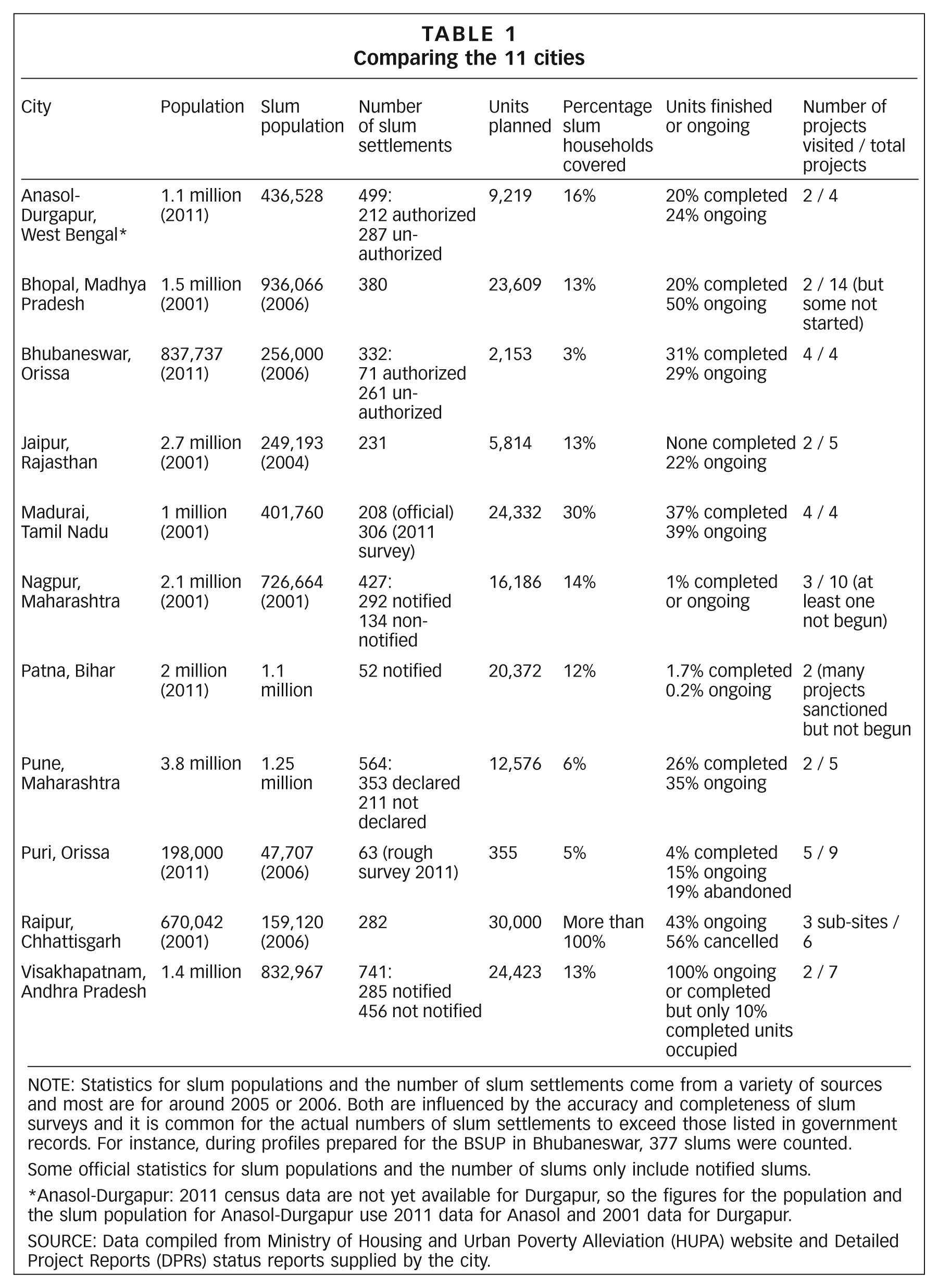
NOTE: Statistics for slum populations and the number of slum settlements come from a variety of sources and most are for around 2005 or 2006. Both are influenced by the accuracy and completeness of slum surveys and it is common for the actual numbers of slum settlements to exceed those listed in government records. For instance, during profiles prepared for the BSUP in Bhubaneswar, 377 slums were counted.
Some official statistics for slum populations and the number of slums only include notified slums.
Anasol-Durgapur: 2011 census data are not yet available for Durgapur, so the figures for the population and the slum population for Anasol-Durgapur use 2011 data for Anasol and 2001 data for Durgapur.
SOURCE: Data compiled from Ministry of Housing and Urban Poverty Alleviation (HUPA) website and Detailed Project Reports (DPRs) status reports supplied by the city.
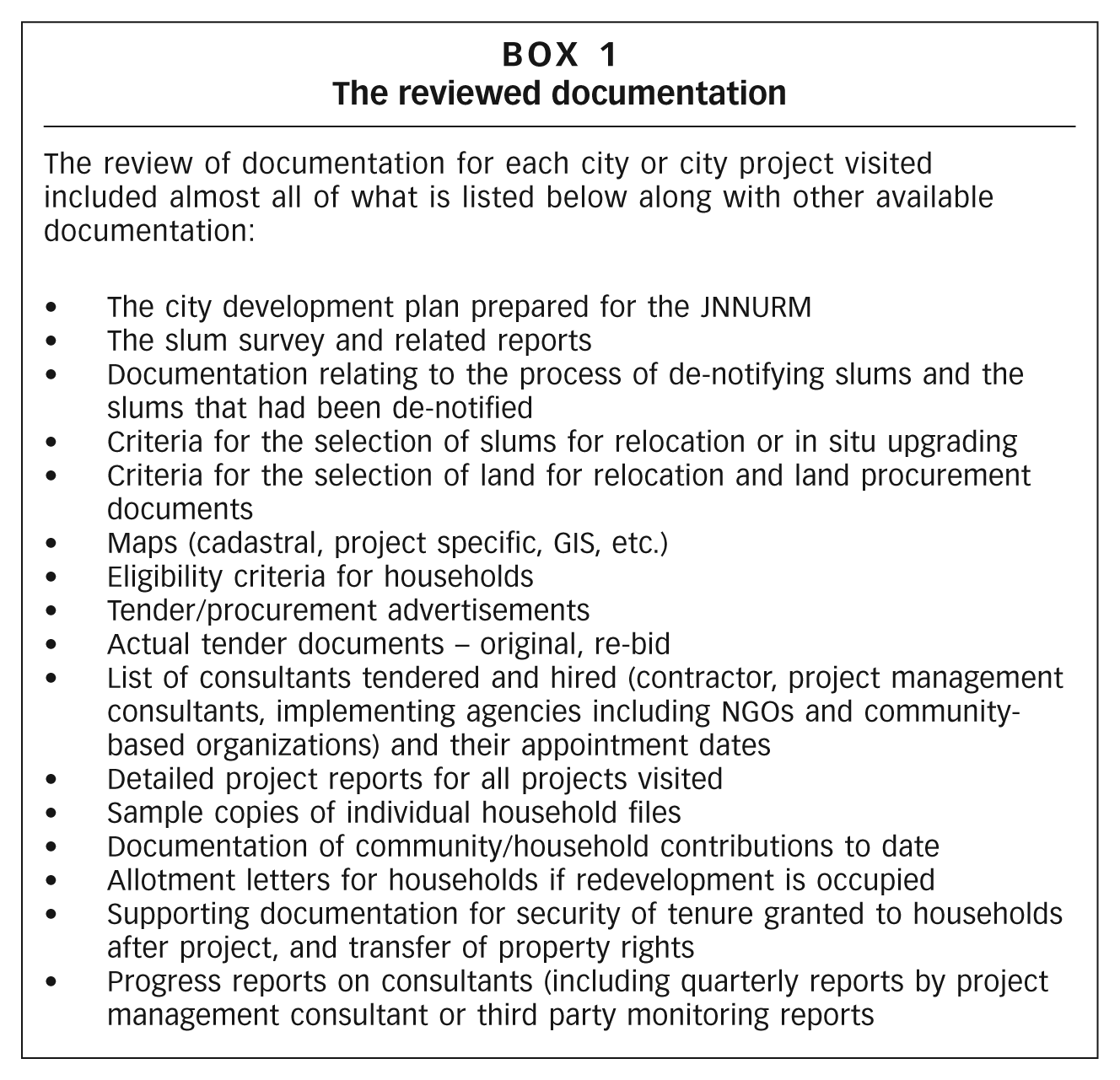
The assessment of the projects included a review of the documentation prepared for the city development plan and also other documentation relevant to the BSUP assessment (Box 1). A common set of questions were prepared and used in interviews with the implementing agencies, urban local bodies, communities and other stakeholders. This was not intended as a survey where all those interviewed answered all the questions but, rather, as a guide to ensure that the same issues were covered in the different cities and project sites visited. A summary of the list of questions is as follows:
background information on each implementing agency and each settlement;
the development of the project (and the extent to which it involved the participation of residents);
the different project phases (the preparation of the city development plan, the survey of eligible households);
how the choice between in situ upgrading and relocation was made;
the procurement process (and how it influenced who was selected to implement each project);
the preparation of the detailed project report;
the slum survey;
the design of interventions (housing designs, settlement layouts, infrastructure); and
the identification of beneficiaries and various documentation on these households showing evidence of their claim for subsidy.
The assessment also looked at the unit costs of projects and the proportion that beneficiaries had to pay; also management of the construction (including whether temporary (transit) accommodation was provided during building) and of the new units’ occupation. It also looked at provision for maintenance (and resident associations who could do this), transfer of tenure and provision for grievance redress.
In each of the 11 cities, a range of people were interviewed that included senior government staff, project staff, local politicians and residents of the “upgraded” slums and resettlement sites. Field visits to projects were decided in consultation with city officials and project staff and were visited with them; there were also discussions with households and contractors. The visits included walking around each project site and visiting the buildings with government staff, residents (if they were present) and, where possible, contractors. Government officers and contractors were interviewed – as were individual households and communities (in group discussions). In most cases, project staff and city officials were willing to answer the questions and reflect on their experiences. But in some projects, the visiting team was asked not to involve particular communities in discussions because there were unresolved problems or conflicts with the authorities. The assessment teams kept field notes and wherever permission was given, interviews and events were videoed.
IV. Upgrade, Rehouse or Resettle?
In most of the project sites that were visited, what was being implemented was not really upgrading but, rather, government funding for contractor-built housing (often of poor quality), mostly on the site of the slum (with the site cleared and conventional housing built) or on another site (relocation).
Although, as noted above, there are no agreed elements for what constitutes upgrading, good practice to date suggests that it has to include upgrading and improvements to existing housing and infrastructure and avoiding any displacement of people to the extent possible. It requires agreement with the inhabitants about what needs to be done, how it is to be done and the allocation of responsibilities. It needs to include measures to transfer tenure, and also household surveys and settlement mapping to support the construction of needed infrastructure and services (especially if there are no maps and little or no data on residents and their housing). The local government agency responsible for upgrading needs to ensure coordination with all other government agencies (or where relevant, private utilities), to provide necessary infrastructure to each housing unit. For many local governments, a shift to upgrading represents a shift in attitude as well as practice, because it implies a recognition of the value to the city of existing slums and of incremental housing improvements, as well as the rights of their inhabitants to the same network of infrastructure and services enjoyed by those who do not live in informal settlements.
What was evident in most of the BSUP projects that were visited was that the city government is seeking to implement upgrading with the same bureaucracy, procedures and institutions that used to be (or still are) responsible for public housing “for the poor”. In most instances, upgrading was seen as contractor-built housing to replace the units where the slum dwellers lived. In most cases, preparation of the detailed project reports, the appraisal process and the procedures for procurement and tendering were no different from those for conventional public housing projects, and the residents were rarely consulted about what their needs were. Meanwhile, local government staff lacked the skills to support upgrading – and this was not helped by the constant transfer of government staff, which did not allow for any continuity.
V. The Focus on Outputs, Not Outcomes and Quality of Provision
Table 1 shows the different scale of BSUP planned in different cities (from 355 to 30,000 units) and the percentage of slum households in each city that this would cover if the units were built − from more than 100 per cent in Raipur, as what was planned would house more than the whole slum population, to three per cent in Bhubaneswar and five per cent in Pune. Table 1 also gives figures for the proportion of planned units that have either been completed or are ongoing. In one city, 100 per cent of units were ongoing or completed (although most were not occupied) and the figure was 70 per cent or more in two other cities. In six cities, fewer than half the units were ongoing or completed; this included two where hardly any of the planned units had been completed or were ongoing. In Nagpur, 16,186 units had been sanctioned but only a few hundred had been built or were underway. In Patna, just two per cent of the 20,372 planned units had been completed or were ongoing. In addition, figures for units completed can be misleading as they include projects where construction has been completed but where there is no basic infrastructure or services (such as solid waste collection). The most ambitious BSUP initiative was in Raipur, where the initial target was larger than the slum population. The number of dwelling units sanctioned under BSUP was 27,976 in 2006, but in 2009 contractors were given work orders for 16,896 units. However, with the non-availability of land (many slums were to be relocated) and escalating costs, the number was reduced to 12,202 units in 2011.
Our visits to the 11 cities and 31 project sites highlighted issues that have relevance far beyond that of meeting numerical targets, since much of what was built did not meet the needs of slum dwellers. As described in more detail below, there are even instances of the supposed beneficiaries not wanting to move into the new housing units built for them. The limitations of what has been built under the BSUP in most of these cities has much more to do with the failure of the process to listen to and work with slum dwellers.
VI. Project Preparation
Most of the city development plans and the detailed project reports were prepared by consultants or municipal engineers. There was little or no scope for input from or discussion with the residents who were meant to be the beneficiaries regarding housing and settlement design and residents’ roles and contributions, or consultation on whether to upgrade in situ or relocate. If the project involved relocation, there was little or no consultation with those who were to be moved on where they were to go, and relocation sites were far from livelihood opportunities and lacked provision for public transport. Except in projects in Madurai, Bhubaneswar and Puri, support for residents to upgrade their own homes was not considered (even though this is central to most successful upgrading schemes in other nations). At best, residents in settlements chosen for inclusion in BSUP were simply informed as to what was going to happen. In some instances, the detailed project reports were imposed even when the households that were meant to be beneficiaries objected.
The data needed to design and implement the projects were often not collected, or if they were their accuracy and quality were in doubt. The criteria for choosing slums to be included in BSUP were unclear in most cities. The data collected on land and on households for the settlements chosen for inclusion were often inaccurate and lacking in the necessary detail. Many detailed project reports were prepared without studying land availability and without considering the site’s access to trunk infrastructure (for instance piped water, sewerage and drainage networks).
There were also problems resulting from delays between undertaking the surveys and starting the projects, so surveys and lists of beneficiary households were out of date by the time the work began. Cost estimates quickly become outdated but there was no provision for updating those that were originally accepted, even when there were long delays in starting implementation.
The procurement and tendering process used in most cities and states to award contracts was no different from that used for conventional public works and there was no accountability to the beneficiaries.
VII. Project Implementation
The whole point of slum upgrading is to benefit the slum residents. Yet in almost all the sites, the residents were dissatisfied with the initiatives and often in conflict with the authorities. There was no provision for grievance redress in most cities.
In Nagpur, in situ upgrading in eight projects was conceived as redevelopment, with the existing housing being demolished and new high rise buildings being constructed on the same site. This did not appeal to many households as their existing housing was in good condition. Seventy per cent of the housing in Nagpur slums comprised good quality (pucca) structures and more than 70 per cent had individual toilets. A resident from one of the slums (Nehru Nagar) commented: “Why should I leave my house and go and stay in a flat when I am in this area for so many years and I have all the documents such as photo pass, water meter bill, receipt of property tax, electricity meter bill, with all the basic amenities in the house. If at all government wants to implement any schemes, they should give us the amount sanctioned by the government to use and we ourselves will construct our own houses in the same place.”
The flats offered by this project were smaller than the original homes. A resident of Jai Bajrang Nag commented: “Now government wants our houses to be demolished and [to] shift us into small size flats. But what will happen to my son’s family who is also staying in the same plot but in a different structure; he won’t get a room in this new scheme.” A visit to Nagpur by the state government’s Principal Secretary (Gautam Chatterji) in 2010−2011 encouraged them to revise all in situ detailed project reports to recognize the quality of housing and amenities that already existed in these slums.
Regarding the in situ and relocation project in Srinagar Colony (Anasol), 288 dwelling units were sanctioned in 2006, with work starting in 2008 and completed in 2009. But there is no solid waste collection system in the new settlement (either door to door or community container) and almost all open spaces along the streets act as garbage dumps. There was no electricity or water for three months after the residents had moved in, and after a year the water supply was limited to three community taps shared between 280 families, providing water for three hours a day. There was no provision for temporary (transit) accommodation for those whose homes had been demolished, and because the resettlement housing had not been completed many moved away, unaware that they were meant to be getting one of the newly constructed houses. All houses were built by a local contractor but many indoor walls were damp, the load-bearing houses had been constructed with no RCC (reinforced concrete) and some walls had cracked. The lack of a residents’ organization (for instance a building society) has meant that residents looked to the municipality for maintenance.
In relocation housing built in Warje (Pune), the new housing was of such poor quality that the beneficiaries did not want to move there. The new units had to be built as G+7 (ground plus seven storeys) because less land was available than originally planned for. The units did not have the balconies that featured in the original design − and that are particularly useful for those living in small units. The site was half an hour from the city and some of the infrastructure was still not finished. Sharad Mahajan from a local NGO, Mashal, commented: “Since the relocation projects were building oriented and contractor oriented, people were not ready to shift. Two NGOs were involved to motivate people to move; after two months they failed to motivate even one person to move. When asked in a community meeting how many wanted to stay where they were, all raised their hands.”
Perhaps the most important aspect of successful upgrading initiatives in other nations is major improvements in access to basic services such as piped water, sewer connections, electricity and garbage collection. Despite being called Basic Services for the Urban Poor, basic services were not provided by many of the BSUP initiatives. The discourse above highlights the deficiencies in infrastructure provision in Srinagar Colony. In the in situ redevelopment in Kalpana Nagar (Bhopal), residents pointed to the lack of any solid waste collection and to the fact that water was only available two hours a day, and with the top floors in the G+3 structures not getting any water at all. In the in situ redevelopment and relocation in Shabri Nagar (Bhopal), there was no provision for solid waste collection. In the G+2 units built in Harijan Colony (Madurai), there were no connections to sewer lines or water mains. In the in situ project at Isopur Nahar (Patna), the newly built houses had no connections to the sewers and, although there was an electricity mains, none of the units were connected. In the in situ project in Sharifaganj (Patna), in the G+3 buildings that had been completed, toilets were not connected to sewer lines (toilets were blocked and unusable), construction was of poor quality and there was no garbage collection, so pathways were clogged with garbage.
In many of the projects visited, the built units were of poor quality and unfinished − and often built and declared completed but with no infrastructure. Rooms were small and walls often damp. For instance, in Shabri Nagar (Bhopal), the quality of buildings was poor and most had no glass in their windows. In the in situ project at Isopur Nahar (Patna), 192 units had been completed but again, with no glass in the windows.
VIII. Limitations in the Institutional FrameWork
The need to scale up initiatives to reach those living in slums with basic services and better housing conditions is obvious. In just these 11 cities, the scale of the slum population is evident: it reaches more than one million in two cities and more than 700,000 in three others. In most of the 11 cities, more than 30 per cent of the population lives in slums – with much higher numbers in Bhopal, Patna and Visakhapatnam.
The government of India’s growing interest in this is evident through their funding of BSUP and other initiatives (including, as noted earlier, RAY). The government of India announced plans to launch a national urban health mission in August 2012, which is targeted at providing good quality health care to the urban poor. Central government funding for BSUP (and RAY) is conditional on state and city governments undertaking various reforms, but in most of the BSUP projects visited, the basic institutional structure needed to implement BSUP was absent. In most cities, there is no group or cadre of government officials with the knowledge to design and implement upgrading initiatives − working with the inhabitants − or able to obtain the necessary agreements from different agencies and coordinate their inputs. One problem mentioned at many of the sites was the constant change in city personnel allocated to manage BSUP initiatives.
Perhaps the area where the lack of knowledge and institutional capacity within city governments was most evident was in the understanding of what in situ upgrading should involve and how it should be supported. In most cities, in situ upgrading was understood to mean demolishing all houses on the site, clearing it and building new units – and with this task being taken on by private contractors. As noted earlier, this was often done without consulting those who were meant to be “beneficiaries”. This goes against the whole concept of slum upgrading, which is to add to and build on existing housing and infrastructure – and support for incremental upgrading of homes and other buildings is one of the key characteristics of successful upgrading in other nations. Residents in several of the settlements that were visited emphasized that their original houses had been good quality dwellings for which they had tenure (patta) and that could be upgraded. Most residents also wanted to keep their own individual plots – rather than be rehoused in apartments − but they were not allowed to do so. When they were finally rehoused (after their site had been cleared and new buildings constructed), it was in much smaller units than their original dwellings. This was the case in the in situ redevelopment in Kalpana Nagar (Madhya Pradesh), where residents are refusing to pay their contribution.
However, there were some instances of households being provided with subsidies to upgrade their own homes – for instance in Bharatpur and Dumduma in Bhubaneswar, and Babu Talav in Anasol. There were also some in situ upgrading projects where households were involved in designing and managing the building work for their housing, for instance in three projects in Madurai − Harijan Colony, Mill Land area and Mella Vadakka. In the in situ upgrading in Mother Teresa Nagar in Pune, once the project had been sanctioned the detailed project report designs were replaced by ones developed by architects in consultation with each household. Women were particularly active in designing their units and the internal spaces, and 2,000 individual house plans were prepared and sanctioned by the local government. Community members who wanted to work on the construction sites were encouraged to do so. Some of the housing plots were too small to upgrade, so their inhabitants were rehoused in G+3 buildings, but still within the settlement. In Nagpur Chawl, also in Pune, designs for the upgrading of housing were developed with households.
One consequence of the focus on clearing sites and rebuilding from scratch was the need for households to find alternative accommodation while their homes were being demolished, the site cleared and new buildings constructed. In most projects, there was no provision for temporary (transit) accommodation for those whose homes were demolished as they waited for the houses to be built. Incremental upgrading that is managed by individual households usually means less disruption – as the household can still live on site during much of the work, and if upgrading does require the household to move, it is usually for a shorter period.
In most BSUP projects, two problems with finance were highlighted. The first, noted above, is the lack of provision for adjusting costs, as these rise as a result of delays that should have been anticipated. It is common for there to be a two to four year gap between project approval and the start of construction, yet there is no possibility for adjusting the initial budget to take account of this. The second problem is that work is often delayed because payments to implementing agencies do not arrive on time.
IX. Conclusions
Although the documents associated with the BSUP mention the importance of participation, in almost all municipalities, participation is viewed simply as providing information to communities about the project. Some detailed project reports and municipal staff recognize the importance of community participation, but there are no mechanisms on the ground to respond to this – be it in the selection of slums and eligible households; or in the design and planning of what is to be done and the size and design of the units; or in the decision as to whether to do in situ upgrading or relocation; or in the implementation (and supervision of building); or in the terms and conditions for the financial contribution demanded of them; or in the monitoring, maintenance and evaluation. Sadly, the main involvement of “beneficiaries” in many projects is in protests and in resistance to moving or paying their contribution. In most projects, there were no mechanisms for accountability to the beneficiaries by the chosen consultants and contractors.
The possibilities for increasing the scale and effectiveness of the BSUP (and of other initiatives to support improved living conditions in slums) depends on local governments and the contractors and consultants they commission learning to work with residents of slums and their community organizations. Slum upgrading should be a process rooted in consultation, discussion and agreement with slum residents with regard to design, implementation schedules and the division of responsibilities between government agencies, residents and their community organizations, and chosen consultants and agreed contractors. This might seem time consuming to a government structure that focuses too much on quantitative outputs, but it is likely to reduce or remove community hostility and make implementation easier and quicker. Community organizations within the slums and the larger federations of which they are often members also have the capacity to provide the mapping and detailed household surveys that slum upgrading needs.(8) When slum households are fully engaged in decisions about what is planned and costed, the likelihood that they can and will make the contributions that are required of them also increases.
Footnotes
1.
The term slum usually has derogatory connotations and can suggest that a settlement needs replacement or can legitimate the eviction of its residents. However, it is a difficult term to avoid for at least three reasons. First, some networks of neighbourhood organizations choose to identify themselves with a positive use of the term, partly to neutralize these negative connotations; one of the most successful is the National Slum Dwellers Federation in India. Second, the only global estimates for housing deficiencies, collected by the United Nations, are for what they term slums. And third, in some nations, there are advantages for residents of informal settlements if their settlement is recognized officially as a slum; indeed, the residents may lobby to get their settlement classified as a “notified slum”. Where the term is used in this journal, it refers to settlements characterized by at least some of the following features: a lack of formal recognition on the part of local government of the settlement and its residents; the absence of secure tenure for residents; inadequacies in provision for infrastructure and services; overcrowded and sub-standard dwellings; and location on land less than suitable for occupation. For a discussion of more precise ways to classify the range of housing sub-markets through which those with limited incomes buy, rent or build accommodation, see
Environment and Urbanization Vol 1, No 2, October (1989), available at  .
.
2.
Sivaramakrishnan, K C (2011), Re-visioning Indian Cities; The Urban Renewal Mission, Sage Publications, New Delhi, 278 pages.
3.
Anzorena, E J (1988), “The incremental development scheme of Hyderabad”, SELAVIP Newsletter (journal of low-income housing in Asia and the world), March.
4.
Hardoy, Jorge E and David Satterthwaite (1989), Squatter Citizen: Life in the Urban Third World, Earthscan Publications, London, 388 pages.
5.
Cohen, Michael A (1983), Learning by Doing: World Bank Lending for Urban Development, 1972−1982, World Bank, Washington DC, 55 pages.
6.
See Almansi, Florencia (2009), “Regularizing land tenure within upgrading programmes in Argentina; the cases of Promeba and Rosario Hábitat”, Environment and Urbanization Vol 21, No 2, October, pages 389−414.
7.
Boonyabancha, Somsook (2005), “Baan Mankong; going to scale with ‘slum’ and squatter upgrading in Thailand”, Environment and Urbanization Vol 17, No 1, April, pages 21−46.
8.
See Patel, Sheela, Carrie Baptist and Celine D’Cruz (2012), “Knowledge is power – informal communities assert their right to the city through SDI and community-led enumerations”, Environment and Urbanization Vol 24, No 1, April, pages 13−26; see also other case studies of community-driven enumeration in the same issue of the Journal.