




Abstract

I. Themes for future issues
II. IPCC Special Report on Managing the Risks of Disasters
III. Discounted prices and electronic access to Environment and Urbanization
IV. Medio Ambiente y Urbanización (MAyU)
V. Environment and Urbanization’s downloads
I. Themes for Future Issues
Here, there is particular interest in the impact of urban change on gender relations, and perhaps the impacts of gender on urban change. Possible themes include: changing urban labour markets; changing gender relations in rural areas and the consequences for urban migration; the formation of women-headed households in urban areas; the impacts of increased women’s representation and labour market feminization on the organizations formed by the urban poor; gendered responses to the current economic crisis; and the impacts of climate change on gender relations, roles and responsibilities.
The focus of papers published to date in Environment and Urbanization on climate change adaptation has been more on risk and vulnerability than on resilience. For this issue, we encourage papers on cities that have resilience to climate change impacts. We also encourage papers on cities that go beyond this, i.e. that not only develop this resilience but also integrate into their development and adaptation policies the need for mitigation and limited ecological footprints.
Although resilience is usually considered to be the opposite of vulnerability, vulnerability is more often discussed in relation to particular groups of people within the population, whereas resilience is more often discussed in relation to urban centres (even though these discussions are usually around making the urban centre or its infrastructure better able to protect populations). We encourage papers that consider what contributes to those urban centres that have more resilience to the direct and indirect impacts of climate change. Achieving such resilience is also understood as a constant process, as it has to respond to changes in impacts (for instance rising sea levels, often increasing water constraints and often increases in intensity or frequency of extreme weather). Here, there is a particular interest in how city, municipal or metropolitan governments have addressed this. We also encourage papers on how low-income urban dwellers and their own grassroots organizations have addressed issues of resilience.
Resilience applied to local government would include the capacity to take measures to ensure households/communities/enterprises avoid a climate change impact; take action before it happens in order to reduce its impact; cope with it when it occurs; and to bounce back (get the key services up and running, repair infrastructure…).
II. IPCC Special Report on Managing the Risks of Disasters
The Intergovernmental Panel on Climate Change (IPCC) recently released The Special Report for Managing the Risks of Extreme Events and Disasters to Advance Climate Change Adaptation (SREX). This is an assessment of the role of climate change in altering the characteristics of extreme events, and of experience with a wide range of options used by institutions, organizations and communities to reduce exposure and vulnerability and improve resilience to climate extremes. This report can be downloaded at no charge from http://ipcc-wg2.gov/SREX/report/.
III. Discounted Prices and Electronic Access to Environment and Urbanization
All papers published in Environment and Urbanization since its first issue in 1989 are available at http://eau.sagepub.com/, and all but those issues published during the last two years are open access – available free of charge. Printed subscriptions of the journal are also available at no charge to libraries or resource centres of universities or teaching or training institutions in low- and middle-income nations.
The publisher of Environment and Urbanization, Sage Publications, offers large discounts on subscription prices to charities and students and to all subscribers from low- and middle-income nations; see http://eau.sagepub.com/ and click on subscribe. With regard to electronic access to the journal, there are schemes covering this for most African nations; see Research4Life (http://www.research4life.org/). This includes Online Access to Research on the Environment (OARE), which has research journals on the environment, including Environment and Urbanization (http://www.oaresciences.org/en/).
IV. Medio Ambiente Y Urbanización (MAyU)
The latest issue of our sister journal (No 75, November 2011) is on the local management of risk in urban areas. It includes papers on:
Local governance or management of risk in urban areas of Latin America – Jorgelina Hardoy, Gustavo Pandiella and Luz Stella Velásquez Barrero
The management of risk in Manizales (Colombia) – Luz Stella Velásquez Barrero
The expansion of informal settlements and their environmental impacts in Xalapa, Veracruz, México – Griselda Benítez, Arturo Pérez-Vázquez, Martha Nava-Tablada, Miguel Equihua and José Luis Álvarez-Palacios
Regulatory frameworks for reducing disaster risk through planning and building – Cassidy Johnson
Environmental risks and urban planning – Florencia Almansi
Developments in disaster management in Turkey since the 1999 earthquakes; regulatory frameworks and implementation of land use planning for disaster risk reduction – Ayse Yonder and Handan Turkoglu
A review of the informal settlement disaster risk preparedness in Oshana region of Namibia – Jane Gold, Melkisedek Namupolo and Anna Muller
The informal settlement improvement programme entitled “To construct the city reducing environmental risks by the state” – Nora Prudkin and Adriana Pedraglio
This issue and the previous 14 issues of MAyU are accessible at no charge at http://www.ingentaconnect.com/content/iieal/meda. An annual personal subscription to the print edition of the journal (two issues) costs US$ 28 for those outside Latin America; payment can be arranged by credit card through IIED (e-mail:
V. Environment and Urbanization’s Downloads
One measure of a journal’s circulation is the number of downloads of the full text of the papers it publishes electronically. Of course, this does not include the number of people who read the printed copies. Nor does it include downloads by participants on courses where Environment and Urbanization papers are used and where electronic copies of the papers are stored on the teaching institution’s internal websites. But the number of downloads recorded may be of interest to readers, as during 2011 these totalled more than 320,000 (Figure 1).
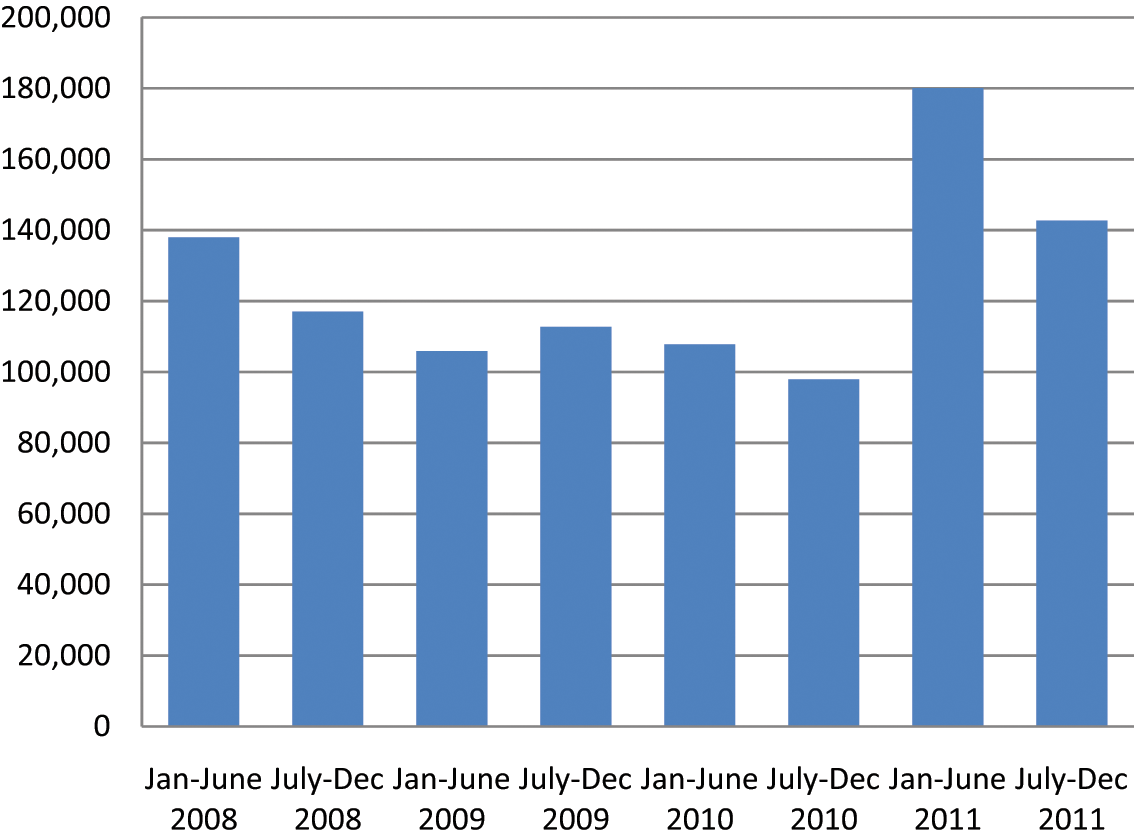
Number of full text downloads of Environment and Urbanization papers from http://eau.sagepub.com/ (2008–2011)
Looking at the monthly figures for downloads there are some recurring patterns over the years. For instance, October has among the largest number of downloads by month each year, in part because the publication of a new issue boosts downloads and in part because October is the beginning of term for so many universities in Europe and North America (universities in these regions are among the heaviest downloaders – see below). Downloads for June, July and August are generally among the lowest in the year – although this was less evident in 2011. Sometimes, the release of a particular paper boosts downloads – for instance, when the paper by Hoornweg, D, L Sugar and C L Trejos Gomez (2011), “Cities and greenhouse gas emissions: moving forward”, Environment and Urbanization Vol 23, No 1, April, pages 207–227 was released Online First in January 2011, this generated many downloads and boosted the figures for that month.
We have a particular interest in the extent to which Environment and Urbanization is reaching beyond universities in high-income nations. More than 1,400 universities or research or training institutes in low- and middle-income nations get free subscriptions to the printed copies; here, we look at which institutions had the largest number of full text downloads over a two-year period from December 2009 through November 2011 (Table 1).
The universities and other institutions with the most downloads of the full text of papers from Environment and Urbanization over a two-year period (December 2009–November 2011)
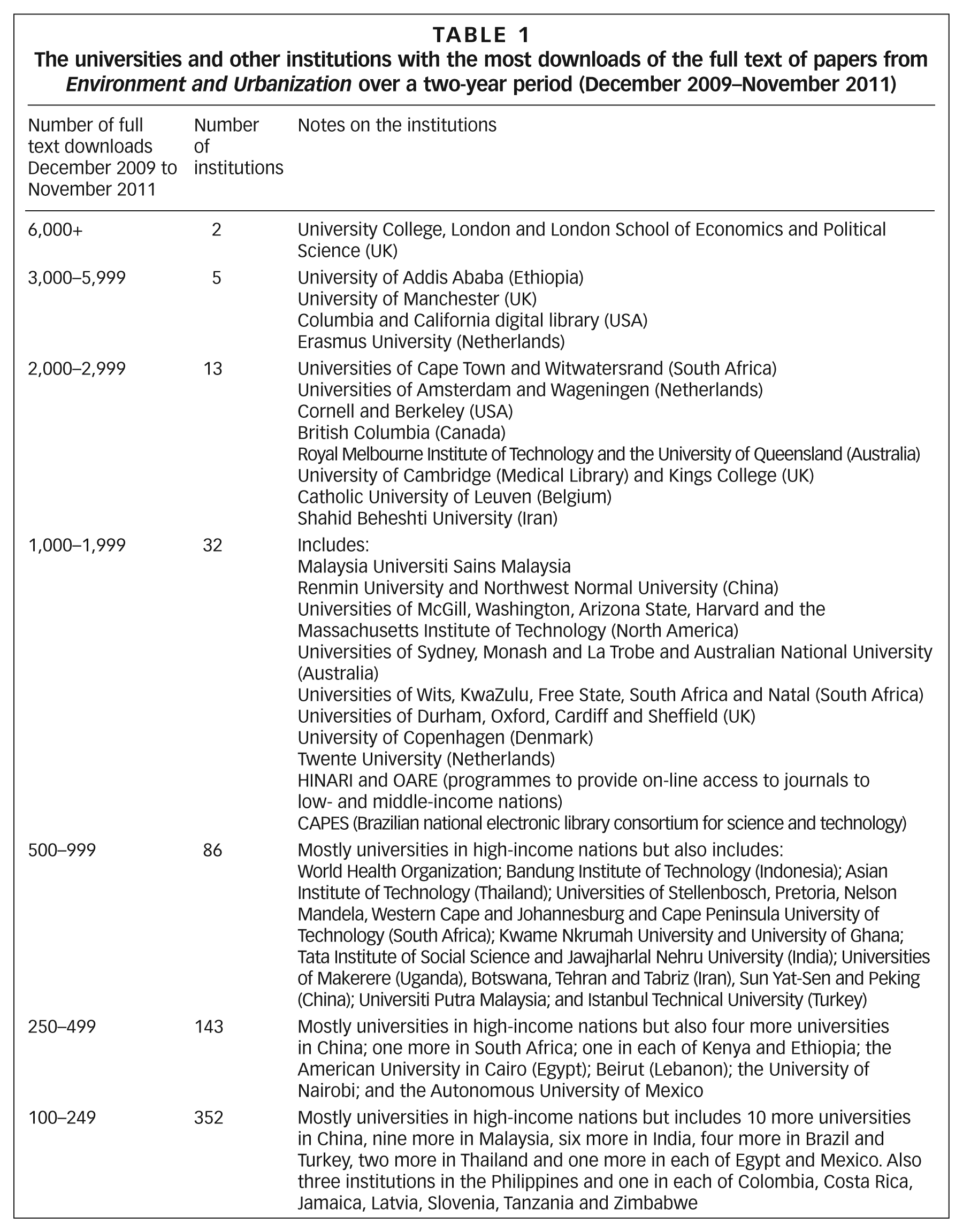
Addis Ababa University (Ethiopia) had among the highest number of downloads for any institution (more than 3,000). Two universities in South Africa and one in Iran had between 2,000 and 2,999. Among the institutions with between 1,000 and 1,999 downloads, there were five universities in South Africa, two in China and one in Malaysia. Many other universities in Malaysia had downloads and for all institutions in the country, these totalled more than 5,000 during this two-year period. Institutions with between 500 and 999 downloads included six more universities in South Africa, two in each of Ghana and India, two more in each of China and Iran and one in each of Indonesia, Thailand, Uganda, Botswana and Turkey. As Table 1 shows, reviewing institutions with between 250 and 499 and between 100 and 249 downloads, there are many more, especially in China, Malaysia, India, Brazil and Turkey. It is also pleasing to see many downloads by institutions in Brazil, Mexico and other Latin American nations as well as many French-speaking institutions.
What is also encouraging is that Environment and Urbanization is being drawn on by diverse specialist libraries – for instance, the Medical Library at the University of Cambridge and the World Health Organization were among the largest downloaders. So too is HINARI (Access to Research in Health Programme) and OARE (Online Access to Research in the Environment), which enable institutions in low- and middle-income nations to gain access to health and environmental science journals.